


ISO/FDIS 21809-2
(Main)Oil and gas industries including lower carbon energy - External coatings for buried or submerged pipelines used in pipeline transportation systems - Part 2: Single-layer fusion-bonded epoxy coatings
Oil and gas industries including lower carbon energy - External coatings for buried or submerged pipelines used in pipeline transportation systems - Part 2: Single-layer fusion-bonded epoxy coatings
ISO 21809-2:2014 specifies the requirements for qualification, application, testing and handling of materials for plant application of single layer fusion-bonded epoxy (FBE) coatings applied externally for the corrosion protection of bare steel pipe for use in pipeline transportation systems for the petroleum and natural gas industries as defined in ISO 13623.
Industries du pétrole et du gaz, y compris les énergies à faible teneur en carbone — Revêtements externes des conduites enterrées ou immergées utilisées dans les systèmes de transport par conduites — Partie 2: Revêtements monocouche à base de résine époxydique appliquée par fusion
L'ISO 21809-2:2014 spécifie les exigences relatives à la qualification, à l'application, aux essais et à la manutention des matériaux pour l'application en usine des revêtements monocouche à base de résine époxydique appliquée par fusion (FBE), appliqués extérieurement pour assurer la protection contre la corrosion des tubes nus en acier, utilisés dans les systèmes de transport par conduites pour les industries du pétrole et du gaz naturel tels que définis dans l'ISO 13623.
General Information
- Status
- Not Published
- Technical Committee
- ISO/TC 67/SC 2 - Pipeline transportation systems
- Drafting Committee
- ISO/TC 67/SC 2 - Pipeline transportation systems
- Current Stage
- 5020 - FDIS ballot initiated: 2 months. Proof sent to secretariat
- Start Date
- 18-Nov-2025
- Completion Date
- 18-Nov-2025
Relations
- Effective Date
- 26-Nov-2022
Overview
ISO/FDIS 21809-2:2025 - Single-layer fusion-bonded epoxy (FBE) coatings - is an international standard for external coatings on buried or submerged steel pipelines used in pipeline transportation systems for the oil, natural gas and lower‑carbon energy industries. It specifies requirements for qualification, application, inspection, testing, handling and storage of plant-applied single‑layer FBE powders used for corrosion protection of bare steel pipe. The document is prepared by ISO/TC 67/SC 2 (Secretariat: UNI) and replaces the 2014 edition, introducing updated classification, a qualification scheme and harmonization with other ISO 21809 parts.
Key Topics
- Scope and applicability: External single-layer FBE coatings for pipeline transportation systems (aligned with ISO 13623).
- Qualification requirements: Procedures for coating qualification (CQ), coating system qualification (CSQ), procedure qualification trial (PQT) and pre-production trials (PPT).
- Application controls: Surface preparation, application and curing temperatures, target coating thickness, cutback and repair methods.
- Inspection & testing: In-process and finished-product tests, holiday detection, thickness inspection and specific normative test methods described in annexes.
- Material testing: Requirements for epoxy powder properties (density, particle size, gel time, thermal analysis, volatile content).
- Performance tests: Adhesion (dry and hot‑water), cathodic disbondment, impact resistance, flexibility, porosity and related assessments.
- Handling and storage: Requirements for material handling in coating plants and storage conditions to preserve powder and coated pipe integrity.
- Documentation & marking: Test reports, inspection documents and required pipe/coating markings for traceability and conformity.
Applications
ISO/FDIS 21809-2 is used to ensure reliable corrosion protection and long-term pipeline integrity where single-layer FBE coatings are selected. Typical users:
- Pipeline operators and owners specifying coating performance and procurement.
- Coating manufacturers qualifying FBE powders and preparing application procedure specifications (APS).
- Coating applicators and plant operators implementing PQT/PPT and production controls.
- Third‑party inspectors, testing laboratories and project engineers verifying conformity.
- Spec writers, procurement teams and regulatory reviewers referencing standardized requirements.
Related Standards
This part of ISO 21809 references and aligns with other standards such as ISO 13623 (pipeline systems), and normative references for powder testing and surface preparation (examples: ISO 8130 series, ISO 8501/8502/8503 series, ISO 11357). These complementary standards support material characterization, surface cleanliness and test methods.

ISO/FDIS 21809-2 - Oil and gas industries including lower carbon energy — External coatings for buried or submerged pipelines used in pipeline transportation systems — Part 2: Single-layer fusion-bonded epoxy coatings Released:4. 11. 2025

REDLINE ISO/FDIS 21809-2 - Oil and gas industries including lower carbon energy — External coatings for buried or submerged pipelines used in pipeline transportation systems — Part 2: Single-layer fusion-bonded epoxy coatings Released:4. 11. 2025

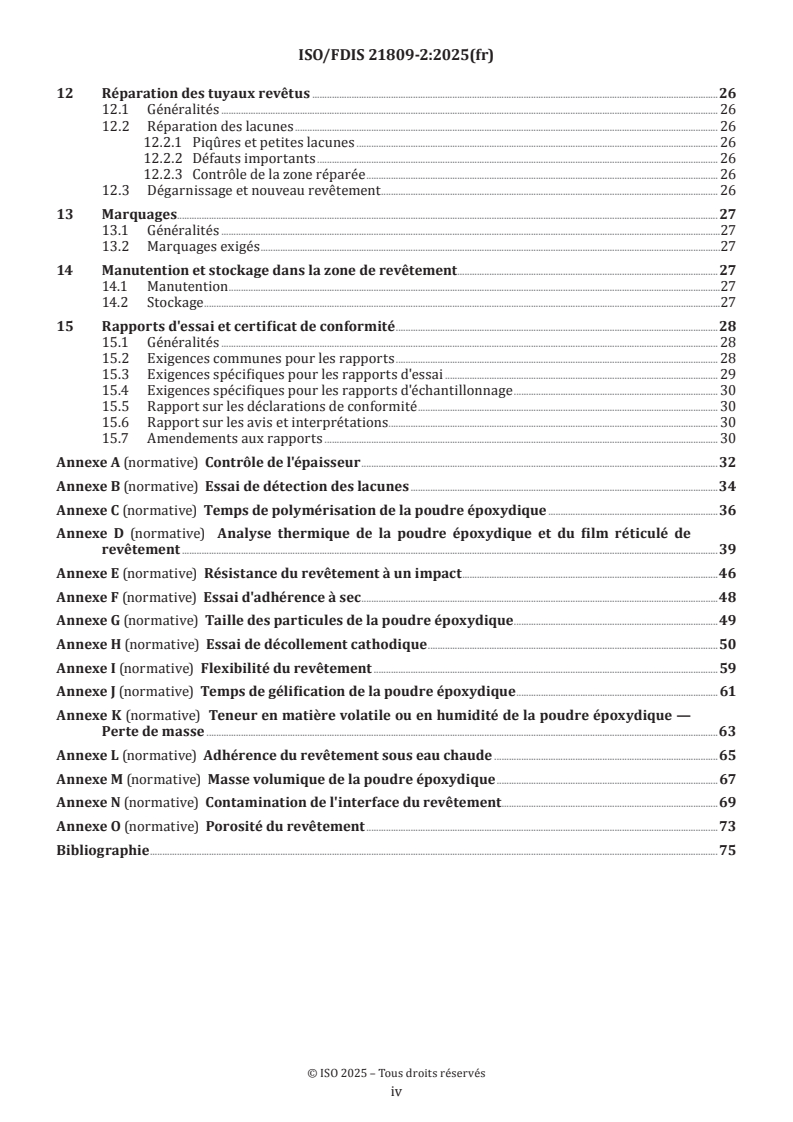
ISO/FDIS 21809-2 - Industries du pétrole et du gaz, y compris les énergies à faible teneur en carbone — Revêtements externes des conduites enterrées ou immergées utilisées dans les systèmes de transport par conduites — Partie 2: Revêtements monocouche à base de résine époxydique appliquée par fusion Released:8. 12. 2025
Frequently Asked Questions
ISO/FDIS 21809-2 is a draft published by the International Organization for Standardization (ISO). Its full title is "Oil and gas industries including lower carbon energy - External coatings for buried or submerged pipelines used in pipeline transportation systems - Part 2: Single-layer fusion-bonded epoxy coatings". This standard covers: ISO 21809-2:2014 specifies the requirements for qualification, application, testing and handling of materials for plant application of single layer fusion-bonded epoxy (FBE) coatings applied externally for the corrosion protection of bare steel pipe for use in pipeline transportation systems for the petroleum and natural gas industries as defined in ISO 13623.
ISO 21809-2:2014 specifies the requirements for qualification, application, testing and handling of materials for plant application of single layer fusion-bonded epoxy (FBE) coatings applied externally for the corrosion protection of bare steel pipe for use in pipeline transportation systems for the petroleum and natural gas industries as defined in ISO 13623.
ISO/FDIS 21809-2 is classified under the following ICS (International Classification for Standards) categories: 75.200 - Petroleum products and natural gas handling equipment. The ICS classification helps identify the subject area and facilitates finding related standards.
ISO/FDIS 21809-2 has the following relationships with other standards: It is inter standard links to ISO 21809-2:2014. Understanding these relationships helps ensure you are using the most current and applicable version of the standard.
ISO/FDIS 21809-2 is available in PDF format for immediate download after purchase. The document can be added to your cart and obtained through the secure checkout process. Digital delivery ensures instant access to the complete standard document.
Standards Content (Sample)
FINAL DRAFT
International
Standard
ISO/TC 67/SC 2
Oil and gas industries including
Secretariat: UNI
lower carbon energy — External
Voting begins on:
coatings for buried or submerged
2025-11-18
pipelines used in pipeline
Voting terminates on:
transportation systems —
2026-01-13
Part 2:
Single-layer fusion-bonded epoxy
coatings
Industries du pétrole et du gaz, y compris les énergies à faible
teneur en carbone — Revêtements externes des conduites
enterrées ou immergées utilisées dans les systèmes de transport
par conduits —
Partie 2: Revêtements monocouche à base de résine époxydique
appliquée par fusion
RECIPIENTS OF THIS DRAFT ARE INVITED TO SUBMIT,
WITH THEIR COMMENTS, NOTIFICATION OF ANY
RELEVANT PATENT RIGHTS OF WHICH THEY ARE AWARE
AND TO PROVIDE SUPPOR TING DOCUMENTATION.
IN ADDITION TO THEIR EVALUATION AS
BEING ACCEPTABLE FOR INDUSTRIAL, TECHNO-
ISO/CEN PARALLEL PROCESSING LOGICAL, COMMERCIAL AND USER PURPOSES, DRAFT
INTERNATIONAL STANDARDS MAY ON OCCASION HAVE
TO BE CONSIDERED IN THE LIGHT OF THEIR POTENTIAL
TO BECOME STAN DARDS TO WHICH REFERENCE MAY BE
MADE IN NATIONAL REGULATIONS.
Reference number
FINAL DRAFT
International
Standard
ISO/TC 67/SC 2
Oil and gas industries including
Secretariat: UNI
lower carbon energy — External
Voting begins on:
coatings for buried or submerged
pipelines used in pipeline
Voting terminates on:
transportation systems —
Part 2:
Single-layer fusion-bonded epoxy
coatings
Industries du pétrole et du gaz, y compris les énergies à faible
teneur en carbone — Revêtements externes des conduites
enterrées ou immergées utilisées dans les systèmes de transport
par conduits —
Partie 2: Revêtements monocouche à base de résine époxydique
appliquée par fusion
RECIPIENTS OF THIS DRAFT ARE INVITED TO SUBMIT,
WITH THEIR COMMENTS, NOTIFICATION OF ANY
RELEVANT PATENT RIGHTS OF WHICH THEY ARE AWARE
AND TO PROVIDE SUPPOR TING DOCUMENTATION.
© ISO 2025
IN ADDITION TO THEIR EVALUATION AS
All rights reserved. Unless otherwise specified, or required in the context of its implementation, no part of this publication may
BEING ACCEPTABLE FOR INDUSTRIAL, TECHNO-
ISO/CEN PARALLEL PROCESSING
LOGICAL, COMMERCIAL AND USER PURPOSES, DRAFT
be reproduced or utilized otherwise in any form or by any means, electronic or mechanical, including photocopying, or posting on
INTERNATIONAL STANDARDS MAY ON OCCASION HAVE
the internet or an intranet, without prior written permission. Permission can be requested from either ISO at the address below
TO BE CONSIDERED IN THE LIGHT OF THEIR POTENTIAL
or ISO’s member body in the country of the requester.
TO BECOME STAN DARDS TO WHICH REFERENCE MAY BE
MADE IN NATIONAL REGULATIONS.
ISO copyright office
CP 401 • Ch. de Blandonnet 8
CH-1214 Vernier, Geneva
Phone: +41 22 749 01 11
Email: copyright@iso.org
Website: www.iso.org
Published in Switzerland Reference number
ii
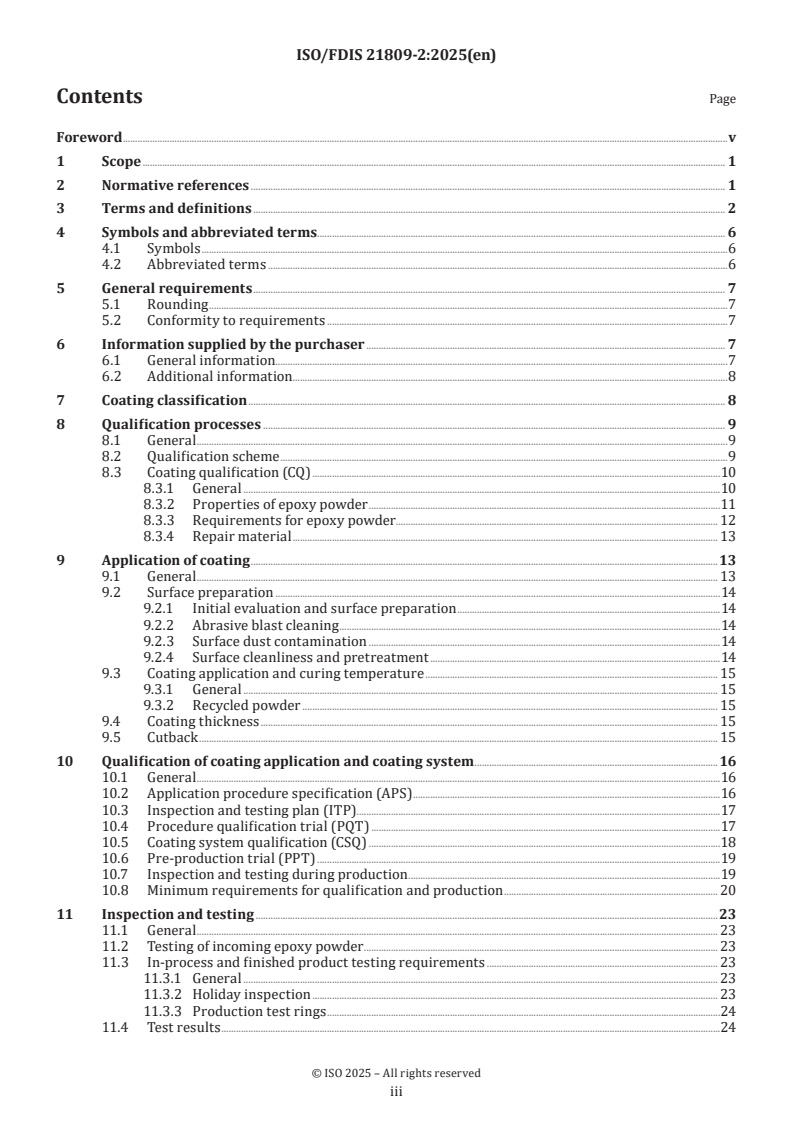
Contents Page
Foreword .v
1 Scope . 1
2 Normative references . 1
3 Terms and definitions . 2
4 Symbols and abbreviated terms. 6
4.1 Symbols .6
4.2 Abbreviated terms .6
5 General requirements . 7
5.1 Rounding .7
5.2 Conformity to requirements .7
6 Information supplied by the purchaser . 7
6.1 General information.7
6.2 Additional information.8
7 Coating classification . 8
8 Qualification processes . 9
8.1 General .9
8.2 Qualification scheme .9
8.3 Coating qualification (CQ) .10
8.3.1 General .10
8.3.2 Properties of epoxy powder .11
8.3.3 Requirements for epoxy powder . 12
8.3.4 Repair material . 13
9 Application of coating .13
9.1 General . 13
9.2 Surface preparation .14
9.2.1 Initial evaluation and surface preparation .14
9.2.2 Abrasive blast cleaning .14
9.2.3 Surface dust contamination .14
9.2.4 Surface cleanliness and pretreatment .14
9.3 Coating application and curing temperature . 15
9.3.1 General . 15
9.3.2 Recycled powder . 15
9.4 Coating thickness . 15
9.5 Cutback . 15
10 Qualification of coating application and coating system .16
10.1 General .16
10.2 Application procedure specification (APS) .16
10.3 Inspection and testing plan (ITP).17
10.4 Procedure qualification trial (PQT) .17
10.5 Coating system qualification (CSQ) .18
10.6 Pre-production trial (PPT) .19
10.7 Inspection and testing during production .19
10.8 Minimum requirements for qualification and production . 20
11 Inspection and testing .23
11.1 General . 23
11.2 Testing of incoming epoxy powder . 23
11.3 In-process and finished product testing requirements . 23
11.3.1 General . 23
11.3.2 Holiday inspection . 23
11.3.3 Production test rings .24
11.4 Test results .24
iii
12 Repair of coated pipe .25
12.1 General . 25
12.2 Repair of holidays . 25
12.2.1 Pinholes and small holidays . 25
12.2.2 Large defects . 25
12.2.3 Inspection of repaired area . 25
12.3 Stripping and recoating . 25
13 Markings .25
13.1 General . 25
13.2 Required markings . 25
14 Handling and storage in the coating area .26
14.1 Handling . 26
14.2 Storage . 26
15 Test reports and inspection documents .26
15.1 General . 26
15.2 Common requirements for reports .27
15.3 Specific requirements for test reports . 28
15.4 Specific requirements for sampling reports . 28
15.5 Reporting statements of conformity . 28
15.6 Reporting opinions and interpretations. 29
15.7 Amendments to reports . 29
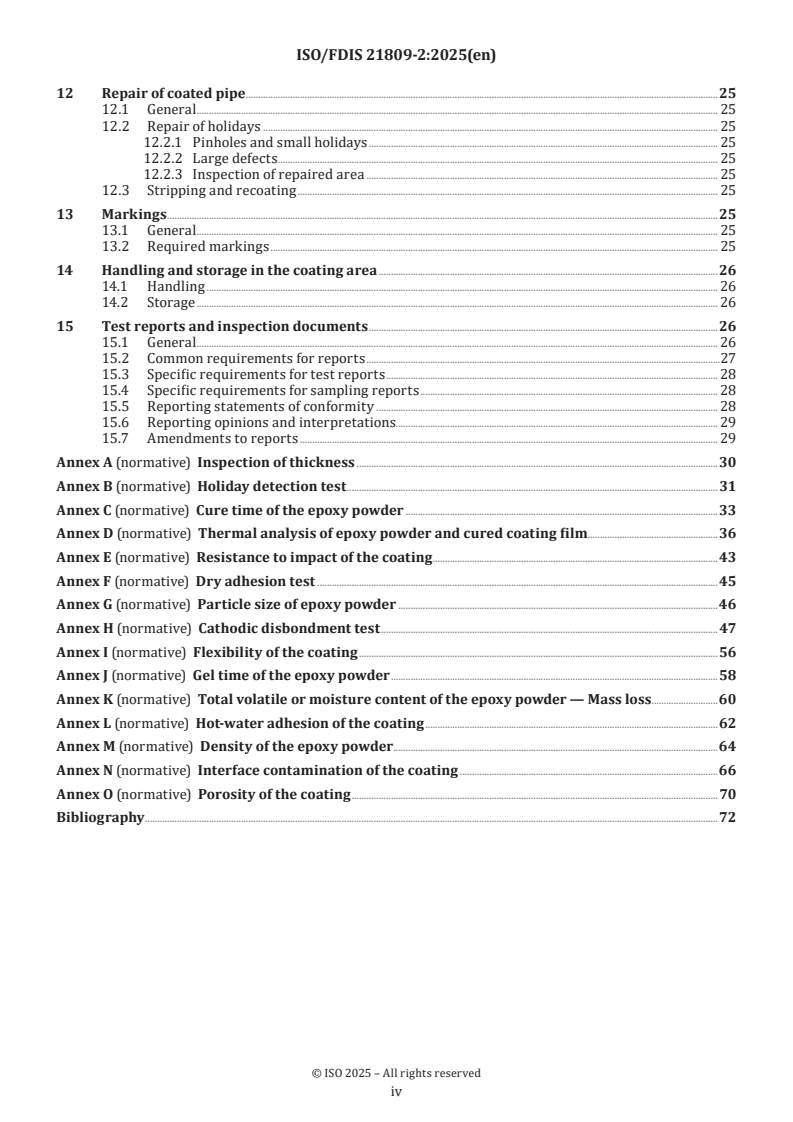
Annex A (normative) Inspection of thickness .30
Annex B (normative) Holiday detection test .31
Annex C (normative) Cure time of the epoxy powder .33
Annex D (normative) Thermal analysis of epoxy powder and cured coating film.36
Annex E (normative) Resistance to impact of the coating .43
Annex F (normative) Dry adhesion test .45
Annex G (normative) Particle size of epoxy powder .46
Annex H (normative) Cathodic disbondment test . 47
Annex I (normative) Flexibility of the coating .56
Annex J (normative) Gel time of the epoxy powder .58
Annex K (normative) Total volatile or moisture content of the epoxy powder — Mass loss .60
Annex L (normative) Hot-water adhesion of the coating .62
Annex M (normative) Density of the epoxy powder .64
Annex N (normative) Interface contamination of the coating .66
Annex O (normative) Porosity of the coating .70
Bibliography .72
iv
Foreword
ISO (the International Organization for Standardization) is a worldwide federation of national standards
bodies (ISO member bodies). The work of preparing International Standards is normally carried out through
ISO technical committees. Each member body interested in a subject for which a technical committee
has been established has the right to be represented on that committee. International organizations,
governmental and non-governmental, in liaison with ISO, also take part in the work. ISO collaborates closely
with the International Electrotechnical Commission (IEC) on all matters of electrotechnical standardization.
The procedures used to develop this document and those intended for its further maintenance are described
in the ISO/IEC Directives, Part 1. In particular, the different approval criteria needed for the different types
of ISO document should be noted. This document was drafted in accordance with the editorial rules of the
ISO/IEC Directives, Part 2 (see www.iso.org/directives).
ISO draws attention to the possibility that the implementation of this document may involve the use of (a)
patent(s). ISO takes no position concerning the evidence, validity or applicability of any claimed patent
rights in respect thereof. As of the date of publication of this document, ISO had not received notice of (a)
patent(s) which may be required to implement this document. However, implementers are cautioned that
this may not represent the latest information, which may be obtained from the patent database available at
www.iso.org/patents. ISO shall not be held responsible for identifying any or all such patent rights.
Any trade name used in this document is information given for the convenience of users and does not
constitute an endorsement.
For an explanation of the voluntary nature of standards, the meaning of ISO specific terms and expressions
related to conformity assessment, as well as information about ISO's adherence to the World Trade
Organization (WTO) principles in the Technical Barriers to Trade (TBT), see www.iso.org/iso/foreword.html.
This document was prepared by Technical Committee ISO/TC 67, Oil and gas industries including lower carbon
energy, Subcommittee SC 2, Pipeline transportation systems, in collaboration with the European Committee
for Standardization (CEN) Technical Committee CEN/TC 459/SC 10, Steel tubes, and iron and steel fittings, in
accordance with the Agreement on technical cooperation between ISO and CEN (Vienna Agreement).
This third edition cancels and replaces the second edition (ISO 21809-2:2014), which has been technically
revised.
The main changes are as follows:
— inclusion of new classifications for materials with glass transitions greater than 115 °C;
— inclusion of a qualification scheme;
— harmonization with the other parts of the ISO 21809 series;
— renumbering and rearranging of the annexes;
— changes in various annexes.
A list of all the parts in the ISO 21809 series can be found on the ISO website.
Any feedback or questions on this document should be directed to the user’s national standards body. A
complete listing of these bodies can be found at www.iso.org/members.html.
v
FINAL DRAFT International Standard ISO/FDIS 21809-2:2025(en)
Oil and gas industries including lower carbon energy —
External coatings for buried or submerged pipelines used in
pipeline transportation systems —
Part 2:
Single-layer fusion-bonded epoxy coatings
1 Scope
This document specifies the requirements for qualification, application, inspection, testing handling
and storage of materials for plant application of single-layer fusion-bonded epoxy (FBE) coatings applied
externally for the corrosion protection of bare steel pipe for use in pipeline transportation systems for oil
and gas industries as defined in ISO 13623.
NOTE Pipes coated in accordance with this document are considered suitable for additional protection by means
of cathodic protection.
2 Normative references
The following documents are referred to in the text in such a way that some or all of their content constitutes
requirements of this document. For dated references, only the edition cited applies. For undated references,
the latest edition of the referenced document (including any amendments) applies.
ISO 8130-2, Coating powders — Part 2: Determination of density by gas comparison pycnometer (referee method)
ISO 8130-3, Coating powders — Part 3: Determination of density by liquid displacement pycnometer
ISO 8501-1, Preparation of steel substrates before application of paints and related products — Visual
assessment of surface cleanliness — Part 1: Rust grades and preparation grades of uncoated steel substrates and
of steel substrates after overall removal of previous coatings
ISO 8502-3, Preparation of steel substrates before application of paints and related products — Tests for the
assessment of surface cleanliness — Part 3: Assessment of dust on steel surfaces prepared for painting (pressure-
sensitive tape method)
ISO 8502-6, Preparation of steel substrates before application of paints and related products — Tests for the
assessment of surface cleanliness — Part 6: Extraction of water soluble contaminants for analysis (Bresle method)
ISO 8502-9, Preparation of steel substrates before application of paints and related products — Tests for the
assessment of surface cleanliness — Part 9: Field method for the conductometric determination of water-soluble salts
ISO 8503-4, Preparation of steel substrates before application of paints and related products — Surface
roughness characteristics of blast-cleaned steel substrates — Part 4: Method for the calibration of ISO surface
profile comparators and for the determination of surface profile — Stylus instrument procedure
ISO 8503-5, Preparation of steel substrates before application of paints and related products — Surface
roughness characteristics of blast-cleaned steel substrates — Part 5: Replica tape method for the determination
of the surface profile
ISO 10474, Steel and steel products — Inspection documents
ISO 11124 (all parts), Preparation of steel substrates before application of paints and related products —
Specifications for metallic blast-cleaning abrasives
ISO 11126 (all parts), Preparation of steel substrates before application of paints and related products —
Specifications for non-metallic blast-cleaning abrasives
ISO 11357-1, Plastics — Differential scanning calorimetry (DSC) — Part 1: General principles
ISO 11357-2, Plastics — Differential scanning calorimetry (DSC) — Part 2: Determination of glass transition
temperature and step height
ISO/IEC 17025, General requirements for the competence of testing and calibration laboratories
ISO 19840, Paints and varnishes — Corrosion protection of steel structures by protective paint systems —
Measurement of, and acceptance criteria for, the thickness of dry films on rough surfaces
ISO 80000-1, Quantities and units — Part 1: General
EN 10204, Metallic products — Types of inspection documents
ASTM D4285, Standard Test Method for Indicating Oil or Water in Compressed Air
ASTM D4940, Standard Test Method for Conductimetric Analysis of Water Soluble Ionic Contamination of
Blasting Abrasives
SSPC-AB 1, Mineral and Slag Abrasives
SSPC-AB 2, Cleanliness of Recycled Ferrous Metallic Abrasives
SSPC-AB 3, Ferrous Metallic Abrasive
SSPC-PA2, Procedure for Determining Conformance to Dry Coating Thickness Requirements
SSPC-SP 1, Solvent cleaning
SSPC-Guide 15, Field Methods for Extraction and Analysis of Soluble Salts on Steel and Other Nonporous
Substrates
3 Terms and definitions
For the purposes of this document, the following terms and definitions apply.
ISO and IEC maintain terminological databases for use in standardization at the following addresses:
— ISO Online browsing platform: available at https:// www .iso .org/ obp
— IEC Electropedia: available at https:// www .electropedia .org/
3.1
adhesion
bond between coating and substrate
3.2
application procedure specification
APS
document describing procedures, methods, equipment and tools used for coating application
3.3
applicator
company that undertakes the coating application
Note 1 to entry: The coating application shall be in accordance with this document.
3.4
batch
quantity of material produced in a continuous manufacturing operation using raw materials of the same
source and grade
3.5
batch certificate
document provided by the manufacturer (3.17) that contains the results of specific tests or analysis,
including test methodology, performed on a defined lot of the manufacturer’s product and corresponding
conformity ranges for each coating system
3.6
coating qualification
CQ
qualification of the coating materials properties carried out by the manufacturer (3.17) before the coating
system qualification (3.7)
3.7
coating system qualification
CSQ
qualification of application method, applied coating system and subsequent inspection or testing of its
properties, to confirm that the APS (3.2) is adequate to produce a coating with the specified properties
3.8
cutback
length of pipe left uncoated at each end for joining purposes
3.9
design temperature
temperature, that can be endured by a pipeline (3.24) (component) during operation, including maximum
and minimum temperatures, likely to be reached during transport, storage, handling, installation, upset
conditions and operation
Note 1 to entry: The design temperature range of the coating can be narrower than that specified for the steel pipe
material.
3.10
dummy pipe
pipe having the same outside diameter and wall thickness of the project pipes
Note 1 to entry: Dummy pipes and coated dummy pipes shall be representative of the production and shall be coated
in accordance with approved APS (3.2).
3.11
end user
company (or companies) that owns or operates pipeline(s) (3.24)
Note 1 to entry: There can be a combination of ownership and operating.
3.12
glass transition
reversible change in an amorphous polymer or in amorphous regions of a partially crystalline polymer from
(or to) a viscous or rubbery condition to (or from) a hard and relatively brittle one
3.13
holiday
coating discontinuity that exhibits electrical conductivity when exposed to a specific voltage
3.14
inspection certificate
document giving the results of the testing of coated pipes, supplied and signed by a representative of the
applicator (3.3) authorized to issue such documents
Note 1 to entry: The inspection certificate shall be issued in accordance with ISO 10474 or EN 10204.
3.15
inspection and testing plan
ITP
document providing an overview of the sequence of inspections and tests, including appropriate resources
and procedures
3.16
laboratory-coated test specimen
specimen (3.30) taken from a laboratory-prepared panel
3.17
manufacturer
company responsible for the manufacture of coating material(s)
3.18
manufacturer’s specification
document that specifies the characteristics, test requirements and application recommendations for the
coating materials
3.19
maximum service temperature
T
max
maximum continuous temperature that the coating can resist based on information from coating material
manufacturer (3.17)
3.20
minimum service temperature
T
min
minimum continuous temperature that the coating can resist based on information from coating material
manufacturer (3.17)
3.21
operating temperature
temperature that can be endured by a pipeline (3.24) (component) during operation, within the design
temperature (3.9) range
3.22
shipment
individual container received at the site of the applicator (3.3) with a total mass of epoxy powder not to
exceed 25 000 kg
3.23
pipe diameter length
length along the pipe axis equal to the specified outside diameter of the pipe
3.24
pipeline
facilities through which fluids are conveyed, including pipe, pig traps, components, appurtenances, spools,
risers, isolating valves, and sectionalizing valves
3.25
pre-production trial
PPT
application of a coating and subsequent inspection or testing of its properties, to confirm that the application
procedure specification (3.2) is adequate to produce a coating with the specified properties, carried out in the
coating plant immediately prior to start of production and to verify that the plant's equipment is adequate to
consistently adhere to the APS (3.2) requirements
3.26
procedure qualification trial
PQT
application of a coating and subsequent inspection or testing of its properties, to confirm that the coatings
produced in accordance with the APS (3.2) and ITP (3.15) are acceptable within the specified properties,
carried out in the coating plant at a specific coating line and to verify that the plant's equipment is adequate
to consistently adhere to the APS requirements
3.27
purchaser
company responsible for providing the purchase order requirements
3.28
record
information created, received, and maintained as evidence and as an asset by an organization or person, in
pursuit of legal obligations or in the transaction of business
Note 1 to entry: Maintained information can be in different formats such as on paper and digital.
[SOURCE: ISO 15489-1:2016, 3.14, modified — The term has been changed from "record(s)" to "record";
note 1 to entry has been added.]
3.29
sample
portion of material taken from a batch (3.4) of raw material or coating that represents the properties of the
complete batch
3.30
specimen
object prepared for the purpose of testing specific properties
Note 1 to entry: Specimens may be as follows: the coating material; a flat panel or similar prepared specifically for
testing; a coupon, ring or similar that has been cut from a pipe; a pipe that has been coated in production or otherwise,
in laboratory or plant conditions.
3.31
test report
document that provides the quantitative test results for tests conducted in accordance with document
specific requirements
3.32
test ring
specimen (3.30) taken from production-coated pipe
4 Symbols and abbreviated terms
4.1 Symbols
C percentage conversion of FBE coating, expressed as a percentage
D the required angle of deflection per pipe diameter length
t effective specimen thickness, expressed in millimetres
ΔH exothermic heat of reaction, expressed in joules per gram
m mass, expressed in grams
R mandrel radius, expressed in millimetres
T glass transition temperature, expressed in degrees Celcius
g
ΔT difference in the glass transition temperature between two successive thermal analysis scans, ex-
g
pressed in degrees Celsius
T maximum service temperature
max
T minimum service temperature
min
ρ
density of the epoxy powder, expressed in g/cm
p
ρ
density of the mineral spirits, expressed in g/cm
s
w mass fraction of the epoxy power retained on a sieve, expressed as a percentage of total sample
ep
w mass fraction of moisture, expressed as a percentage
m
4.2 Abbreviated terms
APS application procedure specification
CQ coating qualification
CSQ coating system qualification
DC direct current
DSC differential scanning calorimetry
FBE fusion-bonded epoxy
HRC Rockwell C scale hardness
ILAC International Laboratory Accreditation Cooperation
ITP inspection and testing plan
NPS nominal pipe size
OD outer diameter
ppd per pipe diameter
PPT pre-production trial
PQT procedure qualification trial
5 General requirements
5.1 Rounding
Unless otherwise stated in this document, to determine conformity to the specified requirements, observed
or calculated values shall be rounded to the nearest unit in the last right-hand place of figures used in
expressing the limiting value, in accordance with ISO 80000-1.
NOTE For the purposes of this provision, the rounding method of ASTM E29 is equivalent to ISO 80000-1.
5.2 Conformity to requirements
A quality system and an environmental management system should be applied to assist conformity to the
requirements of this document.
NOTE ISO 9001 provides requirements on a quality management system and ISO 14001 provides requirements
on the selection and use of an environmental management system.
The applicator shall be responsible for conforming to all the applicable requirements of this document. The
purchaser shall be allowed to make any investigation necessary to ensure conformity by the applicator and
to reject any material or coating that does not conform.
6 Information supplied by the purchaser
6.1 General information
In advance of the purchase order there shall be an agreement between the purchaser and the applicator on
the following items and laid down in the purchase order:
a) a reference to this document and year of publication, i.e. ISO 21809-2:—;
b) pipe quantity, outside diameter, length (minimum, maximum and nominal), wall thickness (minimum
and nominal) and grade of steel;
c) bare pipe standard or specification designation, e.g. ISO 3183;
d) requested schedule of delivery;
e) requested documentation and schedule for supply of documentation;
f) requirements on test reports and (daily) log;
g) type and frequency of inspection certificate;
h) requirements for traceability of coating system, repairs and marking of repairs;
i) minimum thickness and maximum permissible thickness of the FBE coating and FBE coating classes;
j) cutback length and tolerances for both ends of pipe;
k) additional or deviating tests or requirements in the qualification process or during production; parts in
the qualification or production process are CSQ, CQ, PQT, PPT, production, APS and ITP;
l) entire or partial approval by the purchaser of existing parts of the qualification or production process.
6.2 Additional information
If applicable, in advance of the purchase order there shall be an agreement between the purchaser and the
applicator on the following items and laid down in the purchase order:
a) plant and process inspection by the purchaser;
b) increased test ring length;
c) test ring location;
d) test frequency for additional test rings;
e) additional markings;
f) additional handling procedures;
g) additional storage procedures;
h) waiver of test reports;
i) maximum allowable preheating temperature;
j) applicator qualification requirements;
k) other special requirements;
l) pipe tracking and traceability of pipes to coating materials;
m) permissible number coating repairs per pipe;
n) additional tests originated from specific installation methods;
o) inspection of incoming pipe;
p) pipe end protection;
q) surface pretreatments if any;
r) minimum and maximum pipeline design or operating temperatures or both;
s) use of dummy pipe for destructive tests;
t) test temperature for flexibility;
u) request for a PPT.
If further installation processes (e.g. welding processes and field joint coating application) that envisage the
heating of the coated pipe are needed, further testing (e.g. adhesion) may be considered by the purchaser in
order to assess the compatibility of the line pipe coating against the application parameters of the chosen
field joint coating and vice-versa. Pertinent information on the application shall be provided by the pipe
coating applicator.
7 Coating classification
The coating is classified into two categories, class 1 and class 2.
— Class 1 has a cured epoxy T ≤ 115 °C.
g2
— Class 2 has a cured epoxy T > 115 °C.
g2
The use of coating classes outside these guidelines is acceptable provided that the applied coating shall be
tested against the requirements specified in Table 4 for each relevant class (i.e. class 1 shall be tested against
requirements for class 1 in Table 4, class 2 shall be tested against requirements for class 2 in Table 4).
Different requirements for coating materials outside these classification systems shall be agreed upon by
the applicator and purchaser.
Use of coating classes outside these guidelines shall be approved by the purchaser.
8 Qualification processes
8.1 General
The purchaser is either the end user or the representative of the end user.
The qualification scheme shall be performed per coating line, coating material and application procedure
and in case of modifications to the coating line, coating materials or application procedures qualification
shall be repeated.
The applicator shall carry out and report the coating system qualification in accordance with the
requirements of this document. The test report shall contain the results of the qualification tests and data
required in Tables 1, 2, 3 and 4.
8.2 Qualification scheme
The qualification process in accordance with this document includes the following qualification steps:
a) Coating material qualification (CQ), by the manufacturer (8.3).
Each coating material shall be qualified by the manufacturer in accordance with the requirements of
Tables 1 and 2. The manufacturer shall carry out and report the coating material qualification in accordance
with the requirements of Tables 1 and 2 where applicable. The test report issued by the manufacturer may
be acknowledged by a certification organization.
b) Procedure qualification trial (PQT), by the applicator (10.4).
An application procedure specification (APS) (see 10.2) and an inspection and test plan (ITP) (see 10.3) shall
be prepared. The applicator shall carry out and report the coating application qualification in accordance
with the requirements of Tables 3 and 4. The test report issued by the applicator may be acknowledged by a
certification organization.
c) Coating system qualification (CSQ) (Clause 11).
Each coating system shall be qualified by the applicator by means of a CSQ. This qualification is based on the
CQ, together with the PQT. Each step, CQ, PQT and CSQ shall be approved by the purchaser. The applicator
shall prepare an APS (see 10.2) and ITP (see 10.3) related to the PQT of the specific coating system and both
shall be approved by the purchaser. In the APS and ITP the requirements and conditions of the manufacturers
of coating products used, shall be included. Deviations from these requirements and conditions shall be
indicated. Once approved, the APS shall not be changed without prior written authorisation of the purchaser.
The combined test report of the CSQ shall contain the results of the material qualification tests as per Table 1
and Table 2 (CQ) and the application qualification according to Table 3 and Table 4 (PQT). The combined
test report issued by the applicator shall be approved by the purchaser and may be acknowledged by a
certification organization.
A generic PQT may be carried out, for example, independently of any project and this results in a generic CSQ.
In case of a generic PQT (and CSQ) the purchaser shall indicate the validity range of the generic qualification
regarding (at least) pipe diameter and pipe wall thickness.
The purchaser can decide to accept parts or the entire content of an existing qualification.
d) Pre-production trial (PPT) (10.5).
In case a PPT is requested, this shall be requested in the purcha
...
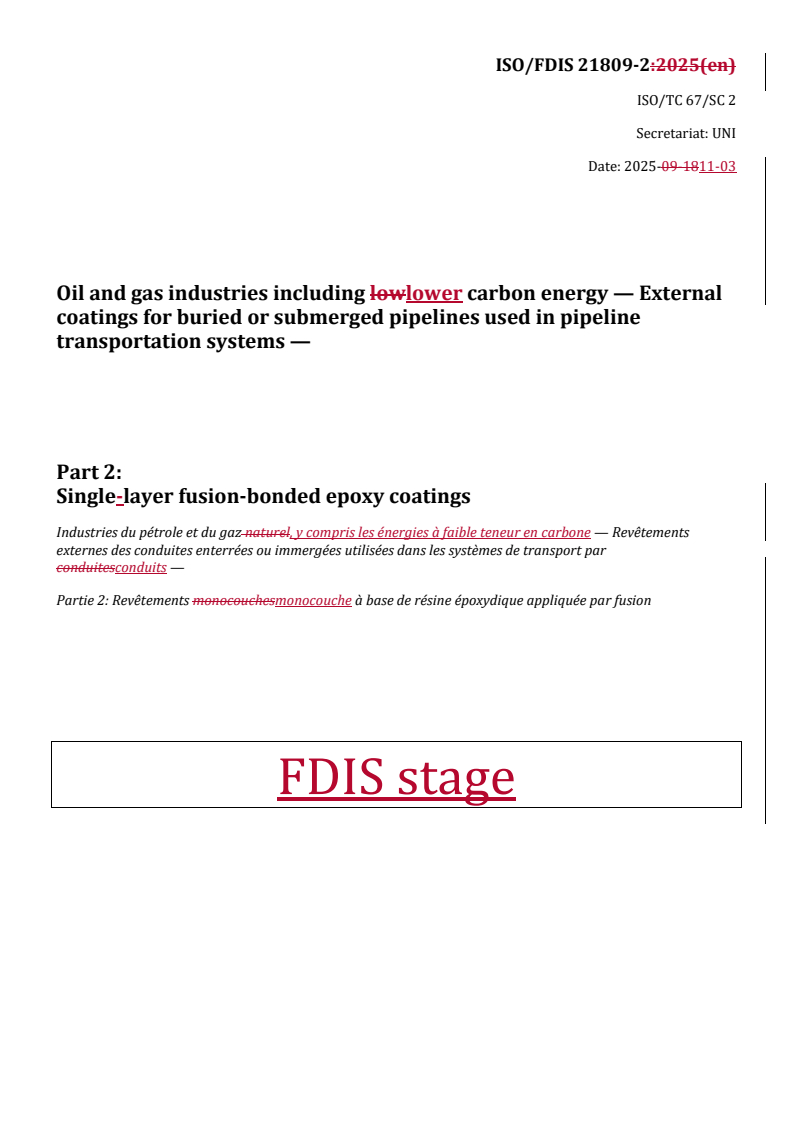
ISO/TC 67/SC 2
Secretariat: UNI
Date: 2025-09-1811-03
Oil and gas industries including lowlower carbon energy — External
coatings for buried or submerged pipelines used in pipeline
transportation systems —
Part 2:
Single-layer fusion-bonded epoxy coatings
Industries du pétrole et du gaz naturel, y compris les énergies à faible teneur en carbone — Revêtements
externes des conduites enterrées ou immergées utilisées dans les systèmes de transport par
conduitesconduits —
Partie 2: Revêtements monocouchesmonocouche à base de résine époxydique appliquée par fusion
FDIS stage
ISO/DISFDIS 21809-2:2024(E2025(en)
All rights reserved. Unless otherwise specified, or required in the context of its implementation, no part of this publication
may be reproduced or utilized otherwise in any form or by any means, electronic or mechanical, including photocopying,
or posting on the internet or an intranet, without prior written permission. Permission can be requested from either ISO
at the address below or ISO’s member body in the country of the requester.
ISO copyright office
CP 401 • Ch. de Blandonnet 8
CH-1214 Vernier, Geneva
Phone: + 41 22 749 01 11
Fax: + 41 22 749 09 47
E-mail: copyright@iso.org
Website: www.iso.org
Published in Switzerland
©© ISO 20242025 – All rights reserved
ii
Contents
iii
ISO/DISFDIS 21809-2:2024(E2025(en)
Contents
Foreword . vi
1 Scope . 1
2 Normative references . 1
3 Terms and definitions . 2
4 Symbols and abbreviated terms . 6
4.1 Symbols . 6
4.2 Abbreviated terms . 6
5 General requirements . 7
5.1 Rounding . 7
5.2 Conformity to requirements . 7
6 Information supplied by the purchaser . 7
6.1 General information . 7
6.2 Additional information . 8
7 Coating classification . 9
8 Qualification processes . 9
8.1 General . 9
8.2 Qualification scheme . 9
8.3 Coating qualification (CQ) . 12
9 Application of coating. 16
9.1 General . 16
9.2 Surface preparation . 16
9.3 Coating application and curing temperature . 17
9.4 Coating thickness . 18
9.5 Cutback . 18
10 Qualification of coating application and coating system . 18
10.1 General . 18
10.2 Application procedure specification (APS) . 18
10.3 Inspection and testing plan (ITP) . 19
10.4 Procedure qualification trial (PQT) . 20
10.5 Coating system qualification (CSQ) . 21
10.6 Pre-production trial (PPT) . 22
10.7 Inspection and testing during production . 23
10.8 Minimum requirements for qualification and production . 24
11 Inspection and testing . 27
11.1 General . 27
11.2 Testing of incoming epoxy powder . 28
11.3 In-process and finished product testing requirements . 28
11.4 Test results . 29
12 Repair of coated pipe . 29
12.1 General . 29
12.2 Repair of holidays . 30
12.3 Stripping and recoating . 30
13 Markings . 30
13.1 General . 30
13.2 Required markings . 30
©© ISO 20242025 – All rights reserved
iv
14 Handling and storage in the coating area . 31
14.1 Handling . 31
14.2 Storage . 31
15 Test reports and inspection documents . 31
15.1 General . 31
15.2 Common requirements for reports . 32
15.3 Specific requirements for test reports . 33
15.4 Specific requirements for sampling reports . 33
15.5 Reporting statements of conformity . 34
15.6 Reporting opinions and interpretations . 34
15.7 Amendments to reports . 34
Annex A (normative) Inspection of thickness . 36
Annex B (normative) Holiday detection test . 38
Annex C (normative) Cure time of the epoxy powder . 40
Annex D (normative) Thermal analysis of epoxy powder and cured coating film . 43
Annex E (normative) Resistance to impact of the coating . 53
Annex F (normative) Dry adhesion test . 55
Annex G (normative) Particle size of epoxy powder . 56
Annex H (normative) Cathodic disbondment test . 58
Annex I (normative) Flexibility of the coating . 69
Annex J (normative) Gel time of the epoxy powder . 72
Annex K (normative) Total volatile or moisture content of the epoxy powder — Mass loss . 74
Annex L (normative) Hot-water adhesion of the coating . 76
Annex M (normative) Density of the epoxy powder . 78
Annex N (normative) Interface contamination of the coating . 80
Annex O (normative) Porosity of the coating. 86
Bibliography . 89
v
ISO/DISFDIS 21809-2:2024(E2025(en)
Foreword
ISO (the International Organization for Standardization) is a worldwide federation of national standards
bodies (ISO member bodies). The work of preparing International Standards is normally carried out through
ISO technical committees. Each member body interested in a subject for which a technical committee has been
established has the right to be represented on that committee. International organizations, governmental and
non-governmental, in liaison with ISO, also take part in the work. ISO collaborates closely with the
International Electrotechnical Commission (IEC) on all matters of electrotechnical standardization.
The procedures used to develop this document and those intended for its further maintenance are described
in the ISO/IEC Directives, Part 1. In particular, the different approval criteria needed for the different types of
ISO document should be noted. This document was drafted in accordance with the editorial rules of the
ISO/IEC Directives, Part 2 (see www.iso.org/directives).
ISO draws attention to the possibility that the implementation of this document may involve the use of (a)
patent(s). ISO takes no position concerning the evidence, validity or applicability of any claimed patent rights
in respect thereof. As of the date of publication of this document, ISO had not received notice of (a) patent(s)
which may be required to implement this document. However, implementers are cautioned that this may not
represent the latest information, which may be obtained from the patent database available at
www.iso.org/patents. ISO shall not be held responsible for identifying any or all such patent rights.
Any trade name used in this document is information given for the convenience of users and does not
constitute an endorsement.
For an explanation of the voluntary nature of standards, the meaning of ISO specific terms and expressions
related to conformity assessment, as well as information about ISO's adherence to the World Trade
Organization (WTO) principles in the Technical Barriers to Trade (TBT), see www.iso.org/iso/foreword.html.
This document was prepared by Technical Committee ISO/TC 67, Oil and gas industries including lower carbon
energy, Subcommittee SC 2, Pipeline transportation systems, in collaboration with the European Committee for
Standardization (CEN) Technical Committee CEN/TC 459/SC 10, Steel tubes, and iron and steel fittings, in
accordance with the Agreement on technical cooperation between ISO and CEN (Vienna Agreement).
This third edition cancels and replaces the second edition (ISO 21809-2:2014), which has been technically
revised.
The main changes are as follows:
— — inclusion of new classifications for materials with glass transitions greater than 115 °C;
— — inclusion of a qualification scheme.;
— Harmonizationharmonization with the other parts of the ISO 21809 series;
— Renumberingrenumbering and rearranging of the annexes;
— Changeschanges in various annexes.
A list of all the parts in the ISO 21809 series can be found on the ISO website.
Any feedback or questions on this document should be directed to the user’s national standards body. A
complete listing of these bodies can be found at www.iso.org/members.html.
©© ISO 20242025 – All rights reserved
vi
FINAL DRAFT International Standard ISO/FDIS 21809-2:2024(en)
Oil and gas industries including lowlower carbon energy — External
coatings for buried or submerged pipelines used in pipeline
transportation systems — Part 2: Single layer fusion-bonded epoxy
coatings
Part 2:
Single-layer fusion-bonded epoxy coatings
1 Scope
This document specifies the requirements for qualification, application, inspection, testing handling and
storage of materials for plant application of single-layer fusion-bonded epoxy (FBE) coatings applied
externally for the corrosion protection of bare steel pipe for use in pipeline transportation systems for oil and
gas industries as defined in ISO 13623.
NOTE Pipes coated in accordance with this document are considered suitable for additional protection by means of
cathodic protection.
2 Normative references
The following documents are referred to in the text in such a way that some or all of their content constitutes
requirements of this document. For dated references, only the edition cited applies. For undated references,
the latest edition of the referenced document (including any amendments) applies.
ISO 8130--2, Coating powders — Part 2: Determination of density by gas comparison pycnometer (referee
method)
ISO 8130--3, Coating powders — Part 3: Determination of density by liquid displacement pycnometer
ISO 8501--1, Preparation of steel substrates before application of paints and related products — Visual
assessment of surface cleanliness — Part 1: Rust grades and preparation grades of uncoated steel substrates and
of steel substrates after overall removal of previous coatings
ISO 8502--3, Preparation of steel substrates before application of paints and related products — Tests for the
assessment of surface cleanliness — Part 3: Assessment of dust on steel surfaces prepared for painting (pressure-
sensitive tape method)
ISO 8502--6, Preparation of steel substrates before application of paints and related products — Tests for the
assessment of surface cleanliness — Part 6: Extraction of water soluble contaminants for analysis (Bresle
method)
ISO 8502--9, Preparation of steel substrates before application of paints and related products — Tests for the
assessment of surface cleanliness — Part 9: Field method for the conductometric determination of water-soluble
salts
ISO 8503--4, Preparation of steel substrates before application of paints and related products — Surface
roughness characteristics of blast-cleaned steel substrates — Part 4: Method for the calibration of ISO surface
profile comparators and for the determination of surface profile — Stylus instrument procedure
ISO/DISFDIS 21809-2:2024(E2025(en)
ISO 8503--5, Preparation of steel substrates before application of paints and related products — Surface
roughness characteristics of blast-cleaned steel substrates — Part 5: Replica tape method for the determination
of the surface profile
ISO 10474, Steel and steel products — Inspection documents
ISO 11124 (all parts), Preparation of steel substrates before application of paints and related products —
Specifications for metallic blast-cleaning abrasives
ISO 11126 (all parts), Preparation of steel substrates before application of paints and related products —
Specifications for non-metallic blast-cleaning abrasives
ISO 11357--1, Plastics — Differential scanning calorimetry (DSC) — Part 1: General principles
ISO 11357--2, Plastics — Differential scanning calorimetry (DSC) — Part 2: Determination of glass transition
temperature and step height
IS
ISO/IEC 17025, General requirements for the competence of testing and calibration laboratories
ISO 19840, Paints and varnishes — Corrosion protection of steel structures by protective paint systems —
Measurement of, and acceptance criteria for, the thickness of dry films on rough surfaces
ISO 80000--1, Quantities and units — Part 1: General
EN 10204, Metallic products — Types of inspection documents
ASTM D4285, Standard Test Method for Indicating Oil or Water in Compressed Air
ASTM D4940, Standard Test Method for Conductimetric Analysis of Water Soluble Ionic Contamination of
Blasting Abrasives
SSPC-AB 1, Mineral and Slag Abrasives
SSPC-AB 2, Cleanliness of Recycled Ferrous Metallic Abrasives
SSPC-AB 3, Ferrous Metallic Abrasive
SSPC-PA2, Procedure for Determining Conformance to Dry Coating Thickness Requirements
SSPC-SP 1, Solvent cleaning
SSPC-Guide 15, Field Methods for Extraction and Analysis of Soluble Salts on Steel and Other Nonporous
Substrates
3 Terms and definitions
For the purposes of this document, the following terms and definitions apply.
ISO and IEC maintain terminological databases for use in standardization at the following addresses:
— — ISO Online browsing platform: available at https://www.iso.org/obp
— — IEC Electropedia: available at https://www.electropedia.org/
©© ISO 20242025 – All rights reserved
3.1 3.1
adhesion
bond between coating and substrate
3.2 3.2
application procedure specification
APS
document describing procedures, methods, equipment and tools used for coating application
3.3 3.3
applicator
company that undertakes the coating application
Note 1 to entry: The coating application shall be in accordance with this document.
3.4 3.4
batch
quantity of material produced in a continuous manufacturing operation using raw materials of the same
source and grade
3.5 3.5
batch certificate
document provided by the manufacturer (3.17(3.17)) that contains the results of specific tests or analysis,
including test methodology, performed on a defined lot of the manufacturer’s product and corresponding
conformity ranges for each coating system
3.6 3.6
coating qualification
CQ
qualification of the coating materials properties carried out by the manufacturer (3.17(3.17)) before the
coating system qualification (3.7(3.7))
3.7 3.7
coating system qualification
CSQ
qualification of application method, applied coating system and subsequent inspection or testing of its
properties, to confirm that the APS (3.2(3.2)) is adequate to produce a coating with the specified properties
3.8 3.8
cutback
length of pipe left uncoated at each end for joining purposes
3.9 3.9
design temperature
temperature, that can be endured by a pipeline (3.24(3.24)) (component) during operation, including
maximum and minimum temperatures, likely to be reached during transport, storage, handling, installation,
upset conditions and operation
Note 1 to entry: The design temperature range of the coating can be narrower than that specified for the steel pipe
material.
3.10 3.10
dummy pipe
pipe having the same outside diameter and wall thickness of the project pipes
ISO/DISFDIS 21809-2:2024(E2025(en)
Note 1 to entry: Dummy pipes and coated dummy pipes shall be representative of the production and shall be coated in
accordance with approved APS (3.2(3.2).).
3.11 3.11
end user
company (or companies) that owns or operates pipeline(s) (3.24(3.24). )
Note 1 to entry: There can be a combination of ownership and operating.
3.12 3.12
glass transition
reversible change in an amorphous polymer or in amorphous regions of a partially crystalline polymer from
(or to) a viscous or rubbery condition to (or from) a hard and relatively brittle one
3.13 3.13
holiday
coating discontinuity that exhibits electrical conductivity when exposed to a specific voltage
3.14 3.14
inspection certificate
document giving the results of the testing of coated pipes, supplied and signed by a representative of the
applicator (3.3(3.3)) authorized to issue such documents
Note 1 to entry: The inspection certificate shall be issued in accordance with ISO 10474 or EN 10204.
3.15 3.15
inspection and testing plan
ITP
document providing an overview of the sequence of inspections and tests, including appropriate resources
and procedures
3.16 3.16
laboratory-coated test specimen
specimen (3.30(3.30)) taken from a laboratory-prepared panel
3.17 3.17
manufacturer
company responsible for the manufacture of coating material(s)
3.18 3.18
manufacturer’s specification
document that specifies the characteristics, test requirements and application recommendations for the
coating materials
3.19 3.19
maximum service temperature of a coating system
T
max
maximum continuous temperature that the coating can resist based on information from coating material
manufacturer (3.17(3.17))
3.20
3.20 minimum service temperature of a coating system
T
min
minimum continuous temperature that the coating can resist based on information from coating material
manufacturer (3.17(3.17))
©© ISO 20242025 – All rights reserved
3.233.21 3.21
operating temperature
temperature that can be endured by a pipeline (3.24(3.24)) (component) during operation, within the design
temperature (3.9(3.9)) range
3.243.22 3.22
shipment
individual container received at the site of the applicator (3.3(3.3)) with a total mass of epoxy powder not to
exceed 2500025 000 kg
3.253.23 3.23
pipe diameter length
length along the pipe axis equal to the specified outside diameter of the pipe
3.263.24 3.24
pipeline
facilities through which fluids are conveyed, including pipe, pig traps, components, appurtenances, spools,
risers, isolating valves, and sectionalizing valves
3.273.25 3.25
pre-production trial
PPT
application of a coating and subsequent inspection or testing of its properties, to confirm that the application
procedure specification (3.2(3.2)) is adequate to produce a coating with the specified properties, carried out
in the coating plant immediately prior to start of production and to verify that the plant's equipment is
adequate to consistently adhere to the APS (3.2(3.2)) requirements
3.283.26 3.26
procedure qualification trial
PQT
application of a coating and subsequent inspection or testing of its properties, to confirm that the coatings
produced in accordance with the APS (3.2(3.2)) and ITP (3.15(3.15)) are acceptable within the specified
properties, carried out in the coating plant at a specific coating line and to verify that the plant's equipment is
adequate to consistently adhere to the APS requirements
3.293.27 3.27
purchaser
company responsible for providing the purchase order requirements
3.303.28 3.28
record
information created, received, and maintained as evidence and as an asset by an organization or person, in
pursuit of legal obligations or in the transaction of business
[SOURCE: ISO 15489-1:2016, 3.14]
Note 1 to entry: maintaining Maintained information can be in different forms likeformats such as on paper, and digital
etc.
3.29
[SOURCE: ISO 15489-1:2016, 3.14, modified — The term has been changed from "record(s)" to "record";
note 1 to entry has been added.]
ISO/DISFDIS 21809-2:2024(E2025(en)
3.29
sample
portion of material taken from a batch (3.4(3.4)) of raw material or coating that represents the properties of
the complete batch
3.313.30 3.30
specimen
object prepared for the purpose of testing specific properties
Note 1 to entry: Specimens may be as follows: the coating material; a flat panel or similar prepared specifically for testing;
a coupon, ring or similar that has been cut from a pipe; a pipe that has been coated in production or otherwise, in
laboratory or plant conditions.
3.323.31 3.31
test report
document that provides the quantitative test results for tests conducted in accordance with document specific
requirements
3.333.32 3.32
test ring
specimen (3.30(3.30)) taken from production-coated pipe
4 Symbols and abbreviated terms
4.1 Symbols
C percentage conversion of FBE coating, expressed as a percentage
D the required angle of deflection per pipe diameter length
t effective specimen thickness, expressed in millimetres
ΔH exothermic heat of reaction, expressed in joules per gram
m mass, expressed in grams
R mandrel radius, expressed in millimetres
T glass transition temperature, expressed in degrees Celcius
g
ΔT difference in the glass transition temperature between two successive thermal analysis scans,
g
expressed in degrees Celsius
T maximum service temperature
max
T minimum service temperature
min
𝜌𝜌𝜌𝜌 density of the epoxy powder, expressed in g/cm
𝑝𝑝 p
𝜌𝜌𝜌𝜌 density of the mineral spirits, expressed in g/cm
𝑠𝑠 s
w mass fraction of the epoxy power retained on a sieve, expressed as a percentage of total sample
ep
w mass fraction of moisture, expressed as a percentage
m
4.2 Abbreviated terms
APS application procedure specification
CQ coating qualification
CSQ coating system qualification
©© ISO 20242025 – All rights reserved
DC direct current
DSC differential scanning calorimetry
FBE fusion-bonded epoxy
HRC Rockwell C scale hardness
ILAC International Laboratory Accreditation Cooperation
ITP inspection and testing plan
NPS nominal pipe size
OD outer diameter
ppd per pipe diameter
PPT pre-production trial
PQT procedure qualification trial
5 General requirements
5.1 Rounding
Unless otherwise stated in this document, to determine conformity to the specified requirements, observed
or calculated values shall be rounded to the nearest unit in the last right-hand place of figures used in
expressing the limiting value, in accordance with ISO 80000-1.
NOTE For the purposes of this provision, the rounding method of ASTM E29 is equivalent to ISO 80000-1.
5.2 Conformity to requirements
A quality system and an environmental management system should be applied to assist conformity to the
requirements of this document.
NOTE ISO 9001 provides requirements on a quality management system and ISO 14001 provides requirements on
the selection and use of an environmental management system.
The applicator shall be responsible for conforming to all the applicable requirements of this document. The
purchaser shall be allowed to make any investigation necessary to ensure conformity by the applicator and to
reject any material or coating that does not conform.
6 Information supplied by the purchaser
6.1 General information
In advance of the purchase order there shall be an agreement between the purchaser and the applicator on
the following items and laid down in the purchase order:
a) a) a reference to this document and year of publication, i.e. ISO 21809-2:--;:—;
b) b) pipe quantity, outside diameter, length (minimum, maximum and nominal), wall thickness
(minimum and nominal) and grade of steel;
c) c) bare pipe standard or specification designation, e.g. ISO 3183;
d) d) requested schedule of delivery;
ISO/DISFDIS 21809-2:2024(E2025(en)
e) e) requested documentation and schedule for supply of documentation;
f) f) requirements on test reports and (daily) log;
g) g) type and frequency of inspection certificate;
h) h) requirements for traceability of coating system, repairs and marking of repairs;
i) i) minimum thickness and maximum permissible thickness of the FBE coating and FBE coating
classes;
j) j) cutback length and tolerances for both ends of pipe;
k) k) additional or deviating tests or requirements in the qualification process or during production. Parts;
parts in the qualification or production process are CSQ, CQ, PQT, PPT, production, APS and ITP. ;
l) l) entire or partial approval by the purchaser of existing parts of the qualification or production process.
6.2 Additional information
If applicable, in advance of the purchase order there shall be an agreement between the purchaser and the
applicator on the following items and laid down in the purchase order:
a) a) plant and process inspection by the purchaser;
b) b) increased test ring length;
c) c) test ring location;
d) d) test frequency for additional test rings;
e) e) additional markings;
f) f) additional handling procedures;
g) g) additional storage procedures;
h) h) waiver of test reports;
i) i) maximum allowable preheating temperature;
j) j) applicator qualification requirements;
k) k) other special requirements;
l) l) pipe tracking and traceability of pipes to coating materials;
m) m) permissible number coating repairs per pipe;
n) n) additional tests originated from specific installation methods;
o) o) inspection of incoming pipe;
p) p) pipe end protection;
q) q) surface pretreatments if any;
©© ISO 20242025 – All rights reserved
r) r) minimum and maximum pipeline design or operating temperatures or both;
s) s) use of dummy pipe for destructive tests;
t) t) test temperature for flexibility;
u) u) request for a PPT.
If further installation processes (e.g. welding processes and field joint coating application) that envisage the
heating of the coated pipe are needed, further testing (e.g. adhesion) may be considered by the purchaser in
order to assess the compatibility of the line pipe coating against the application parameters of the chosen field
joint coating and vice-versa. Pertinent information on the application toshall be provided by the pipe coating
applicator.
7 Coating classification
The coating is classified into two categories, Classclass 1 and Classclass 2.
— — Class 1 has a cured epoxy T ≤ 115 °C.
g2
— — Class 2 has a cured epoxy T > 115 °C.
g2
The use of coating classes outside these guidelines is acceptable provided that the applied coating shall be
tested against the requirements specified in Table 4Table 4 for each relevant class (i.e. class 1 shall be tested
against requirements for class 1 in Table 4Table 4,, class 2 shall be tested against requirements for class 2 in
Table 4Table 4).).
Different requirements for coating materials outside these classification systems shall be agreed upon by the
applicator and purchaser.
Use of coating classes outside these guidelines shall be approved by the purchaser.
8 Qualification processes
8.1 General
The purchaser is either the end user or the representative of the end user.
The qualification scheme shall be performed per coating line, coating material and application procedure and
in case of modifications to the coating line, coating materials or application procedures qualification shall be
repeated.
The applicator shall carry out and report the coating system qualification in accordance with the requirements
of this document. The test report shall contain the results of the qualification tests and data required in
Tables 1, 2Tables 1, 2, 3, 3 and 44.
8.2 Qualification scheme
The qualification process in accordance with this document includes the following qualification steps:
a) a) Coating material qualification (CQ), by the manufacturer (8.3(8.3).).
Each coating material shall be qualified by the manufacturer in accordance with the requirements of
Tables 1Tables 1 and 22. The manufacturer shall carry out and report the coating material qualification in
ISO/DISFDIS 21809-2:2024(E2025(en)
accordance with the requirements of Tables 1Tables 1 and 22 where applicable. The test report issued by the
manufacturer may be acknowledged by a certification organization.
b) b) Procedure qualification trial (PQT), by the applicator (10.4(10.4).).
An application procedure specification (APS) (see 10.210.2)) and an inspection and test plan (ITP) (see
10.310.3)) shall be prepared. The applicator shall carry out and report the coating application qualification in
accordance with the requirements of Tables 3Tables 3 and 44. The test report issued by the applicator may
be acknowledged by a certification organization.
c) c) Coating system qualification (CSQ) (Clause 11(Clause 11).).
Each coating system shall be qualified by the applicator by means of a CSQ. This qualification is based on the
CQ, together with the PQT. Each step, CQ, PQT and CSQ shall be approved by the purchaser. The applicator
shall prepare an APS (see 10.210.2)) and ITP (see 10.310.3)) related to the PQT of the specific coating system
and both shall be approved by the purchaser. In the APS and ITP the requirements and conditions of the
manufacturers of coating products used, shall be included. Deviations from these requirements and conditions
shall be indicated. Once approved, the APS shall not be changed without prior written authorisation of the
purchaser.
The combined test report of the CSQ shall contain the results of the material qualification tests as per
Table 1Table 1 and Table 2Table 2 (CQ) and the application qualification according to Table 3Table 3 and
Table 4Table 4 (PQT). The combined test report issued by the applicator shall be approved by the purchaser
and may be acknowledged by a certification organization.
A generic PQT may be carried out, for example, independently of any project and this results in a generic CSQ.
In case of a generic PQT (and CSQ) the purchaser shall indicate the validity range of the generic qualification
regarding (at least) pipe diameter and pipe wall thickness.
The purchaser can decide to accept parts or the entire content of an existing qualification.
d) d) Pre-production trial (PPT) (10.5(10.5).).
In case a PPT is requested, this shall be requested in the purchase order (see 6.26.2).).
The applicator shall evaluate the APS and ITP after the procedure qualification testing (PQT) has been carried
out. The applicator shall indicate any parts in either the APS or ITP or both that require optimization for the
PPT. Changes to either the APS or ITP or both shall be agreed between the applicator and the purchaser.
e) e) Inspection and testing during production (10.6(10.6).).
The applicator shall evaluate the APS and ITP after the procedure qualification testing (PQT or PPT, when
requested) has been carried out. The applicator shall indicate any parts in either the APS or ITP or both that
require optimization. Changes to either the APS or ITP or both shall be agreed upon between the applicator
and the purchaser.
The qualification scheme used is according to Figure 1Figure 1.
©© ISO 20242025 – All rights reserved
ISO/DISFDIS 21809-2:2024(E2025(en)
Figure 1 — Qualification scheme.
The CQ, PQT, CSQ, APS, ITP and inspection and testing during production are required, while the PPT is
optional.
8.3 Coating qualification (CQ)
8.3.1 General
The scheme of the CQ of the epoxy powder is according to Figure 2Figure 2.
Figure 2 — Scheme of the coating qualification (CQ)
©© ISO 20242025 – All rights reserved
In the coating qualification testing plan, an overview is given of the tests for the coating qualification of the
coating material. The originator of this plan is the coating manufacturer and the result is the coating
qualification report. This report shall be approved by the coating manufacturer and the purchaser. The tests
are generic and do not need to be project specific.
The applicator shall use epoxy powder that is:
a) a) qualified by the manufacturer as in accordance with the requirements of 8.3.28.3.2 and
8.3.38.3.3;;
b) b) identified with the following:
— — manufacturer’s name;
— — product number/ or description;
— — mass of material;
— — batch number/ or manufacturing identification number;
— — location of manufacture;
— — temperature and humidity requirements for transportation and storage of the coating
material;
— — the year, month and day of manufacture;
— — expiry date;
c) c) handled, transported and stored prior to use in accordance with the manufacturer’s
recommendations;.
d) Test results shall be reported in accordance with ISO 10474 or EN 10204 of at least type 3.1
and shall be made available to the applicator. A batch certificate shall be provided by the manufacturer to the
applicator; test reports shall have a three-year validity.
The test report shall contain the results of the qualification tests and the data required in Table 2table 2.
The manufacturer shall carry out and report the coating material qualification in accordance with the
requirements of Clause 8Clause 8 and Tables 1Tables 1 and 22.
The applicator receiving the manufacturer's test report shall verify that it meets the requirement of this
document.
8.3.2 Properties of epoxy powder
As a minimum, each batch of epoxy powder shall be tested by the manufacturer in accordance with the
requirements of Table 1Table 1.
Table 1 — Minimum requirements for epoxy powder
Property Unit Test method Requirements
Cure time s Annex CAnnex C Within the manufacturer’s specification
Gel time s Annex JAnnex J Within the 20 % of the nominal values specified
by the manufacturer
ISO/DISFDIS 21809-2:2024(E2025(en)
Property Unit Test method Requirements
Total volatile / moisture % Annex KAnnex K ≤ 0,5 %
content mass fraction
Particle size % Annex GAnnex G Maximum retained on 150 µm and 250 µm
sieves within the manufacturer’s specification
Density g/cm Annex MAnnex M Within ±0,05 of the manufacturer's specified
nominal value
Thermal characteristics T (°C) Annex DAnnex D Within the manufacturer’s specification
g1
Tg2 (°C)
ΔH (J/g)
8.3.3 Requirements for epoxy powder
8.3.3.1 General
The epoxy powder shall be qualified by the manufacturer in accordance with the acceptance criteria of
Table 2Table 2. The qualification shall be repeated in case of changes in the material composition or changes
in the material manufacturing location. (Variation in gel time of an epoxy powder based on catalyst
concentration is not considered a material compositional change.). The test report issued by the manufacturer
may be also acknowledged by a certification organization.
Table 2 — Requirements for coating material qualification
Acceptance criteria
Number of test Test
Properties
Class 1 Class 2
specimens method
(Tg2≤115 °C) (Tg2>115 °C)
Thermal characteristics Meets the Meets the 1 Annex DAnnex
manufacturer’s manufacturer’s D
specification specification
Cathodic disbondment: ≤5 mm ≤5 mm 3 Annex HAnnex
disbondment disbondment H
24 h, 65 °C ± 3 °C
24 h hot-water adhesion Rating of 1 to 2 N/A 3 Annex LAnnex
75 °C ± 3 °C L
28 d hot-water adhesion Rating of 1 to 3 N/A 3 Annex LAnnex
75 °C ± 3 °C L
24 h hot-water adhesion N/A Rating of 1 to 2 3 Annex LAnnex
95 °C ± 3 °C L
28 d hot-water adhesion N/A Rating of 1 to 3 3 Annex LAnnex
95 °C ± 3 °C L
Cathodic disbondment: ≤6 mm ≤6 mm 3 Annex HAnnex
disbondment disbondment H
28 d, 23 °C ± 3 °C
Cathodic disbondment: ≤15 mm N/A 3 Annex HAnnex
disbondment H
28 d, 65 °C ± 3 °C
Cathodic disbondment: N/A ≤15 mm 3 Annex HAnnex
disbondment H
28 d, 95 °C ± 3 °C
Cathodic disbondment: ≤15 mm ≤15 mm 3 Annex HAnnex
disbondment disbondment H
28 d, at T ±3 °C
max
©© ISO 20242025 – All rights reserved
Acceptance criteria
Number of test Test
Properties
Class 1 Class 2
specimens method
(Tg2≤115 °C) (Tg2>115 °C)
Cross-section porosity Rating of 1 to 3 Rating of 1 to 3 1 Annex OAnnex
O
Interface porosity Rating of 1 to 3 Rating of 1 to 3 1 Annex OAnnex
O
Flexibility at Tmin ±3 °C No cracking No cracking 5 Annex IAnnex
at 3,0° ppd at 2,0° ppd I
Impact at −30 °C ± ± 3 °C ≥1,5 J ≥1,5 J 3 Annex EAnnex
E
8.3.3.2 Preparation of the laboratory coated test specimens
Test specimens shall be mild steel and shall have dimensions in accordance with the requirements of the
applicable test metho
...
PROJET FINAL
Norme
internationale
ISO/TC 67/SC 2
Industries du pétrole et du gaz,
Secrétariat: UNI
y compris les énergies à faible
Début de vote:
teneur en carbone — Revêtements
2025-11-18
externes des conduites enterrées
Vote clos le:
ou immergées utilisées dans
2026-01-13
les systèmes de transport par
conduites —
Partie 2:
Revêtements monocouche à base
de résine époxydique appliquée par
fusion
Oil and gas industries including lower carbon energy — External
coatings for buried or submerged pipelines used in pipeline
transportation systems —
Part 2: Single-layer fusion-bonded epoxy coatings
LES DESTINATAIRES DU PRÉSENT PROJET SONT
INVITÉS À PRÉSENTER, AVEC LEURS OBSERVATIONS,
NOTIFICATION DES DROITS DE PROPRIÉTÉ DONT ILS
AURAIENT ÉVENTUELLEMENT CONNAISSANCE ET À
FOURNIR UNE DOCUMENTATION EXPLICATIVE.
OUTRE LE FAIT D’ÊTRE EXAMINÉS POUR
ÉTABLIR S’ILS SONT ACCEPTABLES À DES FINS
INDUSTRIELLES, TECHNOLOGIQUES ET COM-MERCIALES,
AINSI QUE DU POINT DE VUE DES UTILISATEURS, LES
PROJETS DE NORMES
TRAITEMENT PARALLÈLE ISO/CEN
INTERNATIONALES DOIVENT PARFOIS ÊTRE CONSIDÉRÉS
DU POINT DE VUE DE LEUR POSSI BILITÉ DE DEVENIR DES
NORMES POUVANT
SERVIR DE RÉFÉRENCE DANS LA RÉGLEMENTATION
NATIONALE.
Numéro de référence
PROJET FINAL
Norme
internationale
ISO/TC 67/SC 2
Industries du pétrole et du gaz,
Secrétariat: UNI
y compris les énergies à faible
Début de vote:
teneur en carbone — Revêtements
2025-11-18
externes des conduites enterrées
Vote clos le:
ou immergées utilisées dans
2026-01-13
les systèmes de transport par
conduites —
Partie 2:
Revêtements monocouche à base
de résine époxydique appliquée par
fusion
Oil and gas industries including lower carbon energy — External
coatings for buried or submerged pipelines used in pipeline
transportation systems —
Part 2: Single-layer fusion-bonded epoxy coatings
LES DESTINATAIRES DU PRÉSENT PROJET SONT
INVITÉS À PRÉSENTER, AVEC LEURS OBSERVATIONS,
NOTIFICATION DES DROITS DE PROPRIÉTÉ DONT ILS
AURAIENT ÉVENTUELLEMENT CONNAISSANCE ET À
FOURNIR UNE DOCUMENTATION EXPLICATIVE.
DOCUMENT PROTÉGÉ PAR COPYRIGHT
OUTRE LE FAIT D’ÊTRE EXAMINÉS POUR
ÉTABLIR S’ILS SONT ACCEPTABLES À DES FINS
© ISO 2025 INDUSTRIELLES, TECHNOLOGIQUES ET COM-MERCIALES,
AINSI QUE DU POINT DE VUE DES UTILISATEURS, LES
Tous droits réservés. Sauf prescription différente ou nécessité dans le contexte de sa mise en œuvre, aucune partie de cette
PROJETS DE NORMES
TRAITEMENT PARALLÈLE ISO/CEN
INTERNATIONALES DOIVENT PARFOIS ÊTRE CONSIDÉRÉS
publication ne peut être reproduite ni utilisée sous quelque forme que ce soit et par aucun procédé, électronique ou mécanique,
DU POINT DE VUE DE LEUR POSSI BILITÉ DE DEVENIR DES
y compris la photocopie, ou la diffusion sur l’internet ou sur un intranet, sans autorisation écrite préalable. Une autorisation peut
NORMES POUVANT
être demandée à l’ISO à l’adresse ci-après ou au comité membre de l’ISO dans le pays du demandeur.
SERVIR DE RÉFÉRENCE DANS LA RÉGLEMENTATION
NATIONALE.
ISO copyright office
Case postale 401 • Ch. de Blandonnet 8
CH-1214 Vernier, Genève
Tél.: +41 22 749 01 11
E-mail: copyright@iso.org
Web: www.iso.org
Publié en Suisse Numéro de référence
ii
Sommaire Page
Avant-propos .v
1 Domaine d'application . 1
2 Références normatives . 1
3 Termes et définitions . 2
4 Symboles et abréviations . 6
4.1 Symboles .6
4.2 Abréviations.6
5 Exigences générales . . 7
5.1 Arrondis.7
5.2 Conformité aux exigences .7
6 Informations à fournir par l'acheteur . 7
6.1 Informations générales .7
6.2 Informations complémentaires .8
7 Classification des revêtements . 8
8 Processus de qualification . 9
8.1 Généralités .9
8.2 Programme de qualification.9
8.3 Qualification du revêtement (CQ) .11
8.3.1 Généralités .11
8.3.2 Caractéristiques de la poudre époxydique . 12
8.3.3 Exigences relatives à la poudre époxydique . 12
8.3.4 Matériaux de réparation . 13
9 Application du revêtement . 14
9.1 Généralités .14
9.2 Préparation de surface .14
9.2.1 Évaluation initiale et préparation de la surface .14
9.2.2 Décapage par projection d'abrasif .14
9.2.3 Contamination de la surface par la poussière . 15
9.2.4 Propreté de surface et prétraitement . 15
9.3 Températures d'application du revêtement et de polymérisation . 15
9.3.1 Généralités . 15
9.3.2 Poudre recyclée . 15
9.4 Épaisseur du revêtement .16
9.5 Longueur non revêtue en extrémité.16
10 Qualification de l'application du revêtement et du système de revêtement .16
10.1 Généralités .16
10.2 Spécification du mode opératoire d'application (APS) .16
10.3 plan de contrôles et d'essais (ITP) .17
10.4 Essai de qualification du mode opératoire (PQT) .18
10.5 Qualification du système de revêtement (CSQ) .19
10.6 Essai de pré-production (PPT) . 20
10.7 Inspection et essais pendant la production . 20
10.8 Exigences minimales pour la qualification et la production .21
11 Contrôle et essais.24
11.1 Généralités .24
11.2 Essais de la poudre époxydique approvisionnée .24
11.3 Exigences pour les essais en cours de fabrication et du produit fini .24
11.3.1 Généralités .24
11.3.2 Contrôle des lacunes . 25
11.3.3 Anneaux d'essai de production . 25
11.4 Résultats d'essai . 26
iii
12 Réparation des tuyaux revêtus .26
12.1 Généralités . 26
12.2 Réparation des lacunes . 26
12.2.1 Piqûres et petites lacunes . 26
12.2.2 Défauts importants . 26
12.2.3 Contrôle de la zone réparée . 26
12.3 Dégarnissage et nouveau revêtement . 26
13 Marquages.27
13.1 Généralités .27
13.2 Marquages exigés .27
14 Manutention et stockage dans la zone de revêtement .27
14.1 Manutention .27
14.2 Stockage .27
15 Rapports d'essai et certificat de conformité .28
15.1 Généralités . 28
15.2 Exigences communes pour les rapports . 28
15.3 Exigences spécifiques pour les rapports d'essai . 29
15.4 Exigences spécifiques pour les rapports d'échantillonnage . 30
15.5 Rapport sur les déclarations de conformité . 30
15.6 Rapport sur les avis et interprétations . . 30
15.7 Amendements aux rapports . 30
Annexe A (normative) Contrôle de l'épaisseur .32
Annexe B (normative) Essai de détection des lacunes .34
Annexe C (normative) Temps de polymérisation de la poudre époxydique .36
Annexe D (normative) Analyse thermique de la poudre époxydique et du film réticulé de
revêtement .39
Annexe E (normative) Résistance du revêtement à un impact .46
Annexe F (normative) Essai d'adhérence à sec .48
Annexe G (normative) Taille des particules de la poudre époxydique .49
Annexe H (normative) Essai de décollement cathodique .50
Annexe I (normative) Flexibilité du revêtement .59
Annexe J (normative) Temps de gélification de la poudre époxydique . 61
Annexe K (normative) Teneur en matière volatile ou en humidité de la poudre époxydique —
Perte de masse .63
Annexe L (normative) Adhérence du revêtement sous eau chaude .65
Annexe M (normative) Masse volumique de la poudre époxydique . 67
Annexe N (normative) Contamination de l'interface du revêtement .69
Annexe O (normative) Porosité du revêtement .73
Bibliographie .75
iv
Avant-propos
L'ISO (Organisation internationale de normalisation) est une fédération mondiale d'organismes nationaux
de normalisation (comités membres de l'ISO). L'élaboration des Normes internationales est en général
confiée aux comités techniques de l'ISO. Chaque comité membre intéressé par une étude a le droit de faire
partie du comité technique créé à cet effet. Les organisations internationales, gouvernementales et non
gouvernementales, en liaison avec l'ISO participent également aux travaux. L'ISO collabore étroitement avec
la Commission électrotechnique internationale (IEC) en ce qui concerne la normalisation électrotechnique.
Les procédures utilisées pour élaborer le présent document et celles destinées à sa mise à jour sont
décrites dans les Directives ISO/IEC, Partie 1. Il convient, en particulier, de prendre note des différents
critères d'approbation requis pour les différents types de documents ISO. Le présent document
a été rédigé conformément aux règles de rédaction données dans les Directives ISO/IEC, Partie 2
(voir www.iso.org/directives).
L'ISO attire l'attention sur le fait que la mise en application du présent document peut entraîner l'utilisation
d'un ou de plusieurs brevets. L'ISO ne prend pas position quant à la preuve, à la validité et à l'applicabilité de
tout droit de propriété revendiqué à cet égard. À la date de publication du présent document, l'ISO n'avait pas
reçu notification qu'un ou plusieurs brevets pouvaient être nécessaires à sa mise en application. Toutefois,
il y a lieu d'avertir les responsables de la mise en application du présent document que des informations
plus récentes sont susceptibles de figurer dans la base de données de brevets, disponible à l'adresse
www.iso.org/brevets. L'ISO ne saurait être tenue pour responsable de ne pas avoir identifié de tels droits de
propriété et averti de leur existence.
Les appellations commerciales éventuellement mentionnées dans le présent document sont données pour
information, par souci de commodité, à l'intention des utilisateurs et ne sauraient constituer un engagement.
Pour une explication de la nature volontaire des normes, la signification des termes et expressions
spécifiques de l'ISO liés à l'évaluation de la conformité, ou pour toute information au sujet de l'adhésion de
l'ISO aux principes de l'Organisation mondiale du commerce (OMC) concernant les obstacles techniques au
commerce (OTC), voir www.iso.org/avant-propos.
Le présent document a été élaboré par le comité technique ISO/TC 67, Industries du pétrole et du gaz, y compris
les énergies à faible teneur en carbone, sous-comité SC 2, Systèmes de transport par conduites, en collaboration
avec le comité technique CEN/TC 459/SC 10, Tubes en acier, et raccords en fer et acier du Comité européen
de normalisation (CEN), conformément à l'Accord de coopération technique entre l'ISO et le CEN (Accord de
Vienne).
Cette troisième édition annule et remplace la deuxième édition (ISO 21809-2:2014), qui a fait l'objet d'une
révision technique.
Les principales modifications sont les suivantes:
— ajout de nouvelles classifications pour les matériaux dont les transitions vitreuses sont supérieures à
115 °C;
— ajout d'un programme de qualification;
— harmonisation avec les autres parties de la série ISO 21809;
— renumérotation et la réorganisation des annexes;
— introduction de modifications dans différentes annexes.
Une liste de toutes les parties de la série ISO 21809 se trouve sur le site web de l'ISO.
Il convient que l'utilisateur adresse tout retour d'information ou toute question concernant le présent
document à l'organisme national de normalisation de son pays. Une liste exhaustive desdits organismes se
trouve à l'adresse www.iso.org/fr/members.html.
v
PROJET FINAL Norme internationale ISO/FDIS 21809-2:2025(fr)
Industries du pétrole et du gaz, y compris les énergies à faible
teneur en carbone — Revêtements externes des conduites
enterrées ou immergées utilisées dans les systèmes de
transport par conduites —
Partie 2:
Revêtements monocouche à base de résine époxydique
appliquée par fusion
1 Domaine d'application
Le présent document spécifie les exigences relatives à la qualification, à l'application, au contrôle, aux essais,
à la manutention et au stockage des matériaux pour l'application en usine des revêtements monocouche à
base de résine époxydique appliquée par fusion (FBE), appliqués extérieurement pour assurer la protection
contre la corrosion des tubes nus en acier, utilisés dans les systèmes de transport par conduites pour les
industries du pétrole et du gaz tels que définis dans l'ISO 13623.
NOTE Les tuyaux revêtus conformément au présent document sont considérés comme convenant à une protection
supplémentaire par protection cathodique.
2 Références normatives
Les documents suivants sont cités dans le texte de sorte qu'ils constituent, pour tout ou partie de leur
contenu, des exigences du présent document. Pour les références datées, seule l'édition citée s'applique. Pour
les références non datées, la dernière édition du document de référence s'applique (y compris les éventuels
amendements).
ISO 8130-2, Poudres pour revêtement — Partie 2: Détermination de la masse volumique à l'aide d'un pycnomètre
à gaz (méthode de référence)
ISO 8130-3, Poudres pour revêtement — Partie 3: Détermination de la masse volumique à l'aide d'un pycnomètre
à déplacement de liquide
ISO 8501-1, Préparation des subjectiles d’acier avant application de peintures et de produits assimilés —
Évaluation visuelle de la propreté d’un subjectile — Partie 1: Degrés de rouille et degrés de préparation des
subjectiles d’acier non recouverts et des subjectiles d’acier après décapage sur toute la surface des revêtements
précédents
ISO 8502-3, Préparation des subjectiles d'acier avant application de peintures et de produits assimilés — Essais
pour apprécier la propreté d'une surface — Partie 3: Évaluation de la poussière sur les surfaces d'acier préparées
pour la mise en peinture (méthode du ruban adhésif sensible à la pression)
ISO 8502-6, Préparation des subjectiles d'acier avant application de peintures et de produits assimilés — Essais
pour apprécier la propreté d'une surface — Partie 6: Extraction des contaminants solubles en vue de l'analyse
(Méthode de Bresle)
ISO 8502-9, Préparation des subjectiles d'acier avant application de peintures et de produits assimilés — Essais
pour apprécier la propreté d'une surface — Partie 9: Méthode in situ pour la détermination des sels solubles dans
l'eau par conductimétrie
ISO 8503-4, Préparation des subjectiles d'acier avant application de peintures et de produits assimilés —
Caractéristiques de rugosité des subjectiles d'acier décapés — Partie 4: Méthode d'étalonnage des comparateurs
viso-tactiles ISO et de classification d'un profil de surface — Utilisation d'un appareil à palpeur
ISO 8503-5, Préparation des subjectiles d'acier avant application de peintures et de produits assimilés —
Caractéristiques de rugosité des subjectiles d'acier décapés — Partie 5: Méthode de l'empreinte sur ruban adhésif
pour la détermination du profil de surface
ISO 10474, Aciers et produits sidérurgiques — Documents de contrôle
ISO 11124 (toutes les parties), Préparation des subjectiles d’acier avant application de peintures et de produits
assimilés — Spécifications pour abrasifs métalliques destinés à la préparation par projection
ISO 11126 (toutes les parties), Préparation des subjectiles d’acier avant application de peintures et de produits
assimilés — Spécifications pour abrasifs non métalliques destinés à la préparation par projection
ISO 11357-1, Plastiques — Analyse calorimétrique différentielle (DSC) — Partie 1: Principes généraux
ISO 11357-2, Plastiques — Analyse calorimétrique différentielle (DSC) — Partie 2: Détermination de la
température et de la hauteur de palier de transition vitreuse
ISO/IEC 17025, Exigences générales concernant la compétence des laboratoires d'étalonnages et d'essais
ISO 19840, Peintures et vernis — Anticorrosion des structures en acier par systèmes de peinture — Mesure et
critères d'acceptation de l'épaisseur d'un feuil sec sur des surfaces rugueuses
ISO 80000-1, Grandeurs et unités — Partie 1: Généralités
EN 10204, Produits métalliques — Types de documents de contrôle
ASTM D4285, Standard Test Method for Indicating Oil or Water in Compressed Air
ASTM D4940, Standard Test Method for Conductimetric Analysis of Water Soluble Ionic Contamination of
Blasting Abrasives
SSPC-AB 1, Mineral and Slag Abrasives
SSPC-AB 2, Cleanliness of Recycled Ferrous Metallic Abrasives
SSPC-AB 3, Ferrous Metallic Abrasive
SSPC-PA2, Procedure for Determining Conformance to Dry Coating Thickness Requirements
SSPC-SP 1, Solvent cleaning
SSPC-Guide 15, Field Methods for Extraction and Analysis of Soluble Salts on Steel and Other Nonporous
Substrates
3 Termes et définitions
Pour les besoins du présent document, les termes et définitions suivants s'appliquent.
L'ISO et l'IEC tiennent à jour des bases de données terminologiques destinées à être utilisées en normalisation,
consultables aux adresses suivantes:
— ISO Online browsing platform: disponible à l'adresse https:// www .iso .org/ obp
— IEC Electropedia: disponible à l'adresse https:// www .electropedia .org/
3.1
adhérence
liaison entre le revêtement et le subjectile
3.2
spécification du mode opératoire d'application
APS (Application Procedure Specification)
document décrivant les procédures, les méthodes, l'équipement et les outils à utiliser pour l'application du
revêtement
3.3
applicateur
entreprise qui réalise l'application du revêtement
Note 1 à l'article: L'application du revêtement doit être conforme au présent document.
3.4
lot
quantité de matériau produite lors d'une séquence continue de fabrication en utilisant des matières
premières de la même origine et de la même qualité
3.5
certificat de lot
document fourni par le fabricant (3.17) qui contient les résultats d'essais ou d'analyses spécifiques, y
compris la méthode d'essai, réalisés sur un lot particulier du produit du fabricant et les plages de conformité
correspondantes pour chaque système de revêtement
3.6
qualification du revêtement
CQ
qualification des caractéristiques des matériaux de revêtement effectuée par le fabricant (3.17)
préalablement à la qualification du système de revêtement (3.7)
3.7
qualification du système de revêtement
CSQ
qualification de la méthode d'application, du système de revêtement appliqué et contrôle ou essais ultérieurs
de ses caractéristiques, pour confirmer que l'APS (3.25) est adaptée pour produire un revêtement présentant
les caractéristiques spécifiées
3.8
dénudage
longueur de tuyau laissée sans revêtement à chaque extrémité à des fins d'assemblage
3.9
température de calcul
température qui peut être supportée par une conduite (3.24) (composant) en service, y compris les
températures maximale et minimale, susceptible d'être atteinte pendant le transport, le stockage, la
manutention, l'installation, les conditions de perturbation et l'exploitation
Note 1 à l'article: La plage de températures de calcul du revêtement peut être plus étroite que celle spécifiée pour le
matériau du tube d'acier.
3.10
tube témoin
tube ayant un diamètre extérieur et une épaisseur de paroi identiques aux tubes du projet
Note 1 à l'article: Les tubes témoins et les tubes témoins revêtus doivent être représentatifs de la production et doivent
être revêtus conformément à une APS (3.2) approuvée.
3.11
utilisateur final
entreprise (ou entreprises) possédant et/ou exploitant la ou les conduites (3.24)
Note 1 à l'article: Il peut y avoir une combinaison de propriété et d'exploitation.
3.12
transition vitreuse
changement réversible dans un polymère amorphe ou dans les parties amorphes d'un polymère partiellement
cristallin, d'un état visqueux ou gommeux vers un état dur et relativement fragile, ou vice versa
3.13
lacune
discontinuité du revêtement qui présente une conductivité électrique lorsqu'elle est soumise à une tension
donnée
3.14
certificat de réception
document donnant les résultats d'essai des tuyaux revêtus, fourni et signé par un représentant de
l'applicateur (3.3) autorisé à émettre de tels documents
Note 1 à l'article: Le certificat de réception doit être conforme à l'ISO 10474 ou l'EN 10204.
3.15
plan de contrôles et d'essais
ITP (Inspection and Testing Plan)
document fournissant une vue d'ensemble de la séquence des contrôles et essais, y compris les ressources et
procédures appropriées
3.16
éprouvette revêtue en laboratoire
éprouvette (3.30) prélevée sur un panneau préparé en laboratoire
3.17
fabricant
entreprise ayant la responsabilité de la fabrication du ou des matériaux de revêtement
3.18
spécification du fabricant
document spécifiant les caractéristiques, les exigences d'essai et les recommandations d'application des
matériaux de revêtement
3.19
température maximale de service
T
max
température maximale continue à laquelle le revêtement peut résister, sur la base des informations fournies
par le fabricant (3.17) du matériau de revêtement
3.20
température minimale de service
T
min
température minimale continue à laquelle le revêtement peut résister, sur la base des informations fournies
par le fabricant (3.17) du matériau de revêtement
3.21
température de service
température qui peut être supportée par une conduite (3.24) (composant) en service, dans la gamme de
températures de calcul (3.9)
3.22
expédition
récipient individuel reçu sur le site de l'applicateur (3.9) et dont la masse totale de poudre époxydique ne
dépasse pas 25 000 kg
3.23
longueur d'un diamètre de tuyau
longueur dans l'axe du tuyau égale au diamètre extérieur spécifié du tuyau
3.24
conduite
installation dans laquelle sont transportés les fluides, comprenant tuyaux, gares de racleurs, composants,
accessoires, manchettes, tubes prolongateurs, vannes d'isolement et vannes de sectionnement
3.25
essai de pré-production
PPT
application d'un revêtement et contrôle ou essais ultérieurs de ses caractéristiques pour confirmer que la
spécification du mode opératoire d'application (3.2) est adéquate pour produire un revêtement respectant
les caractéristiques spécifiées, réalisé dans l'usine de revêtement, immédiatement avant le début de la
production et pour vérifier que les équipements de l'usine sont adéquats pour satisfaire de façon constante
les exigences de l'APS (3.2)
3.26
essai de qualification du mode opératoire
PQT
application d'un revêtement et contrôle ou essais ultérieurs de ses caractéristiques pour confirmer que
les revêtements produits conformément à l'APS (3.2) et à l'ITP (3.15) sont acceptables dans le respect des
caractéristiques spécifiées, réalisés dans l'usine de revêtement sur une ligne de revêtement spécifique, et
pour vérifier que les équipements de l'usine sont adéquats pour satisfaire de façon constante les exigences
de l'APS
3.27
acheteur
entreprise responsable de la spécification des exigences de la commande
3.28
enregistrement
information créée, reçue et conservée comme preuve et comme actif par une organisation ou une personne,
dans le cadre de l'exécution d'obligations légales ou de transactions commerciales
Note 1 à l'article: Les informations conservées peuvent être disponibles dans différents formats, par exemple sur
papier ou en format numérique.
[SOURCE: ISO 15489-1:2016, 3.14, modifié — Le terme «enregistrement(s)» a été remplacé par
«enregistrement»; la Note 1 à l'article a été ajoutée.]
3.29
échantillon
portion de matériau prélevée sur un lot (3.4) de matière première ou de revêtement qui représente les
caractéristiques du lot complet
3.30
éprouvette
objet préparé pour les besoins des essais de caractéristiques spécifiques
Note 1 à l'article: Les éprouvettes peuvent avoir les formes suivantes: le matériau de revêtement; panneau plat ou
similaire préparé spécifiquement pour des essais; un coupon, anneau ou similaire qui a été découpé à partir d'un
tuyau; un tuyau qui a été revêtu en production ou autrement, dans des conditions de laboratoire ou d'usine.
3.31
rapport d'essai
document donnant les résultats d'essai quantitatifs pour les essais conduits conformément aux exigences du
document spécifique
3.32
anneau d'essai
éprouvette (3.30) prélevée dans un tuyau de production revêtu
4 Symboles et abréviations
4.1 Symboles
C pourcentage de conversion du revêtement FBE, exprimé en pour cent
D angle de pliage requis pour une longueur d’un diamètre de tuyau
t épaisseur effective de l'éprouvette, exprimée en millimètres
ΔH chaleur exothermique de réaction, exprimée en joules par gramme
m masse, exprimée en grammes
R rayon du mandrin, exprimé en millimètres
T température de transition vitreuse, exprimée en degrés Celsius
g
ΔT différence de température de transition vitreuse entre deux analyses thermiques successives,
g
exprimée en degrés Celsius
T température maximale de service
max
T température minimale de service
min
masse volumique de la poudre époxydique, exprimée en g/cm
ρ
p
masse volumique de la poudre époxydique, exprimée en g/cm .
ρ
s
w fraction en masse de la poudre époxydique retenue dans un tamis, exprimée en pour cent de
ep
l'échantillon total
w fraction en masse d'humidité, exprimée en pour cent
m
4.2 Abréviations
APS spécification du mode opératoire d'application (application procedure specification)
CQ qualification du revêtement (coating qualification)
CSQ qualification du système de revêtement (coating system qualification)
CC courant continu
DSC analyse calorimétrique différentielle
FBE résine époxydique appliquée par fusion (Fusion-Bonded Epoxy)
HRC dureté Rockwell C
ILAC International Laboratory Accreditation Cooperation
ITP plan de contrôles et d'essais (inspection and texting plan)
NPS diamètre nominal de tuyau
OD diamètre extérieur (outer diameter)
ppd par diamètre de tuyau
PPT Essai de pré-production (pre-production trial)
PQT Essai de qualification du mode opératoire (procedure qualification trial)
5 Exigences générales
5.1 Arrondis
Sauf indication contraire dans le présent document, afin de déterminer la conformité aux exigences
spécifiées, les valeurs observées ou calculées doivent être arrondies à l'unité la plus proche à la position la
plus à droite des chiffres exprimant la valeur limite, conformément à l'ISO 80000-1.
NOTE Pour les besoins de cette disposition, la méthode appliquée pour les arrondis dans l'ASTM E29 est
équivalente à celle de l'ISO 80000-1.
5.2 Conformité aux exigences
Il convient d'appliquer un système qualité et un système de gestion environnementale afin de favoriser la
conformité aux exigences du présent document.
NOTE L'ISO 9001 définit les exigences relatives à un système de gestion de la qualité et l'ISO 14001 définit les
exigences relatives au choix et à l'utilisation d'un système de gestion de l'environnement.
L'applicateur doit se conformer à l'ensemble des exigences applicables du présent document et en a la
responsabilité. L'acheteur doit être autorisé à entreprendre tout examen nécessaire afin de s'assurer du
respect de la conformité par l'applicateur et de rejeter tout matériau ou revêtement qui n'est pas conforme.
6 Informations à fournir par l'acheteur
6.1 Informations générales
Avant la commande, un accord doit être convenu entre l'acheteur et l'applicateur en ce qui concerne les
éléments suivants, stipulés dans la commande:
a) une référence au présent document et son année de publication, c'est-à-dire l'ISO 21809-2:—;
b) la quantité de tuyaux, le diamètre extérieur, la longueur (minimale, maximale et nominale), l'épaisseur
de paroi (minimale et nominale) et la nuance d'acier;
c) la norme ou la désignation de la spécification du tuyau nu, par exemple ISO 3183;
d) le calendrier de livraison demandé;
e) la documentation demandée et le calendrier de fourniture de la documentation;
f) les exigences relatives aux rapports d'essai et au rapport (journalier);
g) le type et la fréquence du certificat de réception;
h) les exigences relatives à la traçabilité du système de revêtement, aux réparations et au marquage des
réparations;
i) l'épaisseur minimale et l'épaisseur maximale admissible du revêtement FBE et les classes de revêtement
FBE;
j) la longueur non revêtue en extrémité et les tolérances pour les deux extrémités du tuyau;
k) les essais ou exigences supplémentaires ou divergents dans le processus de qualification ou pendant
la production; les parties du processus de qualification ou de production sont CSQ, CQ, PQT, PPT,
production, APS et ITP;
l) l'approbation totale ou partielle par l'acheteur des parties existantes du processus de qualification ou
de production.
6.2 Informations complémentaires
Avant la commande, un accord doit être convenu, le cas échéant, entre l'acheteur et l'applicateur en ce qui
concerne les éléments suivants, stipulés dans la commande:
a) contrôle de l'usine et du processus par l'acheteur;
b) augmentation de la longueur de l'anneau d'essai;
c) emplacement de l'anneau d'essai;
d) fréquence des essais pour les anneaux d'essai supplémentaires;
e) marquages supplémentaires;
f) procédures de manutention supplémentaires;
g) procédures de stockage supplémentaires;
h) dispense de rapports d'essai;
i) température maximale admissible de préchauffage;
j) exigences relatives à la qualification de l'applicateur;
k) autres exigences particulières;
l) suivi et traçabilité des tuyaux par rapport aux matériaux de revêtement;
m) nombre admissible de réparations de revêtement par tuyau;
n) essais supplémentaires issus de méthodes d'installation spécifiques;
o) contrôle des tuyaux approvisionnés;
p) protection des extrémités des tuyaux;
q) prétraitements de la surface, le cas échéant;
r) températures minimale et maximale de calcul ou de fonctionnement de la conduite, ou les deux;
s) utilisation d'un tuyau témoin pour les essais destructifs;
t) température d'essai pour la flexibilité;
u) demande de PPT.
Si d'autres processus d'installation (par exemple, les processus de soudage et l'application d'un revêtement
de joint soudé sur site) prévoyant le chauffage du tube revêtu sont nécessaires, d'autres essais (par exemple
essai d'adhérence) peuvent être envisagés par l'acheteur afin d'évaluer la compatibilité du revêtement
du tube de ligne par rapport aux paramètres d'application du revêtement du joint soudé sur site choisi et
inversement. Les informations pertinentes sur l'application doivent être fournies par l'applicateur de
revêtement de tuyau.
7 Classification des revêtements
Les revêtements sont classés en deux catégories, classe 1 et classe 2.
— La classe 1 présente une résine époxyde polymérisée T ≤ 115 °C.
g2
— La Classe 2 présente une résine époxyde polymérisée T > 115 °C.
g2
L'utilisation de classes de revêtements en dehors de ces lignes directrices est acceptable à condition que le
revêtement appliqué soit impérativement soumis à des essais tenant compte des exigences spécifiées dans
le Tableau 4 pour chaque classe pertinente (c'est-à-dire que la classe 1 doit être soumise à des essais tenant
compte des exigenc
...
Questions, Comments and Discussion
Ask us and Technical Secretary will try to provide an answer. You can facilitate discussion about the standard in here.
Loading comments...