

ISO 24139-2:2023
(Main)Petroleum and natural gas industries — Corrosion resistant alloy clad bends and fittings for pipeline transportation system — Part 2: Clad fittings
General Information
- Abstract
This document specifies the technical delivery conditions regarding design, geometric dimensions, materials, manufacturing procedures, inspection methods, non-destructive testing, marking, package and storage for factory-made, seamless and welded, corrosion resistant alloy (CRA) clad fittings for use in pipeline transportation systems for the petroleum and natural gas industries as defined in ISO 13623. This document is applicable to CRA clad fittings for use in transportation or process pipelines transporting corrosive media-containing single-phase or multi-phase fluid such as oil, gas and water for the petroleum and natural gas industries. It can also be used as reference in other fields. The clad fittings specified in this document include clad elbows, clad reducers, clad tees and clad caps. Two technical delivery conditions classes for clad fittings are designated. Class B provides a standard quality level for clad fittings and Class S provides technical requirements for sour-service conditions. Fabricated laterals, fabricated lap joint stub ends and other fittings employing circumferential or intersection welds are considered as pipe fabrication and are outside the scope of this document.
- Status
- Published
- Publication Date
- 23-Feb-2023
- Technical Committee
- ISO/TC 67/SC 2 - Pipeline transportation systems
- Drafting Committee
- ISO/TC 67/SC 2/WG 10 - Pipeline flanges, fittings and shopbends
- Current Stage
- 6060 - International Standard published
- Start Date
- 24-Feb-2023
- Due Date
- 20-May-2022
- Completion Date
- 24-Feb-2023
Buy Documents



ISO 24139-2:2023 - Petroleum and natural gas industries — Corrosion resistant alloy clad bends and fittings for pipeline transportation system — Part 2: Clad fittings Released:24. 02. 2023


ISO 24139-2:2023 - Industries du pétrole et du gaz naturel — Coudes et raccords recouverts d'alliage résistant a la corrosion pour systeme de transport par conduites — Partie 2: Raccords recouverts Released:24. 02. 2023
Overview
ISO 24139-2:2023 defines technical delivery conditions for corrosion resistant alloy (CRA) clad fittings used in pipeline transportation systems for the petroleum and natural gas industries. The standard covers factory-made, seamless and welded clad fittings - including clad elbows, reducers, tees and caps - intended for pipelines transporting corrosive single‑phase or multi‑phase fluids (oil, gas, water). It specifies requirements for design, dimensions, materials, manufacturing procedures, inspection, non‑destructive testing (NDT), marking, packaging and storage. Two delivery-condition classes are defined: Class B (standard quality) and Class S (sour‑service / enhanced requirements).
Key topics and technical requirements
ISO 24139-2 addresses the full lifecycle from purchase to delivery, including:
- Scope & applicability: CRA clad fittings for pipeline transport of corrosive media; exclusions include fabricated laterals and fittings with circumferential/intersection welds treated as pipe fabrication.
- Information to be supplied by purchaser: required design, material and manufacturing data, including details of the mother clad pipe and mother steel fitting.
- Designation & design: geometric dimensions, wall thickness, radii, tolerance and end preparation requirements.
- Manufacturing controls: starting materials, clad plate and mother materials, welding consumables, and the Manufacturing Procedure Specification (MPS) development and approval process.
- Welding, heat treatment and forming: procedures for weld overlay, weld positioning and post‑fabrication treatments.
- Testing & inspection: chemical composition, tensile, Charpy V-notch, guided bend, hardness (through‑thickness and surface), clad bond strength, flattening, macrographic/metallographic examinations.
- Corrosion qualification & testing: intergranular corrosion, hydrogen-induced cracking (HIC) and sulphide stress cracking (SSC) assessments for backing steel, and evaluation of CRA layer for the intended service.
- NDT & hydrostatic testing: visual inspection, surface and weld NDT, residual magnetism control, and hydrostatic pressure testing.
- Marking, packaging and storage: traceability and handling to protect the clad layer and ensure delivery integrity.
Practical applications and users
ISO 24139-2 is intended for:
- Pipeline design engineers and integrity teams specifying CRA clad fittings for corrosive service
- Manufacturers and fabricators of CRA clad elbows, tees, reducers and caps
- Procurement and quality assurance/quality control (QA/QC) personnel enforcing technical delivery conditions
- Inspection and third‑party testing organizations performing NDT, mechanical and corrosion tests
- Operators in oil & gas and related industries seeking reliable, traceable clad fittings for service in corrosive or sour environments
Adoption of ISO 24139-2 helps reduce corrosion risk, improves component interchangeability, and standardizes acceptance testing for CRA clad fittings.
Related standards
- ISO 13623 - pipeline transportation systems for the petroleum and natural gas industries (referenced for system context)
- Other parts of the ISO 24139 series and industry specifications may be consulted for complementary requirements and project‑specific adaptations.
Buy Documents
ISO 24139-2:2023 - Petroleum and natural gas industries — Corrosion resistant alloy clad bends and fittings for pipeline transportation system — Part 2: Clad fittings Released:24. 02. 2023
ISO 24139-2:2023 - Industries du pétrole et du gaz naturel — Coudes et raccords recouverts d'alliage résistant a la corrosion pour systeme de transport par conduites — Partie 2: Raccords recouverts Released:24. 02. 2023
Get Certified
Connect with accredited certification bodies for this standard

Element Materials Technology
Materials testing and product certification.

ABS Group Brazil
ABS Group certification services in Brazil.

ABS Quality Evaluations Inc.
American Bureau of Shipping quality certification.
Sponsored listings
Frequently Asked Questions
ISO 24139-2:2023 is a standard published by the International Organization for Standardization (ISO). Its full title is "Petroleum and natural gas industries — Corrosion resistant alloy clad bends and fittings for pipeline transportation system — Part 2: Clad fittings". This standard covers: This document specifies the technical delivery conditions regarding design, geometric dimensions, materials, manufacturing procedures, inspection methods, non-destructive testing, marking, package and storage for factory-made, seamless and welded, corrosion resistant alloy (CRA) clad fittings for use in pipeline transportation systems for the petroleum and natural gas industries as defined in ISO 13623. This document is applicable to CRA clad fittings for use in transportation or process pipelines transporting corrosive media-containing single-phase or multi-phase fluid such as oil, gas and water for the petroleum and natural gas industries. It can also be used as reference in other fields. The clad fittings specified in this document include clad elbows, clad reducers, clad tees and clad caps. Two technical delivery conditions classes for clad fittings are designated. Class B provides a standard quality level for clad fittings and Class S provides technical requirements for sour-service conditions. Fabricated laterals, fabricated lap joint stub ends and other fittings employing circumferential or intersection welds are considered as pipe fabrication and are outside the scope of this document.
This document specifies the technical delivery conditions regarding design, geometric dimensions, materials, manufacturing procedures, inspection methods, non-destructive testing, marking, package and storage for factory-made, seamless and welded, corrosion resistant alloy (CRA) clad fittings for use in pipeline transportation systems for the petroleum and natural gas industries as defined in ISO 13623. This document is applicable to CRA clad fittings for use in transportation or process pipelines transporting corrosive media-containing single-phase or multi-phase fluid such as oil, gas and water for the petroleum and natural gas industries. It can also be used as reference in other fields. The clad fittings specified in this document include clad elbows, clad reducers, clad tees and clad caps. Two technical delivery conditions classes for clad fittings are designated. Class B provides a standard quality level for clad fittings and Class S provides technical requirements for sour-service conditions. Fabricated laterals, fabricated lap joint stub ends and other fittings employing circumferential or intersection welds are considered as pipe fabrication and are outside the scope of this document.
ISO 24139-2:2023 is classified under the following ICS (International Classification for Standards) categories: 75.200 - Petroleum products and natural gas handling equipment. The ICS classification helps identify the subject area and facilitates finding related standards.
ISO 24139-2:2023 is available in PDF format for immediate download after purchase. The document can be added to your cart and obtained through the secure checkout process. Digital delivery ensures instant access to the complete standard document.
Standards Content (Sample)
INTERNATIONAL ISO
STANDARD 24139-2
First edition
2023-02
Petroleum and natural gas
industries — Corrosion resistant alloy
clad bends and fittings for pipeline
transportation system —
Part 2:
Clad fittings
Industries du pétrole et du gaz naturel — Coudes et raccords
recouverts d'alliage résistant à la corrosion pour système de transport
par conduites —
Partie 2: Raccords recouverts
Reference number
© ISO 2023
All rights reserved. Unless otherwise specified, or required in the context of its implementation, no part of this publication may
be reproduced or utilized otherwise in any form or by any means, electronic or mechanical, including photocopying, or posting on
the internet or an intranet, without prior written permission. Permission can be requested from either ISO at the address below
or ISO’s member body in the country of the requester.
ISO copyright office
CP 401 • Ch. de Blandonnet 8
CH-1214 Vernier, Geneva
Phone: +41 22 749 01 11
Email: copyright@iso.org
Website: www.iso.org
Published in Switzerland
ii
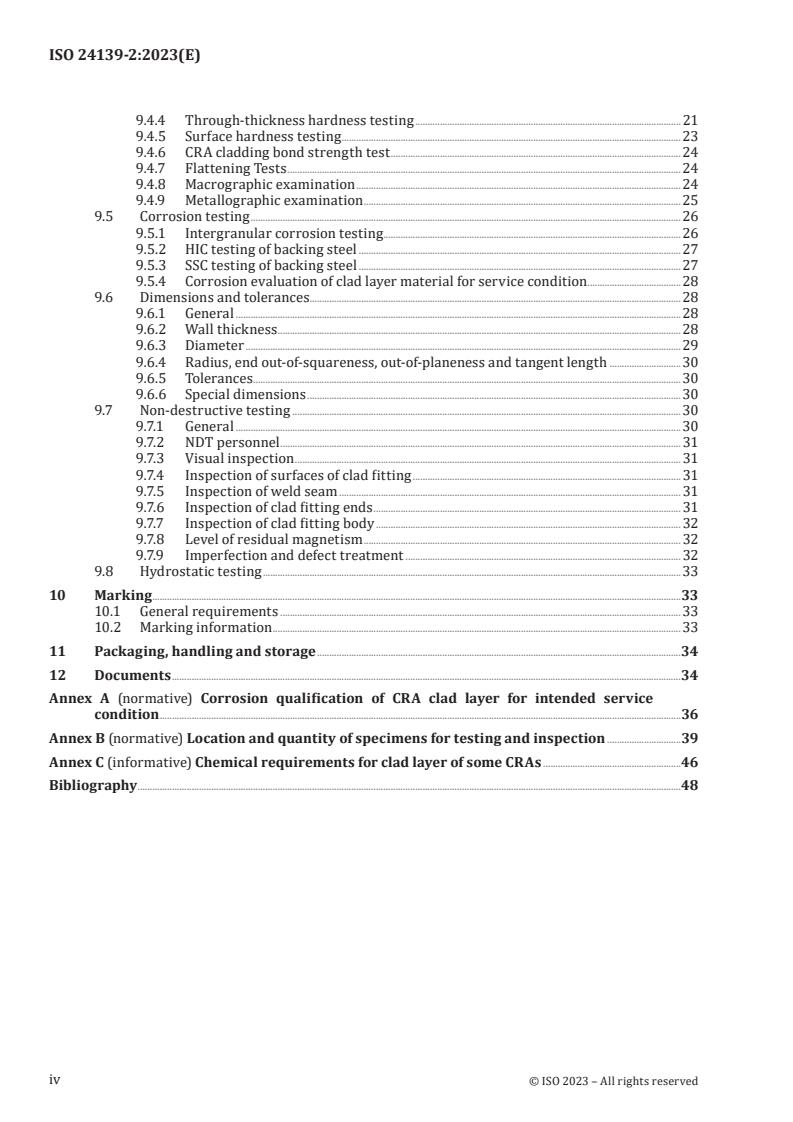
Contents Page
Foreword .v
1 Scope . 1
2 Normative references . 1
3 Terms, definitions, symbols and abbreviated terms . 4
3.1 Terms and definitions . 4
3.2 Symbols . 5
3.3 Abbreviated terms . 5
4 General requirements . 6
4.1 Units of measurement . 6
4.2 Rounding . 6
5 Information supplied by the purchaser . 6
5.1 General information. 6
5.2 Additional information. 7
5.3 Information on the mother clad pipe . 8
5.4 Information on the mother steel fitting . 8
6 Designation . 9
7 Design . 9
8 Manufacturing .10
8.1 Starting materials . 10
8.1.1 General requirement . . 10
8.1.2 Mother clad pipe . 10
8.1.3 Clad plate . 11
8.1.4 Mother steel fitting . 11
8.1.5 Welding consumables . 11
8.1.6 Re-inspection of starting materials . 11
8.2 Manufacturing procedure specification (MPS) . .12
8.2.1 General requirements .12
8.2.2 MPS development procedure . .12
8.2.3 Required information in MPS .12
8.3 Clad fitting manufacture .13
8.4 Welding . . 13
8.4.1 General requirements . 13
8.4.2 Weld overlay .13
8.4.3 Weld metal . 14
8.4.4 Welds and position . 14
8.5 Heat treatment. 15
8.6 Cold forming and sizing .15
8.7 Jointers and girth welds . 15
8.8 End preparation . .15
8.9 Surface treatment . 16
9 Testing and inspection .16
9.1 General requirements . 16
9.2 Extent of testing and inspection . 17
9.3 Chemical composition . 19
9.3.1 Requirements . 19
9.3.2 Test specimens . 19
9.3.3 Test method . 20
9.4 Physical testing . 20
9.4.1 Tensile testing .20
9.4.2 Charpy V-notch impact test . 20
9.4.3 Guided bending testing . 20
iii
9.4.4 Through-thickness hardness testing . 21
9.4.5 Surface hardness testing . 23
9.4.6 CRA cladding bond strength test . 24
9.4.7 Flattening Tests . 24
9.4.8 Macrographic examination . 24
9.4.9 Metallographic examination . 25
9.5 Corrosion testing . 26
9.5.1 Intergranular corrosion testing . 26
9.5.2 HIC testing of backing steel . 27
9.5.3 SSC testing of backing steel . 27
9.5.4 Corrosion evaluation of clad layer material for service condition .28
9.6 Dimensions and tolerances . .28
9.6.1 General .28
9.6.2 Wall thickness .28
9.6.3 Diameter .29
9.6.4 Radius, end out-of-squareness, out-of-planeness and tangent length .30
9.6.5 Tolerances . 30
9.6.6 Special dimensions . 30
9.7 Non-destructive testing . 30
9.7.1 General .30
9.7.2 NDT personnel . 31
9.7.3 Visual inspection . 31
9.7.4 Inspection of surfaces of clad fitting . 31
9.7.5 Inspection of weld seam . 31
9.7.6 Inspection of clad fitting ends . 31
9.7.7 Inspection of clad fitting body . 32
9.7.8 Level of residual magnetism . 32
9.7.9 Imperfection and defect treatment . 32
9.8 Hydrostatic testing .33
10 Marking . .33
10.1 General requirements . 33
10.2 Marking information . 33
11 Packaging, handling and storage .34
12 Documents .34
Annex A (normative) Corrosion qualification of CRA clad layer for intended service
condition .36
Annex B (normative) Location and quantity of specimens for testing and inspection .39
Annex C (informative) Chemical requirements for clad layer of some CRAs .46
Bibliography .48
iv
Foreword
ISO (the International Organization for Standardization) is a worldwide federation of national standards
bodies (ISO member bodies). The work of preparing International Standards is normally carried out
through ISO technical committees. Each member body interested in a subject for which a technical
committee has been established has the right to be represented on that committee. International
organizations, governmental and non-governmental, in liaison with ISO, also take part in the work.
ISO collaborates closely with the International Electrotechnical Commission (IEC) on all matters of
electrotechnical standardization.
The procedures used to develop this document and those intended for its further maintenance are
described in the ISO/IEC Directives, Part 1. In particular, the different approval criteria needed for the
different types of ISO documents should be noted. This document was drafted in accordance with the
editorial rules of the ISO/IEC Directives, Part 2 (see www.iso.org/directives).
Attention is drawn to the possibility that some of the elements of this document may be the subject of
patent rights. ISO shall not be held responsible for identifying any or all such patent rights. Details of
any patent rights identified during the development of the document will be in the Introduction and/or
on the ISO list of patent declarations received (see www.iso.org/patents).
Any trade name used in this document is information given for the convenience of users and does not
constitute an endorsement.
For an explanation of the voluntary nature of standards, the meaning of ISO specific terms and
expressions related to conformity assessment, as well as information about ISO's adherence to
the World Trade Organization (WTO) principles in the Technical Barriers to Trade (TBT), see
www.iso.org/iso/foreword.html.
This document was prepared by Technical Committee ISO/TC 67, Oil and gas industries including lower
carbon energy, Subcommittee SC 2, Pipeline transportation systems.
A list of all parts in the ISO 24139 series can be found on the ISO website.
Any feedback or questions on this document should be directed to the user’s national standards body. A
complete listing of these bodies can be found at www.iso.org/members.html.
v
INTERNATIONAL STANDARD ISO 24139-2:2023(E)
Petroleum and natural gas industries — Corrosion
resistant alloy clad bends and fittings for pipeline
transportation system —
Part 2:
Clad fittings
1 Scope
This document specifies the technical delivery conditions regarding design, geometric dimensions,
materials, manufacturing procedures, inspection methods, non-destructive testing, marking, package
and storage for factory-made, seamless and welded, corrosion resistant alloy (CRA) clad fittings for use
in pipeline transportation systems for the petroleum and natural gas industries as defined in ISO 13623.
This document is applicable to CRA clad fittings for use in transportation or process pipelines
transporting corrosive media-containing single-phase or multi-phase fluid such as oil, gas and water
for the petroleum and natural gas industries. It can also be used as reference in other fields.
The clad fittings specified in this document include clad elbows, clad reducers, clad tees and clad caps.
Two technical delivery conditions classes for clad fittings are designated. Class B provides a standard
quality level for clad fittings and Class S provides technical requirements for sour-service conditions.
Fabricated laterals, fabricated lap joint stub ends and other fittings employing circumferential or
intersection welds are considered as pipe fabrication and are outside the scope of this document.
2 Normative references
The following documents are referred to in the text in such a way that some or all of their content
constitutes requirements of this document. For dated references, only the edition cited applies. For
undated references, the latest edition of the referenced document (including any amendments) applies.
ISO 3183:2019, Petroleum and natural gas industries — Steel pipe for pipeline transportation systems
ISO 3651-1:1998, Determination of resistance to intergranular corrosion of stainless steels — Part 1:
Austenitic and ferritic-austenitic (duplex) stainless steels — Corrosion test in nitric acid medium by
measurement of loss in mass (Huey test)
ISO 3651-2:1998, Determination of resistance to intergranular corrosion of stainless steels — Part 2:
Ferritic,austenitic and ferritic-austenitic (duplex) stainless steels — Corrosion test in media containing
sulfuric acid
ISO 6507 (all parts), Metallic materials — Vickers hardness test
ISO 6892-1, Metallic materials — Tensile testing — Part 1: Method of test at room temperature
ISO 6892-2, Metallic materials — Tensile testing — Part 2: Method of test at elevated temperature
ISO 7438, Metallic materials — Bend test
ISO 7539-2, Corrosion of metals and alloys — Stress corrosion testing — Part 2: Preparation and use of
bent-beam specimens
ISO 8407, Corrosion of metals and alloys — Removal of corrosion products from corrosion test specimens
ISO 8501-1:2007, Preparation of steel substrates before application of paints and related products —
Visual assessment of surface cleanliness — Part 1: Rust grades and preparation grades of uncoated steel
substrates and of steel substrates after overall removal of previous coatings
ISO 9400:1990, Nickel-based alloys — Determination of resistance to intergranular corrosion
ISO 9712, Non-destructive testing — Qualification and certification of NDT personnel
ISO 10474, Steel and steel products — Inspection documents
ISO 10893-4, Non-destructive testing of steel tubes — Part 4: Liquid penetrant inspection of seamless and
welded steel tubes for the detection of surface imperfections
ISO 10893-5, Non-destructive testing of steel tubes — Part 5: Magnetic particle inspection of seamless and
welded ferromagnetic steel tubes for the detection of surface imperfections
ISO 10893-6, Non-destructive testing of steel tubes — Part 6: Radiographic testing of the weld seam of
welded steel tubes for the detection of imperfections
ISO 10893-8, Non-destructive testing of steel tubes — Part 8: Automated ultrasonic testing of seamless and
welded steel tubes for the detection of laminar imperfections
ISO 10893-9, Non-destructive testing of steel tubes — Part 9: Automated ultrasonic testing for the detection
of laminar imperfections in strip/plate used for the manufacture of welded steel tubes
ISO 10893-10, Non-destructive testing of steel tubes — Part 10: Automated full peripheral ultrasonic
testing of seamless and welded (except submerged arc-welded) steel tubes for the detection of longitudinal
and/or transverse imperfections
ISO 10893-11, Non-destructive testing of steel tubes — Part 11: Automated ultrasonic testing of the weld
seam of welded steel tubes for the detection of longitudinal and/or transverse imperfections
ISO 13623, Petroleum and natural gas industries — Pipeline transportation systems
ISO 14250, Steel — Metallographic characterization of duplex grain size and distributions
ISO 14732, Welding personnel — Qualification testing of welding operators and weld setters for mechanized
and automatic welding of metallic materials
ISO 15156-1, Petroleum and natural gas industries — Materials for use in H2S-containing environments in
oil and gas production — Part 1: General principles for selection of cracking-resistant materials
ISO 15156-2, Petroleum and natural gas industries — Materials for use in H2S-containing environments in
oil and gas production — Part 2: Cracking-resistant carbon and low-alloy steels, and the use of cast irons
ISO 15156-3:2020, Petroleum and natural gas industries — Materials for use in H2S-containing
environments in oil and gas production — Part 3: Cracking-resistant CRAs (corrosion-resistant alloys) and
other alloys
ISO 15590-1:2018, Petroleum and natural gas industries — Induction bends, fittings and flanges for
pipeline transportation systems — Part 1: Induction bends
ISO 15590-2:2021, Petroleum and natural gas industries — Factory bends, fittings and flanges for pipeline
transportation systems — Part 2: Fittings
ISO 15614-7, Specification and qualification of welding procedures for metallic materials — Welding
procedure test — Part 7: Overlay welding
ISO 15614-8, Specification and qualification of welding procedures for metallic materials — Welding
procedure test — Part 8: Welding of tubes to tube-plate joints
ISO 17405, Non-destructive testing — Ultrasonic testing — Technique of testing claddings produced by
welding, rolling and explosion
ISO 17639, Destructive tests on welds in metallic materials — Macroscopic and microscopic examination of
welds
ISO 80000-1:2009, Quantities and units — Part 1: General
ASME BPVC Section II - Materials Part C, Specifications for welding rods, electrodes, and filler metals
ASME BPVC Section IX Qualification standard for welding, brazing, and fusing procedures; welders;
brazers; and welding, brazing, and fusing operators
ASME B16.9, Factory-made wrought butt welding fittings
ASME B31.8, Gas transmission and distribution piping systems
ASME B31.4, Pipeline transportation systems for liquids and NDT slurries
ASNT SNT-TC-1A, Recommended practice No. SNT-TC-1A: Personnel qualification and certification in non-
destructive testing
ASTM A262-15, Standard practices for detecting susceptibility to intergranular attack in austenitic
stainless steels
ASTM A263-12, Standard specification for stainless Chromium steel-clad plate
ASTM A264-12, Standard specification for stainless Chromium-Nickel steel-clad plate
ASTM A265-12, Standard specification for Nickel and Nickel-base alloy-clad steel plate
ASTM A370, Standard test methods and definitions for mechanical testing of steel products
ASTM A435, Standard Specification for straight-beam ultrasonic examination of steel plates
ASTM A578/A578M-17, Standard specification for straight-beam ultrasonic examination of rolled steel
plates for special applications
ASTM A751, Standard test methods, practices, and terminology for chemical analysis of steel products
ASTM A923-14, Standard test methods for detecting detrimental intermetallic phase in duplex austenitic/
ferritic stainless steels
ASTM E3, Standard guide for preparation of metallographic specimens
ASTM E92, Standard test methods for Vickers hardness and Knoop hardness of metallic materials
ASTM E165, Standard test method for liquid penetrant examination
ASTM E273, Standard practice for ultrasonic testing of the weld zone of welded pipe and tubing
ASTM E340, Standard practice for macroetching metals and alloys
ASTM E353, Standard test methods for chemical analysis of stainless, heat-resisting, maraging, and other
similar Chromium-Nickel-Iron alloys
ASTM E562, Standard test method for determining volume fraction by systematic manual point count
ASTM E709, Standard guide for magnetic particle testing
ASTM G1, Standard practice for preparing, cleaning, and evaluating corrosion test specimens
ASTM G28-02, Standard test methods for detecting susceptibility to intergranular corrosion in wrought,
Nickel-rich, Chromium-bearing alloys
ASTM G39, Standard practice for preparation and use of bent-beam stress-corrosion test specimens
ASTM G111, Standard guide for corrosion tests in high temperature or high pressure environment, or both
MSS SP-75, High-strength, wrought, butt-welding fittings
NACE TM0177, Standard test method — Laboratory testing of metals for resistance to sulfide stress
cracking and stress corrosion cracking in H S environments
NACE TM0284, Standard test method — Evaluation of pipeline and pressure vessel steels for resistance to
hydrogen-induced cracking
3 Terms, definitions, symbols and abbreviated terms
3.1 Terms and definitions
For the purposes of this document, the terms and definitions given in ISO 15590-2:2021 and the
following apply.
ISO and IEC maintain terminology databases for use in standardization at the following addresses:
— ISO Online browsing platform: available at https:// www .iso .org/ obp
— IEC Electropedia: available at https:// www .electropedia .org/
3.1.1
as agreed
as achieving consensus upon by the manufacturer and purchaser, and specified in the purchase order
3.1.2
backing steel
substrate of the clad plate, clad pipe or clad fittings withstanding mechanical load or pressure, and
made of carbon steel or low alloy steel
3.1.3
clad layer
layer of the corrosion resistant alloy metallurgically bonded to the surface of the backing steel of clad
plate, clad pipe or clad fittings
Note 1 to entry: Metallurgically bonded corrosion resistant alloy (CRA) layer is to be produced by hot roll
bonding, weld overlaying, explosion cladding, coextruding or some other process that produces the atomic
diffusion interface between CRA and carbon steel.
3.1.4
corrosion resistant alloy
CRA
alloy such as stainless steel and nickel-based alloy intended to be resistant to general and localized
corrosion of oilfield environments that are corrosive to carbon steels
[SOURCE: ISO 15156-1:2020, 3.6, modified —"such as stainless steel and nickel-based alloy" has been
added.]
3.1.5
if agreed
as prescribed, or more stringent than is prescribed, if achieved consensus by the manufacturer and the
purchaser and specified in the purchase order
3.1.6
manufacturer
firm, company or corporation responsible for making and marking the product in accordance with
specific requirements
Note 1 to entry: The specific requirements are addressed in this document.
3.1.7
mother clad pipe
metallurgical straight clad pipe from which the corrosion resistant alloy clad fitting is made
3.1.8
mother steel fitting
carbon steel or low-alloy steel fitting onto which the clad fitting is made by weld overlay with corrosion
resistant alloy
3.1.9
neutral zone
zone near the neutral axis of the elbow arc
3.1.10
bond shear strength
tangential stress per unit contact area required to separate the clad layer from the backing steel of the
metallurgically bonded clad plate, clad pipe or clad fittings
3.1.11
sour environment
exposure to oilfield environments that contain sufficient H S to cause cracking of metallic materials by
specific mechanisms
Note 1 to entry: These mechanisms are addressed in ISO 15156-1.
[SOURCE: ISO 15156-1:2020, 3.20, modified — Note 1 to entry has been added.]
3.1.12
manufacturing procedure specification
MPS
document that specifies the process control parameters and the acceptance criteria to apply for all
manufacturing, inspection and testing activities performed during clad fitting manufacture
[SOURCE: ISO 15590-2:2021, 3.5, modified — "Fitting" has been replaced with "clad fitting".]
3.2 Symbols
A elongation of tensile test specimen after fracture, expressed as a percentage
D nominal or calculated (from the specified inside diameter and wall thickness) outside diameter
of clad fittings
d specified inside diameter at end of a clad fittings
R ultimate tensile strength
m
R yield strength for 0,5 % total elongation
t0,5
t minimum wall thickness of clad layer for clad fitting
t nominal (minimum) wall thickness of backing steel for clad fitting
B
3.3 Abbreviated terms
AUT automatic ultrasonic testing
HAZ heat-affected zone
HIC hydrogen induced cracking
MPQT manufacturing procedure qualification test
MT magnetic testing
NDT non-destructive testing
PREN pitting resistance equivalent number
PT penetrant testing
RT radiographic testing
SCC stress corrosion cracking
SMYS specified minimum yield strength
SSC sulfide stress cracking
PWHT post-welding heat treatment
UT ultrasonic testing
WT wall thickness
WPS welding procedure specification
4 General requirements
4.1 Units of measurement
In this document, data are expressed in SI units. For a specific order item, unless otherwise stated, only
one system of units shall be used, without combining data expressed in the other system.
4.2 Rounding
Unless otherwise stated in this document, values shall be rounded to the nearest unit in the last right-
hand place of figures used in expressing the limiting value, in accordance with ISO 80000-1:2009,
Annex B, Rule A.
5 Information supplied by the purchaser
5.1 General information
The purchaser shall provide the following information in the order given below:
a) a reference to this document, i.e. ISO 24139-2:2023;
b) clad fitting designation;
c) quantity of clad fittings;
d) CRA material type or identification (UNS or ASTM A240/A240M, see Annex C) of clad layer;
e) clad fittings dimensions:
— nominal diameter, DN (in accordance with MSS SP-75 or ASME B16.9);
— specified inside diameter at ends;
— nominal (minimum) wall thickness of backing steel;
— nominal (minimum) wall thickness of clad layer;
— the angle (for special elbows).
f) end preparation if different from square ends;
g) seamless or with longitudinal weld(s);
h) whether the purchaser wishes to approve the MPS prior to commencement of manufacturing.
5.2 Additional information
The purchaser should specify the following additional information if applicable, which will include but
not limited to:
a) pipeline operating conditions, including composition of transported fluid, temperature and
pressure;
b) design temperature (minimum and maximum);
c) pipeline design standard or design factors;
d) requirements for maximum wall thickness of both backing steel and clad layer;
e) specifications and materials of matching pipes;
f) special dimensional requirements;
g) supply of mother clad pipes or mother steel fittings by the purchaser or the manufacturer;
h) requirements for gauging and other measurements of dimensions, if different from this document;
i) requirements for supplementary inspection and testing;
j) mechanical property requirements for backing steel at high temperatures;
k) requirements for proof burst testing or hydrostatic testing;
l) whether verification of the capability to withstand internal pressure shall be done by calculation or
by proof testing or both (see Clause 7);
m) requirements for corrosion resistance for both backing steel (such as HIC and SSC) and clad layer;
n) whether approval of the MPS is to be by review of previous production data or by MPQT;
o) coating or painting requirements;
p) marking requirements, if different from this document;
q) packaging and shipping instructions, if different from this document;
r) third-party inspection organization;
s) inspection documents which are required in accordance with ISO 10474;
t) requirements for format and additional information of the inspection documents;
u) PWHT (see 8.5).
5.3 Information on the mother clad pipe
5.3.1 If the mother clad pipe is supplied by the purchaser, the following information on the mother
clad pipe shall be provided to the manufacturer:
a) purchasing specification;
b) pipe diameter, inside or outside;
c) pipe wall thickness (nominal or minimum values for both backing steel and clad layer);
d) pipe length;
e) grade of backing steel;
f) CRA type of clad layer;
g) pipe manufacturer.
5.3.2 If the mother clad pipe is supplied by the purchaser, the following additional information should
also be provided to the manufacturer if applicable:
a) material specification and material certificates of clad pipe, including chemical composition, heat
treatment, mechanical properties, results of NDT and hydrostatic testing;
b) WPS and weld metal chemical composition for welded clad pipe;
c) weld repair record and weld-seam-repair WPS for welded clad pipe.
5.4 Information on the mother steel fitting
5.4.1 If the mother steel fittings are supplied by the purchaser, the following information shall be
provided to the manufacturer:
a) purchasing specification;
b) fitting designation;
c) required fitting dimensions, including:
— nominal diameter, DN,
— specified inside diameter at ends,
— nominal wall thickness,
— radius and type of radius (if applicable), and
— the angle (if applicable).
5.4.2 If the mother steel fittings are supplied by the purchaser, the following additional information
should also be provided to the manufacturer if applicable:
a) material specification and material certificates of the steel fitting, including chemical composition,
heat treatment, mechanical properties, and results of NDT;
b) WPS for welded fittings;
c) heat treatment status or PWHT for welded fittings.
6 Designation
Designation of clad fittings shall take the form of “XXX- YYY/CCC-Z”, where:
— the letters “XXX” represents the codes of clad fittings, which are shown in Table 1;
— the letters “YYY” is the specified minimum yield strength (SMYS) of backing steel, expressed in
megapascals (MPa);
— the letters “CCC” is the CRA type of clad layer (see Annex C);
— the letter “Z” is the suffix B or S, B to identify the technical delivery conditions class for clad fittings
in non-sour service, or the suffix S to identify the use in sour-service conditions.
EXAMPLE “45CEL(L)-245/UNS S31603-B” is a 45 deg. long radius clad elbow, the SMYS of backing steel is
245 MPa, and the CRA type of clad layer is UNS S31603, and identifies the use in non-sour service.
Table 1 — Types and codes of clad fittings
Types Category Codes
Long radius (1.5D) 45CEL(L)
45 deg. clad elbows
3D 45CEL(3D)
Long radius 90CEL(L)
Long radius reducing 90CEL(LR)
90 deg. clad elbows
Short radius (1D) 90CEL(S)
3D 90CEL(3D)
Concentric CCR
Clad reducers Eccentric CER
Conical CNR
Straight CTE(S)
Clad tees
Reducing outlet CTE(R)
Clad caps - CCA
7 Design
The design documents of clad fittings shall at least include design drawings and strength calculations or
proof test report. The design parameters of clad fittings shall be consistent with those of their matching
pipes.
The strength design and material selection of clad fittings shall follow the principle of the backing steel
for withstanding of internal fluid pressure and additional special load and clad layer for corrosion
resistance of conveying fluid.
The capability of the clad fitting to withstand internal pressure shall equal or exceed that of the
matching pipe. The verification of the capability shall be made by design calculation or proof testing or
both.
The calculations of the minimum wall thickness (or design thickness) of the backing steel shall be made
in accordance with ISO 15590-2:2021, Annex A. The calculations of the nominal wall thickness(t )
B
of the backing steel shall be made by Barlow's formula. The hoop stress in the clad fitting due to the
internal fluid pressure shall not exceed the hoop stress for the tangent permitted in ISO 13623 or other
applicable design code.
The proof test procedure shall be as defined in ISO 15590-2:2021, Annex B. The pressure design
thickness (or equivalent pipe wall or schedule rating) for critical areas of each type of clad fitting shall
be determined and recorded. Critical areas are normally the extrados and intrados of elbows, the crotch
of tees, the knuckle of caps, and the large end of reducers.
Additional requirements on strength design verification or different method of calculation, such as
resistance to internal pressure under special load cases in accordance with ISO 13623, ASME B31.8,
ASME B31.4 or other recognized documents shall be indicated at the time of enquiry or purchase order.
The design calculations and/or results of successful proof testing shall be available for review at the
manufacturer’s facility.
If the SMYS of the backing steel of clad fitting is less than that of the matching pipe, the minimum
thickness of the fitting end shall be increased such that the product of its thickness times its SMYS shall
at least equal the product of the specified wall thickness and the SMYS of the matching pipe.
For materials selection for clad fittings, the corrosivity of the transported fluid shall be taken into
account, and the following principles shall apply:
-
a) if the transported fluid contains several corrosive media such as H S, CO or Cl , the clad layer shall
2 2
be resistant to SCC, mass loss corrosion and pitting corrosion, and the clad layer material shall be
in accordance with the requirements given in 9.5.4;
b) if the transported fluid contains H S and is defined as sour environment, the need for the backing
steel to conform with ISO 15156-2 shall be as agreed.
8 Manufacturing
8.1 Starting materials
8.1.1 General requirement
The starting material for clad fittings shall be fusion-welded with filler metal or seamless clad pipe,
clad plate, unalloyed or low-alloy steel seamless and welded fittings.
8.1.2 Mother clad pipe
Mother clad pipe should be manufactured in accordance with API Spec 5LD or other applicable
document as agreed.
The mother clad pipe is a clad bimetallic pipe composed of an internal CRA layer that is metallurgically
bonded to the backing steel. The metallurgical clad layer may be bonded by hot rolling, coextrusion,
weld overlay, explosion bonding, or some other process that produces a metallurgical bond.
The mother clad pipe shall be either a seamless pipe or a welded pipe having only one longitudinal weld.
The mother clad pipe shall not contain girth butt welds. The wall thickness of backing steel and CRA
clad layer of the mother clad pipe shall have adequate allowance for wall thinning at the extrados due to
induction bending or other forming. The mother clad pipe shall not contain weld repairs on the backing
steel pipe body, and repair of weld overlay should be accepted.
The mother clad pipe may be supplied by either the purchaser or the manufacturer. If the mother
clad pipe is supplied by the purchaser, with regard to its suitability for manufacturing of fitting, the
following performance shall
...
NORME ISO
INTERNATIONALE 24139-2
Première édition
2023-02
Industries du pétrole et du gaz
naturel — Coudes et raccords
recouverts d'alliage résistant à la
corrosion pour système de transport
par conduites —
Partie 2:
Raccords recouverts
Petroleum and natural gas industries — Corrosion resistant alloy clad
bends and fittings for pipeline transportation system —
Part 2: Clad fittings
Numéro de référence
DOCUMENT PROTÉGÉ PAR COPYRIGHT
© ISO 2023
Tous droits réservés. Sauf prescription différente ou nécessité dans le contexte de sa mise en œuvre, aucune partie de cette
publication ne peut être reproduite ni utilisée sous quelque forme que ce soit et par aucun procédé, électronique ou mécanique,
y compris la photocopie, ou la diffusion sur l’internet ou sur un intranet, sans autorisation écrite préalable. Une autorisation peut
être demandée à l’ISO à l’adresse ci-après ou au comité membre de l’ISO dans le pays du demandeur.
ISO copyright office
Case postale 401 • Ch. de Blandonnet 8
CH-1214 Vernier, Genève
Tél.: +41 22 749 01 11
E-mail: copyright@iso.org
Web: www.iso.org
Publié en Suisse
ii
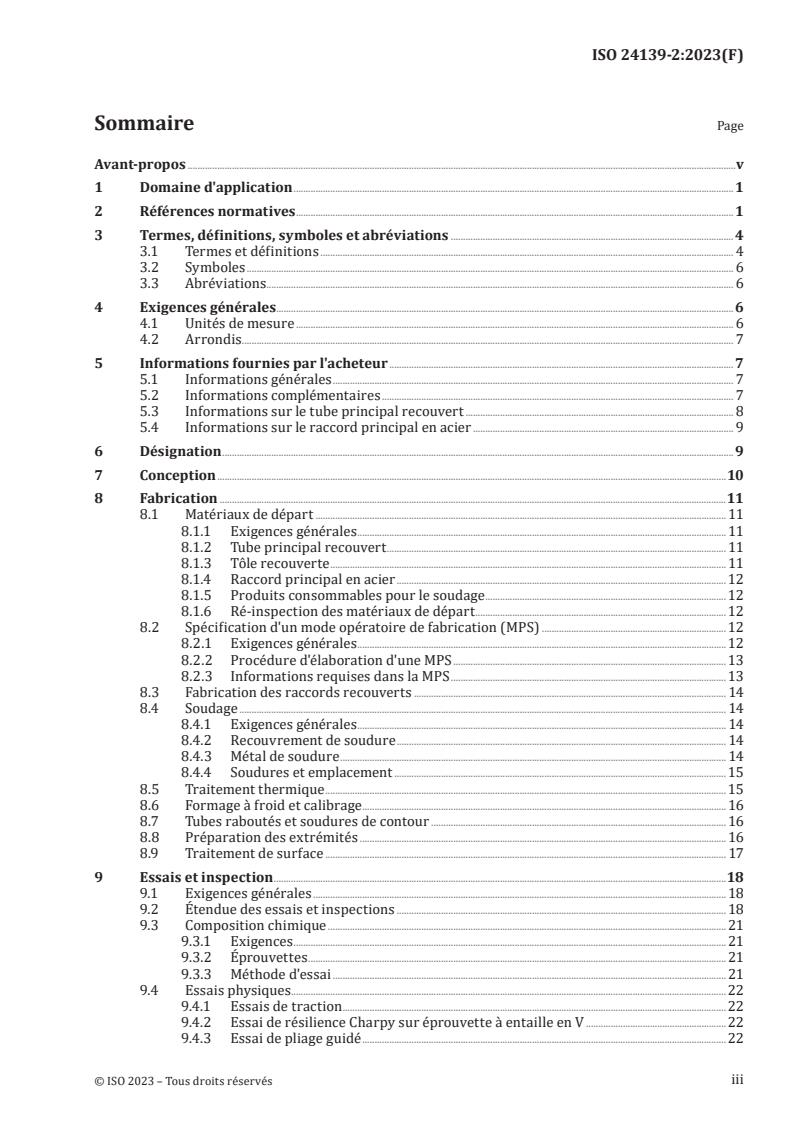
Sommaire Page
Avant-propos .v
1 Domaine d'application .1
2 Références normatives .1
3 Termes, définitions, symboles et abréviations . 4
3.1 Termes et définitions . 4
3.2 Symboles . 6
3.3 Abréviations. 6
4 Exigences générales . .6
4.1 Unités de mesure . 6
4.2 Arrondis. 7
5 Informations fournies par l'acheteur . 7
5.1 Informations générales . 7
5.2 Informations complémentaires . 7
5.3 Informations sur le tube principal recouvert . 8
5.4 Informations sur le raccord principal en acier . 9
6 Désignation . 9
7 Conception .10
8 Fabrication .11
8.1 Matériaux de départ . 11
8.1.1 Exigences générales . 11
8.1.2 Tube principal recouvert . 11
8.1.3 Tôle recouverte . 11
8.1.4 Raccord principal en acier .12
8.1.5 Produits consommables pour le soudage .12
8.1.6 Ré-inspection des matériaux de départ .12
8.2 Spécification d'un mode opératoire de fabrication (MPS) .12
8.2.1 Exigences générales .12
8.2.2 Procédure d'élaboration d'une MPS . 13
8.2.3 Informations requises dans la MPS . 13
8.3 Fabrication des raccords recouverts . 14
8.4 Soudage . 14
8.4.1 Exigences générales . 14
8.4.2 Recouvrement de soudure . 14
8.4.3 Métal de soudure . 14
8.4.4 Soudures et emplacement . 15
8.5 Traitement thermique . 15
8.6 Formage à froid et calibrage . 16
8.7 Tubes raboutés et soudures de contour . 16
8.8 Préparation des extrémités . 16
8.9 Traitement de surface . 17
9 Essais et inspection .18
9.1 Exigences générales . 18
9.2 Étendue des essais et inspections . 18
9.3 Composition chimique . 21
9.3.1 Exigences . 21
9.3.2 Éprouvettes . 21
9.3.3 Méthode d'essai . 21
9.4 Essais physiques . 22
9.4.1 Essais de traction . 22
9.4.2 Essai de résilience Charpy sur éprouvette à entaille en V .22
9.4.3 Essai de pliage guidé . 22
iii
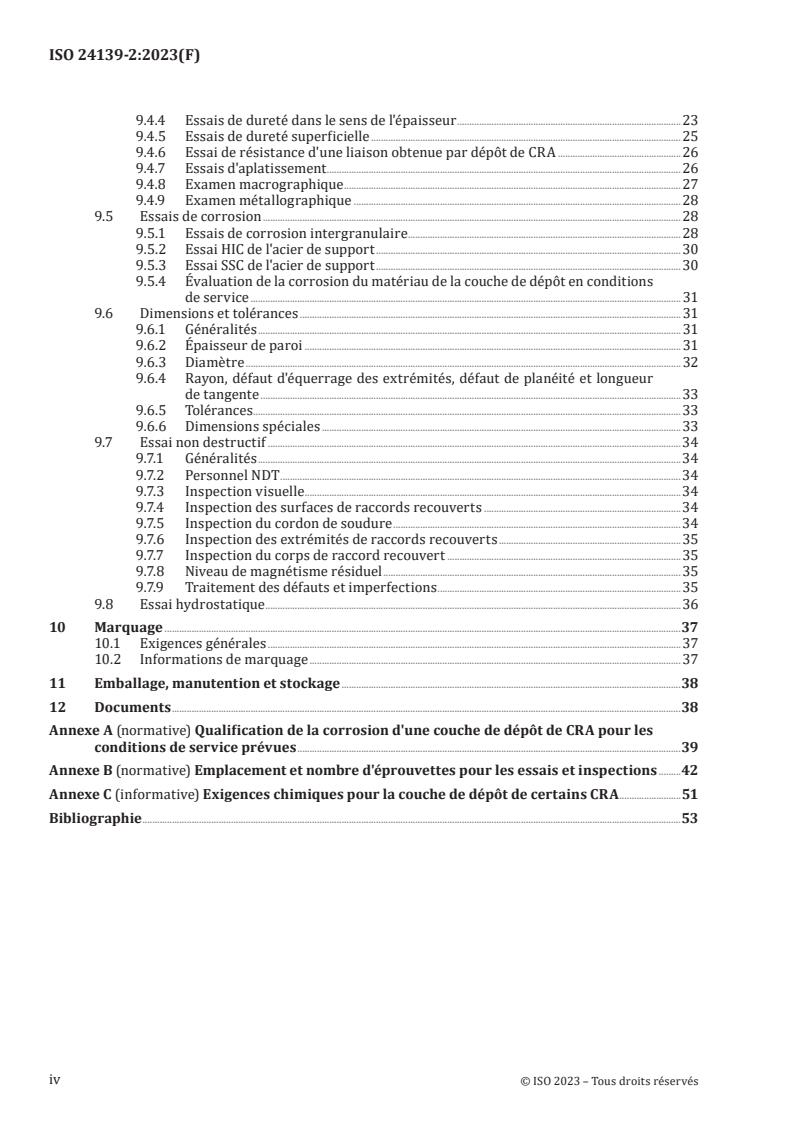
9.4.4 Essais de dureté dans le sens de l'épaisseur . 23
9.4.5 Essais de dureté superficielle . 25
9.4.6 Essai de résistance d'une liaison obtenue par dépôt de CRA .26
9.4.7 Essais d'aplatissement . 26
9.4.8 Examen macrographique . 27
9.4.9 Examen métallographique .28
9.5 Essais de corrosion .28
9.5.1 Essais de corrosion intergranulaire .28
9.5.2 Essai HIC de l'acier de support .30
9.5.3 Essai SSC de l'acier de support .30
9.5.4 Évaluation de la corrosion du matériau de la couche de dépôt en conditions
de service . 31
9.6 Dimensions et tolérances . 31
9.6.1 Généralités . 31
9.6.2 Épaisseur de paroi . 31
9.6.3 Diamètre . 32
9.6.4 Rayon, défaut d'équerrage des extrémités, défaut de planéité et longueur
de tangente .33
9.6.5 Tolérances . 33
9.6.6 Dimensions spéciales .33
9.7 Essai non destructif .34
9.7.1 Généralités .34
9.7.2 Personnel NDT .34
9.7.3 Inspection visuelle .34
9.7.4 Inspection des surfaces de raccords recouverts .34
9.7.5 Inspection du cordon de soudure .34
9.7.6 Inspection des extrémités de raccords recouverts . 35
9.7.7 Inspection du corps de raccord recouvert . 35
9.7.8 Niveau de magnétisme résiduel . 35
9.7.9 Traitement des défauts et imperfections . 35
9.8 Essai hydrostatique .36
10 Marquage .37
10.1 Exigences générales . 37
10.2 Informations de marquage . 37
11 Emballage, manutention et stockage .38
12 Documents .38
Annexe A (normative) Qualification de la corrosion d'une couche de dépôt de CRA pour les
conditions de service prévues .39
Annexe B (normative) Emplacement et nombre d'éprouvettes pour les essais et inspections .42
Annexe C (informative) Exigences chimiques pour la couche de dépôt de certains CRA .51
Bibliographie .53
iv
Avant-propos
L'ISO (Organisation internationale de normalisation) est une fédération mondiale d'organismes
nationaux de normalisation (comités membres de l'ISO). L'élaboration des Normes internationales est
en général confiée aux comités techniques de l'ISO. Chaque comité membre intéressé par une étude
a le droit de faire partie du comité technique créé à cet effet. Les organisations internationales,
gouvernementales et non gouvernementales, en liaison avec l'ISO participent également aux travaux.
L'ISO collabore étroitement avec la Commission électrotechnique internationale (IEC) en ce qui
concerne la normalisation électrotechnique.
Les procédures utilisées pour élaborer le présent document et celles destinées à sa mise à jour sont
décrites dans les Directives ISO/IEC, Partie 1. Il convient, en particulier, de prendre note des différents
critères d'approbation requis pour les différents types de documents ISO. Le présent document a
été rédigé conformément aux règles de rédaction données dans les Directives ISO/IEC, Partie 2 (voir
www.iso.org/directives).
L'attention est attirée sur le fait que certains des éléments du présent document peuvent faire l'objet de
droits de propriété intellectuelle ou de droits analogues. L'ISO ne saurait être tenue pour responsable
de ne pas avoir identifié de tels droits de propriété et averti de leur existence. Les détails concernant
les références aux droits de propriété intellectuelle ou autres droits analogues identifiés lors de
l'élaboration du document sont indiqués dans l'Introduction et/ou dans la liste des déclarations de
brevets reçues par l'ISO (voir www.iso.org/brevets).
Les appellations commerciales éventuellement mentionnées dans le présent document sont données
pour information, par souci de commodité, à l’intention des utilisateurs et ne sauraient constituer un
engagement.
Pour une explication de la nature volontaire des normes, la signification des termes et expressions
spécifiques de l'ISO liés à l'évaluation de la conformité, ou pour toute information au sujet de l'adhésion
de l'ISO aux principes de l’Organisation mondiale du commerce (OMC) concernant les obstacles
techniques au commerce (OTC), voir www.iso.org/avant-propos.
Le présent document a été élaboré par le comité technique ISO/TC 67, Industries du pétrole et du gaz,
y compris les énergies à faible teneur en carbone, sous-comité SC 2, Systèmes de transport par conduites.
Une liste de toutes les parties de la série ISO 24139 se trouve sur le site web de l'ISO.
Il convient que l’utilisateur adresse tout retour d’information ou toute question concernant le présent
document à l’organisme national de normalisation de son pays. Une liste exhaustive desdits organismes
se trouve à l’adresse www.iso.org/fr/members.html.
v
NORME INTERNATIONALE ISO 24139-2:2023(F)
Industries du pétrole et du gaz naturel — Coudes et
raccords recouverts d'alliage résistant à la corrosion pour
système de transport par conduites —
Partie 2:
Raccords recouverts
1 Domaine d'application
Le présent document spécifie les conditions techniques concernant la conception, les dimensions
géométriques, les matériaux, les modes opératoires de fabrication, les exigences techniques, les
méthodes de contrôle, les essais non destructifs, le marquage, l'emballage et le stockage des raccords
recouverts d'alliage résistant à la corrosion (CRA), fabriqués en usine, sans ou avec soudure, destinés
à être utilisés dans les systèmes de transport par conduites pour les industries du pétrole et du gaz
naturel, tels que définis dans l'ISO 13623.
Le présent document s'applique aux raccords recouverts d'alliage CRA destinés à être utilisés dans
les conduites pour les réseaux de transport ou de traitement transportant des fluides mono ou multi
phasiques contenant des fluides corrosifs tels que le pétrole, le gaz et l'eau pour les industries du pétrole
et du gaz naturel. Il peut également servir de référence dans d'autres domaines.
Les raccords recouverts spécifiés dans ce document comprennent les coudes recouverts, les réducteurs
recouverts, les tés recouverts et les obturateurs recouverts.
Deux classes avec des conditions techniques différentes sont désignées comme raccords recouverts.
La classe B fournit un niveau de qualité normale pour les raccords recouverts et la classe S fournit des
exigences techniques pour l'utilisation en milieu corrosif.
Les dérivations, les embouts avec recouvrement et les autres raccords utilisant des soudures
circonférentielles ou d'intersection sont considérés comme des fabrications de tubes et sont en dehors
du domaine d'application du présent document.
2 Références normatives
Les documents suivants sont cités dans le texte de sorte qu'ils constituent, pour tout ou partie de leur
contenu, des exigences du présent document. Pour les références datées, seule l'édition citée s'applique.
Pour les références non datées, la dernière édition du document de référence s'applique (y compris les
éventuels amendements).
ISO 3183:2019, Industries du pétrole et du gaz naturel — Tubes en acier pour les systèmes de transport par
conduites
ISO 3651-1:1998, Détermination de la résistance à la corrosion intergranulaire des aciers inoxydables —
Partie 1: Aciers inoxydables austénitiques et austéno-ferritiques (duplex) — Essai de corrosion en milieu
acide nitrique par mesurage de la perte de masse (essai de Huey)
ISO 3651-2:1998, Détermination de la résistance à la corrosion intergranulaire des aciers inoxydables —
Partie 2: Aciers ferritiques, austénitiques et austéno-ferritiques (duplex) — Essais de corrosion en milieux
contenant de l'acide sulfurique
ISO 6507 (toutes les parties), Matériaux métalliques — Essai de dureté Vickers
ISO 6892-1, Matériaux métalliques — Essai de traction — Partie 1: Méthode d'essai à température ambiante
ISO 6892-2, Matériaux métalliques — Essai de traction — Partie 2: Méthode d'essai à température élevée
ISO 7438, Matériaux métalliques — Essai de pliage
ISO 7539-2, Corrosion des métaux et alliages — Essais de corrosion sous contrainte — Partie 2: Préparation
et utilisation des éprouvettes pour essais en flexion
ISO 8407, Corrosion des métaux et alliages — Élimination des produits de corrosion sur les éprouvettes
d'essai de corrosion
ISO 8501-1:2007, Préparation des subjectiles d'acier avant application de peintures et de produits assimilés
— Évaluation visuelle de la propreté d'un subjectile — Partie 1: Degrés de rouille et degrés de préparation
des subjectiles d'acier non recouverts et des subjectiles d'acier après décapage sur toute la surface des
revêtements précédents
ISO 9400:1990, Alliages à base de nickel — Détermination de la résistance à la corrosion intergranulaire
ISO 9712, Essais non destructifs — Qualification et certification du personnel END
ISO 10474, Aciers et produits sidérurgiques — Documents de contrôle
ISO 10893-4, Essais non destructifs des tubes en acier — Partie 4: Contrôle par ressuage des tubes en acier
sans soudure et soudés pour la détection des imperfections de surface
ISO 10893-5, Essais non destructifs des tubes en acier — Partie 5: Contrôle par magnétoscopie des tubes en
acier ferromagnétique sans soudure et soudés pour la détection des imperfections de surface
ISO 10893-6, Essais non destructifs des tubes en acier — Partie 6: Contrôle radiographique du cordon de
soudure des tubes en acier soudés pour la détection des imperfections
ISO 10893-8, Essais non destructifs des tubes en acier — Partie 8: Contrôle automatisé par ultrasons pour
la détection des dédoublures des tubes en acier sans soudure et soudés
ISO 10893-9, Essais non destructifs des tubes en acier — Partie 9: Contrôle automatisé par ultrasons pour
la détection des dédoublures dans les bandes/tôles fortes utilisées pour la fabrication des tubes en acier
soudés
ISO 10893-10, Essais non destructifs des tubes en acier — Partie 10: Contrôle automatisé par ultrasons sur
toute la circonférence des tubes en acier sans soudure et soudés (sauf à l'arc immergé sous flux en poudre)
pour la détection des imperfections longitudinales et/ou transversales
ISO 10893-11, Essais non destructifs des tubes en acier — Partie 11: Contrôle automatisé par ultrasons
du cordon de soudure des tubes en acier soudés pour la détection des imperfections longitudinales et/ou
transversales
ISO 13623, Industries du pétrole et du gaz naturel — Systèmes de transport par conduites
ISO 14250, Aciers — Caractérisation métallographique de la grosseur et de la distribution de grain duplex
ISO 14732, Personnel en soudage — Épreuve de qualification des opérateurs soudeurs et des régleurs en
soudage pour le soudage mécanisé et le soudage automatique des matériaux métalliques
ISO 15156-1, Industries du pétrole et du gaz naturel — Matériaux pour utilisation dans des environnements
contenant de l'hydrogène sulfuré (H2S) dans la production de pétrole et de gaz — Partie 1: Principes
généraux pour le choix des matériaux résistant à la fissuration
ISO 15156-2, Industries du pétrole et du gaz naturel — Matériaux pour utilisation dans des environnements
contenant de l'hydrogène sulfuré (H2S) dans la production de pétrole et de gaz — Partie 2: Aciers au
carbone et aciers faiblement alliés résistant à la fissuration, et utilisation de fontes
ISO 15156-3:2020, Industries du pétrole et du gaz naturel — Matériaux pour utilisation dans des
environnements contenant de l'hydrogène sulfuré (H2S) dans la production de pétrole et de gaz — Partie 3:
ARC (alliages résistants à la corrosion) et autres alliages résistant à la fissuration
ISO 15590-1:2018, Industries du pétrole et du gaz naturel — Coudes d'induction, raccords et brides pour
systèmes de transport par conduites — Partie 1: Coudes d'induction
ISO 15590-2:2021, Industries du pétrole et du gaz naturel — Coudes d'usine, raccords et brides pour
systèmes de transport par conduites — Partie 2: Raccords
ISO 15614-7, Descriptif et qualification d'un mode opératoire de soudage pour les matériaux métalliques —
Épreuve de qualification d'un mode opératoire de soudage — Partie 7: Rechargement par soudage
ISO 15614-8, Descriptif et qualification d'un mode opératoire de soudage pour les matériaux métalliques
— Épreuve de qualification d'un mode opératoire de soudage — Partie 8: Soudage de tubes sur plaques
tubulaires
ISO 17405, Essais non destructifs — Contrôle par ultrasons — Technique d’essai des placages produits par
soudage, laminage et explosion
ISO 17639, Essais destructifs des soudures sur matériaux métalliques — Examens macroscopique et
microscopique des assemblages soudés
ISO 80000-1:2009, Grandeurs et unités — Partie 1: Généralités
ASME BPVC Section II — Materials — Part C Specifications for welding rods, electrodes, and filler metals
ASME BPVC Section IX Qualification standard for welding, brazing, and fusing procedures; welders;
brazers; and welding, brazing, and fusing operators
ASME B16.9, Factory-made wrought butt welding fittings
ASME B31.8, Gas transmission and distribution piping systems
ASME B31.4, Pipeline transportation systems for liquids and NDT slurries
ASNT SNT-TC-1A, Recommended practice No. SNT-TC-1A: Personnel qualification and certification in non-
destructive testing
ASTM A262-15, Standard practices for detecting susceptibility to intergranular attack in austenitic
stainless steels
ASTM A263-12, Standard specification for stainless Chromium steel-clad plate
ASTM A264-12, Standard specification for stainless Chromium-Nickel steel-clad plate
ASTM A265-12, Standard specification for Nickel and Nickel-base alloy-clad steel plate
ASTM A370, Standard test methods and definitions for mechanical testing of steel products
ASTM A435, Standard Specification for straight-beam ultrasonic examination of steel plates
ASTM A578/A578M-17, Standard specification for straight-beam ultrasonic examination of rolled steel
plates for special applications
ASTM A751, Standard test methods, practices, and terminology for chemical analysis of steel products
ASTM A923-14, Standard test methods for detecting detrimental intermetallic phase in duplex austenitic/
ferritic stainless steels
ASTM E3, Standard guide for preparation of metallographic specimens
ASTM E92, Standard test methods for Vickers hardness and Knoop hardness of metallic materials
ASTM E165, Standard test method for liquid penetrant examination
ASTM E273, Standard practice for ultrasonic testing of the weld zone of welded pipe and tubing
ASTM E340, Standard practice for macroetching metals and alloys
ASTM E353, Standard test methods for chemical analysis of stainless, heat-resisting, maraging, and other
similar Chromium-Nickel-Iron alloys
ASTM E562, Standard test method for determining volume fraction by systematic manual point count
ASTM E709, Standard guide for magnetic particle testing
ASTM G1, Standard practice for preparing, cleaning, and evaluating corrosion test specimens
ASTM G28-02, Standard test methods for detecting susceptibility to intergranular corrosion in wrought,
Nickel-rich, Chromium-bearing alloys
ASTM G39, Standard practice for preparation and use of bent-beam stress-corrosion test specimens
ASTM G111, Standard guide for corrosion tests in high temperature or high pressure environment, or both
MSS SP-75, High-strength, wrought, butt-welding fittings
NACE TM0177, Standard test method — Laboratory testing of metals for resistance to sulfide stress
cracking and stress corrosion cracking in H S environments
NACE TM0284, Standard test method — Evaluation of pipeline and pressure vessel steels for resistance to
hydrogen-induced cracking
3 Termes, définitions, symboles et abréviations
3.1 Termes et définitions
Pour les besoins du présent document, les termes et définitions donnés dans l'ISO 15590-2:2021 ainsi
que les suivants s'appliquent.
L'ISO et l'IEC tiennent à jour des bases de données terminologiques destinées à être utilisées en
normalisation, consultables aux adresses suivantes:
— ISO Online browsing platform: disponible à l'adresse https:// www .iso .org/ obp
— IEC Electropedia: disponible à l'adresse https:// www .electropedia .org/
3.1.1
comme convenu
spécification de la commande ayant fait l'objet d'un accord entre le fabricant et l'acheteur
3.1.2
acier de support
substrat de la tôle, du tube ou des raccords recouverts, résistant à une charge mécanique ou à la
pression, en acier au carbone ou en acier faiblement allié
3.1.3
couche de dépôt
couche d'alliage résistant à la corrosion liée métallurgiquement à la surface de l'acier de support d'une
tôle, d'un tube ou de raccords recouverts
Note 1 à l'article: Une couche d'alliage résistant à la corrosion (CRA) liée métallurgiquement doit être produite
par une liaison obtenue par laminage à chaud, recouvrement de soudure, collage par explosion, coextrusion ou
tout autre procédé produisant l'interface de diffusion atomique entre l'alliage CRA et l'acier au carbone.
3.1.4
alliage résistant à la corrosion
CRA
alliage tel que l'acier inoxydable et les alliages à base de nickel, utilisé pour sa résistance à la corrosion,
générale et localisée, dans des milieux pétroliers corrodant les aciers au carbone
[SOURCE: ISO 15156-1:2020, 3.6, modifié — «tel que l'acier inoxydable et les alliages à base de nickel» a
été ajouté.]
3.1.5
sous réserve d'accord
caractéristique spécifiée dans la commande, devant être telle que prescrite, ou plus contraignante, à
condition qu'elle ait fait l'objet d'un accord entre le fabricant et l'acheteur
3.1.6
fabricant
firme, compagnie ou société responsable de la fabrication et du marquage du produit conformément à
des exigences spécifiques
Note 1 à l'article: Les exigences spécifiques sont traitées dans le présent document.
3.1.7
tube principal recouvert
tube métallurgique droit recouvert dans lequel est fabriqué le raccord recouvert d'alliage résistant à la
corrosion
3.1.8
raccord principal en acier
raccord en acier au carbone ou en acier faiblement allié sur lequel le raccord recouvert est réalisé par
recouvrement de soudure avec un alliage résistant à la corrosion
3.1.9
zone neutre
zone située à proximité de l'axe neutre de l'arc d'un coude
3.1.10
résistance au cisaillement d'une liaison
contrainte tangentielle par surface de contact unitaire nécessaire pour séparer la couche de dépôt de
l'acier de support de la tôle, du tube ou des raccords recouverts liés métallurgiquement
3.1.11
environnement corrosif
exposition à des milieux pétroliers contenant suffisamment d'hydrogène sulfuré (H S) pour engendrer
la fissuration des matériaux métalliques par des mécanismes spécifiques
Note 1 à l'article: Ces mécanismes sont traités dans l'ISO 15156-1.
[SOURCE: ISO 15156-1:2020, 3.20, modifié — La Note 1 à l'article a été ajoutée.]
3.1.12
spécification d'un mode opératoire de fabrication
MPS
document spécifiant les paramètres de commande de processus et les critères d'acceptation à appliquer
pour toutes les activités de fabrication, de contrôle et d'essais effectuées pendant la fabrication de
raccords recouverts
[SOURCE: ISO 15590-2:2021, 3.5, modifié — «raccords» a été remplacé par «raccords recouverts».]
3.2 Symboles
A Allongement de l'éprouvette de traction après fracture, exprimé en pourcentage
D Diamètre extérieur d'un raccord recouvert nominal ou calculé (à partir du diamètre intérieur
et de l'épaisseur de paroi spécifiés)
d Diamètre intérieur spécifié à l'extrémité d'un raccord recouvert
R Résistance ultime à la traction
m
R Limite d'élasticité pour un allongement total de 0,5 %
t0,5
t Épaisseur de paroi minimale d'une couche de dépôt pour un raccord recouvert
t Épaisseur de paroi nominale (minimale) d'acier de support pour un raccord recouvert
B
3.3 Abréviations
AUT essai aux ultrasons automatique
HAZ zone affectée thermiquement
HIC fissuration sous hydrogène
MPQT essai de qualification de mode opératoire de fabrication
MT essai par magnétoscopie
NDT essai non destructif
PREN indice de résistance à la corrosion par piqûres
PT examen par ressuage
PWHT traitement thermique après soudage
RT essai radiographique
SCC corrosion fissurante sous contrainte
SMYS limite d'élasticité minimale spécifiée
SSC fissuration sous contrainte par l'H S
UT essai aux ultrasons
WPS spécification du mode opératoire de soudage
WT épaisseur de paroi
4 Exigences générales
4.1 Unités de mesure
Dans le présent document, les données sont exprimées en unités internationales de mesure (SI). Pour
un article donné et sauf indication contraire, il faut utiliser un seul système d'unités de mesure pour
exprimer les données, sans le combiner à un autre système.
4.2 Arrondis
Sauf convention contraire indiquée dans le présent document, les valeurs doivent être arrondies à
l'unité la plus proche à la position la plus à droite des chiffres exprimant la valeur limite, conformément
à l'ISO 80000-1:2009, Annexe B, Règle A.
5 Informations fournies par l'acheteur
5.1 Informations générales
L'acheteur doit fournir les informations suivantes, dans l'ordre indiqué ci-dessous:
a) une référence au présent document, c'est-à-dire ISO 24139-2:2023;
b) la désignation du raccord recouvert;
c) la quantité de raccords recouverts;
d) le type ou l'identification de l'alliage CRA (UNS ou ASTM A240/A240M, voir Annexe C) de la couche
de dépôt;
e) les dimensions des raccords recouverts:
— diamètre nominal, DN (conformément à la norme MSS SP-75 ou ASME B16.9);
— diamètre intérieur spécifié aux extrémités;
— épaisseur de paroi nominale (minimale) de l'acier de support;
— épaisseur de paroi nominale (minimale) de la couche de dépôt;
— valeur de l'angle (pour les coudes spéciaux);
f) la préparation des extrémités si leur équerrage n'est pas requis;
g) sans soudure ou avec une ou plusieurs soudures longitudinales;
h) si l'acheteur souhaite approuver la MPS avant le début de la fabrication.
5.2 Informations complémentaires
Il convient que l'acheteur spécifie les informations complémentaires suivantes, le cas échéant, qui
comprendront, sans toutefois s'y limiter:
a) les conditions de fonctionnement des conduites, y compris la composition du fluide transporté, sa
température et sa pression;
b) la température de calcul (minimale et maximale);
c) la norme de conception ou les facteurs de conception de la conduite;
d) les exigences en matière d'épaisseur de paroi maximale applicables à l'acier de support et à la
couche de dépôt;
e) les spécifications et les matériaux des tubes en correspondance;
f) les exigences dimensionnelles spéciales;
g) la fourniture de tubes principaux recouverts ou de raccords principaux en acier par l'acheteur ou le
fabricant;
h) les exigences de calibrage et d'autres mesures de dimensions, si elles diffèrent du présent document;
i) les exigences d'inspections et d'essais complémentaires;
j) les exigences de propriétés mécaniques applicables à l'acier de support à haute température;
k) les exigences relatives aux essais d'éclatement ou hydrostatiques;
l) si la vérification de la capacité à résister à la pression interne doit se faire par le calcul ou par des
essais, ou les deux à la fois (voir Article 7);
m) les exigences en matière de résistance à la corrosion pour l'acier de support (essais HIC et SSC
par exemple) et la couche de dépôt;
n) si l'approbation de la MPS doit se faire par l'examen des données de production précédentes ou
par MPQT;
o) les exigences de revêtement ou de peinture;
p) les exigences de marquage, si elles diffèrent de celles du présent document;
q) les instructions d'emballage et d'expédition, si elles diffèrent de celles du présent document;
r) l'organisme tiers chargé de l'inspection;
s) les documents de contrôle exigés conformément à l'ISO 10474;
t) les exigences relatives au format et aux informations complémentaires des documents de contrôle;
u) PWHT (voir 8.5).
5.3 Informations sur le tube principal recouvert
5.3.1 Si le tube principal recouvert est fourni par l'acheteur, ce dernier doit communiquer au fabricant
les informations suivantes sur ce tube:
a) la spécification d'achat;
b) le diamètre du tube (intérieur ou extérieur);
c) l'épaisseur de paroi du tube (valeurs nominales ou minimales pour l'acier de support et pour la
couche de dépôt);
d) la longueur de tube;
e) la nuance de l'acier de support;
f) le type de CRA de la couche de dépôt;
g) le fabricant des tubes.
5.3.2 Si le tube principal recouvert est fourni par l'acheteur, il convient également que ce dernier
communique au fabricant les informations complémentaires suivantes, le cas échéant:
a) spécification des matériaux et certificats des matériaux du tube recouvert, y compris la composition
chimique, le traitement thermique, les propriétés mécaniques, les résultats des NDT et des essais
hydrostatiques;
b) WPS et composition chimique du métal fondu pour les tubes recouverts et soudés;
c) dossier de réparation de soudure et WPS de réparation des cordons de soudure pour les tubes
recouverts et soudés.
5.4 Informations sur le raccord principal en acier
5.4.1 Si les raccords principaux en acier sont fournis par l'acheteur, ce dernier doit communiquer au
fabricant les informations suivantes:
a) la spécification d'achat;
b) la désignation du raccord;
c) les dimensions de raccord requises, y compris:
— diamètre nominal DN;
— diamètre intérieur spécifié aux extrémités;
— épaisseur de paroi nominale;
— rayon et type de rayon (le cas échéant); et
— angle (le cas échéant).
5.4.2 Si les raccords principaux en acier sont fournis par l'acheteur, il convient également que ce
dernier communique au fabricant les informations complémentaires suivantes, le cas échéant:
a) spécification de matériau et certificats des matériaux du raccord en acier, y compris la composition
chimique, le traitement thermique, les propriétés mécaniques et les résultats des NDT;
b) WPS pour les raccords soudés;
c) situation en matière de traitement thermique ou PWHT pour les raccords soudés.
6 Désignation
La désignation des raccords recouverts doit avoir la forme «XXX- YYY/CCC-Z», dans laquelle:
— les lettres «XXX» représentent les codes des raccords recouverts, indiqués dans le Tableau 1;
— les lettres «YYY» représentent la limite d'élasticité minimale spécifiée (SMYS) de l'acier de support,
exprimée en mégapascals (MPa);
— les lettres «CCC» représentent le type de CRA de la couche de dépôt (voir Annexe C);
— la lettre «Z» représente le suffixe B ou S, le suffixe B servant à identifier la classe de conditions
techniques pour les raccords recouverts destinés à une utilisation en milieu non corrosif, et le
suffixe S servant à identifier l'utilisation en milieu corrosif.
EXEMPLE «45CEL(L)-245/UNS S31603-B» désigne un coude recouvert à long rayon de 45 degrés, la
limite SMYS de l'acier de support étant égale à 245 MPa et le CRA de la couche de dépôt étant du type UNS S31603,
pour une utilisation en milieu non corrosif.
Tableau 1 — Types et codes de raccords recouverts
Types Catégorie Codes
Rayon long (1,5D) 45CEL(L)
Coudes recouverts de 45 degrés
3D 45CEL(3D)
Rayon long 90CEL(L)
Réduction à rayon long 90CEL(LR)
Coudes recouverts de 90 degrés
Rayon court (1D) 90CEL(S)
3D 90CEL(3D)
TTaabblleeaauu 11 ((ssuuiitte)e)
Types Catégorie Codes
Concentriques CCR
Réducteurs recouverts Excentriques CER
Coniques CNR
Droits CTE(S)
Tés recouverts
Réduction côté sortie CTE(R)
Obturateurs recouverts - CCA
7 Conception
Les documents de conception des raccords recouverts doivent au moins inclure les plans de conception
et les calculs de résistance ou le rapport d'épreuve. Les paramètres de conception des raccords
recouverts doivent être compatibles avec ceux des tubes en correspondance.
La résistance prévue à la conception et le choix des matériaux des raccords recouverts doivent suivre
le principe selon lequel l'acier de support résiste à la pression interne du fluide et à une charge spéciale
supplémentaire, la couche de dépôt devant résister à la corrosion due au fluide transporté.
La capacit
...