

ISO 24132:2024
(Main)Ships and marine technology — Design and testing of marine transfer arms for liquefied hydrogen
General Information
- Abstract
This document specifies the design, minimum safety requirements, and inspection and testing procedures for liquefied hydrogen (LH2) marine transfer arms intended for use at onshore LH2 terminals handling LH2 carriers. It also covers the minimum requirements for safe LH2 transfer between ship and shore. Although the requirements for power/control systems are covered, this document does not include all of the details for the design and fabrication of standard parts and fittings associated with transfer arms. This document is mainly focused on hard pipe type transfer systems; hose type transfer systems are not described in detail in the general description of this document. However, hose type transfer systems can also be considered as reasonable vacuum insulated technology for the design of transfer arms for liquefied hydrogen.
- Status
- Published
- Publication Date
- 26-Jun-2024
- Technical Committee
- ISO/TC 8/SC 2 - Marine environment protection
- Drafting Committee
- ISO/TC 8/SC 2/WG 12 - Marine liquefied hydrogen transfer arms
- Current Stage
- 9092 - International Standard to be revised
- Start Date
- 26-Mar-2025
- Completion Date
- 29-Aug-2026

Overview - ISO 24132:2024 for liquefied hydrogen marine transfer arms
ISO 24132:2024 establishes design, minimum safety, inspection and testing requirements for marine transfer arms used in ship-to-shore transfer of liquefied hydrogen (LH2) at onshore LH2 terminals. The standard focuses on hard pipe type transfer systems (while noting that vacuum‑insulated hose systems can be considered) and covers product line design, materials, safety systems and commissioning tests. It addresses power and control systems at a high level but does not prescribe every detail for standard off‑the‑shelf parts and fittings.
Key technical topics and requirements
- Design basis and analysis: product line diameters, material selection, stress analysis and thermal analysis to ensure integrity under cryogenic LH2 conditions.
- Swivel joints and bearings: sealing arrangements, bearing systems, external seals and protection for structural bearings.
- Accessories and insulation: provisions for vacuum insulation, vapour recovery lines, liquid nitrogen lines, drainage, stowage devices and ice‑fall protection.
- Welding, corrosion and embrittlement protection: requirements to prevent cryogenic embrittlement and to protect against marine corrosion.
- Safety systems: two‑stage alarm and automatic shutdown, monitoring and alarm envelopes, arm position monitoring (CPMS), emergency release systems (ERS) and associated safety devices (fire, electrical, bonding, stray current protection).
- Ship connection and quick connect/disconnect: requirements for safe connection to carriers, flange covers and QCDC systems.
- Hydraulic and electrical control: design and testing of hydraulic components, electric controls, remote operation and jetty control consoles.
- Inspections and tests: prototype testing (including swivel joints, ERS, insulating flanges and QCDC), manufacturing inspections, materials verification, weld NDT, dimensional checks and pressure testing.
Practical applications and users
ISO 24132:2024 is essential for:
- Marine and port engineers designing LH2 loading arms and transfer systems
- Manufacturers of marine transfer arms, swivel joints and ERS devices
- Onshore LH2 terminal operators and shipowners conducting safe ship-to-shore transfers
- Commissioning teams, inspectors and classification societies performing prototype and manufacturing testing
- Regulators and safety assessors setting terminal approval and operational procedures
Use cases include design verification, procurement specifications, equipment acceptance tests, operational safety planning and maintenance regimes for LH2 ship-to-shore transfers.
Related standards and context
ISO 24132:2024 complements other marine, cryogenic and hydrogen handling standards and national regulations governing port operations, cryogenic piping and gas safety. Implementers should coordinate this standard with applicable IMO, national port authority and hydrogen safety guidance when planning LH2 terminals.
Get Certified
Connect with accredited certification bodies for this standard

DNV
DNV is an independent assurance and risk management provider.

Lloyd's Register
Lloyd's Register is a global professional services organisation specialising in engineering and technology.

FSC International
Forest Stewardship Council certification.
Sponsored listings
Frequently Asked Questions
ISO 24132:2024 is a standard published by the International Organization for Standardization (ISO). Its full title is "Ships and marine technology — Design and testing of marine transfer arms for liquefied hydrogen". This standard covers: This document specifies the design, minimum safety requirements, and inspection and testing procedures for liquefied hydrogen (LH2) marine transfer arms intended for use at onshore LH2 terminals handling LH2 carriers. It also covers the minimum requirements for safe LH2 transfer between ship and shore. Although the requirements for power/control systems are covered, this document does not include all of the details for the design and fabrication of standard parts and fittings associated with transfer arms. This document is mainly focused on hard pipe type transfer systems; hose type transfer systems are not described in detail in the general description of this document. However, hose type transfer systems can also be considered as reasonable vacuum insulated technology for the design of transfer arms for liquefied hydrogen.
This document specifies the design, minimum safety requirements, and inspection and testing procedures for liquefied hydrogen (LH2) marine transfer arms intended for use at onshore LH2 terminals handling LH2 carriers. It also covers the minimum requirements for safe LH2 transfer between ship and shore. Although the requirements for power/control systems are covered, this document does not include all of the details for the design and fabrication of standard parts and fittings associated with transfer arms. This document is mainly focused on hard pipe type transfer systems; hose type transfer systems are not described in detail in the general description of this document. However, hose type transfer systems can also be considered as reasonable vacuum insulated technology for the design of transfer arms for liquefied hydrogen.
ISO 24132:2024 is classified under the following ICS (International Classification for Standards) categories: 47.020.01 - General standards related to shipbuilding and marine structures. The ICS classification helps identify the subject area and facilitates finding related standards.
ISO 24132:2024 is available in PDF format for immediate download after purchase. The document can be added to your cart and obtained through the secure checkout process. Digital delivery ensures instant access to the complete standard document.
Standards Content (Sample)
International
Standard
ISO 24132
First edition
Ships and marine technology —
2024-06
Design and testing of marine
transfer arms for liquefied
hydrogen
Navires et technologie maritime — Conception et essais des bras
de transfert marins pour l'hydrogène liquéfié
Reference number
© ISO 2024
All rights reserved. Unless otherwise specified, or required in the context of its implementation, no part of this publication may
be reproduced or utilized otherwise in any form or by any means, electronic or mechanical, including photocopying, or posting on
the internet or an intranet, without prior written permission. Permission can be requested from either ISO at the address below
or ISO’s member body in the country of the requester.
ISO copyright office
CP 401 • Ch. de Blandonnet 8
CH-1214 Vernier, Geneva
Phone: +41 22 749 01 11
Email: copyright@iso.org
Website: www.iso.org
Published in Switzerland
ii
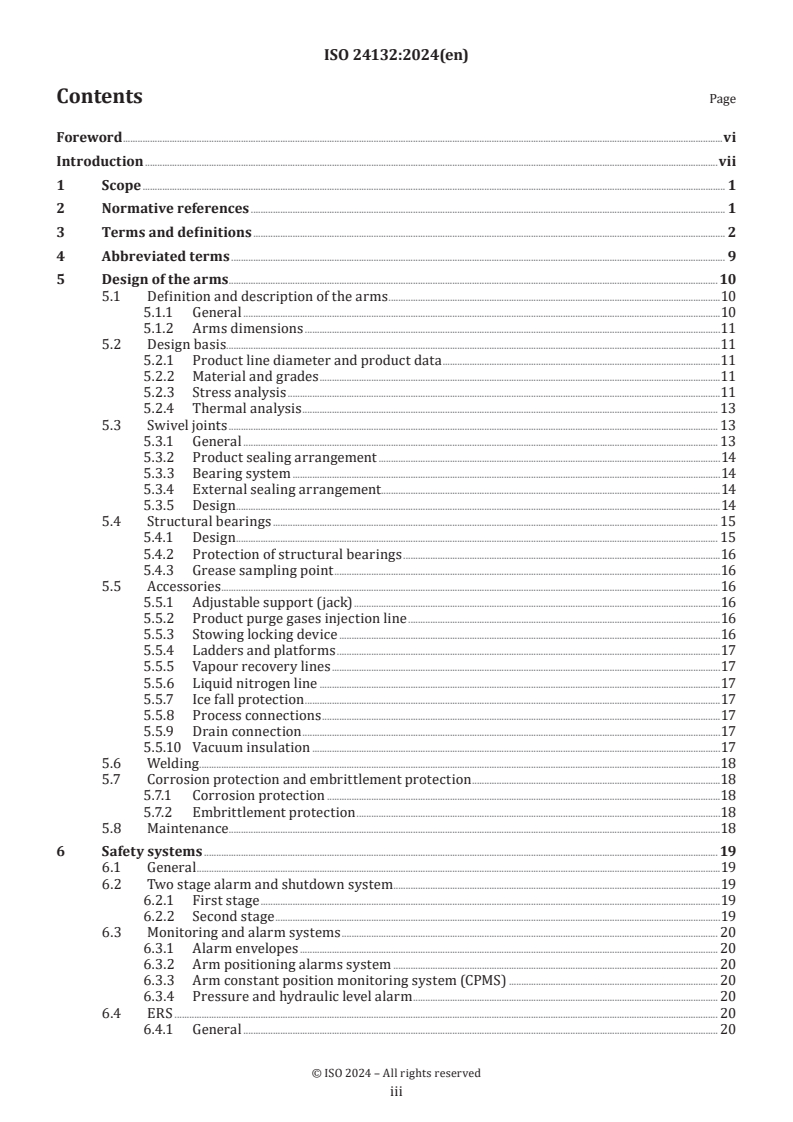
Contents Page
Foreword .vi
Introduction .vii
1 Scope . 1
2 Normative references . 1
3 Terms and definitions . 2
4 Abbreviated terms . 9
5 Design of the arms . 10
5.1 Definition and description of the arms .10
5.1.1 General .10
5.1.2 Arms dimensions .11
5.2 Design basis.11
5.2.1 Product line diameter and product data .11
5.2.2 Material and grades .11
5.2.3 Stress analysis .11
5.2.4 Thermal analysis . 13
5.3 Swivel joints . 13
5.3.1 General . 13
5.3.2 Product sealing arrangement .14
5.3.3 Bearing system .14
5.3.4 External sealing arrangement.14
5.3.5 Design . .14
5.4 Structural bearings . 15
5.4.1 Design . 15
5.4.2 Protection of structural bearings .16
5.4.3 Grease sampling point .16
5.5 Accessories .16
5.5.1 Adjustable support (jack) .16
5.5.2 Product purge gases injection line .16
5.5.3 Stowing locking device .16
5.5.4 Ladders and platforms .17
5.5.5 Vapour recovery lines .17
5.5.6 Liquid nitrogen line .17
5.5.7 Ice fall protection .17
5.5.8 Process connections .17
5.5.9 Drain connection .17
5.5.10 Vacuum insulation .17
5.6 Welding . .18
5.7 Corrosion protection and embrittlement protection .18
5.7.1 Corrosion protection .18
5.7.2 Embrittlement protection .18
5.8 Maintenance .18
6 Safety systems . 19
6.1 General .19
6.2 Two stage alarm and shutdown system .19
6.2.1 First stage .19
6.2.2 Second stage .19
6.3 M onitoring and alarm systems . 20
6.3.1 Alarm envelopes . 20
6.3.2 Arm positioning alarms system . 20
6.3.3 Arm constant position monitoring system (CPMS) . 20
6.3.4 Pressure and hydraulic level alarm . 20
6.4 ERS . 20
6.4.1 General . 20
iii
6.4.2 Design of the ERS .21
6.4.3 Safety devices on the ERS . .21
6.5 Safety devices . 22
6.5.1 Fire safety requirements . 22
6.5.2 Electrical safety requirements . 22
6.5.3 Failure of power supply . 23
6.5.4 Stray current protectors . 23
6.5.5 Bonding . 23
6.5.6 Safety for liquid oxygen. 23
7 Connection with the ship .24
7.1 General .24
7.2 Design of QCDC .24
7.3 QCDC system .24
7.4 Flange cover . 25
8 Hydraulic and electric control systems .25
8.1 General . 25
8.2 Arms operations . 26
8.3 Hydraulic components . 26
8.4 Electric components .27
8.5 Testing of control systems . 28
8.6 Remote control . 28
8.7 Transfer arms jetty control console . 29
9 Inspections and tests .29
9.1 General . 29
9.2 Prototype test . 29
9.2.1 General . 29
9.2.2 Swivel joint . 29
9.2.3 ERS .32
9.2.4 Insulation flange . 34
9.2.5 QCDC . 35
9.3 Manufacturing inspection and tests . 36
9.3.1 General . 36
9.3.2 Materials .37
9.3.3 Welding .37
9.3.4 Non-destructive test .37
9.3.5 Dimensional inspection.37
9.3.6 Pressure test .37
9.3.7 ERS . 38
9.3.8 Insulating flange (stray current protector) . 38
9.3.9 QCDC . 38
9.3.10 Hydraulic circuit test . 39
9.4 Factory acceptance tests . 39
9.5 Site acceptance tests . 40
9.5.1 General . 40
9.5.2 Transfer arm assembly . 40
9.5.3 Hydraulic circuit .42
10 Quality assurance and control .42
10.1 General .42
10.2 Quality plan .42
11 Required documentation .43
Annex A (informative) Design data sheets .44
Annex B (informative) Reference table and figures .50
Annex C (informative) Examples of documentation requirements .54
Annex D (informative) Method of gas displacement .60
iv
Bibliography . 61
v
Foreword
ISO (the International Organization for Standardization) is a worldwide federation of national standards
bodies (ISO member bodies). The work of preparing International Standards is normally carried out through
ISO technical committees. Each member body interested in a subject for which a technical committee
has been established has the right to be represented on that committee. International organizations,
governmental and non-governmental, in liaison with ISO, also take part in the work. ISO collaborates closely
with the International Electrotechnical Commission (IEC) on all matters of electrotechnical standardization.
The procedures used to develop this document and those intended for its further maintenance are described
in the ISO/IEC Directives, Part 1. In particular, the different approval criteria needed for the different types
of ISO documents should be noted. This document was drafted in accordance with the editorial rules of the
ISO/IEC Directives, Part 2 (see www.iso.org/directives).
Attention is drawn to the possibility that some of the elements of this document may be the subject of patent
rights. ISO shall not be held responsible for identifying any or all such patent rights. Details of any patent
rights identified during the development of the document will be in the Introduction and/or on the ISO list of
patent declarations received (see www.iso.org/patents).
Any trade name used in this document is information given for the convenience of users and does not
constitute an endorsement.
For an explanation of the voluntary nature of standards, the meaning of ISO specific terms and expressions
related to conformity assessment, as well as information about ISO's adherence to the World Trade
Organization (WTO) principles in the Technical Barriers to Trade (TBT), see www.iso.org/iso/foreword.html.
This document was prepared by Technical Committee ISO/TC 8, Ships and marine technology, Subcommittee
SC 2, Marine environment protection.
Any feedback or questions on this document should be directed to the user’s national standards body. A
complete listing of these bodies can be found at www.iso.org/members.html.
vi
Introduction
The twenty-first session of the Conference of the Parties (COP21) of the United Nations Framework
Convention on Climate Change (UNFCCC) was held in Paris, France in December 2015 and finally adopted
an agreement for the prevention of global warming, the Paris Agreement. The Agreement requires Parties'
efforts to achieve zero net anthropogenic greenhouse gas (GHG) emissions during the second half of the 21st
century. The International Maritime Organization (IMO) adopted a strategic plan to reduce GHG emissions
from the maritime sector by 50 % in 2050 and finally to zero level within this century. Since the required
reduction of GHG emissions is not attainable by a simple improvement in efficiency, the substitution of
alternative fuels, including hydrogen, ammonia, and biofuels, for present fossil energies must be considered.
Among them, hydrogen is one of the most present energy carriers, not only as fuel, but also as storage and
transportation media.
A massive and long-distance transport of hydrogen by ships from production areas to consumption areas
would be necessary because production plants are often constructed far from consumption areas, which are
typically cities and industrial areas where hydrogen would be used in gas/steam turbine power plants and
transportation systems such as railways, automobiles and ships.
In the marine transportation system of liquefied hydrogen, transfer from shore to ship would take place
using transfer arms. A number of transfer arms are currently used for the loading and unloading of liquefied
natural gas (LNG) at marine terminals. However, the temperature difference between LNG (−162 °C) and
liquefied hydrogen (−253 °C) is critical and requires a significant change in the design of the transfer arms.
Transfer systems minimize heat loss by applying high performance heat insulation technology. Liquid
oxygen (−183 °C) formation on the outer surface of the system should be strictly prevented because some
materials can detonate unpredictably from sources of ignition such as flames, sparks or impact from light
blows if soaked in liquefied oxygen (LO2). Leakage should also be prevented because the hydrogen molecule
is small in size and hydrogen gas is flammable over a wide range of concentrations.
To ensure the safe and smooth transportation of liquefied hydrogen, well-qualified transfer arms that are
compatible with the on-board equipment of hydrogen carriers should be installed at each terminal. This
document is, therefore, developed to provide technical guidance and safety requirements for liquefied
hydrogen marine transfer arms.
vii
International Standard ISO 24132:2024(en)
Ships and marine technology — Design and testing of marine
transfer arms for liquefied hydrogen
1 Scope
This document specifies the design, minimum safety requirements, and inspection and testing procedures
for liquefied hydrogen (LH2) marine transfer arms intended for use at onshore LH2 terminals handling LH2
carriers. It also covers the minimum requirements for safe LH2 transfer between ship and shore.
Although the requirements for power/control systems are covered, this document does not include all of
the details for the design and fabrication of standard parts and fittings associated with transfer arms.
This document is mainly focused on hard pipe type transfer systems; hose type transfer systems are not
described in detail in the general description of this document. However, hose type transfer systems can
also be considered as reasonable vacuum insulated technology for the design of transfer arms for liquefied
hydrogen.
2 Normative references
The following documents are referred to in the text in such a way that some or all of their content constitutes
requirements of this document. For dated references, only the edition cited applies. For undated references,
the latest edition of the referenced document (including any amendments) applies.
ISO 3452-1, Non-destructive testing — Penetrant testing — Part 1: General principles
ISO 4406, Hydraulic fluid power — Fluids — Method for coding the level of contamination by solid particles
ISO 9934-1, Non-destructive testing — Magnetic particle testing — Part 1: General principles
ISO 10474, Steel and steel products — Inspection documents
ISO 10497, Testing of valves — Fire type-testing requirements
ISO 16904, Petroleum and natural gas industries — Design and testing of LNG marine transfer arms for
conventional onshore terminals
ISO 17636-1, Non-destructive testing of welds — Radiographic testing — Part 1: X- and gamma-ray techniques
with film
ISO 17636-2, Non-destructive testing of welds — Radiographic testing — Part 2: X- and gamma-ray techniques
with digital detectors
IEC 60079-10-1, Explosive atmospheres — Part 10-1: Classification of areas - Explosive gas atmospheres
IEC 60079-0, Explosive atmospheres — Part 0: Equipment - General requirements
IEC 60079-1, Explosive atmospheres — Part 1: Equipment protection by flameproof enclosures “d”
IEC 60079-2, Explosive atmospheres — Part 2: Equipment protection by pressurized enclosure “p”
IEC 60079-5, Explosive atmospheres — Part 5: Equipment protection by powder filling “q”
IEC 60079-6, Explosive atmospheres — Part 6: Equipment protection by liquid immersion “o”
IEC 60079-7, Explosive atmospheres — Part 7: Equipment protection by increased safety “e”
IEC 60079-11, Explosive atmospheres — Part 11: Equipment protection by intrinsic safety “i”
IEC 60079-14, Explosive atmospheres — Part 14: Electrical installations design, selection and erection
IEC 60079-18, Explosive atmospheres — Part 18: Equipment protection by encapsulation “m”
IEC 60079-25, Explosive atmospheres — Part 25: Intrinsically safe electrical systems
IEC 60034-5, Rotating electrical machines — Part 5: Degrees of protection provided by the integral design of
rotating electrical machines (IP code) — Classification
IEC 60529, Degrees of protection provided by enclosures (IP Code)
IEC 62305-3, Protection against lightning — Part 3: Physical damage to structures and life hazard
ASME, Boiler and Pressure Vessel Code Section IX
3 Terms and definitions
For the purposes of this document, the following terms and definitions apply.
ISO and IEC maintain terminology databases for use in standardization at the following addresses:
— ISO Online browsing platform: available at https:// www .iso .org/ obp
— IEC Electropedia: available at https:// www .electropedia .org/
3.1
apex swivel
articulated, fluid-carrying joint located between the inboard arm (3.19) and outboard arm (3.32)
Note 1 to entry: See Figure B.2.
Note 2 to entry: It provides luffing (3.25) of the outboard arm relative to the inboard arm.
3.2
attitude
various modes of use and/or location of the transfer arm (3.58) (i.e. manoeuvring, stowed, connected,
hydrostatic test, and maintenance)
Note 1 to entry: The transfer arm can take several positions for each attitude.
3.3
base riser
riser
vertical assembly which bolts to the loading platform and supports the articulated assembly of the transfer
arm (3.58)
Note 1 to entry: See Figure B.2.
Note 2 to entry: Sometimes referred to as “standpost”.
3.4
bottom swivel
swivel joint accommodates the pitching (3.34) motion of the LH2 carrier (3.24) and is located adjacent to
presentation flange (3.36) in horizontal part of the TSA (3.59)
Note 1 to entry: See Figure B.2.
3.5
brinelling
permanent indentation in the swivel (3.54) or structural bearing (3.49) raceways caused by excessive loading
of balls or rollers
3.6
cargo manifold
pipe assembly mounted on board a LH2 carrier (3.24) to which the presentation flange (3.36) or QCDC (3.38)
of the transfer arm (3.58) is connected
Note 1 to entry: See Figure B.2.
3.7
cavitation
formation and collapse of bubbles in a liquid at or below the liquid saturated vapour pressure
Note 1 to entry: The collapse releases energy and may cause erosion at the cavitation sites, sometimes with an audible
sound and vibration.
Note 2 to entry: Such low pressures occur in high velocity zones such as the inner radius of elbows, or at places with
variations of diameters.
3.8
clash
contact during design operational conditions, or as a result of an emergency separation
Note 1 to entry: This contact can occur between any part of a transfer arm (3.58) and:
— adjacent transfer arm while both arms are operating, or one arm is operating, and the other arm is stowed (e.g. the
counterweights (3.10));
— adjacent section of the same transfer arm (e.g. triple swivel assembly (3.59) and the outboard arm (3.32));
— loading platform equipment (e.g. counterweight (3.10) and piping or valves).
3.9
contact angle
α
angle between the plane of the swivel joint (3.54) or structural bearing (3.49) balls or rollers and the centre
of contact at the ball or roller raceway interface
3.10
counterweight
system of weights used to balance the inboard arm (3.19) and outboard arm (3.32) assemblies
Note 1 to entry: Some transfer arms (3.58) have a single counterweight for this function and others have multiple
counterweights.
3.11
design pressure
pressure for which the transfer arm (3.58) is designed
3.12
design temperature
range of temperatures for which the transfer arm (3.58) is designed
3.13
drift
longitudinal and/or lateral displacement of the LH2 carrier (3.24) due to the influence of environmental forces
Note 1 to entry: See also surge fore (3.51) or surge aft (3.50) and sway (3.53).
3.14
emergency release system
ERS
system that provides a positive means of quick release of transfer arms (3.58) and safe isolation between the
LH2 carrier (3.24) and shore, following a predefined procedure including an emergency shutdown (ESD) (3.15)
Note 1 to entry: This is also known as an emergency release coupling (ERC).
Note 2 to entry: See Figure B.2.
3.15
emergency shutdown
ESD
method that safely and effectively stops the transfer of LH2 and vapour between the LH2 carrier (3.24) and shore
3.16
freeboard
vertical distance between the ship's deck and the water level at the manifold location
3.17
free wheel
ability of a hydraulically operated transfer arm (3.58) when connected to a LH2 carrier (3.24) to follow freely,
without hydraulic restraint, the vertical and horizontal motions of the LH2 carrier's manifold (draft changes
and sway (3.53) and surge motions)
3.18
heave
vertical motion of the LH2 carrier (3.24) due to wave action
3.19
inboard arm
product-carrying pipe and any structural members contained between the apex swivel (3.1) and the trunnion
swivel (3.60)
Note 1 to entry: See Figure B.2.
3.20
included angle
angle formed between inboard arm (3.19) and outboard arm (3.32)
Note 1 to entry: See Figure B.2.
Note 2 to entry: The maximum and minimum included angles are left to the transfer arm manufacturer.
Note 3 to entry: The included angle in the stowed position of the transfer arms (3.58) is such, that the arms are parked
with the triple swivel assembly (3.59) behind the berthing line.
3.21
insulating flange
electrical insulating system, usually dedicated, that is installed in the lower end of the outboard arm (3.32)
or in the vertical part of the triple swivel assembly (3.59)
Note 1 to entry: Its purpose is to prevent stray currents from causing an arc at the LH2 carrier's (3.24) flange as the
transfer arm (3.58) is connected or disconnected.
3.22
jack
permanent, adjustable load-carrying mechanism potentially installed in the triple swivel assembly (3.59)
to transfer a portion of the transfer arm (3.58) fluid weight to the deck instead of the LH2 carrier's (3.24)
manifold
Note 1 to entry: See Figure B.2.
3.23
jetty control centre
control centre situated on or adjacent to the jetty primarily to control and/or monitor the transfer arms (3.58)
Note 1 to entry: Sometimes referred to as “jetty control room” or “local control room”.
3.24
LH2 carrier
LH2C
tank ship designed for the carriage of LH2
3.25
luffing
rotary motions of the inboard arm (3.19) and outboard arm (3.32) in the vertical plane
Note 1 to entry: See Figure B.2.
3.26
main hydraulic unit
MHU
hydraulic unit that generates hydraulic power to ensure the normal operation and emergency release
sequence of the arms
3.27
manifold setback
horizontal distance between the board side of the LH2 carrier (3.24) and the face of the cargo manifold (3.6)
3.28
manifold spacing
horizontal distance between two adjacent cargo manifold (3.6) flange axes
3.29
middle swivel
swivel joint accommodates yawing (3.62) and surge of the LH2 carrier (3.24) and is located between the top
swivel (3.56) and bottom swivel (3.4) in the vertical part of the TSA (3.59)
Note 1 to entry: See Figure B.2.
3.30
onshore LH2 terminal
LH2 exporting or receiving terminal that is located on shore and that has marine transfer arms (3.58) for the
loading or unloading of LH2 carriers (3.24) in a harbour or other sheltered coastal location
3.31
operating envelope
volume in which presentation flange(s) (3.36) of a (group of) transfer arm(s) (3.58) is (are) required to operate
3.32
outboard arm
product-carrying pipe and any structural members contained between the apex swivel (3.1) and the triple
swivel assembly (3.59)
Note 1 to entry: See Figure B.2.
3.33
owner
designated agent
company or group of companies for whose use the transfer arms (3.58) are installed, responsible for the safe
design and construction of the installation
3.34
pitch
rotation of the LH2 carrier (3.24) around the transversal horizontal axis
3.35
powered emergency release coupling
PERC
powered device to provide a means of quick release of the transfer arms (3.58) when such action is required
only as an emergency measure
3.36
presentation flange
transfer arm (3.58) flange for connection to either the cargo manifold (3.6) or spool piece (3.46)
Note 1 to entry: See Figure B.2.
3.37
product
fluid transferred using transfer arms (3.58)
Note 1 to entry: Fluids are LH2 or GH2.
3.38
quick connect disconnect coupler
QCDC
coupler
manual or hydraulic mechanical device used to connect the transfer arm (3.58) to the cargo manifold (3.6) or
spool piece (3.46) without employing bolts
Note 1 to entry: See Figure B.2.
3.39
remote pendant control
remote control
device to facilitate the fine manoeuvring operation of the transfer arms (3.58) from a remote location (e.g.
LH2 carrier's (3.24) cargo manifold (3.6) area)
Note 1 to entry: The system can use a trailing wire or radio-controlled system.
3.40
riser and trunnion swivel assembly
fluid carrying system consisting of a riser swivel (3.42), trunnion swivel (3.60) and elbows, and mounted on
top of the base riser (3.3)
Note 1 to entry: See Figure B.2.
3.41
riser flange
transfer arm (3.58) flange for connection to LH2 piping
Note 1 to entry: See Figure B.2.
3.42
riser swivel
swing joint in the riser and trunnion swivel assembly (3.40) which permits slewing (3.45) of the transfer arm (3.58)
Note 1 to entry: See Figure B.2.
3.43
roll
rotation of LH2 carrier (3.24) around longitudinal horizontal axis
3.44
safety integrity level
SIL
statistical representations of the integrity of the safety instrumented system when a process demand occurs
Note 1 to entry: See Clause 6.
3.45
slew
horizontal, rotary motion of the transfer arm (3.58) around the base riser (3.3)
Note 1 to entry: See Figure B.2.
3.46
spool piece
short length of pipe for the purpose of matching the cargo manifold (3.6) to the presentation flange (3.36) or
the QCDC (3.38)
Note 1 to entry: Sometimes referred to as “adaptor” or “short distance piece”.
3.47
spotting line
pre-determined location on the jetty used by the LH2 carrier (3.24) when berthing to align with the LH2
carrier vapour manifold
Note 1 to entry: See Figure A.1.
3.48
stress analysis
detailed calculation of the structural loading in the transfer arm (3.58) and cargo manifold (3.6) for various
positions and attitudes to check the integrity of the transfer arm for the service intended
3.49
structural bearing
bearing in the load carrying components supporting the product line that, in combination, allow the transfer
arm (3.58) to follow freely the motion of the LH2 carrier (3.24)
3.50
surge aft
longitudinal LH2 carrier (3.24) afterward motion
3.51
surge fore
longitudinal LH2 carrier (3.24) forward motion
3.52
surge pressure
rapid change in pressure as a consequence of a change in flow rate in a pipeline and/or piping systems
(including transfer arms (3.58))
3.53
sway
transverse LH2 carrier (3.24) motion
3.54
swivel joint
swivel
swing joint contained in the transfer arm (3.58) to permit the arm to follow freely the motion of the LH2
carrier (3.24)
3.55
terminal
LH2 producing/receiving plant with loading/unloading facilities
3.56
top swivel
swivel joint accommodates rolling (3.43), heave (3.18) and sway (3.53) motion of the LH2 carrier (3.24) and
is located between the outboard arm (3.32) and middle swivel (3.29) in the horizontal part of the triple swivel
assembly (3.59)
Note 1 to entry: See Figure B.2.
3.57
transfer
loading or unloading operation
3.58
transfer arm
arm
articulated metal transfer system used for transferring product (3.37) to or from the LH2 carrier (3.24) with
the capability of accommodating differences in tides, freeboard (3.16) and the LH2 carrier's motions
Note 1 to entry: See Figure B.2.
Note 2 to entry: It can be referred to as a “loading arm” or “unloading arm”.
3.59
triple swivel assembly
TSA
group of three swivels (3.54) and elbows located at the end of the outboard arm (3.32)
Note 1 to entry: See Figure B.2.
3.60
trunnion swivel
swing joint in riser and trunnion swivel assembly (3.40) which permits the inboard arm (3.19) to rotate
around the horizontal axis
Note 1 to entry: See Figure B.2.
3.61
uninterruptible power supply
UPS
back-up of the electrical supply system providing power to critical control and safety systems so that the
plant can be kept in safe conditions
3.62
yaw
rotation of the LH2 carrier (3.24) around vertical axis
4 Abbreviated terms
For the purposes of this document, the following abbreviated terms apply.
CPMS constant position monitoring system
DL dead load
EMC electro-magnetic compatibility
ERS emergency release system
ESD emergency shutdown
FL fluid load
GH2 gaseous hydrogen
He helium
H2 hydrogen gas
IP ingress protection
LHe liquefied helium
LH2 liquefied hydrogen
LNG liquefied natural gas
LH2C liquefied hydrogen carrier
LN2 liq
...