


ISO/FDIS 14025
(Main)Environmental statements and programmes for products — Environmental product declarations (EPDs)
Environmental statements and programmes for products — Environmental product declarations (EPDs)
ISO 14025:2006 establishes the principles and specifies the procedures for developing Type III environmental declaration programmes and Type III environmental declarations. It specifically establishes the use of the ISO 14040 series of standards in the development of Type III environmental declaration programmes and Type III environmental declarations. ISO 14025:2006 establishes principles for the use of environmental information, in addition to those given in ISO 14020:2000 Type III environmental declarations as described in ISO 14025:2006 are primarily intended for use in business-to-business communication, but their use in business-to-consumer communication under certain conditions is not precluded.
Déclarations environnementales et programmes pour les produits — Déclarations environnementales de produits (DEP)
L'ISO 14025:2006 établit les principes et les procédures de développement de déclarations environnementales de Type III et des programmes correspondants. Elle établit spécifiquement l'utilisation de la série de normes ISO 14040 pour le développement de déclarations environnementales de Type III et des programmes correspondants. L'ISO 14025:2006 établit également les principes relatifs à l'utilisation d'informations environnementales additionnelles. Les déclarations environnementales de Type III décrites par l'ISO 14025:2006 sont principalement destinées à une communication interentreprises, mais leur utilisation pour la communication entre une entreprise et des particuliers dans certaines conditions n'est pas exclue.
General Information
- Status
- Not Published
- Technical Committee
- ISO/TC 207/SC 3 - Environmental labelling
- Drafting Committee
- ISO/TC 207/SC 3 - Environmental labelling
- Current Stage
- 5020 - FDIS ballot initiated: 2 months. Proof sent to secretariat
- Start Date
- 26-Mar-2026
- Completion Date
- 26-Mar-2026
Relations
- Effective Date
- 12-Feb-2026
- Effective Date
- 19-Aug-2023
Overview
ISO/FDIS 14025:2026 is a key international standard developed by the International Organization for Standardization (ISO) that provides principles, requirements, and guidance for the development and operation of Environmental Product Declaration (EPD) programmes and the creation of EPDs for products. Environmental product declarations offer transparent, verified, and comparable information about the environmental performance of products throughout their life cycle, following the principles of Life Cycle Assessment (LCA) as defined in ISO 14040 and ISO 14044.
This standard is designed for use primarily in business-to-business (B2B) communication but can also be applied in business-to-consumer (B2C) contexts under specific conditions. ISO 14025:2026 emphasizes the harmonization of environmental information and the credibility of environmental product declarations, supporting sustainability, informed product comparisons, and continual environmental improvement.
Key Topics
Principles for EPD Programmes
Establishes the fundamental principles and structures required for the operation of EPD programmes, including transparency, objectivity, and comparability.EPD Development Requirements
Specifies the procedures for preparing EPDs, including the use of independently verified LCA data and predetermined impact indicators.Programme Administration
Outlines the responsibilities of EPD programme operators, including General Programme Instructions (GPI), involvement of interested parties, and continual improvement.Use of Product Category Rules (PCRs)
Provides guidance for developing and applying PCRs-sets of rules specific to product categories to ensure consistent LCA methodologies and EPD content.Verification and Review
Details requirements for independent verification of both PCRs and EPDs, including third-party verification for B2C EPDs.Communication and Reporting
Addresses requirements and best practices for presenting EPDs, including content structure, additional environmental or sustainability information, and appropriate formats for intended audiences.Harmonization and Mutual Recognition
Supports the alignment of EPD programmes and PCRs globally to facilitate mutual recognition and comparability.
Applications
ISO 14025:2026 and EPDs play a strategic role across industries seeking to evaluate and communicate the environmental aspects of their products. Practical applications include:
Green Public Procurement
Public and private sector procurement can use verified EPDs to make evidence-based purchasing decisions and support environmentally sustainable supply chains.Product Development and Innovation
Manufacturers can identify opportunities to reduce the environmental impact of their products, improve designs, and validate improvements with transparent life cycle data.Sustainability Reporting and Marketing
Organizations can use EPDs to demonstrate environmental responsibility, comply with regulatory requirements, and differentiate their products in markets demanding increased transparency.Building and Construction
EPDs for construction products support green building certifications, such as LEED or BREEAM, and contribute to life cycle assessments of buildings and infrastructure.Comparative Environmental Claims
While EPDs themselves are not comparative assertions, they provide standardized data that enable fair product comparisons based on environmental performance within the same product category.
Related Standards
ISO/FDIS 14025:2026 is part of a comprehensive suite of ISO standards for environmental management and declarations. Related standards include:
- ISO 14020:2022 - Principles and general requirements for environmental statements and programmes for products
- ISO/TS 14027 - Development of Product Category Rules (PCRs)
- ISO/TS 14029 - Mutual recognition of EPDs and footprint communication programmes
- ISO 14040 / ISO 14044 - Life cycle assessment principles, framework, and requirements
- ISO 14050 - Vocabulary for environmental management
Organizations adopting ISO 14025:2026 are encouraged to reference and align with these related standards to ensure consistency, credibility, and compatibility in environmental declarations and sustainability communication.
By following ISO 14025, businesses can enhance transparency, support sustainable development goals, and respond to increasing market demands for reliable environmental information through EPDs.
Buy Documents

ISO/FDIS 14025 - Environmental statements and programmes for products — Environmental product declarations (EPDs)
REDLINE ISO/FDIS 14025 - Environmental statements and programmes for products — Environmental product declarations (EPDs)

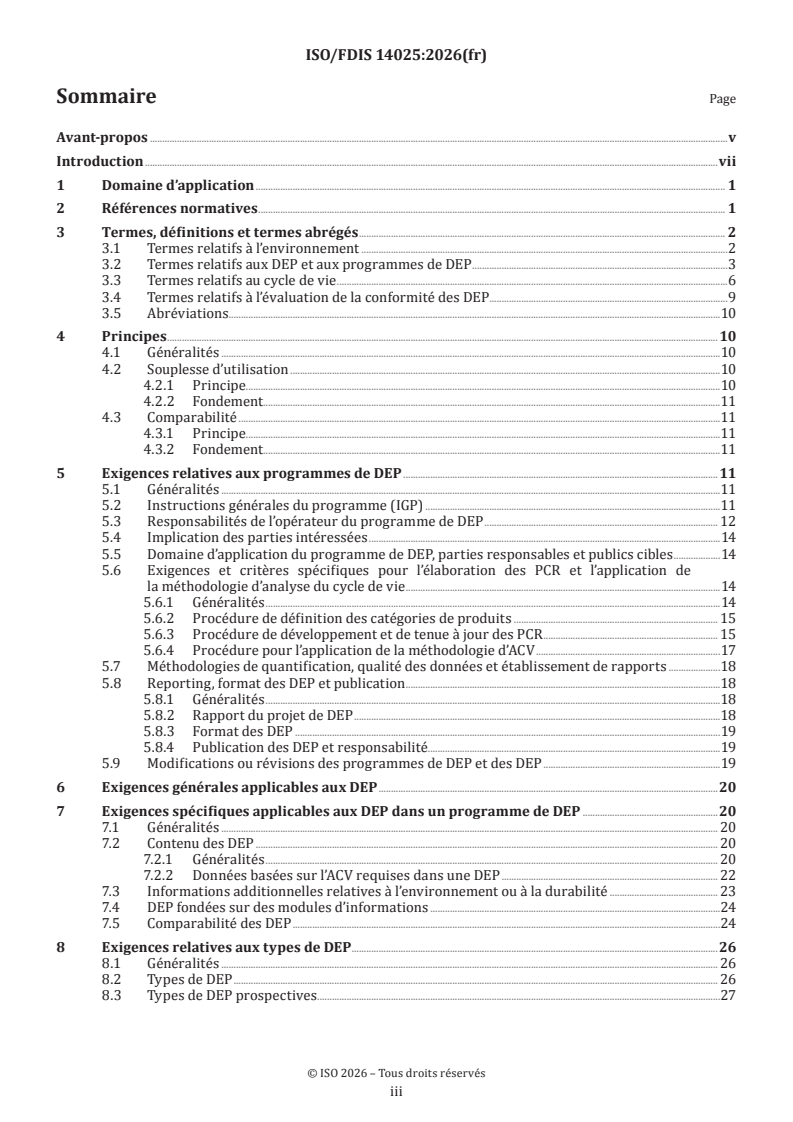
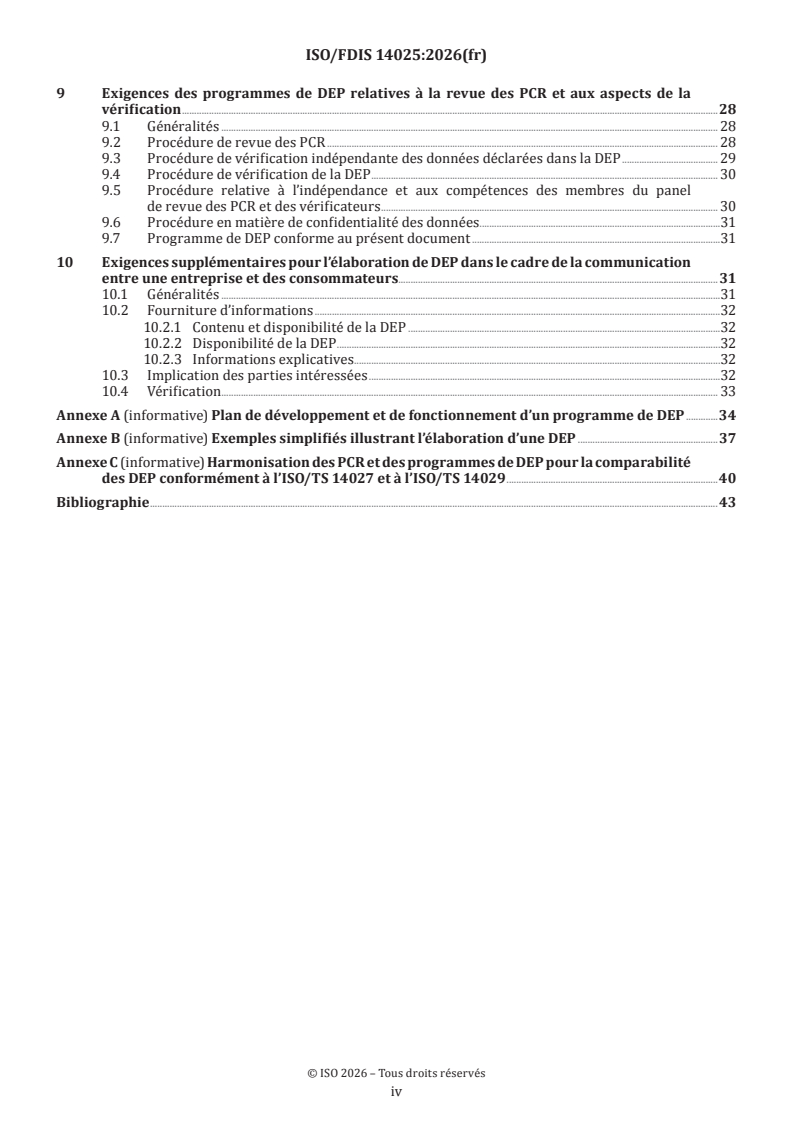
ISO/FDIS 14025 - Déclarations environnementales et programmes pour les produits — Déclarations environnementales de produits (DEP)
Get Certified
Connect with accredited certification bodies for this standard

BSI Group
BSI (British Standards Institution) is the business standards company that helps organizations make excellence a habit.

Bureau Veritas
Bureau Veritas is a world leader in laboratory testing, inspection and certification services.

DNV
DNV is an independent assurance and risk management provider.
Sponsored listings
Frequently Asked Questions
ISO/FDIS 14025 is a draft published by the International Organization for Standardization (ISO). Its full title is "Environmental statements and programmes for products — Environmental product declarations (EPDs)". This standard covers: ISO 14025:2006 establishes the principles and specifies the procedures for developing Type III environmental declaration programmes and Type III environmental declarations. It specifically establishes the use of the ISO 14040 series of standards in the development of Type III environmental declaration programmes and Type III environmental declarations. ISO 14025:2006 establishes principles for the use of environmental information, in addition to those given in ISO 14020:2000 Type III environmental declarations as described in ISO 14025:2006 are primarily intended for use in business-to-business communication, but their use in business-to-consumer communication under certain conditions is not precluded.
ISO 14025:2006 establishes the principles and specifies the procedures for developing Type III environmental declaration programmes and Type III environmental declarations. It specifically establishes the use of the ISO 14040 series of standards in the development of Type III environmental declaration programmes and Type III environmental declarations. ISO 14025:2006 establishes principles for the use of environmental information, in addition to those given in ISO 14020:2000 Type III environmental declarations as described in ISO 14025:2006 are primarily intended for use in business-to-business communication, but their use in business-to-consumer communication under certain conditions is not precluded.
ISO/FDIS 14025 is classified under the following ICS (International Classification for Standards) categories: 13.020.50 - Ecolabelling. The ICS classification helps identify the subject area and facilitates finding related standards.
ISO/FDIS 14025 has the following relationships with other standards: It is inter standard links to FprEN ISO 14025, ISO 14025:2006. Understanding these relationships helps ensure you are using the most current and applicable version of the standard.
ISO/FDIS 14025 is available in PDF format for immediate download after purchase. The document can be added to your cart and obtained through the secure checkout process. Digital delivery ensures instant access to the complete standard document.
Standards Content (Sample)
FINAL DRAFT
International
Standard
ISO/TC 207/SC 3
Environmental statements and
Secretariat: SA
programmes for products —
Voting begins on:
Environmental product declarations
2026-03-26
(EPDs)
Voting terminates on:
2026-05-21
Allégations environnementales et programmes pour les
produits — Déclarations environnementales de produits (DEP)
RECIPIENTS OF THIS DRAFT ARE INVITED TO SUBMIT,
WITH THEIR COMMENTS, NOTIFICATION OF ANY
RELEVANT PATENT RIGHTS OF WHICH THEY ARE AWARE
AND TO PROVIDE SUPPOR TING DOCUMENTATION.
IN ADDITION TO THEIR EVALUATION AS
BEING ACCEPTABLE FOR INDUSTRIAL, TECHNO
ISO/CEN PARALLEL PROCESSING LOGICAL, COMMERCIAL AND USER PURPOSES, DRAFT
INTERNATIONAL STANDARDS MAY ON OCCASION HAVE
TO BE CONSIDERED IN THE LIGHT OF THEIR POTENTIAL
TO BECOME STAN DARDS TO WHICH REFERENCE MAY BE
MADE IN NATIONAL REGULATIONS.
Reference number
FINAL DRAFT
International
Standard
ISO/TC 207/SC 3
Environmental statements and
Secretariat: SA
programmes for products —
Voting begins on:
Environmental product declarations
(EPDs)
Voting terminates on:
Allégations environnementales et programmes pour les
produits — Déclarations environnementales de produits (DEP)
RECIPIENTS OF THIS DRAFT ARE INVITED TO SUBMIT,
WITH THEIR COMMENTS, NOTIFICATION OF ANY
RELEVANT PATENT RIGHTS OF WHICH THEY ARE AWARE
AND TO PROVIDE SUPPOR TING DOCUMENTATION.
© ISO 2026
IN ADDITION TO THEIR EVALUATION AS
All rights reserved. Unless otherwise specified, or required in the context of its implementation, no part of this publication may
BEING ACCEPTABLE FOR INDUSTRIAL, TECHNO
ISO/CEN PARALLEL PROCESSING
LOGICAL, COMMERCIAL AND USER PURPOSES, DRAFT
be reproduced or utilized otherwise in any form or by any means, electronic or mechanical, including photocopying, or posting on
INTERNATIONAL STANDARDS MAY ON OCCASION HAVE
the internet or an intranet, without prior written permission. Permission can be requested from either ISO at the address below
TO BE CONSIDERED IN THE LIGHT OF THEIR POTENTIAL
or ISO’s member body in the country of the requester.
TO BECOME STAN DARDS TO WHICH REFERENCE MAY BE
MADE IN NATIONAL REGULATIONS.
ISO copyright office
CP 401 • Ch. de Blandonnet 8
CH-1214 Vernier, Geneva
Phone: +41 22 749 01 11
Email: copyright@iso.org
Website: www.iso.org
Published in Switzerland Reference number
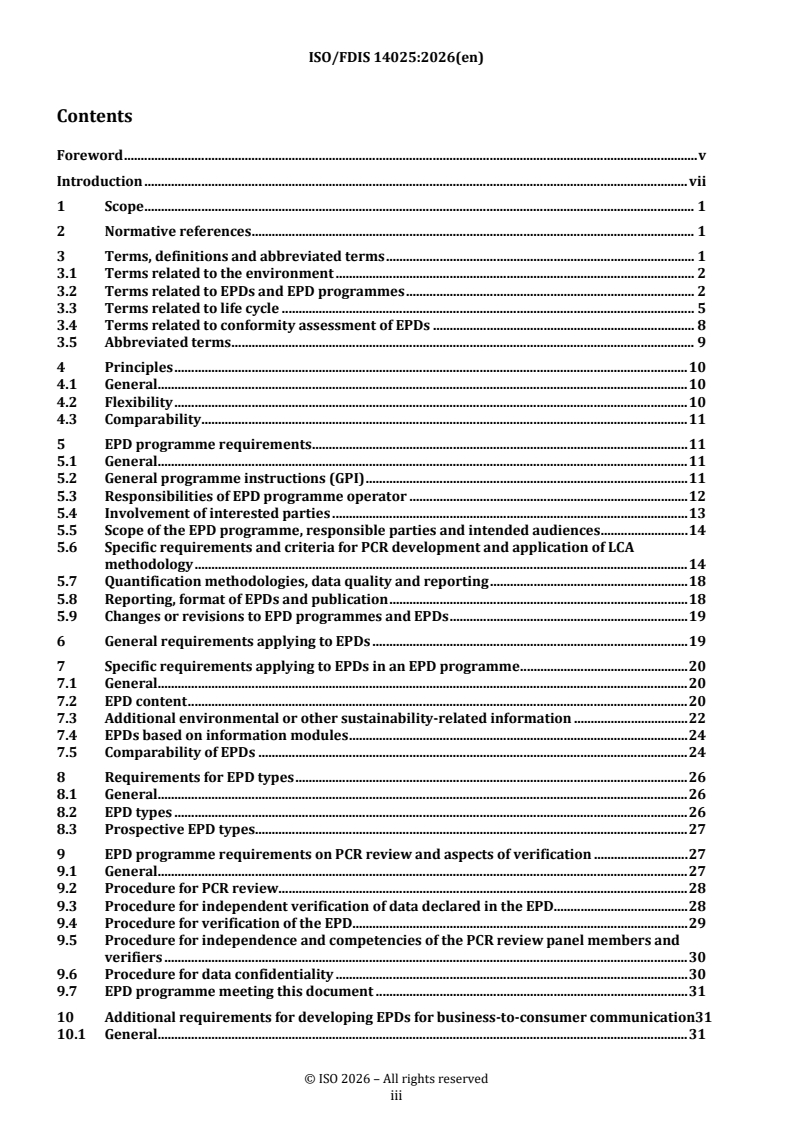
ii
Contents Page
Foreword .v
Introduction .vii
1 Scope . 1
2 Normative references . 1
3 Terms, definitions and abbreviated terms . 1
3.1 Terms related to the environment .2
3.2 Terms related to EPDs and EPD programmes .2
3.3 Terms related to life cycle.5
3.4 Terms related to conformity assessment of EPDs .8
3.5 Abbreviated terms .9
4 Principles . 9
4.1 General .9
4.2 Flexibility.10
4.2.1 Principle .10
4.2.2 Rationale .10
4.3 Comparability .10
4.3.1 Principle .10
4.3.2 Rationale .10
5 EPD programme requirements .10
5.1 General .10
5.2 General programme instructions (GPI) .10
5.3 Responsibilities of EPD programme operator .11
5.4 Involvement of interested parties . 13
5.5 Scope of the EPD programme, responsible parties and intended audiences . 13
5.6 Specific requirements and criteria for PCR development and application of LCA
methodology . 13
5.6.1 General . 13
5.6.2 Procedures for definition of product categories .14
5.6.3 Procedure for the development and maintenance of PCRs .14
5.6.4 Procedure for the application of LCA methodology .16
5.7 Quantification methodologies, data quality and reporting .17
5.8 Reporting, format of EPDs and publication .17
5.8.1 General .17
5.8.2 EPD project report .17
5.8.3 EPD format .18
5.8.4 EPD publication and responsibility .18
5.9 Changes or revisions to EPD programmes and EPDs .18
6 General requirements applying to EPDs . 19
7 Specific requirements applying to EPDs in an EPD programme. 19
7.1 General .19
7.2 EPD content .19
7.2.1 General .19
7.2.2 LCA-based data required in an EPD .21
7.3 Additional environmental or other sustainability-related information .21
7.4 EPDs based on information modules . 23
7.5 Comparability of EPDs . 23
8 Requirements for EPD types .25
8.1 General . 25
8.2 EPD types . 25
8.3 Prospective EPD types . 25
9 EPD programme requirements on PCR review and aspects of verification .26
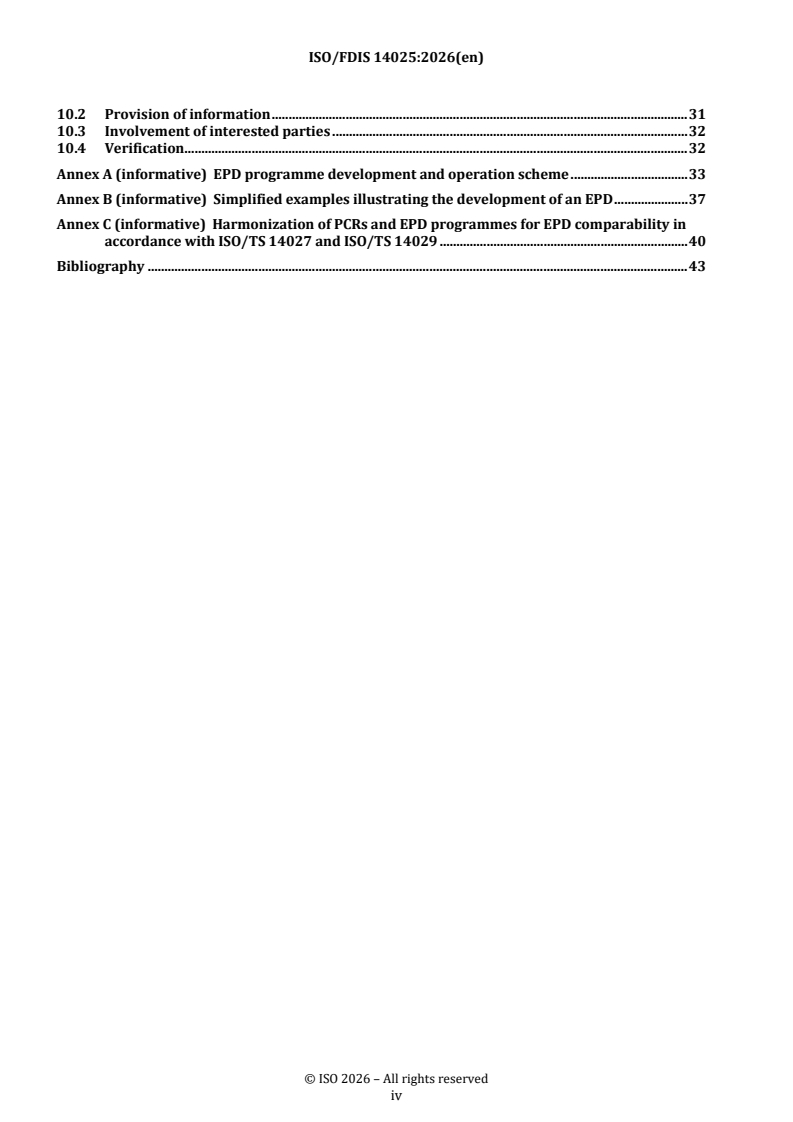
iii
9.1 General . 26
9.2 Procedure for PCR review .27
9.3 Procedure for independent verification of data declared in the EPD .27
9.4 Procedure for verification of the EPD . 28
9.5 Procedure for independence and competencies of the PCR review panel members and
verifiers . 28
9.6 Procedure for data confidentiality . 29
9.7 EPD programme meeting this document . 29
10 Additional requirements for developing EPDs for business-to-consumer communication.29
10.1 General . 29
10.2 Provision of information. 30
10.2.1 Content and availability of the EPD . 30
10.2.2 Availability of the EPD . 30
10.2.3 Explanatory information . 30
10.3 Involvement of interested parties . 30
10.4 Verification . . 30
Annex A (informative) EPD programme development and operation scheme .32
Annex B (informative) Simplified examples illustrating the development of an EPD .35
Annex C (informative) Harmonization of PCRs and EPD programmes for EPD comparability in
accordance with ISO/TS 14027 and ISO/TS 14029 .37
Bibliography .40
iv
Foreword
ISO (the International Organization for Standardization) is a worldwide federation of national standards
bodies (ISO member bodies). The work of preparing International Standards is normally carried out through
ISO technical committees. Each member body interested in a subject for which a technical committee
has been established has the right to be represented on that committee. International organizations,
governmental and non-governmental, in liaison with ISO, also take part in the work. ISO collaborates closely
with the International Electrotechnical Commission (IEC) on all matters of electrotechnical standardization.
The procedures used to develop this document and those intended for its further maintenance are described
in the ISO/IEC Directives, Part 1. In particular, the different approval criteria needed for the different types
of ISO document should be noted. This document was drafted in accordance with the editorial rules of the
ISO/IEC Directives, Part 2 (see www.iso.org/directives).
ISO draws attention to the possibility that the implementation of this document may involve the use of (a)
patent(s). ISO takes no position concerning the evidence, validity or applicability of any claimed patent
rights in respect thereof. As of the date of publication of this document, ISO had not received notice of (a)
patent(s) which may be required to implement this document. However, implementers are cautioned that
this may not represent the latest information, which may be obtained from the patent database available at
www.iso.org/patents. ISO shall not be held responsible for identifying any or all such patent rights.
Any trade name used in this document is information given for the convenience of users and does not
constitute an endorsement.
For an explanation of the voluntary nature of standards, the meaning of ISO specific terms and expressions
related to conformity assessment, as well as information about ISO's adherence to the World Trade
Organization (WTO) principles in the Technical Barriers to Trade (TBT), see www.iso.org/iso/foreword.html.
This document was prepared by Technical Committee ISO/TC 207, Environmental management, Subcommittee
SC 3, Environmental labelling, in collaboration with the European Committee for Standardization (CEN), in
accordance with the Agreement on technical cooperation between ISO and CEN (Vienna Agreement).
This second edition cancels and replaces the first edition (ISO 14025:2006), which has been technically
revised.
The main changes are as follows:
— the title has been updated;
— ISO/TS 14027 and ISO/TS 14029 have been added as normative references;
— new preferred terminology for critical concepts has been introduced and several original preferred
terms have been deprecated including “environmental label”, “environmental declaration” and “Type III
environmental declaration”;
— some of the content from Clauses 4, 5, 6 and 7 has been removed and transferred to the revised ISO 14020;
— a description of the concept of “additional environmental or other sustainability-related information”
and how to include this type of information into an EPD has been added;
— Clause 8 on requirements for EPD types has been added;
— Annex C on the harmonization of PCRs and EPD programmes for EPD comparability in accordance with
ISO/TS 14027 and ISO/TS 14029 has been added;
— EPD programme requirements on PCR review and aspects of verification to satisfy the demands of the
marketplace have been added;
— requirements for new EPD tools, in recognition of the growing reliance on such tools to automate
generation of EPDs, have been added.
v
Any feedback or questions on this document should be directed to the user’s national standards body. A
complete listing of these bodies can be found at www.iso.org/members.html.
vi
Introduction
0.1 This document contains principles, requirements and guidance for environmental product declaration
(EPD) programmes and EPDs. EPDs provide quantified environmental information on the life cycle of a
product that can support comparisons between products fulfilling the same function. EPDs:
— are provided by one or more organizations;
— are based on independently verified life cycle assessment (LCA) data, life cycle inventory analysis (LCI)
data or information modules in accordance with ISO 14040 and ISO 14044 and, where relevant and
available, additional environmental or other sustainability-related information;
— are developed using predetermined impact indicators and predetermined inventory indicators;
— are subject to the administration of a programme operator that acts objectively, avoiding any conflict of
interest (e.g. a company or group of companies, industrial sector or trade association, public authorities
or agencies, an independent scientific body, other organization).
0.2 EPDs are one type of environmental statement. The overall goals of environmental statements are to:
— communicate accurate information about environmental aspects or potential environmental impacts of
products;
— encourage the demand for and supply of products that cause less stress on the environment;
— stimulate market-driven continual environmental improvement in products;
— where relevant, support compliance with regulation.
0.3 An EPD is not in itself a comparative assertion and does not declare the environmental preferability of
a product.
0.4 EPD programmes following this document are required to ensure that both the supporting LCA data
and the resulting EPDs undergo independent verification, either internal or external to the responsible
party. This can, but does not necessarily, mean third-party verification except in the case of business-to-
consumer EPDs, in which case this document requires that EPD programmes specify that all verifications be
carried out as third-party verification.
0.5 Harmonization of general programme instructions (GPI) and particularly product category rules
(PCR) is encouraged between EPD programmes to be aligned with the principle of comparability (see 4.3).
This includes mutual recognition of rules with respect to PCR development, PCR review and verification
procedures, administrative procedures and EPD format. To help ensure comparability of EPDs, programme
operators are encouraged to work cooperatively to achieve harmonization of the programmes and PCRs and
to develop mutual recognition arrangements (MRAs).
To support harmonization, two complementary documents have been published: ISO/TS 14027 and
ISO/TS 14029. These supporting documents describe principles and requirements for PCR development and
MRA, respectively, and are complementary to the related clauses in this document.
NOTE Practical guidance on harmonization of PCRs and EPD programmes in accordance with ISO/TS 14027 and
ISO/TS 14029 in conjunction with this document can be found in Annex C.
0.6 The objective of this document is to harmonize the development and enhance the credibility of EPDs.
The benefits of applying this document are:
a) increased opportunities for purchasers, potential purchasers and users of products to make informed
comparisons of, and purchasing decisions related to, products;
b) to encourage improvement of the environmental performance of products;
c) to provide information for assessing the potential environmental impacts of products over their life
cycle;
vii
d) accurate and verified EPDs that are not misleading;
e) increased potential for market forces to stimulate environmental improvements in production processes
and products;
f) prevention or minimization of unwarranted EPDs and greenwashing;
g) reduction in marketplace confusion with other types of environmental statements and general
certification of products that fulfil environmental or other sustainability-related requirements.
0.7 This document is one of the documents developed by ISO/TC 207/SC 3 that provide principles,
requirements and guidance for different types of environmental statements about products. These
documents include the following:
— ISO 14020, which provides common terms and definitions, principles and general requirements for
all environmental statements (e.g. self-declared environmental claims, ecolabels, EPDs and footprint
communications) and associated programmes that enable the communication of environmental aspects
and environmental impacts of products.
— ISO 14021, which provides principles, requirements and guidance for environmental statements in the
form of self-declared environmental claims.
— ISO 14024, which provides principles, requirements and guidance for environmental statements in the
form of ecolabels.
— ISO 14025 (this document), which provides principles, requirements and guidance for environmental
statements in the form of EPDs.
— ISO 14026, which provides principles, requirements and guidance for environmental statements in the
form of footprint communications.
— ISO/TS 14027, which provides principles, requirements and guidance for PCR that support the use of
LCA as a method to compile and evaluate information that is used as a basis for making environmental
statements.
— ISO/TS 14029, which provides principles, requirements and guidance for the mutual recognition of EPDs,
footprint communications and associated programmes.
0.8 Environmental statement programme operators are encouraged to cooperate and harmonize with each
other, whenever relevant and applicable, to enhance the coherence of environmental statement programmes,
at regional, national and international levels.
0.9 Figure 1 provides the existing structure of the documents on environmental statements developed by
ISO/TC 207/SC 3 in graphic form.
viii
Figure 1 — Structure of documents on environmental statements developed by ISO/TC 207/SC 3
0.10 This document requires the user to apply the requirements in ISO 14020. Those requirements refer
to the generic term “environmental statement”. When reading this document and ISO 14020 together, the
generic term “environmental statement” in ISO 14020 can be interpreted as referring to the specific term
included in this document, i.e. “environmental product declaration (EPD)”.
0.11 EPDs developed in accordance with this document are a type of environmental statement based on
independently verified LCA data (see 0.1). As such, neither self-declared environmental claims developed
under ISO 14021 nor ecolabels developed under ISO 14024 are considered EPDs or a type of EPD. The
original terminology referring to Types I, II and III has been removed from all three documents and is no
longer preferred.
ix
FINAL DRAFT International Standard ISO/FDIS 14025:2026(en)
Environmental statements and programmes for products —
Environmental product declarations (EPDs)
1 Scope
1.1 This document specifies principles and requirements and gives guidance on environmental product
declaration (EPD) programmes and their associated EPDs. This document specifies the use of ISO 14040 and
ISO 14044 on life cycle assessment (LCA) in the development of EPDs.
1.2 This document is applicable to EPD programmes and their associated EPDs that are intended to
address the potential environmental impacts and environmental aspects of products, and which can also
include related social and economic aspects in support of sustainable development.
NOTE 1 This document does not deal with social or economic LCA indicators.
NOTE 2 Related social and economic aspects of the products can be reported as additional sustainability-related
information, where relevant and available.
1.3 This document provides requirements and guidance for the communication of the potential
environmental impacts and environmental aspects of products to the intended audience of the EPD.
1.4 This document does not apply to sector-specific provisions, which are dealt with in other ISO
documents. It is intended that sector-specific provisions in other ISO documents related to EPDs are based
on and use the principles, requirements and guidance of this document.
2 Normative references
The following documents are referred to in the text in such a way that some or all of their content constitutes
requirements of this document. For dated references, only the edition cited applies. For undated references,
the latest edition of the referenced document (including any amendments) applies.
ISO 14020:2022, Environmental statements and programmes for products — Principles and general
requirements
ISO/TS 14027, Environmental labels and declarations — Development of product category rules
ISO/TS 14029, Environmental statements and programmes for products — Mutual recognition of environmental
product declarations (EPDs) and footprint communication programmes
ISO 14040, Environmental management — Life cycle assessment — Principles and framework
ISO 14044, Environmental management — Life cycle assessment — Requirements and guidelines
ISO 14050, Environmental management — Vocabulary
3 Terms, definitions and abbreviated terms
For the purposes of this document, the terms and definitions given in ISO 14050 and the following apply.
ISO and IEC maintain terminology databases for use in standardization at the following addresses:
— ISO Online browsing platform: available at https:// www .iso .org/ obp
— IEC Electropedia: available at https:// www .electropedia .org/
3.1 Terms related to the environment
3.1.1
environment
surroundings in which an organization operates, including air, water, land, natural resources, flora, fauna,
humans and their interrelationships
Note 1 to entry: Surroundings can extend from within an organization to the local, regional and global system.
Note 2 to entry: Surroundings can be described in terms of biodiversity, ecosystems, climate or other characteristics of
an organization’s activities (including projects) or products (3.2.4) that interact or can interact with the environment.
[SOURCE: ISO 14020:2022, 3.1.2]
3.1.2
environmental aspect
element of an organization’s activities or products (3.2.4) that interacts or can interact with the environment
(3.1.1)
Note 1 to entry: Typically, environmental aspects can include emissions to air, discharges to water and soil, and waste,
which in turn can generate environmental and human health impacts such as global warming, smog, water pollution
or contaminated land.
[SOURCE: ISO 14020:2022, 3.1.3, modified — Reference to “soil” and “human” added and “arisings” deleted
in Note 1 to entry.]
3.1.3
environmental impact
change to the environment (3.1.1), whether adverse or beneficial, including possible consequences, wholly or
partially resulting from an organization’s environmental aspects (3.1.2)
[SOURCE: ISO 14020:2022, 3.1.4]
3.1.4
environmental performance
performance related to the management of environmental aspects (3.1.2)
[SOURCE: ISO 14020:2022, 3.1.5]
3.1.5
environmental information
subject matter of a qualitative or quantitative nature that is related to environmental conditions or
environmental performance (3.1.4) of a product (3.2.4)
3.1.6
sustainability-related information
subject matter of a qualitative or quantitative nature that is related to social or economic aspects that are
affected by environmental conditions or the environmental performance (3.1.4) of a product (3.2.4)
3.2 Terms related to EPDs and EPD programmes
3.2.1
environmental statement
DEPRECATED: environmental label
DEPRECATED: environmental declaration
information on one or more environmental aspect(s) (3.1.2) or environmental impact(s) (3.1.3) of a product
(3.2.4) intended to inform and influence the market of the product
Note 1 to entry: The environmental statement can represent a point in time or can cover a period of time.
Note 2 to entry: Types of environmental statement include, but are not limited to:
a) self-declared environmental claims;
b) ecolabels;
c) environmental product declarations (3.2.2);
d) footprint communications.
Note 3 to entry: An environmental statement can appear on a product or packaging as a label, a symbol, a logo, an
electronic product label or a machine-readable code (e.g. QR code and bar code). It can also be communicated in other
ways, e.g. in web-based product data or in an advertisement.
[SOURCE: ISO 14020:2022, 3.2.1, modified — Deprecated term replaced. “intended to inform and influence
the market of the product” replaced “which intends to inform an intended audience and intends to influence
the market of this product” in the definition. Note 3 to entry revised. Note 4 to entry removed.]
3.2.2
environmental product declaration
EPD
DEPRECATED: Type III environmental declaration
environmental statement (3.2.1) providing environmental data of a product (3.2.4) using predetermined
impact indicators (3.3.9) and predetermined inventory indicators (3.3.8) resulting from a life cycle assessment
(LCA) (3.3.2) and, where relevant and available, additional environmental information (3.1.5)
Note 1 to entry: The predetermined indicators address relevant potential environmental impacts (3.1.3) and aspects
(3.1.2), the results of those predetermined indicators are derived from an LCA using product category rules (PCR)
(3.3.3).
Note 2 to entry: Principles and requirements for an LCA are given in ISO 14040 and ISO 14044.
Note 3 to entry: EPDs can include quantitative and qualitative data.
Note 4 to entry: EPDs can include, where relevant and available, data related to additional sustainability-related
information (3.1.6).
Note 5 to entry: Requirements for PCRs are given in ISO/TS 14027.
Note 6 to entry: EPDs undergo an independent verification process (see Clause 9).
[SOURCE: ISO 14020:2022, 3.2.8, modified — In the definition, the terminology regarding indicators has
been made more specific and reference has been added to “where relevant and available”. Note 1 to entry
revised. Note 4 to entry replaced.]
3.2.3
EPD programme
environmental product declaration programme
DEPRECATED: Type III environmental declaration programme
rules and procedures for providing an EPD (3.2.2)
Note 1 to entry: EPD programmes can be carried out at international, regional, national or sub-national levels.
Note 2 to entry: An EPD programme includes requirements for conformity assessment.
Note 3 to entry: For EPD programmes, the programme operator (3.2.8) is typically a party that is external to the
responsible party (3.2.11).
[SOURCE: ISO 14020:2022, 3.3.1, modified — “environmental statement” replaced by “EPD programme” in
the term and definition. Notes 2, 4 and 5 to entry deleted. New Note 3 to entry added.]
3.2.4
product
any goods or service
[SOURCE: ISO 14050:2020, 3.5.12]
3.2.5
product category
group of products (3.2.4) that can fulfil equivalent functions
[SOURCE: ISO 14020:2022, 3.2.12]
3.2.6
intended audience
person or organization identified by the responsible party (3.2.11) as being the one that relies on the
environmental product declaration (EPD) (3.2.2) to make decisions
Note 1 to entry: The intended audience can be a client, purchaser or potential purchaser, investor, consumer (3.2.10),
responsible party, programme operator (3.2.8), regulators, financial community, general public or other interested
parties (3.2.7), such as local communities, governmental or non-governmental organizations (NGOs).
[SOURCE: ISO 14020:2022, 3.2.14, modified — Reference to “environmental statement” replaced with
“environmental product declaration (EPD)” in the definition.]
3.2.7
interested party
person or organization that can affect, be affected by, or perceive itself to be affected by an environmental
product declaration (EPD) (3.2.2)
Note 1 to entry: To “perceive itself to be affected” means the interested party has made its perception known to the
programme operator (3.2.8).
Note 2 to entry: The interested parties for EPD programmes (3.2.3) can include, but are not limited to, material
suppliers, manufacturers, trade associations, purchasers, users, consumers (3.2.10), nongovernmental organizations
(NGOs), public agencies and, when relevant, certification bodies.
[SOURCE: ISO 14020:2022, 3.2.15, modified — Reference to “environmental statement” replaced with
“environmental product declaration (EPD)” in the definition and reference to “environmental statement
programmes” replaced by “EPD programmes” in Note 2 to entry.]
3.2.8
programme operator
person or organization responsible for developing and maintaining an environmental product declaration
(EPD) programme (3.2.3)
Note 1 to entry: For EPDs (3.2.2), the programme operator is typically a party that is external to the responsible party
(3.2.11).
[SOURCE: ISO 14020:2022, 3.3.3, modified — Reference to “environmental statement programme” replaced
with “EPD programme” in the definition. Note 1 to entry revised.]
3.2.9
general programme instructions
GPI
guidelines for the operation of an environmental product declaration (EPD) programme (3.2.3)
[SOURCE: ISO/TS 14029:2022, 3.4, modified — Reference to “footprint communication programme” deleted
from the definition.]
3.2.10
consumer
individual member of the general public purchasing or using products (3.2.4) and property for private
purposes
[SOURCE: ISO 14050:2020, 3.5.17]
3.2.11
responsible party
claimant
person or organization responsible for the provision of the environmental product declaration (EPD) (3.2.2)
Note 1 to entry: The supplier or manufacturer of the product (3.2.4) usually is the responsible party.
[SOURCE: ISO 14020:2022, 3.2.13, modified — “environmental statement” replaced with “EPD” in the
definition. Note 1 to entry revised.]
3.2.12
EPD tool
environmental product declaration tool
calculation tool specifically developed to simplify the life cycle assessment (LCA) (3.3.2) calculation
procedures in order to generate an EPD (3.2.2) based on product category rules (PCR) (3.3.3)
Note 1 to entry: Verification (3.4.5) of an EPD tool can lead to a more simplified and streamlined EPD verification
process.
3.2.13
explanatory information
supporting information
information that is given to enable the understanding and describe the limits of an environmental product
declaration (EPD) (3.2.2)
[SOURCE: ISO 14020:2022, 3.2.5, modified — “Environmental statement” replaced with “EDP” in the
definition.]
3.3 Terms related to life cycle
3.3.1
life cycle
consecutive and interlinked stages, from raw material acquisition or generation from natural resources to
final disposal
[SOURCE: ISO 14044:2006/Amd 2:2020, 3.1]
3.3.2
life cycle assessment
LCA
compilation and evaluation of the inputs (3.3.14), outputs (3.3.15) and the potential environmental impacts
(3.1.3) of a product system throughout its life cycle (3.3.1)
Note 1 to entry: LCA addresses potential environmental impacts, but does not predict absolute or precise
environmental impacts due to:
a) the relative expression of potential environmental impacts to a reference unit;
b) the integration of environmental data over space and time;
c) the inherent uncertainty in modelling of environmental impacts;
d) the fact that some possible environmental impacts are clearly future impacts.
Note 2 to entry: The “potential environmental impacts” are relative expressions, as they are related to the functional
unit (3.3.6) or declared unit (3.3.5) of a product system.
[SOURCE: ISO 14044:2006, 3.2, modified — Notes 1 and 2 to entry added.]
3.3.3
product category rules
PCR
set of specific rules, requirements and guidelines for developing environmental product declarations (EPDs)
(3.2.2) based on life cycle assessment (LCA) (3.3.2) for one or more product categories (3.2.5)
[SOURCE: ISO 14020:2022, 3.4.3, modified — Reference to “statements” replaced by “EPDs”.]
3.3.4
information module
compilation of data to be used as a basis for an environmental product declaration (EPD) (3.2.2), covering a
unit process or a combination of unit processes that are part of the life cycle (3.3.1) of a product (3.2.4)
3.3.5
declared unit
quantity of a product (3.2.4) for use as a reference unit in an environmental product declaration (EPD) (3.2.2)
based on life cycle assessment (LCA) (3.3.2), for the expression of environmental information (3.1.5) needed in
information modules (3.3.4)
EXAMPLE Mass (kilogram or metric tonne), volume (cubic metre).
Note 1 to entry: The declared unit is used where the function and the reference scenario for the full life cycle (3.3.1)
cannot be stated.
3.3.6
functional unit
quantified performance of a product system for use as a reference unit
[SOURCE: ISO 14044:2006, 3.20]
3.3.7
comparative assertion
environmental statement (3.2.1) regarding the superiority or equivalence of one product (3.2.4) versus a
competing product that performs the same function
[SOURCE: ISO 14044:2006, 3.6, modified — Reference to “environmental claim” replaced by “environmental
statement”.]
3.3.8
predetermined inventory indicator
indicator that is derived from life cycle inventory analysis (LCI) (3.3.12) for reporting life cycle assessment
(LCA) (3.3.2) data as identified in the product category rules (PCR) (3.3.3)
EXAMPLE LCI results that are elementary flows such as biogenic carbon, non-renewable primary energy,
renewable primary energy, non-hazardous waste, hazardous waste.
3.3.9
predetermined impact indicator
impact category indicator (3.3.11) that is derived from life cycle impact assessment (LCIA) (3.3.13) for
reporting life cycle assessment (LCA) (3.3.2) data as identified in the product category rules (PCR) (3.3.3)
3.3.10
impact category
class representing environmental issues of concern to which life cycle inventory analysis results may be
assigned
EXAMPLE Climate change, stratospheric ozone depletion, photo-oxidant formation, acidification, eutrophication,
human toxicity, eco-toxicity.
Note 1 to entry: Examples of impact categories are described in ISO/TR 14047.
[SOURCE: ISO 14044:2006, 3.39, modified — Example and Note 1 to entry added.]
3.3.11
impact category indicator
quantifiable representation of an impact category (3.3.10)
[SOURCE: ISO 14044:2006, 3.40, modified — Note 1 to entry deleted.]
3.3.12
life cycle inventory analysis
LCI
phase of life cycle assessment (LCA) (3.3.2) involving the compilation and quantification of inputs (3.3.14) and
outputs (3.3.15) for a product (3.2.4) throughout its life cycle (3.3.1)
[SOURCE: ISO 14044:2006, 3.3]
3.3.13
life cycle impact assessment
LCIA
phase of LCA (3.3.2) aimed at understanding and evaluating the magnitude and significance of the potential
environmental impacts (3.1.3) for a product system throughout the life cycle (3.3.1) of the product (3.2.4)
Note 1 to entry: LCIA results are relative expressions and do not predict impacts on category end points, the exceeding
of thresholds, safety margins or risks.
[SOURCE: ISO 14044:2006, 3.4, modified — Note 1 to entry added.]
3.3.14
input
product (3.2.4), material or energy flow that enters a unit process
Note 1 to entry: Products and materials include raw materials, intermediate products and co-products.
[SOURCE: ISO 14044:2006, 3.21]
3.3.15
output
product (3.2.4), material or energy flow that leaves a unit process
Note 1 to entry: Products and materials include raw materials, intermediate products, co-products and releases.
[SOURCE: ISO 14044:2006, 3.25]
3.3.16
system boundary
boundary based on a set of criteria specifying whi
...
ISO/TC 207/SC 3
Secretariat: SA
Date: 2025-12-182026-03-11
Environmental statements and programmes for products —
Environmental product declarations (EPDs)
Allégations environnementales et programmes pour les produits — Déclarations environnementales de
produits (DEP)
FDIS stage
TThhiiss d drraftaft i iss s suubbmmiitttteded t too a pa pararallel vallel vootte e iinn I ISSOO,, C CEENN.
All rights reserved. Unless otherwise specified, or required in the context of its implementation, no part of this publication
may be reproduced or utilized otherwise in any form or by any means, electronic or mechanical, including photocopying,
or posting on the internet or an intranet, without prior written permission. Permission can be requested from either ISO
at the address below or ISO’s member body in the country of the requester.
ISO copyright office
CP 401 • Ch. de Blandonnet 8
CH-1214 Vernier, Geneva
Phone: + 41 22 749 01 11
E-mail: copyright@iso.org
Website: www.iso.org
Published in Switzerland
ii
Contents
Foreword . v
Introduction . vii
1 Scope . 1
2 Normative references . 1
3 Terms, definitions and abbreviated terms . 1
3.1 Terms related to the environment . 2
3.2 Terms related to EPDs and EPD programmes . 2
3.3 Terms related to life cycle . 5
3.4 Terms related to conformity assessment of EPDs . 8
3.5 Abbreviated terms . 9
4 Principles . 10
4.1 General. 10
4.2 Flexibility . 10
4.3 Comparability . 11
5 EPD programme requirements . 11
5.1 General. 11
5.2 General programme instructions (GPI) . 11
5.3 Responsibilities of EPD programme operator . 12
5.4 Involvement of interested parties . 13
5.5 Scope of the EPD programme, responsible parties and intended audiences . 14
5.6 Specific requirements and criteria for PCR development and application of LCA
methodology . 14
5.7 Quantification methodologies, data quality and reporting . 18
5.8 Reporting, format of EPDs and publication . 18
5.9 Changes or revisions to EPD programmes and EPDs . 19
6 General requirements applying to EPDs . 19
7 Specific requirements applying to EPDs in an EPD programme . 20
7.1 General. 20
7.2 EPD content . 20
7.3 Additional environmental or other sustainability-related information . 22
7.4 EPDs based on information modules . 24
7.5 Comparability of EPDs . 24
8 Requirements for EPD types . 26
8.1 General. 26
8.2 EPD types . 26
8.3 Prospective EPD types. 27
9 EPD programme requirements on PCR review and aspects of verification . 27
9.1 General. 27
9.2 Procedure for PCR review . 28
9.3 Procedure for independent verification of data declared in the EPD. 28
9.4 Procedure for verification of the EPD. 29
9.5 Procedure for independence and competencies of the PCR review panel members and
verifiers . 30
9.6 Procedure for data confidentiality . 30
9.7 EPD programme meeting this document . 31
10 Additional requirements for developing EPDs for business-to-consumer communication31
10.1 General. 31
iii
10.2 Provision of information . 31
10.3 Involvement of interested parties . 32
10.4 Verification . 32
Annex A (informative) EPD programme development and operation scheme . 33
Annex B (informative) Simplified examples illustrating the development of an EPD . 37
Annex C (informative) Harmonization of PCRs and EPD programmes for EPD comparability in
accordance with ISO/TS 14027 and ISO/TS 14029 . 40
Bibliography . 43
iv
Foreword
ISO (the International Organization for Standardization) is a worldwide federation of national standards
bodies (ISO member bodies). The work of preparing International Standards is normally carried out through
ISO technical committees. Each member body interested in a subject for which a technical committee has been
established has the right to be represented on that committee. International organizations, governmental and
non-governmental, in liaison with ISO, also take part in the work. ISO collaborates closely with the
International Electrotechnical Commission (IEC) on all matters of electrotechnical standardization.
The procedures used to develop this document and those intended for its further maintenance are described
in the ISO/IEC Directives, Part 1. In particular, the different approval criteria needed for the different types of
ISO document should be noted. This document was drafted in accordance with the editorial rules of the
ISO/IEC Directives, Part 2 (see www.iso.org/directives).
ISO draws attention to the possibility that the implementation of this document may involve the use of (a)
patent(s). ISO takes no position concerning the evidence, validity or applicability of any claimed patent rights
in respect thereof. As of the date of publication of this document, ISO had not received notice of (a) patent(s)
which may be required to implement this document. However, implementers are cautioned that this may not
represent the latest information, which may be obtained from the patent database available at
www.iso.org/patents. ISO shall not be held responsible for identifying any or all such patent rights.
Any trade name used in this document is information given for the convenience of users and does not
constitute an endorsement.
For an explanation of the voluntary nature of standards, the meaning of ISO specific terms and expressions
related to conformity assessment, as well as information about ISO's adherence to the World Trade
Organization (WTO) principles in the Technical Barriers to Trade (TBT), see www.iso.org/iso/foreword.html.
This document was prepared by Technical Committee ISO/TC 207, Environmental management,
Subcommittee SC 3, Environmental labelling, in collaboration with the European Committee for
Standardization (CEN), in accordance with the Agreement on technical cooperation between ISO and CEN
(Vienna Agreement).
This second edition cancels and replaces the first edition (ISO 14025:2006), which has been technically
revised.
The main changes are as follows:
— the title has been updated;
— introduction of ISO/TS 14027 and ISO/TS 14029 have been added as normative references;
— new preferred terminology for critical concepts together with has been introduced and several original
preferred terms beinghave been deprecated including “environmental label, ”, “environmental
declaration” and “Type III environmental declaration;”;
— some of the content from Clauses 4, 5, 6 and 7 has been removed and transferred to the revised ISO 14020;
— a description of the concept of “additional environmental or other sustainability-related information” and
how to include this type of information into an EPD has been added;
— Clause 8ISO/TS 14027 and ISO/TS 14029 have on requirements for EPD types has been added as
normative references;
v
— Annex C on the harmonization of PCRs and EPD programmes for EPD comparability in accordance with
ISO/TS 14027 and ISO/TS 14029 has been added;
— Clause 8 on requirements for EPD types has been added;
— EPD programme requirements on PCR review and aspects of verification to satisfy the demands of the
marketplace have been added;
— requirements for new EPD tools, in recognition of the growing reliance on such tools to automate
generation of EPDs, have been added.
Any feedback or questions on this document should be directed to the user’s national standards body. A
complete listing of these bodies can be found at www.iso.org/members.html.
vi
Introduction
0.1 This document contains principles, requirements and guidance for environmental product declaration
(EPD) programmes and EPDs. EPDs provide quantified environmental information on the life cycle of a
product that can support comparisons between products fulfilling the same function. EPDs:
— are provided by one or more organizations;
— are based on independently verified life cycle assessment (LCA) data, life cycle inventory analysis (LCI)
data or information modules in accordance with ISO 14040 and ISO 14044 and, where relevant and
available, additional environmental or other sustainability-related information;
— are developed using predetermined impact indicators and predetermined inventory indicators;
— are subject to the administration of a programme operator that acts objectively, avoiding any conflict of
interest (e.g. a company or group of companies, industrial sector or trade association, public authorities
or agencies, an independent scientific body, other organization).
0.2 EPDs are one type of environmental statement. The overall goals of environmental statements are to:
— communicate accurate information about environmental aspects or potential environmental impacts of
products;
— encourage the demand for and supply of products that cause less stress on the environment;
— stimulate market-driven continual environmental improvement in products;
— where relevant, support compliance with regulation.
0.3 An EPD is not in itself a comparative assertion and does not declare the environmental preferability of
a product.
0.4 EPD programmes following this document are required to ensure that both the supporting LCA data and
the resulting EPDs undergo independent verification, either internal or external to the responsible party. This
can, but does not necessarily, mean third-party verification except in the case of business-to-consumer EPDs,
in which case this document requires that EPD programmes specify that all verifications be carried out as
third-party verification.
0.5 Harmonization of general programme instructions (GPI) and particularly product category rules (PCR)
is encouraged between EPD programmes to be aligned with the principle of comparability (see 4.3). This
includes mutual recognition of rules with respect to PCR development, PCR review and verification
procedures, administrative procedures and EPD format. To help ensure comparability of EPDs, programme
operators are encouraged to work cooperatively to achieve harmonization of the programmes and PCRs and
to develop mutual recognition arrangements (MRAs).
To support harmonization, two complementary documents have been published: ISO/TS 14027 and ISO/TS
14029. These supporting documents describe principles and requirements for PCR development and MRA,
respectively, and are complementary to the related clauses in this document.
NOTE Practical guidance on harmonization of PCRs and EPD programmes in accordance with ISO/TS 14027 and
ISO/TS 14029 in conjunction with this document can be found in Annex C.
vii
0.6 The objective of this document is to harmonize the development and enhance the credibility of EPDs.
The benefits of applying this document are:
a) increased opportunities for purchasers, potential purchasers and users of products to make informed
comparisons of, and purchasing decisions related to, products;
b) to encourage improvement of the environmental performance of products;
c) to provide information for assessing the potential environmental impacts of products over their life cycle;
d) accurate and verified EPDs that are not misleading;
e) increased potential for market forces to stimulate environmental improvements in production processes
and products;
f) prevention or minimization of unwarranted EPDs and greenwashing;
g) reduction in marketplace confusion with other types of environmental statements and general
certification of products that fulfil environmental or other sustainability-related requirements.
0.7 This document is one of the documents developed by ISO/TC 207/SC 3 that provide principles,
requirements and guidance for different types of environmental statements about products. TheThese
documents include the following:
— ISO 14020, which provides common terms and definitions, principles and general requirements for all
environmental statements (e.g. self-declared environmental claims, ecolabels, EPDs and footprint
communications) and associated programmes that enable the communication of environmental aspects
and environmental impacts of products.
— ISO 14021, which provides principles, requirements and guidance for environmental statements in the
form of self-declared environmental claims.
— ISO 14024, which provides principles, requirements and guidance for environmental statements in the
form of ecolabels.
— ISO 14025 (this document), which provides principles, requirements and guidance for environmental
statements in the form of EPDs.
— ISO 14026, which provides principles, requirements and guidance for environmental statements in the
form of footprint communications.
— ISO/TS 14027, which provides principles, requirements and guidance for PCR that support the use of LCA
as a method to compile and evaluate information that is used as a basis for making environmental
statements.
— ISO/TS 14029, which provides principles, requirements and guidance for the mutual recognition of EPDs,
footprint communications and associated programmes.
viii
0.8 Environmental statement programme operators are encouraged to cooperate and harmonize with each
other, whenever relevant and applicable, to enhance the coherence of environmental statement programmes,
at regional, national, and international levels.
0.9 Figure 1 provides the existing structure of the documents on environmental statements developed by
ISO/TC 207/SC 3 in graphic form.
Figure 1— Structure of documents on environmental statements developed by ISO/TC 207/SC 3
0.10 This document requires the user to apply the requirements in ISO 14020. Those requirements refer to
the generic term “environmental statement”. When reading this document and ISO 14020 together, the
ix
generic term “environmental statement” in ISO 14020 can be interpreted as referring to the specific term
included in this document, i.e. “environmental product declaration (EPD)”.
0.11 EPDs developed in accordance with this document are a type of environmental statement based on
independently verified LCA data (see Clause 0.1). As such, neither self-declared environmental claims
developed under ISO 14021 nor ecolabels developed under ISO 14024 are considered EPDs or a type of EPD.
The original terminology referring to Types I, II and III has been removed from all three documents and is no
longer preferred.
x
Environmental statements and programmes for products —
Environmental product declarations (EPDs)
1 Scope
1.1 This document specifies principles and requirements and gives guidance on environmental product
declaration (EPD) programmes and their associated EPDs. This document specifies the use of ISO 14040 and
ISO 14044 on life cycle assessment (LCA) in the development of EPDs.
1.2 This document is applicable to EPD programmes and their associated EPDs that are intended to address
the potential environmental impacts and environmental aspects of products, and which can also include
related social and economic aspects in support of sustainable development.
NOTE 1 This document does not deal with social or economic LCA indicators.
NOTE 2 Related social and economic aspects of the products can be reported as additional sustainability-related
information, where relevant and available.
1.3 This document provides requirements and guidance for the communication of the potential
environmental impacts and environmental aspects of products to the intended audience of the EPD.
1.4 This document does not apply to sector-specific provisions, which are dealt with in other ISO
documents. It is intended that sector-specific provisions in other ISO documents related to EPDs are based on
and use the principles, requirements and guidance of this document.
2 Normative references
The following documents are referred to in the text in such a way that some or all of their content constitutes
requirements of this document. For dated references, only the edition cited applies. For undated references,
the latest edition of the referenced document (including any amendments) applies.
ISO 14020:2022, Environmental statements and programmes for products — Principles and general
requirements
ISO/TS 14027, Environmental labels and declarations — Development of product category rules
ISO/TS 14029, Environmental statements and programmes for products — Mutual recognition of environmental
product declarations (EPDs) and footprint communication programmes
ISO 14040, Environmental management — Life cycle assessment — Principles and framework
ISO 14044, Environmental management — Life cycle assessment — Requirements and guidelines
ISO 14050, Environmental management — Vocabulary
3 Terms, definitions and abbreviated terms
For the purposes of this document, the terms and definitions given in ISO 14050 and the following apply.
ISO and IEC maintain terminology databases for use in standardization at the following addresses:
— ISO Online browsing platform: available at https://www.iso.org/obp
— IEC Electropedia: available at https://www.electropedia.org/
3.1 Terms related to the environment
3.1.1
environment
surroundings in which an organization operates, including air, water, land, natural resources, flora, fauna,
humans and their interrelationships
Note 1 to entry: Surroundings can extend from within an organization to the local, regional and global system.
Note 2 to entry: Surroundings can be described in terms of biodiversity, ecosystems, climate or other characteristics of
an organization’s activities (including projects) or products (3.2.4) that interact or can interact with the environment.
[SOURCE: ISO 14020:2022, 3.1.2]
3.1.2
environmental aspect
element of an organization’s activities or products (3.2.4) that interacts or can interact with the environment
(3.1.1)
Note 1 to entry: Typically, environmental aspects can include emissions to air, discharges to water and soil, and waste,
which in turn can generate environmental and human health impacts such as global warming, smog, water pollution or
contaminated land.
[SOURCE: ISO 14020:2022, 3.1.3, modified — Reference to “soil” and “human” added and “arisings” deleted in
Note 1 to entry.]
3.1.3
environmental impact
change to the environment (3.1.1), whether adverse or beneficial, including possible consequences, wholly or
partially resulting from an organization’s environmental aspects (3.1.2)
[SOURCE: ISO 14020:2022, 3.1.4]
3.1.4
environmental performance
performance related to the management of environmental aspects (3.1.2)
[SOURCE: ISO 14020:2022, 3.1.5]
3.1.5
environmental information
subject matter of a qualitative or quantitative nature that is related to environmental conditions or
environmental performance (3.1.4) of a product (3.2.4)
3.1.6
sustainability-related information
subject matter of a qualitative or quantitative nature that is related to social or economic aspects that are
affected by environmental conditions or the environmental performance (3.1.4) of a product (3.2.4)
3.2 Terms related to EPDs and EPD programmes
3.2.1
environmental statement
DEPRECATED: environmental label
DEPRECATED: environmental declaration
information on one or more environmental aspect(s) (3.1.2) or environmental impact(s) (3.1.3) of a product
(3.2.4) intended to inform and influence the market of the product
Note 1 to entry: The environmental statement can represent a point in time or can cover a period of time.
Note 2 to entry: Types of environmental statement include, but are not limited to:
a) self-declared environmental claims;
b) ecolabels;
environmental product declarations (3.2.2EPDs (3.2.2);
c) );
c)d) footprint communications.
Note 3 to entry: An environmental statement can appear on a product or packaging as a label, a symbol, a logo, an
electronic product label or a machine-readable code (e.g. QR code and bar code). It can also be communicated in other
ways, e.g. in web-based product data or in an advertisement.
[SOURCE: ISO 14020:2022, 3.2.1, modified — simplifiedDeprecated term replaced. “intended to inform and
influence the intent, listmarket of deprecated terms changed,the product” replaced “which intends to inform
an intended audience and intends to influence the market of this product” in the definition. Note 3 to entry
revised and. Note 4 to entry removed.]
3.2.2
environmental product declaration
EPD
DEPRECATED: Type III environmental declaration
environmental statement (3.2.1) providing environmental data of a product (3.2.4) using predetermined impact
indicators (3.3.9) and predetermined inventory indicators (3.3.8(3.3.8)) resulting from an a life cycle assessment
(LCA) (3.3.2) and, where relevant and available, additional environmental information (3.1.5)
Note 1 to entry: The predetermined indicators address relevant potential environmental impacts (3.1.3) and aspects
(3.1.2), the results of those predetermined indicators are derived from an LCA using product category rules (PCR) (3.3.3).
Note 2 to entry: Principles and requirements for an LCA are given in ISO 14040 and ISO 14044.
Note 3 to entry: EPDs can include quantitative and qualitative data.
Note 4 to entry: EPDs can include, where relevant and available, data related to additional sustainability-related
information (3.1.6).
Note 5 to entry: Requirements for PCRs are given in ISO/TS 14027.
Note 6 to entry: EPDs undergo an independent verification process (see Clause 9).
[SOURCE: ISO 14020:2022, 3.2.8, modified — iInIn the definition, the terminology regarding indicators has
been made more specific and reference has been added to “where relevant and available”.,”. Note 1 to entry
has been revised. and Note 4 to entry has been replaced.]
3.2.3
EPD programme
environmental product declaration programme
DEPRECATED: Type III environmental declaration programme
rules and procedures for providing an EPD (3.2.2)
Note 1 to entry: EPD programmes can be carried out at international, regional, national or sub-national levels.
Note 2 to entry: An EPD programme includes requirements for conformity assessment.
Note 3 to entry: For EPD programmes, the programme operator (3.2.8) is typically a party that is external to the
responsible party (3.2.11).
[SOURCE: ISO 14020:2022, 3.3.1, modified — “environmental statement” replaced by “EPD programme” in
the term and definition. Notes 2, 4 and 5 to entry deleted. New Note 3 to entry added.]
3.2.4
product
any goods or service
[SOURCE: ISO 14050:2020, 3.5.12]
3.2.5
product category
group of products (3.2.4) that can fulfil equivalent functions
[SOURCE: ISO 14020:2022, 3.2.12]
3.2.6
intended audience
person or organization identified by the responsible party (3.2.11) as being the one that relies on the
environmental product declaration (EPD) (3.2.2statement (3.2.1)) to make decisions
Note 1 to entry: The intended audience can be a client, purchaser or potential purchaser, investor, consumer (3.2.10),
responsible party, programme operator (3.2.8), regulators, financial community, general public or other interested parties
(3.2.7), such as local communities, governmental or non-governmental organizations (NGOs).
[SOURCE: ISO 14020:2022, 3.2.14], modified — Reference to “environmental statement” replaced with
“environmental product declaration (EPD)” in the definition.]
3.2.7
interested party
person or organization that can affect, be affected by, or perceive itself to be affected by an environmental
product declaration (EPD) (3.2.2statement (3.2.1))
Note 1 to entry: To “perceive itself to be affected” means the interested party has made its perception known to the
programme operator (3.2.8).
Note 2 to entry: The interested parties for EPD programmes (3.2.3) can include, but are not limited to, material suppliers,
manufacturers, trade associations, purchasers, users, consumers (3.2.10), nongovernmental organizations (NGOs), public
agencies and, when relevant, certification bodies.
[SOURCE: ISO 14020:2022, 3.2.15, modified — Reference to “environmental statement” replaced with
“environmental product declaration (EPD)” in the definition and reference to “environmental statement
programmes” replaced by “EPD programmes” in Note 2 to entry.]
3.2.8
programme operator
person or organization responsible for developing and maintaining an environmental product declaration
(EPD) programme (3.2.3)
Note 1 to entry: For EPDs (3.2.2), the programme operator is typically a party that is external to the responsible party
(3.2.11).
[SOURCE: ISO 14020:2022, 3.3.3, modified — Reference to “environmental statement programme” replaced
with “EPD programme” in the definition. Note 1 to entry revised.]
3.2.9
general programme instructions
GPI
guidelines for the operation of an environmental product declaration (EPD) programme (3.2.3)
[SOURCE: ISO/TS 14029:2022, 3.4, modified — Reference to “footprint communication programme” deleted
from the definition.]
3.2.10
consumer
individual member of the general public purchasing or using products (3.2.4) and property for private
purposes
[SOURCE: ISO 14050:2020, 3.5.17]
3.2.11
responsible party
claimant
person or organization responsible for the provision of the environmental product declaration (EPD) (3.2.2)
Note 1 to entry: The supplier or manufacturer of the product (3.2.4) usually is the responsible party.
[SOURCE: ISO 14020:2022, 3.2.13, modified — “environmental statement” replaced with “EPD” in the
definition. Note 1 to entry revised.]
3.2.12
EPD tool
environmental product declaration tool
calculation tool specifically developed to simplify the life cycle assessment (LCA) (3.3.2) calculation procedures
in order to generate an EPD (3.2.2) based on product category rules (PCR) (3.3.3)
Note 1 to entry: Verification (3.4.5) of an EPD tool can lead to a more simplified and streamlined EPD verification (3.4.5)
process.
3.2.13
explanatory information
supporting information
information that is given to enable the understanding and describe the limits of an environmental product
declaration (EPD) (3.2.2EPD (3.2.2) )
[SOURCE: ISO 14020:2022, 3.2.5, modified — the preferability of the terms made equivalent. “Environmental
statement” replaced with “EDP” in the definition.]
3.3 Terms related to life cycle
3.3.1
life cycle
consecutive and interlinked stages, from raw material acquisition or generation from natural resources to
final disposal
[SOURCE: ISO 14044:2006/Amd 2:2020, 3.1]
3.3.2
life cycle assessment
LCA
compilation and evaluation of the inputs (3.3.14), outputs (3.3.15) and the potential environmental impacts
(3.1.3) of a product system throughout its life cycle (3.3.1)
Note 1 to entry: LCA addresses potential environmental impacts, but does not predict absolute or precise environmental
impacts due to:
a) the relative expression of potential environmental impacts to a reference unit;
b) the integration of environmental data over space and time;
c) the inherent uncertainty in modelling of environmental impacts, and;
d) the fact that some possible environmental impacts are clearly future impacts.
Note 2 to entry: The “potential environmental impacts” are relative expressions, as they are related to the functional unit
(3.3.6) or declared unit (3.3.5) of a product system.
[SOURCE: ISO 14044:2006, 3.2, modified –— Notes 1 and 2 to entry added].]
3.3.3
product category rules
PCR
set of specific rules, requirements and guidelines for developing environmental product declarations (EPDs)
(3.2.2) based on life cycle assessment (LCA) (3.3.2) for one or more product categories (3.2.5)
[SOURCE: ISO 14020:2022, 3.4.3, modified — Reference to “statements” replaced by “EPDs”.]
3.3.4
information module
compilation of data to be used as a basis for an environmental product declaration (EPD) (3.2.2), covering a
unit process or a combination of unit processes that are part of the life cycle (3.3.1) of a product (3.2.4)
3.3.5
declared unit
quantity of a product (3.2.4) for use as a reference unit in an environmental product declaration (EPD) (3.2.2)
based on life cycle assessment (LCA) (3.3.2), for the expression of environmental information (3.1.5) needed in
information modules (3.3.4)
EXAMPLE Mass (kilogram or metric tonne), volume (cubic metre).
Note 1 to entry: The declared unit is used where the function and the reference scenario for the full life cycle (3.3.1)
cannot be stated.
3.3.6
functional unit
quantified performance of a product system for use as a reference unit
[SOURCE: ISO 14044:2006, 3.20]
3.3.7
comparative assertion
environmental statement (3.2.1) regarding the superiority or equivalence of one product (3.2.4) versus a
competing product that performs the same function
[SOURCE: ISO 14044:2006, 3.6, modified — Reference to “environmental claim” replaced by “environmental
statement”.]
3.3.8
predetermined inventory indicator
indicator that is derived from life cycle inventory analysis (LCI) (3.3.12) for reporting life cycle assessment (LCA)
(3.3.2) data as identified in the product category rules (PCR) (3.3.3)
EXAMPLE LCI results that are elementary flows such as biogenic carbon, non-renewable primary energy, renewable
primary energy, non-hazardous waste, hazardous waste.
3.3.9
predetermined impact indicator
impact category indicator (3.3.11) that is derived from life cycle impact assessment (LCIA) (3.3.13) for reporting
life cycle assessment (LCA) (3.3.2) data as identified in the product category rules (PCR) (3.3.3)
3.3.10
impact category
class representing environmental issues of concern to which life cycle inventory analysis results may be
assigned
EXAMPLE Climate change, stratospheric ozone depletion, photo-oxidant formation, acidification, eutrophication,
human toxicity, eco-toxicity.
Note 1 to entry: Examples of impact categories are described in ISO/TR 14047.
[SOURCE: ISO 14044:2006, 3.39, modified — Example and Note 1 to entry added.]
3.3.11
impact category indicator
quantifiable representation of an impact category (3.3.10)
[SOURCE: ISO 14044:2006, 3.40, modified — Note 1 to entry deleted.]
3.3.12
life cycle inventory analysis
LCI
phase of life cycle assessment (LCA) (3.3.2) involving the compilation and quantification of inputs (3.3.14) and
outputs (3.3.15) for a product (3.2.4) throughout its life cycle (3.3.1)
[SOURCE: ISO 14044:2006, 3.3]
3.3.13
life cycle impact assessment
LCIA
phase of LCA (3.3.2) aimed at understanding and evaluating the magnitude and significance of the potential
environmental impacts (3.1.3) for a product system throughout the life cycle (3.3.1) of the product (3.2.4)
Note 1 to entry: LCIA results are relative expressions and do not predict impacts on category endpointsend points, the
exceeding of thresholds, safety margins or risks.
[SOURCE: ISO 14044:2006, 3.4, modified –— Note 1 to entry added.]
3.3.14
input
product (3.2.4), material or energy flow that enters a unit process
Note 1 to entry: Products and materials include raw materials, intermediate products and co-products.
[SOURCE: ISO 14044:2006, 3.21]
3.3.15
output
product (3.2.4), material or energy flow that leaves a unit process
Note 1 to entry: Products and materials include raw materials, intermediate products, co-products and releases.
[SOURCE: ISO 14044:2006, 3.25]
3.3.16
system boundary
boundary based on a set of criteria specifying which unit processes are part of the system under study
Note 1 to entry: In this document, “system under study” refers to product system.
[SOURCE: ISO 14044:2006/Amd 2:2020, 3.32]
3.3.17
chain of custody
process by which inputs and outputs and associated information are transferred, monitored and controlled as
they move through each step in the relevant supply chain
Note 1 to entry: For definitions of supply chain, input and output, see ISO 22095:2020, 3.2.1, 3.2.2 and 3.2.3, respectively.
[SOURCE: ISO 22095:2020, 3.1.1, modified –— Note to entry added.]
3.3.18
chain of custody system
set of measures designed to implement a chain of custody (3.3.17), including documentation of these measures
Note 1 to entry: For definitions of supply chain and specified characteristics, see ISO 22095:2020, 3.2.1 and 3.2.5,
respectively.
[SOURCE: ISO 22095:2020, 3.1.2, modified — Notes 1 and 2 to entry deleted. Note 1 to entry added.]
3.3.19
chain of custody model
approach taken to control inputs and outputs and associated information in a particular chain of custody
system (3.3.18)
Note 1 to entry: For definitions of input, output and specified characteristics, see ISO 22095:2020, 3.2.2, 3.2.3 and 3.2.5
respectively.
[SOURCE: ISO 22095:2020, 3.1.3, modified — NoteNotes 1 deleted. Noteand 2 to entry replaceddeleted. Note
1 to entry added.]
3.4 Terms related to conformity assessment of EPDs
3.4.1
competence
ability to apply knowledge and skills to achieve intended results
[SOURCE: ISO 14050:2020, 3.1.10]
3.4.2
third party, noun
person or body that is recognized as being independent of the parties involved, as concerns the issues in
question
Note 1 to entry: In this context, “parties” refers to the intended audience (3.2.6), which can include, but is not be limited
to, a client, purchaser or potential purchaser, investor, consumer (3.2.10), responsible party (3.2.11), programme operator
(3.2.8), life cycle assessment (LCA) practitioner, environmental product declaration (EPD) tool developers, regulators,
financial community, general public or other interested parties (3.2.7), such as local communities, governmental or non-
governmental organizations (NGOs).
Note 2 to entry: In this document, when the term is used as an adjective it is hyphenated.
[SOURCE: ISO 14050:2020, 3.2.8, modified — Figure of speech and New Notes 1 and 2 to entry added.]
3.4.3
verifier
competent and independent person or persons with responsibility for performing and reporting on a
verification (3.4.5) process
Note 1 to entry: In this document, the “verification” process is carried out by either independent verifiers that are internal
or external to the responsible party (3.2.11) or third-party (3.4.2) verifiers (see Clause 9).
[SOURCE: ISO 14050:2020, 3.4.5, modified –— Note 1 to entry added.]
3.4.4
PCR review
product category rules review
process whereby a third-party (3.4.2) panel reviews the PCR (3.3.3)
3.4.5
verification
confirmation of an environmental product declaration (EPD) (3.2.2), through the provision of objective evidence
(3.4.6), that specified requirements have been fulfilled
[SOURCE: ISO 14050:2020, 3.4.1, modified — Admitted term “conformity assessment” deleted. Reference to
“of an EPD” added.]
3.4.6
objective evidence
data supporting the existence or verity of something
[SOURCE: ISO 14050:2020, 3.4.32, modified — Delimiting subject field “audit” deleted.]
3.5 Abbreviated terms
EPD environmental product declaration
GPI general programme instructions
GWP global warming potential
LCA life cycle assessment
LCI life cycle inventory analysis
LCIA life cycle impact assessment
MOU memorandum of understanding
MRA mutual recognition arrangement
NGO nongovernmental organization
product category rules
PCR
NOTE Use of the abbreviated term “PCRs” within the text refers to multiple or a set
of different PCR.
NOTE Use of the abbreviated term “PCRs” within the text refers to multiple or a set of different PCR.
4 Principles
4.1 General
The principles of ISO 14020:2022, Clause 4, and those described in 4.2 and 4.3 shall apply. The principles from
ISO 14020 include the following:
— credibility;
— evidence-based methodology;
— transparency and availability;
— confidentiality;
— life cycle perspective;
— environmental performance improvement and innovation;
— accessibility and avoidance of unnecessary information and administrative demands;
— interested parties and consultation;
— voluntary;
— regionality.
NOTE EPDs are developed based on the LCA requirements of ISO 14040 and ISO 14044.
4.2 Flexibility
4.2.1 Principle
Communication of environmental aspects and potential environmental impacts of products using EPDs and
associated programmes is flexible with regard to allowing different types of organizations to operate an EPD
programme, EPDs to utilize all relevant life cycle stages and information modules, digitized reporting formats,
EPD tools for generation efficiency and the declaration of additional sustainability-related information.
4.2.2 Rationale
Being flexible allows EPDs to improve the marketplaces’ understanding of environmental performance of
products while being technically credible, practical and cost-effective.
4.3 Comparability
4.3.1 Principle
EPDs provide quantified environmental information on the life cycle of a product to support comparisons
between products.
NOTE One goal of comparing EPDs is to lower adverse potential environmental impacts and improve environmental
benefits.
4.3.2 Rationale
The PCR document(s) provides the basis for valid comparisons of EPDs (see 7.5.3)
...
PROJET FINAL
Norme
internationale
ISO/TC 207/SC 3
Déclarations environnementales et
Secrétariat: SA
programmes pour les produits —
Début de vote:
Déclarations environnementales de
2026-03-26
produits (DEP)
Vote clos le:
2026-05-21
Environmental statements and programmes for products —
Environmental product declarations (EPDs)
LES DESTINATAIRES DU PRÉSENT PROJET SONT
INVITÉS À PRÉSENTER, AVEC LEURS OBSERVATIONS,
NOTIFICATION DES DROITS DE PROPRIÉTÉ DONT ILS
AURAIENT ÉVENTUELLEMENT CONNAISSANCE ET À
FOURNIR UNE DOCUMENTATION EXPLICATIVE.
OUTRE LE FAIT D’ÊTRE EXAMINÉS POUR
ÉTABLIR S’ILS SONT ACCEPTABLES À DES FINS
INDUSTRIELLES, TECHNOLOGIQUES ET COM-MERCIALES,
AINSI QUE DU POINT DE VUE DES UTILISATEURS, LES
PROJETS DE NORMES
TRAITEMENT PARALLÈLE ISO/CEN
INTERNATIONALES DOIVENT PARFOIS ÊTRE CONSIDÉRÉS
DU POINT DE VUE DE LEUR POSSI BILITÉ DE DEVENIR DES
NORMES POUVANT
SERVIR DE RÉFÉRENCE DANS LA RÉGLEMENTATION
NATIONALE.
Numéro de référence
PROJET FINAL
Norme
internationale
ISO/TC 207/SC 3
Déclarations environnementales et
Secrétariat: SA
programmes pour les produits —
Début de vote:
Déclarations environnementales de
2026-03-26
produits (DEP)
Vote clos le:
2026-05-21
Environmental statements and programmes for products —
Environmental product declarations (EPDs)
LES DESTINATAIRES DU PRÉSENT PROJET SONT
INVITÉS À PRÉSENTER, AVEC LEURS OBSERVATIONS,
NOTIFICATION DES DROITS DE PROPRIÉTÉ DONT ILS
AURAIENT ÉVENTUELLEMENT CONNAISSANCE ET À
FOURNIR UNE DOCUMENTATION EXPLICATIVE.
DOCUMENT PROTÉGÉ PAR COPYRIGHT
OUTRE LE FAIT D’ÊTRE EXAMINÉS POUR
ÉTABLIR S’ILS SONT ACCEPTABLES À DES FINS
© ISO 2026 INDUSTRIELLES, TECHNOLOGIQUES ET COM-MERCIALES,
AINSI QUE DU POINT DE VUE DES UTILISATEURS, LES
Tous droits réservés. Sauf prescription différente ou nécessité dans le contexte de sa mise en œuvre, aucune partie de cette
PROJETS DE NORMES
TRAITEMENT PARALLÈLE ISO/CEN
INTERNATIONALES DOIVENT PARFOIS ÊTRE CONSIDÉRÉS
publication ne peut être reproduite ni utilisée sous quelque forme que ce soit et par aucun procédé, électronique ou mécanique,
DU POINT DE VUE DE LEUR POSSI BILITÉ DE DEVENIR DES
y compris la photocopie, ou la diffusion sur l’internet ou sur un intranet, sans autorisation écrite préalable. Une autorisation peut
NORMES POUVANT
être demandée à l’ISO à l’adresse ci-après ou au comité membre de l’ISO dans le pays du demandeur.
SERVIR DE RÉFÉRENCE DANS LA RÉGLEMENTATION
NATIONALE.
ISO copyright office
Case postale 401 • Ch. de Blandonnet 8
CH-1214 Vernier, Genève
Tél.: +41 22 749 01 11
E-mail: copyright@iso.org
Web: www.iso.org
Publié en Suisse Numéro de référence
ii
Sommaire Page
Avant-propos .v
Introduction .vii
1 Domaine d’application . 1
2 Références normatives . 1
3 Termes, définitions et termes abrégés . 2
3.1 Termes relatifs à l’environnement .2
3.2 Termes relatifs aux DEP et aux programmes de DEP .3
3.3 Termes relatifs au cycle de vie .6
3.4 Termes relatifs à l’évaluation de la conformité des DEP . .9
3.5 Abréviations.10
4 Principes . 10
4.1 Généralités .10
4.2 Souplesse d’utilisation .10
4.2.1 Principe.10
4.2.2 Fondement . .11
4.3 Comparabilité .11
4.3.1 Principe.11
4.3.2 Fondement . .11
5 Exigences relatives aux programmes de DEP .11
5.1 Généralités .11
5.2 Instructions générales du programme (IGP) .11
5.3 Responsabilités de l’opérateur du programme de DEP . 12
5.4 Implication des parties intéressées .14
5.5 Domaine d’application du programme de DEP, parties responsables et publics cibles .14
5.6 Exigences et critères spécifiques pour l’élaboration des PCR et l’application de
la méthodologie d’analyse du cycle de vie .14
5.6.1 Généralités .14
5.6.2 Procédure de définition des catégories de produits . 15
5.6.3 Procédure de développement et de tenue à jour des PCR . 15
5.6.4 Procédure pour l’application de la méthodologie d’ACV .17
5.7 Méthodologies de quantification, qualité des données et établissement de rapports .18
5.8 Reporting, format des DEP et publication .18
5.8.1 Généralités .18
5.8.2 Rapport du projet de DEP .18
5.8.3 Format des DEP .19
5.8.4 Publication des DEP et responsabilité.19
5.9 Modifications ou révisions des programmes de DEP et des DEP .19
6 Exigences générales applicables aux DEP .20
7 Exigences spécifiques applicables aux DEP dans un programme de DEP .20
7.1 Généralités . 20
7.2 Contenu des DEP . 20
7.2.1 Généralités . 20
7.2.2 Données basées sur l’ACV requises dans une DEP . 22
7.3 Informations additionnelles relatives à l’environnement ou à la durabilité . 23
7.4 DEP fondées sur des modules d’informations .24
7.5 Comparabilité des DEP .24
8 Exigences relatives aux types de DEP .26
8.1 Généralités . 26
8.2 Types de DEP . 26
8.3 Types de DEP prospectives . .27
iii
9 Exigences des programmes de DEP relatives à la revue des PCR et aux aspects de la
vérification .28
9.1 Généralités . 28
9.2 Procédure de revue des PCR . 28
9.3 Procédure de vérification indépendante des données déclarées dans la DEP . 29
9.4 Procédure de vérification de la DEP . 30
9.5 Procédure relative à l’indépendance et aux compétences des membres du panel
de revue des PCR et des vérificateurs . 30
9.6 Procédure en matière de confidentialité des données.31
9.7 Programme de DEP conforme au présent document .31
10 Exigences supplémentaires pour l’élaboration de DEP dans le cadre de la communication
entre une entreprise et des consommateurs . .31
10.1 Généralités .31
10.2 Fourniture d’informations .32
10.2.1 Contenu et disponibilité de la DEP .32
10.2.2 Disponibilité de la DEP .32
10.2.3 Informations explicatives . .32
10.3 Implication des parties intéressées .32
10.4 Vérification . . 33
Annexe A (informative) Plan de développement et de fonctionnement d’un programme de DEP .34
Annexe B (informative) Exemples simplifiés illustrant l’élaboration d’une DEP .37
Annexe C (informative) Harmonisation des PCR et des programmes de DEP pour la comparabilité
des DEP conformément à l’ISO/TS 14027 et à l’ISO/TS 14029 .40
Bibliographie .43
iv
Avant-propos
L’ISO (Organisation internationale de normalisation) est une fédération mondiale d’organismes nationaux
de normalisation (comités membres de l’ISO). L’élaboration des Normes internationales est en général
confiée aux comités techniques de l’ISO. Chaque comité membre intéressé par une étude a le droit de faire
partie du comité technique créé à cet effet. Les organisations internationales, gouvernementales et non
gouvernementales, en liaison avec l’ISO participent également aux travaux. L’ISO collabore étroitement avec
la Commission électrotechnique internationale (IEC) en ce qui concerne la normalisation électrotechnique.
Les procédures utilisées pour élaborer le présent document et celles destinées à sa mise à jour sont
décrites dans les Directives ISO/IEC, Partie 1. Il convient, en particulier, de prendre note des différents
critères d’approbation requis pour les différents types de documents ISO. Le présent document
a été rédigé conformément aux règles de rédaction données dans les Directives ISO/IEC, Partie 2
(voir www.iso.org/directives).
L’ISO attire l’attention sur le fait que la mise en application du présent document peut entraîner l’utilisation
d’un ou de plusieurs brevets. L’ISO ne prend pas position quant à la preuve, à la validité et à l’applicabilité
de tout droit de brevet revendiqué à cet égard. À la date de publication du présent document, l’ISO n’avait pas
reçu notification qu’un ou plusieurs brevets pouvaient être nécessaires à sa mise en application. Toutefois,
il y a lieu d’avertir les responsables de la mise en application du présent document que des informations
plus récentes sont susceptibles de figurer dans la base de données de brevets, disponible à l’adresse
www.iso.org/brevets. L’ISO ne saurait être tenue pour responsable de ne pas avoir identifié de tels droits
de brevet.
Les appellations commerciales éventuellement mentionnées dans le présent document sont données pour
information, par souci de commodité, à l’intention des utilisateurs et ne sauraient constituer un engagement.
Pour une explication de la nature volontaire des normes, la signification des termes et expressions
spécifiques de l’ISO liés à l’évaluation de la conformité, ou pour toute information au sujet de l’adhésion de
l’ISO aux principes de l’Organisation mondiale du commerce (OMC) concernant les obstacles techniques au
commerce (OTC), voir www.iso.org/avant-propos.
Le présent document a été élaboré par le comité ISO/TC 207, Management environnemental, sous-comité
SC 3, Étiquetage environnemental, en collaboration avec le Comité européen de normalisation (CEN),
conformément à l’Accord de coopération technique entre l’ISO et le CEN (Accord de Vienne).
Cette deuxième édition annule et remplace la première édition (ISO 14025:2006), qui a fait l’objet d’une
révision technique.
Les principales modifications sont les suivantes:
— le titre a été mis à jour;
— l’ISO/TS 14027 et l’ISO/TS 14029 ont été ajoutées en tant que références normatives;
— une nouvelle terminologie pour les concepts critiques a été introduite et plusieurs termes recommandés
ont été modifiés en termes déconseillés, notamment “étiquette environnementale”, “déclaration
environnementale” et “déclaration environnementale de type III”;
— une partie du contenu des Articles 4, 5, 6 et 7 a été supprimée et transférée dans la version révisée de
l’ISO 14020;
— une description du concept d’”informations additionnelles relatives à l’environnement ou à la durabilité”
et de la manière d’inclure ce type d’informations dans une DEP a été ajoutée;
— l’Article 8 sur les exigences relatives aux types de DEP a été ajouté;
— l’Annexe C sur l’harmonisation des PCR et des programmes de DEP pour la comparabilité des DEP
conformément à l’ISO/TS 14027 et à l’ISO/TS 14029 a été ajoutée;
v
— des exigences relatives aux programmes de DEP en ce qui concerne la revue des PCR et les aspects de
la vérification afin de répondre aux exigences du marché ont été ajoutées;
— des exigences sur les nouveaux outils de DEP, en écho à l’utilisation croissante de tels outils pour
automatiser la génération de DEP, ont été ajoutées.
Il convient que l’utilisateur adresse tout retour d’information ou toute question concernant le présent
document à l’organisme national de normalisation de son pays. Une liste exhaustive desdits organismes
se trouve à l’adresse www.iso.org/fr/members.html.
vi
Introduction
0.1 Le présent document contient des principes, des exigences et des recommandations pour les
programmes de déclarations environnementales de produits (DEP) et les DEP. Les DEP fournissent des
informations environnementales quantifiées sur le cycle de vie d’un produit, qui permettent de comparer
des produits remplissant la même fonction. Les DEP:
— sont fournies par un ou plusieurs organismes;
— sont fondées sur une vérification indépendante des données d’analyse du cycle de vie (ACV), des données
d’analyse de l’inventaire du cycle de vie (ICV) ou des modules d’informations conformément à l’ISO 14040
et l’ISO 14044 et, lorsqu’elles sont pertinentes et disponibles, des informations additionnelles relatives
à l’environnement ou à la durabilité;
— sont élaborées à l’aide d’indicateurs d’impact prédéterminés et d’indicateurs d’inventaire prédéterminés;
— sont soumises à la gestion d’un opérateur du programme qui agit avec objectivité, en évitant tout conflit
d’intérêts (par exemple, une société ou un groupe de sociétés, un secteur industriel ou une association
professionnelle, des pouvoirs publics ou des organismes gouvernementaux, un organisme scientifique
indépendant, un organisme autre).
0.2 Les DEP sont un type de déclaration environnementale. Les objectifs globaux des déclarations
environnementales sont les suivants:
— communiquer des informations appropriées sur les aspects environnementaux ou les impacts
environnementaux potentiels des produits;
— encourager et satisfaire la demande pour les produits qui génèrent moins de pression sur l’environnement;
— stimuler l’amélioration continue des produits du point de vue environnemental guidée par le marché;
— le cas échéant, aider à répondre aux exigences réglementaires.
0.3 Une DEP n’est pas en soi une affirmation comparative et ne déclare pas la “préférabilité”
environnementale d’un produit.
0.4 es programmes de DEP qui suivent le présent document doivent veiller à ce que les données d’ACV
et les DEP qui en résultent fassent l’objet d’une vérification indépendante, interne ou extérieure à la partie
responsable. Cela peut signifier, mais pas nécessairement, la vérification par une tierce partie, sauf dans
le cas des DEP entre une entreprise et des consommateurs, auquel cas le présent document exige que les
programmes de DEP spécifient que toutes les vérifications sont effectuées par une tierce partie.
0.5 L’harmonisation des instructions générales de programme (IGP) et notamment des règles de définition
des catégories de produits (PCR) est encouragée entre les programmes de DEP pour répondre au principe
de comparabilité (voir 4.3). Cela inclut la reconnaissance mutuelle des règles en fonction du développement
des PCR, de la revue des PCR et des procédures de vérification, des procédures administratives et du
format de la DEP. Afin de garantir la comparabilité des DEP, les opérateurs de programme sont encouragés
à collaborer afin d’harmoniser les programmes et les DEP et d’élaborer des arrangements de reconnaissance
mutuelle (ARM).
Pour favoriser l’harmonisation, deux documents complémentaires ont été publiés: l’ISO/TS 14027 et
l’ISO/TS 14029. Ces documents supports décrivent les principes et les exigences pour le développement
des PCR et pour les ARM respectivement, et viennent compléter les articles correspondants du présent
document.
NOTE Des recommandations pratiques sur l’harmonisation des PCR et des programmes de DEP conformément
à l’ISO/TS 14027 et l’ISO/TS 14029, en liaison avec le présent document, figurent à l’Annexe C.
vii
0.6 L’objectif du présent document est d’harmoniser l’élaboration des DEP et d’en améliorer la crédibilité.
Les avantages du présent document sont les suivants:
a) offrir aux acheteurs, aux acheteurs potentiels et aux utilisateurs de produits des possibilités accrues de
comparer les produits en connaissance de cause et de prendre des décisions d’achat à leur sujet;
b) encourager l’amélioration de la performance environnementale des produits;
c) fournir des informations pour analyser les impacts environnementaux potentiels des produits tout au
long de leur cycle de vie;
d) obtenir des DEP précises et vérifiées qui ne sont pas trompeuses;
e) accroître le potentiel des forces du marché pour stimuler les améliorations environnementales dans
les processus de production et dans les produits;
f) prévenir ou réduire au minimum les DEP douteuses et le greenwashing;
g) réduire la confusion sur le marché avec d’autres types de déclarations environnementales et de
certification générale de produits qui satisfont à des exigences en matière d’environnement ou de
durabilité.
0.7 Le présent document fait partie des documents élaborés par l’ISO/TC 207/SC 3 qui fournissent des
principes, des exigences et des recommandations pour différents types de déclarations environnementales
relatives à des produits. Ces documents incluent:
— l’ISO 14020, qui fournit des termes et définitions communs, principes et exigences générales relatifs
aux déclarations environnementales (par exemple, autodéclarations environnementales, écolabels,
DEP et communications d’empreinte) et aux programmes associés qui permettent la communication
des aspects environnementaux et des impacts environnementaux des produits;
— l’ISO 14021, qui fournit des principes, exigences et recommandations relatifs aux déclarations
environnementales sous la forme d’autodéclarations environnementales;
— l’ISO 14024, qui fournit des principes, exigences et recommandations relatifs aux déclarations
environnementales sous la forme d’écolabels;
— l’ISO 14025 (le présent document), qui fournit des principes, exigences et recommandations relatifs
aux déclarations environnementales sous la forme de DEP;
— l’ISO 14026, qui fournit des principes, exigences et recommandations relatifs aux déclarations
environnementales sous la forme de communications d’empreinte;
— l’ISO/TS 14027, qui fournit des principes, exigences et recommandations relatifs aux PCR qui viennent
à l’appui de l’utilisation de lACV comme méthode pour compiler et évaluer les informations servant de
base à l’établissement de déclarations environnementales;
— l’ISO/TS 14029, qui fournit des principes, exigences et recommandations relatifs à la reconnaissance
mutuelle des DEP, des communications d’empreinte et des programmes associés.
0.8 Les opérateurs du programme de déclarations environnementales sont encouragés à coopérer et
à harmoniser leurs pratiques, lorsque cela st pertinent et applicable, afin d’améliorer la cohérence des
programmes de déclarations environnementales aux niveaux régional, national et international.
0.9 La Figure 1 fournit la structure existante des documents sur les déclarations environnementales
élaborés par l’ISO/TC 207/SC 3 sous forme graphique.
viii
Figure 1 — Structure des documents sur les déclarations environnementales
élaborés par l’ISO/TC 207/SC 3
0.10 Le présent document exige de l’utilisateur qu’il applique les exigences de l’ISO 14020. Ces exigences
font référence au terme générique de “déclaration environnementale”. Lors de la lecture conjointe du
présent document et de l’ISO 14020, le terme générique de “déclaration environnementale” de l’ISO 14020
peut être interprété comme faisant référence au terme spécifique inclus dans le présent document, à savoir
“déclaration environnementale de produit (DEP)”.
0.11 Les DEP élaborées conformément au présent document sont un type de déclaration environnementale
basées sur des données d’ACV fondées sur une vérification indépendante (voir 0.1). Par conséquent, ni les
autodéclarations environnementales conformes à l’ISO 14021 ni les écolabels conformes à l’ISO 14024
ix
ne sont considérés comme étant des DEP ou un type de DEP. La terminologie originale faisant référence
aux Types I, II et III a été supprimée de ces trois documents et n’est plus recommandée.
x
PROJET FINAL Norme internationale ISO/FDIS 14025:2026(fr)
Déclarations environnementales et programmes pour les
produits — Déclarations environnementales de produits
(DEP)
1 Domaine d’application
1.1 Le présent document spécifie des principes et des exigences et donne des recommandations pour
les programmes de déclarations environnementales de produits (DEP) et les DEP qui y sont associées. Le
présent document spécifie l’utilisation de l’ISO 14040 et de l’ISO 14044 relatives à l’analyse du cycle de vie
(ACV) dans le cadre de l’élaboration des DEP.
1.2 Le présent document s’applique aux programmes de DEP et les DEP qui leur sont associées, qui sont
destinés à traiter les aspects environnementaux et les impacts environnementaux potentiels des produits,
et qui peuvent également inclure des aspects sociaux et économiques connexes en faveur de la durabilité.
NOTE 1 Le présent document ne traite pas des indicateurs de l’ACV sociale ou économique.
NOTE 2 Les aspects sociaux et économiques connexes des produits peuvent être consignés en tant qu’informations
additionnelles relatives à la durabilité, lorsqu’elles sont pertinentes et disponibles.
1.3 Le présent document fournit des exigences et des recommandations pour la communication des
aspects environnementaux et des impacts environnementaux potentiels des produits au public cible la DEP.
1.4 Le présent document n’applique pas aux dispositions spécifiques à un secteur, celles-ci faisant l’objet
d’autres documents ISO. Il est attendu que des dispositions spécifiques à un secteur présentes dans d’autres
documents ISO relatifs aux DEP se basent sur les principes, les exigences et les recommandations figurant
dans le présent document.
2 Références normatives
Les documents suivants sont cités dans le texte de sorte qu’ils constituent, pour tout ou partie de leur
contenu, des exigences du présent document. Pour les références datées, seule l’édition citée s’applique. Pour
les références non datées, la dernière édition du document de référence s’applique (y compris les éventuels
amendements).
ISO 14020:2022, Déclarations environnementales et programmes pour les produits — Principes et exigences
générales
ISO/TS 14027, Marquages et déclarations environnementaux — Développement des règles de définition des
catégories de produit
ISO/TS 14029, Déclarations environnementales et programmes pour les produits — Reconnaissance mutuelle
des déclarations environnementales de produits (DEP) et des programmes de communication d’empreinte
ISO 14040, Management environnemental — Analyse du cycle de vie — Principes et cadre
ISO 14044, Management environnemental — Analyse du cycle de vie — Exigences et lignes directrices
ISO 14050, Management environnemental — Vocabulaire
3 Termes, définitions et termes abrégés
Pour les besoins du présent document, les termes et les définitions de l’ISO 14050 ainsi que les suivants
s’appliquent.
L’ISO et l’IEC tiennent à jour des bases de données terminologiques destinées à être utilisées en normalisation,
consultables aux adresses suivantes:
— ISO Online browsing platform: disponible à l’adresse https:// www .iso .org/ obp
— IEC Electropedia: disponible à l’adresse https:// www .electropedia .org/
3.1 Termes relatifs à l’environnement
3.1.1
environnement
milieu dans lequel un organisme fonctionne, incluant l’air, l’eau, le sol, les ressources naturelles, la flore,
la faune, les êtres humains et leurs interrelations
Note 1 à l'article: Le milieu peut s’étendre de l’intérieur de l’organisme au système local, régional et mondial.
Note 2 à l'article: Le milieu peut être décrit en termes de biodiversité, d’écosystèmes, de climat ou d’autres
caractéristiques des activités d’un organisme (y compris des projets) ou des produits (3.2.4) qui interagissent ou
peuvent interagir avec l’environnement.
[SOURCE: ISO 14020:2022, 3.1.2]
3.1.2
aspect environnemental
élément des activités ou produits (3.2.4) d’un organisme interagissant ou susceptible d’interactions avec
l’environnement (3.1.1)
Note 1 à l'article: En temps normal, les aspects environnementaux peuvent inclure les émissions atmosphériques,
les rejets dans l’eau et le sol, et les déchets, qui peuvent à leur tour donner lieu à des impacts sur l’environnement et sur
la santé humaine, comme le réchauffement global, le smog, la pollution de l’eau ou la contamination des sols.
[SOURCE: ISO 14020:2022, 3.1.3, modifié — La référence à “et le sol” et “humaine” a été ajoutée et “générés”
a été supprimé dans la Note 1 à l’article.]
3.1.3
impact environnemental
modification de l’environnement (3.1.1), négative ou bénéfique, incluant les conséquences possibles, résultant
totalement ou partiellement des aspects environnementaux (3.1.2) d’un organisme
[SOURCE: ISO 14020:2022, 3.1.4]
3.1.4
performance environnementale
performance liée au management des aspects environnementaux (3.1.2)
[SOURCE: ISO 14020:2022, 3.1.5]
3.1.5
information environnementale
sujet de nature qualitative ou quantitative, qui est lié aux conditions environnementales ou à la performance
environnementale (3.1.4) d’un produit (3.2.4)
3.1.6
information relative à la durabilité
sujet de nature qualitative ou quantitative, lié aux aspects sociaux ou économiques qui sont impactés par
les conditions environnementales ou la performance environnementale (3.1.4) d’un produit (3.2.4)
3.2 Termes relatifs aux DEP et aux programmes de DEP
3.2.1
déclaration environnementale
DÉCONSEILLÉ: étiquette environnementale
DÉCONSEILLÉ: allégation environnementale
information relative à un ou plusieurs aspects environnementaux (3.1.2) ou un ou plusieurs impacts
environnementaux (3.1.3) d’un produit (3.2.4), destinée à informer et à influencer le marché du produit
Note 1 à l'article: La déclaration environnementale peut représenter une situation à un moment donné ou couvrir
une période.
Note 2 à l'article: Les types de déclarations environnementales comprennent, sans toutefois s’y limiter:
a) autodéclarations environnementales;
b) écolabels;
c) déclarations environnementales de produits (3.2.2);
d) communications d’empreinte.
Note 3 à l'article: Une déclaration environnementale peut apparaître sur un produit ou sur un emballage sous la forme
d’une étiquette, d’un symbole, d’un logo, d’une étiquette électronique de produit ou d’un code lisible par une machine
(par exemple, un QR code ou un code-barres). Elle peut également être communiquée d’autres manières, par exemple
dans une publicité ou dans des données en ligne relatives au produit.
[SOURCE: ISO 14020:2022, 3.2.1, modifié — Un terme déconseillé a été remplacé. “qui a pour vocation
d’informer un public cible et d’influencer le marché de ce produit” a été remplacé par “destinée à informer et
à influencer le marché du produit” dans la définition. La Note 3 à l’article a été révisée. La Note 4 à l’article a
été supprimée.]
3.2.2
déclaration environnementale de produit
DEP
DÉCONSEILLÉ: déclaration environnementale de type III
déclaration environnementale (3.2.1) qui fournit les données environnementales d’un produit (3.2.4)
à l’aide d’indicateurs d’impact prédéterminés (3.3.9) et d’indicateurs d’inventaire prédéterminés (3.3.8)
tirés d’une analyse du cycle de vie (ACV) (3.3.2) et, lorsqu’elles sont pertinentes et disponibles,
d’informationsenvironnementales (3.1.5) complémentaires
Note 1 à l'article: Les indicateurs prédéterminés portent sur les aspects environnementaux (3.1.2) et les impacts
environnementaux (3.1.3) potentiels pertinents; les résultats de ces indicateurs prédéterminés proviennent d’une ACV
utilisant des PCR (3.3.3).
Note 2 à l'article: Les principes et exigences relatifs à une ACV sont donnés dans l’ISO 14040 et l’ISO 14044.
Note 3 à l'article: Les DEP peuvent comprendre des données quantitatives et qualitatives.
Note 4 à l'article: Les DEP peuvent comprendre des données concernant des informations relatives à la durabilité (3.1.6)
additionnelles, lorsqu’elles sont pertinentes et disponibles.
Note 5 à l'article: Les exigences relatives aux PCR sont données dans l’ISO/TS 14027.
Note 6 à l'article: Les DEP font l’objet d’un processus de vérification indépendant (voir Article 9).
[SOURCE: ISO 14020:2022, 3.2.8, modifié — Dans la définition, la terminologie relative aux indicateurs a
été rendue plus spécifique et une référence a été ajoutée à “lorsqu’elles sont pertinentes et disponibles”. La
Note 1 à l’article a été révisée. La Note 4 à l’article a été remplacée.]
3.2.3
programme de DEP
programme de déclaration environnementale de produit
DÉCONSEILLÉ: programme de déclarations environnementales de type III
règles et procédures visant à fournir une DEP (3.2.2)
Note 1 à l'article: Les programmes de DEP peuvent être mis en œuvre aux niveaux international, régional, national ou
infranational.
Note 2 à l'article: Un programme de DEP comprend des exigences relatives à l’évaluation de la conformité.
Note 3 à l'article: Pour les programmes de DEP, l’opérateur du programme (3.2.8) est généralement une partie externe
à la partie responsable (3.2.11).
[SOURCE: ISO 14020:2022, 3.3.1, modifié — “déclaration environnementale” a été remplacée par “programme
de DEP” dans le terme et la définition. Les Notes 2, 4 et 5 à l’article ont été supprimées. Une nouvelle Note 3
à l’article a été ajoutée.]
3.2.4
produit
tout bien ou service
[SOURCE: ISO 14050:2020, 3.5.12]
3.2.5
catégorie de produit
groupe de produits (3.2.4) pouvant remplir des fonctions équivalentes
[SOURCE: ISO 14020:2022, 3.2.12]
3.2.6
public cible
personne ou organisme identifié par la partie responsable (3.2.11) comme comptant sur la déclaration
environnementale de produit (DEP) (3.2.2) pour prendre des décisions
Note 1 à l'article: Le public cible peut être un client, un acheteur ou un acheteur potentiel, un investisseur,
un consommateur (3.2.10), la partie responsable, l’opérateur du programme (3.2.8), des autorités réglementaires,
la sphère financière, le grand public ou d’autres parties intéressées (3.2.7), telles que des collectivités locales ou
des organisations gouvernementales ou non gouvernementales (ONG).
[SOURCE: ISO 14020:2022, 3.2.14, modifié — La référence à “déclaration environnementale” a été remplacée
par “déclaration environnementale de produit (DEP)” dans la définition.]
3.2.7
partie intéressée
personne ou organisme qui peut soit influer sur une décision ou une activité, soit être influencé(e) ou
s’estimer influencé(e) par une déclaration environnementale de produit (3.2.2)
Note 1 à l'article: “S’estimer influencé(e)” signifie que la partie intéressée a fait part de sa perception à l’opérateur
du programme (3.2.8).
Note 2 à l'article: Les parties intéressées aux programmes de DEP (3.2.3) peuvent comprendre, sans toutefois s’y
limiter, des fournisseurs de matériaux, des fabricants, des associations commerciales, des acheteurs, des utilisateurs,
des consommateurs (3.2.10), des organisations non gouvernementales (ONG), des agences publiques et, le cas échéant,
des organismes de certification.
[SOURCE: ISO 14020:2022, 3.2.15, modifié — La référence à “déclaration environnementale” a été remplacée
par “déclaration environnementale de produit (DEP)” dans la définition et la référence à “programmes de
déclarations environnementales” a été remplacée par “programmes de DEP” dans la Note 2 à l’article.]
3.2.8
opérateur du programme
personne ou organisme responsable de l’élaboration et de la tenue à jour d’un programme de déclaration
environnementale de produit (DEP) (3.2.3)
Note 1 à l'article: Pour les DEP (3.2.2), l’opérateur du programme est généralement une partie externe à la partie
responsable (3.2.11).
[SOURCE: ISO 14020:2022, 3.3.3, modifié — La référence à “programme de DEP” a été remplacée par
“programme de déclaration environnementale” dans la définition. La Note 1 à l’article a été révisée.]
3.2.9
instructions générales du programme
IGP
lignes directrices relatives à la réalisation d’un programme de déclaration environnementale de produit (DEP)
(3.2.3)
[SOURCE: ISO/TS 14029:2022, 3.4, modifié – La référence à “programme de communication d’empreinte”
a été supprimée de la définition.]
3.2.10
consommateur
membre du grand public achetant ou utilisant des produits (3.2.4) et des biens à des fins privées
[SOURCE: ISO 14050:2020, 3.5.17]
3.2.11
partie responsable
demandeur
personne ou organisme responsable de la délivrance de la déclaration environnementale de produit (DEP)
(3.2.2)
Note 1 à l'article: Le fournisseur ou le fabricant du produit (3.2.4) est généralement la partie responsable.
[SOURCE: ISO 14020:2022, 3.2.13, modifié — “déclaration environnementale” a été remplacé par “DEP” dans
la définition. La Note 1 à l’article a été révisée.]
3.2.12
outil de DEP
outil de déclaration environnementale de produit
outil de calcul spécifiquement développé pour simplifier les procédures de calcul de l’analyse du cycle
de vie (ACV) (3.3.2) afin de générer une DEP (3.2.2) basée sur les règles de définition des catégories de
produits (PCR) (3.3.3)
Note 1 à l'article: La vérification (3.4.5) d’un outil de DEP peut aboutir à un processus de vérification de DEP simplifié
et rationalisé.
3.2.13
information explicative
information complémentaire
information fournie pour permettre de comprendre et de décrire les limites d’une déclaration
environnementale de produit (EPD) (3.2.2)
[SOURCE: ISO 14020:2022, 3.2.5, modifié — “déclaration environnementale” a été remplacée par “DEP” dans
la définition.]
3.3 Termes relatifs au cycle de vie
3.3.1
cycle de vie
phases consécutives et liées, de l’acquisition des matières premières ou de la génération des ressources
naturelles à l’élimination finale
[SOURCE: ISO 14044:2006/Amd 2:2020, 3.1]
3.3.2
analyse du cycle de vie
ACV
compilation et évaluation des intrants (3.3.14), des extrants (3.3.15) et des impacts environnementaux (3.1.3)
potentiels d’un système de produits au cours de son cycle de vie (3.3.1)
Note 1 à l'article: L’ACV traite des impacts environnementaux potentiels, mais ne définit pas d’impacts
environnementaux absolus ou précis en raison:
a) de l’expression relative des impacts environnementaux potentiels reliée à une ’unité fonctionnelle;
b) de l’intégration de données environnementales dans l’espace et au fil du temps;
c) de l’incertitude inhérente dans la modélisation des impacts environnementaux;
d) du fait que certains impacts environnementaux possibles sont clairement des impacts futurs.
Note 2 à l'article: Les “impacts environnementaux potentiels” sont des expressions relatives, reliées à l’unité
fonctionnelle (3.3.6) ou l’unité déclarée (3.3.5) d’un système de produit.
[SOURCE: ISO 14044:2006, 3.2, modifié — Les Notes 1 et 2 à l’article ont été ajoutées.]
3.3.3
règles de définition des catégories de produits
PCR
ensemble de règles, d’exigences et de lignes directrices spécifiques pour l’élaboration de déclarations
...
Questions, Comments and Discussion
Ask us and Technical Secretary will try to provide an answer. You can facilitate discussion about the standard in here.
Loading comments...