


ISO/FDIS 14021
(Main)Environmental statements and programmes for products — Self-declared environmental claims
Environmental statements and programmes for products — Self-declared environmental claims
ISO 14021:2016 specifies requirements for self-declared environmental claims, including statements, symbols and graphics, regarding products. It further describes selected terms commonly used in environmental claims and gives qualifications for their use. This International Standard also describes a general evaluation and verification methodology for self-declared environmental claims and specific evaluation and verification methods for the selected claims in this International Standard. ISO 14021:2016 does not preclude, override, or in any way change, legally required environmental information, claims or labelling, or any other applicable legal requirements.
Déclarations environnementales et programmes pour les produits — Autodéclarations environnementales
ISO 14021:2016 spécifie les exigences relatives aux autodéclarations environnementales, y compris les mentions, symboles et graphiques concernant les produits. Elle décrit, en outre, des termes choisis, couramment employés dans les allégations environnementales, en précisant leur utilisation. La présente Norme internationale décrit également une méthodologie générale d'évaluation et de vérification des autodéclarations environnementales, ainsi que des méthodes spécifiques d'évaluation et de vérification des allégations sélectionnées dans la présente Norme internationale. ISO 14021:2016 n'exclut, n'annule ni ne modifie de quelque façon que ce soit les exigences légales en matière d'informations, d'allégations ou d'étiquetage relatifs à l'environnement, ou toute autre exigence réglementaire.
General Information
- Status
- Not Published
- Technical Committee
- ISO/TC 207/SC 3 - Environmental labelling
- Drafting Committee
- ISO/TC 207/SC 3 - Environmental labelling
- Current Stage
- 5020 - FDIS ballot initiated: 2 months. Proof sent to secretariat
- Start Date
- 26-Mar-2026
- Completion Date
- 26-Mar-2026
Relations
- Effective Date
- 12-Feb-2026
- Effective Date
- 19-Aug-2023
- Effective Date
- 19-Aug-2023
Overview
ISO/FDIS 14021:2026 is an international standard developed by the International Organization for Standardization (ISO) that sets requirements for self-declared environmental claims about products. These claims can take the form of statements, symbols, or graphics made by manufacturers, importers, distributors, or retailers without independent third-party certification. The standard aims to foster transparency, accuracy, and credibility in environmental messaging, reducing misleading or unverifiable claims - often known as greenwashing - and supporting better environmental performance across markets.
Key Topics
- Scope and Definitions: ISO 14021 covers requirements for any self-declared environmental claims related to a product, including common terms such as recyclable, biodegradable, compostable, and recycled content. It provides clear definitions and conditions for their use, supporting consistent communication in product labelling, packaging, advertising, and digital communications.
- Requirements for Environmental Claims: The standard specifies that claims must be accurate, verifiable, relevant, and not misleading. Documentary evidence should support all claims, and explanatory text must be provided where necessary to avoid ambiguity.
- Environmental Statement Programmes: Organizations making environmental claims are required to implement a programme that documents their claims, methodologies, data quality, and conformity assessment procedures. This programme should be transparent and retain comprehensive records supporting all self-declared claims.
- Use of Symbols and Graphics: The standard addresses how symbols and graphics (like the Mobius loop for recycling) should be used to prevent marketplace confusion. It includes updated guidance reflecting current market practices.
- Comparative and Attributional Claims: Rules are outlined for making valid comparisons between products or using chain of custody models for claims about recycled or renewable content.
- Greenwashing Prevention: By demanding substantiation and clarity, ISO 14021 helps safeguard against vague, nonspecific, or unsubstantiated claims and minimizes the risk of misleading stakeholders.
Applications
ISO 14021 is vital for organizations that want to improve the environmental credibility of their products and communicate these attributes responsibly to purchasers, regulators, and the public. Key applications include:
- Product Labelling: Brands can make claims such as “recyclable,” “contains recycled content,” or “biodegradable” on packaging, under standardized definitions and verification requirements.
- Marketing and Advertising: Reduces the risks associated with making unsubstantiated environmental claims in promotional material, helping organizations avoid allegations of greenwashing.
- Procurement: Institutions and businesses rely on standardized claims when selecting products that meet environmental criteria, simplifying the procurement of sustainable goods.
- Regulatory and Trade Compliance: Harmonizes environmental communication across markets, aiding compliance with legal requirements and facilitating international trade.
- Corporate Environmental Programmes: Assists in the development and documentation of internal processes for accurately communicating and verifying environmental product attributes.
Related Standards
Several ISO standards complement ISO 14021 by covering other aspects of environmental statements and product labelling:
- ISO 14020: Provides fundamental principles and general requirements for all environmental statements about products.
- ISO 14024: Focuses on third-party certified environmental labels (Type I ecolabels).
- ISO 14025: Covers Environmental Product Declarations (EPDs), providing quantitative environmental information based on life cycle assessment.
- ISO 14026: Specifies requirements for footprint communications, such as carbon footprints.
- ISO/TS 14027 & ISO/TS 14029: Offer guidance on product category rules and mutual recognition of environmental declarations.
Adopting ISO 14021 ensures that environmental claims are clear, credible, and comparable, building trust with customers and stakeholders while supporting environmental improvement and sustainable trade.
Buy Documents
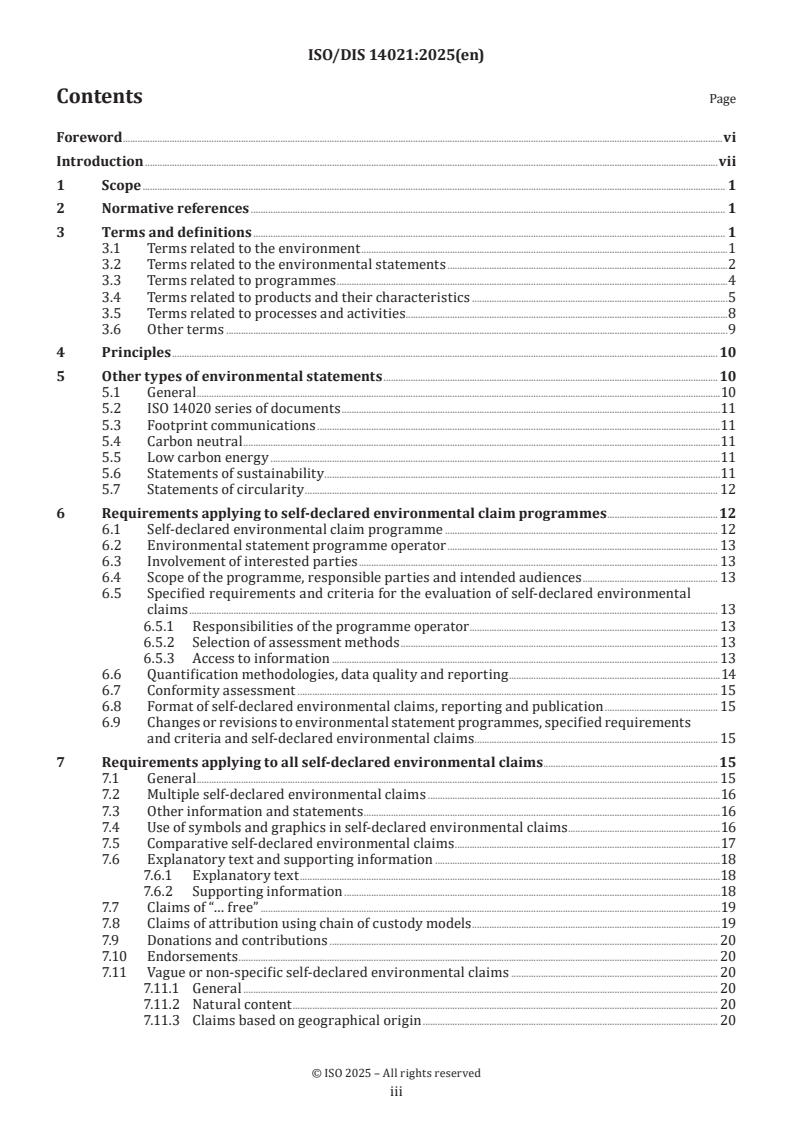
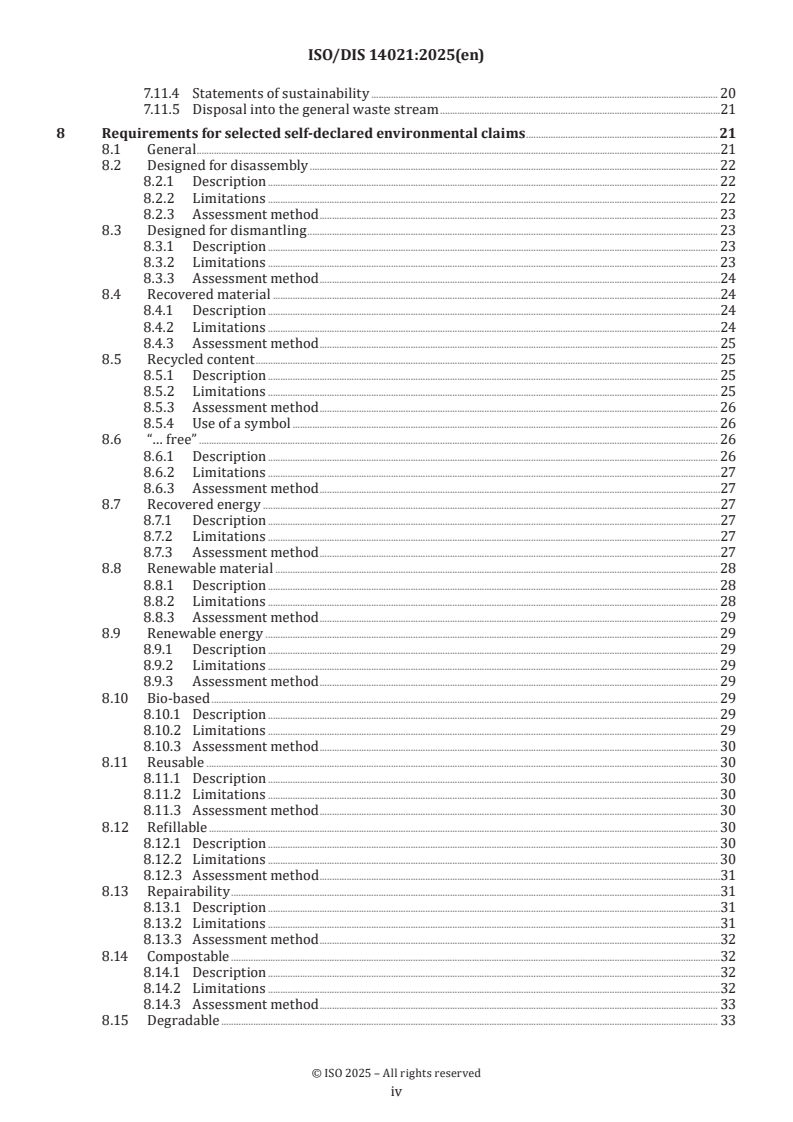
ISO/FDIS 14021 - Environmental statements and programmes for products — Self-declared environmental claims/1/2025
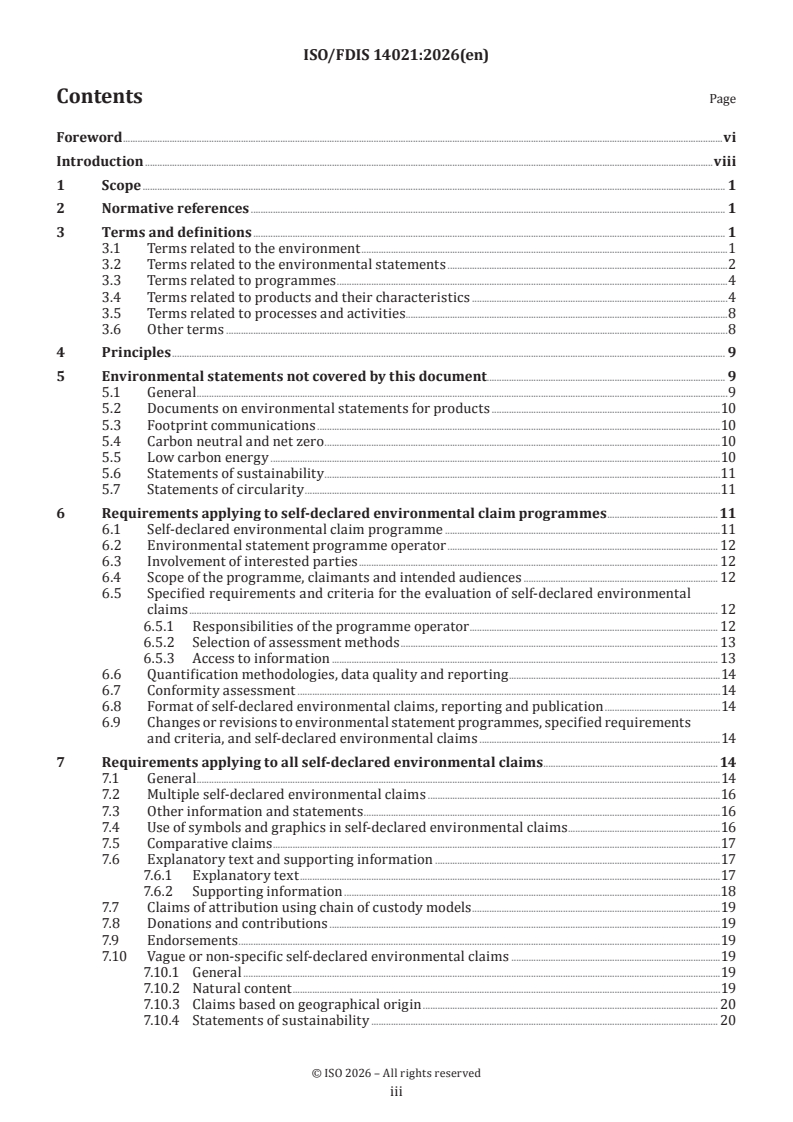
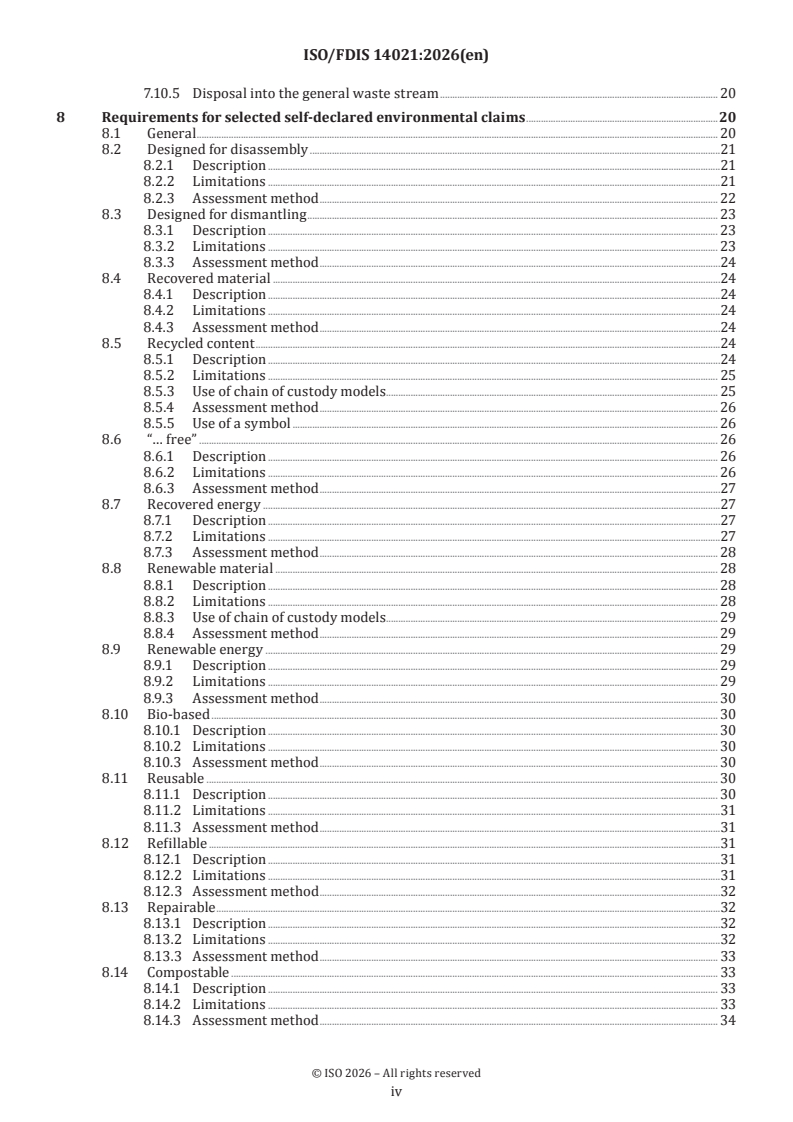
ISO/FDIS 14021 - Environmental statements and programmes for products — Self-declared environmental claims
REDLINE ISO/FDIS 14021 - Environmental statements and programmes for products — Self-declared environmental claims
ISO/FDIS 14021 - Déclarations environnementales et programmes pour les produits — Autodéclarations environnementales/23/2025
ISO/FDIS 14021 - Déclarations environnementales et programmes pour les produits — Autodéclarations environnementales
Get Certified
Connect with accredited certification bodies for this standard

BSI Group
BSI (British Standards Institution) is the business standards company that helps organizations make excellence a habit.

Bureau Veritas
Bureau Veritas is a world leader in laboratory testing, inspection and certification services.

DNV
DNV is an independent assurance and risk management provider.
Sponsored listings
Frequently Asked Questions
ISO/FDIS 14021 is a draft published by the International Organization for Standardization (ISO). Its full title is "Environmental statements and programmes for products — Self-declared environmental claims". This standard covers: ISO 14021:2016 specifies requirements for self-declared environmental claims, including statements, symbols and graphics, regarding products. It further describes selected terms commonly used in environmental claims and gives qualifications for their use. This International Standard also describes a general evaluation and verification methodology for self-declared environmental claims and specific evaluation and verification methods for the selected claims in this International Standard. ISO 14021:2016 does not preclude, override, or in any way change, legally required environmental information, claims or labelling, or any other applicable legal requirements.
ISO 14021:2016 specifies requirements for self-declared environmental claims, including statements, symbols and graphics, regarding products. It further describes selected terms commonly used in environmental claims and gives qualifications for their use. This International Standard also describes a general evaluation and verification methodology for self-declared environmental claims and specific evaluation and verification methods for the selected claims in this International Standard. ISO 14021:2016 does not preclude, override, or in any way change, legally required environmental information, claims or labelling, or any other applicable legal requirements.
ISO/FDIS 14021 is classified under the following ICS (International Classification for Standards) categories: 13.020.50 - Ecolabelling. The ICS classification helps identify the subject area and facilitates finding related standards.
ISO/FDIS 14021 has the following relationships with other standards: It is inter standard links to FprEN ISO 14021, ISO 14021:2016, ISO 14021:2016/Amd 1:2021. Understanding these relationships helps ensure you are using the most current and applicable version of the standard.
ISO/FDIS 14021 is available in PDF format for immediate download after purchase. The document can be added to your cart and obtained through the secure checkout process. Digital delivery ensures instant access to the complete standard document.
Standards Content (Sample)
DRAFT
International
Standard
ISO/DIS 14021
ISO/TC 207/SC 3
Environmental statements and
Secretariat: SA
programmes for products — Self-
Voting begins on:
declared environmental claims
2025-04-28
ICS: 13.020.50
Voting terminates on:
2025-07-21
THIS DOCUMENT IS A DRAFT CIRCULATED
FOR COMMENTS AND APPROVAL. IT
IS THEREFORE SUBJECT TO CHANGE
AND MAY NOT BE REFERRED TO AS AN
INTERNATIONAL STANDARD UNTIL
PUBLISHED AS SUCH.
This document is circulated as received from the committee secretariat.
IN ADDITION TO THEIR EVALUATION AS
BEING ACCEPTABLE FOR INDUSTRIAL,
TECHNOLOGICAL, COMMERCIAL AND
USER PURPOSES, DRAFT INTERNATIONAL
STANDARDS MAY ON OCCASION HAVE TO
ISO/CEN PARALLEL PROCESSING
BE CONSIDERED IN THE LIGHT OF THEIR
POTENTIAL TO BECOME STANDARDS TO
WHICH REFERENCE MAY BE MADE IN
NATIONAL REGULATIONS.
RECIPIENTS OF THIS DRAFT ARE INVITED
TO SUBMIT, WITH THEIR COMMENTS,
NOTIFICATION OF ANY RELEVANT PATENT
RIGHTS OF WHICH THEY ARE AWARE AND TO
PROVIDE SUPPORTING DOCUMENTATION.
Reference number
ISO/DIS 14021:2025(en)
DRAFT
ISO/DIS 14021:2025(en)
International
Standard
ISO/DIS 14021
ISO/TC 207/SC 3
Environmental statements and
Secretariat: SA
programmes for products — Self-
Voting begins on:
declared environmental claims
ICS: 13.020.50
Voting terminates on:
THIS DOCUMENT IS A DRAFT CIRCULATED
FOR COMMENTS AND APPROVAL. IT
IS THEREFORE SUBJECT TO CHANGE
AND MAY NOT BE REFERRED TO AS AN
INTERNATIONAL STANDARD UNTIL
PUBLISHED AS SUCH.
This document is circulated as received from the committee secretariat.
IN ADDITION TO THEIR EVALUATION AS
BEING ACCEPTABLE FOR INDUSTRIAL,
© ISO 2025
TECHNOLOGICAL, COMMERCIAL AND
USER PURPOSES, DRAFT INTERNATIONAL
All rights reserved. Unless otherwise specified, or required in the context of its implementation, no part of this publication may
STANDARDS MAY ON OCCASION HAVE TO
ISO/CEN PARALLEL PROCESSING
be reproduced or utilized otherwise in any form or by any means, electronic or mechanical, including photocopying, or posting on
BE CONSIDERED IN THE LIGHT OF THEIR
the internet or an intranet, without prior written permission. Permission can be requested from either ISO at the address below
POTENTIAL TO BECOME STANDARDS TO
WHICH REFERENCE MAY BE MADE IN
or ISO’s member body in the country of the requester.
NATIONAL REGULATIONS.
ISO copyright office
RECIPIENTS OF THIS DRAFT ARE INVITED
CP 401 • Ch. de Blandonnet 8
TO SUBMIT, WITH THEIR COMMENTS,
CH-1214 Vernier, Geneva
NOTIFICATION OF ANY RELEVANT PATENT
Phone: +41 22 749 01 11
RIGHTS OF WHICH THEY ARE AWARE AND TO
PROVIDE SUPPORTING DOCUMENTATION.
Email: copyright@iso.org
Website: www.iso.org
Published in Switzerland Reference number
ISO/DIS 14021:2025(en)
ii
ISO/DIS 14021:2025(en)
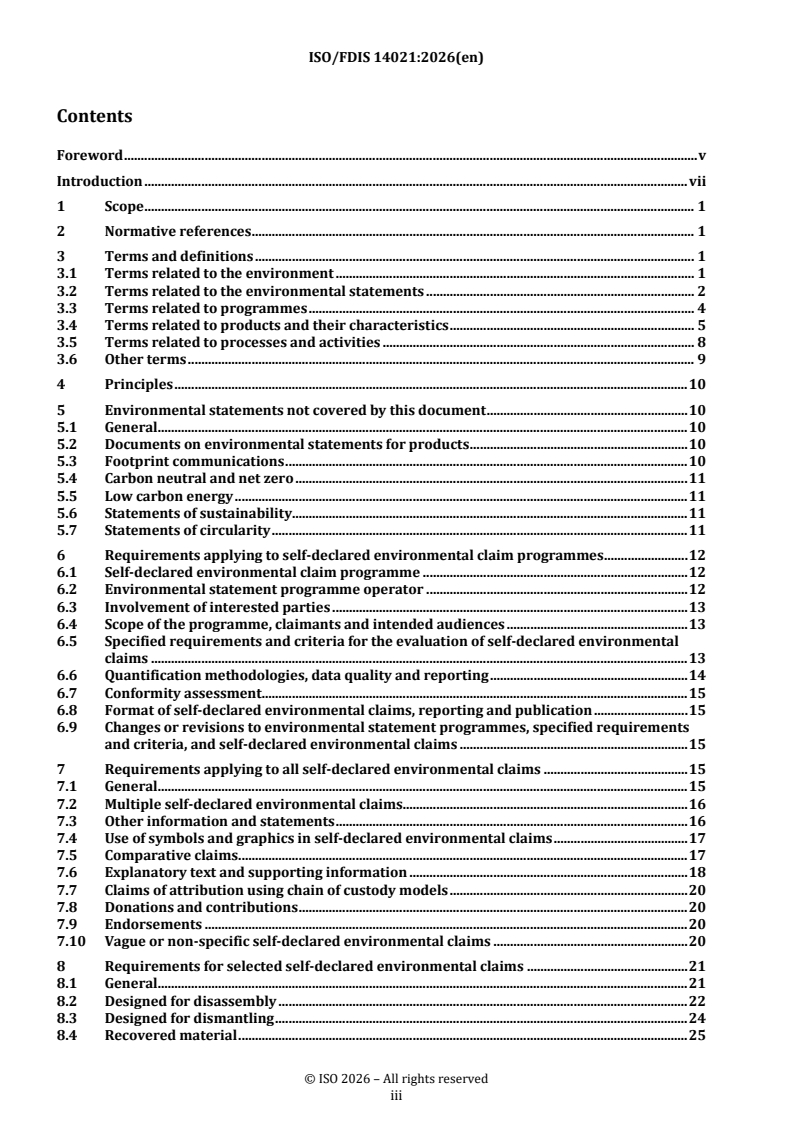
Contents Page
Foreword .vi
Introduction .vii
1 Scope . 1
2 Normative references . 1
3 Terms and definitions . 1
3.1 Terms related to the environment .1
3.2 Terms related to the environmental statements .2
3.3 Terms related to programmes .4
3.4 Terms related to products and their characteristics .5
3.5 Terms related to processes and activities .8
3.6 Other terms .9
4 Principles . 10
5 Other types of environmental statements . 10
5.1 General .10
5.2 ISO 14020 series of documents .11
5.3 Footprint communications .11
5.4 Carbon neutral .11
5.5 Low carbon energy .11
5.6 Statements of sustainability .11
5.7 Statements of circularity . 12
6 Requirements applying to self-declared environmental claim programmes .12
6.1 Self-declared environmental claim programme . 12
6.2 Environmental statement programme operator . 13
6.3 Involvement of interested parties . 13
6.4 Scope of the programme, responsible parties and intended audiences . 13
6.5 Specified requirements and criteria for the evaluation of self-declared environmental
claims . 13
6.5.1 Responsibilities of the programme operator . 13
6.5.2 Selection of assessment methods . 13
6.5.3 Access to information . 13
6.6 Quantification methodologies, data quality and reporting .14
6.7 Conformity assessment . 15
6.8 Format of self-declared environmental claims, reporting and publication . 15
6.9 Changes or revisions to environmental statement programmes, specified requirements
and criteria and self-declared environmental claims . 15
7 Requirements applying to all self-declared environmental claims .15
7.1 General . 15
7.2 Multiple self-declared environmental claims .16
7.3 Other information and statements .16
7.4 Use of symbols and graphics in self-declared environmental claims .16
7.5 Comparative self-declared environmental claims .17
7.6 Explanatory text and supporting information .18
7.6.1 Explanatory text .18
7.6.2 Supporting information .18
7.7 Claims of “… free” .19
7.8 Claims of attribution using chain of custody models .19
7.9 Donations and contributions . 20
7.10 Endorsements . 20
7.11 Vague or non-specific self-declared environmental claims . 20
7.11.1 General . 20
7.11.2 Natural content . 20
7.11.3 Claims based on geographical origin . 20
iii
ISO/DIS 14021:2025(en)
7.11.4 Statements of sustainability . 20
7.11.5 Disposal into the general waste stream .21
8 Requirements for selected self-declared environmental claims .21
8.1 General .21
8.2 Designed for disassembly . 22
8.2.1 Description . 22
8.2.2 Limitations . 22
8.2.3 Assessment method . 23
8.3 Designed for dismantling . 23
8.3.1 Description . 23
8.3.2 Limitations . 23
8.3.3 Assessment method .24
8.4 Recovered material .24
8.4.1 Description .24
8.4.2 Limitations .24
8.4.3 Assessment method . 25
8.5 Recycled content . 25
8.5.1 Description . 25
8.5.2 Limitations . 25
8.5.3 Assessment method . 26
8.5.4 Use of a symbol . 26
8.6 “… free” . 26
8.6.1 Description . 26
8.6.2 Limitations .27
8.6.3 Assessment method .27
8.7 Recovered energy .27
8.7.1 Description .27
8.7.2 Limitations .27
8.7.3 Assessment method .27
8.8 Renewable material . 28
8.8.1 Description . 28
8.8.2 Limitations . 28
8.8.3 Assessment method . 29
8.9 Renewable energy . 29
8.9.1 Description . 29
8.9.2 Limitations . 29
8.9.3 Assessment method . 29
8.10 Bio-based . 29
8.10.1 Description . 29
8.10.2 Limitations . 29
8.10.3 Assessment method . 30
8.11 Reusable . 30
8.11.1 Description . 30
8.11.2 Limitations . 30
8.11.3 Assessment method . 30
8.12 Refillable . 30
8.12.1 Description . 30
8.12.2 Limitations . 30
8.12.3 Assessment method .31
8.13 Repairability .31
8.13.1 Description .31
8.13.2 Limitations .31
8.13.3 Assessment method .32
8.14 Compostable .32
8.14.1 Description .32
8.14.2 Limitations .32
8.14.3 Assessment method . 33
8.15 Degradable . 33
iv
ISO/DIS 14021:2025(en)
8.15.1 Description . 33
8.15.2 Limitations . 33
8.15.3 Assessment method . 34
8.16 Biodegradable . 34
8.16.1 Description . 34
8.16.2 Limitations . 34
8.16.3 Assessment method . 35
8.17 Recyclable . 35
8.17.1 Description . 35
8.17.2 Limitations . 35
8.17.3 Assessment method . 35
8.17.4 Use of a symbol . 36
8.18 Extended life . 36
8.18.1 Description . 36
8.18.2 Description . 36
8.18.3 Assessment method .37
8.19 Waste reduction .37
8.19.1 Description .37
8.19.2 Limitations .37
8.19.3 Assessment method .37
8.20 Reduced resource use .37
8.20.1 Description .37
8.20.2 Limitations . 38
8.20.3 Assessment method . 38
8.21 Reduced energy consumption of products . 39
8.21.1 Description . 39
8.21.2 Limitations . 39
8.21.3 Assessment method . 39
8.22 Reduced water use of products . 39
8.22.1 Description . 39
8.22.2 Limitations . 39
8.22.3 Assessment method . 39
Annex A (informative) Examples of supporting information for self-declared environmental
claims .40
Annex B (informative) Simplified diagrammatic representation of a recycling system .44
Annex C (informative) Conformity assessment methods .45
Annex D (informative) Chain of Custody .46
Bibliography .50
v
ISO/DIS 14021:2025(en)
Foreword
ISO (the International Organization for Standardization) is a worldwide federation of national standards
bodies (ISO member bodies). The work of preparing International Standards is normally carried out through
ISO technical committees. Each member body interested in a subject for which a technical committee
has been established has the right to be represented on that committee. International organizations,
governmental and non-governmental, in liaison with ISO, also take part in the work. ISO collaborates closely
with the International Electrotechnical Commission (IEC) on all matters of electrotechnical standardization.
The procedures used to develop this document and those intended for its further maintenance are described
in the ISO/IEC Directives, Part 1. In particular, the different approval criteria needed for the different types
of ISO documents should be noted. This document was drafted in accordance with the editorial rules of the
ISO/IEC Directives, Part 2 (see www.iso.org/directives).
ISO draws attention to the possibility that the implementation of this document may involve the use of (a)
patent(s). ISO takes no position concerning the evidence, validity or applicability of any claimed patent
rights in respect thereof. As of the date of publication of this document, ISO had not received notice of (a)
patent(s) which may be required to implement this document. However, implementers are cautioned that
this may not represent the latest information, which may be obtained from the patent database available at
www.iso.org/patents. ISO shall not be held responsible for identifying any or all such patent rights.
Any trade name used in this document is information given for the convenience of users and does not
constitute an endorsement.
For an explanation of the voluntary nature of standards, the meaning of ISO specific terms and expressions
related to conformity assessment, as well as information about ISO's adherence to the World Trade
Organization (WTO) principles in the Technical Barriers to Trade (TBT), see www.iso.org/iso/foreword.html.
This document was prepared by Technical Committee ISO/TC 207/SC 3 Environmental Labelling.
This third edition cancels and replaces the second edition (ISO 14021:2016), which has been technically
revised.
The main changes are as follows:
— The elements that are common to all the documents in the 14020 series have been removed and are now
in ISO 14020-2022.
— the addition of a normative reference to the revised ISO 14020.
— the structuring of the document to correspond with the structure of ISO 14020.
— Self-declared environmental claims are now required to be part of a documented “programme”.
— inclusion of enhanced requirements for documentary information to be retained to demonstrate
the validity/veracity of the self-declared environmental claim. Inclusion of new requirements to
disclose the effect of attribution of characteristics where it impacts the reliability of some self-
declared environmental claims
— inclusion of guidance about the role that maintaining a chain of custody plays in assessing certain
self-declared environmental claims, such as recycled content.
— updating of the specific claims included in Clause 8 to reflect changes in the market.
— updating of reference documents.
A list of all parts in the ISO 14020 series can be found on the ISO website.
Any feedback or questions on this document should be directed to the user’s national standards body. A
complete listing of these bodies can be found at www.iso.org/members.html.
vi
ISO/DIS 14021:2025(en)
Introduction
0.1 This document contains principles, requirements and guidance for self-declared environmental claims
that provide environmental information about products. The validity and accuracy of such claims is
essential to avoid unfair competition that can arise from vague, unreliable and deceptive environmental
claims (i.e. greenwashing). When assessment methods used by those who make self-declared
environmental claims, are transparent, scientifically sound and documented, those who purchase, or
may potentially purchase, products can be assured of the validity and accuracy of the claims.
0.2 Self-declared environmental claims may be made by manufacturers, importers, distributors, retailers
or anyone else likely to benefit from such claims. Self-declared environmental claims made in regard
to products may take the form of words, symbols or graphics or combinations thereof on product or
package labels, or in product literature, technical bulletins, advertising, publicity, telemarketing, as well
as digital or electronic media, such as the internet.
0.3 Self-declared environmental claims are one type of environmental statement. The overall goal of
environmental statements is to:
a) communicate accurate and relevant information about the environmental aspects or impacts of
products,
b) encourage the demand for and supply of products that cause less stress on the environment, and
c) stimulate market-driven continual environmental improvement in products.
0.4 The objective of this document is to harmonize the use of self-declared environmental claims. The
benefits using this document will be:
a) accurate, relevant and verifiable self-declared environmental claims that are not misleading,
b) increased potential for market forces to stimulate and improve environmental aspects in
production, processes, products,
c) prevention or minimization of unwarranted claims and greenwashing,
d) less marketplace confusion,
e) facilitation of international trade, and
f) increased opportunities for purchasers, potential purchasers and users of the product to make
better informed choices.
0.5 The international harmonization of requirements for self-declared environmental claims is intended
to help businesses, especially SMEs, to present substantiated, correct and transparent environmental
information on their products, consequently limiting the risk of “greenwashing”.
0.6 Third party audits are not required but the additional rigour is intended to help users of the standard
avoid greenwashing.
0.7 This document provides a framework for regulatory authorities of all types and sizes and trade
associations to identify “best practices” in self-declared environmental claims.
0.8 This document is one of a series of ISO documents (i.e. the ISO 14020 series of documents) that provide
requirements and guidance for different types of environmental statements. The documents in the
ISO 14020 series include:
— ISO 14020: common terms and definitions, principles and general requirements for all environmental
statements (e.g. self-declared environmental claims, ecolabels, EPDs and footprint communications)
and associated programmes that enable the communication of environmental aspects and
environmental impacts of products.
— ISO 14021: requirements for environmental statements in the form of self-declared environmental claims.
vii
ISO/DIS 14021:2025(en)
— ISO 14024: requirements for environmental statements in the form of environmental labels known
as ecolabels.
— ISO 14025: requirements for environmental statements in the form of environmental product
declarations (EPDs).
— ISO 14026: requirements for environmental statements in the form of footprint communications.
— ISO/TS 14027: requirements for product category rules (PCR) that support the use of life cycle
assessment (LCA) as a method to compile and evaluate information that is used as a basis for making
environmental statements.
— ISO/TS 14029: requirements for the mutual recognition of EPDs, footprint communications and
associated programmes.
This following diagram provides the structure of the ISO 14020 series of documents in graphic form.
Figure 1 — Structure of the ISO 14020 series of standards
0.9 This document makes normative reference to requirements in ISO 14020. Those requfirements refer
to the generic term ‘environmental statement’. In reading this document and ISO 14020 together, the
generic term ‘environmental statement’ in ISO 14020 can be interpreted as referring to the specific
term included in this document i.e. ‘self-declared environment claim’.
viii
DRAFT International Standard ISO/DIS 14021:2025(en)
Environmental statements and programmes for products —
Self-declared environmental claims
1 Scope
This document establishes principles, specifies requirements and gives guidance for self-declared
environmental claims about products and their programmes, including claims that also cover related social
and economic aspects that are affected by environmental conditions or the environmental performance of
the product.
This document also defines selected terms commonly used in self-declared environmental claims and
provides qualifications for their use, as well as describing the documentation and methodologies required
for assessing self-declared environmental claims.
This document is applicable to self-declared environmental claims that are predominantly take the form of
words, but can also be used for symbols and graphics on product or package labels, or in product literature,
technical bulletins, advertising and publicity, including on digital platforms.
2 Normative references
The following document is referred to in the text in such a way that some or all of its content constitutes
requirements of this document. For dated references, only the edition cited applies. For undated references,
the latest edition of the referenced document (including any amendments) applies.
ISO 14020, Environmental statements and programmes for products — Principles and general requirements
3 Terms and definitions
For the purposes of this document, the terms and definitions given in ISO 14020 and ISO 14050 and the
following apply.
ISO and IEC maintain terminology databases for use in standardization at the following addresses:
— ISO Online browsing platform: available at https:// www .iso .org/ obp
— IEC Electropedia: available at https:// www .electropedia .org/
3.1 Terms related to the environment
3.1.1
environment
surroundings in which an organization (3.6.1) operates, including air, water, land, natural resources, flora,
fauna, humans, and their interrelationships
Note 1 to entry: Surroundings can extend from within an organization to the local, regional and global system.
Note 2 to entry: Surroundings can be described in terms of biodiversity, ecosystems, climate or other characteristics of
an organization’s activities (including projects) or products (3.4.1). that interact or can interact with the environment.
[SOURCE: ISO 14020:2022, 3.1.2]
ISO/DIS 14021:2025(en)
3.1.2
environmental aspect
element of an organization’s (3.6.1) activities or products (3.4.1) that interacts or can interact with
the environment (3.1.1).
Note 1 to entry: Typically, environmental aspects can include emissions to air, discharges to water and waste (3.4.6)
arisings, which in turn can generate environmental and health impacts such as global warming, smog, water pollution
or contaminated land.
[SOURCE: ISO 14020:2022, 3.1.3]
3.1.3
environmental impact
change to the environment (3.1.1) whether adverse or beneficial, including possible consequences, wholly or
partially resulting from an organization’s (3.6.1) environmental aspects (3.1.2)
[SOURCE: ISO 14020:2022, 3.1.4]
3.1.4
environmental performance
performance related to the management of environmental aspects (3.1.2)
[SOURCE: ISO 14020:2022, 3.1.5]
3.2 Terms related to the environmental statements
3.2.1
environmental statement
information on one or more environmental aspect(s) (3.1.2) or environmental impact(s) (3.1.3) of a product
(3.4.1) which intends to inform an intended audience and intends to influence the market of this product
Note 1 to entry: The environmental statement can represent a point in time or can cover a period of time.
Note 2 to entry: Types of environmental statement include, but are not limited to:
a) self-declared environmental claims (3.2.4);
b) ecolabels (3.2.5);
c) environmental product declarations (3.2.6);
d) footprint communications (3.2.8).
Note 3 to entry: An environmental statement can appear on a product (3.4.1) or packaging as a label, a symbol, a logo,
an electronic product label or a machine-readable code. It can also be communicated in other ways, e.g. in web-based
product data or in an advertisement.
Note 4 to entry: In some co
...
FINAL DRAFT
International
Standard
ISO/TC 207/SC 3
Environmental statements and
Secretariat: SA
programmes for products — Self-
Voting begins on:
declared environmental claims
2026-03-26
Déclarations environnementales et programmes pour les
Voting terminates on:
produits — Autodéclarations environnementales
2026-05-21
RECIPIENTS OF THIS DRAFT ARE INVITED TO SUBMIT,
WITH THEIR COMMENTS, NOTIFICATION OF ANY
RELEVANT PATENT RIGHTS OF WHICH THEY ARE AWARE
AND TO PROVIDE SUPPOR TING DOCUMENTATION.
IN ADDITION TO THEIR EVALUATION AS
BEING ACCEPTABLE FOR INDUSTRIAL, TECHNO
ISO/CEN PARALLEL PROCESSING LOGICAL, COMMERCIAL AND USER PURPOSES, DRAFT
INTERNATIONAL STANDARDS MAY ON OCCASION HAVE
TO BE CONSIDERED IN THE LIGHT OF THEIR POTENTIAL
TO BECOME STAN DARDS TO WHICH REFERENCE MAY BE
MADE IN NATIONAL REGULATIONS.
Reference number
FINAL DRAFT
International
Standard
ISO/TC 207/SC 3
Environmental statements and
Secretariat: SA
programmes for products — Self-
Voting begins on:
declared environmental claims
Déclarations environnementales et programmes pour les
Voting terminates on:
produits — Autodéclarations environnementales
RECIPIENTS OF THIS DRAFT ARE INVITED TO SUBMIT,
WITH THEIR COMMENTS, NOTIFICATION OF ANY
RELEVANT PATENT RIGHTS OF WHICH THEY ARE AWARE
AND TO PROVIDE SUPPOR TING DOCUMENTATION.
© ISO 2026
IN ADDITION TO THEIR EVALUATION AS
All rights reserved. Unless otherwise specified, or required in the context of its implementation, no part of this publication may
BEING ACCEPTABLE FOR INDUSTRIAL, TECHNO
ISO/CEN PARALLEL PROCESSING
LOGICAL, COMMERCIAL AND USER PURPOSES, DRAFT
be reproduced or utilized otherwise in any form or by any means, electronic or mechanical, including photocopying, or posting on
INTERNATIONAL STANDARDS MAY ON OCCASION HAVE
the internet or an intranet, without prior written permission. Permission can be requested from either ISO at the address below
TO BE CONSIDERED IN THE LIGHT OF THEIR POTENTIAL
or ISO’s member body in the country of the requester.
TO BECOME STAN DARDS TO WHICH REFERENCE MAY BE
MADE IN NATIONAL REGULATIONS.
ISO copyright office
CP 401 • Ch. de Blandonnet 8
CH-1214 Vernier, Geneva
Phone: +41 22 749 01 11
Email: copyright@iso.org
Website: www.iso.org
Published in Switzerland Reference number
ii
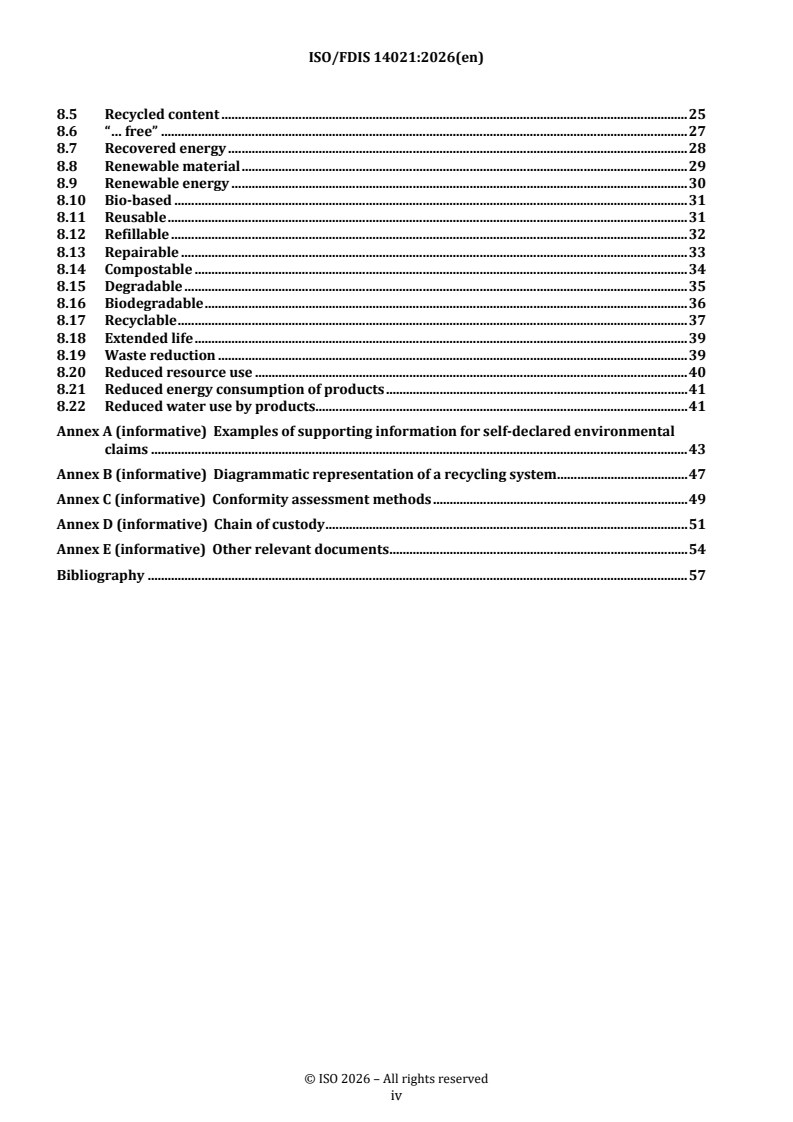
Contents Page
Foreword .vi
Introduction .viii
1 Scope . 1
2 Normative references . 1
3 Terms and definitions . 1
3.1 Terms related to the environment .1
3.2 Terms related to the environmental statements .2
3.3 Terms related to programmes .4
3.4 Terms related to products and their characteristics .4
3.5 Terms related to processes and activities .8
3.6 Other terms .8
4 Principles . 9
5 Environmental statements not covered by this document . 9
5.1 General .9
5.2 Documents on environmental statements for products .10
5.3 Footprint communications .10
5.4 Carbon neutral and net zero .10
5.5 Low carbon energy .10
5.6 Statements of sustainability .11
5.7 Statements of circularity .11
6 Requirements applying to self-declared environmental claim programmes .11
6.1 Self-declared environmental claim programme .11
6.2 Environmental statement programme operator . 12
6.3 Involvement of interested parties . 12
6.4 Scope of the programme, claimants and intended audiences . 12
6.5 Specified requirements and criteria for the evaluation of self-declared environmental
claims . 12
6.5.1 Responsibilities of the programme operator . 12
6.5.2 Selection of assessment methods . 13
6.5.3 Access to information . 13
6.6 Quantification methodologies, data quality and reporting .14
6.7 Conformity assessment .14
6.8 Format of self-declared environmental claims, reporting and publication .14
6.9 Changes or revisions to environmental statement programmes, specified requirements
and criteria, and self-declared environmental claims .14
7 Requirements applying to all self-declared environmental claims . 14
7.1 General .14
7.2 Multiple self-declared environmental claims .16
7.3 Other information and statements .16
7.4 Use of symbols and graphics in self-declared environmental claims .16
7.5 Comparative claims .17
7.6 Explanatory text and supporting information .17
7.6.1 Explanatory text .17
7.6.2 Supporting information .18
7.7 Claims of attribution using chain of custody models .19
7.8 Donations and contributions .19
7.9 Endorsements .19
7.10 Vague or non-specific self-declared environmental claims .19
7.10.1 General .19
7.10.2 Natural content .19
7.10.3 Claims based on geographical origin . 20
7.10.4 Statements of sustainability . 20
iii
7.10.5 Disposal into the general waste stream . 20
8 Requirements for selected self-declared environmental claims .20
8.1 General . 20
8.2 Designed for disassembly .21
8.2.1 Description .21
8.2.2 Limitations .21
8.2.3 Assessment method . 22
8.3 Designed for dismantling . 23
8.3.1 Description . 23
8.3.2 Limitations . 23
8.3.3 Assessment method .24
8.4 Recovered material .24
8.4.1 Description .24
8.4.2 Limitations .24
8.4.3 Assessment method .24
8.5 Recycled content .24
8.5.1 Description .24
8.5.2 Limitations . 25
8.5.3 Use of chain of custody models. 25
8.5.4 Assessment method . 26
8.5.5 Use of a symbol . 26
8.6 “… free” . 26
8.6.1 Description . 26
8.6.2 Limitations . 26
8.6.3 Assessment method .27
8.7 Recovered energy .27
8.7.1 Description .27
8.7.2 Limitations .27
8.7.3 Assessment method . 28
8.8 Renewable material . 28
8.8.1 Description . 28
8.8.2 Limitations . 28
8.8.3 Use of chain of custody models. 29
8.8.4 Assessment method . 29
8.9 Renewable energy . 29
8.9.1 Description . 29
8.9.2 Limitations . 29
8.9.3 Assessment method . 30
8.10 Bio-based . 30
8.10.1 Description . 30
8.10.2 Limitations . 30
8.10.3 Assessment method . 30
8.11 Reusable . 30
8.11.1 Description . 30
8.11.2 Limitations .31
8.11.3 Assessment method .31
8.12 Refillable .31
8.12.1 Description .31
8.12.2 Limitations .31
8.12.3 Assessment method .32
8.13 Repairable .32
8.13.1 Description .32
8.13.2 Limitations .32
8.13.3 Assessment method . 33
8.14 Compostable . 33
8.14.1 Description . 33
8.14.2 Limitations . 33
8.14.3 Assessment method . 34
iv
8.15 Degradable . 34
8.15.1 Description . 34
8.15.2 Limitations . 35
8.15.3 Assessment method . 35
8.16 Biodegradable . 35
8.16.1 Description . 35
8.16.2 Limitations . 35
8.16.3 Assessment method . 36
8.17 Recyclable . 36
8.17.1 Description . 36
8.17.2 Limitations . 36
8.17.3 Assessment method . 36
8.17.4 Use of a symbol .37
8.18 Extended life . 38
8.18.1 Description . 38
8.18.2 Limitations . 38
8.18.3 Assessment method . 38
8.19 Waste reduction . 38
8.19.1 Description . 38
8.19.2 Limitations . 38
8.19.3 Assessment method . 39
8.20 Reduced resource use . 39
8.20.1 Description . 39
8.20.2 Limitations . 39
8.20.3 Assessment method . 39
8.21 Reduced energy consumption of products . 40
8.21.1 Description . 40
8.21.2 Limitations . 40
8.21.3 Assessment method . 40
8.22 Reduced water use by products . 40
8.22.1 Description . 40
8.22.2 Limitations .41
8.22.3 Assessment method .41
Annex A (informative) Examples of supporting information for self-declared environmental
claims .42
Annex B (informative) Diagrammatic representation of a recycling system .46
Annex C (informative) Conformity assessment methods . 47
Annex D (informative) Chain of custody .48
Annex E (informative) Other relevant documents . 51
Bibliography .54
v
Foreword
ISO (the International Organization for Standardization) is a worldwide federation of national standards
bodies (ISO member bodies). The work of preparing International Standards is normally carried out through
ISO technical committees. Each member body interested in a subject for which a technical committee
has been established has the right to be represented on that committee. International organizations,
governmental and non-governmental, in liaison with ISO, also take part in the work. ISO collaborates closely
with the International Electrotechnical Commission (IEC) on all matters of electrotechnical standardization.
The procedures used to develop this document and those intended for its further maintenance are described
in the ISO/IEC Directives, Part 1. In particular, the different approval criteria needed for the different types
of ISO document should be noted. This document was drafted in accordance with the editorial rules of the
ISO/IEC Directives, Part 2 (see www.iso.org/directives).
ISO draws attention to the possibility that the implementation of this document may involve the use of (a)
patent(s). ISO takes no position concerning the evidence, validity or applicability of any claimed patent
rights in respect thereof. As of the date of publication of this document, ISO had not received notice of (a)
patent(s) which may be required to implement this document. However, implementers are cautioned that
this may not represent the latest information, which may be obtained from the patent database available at
www.iso.org/patents. ISO shall not be held responsible for identifying any or all such patent rights.
Any trade name used in this document is information given for the convenience of users and does not
constitute an endorsement.
For an explanation of the voluntary nature of standards, the meaning of ISO specific terms and expressions
related to conformity assessment, as well as information about ISO's adherence to the World Trade
Organization (WTO) principles in the Technical Barriers to Trade (TBT), see www.iso.org/iso/foreword.html.
This document was prepared by Technical Committee ISO/TC 207, Environmental management, Subcommittee
SC 3, Environmental labelling, in collaboration with the European Committee for Standardization (CEN), in
accordance with the Agreement on technical cooperation between ISO and CEN (Vienna Agreement).
This third edition cancels and replaces the second edition (ISO 14021:2016), which has been technically
revised. It also incorporates the Amendment ISO 14021:2016/Amd 1:2021.
The main changes are as follows:
— elements that are common to all the documents on environmental statements developed by
ISO/TC 207/SC 3 have been removed and are now in ISO 14020:2022;
— the document has been restructured to correspond with the structure of ISO 14020;
— self-declared environmental claims are now required to be part of a documented “programme”;
— enhanced requirements have been included for documentary information to be retained to demonstrate
the validity/veracity of the self-declared environmental claim;
— new requirements have been added to disclose the effect of attribution of characteristics where it impacts
the reliability of some self-declared environmental claims;
— guidance has been added about the role that maintaining a chain of custody plays in assessing certain
self-declared environmental claims, such as recycled content;
— the specific claims included in Clause 8 have been updated to reflect changes in the market and additional
claims have been added to Clause 8;
— guidance for use of the Mobius loop symbol has been changed to address current marketplace confusion;
— identification of environmental statements that are not appropriate for self-declared environmental
claims and listing of other standards that can be used for these claims has been added;
vi
— reference documents have been updated and some terminology has been updated to reflect general
usage.
Any feedback or questions on this document should be directed to the user’s national standards body. A
complete listing of these bodies can be found at www.iso.org/members.html.
vii
Introduction
0.1 This document contains principles, requirements and guidance for self-declared environmental
claims as well as related social and economic aspects that are affected by environmental conditions or
the environmental performance of the product. The validity and accuracy of such claims is essential to
avoid unfair competition that can arise from vague, unreliable and deceptive environmental claims (e.g.
greenwashing). When assessment methods used by those who make self-declared environmental claims
are transparent, scientifically sound and documented, those who purchase, or will potentially purchase,
products can be assured of the validity and accuracy of the claims.
0.2 Self-declared environmental claims can be made by manufacturers, importers, distributors, retailers
or anyone likely to benefit from such claims. Self-declared environmental claims made in regard to products
can take the form of words, symbols or graphics or combinations thereof on product or package labels, or in
product literature, technical bulletins, advertising, publicity or telemarketing, as well as digital or electronic
media.
0.3 Self-declared environmental claims are one type of environmental statement. The overall goals of
environmental statements are to:
a) communicate accurate and relevant information about the environmental aspects or potential
environmental impacts of products;
b) encourage the demand for and supply of products that cause less stress on the environment;
c) stimulate market-driven continual environmental improvement in products.
0.4 This document harmonizes the use of self-declared environmental claims. The benefits of using this
document are:
a) accurate, relevant and verifiable self-declared environmental claims that are not misleading;
b) increased potential for market forces to stimulate and improve environmental aspects in production,
processes and products;
c) prevention or minimization of unwarranted claims and greenwashing;
d) less marketplace confusion;
e) facilitation of international trade;
f) increased opportunities for purchasers, potential purchasers and users of a product to make better-
informed choices.
0.5 The international harmonization of requirements for self-declared environmental claims is intended
to help businesses, including small and medium enterprises (SMEs), to present substantiated, correct and
transparent environmental information on their products, consequently limiting the risk of greenwashing.
0.6 This document provides a framework for regulatory authorities in different jurisdictions to harmonize
how they interpret various self-declared environmental claims.
The document can also be of use to trade associations seeking to provide their members with guidance
about making self-declared environmental claims.
0.7 This document is one of the documents developed by ISO/TC 207/SC 3 that provide principles,
requirements and guidance for different types of environmental statements about products. These
documents include the following:
— ISO 14020, which provides common terms and definitions, principles and general requirements for
all environmental statements (e.g. self-declared environmental claims, ecolabels, EPDs and footprint
communications) and associated programmes that enable the communication of environmental aspects
and environmental impacts of products.
viii
— ISO 14021 (this document), which provides principles, requirements and guidance for environmental
statements in the form of self-declared environmental claims.
— ISO 14024, which provides principles, requirements and guidance for environmental statements in the
form of ecolabels.
— ISO 14025, which provides principles, requirements and guidance for environmental statements in the
form of environmental product declarations (EPDs).
— ISO 14026, which provides principles, requirements and guidance for environmental statements in the
form of footprint communications.
— ISO/TS 14027, which provides principles, requirements and guidance for product category rules (PCR)
that support the use of life cycle assessment (LCA) as a method to compile and evaluate information that
is used as a basis for making environmental statements.
— ISO/TS 14029, which provides principles, requirements and guidance for the mutual recognition of EPDs,
footprint communications and associated programmes.
0.8. Environmental statement programme operators are encouraged to cooperate and harmonize with each
other, whenever relevant and applicable, to enhance the coherence of environmental statement programmes,
at regional, national and international levels.
0.9 Figure 1 provides the existing structure of the documents on environmental statements developed by
ISO/TC 207/SC 3 in graphic form.
ix
Figure 1 — Structure of documents on environmental statements developed by ISO/TC 207/SC 3
0.10 This document requires the user to apply the requirements in ISO 14020. Those requirements refer
to the generic term “environmental statement”. When reading this document and ISO 14020 together, the
generic term “environmental statement” in ISO 14020 can be interpreted as referring to the specific term
included in this document i.e. “self-declared environment claim”.
x
FINAL DRAFT International Standard ISO/FDIS 14021:2026(en)
Environmental statements and programmes for products —
Self-declared environmental claims
1 Scope
This document establishes principles, specifies requirements and gives guidance on self-declared
environmental claims about products and their environmental statement programmes, including claims
that also cover related social and economic aspects that are affected by environmental conditions or the
environmental performance of a product.
This document defines selected terms commonly used in self-declared environmental claims and provides
qualifications for their use, as well as describing the documentation and methodologies required for
assessing self-declared environmental claims.
This document is applicable to self-declared environmental claims that predominantly take the form of
words, but can also be symbols or graphics on product or package labels, or appear in product literature,
technical bulletins, advertising and publicity, including on digital platforms.
2 Normative references
The following documents are referred to in the text in such a way that some or all of their content constitutes
requirements of this document. For dated references, only the edition cited applies. For undated references,
the latest edition of the referenced document (including any amendments) applies.
ISO 14020, Environmental statements and programmes for products — Principles and general requirements
ISO 14050, Environmental management — Vocabulary
3 Terms and definitions
For the purposes of this document, the terms and definitions given in ISO 14020, ISO 14050 and the following
apply.
ISO and IEC maintain terminology databases for use in standardization at the following addresses:
— ISO Online browsing platform: available at https:// www .iso .org/ obp
— IEC Electropedia: available at https:// www .electropedia .org/
3.1 Terms related to the environment
3.1.1
environment
surroundings in which an organization (3.6.1) operates, including air, water, land, natural resources, flora,
fauna, humans and their interrelationships
Note 1 to entry: Surroundings can extend from within an organization to the local, regional and global system.
Note 2 to entry: Surroundings can be described in terms of biodiversity, ecosystems, climate or other characteristics of
an organization’s activities (including projects) or products (3.4.1). that interact or can interact with the environment.
[SOURCE: ISO 14020:2022, 3.1.2]
3.1.2
environmental aspect
element of an organization’s (3.6.1) activities or products (3.4.1) that interacts or can interact with
the environment (3.1.1)
Note 1 to e
...
ISO/DIS FDIS 14021:2025(en)
ISO/TC 207/SC 3/WG 10
Secretariat: SA
Date: 2025-12-182026-03-11
Environmental statements and programmes for products — Self-
declared environmental claims
Déclarations environnementales et programmes pour les produits — Autodéclarations environnementales
FDIS stage
TThhiiss d drraftaft i iss s suubbmmiitttteded t too a pa pararallel vallel vootte e iinn I ISSOO,, C CEENN.
All rights reserved. Unless otherwise specified, or required in the context of its implementation, no part of this publication
may be reproduced or utilized otherwise in any form or by any means, electronic or mechanical, including photocopying,
or posting on the internet or an intranet, without prior written permission. Permission can be requested from either ISO
at the address below or ISO’s member body in the country of the requester.
ISO copyright office
CP 401 • Ch. de Blandonnet 8
CH-1214 Vernier, Geneva
Phone: + 41 22 749 01 11
E-mail: copyright@iso.org
Website: www.iso.org
Published in Switzerland
ii
Contents
Foreword . v
Introduction . vii
1 Scope . 1
2 Normative references . 1
3 Terms and definitions . 1
3.1 Terms related to the environment . 1
3.2 Terms related to the environmental statements . 2
3.3 Terms related to programmes . 4
3.4 Terms related to products and their characteristics . 5
3.5 Terms related to processes and activities . 8
3.6 Other terms . 9
4 Principles . 10
5 Environmental statements not covered by this document . 10
5.1 General. 10
5.2 Documents on environmental statements for products . 10
5.3 Footprint communications . 10
5.4 Carbon neutral and net zero . 11
5.5 Low carbon energy . 11
5.6 Statements of sustainability. 11
5.7 Statements of circularity . 11
6 Requirements applying to self-declared environmental claim programmes . 12
6.1 Self-declared environmental claim programme . 12
6.2 Environmental statement programme operator . 12
6.3 Involvement of interested parties . 13
6.4 Scope of the programme, claimants and intended audiences . 13
6.5 Specified requirements and criteria for the evaluation of self-declared environmental
claims . 13
6.6 Quantification methodologies, data quality and reporting . 14
6.7 Conformity assessment . 15
6.8 Format of self-declared environmental claims, reporting and publication . 15
6.9 Changes or revisions to environmental statement programmes, specified requirements
and criteria, and self-declared environmental claims . 15
7 Requirements applying to all self-declared environmental claims . 15
7.1 General. 15
7.2 Multiple self-declared environmental claims. 16
7.3 Other information and statements . 16
7.4 Use of symbols and graphics in self-declared environmental claims . 17
7.5 Comparative claims . 17
7.6 Explanatory text and supporting information . 18
7.7 Claims of attribution using chain of custody models . 20
7.8 Donations and contributions . 20
7.9 Endorsements . 20
7.10 Vague or non-specific self-declared environmental claims . 20
8 Requirements for selected self-declared environmental claims . 21
8.1 General. 21
8.2 Designed for disassembly . 22
8.3 Designed for dismantling . 24
8.4 Recovered material . 25
iii
8.5 Recycled content . 25
8.6 “… free” . 27
8.7 Recovered energy . 28
8.8 Renewable material . 29
8.9 Renewable energy . 30
8.10 Bio-based . 31
8.11 Reusable . 31
8.12 Refillable . 32
8.13 Repairable . 33
8.14 Compostable . 34
8.15 Degradable . 35
8.16 Biodegradable . 36
8.17 Recyclable . 37
8.18 Extended life . 39
8.19 Waste reduction . 39
8.20 Reduced resource use . 40
8.21 Reduced energy consumption of products . 41
8.22 Reduced water use by products. 41
Annex A (informative) Examples of supporting information for self-declared environmental
claims . 43
Annex B (informative) Diagrammatic representation of a recycling system . 47
Annex C (informative) Conformity assessment methods . 49
Annex D (informative) Chain of custody . 51
Annex E (informative) Other relevant documents . 54
Bibliography . 57
iv
Foreword
ISO (the International Organization for Standardization) is a worldwide federation of national standards
bodies (ISO member bodies). The work of preparing International Standards is normally carried out through
ISO technical committees. Each member body interested in a subject for which a technical committee has been
established has the right to be represented on that committee. International organizations, governmental and
non-governmental, in liaison with ISO, also take part in the work. ISO collaborates closely with the
International Electrotechnical Commission (IEC) on all matters of electrotechnical standardization.
The procedures used to develop this document and those intended for its further maintenance are described
in the ISO/IEC Directives, Part 1. In particular, the different approval criteria needed for the different types of
ISO document should be noted. This document was drafted in accordance with the editorial rules of the
ISO/IEC Directives, Part 2 (see www.iso.org/directives).
ISO draws attention to the possibility that the implementation of this document may involve the use of (a)
patent(s). ISO takes no position concerning the evidence, validity or applicability of any claimed patent rights
in respect thereof. As of the date of publication of this document, ISO had not received notice of (a) patent(s)
which may be required to implement this document. However, implementers are cautioned that this may not
represent the latest information, which may be obtained from the patent database available at
www.iso.org/patents. ISO shall not be held responsible for identifying any or all such patent rights.
Any trade name used in this document is information given for the convenience of users and does not
constitute an endorsement.
For an explanation of the voluntary nature of standards, the meaning of ISO specific terms and expressions
related to conformity assessment, as well as information about ISO's adherence to the World Trade
Organization (WTO) principles in the Technical Barriers to Trade (TBT), see www.iso.org/iso/foreword.html.
This document was prepared by Technical Committee ISO/TC 207, Environmental management,
Subcommittee SC 3, Environmental labelling, in collaboration with the European Committee for
Standardization (CEN), in accordance with the Agreement on technical cooperation between ISO and CEN
(Vienna Agreement).
This third edition cancels and replaces the second edition (ISO 14021:2016), which has been technically
revised. It also incorporates the Amendment ISO 14021:2016/Amd 1:2021.
The main changes are as follows:
— elements that are common to all the documents on environmental statements developed by
ISO/TC 207/SC 3 have been removed and are now in ISO 14020:2022;
— the document has been restructured to correspond with the structure of ISO 14020;
— self-declared environmental claims are now required to be part of a documented “programme”;
— enhanced requirements have been included for documentary information to be retained to demonstrate
the validity/veracity of the self-declared environmental claim;
— new requirements have been added to disclose the effect of attribution of characteristics where it impacts
the reliability of some self-declared environmental claims;
— guidance has been added about the role that maintaining a chain of custody plays in assessing certain self-
declared environmental claims, such as recycled content;
v
— the specific claims included in Clause 8 have been updated to reflect changes in the market and additional
claims have been added to Clause 8;
— guidance for use of the Mobius loop symbol has been changed to address current marketplace confusion;
— identification of environmental statements that are not appropriate for self-declared environmental
claims and listing of other standards that can be used for these claims has been added;
— reference documents have been updated and some terminology has been updated to reflect general usage.
Any feedback or questions on this document should be directed to the user’s national standards body. A
complete listing of these bodies can be found at www.iso.org/members.html.
vi
Introduction
0.1 This document contains principles, requirements and guidance for self-declared environmental claims
and can also coveras well as related social and economic aspects that are affected by environmental conditions
or the environmental performance of the product. The validity and accuracy of such claims is essential to avoid
unfair competition that can arise from vague, unreliable and deceptive environmental claims (e.g.
greenwashing). When assessment methods used by those who make self-declared environmental claims are
transparent, scientifically sound and documented, those who purchase, or will potentially purchase, products
can be assured of the validity and accuracy of the claims.
0.2 Self-declared environmental claims can be made by manufacturers, importers, distributors, retailers
or anyone likely to benefit from such claims. Self-declared environmental claims made in regard to products
can take the form of words, symbols or graphics or combinations thereof on product or package labels, or in
product literature, technical bulletins, advertising, publicity or telemarketing, as well as digital or electronic
media.
0.3 Self-declared environmental claims are one type of environmental statement. The overall goals of
environmental statements are to:
a) communicate accurate and relevant information about the environmental aspects or potential
environmental impacts of products;
b) encourage the demand for and supply of products that cause less stress on the environment;
c) stimulate market-driven continual environmental improvement in products.
0.4 This document harmonizes the use of self-declared environmental claims. The benefits of using this
document are:
a) accurate, relevant and verifiable self-declared environmental claims that are not misleading;
b) increased potential for market forces to stimulate and improve environmental aspects in production,
processes and products;
c) prevention or minimization of unwarranted claims and greenwashing;
d) less marketplace confusion;
e) facilitation of international trade;
f) increased opportunities for purchasers, potential purchasers and users of a product to make better-
informed choices.
0.5 The international harmonization of requirements for self-declared environmental claims is intended
to help businesses, including small and medium enterprises (SMEs), to present substantiated, correct and
transparent environmental information on their products, consequently limiting the risk of greenwashing.
0.6 This document provides a framework for regulatory authorities in different jurisdictions to harmonize
how they interpret various self-declared environmental claims.
The document can also be of use to trade associations seeking to provide their members with guidance about
making self-declared environmental claims.
vii
0.7 This document is one of the documents developed by ISO/TC 207/SC 3 that provide principles,
requirements and guidance for different types of environmental statements about products. These documents
include the following:
— ISO 14020, which provides common terms and definitions, principles and general requirements for all
environmental statements (e.g. self-declared environmental claims, ecolabels, EPDs and footprint
communications) and associated programmes that enable the communication of environmental aspects
and potential environmental impacts of products.
— ISO 14021 (this document), which provides principles, requirements, and guidance for environmental
statements in the form of self-declared environmental claims.
— ISO 14024, which provides principles, requirements, and guidance for environmental statements in the
form of environmental claims known as ecolabels.
— ISO 14025, which provides principles, requirements, and guidance for environmental statements in the
form of environmental product declarations (EPDs).
— ISO 14026, which provides principles, requirements, and guidance for environmental statements in the
form of footprint communications.
— ISO/TS 14027, which provides principles, requirements, and guidance for product category rules (PCR)
that support the use of life cycle assessment (LCA) as a method to compile and evaluate information that
is used as a basis for making environmental statements.
— ISO/TS 14029, which provides principles, requirements and guidance for the mutual recognition of EPDs,
footprint communications and associated programmes.
0.8 Environmental statement programme operators are encouraged to cooperate and harmonize with
each other, whenever relevant and applicable, to enhance the coherence of environmental statement
programmes, at regional, national and international levels.
0.9 Figure 1 provides the existing structure of the documents on environmental statements developed by
ISO/TC 207/SC 3 in graphic form.
viii
Figure 1— Structure of the documents on environmental statements developed by ISO/TC 207/SC 3
0.10 This document requires the user to apply the requirements in ISO 14020. Those requirements refer to
the generic term “environmental statement”. When reading this document and ISO 14020 together, the
generic term “environmental statement” in ISO 14020 can be interpreted as referring to the specific term
included in this document i.e. “self-declared environment claim”.
ix
Environmental statements and programmes for products — Self-
declared environmental claims
1 Scope
This document establishes principles, specifies requirements and gives guidance on self-declared
environmental claims about products and their environmental statement programmes, including claims that
also cover related social and economic aspects that are affected by environmental conditions or the
environmental performance of a product.
This document defines selected terms commonly used in self-declared environmental claims and provides
qualifications for their use, as well as describing the documentation and methodologies required for assessing
self-declared environmental claims.
This document is applicable to self-declared environmental claims that predominantly take the form of words,
but can also be symbols or graphics on product or package labels, or appear in product literature, technical
bulletins, advertising and publicity, including on digital platforms.
2 Normative references
The following documents are referred to in the text in such a way that some or all of their content constitutes
requirements of this document. For dated references, only the edition cited applies. For undated references,
the latest edition of the referenced document (including any amendments) applies.
ISO 14020, Environmental statements and programmes for products — Principles and general requirements
ISO 14050, Environmental management — Vocabulary
3 Terms and definitions
For the purposes of this document, the terms and definitions given in ISO 14020, ISO 14050 and the following
apply.
ISO and IEC maintain terminology databases for use in standardization at the following addresses:
— ISO Online browsing platform: available at https://www.iso.org/obp
— IEC Electropedia: available at https://www.electropedia.org/
3.1 Terms related to the environment
3.1.1
environment
surroundings in which an organization (3.6.1) operates, including air, water, land, natural resources, flora,
fauna, humans and their interrelationships
Note 1 to entry: Surroundings can extend from within an organization to the local, regional and global system.
Note 2 to entry: Surroundings can be described in terms of biodiversity, ecosystems, climate or other characteristics of
an organization’s activities (including projects) or products (3.4.1). that interact or can interact with the environment.
[SOURCE: ISO 14020:2022, 3.1.2]
3.1.2
environmental aspect
element of an organization’s (3.6.1) activities or products (3.4.1) that interacts or can interact with
the environment (3.1.1)
Note 1 to entry: Typically, environmental aspects can include emissions to air, discharges to water and soil, and waste,
which in turn can generate environmental and human health impacts such as global warming, smog, water pollution or
contaminated land.
[SOURCE: ISO 14020:2022, 3.1.3, modified — referenceReference to “soil” and “human” added and “arisings”
deleted in Note 1 to entry.]
3.1.3
environmental impact
change to the environment (3.1.1) whether adverse or beneficial, including possible consequences, wholly or
partially resulting from an organization’s (3.6.1)environmental aspects (3.1.2)
[SOURCE: ISO 14020:2022, 3.1.4]
3.1.4
environmental performance
performance related to the management of environmental aspects (3.1.2)
[SOURCE: ISO 14020:2022, 3.1.5]
3.2 Terms related to the environmental statements
3.2.1
environmental statement
DEPRECATED: environmental label
DEPRECATED: environmental declaration
information on one or more environmental aspect(s) (3.1.2) or environmental impact(s) (3.1.3) of a product
(3.4.1) intended to inform and influence the market of the product
Note 1 to entry: The environmental statement can represent a point in time or can cover a period of time.
Note 2 to entry: Types of environmental statement include, but are not limited to:
a) self-declared environmental claims (3.2.4);
b) ecolabels;
c) environmental product declarations;
d) footprint communications.
Note 3 to entry: An environmental statement can appear on a product or packaging as a label, a symbol, a logo, an
electronic product label or a machine-readable code. It can also be communicated in other ways, e.g. in web-based
product data or in an advertisement.
Note 4 to entry: In some countries, the term “environmental claim” is used to indicate all types of product environmental
statements. However, for the sake of clarity, within this document the word “claim” is only used in relation to a self-
declared environmental claim.
[SOURCE: ISO 14020:2022, 3.2.1, modified — simplified the intent, list of deprecated terms
changedDeprecated term replaced. “intended to inform and influence the market of the product” replaced
“which intends to inform an intended audience and intends to influence the market of this product” in the
definition.]
3.2.2
comparative claim
self-declared environmental claim (3.2.4) comparing the environmental impact(s) (3.1.3) of one product (3.4.1)
versus other products that perform the same function with regard to the environmental aspect(s) (3.1.2)
addressed
Note 1 to entry: Comparative claims can also be applied to the same product over time, e.g. performance tracking.
3.2.3
supporting information
information about the self-declared environmental claim (3.2.4) and the
environmental statement programme (3.3.1) that is provided to support the validity of a self-declared
environmental claim
3.2.4
self-declared environmental claim
DEPRECATED: Type II environmental label
environmental statement (3.2.1) that is made outside of any third-party environmental statement programme
(3.3.1) by the supplier of the product (3.4.1), or by any other party likely to benefit from the supply of the
product to the user
Note 1 to entry: The supplier typically can include the manufacturer, importer, distributor, retailer or marketer of the
product; however, independent reviews and commentary on the environmental aspects (3.1.2) of a product would not be
included under this definition, unless they are sponsored by the supplier.
3.2.5
footprint
metric(s) used to report life cycle assessment results addressing an area of concern
EXAMPLE Carbon footprint of a product (CFP) within the area of concern of climate change.
Note 1 to entry: Requirements for footprint communication (3.2.8) are given in ISO 14026.
[SOURCE: ISO 14020:2022, 3.2.9]
3.2.6
claimant
responsible party
person or organization (3.6.1) responsible for the provision of the self-declared environmental claim (3.2.4)
Note 1 to entry: The claimant (responsible party) can be the manufacturer, importer, distributor, retailer or marketer of
a product (3.4.1), or any other party along the supply chain.
[SOURCE: ISO 14020:2022, 3.2.13, modified — “claimant” replaced “responsible party” as the preferred term.
“self-declared environmental claim”, claimant shown as second preferred term and” replaced “environmental
statement” in the definition. Note 1 to entry has been revisedreplaced.]
3.2.7
intended audience
person or organization (3.6.1) identified by the claimant (3.2.6) as being the one that relies on the
environmental statement (3.2.1) to make decisions
Note 1 to entry: The intended audience can be a purchaser or potential purchaser, an investor, a consumer, or the general
public.
[SOURCE: ISO 14020:2022, 3.2.14, modified — “claimant” replaced “responsible party” in the definition. Note
1 to entry revised.]
3.2.8
greenwashing
unsubstantiated, misleading or irrelevant environmental statement (3.2.1)
3.2.9
conformity assessment
confirmation through the provision of objective evidence that specified requirements have been fulfilled
[SOURCE: ISO 14050:2020, 3.4.1 modified — Preferred term “verification” deleted.]
3.2.10
explanatory text
explanation that is needed or given so that a self-declared environmental claim (3.2.4) can be properly
understood by the intended audience (3.2.7)
[SOURCE: ISO 14050:2020, 3.7.6, modified — the preferred term changed from“explanatory text” replaced
“explanatory statement”. In the definition reference to ‘environmental claim’ changed to ‘” as the term. “self-
declared environmental claim’claim” replaced “environmental claim” and reference to ‘“intended audience”
replaced “by a purchaser, potential purchaser or user of the product’ changed to ‘intended audience.’]product”
in the definition.]
3.3 Terms related to programmes
3.3.1
environmental statement programme
rules and procedures for providing an environmental statement (3.2.1)
Note 1 to entry: Environmental statement programmes can be carried out at international, regional, national or sub-
national levels.
Note 2 to entry: An environmental statement programme can include requirements for conformity assessment (3.2.9).
Note 3 to entry: In the case of self-declared environmental claims (3.2.4), made in accordance with this document, the
environmental statement programme is typically established by the claimant (3.2.6). For other types of environmental
statement, the environmental statement programme is typically established by a party that is external to the claimant.
Note 4 to entry: In the case of self-declared environmental claims, the environmental statement programme consists of
the information and records used to support the claim, in accordance with this document.
[SOURCE: ISO 14020:2022, 3.3.1, modified — Note 2 to entry removeddeleted and referencesnotes to ‘entry
renumbered. “made in accordance with this document’document” added to Notes 3 and 4 to entry. “claimant”
replaced “responsible party” in Note 3 to entry.]
3.3.2
programme operator
person or organization (3.6.1) responsible for developing and maintaining an environmental statement
programme (3.3.1)
Note 1 to entry: In the case of self-declared environmental claims (3.2.4), the programme operator is typically the claimant
(3.2.6). For other types of environmental statement (3.2.1), the programme operator is typically a party that is external
to the claimant.
[SOURCE: ISO 14020:2022, 3.3.3, modified – “claimant” replaced “responsible party” changed to “claimant” in Note
1 to entry]].]
3.4 Terms related to products and their characteristics
3.4.1
product
any goods or service
Note 1 to entry: The definition of product can refer to the process of producing the good or service.
[SOURCE: ISO 14020:2022, 3.2.11]
3.4.2
product category
group of products (3.4.1) that can fulfil equivalent functions
[SOURCE: ISO 14020:2022, 3.2.12]
3.4.3
biomass
material of biological origin excluding material embedded in geological formations, peat and material
transformed to fossilized material
[SOURCE: ISO 14050:2020, 3.8.25, modified — reference to ‘peat’“peat” added in the definition.]
3.4.4
bio-based
biobased
derived from biomass (3.4.3)
[SOURCE: ISO 16559:2022, 3.23, modified — A second form of the preferredAdmitted term includedadded.]
3.4.5
material identification
words, numbers or symbols used to designate composition of components of a product (3.4.1) or packaging
Note 1 to entry: A material identification symbol is not considered to be an environmental statement (3.2.1).
Note 2 to entry: Clause E.4 gives examples of International Standards and industry publications concerning material
identification symbols.
3.4.6
waste
resource that is no longer considered to be an asset as it, at the time, provides insufficient value to the holder
Note 1 to entry: The holder can choose to retain, discard, or transfer the waste.
Note 2 to entry: Value can be assigned to waste as a result of a need from another interested party, at which point the
resource is no longer considered waste.
Note 3 to entry: The assignment of value to waste as a resource is linked, in part, to the available technology (e.g. landfill
mining).
Note 4 to entry: Some regulations require the holder to dispose of certain types of waste, while others assign value to
waste.
Note 5 to entry: Because resources include the energy content or energy potential of materials, such energy, when
liberated during a process and not recovered for another use, can be considered a waste.
[SOURCE: ISO 59004:2024, 3.3.6]
3.4.7
compostable
capable of decomposing within a specified time under controlled conditions, generating a relatively
homogeneous and stable humus-like substance and leaving no visible, distinguishable or toxic residue
Note 1 to entry: In this document, compostable is applicable only for the terrestrial environment, not for marine and
fresh-water environments.
3.4.8
degradable
capable of breaking down in the environment (3.1.1) into its constituents
Note 1 to entry: Degradable refers to photodegradable, oxydegradable and other similar terms but not biodegradable
(3.4.9).
3.4.9
biodegradable
capable of being broken down by the action of micro-organismsmicroorganisms in the environment (3.1.1)
through biological decomposition
3.4.10
post-consumer material
material generated by households or by commercial, industrial and institutional facilities in their role as end-
users of a product (3.4.1) which is no longer used for its intended purpose
Note 1 to entry: This includes returns of material from the distribution chain.
Note 2 to entry: This includes material of uncertain origin that is recovered from the natural environment, (e.g. a beach
cleanupclean-up programme) but does not include material recovered from the natural environment by the original
owner (e.g. a clean-up of an industrial spill, funded by the original owner responsible for the spill).
Note 3 to entry: Post-consumer materials can be sold, given away or discarded as waste (3.4.6).
Note 4 to entry: Post-consumer material retains its status as post-consumer through all following manufacturing
processes and actions even if it was reused or recovered through the value chain, including reuse (3.5.3) and recovery
from a waste stream of a manufacturing process.
3.4.11
pre-consumer material
post-industrial material
material diverted from the waste stream during a manufacturing process
Note 1 to entry: Reutilization of materials such as rework, regrind or scrap generated in a process and recovered within
the same process that generated it is excluded from this definition.
Note 2 to entry: Pre-consumer material retains its status as pre-consumer through all future manufacturing processes
and actions even if it was reused or recovered through the value chain, including reuse and recovery from a waste stream
of a manufacturing process.
3.4.12
recovered energy
energy recovered from a system or process that would have been otherwise lost or not used in the system
Note 1 to entry: In this context, the product (3.4.1) can be the recovered energy itself.
3.4.13
energy recovery
generation of useful energy through direct and controlled transformation of materials that would have
otherwise been disposed of as waste (3.4.6)
Note 1 to entry: Forms of useful energy include usable heat and electricity.
Note 2 to entry: Where alternative processing technologies are not established, energy recovery is often the final
treatment for use of materials that would have otherwise been disposed of as waste.
Note 3 to entry: In the context of the circular economy, the generation of energy from virgin resources is not a form of
“energy recovery”.
[SOURCE: ISO 59004:2024, 3.3.16, modified —reference to ‘recovered materials’ replaced by ‘ “materials that
would have otherwise been disposed of as waste’waste” replaced ““recovered materials” in the definition and
Note 2 to entry.]. “Where alternative processing technologies are not established” added to Note 2 to entry.]
3.4.14
recyclable
capable of being diverted from the waste stream through available processes and programmes and collected,
processed and returned to use in the form of raw materials or products (3.4.1)
Note 1 to entry: Recycling (3.5.3) is only one of several waste-prevention strategies. The choice of a strategy will depend
on circumstances and account should be taken of differing regional impacts in making this choice.
3.4.15
recycled content
proportion by mass of recycled material (3.4.16) in, or attributed to, a product (3.4.1), a component or
packaging
Note 1 to entry: Requirements for self-declared environmental claims (3.2.4) involving attributed content are set out in
Clause 7clause 7.
Note 2 to entry: When attribution (3.6.5) occurs using chain of custody mass balance models, the claimed recycled
content cannot be guaranteed in any individual product supplied.
3.4.16
recycled material
pre-consumer material (3.4.11) or post-consumer material (3.4.10) or both, that has been reprocessed from
recovered material (3.4.17) and incorporated into a product (3.4.1) or into a component, excluding recovered
energy (3.4.12)
Note 1 to entry: A diagrammatic representation of a recycling system is given in Annex B.
Note 2 to entry: Material can be a substance or a mixture of substances that have been reprocessed.
3.4.17
recovered material
reclaimed material
material that would have otherwise been disposed of as waste (3.4.6) or used for energy recovery (3.4.13), but
has instead been collected for use as a material input
Note 1 to entry: Recovered material can be pre-consumer material (3.4.11) or post-consumer material (3.4.10).
Note 2 to entry: This includes material of uncertain origin that is recovered from the natural environment, (e.g. a beach
cleanupclean-up programme).
3.4.18
renewable energy
energy collected from resources that are naturally replenished at a rate equal to or faster than extracted or
used
Note 1 to entry: Renewable energy includes sources such as sunlight, wind, rain, tides, waves, biomass (3.4.3) and
geothermal heat.
[9]
[SOURCE: IPCC AR6, Working Group III, Annex 1 , modified]
3.4.19
refillable
characteristic of packaging or a container that has been conceived and designed to accomplish within its life
cycle (3.6.4) a certain number of trips or rotations from supplier to user after being replenished with the same
or a similar product (3.4.1) to that it originally contained
3.4.20
reusable
characteristic of the design of a product (3.4.1) or packaging that allows it to be used again by a consumer for
the same or a similar purpose in its original form without additional processing except for minor treatment
(e.g. cleaning)
3.4.21
renewable material
material that can be naturally or artificially grown or replenished within a foreseeable time frame by processes
found in nature
Note 1 to entry: Some materials are capable of being exhausted but can be regrown or replenished indefinitely with
proper stewardship when managed in line with principles of sustainable development (3.6.2). Examples include trees in
forests, grasses in grasslands and fertile soil.
Note 2 to entry: In this context, foreseeable timeframetime frame excludes material embedded in geological formations
or fossilized material.
3.5 Terms related to processes and activities
3.5.1
disassembly
process whereby a product (3.4.1) is taken apart in such a way that it can subsequently be reassembled and
made operational
[SOURCE: IEC 62542:2013, 6.1]
3.5.2
dismantling
process whereby a product (3.4.1) is taken apart at the end of its useful life in such a way that allows
components and parts to be reused, recycled, recovered for energy or, in some other way, diverted from the
waste stream
Note 1 to entry: Dismantling can be destructive or non-destructive.
3.5.3
recycling
process by which recovered material (3.4.17) is made suitable to use in a manufacturing process, product
(3.4.1) or component, excluding energy recovery (3.4.13)
Note 1 to entry: Recycling includes recovery actions such as collection, transport, sorting, cleaning. Recycling also
includes re-processing.
Note 2 to entry: Recycling does not include reuse.
Note 3 to entry: The position of a recycling process within a recycling system is shown in Annex B.
3.6 Other terms
3.6.1
organization
person or group of people that has its own functions with responsibilities, authorities and relationships to
achieve its objectives
Note 1 to entry: The concept of organization includes, but is not limited to sole-trader, company, corporation, firm,
enterprise, authority, partnership, charity or institution, or part or combination thereof, whether incorporated or not,
public, or private (e.g. foundation, union, association, agency, municipality, region, country, intergovernmental agency).
Note 2 to entry: A group of organizations can also be considered as an organization that has, alone or collectively, their
own objectives.
[SOURCE: ISO 14001:2015, 3.1.4, modified — Examples in Note 1 to entry and new Note 2 to entry added.]
3.6.2
sustainable development
development that meets the environmental, social and economic needs of the present without compromising
the ability of future generations to meet their own needs
[10]
Note 1 to entry: Derived from the Brundtland Report .
[SOURCE: ISO Guide 82:2019, 3.2]
3.6.3
sustainability
state of the global system, including environmental, social and economic aspects, in which the needs of the
present are met without compromising the ability of future generations to meet th
...
PROJET
Norme
internationale
ISO/DIS 14021
ISO/TC 207/SC 3
Déclarations environnementales
Secrétariat: SA
et programmes pour les
Début de vote:
produits — Autodéclarations
2025-04-28
environnementales
Vote clos le:
2025-07-21
Environmental statements and programmes for products — Self-
declared environmental claims
ICS: 13.020.50
CE DOCUMENT EST UN PROJET DIFFUSÉ
POUR OBSERVATIONS ET APPROBATION. IL
EST DONC SUSCEPTIBLE DE MODIFICATION
ET NE PEUT ÊTRE CITÉ COMME NORME
INTERNATIONALE AVANT SA PUBLICATION EN
TANT QUE TELLE.
Le présent document est distribué tel qu’il est parvenu du secrétariat
du comité. OUTRE LE FAIT D’ÊTRE EXAMINÉS POUR
ÉTABLIR S’ILS SONT ACCEPTABLES À DES
FINS INDUSTRIELLES, TECHNOLOGIQUES ET
COMMERCIALES, AINSI QUE DU POINT DE VUE
DES UTILISATEURS, LES PROJETS DE NORMES
INTERNATIONALES DOIVENT PARFOIS ÊTRE
TRAITEMENT PARALLÈLE ISO/CEN
CONSIDÉRÉS DU POINT DE VUE DE LEUR
POSSIBILITÉ DE DEVENIR DES NORMES
POUVANT SERVIR DE RÉFÉRENCE DANS LA
RÉGLEMENTATION NATIONALE.
LES DESTINATAIRES DU PRÉSENT PROJET
SONT INVITÉS À PRÉSENTER, AVEC LEURS
OBSERVATIONS, NOTIFICATION DES DROITS
DE PROPRIÉTÉ DONT ILS AURAIENT
ÉVENTUELLEMENT CONNAISSANCE
ET À FOURNIR UNE DOCUMENTATION
EXPLICATIVE.
Numéro de référence
ISO/DIS 14021:2025(fr)
ISO/TC 207/SC 3
ISO/DIS 14021:2025(fr)
Date : 2025-07-21
ISO/DIS 14021:2025(fr)
ISO/TC 207/SC 3/GT 10
Secrétariat : SA
Déclarations environnementales et programmes pour les produits —
Autodéclarations environnementales
Environmental statements and programmes for products — Self-declared environmental claims
ICS : 13.020.50
Avertissement
Ce document n'est pas une Norme internationale de l'ISO. Il est distribué pour examen et observations.
Il est susceptible de modification sans préavis et ne peut être cité comme Norme internationale.
Les destinataires du présent projet sont invités à présenter, avec leurs observations, notification des droits
de propriété dont ils auraient éventuellement connaissance et à fournir une documentation explicative.
DOCUMENT PROTÉGÉ PAR COPYRIGHT
© ISO 2025
Tous droits réservés. Sauf prescription différente ou nécessité dans le contexte de sa mise en œuvre, aucune partie de cette
publication ne peut être reproduite ni utilisée sous quelque forme que ce soit et par aucun procédé, électronique ou mécanique,
y compris la photocopie, ou la diffusion sur l’internet ou sur un intranet, sans autorisation écrite préalable. Une autorisation peut
être demandée à l’ISO à l’adresse ci-après ou au comité membre de l’ISO dans le pays du demandeur.
ISO copyright office
Type du document : Norme internationale
Case postale 401 • Ch. de Blandonnet 8
Sous-type du document :
CH-1214 Vernier, Genève
Stade du document : (40) Enquête
Tél.: +41 22 749 01 11
Langue du document : F
E-mail: copyright@iso.org
Web: www.iso.org
Publié en Suisse
ii
ISO/DIS 14021:2025(fr)
Sommaire Page
Avant-propos . vi
Introduction .viii
1 Domaine d’application . 1
2 Références normatives . 1
3 Termes et définitions . 1
3.1 Termes relatifs à l’environnement . 2
3.2 Termes relatifs aux déclarations environnementales . 2
3.3 Termes relatifs aux programmes . 5
3.4 Termes relatifs aux produits et à leurs caractéristiques . 6
3.5 Termes relatifs aux processus et activités . 10
3.6 Autres termes . 11
4 Principes . 12
5 Autres types de déclarations environnementales . 13
5.1 Généralités . 13
5.2 Série de documents ISO 14020 . 13
5.3 Communications d’empreinte . 13
5.4 Neutralité carbone . 13
5.5 Énergie à faible émission de carbone . 14
5.6 Déclarations de durabilité . 14
5.7 Déclarations de circularité . 14
6 Exigences s’appliquant aux programmes d’autodéclarations environnementales . 14
6.1 Programme d’autodéclarations environnementales . 14
6.2 Opérateurs de programmes de déclarations environnementales . 15
6.3 Implication des parties intéressées . 15
6.4 Domaine d’application du programme, parties responsables et publics cibles . 15
6.5 Exigences et critères spécifiés pour l’évaluation des autodéclarations environnementales . 16
6.5.1 Responsabilités de l’opérateur du programme . 16
6.5.2 Sélection des méthodes d’évaluation . 16
6.5.3 Accès aux informations . 16
6.6 Méthodologies de quantification, qualité des données et établissement de rapports . 17
6.7 Évaluation de la conformité . 17
6.8 Format des autodéclarations environnementales, de l’établissement de rapports et de la
publication . 18
6.9 Modifications ou révisions des programmes de déclarations environnementales,
des exigences et des critères spécifiés, ainsi que des autodéclarations environnementales . 18
7 Exigences s’appliquant à toutes les autodéclarations environnementales . 18
7.1 Généralités . 18
7.2 Autodéclarations environnementales multiples . 19
7.3 Autres informations et déclarations . 19
7.4 Utilisation de symboles et de graphiques dans les autodéclarations environnementales . 20
7.5 Autodéclarations environnementales comparatives . 20
7.6 Texte explicatif et informations complémentaires . 21
7.6.1 Texte explicatif . 21
7.6.2 Informations complémentaires . 22
7.7 Déclaration de type « sans … » . 23
7.8 Déclarations d’attribution utilisant des modèles de chaîne de contrôle . 23
iii
ISO/DIS 14021:2025(fr)
7.9 Dons et contributions . 23
7.10 Approbations . 23
7.11 Autodéclarations environnementales vagues ou non spécifiques . 24
7.11.1 Généralités . 24
7.11.2 Contenu naturel . 24
7.11.3 Déclarations fondées sur l’origine géographique . 24
7.11.4 Déclarations de durabilité . 24
7.11.5 Élimination dans le flux général de déchets . 25
8 Exigences relatives aux autodéclarations environnementales sélectionnées . 25
8.1 Généralités . 25
8.2 Conçu pour être démonté . 26
8.2.1 Description . 26
8.2.2 Limitations . 26
8.2.3 Méthode d’évaluation . 27
8.3 Conçu pour être démantelé . 27
8.3.1 Description . 27
8.3.2 Limitations . 27
8.3.3 Méthode d’évaluation . 29
8.4 Matériau valorisé . 29
8.4.1 Description . 29
8.4.2 Limitations . 29
8.4.3 Méthode d’évaluation . 29
8.5 Contenu recyclé . 29
8.5.1 Description . 29
8.5.2 Limitations . 30
8.5.3 Méthode d’évaluation . 30
8.5.4 Utilisation d’un symbole. 31
8.6 « Sans … » . 31
8.6.1 Description . 31
8.6.2 Limitations . 31
8.6.3 Méthode d’évaluation . 31
8.7 Énergie récupérée . 32
8.7.1 Description . 32
8.7.2 Limitations . 32
8.7.3 Méthode d’évaluation . 32
8.8 Matériau renouvelable . 33
8.8.1 Description . 33
8.8.2 Limitations . 33
8.8.3 Méthode d’évaluation . 33
8.9 Énergie renouvelable . 34
8.9.1 Description . 34
8.9.2 Limitations . 34
8.9.3 Méthode d’évaluation . 34
8.10 Biosourcé . 34
8.10.1 Description . 34
8.10.2 Limitations . 34
8.10.3 Méthode d’évaluation . 34
8.11 Réutilisable . 35
8.11.1 Description . 35
8.11.2 Limitations . 35
8.11.3 Méthode d’évaluation . 35
8.12 Rechargeable . 35
8.12.1 Description . 35
iv
ISO/DIS 14021:2025(fr)
8.12.2 Limitations . 35
8.12.3 Méthode d’évaluation . 36
8.13 Réparabilité . 36
8.13.1 Description . 36
8.13.2 Limitations . 36
8.13.3 Méthode d’évaluation . 37
8.14 Compostable . 37
8.14.1 Description . 37
8.14.2 Limitations . 37
8.14.3 Méthode d’évaluation . 38
8.15 Dégradable . 39
8.15.1 Description . 39
8.15.2 Limitations . 39
8.15.3 Méthode d’évaluation . 39
8.16 Biodégradable . 40
8.16.1 Description . 40
8.16.2 Limitations . 40
8.16.3 Méthode d’évaluation . 40
8.17 Recyclable . 40
8.17.1 Description . 40
8.17.2 Limitations . 40
8.17.3 Méthode d’évaluation . 41
8.17.4 Utilisation d’un symbole. 41
8.18 Durée de vie allongée . 42
8.18.1 Description . 42
8.18.2 Description . 42
8.18.3 Méthode d’évaluation . 42
8.19 Réduction des déchets . 43
8.19.1 Description . 43
8.19.2 Limitations . 43
8.19.3 Méthode d’évaluation . 43
8.20 Utilisation réduite des ressources . 43
8.20.1 Description . 43
8.20.2 Limitations . 43
8.20.3 Méthode d’évaluation . 44
8.21 Consommation réduite d’énergie . 44
8.21.1 Description . 44
8.21.2 Limitations . 45
8.21.3 Méthode d’évaluation . 45
8.22 Utilisation réduite d’eau . 45
8.22.1 Description . 45
8.22.2 Limitations . 45
8.22.3 Méthode d’évaluation . 45
Annexe A (informative) Exemples d’informations complémentaires d’une autodéclaration
environnementale . 46
Annexe B (informative) Représentation schématique simplifiée d’un système de recyclage . 50
Annexe C (informative) Méthodes d’évaluation de la conformité . 51
Annexe D (informative) Chaîne de contrôle . 52
Bibliographie . 56
v
ISO/DIS 14021:2025(fr)
Avant-propos
L’ISO (Organisation internationale de normalisation) est une fédération mondiale d’organismes nationaux de
normalisation (comités membres de l’ISO). L’élaboration des Normes internationales est en général confiée
aux comités techniques de l’ISO. Chaque comité membre intéressé par une étude a le droit de faire partie du
comité technique créé à cet effet. Les organisations internationales, gouvernementales et non gouvernementales,
en liaison avec l’ISO participent également aux travaux. L’ISO collabore étroitement avec la Commission
électrotechnique internationale (IEC) en ce qui concerne la normalisation électrotechnique.
Les procédures utilisées pour élaborer le présent document et celles destinées à sa mise à jour sont décrites
dans les Directives ISO/IEC, Partie 1. Il convient, en particulier, de prendre note des différents critères
d’approbation requis pour les différents types de documents ISO. Le présent document a été rédigé
conformément aux règles de rédaction données dans les Directives ISO/IEC, Partie 2
(voir www.iso.org/directives).
L’ISO attire l’attention sur le fait que la mise en application du présent document peut entraîner l’utilisation
d’un ou de plusieurs brevets. L’ISO ne prend pas position quant à la preuve, à la validité et à l’applicabilité de
tout droit de brevet revendiqué à cet égard. À la date de publication du présent document, l’ISO n’avait pas
reçu notification qu’un ou plusieurs brevets pouvaient être nécessaires à sa mise en application. Toutefois,
il y a lieu d’avertir les responsables de la mise en application du présent document que des informations plus
récentes sont susceptibles de figurer dans la base de données de brevets, disponible à l’adresse
www.iso.org/brevets. L’ISO ne saurait être tenue pour responsable de ne pas avoir identifié de tels droits
de brevet.
Les appellations commerciales éventuellement mentionnées dans le présent document sont données pour
information, par souci de commodité, à l’intention des utilisateurs et ne sauraient constituer un engagement.
Pour une explication de la nature volontaire des normes, la signification des termes et expressions spécifiques
de l’ISO liés à l’évaluation de la conformité, ou pour toute information au sujet de l’adhésion de l’ISO aux principes
de l’Organisation mondiale du commerce (OMC) concernant les obstacles techniques au commerce (OTC),
voir www.iso.org/avant-propos.
Le présent document a été élaboré par le comité technique ISO/TC 207/SC 3, Étiquetage environnemental.
Cette troisième édition annule et remplace la deuxième édition (ISO 14021:2016), qui a fait l’objet d’une révision
technique.
vi
ISO/DIS 14021:2025(fr)
Les principales modifications sont les suivantes :
— suppression des éléments communs à tous les documents de la série 14020, qui figurent désormais dans
l’ISO 14020-2022 ;
— ajout d’une référence normative à l’ISO 14020 révisée ;
— structuration du document pour qu’il corresponde à la structure de l’ISO 14020 ;
— intégration des autodéclarations environnementales à un « programme » documenté ;
— inclusion d’exigences renforcées concernant les informations documentaires à conserver pour
démontrer la validité/véracité de l’autodéclaration environnementale ;
— inclusion de nouvelles exigences pour indiquer l’effet de l’attribution des caractéristiques lorsqu’il
a un impact sur la fiabilité de certaines autodéclarations environnementales ;
— inclusion de recommandations sur le rôle que joue le maintien d’une chaîne de contrôle dans
l’évaluation de certaines autodéclarations environnementales, telles que le contenu recyclé ;
— mise à jour des déclarations spécifiques incluses à l’Article 8 pour refléter l’évolution du marché ;
— actualisation des documents de référence.
Une liste de toutes les parties de la série ISO 14020 se trouve sur le site web de l’ISO.
Il convient que l’utilisateur adresse tout retour d’information ou toute question concernant le présent
document à l’organisme national de normalisation de son pays. Une liste exhaustive desdits organismes
se trouve à l’adresse www.iso.org/fr/members.html.
vii
ISO/DIS 14021:2025(fr)
Introduction
0.1 Le présent document contient des principes, des exigences et des recommandations pour les
autodéclarations environnementales qui fournissent des informations environnementales sur les produits.
La validité et l’exactitude de ces déclarations sont essentielles pour éviter la concurrence déloyale
qui peut résulter de déclarations environnementales vagues, peu fiables et trompeuses (c’est-à-dire
le greenwashing). Lorsque les méthodes d’évaluation utilisées par les personnes qui font des
autodéclarations environnementales sont transparentes, scientifiquement fiables et documentées,
les personnes qui achètent ou peuvent potentiellement acheter des produits peuvent être assurées de
la validité et de l’exactitude des déclarations.
0.2 Les autodéclarations environnementales peuvent être établies par des fabricants, des importateurs,
des distributeurs, des détaillants ou toute autre entité susceptible de tirer profit de ces déclarations.
Les autodéclarations environnementales concernant des produits peuvent prendre la forme de mots,
de symboles ou de graphiques, ou d’une combinaison de ces derniers, sur des étiquettes de produit ou
d’emballage, ou dans une documentation relative à des produits, des bulletins techniques, de la publicité,
des publications, du télémarketing, ainsi que des supports numériques ou électroniques, tels qu’Internet.
0.3 Les autodéclarations environnementales sont un type de déclaration environnementale. Les objectifs
globaux des déclarations environnementales sont les suivants :
a) communiquer des informations appropriées et pertinentes sur les aspects ou les impacts
environnementaux des produits ;
b) encourager et satisfaire la demande pour les produits qui génèrent moins de pression sur
l’environnement ; et
c) stimuler l’amélioration continue des produits du point de vue environnemental guidée par le marché.
0.4 L’objectif du présent document est d’harmoniser l’utilisation des autodéclarations environnementales.
Les avantages du présent document sont les suivants :
a) des autodéclarations environnementales précises, pertinentes et vérifiables qui ne sont pas trompeuses ;
b) un potentiel accru pour que les forces du marché stimulent et améliorent les aspects environnementaux
dans la production, les processus et les produits ;
c) la prévention ou la réduction au minimum des déclarations douteuses et du greenwashing ;
d) la réduction de la confusion sur le marché ;
e) la facilitation du commerce international ; et
f) une opportunité plus grande pour les acheteurs, les acheteurs potentiels et les utilisateurs du produit
de faire des choix mieux informés.
0.5 L’harmonisation internationale des exigences relatives aux autodéclarations environnementales vise
à aider les entreprises, en particulier les PME, à présenter des informations environnementales étayées,
correctes et transparentes sur leurs produits, limitant ainsi le risque de « greenwashing ».
0.6 Des audits de tierce partie ne sont pas exigés, mais cette rigueur supplémentaire est destinée à aider
les utilisateurs de la norme à éviter le greenwashing.
viii
ISO/DIS 14021:2025(fr)
0.7 Le présent document fournit un cadre aux autorités réglementaires de tous types et de toutes tailles ainsi
qu’aux associations professionnelles pour identifier les « meilleures pratiques » dans les autodéclarations
environnementales.
0.8 Le présent document fait partie d’une série de documents ISO (à savoir la série ISO 14020) qui fournissent
des exigences et des recommandations pour différents types de déclarations environnementales.
Les documents de la série ISO 14020 comprennent :
— l’ISO 14020 : termes et définitions communs, principes et exigences générales relatifs aux déclarations
environnementales (par exemple, autodéclarations environnementales, écolabels, DEP et
communications d’empreinte) et aux programmes associés qui permettent la communication des
aspects environnementaux et des impacts environnementaux des produits ;
— l’ISO 14021 : exigences relatives aux déclarations environnementales sous la forme d’autodéclarations
environnementales ;
— l’ISO 14024 : exigences relatives aux déclarations environnementales sous la forme d’étiquettes
environnementales, connues sous le nom d’écolabels ;
— l’ISO 14025 : exigences relatives aux déclarations environnementales sous la forme de déclarations
environnementales de produits (DEP) ;
— l’ISO 14026 : exigences relatives aux déclarations environnementales sous la forme de communications
d’empreinte ;
— l’ISO/TS 14027 : exigences relatives aux règles de définition des catégories de produits (PCR)
qui viennent à l’appui de l’utilisation de l’analyse du cycle de vie (ACV) comme méthode pour compiler
et évaluer les informations servant de base à l’établissement de déclarations environnementales ;
— l’ISO/TS 14029 : exigences relatives à la reconnaissance mutuelle des DEP, des communications
d’empreinte et des programmes associés.
ix
ISO/DIS 14021:2025(fr)
Le schéma suivant présente la structure de la série ISO 14020 sous forme graphique.
Figure 1 — Structure de la série de normes ISO 14020
0.9 Le présent document fait référence de manière normative aux exigences de l’ISO 14020. Ces exigences
font référence au terme générique de « déclaration environnementale ». Lors de la lecture conjointe
du présent document et de l’ISO 14020, le terme générique de « déclaration environnementale »
de l’ISO 14020 peut être interprété comme faisant référence au terme spécifique inclus dans le présent
document, à savoir « autodéclaration environnementale ».
x
PROJET DE NORME INTERNATIONALE ISO/DIS 14021:2025(fr)
Déclarations environnementales et programmes
pour les produits — Autodéclarations environnementales
1 Domaine d’application
Le présent document établit des principes, spécifie des exigences et fournit des recommandations pour
les autodéclarations environnementales relatives à des produits et à leurs programmes, y compris
les déclarations qui couvrent également les aspects économiques et sociaux associés qui sont affectés par
les conditions environnementales ou la performance environnementale du produit.
Le présent document définit également une sélection de termes couramment utilisés dans les autodéclarations
environnementales et fournit des qualifications pour leur utilisation, ainsi qu’une description de
l documentation et des méthodologies requises pour évaluer les autodéclarations environnementales.
Le présent document s’applique aux autodéclarations environnementales qui prennent principalement
la forme de mots, mais peut également être utilisé pour des symboles et des graphiques sur les étiquettes
de produit ou d’emballage, ou dans la documentation relative à des produits, des bulletins techniques,
de la publicité et des publications, y compris sur les plateformes numériques.
2 Références normatives
Le document suivant est cité dans le texte de sorte qu’il constitue, pour tout ou partie de son contenu, des
exigences du présent document. Pour les références datées, seule l’édition citée s’applique. Pour les références
non datées, la dernière édition du document de référence s’applique (y compris les éventuels amendements).
ISO 14020, Déclarations environnementales et programmes pour les produits — Principes et exigences générales.
3 Termes et définitions
Pour les besoins du présent document, les termes et définitions de l’ISO 14020 et l’ISO 14050 ainsi que
les suivants s’appliquent.
L’ISO et l’IEC tiennent à jour des bases de données terminologiques destinées à être utilisées en normalisation,
consultables aux adresses suivantes :
— ISO Online browsing platform : disponible à l’adresse https://www.iso.org/obp
— IEC Electropedia : disponible à l’adresse https://www.electropedia.org/
ISO/DIS 14021:2025(fr)
3.1 Termes relatifs à l’environnement
3.1.1
environnement
milieu dans lequel un organisme (3.6.1) fonctionne, incluant l’air, l’eau, le sol, les ressources naturelles, la flore,
la faune, les êtres humains et leurs interrelations
Note 1 à l’article : Le milieu peut s’étendre de l’intérieur de l’organisme au système local, régional et mondial.
Note 2 à l’article : Le milieu peut être décrit en termes de biodiversité, d’écosystèmes, de climat ou d’autres
caractéristiques des activités d’un organisme (y compris des projets) ou des produits (3.4.1) qui interagissent ou peuvent
interagir avec l’environnement.
[SOURCE : ISO 14020:2022, 3.1.2]
3.1.2
aspect environnemental
élément des activités ou produits (3.4.1) d’un organisme (3.6.1) interagissant ou susceptible d’interactions
avec l’environnement (3.1.1)
Note 1 à l’article : En temps normal, les aspects environnementaux peuvent inclure les émissions atmosphériques,
les rejets dans l’eau et les déchets (3.4.6) générés, qui peuvent à leur tour donner lieu à des impacts sur l’environnement
et sur la santé, comme le réchauffement global, le smog, la pollution de l’eau ou la contamination des sols.
[SOURCE : ISO 14020:2022, 3.1.3]
3.1.3
impact environnemental
modification de l’environnement (3.1.1), négative ou bénéfique, incluant les conséquences possibles, résultant
totalement ou partiellement des aspects environnementaux (3.1.2) d’un organisme (3.6.1)
[SOURCE : ISO 14020:2022, 3.1.4]
3.1.4
performance environnementale
performance liée au management des aspects environnementaux (3.1.2)
[SOURCE : ISO 14020:2022, 3.1.5]
3.2 Termes relatifs aux déclarations environnementales
3.2.1
déclaration environnementale
information relative à un ou plusieurs aspects environnementaux (3.1.2) ou un ou plusieurs impacts
environnementaux (3.1.3) d’un produit (3.4.1), qui a pour vocation d’informer un public cible et d’influencer
le marché de ce produit
Note 1 à l’article : La déclaration environnementale peut représenter une situation à un moment donné ou couvrir
une période.
Note 2 à l’article : Les types de déclarations environnementales comprennent, sans toutefois s’y limiter :
a) autodéclarations environnementales (3.2.4) ;
b) écolabels (3.2.5) ;
ISO/DIS 14021:2025(fr)
c) déclarations environnementales de produits (3.2.6) ;
d) communications d’empreinte (3.2.8).
Note 3 à l’article : Une déclaration environnementale peut apparaître sur un produit (3.4.1) ou sur un emballage sous
la forme d’une étiquette, d’un symbole, d’un logo, d’une étiquette électronique de produit ou d’un code lisible par
une machine. Elle peut également être communiquée d’autres manières, par exemple dans une publicité ou dans des
données en ligne relatives au produit.
Note 4 à l’article : Dans certains pays, le terme « revendication environnementale » est utilisé pour désigner tous les
types de déclarations environnementales de produits. Cependant, à des fins de clarté, dans le présent document, le mot
« revendication » est uniquement utilisé en relation avec une autodéclaration environnementale.
[SOURCE : ISO 14020:2022, 3.2.1, modifié — Les termes déconseillés ont été supprimés.]
3.2.2
autodéclaration environnementale comparative
déclaration environnementale (3.2.1) qui compare le ou les impacts environnementaux d’un produit (3.4.1) par
rapport à d’autres produits qui remplissent la même fonction vis-à-vis de ou des aspects environnementaux (3.1.2)
concernés
Note 1 à l’article : Dans le cas de déclarations environnementales de produits (3.2.6) et de communications d’empreinte (3.2.8)
comparatives, les produits remplissent la même unité fonctionnelle.
Note 2 à l’article : Les déclarations environnementales comparatives peuvent aussi être appliquées au même produit
au fil du temps, par exemple un suivi de performance.
[SOURCE : ISO 14020:2022, 3.2.4, modifié]
3.2.3
information complémentaire
information concernant le programme de déclaration environnementale fournie pour étayer la validité
d’une autodéclaration environnementale
[SOURCE : ISO 14020:2022, 3.2.5, modifié]
3.2.4
autodéclaration environnementale
DÉCONSEILLÉ : étiquetage de type II
déclaration environnementale (3.2.1) qui est faite en dehors de tout programme de déclaration
environnementale (3.3.1) de tierce partie par le fournisseur d
...
PROJET FINAL
Norme
internationale
ISO/TC 207/SC 3
Déclarations environnementales
Secrétariat: SA
et programmes pour les
Début de vote:
produits — Autodéclarations
2026-03-26
environnementales
Vote clos le:
2026-05-21
Environmental statements and programmes for products — Self-
declared environmental claims
LES DESTINATAIRES DU PRÉSENT PROJET SONT
INVITÉS À PRÉSENTER, AVEC LEURS OBSERVATIONS,
NOTIFICATION DES DROITS DE PROPRIÉTÉ DONT ILS
AURAIENT ÉVENTUELLEMENT CONNAISSANCE ET À
FOURNIR UNE DOCUMENTATION EXPLICATIVE.
OUTRE LE FAIT D’ÊTRE EXAMINÉS POUR
ÉTABLIR S’ILS SONT ACCEPTABLES À DES FINS
INDUSTRIELLES, TECHNOLOGIQUES ET COM-MERCIALES,
AINSI QUE DU POINT DE VUE DES UTILISATEURS, LES
PROJETS DE NORMES
TRAITEMENT PARALLÈLE ISO/CEN
INTERNATIONALES DOIVENT PARFOIS ÊTRE CONSIDÉRÉS
DU POINT DE VUE DE LEUR POSSI BILITÉ DE DEVENIR DES
NORMES POUVANT
SERVIR DE RÉFÉRENCE DANS LA RÉGLEMENTATION
NATIONALE.
Numéro de référence
PROJET FINAL
Norme
internationale
ISO/TC 207/SC 3
Déclarations environnementales
Secrétariat: SA
et programmes pour les
Début de vote:
produits — Autodéclarations
2026-03-26
environnementales
Vote clos le:
2026-05-21
Environmental statements and programmes for products — Self-
declared environmental claims
LES DESTINATAIRES DU PRÉSENT PROJET SONT
INVITÉS À PRÉSENTER, AVEC LEURS OBSERVATIONS,
NOTIFICATION DES DROITS DE PROPRIÉTÉ DONT ILS
AURAIENT ÉVENTUELLEMENT CONNAISSANCE ET À
FOURNIR UNE DOCUMENTATION EXPLICATIVE.
DOCUMENT PROTÉGÉ PAR COPYRIGHT
OUTRE LE FAIT D’ÊTRE EXAMINÉS POUR
ÉTABLIR S’ILS SONT ACCEPTABLES À DES FINS
© ISO 2026 INDUSTRIELLES, TECHNOLOGIQUES ET COM-MERCIALES,
AINSI QUE DU POINT DE VUE DES UTILISATEURS, LES
Tous droits réservés. Sauf prescription différente ou nécessité dans le contexte de sa mise en œuvre, aucune partie de cette
PROJETS DE NORMES
TRAITEMENT PARALLÈLE ISO/CEN
INTERNATIONALES DOIVENT PARFOIS ÊTRE CONSIDÉRÉS
publication ne peut être reproduite ni utilisée sous quelque forme que ce soit et par aucun procédé, électronique ou mécanique,
DU POINT DE VUE DE LEUR POSSI BILITÉ DE DEVENIR DES
y compris la photocopie, ou la diffusion sur l’internet ou sur un intranet, sans autorisation écrite préalable. Une autorisation peut
NORMES POUVANT
être demandée à l’ISO à l’adresse ci-après ou au comité membre de l’ISO dans le pays du demandeur.
SERVIR DE RÉFÉRENCE DANS LA RÉGLEMENTATION
NATIONALE.
ISO copyright office
Case postale 401 • Ch. de Blandonnet 8
CH-1214 Vernier, Genève
Tél.: +41 22 749 01 11
E-mail: copyright@iso.org
Web: www.iso.org
Publié en Suisse Numéro de référence
ii
Sommaire Page
Avant-propos .vi
Introduction .viii
1 Domaine d’application . 1
2 Références normatives . 1
3 Termes et définitions . 1
3.1 Termes relatifs à l’environnement .1
3.2 Termes relatifs aux déclarations environnementales .2
3.3 Termes relatifs aux programmes .4
3.4 Termes relatifs aux produits et à leurs caractéristiques .5
3.5 Termes relatifs aux processus et activités .8
3.6 Autres termes .9
4 Principes . 10
5 Déclarations environnementales non couvertes par le présent document .10
5.1 Généralités .10
5.2 Documents sur les déclarations environnementales pour les produits .10
5.3 Communications d’empreinte .10
5.4 Neutralité carbone et zéro émission net .11
5.5 Énergie à faible émission de carbone .11
5.6 Déclarations de durabilité .11
5.7 Déclarations de circularité .11
6 Exigences s’appliquant aux programmes d’autodéclarations environnementales .12
6.1 Programme d’autodéclarations environnementales . 12
6.2 Opérateurs de programme de déclarations environnementales . 12
6.3 Implication des parties intéressées . 12
6.4 Domaine d’application du programme, demandeurs et publics cibles . 13
6.5 Exigences et critères spécifiés pour l’évaluation des autodéclarations
environnementales . 13
6.5.1 Responsabilités de l’opérateur du programme . 13
6.5.2 Sélection des méthodes d’évaluation . 13
6.5.3 Accès aux informations .14
6.6 Méthodologies de quantification, qualité des données et établissement de rapports . 15
6.7 Évaluation de la conformité . 15
6.8 Format des autodéclarations environnementales, de l’établissement de rapports et
de la publication . 15
6.9 Modifications ou révisions des programmes de déclarations environnementales,
des exigences et des critères spécifiés, et des autodéclarations environnementales . 15
7 Exigences s’appliquant à toutes les autodéclarations environnementales .15
7.1 Généralités . 15
7.2 Autodéclarations environnementales multiples .16
7.3 Autres informations et déclarations .17
7.4 Utilisation de symboles et de graphiques dans les autodéclarations environnementales .17
7.5 Déclarations comparatives .18
7.6 Texte explicatif et informations complémentaires .19
7.6.1 Texte explicatif .19
7.6.2 Informations complémentaires .19
7.7 Déclarations d’attribution utilisant des modèles de chaîne de contrôle. 20
7.8 Dons et contributions . 20
7.9 Approbations . . 20
7.10 Autodéclarations environnementales vagues ou non spécifiques . 20
7.10.1 Généralités . 20
7.10.2 Contenu naturel .21
7.10.3 Déclarations fondées sur l’origine géographique .21
iii
7.10.4 Déclarations de durabilité .21
7.10.5 Élimination dans le flux général de déchets .21
8 Exigences relatives aux autodéclarations environnementales sélectionnées .22
8.1 Généralités . 22
8.2 Conçu pour être démonté. 23
8.2.1 Description . 23
8.2.2 Limitations . 23
8.2.3 Méthode d’évaluation .24
8.3 Conçu pour être démantelé .24
8.3.1 Description .24
8.3.2 Limitations .24
8.3.3 Méthode d’évaluation . 25
8.4 Matériau valorisé. 25
8.4.1 Description . 25
8.4.2 Limitations . 25
8.4.3 Méthode d’évaluation . 26
8.5 Contenu recyclé . 26
8.5.1 Description . 26
8.5.2 Limitations . 26
8.5.3 Utilisation de modèles de chaîne de contrôle .27
8.5.4 Méthode d’évaluation .27
8.5.5 Utilisation d’un symbole . 28
8.6 “Sans …” . 28
8.6.1 Description . 28
8.6.2 Limitations . 28
8.6.3 Méthode d’évaluation . 28
8.7 Énergie récupérée . 29
8.7.1 Description . 29
8.7.2 Limitations . 29
8.7.3 Méthode d’évaluation . 29
8.8 Matériau renouvelable . 30
8.8.1 Description . 30
8.8.2 Limitations . 30
8.8.3 Utilisation de modèles de chaîne de contrôle . 30
8.8.4 Méthode d’évaluation .31
8.9 Énergie renouvelable .31
8.9.1 Description .31
8.9.2 Limitations .31
8.9.3 Méthode d’évaluation .31
8.10 Biosourcé .32
8.10.1 Description .32
8.10.2 Limitations .32
8.10.3 Méthode d’évaluation .32
8.11 Réutilisable .32
8.11.1 Description .32
8.11.2 Limitations .32
8.11.3 Méthode d’évaluation . 33
8.12 Rechargeable . 33
8.12.1 Description . 33
8.12.2 Limitations . 33
8.12.3 Méthode d’évaluation . 33
8.13 Réparable . 34
8.13.1 Description . 34
8.13.2 Limitations . 34
8.13.3 Méthode d’évaluation . 35
8.14 Compostable . 35
8.14.1 Description . 35
8.14.2 Limitations . 35
iv
8.14.3 Méthode d’évaluation . 36
8.15 Dégradable . 36
8.15.1 Description . 36
8.15.2 Limitations .37
8.15.3 Méthode d’évaluation .37
8.16 Biodégradable .37
8.16.1 Description .37
8.16.2 Limitations .37
8.16.3 Méthode d’évaluation . 38
8.17 Recyclable . 38
8.17.1 Description . 38
8.17.2 Limitations . 38
8.17.3 Méthode d’évaluation . 39
8.17.4 Utilisation d’un symbole . 39
8.18 Durée de vie allongée . 40
8.18.1 Description . 40
8.18.2 Limitations . 40
8.18.3 Méthode d’évaluation . 40
8.19 Réduction des déchets .41
8.19.1 Description .41
8.19.2 Limitations .41
8.19.3 Méthode d’évaluation .41
8.20 Utilisation réduite des ressources .41
8.20.1 Description .41
8.20.2 Limitations .41
8.20.3 Méthode d’évaluation .42
8.21 Consommation réduite d’énergie .42
8.21.1 Description .42
8.21.2 Limitations .43
8.21.3 Méthode d’évaluation .43
8.22 Utilisation réduite d’eau .43
8.22.1 Description .43
8.22.2 Limitations .43
8.22.3 Méthode d’évaluation .43
Annexe A (informative) Exemples d’informations complémentairesd’une autodéclaration
environnementale .44
Annexe B (informative) Représentation schématique d’un système de recyclage .49
Annexe C (informative) Méthodes d’évaluation de la conformité .50
Annexe D (informative) Chaîne de contrôle . 51
Annexe E (informative) Autres documents pertinents .54
Bibliographie .57
v
Avant-propos
L’ISO (Organisation internationale de normalisation) est une fédération mondiale d’organismes nationaux
de normalisation (comités membres de l’ISO). L’élaboration des Normes internationales est en général
confiée aux comités techniques de l’ISO. Chaque comité membre intéressé par une étude a le droit de faire
partie du comité technique créé à cet effet. Les organisations internationales, gouvernementales et non
gouvernementales, en liaison avec l’ISO participent également aux travaux. L’ISO collabore étroitement avec
la Commission électrotechnique internationale (IEC) en ce qui concerne la normalisation électrotechnique.
Les procédures utilisées pour élaborer le présent document et celles destinées à sa mise à jour sont
décrites dans les Directives ISO/IEC, Partie 1. Il convient, en particulier, de prendre note des différents
critères d’approbation requis pour les différents types de documents ISO. Le présent document
a été rédigé conformément aux règles de rédaction données dans les Directives ISO/IEC, Partie 2
(voir www.iso.org/directives).
L’ISO attire l’attention sur le fait que la mise en application du présent document peut entraîner l’utilisation
d’un ou de plusieurs brevets. L’ISO ne prend pas position quant à la preuve, à la validité et à l’applicabilité
de tout droit de brevet revendiqué à cet égard. À la date de publication du présent document, l’ISO n’avait pas
reçu notification qu’un ou plusieurs brevets pouvaient être nécessaires à sa mise en application. Toutefois,
il y a lieu d’avertir les responsables de la mise en application du présent document que des informations
plus récentes sont susceptibles de figurer dans la base de données de brevets, disponible à l’adresse
www.iso.org/brevets. L’ISO ne saurait être tenue pour responsable de ne pas avoir identifié de tels droits
de brevet.
Les appellations commerciales éventuellement mentionnées dans le présent document sont données pour
information, par souci de commodité, à l’intention des utilisateurs et ne sauraient constituer un engagement.
Pour une explication de la nature volontaire des normes, la signification des termes et expressions
spécifiques de l’ISO liés à l’évaluation de la conformité, ou pour toute information au sujet de l’adhésion de
l’ISO aux principes de l’Organisation mondiale du commerce (OMC) concernant les obstacles techniques au
commerce (OTC), voir www.iso.org/avant-propos.
Le présent document a été élaboré par le comité ISO/TC 207, Management environnemental, sous-comité
SC 3, Étiquetage environnemental, en collaboration avec le Comité européen de normalisation (CEN),
conformément à l’Accord de coopération technique entre l’ISO et le CEN (Accord de Vienne).
Cette troisième édition annule et remplace la deuxième édition (ISO 14021:2016), qui a fait l’objet d’une
révision technique. Elle intègre également l’Amendement ISO 14021:2016/Amd 1:2021.
Les principales modifications sont les suivantes:
— les éléments communs à tous les documents sur les déclarations environnementales élaborés par
l’ISO/TC 207/SC 3 ont été supprimés et figurent désormais dans l’ISO 14020-2022;
— le document a été restructuré pour correspondre à la structure de l’ISO 14020;
— les autodéclarations environnementales sont à présent intégrées à un “programme” documenté;
— des exigences renforcées ont été incluses concernant les informations documentaires à conserver pour
démontrer la validité/véracité de l’autodéclaration environnementale;
— de nouvelles exigences ont été ajoutées pour indiquer l’effet de l’attribution des caractéristiques lorsqu’il
a un impact sur la fiabilité de certaines autodéclarations environnementales;
— des recommandations ont été ajoutées sur le rôle que joue le maintien d’une chaîne de contrôle dans
l’évaluation de certaines autodéclarations environnementales, telles que le contenu recyclé;
— les déclarations spécifiques incluses à l’Article 8 ont été mises à jour pour refléter l’évolution du marché
et des déclarations supplémentaires ont été ajoutées à l’Article 8;
vi
— les recommandations relatives à l’utilisation du symbole de la boucle de Möbius ont été modifiées pour
éviter la confusion actuelle sur le marché;
— l’identification de déclarations environnementales qui ne sont pas appropriées pour les autodéclarations
environnementales et l’énumération d’autres normes pouvant être utilisées pour ces déclarations ont été
ajoutées;
— les documents de référence ont été mis à jour et certains termes ont été actualisés pour refléter l’usage
général.
Il convient que l’utilisateur adresse tout retour d’information ou toute question concernant le présent
document à l’organisme national de normalisation de son pays. Une liste exhaustive desdits organismes
se trouve à l’adresse www.iso.org/fr/members.html.
vii
Introduction
0.1 Le présent document contient des principes, des exigences et des recommandations pour les
autodéclarations environnementales ainsi que les aspects économiques et sociaux associés qui sont
affectés par les conditions environnementales ou la performance environnementale du produit. La
validité et l’exactitude de ces déclarations sont essentielles pour éviter la concurrence déloyale qui
peut résulter de déclarations environnementales vagues, peu fiables et trompeuses (par exemple, le
greenwashing). Lorsque les méthodes d’évaluation utilisées par les personnes qui font des autodéclarations
environnementales sont transparentes, scientifiquement fiables et documentées, les personnes qui achètent
ou achèteront potentiellement des produits peuvent être assurées de la validité et de l’exactitude des
déclarations.
0.2 Les autodéclarations environnementales peuvent être établies par des fabricants, des importateurs,
des distributeurs, des détaillants ou toute autre entité susceptible de tirer profit de ces déclarations.
Les autodéclarations environnementales concernant des produits peuvent prendre la forme de mots,
de symboles ou de graphiques, ou d’une combinaison de ces derniers, sur des étiquettes de produit ou
d’emballage, ou dans une documentation relative à des produits, des bulletins techniques, de la publicité, des
publications ou du télémarketing, ainsi que des supports numériques ou électroniques.
0.3 Les autodéclarations environnementales sont un type de déclaration environnementale. Les objectifs
globaux des déclarations environnementales sont les suivants:
a) communiquer des informations appropriées et pertinentes sur les aspects environnementaux ou les
impacts environnementaux potentiels des produits;
b) encourager et satisfaire la demande pour les produits qui génèrent moins de pression sur
l’environnement;
c) stimuler l’amélioration continue des produits du point de vue environnemental guidée par le marché.
0.4 Le présent document harmonise l’utilisation des autodéclarations environnementales. Les avantages
du présent document sont les suivants:
a) des autodéclarations environnementales précises, pertinentes et vérifiables qui ne sont pas trompeuses;
b) un potentiel accru pour que les forces du marché stimulent et améliorent les aspects environnementaux
dans la production, les processus et les produits;
c) la prévention ou la réduction au minimum des déclarations douteuses et du greenwashing;
d) la réduction de la confusion sur le marché;
e) la facilitation du commerce international;
f) une opportunité plus grande pour les acheteurs, les acheteurs potentiels et les utilisateurs d’un produit
de faire des choix mieux informés.
0.5 L’harmonisation internationale des exigences relatives aux autodéclarations environnementales
vise à aider les entreprises, en particulier les petites et moyennes entreprises (PME), à présenter des
informations environnementales étayées, correctes et transparentes sur leurs produits, limitant ainsi le
risque de greenwashing.
0.6 Le présent document fournit un cadre aux autorités réglementaires de différentes juridictions pour
harmoniser l’interprétation des autodéclarations environnementales.
Le document peut également être utilisé par les associations commerciales pour fournir à leurs membres
des recommandations sur l’élaboration d’autodéclarations environnementales.
viii
0.7 Le présent document fait partie des documents élaborés par l’ISO/TC 207/SC 3 qui fournissent des
principes, des exigences et des recommandations pour différents types de déclarations environnementales
relatives à des produits. Ces documents incluent:
— l’ISO 14020, qui fournit des termes et définitions communs, principes et exigences générales relatifs
aux déclarations environnementales (par exemple, autodéclarations environnementales, écolabels,
DEP et communications d’empreinte) et aux programmes associés qui permettent la communication
des aspects environnementaux et des impacts environnementaux des produits;
— l’ISO 14021 (le présent document), qui fournit des principes, exigences et recommandations relatifs
aux déclarations environnementales sous la forme d’autodéclarations environnementales;
— l’ISO 14024, qui fournit des principes, exigences et recommandations relatifs aux déclarations
environnementales sous la forme d’écolabels;
— l’ISO 14025, qui fournit des principes, exigences et recommandations relatifs aux déclarations
environnementales sous la forme de déclarations environnementales de produits (DEP);
— l’ISO 14026, qui fournit des principes, exigences et recommandations relatifs aux déclarations
environnementales sous la forme de communications d’empreinte;
— l’ISO/TS 14027, qui fournit des principes, exigences et recommandations relatifs aux règles de définition
des catégories de produits (PCR) qui viennent à l’appui de l’utilisation de l’analyse du cycle de vie
(ACV) comme méthode pour compiler et évaluer les informations servant de base à l’établissement de
déclarations environnementales;
— l’ISO/TS 14029, qui fournit des principes, exigences et recommandations relatifs à la reconnaissance
mutuelle des DEP, des communications d’empreinte et des programmes associés.
0.8 Les opérateurs du programme de déclarations environnementales sont encouragés à coopérer et
à harmoniser leurs pratiques, lorsque cela est pertinent et applicable, afin d’améliorer la cohérence des
programmes de déclarations environnementales aux niveaux régional, national et international.
0.9 La Figure 1 fournit la structure existante des documents sur les déclarations environnementales
élaborés par l’ISO/TC 207/SC 3 sous forme graphique.
ix
Figure 1 — Structure des documents sur les déclarations environnementales
élaborés par l’ISO/TC 207/SC 3
0.10 Le présent document exige de l’utilisateur qu’il applique les exigences de l’ISO 14020. Ces exigences
font référence au terme générique de “déclaration environnementale”. Lors de la lecture conjointe du
présent document et de l’ISO 14020, le terme générique de “déclaration environnementale” de l’ISO 14020
peut être interprété comme faisant référence au terme spécifique inclus dans le présent document, à savoir
“autodéclaration environnementale”
x
PROJET FINAL Norme internationale ISO/FDIS 14021:2026(fr)
Déclarations environnementales et programmes pour les
produits — Autodéclarations environnementales
1 Domaine d’application
Le présent document établit des principes, spécifie des exigences et fournit des recommandations sur
les autodéclarations environnementales relatives à des produits et à leurs programmes de déclarations
environnementales, y compris les déclarations qui couvrent également les aspects économiques et sociaux
associés qui sont affectés par les conditions environnementales ou la performance environnementale du
produit.
Le présent document définit une sélection de termes couramment utilisés dans les autodéclarations
environnementales et fournit des qualifications pour leur utilisation, ainsi qu’une description de la
documentation et des méthodologies requises pour évaluer les autodéclarations environnementales.
Le présent document s’applique aux autodéclarations environnementales qui prennent principalement
la forme de mots, mais peut également être des symboles ou des graphiques sur les étiquettes de produit
ou d’emballage, ou figurent dans la documentation relative à des produits, des bulletins techniques, de la
publicité et des publications, y compris sur les plateformes numériques.
2 Références normatives
Les documents suivants sont cités dans le texte de sorte qu’ils constituent, pour tout
...
Questions, Comments and Discussion
Ask us and Technical Secretary will try to provide an answer. You can facilitate discussion about the standard in here.
Loading comments...