

ISO 15202-2:2020
(Main)Workplace air — Determination of metals and metalloids in airborne particulate matter by inductively coupled plasma atomic emission spectrometry — Part 2: Sample preparation
General Information
- Abstract
This document specifies a number of suitable methods for preparing test solutions from samples of airborne particulate matter collected using the method specified in ISO 15202‑1, for subsequent determination of metals and metalloids by ICP‑AES using the method specified in ISO 15202‑3. It contains information about the applicability of the methods with respect to the measurement of metals and metalloids for which limit values have been set. The methods can also be used in the measurement of some metals and metalloids for which limit values have not been set but no information about its applicability is provided in this case. NOTE The sample preparation methods described in this document are generally suitable for use with analytical techniques other than ICP‑AES, e.g. atomic absorption spectrometry (AAS) by ISO 8518[5] and ISO 11174[10] and inductively coupled plasma mass spectrometry (ICP‑MS) by ISO 30011[11]. The method specified in Annex B is applicable when making measurements for comparison with limit values for soluble metal or metalloid compounds. One or more of the sample dissolution methods specified in Annexes C through H are applicable when making measurements for comparison with limit values for total metals and metalloids and their compounds. Information on the applicability of individual methods is given in the scope of the annex in which the method is specified. The following is a non-exclusive list of metals and metalloids for which limit values have been set (see References [14] and [15]) and for which one or more of the sample dissolution methods specified in this document are applicable. However, there is no information available on the effectiveness of any of the specified sample dissolution methods for those elements in italics. Aluminium Calcium Magnesium Selenium Tungsten Antimony Chromium Manganese Silver Uranium Arsenic Cobalt Mercury Sodium Vanadium Barium Copper Molybdenum Strontium Yttrium Beryllium Hafnium Nickel Tantalum Zinc Bismuth Indium Phosphorus Tellurium Zirconium Boron Iron Platinum Thallium Caesium Lead Potassium Tin Cadmium Lithium Rhodium Titanium ISO 15202 is not applicable to the determination of elemental mercury or arsenic trioxide, since mercury vapour and arsenic trioxide vapour are not collected using the sampling method specified in ISO 15202‑1.
- Status
- Published
- Publication Date
- 04-May-2020
- Technical Committee
- ISO/TC 146/SC 2 - Workplace atmospheres
- Drafting Committee
- ISO/TC 146/SC 2/WG 2 - Inorganic particulate matter
- Current Stage
- 9093 - International Standard confirmed
- Start Date
- 04-Sep-2025
- Completion Date
- 29-Aug-2026
Buy Documents






ISO 15202-2:2020 - Workplace air -- Determination of metals and metalloids in airborne particulate matter by inductively coupled plasma atomic emission spectrometry

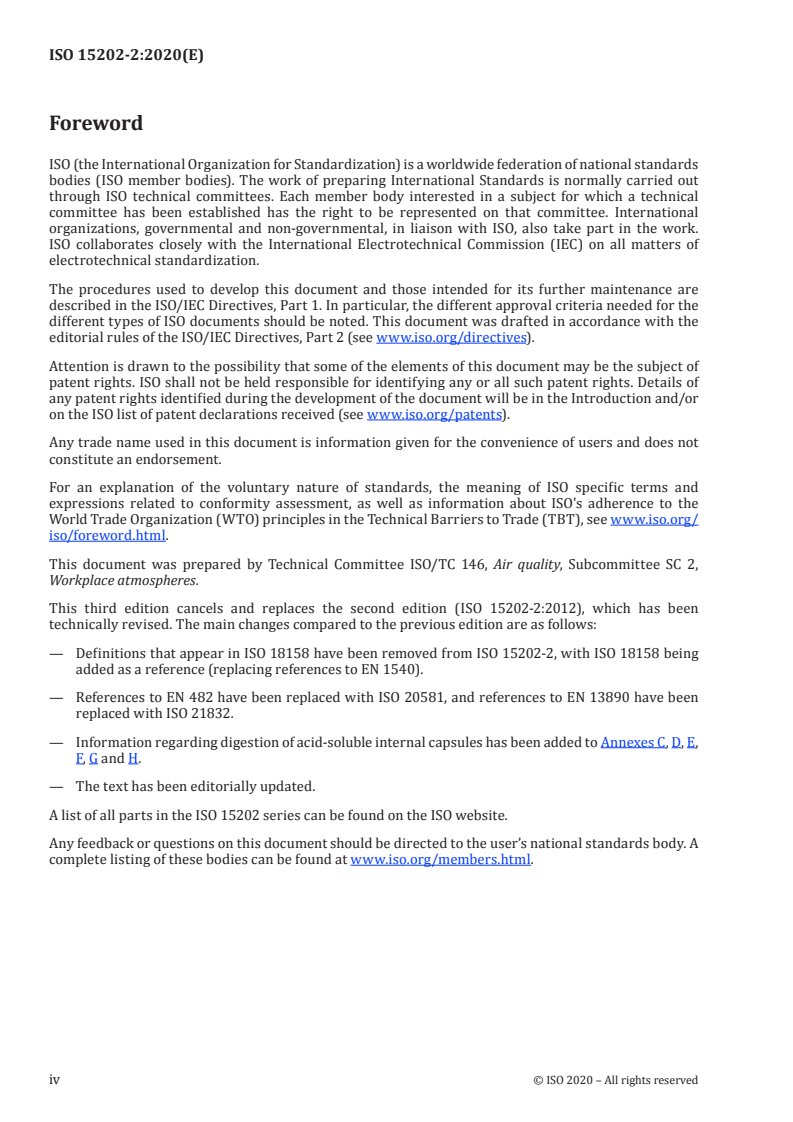
ISO 15202-2:2020 - Workplace air — Determination of metals and metalloids in airborne particulate matter by inductively coupled plasma atomic emission spectrometry — Part 2: Sample preparation/5/2020


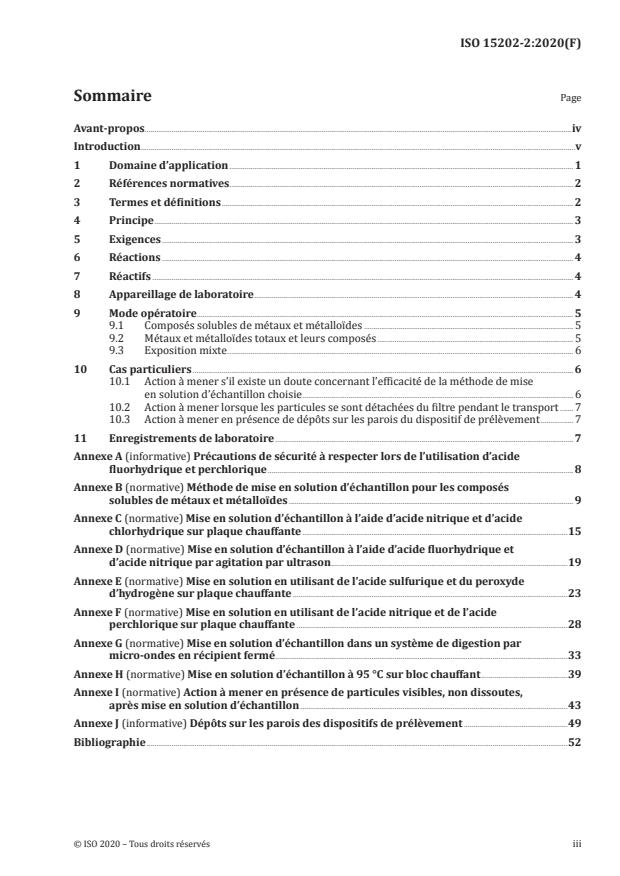
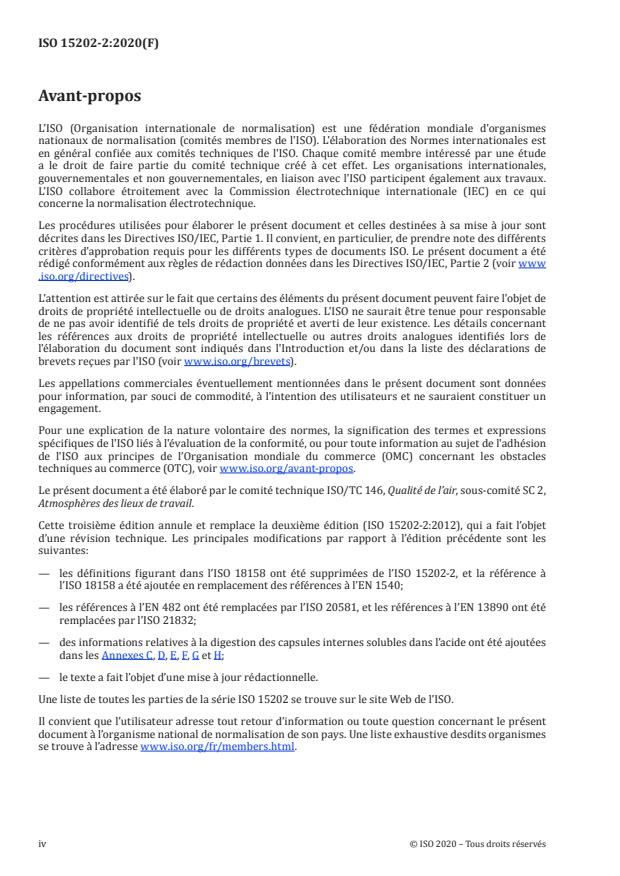
ISO 15202-2:2020 - Air des lieux de travail -- Détermination des métaux et métalloïdes dans les particules en suspension dans l'air par spectrométrie d'émission atomique avec plasma à couplage inductif
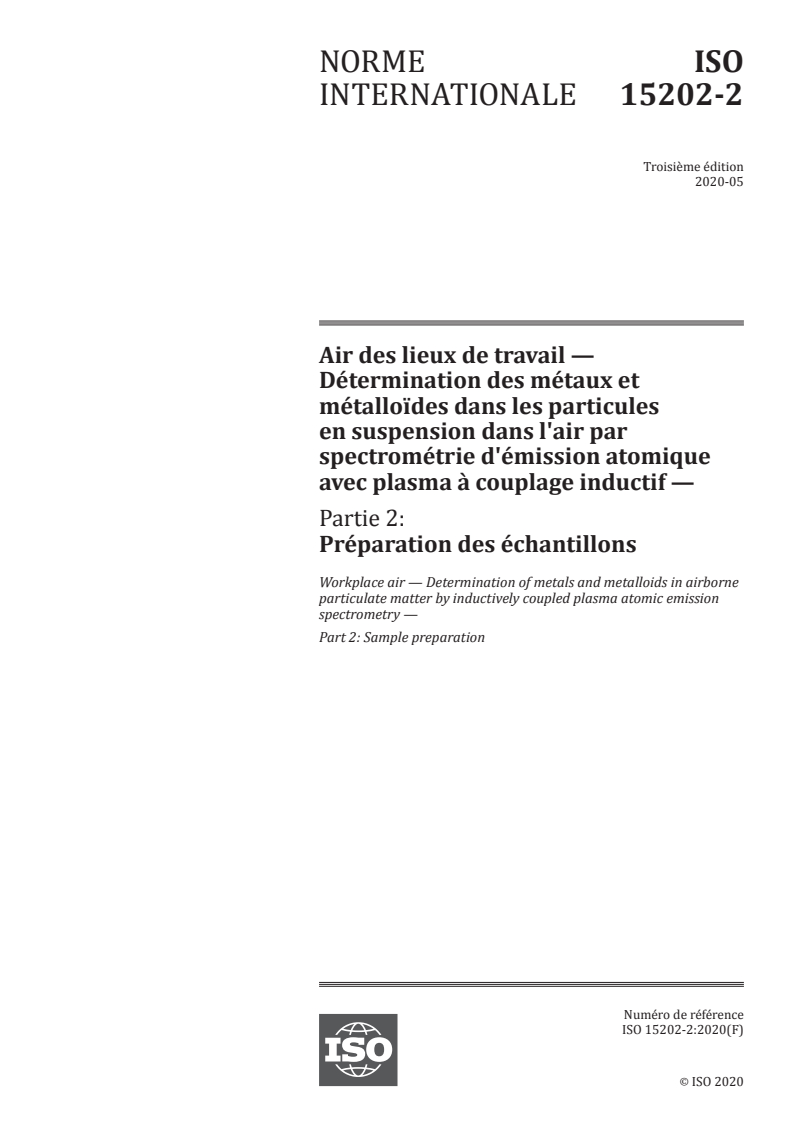

ISO 15202-2:2020 - Air des lieux de travail — Détermination des métaux et métalloïdes dans les particules en suspension dans l'air par spectrométrie d'émission atomique avec plasma à couplage inductif — Partie 2: Préparation des échantillons/17/2020
Overview
ISO 15202-2:2020 specifies accepted sample preparation methods for the chemical analysis of metals and metalloids in workplace air. It covers procedures to prepare test solutions from airborne particulate matter collected according to ISO 15202-1, for subsequent analysis by inductively coupled plasma atomic emission spectrometry (ICP‑AES). The standard clarifies when to use methods for soluble compounds versus methods for total metals, notes applicability to many regulated elements, and includes safety guidance for hazardous reagents.
Key topics and technical requirements
- Scope and purpose: Procedures to obtain representative sample solutions from filters and sampler deposits for ICP‑AES analysis (ISO 15202‑3).
- Sample dissolution approaches:
- Annex B: dissolution for soluble metal/metalloid compounds.
- Annexes C–H: methods for total metals (different acid digestions and systems).
- Methods include: nitric + hydrochloric acid (hotplate), hydrofluoric + nitric acid (ultrasonic), sulfuric acid + hydrogen peroxide (hotplate), nitric + perchloric acid (hotplate), closed‑vessel microwave dissolution, and dissolution at 95 °C using a hot block.
- Safety and handling: Annex A provides safety precautions for hazardous reagents such as hydrofluoric and perchloric acids; the document warns about hazardous materials and requires appropriate lab practices.
- Quality and procedure controls:
- Guidance for dealing with undissolved particulates (Annex I).
- Actions for sampler wall deposits and displaced filter particles (Annex J).
- Requirements for laboratory records and documentation of procedures and results.
- Analytical compatibility: While written for ICP‑AES, methods are generally suitable for other techniques like AAS and ICP‑MS.
Note: ISO 15202-2 is not applicable to elemental mercury or arsenic trioxide vapours, which are not collected by the sampling method in ISO 15202‑1.
Applications and users
ISO 15202-2 is intended for:
- Industrial hygiene and occupational health professionals conducting workplace air monitoring for metals and metalloids.
- Analytical testing laboratories preparing samples for ICP‑AES, ICP‑MS, or AAS.
- Regulatory agencies and employers validating compliance with occupational exposure limit values. Practical applications include periodic exposure assessments, control measure verification, and regulatory compliance testing for a wide range of metals (e.g., lead, cadmium, chromium, nickel, arsenic, zinc) and metalloids.
Related standards
- ISO 15202-1 (Sampling)
- ISO 15202-3 (Analysis by ICP‑AES)
- ISO 18158 (Terminology)
- ISO 21832 (Evaluation of measuring procedures)
- Relevant analytical technique standards: ISO 8518, ISO 11174 (AAS), ISO 30011 (ICP‑MS)
Keywords: workplace air standard, sample preparation, airborne particulate matter, metals and metalloids, ICP‑AES, acid digestion, microwave dissolution, industrial hygiene, occupational exposure.
Relations
- Effective Date
- 06-Jun-2022
- Effective Date
- 15-Dec-2017
Buy Documents
ISO 15202-2:2020 - Workplace air -- Determination of metals and metalloids in airborne particulate matter by inductively coupled plasma atomic emission spectrometry
ISO 15202-2:2020 - Workplace air — Determination of metals and metalloids in airborne particulate matter by inductively coupled plasma atomic emission spectrometry — Part 2: Sample preparation/5/2020
ISO 15202-2:2020 - Air des lieux de travail -- Détermination des métaux et métalloïdes dans les particules en suspension dans l'air par spectrométrie d'émission atomique avec plasma à couplage inductif
ISO 15202-2:2020 - Air des lieux de travail — Détermination des métaux et métalloïdes dans les particules en suspension dans l'air par spectrométrie d'émission atomique avec plasma à couplage inductif — Partie 2: Préparation des échantillons/17/2020
Get Certified
Connect with accredited certification bodies for this standard

CIS Institut d.o.o.
Personal Protective Equipment (PPE) certification body. Notified Body NB-2890 for EU Regulation 2016/425 PPE.

Kiwa BDA Testing
Building and construction product certification.
Kmetijski inštitut Slovenije
Agricultural Institute of Slovenia. Soil testing, plant health, agricultural product analysis.
Sponsored listings
Frequently Asked Questions
ISO 15202-2:2020 is a standard published by the International Organization for Standardization (ISO). Its full title is "Workplace air — Determination of metals and metalloids in airborne particulate matter by inductively coupled plasma atomic emission spectrometry — Part 2: Sample preparation". This standard covers: This document specifies a number of suitable methods for preparing test solutions from samples of airborne particulate matter collected using the method specified in ISO 15202‑1, for subsequent determination of metals and metalloids by ICP‑AES using the method specified in ISO 15202‑3. It contains information about the applicability of the methods with respect to the measurement of metals and metalloids for which limit values have been set. The methods can also be used in the measurement of some metals and metalloids for which limit values have not been set but no information about its applicability is provided in this case. NOTE The sample preparation methods described in this document are generally suitable for use with analytical techniques other than ICP‑AES, e.g. atomic absorption spectrometry (AAS) by ISO 8518[5] and ISO 11174[10] and inductively coupled plasma mass spectrometry (ICP‑MS) by ISO 30011[11]. The method specified in Annex B is applicable when making measurements for comparison with limit values for soluble metal or metalloid compounds. One or more of the sample dissolution methods specified in Annexes C through H are applicable when making measurements for comparison with limit values for total metals and metalloids and their compounds. Information on the applicability of individual methods is given in the scope of the annex in which the method is specified. The following is a non-exclusive list of metals and metalloids for which limit values have been set (see References [14] and [15]) and for which one or more of the sample dissolution methods specified in this document are applicable. However, there is no information available on the effectiveness of any of the specified sample dissolution methods for those elements in italics. Aluminium Calcium Magnesium Selenium Tungsten Antimony Chromium Manganese Silver Uranium Arsenic Cobalt Mercury Sodium Vanadium Barium Copper Molybdenum Strontium Yttrium Beryllium Hafnium Nickel Tantalum Zinc Bismuth Indium Phosphorus Tellurium Zirconium Boron Iron Platinum Thallium Caesium Lead Potassium Tin Cadmium Lithium Rhodium Titanium ISO 15202 is not applicable to the determination of elemental mercury or arsenic trioxide, since mercury vapour and arsenic trioxide vapour are not collected using the sampling method specified in ISO 15202‑1.
This document specifies a number of suitable methods for preparing test solutions from samples of airborne particulate matter collected using the method specified in ISO 15202‑1, for subsequent determination of metals and metalloids by ICP‑AES using the method specified in ISO 15202‑3. It contains information about the applicability of the methods with respect to the measurement of metals and metalloids for which limit values have been set. The methods can also be used in the measurement of some metals and metalloids for which limit values have not been set but no information about its applicability is provided in this case. NOTE The sample preparation methods described in this document are generally suitable for use with analytical techniques other than ICP‑AES, e.g. atomic absorption spectrometry (AAS) by ISO 8518[5] and ISO 11174[10] and inductively coupled plasma mass spectrometry (ICP‑MS) by ISO 30011[11]. The method specified in Annex B is applicable when making measurements for comparison with limit values for soluble metal or metalloid compounds. One or more of the sample dissolution methods specified in Annexes C through H are applicable when making measurements for comparison with limit values for total metals and metalloids and their compounds. Information on the applicability of individual methods is given in the scope of the annex in which the method is specified. The following is a non-exclusive list of metals and metalloids for which limit values have been set (see References [14] and [15]) and for which one or more of the sample dissolution methods specified in this document are applicable. However, there is no information available on the effectiveness of any of the specified sample dissolution methods for those elements in italics. Aluminium Calcium Magnesium Selenium Tungsten Antimony Chromium Manganese Silver Uranium Arsenic Cobalt Mercury Sodium Vanadium Barium Copper Molybdenum Strontium Yttrium Beryllium Hafnium Nickel Tantalum Zinc Bismuth Indium Phosphorus Tellurium Zirconium Boron Iron Platinum Thallium Caesium Lead Potassium Tin Cadmium Lithium Rhodium Titanium ISO 15202 is not applicable to the determination of elemental mercury or arsenic trioxide, since mercury vapour and arsenic trioxide vapour are not collected using the sampling method specified in ISO 15202‑1.
ISO 15202-2:2020 is classified under the following ICS (International Classification for Standards) categories: 13.040.30 - Workplace atmospheres. The ICS classification helps identify the subject area and facilitates finding related standards.
ISO 15202-2:2020 has the following relationships with other standards: It is inter standard links to ISO 8437-1:2019/Amd 1:2026, ISO 15202-2:2012. Understanding these relationships helps ensure you are using the most current and applicable version of the standard.
ISO 15202-2:2020 is available in PDF format for immediate download after purchase. The document can be added to your cart and obtained through the secure checkout process. Digital delivery ensures instant access to the complete standard document.
Standards Content (Sample)
SLOVENSKI STANDARD
01-november-2020
Nadomešča:
SIST ISO 15202-2:2013
Zrak na delovnem mestu - Določevanje kovin in polkovin v lebdečih delcih z
atomsko emisijsko spektrometrijo z induktivno sklopljeno plazmo - 2. del: Priprava
vzorcev
Workplace air - Determination of metals and metalloids in airborne particulate matter by
inductively coupled plasma atomic emission spectrometry - Part 2: Sample preparation
Air des lieux de travail - Détermination des métaux et métalloïdes dans les particules en
suspension dans l'air par spectrométrie d'émission atomique avec plasma à couplage
inductif - Partie 2: Préparation des échantillons
Ta slovenski standard je istoveten z: ISO 15202-2:2020
ICS:
13.040.30 Kakovost zraka na delovnem Workplace atmospheres
mestu
2003-01.Slovenski inštitut za standardizacijo. Razmnoževanje celote ali delov tega standarda ni dovoljeno.
INTERNATIONAL ISO
STANDARD 15202-2
Third edition
2020-05
Workplace air — Determination of
metals and metalloids in airborne
particulate matter by inductively
coupled plasma atomic emission
spectrometry —
Part 2:
Sample preparation
Air des lieux de travail — Détermination des métaux et métalloïdes
dans les particules en suspension dans l'air par spectrométrie
d'émission atomique avec plasma à couplage inductif —
Partie 2: Préparation des échantillons
Reference number
©
ISO 2020
© ISO 2020
All rights reserved. Unless otherwise specified, or required in the context of its implementation, no part of this publication may
be reproduced or utilized otherwise in any form or by any means, electronic or mechanical, including photocopying, or posting
on the internet or an intranet, without prior written permission. Permission can be requested from either ISO at the address
below or ISO’s member body in the country of the requester.
ISO copyright office
CP 401 • Ch. de Blandonnet 8
CH-1214 Vernier, Geneva
Phone: +41 22 749 01 11
Fax: +41 22 749 09 47
Email: copyright@iso.org
Website: www.iso.org
Published in Switzerland
ii © ISO 2020 – All rights reserved
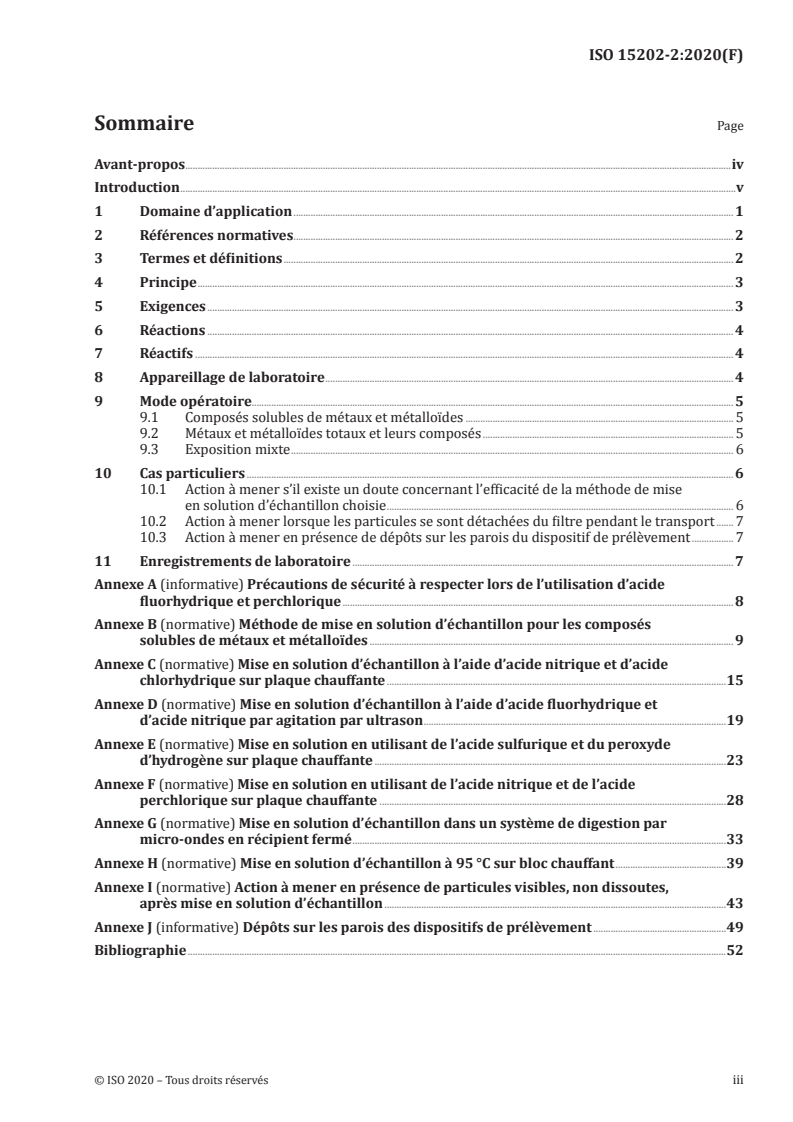
Contents Page
Foreword .iv
Introduction .v
1 Scope . 1
2 Normative references . 2
3 Terms and definitions . 2
4 Principle . 3
5 Requirements . 3
6 Reactions . 3
7 Reagents . 3
8 Laboratory apparatus . 4
9 Procedure. 4
9.1 Soluble metal and metalloid compounds . 4
9.2 Total metals and metalloids and their compounds . 5
9.3 Mixed exposure . 5
10 Special cases . 5
10.1 Action to be taken if there is doubt about the effectiveness of the selected sample
dissolution method . 5
10.2 Action to be taken when particles have become dislodged from the filter during
transportation . 6
10.3 Action to be taken regarding sampler wall deposits . 6
11 Laboratory records . 6
Annex A (informative) Safety precautions to be observed when using hydrofluoric and
perchloric acids . 7
Annex B (normative) Sample dissolution method for soluble metal and metalloid compounds .8
Annex C (normative) Sample dissolution using nitric acid and hydrochloric acid on a hotplate .14
Annex D (normative) Sample dissolution using hydrofluoric and nitric acids and ultrasonic
agitation . .18
Annex E (normative) Sample dissolution using sulfuric acid and hydrogen peroxide on a
hotplate .21
Annex F (normative) Sample dissolution using nitric acid and perchloric acid on a hotplate .25
Annex G (normative) Sample dissolution in a closed vessel microwave dissolution system .29
Annex H (normative) Sample dissolution at 95 °C using a hot block .35
Annex I (normative) Action to be taken when there is visible, undissolved, particulate
material after sample dissolution .38
Annex J (informative) Sampler wall deposits .44
Bibliography .47
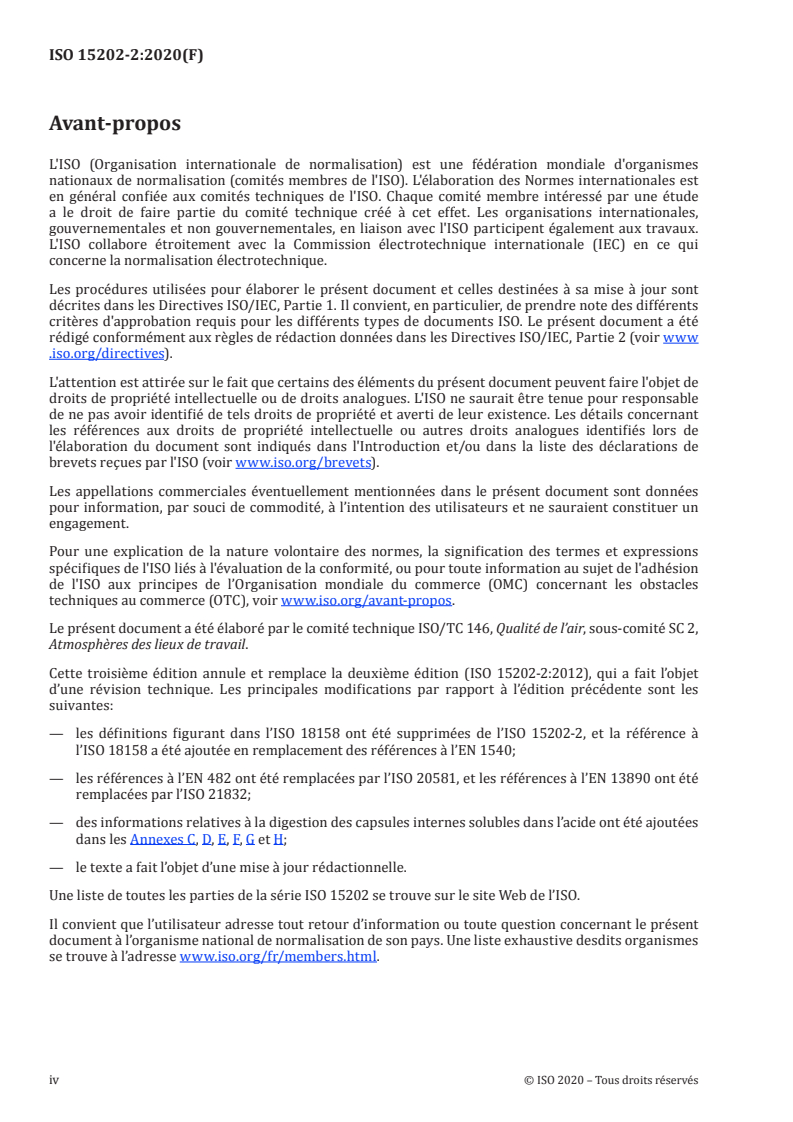
Foreword
ISO (the International Organization for Standardization) is a worldwide federation of national standards
bodies (ISO member bodies). The work of preparing International Standards is normally carried out
through ISO technical committees. Each member body interested in a subject for which a technical
committee has been established has the right to be represented on that committee. International
organizations, governmental and non-governmental, in liaison with ISO, also take part in the work.
ISO collaborates closely with the International Electrotechnical Commission (IEC) on all matters of
electrotechnical standardization.
The procedures used to develop this document and those intended for its further maintenance are
described in the ISO/IEC Directives, Part 1. In particular, the different approval criteria needed for the
different types of ISO documents should be noted. This document was drafted in accordance with the
editorial rules of the ISO/IEC Directives, Part 2 (see www .iso .org/ directives).
Attention is drawn to the possibility that some of the elements of this document may be the subject of
patent rights. ISO shall not be held responsible for identifying any or all such patent rights. Details of
any patent rights identified during the development of the document will be in the Introduction and/or
on the ISO list of patent declarations received (see www .iso .org/ patents).
Any trade name used in this document is information given for the convenience of users and does not
constitute an endorsement.
For an explanation of the voluntary nature of standards, the meaning of ISO specific terms and
expressions related to conformity assessment, as well as information about ISO's adherence to the
World Trade Organization (WTO) principles in the Technical Barriers to Trade (TBT), see www .iso .org/
iso/ foreword .html.
This document was prepared by Technical Committee ISO/TC 146, Air quality, Subcommittee SC 2,
Workplace atmospheres.
This third edition cancels and replaces the second edition (ISO 15202-2:2012), which has been
technically revised. The main changes compared to the previous edition are as follows:
— Definitions that appear in ISO 18158 have been removed from ISO 15202-2, with ISO 18158 being
added as a reference (replacing references to EN 1540).
— References to EN 482 have been replaced with ISO 20581, and references to EN 13890 have been
replaced with ISO 21832.
— Information regarding digestion of acid-soluble internal capsules has been added to Annexes C, D, E,
F, G and H.
— The text has been editorially updated.
A list of all parts in the ISO 15202 series can be found on the ISO website.
Any feedback or questions on this document should be directed to the user’s national standards body. A
complete listing of these bodies can be found at www .iso .org/ members .html.
iv © ISO 2020 – All rights reserved
Introduction
The health of workers in many industries is at risk through exposure by inhalation of toxic metals
and metalloids. Industrial hygienists and other public health professionals need to determine the
effectiveness of measures taken to control workers' exposure, and this is generally achieved by making
workplace air measurements. This document has been published in order to make available a method
for making valid exposure measurements for a wide range of metals and metalloids in use in industry.
It will be of benefit to agencies concerned with health and safety at work, industrial hygienists and
other public health professionals, analytical laboratories, industrial users of metals and metalloids and
their workers.
ISO 15202, published in three parts, specifies a generic method for the determination of the mass
concentration of metals and metalloids in workplace air using inductively coupled plasma atomic
emission spectrometry (ICP-AES).
— ISO 15202-1 gives details of relevant International, European and National Standards which specify
characteristics, performance requirements and test methods relating to sampling equipment. It
also augments guidance provided elsewhere on assessment strategy and measurement strategy,
as well as specifying a method for collecting samples of airborne particulate matter for subsequent
chemical analysis.
— ISO 15202-2 describes a number of procedures for preparing sample solutions for analysis by
ICP-AES.
— ISO 15202-3 gives requirements and test methods for the analysis of sample solutions by ICP-AES.
The sample preparation methods described in this part of ISO 15202 are generally suitable for use with
analytical techniques other than ICP-AES; e.g. atomic absorption spectroscopy (AAS) and inductively
coupled plasma mass spectrometry (ICP-MS).
It has been assumed in the drafting of this document that the execution of its provisions and the
interpretation of the results obtained are entrusted to appropriately qualified and experienced people.
INTERNATIONAL STANDARD ISO 15202-2:2020(E)
Workplace air — Determination of metals and metalloids
in airborne particulate matter by inductively coupled
plasma atomic emission spectrometry —
Part 2:
Sample preparation
WARNING — The use of this document may involve hazardous materials, operations and
equipment. This document does not purport to address any safety problems associated with
its use. It is the responsibility of the user of this document to establish appropriate safety and
health practices and determine the applicability of regulatory limitations prior to use.
1 Scope
This document specifies a number of suitable methods for preparing test solutions from samples of
airborne particulate matter collected using the method specified in ISO 15202-1, for subsequent
determination of metals and metalloids by ICP-AES using the method specified in ISO 15202-3. It
contains information about the applicability of the methods with respect to the measurement of metals
and metalloids for which limit values have been set. The methods can also be used in the measurement
of some metals and metalloids for which limit values have not been set but no information about its
applicability is provided in this case.
NOTE The sample preparation methods described in this document are generally suitable for use with
[5]
analytical techniques other than ICP-AES, e.g. atomic absorption spectrometry (AAS) by ISO 8518 and
[10] [11]
ISO 11174 and inductively coupled plasma mass spectrometry (ICP-MS) by ISO 30011 .
The method specified in Annex B is applicable when making measurements for comparison with limit
values for soluble metal or metalloid compounds.
One or more of the sample dissolution methods specified in Annexes C through H are applicable when
making measurements for comparison with limit values for total metals and metalloids and their
compounds. Information on the applicability of individual methods is given in the scope of the annex in
which the method is specified.
The following is a non-exclusive list of metals and metalloids for which limit values have been set (see
References [14] and [15]) and for which one or more of the sample dissolution methods specified in this
document are applicable. However, there is no information available on the effectiveness of any of the
specified sample dissolution methods for those elements in italics.
Aluminium Calcium Magnesium Selenium Tungsten
Antimony Chromium Manganese Silver Uranium
Arsenic Cobalt Mercury Sodium Vanadium
Barium Copper Molybdenum Strontium Yttrium
Beryllium Hafnium Nickel Tantalum Zinc
Bismuth Indium Phosphorus Tellurium Zirconium
Boron Iron Platinum Thallium
Caesium Lead Potassium Tin
Cadmium Lithium Rhodium Titanium
ISO 15202 is not applicable to the determination of elemental mercury or arsenic trioxide, since
mercury vapour and arsenic trioxide vapour are not collected using the sampling method specified in
ISO 15202-1.
2 Normative references
The following documents are referred to in the text in such a way that some or all of their content
constitutes requirements of this document. For dated references, only the edition cited applies. For
undated references, the latest edition of the referenced document (including any amendments) applies.
ISO 15202-1, Workplace air — Determination of metals and metalloids in airborne particulate matter by
inductively coupled plasma atomic emission spectrometry — Part 1: Sampling
ISO 15202-3, Workplace air — Determination of metals and metalloids in airborne particulate matter by
inductively coupled plasma atomic emission spectrometry — Part 3: Analysis
ISO 18158, Workplace air — Terminology
ISO 21832, Workplace air — Metals and metalloids in airborne particles — Requirements for evaluation of
measuring procedures
3 Terms and definitions
For the purposes of this document, the terms and definitions given in ISO 18158 and the following apply.
ISO and IEC maintain terminological databases for use in standardization at the following addresses:
— ISO Online browsing platform: available at https:// www .iso .org/ obp
— IEC Electropedia: available at http:// www .electropedia .org
3.1
sample dissolution
process of obtaining a solution containing all analytes of interest from a sample, which might or might
not involve complete dissolution of the sample
3.2
sample solution
solution prepared from a sample by the process of sample dissolution (3.1)
Note 1 to entry: A sample solution might need to be subjected to further operations, e.g. dilution, or addition, or
both, of an internal standard(s), in order to produce a test solution (3.3).
SOURCE: Adapted from EN 14902:2005, 3.1.22.
3.3
test solution
blank solution or sample solution (3.2) that has been subjected to all operations required to bring it into
a state in which it is ready for analysis
Note 1 to entry: “Ready for analysis” includes any required dilution or addition, or both, of an internal standard.
If a blank solution or sample solution (3.2) is not subject to any further operations before analysis, it is a test
solution.
SOURCE: EN 14902:2005, 3.1.30.
2 © ISO 2020 – All rights reserved
4 Principle
4.1 Airborne particles containing metals and metalloids are collected by drawing a measured volume
of air through a collection substrate, typically a filter mounted in a sampler designed to collect an
appropriate size fraction of airborne particles, using the method specified in ISO 15202-1.
4.2 An appropriate and suitable sample dissolution method is selected from those specified in
Annexes B through H, taking into consideration the metals and metalloids which are to be determined,
the limit values that have been set for those metals and metalloids, the applicability of the methods for
dissolution of the metals and metalloids of interest from materials which could be present in the test
atmosphere and the availability of the required laboratory apparatus.
4.3 The sample and collection substrate are then treated to dissolve the metals and metalloids of
interest using the selected sample dissolution method.
4.4 The resultant test solution is subsequently analysed for the metals and metalloids of interest by
inductively coupled plasma-atomic emission spectrometry using the method specified in ISO 15202-3.
NOTE Sample preparation methods described in Annexes B through H are generally suitable for use with
[5] [10] [11]
analytical techniques other than ICP-AES, e.g. AAS by ISO 8518 and ISO 11174 and ICP-MS by ISO 30011 .
For ICP-MS, changes could be required in the concentrations of acids or the dilution factors used to prepare
test solutions. Furthermore, some acids, such as hydrochloric acid, are not recommended for test solutions for
analysis by ICP-MS.
5 Requirements
The measuring procedure as a whole (covered by ISO 15202-1, ISO 15202-2 and ISO 15202-3) shall
conform to any relevant performance requirements for measuring chemical agents in workplace air
[12]
(for example ISO 20581 and ISO 21832).
6 Reactions
In general, the majority of particulate metals and metalloids and particulate metal and metalloid
compounds which are commonly of interest in samples of workplace air are converted to water-soluble
ions by one or more of the sample dissolution methods specified in this document. However, if there
is any doubt about whether a method will exhibit the required analytical recovery for a particular
application, it is necessary to investigate this before proceeding with the method (see 10.1).
7 Reagents
During the analysis, use only reagents of analytical grade and only water as specified in 7.1.
NOTE 1 Safety precautions to be observed when using hydrofluoric and perchloric acids are given in Annex A.
NOTE 2 Details of reagents that are required for use in Annexes B through I are given in the annex concerned.
NOTE 3 It could be necessary to use acids of higher purity in order to obtain an adequate detection limit for
some metals and metalloids.
[3]
7.1 Water, conforming with the requirements for ISO 3696 grade 2 water (electrical conductivity
less than 0,1 mS/m and resistivity greater than 0,01 MΩ⋅m at 25 °C).
It is recommended that the water used be obtained from a water purification system that delivers
ultrapure water having a resistivity greater than 0,18 MΩ⋅m (usually expressed by manufacturers of
water purification systems as 18 MΩ⋅cm).
−1
7.2 Nitric acid (HNO ), concentrated,ρ ≈ 1,42 g ml , w ≈ 70 % mass fraction.
HNO HNO
3 3
−1
The concentration of the metals and metalloids of interest shall be less than 0,1 µg ml .
WARNING — Concentrated nitric acid is corrosive and oxidizing, and nitric acid fumes are
irritant. Avoid exposure by contact with the skin or eyes, or by inhalation of fumes. Use suitable
personal protective equipment (including suitable gloves, face shield or safety spectacles, etc.)
when working with the concentrated or dilute nitric acid and carry out sample dissolution with
concentrated nitric acid in open vessels in a fume hood.
7.3 Nitric acid, diluted 1 + 9.
Carefully and slowly begin adding 50 ml of concentrated nitric acid (7.2) to 450 ml of water (7.1) in a 1 l
polypropylene bottle (8.5). Add the acid in small aliquots. Between additions, swirl to mix and run cold
tap water over the side of the bottle to cool the contents. Do not allow the tap water to contaminate the
contents of the bottle. When the addition of the concentrated nitric acid is complete, swirl the bottle
to mix the contents, allow to cool to room temperature, close the bottle with its screw cap and mix
thoroughly.
8 Laboratory apparatus
Usual laboratory apparatus and, in particular, the following.
8.1 Disposable gloves, impermeable and powder free, to avoid the possibility of contamination from
the hands and to protect them from contact with toxic and corrosive substances. PVC gloves are suitable.
8.2 Glassware, beakers and one-mark volumetric flasks conforming to the requirements of
[1] [2]
ISO 1042 , made of borosilicate glass conforming with the requirements of ISO 3585 , cleaned before
use by soaking in 1 + 9 nitric acid (7.3) for at least 24 h and then rinsing thoroughly with water (7.1).
Alternatively, the glassware may be cleaned with a suitable laboratory detergent using a laboratory
washing machine.
8.3 Flat-tipped forceps, non-metallic (e.g. plastic or plastic-coated), for unloading filters from
samplers or from filter transport cassettes.
[6]
8.4 Piston-operated volumetric instruments, conforming with the requirements of ISO 8655-1
[9]
and tested in accordance with ISO 8655-6 , including pipettors conforming with the requirements of
[7] [8]
ISO 8655-2 and dispensers conforming with the requirements of ISO 8655-5 , for dispensing leach
solution, acids, etc.
8.5 Polypropylene bottle, 1 l capacity, with leakproof screw cap.
A bottle made of an alternative plastic may be used provided that it is suitable for the intended use
(see 7.3).
NOTE Details of laboratory apparatus that are required for use in Annexes B through I are given in the annex
concerned.
9 Procedure
9.1 Soluble metal and metalloid compounds
9.1.1 If results are required for comparison with limit values for soluble metal or metalloid compounds,
or both, use the sample dissolution method specified in Annex B to prepare test solutions for analysis by
the method specified in ISO 15202-3.
4 © ISO 2020 – All rights reserved
9.1.2 Alternatively, if it is known that no insoluble compounds of the metals or metalloids, or both,
of interest are used in the workplace and that none are produced in the processes carried out, prepare
test solutions for analysis by the method specified in ISO 15202-3, using one of the sample dissolution
methods for total metals and metalloids and their compounds prescribed in Annexes C through H, and
compare the results with the limit value for the soluble metals or metalloids, or both, concerned.
The methods prescribed in Annexes C through H are not specific for soluble metal or metalloid
compounds, or both. However, in the circumstances described above, they may be used as an alternative
to the method described in Annex B, if this is more convenient.
9.2 Total metals and metalloids and their compounds
9.2.1 If results are required for comparison with limit values for total metals or metalloids, or both,
and their compounds, select a suitable sample dissolution method from those specified in Annexes C
through H. Take into consideration the applicability of each method for dissolution of the metals and
metalloids of interest from materials that could be present in the test atmosphere (refer to the clause on
the effectiveness of the sample dissolution method in the annex in which the method is specified) and the
availability of the required laboratory apparatus.
9.2.2 Use the selected sample dissolution method to prepare test solutions for analysis of total metals
and metalloids and their compounds by the method specified in ISO 15202-3.
9.3 Mixed exposure
9.3.1 If results are required
— for comparison with limit values for soluble metal and/or metalloid compounds and with limit
values for metals and/or metalloids and their insoluble compounds, or
— for comparison with limit values for soluble metal and/or metalloid compounds and with limit
values for total metals and/or metalloids and their compounds,
follow the instructions given in 9.3.2 and 9.3.3.
9.3.2 Use the sample dissolution method specified in Annex B to prepare test solutions for the
determination of soluble metal and metalloid compounds by the method specified in ISO 15202-3.
9.3.3 Select a suitable sample dissolution method for total metals and metalloids and compounds
(see 9.2). Use this to treat undissolved material from the method for soluble metal and metalloid
compounds (see B.6.7.1) and prepare test solutions for determination of metals and metalloids and their
insoluble compounds by the method specified in ISO 15202-3.
10 Special cases
10.1 Action to be taken if there is doubt about the effectiveness of the selected sample
dissolution method
10.1.1 If there is any doubt about whether the selected sample dissolution method will exhibit the
required analytical recovery when used for dissolution of the metals and metalloids of interest from
materials which could be present in the test atmosphere, determine its effectiveness for that particular
application. For total metals and metalloids, this may be achieved by analysing a bulk sample of known
composition which is similar in nature to the materials being used or produced in the workplace, e.g. a
certified reference material. For soluble metals and metalloids, analytical recovery is best determined by
analysing filters spiked with solution containing a known mass of the soluble compound of interest.
NOTE In designing an experiment to determine the effectiveness of a sample dissolution method, the particle
size of a bulk sample can have a significant influence on the efficiency of its dissolution. Furthermore, microgram
amounts of relatively insoluble material are normally much more easily dissolved than milligram amounts.
10.1.2 If the analytical recovery is less than the minimum acceptable value prescribed in ISO 21832
(analytical recovery at least 90 % with a coefficient of variation less than 5 %), investigate the use of an
alternative sample dissolution method. This may be a method not specified in this document if it can be
demonstrated that its analytical recovery meets the requirements of ISO 21832.
10.1.3 Do not use a correction factor to compensate for an apparently ineffective sample dissolution
method, since this might equally lead to erroneous results.
10.2 Action to be taken when particles have become dislodged from the filter during
transportation
When the filter transport cassettes or samplers are opened, it is advisable to look for evidence that
particles have become dislodged from the filter during transportation. If this appears to have occurred,
wash the internal surfaces of the filter transport cassette or sampler in the sample dissolution vessel
in order to recover the material concerned. Before analysis is carried out, inform the originator of the
sample of the condition in which it was received so that the originator can make a judgement as to
whether it is to be analysed.
10.3 Action to be taken regarding sampler wall deposits
Particles are frequently found to have deposited on the interior walls of samplers, and for many
samplers these particles comprise an integral, and often substantial component of the sample. In such
cases, action shall be taken to include these deposits in the analysis. Additional information is provided
in Annex J.
11 Laboratory records
11.1 Record details of all reagent sources (lot numbers) used for sample preparation.
11.2 Record details of laboratory apparatus used for sample preparation, where this is relevant, e.g.
the serial number of equipment when there is more than one item of equipment of the same type in the
laboratory.
11.3 Record any deviations from the specified methods.
11.4 Record any unusual events or observations during sample preparation.
6 © ISO 2020 – All rights reserved
Annex A
(informative)
Safety precautions to be observed when using hydrofluoric and
perchloric acids
A.1 Special precautions to be observed when using hydrofluoric acid
A.1.1 Take extreme care when using hydrofluoric acid. Ensure that the nature and seriousness of
hydrofluoric acid burns is understood before commencing work with this substance.
The burning sensation associated with many concentrated acid burns is not immediately apparent
on exposure to hydrofluoric acid and may not be felt for several hours. Relatively dilute solutions of
hydrofluoric acid can also be absorbed through the skin, with serious effects similar to those resulting
from exposure to the concentrated acid.
When using hydrofluoric acid, it is recommended that a pair of disposable gloves is worn underneath
suitable rubber gloves to provide added protection for the hands.
A.1.2 Carry hydrofluoric acid burn cream (containing calcium gluconate) at all times while working
with hydrofluoric acid and for 24 h afterwards. Apply the cream to any contaminated skin, after washing
the affected area with copious amounts of water. Obtain medical advice immediately in case of an accident.
Calcium gluconate cream has a limited lifetime and should be replaced prior to its expiration date.
A.2 Special precautions to be observed when using perchloric acid
A.2.1 Perchloric acid forms explosive compounds with organics and with many metal salts. When
performing sample dissolution using this acid, ensure that any organic material present is destroyed, e.g.
by heating with nitric acid before addition of perchloric acid.
A.2.2 Do not allow perchloric acid solutions containing high concentrations of metal salts to boil dry, as
solid perchlorates are shock-sensitive and can explode.
A.2.3 Perform sample dissolution using a special fume cupboard designed for the use of perchloric
acid and incorporating a scrubbing system to remove acid vapours from exhaust gases so as to prevent
the possibility of potentially explosive material accumulating in ducts.
Annex B
(normative)
Sample dissolution method for soluble metal and metalloid
compounds
B.1 Scope
B.1.1 This annex specifies a method for the dissolution of soluble metal and metalloid compounds
using a suitable leach solution.
B.1.2 The method is applicable in all instances, except when use of a specific leach solution or leach
conditions, or both, is prescribed in National Standards or Regulations.
B.1.3 Metals for which limit values for soluble compounds have typically been set (see
References [14] and [15]), and for which the sample dissolution method specified in this annex is
applicable, are listed below:
Aluminium Molybdenum Platinum Silver Tungsten
Barium Nickel Rhodium Thallium Uranium
NOTE 1 The above list is based upon the applicability of the sample dissolution procedure reported in
References [17], [18] and [19], with adaptation based on expert judgement. Furthermore, the list is not
comprehensive and the procedure will be effective for some metals and metalloids that are not listed.
NOTE 2 The sample dissolution method specified in this annex can also be used for the dissolution of soluble
zinc compounds, e.g. for determination of zinc chloride in the presence of zinc oxide in galvanizing fume.
B.2 Effectiveness of the sample dissolution method
B.2.1 Soluble compounds of metals and metalloids are essentially defined by the specific leach solutions
and leach conditions used in the measurement methods prescribed for their determination. (This is
because, except for compounds that are very soluble or very insoluble in water, solubility can be dependent
upon the nature of the leach solution and parameters such as particle size, solute/solvent ratio, pH,
temperature, etc.) Consequently, the sample dissolution method, by definition, gives the desired result.
NOTE The repeatability and reproducibility of water leach for soluble metals has been demonstrated for
[43]
welding fume in an interlaboratory study .
B.2.2 Although the sample dissolution method for soluble compounds prescribed in this document is
design-based, there are circumstances in which it can give incorrect results. In particular, this can occur if
a soluble compound reacts with the filter material, or a contaminant on the filter, to produce an insoluble
compound. For example, a low recovery will be obtained for soluble silver compounds if the filter used
is contaminated with chloride. It is therefore important that proper consideration is given to chemical
compatibility when selecting a filter for collecting samples of soluble compounds (see ISO 15202-1). If it
is believed that there could be a chemical compatibility problem, tests should be performed to confirm
that analytical recovery is satisfactory before samples are collected (see 10.1.1). Low recoveries for
[20]
soluble silver can also occur if samples are exposed to light .
8 © ISO 2020 – All rights reserved
B.3 Principle
B.3.1 Soluble metal and metalloid compounds are dissolved by treating the filter and collected sample
with a suitable leach solution and agitating in a water bath at 37 °C ± 2 °C for 60 min.
B.3.2 The resultant sample solution is filtered through a membrane filter to remove undissolved
particulate material and to produce a test solution for analysis using the method specified in ISO 15202-3.
B.4 Reagents
B.4.1 Water, as specified in 7.1.
B.4.2 Nitric acid (HNO ), concentrated, as specified in 7.2.
B.5 Laboratory apparatus
Usual laboratory apparatus and in particular the following.
B.5.1 Disposable gloves, as specified in 8.1.
B.5.2 Glassware, as specified in 8.2.
B.5.2.1 Beakers, 50 ml capacity, of a form that is compatible with filters of the diameter used in the
sampler, for preparation of test solutions.
NOTE Beakers are not required if the leach step is carried out in the sampler (see Note 2 in B.6.2.2).
It is preferable to reserve a set of beakers for use in the sample dissolution methods specified in this
annex and other annexes of this document. Heavily contaminated beakers in general usage might not
be satisfactorily cleaned by the method specified in 8.2. If such beakers are to be used, it is strongly
recommended that they are cleaned under the test conditions before use. This should be done by adding
the appropriate reagents and taking through the sample dissolution method concerned.
B.5.2.2 One-mark volumetric flasks, 10 ml capacity for preparation of test solutions.
NOTE 10 ml volumetric flasks are not required if test solutions are to be made up in graduated test tubes
(see B.6.4.4) or if undissolved material is to be removed using a syringe filter (see B.6.4).
B.5.3 Disposable test tubes, polypropylene, graduated, 10 ml capacity, with push-fit closures and
preferably compatible with the auto sampler tube racks of the ICP-AES instrument.
NOTE Test tubes without graduation are satisfactory if the samples are made up in volumetric flasks (see
B.6.3.1).
B.5.4 Forceps, as specified in 8.3.
B.5.5 Piston operated volumetric apparatus, as specified in 8.4, for dispensing leach solution (see
B.6.2.2 and B.6.4.1).
B.5.6 Water bath, with temperature control, and preferably equipped with integral sample shaker.
If the water bath is not fitted with an integral sample shaker, a waterproof magnetic stirrer may
be placed in the bottom of the water bath and the sample solutions stirred using polypropylene
encapsulated magnetic followers.
B.5.7 Suction filtration equipment.
NOTE Suction filtration equipment is not required if disposable syringe filters are used to remove
undissolved particulate from the sample solutions (see B.6.4).
B.5.7.1 Suction filtration apparatus, typically a water-operated or electrically driven vacuum pump,
connected to a conical flask fitted with a filter funnel/support assembly (see Figure B.1).
NOTE Alternative suction filtration apparatus is commercially available that permits simultaneous vacuum
filtration of multiple sample solutions.
B.5.7.2 Membrane filters, of a diameter suitable for use with the suction filtration apparatus (B.5.7.1).
The membrane filters used should be selected carefully, taking full account of any possible reaction of
the analyte with the filter material or contaminant of the filter (see B.2.2). Consideration should also be
given to the fact that the filters used should preferably be soluble in any subsequent sample preparation
method for determination of total metals and metalloids.
B.5.8 Syringe filtration equipment
B.5.8.1 Syringes, disposable, polypropylene, 5 ml capacity, suitable for use with disposable syringe
filters (B.5.8.2).
NOTE Disposable syringes are not required if suction filtration equipment is used to remove undissolved
particulate from the sample solutions (see B.6.3).
B.5.8.2 Syringe filters, disposable, polypropylene, incorporating a suitable membrane filter (e.g.
polypropylene) with a pore size of 0,8 µm or less, for use with disposable syringes (B.5.8.1).
NOTE Disposable syringe filters are not required if suction filtration equipment is used to remove
undissolved particulate from the sample solutions (see B.6.3).
B.6 Procedure
B.6.1 Selection of leach solution
B.6.1.1 Except when national standards or regulations specify otherwise, use water (B.4.1) to leach the
sample filter.
B.6.1.2 Follow the instructions given in national standards or regulations, if these prescribe that a
specific leach solution or leach conditions, or both, is to be used when measuring the soluble compounds
of a particular metal or metalloid.
B.6.2 Preparation of sample solutions
NOTE It is advisable to wear disposable gloves (B.5.1) during sample preparation, for personal protection
and in order to avoid the possibility of contamination from the hands.
10 © ISO 2020 – All rights reserved
Key
1 filter funnel
2 membrane filter
3 fritted glass base
4 stopper
5 spring clamp
6 filtering flask, 250 ml
7 test tube, 16 mm × 95 mm
Figure B.1 — Example of a suction filtration apparatus
B.6.2.1 Open the filter transport cassettes, sampler filter cassettes or samplers and transfer each filter
into an individual, labelled, 50 ml beaker (B.5.2.1) using clean flat-tipped forceps (B.5.4). Follow the same
procedure for the blank filters.
NOTE If the leach is carried out in the sampler (see Note 2 in B.6.2.2), there is no need to remove the filter.
B.6.2.2 Accurately pipette 5 ml of leach solution (see B.6.1) into each beaker. If the sampler used was
of a type in which airborne particles deposited on the internal surfaces of the filter cassette or sampler
form part of the sample, use the leach solution to carefully wash any particulate material adhering to the
internal surfaces of the sampler into the beaker.
NOTE 1 The volume of leach solution can be increased, if necessary, in order to ensure that the sample filters
are fully immersed during the heating and agitation step (B.6.2.3). In this case, however, if a syringe filter is used
to remove undissolved material from the sample solution, there will need to be a corresponding reduction in the
further volume of leach solution added in B.6.4.1.
NOTE 2 Alternatively, the leach can be carried out in the sampler, if it is watertight when the sample outlet
orifice is sealed with its protective plug and if it is of sufficient capacity, by adding leach solution to each sampler
via the air inlet orifice and positioning the samplers in the water bath in a suitable manner, so that spillage and
contamination of the sample solutions are avoided. See Reference [19] for more details.
B.6.2.3 Cover each beaker, place in a water bath (B.5.6) at 37 °C ± 2 °C and agitate for 60 min, ensuring
that the sample filters are fully immersed throughout the leach period. Do not use ultrasonic agitation to
promote sample dissolution.
B.6.2.4 Remove undissolved material from the sample solution using suction filtration equipment,
following the method specified in B.6.3, or using a syringe filter, following the method specified in B.6.4.
If a test solution is also to be prepared for determination of metals and metalloids and their insoluble
compound
...
INTERNATIONAL ISO
STANDARD 15202-2
Third edition
2020-05
Workplace air — Determination of
metals and metalloids in airborne
particulate matter by inductively
coupled plasma atomic emission
spectrometry —
Part 2:
Sample preparation
Air des lieux de travail — Détermination des métaux et métalloïdes
dans les particules en suspension dans l'air par spectrométrie
d'émission atomique avec plasma à couplage inductif —
Partie 2: Préparation des échantillons
Reference number
©
ISO 2020
© ISO 2020
All rights reserved. Unless otherwise specified, or required in the context of its implementation, no part of this publication may
be reproduced or utilized otherwise in any form or by any means, electronic or mechanical, including photocopying, or posting
on the internet or an intranet, without prior written permission. Permission can be requested from either ISO at the address
below or ISO’s member body in the country of the requester.
ISO copyright office
CP 401 • Ch. de Blandonnet 8
CH-1214 Vernier, Geneva
Phone: +41 22 749 01 11
Fax: +41 22 749 09 47
Email: copyright@iso.org
Website: www.iso.org
Published in Switzerland
ii © ISO 2020 – All rights reserved
Contents Page
Foreword .iv
Introduction .v
1 Scope . 1
2 Normative references . 2
3 Terms and definitions . 2
4 Principle . 3
5 Requirements . 3
6 Reactions . 3
7 Reagents . 3
8 Laboratory apparatus . 4
9 Procedure. 4
9.1 Soluble metal and metalloid compounds . 4
9.2 Total metals and metalloids and their compounds . 5
9.3 Mixed exposure . 5
10 Special cases . 5
10.1 Action to be taken if there is doubt about the effectiveness of the selected sample
dissolution method . 5
10.2 Action to be taken when particles have become dislodged from the filter during
transportation . 6
10.3 Action to be taken regarding sampler wall deposits . 6
11 Laboratory records . 6
Annex A (informative) Safety precautions to be observed when using hydrofluoric and
perchloric acids . 7
Annex B (normative) Sample dissolution method for soluble metal and metalloid compounds .8
Annex C (normative) Sample dissolution using nitric acid and hydrochloric acid on a hotplate .14
Annex D (normative) Sample dissolution using hydrofluoric and nitric acids and ultrasonic
agitation . .18
Annex E (normative) Sample dissolution using sulfuric acid and hydrogen peroxide on a
hotplate .21
Annex F (normative) Sample dissolution using nitric acid and perchloric acid on a hotplate .25
Annex G (normative) Sample dissolution in a closed vessel microwave dissolution system .29
Annex H (normative) Sample dissolution at 95 °C using a hot block .35
Annex I (normative) Action to be taken when there is visible, undissolved, particulate
material after sample dissolution .38
Annex J (informative) Sampler wall deposits .44
Bibliography .47
Foreword
ISO (the International Organization for Standardization) is a worldwide federation of national standards
bodies (ISO member bodies). The work of preparing International Standards is normally carried out
through ISO technical committees. Each member body interested in a subject for which a technical
committee has been established has the right to be represented on that committee. International
organizations, governmental and non-governmental, in liaison with ISO, also take part in the work.
ISO collaborates closely with the International Electrotechnical Commission (IEC) on all matters of
electrotechnical standardization.
The procedures used to develop this document and those intended for its further maintenance are
described in the ISO/IEC Directives, Part 1. In particular, the different approval criteria needed for the
different types of ISO documents should be noted. This document was drafted in accordance with the
editorial rules of the ISO/IEC Directives, Part 2 (see www .iso .org/ directives).
Attention is drawn to the possibility that some of the elements of this document may be the subject of
patent rights. ISO shall not be held responsible for identifying any or all such patent rights. Details of
any patent rights identified during the development of the document will be in the Introduction and/or
on the ISO list of patent declarations received (see www .iso .org/ patents).
Any trade name used in this document is information given for the convenience of users and does not
constitute an endorsement.
For an explanation of the voluntary nature of standards, the meaning of ISO specific terms and
expressions related to conformity assessment, as well as information about ISO's adherence to the
World Trade Organization (WTO) principles in the Technical Barriers to Trade (TBT), see www .iso .org/
iso/ foreword .html.
This document was prepared by Technical Committee ISO/TC 146, Air quality, Subcommittee SC 2,
Workplace atmospheres.
This third edition cancels and replaces the second edition (ISO 15202-2:2012), which has been
technically revised. The main changes compared to the previous edition are as follows:
— Definitions that appear in ISO 18158 have been removed from ISO 15202-2, with ISO 18158 being
added as a reference (replacing references to EN 1540).
— References to EN 482 have been replaced with ISO 20581, and references to EN 13890 have been
replaced with ISO 21832.
— Information regarding digestion of acid-soluble internal capsules has been added to Annexes C, D, E,
F, G and H.
— The text has been editorially updated.
A list of all parts in the ISO 15202 series can be found on the ISO website.
Any feedback or questions on this document should be directed to the user’s national standards body. A
complete listing of these bodies can be found at www .iso .org/ members .html.
iv © ISO 2020 – All rights reserved
Introduction
The health of workers in many industries is at risk through exposure by inhalation of toxic metals
and metalloids. Industrial hygienists and other public health professionals need to determine the
effectiveness of measures taken to control workers' exposure, and this is generally achieved by making
workplace air measurements. This document has been published in order to make available a method
for making valid exposure measurements for a wide range of metals and metalloids in use in industry.
It will be of benefit to agencies concerned with health and safety at work, industrial hygienists and
other public health professionals, analytical laboratories, industrial users of metals and metalloids and
their workers.
ISO 15202, published in three parts, specifies a generic method for the determination of the mass
concentration of metals and metalloids in workplace air using inductively coupled plasma atomic
emission spectrometry (ICP-AES).
— ISO 15202-1 gives details of relevant International, European and National Standards which specify
characteristics, performance requirements and test methods relating to sampling equipment. It
also augments guidance provided elsewhere on assessment strategy and measurement strategy,
as well as specifying a method for collecting samples of airborne particulate matter for subsequent
chemical analysis.
— ISO 15202-2 describes a number of procedures for preparing sample solutions for analysis by
ICP-AES.
— ISO 15202-3 gives requirements and test methods for the analysis of sample solutions by ICP-AES.
The sample preparation methods described in this part of ISO 15202 are generally suitable for use with
analytical techniques other than ICP-AES; e.g. atomic absorption spectroscopy (AAS) and inductively
coupled plasma mass spectrometry (ICP-MS).
It has been assumed in the drafting of this document that the execution of its provisions and the
interpretation of the results obtained are entrusted to appropriately qualified and experienced people.
INTERNATIONAL STANDARD ISO 15202-2:2020(E)
Workplace air — Determination of metals and metalloids
in airborne particulate matter by inductively coupled
plasma atomic emission spectrometry —
Part 2:
Sample preparation
WARNING — The use of this document may involve hazardous materials, operations and
equipment. This document does not purport to address any safety problems associated with
its use. It is the responsibility of the user of this document to establish appropriate safety and
health practices and determine the applicability of regulatory limitations prior to use.
1 Scope
This document specifies a number of suitable methods for preparing test solutions from samples of
airborne particulate matter collected using the method specified in ISO 15202-1, for subsequent
determination of metals and metalloids by ICP-AES using the method specified in ISO 15202-3. It
contains information about the applicability of the methods with respect to the measurement of metals
and metalloids for which limit values have been set. The methods can also be used in the measurement
of some metals and metalloids for which limit values have not been set but no information about its
applicability is provided in this case.
NOTE The sample preparation methods described in this document are generally suitable for use with
[5]
analytical techniques other than ICP-AES, e.g. atomic absorption spectrometry (AAS) by ISO 8518 and
[10] [11]
ISO 11174 and inductively coupled plasma mass spectrometry (ICP-MS) by ISO 30011 .
The method specified in Annex B is applicable when making measurements for comparison with limit
values for soluble metal or metalloid compounds.
One or more of the sample dissolution methods specified in Annexes C through H are applicable when
making measurements for comparison with limit values for total metals and metalloids and their
compounds. Information on the applicability of individual methods is given in the scope of the annex in
which the method is specified.
The following is a non-exclusive list of metals and metalloids for which limit values have been set (see
References [14] and [15]) and for which one or more of the sample dissolution methods specified in this
document are applicable. However, there is no information available on the effectiveness of any of the
specified sample dissolution methods for those elements in italics.
Aluminium Calcium Magnesium Selenium Tungsten
Antimony Chromium Manganese Silver Uranium
Arsenic Cobalt Mercury Sodium Vanadium
Barium Copper Molybdenum Strontium Yttrium
Beryllium Hafnium Nickel Tantalum Zinc
Bismuth Indium Phosphorus Tellurium Zirconium
Boron Iron Platinum Thallium
Caesium Lead Potassium Tin
Cadmium Lithium Rhodium Titanium
ISO 15202 is not applicable to the determination of elemental mercury or arsenic trioxide, since
mercury vapour and arsenic trioxide vapour are not collected using the sampling method specified in
ISO 15202-1.
2 Normative references
The following documents are referred to in the text in such a way that some or all of their content
constitutes requirements of this document. For dated references, only the edition cited applies. For
undated references, the latest edition of the referenced document (including any amendments) applies.
ISO 15202-1, Workplace air — Determination of metals and metalloids in airborne particulate matter by
inductively coupled plasma atomic emission spectrometry — Part 1: Sampling
ISO 15202-3, Workplace air — Determination of metals and metalloids in airborne particulate matter by
inductively coupled plasma atomic emission spectrometry — Part 3: Analysis
ISO 18158, Workplace air — Terminology
ISO 21832, Workplace air — Metals and metalloids in airborne particles — Requirements for evaluation of
measuring procedures
3 Terms and definitions
For the purposes of this document, the terms and definitions given in ISO 18158 and the following apply.
ISO and IEC maintain terminological databases for use in standardization at the following addresses:
— ISO Online browsing platform: available at https:// www .iso .org/ obp
— IEC Electropedia: available at http:// www .electropedia .org
3.1
sample dissolution
process of obtaining a solution containing all analytes of interest from a sample, which might or might
not involve complete dissolution of the sample
3.2
sample solution
solution prepared from a sample by the process of sample dissolution (3.1)
Note 1 to entry: A sample solution might need to be subjected to further operations, e.g. dilution, or addition, or
both, of an internal standard(s), in order to produce a test solution (3.3).
SOURCE: Adapted from EN 14902:2005, 3.1.22.
3.3
test solution
blank solution or sample solution (3.2) that has been subjected to all operations required to bring it into
a state in which it is ready for analysis
Note 1 to entry: “Ready for analysis” includes any required dilution or addition, or both, of an internal standard.
If a blank solution or sample solution (3.2) is not subject to any further operations before analysis, it is a test
solution.
SOURCE: EN 14902:2005, 3.1.30.
2 © ISO 2020 – All rights reserved
4 Principle
4.1 Airborne particles containing metals and metalloids are collected by drawing a measured volume
of air through a collection substrate, typically a filter mounted in a sampler designed to collect an
appropriate size fraction of airborne particles, using the method specified in ISO 15202-1.
4.2 An appropriate and suitable sample dissolution method is selected from those specified in
Annexes B through H, taking into consideration the metals and metalloids which are to be determined,
the limit values that have been set for those metals and metalloids, the applicability of the methods for
dissolution of the metals and metalloids of interest from materials which could be present in the test
atmosphere and the availability of the required laboratory apparatus.
4.3 The sample and collection substrate are then treated to dissolve the metals and metalloids of
interest using the selected sample dissolution method.
4.4 The resultant test solution is subsequently analysed for the metals and metalloids of interest by
inductively coupled plasma-atomic emission spectrometry using the method specified in ISO 15202-3.
NOTE Sample preparation methods described in Annexes B through H are generally suitable for use with
[5] [10] [11]
analytical techniques other than ICP-AES, e.g. AAS by ISO 8518 and ISO 11174 and ICP-MS by ISO 30011 .
For ICP-MS, changes could be required in the concentrations of acids or the dilution factors used to prepare
test solutions. Furthermore, some acids, such as hydrochloric acid, are not recommended for test solutions for
analysis by ICP-MS.
5 Requirements
The measuring procedure as a whole (covered by ISO 15202-1, ISO 15202-2 and ISO 15202-3) shall
conform to any relevant performance requirements for measuring chemical agents in workplace air
[12]
(for example ISO 20581 and ISO 21832).
6 Reactions
In general, the majority of particulate metals and metalloids and particulate metal and metalloid
compounds which are commonly of interest in samples of workplace air are converted to water-soluble
ions by one or more of the sample dissolution methods specified in this document. However, if there
is any doubt about whether a method will exhibit the required analytical recovery for a particular
application, it is necessary to investigate this before proceeding with the method (see 10.1).
7 Reagents
During the analysis, use only reagents of analytical grade and only water as specified in 7.1.
NOTE 1 Safety precautions to be observed when using hydrofluoric and perchloric acids are given in Annex A.
NOTE 2 Details of reagents that are required for use in Annexes B through I are given in the annex concerned.
NOTE 3 It could be necessary to use acids of higher purity in order to obtain an adequate detection limit for
some metals and metalloids.
[3]
7.1 Water, conforming with the requirements for ISO 3696 grade 2 water (electrical conductivity
less than 0,1 mS/m and resistivity greater than 0,01 MΩ⋅m at 25 °C).
It is recommended that the water used be obtained from a water purification system that delivers
ultrapure water having a resistivity greater than 0,18 MΩ⋅m (usually expressed by manufacturers of
water purification systems as 18 MΩ⋅cm).
−1
7.2 Nitric acid (HNO ), concentrated,ρ ≈ 1,42 g ml , w ≈ 70 % mass fraction.
HNO HNO
3 3
−1
The concentration of the metals and metalloids of interest shall be less than 0,1 µg ml .
WARNING — Concentrated nitric acid is corrosive and oxidizing, and nitric acid fumes are
irritant. Avoid exposure by contact with the skin or eyes, or by inhalation of fumes. Use suitable
personal protective equipment (including suitable gloves, face shield or safety spectacles, etc.)
when working with the concentrated or dilute nitric acid and carry out sample dissolution with
concentrated nitric acid in open vessels in a fume hood.
7.3 Nitric acid, diluted 1 + 9.
Carefully and slowly begin adding 50 ml of concentrated nitric acid (7.2) to 450 ml of water (7.1) in a 1 l
polypropylene bottle (8.5). Add the acid in small aliquots. Between additions, swirl to mix and run cold
tap water over the side of the bottle to cool the contents. Do not allow the tap water to contaminate the
contents of the bottle. When the addition of the concentrated nitric acid is complete, swirl the bottle
to mix the contents, allow to cool to room temperature, close the bottle with its screw cap and mix
thoroughly.
8 Laboratory apparatus
Usual laboratory apparatus and, in particular, the following.
8.1 Disposable gloves, impermeable and powder free, to avoid the possibility of contamination from
the hands and to protect them from contact with toxic and corrosive substances. PVC gloves are suitable.
8.2 Glassware, beakers and one-mark volumetric flasks conforming to the requirements of
[1] [2]
ISO 1042 , made of borosilicate glass conforming with the requirements of ISO 3585 , cleaned before
use by soaking in 1 + 9 nitric acid (7.3) for at least 24 h and then rinsing thoroughly with water (7.1).
Alternatively, the glassware may be cleaned with a suitable laboratory detergent using a laboratory
washing machine.
8.3 Flat-tipped forceps, non-metallic (e.g. plastic or plastic-coated), for unloading filters from
samplers or from filter transport cassettes.
[6]
8.4 Piston-operated volumetric instruments, conforming with the requirements of ISO 8655-1
[9]
and tested in accordance with ISO 8655-6 , including pipettors conforming with the requirements of
[7] [8]
ISO 8655-2 and dispensers conforming with the requirements of ISO 8655-5 , for dispensing leach
solution, acids, etc.
8.5 Polypropylene bottle, 1 l capacity, with leakproof screw cap.
A bottle made of an alternative plastic may be used provided that it is suitable for the intended use
(see 7.3).
NOTE Details of laboratory apparatus that are required for use in Annexes B through I are given in the annex
concerned.
9 Procedure
9.1 Soluble metal and metalloid compounds
9.1.1 If results are required for comparison with limit values for soluble metal or metalloid compounds,
or both, use the sample dissolution method specified in Annex B to prepare test solutions for analysis by
the method specified in ISO 15202-3.
4 © ISO 2020 – All rights reserved
9.1.2 Alternatively, if it is known that no insoluble compounds of the metals or metalloids, or both,
of interest are used in the workplace and that none are produced in the processes carried out, prepare
test solutions for analysis by the method specified in ISO 15202-3, using one of the sample dissolution
methods for total metals and metalloids and their compounds prescribed in Annexes C through H, and
compare the results with the limit value for the soluble metals or metalloids, or both, concerned.
The methods prescribed in Annexes C through H are not specific for soluble metal or metalloid
compounds, or both. However, in the circumstances described above, they may be used as an alternative
to the method described in Annex B, if this is more convenient.
9.2 Total metals and metalloids and their compounds
9.2.1 If results are required for comparison with limit values for total metals or metalloids, or both,
and their compounds, select a suitable sample dissolution method from those specified in Annexes C
through H. Take into consideration the applicability of each method for dissolution of the metals and
metalloids of interest from materials that could be present in the test atmosphere (refer to the clause on
the effectiveness of the sample dissolution method in the annex in which the method is specified) and the
availability of the required laboratory apparatus.
9.2.2 Use the selected sample dissolution method to prepare test solutions for analysis of total metals
and metalloids and their compounds by the method specified in ISO 15202-3.
9.3 Mixed exposure
9.3.1 If results are required
— for comparison with limit values for soluble metal and/or metalloid compounds and with limit
values for metals and/or metalloids and their insoluble compounds, or
— for comparison with limit values for soluble metal and/or metalloid compounds and with limit
values for total metals and/or metalloids and their compounds,
follow the instructions given in 9.3.2 and 9.3.3.
9.3.2 Use the sample dissolution method specified in Annex B to prepare test solutions for the
determination of soluble metal and metalloid compounds by the method specified in ISO 15202-3.
9.3.3 Select a suitable sample dissolution method for total metals and metalloids and compounds
(see 9.2). Use this to treat undissolved material from the method for soluble metal and metalloid
compounds (see B.6.7.1) and prepare test solutions for determination of metals and metalloids and their
insoluble compounds by the method specified in ISO 15202-3.
10 Special cases
10.1 Action to be taken if there is doubt about the effectiveness of the selected sample
dissolution method
10.1.1 If there is any doubt about whether the selected sample dissolution method will exhibit the
required analytical recovery when used for dissolution of the metals and metalloids of interest from
materials which could be present in the test atmosphere, determine its effectiveness for that particular
application. For total metals and metalloids, this may be achieved by analysing a bulk sample of known
composition which is similar in nature to the materials being used or produced in the workplace, e.g. a
certified reference material. For soluble metals and metalloids, analytical recovery is best determined by
analysing filters spiked with solution containing a known mass of the soluble compound of interest.
NOTE In designing an experiment to determine the effectiveness of a sample dissolution method, the particle
size of a bulk sample can have a significant influence on the efficiency of its dissolution. Furthermore, microgram
amounts of relatively insoluble material are normally much more easily dissolved than milligram amounts.
10.1.2 If the analytical recovery is less than the minimum acceptable value prescribed in ISO 21832
(analytical recovery at least 90 % with a coefficient of variation less than 5 %), investigate the use of an
alternative sample dissolution method. This may be a method not specified in this document if it can be
demonstrated that its analytical recovery meets the requirements of ISO 21832.
10.1.3 Do not use a correction factor to compensate for an apparently ineffective sample dissolution
method, since this might equally lead to erroneous results.
10.2 Action to be taken when particles have become dislodged from the filter during
transportation
When the filter transport cassettes or samplers are opened, it is advisable to look for evidence that
particles have become dislodged from the filter during transportation. If this appears to have occurred,
wash the internal surfaces of the filter transport cassette or sampler in the sample dissolution vessel
in order to recover the material concerned. Before analysis is carried out, inform the originator of the
sample of the condition in which it was received so that the originator can make a judgement as to
whether it is to be analysed.
10.3 Action to be taken regarding sampler wall deposits
Particles are frequently found to have deposited on the interior walls of samplers, and for many
samplers these particles comprise an integral, and often substantial component of the sample. In such
cases, action shall be taken to include these deposits in the analysis. Additional information is provided
in Annex J.
11 Laboratory records
11.1 Record details of all reagent sources (lot numbers) used for sample preparation.
11.2 Record details of laboratory apparatus used for sample preparation, where this is relevant, e.g.
the serial number of equipment when there is more than one item of equipment of the same type in the
laboratory.
11.3 Record any deviations from the specified methods.
11.4 Record any unusual events or observations during sample preparation.
6 © ISO 2020 – All rights reserved
Annex A
(informative)
Safety precautions to be observed when using hydrofluoric and
perchloric acids
A.1 Special precautions to be observed when using hydrofluoric acid
A.1.1 Take extreme care when using hydrofluoric acid. Ensure that the nature and seriousness of
hydrofluoric acid burns is understood before commencing work with this substance.
The burning sensation associated with many concentrated acid burns is not immediately apparent
on exposure to hydrofluoric acid and may not be felt for several hours. Relatively dilute solutions of
hydrofluoric acid can also be absorbed through the skin, with serious effects similar to those resulting
from exposure to the concentrated acid.
When using hydrofluoric acid, it is recommended that a pair of disposable gloves is worn underneath
suitable rubber gloves to provide added protection for the hands.
A.1.2 Carry hydrofluoric acid burn cream (containing calcium gluconate) at all times while working
with hydrofluoric acid and for 24 h afterwards. Apply the cream to any contaminated skin, after washing
the affected area with copious amounts of water. Obtain medical advice immediately in case of an accident.
Calcium gluconate cream has a limited lifetime and should be replaced prior to its expiration date.
A.2 Special precautions to be observed when using perchloric acid
A.2.1 Perchloric acid forms explosive compounds with organics and with many metal salts. When
performing sample dissolution using this acid, ensure that any organic material present is destroyed, e.g.
by heating with nitric acid before addition of perchloric acid.
A.2.2 Do not allow perchloric acid solutions containing high concentrations of metal salts to boil dry, as
solid perchlorates are shock-sensitive and can explode.
A.2.3 Perform sample dissolution using a special fume cupboard designed for the use of perchloric
acid and incorporating a scrubbing system to remove acid vapours from exhaust gases so as to prevent
the possibility of potentially explosive material accumulating in ducts.
Annex B
(normative)
Sample dissolution method for soluble metal and metalloid
compounds
B.1 Scope
B.1.1 This annex specifies a method for the dissolution of soluble metal and metalloid compounds
using a suitable leach solution.
B.1.2 The method is applicable in all instances, except when use of a specific leach solution or leach
conditions, or both, is prescribed in National Standards or Regulations.
B.1.3 Metals for which limit values for soluble compounds have typically been set (see
References [14] and [15]), and for which the sample dissolution method specified in this annex is
applicable, are listed below:
Aluminium Molybdenum Platinum Silver Tungsten
Barium Nickel Rhodium Thallium Uranium
NOTE 1 The above list is based upon the applicability of the sample dissolution procedure reported in
References [17], [18] and [19], with adaptation based on expert judgement. Furthermore, the list is not
comprehensive and the procedure will be effective for some metals and metalloids that are not listed.
NOTE 2 The sample dissolution method specified in this annex can also be used for the dissolution of soluble
zinc compounds, e.g. for determination of zinc chloride in the presence of zinc oxide in galvanizing fume.
B.2 Effectiveness of the sample dissolution method
B.2.1 Soluble compounds of metals and metalloids are essentially defined by the specific leach solutions
and leach conditions used in the measurement methods prescribed for their determination. (This is
because, except for compounds that are very soluble or very insoluble in water, solubility can be dependent
upon the nature of the leach solution and parameters such as particle size, solute/solvent ratio, pH,
temperature, etc.) Consequently, the sample dissolution method, by definition, gives the desired result.
NOTE The repeatability and reproducibility of water leach for soluble metals has been demonstrated for
[43]
welding fume in an interlaboratory study .
B.2.2 Although the sample dissolution method for soluble compounds prescribed in this document is
design-based, there are circumstances in which it can give incorrect results. In particular, this can occur if
a soluble compound reacts with the filter material, or a contaminant on the filter, to produce an insoluble
compound. For example, a low recovery will be obtained for soluble silver compounds if the filter used
is contaminated with chloride. It is therefore important that proper consideration is given to chemical
compatibility when selecting a filter for collecting samples of soluble compounds (see ISO 15202-1). If it
is believed that there could be a chemical compatibility problem, tests should be performed to confirm
that analytical recovery is satisfactory before samples are collected (see 10.1.1). Low recoveries for
[20]
soluble silver can also occur if samples are exposed to light .
8 © ISO 2020 – All rights reserved
B.3 Principle
B.3.1 Soluble metal and metalloid compounds are dissolved by treating the filter and collected sample
with a suitable leach solution and agitating in a water bath at 37 °C ± 2 °C for 60 min.
B.3.2 The resultant sample solution is filtered through a membrane filter to remove undissolved
particulate material and to produce a test solution for analysis using the method specified in ISO 15202-3.
B.4 Reagents
B.4.1 Water, as specified in 7.1.
B.4.2 Nitric acid (HNO ), concentrated, as specified in 7.2.
B.5 Laboratory apparatus
Usual laboratory apparatus and in particular the following.
B.5.1 Disposable gloves, as specified in 8.1.
B.5.2 Glassware, as specified in 8.2.
B.5.2.1 Beakers, 50 ml capacity, of a form that is compatible with filters of the diameter used in the
sampler, for preparation of test solutions.
NOTE Beakers are not required if the leach step is carried out in the sampler (see Note 2 in B.6.2.2).
It is preferable to reserve a set of beakers for use in the sample dissolution methods specified in this
annex and other annexes of this document. Heavily contaminated beakers in general usage might not
be satisfactorily cleaned by the method specified in 8.2. If such beakers are to be used, it is strongly
recommended that they are cleaned under the test conditions before use. This should be done by adding
the appropriate reagents and taking through the sample dissolution method concerned.
B.5.2.2 One-mark volumetric flasks, 10 ml capacity for preparation of test solutions.
NOTE 10 ml volumetric flasks are not required if test solutions are to be made up in graduated test tubes
(see B.6.4.4) or if undissolved material is to be removed using a syringe filter (see B.6.4).
B.5.3 Disposable test tubes, polypropylene, graduated, 10 ml capacity, with push-fit closures and
preferably compatible with the auto sampler tube racks of the ICP-AES instrument.
NOTE Test tubes without graduation are satisfactory if the samples are made up in volumetric flasks (see
B.6.3.1).
B.5.4 Forceps, as specified in 8.3.
B.5.5 Piston operated volumetric apparatus, as specified in 8.4, for dispensing leach solution (see
B.6.2.2 and B.6.4.1).
B.5.6 Water bath, with temperature control, and preferably equipped with integral sample shaker.
If the water bath is not fitted with an integral sample shaker, a waterproof magnetic stirrer may
be placed in the bottom of the water bath and the sample solutions stirred using polypropylene
encapsulated magnetic followers.
B.5.7 Suction filtration equipment.
NOTE Suction filtration equipment is not required if disposable syringe filters are used to remove
undissolved particulate from the sample solutions (see B.6.4).
B.5.7.1 Suction filtration apparatus, typically a water-operated or electrically driven vacuum pump,
connected to a conical flask fitted with a filter funnel/support assembly (see Figure B.1).
NOTE Alternative suction filtration apparatus is commercially available that permits simultaneous vacuum
filtration of multiple sample solutions.
B.5.7.2 Membrane filters, of a diameter suitable for use with the suction filtration apparatus (B.5.7.1).
The membrane filters used should be selected carefully, taking full account of any possible reaction of
the analyte with the filter material or contaminant of the filter (see B.2.2). Consideration should also be
given to the fact that the filters used should preferably be soluble in any subsequent sample preparation
method for determination of total metals and metalloids.
B.5.8 Syringe filtration equipment
B.5.8.1 Syringes, disposable, polypropylene, 5 ml capacity, suitable for use with disposable syringe
filters (B.5.8.2).
NOTE Disposable syringes are not required if suction filtration equipment is used to remove undissolved
particulate from the sample solutions (see B.6.3).
B.5.8.2 Syringe filters, disposable, polypropylene, incorporating a suitable membrane filter (e.g.
polypropylene) with a pore size of 0,8 µm or less, for use with disposable syringes (B.5.8.1).
NOTE Disposable syringe filters are not required if suction filtration equipment is used to remove
undissolved particulate from the sample solutions (see B.6.3).
B.6 Procedure
B.6.1 Selection of leach solution
B.6.1.1 Except when national standards or regulations specify otherwise, use water (B.4.1) to leach the
sample filter.
B.6.1.2 Follow the instructions given in national standards or regulations, if these prescribe that a
specific leach solution or leach conditions, or both, is to be used when measuring the soluble compounds
of a particular metal or metalloid.
B.6.2 Preparation of sample solutions
NOTE It is advisable to wear disposable gloves (B.5.1) during sample preparation, for personal protection
and in order to avoid the possibility of contamination from the hands.
10 © ISO 2020 – All rights reserved
Key
1 filter funnel
2 membrane filter
3 fritted glass base
4 stopper
5 spring clamp
6 filtering flask, 250 ml
7 test tube, 16 mm × 95 mm
Figure B.1 — Example of a suction filtration apparatus
B.6.2.1 Open the filter transport cassettes, sampler filter cassettes or samplers and transfer each filter
into an individual, labelled, 50 ml beaker (B.5.2.1) using clean flat-tipped forceps (B.5.4). Follow the same
procedure for the blank filters.
NOTE If the leach is carried out in the sampler (see Note 2 in B.6.2.2), there is no need to remove the filter.
B.6.2.2 Accurately pipette 5 ml of leach solution (see B.6.1) into each beaker. If the sampler used was
of a type in which airborne particles deposited on the internal surfaces of the filter cassette or sampler
form part of the sample, use the leach solution to carefully wash any particulate material adhering to the
internal surfaces of the sampler into the beaker.
NOTE 1 The volume of leach solution can be increased, if necessary, in order to ensure that the sample filters
are fully immersed during the heating and agitation step (B.6.2.3). In this case, however, if a syringe filter is used
to remove undissolved material from the sample solution, there will need to be a corresponding reduction in the
further volume of leach solution added in B.6.4.1.
NOTE 2 Alternatively, the leach can be carried out in the sampler, if it is watertight when the sample outlet
orifice is sealed with its protective plug and if it is of sufficient capacity, by adding leach solution to each sampler
via the air inlet orifice and positioning the samplers in the water bath in a suitable manner, so that spillage and
contamination of the sample solutions are avoided. See Reference [19] for more details.
B.6.2.3 Cover each beaker, place in a water bath (B.5.6) at 37 °C ± 2 °C and agitate for 60 min, ensuring
that the sample filters are fully immersed throughout the leach period. Do not use ultrasonic agitation to
promote sample dissolution.
B.6.2.4 Remove undissolved material from the sample solution using suction filtration equipment,
following the method specified in B.6.3, or using a syringe filter, following the method specified in B.6.4.
If a test solution is also to be prepared for determination of metals and metalloids and their insoluble
compounds, it is necessary to use the method using suction filtration equipment specified in B.6.3.
B.6.3 Removal of undissolved material from the sample solution using suction filtration
equipment
B.6.3.1 Filter (B.6.2.3) each sample solution through a membrane filter (B.5.7.2) using suction filtration
apparatus (B.5.7.1), collecting the filtrate in an individual, labelled, 10 ml test tube (B.5.3).
If the leach was carried out in the sampler (see Note 2 in B.6.2.2), the sample filter may be used to filter
the sample solution. Quantitatively transfer the filtrate (B.6.3.2) into a 10 ml volumetric flask (B.5.2.2),
rinsing out the test tube with a further 1 ml of leach solution (see B.6.1). Dilute to the mark with leach
solution, stopper, and mix thoroughly to produce the test solution.
The sample solution may be made up to a larger volume, if more than 10 ml of test solution is required
for analysis.
B.6.3.2 If results are also required for total metals and metalloids and their compounds (see 9.3), retain
the sample filters and the secondary filters (the membrane filters used for filtration of the leach solution)
for subsequent analysis (see B.6.6).
B.6.4 Removal of undissolved material from the sample solution using a syringe filter
B.6.4.1 Accurately pipette a further 4 ml of leach solution (see B.6.1) into each beaker (B.6.2.3) and
swirl to mix.
B.6.4.2 Accurately pipette 0,5 ml of nitric acid (7.2) into a test tube (B.5.3) to stabilize the solution of
the metals and metalloids of inte
...
INTERNATIONAL ISO
STANDARD 15202-2
Third edition
2020-05
Workplace air — Determination of
metals and metalloids in airborne
particulate matter by inductively
coupled plasma atomic emission
spectrometry —
Part 2:
Sample preparation
Air des lieux de travail — Détermination des métaux et métalloïdes
dans les particules en suspension dans l'air par spectrométrie
d'émission atomique avec plasma à couplage inductif —
Partie 2: Préparation des échantillons
Reference number
©
ISO 2020
© ISO 2020
All rights reserved. Unless otherwise specified, or required in the context of its implementation, no part of this publication may
be reproduced or utilized otherwise in any form or by any means, electronic or mechanical, including photocopying, or posting
on the internet or an intranet, without prior written permission. Permission can be requested from either ISO at the address
below or ISO’s member body in the country of the requester.
ISO copyright office
CP 401 • Ch. de Blandonnet 8
CH-1214 Vernier, Geneva
Phone: +41 22 749 01 11
Fax: +41 22 749 09 47
Email: copyright@iso.org
Website: www.iso.org
Published in Switzerland
ii © ISO 2020 – All rights reserved
Contents Page
Foreword .iv
Introduction .v
1 Scope . 1
2 Normative references . 2
3 Terms and definitions . 2
4 Principle . 3
5 Requirements . 3
6 Reactions . 3
7 Reagents . 3
8 Laboratory apparatus . 4
9 Procedure. 4
9.1 Soluble metal and metalloid compounds . 4
9.2 Total metals and metalloids and their compounds . 5
9.3 Mixed exposure . 5
10 Special cases . 5
10.1 Action to be taken if there is doubt about the effectiveness of the selected sample
dissolution method . 5
10.2 Action to be taken when particles have become dislodged from the filter during
transportation . 6
10.3 Action to be taken regarding sampler wall deposits . 6
11 Laboratory records . 6
Annex A (informative) Safety precautions to be observed when using hydrofluoric and
perchloric acids . 7
Annex B (normative) Sample dissolution method for soluble metal and metalloid compounds .8
Annex C (normative) Sample dissolution using nitric acid and hydrochloric acid on a hotplate .14
Annex D (normative) Sample dissolution using hydrofluoric and nitric acids and ultrasonic
agitation . .18
Annex E (normative) Sample dissolution using sulfuric acid and hydrogen peroxide on a
hotplate .21
Annex F (normative) Sample dissolution using nitric acid and perchloric acid on a hotplate .25
Annex G (normative) Sample dissolution in a closed vessel microwave dissolution system .29
Annex H (normative) Sample dissolution at 95 °C using a hot block .35
Annex I (normative) Action to be taken when there is visible, undissolved, particulate
material after sample dissolution .38
Annex J (informative) Sampler wall deposits .44
Bibliography .47
Foreword
ISO (the International Organization for Standardization) is a worldwide federation of national standards
bodies (ISO member bodies). The work of preparing International Standards is normally carried out
through ISO technical committees. Each member body interested in a subject for which a technical
committee has been established has the right to be represented on that committee. International
organizations, governmental and non-governmental, in liaison with ISO, also take part in the work.
ISO collaborates closely with the International Electrotechnical Commission (IEC) on all matters of
electrotechnical standardization.
The procedures used to develop this document and those intended for its further maintenance are
described in the ISO/IEC Directives, Part 1. In particular, the different approval criteria needed for the
different types of ISO documents should be noted. This document was drafted in accordance with the
editorial rules of the ISO/IEC Directives, Part 2 (see www .iso .org/ directives).
Attention is drawn to the possibility that some of the elements of this document may be the subject of
patent rights. ISO shall not be held responsible for identifying any or all such patent rights. Details of
any patent rights identified during the development of the document will be in the Introduction and/or
on the ISO list of patent declarations received (see www .iso .org/ patents).
Any trade name used in this document is information given for the convenience of users and does not
constitute an endorsement.
For an explanation of the voluntary nature of standards, the meaning of ISO specific terms and
expressions related to conformity assessment, as well as information about ISO's adherence to the
World Trade Organization (WTO) principles in the Technical Barriers to Trade (TBT), see www .iso .org/
iso/ foreword .html.
This document was prepared by Technical Committee ISO/TC 146, Air quality, Subcommittee SC 2,
Workplace atmospheres.
This third edition cancels and replaces the second edition (ISO 15202-2:2012), which has been
technically revised. The main changes compared to the previous edition are as follows:
— Definitions that appear in ISO 18158 have been removed from ISO 15202-2, with ISO 18158 being
added as a reference (replacing references to EN 1540).
— References to EN 482 have been replaced with ISO 20581, and references to EN 13890 have been
replaced with ISO 21832.
— Information regarding digestion of acid-soluble internal capsules has been added to Annexes C, D, E,
F, G and H.
— The text has been editorially updated.
A list of all parts in the ISO 15202 series can be found on the ISO website.
Any feedback or questions on this document should be directed to the user’s national standards body. A
complete listing of these bodies can be found at www .iso .org/ members .html.
iv © ISO 2020 – All rights reserved
Introduction
The health of workers in many industries is at risk through exposure by inhalation of toxic metals
and metalloids. Industrial hygienists and other public health professionals need to determine the
effectiveness of measures taken to control workers' exposure, and this is generally achieved by making
workplace air measurements. This document has been published in order to make available a method
for making valid exposure measurements for a wide range of metals and metalloids in use in industry.
It will be of benefit to agencies concerned with health and safety at work, industrial hygienists and
other public health professionals, analytical laboratories, industrial users of metals and metalloids and
their workers.
ISO 15202, published in three parts, specifies a generic method for the determination of the mass
concentration of metals and metalloids in workplace air using inductively coupled plasma atomic
emission spectrometry (ICP-AES).
— ISO 15202-1 gives details of relevant International, European and National Standards which specify
characteristics, performance requirements and test methods relating to sampling equipment. It
also augments guidance provided elsewhere on assessment strategy and measurement strategy,
as well as specifying a method for collecting samples of airborne particulate matter for subsequent
chemical analysis.
— ISO 15202-2 describes a number of procedures for preparing sample solutions for analysis by
ICP-AES.
— ISO 15202-3 gives requirements and test methods for the analysis of sample solutions by ICP-AES.
The sample preparation methods described in this part of ISO 15202 are generally suitable for use with
analytical techniques other than ICP-AES; e.g. atomic absorption spectroscopy (AAS) and inductively
coupled plasma mass spectrometry (ICP-MS).
It has been assumed in the drafting of this document that the execution of its provisions and the
interpretation of the results obtained are entrusted to appropriately qualified and experienced people.
INTERNATIONAL STANDARD ISO 15202-2:2020(E)
Workplace air — Determination of metals and metalloids
in airborne particulate matter by inductively coupled
plasma atomic emission spectrometry —
Part 2:
Sample preparation
WARNING — The use of this document may involve hazardous materials, operations and
equipment. This document does not purport to address any safety problems associated with
its use. It is the responsibility of the user of this document to establish appropriate safety and
health practices and determine the applicability of regulatory limitations prior to use.
1 Scope
This document specifies a number of suitable methods for preparing test solutions from samples of
airborne particulate matter collected using the method specified in ISO 15202-1, for subsequent
determination of metals and metalloids by ICP-AES using the method specified in ISO 15202-3. It
contains information about the applicability of the methods with respect to the measurement of metals
and metalloids for which limit values have been set. The methods can also be used in the measurement
of some metals and metalloids for which limit values have not been set but no information about its
applicability is provided in this case.
NOTE The sample preparation methods described in this document are generally suitable for use with
[5]
analytical techniques other than ICP-AES, e.g. atomic absorption spectrometry (AAS) by ISO 8518 and
[10] [11]
ISO 11174 and inductively coupled plasma mass spectrometry (ICP-MS) by ISO 30011 .
The method specified in Annex B is applicable when making measurements for comparison with limit
values for soluble metal or metalloid compounds.
One or more of the sample dissolution methods specified in Annexes C through H are applicable when
making measurements for comparison with limit values for total metals and metalloids and their
compounds. Information on the applicability of individual methods is given in the scope of the annex in
which the method is specified.
The following is a non-exclusive list of metals and metalloids for which limit values have been set (see
References [14] and [15]) and for which one or more of the sample dissolution methods specified in this
document are applicable. However, there is no information available on the effectiveness of any of the
specified sample dissolution methods for those elements in italics.
Aluminium Calcium Magnesium Selenium Tungsten
Antimony Chromium Manganese Silver Uranium
Arsenic Cobalt Mercury Sodium Vanadium
Barium Copper Molybdenum Strontium Yttrium
Beryllium Hafnium Nickel Tantalum Zinc
Bismuth Indium Phosphorus Tellurium Zirconium
Boron Iron Platinum Thallium
Caesium Lead Potassium Tin
Cadmium Lithium Rhodium Titanium
ISO 15202 is not applicable to the determination of elemental mercury or arsenic trioxide, since
mercury vapour and arsenic trioxide vapour are not collected using the sampling method specified in
ISO 15202-1.
2 Normative references
The following documents are referred to in the text in such a way that some or all of their content
constitutes requirements of this document. For dated references, only the edition cited applies. For
undated references, the latest edition of the referenced document (including any amendments) applies.
ISO 15202-1, Workplace air — Determination of metals and metalloids in airborne particulate matter by
inductively coupled plasma atomic emission spectrometry — Part 1: Sampling
ISO 15202-3, Workplace air — Determination of metals and metalloids in airborne particulate matter by
inductively coupled plasma atomic emission spectrometry — Part 3: Analysis
ISO 18158, Workplace air — Terminology
ISO 21832, Workplace air — Metals and metalloids in airborne particles — Requirements for evaluation of
measuring procedures
3 Terms and definitions
For the purposes of this document, the terms and definitions given in ISO 18158 and the following apply.
ISO and IEC maintain terminological databases for use in standardization at the following addresses:
— ISO Online browsing platform: available at https:// www .iso .org/ obp
— IEC Electropedia: available at http:// www .electropedia .org
3.1
sample dissolution
process of obtaining a solution containing all analytes of interest from a sample, which might or might
not involve complete dissolution of the sample
3.2
sample solution
solution prepared from a sample by the process of sample dissolution (3.1)
Note 1 to entry: A sample solution might need to be subjected to further operations, e.g. dilution, or addition, or
both, of an internal standard(s), in order to produce a test solution (3.3).
SOURCE: Adapted from EN 14902:2005, 3.1.22.
3.3
test solution
blank solution or sample solution (3.2) that has been subjected to all operations required to bring it into
a state in which it is ready for analysis
Note 1 to entry: “Ready for analysis” includes any required dilution or addition, or both, of an internal standard.
If a blank solution or sample solution (3.2) is not subject to any further operations before analysis, it is a test
solution.
SOURCE: EN 14902:2005, 3.1.30.
2 © ISO 2020 – All rights reserved
4 Principle
4.1 Airborne particles containing metals and metalloids are collected by drawing a measured volume
of air through a collection substrate, typically a filter mounted in a sampler designed to collect an
appropriate size fraction of airborne particles, using the method specified in ISO 15202-1.
4.2 An appropriate and suitable sample dissolution method is selected from those specified in
Annexes B through H, taking into consideration the metals and metalloids which are to be determined,
the limit values that have been set for those metals and metalloids, the applicability of the methods for
dissolution of the metals and metalloids of interest from materials which could be present in the test
atmosphere and the availability of the required laboratory apparatus.
4.3 The sample and collection substrate are then treated to dissolve the metals and metalloids of
interest using the selected sample dissolution method.
4.4 The resultant test solution is subsequently analysed for the metals and metalloids of interest by
inductively coupled plasma-atomic emission spectrometry using the method specified in ISO 15202-3.
NOTE Sample preparation methods described in Annexes B through H are generally suitable for use with
[5] [10] [11]
analytical techniques other than ICP-AES, e.g. AAS by ISO 8518 and ISO 11174 and ICP-MS by ISO 30011 .
For ICP-MS, changes could be required in the concentrations of acids or the dilution factors used to prepare
test solutions. Furthermore, some acids, such as hydrochloric acid, are not recommended for test solutions for
analysis by ICP-MS.
5 Requirements
The measuring procedure as a whole (covered by ISO 15202-1, ISO 15202-2 and ISO 15202-3) shall
conform to any relevant performance requirements for measuring chemical agents in workplace air
[12]
(for example ISO 20581 and ISO 21832).
6 Reactions
In general, the majority of particulate metals and metalloids and particulate metal and metalloid
compounds which are commonly of interest in samples of workplace air are converted to water-soluble
ions by one or more of the sample dissolution methods specified in this document. However, if there
is any doubt about whether a method will exhibit the required analytical recovery for a particular
application, it is necessary to investigate this before proceeding with the method (see 10.1).
7 Reagents
During the analysis, use only reagents of analytical grade and only water as specified in 7.1.
NOTE 1 Safety precautions to be observed when using hydrofluoric and perchloric acids are given in Annex A.
NOTE 2 Details of reagents that are required for use in Annexes B through I are given in the annex concerned.
NOTE 3 It could be necessary to use acids of higher purity in order to obtain an adequate detection limit for
some metals and metalloids.
[3]
7.1 Water, conforming with the requirements for ISO 3696 grade 2 water (electrical conductivity
less than 0,1 mS/m and resistivity greater than 0,01 MΩ⋅m at 25 °C).
It is recommended that the water used be obtained from a water purification system that delivers
ultrapure water having a resistivity greater than 0,18 MΩ⋅m (usually expressed by manufacturers of
water purification systems as 18 MΩ⋅cm).
−1
7.2 Nitric acid (HNO ), concentrated,ρ ≈ 1,42 g ml , w ≈ 70 % mass fraction.
HNO HNO
3 3
−1
The concentration of the metals and metalloids of interest shall be less than 0,1 µg ml .
WARNING — Concentrated nitric acid is corrosive and oxidizing, and nitric acid fumes are
irritant. Avoid exposure by contact with the skin or eyes, or by inhalation of fumes. Use suitable
personal protective equipment (including suitable gloves, face shield or safety spectacles, etc.)
when working with the concentrated or dilute nitric acid and carry out sample dissolution with
concentrated nitric acid in open vessels in a fume hood.
7.3 Nitric acid, diluted 1 + 9.
Carefully and slowly begin adding 50 ml of concentrated nitric acid (7.2) to 450 ml of water (7.1) in a 1 l
polypropylene bottle (8.5). Add the acid in small aliquots. Between additions, swirl to mix and run cold
tap water over the side of the bottle to cool the contents. Do not allow the tap water to contaminate the
contents of the bottle. When the addition of the concentrated nitric acid is complete, swirl the bottle
to mix the contents, allow to cool to room temperature, close the bottle with its screw cap and mix
thoroughly.
8 Laboratory apparatus
Usual laboratory apparatus and, in particular, the following.
8.1 Disposable gloves, impermeable and powder free, to avoid the possibility of contamination from
the hands and to protect them from contact with toxic and corrosive substances. PVC gloves are suitable.
8.2 Glassware, beakers and one-mark volumetric flasks conforming to the requirements of
[1] [2]
ISO 1042 , made of borosilicate glass conforming with the requirements of ISO 3585 , cleaned before
use by soaking in 1 + 9 nitric acid (7.3) for at least 24 h and then rinsing thoroughly with water (7.1).
Alternatively, the glassware may be cleaned with a suitable laboratory detergent using a laboratory
washing machine.
8.3 Flat-tipped forceps, non-metallic (e.g. plastic or plastic-coated), for unloading filters from
samplers or from filter transport cassettes.
[6]
8.4 Piston-operated volumetric instruments, conforming with the requirements of ISO 8655-1
[9]
and tested in accordance with ISO 8655-6 , including pipettors conforming with the requirements of
[7] [8]
ISO 8655-2 and dispensers conforming with the requirements of ISO 8655-5 , for dispensing leach
solution, acids, etc.
8.5 Polypropylene bottle, 1 l capacity, with leakproof screw cap.
A bottle made of an alternative plastic may be used provided that it is suitable for the intended use
(see 7.3).
NOTE Details of laboratory apparatus that are required for use in Annexes B through I are given in the annex
concerned.
9 Procedure
9.1 Soluble metal and metalloid compounds
9.1.1 If results are required for comparison with limit values for soluble metal or metalloid compounds,
or both, use the sample dissolution method specified in Annex B to prepare test solutions for analysis by
the method specified in ISO 15202-3.
4 © ISO 2020 – All rights reserved
9.1.2 Alternatively, if it is known that no insoluble compounds of the metals or metalloids, or both,
of interest are used in the workplace and that none are produced in the processes carried out, prepare
test solutions for analysis by the method specified in ISO 15202-3, using one of the sample dissolution
methods for total metals and metalloids and their compounds prescribed in Annexes C through H, and
compare the results with the limit value for the soluble metals or metalloids, or both, concerned.
The methods prescribed in Annexes C through H are not specific for soluble metal or metalloid
compounds, or both. However, in the circumstances described above, they may be used as an alternative
to the method described in Annex B, if this is more convenient.
9.2 Total metals and metalloids and their compounds
9.2.1 If results are required for comparison with limit values for total metals or metalloids, or both,
and their compounds, select a suitable sample dissolution method from those specified in Annexes C
through H. Take into consideration the applicability of each method for dissolution of the metals and
metalloids of interest from materials that could be present in the test atmosphere (refer to the clause on
the effectiveness of the sample dissolution method in the annex in which the method is specified) and the
availability of the required laboratory apparatus.
9.2.2 Use the selected sample dissolution method to prepare test solutions for analysis of total metals
and metalloids and their compounds by the method specified in ISO 15202-3.
9.3 Mixed exposure
9.3.1 If results are required
— for comparison with limit values for soluble metal and/or metalloid compounds and with limit
values for metals and/or metalloids and their insoluble compounds, or
— for comparison with limit values for soluble metal and/or metalloid compounds and with limit
values for total metals and/or metalloids and their compounds,
follow the instructions given in 9.3.2 and 9.3.3.
9.3.2 Use the sample dissolution method specified in Annex B to prepare test solutions for the
determination of soluble metal and metalloid compounds by the method specified in ISO 15202-3.
9.3.3 Select a suitable sample dissolution method for total metals and metalloids and compounds
(see 9.2). Use this to treat undissolved material from the method for soluble metal and metalloid
compounds (see B.6.7.1) and prepare test solutions for determination of metals and metalloids and their
insoluble compounds by the method specified in ISO 15202-3.
10 Special cases
10.1 Action to be taken if there is doubt about the effectiveness of the selected sample
dissolution method
10.1.1 If there is any doubt about whether the selected sample dissolution method will exhibit the
required analytical recovery when used for dissolution of the metals and metalloids of interest from
materials which could be present in the test atmosphere, determine its effectiveness for that particular
application. For total metals and metalloids, this may be achieved by analysing a bulk sample of known
composition which is similar in nature to the materials being used or produced in the workplace, e.g. a
certified reference material. For soluble metals and metalloids, analytical recovery is best determined by
analysing filters spiked with solution containing a known mass of the soluble compound of interest.
NOTE In designing an experiment to determine the effectiveness of a sample dissolution method, the particle
size of a bulk sample can have a significant influence on the efficiency of its dissolution. Furthermore, microgram
amounts of relatively insoluble material are normally much more easily dissolved than milligram amounts.
10.1.2 If the analytical recovery is less than the minimum acceptable value prescribed in ISO 21832
(analytical recovery at least 90 % with a coefficient of variation less than 5 %), investigate the use of an
alternative sample dissolution method. This may be a method not specified in this document if it can be
demonstrated that its analytical recovery meets the requirements of ISO 21832.
10.1.3 Do not use a correction factor to compensate for an apparently ineffective sample dissolution
method, since this might equally lead to erroneous results.
10.2 Action to be taken when particles have become dislodged from the filter during
transportation
When the filter transport cassettes or samplers are opened, it is advisable to look for evidence that
particles have become dislodged from the filter during transportation. If this appears to have occurred,
wash the internal surfaces of the filter transport cassette or sampler in the sample dissolution vessel
in order to recover the material concerned. Before analysis is carried out, inform the originator of the
sample of the condition in which it was received so that the originator can make a judgement as to
whether it is to be analysed.
10.3 Action to be taken regarding sampler wall deposits
Particles are frequently found to have deposited on the interior walls of samplers, and for many
samplers these particles comprise an integral, and often substantial component of the sample. In such
cases, action shall be taken to include these deposits in the analysis. Additional information is provided
in Annex J.
11 Laboratory records
11.1 Record details of all reagent sources (lot numbers) used for sample preparation.
11.2 Record details of laboratory apparatus used for sample preparation, where this is relevant, e.g.
the serial number of equipment when there is more than one item of equipment of the same type in the
laboratory.
11.3 Record any deviations from the specified methods.
11.4 Record any unusual events or observations during sample preparation.
6 © ISO 2020 – All rights reserved
Annex A
(informative)
Safety precautions to be observed when using hydrofluoric and
perchloric acids
A.1 Special precautions to be observed when using hydrofluoric acid
A.1.1 Take extreme care when using hydrofluoric acid. Ensure that the nature and seriousness of
hydrofluoric acid burns is understood before commencing work with this substance.
The burning sensation associated with many concentrated acid burns is not immediately apparent
on exposure to hydrofluoric acid and may not be felt for several hours. Relatively dilute solutions of
hydrofluoric acid can also be absorbed through the skin, with serious effects similar to those resulting
from exposure to the concentrated acid.
When using hydrofluoric acid, it is recommended that a pair of disposable gloves is worn underneath
suitable rubber gloves to provide added protection for the hands.
A.1.2 Carry hydrofluoric acid burn cream (containing calcium gluconate) at all times while working
with hydrofluoric acid and for 24 h afterwards. Apply the cream to any contaminated skin, after washing
the affected area with copious amounts of water. Obtain medical advice immediately in case of an accident.
Calcium gluconate cream has a limited lifetime and should be replaced prior to its expiration date.
A.2 Special precautions to be observed when using perchloric acid
A.2.1 Perchloric acid forms explosive compounds with organics and with many metal salts. When
performing sample dissolution using this acid, ensure that any organic material present is destroyed, e.g.
by heating with nitric acid before addition of perchloric acid.
A.2.2 Do not allow perchloric acid solutions containing high concentrations of metal salts to boil dry, as
solid perchlorates are shock-sensitive and can explode.
A.2.3 Perform sample dissolution using a special fume cupboard designed for the use of perchloric
acid and incorporating a scrubbing system to remove acid vapours from exhaust gases so as to prevent
the possibility of potentially explosive material accumulating in ducts.
Annex B
(normative)
Sample dissolution method for soluble metal and metalloid
compounds
B.1 Scope
B.1.1 This annex specifies a method for the dissolution of soluble metal and metalloid compounds
using a suitable leach solution.
B.1.2 The method is applicable in all instances, except when use of a specific leach solution or leach
conditions, or both, is prescribed in National Standards or Regulations.
B.1.3 Metals for which limit values for soluble compounds have typically been set (see
References [14] and [15]), and for which the sample dissolution method specified in this annex is
applicable, are listed below:
Aluminium Molybdenum Platinum Silver Tungsten
Barium Nickel Rhodium Thallium Uranium
NOTE 1 The above list is based upon the applicability of the sample dissolution procedure reported in
References [17], [18] and [19], with adaptation based on expert judgement. Furthermore, the list is not
comprehensive and the procedure will be effective for some metals and metalloids that are not listed.
NOTE 2 The sample dissolution method specified in this annex can also be used for the dissolution of soluble
zinc compounds, e.g. for determination of zinc chloride in the presence of zinc oxide in galvanizing fume.
B.2 Effectiveness of the sample dissolution method
B.2.1 Soluble compounds of metals and metalloids are essentially defined by the specific leach solutions
and leach conditions used in the measurement methods prescribed for their determination. (This is
because, except for compounds that are very soluble or very insoluble in water, solubility can be dependent
upon the nature of the leach solution and parameters such as particle size, solute/solvent ratio, pH,
temperature, etc.) Consequently, the sample dissolution method, by definition, gives the desired result.
NOTE The repeatability and reproducibility of water leach for soluble metals has been demonstrated for
[43]
welding fume in an interlaboratory study .
B.2.2 Although the sample dissolution method for soluble compounds prescribed in this document is
design-based, there are circumstances in which it can give incorrect results. In particular, this can occur if
a soluble compound reacts with the filter material, or a contaminant on the filter, to produce an insoluble
compound. For example, a low recovery will be obtained for soluble silver compounds if the filter used
is contaminated with chloride. It is therefore important that proper consideration is given to chemical
compatibility when selecting a filter for collecting samples of soluble compounds (see ISO 15202-1). If it
is believed that there could be a chemical compatibility problem, tests should be performed to confirm
that analytical recovery is satisfactory before samples are collected (see 10.1.1). Low recoveries for
[20]
soluble silver can also occur if samples are exposed to light .
8 © ISO 2020 – All rights reserved
B.3 Principle
B.3.1 Soluble metal and metalloid compounds are dissolved by treating the filter and collected sample
with a suitable leach solution and agitating in a water bath at 37 °C ± 2 °C for 60 min.
B.3.2 The resultant sample solution is filtered through a membrane filter to remove undissolved
particulate material and to produce a test solution for analysis using the method specified in ISO 15202-3.
B.4 Reagents
B.4.1 Water, as specified in 7.1.
B.4.2 Nitric acid (HNO ), concentrated, as specified in 7.2.
B.5 Laboratory apparatus
Usual laboratory apparatus and in particular the following.
B.5.1 Disposable gloves, as specified in 8.1.
B.5.2 Glassware, as specified in 8.2.
B.5.2.1 Beakers, 50 ml capacity, of a form that is compatible with filters of the diameter used in the
sampler, for preparation of test solutions.
NOTE Beakers are not required if the leach step is carried out in the sampler (see Note 2 in B.6.2.2).
It is preferable to reserve a set of beakers for use in the sample dissolution methods specified in this
annex and other annexes of this document. Heavily contaminated beakers in general usage might not
be satisfactorily cleaned by the method specified in 8.2. If such beakers are to be used, it is strongly
recommended that they are cleaned under the test conditions before use. This should be done by adding
the appropriate reagents and taking through the sample dissolution method concerned.
B.5.2.2 One-mark volumetric flasks, 10 ml capacity for preparation of test solutions.
NOTE 10 ml volumetric flasks are not required if test solutions are to be made up in graduated test tubes
(see B.6.4.4) or if undissolved material is to be removed using a syringe filter (see B.6.4).
B.5.3 Disposable test tubes, polypropylene, graduated, 10 ml capacity, with push-fit closures and
preferably compatible with the auto sampler tube racks of the ICP-AES instrument.
NOTE Test tubes without graduation are satisfactory if the samples are made up in volumetric flasks (see
B.6.3.1).
B.5.4 Forceps, as specified in 8.3.
B.5.5 Piston operated volumetric apparatus, as specified in 8.4, for dispensing leach solution (see
B.6.2.2 and B.6.4.1).
B.5.6 Water bath, with temperature control, and preferably equipped with integral sample shaker.
If the water bath is not fitted with an integral sample shaker, a waterproof magnetic stirrer may
be placed in the bottom of the water bath and the sample solutions stirred using polypropylene
encapsulated magnetic followers.
B.5.7 Suction filtration equipment.
NOTE Suction filtration equipment is not required if disposable syringe filters are used to remove
undissolved particulate from the sample solutions (see B.6.4).
B.5.7.1 Suction filtration apparatus, typically a water-operated or electrically driven vacuum pump,
connected to a conical flask fitted with a filter funnel/support assembly (see Figure B.1).
NOTE Alternative suction filtration apparatus is commercially available that permits simultaneous vacuum
filtration of multiple sample solutions.
B.5.7.2 Membrane filters, of a diameter suitable for use with the suction filtration apparatus (B.5.7.1).
The membrane filters used should be selected carefully, taking full account of any possible reaction of
the analyte with the filter material or contaminant of the filter (see B.2.2). Consideration should also be
given to the fact that the filters used should preferably be soluble in any subsequent sample preparation
method for determination of total metals and metalloids.
B.5.8 Syringe filtration equipment
B.5.8.1 Syringes, disposable, polypropylene, 5 ml capacity, suitable for use with disposable syringe
filters (B.5.8.2).
NOTE Disposable syringes are not required if suction filtration equipment is used to remove undissolved
particulate from the sample solutions (see B.6.3).
B.5.8.2 Syringe filters, disposable, polypropylene, incorporating a suitable membrane filter (e.g.
polypropylene) with a pore size of 0,8 µm or less, for use with disposable syringes (B.5.8.1).
NOTE Disposable syringe filters are not required if suction filtration equipment is used to remove
undissolved particulate from the sample solutions (see B.6.3).
B.6 Procedure
B.6.1 Selection of leach solution
B.6.1.1 Except when national standards or regulations specify otherwise, use water (B.4.1) to leach the
sample filter.
B.6.1.2 Follow the instructions given in national standards or regulations, if these prescribe that a
specific leach solution or leach conditions, or both, is to be used when measuring the soluble compounds
of a particular metal or metalloid.
B.6.2 Preparation of sample solutions
NOTE It is advisable to wear disposable gloves (B.5.1) during sample preparation, for personal protection
and in order to avoid the possibility of contamination from the hands.
10 © ISO 2020 – All rights reserved
Key
1 filter funnel
2 membrane filter
3 fritted glass base
4 stopper
5 spring clamp
6 filtering flask, 250 ml
7 test tube, 16 mm × 95 mm
Figure B.1 — Example of a suction filtration apparatus
B.6.2.1 Open the filter transport cassettes, sampler filter cassettes or samplers and transfer each filter
into an individual, labelled, 50 ml beaker (B.5.2.1) using clean flat-tipped forceps (B.5.4). Follow the same
procedure for the blank filters.
NOTE If the leach is carried out in the sampler (see Note 2 in B.6.2.2), there is no need to remove the filter.
B.6.2.2 Accurately pipette 5 ml of leach solution (see B.6.1) into each beaker. If the sampler used was
of a type in which airborne particles deposited on the internal surfaces of the filter cassette or sampler
form part of the sample, use the leach solution to carefully wash any particulate material adhering to the
internal surfaces of the sampler into the beaker.
NOTE 1 The volume of leach solution can be increased, if necessary, in order to ensure that the sample filters
are fully immersed during the heating and agitation step (B.6.2.3). In this case, however, if a syringe filter is used
to remove undissolved material from the sample solution, there will need to be a corresponding reduction in the
further volume of leach solution added in B.6.4.1.
NOTE 2 Alternatively, the leach can be carried out in the sampler, if it is watertight when the sample outlet
orifice is sealed with its protective plug and if it is of sufficient capacity, by adding leach solution to each sampler
via the air inlet orifice and positioning the samplers in the water bath in a suitable manner, so that spillage and
contamination of the sample solutions are avoided. See Reference [19] for more details.
B.6.2.3 Cover each beaker, place in a water bath (B.5.6) at 37 °C ± 2 °C and agitate for 60 min, ensuring
that the sample filters are fully immersed throughout the leach period. Do not use ultrasonic agitation to
promote sample dissolution.
B.6.2.4 Remove undissolved material from the sample solution using suction filtration equipment,
following the method specified in B.6.3, or using a syringe filter, following the method specified in B.6.4.
If a test solution is also to be prepared for determination of metals and metalloids and their insoluble
compounds, it is necessary to use the method using suction filtration equipment specified in B.6.3.
B.6.3 Removal of undissolved material from the sample solution using suction filtration
equipment
B.6.3.1 Filter (B.6.2.3) each sample solution through a membrane filter (B.5.7.2) using suction filtration
apparatus (B.5.7.1), collecting the filtrate in an individual, labelled, 10 ml test tube (B.5.3).
If the leach was carried out in the sampler (see Note 2 in B.6.2.2), the sample filter may be used to filter
the sample solution. Quantitatively transfer the filtrate (B.6.3.2) into a 10 ml volumetric flask (B.5.2.2),
rinsing out the test tube with a further 1 ml of leach solution (see B.6.1). Dilute to the mark with leach
solution, stopper, and mix thoroughly to produce the test solution.
The sample solution may be made up to a larger volume, if more than 10 ml of test solution is required
for analysis.
B.6.3.2 If results are also required for total metals and metalloids and their compounds (see 9.3), retain
the sample filters and the secondary filters (the membrane filters used for filtration of the leach solution)
for subsequent analysis (see B.6.6).
B.6.4 Removal of undissolved material from the sample solution using a syringe filter
B.6.4.1 Accurately pipette a further 4 ml of leach solution (see B.6.1) into each beaker (B.6.2.3) and
swirl to mix.
B.6.4.2 Accurately pipette 0,5 ml of nitric acid (7.2) into a test tube (B.5.3) to stabilize the solution of
the metals and metalloids of inte
...
NORME ISO
INTERNATIONALE 15202-2
Troisième édition
2020-05
Air des lieux de travail —
Détermination des métaux et
métalloïdes dans les particules
en suspension dans l'air par
spectrométrie d'émission atomique
avec plasma à couplage inductif —
Partie 2:
Préparation des échantillons
Workplace air — Determination of metals and metalloids in airborne
particulate matter by inductively coupled plasma atomic emission
spectrometry —
Part 2: Sample preparation
Numéro de référence
©
ISO 2020
DOCUMENT PROTÉGÉ PAR COPYRIGHT
© ISO 2020
Tous droits réservés. Sauf prescription différente ou nécessité dans le contexte de sa mise en œuvre, aucune partie de cette
publication ne peut être reproduite ni utilisée sous quelque forme que ce soit et par aucun procédé, électronique ou mécanique,
y compris la photocopie, ou la diffusion sur l’internet ou sur un intranet, sans autorisation écrite préalable. Une autorisation peut
être demandée à l’ISO à l’adresse ci-après ou au comité membre de l’ISO dans le pays du demandeur.
ISO copyright office
Case postale 401 • Ch. de Blandonnet 8
CH-1214 Vernier, Genève
Tél.: +41 22 749 01 11
E-mail: copyright@iso.org
Web: www.iso.org
Publié en Suisse
ii © ISO 2020 – Tous droits réservés
Sommaire Page
Avant-propos .iv
Introduction .v
1 Domaine d’application . 1
2 Références normatives . 2
3 Termes et définitions . 2
4 Principe . 3
5 Exigences . 3
6 Réactions . 4
7 Réactifs . 4
8 Appareillage de laboratoire . 4
9 Mode opératoire. 5
9.1 Composés solubles de métaux et métalloïdes . 5
9.2 Métaux et métalloïdes totaux et leurs composés . 5
9.3 Exposition mixte . 6
10 Cas particuliers . 6
10.1 Action à mener s’il existe un doute concernant l’efficacité de la méthode de mise
en solution d’échantillon choisie . 6
10.2 Action à mener lorsque les particules se sont détachées du filtre pendant le transport . 7
10.3 Action à mener en présence de dépôts sur les parois du dispositif de prélèvement . 7
11 Enregistrements de laboratoire . 7
Annexe A (informative) Précautions de sécurité à respecter lors de l’utilisation d’acide
fluorhydrique et perchlorique . 8
Annexe B (normative) Méthode de mise en solution d’échantillon pour les composés
solubles de métaux et métalloïdes . 9
Annexe C (normative) Mise en solution d’échantillon à l’aide d’acide nitrique et d’acide
chlorhydrique sur plaque chauffante .15
Annexe D (normative) Mise en solution d’échantillon à l’aide d’acide fluorhydrique et
d’acide nitrique par agitation par ultrason .19
Annexe E (normative) Mise en solution en utilisant de l’acide sulfurique et du peroxyde
d’hydrogène sur plaque chauffante .23
Annexe F (normative) Mise en solution en utilisant de l’acide nitrique et de l’acide
perchlorique sur plaque chauffante .28
Annexe G (normative) Mise en solution d’échantillon dans un système de digestion par
micro-ondes en récipient fermé .33
Annexe H (normative) Mise en solution d’échantillon à 95 °C sur bloc chauffant .39
Annexe I (normative) Action à mener en présence de particules visibles, non dissoutes,
après mise en solution d’échantillon .43
Annexe J (informative) Dépôts sur les parois des dispositifs de prélèvement .49
Bibliographie .52
Avant-propos
L'ISO (Organisation internationale de normalisation) est une fédération mondiale d'organismes
nationaux de normalisation (comités membres de l'ISO). L'élaboration des Normes internationales est
en général confiée aux comités techniques de l'ISO. Chaque comité membre intéressé par une étude
a le droit de faire partie du comité technique créé à cet effet. Les organisations internationales,
gouvernementales et non gouvernementales, en liaison avec l'ISO participent également aux travaux.
L'ISO collabore étroitement avec la Commission électrotechnique internationale (IEC) en ce qui
concerne la normalisation électrotechnique.
Les procédures utilisées pour élaborer le présent document et celles destinées à sa mise à jour sont
décrites dans les Directives ISO/IEC, Partie 1. Il convient, en particulier, de prendre note des différents
critères d'approbation requis pour les différents types de documents ISO. Le présent document a été
rédigé conformément aux règles de rédaction données dans les Directives ISO/IEC, Partie 2 (voir www
.iso .org/ directives).
L'attention est attirée sur le fait que certains des éléments du présent document peuvent faire l'objet de
droits de propriété intellectuelle ou de droits analogues. L'ISO ne saurait être tenue pour responsable
de ne pas avoir identifié de tels droits de propriété et averti de leur existence. Les détails concernant
les références aux droits de propriété intellectuelle ou autres droits analogues identifiés lors de
l'élaboration du document sont indiqués dans l'Introduction et/ou dans la liste des déclarations de
brevets reçues par l'ISO (voir www .iso .org/ brevets).
Les appellations commerciales éventuellement mentionnées dans le présent document sont données
pour information, par souci de commodité, à l’intention des utilisateurs et ne sauraient constituer un
engagement.
Pour une explication de la nature volontaire des normes, la signification des termes et expressions
spécifiques de l'ISO liés à l'évaluation de la conformité, ou pour toute information au sujet de l'adhésion
de l'ISO aux principes de l’Organisation mondiale du commerce (OMC) concernant les obstacles
techniques au commerce (OTC), voir www .iso .org/ avant -propos.
Le présent document a été élaboré par le comité technique ISO/TC 146, Qualité de l’air, sous-comité SC 2,
Atmosphères des lieux de travail.
Cette troisième édition annule et remplace la deuxième édition (ISO 15202-2:2012), qui a fait l’objet
d’une révision technique. Les principales modifications par rapport à l’édition précédente sont les
suivantes:
— les définitions figurant dans l’ISO 18158 ont été supprimées de l’ISO 15202-2, et la référence à
l’ISO 18158 a été ajoutée en remplacement des références à l’EN 1540;
— les références à l’EN 482 ont été remplacées par l’ISO 20581, et les références à l’EN 13890 ont été
remplacées par l’ISO 21832;
— des informations relatives à la digestion des capsules internes solubles dans l’acide ont été ajoutées
dans les Annexes C, D, E, F, G et H;
— le texte a fait l’objet d’une mise à jour rédactionnelle.
Une liste de toutes les parties de la série ISO 15202 se trouve sur le site Web de l’ISO.
Il convient que l’utilisateur adresse tout retour d’information ou toute question concernant le présent
document à l’organisme national de normalisation de son pays. Une liste exhaustive desdits organismes
se trouve à l’adresse www .iso .org/ fr/ members .html.
iv © ISO 2020 – Tous droits réservés
Introduction
La santé des travailleurs dans de nombreuses industries est en danger du fait de l’exposition par
inhalation aux métaux et aux métalloïdes toxiques. Les hygiénistes industriels et autres professionnels
de santé publique ont besoin de déterminer l’efficacité des mesures prises pour contrôler l’exposition
des travailleurs et cela s’effectue en général en réalisant des mesurages de l’air du lieu de travail. Le
présent document a été publié dans le but de mettre à disposition une méthode permettant d’effectuer
des mesurages d’exposition valides pour un large éventail de métaux et de métalloïdes utilisés dans
l’industrie. Il sera utile aux organismes concernés par la santé et la sécurité sur le lieu de travail, aux
hygiénistes industriels et autres professionnels de santé publique, aux laboratoires d’analyses, aux
industriels utilisateurs de métaux et métalloïdes et à leurs employés.
L’ISO 15202, publiée en trois parties, spécifie une méthode générique pour la détermination de la
concentration en masse des métaux et métalloïdes sur le lieu de travail en utilisant la spectrométrie
d’émission atomique avec plasma à couplage inductif (ICP-AES):
— L’ISO 15202-1 donne les détails des Normes internationales, européennes et nationales appropriées
qui spécifient les caractéristiques, les exigences de performance et les méthodes d’essai se rapportant
à l’équipement de prélèvement. Elle complète les conseils donnés par ailleurs sur la stratégie
d’évaluation et la stratégie de mesurage et spécifie une méthode de prélèvement d’échantillons de
matière particulaire en suspension dans l’air en vue d’une analyse chimique ultérieure.
— L’ISO 15202-2 décrit plusieurs méthodes de préparation des solutions d’échantillons pour analyse
par ICP-AES.
— L’ISO 15202-3 définit les exigences et les méthodes d’essai pour l’analyse de solutions d’échantillons
par ICP-AES.
Les méthodes de préparation d’échantillons décrites dans la présente partie de l’ISO 15202 sont
généralement appropriées pour une utilisation avec d’autres techniques d’analyse que l’ICP-AES, par
exemple la spectrométrie d’absorption atomique (AAS) et la spectrométrie de masse avec plasma à
couplage inductif (ICP-MS).
Lors de l’élaboration du présent document, il a été présumé que les personnes chargées de l’exécution
de ses dispositions et de l’interprétation des résultats obtenus ont les qualifications et l’expérience
appropriées.
NORME INTERNATIONALE ISO 15202-2:2020(F)
Air des lieux de travail — Détermination des métaux et
métalloïdes dans les particules en suspension dans l'air
par spectrométrie d'émission atomique avec plasma à
couplage inductif —
Partie 2:
Préparation des échantillons
AVERTISSEMENT — L’utilisation du présent document peut impliquer l’emploi de produits et
la mise en œuvre de modes opératoires et d’appareillages à caractère dangereux. Le présent
document n’a pas pour but d’aborder tous les problèmes de sécurité liés à son utilisation. Il
incombe à l’utilisateur du présent document d’établir, avant de l’utiliser, des pratiques d’hygiène
et de sécurité appropriées et de déterminer l’applicabilité des restrictions réglementaires.
1 Domaine d’application
Le présent document spécifie plusieurs méthodes appropriées de préparation de solutions d’essai à
partir d’échantillons de matière particulaire en suspension dans l’air prélevés en utilisant la méthode
spécifiée dans l’ISO 15202-1, en vue du dosage des métaux et métalloïdes par ICP-AES à l’aide de la
méthode spécifiée dans l’ISO 15202-3. Il contient des informations relatives à l’applicabilité des
méthodes par rapport au dosage de métaux et métalloïdes pour lesquels des valeurs limites ont
été établies. Ces méthodes peuvent également être utilisées pour le dosage de certains métaux et
métalloïdes pour lesquels les valeurs limites n’ont pas été établies mais, dans ce cas, aucune information
sur leur applicabilité n’est disponible.
NOTE Les méthodes de préparation d’échantillons décrites dans le présent document sont généralement
appropriées pour une utilisation conjointe avec d’autres techniques d’analyse que l’ICP-AES, par exemple la
[5] [10]
spectrométrie d’absorption atomique (AAS) définie dans l’ISO 8518 et l’ISO 11174 et la spectrométrie de
[11]
masse avec plasma à couplage inductif (ICP-MS) définie dans l’ISO 30011 .
La méthode spécifiée à l’Annexe B est applicable pour effectuer des mesurages de comparaison avec des
valeurs limites de composés solubles de métaux ou métalloïdes.
Une ou plusieurs des méthodes de mise en solution d’échantillon spécifiées aux Annexes C à H sont
applicables pour effectuer des mesurages de comparaison avec des valeurs limites de métaux et
métalloïdes totaux et leurs composés. Des informations concernant les possibilités d’application des
méthodes individuelles sont données dans le domaine d’application de l’annexe dans laquelle la méthode
est spécifiée.
La liste suivante est une liste non exhaustive des métaux et métalloïdes pour lesquels des valeurs
limites ont été déterminées (voir Références [14] et [15]) et pour lesquels au moins une des méthodes de
mise en solution d’échantillon spécifiées dans le présent document est applicable. Il n’existe cependant
pas d’informations disponibles sur l’efficacité de l’ensemble de ces méthodes de mise en solution
d’échantillon spécifiées pour les éléments indiqués en italique.
Aluminium Calcium Lithium Potassium Tungstène
Antimoine Césium Magnésium Rhodium Uranium
Argent Chrome Manganèse Sélénium Vanadium
Arsenic Cobalt Mercure Sodium Yttrium
Baryum Cuivre Molybdène Strontium Zinc
Béryllium Étain Nickel Tantale Zirconium
Bismuth Fer Phosphore Tellure
Bore Hafnium Platine Thallium
Cadmium Indium Plomb Titane
L’ISO 15202 n’est pas applicable pour la détermination du mercure élémentaire ni de l’anhydride
arsénieux, dans la mesure où les vapeurs de mercure et les vapeurs d’anhydride arsénieux ne sont pas
recueillies en utilisant la méthode de prélèvement spécifiée dans l’ISO 15202-1.
2 Références normatives
Les documents suivants sont cités dans le texte de sorte qu’ils constituent, pour tout ou partie de leur
contenu, des exigences du présent document. Pour les références datées, seule l’édition citée s’applique.
Pour les références non datées, la dernière édition du document de référence s’applique (y compris les
éventuels amendements)
ISO 15202-1, Air des lieux de travail — Détermination des métaux et métalloïdes dans les particules en
suspension dans l’air par spectrométrie d’émission atomique avec plasma à couplage inductif — Partie 1:
Prélèvement d’échantillons
ISO 15202-3, Air des lieux de travail — Détermination des métaux et métalloïdes dans les particules en
suspension dans l'air par spectrométrie d'émission atomique avec plasma à couplage inductif — Partie
3: Analyse
ISO 18158, Qualité de l'air — Terminologie
ISO 21832, Air des lieux de travail — Métaux et métalloïdes dans les particules en suspension dans l'air —
Exigences relatives à l'évaluation des procédures de mesure
3 Termes et définitions
Pour les besoins du présent document, les termes et définitions de l’ISO 18158 ainsi que les suivants,
s’appliquent.
L’ISO et l’IEC tiennent à jour des bases de données terminologiques destinées à être utilisées en
normalisation, consultables aux adresses suivantes:
— ISO Online browsing platform: disponible à l’adresse https:// www .iso .org/ obp;
— IEC Electropedia: disponible à l’adresse http:// www .electropedia .org.
3.1
mise en solution de l’échantillon
processus permettant d’obtenir une solution contenant les analytes étudiés à partir d’un échantillon,
lequel processus peut, ou non, impliquer la mise en solution complète de l’échantillon
2 © ISO 2020 – Tous droits réservés
3.2
solution d’échantillon
solution préparée à partir d’un échantillon au moyen du processus de mise en solution de l’échantillon (3.1)
Note 1 à l'article: Il peut se révéler nécessaire de soumettre une solution d’échantillon à d’autres opérations, par
exemple à une dilution ou à un ajout d’étalon(s) interne(s), ou les deux, en vue de produire une solution d’essai (3.3).
SOURCE: Adaptée de l’EN 14902:2005, 3.1.22
3.3
solution d’essai
solution de blanc ou solution d’échantillon (3.2) qui a été soumise à toutes les opérations nécessaires
pour l’amener à un état dans lequel elle est prête pour l’analyse
Note 1 à l'article: L’expression «prête pour l’analyse» comprend toute dilution nécessaire ou tout ajout nécessaire
d’étalon(s) interne(s), ou les deux. Si une solution de blanc ou une solution d’échantillon (3.2) n’est pas soumise à
d’autres opérations avant l’analyse, il s’agit d’une solution d’essai.
SOURCE: EN 14902:2005, 3.1.30
4 Principe
4.1 Les particules en suspension dans l’air contenant des métaux et métalloïdes sont recueillies par
passage d’un volume d’air mesuré à travers un substrat de collecte, généralement un filtre monté dans
un dispositif de prélèvement étudié pour retenir une fraction de taille appropriée des particules dans
l’air, en utilisant la méthode spécifiée dans l’ISO 15202-1.
4.2 Une méthode de mise en solution d’échantillon appropriée et adéquate est choisie parmi celles
spécifiées aux Annexes B à H, en tenant compte des métaux et métalloïdes à déterminer, des valeurs
limites ayant été déterminées pour ces métaux et métalloïdes, des possibilités d’application de ces
méthodes de mise en solution des métaux et métalloïdes étudiés en fonction de la nature des matériaux
qui pourraient être présents dans l’atmosphère d’essai, ainsi que de la disponibilité de l’appareillage de
laboratoire nécessaire.
4.3 L’échantillon et le substrat de collecte sont alors traités pour mettre en solution les métaux et
métalloïdes étudiés en utilisant la méthode de mise en solution d’échantillon choisie.
4.4 La solution d’essai obtenue est ensuite analysée pour déterminer les métaux et métalloïdes
étudiés par spectrométrie d’émission atomique avec plasma à couplage inductif au moyen de la méthode
spécifiée dans l’ISO 15202-3.
NOTE Les méthodes de préparation d’échantillons décrites aux Annexes B à H sont généralement appropriées
pour une utilisation conjointe avec d’autres techniques d’analyse que l’ICP-AES, par exemple la spectrométrie
[5] [10]
d’absorption atomique (AAS) définie dans l’ISO 8518 et l’ISO 11174 et la spectrométrie de masse avec
[11]
plasma à couplage inductif (ICP-MS) définie dans l’ISO 30011 . Pour l’ICP-MS, il pourrait se révéler nécessaire
de modifier les concentrations d’acides ou les facteurs de dilution utilisés pour préparer les solutions d’essai.
En outre, certains acides, tels que l’acide chlorhydrique, ne sont pas recommandés pour les solutions d’essai
destinées à une analyse par ICP-MS.
5 Exigences
Le mode opératoire de mesurage dans son ensemble (couvert par l’ISO 15202-1, l’ISO 15202-2 et
l’ISO 15202-3) doit être conforme à toute exigence de performance concernant le mesurage des agents
[12]
chimiques présents dans l’air des lieux de travail (par exemple l’ISO 20581 et l’ISO 21832).
6 Réactions
En général, la majorité des particules de métaux et métalloïdes et des particules de composés de
métaux et métalloïdes qui sont communément étudiés dans les échantillons d’air des lieux de travail
est convertie en ions solubles dans l’eau par au moins l’une des méthodes de mise en solution spécifiées
dans le présent document. Cependant, s’il existe le moindre doute concernant la capacité de la méthode
à obtenir le taux de récupération analytique nécessaire pour une application particulière, il est alors
nécessaire d’étudier ce problème avant de poursuivre avec la méthode (voir 10.1).
7 Réactifs
Au cours de l’analyse, utiliser uniquement des réactifs de qualité analytique et uniquement de l’eau telle
que spécifiée en 7.1.
NOTE 1 Les précautions de sécurité à respecter lors de l’utilisation d’acide fluorhydrique et perchlorique sont
données dans l’Annexe A.
NOTE 2 Des détails concernant les réactifs nécessaires pour une utilisation aux Annexes B à I sont donnés
dans l’annexe concernée.
NOTE 3 Il pourrait se révéler nécessaire d’utiliser des acides de pureté supérieure de manière à obtenir une
limite de détection adéquate pour certains métaux et métalloïdes.
[3]
7.1 Eau, conforme aux exigences de l’ISO 3696 , qualité 2 (conductivité électrique inférieure à
0,1 mS/m et résistivité supérieure à 0,01 MΩ⋅m à 25 °C).
Il est recommandé d’utiliser une eau ayant été traitée dans un système de purification fournissant
une eau ultrapure, de résistivité supérieure à 0,18 MΩ⋅m (les fabricants expriment généralement cette
valeur sous la forme 18 MΩ⋅cm).
−1
7.2 Acide nitrique (HNO ), concentré,ρ ≈ 1,42 g ml , fraction massique w ≈ 70 %.
3 HNO HNO
3 3
−1
La teneur en métaux et métalloïdes étudiés doit être inférieure à 0,1 µg ml .
AVERTISSEMENT — L’acide nitrique concentré est corrosif et comburant et les fumées d’acide
nitrique sont irritantes. Éviter toute exposition par le contact avec la peau ou les yeux, ou
par inhalation de fumées. Utiliser un équipement de protection individuelle (y compris gants
appropriés, écran facial ou lunettes de protection, etc.) pour tout travail avec de l’acide nitrique
concentré ou dilué, et effectuer la mise en solution d’échantillon avec de l’acide nitrique
concentré dans des récipients ouverts sous une hotte.
7.3 Acide nitrique, dilué 1 + 9.
Commencer par ajouter soigneusement et lentement 50 ml d’acide nitrique concentré (7.2) à 450 ml
d’eau (7.1) dans une bouteille en polypropylène de 1 l (8.5). Verser l’acide par petites aliquotes. Entre
les ajouts, faire tourner pour mélanger et faire couler de l’eau courante froide sur la paroi de la bouteille
pour refroidir le contenu. Empêcher l’eau courante de contaminer le contenu de la bouteille. Après
ajout complet de l’acide nitrique concentré, faire tourner la bouteille pour mélanger le contenu, laisser
refroidir à température ambiante, fermer la bouteille avec son bouchon à vis et mélanger parfaitement.
8 Appareillage de laboratoire
Matériel courant de laboratoire et, en particulier, ce qui suit.
8.1 Gants à usage unique, imperméables et non poudrés, pour empêcher toute possibilité de
contamination par les mains et pour les protéger contre le contact avec des substances toxiques et
corrosives. Des gants en PVC sont adéquats.
4 © ISO 2020 – Tous droits réservés
[1]
8.2 Verrerie, béchers et fioles jaugées à un trait, conformes aux exigences de l’ISO 1042 , en verre
[2]
borosilicaté conforme aux exigences de l’ISO 3585 , nettoyés avant utilisation par trempage dans de
l’acide nitrique 1 + 9 (7.3) pendant au moins 24 h puis rinçage abondant avec de l’eau (7.1).
En variante, la verrerie peut être nettoyée avec un détergent de laboratoire approprié en utilisant une
machine à laver de laboratoire.
8.3 Pinces à bout plat, non métallique (par exemple en plastique ou recouvertes de plastique) pour
retirer les filtres des dispositifs de prélèvement ou des cassettes de transport de filtre.
[6]
8.4 Instruments volumétriques à piston, conformes aux exigences de l’ISO 8655-1 et soumis à essai
[9] [7]
conformément à l’ISO 8655-6 , comprenant des pipettes conformes aux exigences de l’ISO 8655-2 et
[8]
des dispenseurs conformes aux exigences de l’ISO 8655-5 , pour délivrer la solution de lixiviation, les
acides, etc.
8.5 Bouteille en polypropylène, d’une capacité de 1 l, munie d’un bouchon à vis étanche.
Une bouteille fabriquée dans un plastique différent peut être utilisée sous réserve qu’elle soit adéquate
pour l’utilisation prévue (voir 7.3).
NOTE Des détails concernant l’appareillage de laboratoire nécessaire pour une utilisation aux Annexes B à I
sont donnés dans l’annexe concernée.
9 Mode opératoire
9.1 Composés solubles de métaux et métalloïdes
9.1.1 S’il est nécessaire de comparer des résultats avec des valeurs limites pour les composés solubles
de métaux ou de métalloïdes, ou les deux, utiliser la méthode de mise en solution spécifiée à l’Annexe B
pour préparer les solutions d’essai destinées à l’analyse par la méthode spécifiée dans l’ISO 15202-3.
9.1.2 Lorsqu’il est certain qu’aucun composé insoluble des métaux ou des métalloïdes étudiés, ou les
deux, n’est utilisé sur le lieu de travail ni produit dans les processus mis en œuvre, une autre méthode
consiste à préparer des solutions d’essai pour analyse à l’aide de la méthode spécifiée dans l’ISO 15202-3,
en utilisant une des méthodes de mise en solution d’échantillon pour les métaux et métalloïdes totaux
et leurs composés spécifiées aux Annexes C à H, et à comparer les résultats avec les valeurs limites des
métaux ou métalloïdes solubles, ou les deux, concernés.
Les méthodes spécifiées aux Annexes C à H ne sont pas spécifiques aux composés solubles de métaux
ou de métalloïdes, ou les deux. Toutefois, dans les circonstances décrites ci-dessus, elles peuvent être
utilisées comme méthode alternative à la méthode décrite à l’Annexe B, si cela s’avère plus pratique.
9.2 Métaux et métalloïdes totaux et leurs composés
9.2.1 S’il est nécessaire de comparer des résultats avec des valeurs limites pour les métaux ou
métalloïdes totaux, ou les deux, et leurs composés, choisir une méthode de mise en solution d’échantillon
adéquate parmi celles spécifiées aux Annexes C à H. Tenir compte des possibilités d’application de chaque
méthode pour la mise en solution des métaux et métalloïdes en fonction de la nature des matériaux qui
pourraient être présents dans l’atmosphère d’essai (se rapporter à l’article sur l’efficacité de la méthode
de mise en solution d’échantillon à l’annexe spécifiant la méthode concernée), ainsi que de la disponibilité
des instruments de laboratoire nécessaires.
9.2.2 Utiliser la méthode de mise en solution d’échantillon pour préparer des solutions d’essai
destinées à l’analyse des métaux et métalloïdes totaux et leurs composés par la méthode spécifiée dans
l’ISO 15202-3.
9.3 Exposition mixte
9.3.1 S’il est nécessaire:
— de comparer des résultats avec des valeurs limites pour les composés solubles de métaux et/
ou métalloïdes et avec des valeurs limites pour les métaux et/ou métalloïdes et leurs composés
insolubles; ou
— de comparer des résultats avec des valeurs limites pour les composés solubles de métaux et/ou
métalloïdes et avec des valeurs limites pour les métaux et/ou métalloïdes totaux et leurs composés;
suivre les instructions données en 9.3.2 et 9.3.3.
9.3.2 Utiliser la méthode de mise en solution d’échantillon spécifiée à l’Annexe B pour préparer des
solutions d’essai permettant de déterminer des composés solubles de métaux et métalloïdes par la
méthode spécifiée dans l’ISO 15202-3.
9.3.3 Choisir une méthode de mise en solution d’échantillon adéquate pour les métaux et métalloïdes
totaux et leurs composés (voir 9.2). L’utiliser pour le traitement de matériaux non solubilisés par la
méthode utilisée pour les composés solubles de métaux et métalloïdes (voir B.6.7.1) et préparer des
solutions d’essai permettant de déterminer les métaux et métalloïdes et leurs composés insolubles par la
méthode spécifiée dans l’ISO 15202-3.
10 Cas particuliers
10.1 Action à mener s’il existe un doute concernant l’efficacité de la méthode de mise en
solution d’échantillon choisie
10.1.1 S’il existe le moindre doute concernant l’efficacité de la méthode de mise en solution d’échantillon
choisie pour obtenir le taux de récupération analytique requis, lorsque cette méthode est utilisée
pour la mise en solution des métaux et métalloïdes étudiés en fonction de la nature des matériaux
qui pourraient être présents dans l’atmosphère d’essai, déterminer alors son efficacité pour cette
application particulière. À cet effet, dans le cas des métaux et métalloïdes totaux, il est permis d’analyser
un échantillon massif de composition connue de nature similaire aux matériaux utilisés ou produits sur
le lieu de travail, par exemple un matériau de référence certifié. Pour le taux de récupération analytique
des métaux et métalloïdes solubles, de meilleurs résultats sont obtenus en analysant des filtres dopés à
l’aide d’une solution contenant une quantité connue des composés solubles étudiés.
NOTE Lors de l’élaboration d’une expérience destinée à déterminer l’efficacité d’une méthode de mise en
solution d’échantillon, la granulométrie d’un échantillon massif peut avoir un effet significatif sur l’efficacité de
la mise en solution. De plus, il est habituellement plus facile de mettre en solution quelques microgrammes de
matériaux relativement insolubles que de mettre en solution quelques milligrammes.
10.1.2 Si le taux de récupération analytique est inférieur à la valeur acceptable minimale spécifiée dans
l’ISO 21832 (taux de récupération analytique d’au moins 90 % avec un coefficient de variation inférieur à
5 %), étudier l’utilisation d’une autre méthode de mise en solution d’échantillon. Celle-ci peut ne pas être
une méthode spécifiée dans le présent document, s’il peut être démontré que son taux de récupération
analytique répond aux exigences de l’ISO 21832.
10.1.3 Ne pas utiliser de coefficient de correction pour compenser l’inefficacité supposée d’une méthode
de mise en solution, dans la mesure où cela pourrait également entraîner des résultats erronés.
6 © ISO 2020 – Tous droits réservés
10.2 Action à mener lorsque les particules se sont détachées du filtre pendant le
transport
Lorsque les cassettes de transport de filtre ou les dispositifs de prélèvement sont ouverts, il est
recommandé de rechercher tout signe permettant de conclure que des particules se sont détachées du
filtre pendant le transport. Si cela est avéré, nettoyer les surfaces intérieures de la cassette de transport
de filtre ou du dispositif de prélèvement dans le récipient de mise en solution d’échantillon afin de
récupérer le matériau concerné. Avant d’effectuer toute analyse, informer la personne ayant prélevé
l’échantillon des conditions dans lesquelles ce dernier a été reçu de manière que cette personne puisse
évaluer s’il est nécessaire d’analyser l’échantillon.
10.3 Action à mener en présence de dépôts sur les parois du dispositif de prélèvement
Il est fréquent que des particules se déposent sur les parois intérieures des dispositifs de prélèvement,
et pour nombre de ces dispositifs, ces particules sont une partie intégrante, et souvent substantielle,
de l’échantillon. Dans ces cas, une action doit être menée pour inclure les dépôts dans l’analyse. Des
informations supplémentaires sont données à l’Annexe J.
11 Enregistrements de laboratoire
11.1 Enregistrer les détails concernant toutes les sources de réactifs (numéros de lot) utilisées pour la
préparation des échantillons.
11.2 Enregistrer les détails concernant l’appareillage de laboratoire utilisé pour la préparation des
échantillons, si nécessaire, par exemple le numéro de série des équipements lorsqu’il y a plus d’une pièce
d’équipement du même type dans le laboratoire.
11.3 Enregistrer tout écart par rapport aux méthodes spécifiées.
11.4 Enregistrer tout événement ou observation inhabituel(le) lors de la préparation des échantillons.
Annexe A
(informative)
Précautions de sécurité à respecter lors de l’utilisation d’acide
fluorhydrique et perchlorique
A.1 Précautions spéciales à respecter lors de l’utilisation d’acide fluorhydrique
A.1.1 Prendre d’extrêmes précautions lors de l’utilisation d’acide fluorhydrique. S’assurer que la
nature et la gravité de brûlures d’acide fluorhydrique sont connues avant de commencer à travailler avec
cette substance.
La sensation de brûlure liée à de nombreuses brûlures à l’acide concentré n’apparaît pas immédiatement
après exposition à l’acide fluorhydrique et peut ne pas apparaître avant plusieurs heures. Des solutions
relativement diluées d’acide fluorhydrique peuvent également être absorbées par la peau, avec des
conséquences sérieuses similaires à celles résultant d’une exposition à l’acide concentré.
Lors de l’utilisation d’acide fluorhydrique, il est recommandé de porter une paire de gants à usage
unique sous une paire de gants en caoutchouc adéquate pour fournir une protection supplémentaire
aux mains.
A.1.2 Avoir à portée de main une crème contre les brûlures d’acide fluorhydrique (contenant du
gluconate de calcium) à tout moment pendant tout travail avec de l’acide fluorhydrique et pendant
encore 24 h après. Appliquer la crème sur toute peau contaminée, après avoir abondamment lavé à l’eau
la surface affectée. Consulter immédiatement un médecin en cas d’accident. La crème à base de gluconate
de calcium a une durée de vie limitée et il convient de la remplacer avant sa date d’expiration.
A.2 Précautions spéciales à respecter lors de l’utilisation d’acide perchlorique
A.2.1 L’acide perchlorique forme des composés explosifs avec des matériaux organiques et de
nombreux sels métalliques. Lors de la mise en solution d’échantillon utilisant cet acide, s’assurer que
tout matériau organique présent est détruit, par exemple en chauffant avec de l’acide nitrique, avant de
verser de l’acide perchlorique.
A.2.2 Ne pas laisser bouillir jusqu’à extrait sec des solutions d’acide perchlorique présentant des
teneurs élevées en sels métalliques, car les perchlorates solides sont sensibles au choc et peuvent
exploser.
A.2.3 Effectuer des digestions d’échantillons en utilisant une hotte conçue pour l’utilisation d’acide
perchlorique et comprenant un système d’épuration pour éliminer les vapeurs d’acide des gaz
d’échappement de manière à empêcher toute possibilité d’accumulation de matières potentiellement
explosibles dans les conduits.
8 © ISO 2020 – Tous droits réservés
Annexe B
(normative)
Méthode de mise en solution d’échantillon pour les composés
solubles de métaux et métalloïdes
B.1 Domaine d’application
B.1.1 La présente annexe spécifie une méthode de mise en solution des composés solubles de métaux
et métalloïdes utilisant une solution de lixiviation adéquate.
B.1.2 Cette méthode est applicable dans tous les cas, sauf lorsqu’une solution de lixiviation ou des
conditions de lixiviation spécifiques, ou les deux, sont spécifiées dans des normes ou réglementations
nationales.
B.1.3 Les métaux pour lesquels les valeurs limites de leurs composés solubles ont généralement été
établies (voir Références [14] et [15]) et pour lesquels la méthode de mise en solution d’échantillon
spécifiée dans la présente annexe est applicable sont énumérés ci-dessous:
Aluminium Baryum Nickel Rhodium Tungstène
Argent Molybdène Platine Thallium Uranium
NOTE 1 La liste ci-dessus est fondée sur l’applicabilité du mode opératoire de mise en solution d’échantillon
spécifié dans les Références [17], [18] et [19], avec adaptation sur la base du jugement d’experts. En outre, il ne
s’agit pas d’une liste exhaustive et le mode opératoire sera efficace pour certains métaux et métalloïdes qui n’y
sont pas répertoriés.
NOTE 2 La méthode de mise en solution d’échantillon spécifiée dans la présente annexe peut également être
utilisée pour la mise en solution de composés solubles de zinc, par exemple pour le dosage du chlorure de zinc
lorsque de l’oxyde de zinc est présent dans les fumées émises lors d’une galvanisation.
B.2 Efficacité de la méthode de mise en solution d’échantillon
B.2.1 Les «composés solubles» de métaux et métalloïdes se définissent essentiellement par les
solutions de lixiviation spécifiques et les conditions de lixiviation utilisées pour les méthodes de mesure
spécifiées pour leur détermination. (Cela parce que, excepté les composés très solubles ou très insolubles
dans l’eau, la solubilité peut dépendre de la nature de la solution de lixiviation et de paramètres tels que
la granulométrie, le rapport soluté/solvant, le pH, la température, etc.). Par conséquent, la méthode de
mise en solution d’échantillon donne, par définition, le résultat attendu.
NOTE La répétabilité et la reproductibilité de la lixiviation à l’eau des métaux solubles ont été démontrées
[43]
pour les fumées de soudage dans le cadre d’une étude interlaboratoires .
B.2.2 Bien que la méthode de mise en solution d’échantillon des composés solubles spécifiée dans le
présent document soit définie par elle-même, elle peut dans certains cas donner des résultats erronés.
C’est le cas, notamment, lorsqu’un composé soluble réagit avec le matériau du filtre ou un contaminant
présent sur le filtre, créant ainsi un composé insoluble. Par exemple, pour les composés d’argent solubles,
le taux de récupération sera faible si le filtre utilisé est contaminé par du chlorure. Il est par conséquent
important de tenir compte de la compatibilité chimique lors du choix d’un filtre pour le prélèvement
des échantillons de composés solubles (voir l’ISO 15202-1). Lorsqu’un problème de compatibilité
chimique est susceptible d’apparaître, il convient de procéder à des essais pour s’assurer que le taux
de récupération analytique est satisfaisant avant de prélever les échantillons (voir 10.1.1). Pour l’argent
soluble, les taux de récupération peuvent également être faibles lorsque les échantillons sont exposés à
[20]
la lumière .
B.3 Principe
B.3.1 Les composés solubles de métaux et métalloïdes sont dissous en traitant le filtre et l’échantillon
recueilli à l’aide d’une solution de lixiviation adéquate et en agitant dans un bain-marie à 37 °C ± 2 °C
pendant 60 min.
B.3.2 La solution d’échantillon obtenue est filtrée à travers un filtre à membrane pour retirer tout
matériau non dissous et produire une solution d’essai pour analyse en utilisant la méthode spécifiée
dans l’ISO 15202-3.
B.4 Réactifs
B.4.1 Eau, comme spécifié en 7.1.
B.4.2 Acide nitrique (HNO ), concentré, comme spécifié en 7.2.
B.5 Appareillage de laboratoire
Matériel courant de laboratoire et, en particulier, ce qui suit.
B.5.1 Gants à usage unique, comme spécifié en 8.1.
B.5.2 Verrerie, comme spécifié en 8.2.
B.5.2.1 Béchers, d’une capacité de 50 ml, d’une forme compatible avec des filtres du diamètre utilisé
dans le dispositif de prélèvement, pour la préparation de solutions d’essai.
NOTE Les béchers ne sont pas nécessaires si l’étape de lixiviation est effectuée dans le dispositif de
prélèvement (voir NOTE 2 en B.6.2.2).
Il est préférable de réserver un ensemble de béchers à utiliser dans les méthodes de mise en solution
d’échantillon spécifiées dans la présente annexe et dans les autres annexes du présent document.
Des béchers très contaminés lors d’utilisations générales peuvent ne pas être nettoyés de manière
satisfaisante par la méthode spécifiée en 8.2. Si de tels béchers doivent être utilisés, il est fortement
recommandé de les nettoyer dans les conditions d’essai avant de les utiliser. Pour ce faire, il convient
généralement d’ajouter des réactifs appropriés et de poursuivre la méthode de mise en solution
d’échantillon concernée.
B.5.2.2 Fioles jaugées à un trait, d’une capacité de 10 ml, pour la préparation de solutions d’essai.
NOTE Les fioles jaugées de 10 ml ne sont pas nécessaires si des solutions d’essai doivent être élaborées dans
des tubes à essai gradués (voir B.6.4.4) ou si un matériau non dissous doit être retiré en utilisant un filtre à
seringue (voir B.6.4).
B.5.3 Tubes à essai à usage unique, en polypropylène, gradués, d’une capacité de 10 ml, avec des
fermetures à emboîtement et de préférence compatibles avec les porte-tubes du passeur d’échantillons
de l’instrument ICP-AES.
NOTE Les tubes à essai non gradués sont satisfaisants si les échantillons sont élaborés dans des fioles
jaugées (voir B.6.3.1).
10 © ISO 2020 – Tous droits réservés
B.5.4 Pinces, comme spécifié en 8.3.
B.5.5 Distributeur volumétrique à piston, comme spécifié en 8.4, pour délivrer la solution de
lixiviation (voir B.6.2.2 et B.6.4.1).
B.5.6 Bain-marie, avec contrôle de température, de préférence équipé d’un agitateur d’échantillon
intégré.
Si le bain-marie n’est pas muni d’un agitateur d’échantillon intégré, un agitateur magnétique étanche
peut être placé dans le fond du bain-marie et les solutions d’échantillons agitées en utilisant des
barreaux magnétiques encapsulés en polypropylène.
B.5.7 Équipement de filtration sous vide.
NOTE Aucun équipement de filtration sous vide
...
NORME ISO
INTERNATIONALE 15202-2
Troisième édition
2020-05
Air des lieux de travail —
Détermination des métaux et
métalloïdes dans les particules
en suspension dans l'air par
spectrométrie d'émission atomique
avec plasma à couplage inductif —
Partie 2:
Préparation des échantillons
Workplace air — Determination of metals and metalloids in airborne
particulate matter by inductively coupled plasma atomic emission
spectrometry —
Part 2: Sample preparation
Numéro de référence
©
ISO 2020
DOCUMENT PROTÉGÉ PAR COPYRIGHT
© ISO 2020
Tous droits réservés. Sauf prescription différente ou nécessité dans le contexte de sa mise en œuvre, aucune partie de cette
publication ne peut être reproduite ni utilisée sous quelque forme que ce soit et par aucun procédé, électronique ou mécanique,
y compris la photocopie, ou la diffusion sur l’internet ou sur un intranet, sans autorisation écrite préalable. Une autorisation peut
être demandée à l’ISO à l’adresse ci-après ou au comité membre de l’ISO dans le pays du demandeur.
ISO copyright office
Case postale 401 • Ch. de Blandonnet 8
CH-1214 Vernier, Genève
Tél.: +41 22 749 01 11
E-mail: copyright@iso.org
Web: www.iso.org
Publié en Suisse
ii © ISO 2020 – Tous droits réservés
Sommaire Page
Avant-propos .iv
Introduction .v
1 Domaine d’application . 1
2 Références normatives . 2
3 Termes et définitions . 2
4 Principe . 3
5 Exigences . 3
6 Réactions . 4
7 Réactifs . 4
8 Appareillage de laboratoire . 4
9 Mode opératoire. 5
9.1 Composés solubles de métaux et métalloïdes . 5
9.2 Métaux et métalloïdes totaux et leurs composés . 5
9.3 Exposition mixte . 6
10 Cas particuliers . 6
10.1 Action à mener s’il existe un doute concernant l’efficacité de la méthode de mise
en solution d’échantillon choisie . 6
10.2 Action à mener lorsque les particules se sont détachées du filtre pendant le transport . 7
10.3 Action à mener en présence de dépôts sur les parois du dispositif de prélèvement . 7
11 Enregistrements de laboratoire . 7
Annexe A (informative) Précautions de sécurité à respecter lors de l’utilisation d’acide
fluorhydrique et perchlorique . 8
Annexe B (normative) Méthode de mise en solution d’échantillon pour les composés
solubles de métaux et métalloïdes . 9
Annexe C (normative) Mise en solution d’échantillon à l’aide d’acide nitrique et d’acide
chlorhydrique sur plaque chauffante .15
Annexe D (normative) Mise en solution d’échantillon à l’aide d’acide fluorhydrique et
d’acide nitrique par agitation par ultrason .19
Annexe E (normative) Mise en solution en utilisant de l’acide sulfurique et du peroxyde
d’hydrogène sur plaque chauffante .23
Annexe F (normative) Mise en solution en utilisant de l’acide nitrique et de l’acide
perchlorique sur plaque chauffante .28
Annexe G (normative) Mise en solution d’échantillon dans un système de digestion par
micro-ondes en récipient fermé .33
Annexe H (normative) Mise en solution d’échantillon à 95 °C sur bloc chauffant .39
Annexe I (normative) Action à mener en présence de particules visibles, non dissoutes,
après mise en solution d’échantillon .43
Annexe J (informative) Dépôts sur les parois des dispositifs de prélèvement .49
Bibliographie .52
Avant-propos
L'ISO (Organisation internationale de normalisation) est une fédération mondiale d'organismes
nationaux de normalisation (comités membres de l'ISO). L'élaboration des Normes internationales est
en général confiée aux comités techniques de l'ISO. Chaque comité membre intéressé par une étude
a le droit de faire partie du comité technique créé à cet effet. Les organisations internationales,
gouvernementales et non gouvernementales, en liaison avec l'ISO participent également aux travaux.
L'ISO collabore étroitement avec la Commission électrotechnique internationale (IEC) en ce qui
concerne la normalisation électrotechnique.
Les procédures utilisées pour élaborer le présent document et celles destinées à sa mise à jour sont
décrites dans les Directives ISO/IEC, Partie 1. Il convient, en particulier, de prendre note des différents
critères d'approbation requis pour les différents types de documents ISO. Le présent document a été
rédigé conformément aux règles de rédaction données dans les Directives ISO/IEC, Partie 2 (voir www
.iso .org/ directives).
L'attention est attirée sur le fait que certains des éléments du présent document peuvent faire l'objet de
droits de propriété intellectuelle ou de droits analogues. L'ISO ne saurait être tenue pour responsable
de ne pas avoir identifié de tels droits de propriété et averti de leur existence. Les détails concernant
les références aux droits de propriété intellectuelle ou autres droits analogues identifiés lors de
l'élaboration du document sont indiqués dans l'Introduction et/ou dans la liste des déclarations de
brevets reçues par l'ISO (voir www .iso .org/ brevets).
Les appellations commerciales éventuellement mentionnées dans le présent document sont données
pour information, par souci de commodité, à l’intention des utilisateurs et ne sauraient constituer un
engagement.
Pour une explication de la nature volontaire des normes, la signification des termes et expressions
spécifiques de l'ISO liés à l'évaluation de la conformité, ou pour toute information au sujet de l'adhésion
de l'ISO aux principes de l’Organisation mondiale du commerce (OMC) concernant les obstacles
techniques au commerce (OTC), voir www .iso .org/ avant -propos.
Le présent document a été élaboré par le comité technique ISO/TC 146, Qualité de l’air, sous-comité SC 2,
Atmosphères des lieux de travail.
Cette troisième édition annule et remplace la deuxième édition (ISO 15202-2:2012), qui a fait l’objet
d’une révision technique. Les principales modifications par rapport à l’édition précédente sont les
suivantes:
— les définitions figurant dans l’ISO 18158 ont été supprimées de l’ISO 15202-2, et la référence à
l’ISO 18158 a été ajoutée en remplacement des références à l’EN 1540;
— les références à l’EN 482 ont été remplacées par l’ISO 20581, et les références à l’EN 13890 ont été
remplacées par l’ISO 21832;
— des informations relatives à la digestion des capsules internes solubles dans l’acide ont été ajoutées
dans les Annexes C, D, E, F, G et H;
— le texte a fait l’objet d’une mise à jour rédactionnelle.
Une liste de toutes les parties de la série ISO 15202 se trouve sur le site Web de l’ISO.
Il convient que l’utilisateur adresse tout retour d’information ou toute question concernant le présent
document à l’organisme national de normalisation de son pays. Une liste exhaustive desdits organismes
se trouve à l’adresse www .iso .org/ fr/ members .html.
iv © ISO 2020 – Tous droits réservés
Introduction
La santé des travailleurs dans de nombreuses industries est en danger du fait de l’exposition par
inhalation aux métaux et aux métalloïdes toxiques. Les hygiénistes industriels et autres professionnels
de santé publique ont besoin de déterminer l’efficacité des mesures prises pour contrôler l’exposition
des travailleurs et cela s’effectue en général en réalisant des mesurages de l’air du lieu de travail. Le
présent document a été publié dans le but de mettre à disposition une méthode permettant d’effectuer
des mesurages d’exposition valides pour un large éventail de métaux et de métalloïdes utilisés dans
l’industrie. Il sera utile aux organismes concernés par la santé et la sécurité sur le lieu de travail, aux
hygiénistes industriels et autres professionnels de santé publique, aux laboratoires d’analyses, aux
industriels utilisateurs de métaux et métalloïdes et à leurs employés.
L’ISO 15202, publiée en trois parties, spécifie une méthode générique pour la détermination de la
concentration en masse des métaux et métalloïdes sur le lieu de travail en utilisant la spectrométrie
d’émission atomique avec plasma à couplage inductif (ICP-AES):
— L’ISO 15202-1 donne les détails des Normes internationales, européennes et nationales appropriées
qui spécifient les caractéristiques, les exigences de performance et les méthodes d’essai se rapportant
à l’équipement de prélèvement. Elle complète les conseils donnés par ailleurs sur la stratégie
d’évaluation et la stratégie de mesurage et spécifie une méthode de prélèvement d’échantillons de
matière particulaire en suspension dans l’air en vue d’une analyse chimique ultérieure.
— L’ISO 15202-2 décrit plusieurs méthodes de préparation des solutions d’échantillons pour analyse
par ICP-AES.
— L’ISO 15202-3 définit les exigences et les méthodes d’essai pour l’analyse de solutions d’échantillons
par ICP-AES.
Les méthodes de préparation d’échantillons décrites dans la présente partie de l’ISO 15202 sont
généralement appropriées pour une utilisation avec d’autres techniques d’analyse que l’ICP-AES, par
exemple la spectrométrie d’absorption atomique (AAS) et la spectrométrie de masse avec plasma à
couplage inductif (ICP-MS).
Lors de l’élaboration du présent document, il a été présumé que les personnes chargées de l’exécution
de ses dispositions et de l’interprétation des résultats obtenus ont les qualifications et l’expérience
appropriées.
NORME INTERNATIONALE ISO 15202-2:2020(F)
Air des lieux de travail — Détermination des métaux et
métalloïdes dans les particules en suspension dans l'air
par spectrométrie d'émission atomique avec plasma à
couplage inductif —
Partie 2:
Préparation des échantillons
AVERTISSEMENT — L’utilisation du présent document peut impliquer l’emploi de produits et
la mise en œuvre de modes opératoires et d’appareillages à caractère dangereux. Le présent
document n’a pas pour but d’aborder tous les problèmes de sécurité liés à son utilisation. Il
incombe à l’utilisateur du présent document d’établir, avant de l’utiliser, des pratiques d’hygiène
et de sécurité appropriées et de déterminer l’applicabilité des restrictions réglementaires.
1 Domaine d’application
Le présent document spécifie plusieurs méthodes appropriées de préparation de solutions d’essai à
partir d’échantillons de matière particulaire en suspension dans l’air prélevés en utilisant la méthode
spécifiée dans l’ISO 15202-1, en vue du dosage des métaux et métalloïdes par ICP-AES à l’aide de la
méthode spécifiée dans l’ISO 15202-3. Il contient des informations relatives à l’applicabilité des
méthodes par rapport au dosage de métaux et métalloïdes pour lesquels des valeurs limites ont
été établies. Ces méthodes peuvent également être utilisées pour le dosage de certains métaux et
métalloïdes pour lesquels les valeurs limites n’ont pas été établies mais, dans ce cas, aucune information
sur leur applicabilité n’est disponible.
NOTE Les méthodes de préparation d’échantillons décrites dans le présent document sont généralement
appropriées pour une utilisation conjointe avec d’autres techniques d’analyse que l’ICP-AES, par exemple la
[5] [10]
spectrométrie d’absorption atomique (AAS) définie dans l’ISO 8518 et l’ISO 11174 et la spectrométrie de
[11]
masse avec plasma à couplage inductif (ICP-MS) définie dans l’ISO 30011 .
La méthode spécifiée à l’Annexe B est applicable pour effectuer des mesurages de comparaison avec des
valeurs limites de composés solubles de métaux ou métalloïdes.
Une ou plusieurs des méthodes de mise en solution d’échantillon spécifiées aux Annexes C à H sont
applicables pour effectuer des mesurages de comparaison avec des valeurs limites de métaux et
métalloïdes totaux et leurs composés. Des informations concernant les possibilités d’application des
méthodes individuelles sont données dans le domaine d’application de l’annexe dans laquelle la méthode
est spécifiée.
La liste suivante est une liste non exhaustive des métaux et métalloïdes pour lesquels des valeurs
limites ont été déterminées (voir Références [14] et [15]) et pour lesquels au moins une des méthodes de
mise en solution d’échantillon spécifiées dans le présent document est applicable. Il n’existe cependant
pas d’informations disponibles sur l’efficacité de l’ensemble de ces méthodes de mise en solution
d’échantillon spécifiées pour les éléments indiqués en italique.
Aluminium Calcium Lithium Potassium Tungstène
Antimoine Césium Magnésium Rhodium Uranium
Argent Chrome Manganèse Sélénium Vanadium
Arsenic Cobalt Mercure Sodium Yttrium
Baryum Cuivre Molybdène Strontium Zinc
Béryllium Étain Nickel Tantale Zirconium
Bismuth Fer Phosphore Tellure
Bore Hafnium Platine Thallium
Cadmium Indium Plomb Titane
L’ISO 15202 n’est pas applicable pour la détermination du mercure élémentaire ni de l’anhydride
arsénieux, dans la mesure où les vapeurs de mercure et les vapeurs d’anhydride arsénieux ne sont pas
recueillies en utilisant la méthode de prélèvement spécifiée dans l’ISO 15202-1.
2 Références normatives
Les documents suivants sont cités dans le texte de sorte qu’ils constituent, pour tout ou partie de leur
contenu, des exigences du présent document. Pour les références datées, seule l’édition citée s’applique.
Pour les références non datées, la dernière édition du document de référence s’applique (y compris les
éventuels amendements)
ISO 15202-1, Air des lieux de travail — Détermination des métaux et métalloïdes dans les particules en
suspension dans l’air par spectrométrie d’émission atomique avec plasma à couplage inductif — Partie 1:
Prélèvement d’échantillons
ISO 15202-3, Air des lieux de travail — Détermination des métaux et métalloïdes dans les particules en
suspension dans l'air par spectrométrie d'émission atomique avec plasma à couplage inductif — Partie
3: Analyse
ISO 18158, Qualité de l'air — Terminologie
ISO 21832, Air des lieux de travail — Métaux et métalloïdes dans les particules en suspension dans l'air —
Exigences relatives à l'évaluation des procédures de mesure
3 Termes et définitions
Pour les besoins du présent document, les termes et définitions de l’ISO 18158 ainsi que les suivants,
s’appliquent.
L’ISO et l’IEC tiennent à jour des bases de données terminologiques destinées à être utilisées en
normalisation, consultables aux adresses suivantes:
— ISO Online browsing platform: disponible à l’adresse https:// www .iso .org/ obp;
— IEC Electropedia: disponible à l’adresse http:// www .electropedia .org.
3.1
mise en solution de l’échantillon
processus permettant d’obtenir une solution contenant les analytes étudiés à partir d’un échantillon,
lequel processus peut, ou non, impliquer la mise en solution complète de l’échantillon
2 © ISO 2020 – Tous droits réservés
3.2
solution d’échantillon
solution préparée à partir d’un échantillon au moyen du processus de mise en solution de l’échantillon (3.1)
Note 1 à l'article: Il peut se révéler nécessaire de soumettre une solution d’échantillon à d’autres opérations, par
exemple à une dilution ou à un ajout d’étalon(s) interne(s), ou les deux, en vue de produire une solution d’essai (3.3).
SOURCE: Adaptée de l’EN 14902:2005, 3.1.22
3.3
solution d’essai
solution de blanc ou solution d’échantillon (3.2) qui a été soumise à toutes les opérations nécessaires
pour l’amener à un état dans lequel elle est prête pour l’analyse
Note 1 à l'article: L’expression «prête pour l’analyse» comprend toute dilution nécessaire ou tout ajout nécessaire
d’étalon(s) interne(s), ou les deux. Si une solution de blanc ou une solution d’échantillon (3.2) n’est pas soumise à
d’autres opérations avant l’analyse, il s’agit d’une solution d’essai.
SOURCE: EN 14902:2005, 3.1.30
4 Principe
4.1 Les particules en suspension dans l’air contenant des métaux et métalloïdes sont recueillies par
passage d’un volume d’air mesuré à travers un substrat de collecte, généralement un filtre monté dans
un dispositif de prélèvement étudié pour retenir une fraction de taille appropriée des particules dans
l’air, en utilisant la méthode spécifiée dans l’ISO 15202-1.
4.2 Une méthode de mise en solution d’échantillon appropriée et adéquate est choisie parmi celles
spécifiées aux Annexes B à H, en tenant compte des métaux et métalloïdes à déterminer, des valeurs
limites ayant été déterminées pour ces métaux et métalloïdes, des possibilités d’application de ces
méthodes de mise en solution des métaux et métalloïdes étudiés en fonction de la nature des matériaux
qui pourraient être présents dans l’atmosphère d’essai, ainsi que de la disponibilité de l’appareillage de
laboratoire nécessaire.
4.3 L’échantillon et le substrat de collecte sont alors traités pour mettre en solution les métaux et
métalloïdes étudiés en utilisant la méthode de mise en solution d’échantillon choisie.
4.4 La solution d’essai obtenue est ensuite analysée pour déterminer les métaux et métalloïdes
étudiés par spectrométrie d’émission atomique avec plasma à couplage inductif au moyen de la méthode
spécifiée dans l’ISO 15202-3.
NOTE Les méthodes de préparation d’échantillons décrites aux Annexes B à H sont généralement appropriées
pour une utilisation conjointe avec d’autres techniques d’analyse que l’ICP-AES, par exemple la spectrométrie
[5] [10]
d’absorption atomique (AAS) définie dans l’ISO 8518 et l’ISO 11174 et la spectrométrie de masse avec
[11]
plasma à couplage inductif (ICP-MS) définie dans l’ISO 30011 . Pour l’ICP-MS, il pourrait se révéler nécessaire
de modifier les concentrations d’acides ou les facteurs de dilution utilisés pour préparer les solutions d’essai.
En outre, certains acides, tels que l’acide chlorhydrique, ne sont pas recommandés pour les solutions d’essai
destinées à une analyse par ICP-MS.
5 Exigences
Le mode opératoire de mesurage dans son ensemble (couvert par l’ISO 15202-1, l’ISO 15202-2 et
l’ISO 15202-3) doit être conforme à toute exigence de performance concernant le mesurage des agents
[12]
chimiques présents dans l’air des lieux de travail (par exemple l’ISO 20581 et l’ISO 21832).
6 Réactions
En général, la majorité des particules de métaux et métalloïdes et des particules de composés de
métaux et métalloïdes qui sont communément étudiés dans les échantillons d’air des lieux de travail
est convertie en ions solubles dans l’eau par au moins l’une des méthodes de mise en solution spécifiées
dans le présent document. Cependant, s’il existe le moindre doute concernant la capacité de la méthode
à obtenir le taux de récupération analytique nécessaire pour une application particulière, il est alors
nécessaire d’étudier ce problème avant de poursuivre avec la méthode (voir 10.1).
7 Réactifs
Au cours de l’analyse, utiliser uniquement des réactifs de qualité analytique et uniquement de l’eau telle
que spécifiée en 7.1.
NOTE 1 Les précautions de sécurité à respecter lors de l’utilisation d’acide fluorhydrique et perchlorique sont
données dans l’Annexe A.
NOTE 2 Des détails concernant les réactifs nécessaires pour une utilisation aux Annexes B à I sont donnés
dans l’annexe concernée.
NOTE 3 Il pourrait se révéler nécessaire d’utiliser des acides de pureté supérieure de manière à obtenir une
limite de détection adéquate pour certains métaux et métalloïdes.
[3]
7.1 Eau, conforme aux exigences de l’ISO 3696 , qualité 2 (conductivité électrique inférieure à
0,1 mS/m et résistivité supérieure à 0,01 MΩ⋅m à 25 °C).
Il est recommandé d’utiliser une eau ayant été traitée dans un système de purification fournissant
une eau ultrapure, de résistivité supérieure à 0,18 MΩ⋅m (les fabricants expriment généralement cette
valeur sous la forme 18 MΩ⋅cm).
−1
7.2 Acide nitrique (HNO ), concentré,ρ ≈ 1,42 g ml , fraction massique w ≈ 70 %.
3 HNO HNO
3 3
−1
La teneur en métaux et métalloïdes étudiés doit être inférieure à 0,1 µg ml .
AVERTISSEMENT — L’acide nitrique concentré est corrosif et comburant et les fumées d’acide
nitrique sont irritantes. Éviter toute exposition par le contact avec la peau ou les yeux, ou
par inhalation de fumées. Utiliser un équipement de protection individuelle (y compris gants
appropriés, écran facial ou lunettes de protection, etc.) pour tout travail avec de l’acide nitrique
concentré ou dilué, et effectuer la mise en solution d’échantillon avec de l’acide nitrique
concentré dans des récipients ouverts sous une hotte.
7.3 Acide nitrique, dilué 1 + 9.
Commencer par ajouter soigneusement et lentement 50 ml d’acide nitrique concentré (7.2) à 450 ml
d’eau (7.1) dans une bouteille en polypropylène de 1 l (8.5). Verser l’acide par petites aliquotes. Entre
les ajouts, faire tourner pour mélanger et faire couler de l’eau courante froide sur la paroi de la bouteille
pour refroidir le contenu. Empêcher l’eau courante de contaminer le contenu de la bouteille. Après
ajout complet de l’acide nitrique concentré, faire tourner la bouteille pour mélanger le contenu, laisser
refroidir à température ambiante, fermer la bouteille avec son bouchon à vis et mélanger parfaitement.
8 Appareillage de laboratoire
Matériel courant de laboratoire et, en particulier, ce qui suit.
8.1 Gants à usage unique, imperméables et non poudrés, pour empêcher toute possibilité de
contamination par les mains et pour les protéger contre le contact avec des substances toxiques et
corrosives. Des gants en PVC sont adéquats.
4 © ISO 2020 – Tous droits réservés
[1]
8.2 Verrerie, béchers et fioles jaugées à un trait, conformes aux exigences de l’ISO 1042 , en verre
[2]
borosilicaté conforme aux exigences de l’ISO 3585 , nettoyés avant utilisation par trempage dans de
l’acide nitrique 1 + 9 (7.3) pendant au moins 24 h puis rinçage abondant avec de l’eau (7.1).
En variante, la verrerie peut être nettoyée avec un détergent de laboratoire approprié en utilisant une
machine à laver de laboratoire.
8.3 Pinces à bout plat, non métallique (par exemple en plastique ou recouvertes de plastique) pour
retirer les filtres des dispositifs de prélèvement ou des cassettes de transport de filtre.
[6]
8.4 Instruments volumétriques à piston, conformes aux exigences de l’ISO 8655-1 et soumis à essai
[9] [7]
conformément à l’ISO 8655-6 , comprenant des pipettes conformes aux exigences de l’ISO 8655-2 et
[8]
des dispenseurs conformes aux exigences de l’ISO 8655-5 , pour délivrer la solution de lixiviation, les
acides, etc.
8.5 Bouteille en polypropylène, d’une capacité de 1 l, munie d’un bouchon à vis étanche.
Une bouteille fabriquée dans un plastique différent peut être utilisée sous réserve qu’elle soit adéquate
pour l’utilisation prévue (voir 7.3).
NOTE Des détails concernant l’appareillage de laboratoire nécessaire pour une utilisation aux Annexes B à I
sont donnés dans l’annexe concernée.
9 Mode opératoire
9.1 Composés solubles de métaux et métalloïdes
9.1.1 S’il est nécessaire de comparer des résultats avec des valeurs limites pour les composés solubles
de métaux ou de métalloïdes, ou les deux, utiliser la méthode de mise en solution spécifiée à l’Annexe B
pour préparer les solutions d’essai destinées à l’analyse par la méthode spécifiée dans l’ISO 15202-3.
9.1.2 Lorsqu’il est certain qu’aucun composé insoluble des métaux ou des métalloïdes étudiés, ou les
deux, n’est utilisé sur le lieu de travail ni produit dans les processus mis en œuvre, une autre méthode
consiste à préparer des solutions d’essai pour analyse à l’aide de la méthode spécifiée dans l’ISO 15202-3,
en utilisant une des méthodes de mise en solution d’échantillon pour les métaux et métalloïdes totaux
et leurs composés spécifiées aux Annexes C à H, et à comparer les résultats avec les valeurs limites des
métaux ou métalloïdes solubles, ou les deux, concernés.
Les méthodes spécifiées aux Annexes C à H ne sont pas spécifiques aux composés solubles de métaux
ou de métalloïdes, ou les deux. Toutefois, dans les circonstances décrites ci-dessus, elles peuvent être
utilisées comme méthode alternative à la méthode décrite à l’Annexe B, si cela s’avère plus pratique.
9.2 Métaux et métalloïdes totaux et leurs composés
9.2.1 S’il est nécessaire de comparer des résultats avec des valeurs limites pour les métaux ou
métalloïdes totaux, ou les deux, et leurs composés, choisir une méthode de mise en solution d’échantillon
adéquate parmi celles spécifiées aux Annexes C à H. Tenir compte des possibilités d’application de chaque
méthode pour la mise en solution des métaux et métalloïdes en fonction de la nature des matériaux qui
pourraient être présents dans l’atmosphère d’essai (se rapporter à l’article sur l’efficacité de la méthode
de mise en solution d’échantillon à l’annexe spécifiant la méthode concernée), ainsi que de la disponibilité
des instruments de laboratoire nécessaires.
9.2.2 Utiliser la méthode de mise en solution d’échantillon pour préparer des solutions d’essai
destinées à l’analyse des métaux et métalloïdes totaux et leurs composés par la méthode spécifiée dans
l’ISO 15202-3.
9.3 Exposition mixte
9.3.1 S’il est nécessaire:
— de comparer des résultats avec des valeurs limites pour les composés solubles de métaux et/
ou métalloïdes et avec des valeurs limites pour les métaux et/ou métalloïdes et leurs composés
insolubles; ou
— de comparer des résultats avec des valeurs limites pour les composés solubles de métaux et/ou
métalloïdes et avec des valeurs limites pour les métaux et/ou métalloïdes totaux et leurs composés;
suivre les instructions données en 9.3.2 et 9.3.3.
9.3.2 Utiliser la méthode de mise en solution d’échantillon spécifiée à l’Annexe B pour préparer des
solutions d’essai permettant de déterminer des composés solubles de métaux et métalloïdes par la
méthode spécifiée dans l’ISO 15202-3.
9.3.3 Choisir une méthode de mise en solution d’échantillon adéquate pour les métaux et métalloïdes
totaux et leurs composés (voir 9.2). L’utiliser pour le traitement de matériaux non solubilisés par la
méthode utilisée pour les composés solubles de métaux et métalloïdes (voir B.6.7.1) et préparer des
solutions d’essai permettant de déterminer les métaux et métalloïdes et leurs composés insolubles par la
méthode spécifiée dans l’ISO 15202-3.
10 Cas particuliers
10.1 Action à mener s’il existe un doute concernant l’efficacité de la méthode de mise en
solution d’échantillon choisie
10.1.1 S’il existe le moindre doute concernant l’efficacité de la méthode de mise en solution d’échantillon
choisie pour obtenir le taux de récupération analytique requis, lorsque cette méthode est utilisée
pour la mise en solution des métaux et métalloïdes étudiés en fonction de la nature des matériaux
qui pourraient être présents dans l’atmosphère d’essai, déterminer alors son efficacité pour cette
application particulière. À cet effet, dans le cas des métaux et métalloïdes totaux, il est permis d’analyser
un échantillon massif de composition connue de nature similaire aux matériaux utilisés ou produits sur
le lieu de travail, par exemple un matériau de référence certifié. Pour le taux de récupération analytique
des métaux et métalloïdes solubles, de meilleurs résultats sont obtenus en analysant des filtres dopés à
l’aide d’une solution contenant une quantité connue des composés solubles étudiés.
NOTE Lors de l’élaboration d’une expérience destinée à déterminer l’efficacité d’une méthode de mise en
solution d’échantillon, la granulométrie d’un échantillon massif peut avoir un effet significatif sur l’efficacité de
la mise en solution. De plus, il est habituellement plus facile de mettre en solution quelques microgrammes de
matériaux relativement insolubles que de mettre en solution quelques milligrammes.
10.1.2 Si le taux de récupération analytique est inférieur à la valeur acceptable minimale spécifiée dans
l’ISO 21832 (taux de récupération analytique d’au moins 90 % avec un coefficient de variation inférieur à
5 %), étudier l’utilisation d’une autre méthode de mise en solution d’échantillon. Celle-ci peut ne pas être
une méthode spécifiée dans le présent document, s’il peut être démontré que son taux de récupération
analytique répond aux exigences de l’ISO 21832.
10.1.3 Ne pas utiliser de coefficient de correction pour compenser l’inefficacité supposée d’une méthode
de mise en solution, dans la mesure où cela pourrait également entraîner des résultats erronés.
6 © ISO 2020 – Tous droits réservés
10.2 Action à mener lorsque les particules se sont détachées du filtre pendant le
transport
Lorsque les cassettes de transport de filtre ou les dispositifs de prélèvement sont ouverts, il est
recommandé de rechercher tout signe permettant de conclure que des particules se sont détachées du
filtre pendant le transport. Si cela est avéré, nettoyer les surfaces intérieures de la cassette de transport
de filtre ou du dispositif de prélèvement dans le récipient de mise en solution d’échantillon afin de
récupérer le matériau concerné. Avant d’effectuer toute analyse, informer la personne ayant prélevé
l’échantillon des conditions dans lesquelles ce dernier a été reçu de manière que cette personne puisse
évaluer s’il est nécessaire d’analyser l’échantillon.
10.3 Action à mener en présence de dépôts sur les parois du dispositif de prélèvement
Il est fréquent que des particules se déposent sur les parois intérieures des dispositifs de prélèvement,
et pour nombre de ces dispositifs, ces particules sont une partie intégrante, et souvent substantielle,
de l’échantillon. Dans ces cas, une action doit être menée pour inclure les dépôts dans l’analyse. Des
informations supplémentaires sont données à l’Annexe J.
11 Enregistrements de laboratoire
11.1 Enregistrer les détails concernant toutes les sources de réactifs (numéros de lot) utilisées pour la
préparation des échantillons.
11.2 Enregistrer les détails concernant l’appareillage de laboratoire utilisé pour la préparation des
échantillons, si nécessaire, par exemple le numéro de série des équipements lorsqu’il y a plus d’une pièce
d’équipement du même type dans le laboratoire.
11.3 Enregistrer tout écart par rapport aux méthodes spécifiées.
11.4 Enregistrer tout événement ou observation inhabituel(le) lors de la préparation des échantillons.
Annexe A
(informative)
Précautions de sécurité à respecter lors de l’utilisation d’acide
fluorhydrique et perchlorique
A.1 Précautions spéciales à respecter lors de l’utilisation d’acide fluorhydrique
A.1.1 Prendre d’extrêmes précautions lors de l’utilisation d’acide fluorhydrique. S’assurer que la
nature et la gravité de brûlures d’acide fluorhydrique sont connues avant de commencer à travailler avec
cette substance.
La sensation de brûlure liée à de nombreuses brûlures à l’acide concentré n’apparaît pas immédiatement
après exposition à l’acide fluorhydrique et peut ne pas apparaître avant plusieurs heures. Des solutions
relativement diluées d’acide fluorhydrique peuvent également être absorbées par la peau, avec des
conséquences sérieuses similaires à celles résultant d’une exposition à l’acide concentré.
Lors de l’utilisation d’acide fluorhydrique, il est recommandé de porter une paire de gants à usage
unique sous une paire de gants en caoutchouc adéquate pour fournir une protection supplémentaire
aux mains.
A.1.2 Avoir à portée de main une crème contre les brûlures d’acide fluorhydrique (contenant du
gluconate de calcium) à tout moment pendant tout travail avec de l’acide fluorhydrique et pendant
encore 24 h après. Appliquer la crème sur toute peau contaminée, après avoir abondamment lavé à l’eau
la surface affectée. Consulter immédiatement un médecin en cas d’accident. La crème à base de gluconate
de calcium a une durée de vie limitée et il convient de la remplacer avant sa date d’expiration.
A.2 Précautions spéciales à respecter lors de l’utilisation d’acide perchlorique
A.2.1 L’acide perchlorique forme des composés explosifs avec des matériaux organiques et de
nombreux sels métalliques. Lors de la mise en solution d’échantillon utilisant cet acide, s’assurer que
tout matériau organique présent est détruit, par exemple en chauffant avec de l’acide nitrique, avant de
verser de l’acide perchlorique.
A.2.2 Ne pas laisser bouillir jusqu’à extrait sec des solutions d’acide perchlorique présentant des
teneurs élevées en sels métalliques, car les perchlorates solides sont sensibles au choc et peuvent
exploser.
A.2.3 Effectuer des digestions d’échantillons en utilisant une hotte conçue pour l’utilisation d’acide
perchlorique et comprenant un système d’épuration pour éliminer les vapeurs d’acide des gaz
d’échappement de manière à empêcher toute possibilité d’accumulation de matières potentiellement
explosibles dans les conduits.
8 © ISO 2020 – Tous droits réservés
Annexe B
(normative)
Méthode de mise en solution d’échantillon pour les composés
solubles de métaux et métalloïdes
B.1 Domaine d’application
B.1.1 La présente annexe spécifie une méthode de mise en solution des composés solubles de métaux
et métalloïdes utilisant une solution de lixiviation adéquate.
B.1.2 Cette méthode est applicable dans tous les cas, sauf lorsqu’une solution de lixiviation ou des
conditions de lixiviation spécifiques, ou les deux, sont spécifiées dans des normes ou réglementations
nationales.
B.1.3 Les métaux pour lesquels les valeurs limites de leurs composés solubles ont généralement été
établies (voir Références [14] et [15]) et pour lesquels la méthode de mise en solution d’échantillon
spécifiée dans la présente annexe est applicable sont énumérés ci-dessous:
Aluminium Baryum Nickel Rhodium Tungstène
Argent Molybdène Platine Thallium Uranium
NOTE 1 La liste ci-dessus est fondée sur l’applicabilité du mode opératoire de mise en solution d’échantillon
spécifié dans les Références [17], [18] et [19], avec adaptation sur la base du jugement d’experts. En outre, il ne
s’agit pas d’une liste exhaustive et le mode opératoire sera efficace pour certains métaux et métalloïdes qui n’y
sont pas répertoriés.
NOTE 2 La méthode de mise en solution d’échantillon spécifiée dans la présente annexe peut également être
utilisée pour la mise en solution de composés solubles de zinc, par exemple pour le dosage du chlorure de zinc
lorsque de l’oxyde de zinc est présent dans les fumées émises lors d’une galvanisation.
B.2 Efficacité de la méthode de mise en solution d’échantillon
B.2.1 Les «composés solubles» de métaux et métalloïdes se définissent essentiellement par les
solutions de lixiviation spécifiques et les conditions de lixiviation utilisées pour les méthodes de mesure
spécifiées pour leur détermination. (Cela parce que, excepté les composés très solubles ou très insolubles
dans l’eau, la solubilité peut dépendre de la nature de la solution de lixiviation et de paramètres tels que
la granulométrie, le rapport soluté/solvant, le pH, la température, etc.). Par conséquent, la méthode de
mise en solution d’échantillon donne, par définition, le résultat attendu.
NOTE La répétabilité et la reproductibilité de la lixiviation à l’eau des métaux solubles ont été démontrées
[43]
pour les fumées de soudage dans le cadre d’une étude interlaboratoires .
B.2.2 Bien que la méthode de mise en solution d’échantillon des composés solubles spécifiée dans le
présent document soit définie par elle-même, elle peut dans certains cas donner des résultats erronés.
C’est le cas, notamment, lorsqu’un composé soluble réagit avec le matériau du filtre ou un contaminant
présent sur le filtre, créant ainsi un composé insoluble. Par exemple, pour les composés d’argent solubles,
le taux de récupération sera faible si le filtre utilisé est contaminé par du chlorure. Il est par conséquent
important de tenir compte de la compatibilité chimique lors du choix d’un filtre pour le prélèvement
des échantillons de composés solubles (voir l’ISO 15202-1). Lorsqu’un problème de compatibilité
chimique est susceptible d’apparaître, il convient de procéder à des essais pour s’assurer que le taux
de récupération analytique est satisfaisant avant de prélever les échantillons (voir 10.1.1). Pour l’argent
soluble, les taux de récupération peuvent également être faibles lorsque les échantillons sont exposés à
[20]
la lumière .
B.3 Principe
B.3.1 Les composés solubles de métaux et métalloïdes sont dissous en traitant le filtre et l’échantillon
recueilli à l’aide d’une solution de lixiviation adéquate et en agitant dans un bain-marie à 37 °C ± 2 °C
pendant 60 min.
B.3.2 La solution d’échantillon obtenue est filtrée à travers un filtre à membrane pour retirer tout
matériau non dissous et produire une solution d’essai pour analyse en utilisant la méthode spécifiée
dans l’ISO 15202-3.
B.4 Réactifs
B.4.1 Eau, comme spécifié en 7.1.
B.4.2 Acide nitrique (HNO ), concentré, comme spécifié en 7.2.
B.5 Appareillage de laboratoire
Matériel courant de laboratoire et, en particulier, ce qui suit.
B.5.1 Gants à usage unique, comme spécifié en 8.1.
B.5.2 Verrerie, comme spécifié en 8.2.
B.5.2.1 Béchers, d’une capacité de 50 ml, d’une forme compatible avec des filtres du diamètre utilisé
dans le dispositif de prélèvement, pour la préparation de solutions d’essai.
NOTE Les béchers ne sont pas nécessaires si l’étape de lixiviation est effectuée dans le dispositif de
prélèvement (voir NOTE 2 en B.6.2.2).
Il est préférable de réserver un ensemble de béchers à utiliser dans les méthodes de mise en solution
d’échantillon spécifiées dans la présente annexe et dans les autres annexes du présent document.
Des béchers très contaminés lors d’utilisations générales peuvent ne pas être nettoyés de manière
satisfaisante par la méthode spécifiée en 8.2. Si de tels béchers doivent être utilisés, il est fortement
recommandé de les nettoyer dans les conditions d’essai avant de les utiliser. Pour ce faire, il convient
généralement d’ajouter des réactifs appropriés et de poursuivre la méthode de mise en solution
d’échantillon concernée.
B.5.2.2 Fioles jaugées à un trait, d’une capacité de 10 ml, pour la préparation de solutions d’essai.
NOTE Les fioles jaugées de 10 ml ne sont pas nécessaires si des solutions d’essai doivent être élaborées dans
des tubes à essai gradués (voir B.6.4.4) ou si un matériau non dissous doit être retiré en utilisant un filtre à
seringue (voir B.6.4).
B.5.3 Tubes à essai à usage unique, en polypropylène, gradués, d’une capacité de 10 ml, avec des
fermetures à emboîtement et de préférence compatibles avec les porte-tubes du passeur d’échantillons
de l’instrument ICP-AES.
NOTE Les tubes à essai non gradués sont satisfaisants si les échantillons sont élaborés dans des fioles
jaugées (voir B.6.3.1).
10 © ISO 2020 – Tous droits réservés
B.5.4 Pinces, comme spécifié en 8.3.
B.5.5 Distributeur volumétrique à piston, comme spécifié en 8.4, pour délivrer la solution de
lixiviation (voir B.6.2.2 et B.6.4.1).
B.5.6 Bain-marie, avec contrôle de température, de préférence équipé d’un agitateur d’échantillon
intégré.
Si le bain-marie n’est pas muni d’un agitateur d’échantillon intégré, un agitateur magnétique étanche
peut être placé dans le fond du bain-marie et les solutions d’échantillons agitées en utilisant des
barreaux magnétiques encapsulés en polypropylène.
B.5.7 Équipement de filtration sous vide.
NOTE Aucun équipement de filtration sous vide
...