


ISO/FDIS 19383
(Main)Atomic layer deposition — Chemical characteristics and related process specifications of atomic layer deposition precursors
Atomic layer deposition — Chemical characteristics and related process specifications of atomic layer deposition precursors
This document describes the chemical characteristics and related process specifications of the atomic layer deposition precursors, including assay content, metal purity, and anion content specification.
Dépôt de couches atomiques — Caractéristiques chimiques et spécifications de processus associées des précurseurs pour le dépôt de couches atomiques
General Information
- Status
- Not Published
- Technical Committee
- ISO/TC 107 - Metallic and other inorganic coatings
- Drafting Committee
- ISO/TC 107/WG 5 - Atomic layer deposition
- Current Stage
- 5020 - FDIS ballot initiated: 2 months. Proof sent to secretariat
- Start Date
- 11-Feb-2026
- Completion Date
- 11-Feb-2026
Overview
ISO/FDIS 19383: Atomic Layer Deposition - Chemical Characteristics and Related Process Specifications of Atomic Layer Deposition Precursors is an international standard developed by ISO/TC 107, focusing on the specification, classification, and quality assessment of atomic layer deposition (ALD) precursors. ALD is a critical thin-film deposition method widely used in semiconductor manufacturing, photovoltaics, flexible electronics, micro-electromechanical systems (MEMS), catalysis, and optics.
This standard provides unified criteria for determining the chemical characteristics and process specifications of ALD precursors, addressing key aspects such as assay content, metal purity, and anion content. The goal is to enhance the consistency, reliability, and performance of ALD processes globally by ensuring precise precursor quality control.
Key Topics
Classification of ALD Precursors:
- Divides precursors into categories for metals and non-metals, considering chemical nature and application.
- Common types for metals: metal halides, hydrides, alkoxides, beta-diketonates, alkylimides, alkylamides, amidinates, alkyls, and cyclopentadienyls.
- For non-metals: hydrides, halides, alkylamides, alkoxides, and alkyls.
Chemical Purity and Assay Testing:
- Establishes quantitative methods (e.g., NMR, TGA, GC) to assess chemical composition and identify target compound content.
- Outlines procedures and best practices for sample handling to maintain accuracy, especially for air-sensitive or high-purity materials.
Metal Purity (N Values):
- Defines "N value" classification for metal and non-metal precursors, indicating the level of metal impurity (e.g., 4N corresponds to 99.99% purity).
- Specifies use of techniques such as ICP-MS for trace metal analysis.
Anion Content Specifications:
- Sets guidelines for measuring and minimizing halide residues, especially chlorine, which can impact device performance.
- Uses ion chromatography (IC) as a primary analytical technique.
Applications
Implementing ISO/FDIS 19383 delivers practical benefits across the ALD value chain, including:
Semiconductor Device Fabrication:
- Ensures uniform film thickness and high purity, directly impacting transistor performance and reliability.
- Supports advanced node production where impurity control is vital.
Photovoltaic and Thin-Film Solar Cells:
- Facilitates deposition of films with precise electrical and optical properties, improving device efficiency.
MEMS and Flexible Electronics:
- Enables high-quality coatings on intricate geometries, enhancing mechanical and functional properties.
Catalysis and Optical Coatings:
- Supports the synthesis of catalytic layers and optical films with tailored properties via controlled precursor selection and purity.
Quality Control and Supplier Evaluation:
- Provides a standardized framework for sourcing, inspecting, and qualifying ALD precursors internationally.
Related Standards
ISO 8181: Atomic Layer Deposition - Vocabulary:
Establishes terminology and definitions used throughout ALD-related standards, referenced within ISO/FDIS 19383.Other ISO/TC 107 Standards:
Additional ISO standards under this technical committee address coatings, analytical techniques, and test methods relevant to ALD processes.Industry Best Practices and Analytical Methods:
Techniques such as NMR, thermogravimetric analysis, ICP-MS, and ion chromatography align with global laboratory and manufacturing protocols.
By specifying chemical characteristics and testing requirements for ALD precursors, ISO/FDIS 19383 helps organizations achieve reliable, high-quality thin film deposition, reduce variability, and streamline innovation in rapidly evolving high-tech sectors. This standard supports both manufacturers and end-users, promoting process efficiency and international quality assurance in atomic layer deposition.
Buy Documents


ISO/FDIS 19383 - Atomic layer deposition — Chemical characteristics and related process specifications of atomic layer deposition precursors Released:28. 01. 2026
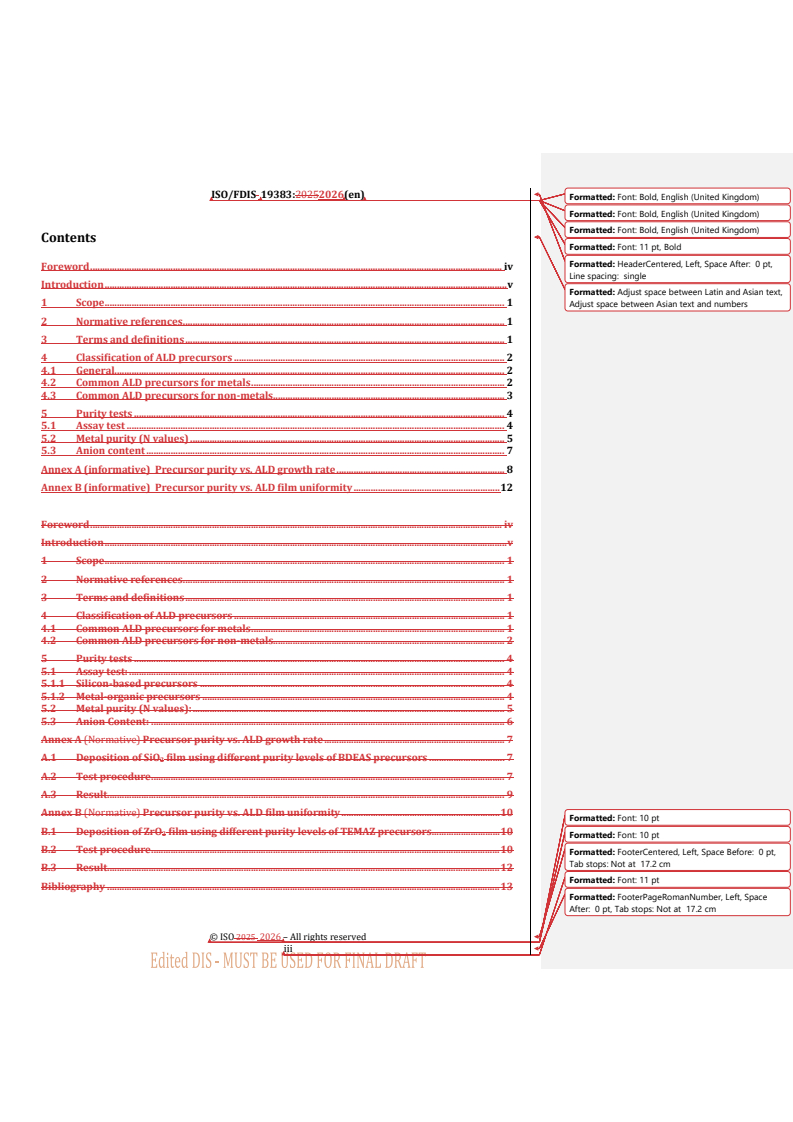
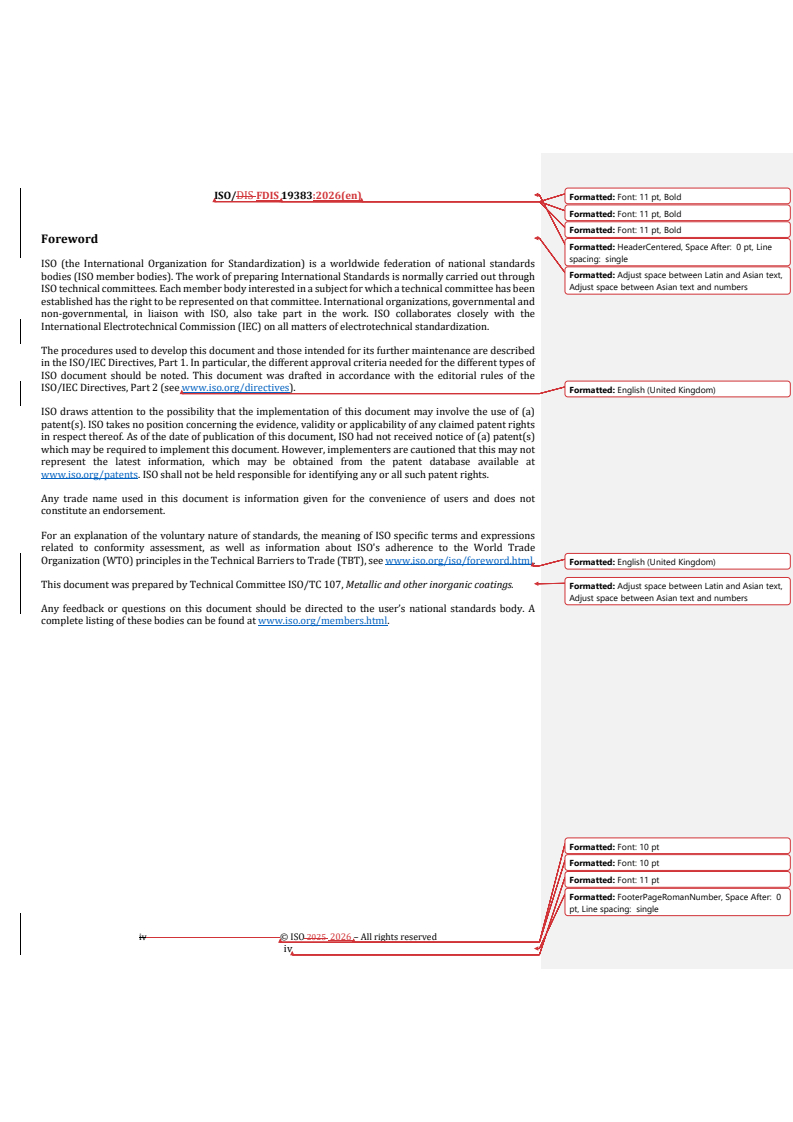
REDLINE ISO/FDIS 19383 - Atomic layer deposition — Chemical characteristics and related process specifications of atomic layer deposition precursors Released:28. 01. 2026
Get Certified
Connect with accredited certification bodies for this standard

National Aerospace and Defense Contractors Accreditation Program (NADCAP)
Global cooperative program for special process quality in aerospace.
CARES (UK Certification Authority for Reinforcing Steels)
UK certification for reinforcing steels and construction.
DVS-ZERT GmbH
German welding certification society.
Sponsored listings
Frequently Asked Questions
ISO/FDIS 19383 is a draft published by the International Organization for Standardization (ISO). Its full title is "Atomic layer deposition — Chemical characteristics and related process specifications of atomic layer deposition precursors". This standard covers: This document describes the chemical characteristics and related process specifications of the atomic layer deposition precursors, including assay content, metal purity, and anion content specification.
This document describes the chemical characteristics and related process specifications of the atomic layer deposition precursors, including assay content, metal purity, and anion content specification.
ISO/FDIS 19383 is classified under the following ICS (International Classification for Standards) categories: 25.220.01 - Surface treatment and coating in general. The ICS classification helps identify the subject area and facilitates finding related standards.
ISO/FDIS 19383 is available in PDF format for immediate download after purchase. The document can be added to your cart and obtained through the secure checkout process. Digital delivery ensures instant access to the complete standard document.
Standards Content (Sample)
FINAL DRAFT
International
Standard
ISO/TC 107
Atomic layer deposition — Chemical
Secretariat: KATS
characteristics and related process
Voting begins on:
specifications of atomic layer
2026-02-11
deposition precursors
Voting terminates on:
2026-04-08
RECIPIENTS OF THIS DRAFT ARE INVITED TO SUBMIT,
WITH THEIR COMMENTS, NOTIFICATION OF ANY
RELEVANT PATENT RIGHTS OF WHICH THEY ARE AWARE
AND TO PROVIDE SUPPOR TING DOCUMENTATION.
IN ADDITION TO THEIR EVALUATION AS
BEING ACCEPTABLE FOR INDUSTRIAL, TECHNO
LOGICAL, COMMERCIAL AND USER PURPOSES, DRAFT
INTERNATIONAL STANDARDS MAY ON OCCASION HAVE
TO BE CONSIDERED IN THE LIGHT OF THEIR POTENTIAL
TO BECOME STAN DARDS TO WHICH REFERENCE MAY BE
MADE IN NATIONAL REGULATIONS.
Reference number
FINAL DRAFT
International
Standard
ISO/TC 107
Atomic layer deposition — Chemical
Secretariat: KATS
characteristics and related process
Voting begins on:
specifications of atomic layer
deposition precursors
Voting terminates on:
RECIPIENTS OF THIS DRAFT ARE INVITED TO SUBMIT,
WITH THEIR COMMENTS, NOTIFICATION OF ANY
RELEVANT PATENT RIGHTS OF WHICH THEY ARE AWARE
AND TO PROVIDE SUPPOR TING DOCUMENTATION.
© ISO 2026
IN ADDITION TO THEIR EVALUATION AS
All rights reserved. Unless otherwise specified, or required in the context of its implementation, no part of this publication may
BEING ACCEPTABLE FOR INDUSTRIAL, TECHNO
LOGICAL, COMMERCIAL AND USER PURPOSES, DRAFT
be reproduced or utilized otherwise in any form or by any means, electronic or mechanical, including photocopying, or posting on
INTERNATIONAL STANDARDS MAY ON OCCASION HAVE
the internet or an intranet, without prior written permission. Permission can be requested from either ISO at the address below
TO BE CONSIDERED IN THE LIGHT OF THEIR POTENTIAL
or ISO’s member body in the country of the requester.
TO BECOME STAN DARDS TO WHICH REFERENCE MAY BE
MADE IN NATIONAL REGULATIONS.
ISO copyright office
CP 401 • Ch. de Blandonnet 8
CH-1214 Vernier, Geneva
Phone: +41 22 749 01 11
Email: copyright@iso.org
Website: www.iso.org
Published in Switzerland Reference number
ii
Contents Page
Foreword .iv
Introduction .v
1 Scope . 1
2 Normative references . 1
3 Terms and definitions . 1
4 Classification of ALD precursors . 2
4.1 General .2
4.2 Common ALD precursors for metals .2
4.3 Common ALD precursors for non-metals .3
5 Purity tests . 4
5.1 Assay test .4
5.1.1 General .4
5.1.2 Metal-organic precursors . .4
5.1.3 Non-metal precursors .5
5.2 Metal purity (N values) .5
5.3 Anion content .6
Annex A (informative) Precursor purity vs. ALD growth rate . 8
Annex B (informative) Precursor purity vs. ALD film uniformity .11
iii
Foreword
ISO (the International Organization for Standardization) is a worldwide federation of national standards
bodies (ISO member bodies). The work of preparing International Standards is normally carried out through
ISO technical committees. Each member body interested in a subject for which a technical committee
has been established has the right to be represented on that committee. International organizations,
governmental and non-governmental, in liaison with ISO, also take part in the work. ISO collaborates closely
with the International Electrotechnical Commission (IEC) on all matters of electrotechnical standardization.
The procedures used to develop this document and those intended for its further maintenance are described
in the ISO/IEC Directives, Part 1. In particular, the different approval criteria needed for the different types
of ISO document should be noted. This document was drafted in accordance with the editorial rules of the
ISO/IEC Directives, Part 2 (see www.iso.org/directives).
ISO draws attention to the possibility that the implementation of this document may involve the use of (a)
patent(s). ISO takes no position concerning the evidence, validity or applicability of any claimed patent
rights in respect thereof. As of the date of publication of this document, ISO had not received notice of (a)
patent(s) which may be required to implement this document. However, implementers are cautioned that
this may not represent the latest information, which may be obtained from the patent database available at
www.iso.org/patents. ISO shall not be held responsible for identifying any or all such patent rights.
Any trade name used in this document is information given for the convenience of users and does not
constitute an endorsement.
For an explanation of the voluntary nature of standards, the meaning of ISO specific terms and expressions
related to conformity assessment, as well as information about ISO's adherence to the World Trade
Organization (WTO) principles in the Technical Barriers to Trade (TBT), see www.iso.org/iso/foreword.html.
This document was prepared by Technical Committee ISO/TC 107, Metallic and other inorganic coatings.
Any feedback or questions on this document should be directed to the user’s national standards body. A
complete listing of these bodies can be found at www.iso.org/members.html.
iv
Introduction
Advances in nanotechnology have led to higher requirements for thin film deposition technology. Atomic
layer deposition (ALD) technology has broad application prospects in the field of photovoltaic, semiconductor,
flexible electronics, micro-electromechanical systems (MEMS), catalysis and optical devices, etc., with its
unique advantages, such as precise and controllable film thickness, excellent uniformity and good step
coverage.
ALD precursors are critical to film quality and performance. The continuous expansion of precursors
provides more options for the preparation of high-quality films with specific needs in terms of composition,
uniformity, step coverage and electrical properties. In the absence of a standard to regulate ALD precursor
grades, the industry has not formed a unified standard for the purity detection and quality control of the
precursors, leading to various criteria of precursor qualities. This document provides an evaluation index and
testing methods of ALD precursors to serve the rising demand of the ALD market. This document provides
standards, methods and regulations to the ALD field internationally, including precursor development and
production, process exploration and application development in both industry and academia.
v
FINAL DRAFT International Standard ISO/FDIS 19383:2026(en)
Atomic layer deposition — Chemical characteristics and
related process specifications of atomic layer deposition
precursors
1 Scope
This document defines the chemical characteristics and related process specifications of atomic layer
deposition precursors, including assay content, metal purity and anion content specification.
2 Normative references
The following documents are referred to in the text in such a way that some or all of their content constitutes
requirements of this document. For dated references, only the edition cited applies. For undated references,
the latest edition of the referenced document (including any amendments) applies.
ISO 8181, Atomic layer deposition — Vocabulary
3 Terms and definitions
For the purposes of this document, the terms and definitions given in ISO 8181 and the following apply.
ISO and IEC maintain terminology databases for use in standardization at the following addresses:
— ISO Online browsing platform: available at https:// www .iso .org/ obp
— IEC Electropedia: available at https:// www .electropedia .org/
3.1
precursor
reaction source used in atomic layer deposition process
3.2
assay
quantitative content (by moles) of a substance in a product
3.3
metal purity
percentage of metal content (by weight) after subtracting the sum of all the metal impurities from 100 %
3.4
anion content
percentage of negatively charged ions (by weight)
3.5
film uniformity
variation in film properties, particularly the thickness, across the surface of a flat substrate
4 Classification of ALD precursors
4.1 General
ALD precursors can be classified based on various criteria, including chemical nature, types of film formed,
substrate compatibility, reactivity and application specificity. However, the procedure to test the purity of
the ALD precursor is mainly based on whether it has metal atom(s) or not. Therefore, in this document, ALD
precursors are classified based on their chemical nature.
4.2 Common ALD precursors for metals
The choice of precursor depends on factors such as the desired film properties, chemical reactivity, volatility
and thermal stability. The common class of ALD precursors includes metal halides, hydrides, alkoxides,
beta-diketonates, alkylimides, alkylamides, amidinates, alkyls and cyclopendadienyls. Table 1 shows the
classification of the common ALD precursors for metals.
Table 1 — Classification of the common ALD precursors for metals
Class Suitable metals Examples
HfCl (Hafnium tetrachloride)
Metal halide Hf, Ti, Al, Zr, Ta, Nb, Mo, W TiCl (Titanium tetrachloride)
AlCl (Aluminum trichloride)
Metal hydride Ge and Sn GeH (Germane), SnH (Stannane)
4 4
C H O Ti /TTIP (Titanium tetraisopropoxide)
12 28 4
t
Metal alkoxide Ti, Li, Ta C H LiO/LiO Bu (Lithium tert-butoxide)
4 9
C H O Ta/Ta(OEt) (Tantalum(V) ethoxide)
10 25 5 5
C H F O Pd/Pd(HFAC) (Palladium(II) hexafluoro-
10 2 12 4 2
acetylacetonate)
C H F O Cu/Cu(HFAC) (Copper (II) trifluorometh-
10 2 12 4 2
anesulfonate)
Metal beta-diketonate Pd, Cu, Rh, La
C H O Rh/Rh(acac) (Rhodium(III) 2,4-pentanedi-
15 21 6 3
onate)
C H O La/La(thd) (Tris (2,2,6,6-tetrame-
33 57 6 3
thyl-3,5-heptanedionato)lanthanum)
C H N Nb/TBTDEN [Tris(diethylamino)(tert-bu-
16 39 4
tylimino)niobium]
C H N Ta/TBTEMT [Tris (ethylmethylamino)
13 33 4
Metal alkylimide Nb, Ta, W, Mo
(tert-butylimino)tantalum]
C H N W/BTBMW [Bis(tert-butylimino)bis(di-
12 30 4
methylamino)tungsten]
C H N Zr/TEMAZ
12 32 4
[Tetrakis(ethylmethylamino)Zirconium]
Metal alkylamide Nb, Ta, Ti, Zr, Hf, Mo, W, Sn, Sb, Ge
C H N Ti/TDEAT [Tetrakis(diethylamino)titani-
12 32 4
um]
C H N Sn/TDMASn [Tetrakis(dimethylamido)tin]
8 24 4
TTabablele 1 1 ((ccoonnttiinnueuedd))
Class Suitable metals Examples
C H LaN /La-FMD [Tris(N,N'-di-i-propylformamid-
21 45 6
inato)lanthanum]
Metal amidinate La, Ce, Co, Ni, Cu, Mn
i
C H CoN /Co( Pr-amd) [Bis(N,N'-diisopropy-
16 34 4 2
lacetamidinato) cobalt]
C H Zn/DEZ [Diethylzinc]
4 10
Metal alkyls Zn, Al, Ga, In, Cd, Pb, Sn C H Al/TMA [Trimethylaluminum]
3 9
C H Sn/SnEt [Tetraethyltin]
8 20 4
i
C H La/La( PrCp) [Tris (isopropylcyclopentadie-
24 33 3
nyl)lanthanum]
C H N Zr/CpZr [Cyclopentadienyl tris (dimethyl-
11 23 3
Metal cyclopentadienyl La, Ce, Y, Zr, Hf, Ni, Co, Fe
amino)zirconium]
C H Ni/Ni(MeCp) [Bis(methylcyclopentadienyl)
12 14 2
nickel]
4.3 Common ALD precursors for non-metals
For non-metallic ALD coatings, precursors for non-metal generally refer to silicon, boron, arsenic, selenium,
phosphorus, tellurium, etc. Table 2 summarizes the common ALD precursors for non-metals.
Table 2 — Classification of the typical ALD precursors for non-metals
Non-metals Class Examples
SiH [Silane]
Hydride
Si H [Disilane]
2 6
Silicon
SiH Cl /DCS [Dichlorosilane]
2 2
Halide Si Cl /HCDS [Hexachlorodisilane]
2 6
SiH I /DIS [Diiodosilane]
2 2
C H N Si/BDEAS [Bis(diethylamino)silane]
8 22 2
C H N Si/DIPAS [Diisopropylaminosialne]
6 16 2
— Alkylamide
C H N Si /BDIPADS [1,2-Bis(diisopropyl-
12 32 2 2
amino)disilane]
C H O Si/TEOS [Tetraethyl orthosilicate]
8 20 4
— Alkoxide
C H O Si/TMOS [Tetramethyl orthosili-
4 12 4
cate]
C H NAs/TDMAAs [Tris(dimethylamino)
6 18
Alkylamide
arsenic]
Arsenic
Hydride AsH [Arsine]
Hydride B H [Diborane]
2 6
Boron
BCl [Boron trichloride]
Halide
BBr [Boron tribromide]
C H BN/TDMAB [Tris(dimethylamino)
6 18
borane]
— Alkylamide
C H BN/TEMAB [Tris(ethylmethylamino)
9 24
borane]
— Alkoxide C H BO /B(OMe) [Trimethyl borate]
3 9 3 3
TTabablele 2 2 ((ccoonnttiinnueuedd))
Non-metals Class Examples
Hydride PH [Phosphorane]
PCl [Phosphorus trichloride]
Halide
POCl [Phosphorus(V) oxychloride]
C H N P/P(NMe ) [Tris(dimethylamino)
6 18 3 2 3
Phosphorus Alkylamide
phosphine]
C H O P/P(OMe) [Trimethyl phosphite]
3 9 3 3
Alkoxide
C H O P/PO(OEt) [Triethyl phosphate]
6 15 4 3
t
Akyls C H P/ BuPH [t-butylphosphine]
4 11 2
C H Se/Et Se [Diethyl selenide]
4 10 2
Akyls
C H Se/Me Se [Dimethyl selenide]
2 6 2
Hydride H Se [Dihydrogen selenide]
Selenium
C H SeSi /(Me Si) Se [Bis(trimethylsilyl)
6 18 2 3 2
selenide]
Alkylsilyls
C H SeSi /(Et Si) Se [Bis(triethylsilyl)
12 30 2 3 2
selenide]
C H Te/Et Te [Diethyl telluride]
4 10 2
Akyls
C H18Te/(tBu) Te [Di-tert-butyl Telluride]
8 2
Alkoxide C H O Te/Te(OEt) [Tellurium ethoxide]
8 20 4 4
Tellurium
C H TeSi /(Me Si) Te [Bis(trimethylsilyl)
6 18 2 3 2
tellurium]
Alkylsilyls
C H TeSi /(Et Si) Te [Bis(triethylsilyl)
12 30 2 3 2
tellurium]
5 Purity tests
5.1 Assay test
5.1.1 General
The purity of ALD precursors is crucial to film quality and performance. As specified in Annex A, the ALD
growth rate is affected by the precursor purity; higher purity always leads to higher growth rate. Similarly,
the effect of precursor purity on film uniformit
...
Style Definition
...
Style Definition
...
Style Definition
...
Style Definition
...
Style Definition
...
ISO/FDIS 19383:2025(en)
Style Definition
...
ISO/TC 107/WG 5
Style Definition
...
Style Definition
...
Secretariat: KATS
Style Definition
...
Date: 2025-12-022026-01-27
Style Definition
...
Style Definition
...
Style Definition
...
Style Definition
...
Style Definition
...
Style Definition
...
Atomic layer deposition — Chemical characteristics and related
Style Definition
...
process specifications of atomic layer deposition precursors
Style Definition
...
Style Definition
...
Style Definition
...
Style Definition
...
Style Definition
...
Style Definition
...
Style Definition
...
Style Definition
...
FDIS stage
Style Definition
...
Style Definition
...
Style Definition
...
Style Definition
...
Style Definition
...
Style Definition
...
Style Definition
...
Style Definition
...
Style Definition
...
Style Definition
...
Style Definition
...
Style Definition
...
Style Definition
...
Style Definition
...
Style Definition
...
Style Definition
...
Style Definition
...
Style Definition
...
Style Definition
...
Style Definition
...
Style Definition
...
Style Definition
...
Style Definition
...
Style Definition
...
Style Definition
...
Style Definition
...
Style Definition
...
Style Definition
...
Style Definition
...
Style Definition
...
Style Definition
...
Style Definition
...
Style Definition
...
St l D fi iti
ISO/DIS FDIS 19383:2026(en) Formatted: Font: 11 pt, Bold
Formatted: Font: 11 pt, Bold
Formatted: Font: 11 pt, Bold
Formatted: HeaderCentered, Space After: 0 pt, Line
spacing: single
All rights reserved. Unless otherwise specified, or required in the context of its implementation, no part of this publication
may be reproduced or utilized otherwise in any form or by any means, electronic or mechanical, including photocopying, Formatted: Default Paragraph Font
or posting on the internet or an intranet, without prior written permission. Permission can be requested from either ISO
Formatted: Indent: Left: 0 cm, Right: 0 cm, Space
at the address below or ISO’s member body in the country of the requester.
Before: 0 pt, No page break before, Adjust space
between Latin and Asian text, Adjust space between
ISO copyright office
Asian text and numbers
CP 401 • Ch. de Blandonnet 8
CH-1214 Vernier, Geneva
Phone: + 41 22 749 01 11
Formatted: French (Switzerland)
EmailE-mail: copyright@iso.org
Formatted: French (Switzerland)
Website: www.iso.orgwww.iso.org
Formatted: French (Switzerland)
Published in Switzerland
Formatted: German (Germany)
Formatted: German (Germany)
Formatted: Font: 10 pt
Formatted: Font: 10 pt
Formatted: Font: 11 pt
Formatted: FooterPageRomanNumber, Space After: 0
pt, Line spacing: single
ii © ISO 2025 2026 – All rights reserved
ii
ISO/FDIS 19383:20252026(en)
Formatted: Font: Bold, English (United Kingdom)
Formatted: Font: Bold, English (United Kingdom)
Formatted: Font: Bold, English (United Kingdom)
Contents
Formatted: Font: 11 pt, Bold
Formatted: HeaderCentered, Left, Space After: 0 pt,
Foreword . iv
Line spacing: single
Introduction . v
Formatted: Adjust space between Latin and Asian text,
1 Scope . 1
Adjust space between Asian text and numbers
2 Normative references . 1
3 Terms and definitions . 1
4 Classification of ALD precursors . 2
4.1 General. 2
4.2 Common ALD precursors for metals . 2
4.3 Common ALD precursors for non-metals. 3
5 Purity tests . 4
5.1 Assay test . 4
5.2 Metal purity (N values) . 5
5.3 Anion content . 7
Annex A (informative) Precursor purity vs. ALD growth rate . 8
Annex B (informative) Precursor purity vs. ALD film uniformity . 12
Foreword . iv
Introduction . v
1 Scope . 1
2 Normative references . 1
3 Terms and definitions . 1
4 Classification of ALD precursors . 1
4.1 Common ALD precursors for metals . 1
4.2 Common ALD precursors for non-metals. 2
5 Purity tests . 4
5.1 Assay test: . 4
5.1.1 Silicon-based precursors . 4
5.1.2 Metal-organic precursors . 4
5.2 Metal purity (N values): . 5
5.3 Anion Content: . 6
Annex A (Normative) Precursor purity vs. ALD growth rate . 7
A.1 Deposition of SiO film using different purity levels of BDEAS precursors . 7
A.2 Test procedure . 7
A.3 Result . 9
Annex B (Normative) Precursor purity vs. ALD film uniformity . 10
Formatted: Font: 10 pt
B.1 Deposition of ZrO film using different purity levels of TEMAZ precursors . 10
Formatted: Font: 10 pt
B.2 Test procedure . 10
Formatted: FooterCentered, Left, Space Before: 0 pt,
Tab stops: Not at 17.2 cm
B.3 Result . 12
Formatted: Font: 11 pt
Bibliography . 13
Formatted: FooterPageRomanNumber, Left, Space
After: 0 pt, Tab stops: Not at 17.2 cm
iii
ISO/DIS FDIS 19383:2026(en) Formatted: Font: 11 pt, Bold
Formatted: Font: 11 pt, Bold
Formatted: Font: 11 pt, Bold
Foreword
Formatted: HeaderCentered, Space After: 0 pt, Line
spacing: single
ISO (the International Organization for Standardization) is a worldwide federation of national standards
bodies (ISO member bodies). The work of preparing International Standards is normally carried out through Formatted: Adjust space between Latin and Asian text,
Adjust space between Asian text and numbers
ISO technical committees. Each member body interested in a subject for which a technical committee has been
established has the right to be represented on that committee. International organizations, governmental and
non-governmental, in liaison with ISO, also take part in the work. ISO collaborates closely with the
International Electrotechnical Commission (IEC) on all matters of electrotechnical standardization.
The procedures used to develop this document and those intended for its further maintenance are described
in the ISO/IEC Directives, Part 1. In particular, the different approval criteria needed for the different types of
ISO document should be noted. This document was drafted in accordance with the editorial rules of the
ISO/IEC Directives, Part 2 (see www.iso.org/directives).
Formatted: English (United Kingdom)
ISO draws attention to the possibility that the implementation of this document may involve the use of (a)
patent(s). ISO takes no position concerning the evidence, validity or applicability of any claimed patent rights
in respect thereof. As of the date of publication of this document, ISO had not received notice of (a) patent(s)
which may be required to implement this document. However, implementers are cautioned that this may not
represent the latest information, which may be obtained from the patent database available at
www.iso.org/patents. ISO shall not be held responsible for identifying any or all such patent rights.
Any trade name used in this document is information given for the convenience of users and does not
constitute an endorsement.
For an explanation of the voluntary nature of standards, the meaning of ISO specific terms and expressions
related to conformity assessment, as well as information about ISO's adherence to the World Trade
Organization (WTO) principles in the Technical Barriers to Trade (TBT), see www.iso.org/iso/foreword.html.
Formatted: English (United Kingdom)
This document was prepared by Technical Committee ISO/TC 107, Metallic and other inorganic coatings.
Formatted: Adjust space between Latin and Asian text,
Adjust space between Asian text and numbers
Any feedback or questions on this document should be directed to the user’s national standards body. A
complete listing of these bodies can be found at www.iso.org/members.html.
Formatted: Font: 10 pt
Formatted: Font: 10 pt
Formatted: Font: 11 pt
Formatted: FooterPageRomanNumber, Space After: 0
pt, Line spacing: single
iv © ISO 2025 2026 – All rights reserved
iv
ISO/FDIS 19383:20252026(en)
Formatted: Font: Bold, English (United Kingdom)
Formatted: Font: Bold, English (United Kingdom)
Formatted: Font: Bold, English (United Kingdom)
Introduction
Formatted: Font: 11 pt, Bold
Formatted: HeaderCentered, Left, Space After: 0 pt,
Advances in nanotechnology have led to higher requirements for thin film deposition technology. Atomic layer
Line spacing: single
deposition (ALD) technology has broad application prospects in the field of photovoltaic, semiconductor,
flexible electronics, Microelectromechanical systemmicro-electromechanical systems (MEMS), catalysis and
optical devices, etc., with its unique advantages, such as precise and controllable film thickness, excellent
uniformity and good step coverage.
ALD precursors are critical to film quality and performance. The continuous expansion of precursors provides
Formatted: English (United Kingdom)
more options for the preparation of high-quality films with specific needs in terms of composition, uniformity,
step coverage and electrical properties. In the absence of a standard to regulate ALD precursor grades, the
industry has not formed a unified standard for the purity detection and quality control of the precursors,
leading to various criteria of precursor qualities. This document provides an evaluation index and testing
methods of ALD precursors to serve the rising demand of the ALD market. This document provides standards,
methods and regulations to the ALD field internationally, including precursor development and production,
process exploration and application development in both industry and academia.
Formatted: Font: 10 pt
Formatted: Font: 10 pt
Formatted: FooterCentered, Left, Space Before: 0 pt,
Tab stops: Not at 17.2 cm
Formatted: Font: 11 pt
Formatted: FooterPageRomanNumber, Left, Space
After: 0 pt, Tab stops: Not at 17.2 cm
v
FINAL DRAFT International Standard ISO/FDIS 19383:2025(en)
Atomic layer deposition — Chemical characteristics and related
process specifications of atomic layer deposition precursors
1 Scope
This document defines the chemical characteristics and related process specifications of atomic layer
deposition precursors, including assay content, metal purity and anion content specification.
2 Normative references
The following documents are referred to in the text in such a way that some or all of their content constitutes
requirements of this document. For dated references, only the edition cited applies. For undated references,
the latest edition of the referenced document (including any amendments) applies.
ISO 8181, Atomic layer deposition — Vocabulary
Formatted: Default Paragraph Font
Formatted: Default Paragraph Font
3 Terms and definitions
Formatted: Default Paragraph Font
For the purposes of this document, the terms and definitions given in ISO 8181 and the following apply.
Formatted: Adjust space between Latin and Asian text,
Adjust space between Asian text and numbers, Tab
ISO and IEC maintain terminology databases for use in standardization at the following addresses:
stops: Not at 0.7 cm + 1.4 cm + 2.1 cm + 2.8 cm +
3.5 cm + 4.2 cm + 4.9 cm + 5.6 cm + 6.3 cm + 7 cm
— ISO Online browsing platform: available at https://www.iso.org/obp
Formatted: Adjust space between Latin and Asian text,
Adjust space between Asian text and numbers
— IEC Electropedia: available at https://www.electropedia.org/
Formatted: Default Paragraph Font
3.1
Formatted: Default Paragraph Font
precursor
Formatted: Adjust space between Latin and Asian text,
reaction source used in atomic layer deposition process
Adjust space between Asian text and numbers, Tab
stops: Not at 0.7 cm + 1.4 cm + 2.1 cm + 2.8 cm +
3.2
3.5 cm + 4.2 cm + 4.9 cm + 5.6 cm + 6.3 cm + 7 cm
assay
Formatted: English (United States)
quantitative content (by moles) of a substance in a product
Formatted: TermNum2, Adjust space between Latin
3.3
and Asian text, Adjust space between Asian text and
metal purity
numbers
percentage of metal content (by weight) after subtracting the sum of all the metal impurities from 100 %
Formatted: English (United States)
Formatted: English (United States)
3.4
anion content
Formatted: English (United States)
percentage of negatively charged ions (by weight)
Formatted: English (United Kingdom)
3.5
film uniformity
the variation in film properties, particularly the thickness, across the surface of a flat substrate
Formatted: Footer, Left, Space After: 0 pt, Line
spacing: single, Tab stops: Not at 17.2 cm
Formatted
...
Formatted
...
ISO/DIS FDIS 19383:2026(en)
Formatted
...
Formatted
...
Formatted
...
4 Classification of ALD precursors
Formatted
...
4.1 General
Formatted
...
Formatted
...
ALD precursors can be classified based on various criteria, including chemical nature, types of film formed,
substrate compatibility, reactivity and application specificity. However, the procedure to test the purity of the
Formatted
...
ALD precursor is mainly based on whether it has metal atom(s) or not. Therefore, in this document, ALD
Formatted
...
precursors are classified based on their chemical nature.
Formatted
...
4.2 Common ALD precursors for metals
Formatted
...
Formatted Table
...
The choice of precursor depends on factors such as the desired film properties, chemical reactivity, volatility
and thermal stability. The common class of ALD precursors includes metal halides, hydrides, alkoxides, beta- Formatted
...
diketonates, alkylimides, alkylamides, amidinates, alkyls, and cyclopendadienyls, etc. Table 1. Table 1 shows
Formatted
...
the classification of the common ALD precursors for metals.
Formatted
...
Table 1 — Classification of the common ALD precursors for metals
Formatted
...
Formatted
...
Class Suitable metals Examples
Formatted
...
HfCl4 (Hafnium tetrachloride)
Formatted
...
Metal halide Hf, Ti, Al, Zr, Ta, Nb, Mo, W TiCl4 (Titanium tetrachloride)
AlCl (Aluminum trichloride) Formatted
...
Formatted
Metal hydride Ge and Sn GeH4 (Germane), SnH4 (Stannane) .
Formatted
C H O Ti /TTIP (Titanium tetraisopropoxide) .
12 28 4
t
Metal alkoxide Ti, Li, Ta C4H9LiO/LiO Bu (Lithium tert-butoxide) Formatted
...
C10H25O5Ta/Ta(OEt)5 (Tantalum(V) ethoxide)
Formatted
...
C10H2F12O4Pd/Pd(HFAC)2 (Palladium(II)
Formatted
...
hexafluoroacetylacetonate)
Formatted
...
C H F O Cu/Cu(HFAC) (Copper (II)
10 2 12 4 2
Formatted
trifluoromethanesulfonate) .
Metal beta-diketonate Pd, Cu, Rh, La
C H O Rh/Rh(acac) (Rhodium(III) 2,4-
15 21 6 3 Formatted
...
pentanedionate)
Formatted
...
C33H57O6La/La(thd)3 (Tris (2,2,6,6-tetramethyl-3,5-
Formatted
heptanedionato)lanthanum) .
Formatted
...
C16H39N4Nb/TBTDEN [Tris(diethylamino)(tert-
butylimino)niobium]
Formatted
...
C13H33N4Ta/TBTEMT [Tris (ethylmethylamino)
Formatted
Metal alkylimide Nb, Ta, W, Mo
...
(tert-butylimino)tantalum]
Formatted
...
C12H30N4W/BTBMW [Bis(tert-
butylimino)bis(dimethylamino)tungsten]
Formatted
...
C12H32N4Zr/TEMAZ Formatted
...
[Tetrakis(ethylmethylamino)Zirconium]
Formatted
...
Nb, Ta, Ti, Zr, Hf, Mo, W, Sn, Sb,
Metal alkylamide
C H N Ti/TDEAT
12 32 4
Ge
Formatted
...
[Tetrakis(diethylamino)titanium]
Formatted
...
C8H24N4Sn/TDMASn [Tetrakis(dimethylamido)tin]
Formatted
...
C21H45LaN6/La-FMD [Tris(N,N'-di-i-
propylformamidinato)lanthanum] Formatted
...
Metal amidinate La, Ce, Co, Ni, Cu, Mn
i
C H CoN /Co( Pr-amd) [Bis(N,N'-
16 34 4 2
Formatted
...
diisopropylacetamidinato) cobalt]
Formatted
...
Metal alkyls Zn, Al, Ga, In, Cd, Pb, Sn C H Zn/DEZ [Diethylzinc]
4 10
Formatted
...
Formatted
...
2 © ISO 2025 2026 – All rights reserved
Formatted
...
Formatted
...
Formatted
...
Formatted
...
ISO/FDIS 19383:20252026(en)
Formatted
...
Formatted
...
Formatted
...
Class Suitable metals Examples
Formatted
...
C3H9Al/TMA [Trimethylaluminum]
Formatted Table
...
C8H20Sn/SnEt4 [Tetraethyltin]
Formatted
i
...
C H La/La( PrCp) [Tris
24 33 3
(isopropylcyclopentadienyl)lanthanum]
Formatted
...
C H N Zr/CpZr [Cyclopentadienyl tris
11 23 3
Formatted
Metal cyclopentadienyl La, Ce, Y, Zr, Hf, Ni, Co, Fe .
(dimethylamino)zirconium]
Formatted
...
C12H14Ni/Ni(MeCp)2
[Bis(methylcyclopentadienyl)nickel]
Formatted
...
Formatted
...
4.3 Common ALD precursors for non-metals
Formatted
...
Formatted
For non-metallic ALD coatings, precursors for non-metal generally refer to silicon, boron, arsenic, selenium,
...
phosphorus, tellurium, etc. Table 2Table 2 summarizes the common ALD precursors for non-metals.
Formatted
...
Formatted
...
Table 2 — Classification of the typical ALD precursors for non-metals
Formatted
...
Non-metals Class Examples
Formatted Table
...
SiH4 [Silane]
Hydride Formatted
...
Si H [Disilane]
2 6
Formatted
...
Silicon
SiH Cl /DCS [Dichlorosilane]
2 2
Formatted
...
Halide Si2Cl6/HCDS [Hexachlorodisilane]
Formatted
...
SiH2I2/DIS [Diiodosilane]
Formatted
...
C H N Si/BDEAS
8 22 2
[Bis(diethylamino)silane] Formatted
...
— Alkylamide C H N Si/DIPAS [Diisopropylaminosialne]
6 16 2
Formatted
...
C12H32N2Si2/BDIPADS [1,2-
Formatted
...
Bis(diisopropylamino)disilane]
Formatted
...
C8H20O4Si/TEOS [Tetraethyl orthosilicate]
Formatted
...
— Alkoxide
C4H12O4Si/TMOS [Tetramethyl
orthosilicate]
Formatted
...
Formatted
C6H18NAs/TDMAAs
...
Alkylamide
[Tris(dimethylamino)arsenic]
Arsenic
Formatted
...
Hydride AsH3 [Arsine]
Formatted
...
Hydride B2H6 [Diborane]
Formatted
...
Boron
BCl3 [Boron trichloride]
Formatted
...
Halide
BBr [Boron tribromide]
Formatted
...
C6H18BN/TDMAB
Formatted
...
[Tris(dimethylamino)borane]
— Alkylamide
Formatted
...
C9H24BN/TEMAB
[Tris(ethylmethylamino)borane]
Formatted
...
Formatted
— Alkoxide C3H9BO3/B(OMe)3 [Trimethyl borate]
...
Formatted
Hydride PH [Phosphorane] .
Formatted
...
PCl3 [Phosphorus trichloride]
Halide
Phosphorus
POCl [Phosphorus(V) oxychloride] Formatted
...
Formatted
C6H18N3P/P(NMe2)3 .
Alkylamide
[Tris(dimethylamino)phosphine]
Formatted
...
Formatted
...
Formatted
...
Formatted
...
Formatted
...
Formatted
...
Formatted
...
Formatted
...
Formatted
...
Formatted
...
Formatted
...
Formatted
...
Formatted
...
F tt d
Formatted
...
Formatted
...
ISO/DIS FDIS 19383:2026(en)
Formatted
...
Formatted
...
Formatted
...
Non-metals Class Examples
Formatted Table
...
C H O P/P(OMe) [Trimethyl phosphite]
3 9 3 3
Alkoxide Formatted
...
C6H15O4P/PO(OEt)3 [Triethyl phosphate]
Formatted
...
t
Akyls C H P/ BuPH [t-butylphosphine]
4 11 2
Formatted
...
C4H10Se/Et2Se [Diethyl selenide]
Akyls Formatted
...
C H Se/Me Se [Dimethyl selenide]
2 6 2
Formatted
...
Hydride H2Se [Dihydrogen selenide]
Formatted
Selenium .
C6H18SeSi2/(Me3Si)2Se
Formatted
...
[Bis(trimethylsilyl)selenide]
Alkylsilyls
C H SeSi /(Et Si) Se Formatted
12 30 2 3 2 .
[Bis(triethylsilyl)selenide]
Formatted
...
C H Te/Et Te [Diethyl telluride]
4 10 2
Formatted
...
Akyls
C8H18Te/(tBu)2Te [Di-tert-butyl Telluride]
Formatted
...
Alkoxide C8H20O4Te/Te(OEt)4 [Tellurium ethoxide]
Formatted
...
Tellurium
C6H18TeSi2/(Me3Si)2Te [Bis(trimethylsilyl)
Formatted
...
tellurium]
Alkylsilyls
Formatted
...
C H TeSi /(Et Si) Te
12 30 2 3 2
Formatted
[Bis(triethylsilyl)tellurium]
...
Formatted
...
5 Purity tests
Formatted
...
Formatted
5.1 Assay test .
Formatted
...
5.1.1 General
Formatted
...
The purity of ALD precursors is crucial to film quality and performance. As specified in Annex A,Annex A, the
Formatted
...
ALD growth rate is affected by the precursor purity; higher purity always leads to higher growth rate.
Formatted
...
Similarly, the effect of precursor purity on film uniformity is described in Annex B.Annex B.
Formatted
...
Assay indicates the chemical purity of the products, that is,i.e. the percentage of target material in the product.
Formatted
...
The assay is usually measured by techniques such as gas chromatography (GC), nuclear magnetic resonance
Formatted
...
(NMR), thermogravimetric analysis (TGA),) and high-performance liquid chromatography (HPLC), etc.).
Formatted
...
5.1.2 Metal-organic precursors
Formatted
...
Formatted
For most metal-organic precursors, the assay is determined by proton nuclear magnetic resonance (H-NMR,), .
supplemented by TGA. In the H-NMR measurement, the sample is excited in the magnetic field into nuclear
Formatted
...
magnetic resonanceNMR, producing NMR signals. The resonance frequency of hydrogen atoms is changed by
Formatted
...
the intramolecular magnetic field. It provides details of the individual functional groups and electronic
Formatted
structure. While TGA is a technique in which the mass of a sample is monitored against time or temperature, .
the total loss of mass and the weight of residual material indicate the assay of the precursor.
Formatted
...
Formatted
...
It is recommended to follow theseThe following precautions should be followed during the proton nuclear
magnetic resonance (H-NMR) testing procedure for high-purity ALD precursors: Formatted
...
Formatted
...
— — Rinse the NMR tube thoroughly with ultra-pure water and bake it completely dry.
Formatted
...
— — Transfer at least 5 mg samples to the NMR tube; ensure that the height of the sample is greater than
Formatted
...
3,5 cm.
Formatted
...
Formatted
— — Transfer the sample in an inert atmosphere, e.g. in a N glove box.
2 .
Formatted
...
4 © ISO 2025 2026 – All rights reserved
ISO/FDIS 19383:20252026(en)
Formatted: Font: Bold, English (United Kingdom)
Formatted: Font: Bold, English (United Kingdom)
Formatted: Font: Bold, English (United Kingdom)
— — Select a proper deuterium reagent to completely resolve the sample; the selections can be deuterated
Formatted: Font: 11 pt, Bold
benzene, deuterated chloroform, deuterated acetone, etc. The deuterium reagent should be completely
dehydrated.
Formatted: HeaderCentered, Left, Space After: 0 pt,
Line spacing: single
TGA testing should ensure that:
Formatted: Adjust space between Latin and Asian text,
Adjust space between Asian text and numbers
— — the STA instrument is installed in an inert atmosphere (Ar environment is preferred);
Formatted: Adjust space between Latin and Asian text,
Adjust space between Asian text and numbers, Tab
— — the resolution o
...
Questions, Comments and Discussion
Ask us and Technical Secretary will try to provide an answer. You can facilitate discussion about the standard in here.
Loading comments...