

ISO 707:2008
(Main)Milk and milk products — Guidance on sampling
General Information
- Abstract
ISO 707|IDF 50:2008 gives guidance on methods of sampling milk and milk products for microbiological, chemical, physical and sensory analysis, except for (semi)automated sampling.
- Status
- Published
- Publication Date
- 10-Aug-2008
- Technical Committee
- ISO/TC 34/SC 5 - Milk and milk products
- Drafting Committee
- ISO/TC 34/SC 5 - Milk and milk products
- Current Stage
- 9093 - International Standard confirmed
- Start Date
- 28-Sep-2023
- Completion Date
- 29-Aug-2026
Buy Documents
ISO 707:2008 - Milk and milk products — Guidance on sampling Released:8/11/2008

ISO 707:2008 - Lait et produits laitiers — Lignes directrices pour l'échantillonnage Released:1/5/2009
Overview
ISO 707:2008 (IDF 50:2008) - "Milk and milk products - Guidance on sampling" provides practical guidance for sampling milk and milk products intended for microbiological, chemical, physical and sensory analysis. It covers manual sampling procedures, sample preservation, storage and transport, and documentation requirements, but explicitly excludes (semi)automated sampling. The standard is written as guidance (good practice) rather than as a legal specification and is widely used by laboratories, dairy producers and regulators.
Key topics and requirements
- Scope and definitions
- Clarifies terms such as laboratory sample and test portion and notes that sampling is part of the measurement procedure.
- Sampling personnel
- Sampling must be performed by an authorized, trained person (e.g., microbiologically competent and free from infectious disease).
- Sealing, labelling and replicate samples
- Guidance on sealing and labelling samples, taking duplicate or additional sets for arbitration, and retaining samples when agreed.
- Sampling report
- Minimum report contents (examples from the standard): place/date/time, names of samplers/witnesses, precise sampling and homogenization methods, consignment identification, batch codes, sample identifiers, destination, and producer/trader details. Additional relevant conditions (temperature, packaging, preservatives) should be recorded.
- Apparatus and hygiene
- Sampling equipment should be of suitable materials (stainless steel or equivalent), smooth and clean. For microbiological sampling, equipment must be sterilized or sterile disposables used.
- Recognized sterilization methods include:
- Method A: hot air at 170 °C for at least 1 hour
- Method B: autoclave steam at 121 °C ± 1 °C for at least 15 minutes
- Method C: adequate dose of γ-radiation
- Product-specific guidance
- Detailed sampling approaches for milk, liquid products, evaporated/sweetened condensed milk, semi-solid and solid products (including cheese and butter), edible ices, dried milk, butterfat, and related products.
- Annexes
- Practical aids such as sampling equipment examples, insulated transport container design and use, and a sample cheese sampling report.
Practical applications and users
ISO 707:2008 is used by:
- Dairy laboratories performing microbiological, chemical, physical and sensory tests
- Quality control teams in dairy processors and manufacturers
- Regulatory authorities and auditors validating compliance and sampling chains
- Forensic and arbitration sampling for disputes (duplicate/arbitration samples)
It helps reduce sampling-related variability, informs sample handling and transport, and supports traceable, defensible test results - especially important for heterogeneous products like cheese where sampling location and method significantly affect outcomes.
Related standards
- ISO 7002 (layout for sampling from a lot)
- ISO 7218 (microbiological examination; sterilization references)
- ISO 78-2 (laboratory sample/test portion definitions)
- ISO/IEC 17025 (laboratory competence and requirement for written procedures)
- ISO 5538 / ISO 8197 (sampling plans and inspection methods)
Relations
- Effective Date
- 12-Feb-2026
- Effective Date
- 15-Apr-2008
Buy Documents
ISO 707:2008 - Milk and milk products — Guidance on sampling Released:8/11/2008
ISO 707:2008 - Lait et produits laitiers — Lignes directrices pour l'échantillonnage Released:1/5/2009
Get Certified
Connect with accredited certification bodies for this standard

BSI Group
BSI (British Standards Institution) is the business standards company that helps organizations make excellence a habit.

Bureau Veritas
Bureau Veritas is a world leader in laboratory testing, inspection and certification services.

DNV
DNV is an independent assurance and risk management provider.
Sponsored listings
Frequently Asked Questions
ISO 707:2008 is a standard published by the International Organization for Standardization (ISO). Its full title is "Milk and milk products — Guidance on sampling". This standard covers: ISO 707|IDF 50:2008 gives guidance on methods of sampling milk and milk products for microbiological, chemical, physical and sensory analysis, except for (semi)automated sampling.
ISO 707|IDF 50:2008 gives guidance on methods of sampling milk and milk products for microbiological, chemical, physical and sensory analysis, except for (semi)automated sampling.
ISO 707:2008 is classified under the following ICS (International Classification for Standards) categories: 67.100.01 - Milk and milk products in general. The ICS classification helps identify the subject area and facilitates finding related standards.
ISO 707:2008 has the following relationships with other standards: It is inter standard links to EN ISO 707:2008, ISO 707:1997. Understanding these relationships helps ensure you are using the most current and applicable version of the standard.
ISO 707:2008 is available in PDF format for immediate download after purchase. The document can be added to your cart and obtained through the secure checkout process. Digital delivery ensures instant access to the complete standard document.
Standards Content (Sample)
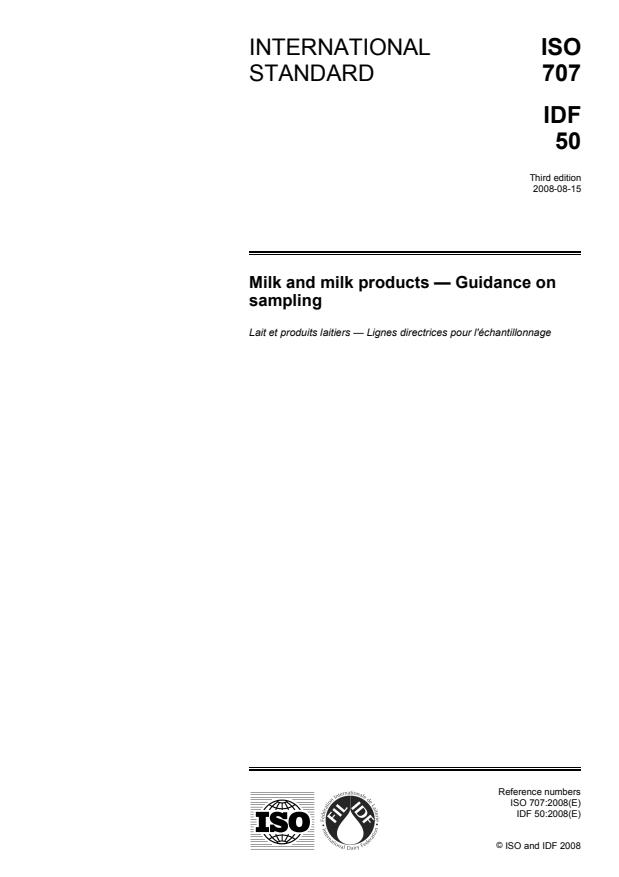
INTERNATIONAL ISO
STANDARD 707
IDF
Third edition
2008-08-15
Milk and milk products — Guidance on
sampling
Lait et produits laitiers — Lignes directrices pour l'échantillonnage
Reference numbers
IDF 50:2008(E)
©
ISO and IDF 2008
IDF 50:2008(E)
PDF disclaimer
This PDF file may contain embedded typefaces. In accordance with Adobe's licensing policy, this file may be printed or viewed but
shall not be edited unless the typefaces which are embedded are licensed to and installed on the computer performing the editing. In
downloading this file, parties accept therein the responsibility of not infringing Adobe's licensing policy. Neither the ISO Central
Secretariat nor the IDF accepts any liability in this area.
Adobe is a trademark of Adobe Systems Incorporated.
Details of the software products used to create this PDF file can be found in the General Info relative to the file; the PDF-creation
parameters were optimized for printing. Every care has been taken to ensure that the file is suitable for use by ISO member bodies
and IDF national committees. In the unlikely event that a problem relating to it is found, please inform the ISO Central Secretariat at the
address given below.
© ISO and IDF 2008
All rights reserved. Unless otherwise specified, no part of this publication may be reproduced or utilized in any form or by any means,
electronic or mechanical, including photocopying and microfilm, without permission in writing from either ISO or IDF at the respective
address below.
ISO copyright office International Dairy Federation
Case postale 56 • CH-1211 Geneva 20 Diamant Building • Boulevard Auguste Reyers 80 • B-1030 Brussels
Tel. + 41 22 749 01 11 Tel. + 32 2 733 98 88
Fax + 41 22 749 09 47 Fax + 32 2 733 04 13
E-mail copyright@iso.org E-mail info@fil-idf.org
Web www.iso.org Web www.fil-idf.org
Published in Switzerland
ii © ISO and IDF 2008 – All rights reserved
IDF 50:2008(E)
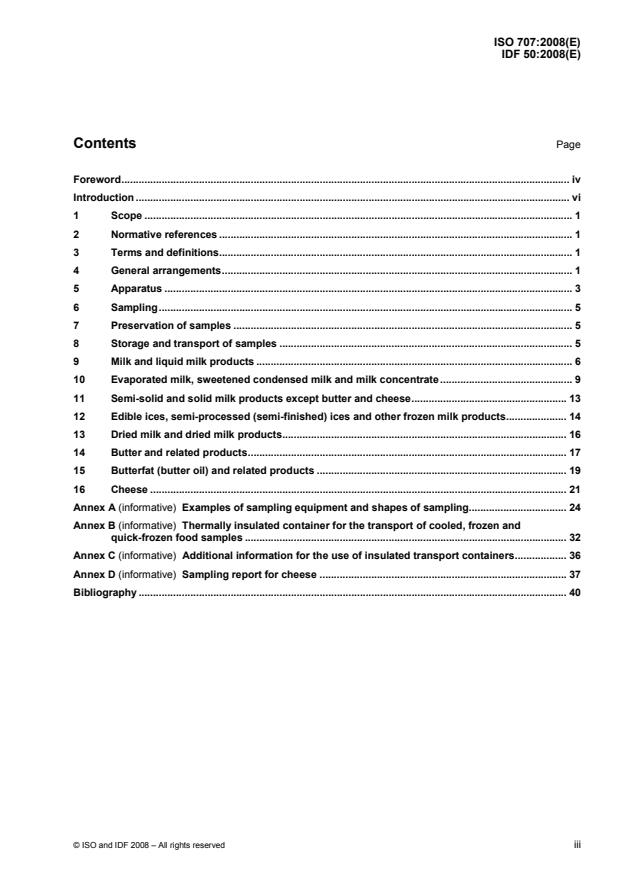
Contents Page
Foreword. iv
Introduction . vi
1 Scope . 1
2 Normative references . 1
3 Terms and definitions. 1
4 General arrangements. 1
5 Apparatus . 3
6 Sampling. 5
7 Preservation of samples . 5
8 Storage and transport of samples . 5
9 Milk and liquid milk products . 6
10 Evaporated milk, sweetened condensed milk and milk concentrate . 9
11 Semi-solid and solid milk products except butter and cheese. 13
12 Edible ices, semi-processed (semi-finished) ices and other frozen milk products. 14
13 Dried milk and dried milk products. 16
14 Butter and related products. 17
15 Butterfat (butter oil) and related products . 19
16 Cheese . 21
Annex A (informative) Examples of sampling equipment and shapes of sampling. 24
Annex B (informative) Thermally insulated container for the transport of cooled, frozen and
quick-frozen food samples . 32
Annex C (informative) Additional information for the use of insulated transport containers. 36
Annex D (informative) Sampling report for cheese . 37
Bibliography . 40
IDF 50:2008(E)
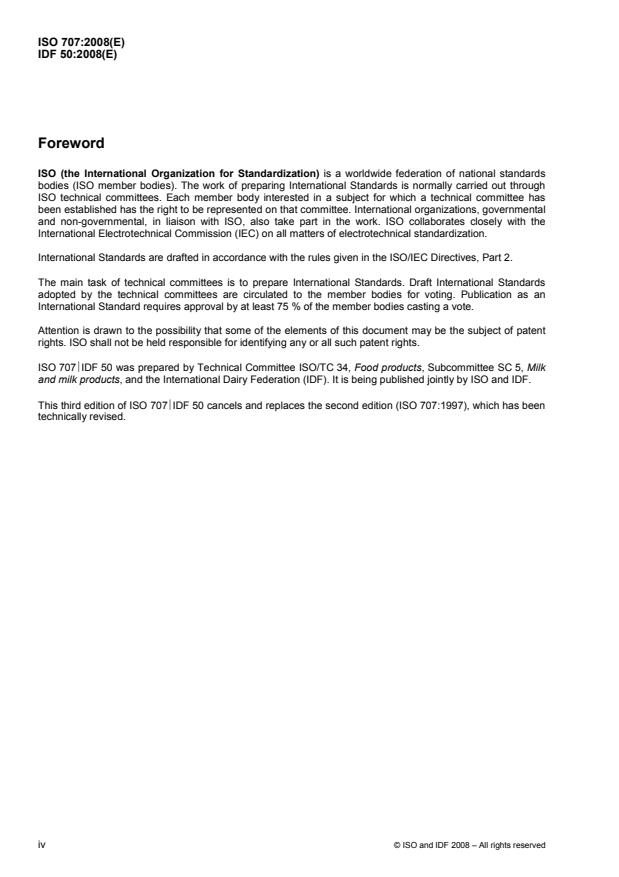
Foreword
ISO (the International Organization for Standardization) is a worldwide federation of national standards
bodies (ISO member bodies). The work of preparing International Standards is normally carried out through
ISO technical committees. Each member body interested in a subject for which a technical committee has
been established has the right to be represented on that committee. International organizations, governmental
and non-governmental, in liaison with ISO, also take part in the work. ISO collaborates closely with the
International Electrotechnical Commission (IEC) on all matters of electrotechnical standardization.
International Standards are drafted in accordance with the rules given in the ISO/IEC Directives, Part 2.
The main task of technical committees is to prepare International Standards. Draft International Standards
adopted by the technical committees are circulated to the member bodies for voting. Publication as an
International Standard requires approval by at least 75 % of the member bodies casting a vote.
Attention is drawn to the possibility that some of the elements of this document may be the subject of patent
rights. ISO shall not be held responsible for identifying any or all such patent rights.
ISO 707⎪IDF 50 was prepared by Technical Committee ISO/TC 34, Food products, Subcommittee SC 5, Milk
and milk products, and the International Dairy Federation (IDF). It is being published jointly by ISO and IDF.
This third edition of ISO 707⎪IDF 50 cancels and replaces the second edition (ISO 707:1997), which has been
technically revised.
iv © ISO and IDF 2008 – All rights reserved
IDF 50:2008(E)
Foreword
IDF (the International Dairy Federation) is a non-profit organization representing the dairy sector worldwide.
IDF membership comprises National Committees in every member country as well as regional dairy
associations having signed a formal agreement on cooperation with IDF. All members of IDF have the right to
be represented on the IDF Standing Committees carrying out the technical work. IDF collaborates with ISO in
the development of standard methods of analysis and sampling for milk and milk products.
Draft International Standards adopted by the Action Teams and Standing Committees are circulated to the
National Committees for voting. Publication as an International Standard requires approval by at least 50 % of
the IDF National Committees casting a vote.
Attention is drawn to the possibility that some of the elements of this document may be the subject of patent
rights. IDF shall not be held responsible for identifying any or all such patent rights.
ISO 707⎪IDF 50 was prepared by the International Dairy Federation (IDF) and Technical Committee
ISO/TC 34, Food products, Subcommittee SC 5, Milk and milk products. It is being published jointly by IDF
and ISO.
All work was carried out by the Joint ISO-IDF Action Team on Sampling and sample preparation of the
Standing Committee on Quality assurance, statistics of analytical data and sampling under the aegis of its
project leader, Mr. T. Berger (CH).
This edition of ISO 707⎪IDF 50 cancels and replaces IDF 50:1995, which has been technically revised.
IDF 50:2008(E)
Introduction
Sampling is an operation that requires most careful attention; emphasis cannot be too strongly laid on the
necessity of obtaining a properly representative sample. Written sampling procedures are demanded by
[6]
ISO/IEC 17025 if sampling is performed by laboratories. Written procedures are also required for
subsampling steps in the laboratory, e.g. the preparation of test portions. The sampling procedure is part of
the measurement procedure, but not of the measurement itself. It therefore does not contribute to the
measurement uncertainty. Variations resulting from sampling procedures handled by the laboratory contribute
to the uncertainty of the reported result and have therefore to be added to the measurement uncertainty.
Reference [10] is a guidance document on this issue.
The procedures described in this International Standard are recognized as good practice to be followed
whenever practicable. However, it is impossible to lay down fixed rules to be followed in every case, and,
however explicit, they cannot fully take the place of judgement, skill and experience. In particular, unforeseen
circumstances may render some modifications desirable. Whenever special requirements are given for
sampling and/or arise from a specific analysis to be performed, these requirements should be followed.
Heterogeneity in cheese provides particular challenges for sampling. Sampling uncertainty is mainly
influenced by the heterogeneity of the sample, the sample size and the sampling method.
There are significant consequences for both microbiological as well as for chemical analyses in cheese.
Normally the cheese curd is moulded into a specific shape and dimensions and this can affect the
development. During ripening of the moulded cheese curd under regular conditions or in environments in
which the humidity, temperature, and possibly composition of the atmosphere are controlled, the outside of
the cheese will develop into a semi-closed layer with a lower moisture content, the rind, often initiated by
brining. Due to the influence of the salt gradient in the brine, of oxygen, of drying out and of other reactions,
the rind successively becomes of a somewhat different composition than the interior of the cheese.
Rennet and microorganisms, added as selected cultures or naturally available, by enzymatic and
microbiological activity, change the structure and composition of the inner zone of the cheese. Moreover,
microorganisms are often not homogeneously distributed throughout the cheese.
Ripening is influenced by storage temperature, time, humidity, and salt gradients. During or after ripening, the
cheese rind can be treated or can be naturally colonized with desired cultures of microorganisms. The
resulting layer, in the latter case referred to as smear, will have further influence on the ripening of the border
zone. To be able to make correct decisions on the sampled material, specific knowledge of cheese ripening is
necessary. Depending on the desired conclusion, it has to be decided where a sample is to be taken and how
many samples are necessary.
For these reasons, ISO 707⎪IDF 50 has been written in the form of guidance rather than as an “imperative”
standard.
The test samples obtained by the methods described in this International Standard are “laboratory samples”
[1]
as defined in ISO 78-2:1999 , 3.1. The “test portion” obtained by the methods described is also defined in
[1]
ISO 78-2:1999 , 3.3.
vi © ISO and IDF 2008 – All rights reserved
INTERNATIONAL STANDARD
IDF 50:2008(E)
Milk and milk products — Guidance on sampling
1 Scope
This International Standard gives guidance on methods of sampling milk and milk products for microbiological,
chemical, physical and sensory analysis, except for (semi)automated sampling.
NOTE See also Reference [9].
2 Normative references
The following referenced documents are indispensable for the application of this document. For dated
references, only the edition cited applies. For undated references, the latest edition of the referenced
document (including any amendments) applies.
ISO 7002, Agricultural food products — Layout for a standard method of sampling from a lot
3 Terms and definitions
For the purposes of this document, the terms and definitions given in ISO 7002, and the following, apply.
3.1
laboratory sample
sample as prepared for sending to the laboratory and intended for inspection or testing
[1]
[ISO 78-2:1999 , 3.1]
3.2
test portion
quantity of material drawn from the laboratory sample on which the test or observation is actually carried out
[1]
[Adapted from ISO 78-2:1999 , 3.3]
NOTE It is possible that test portions of milk and milk products may require further processing, e.g. removal of parts
that impair the test result, aseptic extraction of parts or grating.
4 General arrangements
This International Standard is not suitable as a basis for formulating legal obligations between contracting
parties. In such cases, additional written requirements are necessary.
The number of units to be selected for sampling by inspection by attributes may be determined according to
[3]
ISO 5538⎪IDF 113 . Sampling for inspection by variables may be determined according to lSO 8197
[5]
(IDF 136A) .
IDF 50:2008(E)
The following instructions are not necessarily applicable for routine sampling:
a) the parties concerned or their representatives should be given the opportunity to be present when
sampling is performed;
b) whenever special requirements are given for the sampling and/or arise from a specific analysis to be
performed, these requirements should be followed.
1)
4.1 Sampling personnel
An authorized person, properly trained in the appropriate technique, e.g. for microbiological purposes, and
free from any infectious disease, shall perform sampling.
4.2 Sealing and labelling of samples
Samples should be sealed (if this is a legal requirement or if agreed between the parties concerned) and a
label attached, reproducing integrally the identification of product, the nature of the product and, at least, the
identification number, name and signature (or initials) of the authorized person (4.1) responsible for taking the
samples.
If necessary, additional information may be included, such as the purpose of sampling, the mass or volume of
sample, and the unit from which the sample was taken and the condition of product and storage conditions at
the moment of sampling.
4.3 Replicate samples
Samples should be taken in duplicate, or in greater numbers, if this is a legal requirement or if agreed
between the parties concerned.
It is recommended that additional sets of samples be taken and retained for arbitration purposes, if agreed
between the interested parties.
4.4 Sampling report
Samples should be accompanied by a report, signed or initialled by the authorized sampling personnel (4.1)
and countersigned — as far as necessary or agreed by the parties concerned — by witnesses present.
The report should include at least the following information:
a) the place, date and time of sampling (the time only being required when agreed between the parties
concerned);
b) the names and designations of the authorized sampling personnel and of any witnesses;
c) the precise method of sampling, including sample preparation and homogenization techniques;
d) the nature and number of units constituting the consignment, together with their batch code markings,
where available;
e) the identification number and any code markings of the batch from which the samples were taken;
f) the number of samples duly identified as to the batches from which they were taken;
g) if necessary, the place to which the samples are to be sent;
h) if possible, the name and address of the producer or trader or of the persons responsible for packing the
product.
1) In some countries it is the practice to employ a sworn person for sampling.
2 © ISO and IDF 2008 – All rights reserved
IDF 50:2008(E)
When appropriate, the report should also include any relevant conditions or circumstances (e.g. the condition
of the product containers and their surroundings, temperature and humidity of the atmosphere, the age of the
product, method of sterilization of the sampling equipment, whether a preservative substance has been added
to the samples), and any special information relating to the product being sampled, e.g. difficulty in achieving
homogeneity of the product.
Test portion size and handling vary according to the test(s) intended and are found under the appropriate
headings in the individual International Standards specifying the tests.
Sampling also includes preparation of the laboratory sample. Therefore, the sampling report or a separate
laboratory report should clearly state how the laboratory samples were prepared. Sampling reports are
transmitted to the appropriate authority together with the test report. The example of a sampling report for
cheese is given in Annex D (see also 16.3).
5 Apparatus
5.1 Sampling equipment
5.1.1 General
Sampling equipment should be made of stainless steel, or other suitable material of adequate strength, which
does not bring about a change in the sample which could affect the results of subsequent examinations.
All surfaces should be smooth and free from crevices. All corners should be rounded except in the case of
method D mentioned in 5.1.2. The equipment should be dry prior to use.
5.1.2 For microbiological examination
Sampling equipment for microbiological examination should be clean and sterilized prior to use. Disposable
plastics equipment should be sterile.
If solder is used in the manufacture of the equipment, it should be capable of withstanding a temperature of
180 °C. If possible, sterilization should be performed by one of the three following methods:
[4]
a) Method A: Exposure to hot air at 170 °C for at least 1 h or equivalent (see ISO 7218 );
b) Method B: Exposure to steam in an autoclave set at 121 °C ± 1 °C for at least 15 min (see
[4]
ISO 7218 );
c) Method C: Exposure to a sufficient dose of γ-radiation.
After sterilization by one of methods A, B or C, the sampling equipment should be stored under conditions to
ensure sterility until ready to sample.
If, in a particular situation, sterilization by methods A, B or C is impossible, one the following alternative
methods might be used provided that the sampling equipment is used immediately after treatment. However,
these methods should be regarded as secondary methods only.
d) Method D: Exposure of all working surfaces of the sampling equipment to a suitable flame;
e) Method E: Immersion in ethanol of at least 70 % volume fraction (see 5.5.1) followed by 5 min drying
time;
f) Method F: Ignition with ethanol of 96 % volume fraction (see 5.5.2).
After treatment by either method D or method F, the sampling equipment should be cooled under appropriate
conditions to maintain sanitation before sampling.
IDF 50:2008(E)
5.1.3 For chemical and physical analysis and for sensory examination
Sampling equipment should be clean and dry and should not influence the properties, such as odour, flavour,
consistency, and composition, of the product. In some cases, equipment treated as described in 5.1.2 is
required to avoid microbial contamination of the product.
The marking of samples should not influence the properties or composition of the product. Odourless marking
equipment should be used, e.g. odourless permanent ink or felt-tip pens.
5.2 Sample containers
Sample containers and closures should be of material and construction that adequately protect the sample
and which do not bring about a change in the sample which could affect the results of subsequent analyses or
examinations. Appropriate materials include glass, some metallic materials (e.g. stainless steel) and some
plastics (e.g. polypropylene).
The containers should preferably be opaque. If necessary, transparent filled containers should be stored in a
dark place. Containers and closures should be dry, clean and either sterile or suitable for treatment by one of
the methods described in 5.1.2. The use of glass containers for sampling inside production areas should be
avoided.
The shape and capacity of the containers should be appropriate to the particular requirements for the product
to be sampled. Single-service plastic containers as well as aluminium foil of adequate strength (sterile and
non-sterile) and suitable plastic bags, with appropriate methods of closure, may also be used.
Sample containers other than plastic bags should be securely closed either by using a suitable stopper or a
screw cap of metallic or plastics material. The latter should have, if necessary, a liquid-tight plastic liner which
is insoluble, non-absorbent and greaseproof and which will not influence the composition, properties or the
odour and flavour of the sample. If stoppers are used, they should be made from, or covered with,
non-absorbent, odourless and flavourless material. Sample containers need to be airtight/sealed to prevent
contamination and air ingress.
Containers for samples for microbiological examinations should not be closed with cork stoppers or caps with
cork seals, even if provided with liners. Containers for solid, semi-solid or viscous products should be
wide-mouthed.
Small retail containers are considered as sample containers; the sample should consist of the contents of one
or more intact, unopened containers.
Requirements for insulated containers for transport of cooled, frozen or quick-frozen samples are given in
Annex B.
5.3 Sample preparation equipment
The technical equipment for sample preparation should be described in the specific method of analysis.
5.4 Thermometer specifications
Thermometers used in the sampling procedure should be validated and of sufficient accuracy.
5.5 Ethanol
5.5.1 Ethanol, undenatured, with a volume fraction of 70 %.
5.5.2 Ethanol, undenatured, with a volume fraction of 96 %.
CAUTION — This solution is hygroscopic and may change its concentration over a long period of time.
Use freshly prepared solutions.
4 © ISO and IDF 2008 – All rights reserved
IDF 50:2008(E)
6 Sampling
Sampling should be done in such a way as to get representative samples of the product.
If laboratory samples for microbiological, chemical and physical analyses and sensory examinations are taken
separately, those for microbiological examinations should be taken first using aseptic techniques and sterilized
equipment and containers (see 5.1.2).
Care should be taken to ensure that when taking samples for sensory examinations, the flavour of the
samples is not adversely affected by the use of sampling equipment or sampling cocks, e.g. method E or F
(5.1.2).
The precise method of sampling and the mass or volume of product to be taken varies according to the nature
of the product and the purpose for which samples are required.
For details of the requirements, see Clauses 9 to 16. If products contain coarse particles, it may be necessary
to increase the minimum sample size. The sample container should be closed immediately after sampling.
For small retail containers, the sample consists of one or more unopened containers.
If necessary, a further sample is taken for temperature control during transportation to the testing laboratory.
7 Preservation of samples
Preservatives should normally not be added to samples intended for microbiological or sensory examination
but may be added to some milk products, provided that:
a) an instruction to do so is issued by the testing laboratory;
b) the preservative is of a nature that does not interfere with subsequent analyses, and testing of texture
and flavour should not be performed;
c) the nature and quantity of preservative are stated in the sampling report and, preferably, indicated on the
label;
d) the safety instructions for the preservative used are followed.
In certain cases, the preservative will interfere with the analyte. In such cases, a suitable correction should be
used.
8 Storage and transport of samples
Storage and dispatch of the samples should be such that the state of the sample at the time of sampling
remains essentially unaltered until the time of starting the test procedure.
During transport, where necessary, precautions should be taken to prevent exposure to off-odours, direct
sunlight and other adverse conditions. If cooling is necessary, the minimum requirements to be met are the
temperature ranges which are either legally requested or prescribed by the manufacturer. The storage
temperature after sampling should be attained as quickly as possible. The time and temperature should be
considered in combination and not independently.
Storage temperatures are given in Table 1.
Samples should be dispatched immediately after sampling to the testing laboratory. The time for dispatch of
the samples to the testing laboratory should be as short as possible, preferably within 24 h. If requested,
samples should be dispatched as instructed by the testing laboratory.
After preparation of the test portion, analysis should be carried out immediately.
IDF 50:2008(E)
Table 1 — Sample preservation, storage temperature and minimum sample size
Sampling Product Preservation Storage Minimum
a
according permitted for temperature recombined
b
to Clause samples intended also used before sample size
for chemical and and during
physical analysis transport
°C
9 Non-sterilized milk and liquid milk products Yes 1 to 5 100 ml or 100 g
9 Sterilized milk, UHT milk and sterilized liquid No Ambient, max. 30 100 ml or 100 g
milk products in original, unopened containers
9 Sterilized milk, UHT milk and sterilized liquid Yes 1 to 5 100 ml or 100 g
milk products after sampling from the production
line or from one or more original pack(s)
10 Evaporated milk, sweetened condensed milk, No Ambient, max. 30 100 g
milk concentrates, and sterilized concentrates
11 Semi-solid and solid milk products except butter No 1 to 5 100 g
and cheese
12 Edible ices and semi-finished ice products No u −18 100 g
13 Dried milk and dried milk products No Ambient, max. 30 100 g
14 Butter and butter products No 1 to 5 (in the dark) 50 g
15 Butterfat (butter oil and similar products) No 1 to 5 (in the dark) 50 g
16 Fresh cheese No 1 to 5 100 g
16 Processed cheese No 1 to 5 100 g
16 Other cheeses No 1 to 5 100 g
a [4]
These temperatures are meant as general guidelines (see ISO 7218 ). For specific analytical purposes, other temperatures can
be more appropriate. It may be, under certain practical conditions, not always easy or even impossible to maintain the “ideal” or
desirable temperatures specified here especially during transportation. It is therefore recommended to use suitable containers in all
cases where it is necessary (see also Annex B) and to monitor and record temperatures in a suitable way.
b
In certain cases, it will be necessary to take a number of samples to produce a composite of corresponding minimum sample size.
A larger sample size for laboratory samples may be necessary according to the tests required and the type of product. Smaller sample
sizes are possible if no analytical and statistical arguments are against it. For the measurement of zonal differences, e.g. in cheese, it
may even be necessary to take smaller sample sizes.
9 Milk and liquid milk products
9.1 Applicability
The instructions given in this clause are applicable to raw and heat-treated milk, whole, partly skimmed and
skimmed milk, flavoured milk, cream, fermented milk, buttermilk, liquid whey and similar products.
9.2 Sampling equipment
Sampling equipment should comply with the requirements of Clause 5.
9.2.1 Apparatus for manual mixing
Apparatus for mixing liquids in bulk should have a surface sufficient to produce adequate disturbance of the
products. In view of the different shapes and sizes of containers, no specific design of apparatus can be
recommended for all purposes, but they should be designed in such a way as to avoid damage of the inner
surface of the container during mixing.
6 © ISO and IDF 2008 – All rights reserved
IDF 50:2008(E)
9.2.1.1 Apparatus for manual mixing in small vessels
For mixing liquids in small vessels (e.g. in buckets and cans) a stirrer (plunger) of the design and dimensions
shown in Figure A.1 is suitable. The length should be adjusted to the depth of the vessel.
9.2.1.2 Apparatus for manual mixing in large vessels
A stirrer (plunger) of the design and dimensions shown in Figure A.2 is suitable for use for larger vessels
(e.g. road and farm tanks).
9.2.2 Apparatus for mechanical agitation
9.2.2.1 Built-in agitators
The product to be stirred in the tank or vessel determines the technical data and construction of built-in
agitators. Various types of agitators are used but no attempt has been made to describe any of them, within
this International Standard.
9.2.2.2 Removable agitators
Removable agitators are mostly provided with a propeller and are introduced into transport, road and rail tanks
through the inspection port. Best stirring results are achieved at a depth corresponding to 0,7 of the filling
height. It is recommended that the agitator be inclined by 5° to 20° as this provides a horizontal as well as
vertical component to the resultant stirring motion of the liquor liquid.
9.2.3 Apparatus for taking samples
9.2.3.1 Apparatus for sampling
A dipper of the shape and size shown in Figure A.3 is suitable for sampling. The tapered form of the cup
permits nesting of the dippers.
9.2.3.2 Sample containers
The capacity of the sample containers should be such that they are almost completely filled by the sample and
allow proper mixing of the content before testing, but avoid churning during transport.
9.2.3.3 Thermally insulated transport container
See Annex B.
9.3 Sampling
Thoroughly mix all liquids, by inverting, stirring, by pouring to and from one product container to another of the
same volume, until sufficient homogeneity is obtained but avoid foaming. The equipment described in 9.2.1
and 9.2.2 may be used.
Take the sample immediately after mixing. Refer to Table 1 for minimum sample size and acceptable
sampling temperatures.
9.3.1 Sampling for microbiological examination
Samples for microbiological examination should always be taken first using aseptic techniques. Whenever
possible, they should be taken from the same product containers as those for chemical and physical analysis
and for sensory examination.
Treat the sampling equipment and sample containers as described in 5.1.2.
Proceed as described in 9.3.2 but using aseptic techniques.
IDF 50:2008(E)
9.3.2 Sampling for chemical and physical analysis and sensory examination
In certain cases, sampling equipment and sample containers should be treated as described in 5.1.2 for
chemical and physical analysis and sensory examination.
9.3.2.1 Small vessels, milk buckets and cans
Thoroughly mix the milk, e.g. by transfer, stirring or plunging (plunger).
9.3.2.2 Milk tanks or vats
Mechanically stir the milk for at least 5 min until sufficient homogeneity is obtained. If the tank is equipped with
a periodical, time-programmed agitation system, sampling may be carried out after only a short duration of
agitation (1 min to 2 min). In those instances where the propeller of the agitator is close to the surface of the
milk, the agitator should not be used, as that is likely to lead to the formation of foam.
9.3.2.3 Weighing bowl
To obtain a representative milk sample, it is essential that the milk be adequately mixed in the weighing bowl.
A sufficient degree of mixing is not achieved when the milk being tipped into the weighing bowl varies and
does not allow proper sampling. In that case, it is essential to supplement the mixing by additional agitation.
The amount of additional agitation should be determined by experiment. When the volume of milk to be
sampled exceeds the capacity of the weighing bowl, a sample representative of the whole consignment
should be obtained.
9.3.2.4 Large vessels, storage, rail and road tanks
In each case, thoroughly mix the milk by an appropriate method before sampling, e.g. by mechanical agitation,
by stirring with clean compressed air without foaming or by the use of a plunger. When compressed air is
used, any adverse influence on the product to be mixed should be avoided.
The extent of mixing should be appropriate to the period of time over which the milk has been at rest.
An agitator propeller too close to the surface of the milk is likely to lead to the formation of foam. Do not use
an agitator if foam production cannot be avoided.
Mixing by using a plunger or a removable agitator in road, rail tanks or vessels of similar size should be
performed as follows.
a) When samples are taken within 30 min after filling the container, the milk should be mixed for at least
5 min by plunging or stirring with an agitator. When the milk has been stored in the tank for a longer
period of time, mixing should be extended to at least 15 min.
b) When the tank is completely filled as is normally the case with transport, road and rail tanks, proper
mixing of milk showing pronounced creaming phenomena can only be achieved by mechanical agitation.
In a large vessel with a bottom discharge outlet or a sampling cock installed at another place, there may be, at
the discharge outlet, a small quantity of milk which is not representative of the whole content even after mixing.
Accordingly, samples should preferably be taken through the inspection port. If samples are taken from the
discharge outlet valve or the sampling cock, discharge sufficient milk to ensure that the samples are
representative of the whole.
The efficiency of the method of mixing applied in any particular circumstances should be demonstrated as
being adequate for the purposes of the analysis envisaged; the criterion of mixing efficiency is the repeatability
of analytical results from samples taken either from different parts of the whole, or from the outlet of the tank
at intervals during discharge.
9.3.2.5 Containers of different design
To take samples from shallow containers, special equipment is required.
8 © ISO and IDF 2008 – All rights reserved
IDF 50:2008(E)
9.3.2.6 Subdivided quantities
Unless a part of the bulk is tested individually, a representative quantity should be taken from each container
after mixing the content and the quantity and container related to the sample noted in the sampling report (4.4).
Mix portions of each representative quantity in amounts which are proportional to the quantity of the container
from which they are taken. Samples from the aggregate sample thus obtained should be taken after mixing.
9.3.2.7 Sampling from closed systems
For taking samples from closed systems (e.g. UHT plants, aseptic techniques) and in particular for
microbiological analysis, the working instructions for the installed sampling equipment should be observed.
9.3.2.8 Retail containers
The content of intact and unopened containers constitute the sample.
9.3.3 Applicability to products other than milk
9.3.3.1 Buttermilk, fermented milk, flavoured milk
Choose a suitable method from those described for milk and take a sample before fat or other solid matter has
had time to separate. If the latter has occurred, proceed to ensure a representative sample from a
homogeneous product as described in 9.3.1.
9.3.3.2 Cream
When using a plunger or a mechanical agitator for mixing cream thoroughly, mix the cream at the bottom of
the container with the upper layers.
To avoid foaming, whipping or churning of the cream, do not raise the disc of the plunger above the surface of
the cream during plunging. The equipment described in 9.2.1 (see Figures A.1 and A.2) may be used. When
mechanical agitators are used, the incorporation of air should be avoided.
9.3.3.3 Whey
Choose a suitable method from those described for milk.
9.4 Preservation, storage and dispatch of samples
See Clauses 7 and 8.
10 Evaporated milk, sweetened condensed milk and milk concentrate
10.1 Applicability
The instructions given in this clause are applicable to evaporated milk, sweetened condensed milk and milk
concentrates and similar products.
10.2 Sampling equipment
See 5.1.
10.2.1 Apparatus for manual mixing, see 9.2.1 and 9.2.2.
10.2.2 Stirrers, broad bladed, of sufficient length to reach the bottom of the product container and having
one edge shaped to the contour of the container (see Figure A.4).
IDF 50:2008(E)
10.2.3 Dippers, see 9.2.3.1.
10.2.4 Rods, of length about 1 m and diameter about 35 mm.
10.2.5 Containers, for subsampling, of capacity 5 l, with a wide mouth and meeting the requirements of 5.2.
10.2.6 Spoons or spatula, broad bladed.
10.2.7 Sample containers, see 5.2.
The capacity of the sample containers should be such that they are almost completely filled by the sample and
allow proper mixing of the contents before testing.
10.3 Sampling evaporated milk
Take the sample immediately after mixing, avoid foaming. Refer to Table 1 for minimum sample size and
acceptable sampling temperatures.
10.3.1 Sampling for microbiological examination
Samples for microbiological examination should always be taken first by using aseptic techniques. Whenever
possible, they should be taken from the same product containers as those for chemical and physical analysis
and for sensory examination.
Treat the sampling equipment and sample containers as described in 5.1.2.
Proceed as described in 10.3.2, but using aseptic techniques.
10.3.2 Sampling for chemical and physical analysis and for sensory examination
In certain cases, the sampling equipment and sample containers should also be treated as described in 5.1.2
for chemical and physical analysis and sensory examination.
10.3.2.1 Large vessels (e.g. 2 kg and 4 kg)
Thoroughly mix the evaporated milk by plunging or stirring using a manual stirrer, by mechanical agitation, by
pouring from one container to another, until sufficient homogeneity is obtained. Care should be taken to
minimize foam formation; excess foaming can lead to changes in the physical and sensory characteristics of
the product being sampled.
However, in most cases, sufficient distribution of fat is only obtained if the containers have been left standing
in water at a temperature not greater than 45 °C for a maximum of 30 min before mixing as described above.
If it proves difficult to obtain sufficient homogeneity, take subsamples from different locations of the product
container, collected with the same sampling apparatus to obtain a representative laboratory sample.
Refer to Table 1 for minimum sample size and acceptable sampling temperatures.
Note on the label and in the sampling report (4.4) if the sample is a mixture of subsamples.
10.3.2.2 Very large vessels (containers) of 500 kg and more, and road tanks
Mixing is, in principle, performed in the same manner as described for milk (9.3.2.4). Intensity of mixing is
dependent on the degree of concentration.
10 © ISO and IDF 2008 – All rights reserved
IDF 50:2008(E)
10.3.2.3 Retail containers
The content of an unopened container of size greater than the minimum sample size constitutes the laboratory
sample.
Where the size of a single unopened retail container does not meet the minimum sample size, a composite
from multiple unopened retail containers constitutes the laboratory sample. The composite should be created
as described in 10.3.2.1.
Refer to Table 1 for minimum sample size and acceptable sampling temperatures.
If a sample is taken from retail containers, it should be preheated beforehand as described in 10.3.2.1.
10.4 Sampling sweetened condensed milk and milk concentrate
The sample should be taken immediately after mixing, avoid foaming. Refer to Table 1 for minimum sample
size and acceptable sampling temperatures.
10.4.1 General
The sampling of bulk containers may be a matter of extreme difficulty, particularly when the product is not
homogeneous and is highly viscous.
Problems of sampling may arise through the presence of large crystals of sucrose or lactose, through
precipitation of various salts which may occur throughout the body of the product or adhere to the walls, or
through the presence of lumpy matter. Such conditions will become apparent when a sampling rod is
introduced into the product container (see 10.2.4) and is withdrawn after exploring as large a volume of the
container as possible. Provided that the size of sugar crystals is not larger than 6 µm, difficulties in sampling
should not be experienced from this cause.
Since sweetened condensed milk is frequently stored at ambient temperature, it is recommended that the
content of bulk containers is brought to a feasible temperature. Crystallized concentrate in storage tanks
cannot be sampled representatively unless the tank is designed for and equipped with a power driven agitator.
When the product is not homogeneous and particularly when crystals are not evenly distributed, note this fact
in the sampling report (4.4). Perform sampling immediately after mixing.
10.4.2 Sampling for microbiological examination
Samples for microbiological examination should always be taken first using aseptic techniques. Whenever
possible, they should be taken from the same product containers as those for chemical and physical analysis
and for sensory examination.
Treat the sampling equipment and sample containers as described in 5.1.2.
Proceed as described in 10.4.2.1, but using aseptic techniques.
10.4.2.1 Bulk containers
Thoroughly clean, treat as described in 5.1.2 and rinse with cold sterile water, the outside end of the product
container, or of the drum, if it is an end-opening type (bunghole), before opening the container or removing the
end-cover (bung). For sterilization the surface can, repeatedly if required, be flamed using alcohol (see 5.1.2).
Proceed as described in 10.4.3, but using aseptic techniques.
IDF 50:2008(E)
In the case of condensed milk, which flows readily and is of uniform consistency, drums with a bunghole are
turned. While the product is allowed to drain, the sample should be taken. Bungholes with screw caps are
difficult to disinfect, so particular care should be taken. When the product has become viscous, the surface
layer has to be removed to a depth of
...
NORME ISO
INTERNATIONALE 707
FIL
Troisième édition
2008-08-15
Lait et produits laitiers — Lignes
directrices pour l'échantillonnage
Milk and milk products — Guidance on sampling
Numéros de référence
FIL 50:2008(F)
©
ISO et FIL 2008
FIL 50:2008(F)
PDF – Exonération de responsabilité
Le présent fichier PDF peut contenir des polices de caractères intégrées. Conformément aux conditions de licence d'Adobe, ce fichier
peut être imprimé ou visualisé, mais ne doit pas être modifié à moins que l'ordinateur employé à cet effet ne bénéficie d'une licence
autorisant l'utilisation de ces polices et que celles-ci y soient installées. Lors du téléchargement de ce fichier, les parties concernées
acceptent de fait la responsabilité de ne pas enfreindre les conditions de licence d'Adobe. Le Secrétariat central de l'ISO et la FIL
déclinent toute responsabilité en la matière.
Adobe est une marque déposée d'Adobe Systems Incorporated.
Les détails relatifs aux produits logiciels utilisés pour la création du présent fichier PDF sont disponibles dans la rubrique General Info
du fichier; les paramètres de création PDF ont été optimisés pour l'impression. Toutes les mesures ont été prises pour garantir
l'exploitation de ce fichier par les comités membres de l'ISO et les comités nationaux de la FIL. Dans le cas peu probable où
surviendrait un problème d'utilisation, veuillez en informer le Secrétariat central de l'ISO à l'adresse donnée ci-dessous.
DOCUMENT PROTÉGÉ PAR COPYRIGHT
© ISO et FIL 2008
Droits de reproduction réservés. Sauf prescription différente, aucune partie de cette publication ne peut être reproduite ni utilisée sous
quelque forme que ce soit et par aucun procédé, électronique ou mécanique, y compris la photocopie et les microfilms, sans l'accord écrit
soit de l'ISO soit de la FIL, à l'une ou l'autre des adresses ci-après.
ISO copyright office Fédération Internationale de Laiterie
Case postale 56 • CH-1211 Geneva 20 Diamant Building • Boulevard Auguste Reyers 80 • B-1030 Bruxelles
Tel. + 41 22 749 01 11 Tel. + 32 2 733 98 88
Fax + 41 22 749 09 47 Fax + 32 2 733 04 13
E-mail copyright@iso.org E-mail info@fil-idf.org
Web www.iso.org Web www.fil-idf.org
Version française parue en 2009
Publié en Suisse
ii © ISO et FIL 2008 – Tous droits réservés
FIL 50:2008(F)
Sommaire Page
Avant-propos .iv
Introduction.vi
1 Domaine d'application .1
2 Références normatives.1
3 Termes et définitions .1
4 Dispositions générales .2
5 Appareillage .3
6 Échantillonnage.5
7 Conservation des échantillons .6
8 Stockage et transport des échantillons .6
9 Lait et produits laitiers liquides .8
10 Lait concentré, lait concentré sucré et lait condensé .11
11 Produits laitiers semi solides et solides à l'exception du beurre et du fromage .14
12 Glaces de consommation, préparations pour glaces et autres produits glacés à base de
lait.16
13 Lait sec et produits laitiers secs.18
14 Beurre et produits apparentés .19
15 Matière grasse butyrique (huile de beurre) et produits apparentés .22
16 Fromage.23
Annexe A (informative) Exemples de matériels d'échantillonnage et de formes d'échantillons .26
Annexe B (informative) Récipients isolés thermiquement pour le transport d'échantillons
de produits alimentaires réfrigérés, congelés ou surgelés .35
Annexe C (informative) Informations supplémentaires pour l'utilisation de récipients pour
transport isolés.39
Annexe D (informative) Rapport d'échantillonnage pour le fromage .40
Bibliographie.43
© ISO et FIL 2008 – Tous droits réservés iii
FIL 50:2008(F)
Avant-propos
L'ISO (Organisation internationale de normalisation) est une fédération mondiale d'organismes nationaux
de normalisation (comités membres de l'ISO). L'élaboration des Normes internationales est en général
confiée aux comités techniques de l'ISO. Chaque comité membre intéressé par une étude a le droit de faire
partie du comité technique créé à cet effet. Les organisations internationales, gouvernementales et non
gouvernementales, en liaison avec l'ISO participent également aux travaux. L'ISO collabore étroitement avec
la Commission électrotechnique internationale (CEI) en ce qui concerne la normalisation électrotechnique.
Les Normes internationales sont rédigées conformément aux règles données dans les Directives ISO/CEI,
Partie 2.
La tâche principale des comités techniques est d'élaborer les Normes internationales. Les projets de Normes
internationales adoptés par les comités techniques sont soumis aux comités membres pour vote. Leur
publication comme Normes internationales requiert l'approbation de 75 % au moins des comités membres
votants.
L'attention est appelée sur le fait que certains des éléments du présent document peuvent faire l'objet de
droits de propriété intellectuelle ou de droits analogues. L'ISO ne saurait être tenue pour responsable de ne
pas avoir identifié de tels droits de propriété et averti de leur existence.
L'ISO 707⎪FIL 50 a été élaborée par le comité technique ISO/TC 34, Produits alimentaires, sous-comité SC 5,
Lait et produits laitiers, et la Fédération Internationale de Laiterie (FIL). Elle est publiée conjointement par
l'ISO et la FIL.
Cette troisième édition de l'ISO 707⎪FIL 50 annule et remplace la deuxième édition (ISO 707:1997), qui a fait
l'objet d'une révision technique.
iv © ISO et FIL 2008 – Tous droits réservés
FIL 50:2008(F)
Avant-propos
La FIL (Fédération Internationale de Laiterie) est une organisation sans but lucratif représentant le secteur
laitier mondial. Les membres de la FIL se composent des Comités Nationaux dans chaque pays membre et
des associations laitières régionales avec lesquelles la FIL a signé des accords de coopération. Tout membre
de la FIL a le droit de faire partie des Comités permanents de la FIL auxquels sont confiés les travaux
techniques. La FIL collabore avec l'ISO pour l'élaboration de méthodes normalisées d'analyse et
d'échantillonnage pour le lait et les produits laitiers.
Les projets de Normes internationales adoptés par les Équipes d'Action et les Comités permanents sont
soumis aux Comités Nationaux pour vote. Leur publication comme Normes internationales requiert
l'approbation de 50 % au moins des Comités Nationaux de la FIL votants.
L'attention est appelée sur le fait que certains des éléments du présent document peuvent faire l'objet de
droits de propriété intellectuelle ou de droits analogues. La FIL ne saurait être tenue pour responsable de ne
pas avoir identifié de tels droits de propriété et averti de leur existence.
L'ISO 707⎪FIL 50 a été élaborée par la Fédération Internationale de Laiterie (FIL) et le comité technique
ISO/TC 34, Produits alimentaires, sous-comité SC 5, Lait et produits laitiers. Elle est publiée conjointement
par la FIL et l'ISO.
L'ensemble des travaux a été confié à l'Équipe d'Action mixte ISO-FIL, Échantillonnage et préparation
d'échantillon, du comité permanent chargé de l'Assurance de la qualité, des statistiques des résultats
d'analyse et de l'échantillonnage sous la conduite de son chef de projet, Monsieur T. Berger (CH).
Cette édition de l'ISO 707⎪FIL 50 annule et remplace la FIL 50:1995, qui a fait l'objet d'une révision technique.
© ISO et FIL 2008 – Tous droits réservés v
FIL 50:2008(F)
Introduction
L'échantillonnage est une opération qui demande le plus grand soin. On ne saurait donc trop insister sur la
nécessité d'obtenir un échantillon suffisamment représentatif. Des modes opératoires rédigés sont exigés par
[6]
l'ISO/CEI 17025 dans le cas où l'échantillonnage est réalisé par des laboratoires. Cette exigence s'applique
également aux étapes de sous-échantillonnage effectuées dans le laboratoire, telles que la préparation des
prises d'essai. Le mode opératoire d'échantillonnage fait partie du mode opératoire de mesurage, mais pas du
mesurage lui-même. Il ne contribue donc pas à l'incertitude du mesurage. Les écarts résultant des modes
opératoires d'échantillonnage mis en œuvre par le laboratoire contribuent à l'incertitude des résultats
communiqués et nécessitent donc d'être ajoutés à l'incertitude du mesurage. La Référence [10] fournit des
lignes directrices concernant cette question.
Les modes opératoires décrits dans la présente Norme internationale sont reconnus comme étant ceux de la
bonne pratique et il est recommandé de les suivre toutes les fois que cela est possible. II est toutefois
impossible d'établir des règles absolues à suivre dans tous les cas qui, même si elles sont explicites, ne
peuvent pas remplacer complètement le jugement, la compétence et l'expérience. En particulier, dans
certaines circonstances imprévues, il peut être souhaitable d'y apporter quelques modifications. Quand des
exigences spéciales sont données pour l'échantillonnage et/ou résultent d'une analyse spécifique à effectuer,
il convient de suivre ces exigences.
L'hétérogénéité dans le fromage représente un défi particulier en matière d'échantillonnage. L'incertitude de
l'échantillonnage est principalement influencée par l'hétérogénéité de l'échantillon, de sa taille et de la
méthode d'échantillonnage.
Les conséquences sont importantes à la fois pour les analyses microbiologiques et chimiques du fromage.
Normalement le caillé de fromagerie est moulé dans une forme et des dimensions spécifiques, ce qui peut
affecter son développement. Au cours de la maturation du caillé de fromagerie moulé en création naturelle ou
dans des environnements où l'humidité et éventuellement la composition de l'air sont contrôlés, l'extérieur du
fromage développera une couche semi-fermée avec une teneur en humidité plus faible, la croûte, souvent
initiée par un saumurage. En raison de l'influence du gradient de sel dans la saumure, de l'oxygène, de
l'assèchement et d'autres réactions, la croûte change progressivement de composition par rapport à l'intérieur
du fromage.
La présure et les microorganismes, naturels ou ajoutés comme des cultures choisies, et dotés d'une activité
enzymatique et microbiologique, changent la structure et la composition de la zone interne du fromage. De
plus, les microorganismes sont souvent répartis de manière non homogène dans la texture du fromage.
L'affinage est influencé par la température et la durée de stockage ainsi que par l'humidité et les gradients de
sel. Pendant ou après l'affinage, la croûte de fromage peut être traitée ou colonisée de manière naturelle par
des cultures voulues de microorganismes. La couche obtenue, appelée dans ce dernier cas graisse, aura une
influence sur la maturation de la zone en bordure. Afin de pouvoir prendre les bonnes décisions concernant le
matériel d'échantillonnage, il est nécessaire d'avoir une bonne connaissance concernant l'affinage du fromage.
En fonction de la conclusion souhaitée, il peut être décidé de l'endroit de l'échantillonnage et du nombre
d'échantillons nécessaires.
Sur la base du raisonnement précédent, l'ISO 707⎪FIL 50 constitue un ensemble de lignes directrices, plutôt
qu'une norme «impérative».
Les échantillons pour essai obtenus grâce aux méthodes décrites dans la présente Norme internationale
[1]
sont des «échantillons pour laboratoire» tels que définis dans l'ISO 78-2:1999 , 3.1. La «prise d'essai»
obtenue grâce aux méthodes décrites dans le présent document est également définie dans
[1]
l'ISO 78-2:1999 , 3.3.
vi © ISO et FIL 2008 – Tous droits réservés
NORME INTERNATIONALE
FIL 50:2008(F)
Lait et produits laitiers — Lignes directrices pour
l'échantillonnage
1 Domaine d'application
La présente Norme Internationale donne des lignes directrices relatives aux méthodes d'échantillonnage du
lait et des produits laitiers destinés à une analyse microbiologique, chimique, physique et sensorielle, sauf
pour l'échantillonnage (semi) automatisé.
NOTE Voir aussi la Référence [9].
2 Références normatives
Les documents de référence suivants sont indispensables pour l'application du présent document. Pour les
références datées, seule l'édition citée s'applique. Pour les références non datées, la dernière édition du
document de référence s'applique (y compris les éventuels amendements).
ISO 7002, Produits agricoles alimentaires — Présentation d'une méthode normalisée d'échantillonnage à
partir d'un lot
3 Termes et définitions
Pour les besoins du présent document, les termes et définitions donnés dans l'ISO 7002 ainsi que les
suivants s'appliquent.
3.1
échantillon pour laboratoire
échantillon dans l'état de préparation où il est envoyé au laboratoire et destiné à être utilisé pour un contrôle
ou pour des essais
[1]
[ISO 78-2:1999 , 3.1]
3.2
prise d'essai
quantité de matière prélevée dans l'échantillon pour essai sur laquelle est effectivement effectué(e) l'essai ou
l'observation
[1]
[Adapté de l'ISO 78-2:1999 , 3.3]
NOTE Il est possible que des prises d'essai de lait et de produits laitiers exigent un traitement supplémentaire,
comme par exemple l'élimination des parties qui faussent le résultat de l'essai, l'extraction aseptique de parties ou un
râpage.
© ISO et FIL 2008 – Tous droits réservés 1
FIL 50:2008(F)
4 Dispositions générales
La présente Norme Internationale n'est pas appropriée en tant que base pour formuler des exigences légales
entre les parties contractantes. Dans de tels cas, des exigences écrites complémentaires sont nécessaires.
Le nombre d'unités à sélectionner pour l'échantillonnage par inspection par attributs peut être déterminé selon
[3]
l'ISO 5538⎪FIL 113 . L'échantillonnage par contrôle par mesures peut être déterminé selon l'ISO 8197
[5]
(FIL 136A) .
Les instructions suivantes ne sont pas nécessairement applicables pour l'échantillonnage de routine:
a) il convient que les parties concernées ou leurs représentants aient la possibilité d'assister à
l'échantillonnage;
b) quand des exigences spéciales sont données pour l'échantillonnage et/ou résultent d'une analyse
spécifique à effectuer, il convient de les suivre.
1)
4.1 Personnel chargé de l'échantillonnage
Une personne agréée, correctement formée à la technique appropriée, par exemple à des fins d'analyse
microbiologique, ne souffrant d'aucune maladie contagieuse, doit effectuer l'échantillonnage.
4.2 Scellement et étiquetage des échantillons
Il convient que les échantillons soient scellés (en cas d'exigence légale ou d'accord entre les parties
concernées) et pourvus d'une étiquette reprenant l'identifiant intégral du produit, indiquant la nature du produit
et, au moins, le numéro d'identification, le nom et la signature (ou le paraphe) de la personne agréée (4.1),
responsable du prélèvement des échantillons.
Des informations supplémentaires peuvent également être données, si nécessaire, telles que le but de
l'échantillonnage, la masse ou le volume de l'échantillon, et le lot à partir duquel a été prélevé l'échantillon
ainsi que l'état et les conditions de conservation du produit au moment de l'échantillonnage.
4.3 Échantillons multiples
Il convient de prélever les échantillons en double, ou en un nombre plus important, en cas d'exigence légale
ou d'accord entre les parties concernées.
II est recommandé de prélever des groupes d'échantillons supplémentaires et de les conserver pour des
besoins d'arbitrage, si cela a été convenu entre les parties intéressées.
4.4 Rapport d'échantillonnage
Il convient que les échantillons soient accompagnés d'un rapport, signé ou paraphé par le personnel agréé
chargé de l'échantillonnage (4.1) et contresigné — si cela est nécessaire ou a été convenu entre les parties
concernées — par les témoins présents.
Il convient que le rapport contienne au moins les informations suivantes:
a) le lieu, la date et l'heure de l'échantillonnage (la mention de l'heure de l'échantillonnage n'est requise que
si cela a été convenu entre les parties concernées);
b) les noms et qualités du personnel agréé chargé de l'échantillonnage ainsi que de tous les témoins
éventuels;
c) la méthode précise d'échantillonnage, y compris la préparation de l'échantillon et les techniques
d'homogénéisation;
1) Dans certains pays, il est de pratique courante de faire appel à une personne assermentée pour l'échantillonnage.
2 © ISO et FIL 2008 – Tous droits réservés
FIL 50:2008(F)
d) la nature et le nombre des unités constituant la livraison ainsi que les marquages de code du lot,
lorsqu'ils existent;
e) le numéro d'identification et tous les marquages de code du lot dans lequel ont été prélevés les
échantillons;
f) le nombre d'échantillons dûment identifiés en ce qui concerne les lots dont ils proviennent;
g) si nécessaire, le lieu où les échantillons sont à envoyer;
h) si possible, le nom et l'adresse du producteur ou du vendeur ou des personnes responsables de
l'emballage du produit.
Le cas échéant, il convient que le rapport signale toute condition ou circonstance à prendre en considération
(par exemple l'état des récipients contenant le produit ainsi que leur environnement, la température et
l'humidité atmosphérique, l'âge du produit, la méthode de stérilisation de l'équipement d'échantillonnage, si un
conservateur a été ajouté aux échantillons ou non), et toute information particulière concernant le produit à
échantillonner, par exemple les difficultés rencontrées pour obtenir l'homogénéité du produit.
La taille et la manipulation des prises d'essai varient en fonction de l'objectif de l'essai. Elles sont indiquées
sous l'intitulé correspondant des Normes internationales individuelles spécifiant les essais.
L'échantillonnage comprend également l'étape de préparation de l'échantillon pour laboratoire. Il convient
donc que le rapport d'échantillonnage ou le rapport d'essai du laboratoire mentionne clairement le mode de
préparation des échantillons pour laboratoire. Les rapports d'échantillonnage et le rapport d'essai sont
transmis à la partie intéressée. Un exemple de rapport d'échantillonnage pour le fromage est fourni à
l'Annexe D (voir aussi 16.3).
5 Appareillage
5.1 Matériel d'échantillonnage
5.1.1 Généralités
Il convient que le matériel d'échantillonnage soit en acier inoxydable, ou en tout autre matériau approprié
présentant la résistance nécessaire, qui n'entraîne pas de modification de l'échantillon, laquelle serait
susceptible d'avoir une influence sur les résultats des examens ultérieurs.
Il convient que toutes les surfaces soient lisses et exemptes de crevasses. Il convient que tous les coins
soient arrondis, sauf dans le cas de la méthode D mentionnée en 5.1.2. Il convient que le matériel soit sec
avant usage.
5.1.2 Pour examen microbiologique
Il convient que le matériel d'échantillonnage en vue de l'examen microbiologique soit propre et stérilisé avant
usage. Il convient que le matériel en plastique à usage unique soit stérile.
S'il est fait usage de soudure dans la fabrication du matériel, il convient que celle-ci puisse résister à une
température de 180 °C. Si cela est possible, il convient de procéder à une stérilisation selon l'une des trois
méthodes suivantes:
[4]
a) Méthode A: Exposition à l'air chaud à 170 °C pendant au moins 1 h ou équivalent (voir l'ISO 7218 );
b) Méthode B: Exposition à la vapeur dans un autoclave réglé à (121 ± 1) °C, pendant au moins 15 min
[4]
(voir l'ISO 7218 );
c) Méthode C: Exposition à une dose suffisante de rayonnement γ.
Après stérilisation selon les méthodes A, B ou C, il convient de conserver le matériel d'échantillonnage dans
des conditions stériles avant usage.
© ISO et FIL 2008 – Tous droits réservés 3
FIL 50:2008(F)
Si, dans un cas particulier, la stérilisation selon les méthodes A, B ou C s'avère impossible, l'une des
méthodes suivantes peut être utilisée à la place, à condition d'utiliser le matériel d'échantillonnage
immédiatement après le traitement. Toutefois, il convient de considérer ces méthodes comme des méthodes
secondaires uniquement.
d) Méthode D: Exposition à une flamme appropriée de manière à mettre toutes les surfaces de travail du
matériel d'échantillonnage en contact avec la flamme;
e) Méthode E: Immersion dans l'éthanol à au moins 70 % en fraction volumique (voir 5.5.1) suivie par
5 min de séchage;
f) Méthode F: Flambage à l'éthanol à 96 % en fraction volumique (voir 5.5.2);
Après traitement par la méthode D ou la méthode F, et avant l'échantillonnage, il convient de refroidir le
matériel d'échantillonnage dans des conditions adaptées afin de garantir l'hygiène.
5.1.3 Pour analyse chimique et physique et pour examen sensoriel
Il convient que le matériel d'échantillonnage soit propre et sec et n'ait pas d'influence sur les propriétés, telles
que l'odeur, la flaveur ou la consistance, ou la composition du produit. Dans certains cas, un matériel traité
comme décrit en 5.1.2 est nécessaire afin d'éviter une contamination microbienne du produit.
Il convient que le marquage des échantillons n'ait aucune influence sur les propriétés ou la composition du
produit. Il convient d'utiliser un matériel de marquage inodore, par exemple de l'encre indélébile ou des stylos-
feutres inodores.
5.2 Récipients pour échantillons
Il convient que les récipients pour échantillons et leurs couvercles soient fabriqués dans des matériaux et
conçus de manière à protéger correctement l'échantillon sans entraîner de modification de ce dernier qui
serait susceptible d'avoir une influence sur les résultats des analyses ou des examens ultérieurs. Les
matériaux appropriés englobent le verre, certains métaux (par exemple l'acier inoxydable) et certains
plastiques (par exemple le polypropylène).
II convient, de préférence, que les récipients soient opaques. Dans le cas où l'utilisation de récipients
transparents est nécessaire, il convient de conserver ces derniers dans l'obscurité. Il convient que les
récipients et les couvercles soient secs, propres et soit stériles, soit susceptibles d'être traités selon l'une des
méthodes décrites en 5.1.2. Il convient d'éviter l'utilisation de récipients en verre pour l'échantillonnage dans
les zones de production.
Il convient que la forme et la capacité des récipients soient adaptées aux exigences particulières applicables
aux produits à échantillonner. Des récipients non réutilisables en matière plastique de même que des feuilles
d'aluminium ayant une résistance suffisante (stériles et non stériles) ainsi que des sacs appropriés en matière
plastique, pourvus de systèmes adéquats de fermeture, peuvent également être utilisés.
Il convient de fermer hermétiquement les récipients pour échantillons autres que les sacs en matière plastique
soit à l'aide d'un bouchon approprié, soit à l'aide d'un capuchon fileté en métal ou en matière plastique pourvu,
si nécessaire, d'une garniture plastique étanche aux liquides qui soit insoluble, non absorbante et
imperméable à la graisse et qui n'ait pas d'influence sur la composition, les propriétés ou l'odeur et la flaveur
de l'échantillon. En cas d'utilisation de bouchons, il convient que ceux-ci soient fabriqués, ou recouverts, avec
une matière non absorbante, inodore et insipide. Il est nécessaire que les récipients pour échantillons soient
étanches à l'air/hermétiques pour éviter toute contamination et toute entrée d'air.
Il convient de ne pas fermer les récipients pour échantillons destinés aux examens microbiologiques à l'aide
de bouchons en liège ou de capuchons à scellement en liège, même s'ils sont pourvus d'une garniture. Il
convient que les récipients destinés à contenir des produits solides, semi solides ou visqueux soient pourvus
d'une large ouverture.
4 © ISO et FIL 2008 – Tous droits réservés
FIL 50:2008(F)
Les petits récipients destinés au commerce de détail sont considérés comme des récipients pour échantillons;
il convient que l'échantillon se compose du contenu d'un ou de plusieurs récipient(s) intact(s) qui n'a (n'ont)
pas été ouvert(s).
Les exigences relatives aux récipients isolés destinés au transport d'échantillons réfrigérés, congelés ou
surgelés, sont données en Annexe B.
5.3 Matériel pour la préparation de l'échantillon
Il convient que le matériel technique utilisé pour préparer l'échantillon soit décrit dans la méthode d'analyse
spécifique.
5.4 Spécifications relatives aux thermomètres
Il convient que les thermomètres utilisés lors du mode opératoire d'échantillonnage soient validés et
suffisamment précis.
5.5 Éthanol
5.5.1 Éthanol, non dénaturé, de fraction volumique de 70 %.
5.5.2 Éthanol, non dénaturé, de fraction volumique de 96 %.
ATTENTION — Cette solution est hygroscopique et peut changer de concentration après un certain
temps. Utiliser des solutions fraîchement préparées.
6 Échantillonnage
Il convient que l'échantillonnage soit effectué de manière à obtenir des échantillons représentatifs du produit.
Si les échantillons pour laboratoire destinés aux analyses microbiologiques, chimiques et physiques ainsi
qu'aux examens sensoriels sont prélevés séparément, il convient de prélever en premier les échantillons
destinés aux examens microbiologiques, en utilisant des techniques aseptiques et un matériel et des
récipients stérilisés (voir 5.1.2).
Lors du prélèvement d'échantillons destinés aux examens sensoriels, il convient de s'assurer que l'utilisation
du matériel ou des robinets d'échantillonnage, par exemple la méthode E ou F (5.1.2), ne nuit pas à la flaveur
des échantillons.
La méthode précise d'échantillonnage ainsi que la masse ou le volume de produit à prélever varient avec la
nature du produit et l'utilisation prévue pour les échantillons.
Voir les Articles 9 à 16 pour le détail des exigences. Si les produits contiennent de grosses particules, il peut
être nécessaire d'augmenter la taille minimale de l'échantillon. Il convient de fermer le récipient pour
échantillon immédiatement après l'échantillonnage.
Pour les petits récipients destinés au commerce de détail, l'échantillon se compose d'un ou de plusieurs
récipient(s) non ouvert(s).
Si nécessaire, un autre échantillon est prélevé en vue du contrôle de la température pendant le transport
jusqu'au laboratoire d'essai.
© ISO et FIL 2008 – Tous droits réservés 5
FIL 50:2008(F)
7 Conservation des échantillons
Normalement, il convient de ne pas ajouter de conservateurs aux échantillons destinés à l'examen
microbiologique ou sensoriel. Des conservateurs peuvent être ajoutés à certains produits laitiers, à condition
que:
a) une instruction de le faire soit donnée par le laboratoire d'essai;
b) le conservateur soit d'une nature n'ayant pas d'influence sur les analyses ultérieures et qu'aucun essai de
texture et de flaveur ne soit effectué;
c) la nature et la quantité du conservateur soient stipulées dans le rapport d'échantillonnage, et de
préférence, indiquées sur l'étiquette;
d) les consignes de sécurité relatives au conservateur utilisé soient suivies.
Dans certains cas, le conservateur interférera avec l'analyte. Dans de tels cas, il convient d'utiliser une
correction appropriée.
8 Stockage et transport des échantillons
Il convient de procéder au stockage et à l'expédition des échantillons de manière que l'état de l'échantillon au
moment de l'échantillonnage ne soit pas altéré jusqu'au moment de commencer le mode opératoire d'essai.
Au cours du transport, il convient, si nécessaire, de prendre des précautions pour éviter l'exposition aux
odeurs indésirables, à la lumière directe du soleil et à d'autres conditions défavorables. Si un refroidissement
s'avère nécessaire, les exigences minimales à respecter sont relatives aux plages de températures qui sont
celles requises légalement ou prescrites par le fabricant. II convient que la température de stockage soit
atteinte aussi rapidement que possible après l'échantillonnage. Il convient également de considérer le temps
et la température ensemble et non indépendamment l'un de l'autre.
Les températures de stockage sont données dans le Tableau 1.
Il convient d'expédier les échantillons au laboratoire d'essai immédiatement après l'échantillonnage. Il
convient que le temps d'expédition des échantillons au laboratoire d'essai soit aussi court que possible, de
préférence dans les 24h. Si demandé, il convient d'expédier les échantillons conformément aux instructions
du laboratoire d'essais.
Il convient de procéder à l'analyse immédiatement après la préparation de la prise d'essai.
6 © ISO et FIL 2008 – Tous droits réservés
FIL 50:2008(F)
Tableau 1 — Conservation de l'échantillon, température de stockage et quantité minimale
de l'échantillon
Échantillonnage Produit Conservateurs Température Quantité
a
selon l'Article autorisés pour de stockage minimale
les échantillons également d'échantillon
b
destinés à utilisée avant recombiné
l'analyse chimique et pendant
et physique le transport
°C
9 Lait non stérilisé et produits laitiers liquides Oui 1 à 5 100 ml ou
non stérilisés 100 g
9 Lait stérilisé, lait UHT et produits laitiers Non Ambiante, 30 max. 100 ml ou
liquides stérilisés en récipients non ouverts 100 g
d'origine
9 Lait stérilisé, lait UHT et produits laitiers Oui 1 à 5 100 ml ou
liquides stérilisés après échantillonnage sur 100 g
la chaîne de production ou à partir d'un ou
de plusieurs emballage(s) d'origine
10 Lait concentré, lait concentré sucré, laits Non Ambiante, 30 max. 100 g
condensés et laits condensés stérilisés
11 Produits laitiers semi solides et solides à Non 1 à 5 100 g
l'exception du beurre et du fromage
12 Glaces de consommation et préparations Non −18 ou 100 g
pour glaces au-dessous
13 Lait sec et produits laitiers secs Non Ambiante, 30 max. 100 g
14 Beurre et produits à base de beurre Non 1 à 5 50 g
(dans l'obscurité)
15 Matière grasse butyrique (huile de beurre et Non 1 à 5 50 g
produits apparentés) (dans l'obscurité)
16 Fromage frais Non 1 à 5 100 g
16 Fromage fondu Non 1 à 5 100 g
16 Autres fromages Non 1 à 5 100 g
a [4]
Les températures sont données comme indications générales (voir l'ISO 7218 ). Pour les besoins d'analyses spécifiques, d'autres
températures peuvent être plus appropriées. Dans certaines conditions pratiques, notamment durant le transport, il peut ne pas être
toujours facile ni même possible de maintenir les températures «idéales» ou souhaitables spécifiées ici. Il est donc recommandé
d'utiliser des récipients adéquats dans tous les cas où cela est nécessaire (voir également l'Annexe B) et de surveiller et d'enregistrer
correctement les températures.
b
Dans certains cas, il est nécessaire de prélever plusieurs échantillons pour produire un composite de la taille minimale d'échantillon
correspondante. Des échantillons pour laboratoire de taille plus importante peuvent être nécessaires selon les essais requis et le type
de produit. Des échantillons de taille moins importante sont possibles si aucun argument analytique ou statistique ne vient le contredire.
Pour mesurer des différences entre zones, par exemple dans du fromage, il peut même être nécessaire de prendre des échantillons
plus petits.
© ISO et FIL 2008 – Tous droits réservés 7
FIL 50:2008(F)
9 Lait et produits laitiers liquides
9.1 Applicabilité
Les instructions données dans le présent article sont applicables au lait cru et au lait traité thermiquement, au
lait entier, au lait partiellement ou totalement écrémé, au lait aromatisé, à la crème, au lait fermenté, au
babeurre, au sérum liquide et aux produits similaires.
9.2 Matériel d'échantillonnage
Il convient que le matériel d'échantillonnage soit conforme aux exigences de l'Article 5.
9.2.1 Appareillage pour mélange manuel
Il convient que les agitateurs destinés à mélanger les liquides en vrac présentent une surface suffisante pour
agiter convenablement les produits. Étant données les différentes formes et dimensions des récipients, il n'est
pas possible de recommander un type particulier d'agitateur pour tous les usages, mais il convient que les
agitateurs soient conçus de manière à ne pas endommager la surface interne du récipient au cours du
mélange.
9.2.1.1 Appareillage pour mélange manuel en petits réservoirs
La Figure A.1 présente le type et les dimensions de l'agitateur (du plongeur) qui convient pour mélanger les
liquides dans de petits réservoirs (tels que des seaux ou des bidons). Il convient d'ajuster la longueur à la
profondeur du réservoir.
9.2.1.2 Appareillage pour mélange manuel en grands réservoirs
La Figure A.2 présente le type et les dimensions de l'agitateur (du plongeur) qui convient pour mélanger les
liquides dans de grands réservoirs (tels que des camions-citernes et des cuves installées à la ferme).
9.2.2 Appareillage pour agitation mécanique
9.2.2.1 Agitateurs incorporés
Le produit à agiter dans la citerne ou dans le réservoir détermine les caractéristiques techniques et la
construction des agitateurs incorporés. Divers types d'agitateurs sont utilisés mais il ne s'agit pas de les
décrire dans le cadre de la présente Norme internationale.
9.2.2.2 Agitateurs amovibles
Les agitateurs amovibles sont généralement munis d'une hélice et sont introduits dans les citernes de
transport, camions-citernes et wagons-citernes par l'orifice d'inspection. Les meilleurs résultats en matière
d'agitation sont obtenus à une profondeur correspondant à 0,7 fois la hauteur de remplissage. II est
recommandé d'incliner l'agitateur de 5° à 20°, car cela permet d'imprimer un mouvement horizontal au
mélange vertical du liquide du bain.
9.2.3 Appareillage pour le prélèvement d'échantillons
9.2.3.1 Appareillage pour l'échantillonnage
La Figure A.3 présente une louche de forme et de dimensions appropriées pour l'échantillonnage. La forme
conique de la coupelle permet d'emboîter les louches les unes dans les autres.
8 © ISO et FIL 2008 – Tous droits réservés
FIL 50:2008(F)
9.2.3.2 Récipients pour échantillons
Il convient que la capacité des récipients pour échantillons soit telle qu'ils soient pratiquement remplis par
l'échantillon et qu'il soit possible de mélanger convenablement le contenu avant de procéder aux essais, mais
qu'il n'y ait pas de possibilité de barattage pendant le transport.
9.2.3.3 Récipients de transport isolés thermiquement
Voir l'Annexe B.
9.3 Échantillonnage
Bien mélanger tous les liquides, en les retournant, en les agitant, en les versant d'un récipient pour produit
dans un autre de même volume, jusqu'à obtention d'une homogénéité suffisante, tout en évitant la formation
de mousse. L'appareillage décrit en 9.2.1 et 9.2.2 peut être utilisé.
Prélever l'échantillon immédiatement après le mélange. Se reporter au Tableau 1 pour la taille minimale de
l'échantillon et les températures d'échantillonnage acceptables.
9.3.1 Échantillonnage en vue de l'examen microbiologique
Il convient de toujours prélever en premier les échantillons destinés à l'examen microbiologique en utilisant
des techniques aseptiques, et, chaque fois que cela est possible, à partir des mêmes récipients de produit
que ceux destinés à l'analyse chimique et physique et à l'examen sensoriel.
Traiter le matériel d'échantillonnage et les récipients pour échantillons comme décrit en 5.1.2.
Procéder comme décrit en 9.3.2, en utilisant toutefois des techniques aseptiques.
9.3.2 Échantillonnage en vue de l'analyse chimique et physique et de l'examen sensoriel
Dans certains cas, il convient que le matériel d'échantillonnage et les récipients pour échantillons soient
traités comme décrit en 5.1.2 pour l'analyse chimique et physique ainsi que pour l'examen sensoriel.
9.3.2.1 Petits réservoirs, seaux et bidons de lait
Mélanger parfaitement le lait, par exemple en le transvasant, en le mélangeant ou en utilisant le plongeur.
9.3.2.2 Citernes ou cuves de lait
Agiter mécaniquement le lait pendant au moins 5 min jusqu'à obtention d'une homogénéité suffisante. Si la
citerne est équipée d'un système d'agitation périodique programmée, l'échantillonnage peut être effectué
après seulement une brève agitation (1 min à 2 min). Dans les cas où l'hélice de l'agitateur se trouve près de
la surface du lait, il convient de ne pas utiliser l'agitateur car cela est susceptible d'entraîner la formation de
mousse.
9.3.2.3 Bol de mesure
II est indispensable de bien mélanger le lait dans le bol de mesure pour obtenir un échantillon représentatif.
Le degré de mélange n'est pas atteint lorsque le lait versé dans le bol de mesure varie et ne permet pas un
échantillonnage correct. Dans ce cas, il est indispensable de compléter le mélange en procédant à une
agitation supplémentaire. Il convient que l'expérience détermine l'ampleur du mélange supplémentaire.
Lorsque le volume de lait à échantillonner dépasse la capacité du bol de mesure, il convient qu'un échantillon
représentatif de l'ensemble de la livraison soit obtenu.
© ISO et FIL 2008 – Tous droits réservés 9
FIL 50:2008(F)
9.3.2.4 Grands réservoirs, réservoirs de stockage, wagons-citernes et camions-citernes
Dans chaque cas, bien mélanger le lait avant l'échantillonnage, selon une méthode appropriée, par exemple
par agitation mécanique, à l'aide d'air comprimé propre sans moussage ou à l'aide d'un plongeur. Lors de
l'emploi d'air comprimé, il convient d'éviter tout effet néfaste sur le produit à mélanger.
Il convient que la durée de mélange soit adaptée à la période de temps pendant laquelle le lait a été laissé au
repos.
Lorsque l'hélice de l'agitateur se trouve près de la surface du lait, ne pas utiliser l'agitateur si la formation de
mousse ne peut être évitée.
Il convient de procéder au mélange, à l'aide d'un plongeur ou d'un agitateur amovible utilisé dans des
camions-citernes, des wagons-citernes ou des réservoirs de taille similaire, de la manière suivante.
a) Lorsque les échantillons sont prélevés dans les 30 min suivant le remplissage du récipient, il convient de
mélanger le lait pendant au moins 5 min à l'aide d'un plongeur ou d'un agitateur. Lorsque le lait a été
stocké dans la citerne pendant plus longtemps, il convient de porter la durée de l'agitation du mélange à
au moins 15 min.
b) Lorsque la citerne est entièrement remplie, comme c'est normalement le cas pour le transport par
camions-citernes et wagons citernes, un mélange correct du lait présentant une formation prononcée de
crème ne peut être obtenu qu'en procédant à un mélange mécanique.
Dans un grand réservoir équipé d'une vanne de vidange de fond ou d'un robinet d'échantillonnage situé à un
autre endroit, il peut y avoir, au point d'évacuation, une petite quantité de lait qui ne soit pas représentative de
l'ensemble du contenu, même après mélange. C'est pourquoi il convient, de préférence, de prélever les
échantillons par l'orifice d'inspection. En cas de prélèvement des échantillons à la vanne de vidange de fond
ou au robinet d'échantillonnage, vidanger une quantité suffisante de lait pour s'assurer que les échantillons
sont représentatifs de l'ensemble.
Il convient de démontrer l'efficacité de la méthode de mélange appliquée à chaque cas particulier comme
étant adaptée aux besoins de l'analyse envisagée; le critère de l'efficacité du mode de mélange est la
répétabilité des résultats d'analyses effectuées sur des échantillons prélevés soit à partir de divers endroits de
l'ensemble soit à la sortie du réservoir, à des intervalles réguliers pendant la vidange.
9.3.2.5 Récipients de conception différente
Un matériel spécial est nécessaire pour prélever des échantillons dans des bacs peu profonds.
9.3.2.6 Quantités subdivisées
À moins que l'on ne doive soumettre une partie du lot à des essais séparés, il convient de prélever une
quantité représentative dans chaque récipient après en avoir mélangé le contenu et de noter la quantité et le
récipient correspondant à l'échantillon dans le rapport d'échantillonnage (4.4). Mélanger des portions de ces
quantités représentatives dans des quantités proportionnelles à la quantité se trouvant dans le récipient à
partir duquel chaque portion a été prélevée. Il convient de prélever les échantillons dans cet échantillon global
après avoir procédé au mélange.
9.3.2.7 Échantillonnage à partir de systèmes fermés
Pour le prélèvement d'échantillons à partir de systèmes fermés (par exemple installations UHT, techniques
aseptiques), et en particulier dans le cadre de l'analyse microbiologique, il convient de suivre les instructions
de service du matériel d'échantillonnage installé.
9.3.2.8 Récipients destinés au commerce de détail
Le contenu de récipients non ouverts et intacts constitue l'échantillon.
10 © ISO et FIL 2008 – Tous droits réservés
FIL 50:2008(F)
9.3.3 Applicabilité aux produits autres que le lait
9.3.3.1 Babeurre, lait fermenté, lait aromatisé
Choisir une méthode appropriée parmi celles décrites pour le lait et prélever un échantillon avant que la
matière grasse ou toute autre matière solide n'ait eu le temps de se séparer. Si cela s'est produit, procéder tel
que décrit en 9.3.1 de manière à prélever un échantillon représentatif dans un produit homogène.
9.3.3.2 Crème
Lorsqu'un plongeur ou un agitateur mécanique est utilisé pour mélanger parfaitement la crème, mélanger la
crème située au fond du récipient avec les couches supérieures.
Pour éviter que la crème ne mousse,
...