

ISO 12749-5:2026
(Main)Nuclear energy, nuclear technologies, and radiological protection — Vocabulary — Part 5: Nuclear reactors
- Abstract
This document encompasses the collection of terms, definitions, notes to entry and examples corresponding to nuclear reactors, excluding quantitative data. It provides the minimum essential information for each nuclear reactor concept represented by a single term. Full understanding of concepts requires background knowledge of the nuclear field. It is intended to facilitate communication and promote common understanding. The scope of this document does not cover nuclear fusion reactors. NOTE See Annex A for the methodology used to develop the vocabulary.
- Status
- Published
- Publication Date
- 26-Aug-2026
- Drafting Committee
- ISO/TC 85/WG 1 - Terminology
- Current Stage
- 6060 - International Standard published
- Start Date
- 27-Aug-2026
- Due Date
- 24-Nov-2026
- Completion Date
- 27-Aug-2026

ISO 12749-5:2026 is an ISO International Standard for nuclear energy, nuclear technologies, and radiological protection. It gives vocabulary for nuclear reactors - terms, definitions, notes to entry, and examples - so engineers, operators, project teams, and regulators can use the same language when discussing reactor science, design, operation, and safety.
ISO 12749-5:2026 covers the minimum essential information for each nuclear reactor concept expressed by a single term. It is intended to support communication and shared understanding in the nuclear field, and it excludes quantitative data and nuclear fusion reactors.
What does ISO 12749-5:2026 specify?
ISO 12749-5:2026 specifies a controlled vocabulary for nuclear reactors and the related areas that surround reactor design, projects, plant operation, and safety. Clause 3 is the core of the document: it groups the terms into thematic families so readers can move from general reactor concepts to operational and safety terminology in a structured way.
The document is organized as follows:
- Clause 1 - Scope
- Clause 2 - Normative references
- Clause 3 - Terms and definitions, arranged by topic
- Annex A - Informative methodology used in developing the vocabulary
- Bibliography and an alphabetical index for lookup
Clause 3 is divided into sections on general reactor terms, nuclear fission, reactor types, nuclear power plants, research reactors, special-purpose reactors, nuclear projects, structures, systems and components, operations and support, and nuclear safety. Annex A explains how the vocabulary was built and how concept relationships were treated.
What are the key requirements of ISO 12749-5:2026?
ISO 12749-5:2026 standardizes reactor terminology rather than technical performance. In practice, that means users are expected to apply the defined terms consistently when writing specifications, safety documents, operating procedures, training material, and reports.
Clause 3.1 and Clause 3.2 set the reactor and fission vocabulary
Clause 3.1 defines the basic reactor concepts, including nuclear installation, nuclear reactor, research reactor, nuclear power plant (NPP), nuclear island, reactor core, reactor vessel, moderator, primary coolant, and reactor internals. These terms matter because they separate the reactor itself from the rest of the facility and describe the main physical parts that safety and operations teams discuss.
Clause 3.2 defines the fission language used throughout the rest of the document, including nuclear fission, induced and spontaneous fission, fissile and fertile nuclides, reactivity, criticality, effective neutron multiplication factor, prompt and delayed neutrons, and thermal and fast neutrons. In practice, these terms support reactor physics, startup, control, and safety analysis.
Clause 3.3 classifies reactor types
Clause 3.3 distinguishes power reactor, research reactor, special-purpose reactor, breeder reactor, converter reactor, transmutation reactor, fast reactor, thermal reactor, gas cooled reactor (GCR), light water reactor (LWR), heavy water reactor, liquid metal reactor (LMFR), boiling water reactor (BWR), pressurized water reactor (PWR), and pressurized heavy water reactor (PHWR). This classification matters when a project team needs to name the reactor concept precisely, because the design, coolant, moderator, and intended use are not interchangeable.
Clause 3.4 separates nuclear island, balance of plant, and conversion systems
Clause 3.4 covers nuclear power plant breakdown terms such as single-unit and multiple-unit nuclear power plant, reference unit power, energy availability factor, NPP unit, balance of plant (BOP), turbine island, turbine generator, nuclear steam supply system (NSSS), steam turbine generator, steam condenser, gas turbine BOP, nuclear high temperature gas supply system (NHTGSS), and gas cooler. These terms are useful for scope definition in contracts, interface management, and plant performance reporting.
Clause 3.8 defines structures, systems, and components
Clause 3.8 provides the basic design language for structures, systems, and components (SSCs), including redundancy, containment, plant system, instrumentation and control system, reactor protection system (RPS), reactor regulation system (RRS), nuclear instrumentation, support system, safety system, primary heat transport system (PHTS), process system, electrical system, mechanical system, and active and passive component. In practice, these definitions help teams classify equipment, assign safety roles, and describe how functions are achieved and protected.
Clause 3.9 covers operations, states, and maintenance
Clause 3.9 defines operation, normal operation, full-power operation, partial-load operation, low-power operation, shutdown state, hot shutdown, several PHTS cold shutdown states, operational transient, anticipated operational occurrence, condition monitoring, configuration management, ageing management, lifetime management, life cycle management, maintenance, and preventive maintenance forms such as planned, periodic, and predictive maintenance. These terms matter in plant procedures because they describe what state the reactor is in, what activities are allowed, and how equipment condition is tracked.
Clause 3.10 sets the safety vocabulary
Clause 3.10 defines nuclear safety, event, incident, accident, severe accident, design basis accident, beyond design basis accident, accident management, design extension conditions, common cause failure, common mode failure, reactor shutdown system (SDS), emergency core cooling system (ECCS), shutdown cooling system (SDCS), scram, safety culture, safety analysis, defence in depth, safety limits, operational limits and conditions, safety function, safety related system, safety system support feature, and contamination prevention safety feature. These terms are central for licensing, hazard analysis, and emergency planning because they describe how the plant prevents, controls, and mitigates unsafe conditions.
What terms does ISO 12749-5:2026 define?
ISO 12749-5:2026 defines the language of nuclear reactor science, plant design, operations, and safety. A few high-value terms are:
- Nuclear reactor - a special device designed to start, sustain, and stop a controlled, self-sustaining nuclear fission chain reaction under adequate safety conditions.
- Nuclear power plant (NPP) - a reactor installation whose main purpose is to produce heat, electricity, or both, together with the structures, systems, and components needed for safe operation.
- Primary heat transport system (PHTS) - the plant system that removes heat from the fuel assemblies and transfers it to a heat sink.
- Effective neutron multiplication factor (k_eff) - the ratio that indicates whether neutron population and fission power increase, stay constant, or decrease.
- Design basis (DB) - the range of conditions and events explicitly considered in the design so the facility can withstand them within authorized limits.
- Emergency core cooling system (ECCS) - the safety system that responds after a loss of coolant accident to keep the core adequately cooled and restore coolant inventory.
Who uses ISO 12749-5:2026?
ISO 12749-5:2026 is used by reactor designers, safety analysts, plant operators, project managers, licensing teams, inspectors, contractors, manufacturers, and technical writers. It is also useful for buyers and quality managers who need to check that a specification, contract, or report uses reactor terms consistently.
The standard is relevant across nuclear reactor science, engineering, projects, and operations. It also supports research reactor work, special-purpose reactor projects, and nuclear safety and radiological protection activities where precise wording avoids misunderstandings.
What changed in ISO 12749-5:2026 from the previous edition?
ISO 12749-5:2026 is the second edition and it cancels and replaces ISO 12749-5:2018. The changes stated in the document are:
- the Scope now states that nuclear fusion reactors are not covered
- the sources of the terminological entries were updated
- the heading "Terms related to nuclear fission" was added
- the heading "Terms related to multiple-purpose reactors" was deleted
What does the ISO 12749-5:2026 document contain?
ISO 12749-5:2026 contains the vocabulary entries themselves, each with a term, definition, and where relevant notes to entry and examples. The entries are arranged into 10 thematic groups in Clause 3, which makes the document easier to navigate by topic.
Annex A is informative and explains the methodology used to develop the vocabulary. It describes the concept relationships used in terminology work - generic, partitive, and associative - and includes concept diagrams for the thematic groups. The document also includes a bibliography and an alphabetical index for quick lookup of terms.
Relations
- Effective Date
- 25-Nov-2023
Get Certified
Connect with accredited certification bodies for this standard

CIS Institut d.o.o.
Personal Protective Equipment (PPE) certification body. Notified Body NB-2890 for EU Regulation 2016/425 PPE.

Kiwa BDA Testing
Building and construction product certification.
Kmetijski inštitut Slovenije
Agricultural Institute of Slovenia. Soil testing, plant health, agricultural product analysis.
Sponsored listings
Frequently Asked Questions
ISO 12749-5:2026 is a standard published by the International Organization for Standardization (ISO). Its full title is "Nuclear energy, nuclear technologies, and radiological protection — Vocabulary — Part 5: Nuclear reactors". This standard covers: This document encompasses the collection of terms, definitions, notes to entry and examples corresponding to nuclear reactors, excluding quantitative data. It provides the minimum essential information for each nuclear reactor concept represented by a single term. Full understanding of concepts requires background knowledge of the nuclear field. It is intended to facilitate communication and promote common understanding. The scope of this document does not cover nuclear fusion reactors. NOTE See Annex A for the methodology used to develop the vocabulary.
This document encompasses the collection of terms, definitions, notes to entry and examples corresponding to nuclear reactors, excluding quantitative data. It provides the minimum essential information for each nuclear reactor concept represented by a single term. Full understanding of concepts requires background knowledge of the nuclear field. It is intended to facilitate communication and promote common understanding. The scope of this document does not cover nuclear fusion reactors. NOTE See Annex A for the methodology used to develop the vocabulary.
ISO 12749-5:2026 is classified under the following ICS (International Classification for Standards) categories: 01.040.13 - Environment. Health protection. Safety (Vocabularies); 13.280 - Radiation protection. The ICS classification helps identify the subject area and facilitates finding related standards.
ISO 12749-5:2026 has the following relationships with other standards: It is inter standard links to ISO 12749-5:2018. Understanding these relationships helps ensure you are using the most current and applicable version of the standard.
ISO 12749-5:2026 is available in PDF format for immediate download after purchase. The document can be added to your cart and obtained through the secure checkout process. Digital delivery ensures instant access to the complete standard document.
Standards Content (Sample)
International
Standard
ISO 12749-5
Second edition
Nuclear energy, nuclear
2026-08
technologies, and radiological
protection — Vocabulary —
Part 5:
Nuclear reactors
Énergie nucléaire, technologies nucléaires, et radioprotection —
Vocabulaire —
Partie 5: Réacteurs nucléaires
Reference number
© ISO 2026
All rights reserved. Unless otherwise specified, or required in the context of its implementation, no part of this publication may
be reproduced or utilized otherwise in any form or by any means, electronic or mechanical, including photocopying, or posting on
the internet or an intranet, without prior written permission. Permission can be requested from either ISO at the address below
or ISO’s member body in the country of the requester.
ISO copyright office
CP 401 • Ch. de Blandonnet 8
CH-1214 Vernier, Geneva
Phone: +41 22 749 01 11
Email: copyright@iso.org
Website: www.iso.org
Published in Switzerland
ii
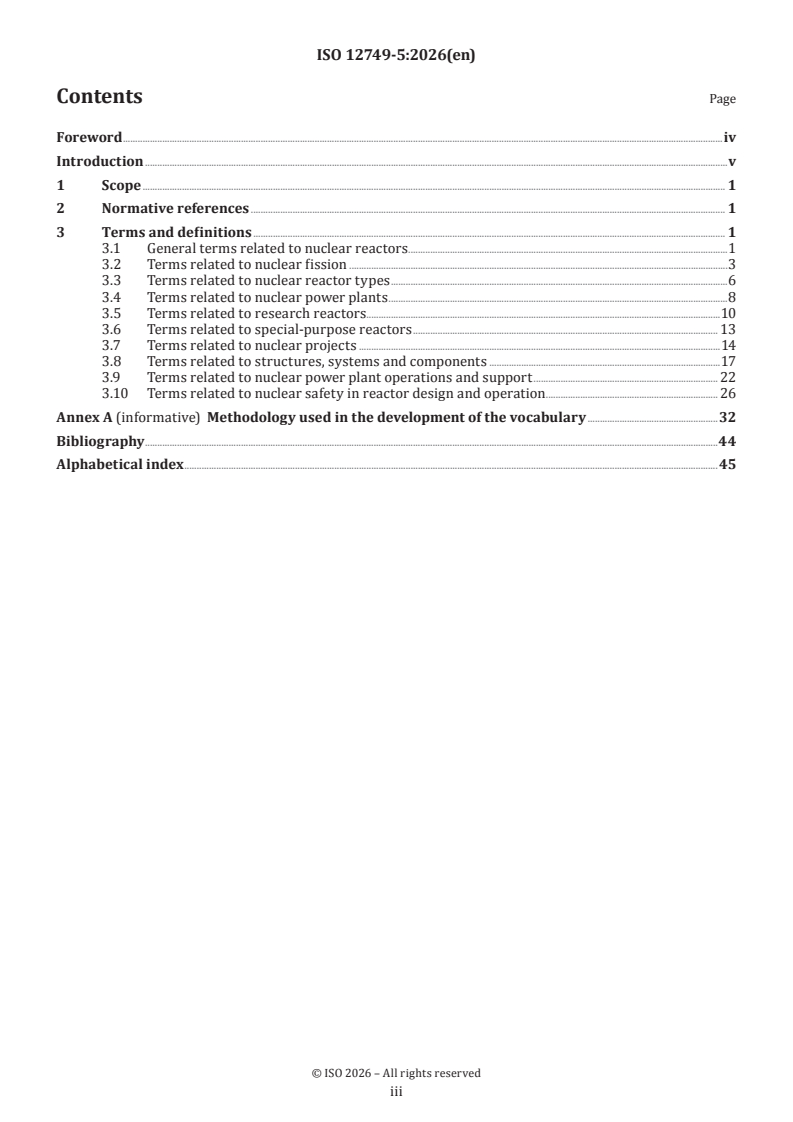
Contents Page
Foreword .iv
Introduction .v
1 Scope . 1
2 Normative references . 1
3 Terms and definitions . 1
3.1 General terms related to nuclear reactors .1
3.2 Terms related to nuclear fission .3
3.3 Terms related to nuclear reactor types .6
3.4 Terms related to nuclear power plants .8
3.5 Terms related to research reactors.10
3.6 Terms related to special-purpose reactors . 13
3.7 Terms related to nuclear projects .14
3.8 Terms related to structures, systems and components .17
3.9 Terms related to nuclear power plant operations and support . 22
3.10 Terms related to nuclear safety in reactor design and operation . 26
Annex A (informative) Methodology used in the development of the vocabulary .32
Bibliography .44
Alphabetical index .45
iii
Foreword
ISO (the International Organization for Standardization) is a worldwide federation of national standards
bodies (ISO member bodies). The work of preparing International Standards is normally carried out through
ISO technical committees. Each member body interested in a subject for which a technical committee
has been established has the right to be represented on that committee. International organizations,
governmental and non-governmental, in liaison with ISO, also take part in the work. ISO collaborates closely
with the International Electrotechnical Commission (IEC) on all matters of electrotechnical standardization.
The procedures used to develop this document and those intended for its further maintenance are described
in the ISO/IEC Directives, Part 1. In particular, the different approval criteria needed for the different types
of ISO documents should be noted. This document was drafted in accordance with the editorial rules of the
ISO/IEC Directives, Part 2 (see www.iso.org/directives).
ISO draws attention to the possibility that the implementation of this document may involve the use of (a)
patent(s). ISO takes no position concerning the evidence, validity or applicability of any claimed patent
rights in respect thereof. As of the date of publication of this document, ISO had not received notice of (a)
patent(s) which may be required to implement this document. However, implementers are cautioned that
this may not represent the latest information, which may be obtained from the patent database available at
www.iso.org/patents. ISO shall not be held responsible for identifying any or all such patent rights.
Any trade name used in this document is information given for the convenience of users and does not
constitute an endorsement.
For an explanation of the voluntary nature of standards, the meaning of ISO specific terms and expressions
related to conformity assessment, as well as information about ISO's adherence to the World Trade
Organization (WTO) principles in the Technical Barriers to Trade (TBT), see www.iso.org/iso/foreword.html.
This document was prepared by Technical Committee ISO/TC 85, Nuclear energy, nuclear technologies, and
radiological protection.
This second edition cancels and replaces the first edition (ISO 12749-5:2018), which has been technically
revised.
The main changes are as follows:
— the addition of the following sentence in the Scope: “The scope of this document does not cover nuclear
fusion reactors.”
— the updated of all the sources of the terminological entries.
— the addition of the heading “Terms related to nuclear fission”.
— the deletion of the heading “Terms related to multiple-purpose reactors”.
A list of all parts in the ISO 12749 series can be found on the ISO website.
Any feedback or questions on this document should be directed to the user’s national standards body. A
complete listing of these bodies can be found at www.iso.org/members.html.
iv
Introduction
This document provides terms and definitions for main concepts in the whole field of nuclear reactor
science, technology, engineering, projects and operations, excluding quantitative data. Terminological data
are taken from ISO standards developed by TC 85/SC 6, from other technically validated documents issued
by international organizations, especially IAEA and IEC, while several definitions have been drafted by
WG 1 experts based on their experience and after detailed discussions on concept characteristics, the best
wording for their designations and definitions, as well as the most important links between concepts.
In most cases, international consensus exists among the communities of nuclear reactor specialists world-
wide, on the most relevant concepts in the nuclear reactor field. Nevertheless, clear, and unambiguous terms
for these concepts are also needed.
The foregoing should also be considered together with the fact that many people are involved in the broad
nuclear reactor field, having different scopes and levels of scientific and technical knowledge, and frequently
having very specific activities within that broad field. Thus, there can be different understandings and
assumptions about concepts. Hence, the result could be a poor communication that might lead into
unexpected, different risky situations or consequences, if a conceptual difference is behind.
v
International Standard ISO 12749-5:2026(en)
Nuclear energy, nuclear technologies, and radiological
protection — Vocabulary —
Part 5:
Nuclear reactors
1 Scope
This document encompasses the collection of terms, definitions, notes to entry and examples corresponding
to nuclear reactors, excluding quantitative data. It provides the minimum essential information for
each nuclear reactor concept represented by a single term. Full understanding of concepts requires
background knowledge of the nuclear field. It is intended to facilitate communication and promote common
understanding.
The scope of this document does not cover nuclear fusion reactors.
NOTE See Annex A for the methodology used to develop the vocabulary.
2 Normative references
There are no normative references in this document.
3 Terms and definitions
For the purposes of this document, the following terms and definitions apply.
ISO and IEC maintain terminology databases for use in standardization at the following addresses:
— ISO Online browsing platform: available at https:// www .iso .org/ obp
— IEC Electropedia: available at https:// www .electropedia .org/
3.1 General terms related to nuclear reactors
3.1.1
nuclear installation
nuclear facility subject to authorization that is part of the nuclear fuel cycle, except facilities for the mining
or processing of uranium ores or thorium ores and disposal facilities for radioactive waste
[SOURCE: IAEA. IAEA Nuclear Safety and Security Glossary. Terminology Used in Nuclear Safety, Nuclear
Security, Radiation Protection and Emergency Preparedness and Response. Vienna: IAEA, 2022. 246 p. ISBN
978-92-0-141822-7]
3.1.2
nuclear reactor
special device having an inventory of nuclear fuel material containing fissionable nuclides (3.2.16) and,
depending on the technology, can have neutron moderating, neutron absorbing and cooling materials, all of
them geometrically arranged in a particular neutron multiplicative configuration (3.2.10) designed and built
for having the capability of initiating, maintaining and extinguishing a controlled, self-sustaining nuclear
fission (3.2.1) chain reaction, under adequate safety conditions
3.1.3
research reactor
nuclear reactor (3.1.2) used mainly for the generation and utilization of neutron flux and ionizing radiation
for research and other purposes
Note 1 to entry: Experimental facilities associated with the reactor and storage, handling and treatment facilities for
radioactive material on the same site, which are directly related to safe operation of the research reactor, are included.
Note 2 to entry: Facilities commonly known as critical assemblies are included.
[SOURCE: IAEA. IAEA Nuclear Safety and Security Glossary. Terminology Used in Nuclear Safety, Nuclear
Security, Radiation Protection and Emergency Preparedness and Response. Vienna: IAEA, 2022. 246 p. ISBN:
978-92-0-141822-7, modified. By splitting the definition into a definition and two notes to entry.]
3.1.4
nuclear power plant
NPP
nuclear reactor (3.1.2) installation with the main purpose of producing heat energy, converting it to
electricity, or both
Note 1 to entry: Nuclear power plant is a nuclear reactor (3.1.2) or reactors together with all structures (3.8.2), systems
and components (3.8.13) necessary for ensuring safe and secure operation in compliance with safeguards agreements
and for the production of power, i.e. heat or electricity.
3.1.5
nuclear island
part of the nuclear power plant (3.1.4) that consists of the containment (3.8.3), auxiliary and fuel buildings
3.1.5.1
reactor core
part of a nuclear reactor (3.1.2), where the fuel assemblies sustaining the fission chain are located
Note 1 to entry: In most cases, moderator (3.1.5.1.2) and coolant are also included in the reactor core.
3.1.5.1.1
core reflector
material placed around the reactor core (3.1.5.1), totally or partially enveloping it, in order to scatter most of
leaking neutrons back into the core, improving neutron economy
Note 1 to entry: Since most of nuclear reactors (3.1.2), have a preferred vertical cylinder geometry, they have three
different reflectors: upper axial, lower axial and radial.
Note 2 to entry: The most used materials as reflectors for slow or thermal neutrons (3.2.18), are H O (light or ordinary
water), D O (heavy water), Be (beryllium), C (carbon, graphite). The most used material for fast neutrons (3.2.19) is
stainless steel.
3.1.5.1.2
moderator
material that reduces neutron energy by scattering without appreciable capture
Note 1 to entry: Materials of prime concern are those containing light nuclei with large scattering cross sections and
relatively low absorption cross sections (e.g. water, hydrocarbons, polyethylene, oils and graphite).
3.1.5.2
reactor internals
any of the different structural parts inside the nuclear reactor (3.1.2), covering various functions, either as
part of the nuclear reactor itself or as part of reactor-associated systems
Note 1 to entry: Some of these functions are:
a) to direct inlet and outlet primary coolant (3.1.5.4) flow and its distribution among all reactor heat sources, similar
structure (3.8.2) for other fluids inside the reactor (like liquid moderator (3.1.5.1.2) and reflectors or both);
b) to provide in-core locations and protection for in-core instrumentation (3.8.5.1.1) and for elements and components
(3.8.13) related to reactivity (3.2.12);
c) to provide power control and safety shutdown.
3.1.5.3
reactor vessel
enveloping structure (3.8.2) for housing all parts of a reactor core (3.1.5.1) and supporting reactor internals
(3.1.5.2)
Note 1 to entry: Main parts usually allocated inside the reactor vessel, are as follows:
a) the reactor core (3.1.5.1) and its reflectors;
b) all structures (3.8.2) and tubes of reactor internals (3.1.5.2).
Note 2 to entry: The reactor vessel additionally serves as confining structure (3.8.2) for the primary coolant (3.1.5.4).
Moreover, depending on the reactor technology, this vessel is also part of a high-pressure boundary for the primary
coolant, mainly encompassing the reactor core (3.1.5.1).
3.1.5.4
primary coolant
fluid circulating through the reactor core (3.1.5.1), in order to extract the heat produced by the nuclear
fission reactions
Note 1 to entry: The primary coolant normally removes instantaneous fission and decay heat generated in the reactor
core (3.1.5.1) and can remove abnormal excessive heat. It circulates within the primary heat transport system (3.8.9)
and transfers all reactor thermal power to a final heat sink. Such thermal power transfer can be either “direct”, or
more usually “indirect”, by means of chained circuits circulating appropriate fluids, between the nuclear reactor
(3.1.2) and that final heat sink.
Note 2 to entry: The primary or main coolant is always a fluid and then it can be, either a liquid in single phase, or a
boiling two-phase fluid, or a gas. The most widely employed are:
a) liquid-state ordinary or light water (H O) at atmospheric or high pressure;
b) liquid-state heavy water (D O) at atmospheric or high pressure;
c) boiling H O at high pressure;
d) CO or He gases.
Note 3 to entry: The final heat sink usually can be either: the atmosphere, a river, a lake, a sea or an ocean. In a nuclear
power plant (3.1.4) one of such sinks shares its function with a turbine-generator (3.4.7) set, where part of the total
thermal power is converted to kinetic power and immediately to electric power.
Note 4 to entry: For molten salt reactors, a similar role to primary coolant is played by a fluid sometimes defined as
intermediate coolant.
3.2 Terms related to nuclear fission
3.2.1
nuclear fission
process by which a nucleus undergoes a partition in two, infrequently in three, main fission fragments,
releasing energy
Note 1 to entry: There are two types of nuclear fission: “spontaneous” fission and “induced” fission.
Note 2 to entry: The nucleus usually has a high mass number A, together with an intermediate or low average binding-
energy-per-nucleon; hence, an inherent instability exists, and the fission fragments are usually highly unstable.
Note 3 to entry: According to their capability for undergoing fission, a nucleus and its associated nuclide can be
qualified as fissionable or eventually fissile.
3.2.2
induced nuclear fission
nuclear fission (3.2.1) initiated by a nucleus when an external colliding particle is absorbed
Note 1 to entry: The absorption of the external colliding particle, usually a neutron, generates a strong increase in the
compound nucleus internal energy and, hence, increases the compound nucleus instability, favouring a large energy
release by means of nuclear fission (3.2.1).
3.2.3
spontaneous nuclear fission
nuclear fission (3.2.1) produced in a nucleus, having an inherent instability, that develops itself in a purely
stochastic way and without intervention of any external colliding particle
3.2.4
fissile nuclide
nuclide capable of undergoing fission by interaction with neutrons of any energy
Note 1 to entry: There is no fission energy threshold to undergo fission.
Note 2 to entry: The term is usually applied to fission predominantly with slow neutrons. The interpretation of “slow”
can vary but the properties of fissile nuclides are clearly distinct from other fissionable nuclides (3.2.16).
233 235 239 241
Note 3 to entry: Particular examples are U, U, Pu and Pu.
3.2.5
fertile nuclide
nuclide that becomes a fissile nuclide (3.2.4) after absorbing a neutron
238 239 240
Note 1 to entry: In practice, the main fertile nuclides are: U (producing the fissile Pu), Pu (producing the fissile
241 232 233
Pu) and Th (producing the fissile U), in all cases after the absorption of one neutron and the fast emission of
some gamma photons.
3.2.6
fission energy
energy released in the fission process, which is primarily in the form of the kinetic energy of the fission
fragments
3.2.7
fission product
radionuclide produced by nuclear fission (3.2.1)
[SOURCE: IAEA. IAEA Nuclear Safety and Security Glossary. Terminology Used in Nuclear Safety, Nuclear
Security, Radiation Protection and Emergency Preparedness and Response. Vienna: IAEA, 2022. 246 p. ISBN:
978-92-0-141822-7.]
3.2.8
delayed fission radiation
gamma, beta radiations or both, in certain cases also alpha radiations released in a stochastic way, from a
fission product (3.2.7)
Note 1 to entry: Every possible fission product decay has extremely diverse half-lives, covering the range around 0,1 s
up to more than a billion years.
Note 2 to entry: These “delayed” released gamma, beta and alpha radiations, after interactions with neighbouring
atoms, are mainly absorbed by the surrounding materials and then finally converted into heat: they are the source of
what is designated as decay-power or decay-heat or residual-heat.
3.2.9
delayed fission neutron
neutron emitted in few particular fission product (3.2.7) decays, typically with half-lives roughly in the range
0,1 s to 1 min, following initiation of a nuclear fission (3.2.1) process
Note 1 to entry: Such decay occurs between two energy levels of a fission product (3.2.7) namely precursor-favouring
a neutron release, hence, the emitted neutron will have a quite defined kinetic energy at its release, typically below
1 MeV.
Note 2 to entry: In a fission neutron population, since delayed neutrons have kinetic evolutions dictated by those rather
long periods, as compared to the extremely fast evolutions of prompt neutrons, the first ones provide an important
contribution to the kinetic control of that neutron population.
3.2.10
neutron multiplicative configuration
geometrical disposition of materials, one or more containing fissionable nuclides (3.2.16), the whole
configuration being capable of maintaining a multiplicative chain reaction of neutron-induced nuclear
fissions (3.2.2)
3.2.11
nuclear chain reaction
successive induced nuclear fissions (3.2.2) initiated by neutrons released, for the most part, from previous
fissions in fissionable nuclides (3.2.16)
Note 1 to entry: The free neutron population in a system is multiplied by fissions releasing several neutrons per fission,
compensating partially or totally, or exceeding the total neutron losses by capture and leakage from the system.
Note 2 to entry: A nuclear chain reaction can be initiated by a pre-existent small neutron population (like that resulting
from photoneutrons in particular materials for this purpose), or by neutrons released by spontaneous fissions, or by
a specific “neutron source” emitting neutrons that initiates its own repetition chain reaction, a fissionable nucleus
absorbs a neutron and fissions spontaneously, releasing additional neutrons.
3.2.12
reactivity
ρ
for a nuclear chain reacting medium:
ρ = (k – 1)/k
eff eff
where k (3.2.15) is the ratio between the number of fissions in two succeeding generations (later to earlier)
eff
of the chain reaction
Note 1 to entry: A measure of the deviation from criticality (3.2.15) of a nuclear chain reacting medium, such that
positive values correspond to a supercritical state and negative values correspond to a subcritical state.
[SOURCE: IAEA. IAEA Nuclear Safety and Security Glossary. Terminology Used in Nuclear Safety, Nuclear
Security, Radiation Protection and Emergency Preparedness and Response. Vienna: IAEA, 2022. 246 p. ISBN:
978-92-0-141822-7 (Retrieved: 4 July 2024)]
3.2.13
poison
substance used to reduce reactivity (3.2.12), typically in a reactor core (3.1.5.1), by virtue of its high neutron
absorption cross-section
[SOURCE: IAEA. IAEA Nuclear Safety and Security Glossary. Terminology Used in Nuclear Safety, Nuclear
Security, Radiation Protection and Emergency Preparedness and Response. Vienna: IAEA, 2022. 246 p. ISBN:
978-92-0-141822-7. (Retrieved: 4 July 2024)]
3.2.14
effective neutron multiplication factor
k
eff
ratio between current to previous generation of neutron population in multiplicative medium
Note 1 to entry: The total number of produced neutrons per unit time includes all prompt and delayed neutrons
released in fissions; while, the total number of lost neutrons are the sum of all absorbed neutrons (in fission and
capture reactions), plus all leaking neutrons escaping.
Note 2 to entry: There are three possible circumstances: a) k > 1: fission power increases in time; b) k = 1: fission
eff eff
power remains constant in time; c) k < 1: fission power decreases in time. When k > 1, system is called supercritical;
eff eff
when k = 1, system is called critical; and finally, when k < 1, then system is called subcritical
eff eff
3.2.15
criticality
state of a nuclear chain reacting medium when the nuclear chain reaction (3.2.11) is just self-sustaining or
critical, i.e. when the reactivity (3.2.12) is zero
[SOURCE: IAEA. IAEA Nuclear Safety and Security Glossary. Terminology Used in Nuclear Safety, Nuclear
Security, Radiation Protection and Emergency Preparedness and Response. Vienna: IAEA, 2022. 246 p. ISBN:
978-92-0-141822-7 (Retrieved: 4 July 2024)]
3.2.16
fissionable nuclide
nuclides that are capable of supporting a self-sustaining nuclear chain reaction (3.2.11) with neutrons of any
speed
[SOURCE: IAEA. IAEA Nuclear Safety and Security Glossary. Terminology Used in Nuclear Safety, Nuclear
Security, Radiation Protection and Emergency Preparedness and Response. Vienna: IAEA, 2022. 246 p. ISBN:
978-92-0-141822-7 (Retrieved: 4 July 2024)]
238 240
Note 1 to entry: Fissionable nuclides include U, Pu, and others with neutron-energy fission thresholds, in addition
to those nuclides that are fissile.
[SOURCE: LA-11627-MS, Glossary of Nuclear Criticality Terms. Los Alamos National Laboratory, 1989.]
3.2.17
prompt fission neutron
neutron emitted from a fission fragment in a stochastic way, with high kinetic-energy just following
initiation of a nuclear fission (3.2.1) process
Note 1 to entry: The number of prompt neutrons released per fission, is stochastic as indicated, with an average value
in the range 2,5 to 3 for most of concerned nuclides.
3.2.18
thermal neutron
neutron with a kinetic energy of about 0,025 eV, which is the energy corresponding to the most probable
speed of 2 000 m/s at 293 K
3.2.19
fast neutron
neutron with kinetic energy greater than 1 keV
Note 1 to entry: Neutrons with energy levels greater than 0,025 eV and up to 1 keV are termed epithermal or resonance
neutrons.
3.3 Terms related to nuclear reactor types
3.3.1
nuclear reactor
(See 3.1.2)
3.3.1.1
power reactor
nuclear reactor (3.1.2) designed to produce electrical power or propulsion
3.3.1.2
research reactor
(See 3.1.3)
3.3.1.3
special-purpose reactor
nuclear reactor (3.1.2) designed with a particular target
EXAMPLE Prototype reactors (3.6.1.3), demonstration reactors (3.6.1.2), naval propulsion reactors, desalination
reactors (3.6.1.5), material testing reactors (3.5.1.4), hydrogen production reactors.
3.3.1.4
breeder reactor
nuclear reactor (3.1.2) designed to produce more fissile nuclides (3.2.4) than it uses, having the conversion
ratio greater than one
Note 1 to entry: The conversion ratio (CR) or conversion coefficient measures the ability of a nuclear reactor (3.1.2) to
238 239
transfer a fertile nuclide (3.2.5), e.g., U, into a fissile (3.2.4), e.g., Pu.
[SOURCE: Koelzer, W. Glossary of Nuclear Terms. Germany, 2013]
3.3.1.5
converter reactor
nuclear reactor (3.1.2) designed to produce less fissile nuclides (3.2.4) than it uses, having a conversion ratio
smaller than one
3.3.1.6
transmutation reactor
nuclear reactor (3.1.2) designed for the purpose of eliminating partially the radioactive wastes contained in
other reactors spent nuclear fuel
3.3.1.7
fast reactor
nuclear reactor (3.1.2) designed and operated mainly using a predominantly fast neutron (3.2.19) energy
spectrum
Note 1 to entry: The main contribution to fission power typically from neutrons with energies above 100 keV.
3.3.1.8
thermal reactor
nuclear reactor (3.1.2) designed and operated using predominantly thermal neutron (3.2.18) reactions
Note 1 to entry: The main contribution to fission power typically from neutrons with energies below 1 eV.
3.3.1.9
gas cooled reactor
GCR
nuclear reactor (3.1.2) that uses gas as primary coolant (3.1.5.4)
Note 1 to entry: A gas cooled reactor can be either a gas-cooled thermal reactor (3.3.1.8) or a gas cooled fast reactor
(3.3.1.7).
Note 2 to entry: The gas is usually helium (He) or carbon dioxide (CO ).
3.3.1.10
light water reactor
LWR
nuclear thermal reactor (3.3.1.8) cooled and moderated by light water
3.3.1.11
heavy water reactor
nuclear thermal reactor (3.3.1.8) that uses heavy water as its moderator (3.1.5.1.2)
Note 1 to entry: Heavy water is a moderator and thus permits the use of unenriched uranium as fuel.
[SOURCE: NRC. Nuclear Regulatory Commission Glossary.http:// www .nrc .gov/ readig -rm/ basic -ref/ glossary
.html. (Retrieved 16 April 2025). modified. By adding “nuclear thermal” at the beginning of the definition
and splitting the definition into a definition and one note to entry.]
3.3.1.12
liquid metal reactor
liquid metal fast reactor
LMFR
nuclear reactor (3.1.2) using as coolant a liquid metal, like sodium, lead, or some alloy
3.3.1.13
boiling water reactor
BWR
nuclear reactor (3.1.2) with water as a coolant and as a moderator (3.1.5.1.2), boiling in the core
Note 1 to entry: In a boiling water reactor the generated heat is removed from the core by evaporation.
[SOURCE: Koelzer, W. & FORSCHUNGSZENTRUM KARLSRUHE GMBH TECHNIK UND UMWELT. Dictionary of
nuclear power. upd. ed.; Lexikon zur Kernenergie. Germany: N. p., 2011.]
3.3.1.14
pressurized water reactor
PWR
nuclear power reactor (3.3.1.1) with water as a coolant and as a moderator (3.1.5.1.2), sufficiently high
pressurized to remain liquid in the core
Note 1 to entry: In a boiling water reactor (3.3.1.13), the generated heat is removed from the core by evaporation.
[SOURCE: Koelzer, W. & FORSCHUNGSZENTRUM KARLSRUHE GMBH TECHNIK UND UMWELT. Dictionary of
nuclear power. upd. ed.; Lexikon zur Kernenergie. Germany: N. p., 2011.]
Note 2 to entry: Where water is uses as moderator (3.1.5.1.2) and as a coolant to remove heat from the core.
3.3.1.15
pressurized heavy water reactor
PHWR
nuclear thermal reactor (3.3.1.8) cooled and moderated by heavy water (D O), having a pressurized D O
2 2
coolant to be kept permanently in the liquid state
3.4 Terms related to nuclear power plants
3.4.1
nuclear power plant
NPP
(See 3.1.4)
3.4.1.1
single-unit nuclear power plant
single-unit NPP
nuclear power plant (3.1.4) having a single electric production line
3.4.1.2
multiple-unit nuclear power plant
multiple-unit NPP
nuclear power plant (3.1.4) having on a common site, two or more electric production lines
Note 1 to entry: The electricity generation can be either almost identical or different between them, though usually
sharing various support or auxiliary installations, systems, supplies or both.
3.4.2
reference unit power
maximum (electrical) power that could be maintained continuously throughout a prolonged period of
operation (3.9.1) under reference ambient conditions
Note 1 to entry: The power value is expressed in units of megawatt (electrical).
[SOURCE: IAEA. Glossary of terms in PRIS reports – PRIS: Power reactor information system. (Retrieved: 22
July, 2024), modified. By splitting the definition into a definition and a note to entry. https:// www .iaea .org/
PRIS/ Glossary .aspx. ]
3.4.3
energy availability factor
ratio of the energy that the available capacity could have produced during a specified period, to the energy
that the reference unit power (3.4.2) could have produced during the same period
[SOURCE: IAEA. Glossary of terms in PRIS reports – PRIS: Power reactor information system. (Retrieved: 22
July, 2024) https:// www .iaea .org/ PRIS/ Glossary .aspx.]
3.4.4
NPP unit
each unit represents a separate reactor (nuclear island (3.1.5) and BOP (3.4.5)) capable of being operated
Note 1 to entry: In the case of dual- or multi-unit plants, a unit can operate independently of the state of completion
or operating condition of any other units co-located on the same site but in different containment (3.8.3)/confinement
buildings, even though the units can have some shared or common systems.
[SOURCE: IAEA. Terms for describing advance nuclear power plants. IAEA Nuclear Energy Series No. NR-T-
1.19. Vienna: IAEA, 2023. 20p. ISBN 978-92-0-145923-7, modified by splitting the definition into a definition
and a note to entry.]
3.4.5
balance of plant
BOP
part of the nuclear power plant (3.1.4) that consists of a set of a main turbine generator (3.4.7) unit and all
associated systems, structures (3.8.2) and components (3.8.13) necessary to produce electric power
3.4.6
turbine island
part of the nuclear power plant (3.1.4) that consists of the turbine building
[SOURCE: IAEA. Construction technologies for nuclear power plants. IAEA Nuclear Energy Series No. NP-T-2.5.
Vienna: IAEA, 2011. 207 p. ISBN 978-92-0-119510-4]
3.4.7
turbine generator
equipment that produces electrical energy and which type is defined by the turbine-driving fluid
3.4.8
steam turbine balance of plant
steam turbine BOP
balance of plant (3.4.5) type that produces electric energy associated to a nuclear steam supply system (3.4.9)
3.4.9
nuclear steam supply system
NSSS
nuclear reactor (3.1.2) and all its associated systems, structures (3.8.2) and components (3.8.13), necessary
to reliably and safely produce steam at a suitable pressure to drive a steam turbine generator (3.4.10) unit
Note 1 to entry: The nuclear steam supply system can have different thermal power sources, such as PWR (3.3.1.14),
PHWR (3.3.1.15), BWR (3.3.1.13), GCR (3.3.1.9) and LMFR (3.3.1.12).
3.4.10
steam turbine generator
equipment in a BOP (3.4.5) that produces electrical energy, where the generator is driven by a steam turbine
supplied by a NSSS (3.4.9)
3.4.11
steam condenser
equipment in a steam turbine BOP (3.4.8), aimed at receiving the exhausting low-pressure turbine steam,
bringing this fluid into the liquid state by cooling
3.4.12
gas turbine balance of plant
gas turbine BOP
balance of plant (3.4.5) type that produces electric energy associated with a nuclear high temperature gas
supply system (3.4.13)
3.4.13
nuclear high temperature gas supply system
NHTGSS
nuclear reactor (3.1.2) and all its associated systems, structures (3.8.2) and components (3.8.13), necessary
to reliably and safely produce gas at high temperature and pressure to drive a gas turbine generator (3.4.14)
unit
Note 1 to entry: The nuclear high temperature gas supply system can have different thermal power sources, such as
GCR (3.3.1.9), LMFR (3.3.1.12) and GCFR.
3.4.14
gas turbine generator
equipment in a BOP (3.4.5) that produces electrical energy, where the generator is driven by a gas turbine
supplied by a NHTGSS (3.4.13)
3.4.15
gas cooler
equipment in a gas turbine BOP (3.4.12), aimed at lowering the gas temperature
Note 1 to entry: In a gas turbine BOP (3.4.12) the NHTGSS (3.4.13) feeds a gas turbine generator (3.4.14) that produces
electrical power. To make this possible, the heat that is not converted to electrical or mechanical power, is transferred
to the secondary cooling fluid.
3.4.16
nuclear island
(See 3.1.5)
3.5 Terms related to research reactors
3.5.1
research reactor
(See 3.1.3)
3.5.1.1
training and education reactor
type of nuclear reactor (3.1.2) dedicated to training students to operate, maintain, regulate, and improve
nuclear reactors and other facilities, aimed from training in very specific reactor concepts up to broad
education in the nuclear reactor field observing the nuclear fission (3.2.1) process and the interaction of
radiation with matter
Note 1 to entry: The application fields can be medical, biological, electronic, engineering, industrial as well as related
to specific reactor concepts or nuclear fuel cycle strategies services, technological developments, industrial production
purposes or both.
3.5.1.2
multiple-purpose reactor
nuclear reactor (3.1.2) designed to fulfil several main purposes together, providing different services, except
electric energy supply
EXAMPLE Reactors that produce radioisotopes, provide irradiation boxes and positions, irradiated material
studies, neutron beams for research and development work, and personnel training.
Note 1 to entry: The application fields can be medical, biological, electronic, engineering, industrial as well as related
to specific reactor concepts or nuclear fuel cycle strategies services, technological developments, industrial production
purposes or both.
3.5.1.3
radioisotope production reactor
nuclear reactor (3.1.2) aimed at producing radioisotopes for medical and industrial applications, by neutron
capture or fission reactions
Note 1 to entry: Usually, the “neutron transmutation doping” (3.5.3) is an application included in radioisotope
production reactors.
3.5.1.4
material testing reactor
nuclear reactor (3.1.2) aimed at irradiating materials, with the purpose of testing and qualifying the
behaviour of the irradiated materials
Note 1 to entry: The materials tested usually include nuclear fuels.
Note 2 to entry: Material testing reactor (MTR) is a generic name given to those reactors that use MTR fuel.
3.5.2
radioisotope production
activity to produce radioactive nuclides from neutron reactions occurring in the material contained in a
target that is being exposed to a neutron radiation field
3.5.3
neutron transmutation doping
technique that consists in the irradiation of a target material with a neutron flux, mostly thermal, in order to
produce dispersed impurities in the target material
Note 1 to entry: Main application is on silicon target, where the impurities produced are the dopants of the
semiconductor.
Note 2 to entry: Special care shall be taken regarding the uniformity of the distribution of the introduced dopants.
3.5.4
boron neutron capture therapy
BNCT
technique for radiation therapy based on B (n, alpha) reaction in cancer tissue or cell which, before the
neutron radiation, has absorbed a chemical compound containing B isotope
Note 1 to entry: Non-radioactive boron is added to pharmaceutical agents that are selective to be located in specific
tissues (tumour localizing drugs). Boron, more precisely the B isotope, has high cross section (that means high
probability) to absorb neutrons; therefore, a nuclear reaction is produced due to neutron capture by boron with its
resulting rupture into a lithium ion and an alpha particle. Both resulting particles have high energy and produce
ionization very close to the reaction point, destroying the tissue cells.
3.5.5
neutron activation analysis
NAA
technique of elemental analysis based on the identification and measurement of intrinsic radiation of nuclide
formed in sample material by neutron bombarding
3.5.5.1
prompt gamma-ray neutron activation analysis
PGAA
technique of elemental analysis based on the identification and measurement of intrinsic radiation emitting
from sample material by neutron continuously bombarding
Note 1 to entry: As a consequence of absorbing neutrons, a gamma ray is emitted by the sample in a very short time
(in comparison with the times for the gamma rays obtained in the neutron activation analysis (3.5.5)). The energy and
intensity of the measured peaks lead to determination of the isotopic composition.
Note 2 to entry: This is a technique useful for trace elements that cannot be well detected by neutron activation analysis
(3.5.5).
3.5.6
neutron diffraction technique
technique by which the study of the scattering of neutrons upon a target reveals information about the
structure of the target material
Note 1 to entry: In order that it is possible to study materials structure, the energy of the neutrons shall be in an
energy range so that their wavelength is comparable to the typical dimensions of the materials being studied. The cold
sources serve this purpose of taking the neutrons to some desired energy range for a variety of materials of interest.
Note 2 to entry: This technique is also available not only in research reactors (3.1.3) but in ad hoc research facilities
like neutron spallation sources.
Note 3 to entry: The technique has a variety of fields of application like, material science, molecular biology and
archaeology.
3.5.7
rod type fuel
pin type fuel
rod of nuclear fuel, comprising a cylindrical tube (cladding) containing an assembly of fuel pellets (typically
UO ) sealed both ends to form a structural unit
Note 1 to entry: In light water reactors “fuel rod (FR)” is used as “rod type fuel”.
SOURCE: IAEA. IAEA Nuclear Safety and Security Glossary. Terminology Used in Nuclear Safety, Nuclear
Security, Radiation Protection and Emergency Preparedness and Response. Vienna: IAEA, 2022. 246 p. ISBN:
978-92-0-141822-7.]
3.5.8
fuel assembly
FA
fuel bundle
set of fuel elements and associated components (3.8.13) which are loaded into and subsequently removed
from a reactor core (3.1.5.1) as a single unit
[SOURCE: IAEA. IAEA Nuclear Safety and Security Glossary. Terminology Used in Nuclear Safety, Nuclear
Security, Radiation Protection and Emergency Preparedness and Response. Vienna: IAEA, 2022. 246 p. ISBN:
978-92-0-141822-7.]
Note 1 to entry: In light water reactors (3.3.1.10) “fuel elements” in the definition should be replaced with “fuel rods”.
Note 2 to entry: In some countries “fuel element” is used as a synonym for “fuel assembly”.
Note 3 to entry: In some countries “fuel bundle” is used as a synonym for “fuel assembly”.
3.5.8.1
annular fuel assembly
fuel assembly (3.5.8) that consists of annular fuel rods, which are clad in their inner and outer surfaces, and
associated components (3.8.13) necessary to form a structural unit
3.6 Terms related to special-purpose reactors
3.6.1
special-purpose reactor
(See 3.3.1.3)
3.6.1.1
zero-power reactor
special-purpose reactor (3.3.1.3) with a negligible thermal power, behaving as an almost identical copy, in its
neutron parameters, of some reference reactor core (3.1.5.1) design
Note 1 to entry: “Critical facility”, “critical mock-up” and “neutronic maquette” are all possible alternative designations
of the same concept.
Note 2 to entry: Zero-power reactors are generally built to assess a novel core design for a power reactor (3.3.1.1),
adequately reproducing the materials and geometry of the designed core.
3.6.1.2
demonstration reactor
special-purpose reactor (3.3.1.3) aimed at characterizing a novel nuclear reactor (3.1.2) design, reproducing
its most relevant and distinctive features and its main nuclear, process system (3.8.10)and safety systems
(3.8.7)
Note 1 to entry: Demonstration reactors should be able to operate in a range of parameters allowing the validation of
the design in the novel features. Usually, their reactor power is scaled down to a fraction of the foreseen power output,
optimizing the investment needs.
Note 2 to entry: The design to be assessed by a demonstration reactor is generally an innovative power reactor (3.3.1.1)
design that is planned for future commercial deployment.
3.6.1.3
prototype reactor
special-purpose reactor (3.3.1.3) aimed at characterizing and qualifying a novel nuclear reactor (3.1.2) design,
reproducing the design of a future series of nuclear reactors, though usually with additional capabilities,
margins and instrumentation and control devices
Note 1 to entry: The design to be qualified by a prototype reactor is generally an innovative power reactor (3.3.1.1)
design that is planned for commercial deployment.
Note 2 to entry: Additional instrumentation allows performance of additional engineering and qualification tests
during commissioning, and during operation (3.9.1).
Note 3 to entry: Prototype reactors can be scaled to a fraction of the foreseen power output through a detailed
similarity analysis and can lack auxiliary systems that are not related to reactor perf
...