

ISO 55011:2024
(Main)Asset management — Guidance for the development of public policy to enable asset management
General Information
- Abstract
This document provides guidance to advance the adoption of asset management through public policy, specifically focused on the external context of all organizations that manage assets. This guidance defines and describes an enabling environment for asset management, and outlines how it can be created, sustained and improved through the use of public policy (see Clause 4). It outlines how participants in that environment can act and interact with one another to influence the development and deployment of public policies to enable asset management in their countries and jurisdictions (see Annexes A and B). This document provides a consistent approach (see Annexes C and D) to the development of public policy instruments (see 5.2.1) that enable asset management and help achieve government objectives. These can include implementing a framework of recommended practices for effective public investment (see Table 1), achieving the United Nations Sustainable Development Goals (UN SDGs), and otherwise generating greater value to society.
- Status
- Published
- Publication Date
- 12-Aug-2024
- Technical Committee
- ISO/TC 251 - Asset management
- Drafting Committee
- ISO/TC 251/WG 7 - Development of ISO 55011
- Current Stage
- 6060 - International Standard published
- Start Date
- 13-Aug-2024
- Due Date
- 09-Jul-2024
- Completion Date
- 13-Aug-2024
Buy Documents



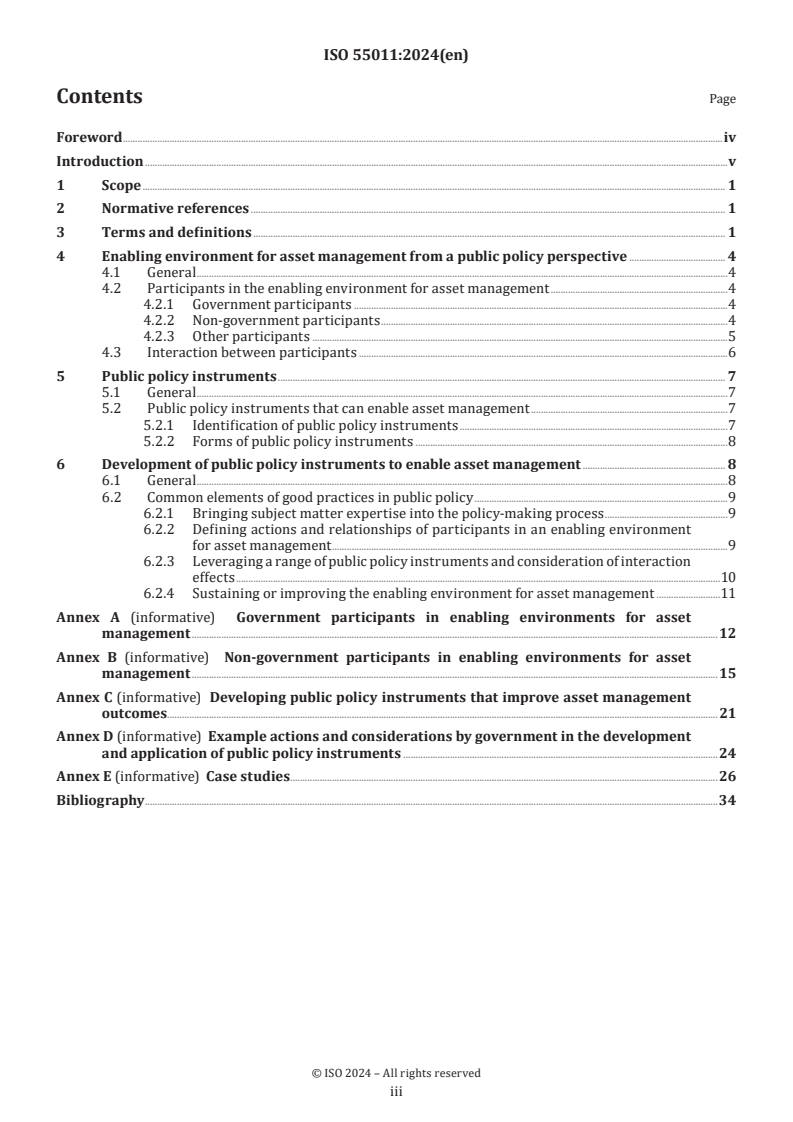
ISO 55011:2024 - Asset management — Guidance for the development of public policy to enable asset management Released:13. 08. 2024

ISO 55011:2024 - Gestion d'actifs — Orientations pour le développement de politiques publiques pour favoriser la gestion d'actifs Released:13. 08. 2024
Overview
ISO 55011:2024 - Asset management - Guidance for the development of public policy to enable asset management - provides practical guidance for governments and stakeholders to create an enabling environment that advances asset management across organizations. The standard focuses on the external context that shapes how asset-owning and operating organizations perform, and describes how public policy instruments can be developed, deployed and sustained to improve national and subnational asset management outcomes.
Key topics
- Enabling environment for asset management: definition and description of the conditions, participants and interactions that support broad adoption of asset management.
- Participants and interactions: roles of government participants, non-government participants and other actors who influence policy and implementation (see Annexes A and B).
- Public policy instruments: identification and forms of policy instruments that can enable asset management (Clause 5; see 5.2.1).
- Policy development practices: recommended practices for designing and applying policy instruments, including bringing subject-matter expertise into policymaking, defining participant actions and relationships, leveraging multiple instruments and managing interaction effects (Clause 6 and Annexes C–D).
- Outcomes and benefits: expected benefits such as better use of financial and non-financial resources, improved decision-making across asset life cycles, alignment with governmental objectives, risk reduction, and contribution to the UN Sustainable Development Goals (Introduction and 0.5).
- Supporting materials: informative annexes and case studies that illustrate real-world application and implementation approaches (Annexes A–E).
Practical applications
ISO 55011:2024 is intended for anyone involved in policy formulation or influence related to public assets and infrastructure:
- Government officials and policy advisors designing legislation, regulations, frameworks for public investment and infrastructure governance.
- Regulators and procurement bodies that set expectations for asset performance, reporting and stewardship.
- Asset owners and operators (public and private) who need alignment with national policy and consistent practices.
- Standards bodies, industry associations and consultants that support capacity building, competency programs and verification schemes.
- Stakeholders aiming to achieve UN SDGs or improve public service delivery through improved asset outcomes.
Using ISO 55011 helps align public policy with asset management best practices to deliver value to taxpayers, improve transparency and make long‑term, resilient decisions about public assets.
Related standards
- ISO 55000 - Overview and principles of asset management
- ISO 55001 - Asset management system - Requirements
- ISO 55002 - Guidance on ISO 55001 application
- ISO/TS 55010, ISO 55012, ISO 55013 - Supplementary guidance in the ISO 55000 family
Keywords: ISO 55011:2024, asset management, public policy, enabling environment, public investment, UN SDGs, asset management standards.
Buy Documents
ISO 55011:2024 - Asset management — Guidance for the development of public policy to enable asset management Released:13. 08. 2024
ISO 55011:2024 - Gestion d'actifs — Orientations pour le développement de politiques publiques pour favoriser la gestion d'actifs Released:13. 08. 2024
Get Certified
Connect with accredited certification bodies for this standard

BSI Group
BSI (British Standards Institution) is the business standards company that helps organizations make excellence a habit.

Bureau Veritas
Bureau Veritas is a world leader in laboratory testing, inspection and certification services.

DNV
DNV is an independent assurance and risk management provider.
Sponsored listings
Frequently Asked Questions
ISO 55011:2024 is a standard published by the International Organization for Standardization (ISO). Its full title is "Asset management — Guidance for the development of public policy to enable asset management". This standard covers: This document provides guidance to advance the adoption of asset management through public policy, specifically focused on the external context of all organizations that manage assets. This guidance defines and describes an enabling environment for asset management, and outlines how it can be created, sustained and improved through the use of public policy (see Clause 4). It outlines how participants in that environment can act and interact with one another to influence the development and deployment of public policies to enable asset management in their countries and jurisdictions (see Annexes A and B). This document provides a consistent approach (see Annexes C and D) to the development of public policy instruments (see 5.2.1) that enable asset management and help achieve government objectives. These can include implementing a framework of recommended practices for effective public investment (see Table 1), achieving the United Nations Sustainable Development Goals (UN SDGs), and otherwise generating greater value to society.
This document provides guidance to advance the adoption of asset management through public policy, specifically focused on the external context of all organizations that manage assets. This guidance defines and describes an enabling environment for asset management, and outlines how it can be created, sustained and improved through the use of public policy (see Clause 4). It outlines how participants in that environment can act and interact with one another to influence the development and deployment of public policies to enable asset management in their countries and jurisdictions (see Annexes A and B). This document provides a consistent approach (see Annexes C and D) to the development of public policy instruments (see 5.2.1) that enable asset management and help achieve government objectives. These can include implementing a framework of recommended practices for effective public investment (see Table 1), achieving the United Nations Sustainable Development Goals (UN SDGs), and otherwise generating greater value to society.
ISO 55011:2024 is classified under the following ICS (International Classification for Standards) categories: 03.100.01 - Company organization and management in general. The ICS classification helps identify the subject area and facilitates finding related standards.
ISO 55011:2024 is available in PDF format for immediate download after purchase. The document can be added to your cart and obtained through the secure checkout process. Digital delivery ensures instant access to the complete standard document.
Standards Content (Sample)
SLOVENSKI STANDARD
01-oktober-2024
Obvladovanje premoženja - Napotki za razvoj javne politike za omogočanje
obvladovanja premoženja
Asset management — Guidance for the development of public policy to enable asset
management
Titre manque
Ta slovenski standard je istoveten z: ISO 55011:2024
ICS:
03.100.10 Nabava. Dobava. Logistika Purchasing. Procurement.
Logistics
2003-01.Slovenski inštitut za standardizacijo. Razmnoževanje celote ali delov tega standarda ni dovoljeno.
International
Standard
ISO 55011
First edition
Asset management — Guidance for
2024-08
the development of public policy to
enable asset management
Gestion d'actifs — Orientations pour le développement de
politiques publiques pour favoriser la gestion d'actifs
Reference number
© ISO 2024
All rights reserved. Unless otherwise specified, or required in the context of its implementation, no part of this publication may
be reproduced or utilized otherwise in any form or by any means, electronic or mechanical, including photocopying, or posting on
the internet or an intranet, without prior written permission. Permission can be requested from either ISO at the address below
or ISO’s member body in the country of the requester.
ISO copyright office
CP 401 • Ch. de Blandonnet 8
CH-1214 Vernier, Geneva
Phone: +41 22 749 01 11
Email: copyright@iso.org
Website: www.iso.org
Published in Switzerland
ii
Contents Page
Foreword .iv
Introduction .v
1 Scope . 1
2 Normative references . 1
3 Terms and definitions . 1
4 Enabling environment for asset management from a public policy perspective . 4
4.1 General .4
4.2 Participants in the enabling environment for asset management .4
4.2.1 Government participants .4
4.2.2 Non-government participants .4
4.2.3 Other participants .5
4.3 Interaction between participants .6
5 Public policy instruments . 7
5.1 General .7
5.2 Public policy instruments that can enable asset management .7
5.2.1 Identification of public policy instruments .7
5.2.2 Forms of public policy instruments .8
6 Development of public policy instruments to enable asset management . 8
6.1 General .8
6.2 Common elements of good practices in public policy .9
6.2.1 Bringing subject matter expertise into the policy-making process .9
6.2.2 Defining actions and relationships of participants in an enabling environment
for asset management .9
6.2.3 Leveraging a range of public policy instruments and consideration of interaction
effects .10
6.2.4 Sustaining or improving the enabling environment for asset management .11
Annex A (informative) Government participants in enabling environments for asset
management .12
Annex B (informative) Non-government participants in enabling environments for asset
management .15
Annex C (informative) Developing public policy instruments that improve asset management
outcomes . .21
Annex D (informative) Example actions and considerations by government in the development
and application of public policy instruments .24
Annex E (informative) Case studies .26
Bibliography .34
iii
Foreword
ISO (the International Organization for Standardization) is a worldwide federation of national standards
bodies (ISO member bodies). The work of preparing International Standards is normally carried out through
ISO technical committees. Each member body interested in a subject for which a technical committee
has been established has the right to be represented on that committee. International organizations,
governmental and non-governmental, in liaison with ISO, also take part in the work. ISO collaborates closely
with the International Electrotechnical Commission (IEC) on all matters of electrotechnical standardization.
The procedures used to develop this document and those intended for its further maintenance are described
in the ISO/IEC Directives, Part 1. In particular, the different approval criteria needed for the different types
of ISO document should be noted. This document was drafted in accordance with the editorial rules of the
ISO/IEC Directives, Part 2 (see www.iso.org/directives).
ISO draws attention to the possibility that the implementation of this document may involve the use of (a)
patent(s). ISO takes no position concerning the evidence, validity or applicability of any claimed patent
rights in respect thereof. As of the date of publication of this document, ISO had not received notice of (a)
patent(s) which may be required to implement this document. However, implementers are cautioned that
this may not represent the latest information, which may be obtained from the patent database available at
www.iso.org/patents. ISO shall not be held responsible for identifying any or all such patent rights.
Any trade name used in this document is information given for the convenience of users and does not
constitute an endorsement.
For an explanation of the voluntary nature of standards, the meaning of ISO specific terms and expressions
related to conformity assessment, as well as information about ISO’s adherence to the World Trade
Organization (WTO) principles in the Technical Barriers to Trade (TBT), see www.iso.org/iso/foreword.html.
This document was prepared by Technical Committee ISO/TC 251, Asset management.
Any feedback or questions on this document should be directed to the user’s national standards body. A
complete listing of these bodies can be found at www.iso.org/members.html.
iv
Introduction
0.1 Purpose
This document provides guidance to advance the adoption of asset management through public policy,
specifically focused on the external context of all organizations that manage assets.
This guidance defines and describes an enabling environment for asset management, and outlines how it
can be created, sustained and improved through the use of public policy (see Clause 4).
It outlines how participants in that environment can act and interact with one another to influence
the development and deployment of public policies to enable asset management in their countries and
jurisdictions (see Annexes A and B).
This document provides a consistent approach (see Annexes C and D) to the development of public policy
instruments (see 5.2.1) that enable asset management and help achieve government objectives. These can
include implementing a framework of recommended practices for effective public investment (see Table 1),
achieving the United Nations Sustainable Development Goals (UN SDGs), and otherwise generating greater
value to society.
0.2 Relationship with other standards
ISO 55000 provides context for the standards on asset management developed by ISO/TC 251 (e.g. ISO 55001,
ISO 55002, ISO/TS 55010, this document, ISO 55012 and ISO 55013).
ISO 55001 specifies requirements for an organizational “asset management system” and ISO 55002 gives
guidance to an organization on the application of ISO 55001.
All concepts, terms and definitions in the above standards are written from the perspective of each
individual organization. From this perspective, this document relates to the external context within which
an organization operates and which is created by conditions established by its external influencers.
This document is written from a broader perspective and recognizes that many different individuals and
organizations (“participants”) are involved in advancing the adoption of asset management in their respective
countries and jurisdictions. It is intended to positively shape the external context of all organizations, rather
than any single organization, through the development, or influencing the development, of supportive public
policies.
0.3 Target audience
This document is intended for those individuals and organizations that want, and are able, to advance and
support the adoption of asset management in their respective countries or jurisdictions through public
policy. This document acknowledges government officials as the primary participants in the public policy
process and recognizes other participants who can be involved in that process. Secondary users are intended
to be individuals and organizations that want to advance and support the adoption of asset management and
who are seeking guidance on how to do so.
NOTE 1 This guidance is relevant to all levels of government. The target audience includes government and other
officials who recognize the benefits of asset management and would like, and are able, to advance asset management
through their work. These individuals can include those who:
— advise on public policy;
— implement public policy;
— issue implementing agency guidance;
— issue executive guidance;
— issue final regulations;
— submit proposed legislation or regulations;
v
— approve proposed legislation or regulations;
— pass legislation;
— are involved in the development of legislation, policy, reporting and control frameworks, including audits;
— influence policy-makers who can mandate asset management and/or support the adoption and allocation of
resources;
— set strategic direction for public policy.
NOTE 2 The target audience can also include non-government individuals and organizations who recognize the
benefits of asset management and would like, and are able, to influence the public policy formulation processes used
by governments as well as the standards development processes used by non-government standards bodies for
advancing asset management.
0.4 Document structure
The document structure is as follows:
— Clause 4 describes the context in which relevant participants in the policy-making process can use public
policy instruments to achieve asset management outcomes.
— Clause 5 identifies the public policy instruments deployed by governments to enable asset management.
— Clause 6 sets out recommended practices for effective public investment, how public policy instruments
can be developed to enable asset management, and elements of good practice.
— Annexes A to E provide details on government and non-government participants, potential behaviours
and actions they can take to enable asset management. They document case studies based on global best
practices demonstrating the development and application of public policy instruments that enable asset
management.
0.5 Benefits of this document
0.5.1 General
The benefits of asset management to individual organizations are described in ISO 55000.
Adoption of this document can facilitate the creation and improvement of an enabling environment, which
in turn can improve the overall maturity of asset management within businesses, organizations and
nationally across countries. From a broader perspective, this can help achieve governmental objectives such
as providing improved public services, infrastructure that supports the desired level for service and safer
public infrastructure at all levels of government, improving the country’s competitiveness in trade with
other countries, assuring that taxpayers get a better return on their taxes, and being more responsive to
societal well-being.
The benefits of adopting this document are outlined in 0.5.2 and 0.5.3.
The benefits of supporting the adoption of asset management for government and non-government
participants are described in more detail in Annexes A and B, respectively.
0.5.2 Benefits of a consistent approach
An effective enabling environment for asset management should result in the broad adoption of a consistent
approach to asset management across the organizations that own, operate or are otherwise responsible for
assets within a country or jurisdiction. Adopting a consistent approach has its own benefits, which include:
a) using consistent terminology to discuss asset management and common processes to create asset
management systems;
b) having agreed minimum datasets that:
1) reduce duplication of effort by asset owners when providing minimum consistent elements for
different jurisdictions;
vi
2) enable alignment and closer collaboration, and facilitate dialogue between jurisdictions,
associations and regulators;
c) creating a community of practice with common objectives and common understandings to promote
better performance outcomes both internal and external to organizations;
d) alignment with validation and verification programmes or schemes;
e) alignment with competency improvement programmes to demonstrate asset management proficiency
among practitioners;
f) providing stakeholders with an understanding of the benefits of a consistent and national approach to
asset management within government and non-government organizations.
0.5.3 Beneficial outcomes of adopting this document
When an enabling environment for asset management is successfully realized, the expected outcomes or
benefits include, but are not limited to, the following:
a) better use of financial and non-financial resources, including:
1) enabling greater resource efficiency (e.g. from energy, water, materials, land and labour), while
reducing environmental impacts and sustaining service delivery;
2) contributing to a better use of finances, ensuring quality services with an acceptable return on
investment and a predictable life cycle cost;
3) facilitating the identification of the human resources that will be required to operate the assets and
their enablers, their competencies and the scheduling of their induction;
4) providing an understanding/identification of the financial resources required to build capacity in
asset management;
b) consideration of the needs and expectations of stakeholders and citizens, by providing effective services;
c) alignment of government objectives, at different levels of administration and in public service providers,
contributing to the achievement of national or subnational objectives;
d) improved decision-making over the long term, including those:
1) that reduce the risks of inefficient use of funding from taxpayers and other funding providers;
2) taken over the entire life cycle of the assets, allowing optimization of the total life cycle cost, through
the cost-risk performance analysis;
3) that consider the impacts of climate change and the need for climate-resilient assets;
e) fostering research and innovation partnerships;
f) maximization of value delivered to society by national and/or subnational assets;
g) continued improvement of the services provided by the state or non-government service providers;
h) improved transparency and accountability of government decisions and associated actions, as
appropriate, which can build trust and credibility within communities of agencies tasked with managing
critical infrastructure;
i) ability to promote, interact with and meet the requirements of other policy objectives, such as the UN SDGs;
j) effective risk management, which can lead to:
1) reduced financial loss, improved safety, goodwill and reputation, and minimizing environmental
and social impacts;
2) reduced liabilities for insurance premiums, fines, penalties, etc.;
vii
3) build resilience, better response and continuity of service;
k) demonstrated social responsibility, which can:
1) improve the organization’s ability to reduce emissions, conserve resources and adapt to climate change;
2) enable the organization to demonstrate social responsibility and ethical business practices,
and where applicable, meet requirements under environmental, social and governance (ESG)
obligations;
3) create safer communities.
See Annex E for example case studies demonstrating how benefits can be achieved by using the approaches
and practices identified in this document.
viii
International Standard ISO 55011:2024(en)
Asset management — Guidance for the development of public
policy to enable asset management
1 Scope
This document gives guidance on establishing, sustaining and improving an enabling environment for asset
management through public policy.
This document is applicable to all types and levels of government.
While ISO 55000, ISO 55001 and ISO 55002 make reference to organizational policy, this document refers
to public policy. The focus of this document is on influencing the choice and development of public policy
instruments that promote the adoption of asset management and use of asset management systems through
ISO 55001 and ISO 55002.
NOTE This document is intended to provide guidance on the development and application of policy instruments
based on international best practices. It is not intended to provide guidance on general public policy-making or on
political issues.
2 Normative references
The following documents are referred to in the text in such a way that some or all of their content constitutes
requirements of this document. For dated references, only the edition cited applies. For undated references,
the latest edition of the referenced document (including any amendments) applies.
ISO 55000, Asset management — Vocabulary, overview and principles
3 Terms and definitions
For the purposes of this document, the terms and definitions given in ISO 55000 and the following apply.
ISO and IEC maintain terminology databases for use in standardization at the following addresses:
— ISO Online browsing platform: available at https:// www .iso .org/ obp
— IEC Electropedia: available at https:// www .electropedia .org/
3.1
capacity building
provision of relevant competencies, skills, knowledge, experience, and the associated funding, technology
and other resources that enable individuals or organizations to accomplish new tasks to achieve asset
management objectives
[24]
[SOURCE: Federation of Canadian Municipalities, 2019 , p.19, modified — “provision” replaced “acquisition”
and “and the associated funding, technology and other resources” and “to achieve asset management
objectives” added.]
3.2
enabling environment for asset management
set of circumstances, objects or conditions, external to organizations managing the assets, that positively
affect their adoption of asset management and the achievement of government (3.4) objectives
Note 1 to entry: Enabling environments for asset management are unique to different countries or regions and can
be unique to different geographic areas within a country. Examples of conditions can include physical conditions (e.g.
natural resources) or non-physical conditions (e.g. legal, bureaucratic, fiscal, informational, political, cultural).
Note 2 to entry: Commonly agreed upon aspects of the enabling environment for asset management typically fit into
five categories: economic, political, administrative, socio-cultural and resources. These factors provide the context
for incentives and opportunities in the achievement of government objectives (including through asset management).
For example, economic factors including the funding of physical infrastructure or administrative actions can include
creating incentives for performance.
Note 3 to entry: Public policies (3.7) are developed and issued by different levels of government, each of which can have
its own enabling environment for asset management consisting of varying conditions.
Note 4 to entry: This document focuses on the conditions in the external context created by the contribution, interests
and demands of non-government participants, and the strategic directions of government participants which can be
modified by public policies.
[12] [40]
[SOURCE: Amjad et al. 2015 ; Ojomo 2016 , modified]
3.3
governance
system of directing and controlling
[SOURCE: ISO/IEC TR 29110-5-3:2018, 3.12]
3.4
government
act of, or responsibility for, managing, governing and promoting the development of a jurisdiction, including
responsibilities for the definition, design, development and institutionalization of public policies (3.7)
expressed in the provision of products and services to its stakeholders
Note 1 to entry: Government can refer to the act of governing, as well as to the institutions (e.g. agencies or
organizations) responsible for governing.
Note 2 to entry: The term “government” refers to all levels of government.
Note 3 to entry: The term “government” is usually used to designate the highest instance of executive administration
(the power of the state that, according to the constitution of a country, has the attribution of governing the people and
administering public interests, faithfully complying with legal ordinances), generally recognized as the leadership of a
state (any sovereign country, with its own politically organized structure, as well as designating the set of institutions
that control and administer a nation) or a nation. States can have several levels or spheres of government, depending
on the political organization of that country, such as local or municipal, regional or state governments, and national or
federal.
3.5
local government
organization that is responsible for the governance (3.3) of a local area and for providing services, etc.
Note 1 to entry: Local government can be a level of subnational government (3.13) in non-federal countries and a sub-
regional level of government (3.4) in federal countries.
Note 2 to entry: The terms “regions” and “local” can also refer more generically to subnational territories with specific
socio-economic or territorial characteristics that can, but not always, correspond to administrative or political units.
3.6
public investment
investment spending by the government (3.4) on physical infrastructure (e.g. roads, public buildings) and
intangible infrastructure (e.g. human capital development, innovation, research and development) with a
long-term productive life
Note 1 to entry: Statistics generally capture direct public investment as measured by gross fixed capital formation.
3.7
public policy
principled guide to a course of actions taken by the government (3.4) as a response to a perceived need,
formulated by a specific political process, and adopted, implemented and enforced by a specific public
agency that expects results
Note 1 to entry: Public policy is different from the term “policy” used in ISO 55000. In ISO 55000, “top management”
issues policies that provide intention and direction of the organization. In this document, government organizations
issue public policies that typically provide a “principled guide” to be followed by various organizations within their
jurisdictions. Examples of public policy in this context that enable asset management include those given in 6.2.
3.8
public policy instrument
intervention made by the government (3.4) which is intended to support the achievement of public policy
objectives (3.10)
Note 1 to entry: See Figure 1, 5.2.1 and Annex C for examples.
3.9
public policy-maker
representative of the government (3.4) who is responsible for developing, administering or influencing public
policies (3.7)
Note 1 to entry: A public policy-maker is not necessarily responsible for implementing public policies.
Note 2 to entry: Public policy-makers can include regulators, elected officials (e.g. politicians) and their delegates, and
public administrators.
3.10
public policy objectives
result to be achieved by a public policy (3.7)
3.11
public policy process
set of interrelated or interacting activities through which a public policy (3.7) is formed, implemented and
evaluated
3.12
service delivery
act of providing a service to customers
3.13
subnational government
level of government (3.4) below national (regional and local) governments
Note 1 to entry: “Regional government” or “region” refers to the level of government immediately below the national
level in federal countries (i.e. federated states) or in unitary countries (with a specific regional level).
4 Enabling environment for asset management from a public policy perspective
4.1 General
The successful implementation of asset management in any organization is influenced by the organization’s
internal and external contexts. These contexts are described in ISO 55000, ISO 55001 and ISO 55002, and
include a variety of conditions such as economic, political, administrative and socio-cultural conditions,
and resources. This document focuses on organizations’ external contexts and a subset of conditions that
contribute, through public policy, to the successful implementation of asset management and in turn,
government objectives (e.g. UN SDGs). This relationship is illustrated in Figure 1.
Success in creating and maintaining the enabling environment for asset management in political jurisdictions
depends on the creation of appropriate public policies with a level of consensus that allows them to be
sustained over time. This document provides guidance on the choice, development and deployment of public
policy instruments (see Clauses 5 and 6 for details). It outlines considerations and actions that can be taken
by government and non-government participants to achieve government objectives and ultimately deliver
greater value to society.
The guidance in this document recognizes governments as the primary actors in the formation of public
policy. However, non-government actors with an interest and expertise in asset management also have a role
to play in the policy-making process. Those involved in the development, implementation or improvement
of public policy to create or improve the enabling environment for asset management are referred to as
“participants” in this document.
The enabling environment for asset management is formed from the interactions of government and non-
government participants, outlined conditions, and the legal, regulatory and policy frameworks (including
public policy instruments). The enabling environment for asset management is dynamic and changes
constantly in response to the actions of its participants.
To create an enabling environment for asset management through public policy, its participants should act
and interact with one another in ways that positively support and advance the adoption of asset management
within their political jurisdictions. The participants in the enabling environment for asset management
are grouped by type and described in 4.2 according to the ways in which they can enable the adoption of
asset management through public policies. Annexes A and B provide examples of participant actions and
behaviours in an enabling environment for asset management.
4.2 Participants in the enabling environment for asset management
4.2.1 Government participants
Government organizations and officials, at all levels of government and regulatory agencies, are the most
significant participants in developing and improving public policies. They generally have the authority to
develop and improve public policy, for example, through the creation of formal rules, delegations, mandates,
inducements and capacity building that directly affect the outcomes of the enabling environment for asset
management. These participants, however, do not necessarily have the asset management expertise that
exists in asset owning or managing organizations, or in organizations that promote asset management.
Annex A describes different government participants in the enabling environment for asset management
and ways they can support asset management through public policy.
4.2.2 Non-government participants
Non-government participants in the enabling environment can promote asset management through
public policy by engaging with government agencies and officials in the development of their public policy
instruments. Non-government participants can include asset owners, asset management advocacy groups,
industry organizations and individuals that support asset owners or operators, professional associations,
academia, the media, and other potential institutions and organizations (including, but not limited to,
lenders, investors and insurers).
These non-governmental participants can have knowledge, experience and/or expertise in asset
management, but generally do not have the authority to issue public policy instruments to create, sustain
or enhance that enabling environment. For example, non-government standards bodies issue voluntary
standards that can also inform the development of public policy that advances asset management. Although
standards do not have the force of law, in many countries and business sectors they can positively influence
behaviour. Other non-government participants can contribute to the advancement of asset management
through other actions that can involve, for example, knowledge-sharing, promoting the benefits of asset
management, capacity building and professional development opportunities.
Annex B describes these non-government participants and ways they can support asset management in the
enabling environment.
4.2.3 Other participants
4.2.3.1 Asset owners, operators and custodians
Organizations that own, operate or are otherwise responsible for assets are the target audiences of other
International Standards on asset management (e.g. ISO 55001, ISO 55002, ISO/TS 55010) and the ones to
which those asset management requirements are addressed. Asset owners and operators are found among
both government and non-government participants in the enabling environment for asset management.
They create organizational policies and support tools that are unique to their own organizational contexts,
including, but not limited to:
— organization-specific strategic plans, which include the strategic objectives of the organization;
— organization-specific asset management policies, as required by ISO 55001;
— organization-specific asset management training programmes.
a
Example categories of conditions include: economic, political, administrative, socio-cultural and resources.
Figure 1 — Key elements and relationships in the enabling environment for asset management from
a public policy perspective
4.2.3.2 Society
Society represents the entire population of a jurisdiction and is ultimately impacted by good or poor
asset management practices. Members of society are uniquely positioned as the recipients of services and
products enabled through the application of asset management by asset owners and service providers. While
members of society normally expect that it is the role of government to create a suitable environment for
effective asset management, members of society can also seek to influence other participants (particularly
governmental ones) in the development of public policy instruments that enable asset management. In either
case, it is important for the government to communicate the need for expenditure on asset management and
to gain societal acceptance for this cost by explaining the value that will be obtained, including how assets
support the services provided. Conversely, society has a role in communicating to the government the need
for expenditure on asset management.
4.3 Interaction between participants
Interaction between different participants is fundamental to the creation of a successful enabling
environment for asset management through public policy. Coordination between public policy-makers,
organizational leaders, asset management experts and relevant non-government participants can result in a
public policy developed with the required asset management input. The resulting public policy instruments
developed can generate more value for both government and society.
Annex D provides example actions and considerations by the government to enable asset management
through different public policy instruments.
5 Public policy instruments
5.1 General
All elements of the enabling environment play positive roles in advancing the adoption of asset management.
Public policy instruments are powerful elements for the creation or improvement of an enabling environment
for asset management because they can mandate the adoption, or provide incentives or support for the
adoption of asset management to aid in the realization of government objectives in their respective countries
and jurisdictions.
An overview of public policy instruments that can be deployed by governments to enable asset management
is outlined in 5.2.1. Public policy instruments can involve varying types of interventions that can range from
mandatory to voluntary to incentive-based according to the need and situation of respective governments
and countries. The respective form(s) the public policy instrument can take are also described. For example,
a government can choose to utilize financial interventions to support the adoption of asset management.
They may include both budgetary programmes (mandatory) in addition to subsidies and competitive
funding opportunities (incentive-based) that support asset management activities.
Clause 6 describes how processes for developing these public policy instruments can connect government and
non-government participants (see 4.2) in the enabling environment and bring in asset management expertise
to improve the effectiveness of those instruments. The benefits that can be realized from a consistent
approach together with the strategic, coordinated development of public policies are outlined in 0.5.
5.2 Public policy instruments that can enable asset management
5.2.1 Identification of public policy instruments
Public policy instruments that can enable asset management include, but are not limited to, those that:
a) promote and facilitate asset management, such as:
1) government strategic planning;
2) definition of a legal and regulatory framework;
3) supervision of exchanges by an institutional framework;
b) involve governance models, such as:
1) corporate governance;
2) public governance;
c) involve governance policies, such as:
1) tax policy (ethical tax standards);
2) investment policy;
3) trade policy;
4) competition policy (including procurement rules);
d) provide sector-specific rules and standards applicable to asset systems type (where practical), such as:
1) service quality objectives and assessment systems;
2) social and environmental responsibility standards;
e) develop human capital, such as:
1) education, training and capacity building policies;
2) development of research and innovation partnerships;
f) develop financial economic and financial instruments, such as:
1) integration of intangible data and information into the value chain;
2) standards on the territorial location of the legal structures of management companies;
3) alignment of financial and non-financial information (see ISO/TS 55010);
g) help measure the success of asset management initiatives while building trust and support for
government initiatives:
1) performance metrics and benchmarking;
2) public communication and engagement.
Annex C provides good practices in the development of these public policy instruments that enable asset
management.
5.2.2 Forms of public policy instruments
Public policy instruments, such as those identified in 5.2.1, act as intermediary devices to orient relations
between government and society and can be operationalized through different forms of government action.
They are presented as a hierarchy of policy authorities as follows:
NOTE This list is illustrative and not exhaustive, and the hierarchy can vary according to the political system in
use in the country or region under consideration.
a) laws (e.g. mandating asset management policies and plans for government agencies);
b) national guidance or executive directives (e.g. national guidance in the form of an oversight committee,
such as Infrastructure Australia);
c) regulations (e.g. audit functions for asset management);
d) policies (e.g. including those that encourage adoption of whole of life cycle approaches);
e) guidelines and manuals (e.g. asset governance).
It should be noted that some public policy instruments can be informed by expertise and an evidence base
provided from non-government bodies, for example:
— a non-government standards body can create sector-specific technical or management system standards;
— an industry association can create guidance for sector specific asset management implementation or
provide certification and training opportunities.
These non-government asset management inputs can work in the service of public policy instruments when
they are linked to the achievement of government objectives.
6 Development of public policy instruments to enable asset management
6.1 General
The processes that governments use to develop and apply public policy instruments can create opportunities
to achieve government objectives at the country or jurisdictional level.
The selection and development of different forms of public policy instruments (see 5.2.2) vary depending
on who is developing the instruments. For example, the different forms are developed by the following
government participants in the enabling environment:
a) legislative bodies that develop and publish laws;
b) executive policy offices that develop and publish executive guidance;
c) administrative offices that carry out laws and who issue regulations, agency policies and agency
guidelines in doing so.
The specific policy-making processes differ according to the type of participant and vary by country. This
is key to understanding at what specific point(s) and how asset management experts or expertise can be
engaged in the development process(es).
In developing public policy instruments, public policy-makers and those who advise them should consider
the common elements of good practices described in 6.2.
6.2 Common elements of good practices in public policy
6.2.1 Bringing subject matter expertise into the policy-making process
Good practices in government policy-making processes engage participants impacted by the prospective
policy elements and give them an opportunity to comment and possibly affect the policies being developed.
Engagement can be initiated by either government or non-government participants.
While specific expertise pertaining to th
...
International
Standard
ISO 55011
First edition
Asset management — Guidance for
2024-08
the development of public policy to
enable asset management
Gestion d'actifs — Orientations pour le développement de
politiques publiques pour favoriser la gestion d'actifs
Reference number
© ISO 2024
All rights reserved. Unless otherwise specified, or required in the context of its implementation, no part of this publication may
be reproduced or utilized otherwise in any form or by any means, electronic or mechanical, including photocopying, or posting on
the internet or an intranet, without prior written permission. Permission can be requested from either ISO at the address below
or ISO’s member body in the country of the requester.
ISO copyright office
CP 401 • Ch. de Blandonnet 8
CH-1214 Vernier, Geneva
Phone: +41 22 749 01 11
Email: copyright@iso.org
Website: www.iso.org
Published in Switzerland
ii
Contents Page
Foreword .iv
Introduction .v
1 Scope . 1
2 Normative references . 1
3 Terms and definitions . 1
4 Enabling environment for asset management from a public policy perspective . 4
4.1 General .4
4.2 Participants in the enabling environment for asset management .4
4.2.1 Government participants .4
4.2.2 Non-government participants .4
4.2.3 Other participants .5
4.3 Interaction between participants .6
5 Public policy instruments . 7
5.1 General .7
5.2 Public policy instruments that can enable asset management .7
5.2.1 Identification of public policy instruments .7
5.2.2 Forms of public policy instruments .8
6 Development of public policy instruments to enable asset management . 8
6.1 General .8
6.2 Common elements of good practices in public policy .9
6.2.1 Bringing subject matter expertise into the policy-making process .9
6.2.2 Defining actions and relationships of participants in an enabling environment
for asset management .9
6.2.3 Leveraging a range of public policy instruments and consideration of interaction
effects .10
6.2.4 Sustaining or improving the enabling environment for asset management .11
Annex A (informative) Government participants in enabling environments for asset
management .12
Annex B (informative) Non-government participants in enabling environments for asset
management .15
Annex C (informative) Developing public policy instruments that improve asset management
outcomes . .21
Annex D (informative) Example actions and considerations by government in the development
and application of public policy instruments .24
Annex E (informative) Case studies .26
Bibliography .34
iii
Foreword
ISO (the International Organization for Standardization) is a worldwide federation of national standards
bodies (ISO member bodies). The work of preparing International Standards is normally carried out through
ISO technical committees. Each member body interested in a subject for which a technical committee
has been established has the right to be represented on that committee. International organizations,
governmental and non-governmental, in liaison with ISO, also take part in the work. ISO collaborates closely
with the International Electrotechnical Commission (IEC) on all matters of electrotechnical standardization.
The procedures used to develop this document and those intended for its further maintenance are described
in the ISO/IEC Directives, Part 1. In particular, the different approval criteria needed for the different types
of ISO document should be noted. This document was drafted in accordance with the editorial rules of the
ISO/IEC Directives, Part 2 (see www.iso.org/directives).
ISO draws attention to the possibility that the implementation of this document may involve the use of (a)
patent(s). ISO takes no position concerning the evidence, validity or applicability of any claimed patent
rights in respect thereof. As of the date of publication of this document, ISO had not received notice of (a)
patent(s) which may be required to implement this document. However, implementers are cautioned that
this may not represent the latest information, which may be obtained from the patent database available at
www.iso.org/patents. ISO shall not be held responsible for identifying any or all such patent rights.
Any trade name used in this document is information given for the convenience of users and does not
constitute an endorsement.
For an explanation of the voluntary nature of standards, the meaning of ISO specific terms and expressions
related to conformity assessment, as well as information about ISO’s adherence to the World Trade
Organization (WTO) principles in the Technical Barriers to Trade (TBT), see www.iso.org/iso/foreword.html.
This document was prepared by Technical Committee ISO/TC 251, Asset management.
Any feedback or questions on this document should be directed to the user’s national standards body. A
complete listing of these bodies can be found at www.iso.org/members.html.
iv
Introduction
0.1 Purpose
This document provides guidance to advance the adoption of asset management through public policy,
specifically focused on the external context of all organizations that manage assets.
This guidance defines and describes an enabling environment for asset management, and outlines how it
can be created, sustained and improved through the use of public policy (see Clause 4).
It outlines how participants in that environment can act and interact with one another to influence
the development and deployment of public policies to enable asset management in their countries and
jurisdictions (see Annexes A and B).
This document provides a consistent approach (see Annexes C and D) to the development of public policy
instruments (see 5.2.1) that enable asset management and help achieve government objectives. These can
include implementing a framework of recommended practices for effective public investment (see Table 1),
achieving the United Nations Sustainable Development Goals (UN SDGs), and otherwise generating greater
value to society.
0.2 Relationship with other standards
ISO 55000 provides context for the standards on asset management developed by ISO/TC 251 (e.g. ISO 55001,
ISO 55002, ISO/TS 55010, this document, ISO 55012 and ISO 55013).
ISO 55001 specifies requirements for an organizational “asset management system” and ISO 55002 gives
guidance to an organization on the application of ISO 55001.
All concepts, terms and definitions in the above standards are written from the perspective of each
individual organization. From this perspective, this document relates to the external context within which
an organization operates and which is created by conditions established by its external influencers.
This document is written from a broader perspective and recognizes that many different individuals and
organizations (“participants”) are involved in advancing the adoption of asset management in their respective
countries and jurisdictions. It is intended to positively shape the external context of all organizations, rather
than any single organization, through the development, or influencing the development, of supportive public
policies.
0.3 Target audience
This document is intended for those individuals and organizations that want, and are able, to advance and
support the adoption of asset management in their respective countries or jurisdictions through public
policy. This document acknowledges government officials as the primary participants in the public policy
process and recognizes other participants who can be involved in that process. Secondary users are intended
to be individuals and organizations that want to advance and support the adoption of asset management and
who are seeking guidance on how to do so.
NOTE 1 This guidance is relevant to all levels of government. The target audience includes government and other
officials who recognize the benefits of asset management and would like, and are able, to advance asset management
through their work. These individuals can include those who:
— advise on public policy;
— implement public policy;
— issue implementing agency guidance;
— issue executive guidance;
— issue final regulations;
— submit proposed legislation or regulations;
v
— approve proposed legislation or regulations;
— pass legislation;
— are involved in the development of legislation, policy, reporting and control frameworks, including audits;
— influence policy-makers who can mandate asset management and/or support the adoption and allocation of
resources;
— set strategic direction for public policy.
NOTE 2 The target audience can also include non-government individuals and organizations who recognize the
benefits of asset management and would like, and are able, to influence the public policy formulation processes used
by governments as well as the standards development processes used by non-government standards bodies for
advancing asset management.
0.4 Document structure
The document structure is as follows:
— Clause 4 describes the context in which relevant participants in the policy-making process can use public
policy instruments to achieve asset management outcomes.
— Clause 5 identifies the public policy instruments deployed by governments to enable asset management.
— Clause 6 sets out recommended practices for effective public investment, how public policy instruments
can be developed to enable asset management, and elements of good practice.
— Annexes A to E provide details on government and non-government participants, potential behaviours
and actions they can take to enable asset management. They document case studies based on global best
practices demonstrating the development and application of public policy instruments that enable asset
management.
0.5 Benefits of this document
0.5.1 General
The benefits of asset management to individual organizations are described in ISO 55000.
Adoption of this document can facilitate the creation and improvement of an enabling environment, which
in turn can improve the overall maturity of asset management within businesses, organizations and
nationally across countries. From a broader perspective, this can help achieve governmental objectives such
as providing improved public services, infrastructure that supports the desired level for service and safer
public infrastructure at all levels of government, improving the country’s competitiveness in trade with
other countries, assuring that taxpayers get a better return on their taxes, and being more responsive to
societal well-being.
The benefits of adopting this document are outlined in 0.5.2 and 0.5.3.
The benefits of supporting the adoption of asset management for government and non-government
participants are described in more detail in Annexes A and B, respectively.
0.5.2 Benefits of a consistent approach
An effective enabling environment for asset management should result in the broad adoption of a consistent
approach to asset management across the organizations that own, operate or are otherwise responsible for
assets within a country or jurisdiction. Adopting a consistent approach has its own benefits, which include:
a) using consistent terminology to discuss asset management and common processes to create asset
management systems;
b) having agreed minimum datasets that:
1) reduce duplication of effort by asset owners when providing minimum consistent elements for
different jurisdictions;
vi
2) enable alignment and closer collaboration, and facilitate dialogue between jurisdictions,
associations and regulators;
c) creating a community of practice with common objectives and common understandings to promote
better performance outcomes both internal and external to organizations;
d) alignment with validation and verification programmes or schemes;
e) alignment with competency improvement programmes to demonstrate asset management proficiency
among practitioners;
f) providing stakeholders with an understanding of the benefits of a consistent and national approach to
asset management within government and non-government organizations.
0.5.3 Beneficial outcomes of adopting this document
When an enabling environment for asset management is successfully realized, the expected outcomes or
benefits include, but are not limited to, the following:
a) better use of financial and non-financial resources, including:
1) enabling greater resource efficiency (e.g. from energy, water, materials, land and labour), while
reducing environmental impacts and sustaining service delivery;
2) contributing to a better use of finances, ensuring quality services with an acceptable return on
investment and a predictable life cycle cost;
3) facilitating the identification of the human resources that will be required to operate the assets and
their enablers, their competencies and the scheduling of their induction;
4) providing an understanding/identification of the financial resources required to build capacity in
asset management;
b) consideration of the needs and expectations of stakeholders and citizens, by providing effective services;
c) alignment of government objectives, at different levels of administration and in public service providers,
contributing to the achievement of national or subnational objectives;
d) improved decision-making over the long term, including those:
1) that reduce the risks of inefficient use of funding from taxpayers and other funding providers;
2) taken over the entire life cycle of the assets, allowing optimization of the total life cycle cost, through
the cost-risk performance analysis;
3) that consider the impacts of climate change and the need for climate-resilient assets;
e) fostering research and innovation partnerships;
f) maximization of value delivered to society by national and/or subnational assets;
g) continued improvement of the services provided by the state or non-government service providers;
h) improved transparency and accountability of government decisions and associated actions, as
appropriate, which can build trust and credibility within communities of agencies tasked with managing
critical infrastructure;
i) ability to promote, interact with and meet the requirements of other policy objectives, such as the UN SDGs;
j) effective risk management, which can lead to:
1) reduced financial loss, improved safety, goodwill and reputation, and minimizing environmental
and social impacts;
2) reduced liabilities for insurance premiums, fines, penalties, etc.;
vii
3) build resilience, better response and continuity of service;
k) demonstrated social responsibility, which can:
1) improve the organization’s ability to reduce emissions, conserve resources and adapt to climate change;
2) enable the organization to demonstrate social responsibility and ethical business practices,
and where applicable, meet requirements under environmental, social and governance (ESG)
obligations;
3) create safer communities.
See Annex E for example case studies demonstrating how benefits can be achieved by using the approaches
and practices identified in this document.
viii
International Standard ISO 55011:2024(en)
Asset management — Guidance for the development of public
policy to enable asset management
1 Scope
This document gives guidance on establishing, sustaining and improving an enabling environment for asset
management through public policy.
This document is applicable to all types and levels of government.
While ISO 55000, ISO 55001 and ISO 55002 make reference to organizational policy, this document refers
to public policy. The focus of this document is on influencing the choice and development of public policy
instruments that promote the adoption of asset management and use of asset management systems through
ISO 55001 and ISO 55002.
NOTE This document is intended to provide guidance on the development and application of policy instruments
based on international best practices. It is not intended to provide guidance on general public policy-making or on
political issues.
2 Normative references
The following documents are referred to in the text in such a way that some or all of their content constitutes
requirements of this document. For dated references, only the edition cited applies. For undated references,
the latest edition of the referenced document (including any amendments) applies.
ISO 55000, Asset management — Vocabulary, overview and principles
3 Terms and definitions
For the purposes of this document, the terms and definitions given in ISO 55000 and the following apply.
ISO and IEC maintain terminology databases for use in standardization at the following addresses:
— ISO Online browsing platform: available at https:// www .iso .org/ obp
— IEC Electropedia: available at https:// www .electropedia .org/
3.1
capacity building
provision of relevant competencies, skills, knowledge, experience, and the associated funding, technology
and other resources that enable individuals or organizations to accomplish new tasks to achieve asset
management objectives
[24]
[SOURCE: Federation of Canadian Municipalities, 2019 , p.19, modified — “provision” replaced “acquisition”
and “and the associated funding, technology and other resources” and “to achieve asset management
objectives” added.]
3.2
enabling environment for asset management
set of circumstances, objects or conditions, external to organizations managing the assets, that positively
affect their adoption of asset management and the achievement of government (3.4) objectives
Note 1 to entry: Enabling environments for asset management are unique to different countries or regions and can
be unique to different geographic areas within a country. Examples of conditions can include physical conditions (e.g.
natural resources) or non-physical conditions (e.g. legal, bureaucratic, fiscal, informational, political, cultural).
Note 2 to entry: Commonly agreed upon aspects of the enabling environment for asset management typically fit into
five categories: economic, political, administrative, socio-cultural and resources. These factors provide the context
for incentives and opportunities in the achievement of government objectives (including through asset management).
For example, economic factors including the funding of physical infrastructure or administrative actions can include
creating incentives for performance.
Note 3 to entry: Public policies (3.7) are developed and issued by different levels of government, each of which can have
its own enabling environment for asset management consisting of varying conditions.
Note 4 to entry: This document focuses on the conditions in the external context created by the contribution, interests
and demands of non-government participants, and the strategic directions of government participants which can be
modified by public policies.
[12] [40]
[SOURCE: Amjad et al. 2015 ; Ojomo 2016 , modified]
3.3
governance
system of directing and controlling
[SOURCE: ISO/IEC TR 29110-5-3:2018, 3.12]
3.4
government
act of, or responsibility for, managing, governing and promoting the development of a jurisdiction, including
responsibilities for the definition, design, development and institutionalization of public policies (3.7)
expressed in the provision of products and services to its stakeholders
Note 1 to entry: Government can refer to the act of governing, as well as to the institutions (e.g. agencies or
organizations) responsible for governing.
Note 2 to entry: The term “government” refers to all levels of government.
Note 3 to entry: The term “government” is usually used to designate the highest instance of executive administration
(the power of the state that, according to the constitution of a country, has the attribution of governing the people and
administering public interests, faithfully complying with legal ordinances), generally recognized as the leadership of a
state (any sovereign country, with its own politically organized structure, as well as designating the set of institutions
that control and administer a nation) or a nation. States can have several levels or spheres of government, depending
on the political organization of that country, such as local or municipal, regional or state governments, and national or
federal.
3.5
local government
organization that is responsible for the governance (3.3) of a local area and for providing services, etc.
Note 1 to entry: Local government can be a level of subnational government (3.13) in non-federal countries and a sub-
regional level of government (3.4) in federal countries.
Note 2 to entry: The terms “regions” and “local” can also refer more generically to subnational territories with specific
socio-economic or territorial characteristics that can, but not always, correspond to administrative or political units.
3.6
public investment
investment spending by the government (3.4) on physical infrastructure (e.g. roads, public buildings) and
intangible infrastructure (e.g. human capital development, innovation, research and development) with a
long-term productive life
Note 1 to entry: Statistics generally capture direct public investment as measured by gross fixed capital formation.
3.7
public policy
principled guide to a course of actions taken by the government (3.4) as a response to a perceived need,
formulated by a specific political process, and adopted, implemented and enforced by a specific public
agency that expects results
Note 1 to entry: Public policy is different from the term “policy” used in ISO 55000. In ISO 55000, “top management”
issues policies that provide intention and direction of the organization. In this document, government organizations
issue public policies that typically provide a “principled guide” to be followed by various organizations within their
jurisdictions. Examples of public policy in this context that enable asset management include those given in 6.2.
3.8
public policy instrument
intervention made by the government (3.4) which is intended to support the achievement of public policy
objectives (3.10)
Note 1 to entry: See Figure 1, 5.2.1 and Annex C for examples.
3.9
public policy-maker
representative of the government (3.4) who is responsible for developing, administering or influencing public
policies (3.7)
Note 1 to entry: A public policy-maker is not necessarily responsible for implementing public policies.
Note 2 to entry: Public policy-makers can include regulators, elected officials (e.g. politicians) and their delegates, and
public administrators.
3.10
public policy objectives
result to be achieved by a public policy (3.7)
3.11
public policy process
set of interrelated or interacting activities through which a public policy (3.7) is formed, implemented and
evaluated
3.12
service delivery
act of providing a service to customers
3.13
subnational government
level of government (3.4) below national (regional and local) governments
Note 1 to entry: “Regional government” or “region” refers to the level of government immediately below the national
level in federal countries (i.e. federated states) or in unitary countries (with a specific regional level).
4 Enabling environment for asset management from a public policy perspective
4.1 General
The successful implementation of asset management in any organization is influenced by the organization’s
internal and external contexts. These contexts are described in ISO 55000, ISO 55001 and ISO 55002, and
include a variety of conditions such as economic, political, administrative and socio-cultural conditions,
and resources. This document focuses on organizations’ external contexts and a subset of conditions that
contribute, through public policy, to the successful implementation of asset management and in turn,
government objectives (e.g. UN SDGs). This relationship is illustrated in Figure 1.
Success in creating and maintaining the enabling environment for asset management in political jurisdictions
depends on the creation of appropriate public policies with a level of consensus that allows them to be
sustained over time. This document provides guidance on the choice, development and deployment of public
policy instruments (see Clauses 5 and 6 for details). It outlines considerations and actions that can be taken
by government and non-government participants to achieve government objectives and ultimately deliver
greater value to society.
The guidance in this document recognizes governments as the primary actors in the formation of public
policy. However, non-government actors with an interest and expertise in asset management also have a role
to play in the policy-making process. Those involved in the development, implementation or improvement
of public policy to create or improve the enabling environment for asset management are referred to as
“participants” in this document.
The enabling environment for asset management is formed from the interactions of government and non-
government participants, outlined conditions, and the legal, regulatory and policy frameworks (including
public policy instruments). The enabling environment for asset management is dynamic and changes
constantly in response to the actions of its participants.
To create an enabling environment for asset management through public policy, its participants should act
and interact with one another in ways that positively support and advance the adoption of asset management
within their political jurisdictions. The participants in the enabling environment for asset management
are grouped by type and described in 4.2 according to the ways in which they can enable the adoption of
asset management through public policies. Annexes A and B provide examples of participant actions and
behaviours in an enabling environment for asset management.
4.2 Participants in the enabling environment for asset management
4.2.1 Government participants
Government organizations and officials, at all levels of government and regulatory agencies, are the most
significant participants in developing and improving public policies. They generally have the authority to
develop and improve public policy, for example, through the creation of formal rules, delegations, mandates,
inducements and capacity building that directly affect the outcomes of the enabling environment for asset
management. These participants, however, do not necessarily have the asset management expertise that
exists in asset owning or managing organizations, or in organizations that promote asset management.
Annex A describes different government participants in the enabling environment for asset management
and ways they can support asset management through public policy.
4.2.2 Non-government participants
Non-government participants in the enabling environment can promote asset management through
public policy by engaging with government agencies and officials in the development of their public policy
instruments. Non-government participants can include asset owners, asset management advocacy groups,
industry organizations and individuals that support asset owners or operators, professional associations,
academia, the media, and other potential institutions and organizations (including, but not limited to,
lenders, investors and insurers).
These non-governmental participants can have knowledge, experience and/or expertise in asset
management, but generally do not have the authority to issue public policy instruments to create, sustain
or enhance that enabling environment. For example, non-government standards bodies issue voluntary
standards that can also inform the development of public policy that advances asset management. Although
standards do not have the force of law, in many countries and business sectors they can positively influence
behaviour. Other non-government participants can contribute to the advancement of asset management
through other actions that can involve, for example, knowledge-sharing, promoting the benefits of asset
management, capacity building and professional development opportunities.
Annex B describes these non-government participants and ways they can support asset management in the
enabling environment.
4.2.3 Other participants
4.2.3.1 Asset owners, operators and custodians
Organizations that own, operate or are otherwise responsible for assets are the target audiences of other
International Standards on asset management (e.g. ISO 55001, ISO 55002, ISO/TS 55010) and the ones to
which those asset management requirements are addressed. Asset owners and operators are found among
both government and non-government participants in the enabling environment for asset management.
They create organizational policies and support tools that are unique to their own organizational contexts,
including, but not limited to:
— organization-specific strategic plans, which include the strategic objectives of the organization;
— organization-specific asset management policies, as required by ISO 55001;
— organization-specific asset management training programmes.
a
Example categories of conditions include: economic, political, administrative, socio-cultural and resources.
Figure 1 — Key elements and relationships in the enabling environment for asset management from
a public policy perspective
4.2.3.2 Society
Society represents the entire population of a jurisdiction and is ultimately impacted by good or poor
asset management practices. Members of society are uniquely positioned as the recipients of services and
products enabled through the application of asset management by asset owners and service providers. While
members of society normally expect that it is the role of government to create a suitable environment for
effective asset management, members of society can also seek to influence other participants (particularly
governmental ones) in the development of public policy instruments that enable asset management. In either
case, it is important for the government to communicate the need for expenditure on asset management and
to gain societal acceptance for this cost by explaining the value that will be obtained, including how assets
support the services provided. Conversely, society has a role in communicating to the government the need
for expenditure on asset management.
4.3 Interaction between participants
Interaction between different participants is fundamental to the creation of a successful enabling
environment for asset management through public policy. Coordination between public policy-makers,
organizational leaders, asset management experts and relevant non-government participants can result in a
public policy developed with the required asset management input. The resulting public policy instruments
developed can generate more value for both government and society.
Annex D provides example actions and considerations by the government to enable asset management
through different public policy instruments.
5 Public policy instruments
5.1 General
All elements of the enabling environment play positive roles in advancing the adoption of asset management.
Public policy instruments are powerful elements for the creation or improvement of an enabling environment
for asset management because they can mandate the adoption, or provide incentives or support for the
adoption of asset management to aid in the realization of government objectives in their respective countries
and jurisdictions.
An overview of public policy instruments that can be deployed by governments to enable asset management
is outlined in 5.2.1. Public policy instruments can involve varying types of interventions that can range from
mandatory to voluntary to incentive-based according to the need and situation of respective governments
and countries. The respective form(s) the public policy instrument can take are also described. For example,
a government can choose to utilize financial interventions to support the adoption of asset management.
They may include both budgetary programmes (mandatory) in addition to subsidies and competitive
funding opportunities (incentive-based) that support asset management activities.
Clause 6 describes how processes for developing these public policy instruments can connect government and
non-government participants (see 4.2) in the enabling environment and bring in asset management expertise
to improve the effectiveness of those instruments. The benefits that can be realized from a consistent
approach together with the strategic, coordinated development of public policies are outlined in 0.5.
5.2 Public policy instruments that can enable asset management
5.2.1 Identification of public policy instruments
Public policy instruments that can enable asset management include, but are not limited to, those that:
a) promote and facilitate asset management, such as:
1) government strategic planning;
2) definition of a legal and regulatory framework;
3) supervision of exchanges by an institutional framework;
b) involve governance models, such as:
1) corporate governance;
2) public governance;
c) involve governance policies, such as:
1) tax policy (ethical tax standards);
2) investment policy;
3) trade policy;
4) competition policy (including procurement rules);
d) provide sector-specific rules and standards applicable to asset systems type (where practical), such as:
1) service quality objectives and assessment systems;
2) social and environmental responsibility standards;
e) develop human capital, such as:
1) education, training and capacity building policies;
2) development of research and innovation partnerships;
f) develop financial economic and financial instruments, such as:
1) integration of intangible data and information into the value chain;
2) standards on the territorial location of the legal structures of management companies;
3) alignment of financial and non-financial information (see ISO/TS 55010);
g) help measure the success of asset management initiatives while building trust and support for
government initiatives:
1) performance metrics and benchmarking;
2) public communication and engagement.
Annex C provides good practices in the development of these public policy instruments that enable asset
management.
5.2.2 Forms of public policy instruments
Public policy instruments, such as those identified in 5.2.1, act as intermediary devices to orient relations
between government and society and can be operationalized through different forms of government action.
They are presented as a hierarchy of policy authorities as follows:
NOTE This list is illustrative and not exhaustive, and the hierarchy can vary according to the political system in
use in the country or region under consideration.
a) laws (e.g. mandating asset management policies and plans for government agencies);
b) national guidance or executive directives (e.g. national guidance in the form of an oversight committee,
such as Infrastructure Australia);
c) regulations (e.g. audit functions for asset management);
d) policies (e.g. including those that encourage adoption of whole of life cycle approaches);
e) guidelines and manuals (e.g. asset governance).
It should be noted that some public policy instruments can be informed by expertise and an evidence base
provided from non-government bodies, for example:
— a non-government standards body can create sector-specific technical or management system standards;
— an industry association can create guidance for sector specific asset management implementation or
provide certification and training opportunities.
These non-government asset management inputs can work in the service of public policy instruments when
they are linked to the achievement of government objectives.
6 Development of public policy instruments to enable asset management
6.1 General
The processes that governments use to develop and apply public policy instruments can create opportunities
to achieve government objectives at the country or jurisdictional level.
The selection and development of different forms of public policy instruments (see 5.2.2) vary depending
on who is developing the instruments. For example, the different forms are developed by the following
government participants in the enabling environment:
a) legislative bodies that develop and publish laws;
b) executive policy offices that develop and publish executive guidance;
c) administrative offices that carry out laws and who issue regulations, agency policies and agency
guidelines in doing so.
The specific policy-making processes differ according to the type of participant and vary by country. This
is key to understanding at what specific point(s) and how asset management experts or expertise can be
engaged in the development process(es).
In developing public policy instruments, public policy-makers and those who advise them should consider
the common elements of good practices described in 6.2.
6.2 Common elements of good practices in public policy
6.2.1 Bringing subject matter expertise into the policy-making process
Good practices in government policy-making processes engage participants impacted by the prospective
policy elements and give them an opportunity to comment and possibly affect the policies being developed.
Engagement can be initiated by either government or non-government participants.
While specific expertise pertaining to the law in question may be consulted in the development of new
laws, disciplines like asset management (that can take a systematic multi-disciplined view) should also be
consulted. Bringing asset management expertise and the holistic, integrative approach of asset management
into applicable policy-making processes can make a significant contribution to the likelihood that the
policies will achieve their intended outcomes (see Annex E for example case studies).
Although governments control the public policy-making processes, non-government subject matter
experts can sometimes bring their expertise into those processes. Examples of good practice in doing this
come mainly from asset management advocacy groups and professional associations that advocate asset
management to or on behalf of their members. These examples include:
a) establishing and maintaining periodic contacts with officials involved in the policy-making processes;
b) being aware of upcoming policy-making activities that
...
Norme
internationale
ISO 55011
Première édition
Gestion d'actifs — Orientations
2024-08
pour le développement de
politiques publiques pour favoriser
la gestion d'actifs
Asset management — Guidance for the development of public
policy to enable asset management
Numéro de référence
DOCUMENT PROTÉGÉ PAR COPYRIGHT
© ISO 2024
Tous droits réservés. Sauf prescription différente ou nécessité dans le contexte de sa mise en œuvre, aucune partie de cette
publication ne peut être reproduite ni utilisée sous quelque forme que ce soit et par aucun procédé, électronique ou mécanique,
y compris la photocopie, ou la diffusion sur l’internet ou sur un intranet, sans autorisation écrite préalable. Une autorisation peut
être demandée à l’ISO à l’adresse ci-après ou au comité membre de l’ISO dans le pays du demandeur.
ISO copyright office
Case postale 401 • Ch. de Blandonnet 8
CH-1214 Vernier, Genève
Tél.: +41 22 749 01 11
E-mail: copyright@iso.org
Web: www.iso.org
Publié en Suisse
ii
Sommaire Page
Avant-propos .iv
Introduction .v
1 Domaine d’application . 1
2 Références normatives . 1
3 Termes et définitions . 1
4 Environnement favorable à la gestion d’actifs du point de vue des politiques publiques . 4
4.1 Généralités .4
4.2 Participants à l’environnement favorable à la gestion d’actifs .4
4.2.1 Participants gouvernementaux .4
4.2.2 Participants non gouvernementaux .5
4.2.3 Autres participants .5
4.3 Interaction entre les participants .6
5 Instruments de politique publique . 7
5.1 Généralités .7
5.2 Instruments de politique publique pouvant favoriser la gestion d’actifs .7
5.2.1 Identification des instruments de politique publique .7
5.2.2 Forme d’instruments de politique publique .8
6 Développement d’instruments de politique publique pour favoriser la gestion d’actifs . 9
6.1 Généralités .9
6.2 Éléments communs des bonnes pratiques en matière de politiques publiques .9
6.2.1 Intégrer l’expertise dans le processus d’élaboration des politiques .9
6.2.2 Définir les actions et les relations des participants à un environnement
favorable à la gestion d’actifs .10
6.2.3 Tirer parti d’une série d’instruments de politique publique et prendre en
compte les effets d’interaction .11
6.2.4 Maintenir ou améliorer l’environnement favorable à la gestion d’actifs .11
Annexe A (informative) Participants gouvernementaux aux environnements favorables à la
gestion d’actifs .13
Annexe B (informative) Participants non gouvernementaux aux environnements favorables à
la gestion d’actifs . 17
Annexe C (informative) Développer des instruments de politique publique permettant
d’améliorer les résultats de la gestion d’actifs .24
Annexe D (informative) Exemples d’actions et d’éléments que le gouvernement doit prendre en
compte dans le développement et l’application des instruments de politique publique .27
Annexe E (informative) Études de cas . .30
Bibliographie .39
iii
Avant-propos
L’ISO (Organisation internationale de normalisation) est une fédération mondiale d’organismes nationaux
de normalisation (comités membres de l’ISO). L’élaboration des Normes internationales est en général
confiée aux comités techniques de l’ISO. Chaque comité membre intéressé par une étude a le droit de faire
partie du comité technique créé à cet effet. Les organisations internationales, gouvernementales et non
gouvernementales, en liaison avec l’ISO participent également aux travaux. L’ISO collabore étroitement avec
la Commission électrotechnique internationale (IEC) en ce qui concerne la normalisation électrotechnique.
Les procédures utilisées pour élaborer le présent document et celles destinées à sa mise à jour sont
décrites dans les Directives ISO/IEC, Partie 1. Il convient, en particulier, de prendre note des différents
critères d’approbation requis pour les différents types de documents ISO. Le présent document a
été rédigé conformément aux règles de rédaction données dans les Directives ISO/IEC, Partie 2 (voir
www.iso.org/directives).
L’ISO attire l’attention sur le fait que la mise en application du présent document peut entraîner l’utilisation
d’un ou de plusieurs brevets. L’ISO ne prend pas position quant à la preuve, à la validité et à l’applicabilité de
tout droit de brevet revendiqué à cet égard. À la date de publication du présent document, l’ISO n’avait pas
reçu notification qu’un ou plusieurs brevets pouvaient être nécessaires à sa mise en application. Toutefois,
il y a lieu d’avertir les responsables de la mise en application du présent document que des informations
plus récentes sont susceptibles de figurer dans la base de données de brevets, disponible à l’adresse
www.iso.org/brevets. L’ISO ne saurait être tenue pour responsable de ne pas avoir identifié tout ou partie de
tels droits de propriété.
Les appellations commerciales éventuellement mentionnées dans le présent document sont données pour
information, par souci de commodité, à l’intention des utilisateurs et ne sauraient constituer un engagement.
Pour une explication de la nature volontaire des normes, la signification des termes et expressions
spécifiques de l’ISO liés à l’évaluation de la conformité, ou pour toute information au sujet de l’adhésion de
l’ISO aux principes de l’Organisation mondiale du commerce (OMC) concernant les obstacles techniques au
commerce (OTC), voir www.iso.org/avant-propos.
Le présent document a été élaboré par le comité technique ISO/TC 251, Gestion d’actifs.
Il convient que l’utilisateur adresse tout retour d’information ou toute question concernant le présent
document à l’organisme national de normalisation de son pays. Une liste exhaustive desdits organismes se
trouve à l’adresse www.iso.org/fr/members.html.
iv
Introduction
0.1 Objet
Le présent document fournit des recommandations visant à favoriser l’adoption de la gestion d’actifs grâce
aux politiques publiques, en mettant particulièrement l’accent sur le contexte externe de tous les organismes
qui gèrent des actifs.
Ces recommandations définissent et décrivent un environnement favorable à la gestion d’actifs et
expliquent la manière dont il peut être créé, maintenu et amélioré par l’utilisation des politiques publiques
(voir Article 4).
Il indique les modalités d’action et d’interaction des participants au sein de cet environnement afin
d’influencer le développement et la mise en œuvre de politiques publiques visant à favoriser la gestion
d’actifs dans leurs pays et juridictions (voir les Annexes A et B).
Le présent document prévoit une approche cohérente (voir Annexes C et D) pour le développement
d’instruments de politique publique (voir 5.2.1) qui favorisent la gestion d’actifs et contribuent à la réalisation
des objectifs des gouvernements. Ceux-ci peuvent inclure la mise en œuvre d’un cadre de pratiques
recommandées pour un investissement public efficace (voir le Tableau 1), la réalisation des objectifs de
développement durable (ODD) des Nations Unies et la création d’une plus grande valeur pour la société.
0.2 Relation avec d’autres normes
L’ISO 55000 fournit un contexte pour les normes relatives à la gestion d’actifs élaborées par l’ISO/TC 251
(par exemple, l’ISO 55001, l’ISO 55002, l’ISO/TS 55010, le présent document, l’ISO 55012 et l’ISO 55013).
L’ISO 55001 spécifie les exigences relatives à un «système de gestion d’actifs» organisationnel et l’ISO 55002
donne des recommandations aux organismes sur l’application de l’ISO 55001.
Tous les concepts, termes et définitions contenus dans les normes ci-dessus sont rédigés du point de vue de
chaque organisme. De ce point de vue, le présent document se rapporte au contexte externe dans lequel agit
un organisme et qui est créé par les conditions établies par ses influenceurs externes.
Le présent document est rédigé dans une perspective plus large et reconnaît que de nombreuses personnes
et de nombreux organismes («participants») sont impliqués dans l’adoption de la gestion d’actifs dans leurs
pays et juridictions respectifs. Il vise à influencer positivement le contexte externe de tous les organismes,
plutôt que celui d’un seul organisme, en élaborant ou en influençant le développement de politiques publiques
favorables.
0.3 Public visé
Le présent document s’adresse aux personnes et aux organismes qui souhaitent et peuvent faire progresser
et soutenir l’adoption de la gestion d’actifs dans leurs pays ou juridictions respectifs par le biais de la
politique publique. Le présent document reconnaît les responsables gouvernementaux comme les principaux
participants au processus de politique publique et reconnaît d’autres participants qui peuvent être impliqués
dans ce processus. Les utilisateurs secondaires comprennent les personnes et les organismes qui souhaitent
faire progresser et soutenir l’adoption de la gestion d’actifs et qui ont besoin de recommandations à ce sujet.
NOTE 1 Ces recommandations s’appliquent à tous les niveaux de gouvernement. Le public visé comprend le
gouvernement et les autres fonctionnaires qui reconnaissent les avantages de la gestion d’actifs et qui souhaitent et
peuvent faire progresser la gestion d’actifs dans le cadre de leur travail. Ces personnes peuvent notamment être celles qui:
— conseillent sur les politiques publiques;
— mettent en œuvre les politiques publiques;
— émettent des recommandations de mise en œuvre pour les organismes;
— émettent des recommandations exécutives;
— émettent des règlements définitifs;
v
— présentent des propositions de législation ou de réglementation;
— approuvent des propositions de législation ou de réglementation;
— adoptent la législation;
— participent à l’élaboration de la législation, de la politique, des rapports et des cadres de contrôle, y compris les audits;
— influencent les responsables de la politique qui peuvent mandater la gestion d’actifs et/ou soutenir l’adoption et
l’allocation des ressources;
— définissent l’orientation stratégique des politiques publiques.
NOTE 2 Le public visé peut également englober des personnes et des organismes non gouvernementaux qui
reconnaissent les avantages de la gestion d’actifs et qui souhaitent et peuvent influencer les processus de formulation
des politiques publiques utilisés par les gouvernements ainsi que les processus d’élaboration des normes utilisés par
les organismes de normalisation non gouvernementaux en vue de faire progresser la gestion d’actifs.
0.4 Structure du document
La structure du présent document est la suivante:
— l’Article 4 décrit le contexte dans lequel les participants au processus d’élaboration des politiques peuvent
utiliser les instruments de politique publique afin d’obtenir des résultats en matière de gestion d’actifs;
— l’Article 5 identifie les instruments de politique publique déployés par les gouvernements pour favoriser
la gestion d’actifs;
— l’Article 6 définit les pratiques recommandées pour un investissement public efficace, la manière dont les
instruments de politique publique peuvent être développés pour favoriser la gestion d’actifs, ainsi que
pour les éléments de bonne pratique;
— les Annexes A à E fournissent des détails sur les participants gouvernementaux et non gouvernementaux,
les comportements potentiels et les actions qu’ils peuvent entreprendre pour favoriser la gestion
d’actifs. Elles présentent des études de cas basées sur les bonnes pratiques mondiales démontrant le
développement et l’application d’instruments de politique publique favorisant la gestion d’actifs.
0.5 Effets positifs du présent document
0.5.1 Généralités
Les effets positifs de la gestion d’actifs pour les organismes individuels sont décrits dans l’ISO 55000.
L’adoption du présent document peut faciliter la création et l’amélioration d’un environnement favorable, qui
à son tour peut améliorer la maturité globale de la gestion d’actifs au sein des entreprises, des organismes
et à l’échelle nationale dans tous les pays. D’un point de vue plus large, elle peut contribuer à la réalisation
d’objectifs gouvernementaux tels que la fourniture de services publics améliorés, d’infrastructures qui
soutiennent le niveau de service souhaité et d’infrastructures publiques plus sûres à tous les niveaux de
gouvernement, l’amélioration de la compétitivité du pays dans ses échanges avec d’autres pays, la garantie
d’un meilleur retour sur investissement pour les contribuables et une plus grande réactivité par rapport au
bien-être de la société.
Les effets positifs de l’adoption du présent document sont décrits en 0.5.2 et 0.5.3.
Les effets positifs du soutien à l’adoption de la gestion d’actifs pour les participants gouvernementaux et non
gouvernementaux sont décrits plus en détail dans les Annexes A et B, respectivement.
0.5.2 Avantages d’une approche cohérente
Il convient qu’un environnement favorable à la gestion d’actifs se traduise par l’adoption généralisée d’une
approche cohérente de la gestion d’actifs dans l’ensemble des organismes qui possèdent, exploitent ou
vi
sont autrement responsables des actifs au sein d’un pays ou d’une juridiction. L’adoption d’une approche
cohérente a ses propres avantages, notamment:
a) l’utilisation d’une terminologie cohérente en matière de gestion d’actifs et de processus communs pour
créer des systèmes de gestion d’actifs;
b) la mise en place d’un minimum convenu d’ensembles de données qui:
1) réduisent la duplication des efforts des propriétaires d’actifs lors de la fourniture d’éléments
minimaux cohérents pour différentes juridictions;
2) favorisent une harmonisation et une collaboration plus étroite, et facilitent le dialogue entre les
juridictions, les associations et les régulateurs;
c) la création d’une communauté de pratique avec des objectifs communs et des compréhensions communes
afin de promouvoir de meilleurs résultats en matière de performance à la fois internes et externes aux
organismes;
d) l’harmonisation avec les programmes ou systèmes de validation et de vérification;
e) l’harmonisation avec les programmes d’amélioration des compétences afin de démontrer la compétence
en gestion d’actifs parmi les praticiens;
f) la fourniture aux parties prenantes d’une compréhension des avantages d’une approche cohérente et
nationale de la gestion d’actifs au sein des organismes gouvernementaux et non gouvernementaux.
0.5.3 Résultats positifs de l’adoption du présent document
La mise en place d’un environnement favorable à la gestion d’actifs permet d’obtenir les résultats ou
avantages suivants, sans toutefois s’y limiter:
a) une meilleure utilisation des ressources financières et non financières, y compris:
1) une plus grande efficacité des ressources (par exemple l’énergie, l’eau, les matériaux, les terres et
la main d’œuvre), tout en réduisant l’impact sur l’environnement et en soutenant la prestation de
services;
2) une meilleure utilisation des ressources financières, en garantissant des services de qualité avec un
retour sur investissement acceptable et un coût du cycle de vie prévisible;
3) une identification plus facile des ressources humaines qui seront nécessaires à l’exploitation des
actifs et de leurs facilitateurs, de leurs compétences et de la programmation de leur mobilisation;
4) la fourniture d’une compréhension/identification des ressources financières nécessaires pour le
renforcement des capacités en matière de gestion d’actifs;
b) la prise en compte des besoins et des attentes des parties prenantes et des citoyens, grâce à la fourniture
de services efficaces;
c) l’harmonisation des objectifs des gouvernements, à différents niveaux de l’administration et chez les
prestataires de service public, contribuant à la réalisation des objectifs nationaux ou infranationaux;
d) une meilleure prise de décisions à long terme, y compris les décisions:
1) qui réduisent les risques de mauvaise utilisation des fonds des contribuables et des autres bailleurs
de fonds;
2) prises sur l’ensemble du cycle de vie des actifs, permettant d’optimiser le coût total du cycle de vie,
grâce à l’analyse coût-risque-performance;
3) qui prennent en compte les impacts du changement climatique et la nécessité de disposer d’actifs
résistants au climat;
e) la promotion des partenariats de recherche et d’innovation;
vii
f) la maximisation de la valeur apportée à la société par les actifs nationaux et/ou infranationaux;
g) l’amélioration continue des services fournis par l’État ou les prestataires de services non
gouvernementaux;
h) l’amélioration de la transparence et de la responsabilité des décisions du gouvernement et des actions
associées, le cas échéant, ce qui peut renforcer la confiance et la crédibilité au sein des communautés
d’organismes chargés de la gestion des infrastructures essentielles;
i) la capacité à promouvoir, à interagir et à répondre aux exigences d’autres objectifs politiques, tels que
les ODD des Nations Unies;
j) une gestion efficace des risques, qui peut conduire à:
1) une réduction des pertes financières, une amélioration de la sécurité, de la clientèle et de la
réputation, et une réduction à un minimum des impacts environnementaux et sociaux;
2) une réduction des responsabilités en matière de primes d’assurance, d’amendes, de pénalités, etc.;
3) le renforcement de la résilience, une meilleure réponse et la continuité du service;
k) une responsabilité sociale démontrée, qui peut:
1) améliorer la capacité de l’organisme à réduire ses émissions, à préserver les ressources et à s’adapter
au changement climatique;
2) permettre à l’organisme de faire preuve de responsabilité sociale et de pratiques commerciales
éthiques et, le cas échéant, de satisfaire aux exigences en vertu des obligations environnementales,
sociales et de gouvernance (ESG);
3) créer des communautés plus sûres.
Voir en Annexe E des exemples d’études de cas démontrant les avantages qui peuvent être obtenus grâce à
l’utilisation des approches et des pratiques identifiées dans le présent document.
viii
Norme internationale ISO 55011:2024(fr)
Gestion d'actifs — Orientations pour le développement de
politiques publiques pour favoriser la gestion d'actifs
1 Domaine d’application
Le présent document donne des recommandations relatives à la mise en place, au maintien et à l’amélioration
d’un environnement favorable à la gestion d’actifs grâce aux politiques publiques.
Le présent document s’applique à tous les types et niveaux d’administration.
Si l’ISO 55000, l’ISO 55001 et l’ISO 55002 font référence à la politique organisationnelle, le présent
document, quant à lui, se réfère à la politique publique. Le présent document vise à influencer le choix et
le développement d’instruments de politique publique qui favorisent l’adoption de la gestion d’actifs et
l’utilisation de systèmes de gestion d’actifs via l’ISO 55001 et l’ISO 55002.
NOTE Le présent document a pour objet de fournir des recommandations sur le développement et l’application
d’instruments de politique fondés sur les bonnes pratiques internationales. Il n’est pas destiné à fournir des
recommandations sur l’élaboration des politiques publiques générales ou sur les questions politiques.
2 Références normatives
The following documents are referred to in the text in such a way that some or all of their content constitutes
requirements of this document. For dated references, only the edition cited applies. For undated references,
the latest edition of the referenced document (including any amendments) applies.
ISO 55000, Gestion d’actifs — Vocabulaire, aperçu général et principes
3 Termes et définitions
Pour les besoins du présent document, les termes et les définitions de l’ISO 55000 ainsi que les suivants
s’appliquent.
L’ISO et l’IEC tiennent à jour des bases de données terminologiques destinées à être utilisées en normalisation,
consultables aux adresses suivantes:
— ISO Online browsing platform: disponible à l’adresse https:// www .iso .org/ obp
— IEC Electropedia: disponible à l’adresse https:// www .electropedia .org/
3.1
renforcement des capacités
mise à disposition de compétences, de techniques, de connaissances et d’expériences pertinentes, ainsi que
des financements, des technologies et des autres ressources associés, qui permettent aux individus ou aux
organisations d’accomplir de nouvelles tâches pour atteindre les objectifs de gestion d’actifs
[24]
[SOURCE: Fédération canadienne des municipalités, 2019, p.21, modifié — «mise à disposition» a
remplacé «acquisition» et «ainsi que des financements, des technologies et des autres ressources associés»
et «pour atteindre les objectifs de gestion d’actifs» ont été ajoutés.]
3.2
environnement favorable à la gestion d’actifs
ensemble de circonstances, d’éléments ou de conditions, extérieurs aux organismes qui gèrent les actifs, qui ont
des effets positifs sur l’adoption de la gestion d’actifs et sur la réalisation des objectifs des gouvernements (3.4)
Note 1 à l'article: Les environnements favorables à la gestion d’actifs sont propres à différents pays ou régions et
peuvent être propres à différentes zones géographiques à l’intérieur d’un pays. Les exemples de conditions peuvent
inclure des conditions physiques (par exemple les ressources naturelles) ou des conditions non physiques (par
exemple juridiques, bureaucratiques, fiscales, informationnelles, politiques, culturelles).
Note 2 à l'article: En règle générale, cinq catégories d’aspects de l’environnement favorable à la gestion d’actifs sont
communément admises: économique, politique, administratif, socioculturel et des ressources. Ces facteurs fournissent
le contexte pour les mesures d’incitation et les opportunités permettant d’atteindre les objectifs du gouvernement
(y compris par le biais de la gestion d’actifs). Par exemple, les facteurs économiques, y compris le financement des
infrastructures physiques, ou les actions administratives peuvent inclure la création de mesures d’incitation à la
performance.
Note 3 à l'article: Les politiques publiques (3.7) sont développées et publiées par différents niveaux de gouvernement,
chacun d’entre eux pouvant disposer de son propre environnement favorable à la gestion d’actifs, constitué de
conditions variables.
Note 4 à l'article: Le présent document se concentre sur les conditions du contexte externe créées par la contribution,
les intérêts et les demandes des participants non gouvernementaux, et les orientations stratégiques des participants
gouvernementaux, qui peuvent être modifiées par les politiques publiques.
[12] [40]
[SOURCE: Amjad et al. 2015 ; Ojomo 2016, modifié.]
3.3
gouvernance
système de direction et de contrôle
[SOURCE: ISO/IEC TR 29110-5-3:2018, 3.12]
3.4
gouvernement
action ou responsabilité de gérer, gouverner et promouvoir le développement d’une juridiction, y compris
les responsabilités relatives à la définition, à la conception, au développement et à l’institutionnalisation
des politiques publiques (3.7) exprimées en termes de fourniture de produits et de services à ses parties
prenantes
Note 1 à l'article: Le terme gouvernement peut désigner l’acte de gouverner, ainsi que les institutions (par exemple les
organes ou les organismes) chargées de gouverner.
Note 2 à l'article: Le terme «gouvernement» se réfère à tous les niveaux de gouvernement.
Note 3 à l'article: Le terme «gouvernement» est généralement employé pour désigner la plus haute instance de
l’administration exécutive (le pouvoir de l’État qui, selon la constitution d’un pays, est chargé de gouverner le peuple
et d’administrer les intérêts publics, en se conformant fidèlement aux ordonnances légales), généralement reconnue
comme la direction d’une nation ou d’un État (tout pays souverain, avec sa propre structure politiquement organisée,
ainsi que l’ensemble des institutions qui contrôlent et administrent une nation). Les États peuvent comporter plusieurs
niveaux ou sphères de gouvernement, en fonction de l’organisation politique du pays, tels que les gouvernements
locaux ou municipaux, régionaux, provinciaux ou étatiques, et nationaux ou fédéraux.
3.5
gouvernement local
organisme responsable de la gouvernance (3.3) d’une zone locale et de la fourniture de services, etc
Note 1 à l'article: Le gouvernement local peut être un niveau de gouvernement infranational (3.13) dans les pays non
fédéraux et un niveau de gouvernement (3.4) infrarégional dans les pays fédéraux.
Note 2 à l'article: Les termes «régions» et «local» peuvent également désigner de façon plus générique des territoires
infranationaux présentant des caractéristiques socio-économiques ou territoriales spécifiques qui peuvent, mais pas
toujours, coïncider avec des unités administratives ou politiques.
3.6
investissement public
investissements du gouvernement (3.4) dans les infrastructures physiques (routes, bâtiments publics) et
immatérielles (développement du capital humain, innovation, recherche et développement) ayant une durée
de vie productive à long terme
Note 1 à l'article: Les statistiques prennent généralement en compte les investissements publics directs mesurés par
la formation brute de capital fixe.
3.7
politique publique
guide de principe pour un plan d’actions prises par le gouvernement (3.4) en réponse à la perception d’un
besoin, formulé par un processus politique spécifique, et adopté, mis en œuvre et appliqué par un organisme
public spécifique, dans l’attente de résultats
Note 1 à l'article: La politique publique est différente du terme «politique» utilisé dans l’ISO 55000. Dans l’ISO 55000, la
«direction» émet des politiques qui définissent l’intention et l’orientation de l’organisme. Dans le présent document, les
organismes gouvernementaux émettent des politiques publiques qui constituent généralement un «guide de principe»
à suivre par les différents organismes relevant de leur juridiction. Parmi les exemples de politiques publiques qui,
dans ce contexte, favorisent la gestion d’actifs figurent celles données en 6.2.
3.8
instrument de politique publique
intervention du gouvernement (3.4) destinée à favoriser la réalisation d’objectifs de politique publique (3.10)
Note 1 à l'article: Voir la Figure 1, 5.2.1, et les exemples donnés en Annexe C.
3.9
responsable de la politique publique
personne représentant le gouvernement (3.4) qui est chargée de développer, d’administrer ou d’influencer
les politiques publiques (3.7)
Note 1 à l'article: Un responsable de la politique publique n’est pas nécessairement chargé de la mise en œuvre des
politiques publiques.
Note 2 à l'article: Parmi les responsables de la politique publique figurent les régulateurs, les élus (par exemple les
politiciens) et leurs délégués, ainsi que les administrateurs publics.
3.10
objectifs de la politique publique
résultats à atteindre par une politique publique (3.7)
3.11
processus de politique publique
ensemble d’activités interdépendantes ou en interaction par lesquelles une politique publique (3.7) est
élaborée, mise en œuvre et évaluée
3.12
prestation de services
action de fournir un service à des clients
3.13
gouvernement infranational
niveau de gouvernement (3.4) inférieur aux gouvernements nationaux (régionaux et locaux)
Note 1 à l'article: Le terme «gouvernement régional», «région» ou «province» désigne le niveau de gouvernement
immédiatement inférieur au niveau national dans les pays fédéraux (c’est-à-dire les États fédérés) ou dans les pays
unitaires (avec un niveau régional spécifique).
4 Environnement favorable à la gestion d’actifs du point de vue des politiques
publiques
4.1 Généralités
Dans tout organisme, la réussite de la mise en œuvre de la gestion d’actifs est influencée par les contextes
internes et externes de l’organisme. Ces contextes sont décrits dans l’ISO 55000, l’ISO 55001 et l’ISO 55002
et comprennent diverses conditions telles que l’économie, la politique, les conditions administratives
et socioculturelles, et les ressources. Le présent document se concentre sur les contextes externes des
organismes et sur un sous-ensemble de conditions qui contribuent, par le biais de la politique publique, à la
réussite de la mise en œuvre de la gestion d’actifs et ensuite, des objectifs du gouvernement (par exemple les
ODD des Nations Unies). Cette relation est illustrée à la Figure 1.
La réussite de la création et du maintien d’un environnement favorable à la gestion d’actifs dans les
juridictions politiques dépend de la création de politiques publiques appropriées avec un niveau de consensus
qui leur permet de perdurer dans le temps. Le présent document fournit des recommandations sur le choix,
le développement et le déploiement des instruments de politique publique (voir les Articles 5 et 6 pour plus
de détails). Il décrit les éléments à prendre en compte et les actions qui peuvent être entreprises par les
participants gouvernementaux et non gouvernementaux afin d’atteindre les objectifs du gouvernement et,
en fin de compte, d’apporter une plus grande valeur à la société.
Les recommandations contenues dans le présent document reconnaissent que les gouvernements sont les
principaux acteurs de la formation des politiques publiques. Toutefois, les acteurs non gouvernementaux
qui possèdent un intérêt et une expertise en matière de gestion d’actifs ont également un rôle à jouer dans
le processus d’élaboration des politiques. Les personnes impliquées dans le développement, la mise en
œuvre ou l’amélioration des politiques publiques visant à créer ou à améliorer l’environnement favorable à la
gestion d’actifs sont appelées «participants» dans le présent document.
L’environnement favorable à la gestion d’actifs est formé par les interactions entre les participants
gouvernementaux et non gouvernementaux, les conditions générales et les cadres juridiques, réglementaires
et politiques (y compris les instruments de politique publique). L’environnement favorable à la gestion
d’actifs est dynamique et change constamment en réponse aux actions de ses participants.
Afin de créer un environnement favorable à la gestion d’actifs grâce aux politiques publiques, il convient
que les participants agissent et interagissent de manière à soutenir et à faire progresser l’adoption de la
gestion d’actifs au sein de leurs juridictions politiques. Les participants à l’environnement favorable à la
gestion d’actifs sont regroupés par type et décrits en 4.2 en fonction de la manière dont ils peuvent favoriser
l’adoption de la gestion d’actifs grâce aux politiques publiques. Les Annexes A et B fournissent des exemples
d’actions et de comportements des participants dans un environnement favorable à la gestion d’actifs.
4.2 Participants à l’environnement favorable à la gestion d’actifs
4.2.1 Participants gouvernementaux
Les organismes gouvernementaux et les fonctionnaires, à tous les niveaux du gouvernement et des
organismes de réglementation, sont les participants les plus importants dans le développement et
l’amélioration des politiques publiques. Ils ont généralement le pouvoir de développer et d’améliorer les
politiques publiques, par exemple en créant des règles formelles, des délégations, des mandats, des mesures
d’incitation et de renforcement des capacités qui affectent directement les résultats de l’environnement
favorable à la gestion d’actifs. Cependant, ces participants ne disposent pas nécessairement de l’expertise en
gestion d’actifs que possèdent les organismes propriétaires ou gestionnaires d’actifs, ou les organismes qui
assurent la promotion de la gestion d’actifs.
L’Annexe A décrit les différents participants gouvernementaux à l’environnement favorable à la gestion
d’actifs et les moyens dont ils disposent pour soutenir la gestion d’actifs grâce aux politiques publiques.
4.2.2 Participants non gouvernementaux
Les participants non gouvernementaux à l’environnement favorable peuvent promouvoir la gestion d’actifs
grâce aux politiques publiques en participant avec les organismes gouvernementaux et les fonctionnaires au
développement de leurs instruments de politique publique. Les participants non gouvernementaux peuvent
être des propriétaires d’actifs, des groupes de défense de la gestion d’actifs, des organismes industriels et
des personnes qui soutiennent les propriétaires ou les opérateurs d’actifs, des associations professionnelles,
des universités, des médias et d’autres institutions et organismes potentiels (y compris, sans toutefois s’y
limiter, les prêteurs, les investisseurs et les assureurs).
Ces participants non gouvernementaux peuvent avoir des connaissances, une expérience et/ou une expertise
en matière de gestion d’actifs, mais ils n’ont généralement pas le pouvoir d’émettre des instruments de
politique publique pour créer, maintenir ou améliorer cet environnement favorable. Par exemple, les
organismes de normalisation non gouvernementaux publient des normes volontaires qui peuvent également
contribuer au développement d’une politique publique en faveur de la gestion d’actifs. Bien que les normes
n’aient pas force de loi, elles peuvent influencer positivement les comportements dans de nombreux pays et
secteurs d’activité. D’autres participants non gouvernementaux peuvent participer à la progression de la
gestion d’actifs grâce à d’autres actions qui peuvent impliquer, par exemple, le partage des connaissances,
la promotion des effets positifs de la gestion d’actifs, le renforcement des capacités et des opportunités de
développement professionnel.
L’Annexe B décrit ces participants non gouvernementaux et les façons dont ils peuvent soutenir la gestion
d’actifs dans l’environnement favorable.
4.2.3 Autres participants
4.2.3.1 Propriétaires, exploitants et dépositaires d’actifs
Les organismes qui possèdent, exploitent ou sont autrement responsables des actifs sont les publics visés
par d’autres normes internationales relatives à la gestion d’actifs (par exemple ISO 55001, ISO 55002,
ISO/TS 55010) et ceux auxquels s’adressent ces exigences de gestion d’actifs. Les propriétaires et exploitants
d’actifs peuvent être des participants gouvernementaux ou non gouvernementaux à l’environnement
favorable à la gestion d’actifs. Ils créent des politiques organisationnelles et des outils de soutien qui sont
propres à leur propre contexte organisationnel, y compris, sans toutefois s’y limiter:
— des plans stratégiques propres à l’organisme, qui comprennent les objectifs stratégiques de l’organisme;
— des politiques de gestion d’actifs propres à l’organisme, comme l’exige l’ISO 55001;
— des programmes de formation à la gestion d’actifs propres à l’organisme.
a
Exemples de catégories de conditions: économiques, politiques, administratives, socioculturelles et de ressources.
Figure 1 — Principaux éléments et relations de l’environnement favorable à la gestion d’actifs du
point de vue des politiques publiques
4.2.3.2 Société
La société représente l’ensemble de la population d’une juridiction et recueille les résultats des bonnes ou
mauvaises pratiques de gestion d’actifs. Les membres de la société occupent une position unique en tant
que bénéficiaires des services et des produits rendus possibles par l’application de la gestion d’actifs par
les propriétaires d’actifs et les prestataires de services. Bien que les membres de la société s’attendent
normalement à ce qu’il revienne au gouvernement de créer un environnement favorable à une gestion d’actifs
efficace, ils peuvent également chercher à influencer d’autres participants (en particulier les participants
gouvernementaux) dans le développement d’instruments de politique publique qui favorisent la gestion
d’actifs. Dans tous les cas, il est important que les gouvernements informent la population de la nécessité
de consacrer des dépenses à la gestion d’actifs et de faire accepter ce coût en expliquant la valeur qui en
résultera, y compris la manière dont les actifs soutiennent les services fournis. Inversement, la société a un
rôle à jouer pour faire comprendre aux gouvernements la nécessité de consacrer des dépenses à la gestion
d’actifs.
4.3 Interaction entre les participants
L’interaction entre les différents participants est fondamentale pour créer un environnement favorable à la
gestion d’actifs grâce à la politique publique. La coordination entre les responsables de la politique publique,
les dirigeants d’organismes, les experts en gestion d’actifs et les participants non gouvernementaux
concernés peut aboutir au développement d’une politique publique intégrant les éléments nécessaires à la
gestion d’actifs. Les instruments de politique publique qui en résultent peuvent générer plus de valeur pour
le gouvernement et la société.
L’Annexe D présente des exemples d’actions et d’éléments que le gouvernement doit prendre en compte pour
favoriser la gestion d’actifs grâce à différents instruments de politique publique.
5 Instruments de politique publique
5.1 Généralités
Tous les éléments de l’environnement favorable jouent un rôle positif dans l’adoption de la gestion d’actifs.
Les instruments de politique publique sont des éléments puissants permettant de créer ou d’améliorer un
environnement favorable à la gestion d’actifs, car ils peuvent imposer ou soutenir l’adoption de la gestion
d’actifs, ou fournir des mesures incitatives, afin de contribuer à la réalisation des objectifs gouvernementaux
dans leurs pays et juridictions respectifs.
Une vue d’ensemble des instruments de politique publique qui peuvent être utilisés par les gouvernements
pour favoriser la gestion d’actifs est présentée en 5.2.1. Les instruments de politique publique peuvent
comprendre différents types d’interventions allant de l’obligatoire au volontaire en passant par l’incitatif,
en fonction des besoins et de la situation des gouvernements et des pays respectifs. La ou les formes que
peut prendre l’instrument de politique publique sont également décrites. Par exemple, un gouvernement
peut choisir d’utiliser des interventions financières pour soutenir l’adoption de la gestion d’actifs. Il peut
s’agir de programmes budgétaires (obligatoires) ainsi que de subventions et d’opportunités de financement
concurrentielles (basées sur l’incitation) qui soutiennent les activités de gestion d’actifs.
L’Article 6 décrit le processus de développement de ces instruments de politique publique, qui peut mettre
en relation les participants gouvernementaux et non gouvernementaux (voir 4.2) dans l’environnement
favorable et faire appel à l’expertise en matière de gestion d’actifs pour améliorer l’efficacité de ces
instruments. Les effets positifs possibles d’une approche cohérente et d’un développement stratégique et
coordonné des politiques publiques sont décrits en 0.5.
5.2 Instruments de politique publique pouvant favoriser la gestion d’actifs
5.2.1 Identification des instruments de politique publique
Les instruments de politique publique pouvant favoriser la gestion d’actifs comprennent, sans toutefois s’y
limiter, ceux qui:
a) encouragent et facilitent la gestion d’actifs, tels que:
1) la planification stratégique du gouvernement;
2) la définition d’un cadre juridique et réglementaire;
3) la supervision des échanges par un cadre institutionnel;
b) impliquent des modèles de gouvernance, tels que:
1) la gouvernance d’entreprise;
2) la gouvernance publique;
c) impliquent des politiques de gouvernance, te
...