

ISO 20468-10:2025
(Main)Performance evaluation of treatment technologies for water reuse systems — Part 10: Guidelines for evaluation of dependability of treatment systems
General Information
- Abstract
This document provides guidelines for evaluating the dependability represented by the availability of treatment systems for water reuse. The document specifies methodologies for both qualitative and quantitative assessments of availability on a life cycle basis.
- Status
- Published
- Publication Date
- 07-Dec-2025
- Technical Committee
- ISO/TC 282/SC 3 - Risk and performance evaluation of water reuse systems
- Drafting Committee
- ISO/TC 282/SC 3 - Risk and performance evaluation of water reuse systems
- Current Stage
- 6060 - International Standard published
- Start Date
- 08-Dec-2025
- Due Date
- 04-Nov-2025
- Completion Date
- 08-Dec-2025


Overview
ISO 20468-10:2025 - "Performance evaluation of treatment technologies for water reuse systems - Part 10: Guidelines for evaluation of dependability of treatment systems" provides standardized guidance to evaluate the dependability of water treatment systems used in water reuse. The document defines dependability primarily in terms of availability over the asset life cycle and specifies both qualitative and quantitative assessment methodologies. It is intended to support planning, design, operation and benchmarking of water reuse treatment systems.
Key topics and technical requirements
- Scope and objective: Guidelines for assessing availability of treatment systems for water reuse on a life cycle basis.
- Dependability concept: Dependability is represented by availability and influenced by reliability, maintainability, and maintenance support performance.
- Availability metrics: Uses standard availability relationships (inherent availability expressed by MTBF / (MTBF + MTTR)) and distinguishes uptime and downtime.
- Performance Control Points (PCPs): Critical unit processes are identified as PCPs; availability of the overall system depends on availability of individual PCPs and their integration.
- Assessment methods:
- Qualitative assessment - based on maintenance strategies, benchmarks and preventive maintenance concepts (useful in planning and design).
- Quantitative assessment - based on collected operational data (mean time between failures, mean time to recovery, uptime/downtime) for operation-stage evaluation.
- Evaluation procedure: Steps include setting evaluation boundaries, selecting PCPs, defining failure states and confirming PCP requirements, then conducting qualitative and/or quantitative availability assessments.
- Benchmarking: Recommends setting availability benchmarks for comparison and improvement.
Applications and users
Practical applications include:
- Selecting and comparing treatment technologies during planning and design of water reuse projects.
- Operational performance monitoring and O&M optimization of membrane systems (RO, NF), UV, biological and chemical unit processes.
- Life cycle performance evaluation that integrates dependability with environmental (GHG) and economic (LCC) assessments from the ISO 20468 series. Who will use it:
- Water reuse project managers and planners
- Treatment plant designers and system integrators
- Operators, maintenance managers and asset managers
- Consultants, regulators and risk/performance assessment specialists
Related standards
- ISO 20468 series (performance evaluation of treatment technologies)
- ISO 20468-1 (general requirements)
- ISO 20468-2 (environmental performance / GHG)
- ISO 20468-8 (economic evaluation / LCC)
- ISO 20670 (water reuse vocabulary)
- ISO 20426 (risk control approach and PCPs referenced)
Keywords: ISO 20468-10:2025, dependability, availability, water reuse, treatment systems, availability assessment, lifecycle evaluation, PCP, MTBF, MTTR, preventive maintenance, benchmarking.
Get Certified
Connect with accredited certification bodies for this standard

BSI Group
BSI (British Standards Institution) is the business standards company that helps organizations make excellence a habit.

Bureau Veritas
Bureau Veritas is a world leader in laboratory testing, inspection and certification services.

DNV
DNV is an independent assurance and risk management provider.
Sponsored listings
Frequently Asked Questions
ISO 20468-10:2025 is a standard published by the International Organization for Standardization (ISO). Its full title is "Performance evaluation of treatment technologies for water reuse systems — Part 10: Guidelines for evaluation of dependability of treatment systems". This standard covers: This document provides guidelines for evaluating the dependability represented by the availability of treatment systems for water reuse. The document specifies methodologies for both qualitative and quantitative assessments of availability on a life cycle basis.
This document provides guidelines for evaluating the dependability represented by the availability of treatment systems for water reuse. The document specifies methodologies for both qualitative and quantitative assessments of availability on a life cycle basis.
ISO 20468-10:2025 is classified under the following ICS (International Classification for Standards) categories: 13.020.40 - Pollution, pollution control and conservation; 13.060.01 - Water quality in general. The ICS classification helps identify the subject area and facilitates finding related standards.
ISO 20468-10:2025 is available in PDF format for immediate download after purchase. The document can be added to your cart and obtained through the secure checkout process. Digital delivery ensures instant access to the complete standard document.
Standards Content (Sample)
International
Standard
ISO 20468-10
First edition
Performance evaluation of
2025-12
treatment technologies for water
reuse systems —
Part 10:
Guidelines for evaluation of
dependability of treatment systems
Évaluation des performances des techniques de traitement des
systèmes de réutilisation de l’eau —
Partie 10: Lignes directrices pour l'évaluation de la sûreté de
fonctionnement des systèmes de traitement
Reference number
© ISO 2025
All rights reserved. Unless otherwise specified, or required in the context of its implementation, no part of this publication may
be reproduced or utilized otherwise in any form or by any means, electronic or mechanical, including photocopying, or posting on
the internet or an intranet, without prior written permission. Permission can be requested from either ISO at the address below
or ISO’s member body in the country of the requester.
ISO copyright office
CP 401 • Ch. de Blandonnet 8
CH-1214 Vernier, Geneva
Phone: +41 22 749 01 11
Email: copyright@iso.org
Website: www.iso.org
Published in Switzerland
ii
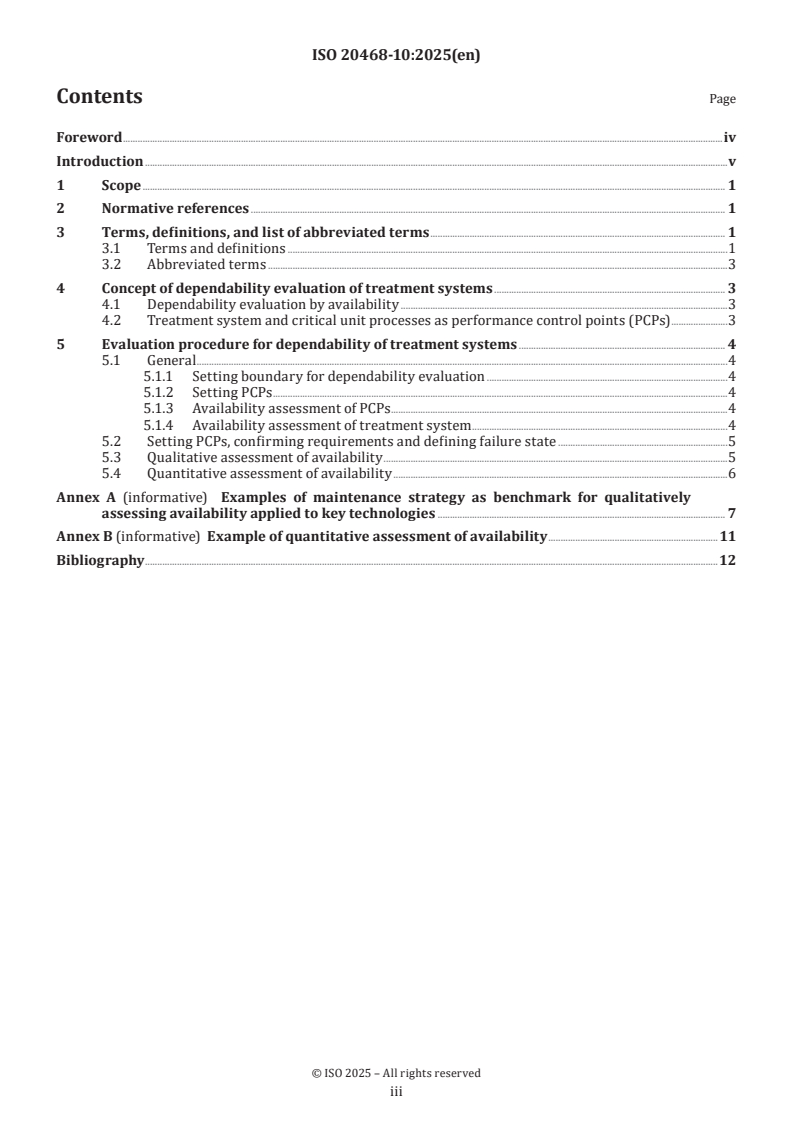
Contents Page
Foreword .iv
Introduction .v
1 Scope . 1
2 Normative references . 1
3 Terms, definitions, and list of abbreviated terms . 1
3.1 Terms and definitions .1
3.2 Abbreviated terms .3
4 Concept of dependability evaluation of treatment systems . 3
4.1 Dependability evaluation by availability .3
4.2 Treatment system and critical unit processes as performance control points (PCPs) .3
5 Evaluation procedure for dependability of treatment systems . 4
5.1 General .4
5.1.1 Setting boundary for dependability evaluation .4
5.1.2 Setting PCPs .4
5.1.3 Availability assessment of PCPs .4
5.1.4 Availability assessment of treatment system .4
5.2 Setting PCPs, confirming requirements and defining failure state .5
5.3 Qualitative assessment of availability .5
5.4 Quantitative assessment of availability .6
Annex A (informative) Examples of maintenance strategy as benchmark for qualitatively
assessing availability applied to key technologies . 7
Annex B (informative) Example of quantitative assessment of availability .11
Bibliography .12
iii
Foreword
ISO (the International Organization for Standardization) is a worldwide federation of national standards
bodies (ISO member bodies). The work of preparing International Standards is normally carried out through
ISO technical committees. Each member body interested in a subject for which a technical committee
has been established has the right to be represented on that committee. International organizations,
governmental and non-governmental, in liaison with ISO, also take part in the work. ISO collaborates closely
with the International Electrotechnical Commission (IEC) on all matters of electrotechnical standardization.
The procedures used to develop this document and those intended for its further maintenance are described
in the ISO/IEC Directives, Part 1. In particular, the different approval criteria needed for the different types
of ISO documents should be noted. This document was drafted in accordance with the editorial rules of the
ISO/IEC Directives, Part 2 (see www.iso.org/directives).
ISO draws attention to the possibility that the implementation of this document may involve the use of (a)
patent(s). ISO takes no position concerning the evidence, validity or applicability of any claimed patent
rights in respect thereof. As of the date of publication of this document, ISO had not received notice of (a)
patent(s) which may be required to implement this document. However, implementers are cautioned that
this may not represent the latest information, which may be obtained from the patent database available at
www.iso.org/patents. ISO shall not be held responsible for identifying any or all such patent rights.
Any trade name used in this document is information given for the convenience of users and does not
constitute an endorsement.
For an explanation of the voluntary nature of standards, the meaning of ISO specific terms and expressions
related to conformity assessment, as well as information about ISO's adherence to the World Trade
Organization (WTO) principles in the Technical Barriers to Trade (TBT), see www.iso.org/iso/foreword.html.
This document was prepared by Technical Committee ISO/TC 282, Water reuse, Subcommittee SC 3, Risk and
performance evaluation of water reuse systems.
A list of all parts in the ISO 20468 series can be found on the ISO website.
Any feedback or questions on this document should be directed to the user’s national standards body. A
complete listing of these bodies can be found at www.iso.org/members.html.
iv
Introduction
The purpose of this document is to define a methodology to evaluate the dependability of treatment systems,
which is listed as one of “treatment technology non-functional requirements” in ISO 20468-1. Although the
targeted performance requirement can be selected depending on the purpose, functional requirements
related to water quality should be targeted with high priority in conventional water reuse projects.
As a consequence, the dependability of a treatment system can be represented and evaluated by availability
as the ability to perform long-term operation without a failure and the fulfilment of functional requirements
related to the water quality target to be conformed with. As well, dependability as a “non-functional
requirement” can be evaluated by benchmarking for making comparisons or improving treatment system
performance.
Performance indicators other than dependability for the non-functional requirements of treatment systems
have already been specified in ISO 20468-2 for environmental performance based on greenhouse gas
(GHG) emissions and in ISO 20468-8 for economic evaluations based on life cycle cost (LCC). If functional
requirements related to water quality performance are satisfied, dependability can provide appropriate
information on operation and maintenance used for calculating GHG emissions and LCC.
A comprehensive evaluation of dependability, environmental, and economic performance can be used to
select an appropriate and cost-effective treatment system in the planning phase and to identify improvement
for operations and optimization opportunities on a life cycle basis. A variety of stakeholders, including
managers of water reuse projects and owners of water infrastructure and facilities can find beneficial
opportunities and options through a comprehensive performance evaluation using the guidelines in the
ISO 20468 series.
v
International Standard ISO 20468-10:2025(en)
Performance evaluation of treatment technologies for water
reuse systems —
Part 10:
Guidelines for evaluation of dependability of treatment systems
1 Scope
This document provides guidelines for evaluating the dependability represented by the availability of
treatment systems for water reuse.
The document specifies methodologies for both qualitative and quantitative assessments of availability on a
life cycle basis.
2 Normative references
The following documents are referred to in the text in such a way that some or all of their content constitutes
requirements of this document. For dated references, only the edition cited applies. For undated references,
the latest edition of the referenced document (including any amendments) applies.
ISO 20670, Water reuse — Vocabulary
3 Terms, definitions, and list of abbreviated terms
For the purposes of this document, the terms and definitions given in ISO 20670 and the following apply.
ISO and IEC maintain terminology databases for use in standardization at the following addresses:
— ISO Online browsing platform: available at https:// www .iso .org/ obp
— IEC Electropedia: available at https:// www .electropedia .org/
3.1 Terms and definitions
3.1.1
availability
ability of a treatment technology to be in a state to perform a required function under given conditions at a
given instant of time or over a given time interval
Note 1 to entry: This ability depends on the combined aspects of reliability (3.1.11) performance, maintainability (3.1.7)
performance, and maintenance support performance (3.1.8). Preventive maintenance (3.1.10) can extend reliability and
improve availability.
[SOURCE: ISO 20468-1:2018, 3.1.1, modified — “assuming that the required external resources are provided”
was removed from the definition; “Preventive maintenance can extend reliability and improve availability”
was added to Note 1 to entry; Note 2 to entry was removed.]
3.1.2
benchmarking
tool for performance improvement through systematic search and adaptation of leading practices
[SOURCE: ISO 20468-1:2018, 3.1.2]
3.1.3
corrective maintenance
maintenance carried out after fault detection to effect restoration
[SOURCE: IEC 60050-192:2015, 192-06-06, modified — Note 1 to entry was removed.]
3.1.4
dependability
ability of a system represented by the availability (3.1.1) performance and its influencing factors, namely
reliability (3.1.11) performance, maintainability (3.1.7) performance and maintenance support performance (3.1.8)
[SOURCE: ISO 20468-1:2018, 3.1.5, modified — “collective term used to describe” was replaced with “ability
of a system represented by”; the list of influencing factors was added to the definition.]
3.1.5
downtime
amount of time that a system or a component is not able to operate or meet required functions
[SOURCE: ISO 20468-1:2018, 3.1.6]
3.1.6
failure
state in which a treatment technology does not meet a functional or a non-functional requirement (3.1.9)
[SOURCE: ISO 20468-1:2018, 3.1.7]
3.1.7
maintainability
ability of a treatment technology, under given conditions of use, to be retained in, or restored to, a state in
which it can perform a required function, when maintenance is performed under given conditions and using
stated procedures and resources
[SOURCE: ISO 20468-1:2018, 3.1.9]
3.1.8
maintenance support performance
ability of a maintenance organisation, under given conditions and maintenance policy, to provide, upon
demand, the resources required to maintain the treatment technology
[SOURCE: ISO 20468-1:2018, 3.1.10, modified — Notes to entry were removed.]
3.1.9
non-functional requirement
requirement that specifies criteria or constraints on the design or implementation of a treatment technology
[SOURCE: ISO 20468-1:2018, 3.1.12]
3.1.10
preventive maintenance
maintenance carried out to mitigate degradation and reduce the probability of failure (3.1.6)
[SOURCE: IEC 60050-192:2015, 192-06-05, modified — Notes to entry were removed.]
3.1.11
reliability
ability that a device, system or process will perform its prescribed function without failure (3.1.6) for a given
time when operated correctly in a specified environment
[SOURCE: ISO 20670:2023, 3.79, modified ― “probability” was replaced with “ability”.]
3.1.12
uptime
amount of time that a system or a component is able to operate or meet required functions
3.2 Abbreviated terms
NF nanofiltration
PCP performance control point
RO reverse osmosis
TMP transmembrane pressure
UV ultraviolet
4 Concept of dependability evaluation of treatment systems
4.1 Dependability evaluation by availability
The dependability of a treatment system is evaluated mainly from the availabilities of unit processes, which
make up the system facility, to achieve functional requirements related to water quality over the course of
operation. In planning or design stage, inherent availability is generally expressed by Formula (1) with two
[9]
influencing factors: reliability and maintainability. The introduction of preventive maintenance to prevent
failures of the treatment system facility can extend the reliability represented by mean time between
failures and improve the inherent availability. While preventive maintenance is usually more effective and
preferable, corrective maintenance for the rapid recovery from a failure can reduce mean time to recovery
and lead to improved maintainability, which in turn contribute to increased availability.
T
b
A = (1)
i
TT+
br
where
A is the inherent availability;
i
T is the mean time between failures (in d);
b
T is the mean time to recovery (in d).
r
The primary functional requirement of a treatment system is to produce reclaimed water that fulfils
quality and quantity requirements, and a failure can be in the context of water quality or quantity. As a
result, dependability represented by availability can be explained as an ability related to the duration of
system operation without intervention or failure and fulfilment of functional requirements related to a
water quality target. As well, dependability as a non-functional requirement can usually be evaluated by
benchmarking for making comparisons or improving treatment system performance.
4.2 Treatment system and critical unit processes as performance control points (PCPs)
For a treatment system, the use of treatment processes as multiple barriers is an effective and commonly
used strategy to reduce residual health risks in reclaimed water. The required level of treatment is
determined based on the degree of required water quality, which is ultimately associated with intended
end-use.
The availability of a treatment system depends on the availability of each of the individual unit treatment
processes that make up the system, and the way in which these processes are integrated. To fulfil the
requirements for the high reclaimed water quality of a treatment system, in addition to monitoring water
quality, ISO 20426 recommends a risk control approach by setting process PCPs. The availability of each
of the unit processes determined as PCPs should be assessed for practical and effective assessments of
treatment system availability.
The availability of unit processes can be assessed by selecting water quality criteria or surrogate parameters
and the measurable control numerical limits that are set for each PCP. For monitoring the fulfilment of
functional requirement of processes as possible PCPs, the ISO 20468 series guidelines for evaluating the
performance of treatment technologies can be used to select appropriate monitoring parameters.
5 Evaluation procedure for dependability of treatment systems
5.1 General
5.1.1 Setting boundary for dependability evaluation
The boundary conditions for a dependability evaluation of a treatment system should be established
according to the relevant project requirements. Normally, the treatment system consists of multiple
treatment processes using physical, biological or chemical means, or a combination of these. The boundary
conditions should be the treatment system or be limited to part of the treatment system and associated
facilities of the treatment processes.
5.1.2 Setting PCPs
Critical processes should be selected as PCPs among the treatment processes included in the boundary, and
prerequisite information on each PCP operation should be confirmed for the availability assessment. Setting
a benchmark
...