

ISO 20468-6:2021
(Main)Guidelines for performance evaluation of treatment technologies for water reuse systems — Part 6: Ion exchange and electrodialysis
General Information
- Abstract
This document provides guidelines on methods for evaluating the performance of ion exchange and electrodialysis for water reuse including ion exchange resin and ion exchange membrane.
- Status
- Published
- Publication Date
- 21-Jun-2021
- Technical Committee
- ISO/TC 282/SC 3 - Risk and performance evaluation of water reuse systems
- Drafting Committee
- ISO/TC 282/SC 3/WG 2 - Performance evaluation
- Current Stage
- 9060 - Close of review
- Completion Date
- 02-Dec-2031
Buy Documents



ISO 20468-6:2021 - Guidelines for performance evaluation of treatment technologies for water reuse systems

ISO 20468-6:2021 - Guidelines for performance evaluation of treatment technologies for water reuse systems — Part 6: Ion exchange and electrodialysis/22/2021
Overview
ISO 20468-6:2021 provides internationally recognized guidelines for evaluating the performance of ion exchange and electrodialysis technologies used in water reuse systems. Focusing on ion exchange resins (IER) and ion exchange membranes (IEM), this standard supports water quality management by outlining methods for system assessment. These guidelines help ensure the reliability, efficiency, and sustainability of advanced water treatment processes, contributing to safer water reuse in both industrial and municipal contexts.
Key Topics
- Performance Evaluation Methods: The standard defines how to assess both functional and non-functional requirements of ion exchange and electrodialysis processes in water reuse applications.
- System Configurations: It covers the setup of ion exchange resin towers and electrodialysers, including the use of cation and anion exchange materials.
- Process Design and Selection: Guidance is provided on selecting the appropriate type, structure, and configuration of resins and membranes for different water types and treatment objectives.
- Operational Considerations: Recommendations for operational parameters, maintenance, regeneration cycles, and performance measurement are detailed.
- Evaluation Criteria: Parameters such as treated water quality, ion exchange capacity, current efficiency, and water recovery rate are emphasized for comprehensive system evaluation.
Applications
ISO 20468-6:2021 is essential for a wide range of water treatment and water reuse scenarios where effective ion removal or desalination is required.
Typical applications include:
- Industrial Water Purification: Softening and demineralizing water for boiler feed, ultra-pure water production, and chemical processing.
- Municipal Water Reuse: Enhancing the quality of reclaimed water for potable or non-potable purposes by removing salts, minerals, and other ions.
- Wastewater Treatment: Recovery of valuable components and treatment of industrial or landfill leachate to comply with environmental standards.
- Food and Beverage Industry: Water softening and desalination to meet strict sanitation and quality standards.
- Seawater and Brackish Water Desalination: Producing fresh water for municipal supply or table salt production.
These methods are particularly suitable when water treatment goals require high selectivity, efficient ion removal, and adaptability to diverse raw water sources.
Related Standards
Organizations involved in water treatment and water reuse may benefit from referencing the following related standards:
- ISO 20468-1: Guidelines for performance evaluation of treatment technologies for water reuse systems – General principles and framework (basis for all parts of ISO 20468).
- ISO 20670: Water reuse – Vocabulary (defines key terms used in ISO 20468-6 and related documents).
- Other Parts of ISO 20468: Covering additional types of advanced treatment technologies such as membranes, UV, ozone, and distillation.
By using ISO 20468-6:2021 in conjunction with these related documents, stakeholders can ensure a robust, standardized approach to assessing and improving the performance of water reuse technologies-strengthening efficiency, regulatory compliance, and sustainability in water management operations.
Keywords: ISO 20468-6, ion exchange, electrodialysis, water reuse, performance evaluation, ion exchange resin, ion exchange membrane, water treatment, desalination, standard guidelines.
Relations
- Consolidated By
ISO/TR 8124-8:2024 - Safety of toys — Part 8: Age determination — First age grade for the appropriate play of toys - Effective Date
- 06-Jun-2022
Buy Documents
ISO 20468-6:2021 - Guidelines for performance evaluation of treatment technologies for water reuse systems
ISO 20468-6:2021 - Guidelines for performance evaluation of treatment technologies for water reuse systems — Part 6: Ion exchange and electrodialysis/22/2021
Get Certified
Connect with accredited certification bodies for this standard

BSI Group
BSI (British Standards Institution) is the business standards company that helps organizations make excellence a habit.

Bureau Veritas
Bureau Veritas is a world leader in laboratory testing, inspection and certification services.

DNV
DNV is an independent assurance and risk management provider.
Sponsored listings
Frequently Asked Questions
ISO 20468-6:2021 is a standard published by the International Organization for Standardization (ISO). Its full title is "Guidelines for performance evaluation of treatment technologies for water reuse systems — Part 6: Ion exchange and electrodialysis". This standard covers: This document provides guidelines on methods for evaluating the performance of ion exchange and electrodialysis for water reuse including ion exchange resin and ion exchange membrane.
This document provides guidelines on methods for evaluating the performance of ion exchange and electrodialysis for water reuse including ion exchange resin and ion exchange membrane.
ISO 20468-6:2021 is classified under the following ICS (International Classification for Standards) categories: 13.020.40 - Pollution, pollution control and conservation; 13.060.01 - Water quality in general. The ICS classification helps identify the subject area and facilitates finding related standards.
ISO 20468-6:2021 has the following relationships with other standards: It is inter standard links to ISO/TR 8124-8:2024. Understanding these relationships helps ensure you are using the most current and applicable version of the standard.
ISO 20468-6:2021 is available in PDF format for immediate download after purchase. The document can be added to your cart and obtained through the secure checkout process. Digital delivery ensures instant access to the complete standard document.
Standards Content (Sample)
INTERNATIONAL ISO
STANDARD 20468-6
First edition
2021-06
Guidelines for performance evaluation
of treatment technologies for water
reuse systems —
Part 6:
Ion exchange and electrodialysis
Lignes directrices pour l’évaluation des performances des techniques
de traitement des systèmes de réutilisation de l’eau —
Partie 6: Échange d'ions et électrodialyse
Reference number
©
ISO 2021
© ISO 2021
All rights reserved. Unless otherwise specified, or required in the context of its implementation, no part of this publication may
be reproduced or utilized otherwise in any form or by any means, electronic or mechanical, including photocopying, or posting
on the internet or an intranet, without prior written permission. Permission can be requested from either ISO at the address
below or ISO’s member body in the country of the requester.
ISO copyright office
CP 401 • Ch. de Blandonnet 8
CH-1214 Vernier, Geneva
Phone: +41 22 749 01 11
Email: copyright@iso.org
Website: www.iso.org
Published in Switzerland
ii © ISO 2021 – All rights reserved
Contents Page
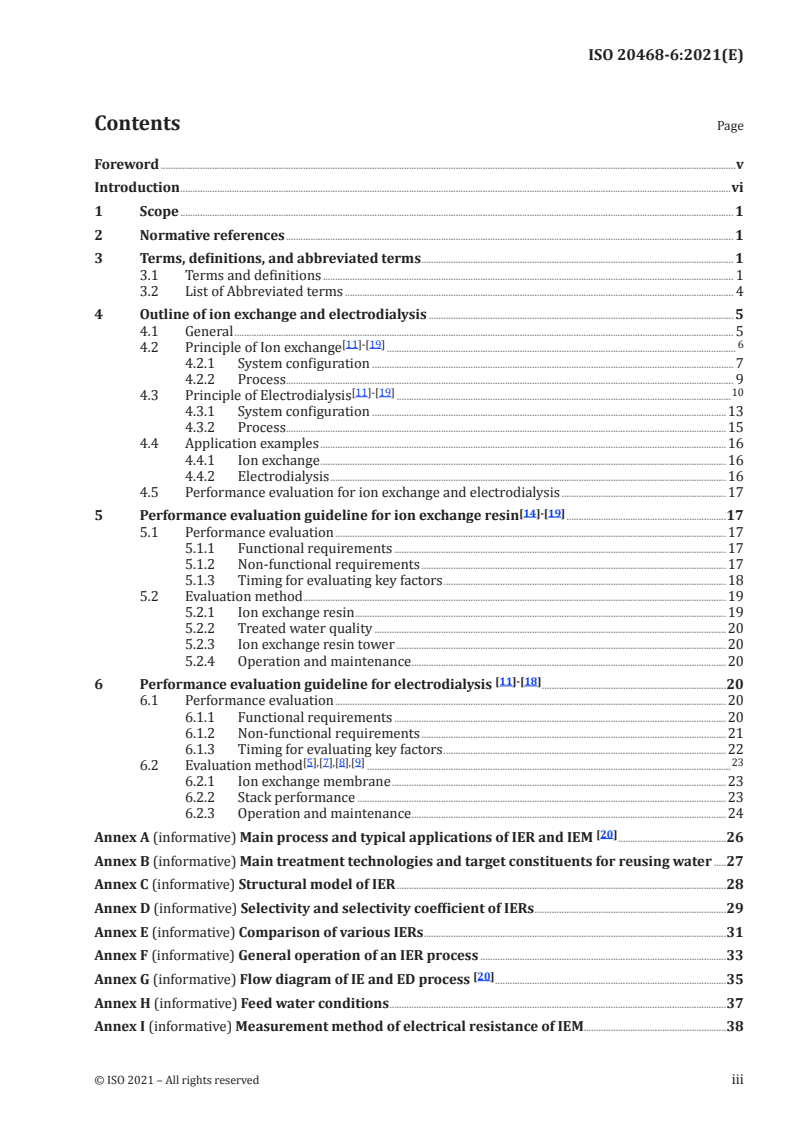
Foreword .v
Introduction .vi
1 Scope . 1
2 Normative references . 1
3 Terms, definitions, and abbreviated terms . 1
3.1 Terms and definitions . 1
3.2 List of Abbreviated terms . 4
4 Outline of ion exchange and electrodialysis . 5
4.1 General . 5
[11]-[19] 6
4.2 Principle of Ion exchange .
4.2.1 System configuration . 7
4.2.2 Process . 9
[11]-[19] 10
4.3 Principle of Electrodialysis .
4.3.1 System configuration .13
4.3.2 Process .15
4.4 Application examples .16
4.4.1 Ion exchange .16
4.4.2 Electrodialysis .16
4.5 Performance evaluation for ion exchange and electrodialysis .17
[14]-[19]
5 Performance evaluation guideline for ion exchange resin .17
5.1 Performance evaluation .17
5.1.1 Functional requirements .17
5.1.2 Non-functional requirements .17
5.1.3 Timing for evaluating key factors .18
5.2 Evaluation method .19
5.2.1 Ion exchange resin .19
5.2.2 Treated water quality .20
5.2.3 Ion exchange resin tower .20
5.2.4 Operation and maintenance .20
[11]-[18]
6 Performance evaluation guideline for electrodialysis .20
6.1 Performance evaluation .20
6.1.1 Functional requirements .20
6.1.2 Non-functional requirements .21
6.1.3 Timing for evaluating key factors .22
[5],[7],[8],[9] 23
6.2 Evaluation method .
6.2.1 Ion exchange membrane .23
6.2.2 Stack performance .23
6.2.3 Operation and maintenance .24
[20]
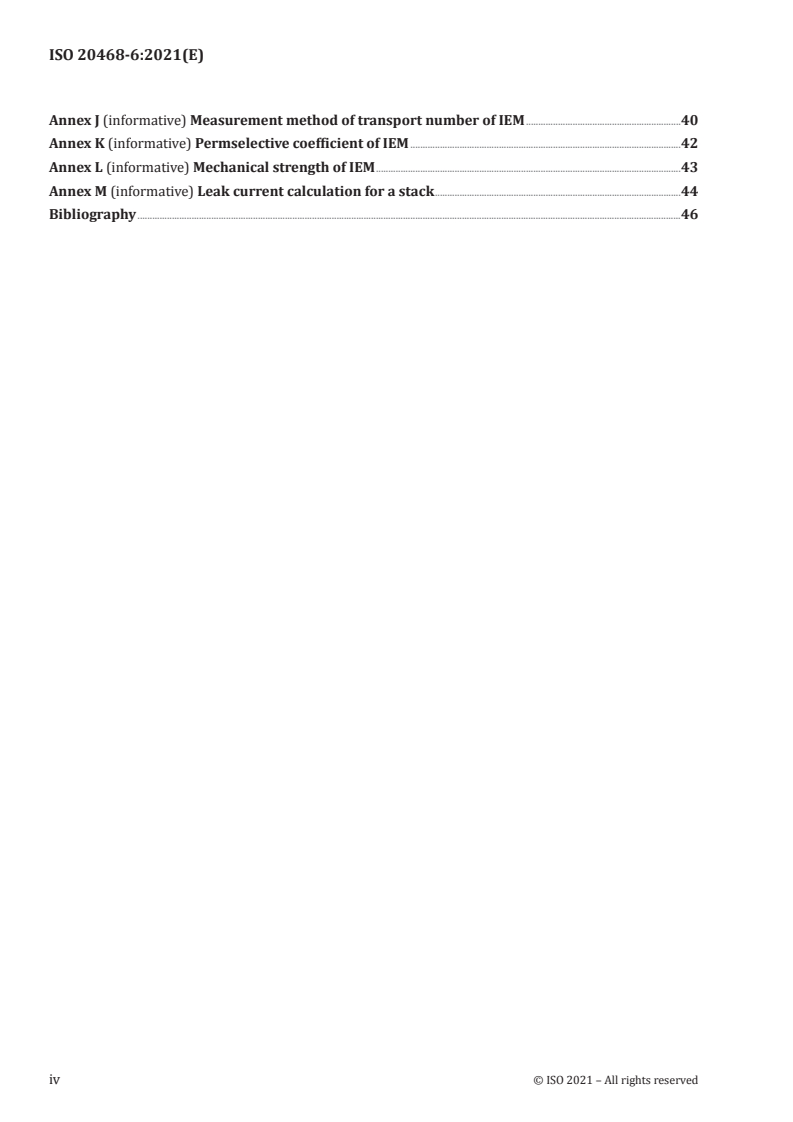
Annex A (informative) Main process and typical applications of IER and IEM .26
Annex B (informative) Main treatment technologies and target constituents for reusing water .27
Annex C (informative) Structural model of IER .28
Annex D (informative) Selectivity and selectivity coefficient of IERs .29
Annex E (informative) Comparison of various IERs .31
Annex F (informative) General operation of an IER process .33
[20]
Annex G (informative) Flow diagram of IE and ED process .35
Annex H (informative) Feed water conditions .37
Annex I (informative) Measurement method of electrical resistance of IEM.38
Annex J (informative) Measurement method of transport number of IEM .40
Annex K (informative) Permselective coefficient of IEM .42
Annex L (informative) Mechanical strength of IEM .43
Annex M (informative) Leak current calculation for a stack .44
Bibliography .46
iv © ISO 2021 – All rights reserved
Foreword
ISO (the International Organization for Standardization) is a worldwide federation of national standards
bodies (ISO member bodies). The work of preparing International Standards is normally carried out
through ISO technical committees. Each member body interested in a subject for which a technical
committee has been established has the right to be represented on that committee. International
organizations, governmental and non-governmental, in liaison with ISO, also take part in the work.
ISO collaborates closely with the International Electrotechnical Commission (IEC) on all matters of
electrotechnical standardization.
The procedures used to develop this document and those intended for its further maintenance are
described in the ISO/IEC Directives, Part 1. In particular, the different approval criteria needed for the
different types of ISO documents should be noted. This document was drafted in accordance with the
editorial rules of the ISO/IEC Directives, Part 2 (see www .iso .org/ directives).
Attention is drawn to the possibility that some of the elements of this document may be the subject of
patent rights. ISO shall not be held responsible for identifying any or all such patent rights. Details of
any patent rights identified during the development of the document will be in the Introduction and/or
on the ISO list of patent declarations received (see www .iso .org/ patents).
Any trade name used in this document is information given for the convenience of users and does not
constitute an endorsement.
For an explanation of the voluntary nature of standards, the meaning of ISO specific terms and
expressions related to conformity assessment, as well as information about ISO's adherence to the
World Trade Organization (WTO) principles in the Technical Barriers to Trade (TBT) see www .iso .org/
iso/ foreword .html.
This document was prepared by Technical Committee ISO/TC 282, Water reuse, Subcommittee SC 3,
Risk and performance evaluation of water reuse system.
A list of all parts in the ISO 20468 series can be found on the ISO website.
Any feedback or questions on this document should be directed to the user’s national standards body. A
complete listing of these bodies can be found at www .iso .org/ members .html.
Introduction
“Ion exchange” for purification with ion exchange resin and “Electrodialysis” for desalination and
[4]
concentration with ion exchange membrane are classified as “Advanced treatment” in ISO 20468-1 .
Raw water compositions and treated water targets are extremely diverse. Such diversity impedes
making world-wide guidelines for ion exchange and electrodialysis.
Ion exchange resin (IER) provides a medium for ion exchange. Target ions in solution are trapped within
the medium causing other ions contained within the medium to be released into solution. The most
common applications are water softening and water purification.
Electrodialysis (ED) is an ion-separation process that utilizes an electrical potential difference across
ion exchange membrane as the driving force for moving ion in a solution. The membrane is selective
in that it only permits the passage of either anions or cations but not both and can be used to reject
opposite charged ions.
The ISO 20468 series is intended to provide international standards for an objective evaluation
of the performance of ion exchange and electrodialysis. It introduces the concepts of “Functional
requirements” and “Non-functional requirements,” which are suggested and defined in ISO 20468-1,
also used for other water reuse technologies that may be used in combination or alternatively, such as
membrane, UV, and ozone disinfection and distillation.
vi © ISO 2021 – All rights reserved
INTERNATIONAL STANDARD ISO 20468-6:2021(E)
Guidelines for performance evaluation of treatment
technologies for water reuse systems —
Part 6:
Ion exchange and electrodialysis
1 Scope
This document provides guidelines on methods for evaluating the performance of ion exchange and
electrodialysis for water reuse including ion exchange resin and ion exchange membrane.
2 Normative references
The following documents are referred to in the text in such a way that some or all of their content
constitutes requirements of this document. For dated references, only the edition cited applies. For
undated references, the latest edition of the referenced document (including any amendments) applies.
ISO 20670, Water reuse — Vocabulary
3 Terms, definitions, and abbreviated terms
For the purposes of this document, the terms and definitions given in ISO 20670 and the following apply.
ISO and IEC maintain terminological databases for use in standardization at the following addresses:
— IEC Electropedia: available at http:// www .electropedia .org/
— ISO Online browsing platform: available at https:// www .iso .org/ obp
3.1 Terms and definitions
3.1.1
anion exchange membrane
polymer sheet that contain positively charged functional groups in its polymer matrix designed to
conduct anions while blocking other ions
3.1.2
anion exchange resin
polymer beads that contain positively charged functional groups in its polymer matrix capable of
undergoing exchange reactions with anions
3.1.3
bed
packed layers of ion exchange resins (3.1.19)
3.1.4
block
unit composed of cell pairs (3.1.8) and intermediate frame at both ends
Note 1 to entry: Cell-pairs are stacked from several pairs up to thousands of pairs inside an electrodialyser ion
exchange.
Note 2 to entry: A large number of cell pairs stacked in series causes problems such as non-uniform hydraulic
pressure and increased leak current in an electrodialyser. To prevent such problems, a large electrodialyser is
separated with an intermediate frame (Figure 8).
3.1.5
cation exchange membrane
polymer sheet that contain negatively charged functional groups in its polymer matrix designed to
conduct cations while blocking other ions
3.1.6
cation exchange resin
polymer beads that contain negatively charged functional groups in its polymer matrix capable of
undergoing exchange reactions with cations
3.1.7
cell
thin sheet compartment, through which desalinate (feed water) or concentrate passes
Note 1 to entry: D-cell means a desalinate cell and C-cell means a concentrate cell.
3.1.8
cell pair
series of D-cell (3.1.7), cation exchange membrane (3.1.5), C-cell (3.1.7), and anion exchange membrane
(3.1.1) that are layered in order to constitute a cell pair
Note 1 to entry: A cell pair is the basic unit for desalination and concentration in electrodialysis.
3.1.9
chelating resin
polymer beads that contain functional groups in its polymer matrix capable of forming chelates with
metal ions
3.1.10
current efficiency
ratio of the theoretical to actual current required to transport ions across an ion exchange membrane
(3.1.18)
3.1.11
direct current
unidirectional flow or movement of electrical charge carriers (which are usually electrons)
3.1.12
electrodeionization
water treatment technology that utilizes electricity, ion exchange membranes (3.1.18) and ion exchange
resin (3.1.19) in order to desalinate ions from one solution to another solution in a very low concentration
3.1.13
electrodialysis
water treatment technology that uses ion exchange membranes (3.1.18) in order to move ions from one
solution to another solution by using electrical potential difference
3.1.14
electrodialysis reversal
type of electrodialysis (3.1.13) process that periodically reverses the electrodes polarity, alternating
concentrated and diluted streams, and continuously self-cleaning the scale components
3.1.15
heterogeneous ion exchange membrane
ion exchange membrane (3.1.18) that is obtained by mixing ion exchange resin (3.1.19) and thermoplastic
resin, and has heterogeneous structure
2 © ISO 2021 – All rights reserved
3.1.16
homogeneous ion exchange membrane
ion exchange membrane (3.1.18) that is uniformly configured except for reinforcement
3.1.17
ion exchange capacity
total quantity of ion exchangeable groups in ion exchange resin (3.1.19)
3.1.18
ion exchange membrane
polymer sheet that contain negatively or positively charged functional groups in its polymer matrix
designed to conduct cations or anions while blocking opposite charged ions
3.1.19
ion exchange resin
polymer beads that contain charged functional groups in its polymer matrix capable of undergoing
exchange reactions with anions or cations
3.1.20
limiting current density
current density beyond which water dissociation will occur
Note 1 to entry: In electrodialysis, ions in a solution migrate from the bulk solution to the surface of an ion
exchange membrane and form a boundary layer having a concentration difference. As current density increases,
the concentration difference of the boundary layer also increases, and the concentration on the surface of the
ion exchange membrane reaches zero. This current density is defined as “Limiting current density (LCD),” and
is an important indicator for deciding the operating current of an electrodialyser. Operation beyond LCD causes
+ -
water to dissociate into hydrogen ions (H ) and hydroxyl ions (OH ) at the ion exchange membrane-surface and
consumes applied current ineffectually.
3.1.21
mixed bed
mixture of anion exchange resin (3.1.2) and cation exchange resins (3.1.6)
3.1.22
particle size and particle size distribution
diameter of ion exchange resin (3.1.19) beads and its distribution
3.1.23
perfect beads content
non-cracked and non-broken bead content in ion exchange resin (3.1.19) beads
3.1.24
reaction rate
ion exchange reaction rate of ion exchange resin (3.1.19)
3.1.25
regeneration
regeneration of ion exchange resin (3.1.19) is a reversal of the exchange reactions with high
concentrations of a regenerate
3.1.26
reverse osmosis (RO)
separation process where one component of a solution is removed from another component by flowing
the feed stream under pressure across a semipermeable membrane that causes selective movement of
solvent against its osmotic pressure difference
Note 1 to entry: Reverse osmosis (RO) removes ions based on electro chemical forces, colloids, and organics
down to 150 molecular weight. May also be called hyperfiltration.
[SOURCE: ASTM D6161-19]
3.1.27
selectivity coefficient
equilibrium constant for ion exchange reaction in ion exchange resins (3.1.19)
3.1.28
stack
entire body of electrodialyser, assembled with multitude of cell pairs (3.1.8) or several blocks (3.1.4)
between anode cell (3.1.7) and cathode cell (3.1.7), and pair of end plates for tightening
3.1.29
strongly acidic cation exchange resins
resins that have strongly acidic functional groups
3.1.30
strongly basic anion exchange resins
resins that have strongly basic functional groups
3.1.31
transport number
fraction of current carried by a given ion for total current carried by all ions
3.1.32
tower
vessels with packed layers of ion exchange resins (3.1.19) and/or degassers
3.1.33
uniform particle size ion exchange resin
ion exchange resin (3.1.19) that has narrow particle size distribution (3.1.22)
3.1.34
water extractable residue
water soluble extractable residue from ion exchange resins (3.1.19)
3.1.35
water recovery rate
ratio between treated water quantity and feed water quantity to electrodialyser
3.1.36
weakly acidic cation exchange resins
cation exchange resins (3.1.6) that have weakly acidic functional group
3.1.37
weakly basic anion exchange resins
anion exchange resins (3.1.2) that have weakly basic functional group
3.2 List of Abbreviated terms
AC Alternating current
AEM Anion exchange membrane
AER Anion exchange resin
CEM Cation exchange membrane
CER Cation exchange resin
CR Chelating resin
DC Direct current
4 © ISO 2021 – All rights reserved
EDI Electrodeionization
ED Electrodialysis
EDR Electrodialysis reversal
IE Ion exchange
IEM Ion exchange membrane
IER Ion exchange resin
[7]
LSI Langelier saturation index
LCD Limiting current density
LCR Inductance (L), capacitance (C), and resistance (R) of an electronic component
MB Mixed bed
R Electrical resistance
RO Reverse osmosis
SDI Silt density index
SAC Strongly acidic cation exchange resins
SBA Strongly basic anion exchange resins
TDS Total dissolved solids
WAC Weakly acidic cation exchange resins
WBA Weakly basic anion exchange resins
4 Outline of ion exchange and electrodialysis
4.1 General
IER and IEM use ionic functional groups fixed in polymer beads or in polymer sheets. These fixed ionic
functional groups exchange ions of an opposite charge or selectively transport ions of an opposite
charge. These technologies can be used for many applications including purifying wastewater by passing
it through an IER packed tower, or desalinating and concentrating wastewater with an electrodialyser
in which IEM are equipped. Among these applications, ion exchange in IER and ED in IEM also apply to
water reclamation. Annex A shows the main process and typical applications of IER and IEM.
Ion exchange and ED are one of several technologies (Annex B) that are used for desalination. Table 1
shows typical salinity range of salt removal about IE and ED.
Table 1 — Typical range of salt removal of ion exchange and electrodialysis
Salinity (NaCl) [g/l]
Type Driving Force
Raw Water Desalinate Concentrate
Electrical field
ED 0,5~200 >0,2 <240
& Diffusion
Adsorption & Deso-
IE <1 >0,001 -
rption
ED, RO, IE and distillation are widely known as a desalination technology. But each strong point is
different. In case of ED, its feature is that both ion concentration and desalination are possible. For
example, in the concentration of seawater, it is possible to concentrate salinity up to about 240g/l
and on the contrary in the desalination, it can be expected to be desalinated about 0,2g/l. It also can
arrange the desalination level. For the desalination purpose, ED is often applicable for brackish water
and ground water.
IE is a purification technology for removing target ions. The purification process is performed by an
adsorption and desorption mechanism. IE is applicable to raw water under 1g/l-TDS and can produce
deionized water and/or ultrapure water. IER is also applicable for decolorizing raw water.
To select an appropriate technology, it is highly recommended to consider the pros and cons of those
technologies. In some cases, a combination of those technologies may contribute great benefits to users
and stakeholders.
EDI is applied to produce pure water or ultrapure water instead of a resin tower or RO. EDI stacks have
an IER or fibre in desalinated chambers to decrease resistivity. As a result, EDI can provide very low
conductivity water.
[11]-[19]
4.2 Principle of Ion exchange
Typical functional groups of IERs are sulfonic acids and quaternary ammoniums, and such IERs are
classified by their functions into CERs, which can exchange cations, and AERs, which can exchange
anions. IERs have spherical crosslinked polymer matrix with functional groups, counter ions, and
hydrated water. These polymer structures affect the ion exchange capacity, reaction rate, and physical
properties of IERs. Annex C shows a structural model of IER.
Ion exchange using IERs depends on a mechanism by which mobile ions from an external solution are
exchanged in the opposite direction for an equivalent number of ions that are electrostatically bound to
functional groups contained within a solid polymer matrix of IERs. Annex D shows the selectivity and
selectivity coefficient of IERs.
The purification process using IER is most commonly performed in cyclic operations of the column
method with an adsorption and desorption mechanism. Each cycle is divided into sorption and
regeneration. Figure 1 shows an outline of an IER tower. Figure 2 shows a representation of an ion
exchange operation cycle.
Key
1 IERs
a
influent
b
effluent
[20]
Figure 1 — Outline of IER tower
6 © ISO 2021 – All rights reserved
1 sorption
2 regeneration
a
feed water
b
treated water
c
regenerant
d
regeneration wastewater
[20]
Figure 2 — Schematic representation of an ion exchange operation cycle
4.2.1 System configuration
The most important component of IE is IER and the IER tower that equipped with IER.
4.2.1.1 Ion exchange resins
IERs are categorized by their functional groups and physical structure. Typical functional groups of
IERs are sulfonic acids and quaternary ammoniums, and such IERs are classified into CERs and AERs.
IERs have two types of physical structure: gel type and macroporous type. Macroporous type IERs
have high density of macroporous in the polymer matrixes and much larger specific surface areas of the
active surface than gel-type resins.
Table 2 shows types and groups of IERs.
Table 2 — Types and groups of IERs
Grade Functional group Physical structure
1 Gel
Strongly acidic Sulfonic acid
2 CER Macroporous
3 Weakly acidic Carboxylic acid Macroporous
Table 2 (continued)
Grade Functional group Physical structure
4 Gel
Type I Trimethylammonium
5 Macroporous
Strongly basic
6 AER Gel
Type II Dimethylethanolammonium
7 Macroporous
8 Weakly basic Dimethylamine Macroporous
In addition, IERs are categorized by particle size distribution into two types: polydispersed particle
size IERs and uniform particle size ion exchange resins. Uniform particle size ion exchange resins have
narrower particle size distribution than polydispersed particle size IERs.
Chelating resins are a type of IER with functional groups that can form chelates with metal ions. Table 3
shows types and groups of CRs.
Table 3 — Types and grouping of CRs
Grade Functional group Physical structure Target ions
1 Iminodiacetate Macroporous Heavy metal ions
2 CR Polyamine Macroporous Heavy metal ions
3 Glucamine Macroporous Borate
4.2.1.2 Ion exchange resin tower
IERs are mainly installed in a fixed bed tower. The ion exchange process is composed of IER towers,
feeding unit for raw water and regenerants, and tanks for treated water and wastewater. Figure 3
shows an outline of an IER tower.
8 © ISO 2021 – All rights reserved
Outside appearance Arrangement of pipings
Key
1 resin bed
2 support plate and strainer
3 flow meter
4 air vent
5 integrating flow meter
a
raw water
b
regenerant
c
treated water
d
wash water
e
backwash waste
[20]
Figure 3 — Outline of an IER tower
4.2.2 Process
4.2.2.1 Process design
Purification processes using IER are classified into several types of water treatment processes. The
softening process requires a CER tower. The demineralization process requires a CER and an AER
tower. The 2-Bed-3-Tower process or 4-Bed 5-Tower process is commonly used for water treatment.
Table 4 shows typical water treatment processes.
Table 4 — Typical water treatment processes
Process Process Flow Special features
2 2
Hard ions (Ca +, Mg +, etc) are exchanged by soft
Softening → SAC (Na form) →
sodium ions with no variance in amounts of salt.
Dealkalization → SAC→ Degasser →
Both hard ions and bicarbonates are removed.
Softening SAC (Na form)
Table 4 (continued)
Process Process Flow Special features
With WBA:
Low operation cost, impossible to remove SiO
2.
2-Bed-3-Tower → SAC → Degasser → WBA or SBA
With SBA:
most common, Type I and Type II of SBA are both
used.
Modification to 2-Bed-3-Tower used for raw waters
with high concentrations of mineral acids to save
3-Bed-4-Tower → SAC → Degasser → WBA → SBA →
NaOH as neutralization. WBA and SBA are sometimes
used multi-layered.
→ WAC → SAC → Degasser → WBA→ Used for waters with large quantities of salt and tem-
SBA → porary-hardness and mineral acids.
→ SAC → Degasser → SBA → SAC
Used for waters with large quantities of salt to obtain
4-Bed-5-Tower
→ SBA → good-quality effluents. SAC and SBA are used at the
latter steps as polishers and regeneration wastes are
→ SAC → WBA → Degasser → SAC →
usually recycled to the former steps.
SBA →
Dual layer → WAC/SAC → Degasser
The same as 4-Bed 5-Tower with weakly electrolyte
resins.
2-Bed-3-Tower → WBA/SBA →
Superior in demineralization to 2-Bed 3-Tower, in
terms of treated water purity, although with lower
volume of treated water produced.
Mixed bed (MB) → SAC/SBA(mixed) →
Usually used as a polisher to get better treated water
quality than with 2-Bed 3-Tower or 3-Bed 4-Tower.
4.2.2.2 Ion exchange resin selection
It is important to select the appropriate grade of IERs in order to ensure treated water quality, high-
efficiency, and to maintain the design performance. Annex E shows a comparison of various IERs.
Uniform particle size ion exchange resins show higher regeneration efficiency and can decrease the
amount of wastewater in the regeneration process. Uniform particle size ion exchange resins are
preferable for water treatment processes and are also suitable for chromatographic separation systems.
4.2.2.3 Operation
Operation of the ion exchange process differs depending on the IER process design. Annex F shows the
general operation of an IER process.
[11]-[19]
4.3 Principle of Electrodialysis
IEMs are selectively permeable to ions and reject ions of the opposite charge. Similar to IERs, the
membranes are named after the type of ions which are selectively transported. CEMs have fixed
negative charge and selectively transport cations while rejecting anions (Figure 4-1). AEMs have a fixed
positive charge and selectively transport anions while rejecting cations (Figure 4-2).
10 © ISO 2021 – All rights reserved
Figure 4-1 Figure 4-2
Key
1 anode
2 cathode
3 cation exchange membrane
4 anion exchange membrane
SOURCE: ASTOM Corporation, JAPAN. Reproduced with the permission of the authors.
Figure 4 — Electrodialysis principle
In an electrodialyser, a large number of these membranes are arranged alternately between two
electrodes and DC is applied to move ions in a solution.
The D-cells and the C-cell are configured alternately (see Figure 5).
Key
1 anode
2 cathode
A anion exchange membrane
C cation exchange membrane
CC concentration compartment
DC desalination compartment
a
C outlet
b
D outlet
c
Feed solution
d
Concentrated solution
SOURCE: ASTOM Corporation, JAPAN. Reproduced with the permission of the authors.
Figure 5 — Electrodialyser stack principle
The feed solution is circulated between the D-cell and the feed solution tank and is desalted (desalinated
solution) whereas the concentrated solution is circulated between the C-cell and the concentrated
solution tank, and it is concentrated (see Figure 6).
The electrode solution is circulated between the electrode chamber and the electrode solution tank
(see Figure 6).
12 © ISO 2021 – All rights reserved
Key
1 anode
2 cathode
3 electrodialyser stack
4 feed solution tank
5 concentrated solution tank
6 electrode solution tank
A anion exchange membrane
C cation exchange membrane
a
diluted solution
b
feed solution
c
concentrated solution
SOURCE: ASTOM Corporation, JAPAN. Reproduced with the permission of the authors.
Figure 6 — Typical example of ED process
4.3.1 System configuration
The most important component of ED is IEM and the electrodialyser that is incorporated IEM.
4.3.1.1 Ion exchange membrane
IEM similarly uses ionic functional groups typically attached to a polymer backbone suitable for
producing into flat membrane sheets. Poly(Styrene/Divinyl-benzene) type, Poly(Acrylate) type,
Poly(Vinyl-alcohol) type and Poly(Olefin) type resin have been used for homogeneous ion exchange
membrane and heterogeneous ion exchange membrane. In addition, some other novel membranes have
been developed. Typical applications of IEM are shown in Figure A.2.
The IEM is divided into AEM and CEM.
4.3.1.1.1 Classification by ion exchange group
CEM has fixed anionic exchange groups.
AEM has fixed cationic exchange groups.
Typical functional groups of IEMs are negatively charged sulfonic acids used for the transport of
cations (CEMs) and positively charged quaternary ammonium for the transport of anions (AEMs). Some
kinds of novel functional groups have been developed such as positively charged pyridium group and
imidazolium group.
4.3.1.1.2 Classification by structure
Homogeneous ion exchange membrane is uniformly configured throughout except for reinforcement.
Heterogeneous ion exchange membrane is obtained by mixing IER and thermoplastic resin and has a
heterogeneous structure.
Homogeneous ion exchange membrane is superior to heterogeneous ion exchange membrane in
electrochemical properties (low electrical resistance, high transport number).
On the other hand, heterogeneous ion exchange membrane is superior to homogeneous ion exchange
membrane in mechanical strength and cost.
4.3.1.2 Electrodialyser
Key
1 Anion exchange membrane
2 Cation exchange membrane
3 D-cell
4 C-cell
5 spacer
a
concentrated solution
b
diluted solution
[20]
Figure 7 — Cell pairs
Figure 7 shows cell pairs and Figure 8 shows ED unit configuration. The D-cell has holes for supplying
and discharging desalination solution at the upper part and the lower part. The D-cell also has a spacer
to make space for water flow between two membranes of both sides.
The C-cell has holes for supplying and discharging concentration solution at the upper part and the
lower part. The C-cell also has a spacer to make space for water flow between two membranes of both
sides.
The IEM has supply and discharge holes at the same position.
The cell pair is stacked in the order of AEM, D-cell, CEM, and C-cell.
14 © ISO 2021 – All rights reserved
Key
1 D-cell
2 anion exchange membrane
3 C-cell
4 cation exchange membrane
5 anode
6 cathode
7 intermediate frame
a
1 block
b
1 cell pair
[20]
Figure 8 — Electrodialysis stack configuration
4.3.2 Process
The operation method of ED is chosen using the desalting rate and scale shown in Table 5.
Table 5 — Classification of operation methods
Method Desalting rate Scale
Batch High Small
One pass Low Small
Continuous Feed & Bleed Middle Middle ~ Large
Multi-stage High Large
4.3.2.1 Batch method
This method circulates raw water between electrodialyser and tank.
The batch method, with replacement of solution but needing work, is used in the case of small-scale,
high salt rejection.
4.3.2.2 One-pass method
This method treats raw water with one continuous pass.
This method, because of continuous operation, is easy to control operationally.
Changes in raw water affect the quality of product water.
4.3.2.3 Feed & bleed method
This method continuously supplies raw water to the desalination tank, where it is desalted.
Overflow water from the desalination tank is product water.
Using this method, the tank is small compared to the batch method.
4.3.2.4 Multi-stage method
The desalination rate of the one-pass method and the feed & bleed method increases using the multi-
stage method.
4.4 Application examples
4.4.1 Ion exchange
See Figure A.1. Typical IE processes are:
— desalination for boiler feed water;
— desalination for ultra-pure water;
— softening for boiler feed water;
— industrial wastewater treatment and recovery of valuable components;
— desalination in the food-processing industry;
— purification of various chemicals.
4.4.2 Electrodialysis
See Figure A.2. Typical ED applications are:
— table salt production from seawater;
— tap water production from brackish water;
— industrial wastewater reclamation;
— desalination of landfill leachate;
— desalination in the food-processing industry.
[8],[9]
NOTE EDR (Electrodialysis Reversal) is one kind of ED process that periodically reverses the electrodes
polarity, alternating concentrated and diluted streams, and continuously self-cleaning the scale components.
16 © ISO 2021 – All rights reserved
4.5 Performance evaluation for ion exchange and electrodialysis
Performance evaluation is divided into functional and non-functional requirements. Each requirement
is described by the selected key factors, which should be measured and be considered at appropriate
points and time intervals.
Performance evaluations goals:
— to ensure treated water quality and quantity;
— to ensure high efficiency;
— to keep designed performance throughout the expected lifetime.
IE and ED are based on the same principle therefore the goals are same; however, these two categories
are described in this document as different processes because equipment, devices and requirements
are quite different.
[14]-[19]
5 Performance evaluation guideline for ion exchange resin
5.1 Performance evaluation
5.1.1 Functional requirements
Functional requirements are performance evaluation of treated water quality and regeneration
efficiency.
5.1.1.1 Treated water quality
To achieve the treated water quality, it is necessary to select IERs that have an adequate ion exchange
capacity. IERs that have a lower capacity cannot achieve the treated water quality consistently.
Treated water quality is also monitored using electrical conductivity.
5.1.1.2 Regeneration efficiency
In IER technology, increasing wastewater from regeneration process is critical from both economic
and environmental aspects. It is necessary to minimize the amount of regenerant in the regeneration
process. The selection of IERs is important for this purpose. Uniform particle size ion exchange resins
and relatively small particle size IERs are appropriate for minimizing the amount of regenerant. It is
also necessary to estimate the particle size and the particle size distribution of IERs.
It is also necessary to estimate the pressure drop and the volume change ratio of IERs to confirm
adaptability to the equipment specification of the IER tower.
5.1.2 Non-functional requirements
Non-functional requirements are performance evaluations to ensure treated water quality and to
maintain the designed performance throughout the expected IER lifetime.
5.1.2.1 Water extractable residue
To achieve the treated water quality, it is necessary to select IERs that have a lower water extractable
residue from IERs. Water extractable residue often causes an increase in the amount of pre-washing
water.
5.1.2.2 Ion exchange resin lifetime
It is necessary to prolong the lifetime of an IER. The lifetime of an IER is determined by the physical
breaking of an IER and/or organic loading/fouling on the IER surface. The key factors for the physical
breaking of an IER are its perfect beads content, physical strength, and osmotic strength. The physical
breaking of an IER also causes an increase of pressure drop in the IER tower and it is necessary to
monitor pressure drops in the IER tower. The indicator of organic loading/fouling of an IER surface is
the reaction rate of an IER.
Table 6 shows a summary of evaluation key factors of IER.
Table 6 — Performance evaluation key factors of IER
Key factors
Purpose Target
Functional requirement Non-functional requirement
IERs Ion exchange capacity Water extractable residue
Treated water
quality
Treated water Electrical conductivity -
Particle size
Particle size distribution
Regeneration effi-
IERS -
ciency
Pressure drop of IER column
Volume change ratio
Perfect beads content
Physical strength
IERs -
Lifetime of IERs Osmotic strength
Reaction rate
IER tower - Pressure drop
5.1.2.3 Sustainability
Methods for reduction of waste water from an IER tower related to desalination technology can be
found in G.1. Concentrated brine generated from desalination systems can have a negative impact on
the environment. Figure G.1 shows water treatment system flow diagram and data about IER process.
5.1.3 Timing for evaluating key factors
In terms of timing, the key factors may be evaluated before operation, periodically monitored or
continuously monitored (see Table 7).
Table 7 — Timing for evaluating key factors
Target Key factors Timing for evaluation
IERs Ion exchange capacity Before operation, periodical monitoring
Water extractable residue Before operation, periodical monitoring
Particle size Before operation
Particle size distribution Before operation
Pressure drop of IER column Before operation
Volume change ratio Before operation
Perfect beads content Before operation, periodical monitoring
Physical strength Before operation, periodical monitoring
Osmotic strength Before operation, periodical monitoring
Reaction rate Before operation, periodical monitoring
18 © ISO 2021 – All rights reserved
Table 7 (continued)
Target Key factors Timing for evaluation
Treated water Electrical conductivity Continuous monitoring
I
...
INTERNATIONAL ISO
STANDARD 20468-6
First edition
2021-06
Guidelines for performance evaluation
of treatment technologies for water
reuse systems —
Part 6:
Ion exchange and electrodialysis
Lignes directrices pour l’évaluation des performances des techniques
de traitement des systèmes de réutilisation de l’eau —
Partie 6: Échange d'ions et électrodialyse
Reference number
©
ISO 2021
© ISO 2021
All rights reserved. Unless otherwise specified, or required in the context of its implementation, no part of this publication may
be reproduced or utilized otherwise in any form or by any means, electronic or mechanical, including photocopying, or posting
on the internet or an intranet, without prior written permission. Permission can be requested from either ISO at the address
below or ISO’s member body in the country of the requester.
ISO copyright office
CP 401 • Ch. de Blandonnet 8
CH-1214 Vernier, Geneva
Phone: +41 22 749 01 11
Email: copyright@iso.org
Website: www.iso.org
Published in Switzerland
ii © ISO 2021 – All rights reserved
Contents Page
Foreword .v
Introduction .vi
1 Scope . 1
2 Normative references . 1
3 Terms, definitions, and abbreviated terms . 1
3.1 Terms and definitions . 1
3.2 List of Abbreviated terms . 4
4 Outline of ion exchange and electrodialysis . 5
4.1 General . 5
[11]-[19] 6
4.2 Principle of Ion exchange .
4.2.1 System configuration . 7
4.2.2 Process . 9
[11]-[19] 10
4.3 Principle of Electrodialysis .
4.3.1 System configuration .13
4.3.2 Process .15
4.4 Application examples .16
4.4.1 Ion exchange .16
4.4.2 Electrodialysis .16
4.5 Performance evaluation for ion exchange and electrodialysis .17
[14]-[19]
5 Performance evaluation guideline for ion exchange resin .17
5.1 Performance evaluation .17
5.1.1 Functional requirements .17
5.1.2 Non-functional requirements .17
5.1.3 Timing for evaluating key factors .18
5.2 Evaluation method .19
5.2.1 Ion exchange resin .19
5.2.2 Treated water quality .20
5.2.3 Ion exchange resin tower .20
5.2.4 Operation and maintenance .20
[11]-[18]
6 Performance evaluation guideline for electrodialysis .20
6.1 Performance evaluation .20
6.1.1 Functional requirements .20
6.1.2 Non-functional requirements .21
6.1.3 Timing for evaluating key factors .22
[5],[7],[8],[9] 23
6.2 Evaluation method .
6.2.1 Ion exchange membrane .23
6.2.2 Stack performance .23
6.2.3 Operation and maintenance .24
[20]
Annex A (informative) Main process and typical applications of IER and IEM .26
Annex B (informative) Main treatment technologies and target constituents for reusing water .27
Annex C (informative) Structural model of IER .28
Annex D (informative) Selectivity and selectivity coefficient of IERs .29
Annex E (informative) Comparison of various IERs .31
Annex F (informative) General operation of an IER process .33
[20]
Annex G (informative) Flow diagram of IE and ED process .35
Annex H (informative) Feed water conditions .37
Annex I (informative) Measurement method of electrical resistance of IEM.38
Annex J (informative) Measurement method of transport number of IEM .40
Annex K (informative) Permselective coefficient of IEM .42
Annex L (informative) Mechanical strength of IEM .43
Annex M (informative) Leak current calculation for a stack .44
Bibliography .46
iv © ISO 2021 – All rights reserved
Foreword
ISO (the International Organization for Standardization) is a worldwide federation of national standards
bodies (ISO member bodies). The work of preparing International Standards is normally carried out
through ISO technical committees. Each member body interested in a subject for which a technical
committee has been established has the right to be represented on that committee. International
organizations, governmental and non-governmental, in liaison with ISO, also take part in the work.
ISO collaborates closely with the International Electrotechnical Commission (IEC) on all matters of
electrotechnical standardization.
The procedures used to develop this document and those intended for its further maintenance are
described in the ISO/IEC Directives, Part 1. In particular, the different approval criteria needed for the
different types of ISO documents should be noted. This document was drafted in accordance with the
editorial rules of the ISO/IEC Directives, Part 2 (see www .iso .org/ directives).
Attention is drawn to the possibility that some of the elements of this document may be the subject of
patent rights. ISO shall not be held responsible for identifying any or all such patent rights. Details of
any patent rights identified during the development of the document will be in the Introduction and/or
on the ISO list of patent declarations received (see www .iso .org/ patents).
Any trade name used in this document is information given for the convenience of users and does not
constitute an endorsement.
For an explanation of the voluntary nature of standards, the meaning of ISO specific terms and
expressions related to conformity assessment, as well as information about ISO's adherence to the
World Trade Organization (WTO) principles in the Technical Barriers to Trade (TBT) see www .iso .org/
iso/ foreword .html.
This document was prepared by Technical Committee ISO/TC 282, Water reuse, Subcommittee SC 3,
Risk and performance evaluation of water reuse system.
A list of all parts in the ISO 20468 series can be found on the ISO website.
Any feedback or questions on this document should be directed to the user’s national standards body. A
complete listing of these bodies can be found at www .iso .org/ members .html.
Introduction
“Ion exchange” for purification with ion exchange resin and “Electrodialysis” for desalination and
[4]
concentration with ion exchange membrane are classified as “Advanced treatment” in ISO 20468-1 .
Raw water compositions and treated water targets are extremely diverse. Such diversity impedes
making world-wide guidelines for ion exchange and electrodialysis.
Ion exchange resin (IER) provides a medium for ion exchange. Target ions in solution are trapped within
the medium causing other ions contained within the medium to be released into solution. The most
common applications are water softening and water purification.
Electrodialysis (ED) is an ion-separation process that utilizes an electrical potential difference across
ion exchange membrane as the driving force for moving ion in a solution. The membrane is selective
in that it only permits the passage of either anions or cations but not both and can be used to reject
opposite charged ions.
The ISO 20468 series is intended to provide international standards for an objective evaluation
of the performance of ion exchange and electrodialysis. It introduces the concepts of “Functional
requirements” and “Non-functional requirements,” which are suggested and defined in ISO 20468-1,
also used for other water reuse technologies that may be used in combination or alternatively, such as
membrane, UV, and ozone disinfection and distillation.
vi © ISO 2021 – All rights reserved
INTERNATIONAL STANDARD ISO 20468-6:2021(E)
Guidelines for performance evaluation of treatment
technologies for water reuse systems —
Part 6:
Ion exchange and electrodialysis
1 Scope
This document provides guidelines on methods for evaluating the performance of ion exchange and
electrodialysis for water reuse including ion exchange resin and ion exchange membrane.
2 Normative references
The following documents are referred to in the text in such a way that some or all of their content
constitutes requirements of this document. For dated references, only the edition cited applies. For
undated references, the latest edition of the referenced document (including any amendments) applies.
ISO 20670, Water reuse — Vocabulary
3 Terms, definitions, and abbreviated terms
For the purposes of this document, the terms and definitions given in ISO 20670 and the following apply.
ISO and IEC maintain terminological databases for use in standardization at the following addresses:
— IEC Electropedia: available at http:// www .electropedia .org/
— ISO Online browsing platform: available at https:// www .iso .org/ obp
3.1 Terms and definitions
3.1.1
anion exchange membrane
polymer sheet that contain positively charged functional groups in its polymer matrix designed to
conduct anions while blocking other ions
3.1.2
anion exchange resin
polymer beads that contain positively charged functional groups in its polymer matrix capable of
undergoing exchange reactions with anions
3.1.3
bed
packed layers of ion exchange resins (3.1.19)
3.1.4
block
unit composed of cell pairs (3.1.8) and intermediate frame at both ends
Note 1 to entry: Cell-pairs are stacked from several pairs up to thousands of pairs inside an electrodialyser ion
exchange.
Note 2 to entry: A large number of cell pairs stacked in series causes problems such as non-uniform hydraulic
pressure and increased leak current in an electrodialyser. To prevent such problems, a large electrodialyser is
separated with an intermediate frame (Figure 8).
3.1.5
cation exchange membrane
polymer sheet that contain negatively charged functional groups in its polymer matrix designed to
conduct cations while blocking other ions
3.1.6
cation exchange resin
polymer beads that contain negatively charged functional groups in its polymer matrix capable of
undergoing exchange reactions with cations
3.1.7
cell
thin sheet compartment, through which desalinate (feed water) or concentrate passes
Note 1 to entry: D-cell means a desalinate cell and C-cell means a concentrate cell.
3.1.8
cell pair
series of D-cell (3.1.7), cation exchange membrane (3.1.5), C-cell (3.1.7), and anion exchange membrane
(3.1.1) that are layered in order to constitute a cell pair
Note 1 to entry: A cell pair is the basic unit for desalination and concentration in electrodialysis.
3.1.9
chelating resin
polymer beads that contain functional groups in its polymer matrix capable of forming chelates with
metal ions
3.1.10
current efficiency
ratio of the theoretical to actual current required to transport ions across an ion exchange membrane
(3.1.18)
3.1.11
direct current
unidirectional flow or movement of electrical charge carriers (which are usually electrons)
3.1.12
electrodeionization
water treatment technology that utilizes electricity, ion exchange membranes (3.1.18) and ion exchange
resin (3.1.19) in order to desalinate ions from one solution to another solution in a very low concentration
3.1.13
electrodialysis
water treatment technology that uses ion exchange membranes (3.1.18) in order to move ions from one
solution to another solution by using electrical potential difference
3.1.14
electrodialysis reversal
type of electrodialysis (3.1.13) process that periodically reverses the electrodes polarity, alternating
concentrated and diluted streams, and continuously self-cleaning the scale components
3.1.15
heterogeneous ion exchange membrane
ion exchange membrane (3.1.18) that is obtained by mixing ion exchange resin (3.1.19) and thermoplastic
resin, and has heterogeneous structure
2 © ISO 2021 – All rights reserved
3.1.16
homogeneous ion exchange membrane
ion exchange membrane (3.1.18) that is uniformly configured except for reinforcement
3.1.17
ion exchange capacity
total quantity of ion exchangeable groups in ion exchange resin (3.1.19)
3.1.18
ion exchange membrane
polymer sheet that contain negatively or positively charged functional groups in its polymer matrix
designed to conduct cations or anions while blocking opposite charged ions
3.1.19
ion exchange resin
polymer beads that contain charged functional groups in its polymer matrix capable of undergoing
exchange reactions with anions or cations
3.1.20
limiting current density
current density beyond which water dissociation will occur
Note 1 to entry: In electrodialysis, ions in a solution migrate from the bulk solution to the surface of an ion
exchange membrane and form a boundary layer having a concentration difference. As current density increases,
the concentration difference of the boundary layer also increases, and the concentration on the surface of the
ion exchange membrane reaches zero. This current density is defined as “Limiting current density (LCD),” and
is an important indicator for deciding the operating current of an electrodialyser. Operation beyond LCD causes
+ -
water to dissociate into hydrogen ions (H ) and hydroxyl ions (OH ) at the ion exchange membrane-surface and
consumes applied current ineffectually.
3.1.21
mixed bed
mixture of anion exchange resin (3.1.2) and cation exchange resins (3.1.6)
3.1.22
particle size and particle size distribution
diameter of ion exchange resin (3.1.19) beads and its distribution
3.1.23
perfect beads content
non-cracked and non-broken bead content in ion exchange resin (3.1.19) beads
3.1.24
reaction rate
ion exchange reaction rate of ion exchange resin (3.1.19)
3.1.25
regeneration
regeneration of ion exchange resin (3.1.19) is a reversal of the exchange reactions with high
concentrations of a regenerate
3.1.26
reverse osmosis (RO)
separation process where one component of a solution is removed from another component by flowing
the feed stream under pressure across a semipermeable membrane that causes selective movement of
solvent against its osmotic pressure difference
Note 1 to entry: Reverse osmosis (RO) removes ions based on electro chemical forces, colloids, and organics
down to 150 molecular weight. May also be called hyperfiltration.
[SOURCE: ASTM D6161-19]
3.1.27
selectivity coefficient
equilibrium constant for ion exchange reaction in ion exchange resins (3.1.19)
3.1.28
stack
entire body of electrodialyser, assembled with multitude of cell pairs (3.1.8) or several blocks (3.1.4)
between anode cell (3.1.7) and cathode cell (3.1.7), and pair of end plates for tightening
3.1.29
strongly acidic cation exchange resins
resins that have strongly acidic functional groups
3.1.30
strongly basic anion exchange resins
resins that have strongly basic functional groups
3.1.31
transport number
fraction of current carried by a given ion for total current carried by all ions
3.1.32
tower
vessels with packed layers of ion exchange resins (3.1.19) and/or degassers
3.1.33
uniform particle size ion exchange resin
ion exchange resin (3.1.19) that has narrow particle size distribution (3.1.22)
3.1.34
water extractable residue
water soluble extractable residue from ion exchange resins (3.1.19)
3.1.35
water recovery rate
ratio between treated water quantity and feed water quantity to electrodialyser
3.1.36
weakly acidic cation exchange resins
cation exchange resins (3.1.6) that have weakly acidic functional group
3.1.37
weakly basic anion exchange resins
anion exchange resins (3.1.2) that have weakly basic functional group
3.2 List of Abbreviated terms
AC Alternating current
AEM Anion exchange membrane
AER Anion exchange resin
CEM Cation exchange membrane
CER Cation exchange resin
CR Chelating resin
DC Direct current
4 © ISO 2021 – All rights reserved
EDI Electrodeionization
ED Electrodialysis
EDR Electrodialysis reversal
IE Ion exchange
IEM Ion exchange membrane
IER Ion exchange resin
[7]
LSI Langelier saturation index
LCD Limiting current density
LCR Inductance (L), capacitance (C), and resistance (R) of an electronic component
MB Mixed bed
R Electrical resistance
RO Reverse osmosis
SDI Silt density index
SAC Strongly acidic cation exchange resins
SBA Strongly basic anion exchange resins
TDS Total dissolved solids
WAC Weakly acidic cation exchange resins
WBA Weakly basic anion exchange resins
4 Outline of ion exchange and electrodialysis
4.1 General
IER and IEM use ionic functional groups fixed in polymer beads or in polymer sheets. These fixed ionic
functional groups exchange ions of an opposite charge or selectively transport ions of an opposite
charge. These technologies can be used for many applications including purifying wastewater by passing
it through an IER packed tower, or desalinating and concentrating wastewater with an electrodialyser
in which IEM are equipped. Among these applications, ion exchange in IER and ED in IEM also apply to
water reclamation. Annex A shows the main process and typical applications of IER and IEM.
Ion exchange and ED are one of several technologies (Annex B) that are used for desalination. Table 1
shows typical salinity range of salt removal about IE and ED.
Table 1 — Typical range of salt removal of ion exchange and electrodialysis
Salinity (NaCl) [g/l]
Type Driving Force
Raw Water Desalinate Concentrate
Electrical field
ED 0,5~200 >0,2 <240
& Diffusion
Adsorption & Deso-
IE <1 >0,001 -
rption
ED, RO, IE and distillation are widely known as a desalination technology. But each strong point is
different. In case of ED, its feature is that both ion concentration and desalination are possible. For
example, in the concentration of seawater, it is possible to concentrate salinity up to about 240g/l
and on the contrary in the desalination, it can be expected to be desalinated about 0,2g/l. It also can
arrange the desalination level. For the desalination purpose, ED is often applicable for brackish water
and ground water.
IE is a purification technology for removing target ions. The purification process is performed by an
adsorption and desorption mechanism. IE is applicable to raw water under 1g/l-TDS and can produce
deionized water and/or ultrapure water. IER is also applicable for decolorizing raw water.
To select an appropriate technology, it is highly recommended to consider the pros and cons of those
technologies. In some cases, a combination of those technologies may contribute great benefits to users
and stakeholders.
EDI is applied to produce pure water or ultrapure water instead of a resin tower or RO. EDI stacks have
an IER or fibre in desalinated chambers to decrease resistivity. As a result, EDI can provide very low
conductivity water.
[11]-[19]
4.2 Principle of Ion exchange
Typical functional groups of IERs are sulfonic acids and quaternary ammoniums, and such IERs are
classified by their functions into CERs, which can exchange cations, and AERs, which can exchange
anions. IERs have spherical crosslinked polymer matrix with functional groups, counter ions, and
hydrated water. These polymer structures affect the ion exchange capacity, reaction rate, and physical
properties of IERs. Annex C shows a structural model of IER.
Ion exchange using IERs depends on a mechanism by which mobile ions from an external solution are
exchanged in the opposite direction for an equivalent number of ions that are electrostatically bound to
functional groups contained within a solid polymer matrix of IERs. Annex D shows the selectivity and
selectivity coefficient of IERs.
The purification process using IER is most commonly performed in cyclic operations of the column
method with an adsorption and desorption mechanism. Each cycle is divided into sorption and
regeneration. Figure 1 shows an outline of an IER tower. Figure 2 shows a representation of an ion
exchange operation cycle.
Key
1 IERs
a
influent
b
effluent
[20]
Figure 1 — Outline of IER tower
6 © ISO 2021 – All rights reserved
1 sorption
2 regeneration
a
feed water
b
treated water
c
regenerant
d
regeneration wastewater
[20]
Figure 2 — Schematic representation of an ion exchange operation cycle
4.2.1 System configuration
The most important component of IE is IER and the IER tower that equipped with IER.
4.2.1.1 Ion exchange resins
IERs are categorized by their functional groups and physical structure. Typical functional groups of
IERs are sulfonic acids and quaternary ammoniums, and such IERs are classified into CERs and AERs.
IERs have two types of physical structure: gel type and macroporous type. Macroporous type IERs
have high density of macroporous in the polymer matrixes and much larger specific surface areas of the
active surface than gel-type resins.
Table 2 shows types and groups of IERs.
Table 2 — Types and groups of IERs
Grade Functional group Physical structure
1 Gel
Strongly acidic Sulfonic acid
2 CER Macroporous
3 Weakly acidic Carboxylic acid Macroporous
Table 2 (continued)
Grade Functional group Physical structure
4 Gel
Type I Trimethylammonium
5 Macroporous
Strongly basic
6 AER Gel
Type II Dimethylethanolammonium
7 Macroporous
8 Weakly basic Dimethylamine Macroporous
In addition, IERs are categorized by particle size distribution into two types: polydispersed particle
size IERs and uniform particle size ion exchange resins. Uniform particle size ion exchange resins have
narrower particle size distribution than polydispersed particle size IERs.
Chelating resins are a type of IER with functional groups that can form chelates with metal ions. Table 3
shows types and groups of CRs.
Table 3 — Types and grouping of CRs
Grade Functional group Physical structure Target ions
1 Iminodiacetate Macroporous Heavy metal ions
2 CR Polyamine Macroporous Heavy metal ions
3 Glucamine Macroporous Borate
4.2.1.2 Ion exchange resin tower
IERs are mainly installed in a fixed bed tower. The ion exchange process is composed of IER towers,
feeding unit for raw water and regenerants, and tanks for treated water and wastewater. Figure 3
shows an outline of an IER tower.
8 © ISO 2021 – All rights reserved
Outside appearance Arrangement of pipings
Key
1 resin bed
2 support plate and strainer
3 flow meter
4 air vent
5 integrating flow meter
a
raw water
b
regenerant
c
treated water
d
wash water
e
backwash waste
[20]
Figure 3 — Outline of an IER tower
4.2.2 Process
4.2.2.1 Process design
Purification processes using IER are classified into several types of water treatment processes. The
softening process requires a CER tower. The demineralization process requires a CER and an AER
tower. The 2-Bed-3-Tower process or 4-Bed 5-Tower process is commonly used for water treatment.
Table 4 shows typical water treatment processes.
Table 4 — Typical water treatment processes
Process Process Flow Special features
2 2
Hard ions (Ca +, Mg +, etc) are exchanged by soft
Softening → SAC (Na form) →
sodium ions with no variance in amounts of salt.
Dealkalization → SAC→ Degasser →
Both hard ions and bicarbonates are removed.
Softening SAC (Na form)
Table 4 (continued)
Process Process Flow Special features
With WBA:
Low operation cost, impossible to remove SiO
2.
2-Bed-3-Tower → SAC → Degasser → WBA or SBA
With SBA:
most common, Type I and Type II of SBA are both
used.
Modification to 2-Bed-3-Tower used for raw waters
with high concentrations of mineral acids to save
3-Bed-4-Tower → SAC → Degasser → WBA → SBA →
NaOH as neutralization. WBA and SBA are sometimes
used multi-layered.
→ WAC → SAC → Degasser → WBA→ Used for waters with large quantities of salt and tem-
SBA → porary-hardness and mineral acids.
→ SAC → Degasser → SBA → SAC
Used for waters with large quantities of salt to obtain
4-Bed-5-Tower
→ SBA → good-quality effluents. SAC and SBA are used at the
latter steps as polishers and regeneration wastes are
→ SAC → WBA → Degasser → SAC →
usually recycled to the former steps.
SBA →
Dual layer → WAC/SAC → Degasser
The same as 4-Bed 5-Tower with weakly electrolyte
resins.
2-Bed-3-Tower → WBA/SBA →
Superior in demineralization to 2-Bed 3-Tower, in
terms of treated water purity, although with lower
volume of treated water produced.
Mixed bed (MB) → SAC/SBA(mixed) →
Usually used as a polisher to get better treated water
quality than with 2-Bed 3-Tower or 3-Bed 4-Tower.
4.2.2.2 Ion exchange resin selection
It is important to select the appropriate grade of IERs in order to ensure treated water quality, high-
efficiency, and to maintain the design performance. Annex E shows a comparison of various IERs.
Uniform particle size ion exchange resins show higher regeneration efficiency and can decrease the
amount of wastewater in the regeneration process. Uniform particle size ion exchange resins are
preferable for water treatment processes and are also suitable for chromatographic separation systems.
4.2.2.3 Operation
Operation of the ion exchange process differs depending on the IER process design. Annex F shows the
general operation of an IER process.
[11]-[19]
4.3 Principle of Electrodialysis
IEMs are selectively permeable to ions and reject ions of the opposite charge. Similar to IERs, the
membranes are named after the type of ions which are selectively transported. CEMs have fixed
negative charge and selectively transport cations while rejecting anions (Figure 4-1). AEMs have a fixed
positive charge and selectively transport anions while rejecting cations (Figure 4-2).
10 © ISO 2021 – All rights reserved
Figure 4-1 Figure 4-2
Key
1 anode
2 cathode
3 cation exchange membrane
4 anion exchange membrane
SOURCE: ASTOM Corporation, JAPAN. Reproduced with the permission of the authors.
Figure 4 — Electrodialysis principle
In an electrodialyser, a large number of these membranes are arranged alternately between two
electrodes and DC is applied to move ions in a solution.
The D-cells and the C-cell are configured alternately (see Figure 5).
Key
1 anode
2 cathode
A anion exchange membrane
C cation exchange membrane
CC concentration compartment
DC desalination compartment
a
C outlet
b
D outlet
c
Feed solution
d
Concentrated solution
SOURCE: ASTOM Corporation, JAPAN. Reproduced with the permission of the authors.
Figure 5 — Electrodialyser stack principle
The feed solution is circulated between the D-cell and the feed solution tank and is desalted (desalinated
solution) whereas the concentrated solution is circulated between the C-cell and the concentrated
solution tank, and it is concentrated (see Figure 6).
The electrode solution is circulated between the electrode chamber and the electrode solution tank
(see Figure 6).
12 © ISO 2021 – All rights reserved
Key
1 anode
2 cathode
3 electrodialyser stack
4 feed solution tank
5 concentrated solution tank
6 electrode solution tank
A anion exchange membrane
C cation exchange membrane
a
diluted solution
b
feed solution
c
concentrated solution
SOURCE: ASTOM Corporation, JAPAN. Reproduced with the permission of the authors.
Figure 6 — Typical example of ED process
4.3.1 System configuration
The most important component of ED is IEM and the electrodialyser that is incorporated IEM.
4.3.1.1 Ion exchange membrane
IEM similarly uses ionic functional groups typically attached to a polymer backbone suitable for
producing into flat membrane sheets. Poly(Styrene/Divinyl-benzene) type, Poly(Acrylate) type,
Poly(Vinyl-alcohol) type and Poly(Olefin) type resin have been used for homogeneous ion exchange
membrane and heterogeneous ion exchange membrane. In addition, some other novel membranes have
been developed. Typical applications of IEM are shown in Figure A.2.
The IEM is divided into AEM and CEM.
4.3.1.1.1 Classification by ion exchange group
CEM has fixed anionic exchange groups.
AEM has fixed cationic exchange groups.
Typical functional groups of IEMs are negatively charged sulfonic acids used for the transport of
cations (CEMs) and positively charged quaternary ammonium for the transport of anions (AEMs). Some
kinds of novel functional groups have been developed such as positively charged pyridium group and
imidazolium group.
4.3.1.1.2 Classification by structure
Homogeneous ion exchange membrane is uniformly configured throughout except for reinforcement.
Heterogeneous ion exchange membrane is obtained by mixing IER and thermoplastic resin and has a
heterogeneous structure.
Homogeneous ion exchange membrane is superior to heterogeneous ion exchange membrane in
electrochemical properties (low electrical resistance, high transport number).
On the other hand, heterogeneous ion exchange membrane is superior to homogeneous ion exchange
membrane in mechanical strength and cost.
4.3.1.2 Electrodialyser
Key
1 Anion exchange membrane
2 Cation exchange membrane
3 D-cell
4 C-cell
5 spacer
a
concentrated solution
b
diluted solution
[20]
Figure 7 — Cell pairs
Figure 7 shows cell pairs and Figure 8 shows ED unit configuration. The D-cell has holes for supplying
and discharging desalination solution at the upper part and the lower part. The D-cell also has a spacer
to make space for water flow between two membranes of both sides.
The C-cell has holes for supplying and discharging concentration solution at the upper part and the
lower part. The C-cell also has a spacer to make space for water flow between two membranes of both
sides.
The IEM has supply and discharge holes at the same position.
The cell pair is stacked in the order of AEM, D-cell, CEM, and C-cell.
14 © ISO 2021 – All rights reserved
Key
1 D-cell
2 anion exchange membrane
3 C-cell
4 cation exchange membrane
5 anode
6 cathode
7 intermediate frame
a
1 block
b
1 cell pair
[20]
Figure 8 — Electrodialysis stack configuration
4.3.2 Process
The operation method of ED is chosen using the desalting rate and scale shown in Table 5.
Table 5 — Classification of operation methods
Method Desalting rate Scale
Batch High Small
One pass Low Small
Continuous Feed & Bleed Middle Middle ~ Large
Multi-stage High Large
4.3.2.1 Batch method
This method circulates raw water between electrodialyser and tank.
The batch method, with replacement of solution but needing work, is used in the case of small-scale,
high salt rejection.
4.3.2.2 One-pass method
This method treats raw water with one continuous pass.
This method, because of continuous operation, is easy to control operationally.
Changes in raw water affect the quality of product water.
4.3.2.3 Feed & bleed method
This method continuously supplies raw water to the desalination tank, where it is desalted.
Overflow water from the desalination tank is product water.
Using this method, the tank is small compared to the batch method.
4.3.2.4 Multi-stage method
The desalination rate of the one-pass method and the feed & bleed method increases using the multi-
stage method.
4.4 Application examples
4.4.1 Ion exchange
See Figure A.1. Typical IE processes are:
— desalination for boiler feed water;
— desalination for ultra-pure water;
— softening for boiler feed water;
— industrial wastewater treatment and recovery of valuable components;
— desalination in the food-processing industry;
— purification of various chemicals.
4.4.2 Electrodialysis
See Figure A.2. Typical ED applications are:
— table salt production from seawater;
— tap water production from brackish water;
— industrial wastewater reclamation;
— desalination of landfill leachate;
— desalination in the food-processing industry.
[8],[9]
NOTE EDR (Electrodialysis Reversal) is one kind of ED process that periodically reverses the electrodes
polarity, alternating concentrated and diluted streams, and continuously self-cleaning the scale components.
16 © ISO 2021 – All rights reserved
4.5 Performance evaluation for ion exchange and electrodialysis
Performance evaluation is divided into functional and non-functional requirements. Each requirement
is described by the selected key factors, which should be measured and be considered at appropriate
points and time intervals.
Performance evaluations goals:
— to ensure treated water quality and quantity;
— to ensure high efficiency;
— to keep designed performance throughout the expected lifetime.
IE and ED are based on the same principle therefore the goals are same; however, these two categories
are described in this document as different processes because equipment, devices and requirements
are quite different.
[14]-[19]
5 Performance evaluation guideline for ion exchange resin
5.1 Performance evaluation
5.1.1 Functional requirements
Functional requirements are performance evaluation of treated water quality and regeneration
efficiency.
5.1.1.1 Treated water quality
To achieve the treated water quality, it is necessary to select IERs that have an adequate ion exchange
capacity. IERs that have a lower capacity cannot achieve the treated water quality consistently.
Treated water quality is also monitored using electrical conductivity.
5.1.1.2 Regeneration efficiency
In IER technology, increasing wastewater from regeneration process is critical from both economic
and environmental aspects. It is necessary to minimize the amount of regenerant in the regeneration
process. The selection of IERs is important for this purpose. Uniform particle size ion exchange resins
and relatively small particle size IERs are appropriate for minimizing the amount of regenerant. It is
also necessary to estimate the particle size and the particle size distribution of IERs.
It is also necessary to estimate the pressure drop and the volume change ratio of IERs to confirm
adaptability to the equipment specification of the IER tower.
5.1.2 Non-functional requirements
Non-functional requirements are performance evaluations to ensure treated water quality and to
maintain the designed performance throughout the expected IER lifetime.
5.1.2.1 Water extractable residue
To achieve the treated water quality, it is necessary to select IERs that have a lower water extractable
residue from IERs. Water extractable residue often causes an increase in the amount of pre-washing
water.
5.1.2.2 Ion exchange resin lifetime
It is necessary to prolong the lifetime of an IER. The lifetime of an IER is determined by the physical
breaking of an IER and/or organic loading/fouling on the IER surface. The key factors for the physical
breaking of an IER are its perfect beads content, physical strength, and osmotic strength. The physical
breaking of an IER also causes an increase of pressure drop in the IER tower and it is necessary to
monitor pressure drops in the IER tower. The indicator of organic loading/fouling of an IER surface is
the reaction rate of an IER.
Table 6 shows a summary of evaluation key factors of IER.
Table 6 — Performance evaluation key factors of IER
Key factors
Purpose Target
Functional requirement Non-functional requirement
IERs Ion exchange capacity Water extractable residue
Treated water
quality
Treated water Electrical conductivity -
Particle size
Particle size distribution
Regeneration effi-
IERS -
ciency
Pressure drop of IER column
Volume change ratio
Perfect beads content
Physical strength
IERs -
Lifetime of IERs Osmotic strength
Reaction rate
IER tower - Pressure drop
5.1.2.3 Sustainability
Methods for reduction of waste water from an IER tower related to desalination technology can be
found in G.1. Concentrated brine generated from desalination systems can have a negative impact on
the environment. Figure G.1 shows water treatment system flow diagram and data about IER process.
5.1.3 Timing for evaluating key factors
In terms of timing, the key factors may be evaluated before operation, periodically monitored or
continuously monitored (see Table 7).
Table 7 — Timing for evaluating key factors
Target Key factors Timing for evaluation
IERs Ion exchange capacity Before operation, periodical monitoring
Water extractable residue Before operation, periodical monitoring
Particle size Before operation
Particle size distribution Before operation
Pressure drop of IER column Before operation
Volume change ratio Before operation
Perfect beads content Before operation, periodical monitoring
Physical strength Before operation, periodical monitoring
Osmotic strength Before operation, periodical monitoring
Reaction rate Before operation, periodical monitoring
18 © ISO 2021 – All rights reserved
Table 7 (continued)
Target Key factors Timing for evaluation
Treated water Electrical conductivity Continuous monitoring
I
...