

ISO 3078:2016
(Main)Shipbuilding — Cargo winches
General Information
- Abstract
ISO 3078:2016 specifies the general requirements of cargo winches on cargo derricks, particularly electric drive or hydraulic drive.
- Status
- Published
- Publication Date
- 16-Nov-2016
- Technical Committee
- ISO/TC 8/SC 4 - Outfitting and deck machinery
- Drafting Committee
- ISO/TC 8/SC 4 - Outfitting and deck machinery
- Current Stage
- 9093 - International Standard confirmed
- Start Date
- 09-Aug-2022
- Completion Date
- 29-Aug-2026


Overview
ISO 3078:2016 - "Shipbuilding - Cargo winches" specifies general requirements for cargo winches used on cargo derricks, with emphasis on electric and hydraulic drive systems. The third edition updates definitions (e.g., maximum setting down speed) and adds rope‑reeling requirements to support safe operation. This standard applies to design, testing, acceptance and designation of winches on merchant ships and related marine lifting appliances.
Key Topics and Technical Requirements
- Scope and definitions: Nominal size, nominal speed of hoisting, drum load and maximum setting down speed are defined to standardize capacity and performance ratings.
- Design and stress calculation:
- Allowable stresses based on drum load and motor torque (limits given relative to 0.2% proof stress).
- Stress checks consider most severe working conditions; torque limiter settings are noted where fitted.
- Control and ergonomics:
- Direction of motion: raising is by clockwise hand‑wheel or lever‑toward‑operator.
- Controls must return to braking position automatically on release and allow the operator to observe the lifting area.
- Dynamics:
- Acceleration/deceleration for direct manoeuvre at drum load: mean value not greater than 3 m/s².
- Braking and safety:
- Automatic braking that engages when control is released or on power loss.
- Brake capacity to arrest and hold at least 1.5 × nominal load; means to lower load during power failure required.
- Drum and rope requirements:
- Minimum drum diameter: ≥ 18 × wire rope diameter (design based on ISO 2408 Group 3, Class 6×37 example).
- Minimum rope remaining on drum: not less than three turns; provisions for even reeling (coilers, grooves) and limits on layers.
- Minimum flange clearance: at least 2.5 × rope diameter (unless guards fitted).
- Performance and testing:
- Performance classes (nominal sizes from about 20 kN to 160 kN) and speed series (A, B, C) are specified in Table 1.
- Type and individual acceptance tests at manufacturer’s works and on‑board tests, including overload test at 1.25 × nominal load and continuous cycling procedures.
Applications and Who Uses It
ISO 3078:2016 is used by:
- Shipyards and naval architects for specifying deck machinery.
- Winch manufacturers and designers for compliant product development.
- Classification societies, maritime inspectors and purchasers for acceptance testing and certification.
- Marine operations, cargo handling planners and safety engineers to ensure safe lifting equipment performance and maintenance.
Practical uses include procurement specifications, factory and on‑board testing protocols, installation checks, and conformity demonstrations for commercial and regulatory compliance.
Related Standards
- ISO 7825 - Shipbuilding: Deck machinery - General requirements
- ISO 2408 - Steel wire ropes - Characteristics
- ISO 6482 - Deck machinery - Warping end profiles
- ISO 3828 - (referenced for terms)
Keywords: ISO 3078:2016, cargo winches, shipbuilding, deck machinery, electric winch, hydraulic winch, winch performance, braking system, drum design, acceptance tests, nominal load.
Relations
- Effective Date
- 07-Dec-2013
Get Certified
Connect with accredited certification bodies for this standard

DNV
DNV is an independent assurance and risk management provider.

Lloyd's Register
Lloyd's Register is a global professional services organisation specialising in engineering and technology.

FSC International
Forest Stewardship Council certification.
Sponsored listings
Frequently Asked Questions
ISO 3078:2016 is a standard published by the International Organization for Standardization (ISO). Its full title is "Shipbuilding — Cargo winches". This standard covers: ISO 3078:2016 specifies the general requirements of cargo winches on cargo derricks, particularly electric drive or hydraulic drive.
ISO 3078:2016 specifies the general requirements of cargo winches on cargo derricks, particularly electric drive or hydraulic drive.
ISO 3078:2016 is classified under the following ICS (International Classification for Standards) categories: 47.020.40 - Lifting and cargo handling equipment. The ICS classification helps identify the subject area and facilitates finding related standards.
ISO 3078:2016 has the following relationships with other standards: It is inter standard links to ISO 3078:1987. Understanding these relationships helps ensure you are using the most current and applicable version of the standard.
ISO 3078:2016 is available in PDF format for immediate download after purchase. The document can be added to your cart and obtained through the secure checkout process. Digital delivery ensures instant access to the complete standard document.
Standards Content (Sample)
INTERNATIONAL ISO
STANDARD 3078
Third edition
2016-11-15
Shipbuilding — Cargo winches
Construction navale — Treuils de charge
Reference number
©
ISO 2016
© ISO 2016, Published in Switzerland
All rights reserved. Unless otherwise specified, no part of this publication may be reproduced or utilized otherwise in any form
or by any means, electronic or mechanical, including photocopying, or posting on the internet or an intranet, without prior
written permission. Permission can be requested from either ISO at the address below or ISO’s member body in the country of
the requester.
ISO copyright office
Ch. de Blandonnet 8 • CP 401
CH-1214 Vernier, Geneva, Switzerland
Tel. +41 22 749 01 11
Fax +41 22 749 09 47
copyright@iso.org
www.iso.org
ii © ISO 2016 – All rights reserved
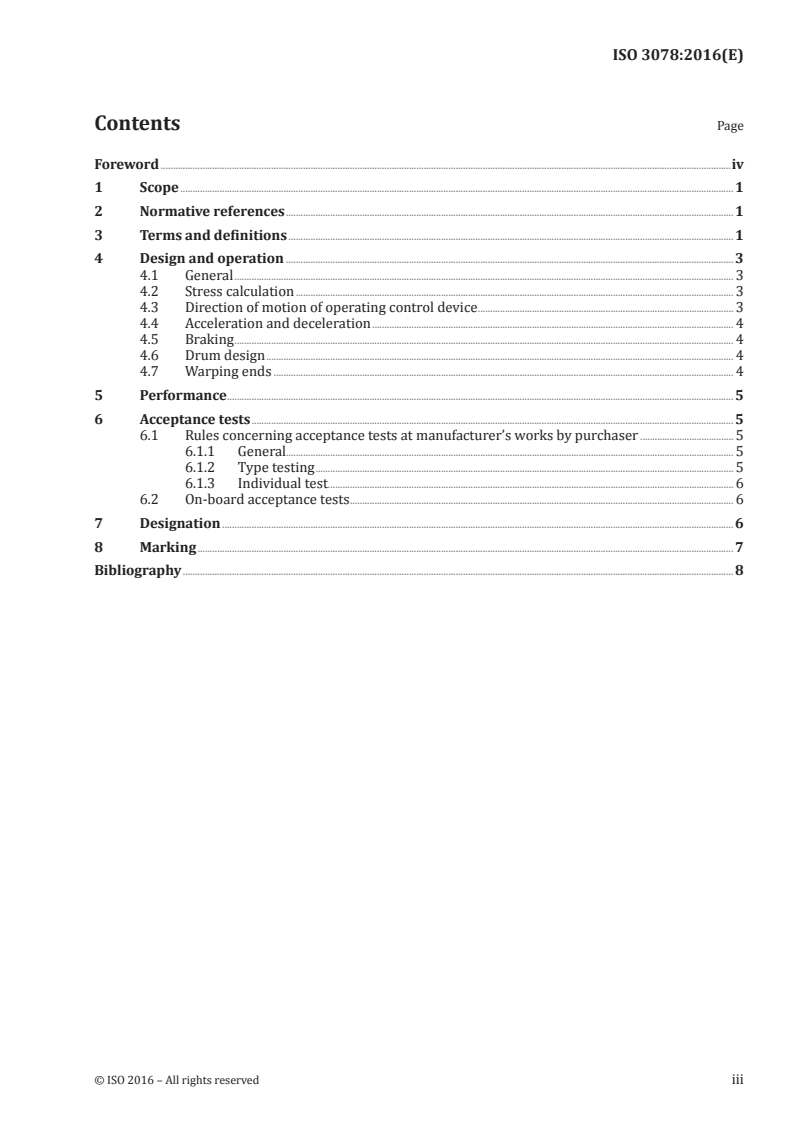
Contents Page
Foreword .iv
1 Scope . 1
2 Normative references . 1
3 Terms and definitions . 1
4 Design and operation . 3
4.1 General . 3
4.2 Stress calculation . 3
4.3 Direction of motion of operating control device . 3
4.4 Acceleration and deceleration . 4
4.5 Braking . 4
4.6 Drum design . 4
4.7 Warping ends . 4
5 Performance . 5
6 Acceptance tests . 5
6.1 Rules concerning acceptance tests at manufacturer’s works by purchaser . 5
6.1.1 General. 5
6.1.2 Type testing . 5
6.1.3 Individual test. 6
6.2 On-board acceptance tests . 6
7 Designation . 6
8 Marking . 7
Bibliography . 8
Foreword
ISO (the International Organization for Standardization) is a worldwide federation of national standards
bodies (ISO member bodies). The work of preparing International Standards is normally carried out
through ISO technical committees. Each member body interested in a subject for which a technical
committee has been established has the right to be represented on that committee. International
organizations, governmental and non-governmental, in liaison with ISO, also take part in the work.
ISO collaborates closely with the International Electrotechnical Commission (IEC) on all matters of
electrotechnical standardization.
The procedures used to develop this document and those intended for its further maintenance are
described in the ISO/IEC Directives, Part 1. In particular the different approval criteria needed for the
different types of ISO documents should be noted. This document was drafted in accordance with the
editorial rules of the ISO/IEC Directives, Part 2 (see www.iso.org/directives).
Attention is drawn to the possibility that some of the elements of this document may be the subject of
patent rights. ISO shall not be held responsible for identifying any or all such patent rights. Details of
any patent rights identified during the development of the document will be in the Introduction and/or
on the ISO list of patent declarations received (see www.iso.org/patents).
Any trade name used in this document is information given for the convenience of users and does not
constitute an endorsement.
For an explanation on the meaning of ISO specific terms and expressions related to conformity assessment,
as well as information about ISO’s adherence to the World Trade Organization (WTO) principles in the
Technical Barriers to Trade (TBT) see the following URL: www.iso.org/iso/foreword.html.
The committee responsible for this document is ISO/TC 8, Ships and marine technology, Subcommittee
SC 4, Outfitting and deck machinery.
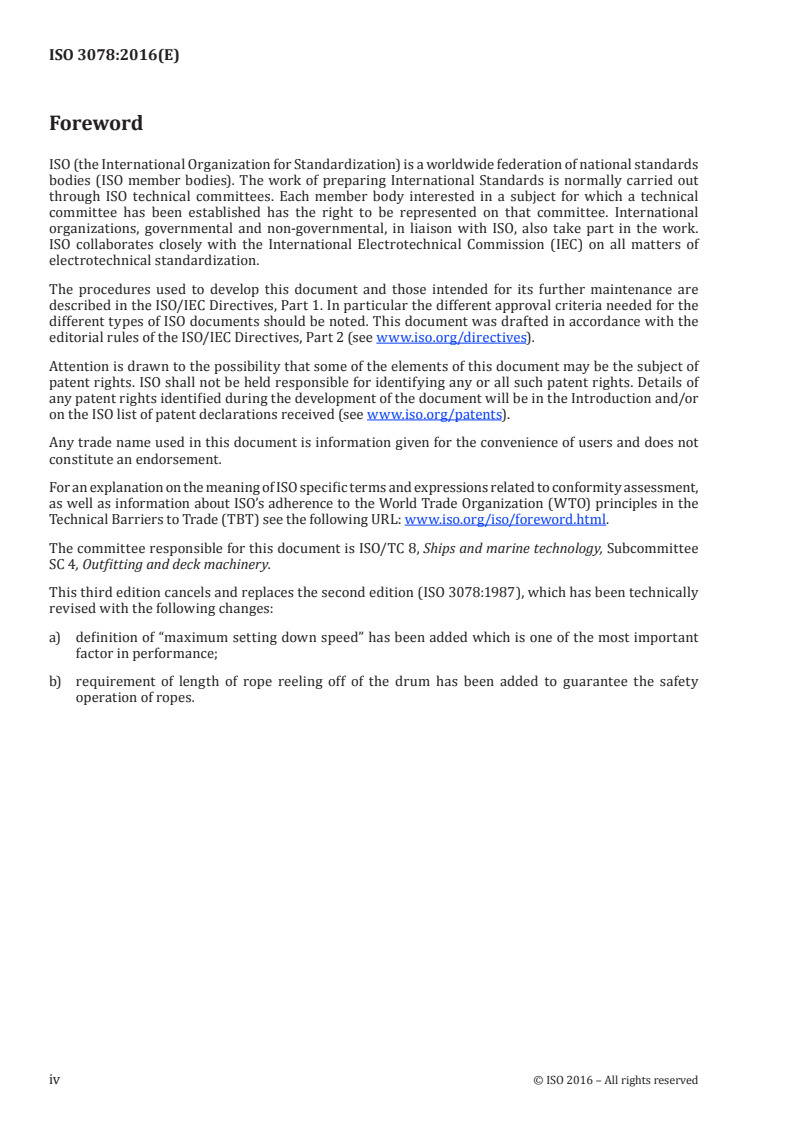
This third edition cancels and replaces the second edition (ISO 3078:1987), which has been technically
revised with the following changes:
a) definition of “maximum setting down speed” has been added which is one of the most important
factor in performance;
b) requirement of length of rope reeling off of the drum has been added to guarantee the safety
operation of ropes.
iv © ISO 2016 – All rights reserved
INTERNATIONAL STANDARD ISO 3078:2016(E)
Shipbuilding — Cargo winches
1 Scope
This document specifies the general requirements of cargo winches on cargo derricks, particularly
electric drive or hydraulic drive.
2 Normative references
The following documents are referred to in the text in such a way that some or all of their content
constitutes requirements of this document. For dated references, only the edition cited applies. For
undated references, the latest edition of the referenced document (including any amendments) applies.
ISO 2408, Steel wire ropes for general purpose — Characteristics
ISO 6482, Shipbuilding — Deck machinery — Warping end profiles
ISO 7825, Shipbuilding — Deck machinery — General requirements
3 Terms and definitions
For the purposes of this document, the terms and definitions given in ISO 3828 and the following apply.
ISO and IEC maintain terminological databases for use in standardization at the following addresses:
— IEC Electropedia: available at http://www.electropedia.org/
— ISO Online browsing platform: available at http://www.iso.org/obp
3.1
cargo winch
winch used for hoisting and lowering cargo
[SOURCE: ISO 3828:2008, 4.2]
3.2
nominal size
size which corresponds to the nominal load, i.e. the maximum working load at the hook, in kilonewtons,
which the winch is rated to lift in direct operations (with a single sheave at the derrick-head and a
single sheave at the foot)
Note 1 to entry: Winches are graded according to their nominal size as given in Table 1.
Note 2 to entry: If the winch has reduction gear with several gear ratios, each step shall correspond to a nominal
load in Table 1.
Note 3 to entry: The nominal sizes are derived from the preferred number series.
Note 4 to entry: The definition of the nominal size given above is not applicable to heavy derricks.
Note 5 to entry: See Figure 1.
3.3
nominal speed of hoisting
minimum speed at which the winch is capable of lifting the nominal load
Note 1 to entry: The minimum nominal speeds of hoisting are given in Table 1.
3.4
drum load
maximum rope tension measured at the drum exit when the winch is hauling in at the nomin
...
INTERNATIONAL ISO
STANDARD 3078
Third edition
2016-11-15
Shipbuilding — Cargo winches
Construction navale — Treuils de charge
Reference number
©
ISO 2016
© ISO 2016, Published in Switzerland
All rights reserved. Unless otherwise specified, no part of this publication may be reproduced or utilized otherwise in any form
or by any means, electronic or mechanical, including photocopying, or posting on the internet or an intranet, without prior
written permission. Permission can be requested from either ISO at the address below or ISO’s member body in the country of
the requester.
ISO copyright office
Ch. de Blandonnet 8 • CP 401
CH-1214 Vernier, Geneva, Switzerland
Tel. +41 22 749 01 11
Fax +41 22 749 09 47
copyright@iso.org
www.iso.org
ii © ISO 2016 – All rights reserved
Contents Page
Foreword .iv
1 Scope . 1
2 Normative references . 1
3 Terms and definitions . 1
4 Design and operation . 3
4.1 General . 3
4.2 Stress calculation . 3
4.3 Direction of motion of operating control device . 3
4.4 Acceleration and deceleration . 4
4.5 Braking . 4
4.6 Drum design . 4
4.7 Warping ends . 4
5 Performance . 5
6 Acceptance tests . 5
6.1 Rules concerning acceptance tests at manufacturer’s works by purchaser . 5
6.1.1 General. 5
6.1.2 Type testing . 5
6.1.3 Individual test. 6
6.2 On-board acceptance tests . 6
7 Designation . 6
8 Marking . 7
Bibliography . 8
Foreword
ISO (the International Organization for Standardization) is a worldwide federation of national standards
bodies (ISO member bodies). The work of preparing International Standards is normally carried out
through ISO technical committees. Each member body interested in a subject for which a technical
committee has been established has the right to be represented on that committee. International
organizations, governmental and non-governmental, in liaison with ISO, also take part in the work.
ISO collaborates closely with the International Electrotechnical Commission (IEC) on all matters of
electrotechnical standardization.
The procedures used to develop this document and those intended for its further maintenance are
described in the ISO/IEC Directives, Part 1. In particular the different approval criteria needed for the
different types of ISO documents should be noted. This document was drafted in accordance with the
editorial rules of the ISO/IEC Directives, Part 2 (see www.iso.org/directives).
Attention is drawn to the possibility that some of the elements of this document may be the subject of
patent rights. ISO shall not be held responsible for identifying any or all such patent rights. Details of
any patent rights identified during the development of the document will be in the Introduction and/or
on the ISO list of patent declarations received (see www.iso.org/patents).
Any trade name used in this document is information given for the convenience of users and does not
constitute an endorsement.
For an explanation on the meaning of ISO specific terms and expressions related to conformity assessment,
as well as information about ISO’s adherence to the World Trade Organization (WTO) principles in the
Technical Barriers to Trade (TBT) see the following URL: www.iso.org/iso/foreword.html.
The committee responsible for this document is ISO/TC 8, Ships and marine technology, Subcommittee
SC 4, Outfitting and deck machinery.
This third edition cancels and replaces the second edition (ISO 3078:1987), which has been technically
revised with the following changes:
a) definition of “maximum setting down speed” has been added which is one of the most important
factor in performance;
b) requirement of length of rope reeling off of the drum has been added to guarantee the safety
operation of ropes.
iv © ISO 2016 – All rights reserved
INTERNATIONAL STANDARD ISO 3078:2016(E)
Shipbuilding — Cargo winches
1 Scope
This document specifies the general requirements of cargo winches on cargo derricks, particularly
electric drive or hydraulic drive.
2 Normative references
The following documents are referred to in the text in such a way that some or all of their content
constitutes requirements of this document. For dated references, only the edition cited applies. For
undated references, the latest edition of the referenced document (including any amendments) applies.
ISO 2408, Steel wire ropes for general purpose — Characteristics
ISO 6482, Shipbuilding — Deck machinery — Warping end profiles
ISO 7825, Shipbuilding — Deck machinery — General requirements
3 Terms and definitions
For the purposes of this document, the terms and definitions given in ISO 3828 and the following apply.
ISO and IEC maintain terminological databases for use in standardization at the following addresses:
— IEC Electropedia: available at http://www.electropedia.org/
— ISO Online browsing platform: available at http://www.iso.org/obp
3.1
cargo winch
winch used for hoisting and lowering cargo
[SOURCE: ISO 3828:2008, 4.2]
3.2
nominal size
size which corresponds to the nominal load, i.e. the maximum working load at the hook, in kilonewtons,
which the winch is rated to lift in direct operations (with a single sheave at the derrick-head and a
single sheave at the foot)
Note 1 to entry: Winches are graded according to their nominal size as given in Table 1.
Note 2 to entry: If the winch has reduction gear with several gear ratios, each step shall correspond to a nominal
load in Table 1.
Note 3 to entry: The nominal sizes are derived from the preferred number series.
Note 4 to entry: The definition of the nominal size given above is not applicable to heavy derricks.
Note 5 to entry: See Figure 1.
3.3
nominal speed of hoisting
minimum speed at which the winch is capable of lifting the nominal load
Note 1 to entry: The minimum nominal speeds of hoisting are given in Table 1.
3.4
drum load
maximum rope tension measured at the drum exit when the winch is hauling in at the nomin
...