

ISO 21125:2019
(Main)Ships and marine technology — Marine cranes — Manufacturing requirements
General Information
- Abstract
This document specifies the general technical manufacturing requirements for marine cranes of metal construction. This document is applicable to the following types of marine cranes: — deck cranes mounted on ships for handling cargo or containers in harbour conditions; — floating cranes or grab cranes mounted on barges or pontoons for operating in harbour conditions; — engine room cranes and provision cranes, etc. mounted on ships (including floating docks) for handling equipment and stores in harbour conditions. NOTE Marine cranes in other types of crane can refer to this document. This document does not apply to cranes manufactured to operate in: — ambient operating temperatures below −20 °C; — ambient operating temperatures above +45 °C; — lifting operations below sea level; — lifting operations involving more than one crane; — emergency rescue operations; — shore-side cargo handling cranes; — lifting lifeboats, liferafts accommodation ladders, pilot ladders, gangways and their handling appliances; — launching appliances for survival craft and rescue boats.
- Status
- Published
- Publication Date
- 04-Jun-2019
- Technical Committee
- ISO/TC 8/SC 4 - Outfitting and deck machinery
- Drafting Committee
- ISO/TC 8/SC 4 - Outfitting and deck machinery
- Current Stage
- 9093 - International Standard confirmed
- Start Date
- 03-Sep-2024
- Completion Date
- 29-Aug-2026
Buy Documents
ISO 21125:2019 - Ships and marine technology -- Marine cranes -- Manufacturing requirements
ISO 21125:2019 - Ships and marine technology — Marine cranes — Manufacturing requirements/5/2019
Overview
ISO 21125:2019 - Ships and marine technology - Marine cranes - Manufacturing requirements - defines the general technical manufacturing requirements for metal marine cranes intended for harbour conditions. Published in 2019, the standard targets deck cranes, floating/barge-mounted cranes, engine-room and provision cranes used on ships (including floating docks). It complements related ISO crane standards and focuses on fabrication, assembly, corrosion protection, testing and documentation.
Key topics and technical requirements
The standard covers practical manufacturing controls and inspection practices, including:
Scope & exclusions
- Applicable to metal marine cranes for harbour operations.
- Not applicable to operation below −20 °C or above +45 °C, multi-crane lifts, emergency rescue, shore-side cargo cranes, lifeboat/launching appliances and certain other specified uses.
Materials & traceability
- Requirements for material selection and maintaining test/inspection certificates and records.
Fabrication & welding
- Rules for welded connections between plates of differing thickness, allowable mismatches, clearance between weld seams, and dimensional tolerances for assemblies.
Machining & dimensional control
- Inspection records for critical mating surfaces (shafts, holes, flanges, sheaves) and planarity checks during shipboard installation.
Anticorrosion & oil sealing
- Surface preparation, rust removal and continuous oil-sealing procedures before storage or installation.
Mechanical, hydraulic and electrical assembly
- Field/ workshop requirements, component identification and records, bolt-torque and assembly sequence guidance, hydraulic port marking, pipe tracing, and electrical cable lay/installation principles.
Tests, markings & documentation
- Requirements for keeping test records, marking plates and traceability for inspection by ship classification or inspection institutions.
Applications and who uses it
ISO 21125:2019 is intended for practical use by:
- Marine crane manufacturers - to define production, welding, machining, assembly and QA processes.
- Shipbuilders and offshore fabricators - for integrating cranes during shipboard installation and verifying flange planarity and mounting tolerances.
- Classification societies and inspection bodies - for conformity checks and review of material/test certificates.
- Ship operators, fleet maintenance and OEM service providers - to guide maintenance, replacement part manufacture and safe reassembly.
Related standards
Key linked documents referenced by ISO 21125:2019:
- ISO 19354 (Marine cranes - General requirements)
- ISO 19355 (Structural requirements)
- ISO 19356 (Test specifications)
- ISO 19360 (Rigging applications)
- ISO 3828 and ISO 4306‑1 (vocabulary and symbols)
Using ISO 21125:2019 helps ensure robust, traceable manufacturing and safer marine crane installation and operation in harbour environments.
Buy Documents
ISO 21125:2019 - Ships and marine technology -- Marine cranes -- Manufacturing requirements
ISO 21125:2019 - Ships and marine technology — Marine cranes — Manufacturing requirements/5/2019
Get Certified
Connect with accredited certification bodies for this standard

DNV
DNV is an independent assurance and risk management provider.

Lloyd's Register
Lloyd's Register is a global professional services organisation specialising in engineering and technology.

FSC International
Forest Stewardship Council certification.
Sponsored listings
Frequently Asked Questions
ISO 21125:2019 is a standard published by the International Organization for Standardization (ISO). Its full title is "Ships and marine technology — Marine cranes — Manufacturing requirements". This standard covers: This document specifies the general technical manufacturing requirements for marine cranes of metal construction. This document is applicable to the following types of marine cranes: — deck cranes mounted on ships for handling cargo or containers in harbour conditions; — floating cranes or grab cranes mounted on barges or pontoons for operating in harbour conditions; — engine room cranes and provision cranes, etc. mounted on ships (including floating docks) for handling equipment and stores in harbour conditions. NOTE Marine cranes in other types of crane can refer to this document. This document does not apply to cranes manufactured to operate in: — ambient operating temperatures below −20 °C; — ambient operating temperatures above +45 °C; — lifting operations below sea level; — lifting operations involving more than one crane; — emergency rescue operations; — shore-side cargo handling cranes; — lifting lifeboats, liferafts accommodation ladders, pilot ladders, gangways and their handling appliances; — launching appliances for survival craft and rescue boats.
This document specifies the general technical manufacturing requirements for marine cranes of metal construction. This document is applicable to the following types of marine cranes: — deck cranes mounted on ships for handling cargo or containers in harbour conditions; — floating cranes or grab cranes mounted on barges or pontoons for operating in harbour conditions; — engine room cranes and provision cranes, etc. mounted on ships (including floating docks) for handling equipment and stores in harbour conditions. NOTE Marine cranes in other types of crane can refer to this document. This document does not apply to cranes manufactured to operate in: — ambient operating temperatures below −20 °C; — ambient operating temperatures above +45 °C; — lifting operations below sea level; — lifting operations involving more than one crane; — emergency rescue operations; — shore-side cargo handling cranes; — lifting lifeboats, liferafts accommodation ladders, pilot ladders, gangways and their handling appliances; — launching appliances for survival craft and rescue boats.
ISO 21125:2019 is classified under the following ICS (International Classification for Standards) categories: 47.020.40 - Lifting and cargo handling equipment. The ICS classification helps identify the subject area and facilitates finding related standards.
ISO 21125:2019 is available in PDF format for immediate download after purchase. The document can be added to your cart and obtained through the secure checkout process. Digital delivery ensures instant access to the complete standard document.
Standards Content (Sample)
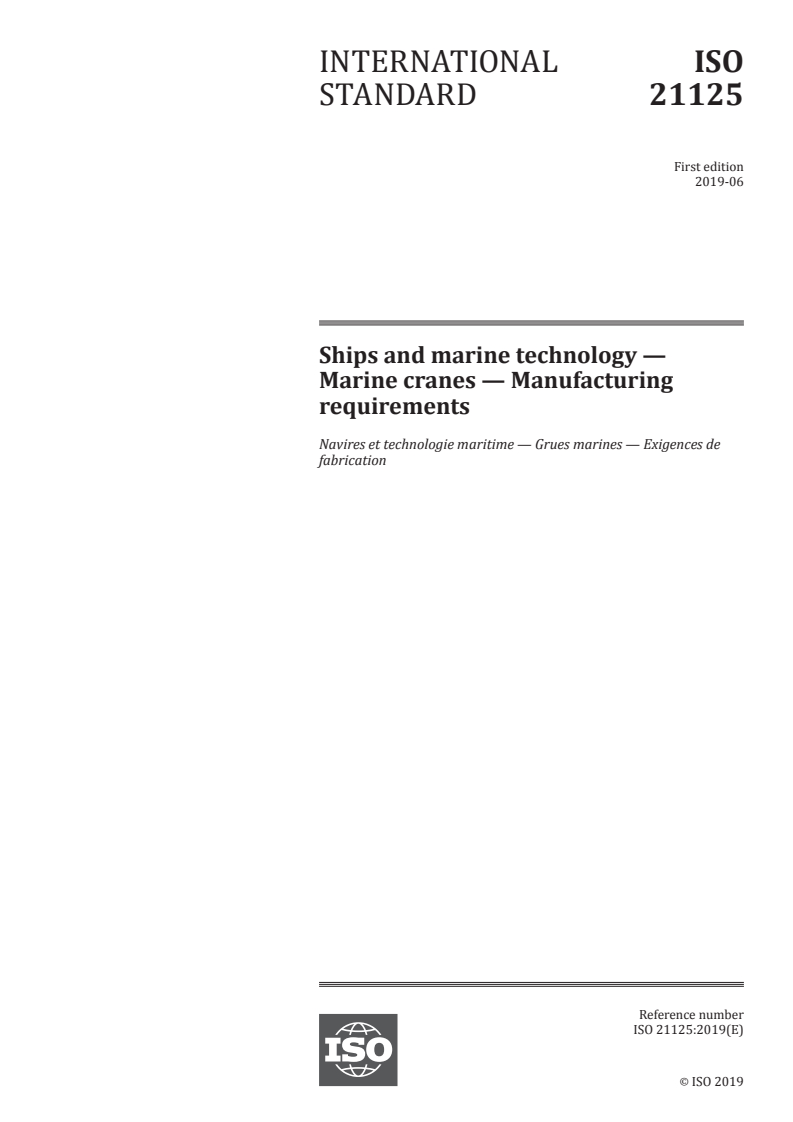
INTERNATIONAL ISO
STANDARD 21125
First edition
2019-06
Ships and marine technology —
Marine cranes — Manufacturing
requirements
Navires et technologie maritime — Grues marines — Exigences de
fabrication
Reference number
©
ISO 2019
© ISO 2019
All rights reserved. Unless otherwise specified, or required in the context of its implementation, no part of this publication may
be reproduced or utilized otherwise in any form or by any means, electronic or mechanical, including photocopying, or posting
on the internet or an intranet, without prior written permission. Permission can be requested from either ISO at the address
below or ISO’s member body in the country of the requester.
ISO copyright office
CP 401 • Ch. de Blandonnet 8
CH-1214 Vernier, Geneva
Phone: +41 22 749 01 11
Fax: +41 22 749 09 47
Email: copyright@iso.org
Website: www.iso.org
Published in Switzerland
ii © ISO 2019 – All rights reserved
Contents Page
Foreword .iv
1 Scope . 1
2 Normative references . 1
3 Terms and definitions . 2
4 General requirements . 2
5 Fabrication standard . 2
5.1 Materials . 2
5.2 Welded connection of steel plates . 2
5.3 Machinery processing . 4
5.4 Anticorrosion and oil seal . 5
6 Mechanical, hydraulic and electrical assembly . 5
6.1 Field requirements . 5
6.2 Mechanical assembly . 5
6.3 Hydraulic assembly . 6
6.4 Installation of electrical system. 6
6.4.1 General requirements . 6
6.4.2 Cable lay . 6
6.5 Other installations . 6
6.6 Shipboard installation . 7
7 Lubricating, oil sealing and coating . 7
8 Tests . 8
9 Markings and plates . 8
Bibliography . 9
Foreword
ISO (the International Organization for Standardization) is a worldwide federation of national standards
bodies (ISO member bodies). The work of preparing International Standards is normally carried out
through ISO technical committees. Each member body interested in a subject for which a technical
committee has been established has the right to be represented on that committee. International
organizations, governmental and non-governmental, in liaison with ISO, also take part in the work.
ISO collaborates closely with the International Electrotechnical Commission (IEC) on all matters of
electrotechnical standardization.
The procedures used to develop this document and those intended for its further maintenance are
described in the ISO/IEC Directives, Part 1. In particular, the different approval criteria needed for the
different types of ISO documents should be noted. This document was drafted in accordance with the
editorial rules of the ISO/IEC Directives, Part 2 (see www .iso .org/directives).
Attention is drawn to the possibility that some of the elements of this document may be the subject of
patent rights. ISO shall not be held responsible for identifying any or all such patent rights. Details of
any patent rights identified during the development of the document will be in the Introduction and/or
on the ISO list of patent declarations received (see www .iso .org/patents).
Any trade name used in this document is information given for the convenience of users and does not
constitute an endorsement.
For an explanation of the voluntary nature of standards, the meaning of ISO specific terms and
expressions related to conformity assessment, as well as information about ISO's adherence to the
World Trade Organization (WTO) principles in the Technical Barriers to Trade (TBT), see www .iso
.org/iso/foreword .html.
This document was prepared by Technical Committee ISO/TC 8, Ships and marine technology,
Subcommittee SC 4, Outfitting and deck machinery.
Any feedback or questions on this document should be directed to the user’s national standards body. A
complete listing of these bodies can be found at www .iso .org/members .html.
iv © ISO 2019 – All rights reserved
INTERNATIONAL STANDARD ISO 21125:2019(E)
Ships and marine technology — Marine cranes —
Manufacturing requirements
1 Scope
This document specifies the general technical manufacturing requirements for marine cranes of metal
construction.
This document is applicable to the following types of marine cranes:
— deck cranes mounted on ships for handling cargo or containers in harbour conditions;
— floating cranes or grab cranes mounted on barges or pontoons for operating in harbour conditions;
— engine room cranes and provision cranes, etc. mounted on ships (including floating docks) for
handling equipment and stores in harbour conditions.
NOTE Marine cranes in other types of crane can refer to this document.
This document does not apply to cranes manufactured to operate in:
— ambient operating temperatures below −20 °C;
— ambient operating temperatures above +45 °C;
— lifting operations below sea level;
— lifting operations involving more than one crane;
— emergency rescue operations;
— shore-side cargo handling cranes;
— lifting lifeboats, liferafts accommodation ladders, pilot ladders, gangways and their handling
appliances;
— launching appliances for survival craft and rescue boats.
2 Normative references
The following documents are referred to in the text in such a way that some or all of their content
constitutes requirements of this document. For dated references, only the edition cited applies. For
undated references, the latest edition of the referenced document (including any amendments) applies.
ISO 3828, Shipbuilding and marine structures — Deck machinery — Vocabulary and symbols
ISO 4306-1, Cranes — Vocabulary — Part 1: General
ISO 19354:2016, Ships and marine technology — Marine cranes — General requirements
ISO 19355, Ships and marine technology — Marine cranes — Structural requirements
ISO 19356, Ships and marine technology — Marine cranes — Test specifications and procedures
ISO 19360, Ships and marine technology — Marine cranes — Technical requirements for rigging
applications
3 Terms and definitions
For the purposes of this document, the terms and definitions given in ISO 4306-1, ISO 3828 and the
following apply.
ISO and IEC maintain terminological databases for use in standardization at the following addresses:
— ISO Online browsing platform: available at https: //www .iso .org/obp
— IEC Electropedia: available at http: //www .electropedia .org/
3.1
oil sealing
process of coating the machining surface of metal components with anti-corrosion grease to prevent
corrosion
4 General requirements
The manufacturing of marine cranes shall be in accordance with ISO 19354, ISO 19355, ISO 19356 and
ISO 19360.
5 Fabrication standard
5.1 Materials
5.1.1 Materials of marine cranes shall meet the requirements of 4.3 in ISO 19354:2016.
5.1.2 Detailed test records shall be kept for all the specified materials requiring testing. Inspection
certificates shall be provided for the inspected materials required by a ship inspection institution.
5.2 Welded connection of steel plates
5.2.1 The connection of components of different thickness shall be in accordance with Table 1.
Table 1 — Requirements for the connection of components of different thickness
Butting form Transitional slope
a:b ≤ 1:3
a:b ≤ 1:3
NOTE If the thickness difference is less than 4 mm, the connection can be done by its shape evenly within the welding width.
2 © ISO 2019 – All rights reserved
5.2.4 The mismatch allowable value of single-sided or double-sided butt welding bevel is given in
Table 2.
Table 2 — Allowable value for mismatch of different butting forms
Allowable value for mismatch
Butting form
(mm)
Double-sided welded seam for isopachous plates
Δa < 0,10 × s, maximum 2
(s is the plate thickness)
Single-sided welded seam for isopachous plates
Δa < 0,10 × s, maximum 2
(s is the plate thickness)
Butt we
...
INTERNATIONAL ISO
STANDARD 21125
First edition
2019-06
Ships and marine technology —
Marine cranes — Manufacturing
requirements
Navires et technologie maritime — Grues marines — Exigences de
fabrication
Reference number
©
ISO 2019
© ISO 2019
All rights reserved. Unless otherwise specified, or required in the context of its implementation, no part of this publication may
be reproduced or utilized otherwise in any form or by any means, electronic or mechanical, including photocopying, or posting
on the internet or an intranet, without prior written permission. Permission can be requested from either ISO at the address
below or ISO’s member body in the country of the requester.
ISO copyright office
CP 401 • Ch. de Blandonnet 8
CH-1214 Vernier, Geneva
Phone: +41 22 749 01 11
Fax: +41 22 749 09 47
Email: copyright@iso.org
Website: www.iso.org
Published in Switzerland
ii © ISO 2019 – All rights reserved
Contents Page
Foreword .iv
1 Scope . 1
2 Normative references . 1
3 Terms and definitions . 2
4 General requirements . 2
5 Fabrication standard . 2
5.1 Materials . 2
5.2 Welded connection of steel plates . 2
5.3 Machinery processing . 4
5.4 Anticorrosion and oil seal . 5
6 Mechanical, hydraulic and electrical assembly . 5
6.1 Field requirements . 5
6.2 Mechanical assembly . 5
6.3 Hydraulic assembly . 6
6.4 Installation of electrical system. 6
6.4.1 General requirements . 6
6.4.2 Cable lay . 6
6.5 Other installations . 6
6.6 Shipboard installation . 7
7 Lubricating, oil sealing and coating . 7
8 Tests . 8
9 Markings and plates . 8
Bibliography . 9
Foreword
ISO (the International Organization for Standardization) is a worldwide federation of national standards
bodies (ISO member bodies). The work of preparing International Standards is normally carried out
through ISO technical committees. Each member body interested in a subject for which a technical
committee has been established has the right to be represented on that committee. International
organizations, governmental and non-governmental, in liaison with ISO, also take part in the work.
ISO collaborates closely with the International Electrotechnical Commission (IEC) on all matters of
electrotechnical standardization.
The procedures used to develop this document and those intended for its further maintenance are
described in the ISO/IEC Directives, Part 1. In particular, the different approval criteria needed for the
different types of ISO documents should be noted. This document was drafted in accordance with the
editorial rules of the ISO/IEC Directives, Part 2 (see www .iso .org/directives).
Attention is drawn to the possibility that some of the elements of this document may be the subject of
patent rights. ISO shall not be held responsible for identifying any or all such patent rights. Details of
any patent rights identified during the development of the document will be in the Introduction and/or
on the ISO list of patent declarations received (see www .iso .org/patents).
Any trade name used in this document is information given for the convenience of users and does not
constitute an endorsement.
For an explanation of the voluntary nature of standards, the meaning of ISO specific terms and
expressions related to conformity assessment, as well as information about ISO's adherence to the
World Trade Organization (WTO) principles in the Technical Barriers to Trade (TBT), see www .iso
.org/iso/foreword .html.
This document was prepared by Technical Committee ISO/TC 8, Ships and marine technology,
Subcommittee SC 4, Outfitting and deck machinery.
Any feedback or questions on this document should be directed to the user’s national standards body. A
complete listing of these bodies can be found at www .iso .org/members .html.
iv © ISO 2019 – All rights reserved
INTERNATIONAL STANDARD ISO 21125:2019(E)
Ships and marine technology — Marine cranes —
Manufacturing requirements
1 Scope
This document specifies the general technical manufacturing requirements for marine cranes of metal
construction.
This document is applicable to the following types of marine cranes:
— deck cranes mounted on ships for handling cargo or containers in harbour conditions;
— floating cranes or grab cranes mounted on barges or pontoons for operating in harbour conditions;
— engine room cranes and provision cranes, etc. mounted on ships (including floating docks) for
handling equipment and stores in harbour conditions.
NOTE Marine cranes in other types of crane can refer to this document.
This document does not apply to cranes manufactured to operate in:
— ambient operating temperatures below −20 °C;
— ambient operating temperatures above +45 °C;
— lifting operations below sea level;
— lifting operations involving more than one crane;
— emergency rescue operations;
— shore-side cargo handling cranes;
— lifting lifeboats, liferafts accommodation ladders, pilot ladders, gangways and their handling
appliances;
— launching appliances for survival craft and rescue boats.
2 Normative references
The following documents are referred to in the text in such a way that some or all of their content
constitutes requirements of this document. For dated references, only the edition cited applies. For
undated references, the latest edition of the referenced document (including any amendments) applies.
ISO 3828, Shipbuilding and marine structures — Deck machinery — Vocabulary and symbols
ISO 4306-1, Cranes — Vocabulary — Part 1: General
ISO 19354:2016, Ships and marine technology — Marine cranes — General requirements
ISO 19355, Ships and marine technology — Marine cranes — Structural requirements
ISO 19356, Ships and marine technology — Marine cranes — Test specifications and procedures
ISO 19360, Ships and marine technology — Marine cranes — Technical requirements for rigging
applications
3 Terms and definitions
For the purposes of this document, the terms and definitions given in ISO 4306-1, ISO 3828 and the
following apply.
ISO and IEC maintain terminological databases for use in standardization at the following addresses:
— ISO Online browsing platform: available at https: //www .iso .org/obp
— IEC Electropedia: available at http: //www .electropedia .org/
3.1
oil sealing
process of coating the machining surface of metal components with anti-corrosion grease to prevent
corrosion
4 General requirements
The manufacturing of marine cranes shall be in accordance with ISO 19354, ISO 19355, ISO 19356 and
ISO 19360.
5 Fabrication standard
5.1 Materials
5.1.1 Materials of marine cranes shall meet the requirements of 4.3 in ISO 19354:2016.
5.1.2 Detailed test records shall be kept for all the specified materials requiring testing. Inspection
certificates shall be provided for the inspected materials required by a ship inspection institution.
5.2 Welded connection of steel plates
5.2.1 The connection of components of different thickness shall be in accordance with Table 1.
Table 1 — Requirements for the connection of components of different thickness
Butting form Transitional slope
a:b ≤ 1:3
a:b ≤ 1:3
NOTE If the thickness difference is less than 4 mm, the connection can be done by its shape evenly within the welding width.
2 © ISO 2019 – All rights reserved
5.2.4 The mismatch allowable value of single-sided or double-sided butt welding bevel is given in
Table 2.
Table 2 — Allowable value for mismatch of different butting forms
Allowable value for mismatch
Butting form
(mm)
Double-sided welded seam for isopachous plates
Δa < 0,10 × s, maximum 2
(s is the plate thickness)
Single-sided welded seam for isopachous plates
Δa < 0,10 × s, maximum 2
(s is the plate thickness)
Butt we
...