

ISO 19357:2016
(Main)Ships and marine technology — Marine cranes — Design requirements for low temperature operation
General Information
- Abstract
ISO 19357:2016 specifies the requirements for design, construction, safety, performance, acceptance test and operation of marine cranes for low temperature operation. ISO 19357:2016 is applicable to marine cranes of the following types, which are exposed to and operated in low temperatures: - deck cranes mounted on ships for handling cargo or containers in harbour or sheltered water conditions; - floating cranes or grab cranes mounted on barges or pontoons for operating in harbour conditions or sheltered water conditions; - engine room cranes and provision cranes, etc. mounted on ships (including floating docks) for handling equipment and stores in harbour conditions. ISO 19357:2016 is not applicable to the following: - minimum ambient operating temperatures no less than −20 °C; - maximum ambient operating temperatures above +45 °C; - transport, assembly, dismantling and decommissioning of cranes; - lifting accessories, i.e. any item between the crane and the load; - lifting operations involving more than one crane; - hand powered cranes; - emergency rescue operations; - shore-side cargo handling cranes; - portable cranes on board; - lifting appliances for lifeboats, liferafts accommodation ladders and pilot ladders; - launching appliances for survival craft and rescue boats; - gangways, accommodation and pilot ladders and their handling appliances.
- Status
- Published
- Publication Date
- 17-Nov-2016
- Technical Committee
- ISO/TC 8/SC 4 - Outfitting and deck machinery
- Drafting Committee
- ISO/TC 8/SC 4 - Outfitting and deck machinery
- Current Stage
- 9093 - International Standard confirmed
- Start Date
- 09-Aug-2022
- Completion Date
- 29-Aug-2026
Buy Documents



ISO 19357:2016 - Ships and marine technology -- Marine cranes -- Design requirements for low temperature operation

ISO 19357:2016 - Ships and marine technology — Marine cranes — Design requirements for low temperature operation/18/2016
Overview
ISO 19357:2016 - Ships and marine technology - Marine cranes - Design requirements for low temperature operation - defines design, construction, safety, performance, acceptance testing and operational requirements for marine cranes intended to operate in low-temperature environments. The standard targets cranes exposed to cold climates (including polar service) and ensures mechanical, hydraulic, electrical and material systems remain reliable and safe at specified low temperatures.
Scope - what it covers
ISO 19357:2016 applies to:
- Deck cranes on ships for cargo/container handling in harbour or sheltered waters
- Floating cranes / grab cranes mounted on barges or pontoons in harbour/sheltered waters
- Engine-room and provision cranes on ships and floating docks for handling equipment and stores
It is not applicable to cranes with minimum ambient operating temperatures no lower than −20 °C, nor to ambient temperatures above +45 °C, nor to a list of specific lifting appliances and shore-based or hand-powered cranes.
Key topics and technical requirements
- Design temperature / Polar Service Temperature (PST): Design service temperature (DST) equals PST and must be set by shipowner/designer at least 10 °C below the lowest Mean Daily Low Temperature (MDLT) for the intended area/season.
- Loads: Requirements for structural, snow and ice loads (snow and ice accumulation considered in storage condition). The document specifies calculation bases for snow and ice loads to ensure structural integrity.
- Material selection: Guidance on rolled steels, forgings, castings, welding consumables, and impact properties suitable for low-temperature service. Material grades and impact requirements are selected to avoid brittle fracture at low temperatures.
- Power, hydraulic and lubrication systems: Reliability of hydraulic oil, gear oils and greases at low temperatures; selection of low-freezing fluids and sealing materials.
- Structure and safety systems: Structural design, insulation/heating of critical components, cabin protection, moisture protection, surface protection, platforms and access for safe operation in cold climates.
- Rope, sheaves and removable parts: Materials, bearings and lubrication suitable for low-temperature operation.
- Inspection and acceptance: Functional and performance tests, visual and surface-protective inspections specific to cold environment readiness.
Applications - who uses ISO 19357:2016
- Shipowners and designers planning vessels for polar or cold-region service
- Marine crane manufacturers engineering cranes for low-temperature operation
- Shipyards and classification societies for compliance checks and certification
- Maintenance and inspection teams implementing tests, acceptance procedures and cold-weather inspections
Related standards
Normative references within ISO 19357:2016 include:
- ISO 19354 - Marine cranes: General requirements
- ISO 19355 - Marine cranes: Structural requirements
- ISO 19356 - Marine cranes: Test specifications and procedures
ISO 19357:2016 is essential when specifying or verifying marine crane performance, materials and safety for operations in polar or other low-temperature maritime environments.
Buy Documents
ISO 19357:2016 - Ships and marine technology -- Marine cranes -- Design requirements for low temperature operation
ISO 19357:2016 - Ships and marine technology — Marine cranes — Design requirements for low temperature operation/18/2016
Get Certified
Connect with accredited certification bodies for this standard

DNV
DNV is an independent assurance and risk management provider.

Lloyd's Register
Lloyd's Register is a global professional services organisation specialising in engineering and technology.

FSC International
Forest Stewardship Council certification.
Sponsored listings
Frequently Asked Questions
ISO 19357:2016 is a standard published by the International Organization for Standardization (ISO). Its full title is "Ships and marine technology — Marine cranes — Design requirements for low temperature operation". This standard covers: ISO 19357:2016 specifies the requirements for design, construction, safety, performance, acceptance test and operation of marine cranes for low temperature operation. ISO 19357:2016 is applicable to marine cranes of the following types, which are exposed to and operated in low temperatures: - deck cranes mounted on ships for handling cargo or containers in harbour or sheltered water conditions; - floating cranes or grab cranes mounted on barges or pontoons for operating in harbour conditions or sheltered water conditions; - engine room cranes and provision cranes, etc. mounted on ships (including floating docks) for handling equipment and stores in harbour conditions. ISO 19357:2016 is not applicable to the following: - minimum ambient operating temperatures no less than −20 °C; - maximum ambient operating temperatures above +45 °C; - transport, assembly, dismantling and decommissioning of cranes; - lifting accessories, i.e. any item between the crane and the load; - lifting operations involving more than one crane; - hand powered cranes; - emergency rescue operations; - shore-side cargo handling cranes; - portable cranes on board; - lifting appliances for lifeboats, liferafts accommodation ladders and pilot ladders; - launching appliances for survival craft and rescue boats; - gangways, accommodation and pilot ladders and their handling appliances.
ISO 19357:2016 specifies the requirements for design, construction, safety, performance, acceptance test and operation of marine cranes for low temperature operation. ISO 19357:2016 is applicable to marine cranes of the following types, which are exposed to and operated in low temperatures: - deck cranes mounted on ships for handling cargo or containers in harbour or sheltered water conditions; - floating cranes or grab cranes mounted on barges or pontoons for operating in harbour conditions or sheltered water conditions; - engine room cranes and provision cranes, etc. mounted on ships (including floating docks) for handling equipment and stores in harbour conditions. ISO 19357:2016 is not applicable to the following: - minimum ambient operating temperatures no less than −20 °C; - maximum ambient operating temperatures above +45 °C; - transport, assembly, dismantling and decommissioning of cranes; - lifting accessories, i.e. any item between the crane and the load; - lifting operations involving more than one crane; - hand powered cranes; - emergency rescue operations; - shore-side cargo handling cranes; - portable cranes on board; - lifting appliances for lifeboats, liferafts accommodation ladders and pilot ladders; - launching appliances for survival craft and rescue boats; - gangways, accommodation and pilot ladders and their handling appliances.
ISO 19357:2016 is classified under the following ICS (International Classification for Standards) categories: 47.020.40 - Lifting and cargo handling equipment. The ICS classification helps identify the subject area and facilitates finding related standards.
ISO 19357:2016 is available in PDF format for immediate download after purchase. The document can be added to your cart and obtained through the secure checkout process. Digital delivery ensures instant access to the complete standard document.
Standards Content (Sample)
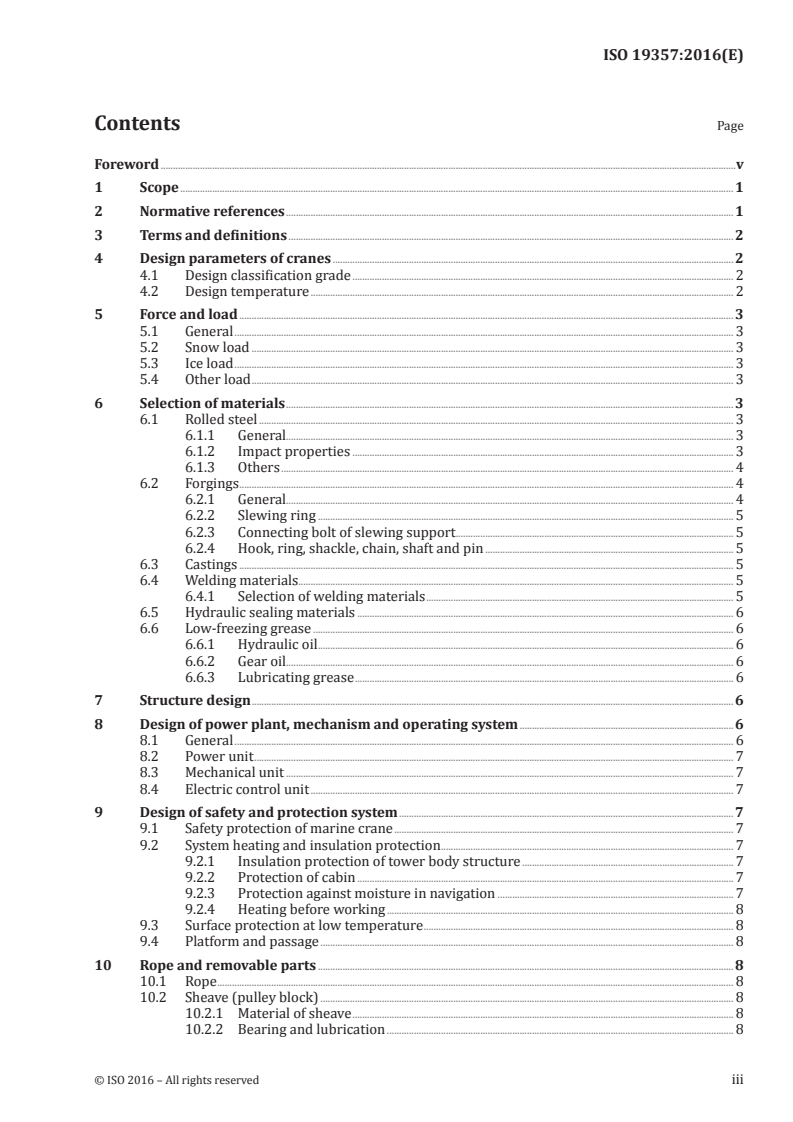
INTERNATIONAL ISO
STANDARD 19357
First edition
2016-11-15
Ships and marine technology —
Marine cranes — Design requirements
for low temperature operation
Navires et technologie maritime — Grues marines — Exigences de
conception pour une exploitation à basses températures
Reference number
©
ISO 2016
© ISO 2016, Published in Switzerland
All rights reserved. Unless otherwise specified, no part of this publication may be reproduced or utilized otherwise in any form
or by any means, electronic or mechanical, including photocopying, or posting on the internet or an intranet, without prior
written permission. Permission can be requested from either ISO at the address below or ISO’s member body in the country of
the requester.
ISO copyright office
Ch. de Blandonnet 8 • CP 401
CH-1214 Vernier, Geneva, Switzerland
Tel. +41 22 749 01 11
Fax +41 22 749 09 47
copyright@iso.org
www.iso.org
ii © ISO 2016 – All rights reserved
Contents Page
Foreword .v
1 Scope . 1
2 Normative references . 1
3 Terms and definitions . 2
4 Design parameters of cranes . 2
4.1 Design classification grade . 2
4.2 Design temperature . 2
5 Force and load . 3
5.1 General . 3
5.2 Snow load . 3
5.3 Ice load . 3
5.4 Other load . 3
6 Selection of materials . 3
6.1 Rolled steel . 3
6.1.1 General. 3
6.1.2 Impact properties . 3
6.1.3 Others . 4
6.2 Forgings . 4
6.2.1 General. 4
6.2.2 Slewing ring . 5
6.2.3 Connecting bolt of slewing support. 5
6.2.4 Hook, ring, shackle, chain, shaft and pin . 5
6.3 Castings . 5
6.4 Welding materials. 5
6.4.1 Selection of welding materials . 5
6.5 Hydraulic sealing materials . 6
6.6 Low-freezing grease . 6
6.6.1 Hydraulic oil . 6
6.6.2 Gear oil. 6
6.6.3 Lubricating grease . 6
7 Structure design . 6
8 Design of power plant, mechanism and operating system . 6
8.1 General . 6
8.2 Power unit . 7
8.3 Mechanical unit . 7
8.4 Electric control unit . 7
9 Design of safety and protection system . 7
9.1 Safety protection of marine crane . 7
9.2 System heating and insulation protection . 7
9.2.1 Insulation protection of tower body structure . 7
9.2.2 Protection of cabin . 7
9.2.3 Protection against moisture in navigation . 7
9.2.4 Heating before working . 8
9.3 Surface protection at low temperature . 8
9.4 Platform and passage . 8
10 Rope and removable parts . 8
10.1 Rope . 8
10.2 Sheave (pulley block) . 8
10.2.1 Material of sheave . 8
10.2.2 Bearing and lubrication . 8
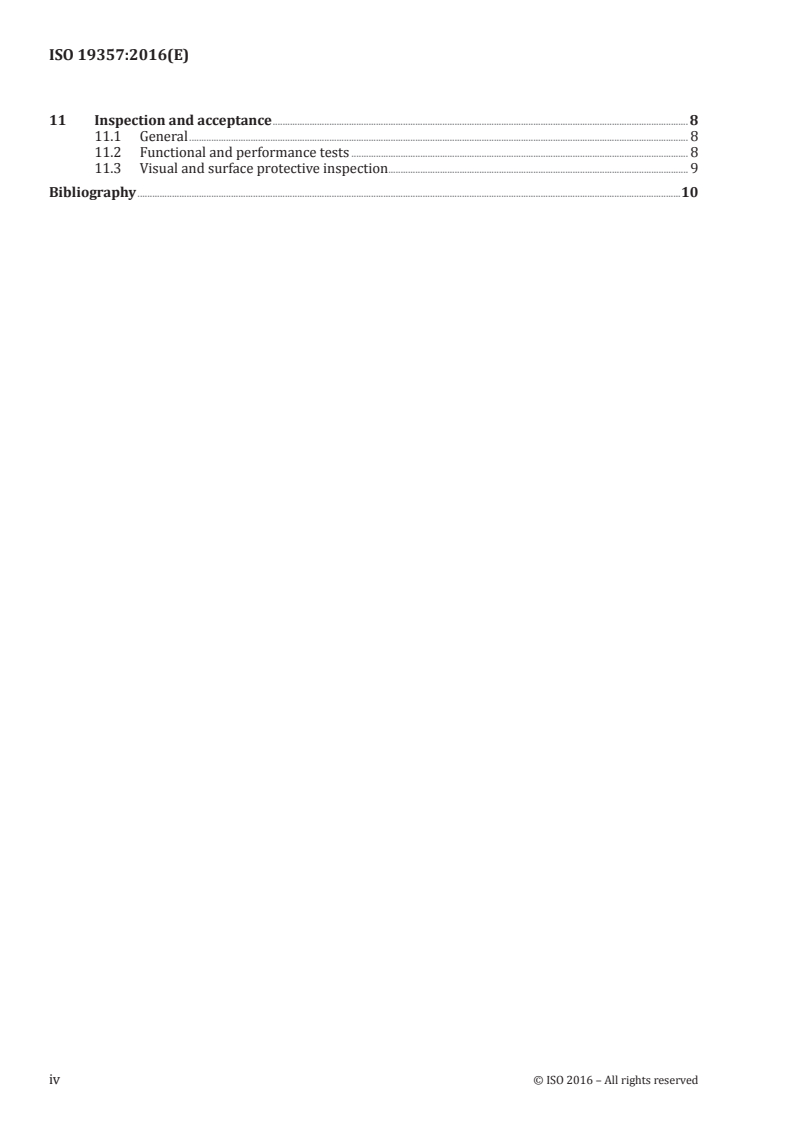
11 Inspection and acceptance . 8
11.1 General . 8
11.2 Functional and performance tests . 8
11.3 Visual and surface protective inspection. 9
Bibliography .10
iv © ISO 2016 – All rights reserved
Foreword
ISO (the International Organization for Standardization) is a worldwide federation of national standards
bodies (ISO member bodies). The work of preparing International Standards is normally carried out
through ISO technical committees. Each member body interested in a subject for which a technical
committee has been established has the right to be represented on that committee. International
organizations, governmental and non-governmental, in liaison with ISO, also take part in the work.
ISO collaborates closely with the International Electrotechnical Commission (IEC) on all matters of
electrotechnical standardization.
The procedures used to develop this document and those intended for its further maintenance are
described in the ISO/IEC Directives, Part 1. In particular the different approval criteria needed for the
different types of ISO documents should be noted. This document was drafted in accordance with the
editorial rules of the ISO/IEC Directives, Part 2 (see www.iso.org/directives).
Attention is drawn to the possibility that some of the elements of this document may be the subject of
patent rights. ISO shall not be held responsible for identifying any or all such patent rights. Details of
any patent rights identified during the development of the document will be in the Introduction and/or
on the ISO list of patent declarations received (see www.iso.org/patents).
Any trade name used in this document is information given for the convenience of users and does not
constitute an endorsement.
For an explanation on the meaning of ISO specific terms and expressions related to conformity assessment,
as well as information about ISO’s adherence to the World Trade Organization (WTO) principles in the
Technical Barriers to Trade (TBT) see the following URL: www.iso.org/iso/foreword.html.
The committee responsible for this document is ISO/TC 8, Ships and marine technology, Subcommittee
SC 4, Outfitting and deck machinery.
INTERNATIONAL STANDARD ISO 19357:2016(E)
Ships and marine technology — Marine cranes — Design
requirements for low temperature operation
1 Scope
This document specifies the requirements for design, construction, safety, performance, acceptance
test and operation of marine cranes for low temperature operation.
This document is applicable to marine cranes of the following types, which are exposed to and operated
in low temperatures:
— deck cranes mounted on ships for handling cargo or containers in harbour or sheltered water
conditions;
— floating cranes or grab cranes mounted on barges or pontoons for operating in harbour conditions
or sheltered water conditions;
— engine room cranes and provision cranes, etc. mounted on ships (including floating docks) for
handling equipment and stores in harbour conditions.
This document is not applicable to the following:
— minimum ambient operating temperatures no less than −20 °C;
— maximum ambient operating temperatures above +45 °C;
— transport, assembly, dismantling and decommissioning of cranes;
— lifting accessories, i.e. any item between the crane and the load;
— lifting operations involving more than one crane;
— hand powered cranes;
— emergency rescue operations;
— shore-side cargo handling cranes;
— portable cranes on board;
— lifting appliances for lifeboats, liferafts accommodation ladders and pilot ladders;
— launching appliances for survival craft and rescue boats;
— gangways, accommodation and pilot ladders and their handling appliances.
2 Normative references
The following documents are referred to in the text in such a way that some or all of their content
constitutes requirements of this document. For dated references, only the edition cited applies. For
undated references, the latest edition of the referenced document (including any amendments) applies.
ISO 19354, Ships and marine technology — Marine cranes — General requirements
ISO 19355, Ships and marine technology — Marine cranes — Structural requirements
ISO 19356, Ships and marine technology — Marine cranes — Test specification and procedures
3 Terms and definitions
For the purposes of this document, the terms and definitions given in ISO 4306-1, ISO 3828 and the
following apply.
ISO and IEC maintain terminological databases for use in standardization at the following addresses:
— IEC Electropedia: available at http://www.electropedia.org/
— ISO Online browsing platform: available at http://www.iso.org/obp
3.1
mean daily low temperature
MDLT
mean value of the daily low temperature for each day of the year over a minimum of ten-year period
Note 1 to entry: A data set acceptab
...
INTERNATIONAL ISO
STANDARD 19357
First edition
2016-11-15
Ships and marine technology —
Marine cranes — Design requirements
for low temperature operation
Navires et technologie maritime — Grues marines — Exigences de
conception pour une exploitation à basses températures
Reference number
©
ISO 2016
© ISO 2016, Published in Switzerland
All rights reserved. Unless otherwise specified, no part of this publication may be reproduced or utilized otherwise in any form
or by any means, electronic or mechanical, including photocopying, or posting on the internet or an intranet, without prior
written permission. Permission can be requested from either ISO at the address below or ISO’s member body in the country of
the requester.
ISO copyright office
Ch. de Blandonnet 8 • CP 401
CH-1214 Vernier, Geneva, Switzerland
Tel. +41 22 749 01 11
Fax +41 22 749 09 47
copyright@iso.org
www.iso.org
ii © ISO 2016 – All rights reserved
Contents Page
Foreword .v
1 Scope . 1
2 Normative references . 1
3 Terms and definitions . 2
4 Design parameters of cranes . 2
4.1 Design classification grade . 2
4.2 Design temperature . 2
5 Force and load . 3
5.1 General . 3
5.2 Snow load . 3
5.3 Ice load . 3
5.4 Other load . 3
6 Selection of materials . 3
6.1 Rolled steel . 3
6.1.1 General. 3
6.1.2 Impact properties . 3
6.1.3 Others . 4
6.2 Forgings . 4
6.2.1 General. 4
6.2.2 Slewing ring . 5
6.2.3 Connecting bolt of slewing support. 5
6.2.4 Hook, ring, shackle, chain, shaft and pin . 5
6.3 Castings . 5
6.4 Welding materials. 5
6.4.1 Selection of welding materials . 5
6.5 Hydraulic sealing materials . 6
6.6 Low-freezing grease . 6
6.6.1 Hydraulic oil . 6
6.6.2 Gear oil. 6
6.6.3 Lubricating grease . 6
7 Structure design . 6
8 Design of power plant, mechanism and operating system . 6
8.1 General . 6
8.2 Power unit . 7
8.3 Mechanical unit . 7
8.4 Electric control unit . 7
9 Design of safety and protection system . 7
9.1 Safety protection of marine crane . 7
9.2 System heating and insulation protection . 7
9.2.1 Insulation protection of tower body structure . 7
9.2.2 Protection of cabin . 7
9.2.3 Protection against moisture in navigation . 7
9.2.4 Heating before working . 8
9.3 Surface protection at low temperature . 8
9.4 Platform and passage . 8
10 Rope and removable parts . 8
10.1 Rope . 8
10.2 Sheave (pulley block) . 8
10.2.1 Material of sheave . 8
10.2.2 Bearing and lubrication . 8
11 Inspection and acceptance . 8
11.1 General . 8
11.2 Functional and performance tests . 8
11.3 Visual and surface protective inspection. 9
Bibliography .10
iv © ISO 2016 – All rights reserved
Foreword
ISO (the International Organization for Standardization) is a worldwide federation of national standards
bodies (ISO member bodies). The work of preparing International Standards is normally carried out
through ISO technical committees. Each member body interested in a subject for which a technical
committee has been established has the right to be represented on that committee. International
organizations, governmental and non-governmental, in liaison with ISO, also take part in the work.
ISO collaborates closely with the International Electrotechnical Commission (IEC) on all matters of
electrotechnical standardization.
The procedures used to develop this document and those intended for its further maintenance are
described in the ISO/IEC Directives, Part 1. In particular the different approval criteria needed for the
different types of ISO documents should be noted. This document was drafted in accordance with the
editorial rules of the ISO/IEC Directives, Part 2 (see www.iso.org/directives).
Attention is drawn to the possibility that some of the elements of this document may be the subject of
patent rights. ISO shall not be held responsible for identifying any or all such patent rights. Details of
any patent rights identified during the development of the document will be in the Introduction and/or
on the ISO list of patent declarations received (see www.iso.org/patents).
Any trade name used in this document is information given for the convenience of users and does not
constitute an endorsement.
For an explanation on the meaning of ISO specific terms and expressions related to conformity assessment,
as well as information about ISO’s adherence to the World Trade Organization (WTO) principles in the
Technical Barriers to Trade (TBT) see the following URL: www.iso.org/iso/foreword.html.
The committee responsible for this document is ISO/TC 8, Ships and marine technology, Subcommittee
SC 4, Outfitting and deck machinery.
INTERNATIONAL STANDARD ISO 19357:2016(E)
Ships and marine technology — Marine cranes — Design
requirements for low temperature operation
1 Scope
This document specifies the requirements for design, construction, safety, performance, acceptance
test and operation of marine cranes for low temperature operation.
This document is applicable to marine cranes of the following types, which are exposed to and operated
in low temperatures:
— deck cranes mounted on ships for handling cargo or containers in harbour or sheltered water
conditions;
— floating cranes or grab cranes mounted on barges or pontoons for operating in harbour conditions
or sheltered water conditions;
— engine room cranes and provision cranes, etc. mounted on ships (including floating docks) for
handling equipment and stores in harbour conditions.
This document is not applicable to the following:
— minimum ambient operating temperatures no less than −20 °C;
— maximum ambient operating temperatures above +45 °C;
— transport, assembly, dismantling and decommissioning of cranes;
— lifting accessories, i.e. any item between the crane and the load;
— lifting operations involving more than one crane;
— hand powered cranes;
— emergency rescue operations;
— shore-side cargo handling cranes;
— portable cranes on board;
— lifting appliances for lifeboats, liferafts accommodation ladders and pilot ladders;
— launching appliances for survival craft and rescue boats;
— gangways, accommodation and pilot ladders and their handling appliances.
2 Normative references
The following documents are referred to in the text in such a way that some or all of their content
constitutes requirements of this document. For dated references, only the edition cited applies. For
undated references, the latest edition of the referenced document (including any amendments) applies.
ISO 19354, Ships and marine technology — Marine cranes — General requirements
ISO 19355, Ships and marine technology — Marine cranes — Structural requirements
ISO 19356, Ships and marine technology — Marine cranes — Test specification and procedures
3 Terms and definitions
For the purposes of this document, the terms and definitions given in ISO 4306-1, ISO 3828 and the
following apply.
ISO and IEC maintain terminological databases for use in standardization at the following addresses:
— IEC Electropedia: available at http://www.electropedia.org/
— ISO Online browsing platform: available at http://www.iso.org/obp
3.1
mean daily low temperature
MDLT
mean value of the daily low temperature for each day of the year over a minimum of ten-year period
Note 1 to entry: A data set acceptab
...