


ISO 1992-5:1974
(Main)Commercial refrigerated cabinets — Methods of test — Part 5: Water vapour condensation test
Commercial refrigerated cabinets — Methods of test — Part 5: Water vapour condensation test
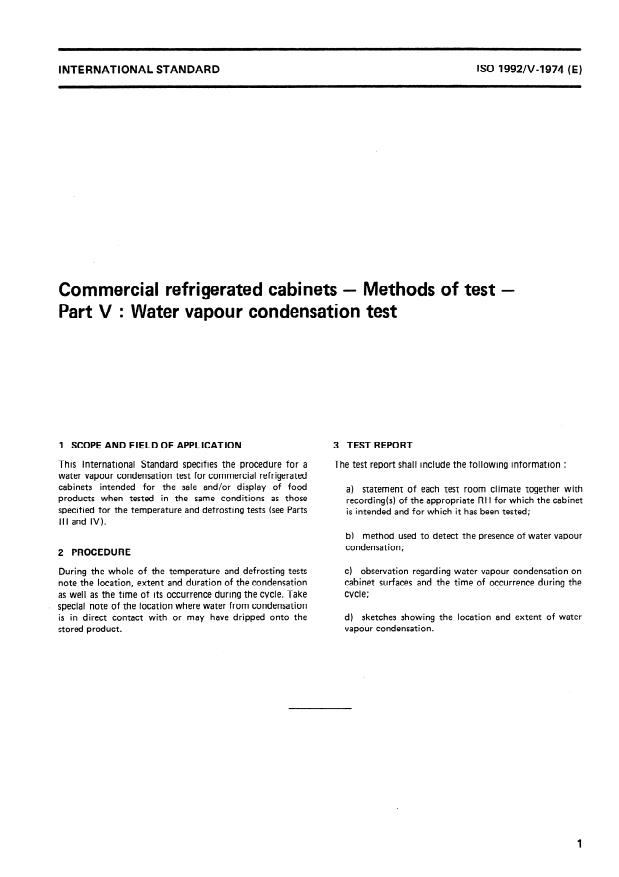
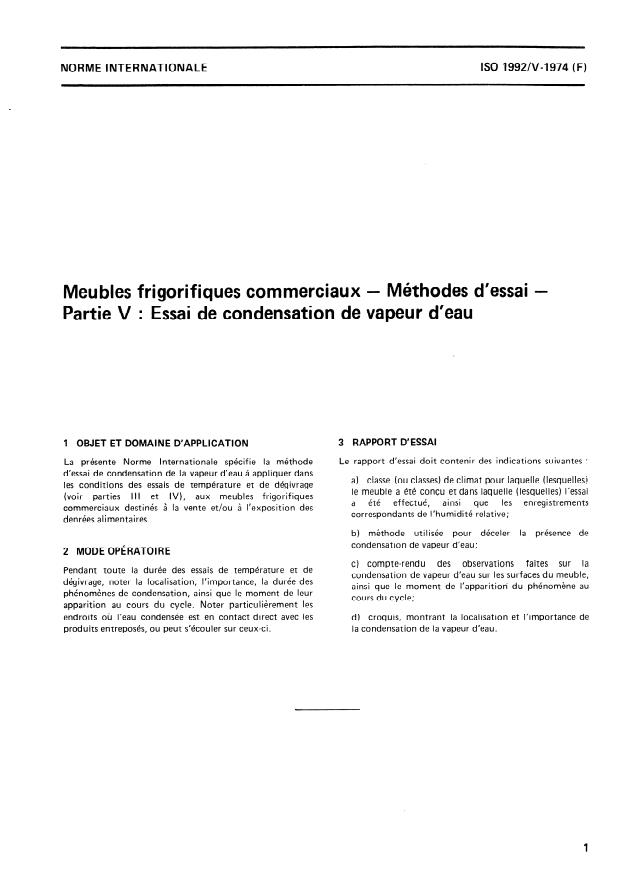
Describes the procedure of a water vapour condensation test for commercial refrigerated cabinets intended for the sale and/or display of food products, when tested on the same conditions as established for the temperature and defrosting tests (see parts 3 and 4 of ISO 1992).
Meubles frigorifiques commerciaux — Méthodes d'essai — Partie 5: Essai de condensation de vapeur d'eau
General Information
- Status
- Withdrawn
- Publication Date
- 31-Mar-1974
- Withdrawal Date
- 31-Mar-1974
- Technical Committee
- ISO/TC 86 - Refrigeration and air-conditioning
- Drafting Committee
- ISO/TC 86 - Refrigeration and air-conditioning
- Current Stage
- 9599 - Withdrawal of International Standard
- Start Date
- 17-Oct-2005
- Completion Date
- 12-Feb-2026
Relations
- Consolidated By
ISO 12402-8:2006 - Personal flotation devices — Part 8: Accessories — Safety requirements and test methods - Effective Date
- 06-Jun-2022
- Effective Date
- 15-Apr-2008
- Effective Date
- 15-Apr-2008

ISO 1992-5:1974 - Commercial refrigerated cabinets -- Methods of test

ISO 1992-5:1974 - Meubles frigorifiques commerciaux -- Méthodes d'essai
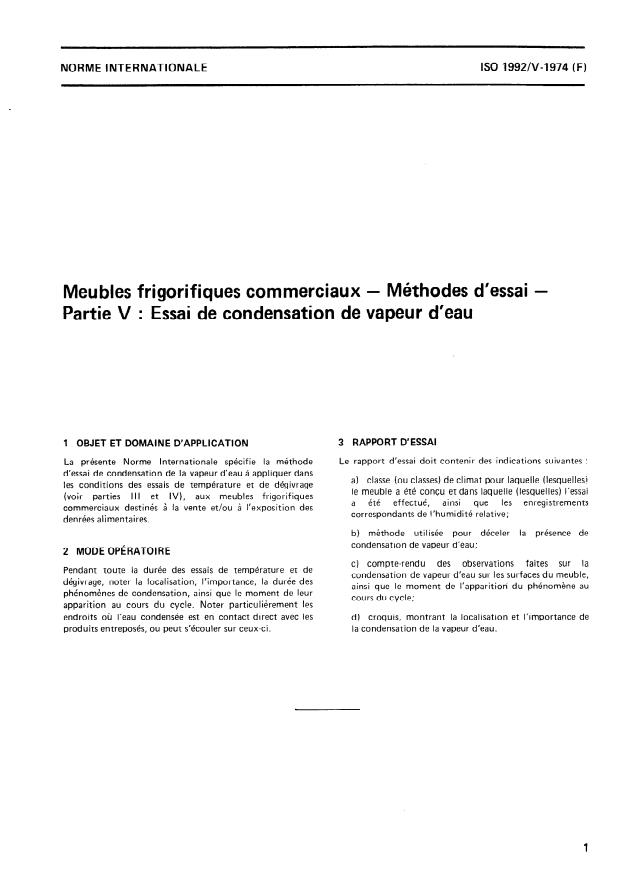

ISO 1992-5:1974 - Meubles frigorifiques commerciaux -- Méthodes d'essai
Frequently Asked Questions
ISO 1992-5:1974 is a standard published by the International Organization for Standardization (ISO). Its full title is "Commercial refrigerated cabinets — Methods of test — Part 5: Water vapour condensation test". This standard covers: Describes the procedure of a water vapour condensation test for commercial refrigerated cabinets intended for the sale and/or display of food products, when tested on the same conditions as established for the temperature and defrosting tests (see parts 3 and 4 of ISO 1992).
Describes the procedure of a water vapour condensation test for commercial refrigerated cabinets intended for the sale and/or display of food products, when tested on the same conditions as established for the temperature and defrosting tests (see parts 3 and 4 of ISO 1992).
ISO 1992-5:1974 is classified under the following ICS (International Classification for Standards) categories: 97.130.20 - Commercial refrigerating appliances. The ICS classification helps identify the subject area and facilitates finding related standards.
ISO 1992-5:1974 has the following relationships with other standards: It is inter standard links to ISO 12402-8:2006, ISO 23953-2:2005, ISO 23953-1:2005. Understanding these relationships helps ensure you are using the most current and applicable version of the standard.
ISO 1992-5:1974 is available in PDF format for immediate download after purchase. The document can be added to your cart and obtained through the secure checkout process. Digital delivery ensures instant access to the complete standard document.
Standards Content (Sample)
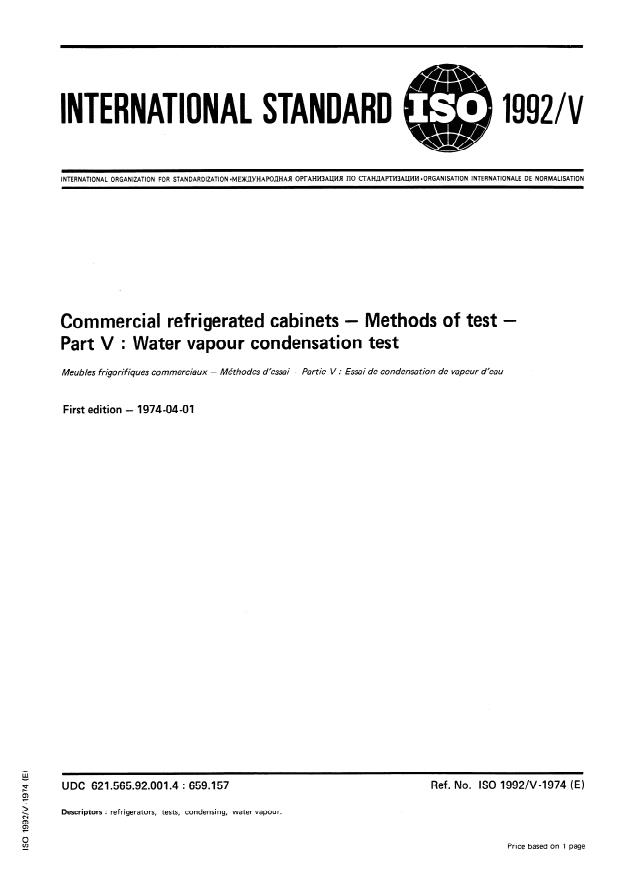
INTERNATIONAL STANDARD
1992/v
INTERNATIONAL ORGANIZATION FOR STANDARDIZATION l MEXAYHAPOAHAX OPl-AHW3AUW(I no CTAHAAPTM3AIJWM.ORGANlSATlON INTERNATIONALE DE NORMALISATION
Commercial refrigerated cabinets - Methods of test -
Part V : Water vapour condensation test
Meubles frigorifiques commerciaux - Mkthodes d’essai - Partie V : Essai de condensation de vapeur d’eau
First edition - 1974-04-01
UDC 621.565.92.001.4 : 659.157 Ref. No. IS0 1992/V-1974 (E)
Descriptors : refrigerators, tests, condensing, water vapou r.
Price based on 1 page
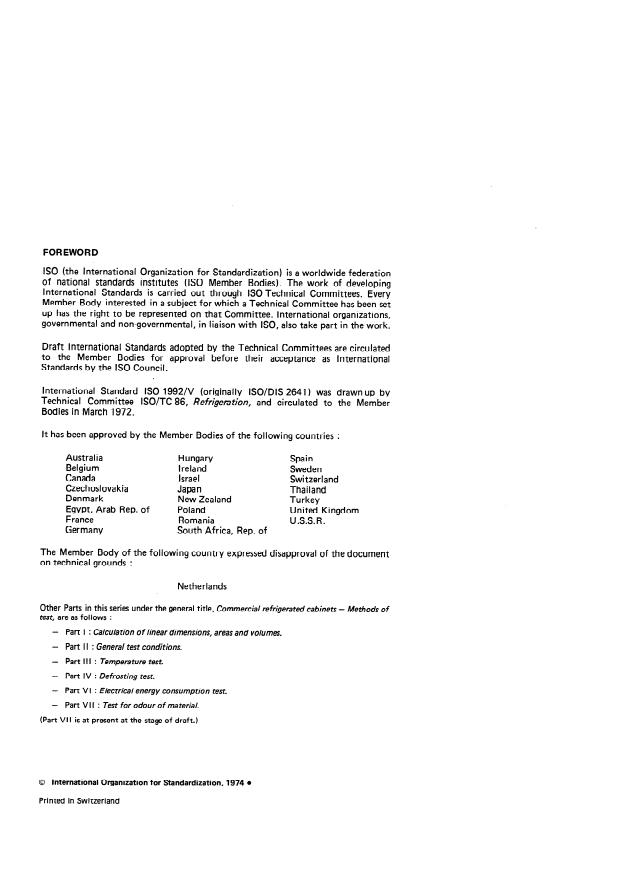
IS0 (the lnternationai Organization for Standardization) is a worldwide federation
of national standards institutes (IS0 Member Bodies). The work of developing
International Standards is carried out through IS0 Technical Committees. Every
Member Body interested in a subject for which a Technical Committee has been set
up has the right to be represented on that Committee. International organizations,
governmental and nongovernmental, in liaison with ISO, also take part in the work.
Draft International Standards adopted by the Technical Committees are circulated
to the Member Bodies for approval before their acceptance as International
Standards by the IS0 Council.
International Standard IS0 1992/V (originally lSO/DIS 2641) was drawn up by
Technical Committee lSO/TC 86, Refrigeration, and circulated to the Member
Bodies in March 1972.
It has been approved by the Member Bodies of the following countries :
Australia
Hungary Spain
Belgium Ireland Sweden
Canada Israel Switzerland
Czechoslovakia Japan Thailand
Denmark New Zealand Turkey
Egypt, Arab Rep. of Poland United Kingdom
France Romania U .S.S. R.
Germany South Africa, Rep. of
d isapproval of the document
The Member Body of the following country expressed
on technical grounds :
Netherlands
Other Parts in this series under the general title, Commercial r
...
1992lv
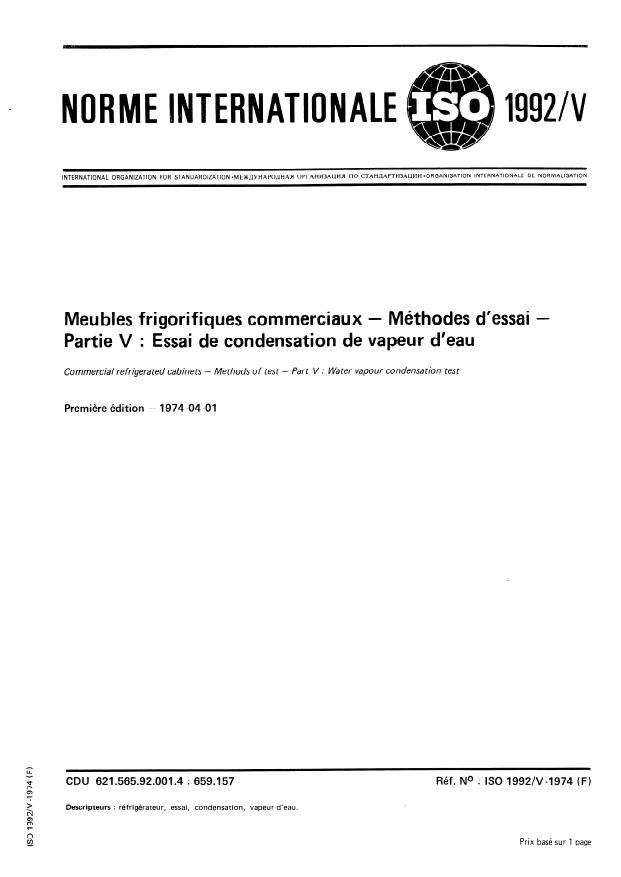
ERNATIONALE
INTERNATIONAL ORGANIZATION FOR STANDARDIZATION l MEX~YHAPOAHAII OPI-AHM3AUMH KIO CTAHAAPTM3AL.U4M*ORGANISATION INTERNATIONALE DE NORMALISATION
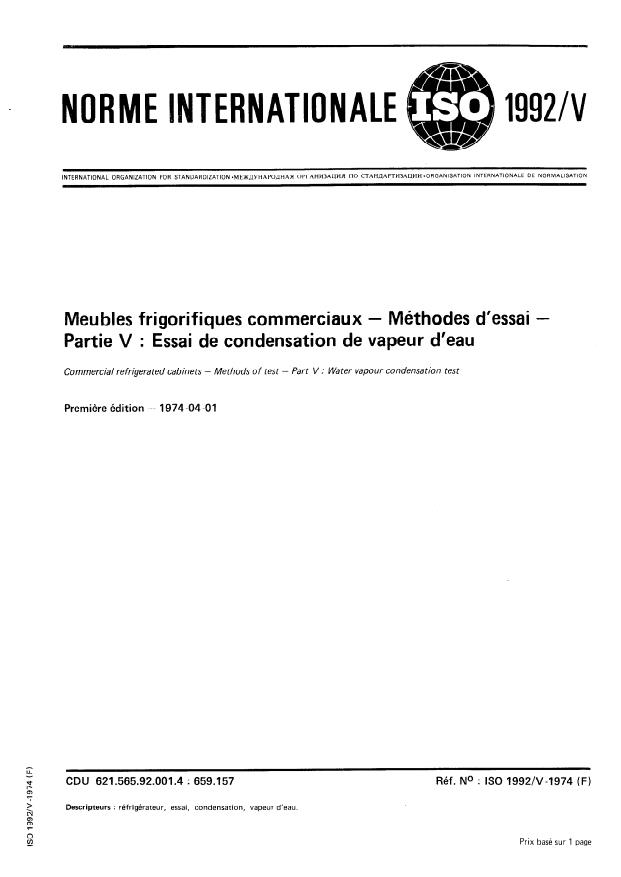
Meubles frigorifiques commerciaux - Méthodes d’essai -
Partie V : Essai de condensation de vapeur d’eau
Commercial refrigerated cabinets - Methods of test - Part V : Water vapour condensation test
Première édition - 1974-04-O’l
CDU 621.565.92.001.4 : 659.157 Réf. No : ISO 1992/V-1974 (FI
Descripteurs : réfrigérateur, essai, condensation, vapeur d’eau
Prix basé sur 1 page
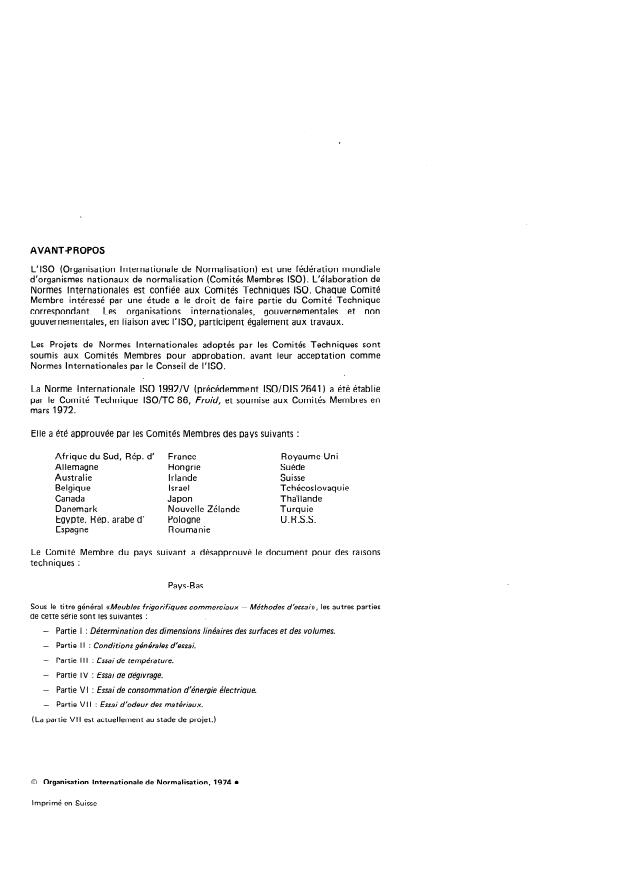
AVANT-PROPOS
LX0 (Organisation Internationale de Normalisation) est une fédération mondiale
d’organismes nationaux de normalisation (Comités Membres ISO). L’élaboration de
Normes Internationales est confiée aux Comités Techniques ISO. Chaque Comité
Membre intéressé par une étude a le droit de faire partie du Comité Technique
correspondant.
Les organisations internationales, gouvernementales et non
gouvernementales, en liaison avec I’ISO, participent également aux travaux.
Les Projets de Normes Internationales adoptés par les Comités Techniques sont
soumis aux Comités Membres pour approbation, avant leur acceptation comme
Normes Internationales par le Conseil de I’ISO.
La Norme Internationale ISO 1992/V (précédemment lSO/DlS 2641) a été établie
par le Comité Technique lSO/TC 86, Froid, et soumise aux Comités Membres en
mars 1972.
Elle a été approuvée par les Comités Membres des pays suivants :
Afrique du Sud, Rép. d’ France Royaume-Uni
Allemagne
Hongrie Suède
Australie Irlande Suisse
Belgique lsrael Tchécoslovaquie
Canada Japon Thaïlande
Danemark Nouvelle-Zélande Turquie
Egypte, Rép. arabe d’ Pologne U.R.S.S.
Espagne Roumanie
Le Comité Membre du pays suivant a désapprouvé le document pour des raisons
techniques :
Pays-Bas
Sous le titre général ((Meubles frigorifiques commerciaux - Méthodes d’essai», les autres parties
de cette série sont les suivantes :
- Partie I : Détermination des dimensions linéaires des s
...
1992lv
ERNATIONALE
INTERNATIONAL ORGANIZATION FOR STANDARDIZATION l MEX~YHAPOAHAII OPI-AHM3AUMH KIO CTAHAAPTM3AL.U4M*ORGANISATION INTERNATIONALE DE NORMALISATION
Meubles frigorifiques commerciaux - Méthodes d’essai -
Partie V : Essai de condensation de vapeur d’eau
Commercial refrigerated cabinets - Methods of test - Part V : Water vapour condensation test
Première édition - 1974-04-O’l
CDU 621.565.92.001.4 : 659.157 Réf. No : ISO 1992/V-1974 (FI
Descripteurs : réfrigérateur, essai, condensation, vapeur d’eau
Prix basé sur 1 page
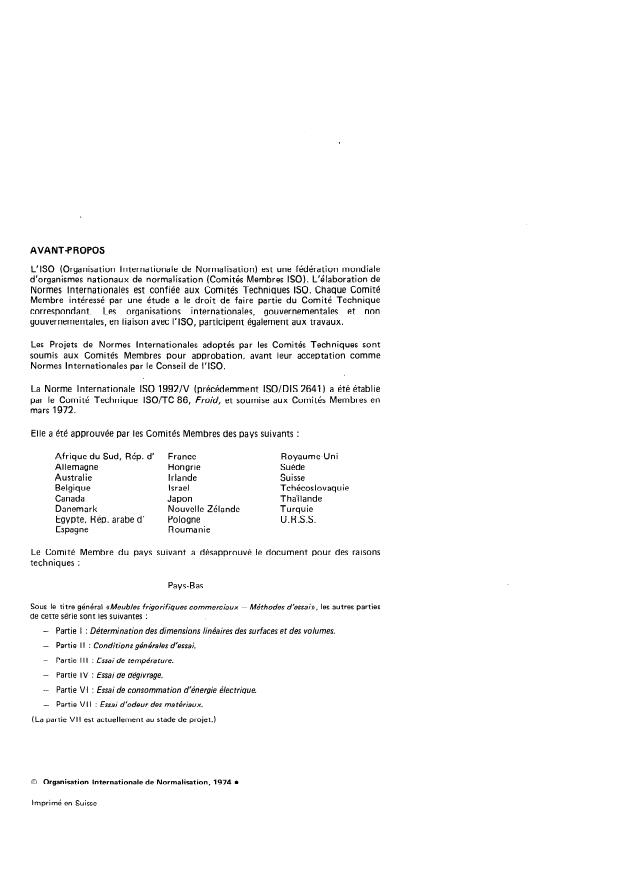
AVANT-PROPOS
LX0 (Organisation Internationale de Normalisation) est une fédération mondiale
d’organismes nationaux de normalisation (Comités Membres ISO). L’élaboration de
Normes Internationales est confiée aux Comités Techniques ISO. Chaque Comité
Membre intéressé par une étude a le droit de faire partie du Comité Technique
correspondant.
Les organisations internationales, gouvernementales et non
gouvernementales, en liaison avec I’ISO, participent également aux travaux.
Les Projets de Normes Internationales adoptés par les Comités Techniques sont
soumis aux Comités Membres pour approbation, avant leur acceptation comme
Normes Internationales par le Conseil de I’ISO.
La Norme Internationale ISO 1992/V (précédemment lSO/DlS 2641) a été établie
par le Comité Technique lSO/TC 86, Froid, et soumise aux Comités Membres en
mars 1972.
Elle a été approuvée par les Comités Membres des pays suivants :
Afrique du Sud, Rép. d’ France Royaume-Uni
Allemagne
Hongrie Suède
Australie Irlande Suisse
Belgique lsrael Tchécoslovaquie
Canada Japon Thaïlande
Danemark Nouvelle-Zélande Turquie
Egypte, Rép. arabe d’ Pologne U.R.S.S.
Espagne Roumanie
Le Comité Membre du pays suivant a désapprouvé le document pour des raisons
techniques :
Pays-Bas
Sous le titre général ((Meubles frigorifiques commerciaux - Méthodes d’essai», les autres parties
de cette série sont les suivantes :
- Partie I : Détermination des dimensions linéaires des s
...
Questions, Comments and Discussion
Ask us and Technical Secretary will try to provide an answer. You can facilitate discussion about the standard in here.
Loading comments...