


ISO/DTR 4234
(Main)Non-active surgical implants — Implant coating — Best practices for coating system assessment
Non-active surgical implants — Implant coating — Best practices for coating system assessment
Implants chirurgicaux non actifs — Revêtement de l'implant — Bonnes pratiques pour l'évaluation du système de revêtement
General Information
- Status
- Not Published
- Technical Committee
- ISO/TC 150 - Implants for surgery
- Drafting Committee
- ISO/TC 150/WG 12 - Implant coatings
- Current Stage
- 5020 - FDIS ballot initiated: 2 months. Proof sent to secretariat
- Start Date
- 05-Dec-2025
- Completion Date
- 05-Dec-2025
Overview
ISO/DTR 4234 - Non‑active surgical implants: Implant coating - Best practices for coating system assessment is a draft technical report (DTR) that provides a structured, systematic approach for developing an assessment plan for implant coating systems. Intended as guidance (not a prescriptive international standard), it describes how to evaluate coating systems from design, functional and manufacturing perspectives - including sterilization, aging and clinical use considerations. The document is distributed for review and may change; implementers are advised this DTR may reference patent‑protected technologies.
Key topics
- Coating system scope and terminology: Defines “coating system” and related terms (implant coating, surface coating, surface modification, intended function, pertinent property).
- Coating regions to assess: Breaks the system into regions for targeted assessment - coating bulk, coating surface, substrate‑coating interface, triple‑phase boundary, and the affected substrate.
- Assessment framework: Presents a stepwise approach to build an assessment plan that links design attributes and intended functions to measurable, pertinent properties (e.g., adhesion, porosity, elution potential - general concepts only).
- Foundational considerations: Emphasizes manufacturing processes, pre/post‑treatments, multi‑layer interfaces, and how processing can impart unintended chemicals or structures to the coating.
- Outcome and risk assessment: Guidance on collecting objective evidence to support design, manufacturing controls, property characterization, aging, and functional performance in the intended clinical environment.
- Tools and examples: Contains illustrative flowcharts (Annex A) and a bibliography to support implementation.
Applications
ISO/DTR 4234 is practical for:
- Developing a coating system assessment plan for non‑active surgical implants.
- Informing risk‑based testing strategies by linking coating regions and failure modes to appropriate evaluation.
- Supporting regulatory communication and documentation (e.g., master files, OEM‑supplier exchanges) without prescribing exact test methods.
- Guiding design reviews, manufacturing process controls, sterilization and aging studies relevant to implant coatings.
Who should use this standard
- Medical device manufacturers (OEMs) designing coated implants.
- Coating suppliers and contract manufacturers responsible for process validation and quality control.
- Regulatory affairs and clinical engineers preparing submissions or assessing coating evidence.
- Testing laboratories and quality assurance teams that translate the assessment plan into test programs.
Related standards
- ISO 17327‑1 - Implant coating - Part 1: General requirements (defines coating properties referenced in this DTR).
- ISO 14630 - Non‑active surgical implants - General requirements.
- ISO/TR 17327‑2 (informative) - lists standards and known test methods related to coatings (useful for selecting specific tests).
Keywords: implant coating, coating system assessment, non‑active surgical implants, ISO/DTR 4234, coating evaluation, coating interface, medical device coatings.

ISO/DTR 4234 - Non-active surgical implants — Implant coating — Best practices for coating system assessment Released:21. 11. 2025


REDLINE ISO/DTR 4234 - Non-active surgical implants — Implant coating — Best practices for coating system assessment Released:21. 11. 2025
Frequently Asked Questions
ISO/DTR 4234 is a draft published by the International Organization for Standardization (ISO). Its full title is "Non-active surgical implants — Implant coating — Best practices for coating system assessment". This standard covers: Non-active surgical implants — Implant coating — Best practices for coating system assessment
Non-active surgical implants — Implant coating — Best practices for coating system assessment
ISO/DTR 4234 is classified under the following ICS (International Classification for Standards) categories: 11.040.40 - Implants for surgery, prosthetics and orthotics. The ICS classification helps identify the subject area and facilitates finding related standards.
ISO/DTR 4234 is available in PDF format for immediate download after purchase. The document can be added to your cart and obtained through the secure checkout process. Digital delivery ensures instant access to the complete standard document.
Standards Content (Sample)
FINAL DRAFT
Technical
Report
ISO/TC 150
Non-active surgical implants —
Secretariat: DIN
Implant coating — Best practices
Voting begins on:
for coating system assessment
2025-12-05
Voting terminates on:
2026-01-30
RECIPIENTS OF THIS DRAFT ARE INVITED TO SUBMIT,
WITH THEIR COMMENTS, NOTIFICATION OF ANY
RELEVANT PATENT RIGHTS OF WHICH THEY ARE AWARE
AND TO PROVIDE SUPPOR TING DOCUMENTATION.
IN ADDITION TO THEIR EVALUATION AS
BEING ACCEPTABLE FOR INDUSTRIAL, TECHNO
LOGICAL, COMMERCIAL AND USER PURPOSES, DRAFT
INTERNATIONAL STANDARDS MAY ON OCCASION HAVE
TO BE CONSIDERED IN THE LIGHT OF THEIR POTENTIAL
TO BECOME STAN DARDS TO WHICH REFERENCE MAY BE
MADE IN NATIONAL REGULATIONS.
Reference number
FINAL DRAFT
Technical
Report
ISO/TC 150
Non-active surgical implants —
Secretariat: DIN
Implant coating — Best practices
Voting begins on:
for coating system assessment
Voting terminates on:
RECIPIENTS OF THIS DRAFT ARE INVITED TO SUBMIT,
WITH THEIR COMMENTS, NOTIFICATION OF ANY
RELEVANT PATENT RIGHTS OF WHICH THEY ARE AWARE
AND TO PROVIDE SUPPOR TING DOCUMENTATION.
© ISO 2025
IN ADDITION TO THEIR EVALUATION AS
All rights reserved. Unless otherwise specified, or required in the context of its implementation, no part of this publication may
BEING ACCEPTABLE FOR INDUSTRIAL, TECHNO
LOGICAL, COMMERCIAL AND USER PURPOSES, DRAFT
be reproduced or utilized otherwise in any form or by any means, electronic or mechanical, including photocopying, or posting on
INTERNATIONAL STANDARDS MAY ON OCCASION HAVE
the internet or an intranet, without prior written permission. Permission can be requested from either ISO at the address below
TO BE CONSIDERED IN THE LIGHT OF THEIR POTENTIAL
or ISO’s member body in the country of the requester.
TO BECOME STAN DARDS TO WHICH REFERENCE MAY BE
MADE IN NATIONAL REGULATIONS.
ISO copyright office
CP 401 • Ch. de Blandonnet 8
CH-1214 Vernier, Geneva
Phone: +41 22 749 01 11
Email: copyright@iso.org
Website: www.iso.org
Published in Switzerland Reference number
ii
Contents Page
Foreword .iv
Introduction .v
1 Scope . 1
2 Normative references . 1
3 Terms and definitions . 1
4 Guidance for coating system assessment . 3
4.1 General .3
4.2 Foundational considerations .3
4.2.1 Coating system .3
4.2.2 Outcome assessment.5
4.3 Coating assessment guide . .5
4.3.1 General .5
4.3.2 Explanation of flowchart.6
Annex A (informative) Example flowcharts . 8
Bibliography .10
iii
Foreword
ISO (the International Organization for Standardization) is a worldwide federation of national standards
bodies (ISO member bodies). The work of preparing International Standards is normally carried out through
ISO technical committees. Each member body interested in a subject for which a technical committee
has been established has the right to be represented on that committee. International organizations,
governmental and non-governmental, in liaison with ISO, also take part in the work. ISO collaborates closely
with the International Electrotechnical Commission (IEC) on all matters of electrotechnical standardization.
The procedures used to develop this document and those intended for its further maintenance are described
in the ISO/IEC Directives, Part 1. In particular, the different approval criteria needed for the different types
of ISO document should be noted. This document was drafted in accordance with the editorial rules of the
ISO/IEC Directives, Part 2 (see www.iso.org/directives).
ISO draws attention to the possibility that the implementation of this document may involve the use of (a)
patent(s). ISO takes no position concerning the evidence, validity or applicability of any claimed patent
rights in respect thereof. As of the date of publication of this document, ISO had not received notice of (a)
patent(s) which may be required to implement this document. However, implementers are cautioned that
this may not represent the latest information, which may be obtained from the patent database available at
www.iso.org/patents. ISO shall not be held responsible for identifying any or all such patent rights.
Any trade name used in this document is information given for the convenience of users and does not
constitute an endorsement.
For an explanation of the voluntary nature of standards, the meaning of ISO specific terms and expressions
related to conformity assessment, as well as information about ISO's adherence to the World Trade
Organization (WTO) principles in the Technical Barriers to Trade (TBT), see www.iso.org/iso/foreword.html.
This document was prepared by Technical Committee ISO/TC 150, Implants for surgery.
Any feedback or questions on this document should be directed to the user’s national standards body. A
complete listing of these bodies can be found at www.iso.org/members.html.
iv
Introduction
Coatings for surgical implants are widely used in the medical device industry. These coatings are
sophisticated systems involving the coating, the coating interface and substrate(s) to the coating. Due
to this increasing complexity and variability of coating systems, tools for the consistent assessment of
their performance and suitability to their application (i.e. their service environment) are increasingly
necessary. Specifically, herein the assessment of coating systems is described from design, functional and
manufacturing perspectives.
As described in ISO 17327-1, an implant coating is a layer of material with any different property than
the natural surface of the substrate that it is intentionally added [upon] and it is designed to have specific
physical features such as dimension, phase and coverage as well as mechanical, physical, optical, electrical,
bonding and perhaps other properties such as elution. A coating also can have specific interactions with the
contacting tissues, that can lead to the tissue’s biological reactions to the coating and the tissue’s impact on
the coating.
A coating has multiple intended functions, such as allowing easier delivery, achieve optimal tissue
integration and support the proper functioning of the device. The functions of a coating are supported by a
coating’s characteristics and intended use conditions in the patient. This drives the coating evaluation work
into two areas:
a) coating characterization per design; and
b) functional evaluation in context of the finished products for the patients.
Although these two areas can overlap, e.g. lubricity of the lubricious coating where both the designer and
user see the same thing from the patient’s function perspective, these two perspectives can also diverge
significantly from a coating characteristic testing perspective.
A coating and the substrate upon which the coating is placed make up a system that is intimately connected
through the interface such that the coating can have an effect on the substrate and the substrate can have an
effect on the coating. Some coatings are multi-layered, and as such, they can have multiple coating-substrate
and coating-coating interfaces to consider. The substrate and intermediate surface can require pre-
treatment such as roughening and cleaning, the use of process and post coating finishing can be necessary.
Due to this complexity, it is possible that some unintended chemicals, physical structures or properties can
be present in the final product. Therefore, the process is not only considered for producing the coating but
can also impart characteristics to the coating. For this reason, both the pre- and post-coating processes are
evaluated when determining the necessary biological functions and safety of a coating system.
A coating is usually made with a validated manufacturing process, that can involve one or more steps or
technologies. It is common that multiple parties are involved in designing and manufacturing finished
devices for medical uses. All parties have to be aware of the intended use of the materials, components and
product that they produce. Blind use of materials, components and processes to make finished products
cannot only add risks to the quality control but also add burden to be compliant to regulations.
v
FINAL DRAFT Technical Report ISO/DTR 4234:2025(en)
Non-active surgical implants — Implant coating — Best
practices for coating system assessment
1 Scope
This document specifies a systematic approach for the development of an assessment plan for coating
systems for potential use for implants. This document provides a brief introductory guidance for the coating
system and intended functions. This document describes the assessment process from the context of product
design, manufacturing (including sterilization), product aging and clinical intended use. This assessment
process is intended to help evaluate coating properties that are pertinent to the performance of the coated
devices and uses relevant examples to illustrate the process.
NOTE ISO 17327-1 defines a set of coating properties that can be pertinent for any specific coating.
This document is intended to be a useful tool in the development of an assessment plan of coating systems and
is meant to support communication, e.g. among coatings manufacturer, original equipment manufacturer
and regulatory bodies (through direct interaction or master files).
This document does not address the clinical safety and performance of the surgical implant for which the
coating system is a part.
This document also does not cover specific tests for coating systems, as it is intended to be a structure for
determining important properties and tests that can be appropriate for any given coating system.
NOTE ISO/TR 17327-2 provides several tables listing standards related to coatings including some known test
methods.
2 Normative references
The following documents are referred to in the text in such a way that some or all of their content constitutes
requirements of this document. For dated references, only the edition cited applies. For undated references,
the latest edition of the referenced document (including any amendments) applies.
ISO 14630, Non-active surgical implants — General requirements
ISO 17327-1, Non-active surgical implants — Implant coating — Part 1: General requirements
3 Terms and definitions
For the purposes of this document, the terms and definitions given in ISO 14630, ISO 17327-1 and the
following apply.
ISO and IEC maintain terminology databases for use in standardization at the following addresses:
— ISO Online browsing platform: available at https:// www .iso .org/ obp
— IEC Electropedia: available at https:// www .electropedia .org/
3.1
implant coating
surface coating (3.2) or surface modification (3.3)
Note 1 to entry: Implant coating is considered a constituent of an implant.
Note 2 to entry: A laminate, i.e. a composite material made of multiple layers of the same or different materials with
the same or different
...
ISO/TC 150/WG 12
Secretariat: DIN
Date: 2025-09-0211-21
First edition
Non-active surgical implants - — Implant coating –— Best
practices for Coating System Assessmentcoating system
assessment
WD/CD/DIS/FDIS stage
Warning for WDs and CDs
This document is not an ISO International Standard. It is distributed for review and comment. It is subject to
change without notice and may not be referred to as an International Standard.
Recipients of this draft are invited to submit, with their comments, notification of any relevant patent rights of
which they are aware and to provide supporting documentation.
© ISO #### – All rights reserved
ISO #####-#:####(X)
2 © ISO #### – All rights reserved
All rights reserved. Unless otherwise specified, or required in the context of its implementation, no part of this publication
may be reproduced or utilized otherwise in any form or by any means, electronic or mechanical, including photocopying,
or posting on the internet or an intranet, without prior written permission. Permission can be requested from either ISO
at the address below or ISO’s member body in the country of the requester.
ISO copyright office
CP 401 • Ch. de Blandonnet 8
CH-1214 Vernier, Geneva
Phone: + 41 22 749 01 11
EmailE-mail: copyright@iso.org
Website: www.iso.orgwww.iso.org
Published in Switzerland
iii
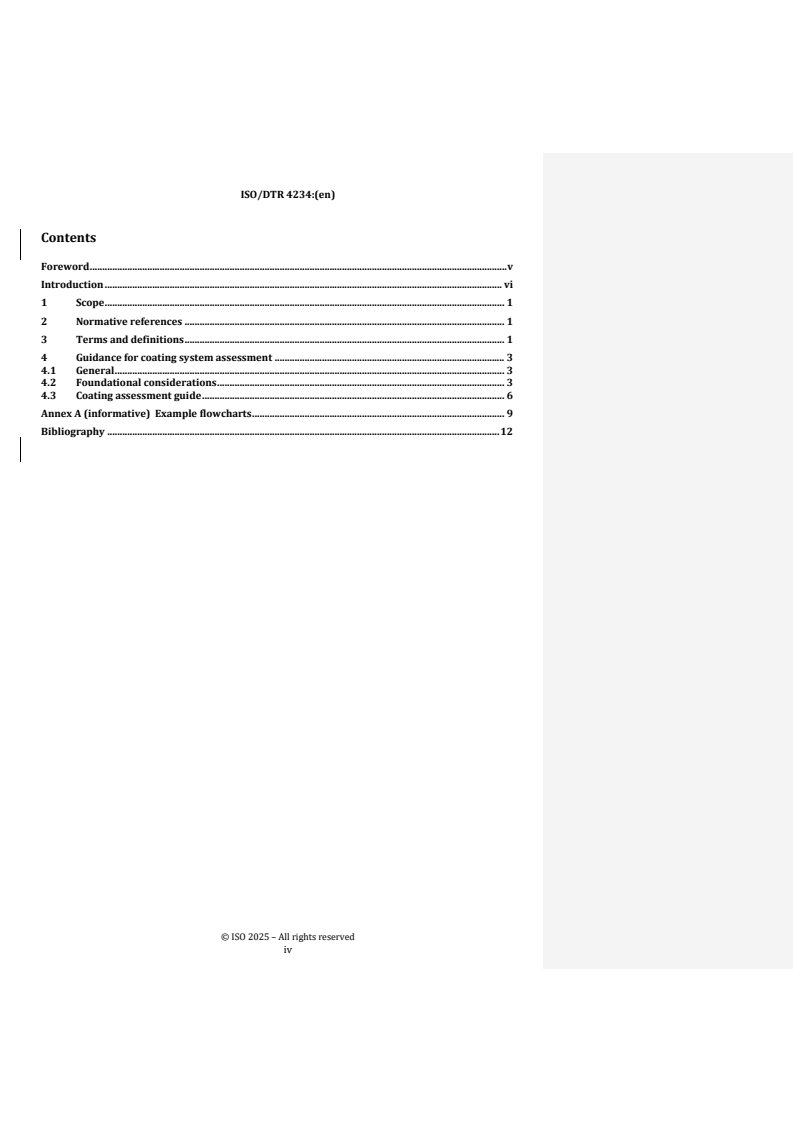
Contents
Foreword . v
Introduction . vi
1 Scope . 1
2 Normative references . 1
3 Terms and definitions . 1
4 Guidance for coating system assessment . 3
4.1 General . 3
4.2 Foundational considerations . 3
4.3 Coating assessment guide . 6
Annex A (informative) Example flowcharts . 9
Bibliography . 12
iv
Foreword
ISO (the International Organization for Standardization) is a worldwide federation of national standards
bodies (ISO member bodies). The work of preparing International Standards is normally carried out through
ISO technical committees. Each member body interested in a subject for which a technical committee has been
established has the right to be represented on that committee. International organizations, governmental and
non-governmental, in liaison with ISO, also take part in the work. ISO collaborates closely with the
International Electrotechnical Commission (IEC) on all matters of electrotechnical standardization.
The procedures used to develop this document and those intended for its further maintenance are described
in the ISO/IEC Directives, Part 1. In particular, the different approval criteria needed for the different types of
ISO documentsdocument should be noted. This document was drafted in accordance with the editorial rules
of the ISO/IEC Directives, Part 2 (see www.iso.org/directives).
Field Code Changed
Attention is drawnISO draws attention to the possibility that some of the elementsimplementation of this
document may beinvolve the subjectuse of (a) patent(s). ISO takes no position concerning the evidence,
validity or applicability of any claimed patent rights in respect thereof. As of the date of publication of this
document, ISO had not received notice of (a) patent(s) which may be required to implement this document.
However, implementers are cautioned that this may not represent the latest information, which may be
obtained from the patent database available at www.iso.org/patents. ISO shall not be held responsible for
identifying any or all such patent rights. Details of any patent rights identified during the development of the
document will be in the Introduction and/or on the ISO list of patent declarations received (see ).
Any trade name used in this document is information given for the convenience of users and does not
constitute an endorsement.
For an explanation of the voluntary nature of standards, the meaning of ISO specific terms and expressions
related to conformity assessment, as well as information about ISO's adherence to the World Trade
Organization (WTO) principles in the Technical Barriers to Trade (TBT), see www.iso.org/iso/foreword.html.
This document was prepared by Technical Committee ISO/TC 150, Implants for surgery.
Any feedback or questions on this document should be directed to the user’s national standards body. A
complete listing of these bodies can be found at www.iso.org/members.html.
v
Introduction
Coatings for surgical implants are widely used in the medical device industry. These coatings are sophisticated
systems involving the coating, the coating interface, and substrate(s) to the coating. Due to this increasing
complexity and variability of coating systems, tools for the consistent assessment of their performance and
suitability to their application (i.e. their service environment) are increasingly necessary. Specifically, herein
the assessment of coating systems is described from design, functional, and manufacturing perspectives.
As described in ISO 17327-1, an implant coating is a layer of material with any different property than the
natural surface of the substrate that it is intentionally added [upon] and it is designed to have specific physical
features such as dimension, phase, and coverage as well as mechanical, physical, optical, electrical, bonding
and perhaps other properties such as elution. A coating also can have specific interactions with the contacting
tissues, that can lead to the tissue’s biological reactions to the coating and the tissue’s impact on the coating.
A coating has multiple intended functions; e. g.,, such as allowing easier delivery, achieve optimal tissue
integration iandand support the proper functioning of the device. The functions of a coating are supported by
a coating’s characteristics and intended use conditions in the patient. This drives the coating evaluation work
into two areas:
a) i) coating characterization per design; and
b) ii) functional evaluation in context of the finished products for the patients.
Although these two areas can overlap, e.g.,. lubricity of the lubricious coating where both the designer and
user see the same thing from the patient’s function perspective, these two perspectives can also diverge
significantly from a coating characteristic testing perspective.
A coating and the substrate upon which the coating is placed make up a system that is intimately connected
through the interface such that the coating can have an effect on the substrate and the substrate can have an
effect on the coating. Some coatings are multi-layered, and as such, they can have multiple coating-substrate
and coating-coating interfaces to consider. The substrate and intermediate surface can require pre-treatment
such as roughening and cleaning, the use of process and post coating finishing can be necessary. Due to this
complexity, it is possible that some unintended chemicals, physical structures, or properties can be present in
the final product. Therefore, the process is not only considered for producing the coating but couldcan also
impart characteristics to the coating. For this reason it is necessary to evaluate, both the pre- and post-coating
processes are evaluated when determining the necessary biological functions and safety of a coating system.
A coating is usually made with a validated manufacturing process, that can involve one or more steps or
technologies. It is common that multiple parties are involved in designing and manufacturing finished devices
for medical uses. It is important that all theAll parties arehave to be aware of the intended use of the materials,
components, and product that they produce and be properly compliant to the quality control regulations.
Blind use of materials, components, and processes to make finished products can notcannot only add risks to
the quality control but also add burden to be compliant to regulations.
vi
Non-active surgical implants - — Implant coating –— Best practices for
Coating System Assessmentcoating system assessment
1 Scope
This document specifies a systematic approach for the development of an assessment plan for coating systems
for potential use for implants. The goal of thisThis document is to provideprovides a brief introductory guidance
for a “Coating System”the coating system and “intended functions”. This document describes the assessment
process from the context of product design, manufacturing (including sterilization), product aging, and clinical
intended use. This assessment process is intended to help evaluate coating properties that are pertinent to the
performance of the coated devices and uses relevant examples to illustrate the process. ISO 17327-1 defines a
set of coating properties that can be pertinent for any specific coating.
NOTE ISO 17327-1 defines a set of coating properties that can be pertinent for any specific coating.
This document is intended to be a useful tool in the development of an assessment plan of coating systems
and is meant to support communication, e.g. among coatings manufacturer, OEM,original equipment
manufacturer and regulatory bodies (through direct interaction or master files).
This document does not address the clinical safety and performance of the surgical implant for which the
coating system is a part.
This document also does not cover specific tests for coating systems, as it is intended asto be a structure for
determining important properties and tests that can be appropriate for any given coating system.
NOTE ISO/TR 17327-2 provides several tables listing standards related to coatings including some known test
methods.
2 Normative references
The following documents are referred to in the text in such a way that some or all of their content constitutes
requirements of this document. For dated references, only the edition cited applies. For undated references,
the latest edition of the referenced document (including any amendments) applies.
ISO 14630, Non-active surgical implants -— General requirements
ISO 17327-1:, Non-active surgical implants -— Implant coating -— Part 1: General requirements
3 Terms and definitions
For the purposes of this document, the terms and definitions given in ISO 14630, ISO 17327-1 and the
following apply.
ISO and IEC maintain terminology databases for use in standardization at the following addresses:
— ISO Online browsing platform: available at https://www.iso.org/obp
Field Code Changed
— IEC Electropedia: available at https://www.electropedia.org/
Field Code Changed
3.1 3.1
implant coating
surface coating (3.2(3.2)) or surface modification (3.3(3.3))
Note 1 to entry: Implant coating is considered a constituent of an implant.
Note 2 to entry: A laminate, i.e. a composite material made of multiple layers of the same or different materials with the
same or different internal structures assembled sandwich-like and bonded by heat, pressure, welding, soldering or
adhesives, is not in itself considered an implant coating. But the exposed surface of the laminate can be an implant coating.
Note 3 to entry: A covering is not considered an implant coating. For example, additional material (e.g. a graft) added to
a structure (e.g. a stent) specifically to bridge elements of the structure for the sole purpose of reducing the permeability
of the structure.
[SOURCE: ISO 17327-1:2018, 3.1]
3.2 3.2
surface coating
layer of material with any different property than the natural surface of the substrate that is intentionally
added to the substrate
Note 1 to entry: The coating can partially or fully cover the substrate surface.
Note 2 to entry: The term includes surface coatings created as a result of additive manufacturing.
[SOURCE: ISO 17327-1:2018, 3.2]
3.3 3.3
surface modification
intentional conversion or reconstruction of the surface of the original substrate to form a new surface material
consisting of components of the substrate´ssubstrate’s own material and possibly foreign material and
forming a surface layer with different properties
[SOURCE: ISO 17327-1:2018, 3.3]
3.4 3.4
coating system
region starting from the outer surface of the coating and ending within the substrate where the coating no
longer affects substrate prop
...
Questions, Comments and Discussion
Ask us and Technical Secretary will try to provide an answer. You can facilitate discussion about the standard in here.
Loading comments...