

ISO 14405-3:2016
(Main)Geometrical product specifications (GPS) — Dimensional tolerancing — Part 3: Angular sizes
General Information
- Abstract
This part of ISO 14405 establishes the default specification operator for angular size and defines a number of special specification operators for features of angular size: cone (truncated, i.e. frustum, or not), wedge (truncated or not), two opposite straight lines (intersection of a wedge/truncated wedge and a plane perpendicular to the intersection straight line of the two planes of the wedge/truncated wedge, intersection of a cone/frustum and a plane containing the axis of revolution of the cone/frustum). See Figure 1 and Figure 2. This part of ISO 14405 also defines the specification modifiers and the drawing indications for these angular sizes. This part of ISO 14405 covers the following angular sizes: — local angular size: — angular size between two lines; — portion angular size; — global angular size: — direct global angular size: — least squares angular size; — minimax angular size; — rank order angular size/indirect global angular size: — maximum angular size; — minimum angular size; — average angular size; — range of angular sizes; — mid-range angular size; — median angular size; — standard deviation of angular size. This part of ISO 14405 defines the meaning of tolerances of angular sizes indicated as — + and/or - limit deviations, e.g. 0°/-0,5°, or — indicated with upper limit of size (ULS) and/or lower limit of size (LLS), e.g. 35° max. or 15° min., 34°/36°, — with or without modifiers. This part of ISO 14405 provides a set of tools to express several types of angular size characteristics. It does not give any information on the relationship between a function or a use and an angular size characteristic.
- Status
- Published
- Publication Date
- 12-Dec-2016
- Drafting Committee
- ISO/TC 213/WG 12 - Size
- Current Stage
- 9093 - International Standard confirmed
Buy Documents


ISO 14405-3:2016 - Geometrical product specifications (GPS) -- Dimensional tolerancing
ISO 14405-3:2016 - Geometrical product specifications (GPS) — Dimensional tolerancing — Part 3: Angular sizes/13/2016

ISO 14405-3:2016 - Spécification géométrique des produits (GPS) -- Tolérancement dimensionnel
ISO 14405-3:2016 - Spécification géométrique des produits (GPS) — Tolérancement dimensionnel — Partie 3: Tailles angulaires/13/2016
Overview
ISO 14405-3:2016 - Geometrical product specifications (GPS) - Dimensional tolerancing - Part 3: Angular sizes - defines how angular dimensions are specified, interpreted and drawn in technical documentation. The standard establishes the default specification operator for angular size and several special specification operators for common angular features such as cones, frustums (truncated cones), wedges (truncated or not) and two opposite straight lines. It also standardizes specification modifiers, drawing indications, and the meaning of common angular tolerance notations (e.g. ± deviations, ULS/LLS).
Key topics and technical requirements
- Default and special specification operators for angular size (cone, frustum, wedge, two-line cases).
- Types of angular size characteristics covered:
- Local angular size (two-line, section, portion)
- Global angular size (direct global, least squares, minmax)
- Rank-order/indirect global (maximum, minimum, average, range, mid-range, median, standard deviation)
- Association and evaluation criteria: defines association methods such as total least squares and min–max for establishing the associated feature used to evaluate angular size (see Annexes for criteria).
- Tolerance representations: clarifies meaning of tolerances shown as + / – limit deviations, upper/lower limit of size (ULS/LLS), and sizes given with or without modifiers (e.g., 0°/–0.5°, 35° max., 34°/36°).
- Drawing indications and graphical symbols: prescribes how to indicate angular size characteristics on drawings and which modifiers to use for unambiguous interpretation.
- Scope limitation: provides tools to express angular size characteristics but does not prescribe how those characteristics relate to a part’s function or use.
Practical applications and users
Who uses ISO 14405-3:
- Mechanical and product designers specifying tapers, cone angles, wedge geometries and opposing-line features.
- Tolerancing and GD&T engineers creating unambiguous manufacturing drawings.
- Metrology and quality assurance teams defining inspection procedures and measurement algorithms.
- CAD/CAM programmers and inspection software developers implementing evaluation criteria (least squares, minmax).
- Technical drafters standardizing drawing symbols and callouts.
Why it matters:
- Ensures consistent interpretation of angular dimensions across design, manufacturing and inspection.
- Reduces ambiguity in drawings for angled features (cones, wedges, prismatic cross-sections).
- Supports reproducible measurement and clear tolerance communication for angular features.
Related standards
- ISO 14405-1 (Linear sizes) and ISO 14405-2 (Dimensions other than linear sizes) - companion parts of the ISO 14405 series.
- ISO 8015 (Fundamental GPS principles), ISO 14253-1 (decision rules), ISO 17450 series (GPS concepts), and ISO 81714 / ISO 3098 for graphical and lettering rules.
Keywords: ISO 14405-3:2016, geometrical product specifications, GPS, dimensional tolerancing, angular sizes, cone angle, wedge, frustum, two-line angular size, least squares, minmax, drawing indications, angular tolerancing.
Relations
- Effective Date
- 25-Aug-2026
- Effective Date
- 25-Aug-2026
- Effective Date
- 25-Aug-2026
- Effective Date
- 24-Jun-2026
- Effective Date
- 12-Feb-2026
- Effective Date
- 06-Jun-2022
Buy Documents
ISO 14405-3:2016 - Geometrical product specifications (GPS) -- Dimensional tolerancing
ISO 14405-3:2016 - Geometrical product specifications (GPS) — Dimensional tolerancing — Part 3: Angular sizes/13/2016
ISO 14405-3:2016 - Spécification géométrique des produits (GPS) -- Tolérancement dimensionnel
ISO 14405-3:2016 - Spécification géométrique des produits (GPS) — Tolérancement dimensionnel — Partie 3: Tailles angulaires/13/2016
Get Certified
Connect with accredited certification bodies for this standard

BSMI (Bureau of Standards, Metrology and Inspection)
Taiwan's standards and inspection authority.
Sponsored listings
Frequently Asked Questions
ISO 14405-3:2016 is a standard published by the International Organization for Standardization (ISO). Its full title is "Geometrical product specifications (GPS) — Dimensional tolerancing — Part 3: Angular sizes". This standard covers: This part of ISO 14405 establishes the default specification operator for angular size and defines a number of special specification operators for features of angular size: cone (truncated, i.e. frustum, or not), wedge (truncated or not), two opposite straight lines (intersection of a wedge/truncated wedge and a plane perpendicular to the intersection straight line of the two planes of the wedge/truncated wedge, intersection of a cone/frustum and a plane containing the axis of revolution of the cone/frustum). See Figure 1 and Figure 2. This part of ISO 14405 also defines the specification modifiers and the drawing indications for these angular sizes. This part of ISO 14405 covers the following angular sizes: — local angular size: — angular size between two lines; — portion angular size; — global angular size: — direct global angular size: — least squares angular size; — minimax angular size; — rank order angular size/indirect global angular size: — maximum angular size; — minimum angular size; — average angular size; — range of angular sizes; — mid-range angular size; — median angular size; — standard deviation of angular size. This part of ISO 14405 defines the meaning of tolerances of angular sizes indicated as — + and/or - limit deviations, e.g. 0°/-0,5°, or — indicated with upper limit of size (ULS) and/or lower limit of size (LLS), e.g. 35° max. or 15° min., 34°/36°, — with or without modifiers. This part of ISO 14405 provides a set of tools to express several types of angular size characteristics. It does not give any information on the relationship between a function or a use and an angular size characteristic.
This part of ISO 14405 establishes the default specification operator for angular size and defines a number of special specification operators for features of angular size: cone (truncated, i.e. frustum, or not), wedge (truncated or not), two opposite straight lines (intersection of a wedge/truncated wedge and a plane perpendicular to the intersection straight line of the two planes of the wedge/truncated wedge, intersection of a cone/frustum and a plane containing the axis of revolution of the cone/frustum). See Figure 1 and Figure 2. This part of ISO 14405 also defines the specification modifiers and the drawing indications for these angular sizes. This part of ISO 14405 covers the following angular sizes: — local angular size: — angular size between two lines; — portion angular size; — global angular size: — direct global angular size: — least squares angular size; — minimax angular size; — rank order angular size/indirect global angular size: — maximum angular size; — minimum angular size; — average angular size; — range of angular sizes; — mid-range angular size; — median angular size; — standard deviation of angular size. This part of ISO 14405 defines the meaning of tolerances of angular sizes indicated as — + and/or - limit deviations, e.g. 0°/-0,5°, or — indicated with upper limit of size (ULS) and/or lower limit of size (LLS), e.g. 35° max. or 15° min., 34°/36°, — with or without modifiers. This part of ISO 14405 provides a set of tools to express several types of angular size characteristics. It does not give any information on the relationship between a function or a use and an angular size characteristic.
ISO 14405-3:2016 is classified under the following ICS (International Classification for Standards) categories: 17.040.10 - Limits and fits. The ICS classification helps identify the subject area and facilitates finding related standards.
ISO 14405-3:2016 has the following relationships with other standards: It is inter standard links to EN ISO 14405-2:2019, EN ISO 4172:2024, EN ISO 128-1:2020, EN ISO 129-1:2019, EN ISO 14405-3:2017, ISO 17662:2005. Understanding these relationships helps ensure you are using the most current and applicable version of the standard.
ISO 14405-3:2016 is available in PDF format for immediate download after purchase. The document can be added to your cart and obtained through the secure checkout process. Digital delivery ensures instant access to the complete standard document.
Standards Content (Sample)
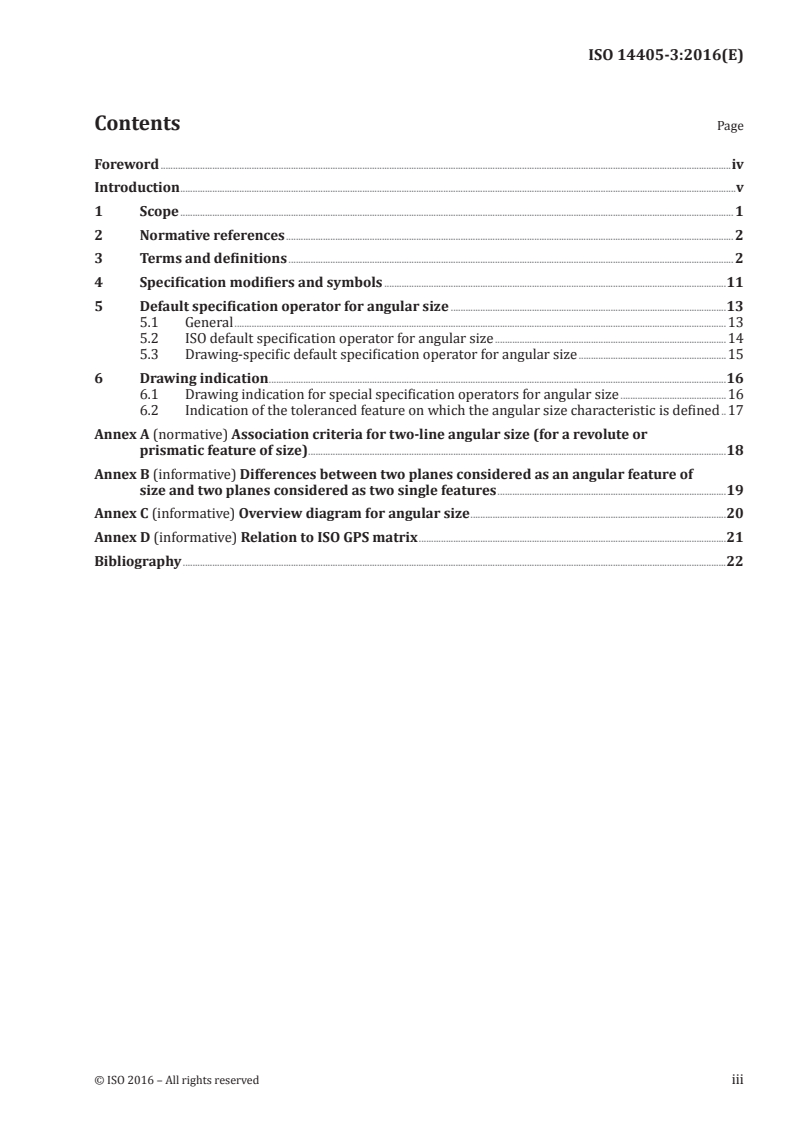
INTERNATIONAL ISO
STANDARD 14405-3
First edition
2016-12-15
Geometrical product specifications
(GPS) — Dimensional tolerancing —
Part 3:
Angular sizes
Spécification géométrique des produits (GPS) — Tolérancement
dimensionnel —
Partie 3: Tailles angulaires
Reference number
©
ISO 2016
© ISO 2016, Published in Switzerland
All rights reserved. Unless otherwise specified, no part of this publication may be reproduced or utilized otherwise in any form
or by any means, electronic or mechanical, including photocopying, or posting on the internet or an intranet, without prior
written permission. Permission can be requested from either ISO at the address below or ISO’s member body in the country of
the requester.
ISO copyright office
Ch. de Blandonnet 8 • CP 401
CH-1214 Vernier, Geneva, Switzerland
Tel. +41 22 749 01 11
Fax +41 22 749 09 47
copyright@iso.org
www.iso.org
ii © ISO 2016 – All rights reserved
Contents Page
Foreword .iv
Introduction .v
1 Scope . 1
2 Normative references . 2
3 Terms and definitions . 2
4 Specification modifiers and symbols .11
5 Default specification operator for angular size .13
5.1 General .13
5.2 ISO default specification operator for angular size .14
5.3 Drawing-specific default specification operator for angular size .15
6 Drawing indication .16
6.1 Drawing indication for special specification operators for angular size .16
6.2 Indication of the toleranced feature on which the angular size characteristic is defined .17
Annex A (normative) Association criteria for two-line angular size (for a revolute or
prismatic feature of size) .18
Annex B (informative) Differences between two planes considered as an angular feature of
size and two planes considered as two single features .19
Annex C (informative) Overview diagram for angular size .20
Annex D (informative) Relation to ISO GPS matrix .21
Bibliography .22
Foreword
ISO (the International Organization for Standardization) is a worldwide federation of national standards
bodies (ISO member bodies). The work of preparing International Standards is normally carried out
through ISO technical committees. Each member body interested in a subject for which a technical
committee has been established has the right to be represented on that committee. International
organizations, governmental and non-governmental, in liaison with ISO, also take part in the work.
ISO collaborates closely with the International Electrotechnical Commission (IEC) on all matters of
electrotechnical standardization.
The procedures used to develop this document and those intended for its further maintenance are
described in the ISO/IEC Directives, Part 1. In particular the different approval criteria needed for the
different types of ISO documents should be noted. This document was drafted in accordance with the
editorial rules of the ISO/IEC Directives, Part 2 (see www.iso.org/directives).
Attention is drawn to the possibility that some of the elements of this document may be the subject of
patent rights. ISO shall not be held responsible for identifying any or all such patent rights. Details of
any patent rights identified during the development of the document will be in the Introduction and/or
on the ISO list of patent declarations received (see www.iso.org/patents).
Any trade name used in this document is information given for the convenience of users and does not
constitute an endorsement.
For an explanation on the meaning of ISO specific terms and expressions related to conformity assessment,
as well as information about ISO’s adherence to the World Trade Organization (WTO) principles in the
Technical Barriers to Trade (TBT) see the following URL: www.iso.org/iso/foreword.html.
The committee responsible for this document is Technical Committee ISO/TC 213, Dimensional and
geometrical product specifications and verification.
ISO 14405 consists of the following parts, under the general title Geometrical product specification
(GPS) — Dimensional tolerancing:
— Part 1: Linear sizes
— Part 2: Dimensions other than linear sizes
— Part 3: Angular sizes
iv © ISO 2016 – All rights reserved
Introduction
This part of ISO 14405 is a geometrical product specification (GPS) standard and is to be regarded as a
general GPS standard (see ISO 14638). In the general GPS matrix, it influences chain links “Symbols and
indications”, “Feature requirements” and “Feature properties” of the size chain of standards.
The ISO/GPS Masterplan given in ISO 14638 gives an overview of the ISO/GPS system of which this
part of ISO 14405 is a part. The fundamental rules of ISO/GPS given in ISO 8015 apply to this part of
ISO 14405 and the default decision rules given in ISO 14253-1 apply to specifications made in accordance
with this part of ISO 14405, unless otherwise indicated.
For more detailed information on the relation of this part of ISO 14405 to other standards and to the
GPS matrix model, see Annex D.
INTERNATIONAL STANDARD ISO 14405-3:2016(E)
Geometrical product specifications (GPS) — Dimensional
tolerancing —
Part 3:
Angular sizes
1 Scope
This part of ISO 14405 establishes the default specification operator for angular size and defines a
number of special specification operators for features of angular size: cone (truncated, i.e. frustum, or
not), wedge (truncated or not), two opposite straight lines (intersection of a wedge/truncated wedge and
a plane perpendicular to the intersection straight line of the two planes of the wedge/truncated wedge,
intersection of a cone/frustum and a plane containing the axis of revolution of the cone/frustum). See
Figure 1 and Figure 2.
This part of ISO 14405 also defines the specification modifiers and the drawing indications for these
angular sizes.
This part of ISO 14405 covers the following angular sizes:
— local angular size:
— angular size between two lines;
— portion angular size;
— global angular size:
— direct global angular size:
— least squares angular size;
— minimax angular size;
— rank order angular size/indirect global angular size:
— maximum angular size;
— minimum angular size;
— average angular size;
— range of angular sizes;
— mid-range angular size;
— median angular size;
— standard deviation of angular size.
This part of ISO 14405 defines the meaning of tolerances of angular sizes indicated as
— + and/or - limit deviations, e.g. 0°/-0,5°, or
— indicated with upper limit of size (ULS) and/or lower limit of size (LLS), e.g. 35° max. or 15° min.,
34°/36°,
— with or without modifiers.
This part of ISO 14405 provides a set of tools to express several types of angular size characteristics.
It does not give any information on the relationship between a function or a use and an angular size
characteristic.
2 Normative references
The following documents, in whole or in part, are normatively referenced in this document and are
indispensable for its application. For dated references, only the edition cited applies. For undated
references, the latest edition of the referenced document (including any amendments) applies.
ISO 8015, Geometrical product specifications (GPS) — Fundamentals — Concepts, principles and rules
ISO 17450-1, Geometrical product specifications (GPS) — General concepts — Part 1: Model for geometrical
specification and verification
ISO 17450-2, Geometrical product specifications (GPS) — General concepts — Part 2: Basic tenets,
specifications, operators, uncertainties and ambiguities
ISO 17450-3, Geometrical product specification (GPS) — General concepts — Part 3: Toleranced Features
ISO 14405-1:2016, Geometrical product specifications (GPS) — Dimensional tolerancing — Part 1:
Linear sizes
ISO 14405-2, Geometrical product specifications (GPS) — Dimensional tolerancing — Part 2: Dimensions
other than linear sizes
3 Terms and definitions
For the purposes of this document, the terms and definitions given in ISO 8015, ISO 17450-1, ISO 17450-2,
ISO 17450-3, ISO 14405-1, ISO 14405-2 and the following apply.
For association criteria, it is assumed that the terms “least squares” and “Gaussian” are equivalent, as
well as “minimax” and “Chebyshev”. In this document, the terms “least squares” and “minimax” are
retained. The least squares criterion is understood without material constraint throughout this part of
ISO 14405.
3.1
angular size
angular dimension of a cone or between two coplanar opposite straight lines or between two opposite
non parallel planes
Note 1 to entry: The angular size is defined from nominal features or from associated features which are angular
features of size.
Note 2 to entry: See example of angular size on Figure 1 and Figure 2.
Note 3 to entry: Definition of “angular feature of size (feature of angular size)” is given in ISO 17450-1, the angle
dimension cannot be 0° or 180°.
Note 4 to entry: Angular features of size are of two types.
— Revolute angular feature of size: a cone or a frustum. Two opposite straight lines are established from
a longitudinal section of a cone/frustum with a plane containing the associated axis of revolution of the
cone/frustum.
— Prismatic angular feature of size: a wedge (truncated or not). Two opposite straight lines are established
from a cross section of a wedge/truncated wedge with a plane perpendicular to the intersection straight line
of the two associated planes of the wedge/truncated wedge.
2 © ISO 2016 – All rights reserved
Note 5 to entry: Figure 1 and Figure 2 illustrate angular features of size type wedge, cone, frustum and two lines.
Note 6 to entry: Figure 3a and Figure 3b illustrate the case of an angular feature of size and an angular distance
between two planes which is not an angular feature of size and shows that an angular feature of size exists when
the material directions are opposed (when one of the features is rotated around their intersection line to coincide
with the other feature, then the material is on the opposite sides for the two features). See also Annex B.
Note 7 to entry: Envelope requirement cannot be applied for angular features of size.
a) Wedge b) Cone
c) Truncated wedge d) Frustum
Figure 1 — Examples of areal angular features of size
a) Two opposite lines of a wedge b) Two opposite generatrix lines of a cone
Figure 2 — Examples of angular features of size
a) Example # 1 b) Example # 2
Key
1 Feature of angular size
2 Non-feature of angular size
Figure 3 — Examples of possible angular features of size
3.2
local angular size
local angular size characteristic
angular size characteristic having a unique value for a specific location and a non-unique value along
and/or around the angular feature of size
Note 1 to entry: For a given feature, an infinite number of local angular sizes exists.
Note 2 to entry: In Figure 4, an example of local angular size is shown.
Note 3 to entry: Two local angular size associations can be specified: least squares local angular size and minimax
local angular size. See Annex A.
4 © ISO 2016 – All rights reserved
Key
1 real angular feature of size
2 associated planes with (1)
3 intersection straight line of (2)
4 perpendicular cross section to (3)
5 two extracted lines
6 two associated straight lines
7 two-line angular size
Figure 4 — Two-line angular size
Key
1 real angular feature of size
2 portion of (1)
3 associated planes with (2)
4 intersection straight line of (3)
5 portion angular size
Figure 5 — Portion angular size
3.2.1
two-line angular size
local angular size between two lines
angle between two associated straight lines established from two extracted lines obtained from the
intersection with an intersection plane defined from the associated angular feature of size
Note 1 to entry: See Figure 4.
Note 2 to entry: The process for establishing the two-line angular size depends on the invariance class of the
feature: revolute surface or prismatic surface.
Note 3 to entry: The default specification operator defining the two-line angular size is described in Annex A.
3.2.1.1
two-line revolute angular size
two-line angular size (3.2.1) where the straight lines are associated with two extracted lines resulting
from the intersection of an extracted revolute feature with a plane containing its associated axis
Note 1 to entry: The axis of the associated revolute feature is the “directly associated median line” described in
ISO 22432:2011, 3.5.1.2.4.
6 © ISO 2016 – All rights reserved
3.2.1.2
two-line prismatic angular size
two-line angular size (3.2.1) where the straight lines are associated with two extracted lines resulting
from the intersection of two extracted surfaces with a plane perpendicular to their associated straight
line of intersection
3.2.2
portion angular size
global angular size (3.3) for a given portion of the extracted angular feature of size
Note 1 to entry: A portion angular size is a local angular size when taking into account the complete angular
feature of size and a global angular size when taking into account only the specific portion.
Note 2 to entry: See Figure 5.
Note 3 to entry: A portion angular size can be a direct global angular size (3.3.1) or an indirect global angular size
(3.3.2).
Note 4 to entry: The operator for defining a portion is not covered by this part of ISO 14405.
3.3
global angular size
global angular size characteristic
angular size characteristic having one unique value for the entire toleranced angular feature of size
3.3.1
direct global angular size
direct global angular size characteristic
global angular size defined from one association on the angular feature of size
Note 1 to entry: If the angular feature of size is a cone, the associated feature is a cone. If the angular feature of
size is a wedge, the associated features are a pair of planes. One plane is associated independently to each side of
the wedge.
Note 2 to entry: See Figure 6.
Note 3 to entry: Different association criteria lead to different results. The association criteria described in this
part of ISO 14405 are the least squares criterion and minimax criteri
...
INTERNATIONAL ISO
STANDARD 14405-3
First edition
2016-12-15
Geometrical product specifications
(GPS) — Dimensional tolerancing —
Part 3:
Angular sizes
Spécification géométrique des produits (GPS) — Tolérancement
dimensionnel —
Partie 3: Tailles angulaires
Reference number
©
ISO 2016
© ISO 2016, Published in Switzerland
All rights reserved. Unless otherwise specified, no part of this publication may be reproduced or utilized otherwise in any form
or by any means, electronic or mechanical, including photocopying, or posting on the internet or an intranet, without prior
written permission. Permission can be requested from either ISO at the address below or ISO’s member body in the country of
the requester.
ISO copyright office
Ch. de Blandonnet 8 • CP 401
CH-1214 Vernier, Geneva, Switzerland
Tel. +41 22 749 01 11
Fax +41 22 749 09 47
copyright@iso.org
www.iso.org
ii © ISO 2016 – All rights reserved
Contents Page
Foreword .iv
Introduction .v
1 Scope . 1
2 Normative references . 2
3 Terms and definitions . 2
4 Specification modifiers and symbols .11
5 Default specification operator for angular size .13
5.1 General .13
5.2 ISO default specification operator for angular size .14
5.3 Drawing-specific default specification operator for angular size .15
6 Drawing indication .16
6.1 Drawing indication for special specification operators for angular size .16
6.2 Indication of the toleranced feature on which the angular size characteristic is defined .17
Annex A (normative) Association criteria for two-line angular size (for a revolute or
prismatic feature of size) .18
Annex B (informative) Differences between two planes considered as an angular feature of
size and two planes considered as two single features .19
Annex C (informative) Overview diagram for angular size .20
Annex D (informative) Relation to ISO GPS matrix .21
Bibliography .22
Foreword
ISO (the International Organization for Standardization) is a worldwide federation of national standards
bodies (ISO member bodies). The work of preparing International Standards is normally carried out
through ISO technical committees. Each member body interested in a subject for which a technical
committee has been established has the right to be represented on that committee. International
organizations, governmental and non-governmental, in liaison with ISO, also take part in the work.
ISO collaborates closely with the International Electrotechnical Commission (IEC) on all matters of
electrotechnical standardization.
The procedures used to develop this document and those intended for its further maintenance are
described in the ISO/IEC Directives, Part 1. In particular the different approval criteria needed for the
different types of ISO documents should be noted. This document was drafted in accordance with the
editorial rules of the ISO/IEC Directives, Part 2 (see www.iso.org/directives).
Attention is drawn to the possibility that some of the elements of this document may be the subject of
patent rights. ISO shall not be held responsible for identifying any or all such patent rights. Details of
any patent rights identified during the development of the document will be in the Introduction and/or
on the ISO list of patent declarations received (see www.iso.org/patents).
Any trade name used in this document is information given for the convenience of users and does not
constitute an endorsement.
For an explanation on the meaning of ISO specific terms and expressions related to conformity assessment,
as well as information about ISO’s adherence to the World Trade Organization (WTO) principles in the
Technical Barriers to Trade (TBT) see the following URL: www.iso.org/iso/foreword.html.
The committee responsible for this document is Technical Committee ISO/TC 213, Dimensional and
geometrical product specifications and verification.
ISO 14405 consists of the following parts, under the general title Geometrical product specification
(GPS) — Dimensional tolerancing:
— Part 1: Linear sizes
— Part 2: Dimensions other than linear sizes
— Part 3: Angular sizes
iv © ISO 2016 – All rights reserved
Introduction
This part of ISO 14405 is a geometrical product specification (GPS) standard and is to be regarded as a
general GPS standard (see ISO 14638). In the general GPS matrix, it influences chain links “Symbols and
indications”, “Feature requirements” and “Feature properties” of the size chain of standards.
The ISO/GPS Masterplan given in ISO 14638 gives an overview of the ISO/GPS system of which this
part of ISO 14405 is a part. The fundamental rules of ISO/GPS given in ISO 8015 apply to this part of
ISO 14405 and the default decision rules given in ISO 14253-1 apply to specifications made in accordance
with this part of ISO 14405, unless otherwise indicated.
For more detailed information on the relation of this part of ISO 14405 to other standards and to the
GPS matrix model, see Annex D.
INTERNATIONAL STANDARD ISO 14405-3:2016(E)
Geometrical product specifications (GPS) — Dimensional
tolerancing —
Part 3:
Angular sizes
1 Scope
This part of ISO 14405 establishes the default specification operator for angular size and defines a
number of special specification operators for features of angular size: cone (truncated, i.e. frustum, or
not), wedge (truncated or not), two opposite straight lines (intersection of a wedge/truncated wedge and
a plane perpendicular to the intersection straight line of the two planes of the wedge/truncated wedge,
intersection of a cone/frustum and a plane containing the axis of revolution of the cone/frustum). See
Figure 1 and Figure 2.
This part of ISO 14405 also defines the specification modifiers and the drawing indications for these
angular sizes.
This part of ISO 14405 covers the following angular sizes:
— local angular size:
— angular size between two lines;
— portion angular size;
— global angular size:
— direct global angular size:
— least squares angular size;
— minimax angular size;
— rank order angular size/indirect global angular size:
— maximum angular size;
— minimum angular size;
— average angular size;
— range of angular sizes;
— mid-range angular size;
— median angular size;
— standard deviation of angular size.
This part of ISO 14405 defines the meaning of tolerances of angular sizes indicated as
— + and/or - limit deviations, e.g. 0°/-0,5°, or
— indicated with upper limit of size (ULS) and/or lower limit of size (LLS), e.g. 35° max. or 15° min.,
34°/36°,
— with or without modifiers.
This part of ISO 14405 provides a set of tools to express several types of angular size characteristics.
It does not give any information on the relationship between a function or a use and an angular size
characteristic.
2 Normative references
The following documents, in whole or in part, are normatively referenced in this document and are
indispensable for its application. For dated references, only the edition cited applies. For undated
references, the latest edition of the referenced document (including any amendments) applies.
ISO 8015, Geometrical product specifications (GPS) — Fundamentals — Concepts, principles and rules
ISO 17450-1, Geometrical product specifications (GPS) — General concepts — Part 1: Model for geometrical
specification and verification
ISO 17450-2, Geometrical product specifications (GPS) — General concepts — Part 2: Basic tenets,
specifications, operators, uncertainties and ambiguities
ISO 17450-3, Geometrical product specification (GPS) — General concepts — Part 3: Toleranced Features
ISO 14405-1:2016, Geometrical product specifications (GPS) — Dimensional tolerancing — Part 1:
Linear sizes
ISO 14405-2, Geometrical product specifications (GPS) — Dimensional tolerancing — Part 2: Dimensions
other than linear sizes
3 Terms and definitions
For the purposes of this document, the terms and definitions given in ISO 8015, ISO 17450-1, ISO 17450-2,
ISO 17450-3, ISO 14405-1, ISO 14405-2 and the following apply.
For association criteria, it is assumed that the terms “least squares” and “Gaussian” are equivalent, as
well as “minimax” and “Chebyshev”. In this document, the terms “least squares” and “minimax” are
retained. The least squares criterion is understood without material constraint throughout this part of
ISO 14405.
3.1
angular size
angular dimension of a cone or between two coplanar opposite straight lines or between two opposite
non parallel planes
Note 1 to entry: The angular size is defined from nominal features or from associated features which are angular
features of size.
Note 2 to entry: See example of angular size on Figure 1 and Figure 2.
Note 3 to entry: Definition of “angular feature of size (feature of angular size)” is given in ISO 17450-1, the angle
dimension cannot be 0° or 180°.
Note 4 to entry: Angular features of size are of two types.
— Revolute angular feature of size: a cone or a frustum. Two opposite straight lines are established from
a longitudinal section of a cone/frustum with a plane containing the associated axis of revolution of the
cone/frustum.
— Prismatic angular feature of size: a wedge (truncated or not). Two opposite straight lines are established
from a cross section of a wedge/truncated wedge with a plane perpendicular to the intersection straight line
of the two associated planes of the wedge/truncated wedge.
2 © ISO 2016 – All rights reserved
Note 5 to entry: Figure 1 and Figure 2 illustrate angular features of size type wedge, cone, frustum and two lines.
Note 6 to entry: Figure 3a and Figure 3b illustrate the case of an angular feature of size and an angular distance
between two planes which is not an angular feature of size and shows that an angular feature of size exists when
the material directions are opposed (when one of the features is rotated around their intersection line to coincide
with the other feature, then the material is on the opposite sides for the two features). See also Annex B.
Note 7 to entry: Envelope requirement cannot be applied for angular features of size.
a) Wedge b) Cone
c) Truncated wedge d) Frustum
Figure 1 — Examples of areal angular features of size
a) Two opposite lines of a wedge b) Two opposite generatrix lines of a cone
Figure 2 — Examples of angular features of size
a) Example # 1 b) Example # 2
Key
1 Feature of angular size
2 Non-feature of angular size
Figure 3 — Examples of possible angular features of size
3.2
local angular size
local angular size characteristic
angular size characteristic having a unique value for a specific location and a non-unique value along
and/or around the angular feature of size
Note 1 to entry: For a given feature, an infinite number of local angular sizes exists.
Note 2 to entry: In Figure 4, an example of local angular size is shown.
Note 3 to entry: Two local angular size associations can be specified: least squares local angular size and minimax
local angular size. See Annex A.
4 © ISO 2016 – All rights reserved
Key
1 real angular feature of size
2 associated planes with (1)
3 intersection straight line of (2)
4 perpendicular cross section to (3)
5 two extracted lines
6 two associated straight lines
7 two-line angular size
Figure 4 — Two-line angular size
Key
1 real angular feature of size
2 portion of (1)
3 associated planes with (2)
4 intersection straight line of (3)
5 portion angular size
Figure 5 — Portion angular size
3.2.1
two-line angular size
local angular size between two lines
angle between two associated straight lines established from two extracted lines obtained from the
intersection with an intersection plane defined from the associated angular feature of size
Note 1 to entry: See Figure 4.
Note 2 to entry: The process for establishing the two-line angular size depends on the invariance class of the
feature: revolute surface or prismatic surface.
Note 3 to entry: The default specification operator defining the two-line angular size is described in Annex A.
3.2.1.1
two-line revolute angular size
two-line angular size (3.2.1) where the straight lines are associated with two extracted lines resulting
from the intersection of an extracted revolute feature with a plane containing its associated axis
Note 1 to entry: The axis of the associated revolute feature is the “directly associated median line” described in
ISO 22432:2011, 3.5.1.2.4.
6 © ISO 2016 – All rights reserved
3.2.1.2
two-line prismatic angular size
two-line angular size (3.2.1) where the straight lines are associated with two extracted lines resulting
from the intersection of two extracted surfaces with a plane perpendicular to their associated straight
line of intersection
3.2.2
portion angular size
global angular size (3.3) for a given portion of the extracted angular feature of size
Note 1 to entry: A portion angular size is a local angular size when taking into account the complete angular
feature of size and a global angular size when taking into account only the specific portion.
Note 2 to entry: See Figure 5.
Note 3 to entry: A portion angular size can be a direct global angular size (3.3.1) or an indirect global angular size
(3.3.2).
Note 4 to entry: The operator for defining a portion is not covered by this part of ISO 14405.
3.3
global angular size
global angular size characteristic
angular size characteristic having one unique value for the entire toleranced angular feature of size
3.3.1
direct global angular size
direct global angular size characteristic
global angular size defined from one association on the angular feature of size
Note 1 to entry: If the angular feature of size is a cone, the associated feature is a cone. If the angular feature of
size is a wedge, the associated features are a pair of planes. One plane is associated independently to each side of
the wedge.
Note 2 to entry: See Figure 6.
Note 3 to entry: Different association criteria lead to different results. The association criteria described in this
part of ISO 14405 are the least squares criterion and minimax criteri
...
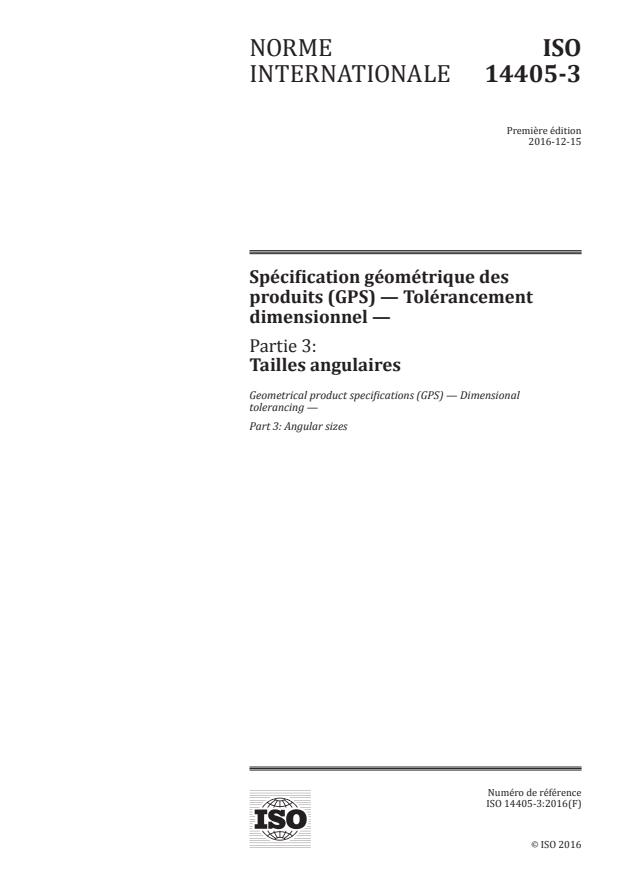
NORME ISO
INTERNATIONALE 14405-3
Première édition
2016-12-15
Spécification géométrique des
produits (GPS) — Tolérancement
dimensionnel —
Partie 3:
Tailles angulaires
Geometrical product specifications (GPS) — Dimensional
tolerancing —
Part 3: Angular sizes
Numéro de référence
©
ISO 2016
DOCUMENT PROTÉGÉ PAR COPYRIGHT
© ISO 2016, Publié en Suisse
Droits de reproduction réservés. Sauf indication contraire, aucune partie de cette publication ne peut être reproduite ni utilisée
sous quelque forme que ce soit et par aucun procédé, électronique ou mécanique, y compris la photocopie, l’affichage sur
l’internet ou sur un Intranet, sans autorisation écrite préalable. Les demandes d’autorisation peuvent être adressées à l’ISO à
l’adresse ci-après ou au comité membre de l’ISO dans le pays du demandeur.
ISO copyright office
Ch. de Blandonnet 8 • CP 401
CH-1214 Vernier, Geneva, Switzerland
Tel. +41 22 749 01 11
Fax +41 22 749 09 47
copyright@iso.org
www.iso.org
ii © ISO 2016 – Tous droits réservés
Sommaire Page
Avant-propos .iv
Introduction .v
1 Domaine d’application .1
2 Références normatives . 2
3 Termes et définitions . 2
4 Modificateurs de spécification et symboles .11
5 Opérateur de spécification de taille angulaire par défaut .13
5.1 Généralités .13
5.2 Opérateur de spécification de taille angulaire par défaut ISO .14
5.3 Opérateur de spécification de taille angulaire par défaut spécifique au dessin .15
6 Indication sur le dessin .16
6.1 Indication d’opérateurs de spécification de taille angulaire spéciaux sur le dessin . .16
6.2 Indication de l’élément tolérancé dont la caractéristique de taille angulaire est définie .17
Annexe A (normative) Critères d’association de la taille angulaire entre deux lignes (pour
une entité dimensionnelle de révolution ou prismatique) .19
Annexe B (informative) Différences entre deux plans considérés comme une entité
dimensionnelle angulaire et deux plans considérés comme deux éléments uniques .21
Annexe C (informative) Diagramme explicatif du concept de taille angulaire .22
Annexe D (informative) Relation avec la matrice ISO GPS .23
Bibliographie .24
Avant-propos
L’ISO (Organisation internationale de normalisation) est une fédération mondiale d’organismes
nationaux de normalisation (comités membres de l’ISO). L’élaboration des Normes internationales est
en général confiée aux comités techniques de l’ISO. Chaque comité membre intéressé par une étude
a le droit de faire partie du comité technique créé à cet effet. Les organisations internationales,
gouvernementales et non gouvernementales, en liaison avec l’ISO participent également aux travaux.
L’ISO collabore étroitement avec la Commission électrotechnique internationale (IEC) en ce qui
concerne la normalisation électrotechnique.
Les procédures utilisées pour élaborer le présent document et celles destinées à sa mise à jour sont
décrites dans les Directives ISO/IEC, Partie 1. Il convient, en particulier de prendre note des différents
critères d’approbation requis pour les différents types de documents ISO. Le présent document a été
rédigé conformément aux règles de rédaction données dans les Directives ISO/IEC, Partie 2 (voir www.
iso.org/directives).
L’attention est appelée sur le fait que certains des éléments du présent document peuvent faire l’objet de
droits de propriété intellectuelle ou de droits analogues. L’ISO ne saurait être tenue pour responsable
de ne pas avoir identifié de tels droits de propriété et averti de leur existence. Les détails concernant
les références aux droits de propriété intellectuelle ou autres droits analogues identifiés lors de
l’élaboration du document sont indiqués dans l’Introduction et/ou dans la liste des déclarations de
brevets reçues par l’ISO (voir www.iso.org/brevets).
Les appellations commerciales éventuellement mentionnées dans le présent document sont données
pour information, par souci de commodité, à l’intention des utilisateurs et ne sauraient constituer un
engagement.
Pour une explication de la signification des termes et expressions spécifiques de l’ISO liés à l’évaluation
de la conformité, ou pour toute information au sujet de l’adhésion de l’ISO aux principes de l’Organisation
mondiale du commerce (OMC) concernant les obstacles techniques au commerce (OTC), voir le lien
suivant: www.iso.org/iso/foreword.html.
Le présent document a été élaboré par le comité technique ISO/TC 213, Spécifications et vérification
dimensionnelles et géométriques des produits.
L’ISO 14405 comprend les parties suivantes, présentées sous le titre général Spécification géométrique
des produits (GPS) — Tolérancement dimensionnel:
— Partie 1: Tailles linéaires
— Partie 2: Dimensions autres que tailles linéaires
— Partie 3: Tailles angulaires
iv © ISO 2016 – Tous droits réservés
Introduction
La présente partie de l’ISO 14405, qui traite de la spécification géométrique des produits (GPS), est
à considérer comme une norme GPS générale (voir l’ISO 14638). Dans la matrice GPS générale, elle
influence les maillons «Symboles et indications», «Exigences de l’élément» et «Propriétés de l’élément»
de la chaîne dimensionnelle de normes.
Le schéma directeur ISO/GPS de l’ISO 14638 donne une vue d’ensemble du système ISO/GPS, dont
l’ISO 14405 fait partie. Les règles fondamentales de l’ISO/GPS fournies dans l’ISO 8015 s’appliquent
à la présente partie de l’ISO 14405 et les règles de décision par défaut indiquées dans l’ISO 14253-1
s’appliquent aux spécifications élaborées conformément à la présente partie de l’ISO 14405, sauf
indication contraire.
Pour de plus amples informations sur la relation de la présente partie de l’ISO 14405 avec les autres
normes et le modèle de matrice GPS, voir l’Annexe D.
NORME INTERNATIONALE ISO 14405-3:2016(F)
Spécification géométrique des produits (GPS) —
Tolérancement dimensionnel —
Partie 3:
Tailles angulaires
1 Domaine d’application
La présente partie de l’ISO 14405 établit l’opérateur de spécification de taille angulaire par défaut et
définit un ensemble d’opérateurs de spécification spéciaux pour les éléments de taille angulaire: cône
(tronqué, c’est à dire tronc de cône, ou non) ou coin (tronqué ou non), deux droites opposées (intersection
d’un coin/coin tronqué et d’un plan perpendiculaire à la ligne droite d’intersection des deux plans du
coin/coin tronqué, intersection d’un cône/tronc de cône et d’un plan contenant l’axe de révolution du
cône/tronc de cône). Voir Figure 1 et Figure 2.
La présente partie de l’ISO 14405 définit également les modificateurs de spécification et les indications
sur dessin de ces tailles angulaires.
La présente partie de l’ISO 14405 couvre les tailles angulaires suivantes:
— taille angulaire locale:
— taille angulaire entre deux lignes;
— taille angulaire sur une portion;
— taille angulaire globale:
— taille angulaire globale directe:
— taille angulaire des moindres carrés;
— taille angulaire du minimax;
— taille angulaire par ordre de rang/taille angulaire globale indirecte:
— taille angulaire maximale;
— taille angulaire minimale;
— taille angulaire moyenne;
— plage de tailles angulaires;
— taille angulaire de centre de plage;
— taille angulaire médiane;
— écart-type des tailles angulaires.
La présente partie de l’ISO 14405 définit la signification des tolérances sur les tailles angulaires
indiquées
— à l’aide des écarts limites + et/ou -, par exemple 0°/-0,5°, ou
— à l’aide de la limite supérieure de taille (Upper Limit of Size, ULS) et/ou de la limite inférieure de
taille (Lower Limit of Size, LLS), par exemple 35° max. ou 15° min., 34°/36°,
— avec ou sans modificateurs.
La présente partie de l’ISO 14405 fournit un ensemble d’outils pour exprimer plusieurs types de
caractéristiques de taille angulaire. Elle ne donne aucune information sur la relation entre une fonction
ou une utilisation et une caractéristique de taille angulaire.
2 Références normatives
Les documents suivants, en tout ou partie, sont référencés de façon normative dans le présent document
et sont indispensables à son application. Pour les références datées, seule l’édition citée s’applique.
Pour les références non datées, la dernière édition du document de référence s’applique (y compris les
éventuels amendements).
ISO 8015, Spécification géométrique des produits (GPS) — Principes fondamentaux — Concepts, principes
et règles
ISO 17450-1, Spécification géométrique des produits (GPS) — Concepts généraux — Partie 1: Modèle pour
la spécification et la vérification géométriques
ISO 17450-2, Spécification géométrique des produits (GPS) — Concepts généraux — Partie 2: Principes de
base, spécifications, opérateurs, incertitudes et ambiguïtés
ISO 17450-3, Spécification géométrique des produits (GPS) — Concepts généraux — Partie 3: Éléments
tolérancés
ISO 14405-1:2016, Spécification géométrique des produits (GPS) — Tolérancement dimensionnel —
Partie 1: Tailles linéaires
ISO 14405-2, Spécification géométrique des produits (GPS) — Tolérancement dimensionnel — Partie 2:
Dimensions autres que tailles linéaires
3 Termes et définitions
Pour les besoins du présent document, les termes et définitions donnés dans l’ISO 8015, l’ISO 17450-1,
l’ISO 17450-2, l’ISO 17450-3, l’ISO 14405-1 et l’ISO 14405-2, ainsi que les suivants, s’appliquent.
En ce qui concerne les critères d’association, on suppose que les termes «moindres carrés» et «gaussien»
sont équivalents, «minimax» et «Chebychev» également. Dans le présent document, les termes
«moindres carrés» et «minimax» sont utilisés. Le critère des moindres carrés s’entend sans contrainte
matière, tout au long de la présente partie de l’ISO 14405.
3.1
taille angulaire
dimension angulaire d’un cône ou entre deux droites coplanaires opposées ou entre deux plans non
parallèles opposés
Note 1 à l’article: La taille angulaire est définie à partir des éléments nominaux ou des éléments associés qui sont
des entités dimensionnelles angulaires.
Note 2 à l’article: Voir un exemple de taille angulaire à la Figure 1 et à la Figure 2.
Note 3 à l’article: La définition d’une «entité dimensionnelle angulaire (entité angulaire dimensionnelle)» est
donnée dans l’ISO 17450-1; la dimension de l’angle ne peut pas être 0° ou 180°.
Note 4 à l’article: Les entités dimensionnelles angulaires sont de deux types:
— entité dimensionnelle angulaire de révolution: un cône ou un tronc de cône. Deux lignes droites opposées
sont établies à partir de la section longitudinale d’un cône/tronc de cône avec un plan contenant l’axe de
révolution associé de ce cône/tronc de cône;
2 © ISO 2016 – Tous droits réservés
— entité dimensionnelle angulaire prismatique: un coin (tronqué ou non). Deux lignes droites opposées sont
établies à travers la section d’un coin/coin tronqué avec un plan perpendiculaire à la ligne droite d’intersection
des deux plans associés du coin/coin tronqué.
Note 5 à l’article: Les Figure 1 et Figure 2 illustrent des entités dimensionnelles angulaires de type coin, cône,
tronc de cône et deux lignes.
Note 6 à l’article: Les Figures 3a et 3b illustrent le cas d’une entité dimensionnelle angulaire et d’une distance
angulaire entre deux plans qui ne constitue pas une entité dimensionnelle angulaire, mais qui montre qu’il
en existe une lorsque les directions de matière sont opposées (lorsque l’un des éléments est tourné autour de
leur ligne d’intersection pour coïncider avec l’autre élément, la matière est sur les côtés opposés pour les deux
éléments). Voir aussi l’Annexe B.
Note 7 à l’article: L’exigence d’enveloppe ne peut pas être appliquée aux entités dimensionnelles angulaires.
a) Coin b) Cône
c) Coin tronqué d) Tronc de cône
Figure 1 — Exemples d’entités dimensionnelles angulaires surfaciques
a) Deux lignes opposées d’un coin b) Deux lignes génératrices opposées d’un cône
Figure 2 — Exemples d’entités dimensionnelles angulaires
a) Exemple #1 b) Exemple # 2
Légende
1 Entité dimensionnelle angulaire
2 Entité autre qu’une entité dimensionnelle angulaire
Figure 3 — Exemples d’entités dimensionnelles angulaires possibles
3.2
taille angulaire locale
caractéristique de taille angulaire locale
caractéristique de taille angulaire ayant une valeur unique pour une position spécifique et une valeur
non unique le long et/ou autour de l’entité dimensionnelle angulaire
Note 1 à l’article: Pour un élément donné, il existe un nombre infini de tailles angulaires locales.
Note 2 à l’article: Un exemple de taille angulaire locale est donné à la Figure 4.
Note 3 à l’article: Deux associations de tailles angulaires locales peuvent être spécifiées: taille angulaire locale
des moindres carrés et taille angulaire locale du minimax. Voir l’Annexe A.
4 © ISO 2016 – Tous droits réservés
Légende
1 entité dimensionnelle angulaire réelle
2 plans associés à (1)
3 ligne droite d’intersection de (2)
4 section droite perpendiculaire de (3)
5 deux lignes extraites
6 deux lignes droites associées
7 taille angulaire entre deux lignes
Figure 4 — Taille angulaire entre deux lignes
Légende
1 entité dimensionnelle angulaire réelle
2 portion de (1)
3 plans associés à (2)
4 ligne droite d’intersection de (3)
5 taille angulaire sur une portion
Figure 5 — Taille angulaire sur une portion
3.2.1
taille angulaire entre deux lignes
taille angulaire locale entre deux lignes
angle formé par deux lignes droites associées, établies à partir de deux lignes extraites obtenues par
l’intersection avec un plan d’intersection défini à partir de l’entité dimensionnelle angulaire associée
Note 1 à l’article: Voir Figure 4.
Note 2 à l’article: Le processus permettant d’établir la taille angulaire entre deux lignes dépend de la classe
d’invariance de l’élément: surface de révolution ou surface prismatique.
Note 3 à l’article: L’opérateur de spécification par défaut définissant la taille angulaire entre deux lignes est décrit
à l’Annexe A.
3.2.1.1
taille angulaire de révolution entre deux lignes
taille angulaire entre deux lignes (3.2.1) où les lignes droites sont associées à deux lignes extraites
résultant de l’intersection d’un élément de révolution extrait avec un plan contenant son axe associé
Note 1 à l’article: L’axe de l’élément de révolution associé est la «ligne médiane directement associée» décrite
dans l’ISO 22432:2011, 3.5.1.2.4.
6 © ISO 2016 – Tous droits réservés
3.2.1.2
taille angulaire prismatique entre deux lignes
taille angulaire entre deux lignes (3.2.1) où les lignes droites sont associées à deux lignes extraites
résultant de l’intersection de deux surfaces extraites avec un plan perpendiculaire à leur ligne droite
d’intersection associée
3.2.2
taille angulaire sur une portion
taille angulaire globale (3.3) pour une portion donnée d’une entité dimensionnelle angulaire extraite
Note 1 à l’article: Une taille angulaire sur une portion est une taille angulaire locale lors de la prise en compte de
l’entité dimensionnelle angulaire complète, et une taille angulaire globale lors de la prise en compte de la portion
spécifique uniquement.
Note 2 à l’article: Voir Figure 5.
Note 3 à l’article: Une taille angulaire sur une portion peut être une taille angulaire globale directe (3.3.1) ou une
taille angulaire globale indirecte (3.3.2).
Note 4 à l’article: L’opérateur permettant de définir une portion n’est pas traité dans la présente partie de
l’ISO 14405.
3.3
taille angulaire globale
caractéristique de taille angulaire globale
caractéristique de taille angulaire ayant une valeur unique pour l’entité dimensionnelle angulaire
tolérancée complète
3.3.1
taille angulaire globale directe
caractéristique de taille angulaire globale directe
taille angulaire globale définie à partir d’une association sur une taille angulaire globale
Note 1 à l’article: Si l’entité dimensionnelle angulaire est un cône, l’élément associé est un cône. Si l’entité
dimensionnelle angulaire est un coin, les éléments associés sont une paire de plans. Un plan est associé
indépendamment de chaque côté du coin.
Note 2 à l’article: Voir Figure 6.
Note 3 à l’article: Des critères d’association différents conduisent à des résultats différents. Les critères
d’association décrits dans la présente partie de l’ISO 14405 sont le critère des moindres carrés et le critère du
minimax.
Légende
1 entités dimensionnelles angulaires réelles
2 plans associés à (1)
3 ligne droite d’intersection de (2)
4 taille angulaire globale directe définie dans un plan perpendiculaire à la ligne droite d’intersection
Figure 6 — Tailles angulaires globales directes
3.3.1.1
taille angulaire globale des moindres carrés
taille angulaire globale directe utilisant le critère d’association des moindres carrés
Note 1 à l’article: Voir Figure 7 et Figure 9.
...
NORME ISO
INTERNATIONALE 14405-3
Première édition
2016-12-15
Spécification géométrique des
produits (GPS) — Tolérancement
dimensionnel —
Partie 3:
Tailles angulaires
Geometrical product specifications (GPS) — Dimensional
tolerancing —
Part 3: Angular sizes
Numéro de référence
©
ISO 2016
DOCUMENT PROTÉGÉ PAR COPYRIGHT
© ISO 2016, Publié en Suisse
Droits de reproduction réservés. Sauf indication contraire, aucune partie de cette publication ne peut être reproduite ni utilisée
sous quelque forme que ce soit et par aucun procédé, électronique ou mécanique, y compris la photocopie, l’affichage sur
l’internet ou sur un Intranet, sans autorisation écrite préalable. Les demandes d’autorisation peuvent être adressées à l’ISO à
l’adresse ci-après ou au comité membre de l’ISO dans le pays du demandeur.
ISO copyright office
Ch. de Blandonnet 8 • CP 401
CH-1214 Vernier, Geneva, Switzerland
Tel. +41 22 749 01 11
Fax +41 22 749 09 47
copyright@iso.org
www.iso.org
ii © ISO 2016 – Tous droits réservés
Sommaire Page
Avant-propos .iv
Introduction .v
1 Domaine d’application .1
2 Références normatives . 2
3 Termes et définitions . 2
4 Modificateurs de spécification et symboles .11
5 Opérateur de spécification de taille angulaire par défaut .13
5.1 Généralités .13
5.2 Opérateur de spécification de taille angulaire par défaut ISO .14
5.3 Opérateur de spécification de taille angulaire par défaut spécifique au dessin .15
6 Indication sur le dessin .16
6.1 Indication d’opérateurs de spécification de taille angulaire spéciaux sur le dessin . .16
6.2 Indication de l’élément tolérancé dont la caractéristique de taille angulaire est définie .17
Annexe A (normative) Critères d’association de la taille angulaire entre deux lignes (pour
une entité dimensionnelle de révolution ou prismatique) .19
Annexe B (informative) Différences entre deux plans considérés comme une entité
dimensionnelle angulaire et deux plans considérés comme deux éléments uniques .21
Annexe C (informative) Diagramme explicatif du concept de taille angulaire .22
Annexe D (informative) Relation avec la matrice ISO GPS .23
Bibliographie .24
Avant-propos
L’ISO (Organisation internationale de normalisation) est une fédération mondiale d’organismes
nationaux de normalisation (comités membres de l’ISO). L’élaboration des Normes internationales est
en général confiée aux comités techniques de l’ISO. Chaque comité membre intéressé par une étude
a le droit de faire partie du comité technique créé à cet effet. Les organisations internationales,
gouvernementales et non gouvernementales, en liaison avec l’ISO participent également aux travaux.
L’ISO collabore étroitement avec la Commission électrotechnique internationale (IEC) en ce qui
concerne la normalisation électrotechnique.
Les procédures utilisées pour élaborer le présent document et celles destinées à sa mise à jour sont
décrites dans les Directives ISO/IEC, Partie 1. Il convient, en particulier de prendre note des différents
critères d’approbation requis pour les différents types de documents ISO. Le présent document a été
rédigé conformément aux règles de rédaction données dans les Directives ISO/IEC, Partie 2 (voir www.
iso.org/directives).
L’attention est appelée sur le fait que certains des éléments du présent document peuvent faire l’objet de
droits de propriété intellectuelle ou de droits analogues. L’ISO ne saurait être tenue pour responsable
de ne pas avoir identifié de tels droits de propriété et averti de leur existence. Les détails concernant
les références aux droits de propriété intellectuelle ou autres droits analogues identifiés lors de
l’élaboration du document sont indiqués dans l’Introduction et/ou dans la liste des déclarations de
brevets reçues par l’ISO (voir www.iso.org/brevets).
Les appellations commerciales éventuellement mentionnées dans le présent document sont données
pour information, par souci de commodité, à l’intention des utilisateurs et ne sauraient constituer un
engagement.
Pour une explication de la signification des termes et expressions spécifiques de l’ISO liés à l’évaluation
de la conformité, ou pour toute information au sujet de l’adhésion de l’ISO aux principes de l’Organisation
mondiale du commerce (OMC) concernant les obstacles techniques au commerce (OTC), voir le lien
suivant: www.iso.org/iso/foreword.html.
Le présent document a été élaboré par le comité technique ISO/TC 213, Spécifications et vérification
dimensionnelles et géométriques des produits.
L’ISO 14405 comprend les parties suivantes, présentées sous le titre général Spécification géométrique
des produits (GPS) — Tolérancement dimensionnel:
— Partie 1: Tailles linéaires
— Partie 2: Dimensions autres que tailles linéaires
— Partie 3: Tailles angulaires
iv © ISO 2016 – Tous droits réservés
Introduction
La présente partie de l’ISO 14405, qui traite de la spécification géométrique des produits (GPS), est
à considérer comme une norme GPS générale (voir l’ISO 14638). Dans la matrice GPS générale, elle
influence les maillons «Symboles et indications», «Exigences de l’élément» et «Propriétés de l’élément»
de la chaîne dimensionnelle de normes.
Le schéma directeur ISO/GPS de l’ISO 14638 donne une vue d’ensemble du système ISO/GPS, dont
l’ISO 14405 fait partie. Les règles fondamentales de l’ISO/GPS fournies dans l’ISO 8015 s’appliquent
à la présente partie de l’ISO 14405 et les règles de décision par défaut indiquées dans l’ISO 14253-1
s’appliquent aux spécifications élaborées conformément à la présente partie de l’ISO 14405, sauf
indication contraire.
Pour de plus amples informations sur la relation de la présente partie de l’ISO 14405 avec les autres
normes et le modèle de matrice GPS, voir l’Annexe D.
NORME INTERNATIONALE ISO 14405-3:2016(F)
Spécification géométrique des produits (GPS) —
Tolérancement dimensionnel —
Partie 3:
Tailles angulaires
1 Domaine d’application
La présente partie de l’ISO 14405 établit l’opérateur de spécification de taille angulaire par défaut et
définit un ensemble d’opérateurs de spécification spéciaux pour les éléments de taille angulaire: cône
(tronqué, c’est à dire tronc de cône, ou non) ou coin (tronqué ou non), deux droites opposées (intersection
d’un coin/coin tronqué et d’un plan perpendiculaire à la ligne droite d’intersection des deux plans du
coin/coin tronqué, intersection d’un cône/tronc de cône et d’un plan contenant l’axe de révolution du
cône/tronc de cône). Voir Figure 1 et Figure 2.
La présente partie de l’ISO 14405 définit également les modificateurs de spécification et les indications
sur dessin de ces tailles angulaires.
La présente partie de l’ISO 14405 couvre les tailles angulaires suivantes:
— taille angulaire locale:
— taille angulaire entre deux lignes;
— taille angulaire sur une portion;
— taille angulaire globale:
— taille angulaire globale directe:
— taille angulaire des moindres carrés;
— taille angulaire du minimax;
— taille angulaire par ordre de rang/taille angulaire globale indirecte:
— taille angulaire maximale;
— taille angulaire minimale;
— taille angulaire moyenne;
— plage de tailles angulaires;
— taille angulaire de centre de plage;
— taille angulaire médiane;
— écart-type des tailles angulaires.
La présente partie de l’ISO 14405 définit la signification des tolérances sur les tailles angulaires
indiquées
— à l’aide des écarts limites + et/ou -, par exemple 0°/-0,5°, ou
— à l’aide de la limite supérieure de taille (Upper Limit of Size, ULS) et/ou de la limite inférieure de
taille (Lower Limit of Size, LLS), par exemple 35° max. ou 15° min., 34°/36°,
— avec ou sans modificateurs.
La présente partie de l’ISO 14405 fournit un ensemble d’outils pour exprimer plusieurs types de
caractéristiques de taille angulaire. Elle ne donne aucune information sur la relation entre une fonction
ou une utilisation et une caractéristique de taille angulaire.
2 Références normatives
Les documents suivants, en tout ou partie, sont référencés de façon normative dans le présent document
et sont indispensables à son application. Pour les références datées, seule l’édition citée s’applique.
Pour les références non datées, la dernière édition du document de référence s’applique (y compris les
éventuels amendements).
ISO 8015, Spécification géométrique des produits (GPS) — Principes fondamentaux — Concepts, principes
et règles
ISO 17450-1, Spécification géométrique des produits (GPS) — Concepts généraux — Partie 1: Modèle pour
la spécification et la vérification géométriques
ISO 17450-2, Spécification géométrique des produits (GPS) — Concepts généraux — Partie 2: Principes de
base, spécifications, opérateurs, incertitudes et ambiguïtés
ISO 17450-3, Spécification géométrique des produits (GPS) — Concepts généraux — Partie 3: Éléments
tolérancés
ISO 14405-1:2016, Spécification géométrique des produits (GPS) — Tolérancement dimensionnel —
Partie 1: Tailles linéaires
ISO 14405-2, Spécification géométrique des produits (GPS) — Tolérancement dimensionnel — Partie 2:
Dimensions autres que tailles linéaires
3 Termes et définitions
Pour les besoins du présent document, les termes et définitions donnés dans l’ISO 8015, l’ISO 17450-1,
l’ISO 17450-2, l’ISO 17450-3, l’ISO 14405-1 et l’ISO 14405-2, ainsi que les suivants, s’appliquent.
En ce qui concerne les critères d’association, on suppose que les termes «moindres carrés» et «gaussien»
sont équivalents, «minimax» et «Chebychev» également. Dans le présent document, les termes
«moindres carrés» et «minimax» sont utilisés. Le critère des moindres carrés s’entend sans contrainte
matière, tout au long de la présente partie de l’ISO 14405.
3.1
taille angulaire
dimension angulaire d’un cône ou entre deux droites coplanaires opposées ou entre deux plans non
parallèles opposés
Note 1 à l’article: La taille angulaire est définie à partir des éléments nominaux ou des éléments associés qui sont
des entités dimensionnelles angulaires.
Note 2 à l’article: Voir un exemple de taille angulaire à la Figure 1 et à la Figure 2.
Note 3 à l’article: La définition d’une «entité dimensionnelle angulaire (entité angulaire dimensionnelle)» est
donnée dans l’ISO 17450-1; la dimension de l’angle ne peut pas être 0° ou 180°.
Note 4 à l’article: Les entités dimensionnelles angulaires sont de deux types:
— entité dimensionnelle angulaire de révolution: un cône ou un tronc de cône. Deux lignes droites opposées
sont établies à partir de la section longitudinale d’un cône/tronc de cône avec un plan contenant l’axe de
révolution associé de ce cône/tronc de cône;
2 © ISO 2016 – Tous droits réservés
— entité dimensionnelle angulaire prismatique: un coin (tronqué ou non). Deux lignes droites opposées sont
établies à travers la section d’un coin/coin tronqué avec un plan perpendiculaire à la ligne droite d’intersection
des deux plans associés du coin/coin tronqué.
Note 5 à l’article: Les Figure 1 et Figure 2 illustrent des entités dimensionnelles angulaires de type coin, cône,
tronc de cône et deux lignes.
Note 6 à l’article: Les Figures 3a et 3b illustrent le cas d’une entité dimensionnelle angulaire et d’une distance
angulaire entre deux plans qui ne constitue pas une entité dimensionnelle angulaire, mais qui montre qu’il
en existe une lorsque les directions de matière sont opposées (lorsque l’un des éléments est tourné autour de
leur ligne d’intersection pour coïncider avec l’autre élément, la matière est sur les côtés opposés pour les deux
éléments). Voir aussi l’Annexe B.
Note 7 à l’article: L’exigence d’enveloppe ne peut pas être appliquée aux entités dimensionnelles angulaires.
a) Coin b) Cône
c) Coin tronqué d) Tronc de cône
Figure 1 — Exemples d’entités dimensionnelles angulaires surfaciques
a) Deux lignes opposées d’un coin b) Deux lignes génératrices opposées d’un cône
Figure 2 — Exemples d’entités dimensionnelles angulaires
a) Exemple #1 b) Exemple # 2
Légende
1 Entité dimensionnelle angulaire
2 Entité autre qu’une entité dimensionnelle angulaire
Figure 3 — Exemples d’entités dimensionnelles angulaires possibles
3.2
taille angulaire locale
caractéristique de taille angulaire locale
caractéristique de taille angulaire ayant une valeur unique pour une position spécifique et une valeur
non unique le long et/ou autour de l’entité dimensionnelle angulaire
Note 1 à l’article: Pour un élément donné, il existe un nombre infini de tailles angulaires locales.
Note 2 à l’article: Un exemple de taille angulaire locale est donné à la Figure 4.
Note 3 à l’article: Deux associations de tailles angulaires locales peuvent être spécifiées: taille angulaire locale
des moindres carrés et taille angulaire locale du minimax. Voir l’Annexe A.
4 © ISO 2016 – Tous droits réservés
Légende
1 entité dimensionnelle angulaire réelle
2 plans associés à (1)
3 ligne droite d’intersection de (2)
4 section droite perpendiculaire de (3)
5 deux lignes extraites
6 deux lignes droites associées
7 taille angulaire entre deux lignes
Figure 4 — Taille angulaire entre deux lignes
Légende
1 entité dimensionnelle angulaire réelle
2 portion de (1)
3 plans associés à (2)
4 ligne droite d’intersection de (3)
5 taille angulaire sur une portion
Figure 5 — Taille angulaire sur une portion
3.2.1
taille angulaire entre deux lignes
taille angulaire locale entre deux lignes
angle formé par deux lignes droites associées, établies à partir de deux lignes extraites obtenues par
l’intersection avec un plan d’intersection défini à partir de l’entité dimensionnelle angulaire associée
Note 1 à l’article: Voir Figure 4.
Note 2 à l’article: Le processus permettant d’établir la taille angulaire entre deux lignes dépend de la classe
d’invariance de l’élément: surface de révolution ou surface prismatique.
Note 3 à l’article: L’opérateur de spécification par défaut définissant la taille angulaire entre deux lignes est décrit
à l’Annexe A.
3.2.1.1
taille angulaire de révolution entre deux lignes
taille angulaire entre deux lignes (3.2.1) où les lignes droites sont associées à deux lignes extraites
résultant de l’intersection d’un élément de révolution extrait avec un plan contenant son axe associé
Note 1 à l’article: L’axe de l’élément de révolution associé est la «ligne médiane directement associée» décrite
dans l’ISO 22432:2011, 3.5.1.2.4.
6 © ISO 2016 – Tous droits réservés
3.2.1.2
taille angulaire prismatique entre deux lignes
taille angulaire entre deux lignes (3.2.1) où les lignes droites sont associées à deux lignes extraites
résultant de l’intersection de deux surfaces extraites avec un plan perpendiculaire à leur ligne droite
d’intersection associée
3.2.2
taille angulaire sur une portion
taille angulaire globale (3.3) pour une portion donnée d’une entité dimensionnelle angulaire extraite
Note 1 à l’article: Une taille angulaire sur une portion est une taille angulaire locale lors de la prise en compte de
l’entité dimensionnelle angulaire complète, et une taille angulaire globale lors de la prise en compte de la portion
spécifique uniquement.
Note 2 à l’article: Voir Figure 5.
Note 3 à l’article: Une taille angulaire sur une portion peut être une taille angulaire globale directe (3.3.1) ou une
taille angulaire globale indirecte (3.3.2).
Note 4 à l’article: L’opérateur permettant de définir une portion n’est pas traité dans la présente partie de
l’ISO 14405.
3.3
taille angulaire globale
caractéristique de taille angulaire globale
caractéristique de taille angulaire ayant une valeur unique pour l’entité dimensionnelle angulaire
tolérancée complète
3.3.1
taille angulaire globale directe
caractéristique de taille angulaire globale directe
taille angulaire globale définie à partir d’une association sur une taille angulaire globale
Note 1 à l’article: Si l’entité dimensionnelle angulaire est un cône, l’élément associé est un cône. Si l’entité
dimensionnelle angulaire est un coin, les éléments associés sont une paire de plans. Un plan est associé
indépendamment de chaque côté du coin.
Note 2 à l’article: Voir Figure 6.
Note 3 à l’article: Des critères d’association différents conduisent à des résultats différents. Les critères
d’association décrits dans la présente partie de l’ISO 14405 sont le critère des moindres carrés et le critère du
minimax.
Légende
1 entités dimensionnelles angulaires réelles
2 plans associés à (1)
3 ligne droite d’intersection de (2)
4 taille angulaire globale directe définie dans un plan perpendiculaire à la ligne droite d’intersection
Figure 6 — Tailles angulaires globales directes
3.3.1.1
taille angulaire globale des moindres carrés
taille angulaire globale directe utilisant le critère d’association des moindres carrés
Note 1 à l’article: Voir Figure 7 et Figure 9.
...