

ISO 12940-2:2026
(Main)Petroleum products and lubricants — Determination of roll stability of lubricating grease — Part 2: Wet condition test
General Information
- Abstract
This document specifies a method for evaluating the change of consistency, as measured by cone penetration, of lubricating grease when worked in the roll stability test apparatus, in the presence of water. The method described in this document only applies to greases with cone penetration in the range of 175 × 0,1 mm to 385 × 0,1 mm as measured using ISO 2137.
- Status
- Published
- Publication Date
- 04-Feb-2026
- Current Stage
- 6060 - International Standard published
- Start Date
- 05-Feb-2026
- Due Date
- 12-Sep-2025
- Completion Date
- 05-Feb-2026
Buy Documents
ISO 12940-2:2026 - Petroleum products and lubricants — Determination of roll stability of lubricating grease — Part 2: Wet condition test Released:5. 02. 2026
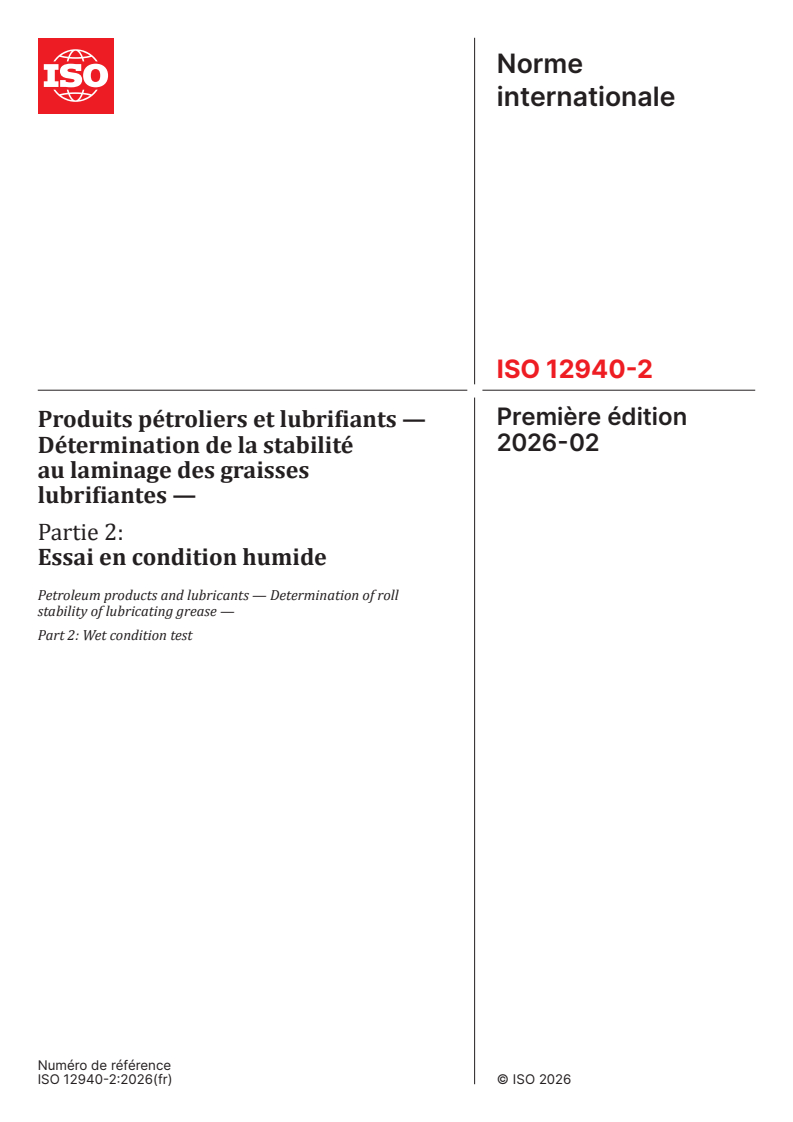
ISO 12940-2:2026 - Produits pétroliers et lubrifiants — Détermination de la stabilité au laminage des graisses lubrifiantes — Partie 2: Essai en condition humide Released:5. 02. 2026
Overview
ISO 12940-2:2026 is an international standard developed by ISO that outlines a specific method for determining the roll stability of lubricating greases under wet conditions. The procedure evaluates changes in grease consistency-measured by cone penetration-when the product is worked in a roll stability test apparatus in the presence of water. This method applies to greases with cone penetration values ranging from 175 × 0.1 mm to 385 × 0.1 mm, as specified by ISO 2137.
This standard is vital for manufacturers, suppliers, and users of lubricating greases, offering an objective and comparative way to assess how exposure to water affects grease performance, consistency, and ultimately, suitability for practical applications.
Key Topics
- Roll Stability in Wet Conditions: The test simulates real-world environments where lubricating grease may be exposed to water, influencing its physical properties.
- Consistency Measurement: Changes in grease consistency are quantified using worked cone penetration before and after exposure to wet rolling conditions.
- Applicability: The standard is relevant to a wide range of grease types within the specified penetration range, supporting product development, quality control, and specification compliance.
- Testing Procedures:
- Grease samples are prepared with water using standardized methods to ensure consistent and homogeneous mixtures.
- The roll stability apparatus subjects the sample to a defined combination of shear and temperature, either at ambient conditions or elevated temperatures.
- Post-test, the consistency is remeasured, and results are compared to pre-test values.
- Reporting and Repeatability: The standard provides guidance for consistent reporting, including test conditions, sample identification, deviations, and observations of physical changes.
Applications
ISO 12940-2:2026 is essential in several key areas:
- Product Development and R&D: Laboratories and manufacturers use the method to evaluate new grease formulations and understand how water exposure impacts performance.
- Quality Control and Specification Compliance: Routine batch testing ensures finished products meet technical requirements and perform reliably in wet environments.
- Industrial Sectors:
- Automotive and Heavy Machinery: For bearings and components exposed to water, such as wheel bearings, marine equipment, and off-road vehicles.
- Steel and Pulp & Paper Industries: Where process equipment operates in high-moisture environments.
- Comparative Benchmarking: Enables clear comparisons between different grease products, supporting purchasing decisions and supplier evaluations.
By adopting ISO 12940-2:2026, organizations can minimize the risk of equipment failure due to improper grease selection, improve machinery life, and document compliance with best practices for lubricant testing.
Related Standards
- ISO 2137: Methods for determining the cone penetration of lubricating greases and petrolatum.
- ISO 11009: Evaluation of grease resistance to water washout in bearings.
- ISO 11007-1 and ISO/TS 11007-2: Determination of rust-prevention characteristics of lubricating greases under dynamic wet conditions and with water wash-out.
- ASTM D7342, ISO 12921, NF T60-626: Additional methods for assessing grease stability in the presence of water.
- ISO 23572: Sampling of lubricating greases for testing purposes.
These complementary standards provide a comprehensive framework for characterizing the behavior of lubricating greases, particularly under challenging conditions involving water exposure.
By implementing ISO 12940-2:2026, stakeholders in the lubricants industry ensure robust, repeatable, and globally recognized evaluation of grease roll stability under wet conditions, supporting operational reliability across diverse sectors.
Buy Documents
ISO 12940-2:2026 - Petroleum products and lubricants — Determination of roll stability of lubricating grease — Part 2: Wet condition test Released:5. 02. 2026
ISO 12940-2:2026 - Produits pétroliers et lubrifiants — Détermination de la stabilité au laminage des graisses lubrifiantes — Partie 2: Essai en condition humide Released:5. 02. 2026
Get Certified
Connect with accredited certification bodies for this standard

Element Materials Technology
Materials testing and product certification.

ABS Group Brazil
ABS Group certification services in Brazil.

ABS Quality Evaluations Inc.
American Bureau of Shipping quality certification.
Sponsored listings
Frequently Asked Questions
ISO 12940-2:2026 is a standard published by the International Organization for Standardization (ISO). Its full title is "Petroleum products and lubricants — Determination of roll stability of lubricating grease — Part 2: Wet condition test". This standard covers: This document specifies a method for evaluating the change of consistency, as measured by cone penetration, of lubricating grease when worked in the roll stability test apparatus, in the presence of water. The method described in this document only applies to greases with cone penetration in the range of 175 × 0,1 mm to 385 × 0,1 mm as measured using ISO 2137.
This document specifies a method for evaluating the change of consistency, as measured by cone penetration, of lubricating grease when worked in the roll stability test apparatus, in the presence of water. The method described in this document only applies to greases with cone penetration in the range of 175 × 0,1 mm to 385 × 0,1 mm as measured using ISO 2137.
ISO 12940-2:2026 is classified under the following ICS (International Classification for Standards) categories: 75.100 - Lubricants, industrial oils and related products. The ICS classification helps identify the subject area and facilitates finding related standards.
ISO 12940-2:2026 is available in PDF format for immediate download after purchase. The document can be added to your cart and obtained through the secure checkout process. Digital delivery ensures instant access to the complete standard document.
Standards Content (Sample)
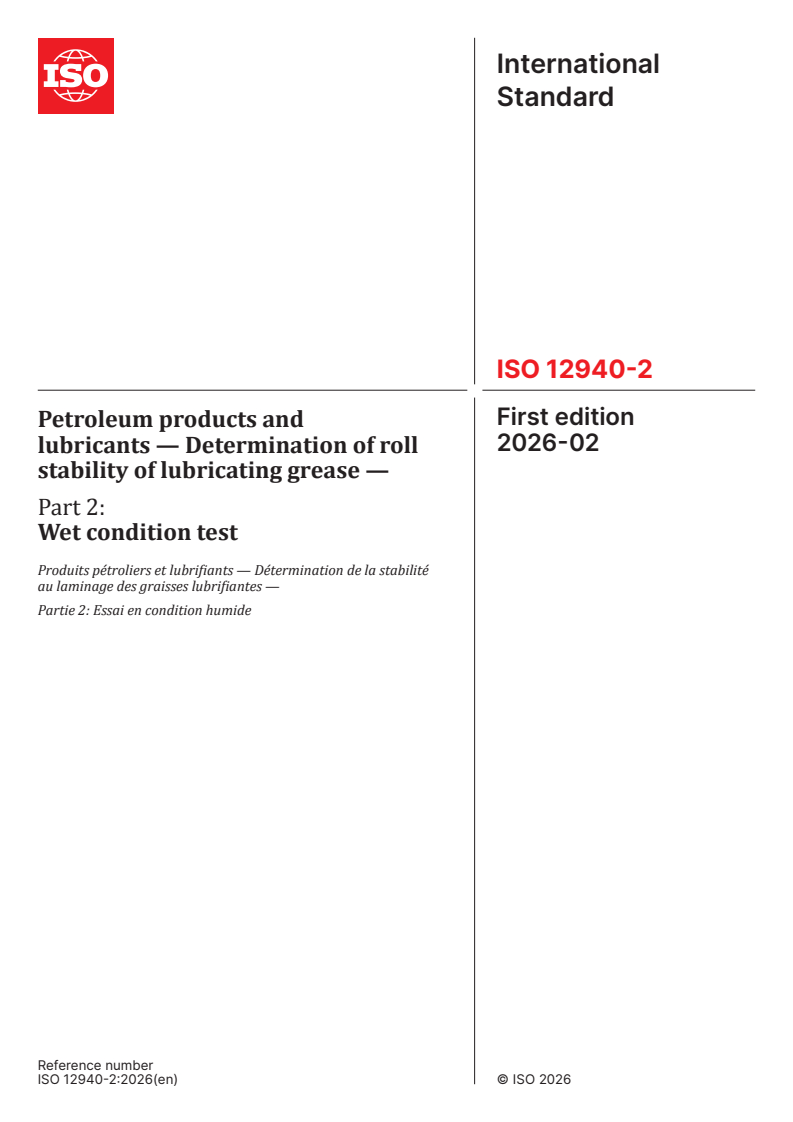
International
Standard
ISO 12940-2
First edition
Petroleum products and
2026-02
lubricants — Determination of roll
stability of lubricating grease —
Part 2:
Wet condition test
Produits pétroliers et lubrifiants — Détermination de la stabilité
au laminage des graisses lubrifiantes —
Partie 2: Essai en condition humide
Reference number
© ISO 2026
All rights reserved. Unless otherwise specified, or required in the context of its implementation, no part of this publication may
be reproduced or utilized otherwise in any form or by any means, electronic or mechanical, including photocopying, or posting on
the internet or an intranet, without prior written permission. Permission can be requested from either ISO at the address below
or ISO’s member body in the country of the requester.
ISO copyright office
CP 401 • Ch. de Blandonnet 8
CH-1214 Vernier, Geneva
Phone: +41 22 749 01 11
Email: copyright@iso.org
Website: www.iso.org
Published in Switzerland
ii
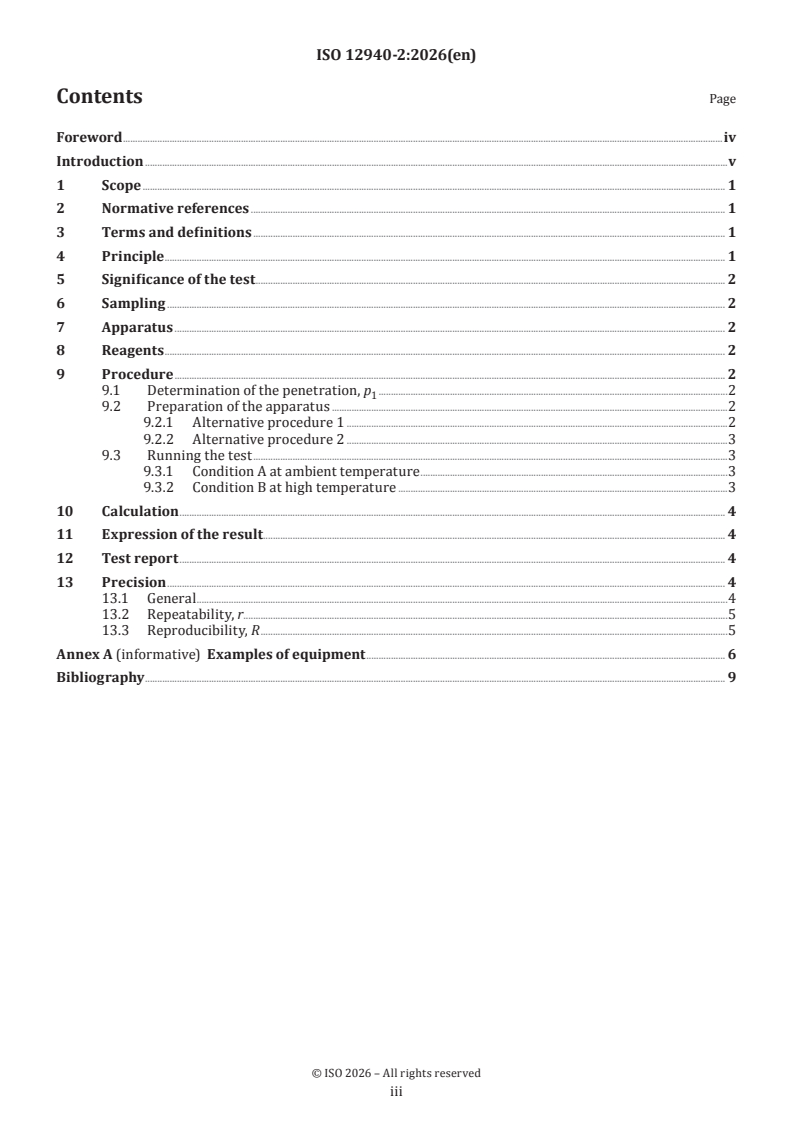
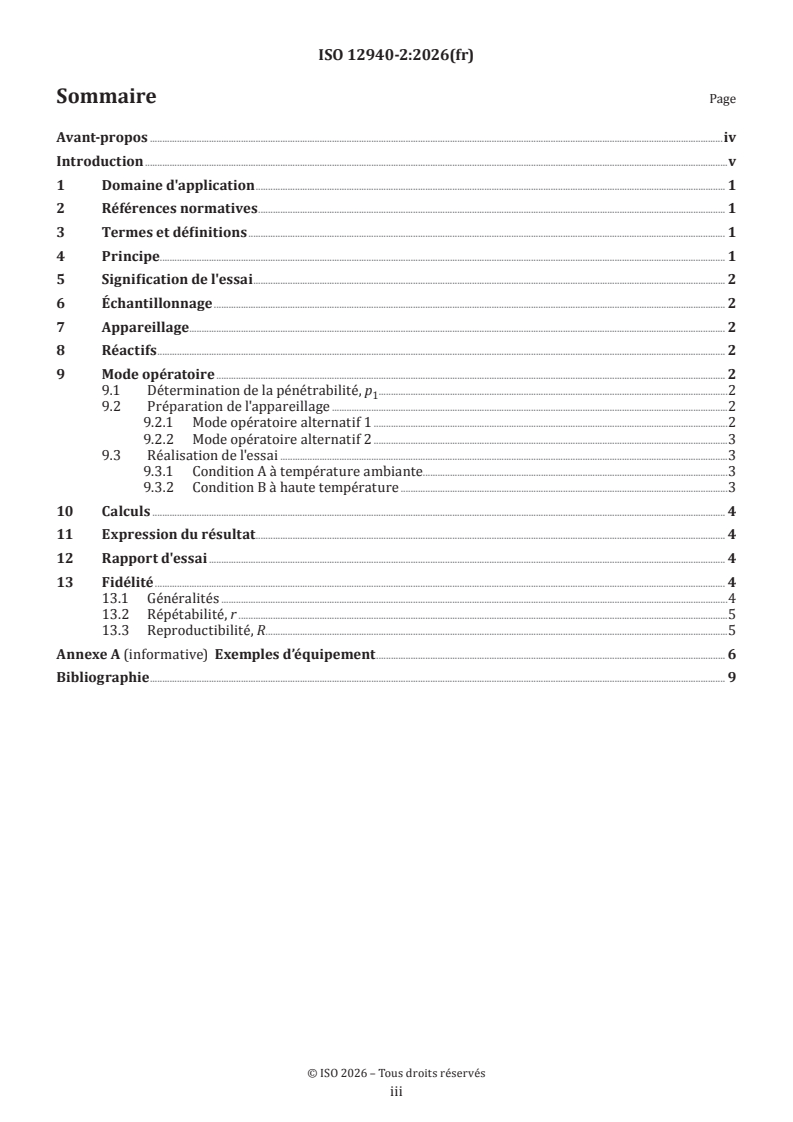
Contents Page
Foreword .iv
Introduction .v
1 Scope . 1
2 Normative references . 1
3 Terms and definitions . 1
4 Principle . 1
5 Significance of the test . 2
6 Sampling . 2
7 Apparatus . 2
8 Reagents . 2
9 Procedure . 2
9.1 Determination of the penetration, p .2
9.2 Preparation of the apparatus .2
9.2.1 Alternative procedure 1 .2
9.2.2 Alternative procedure 2 .3
9.3 Running the test .3
9.3.1 Condition A at ambient temperature .3
9.3.2 Condition B at high temperature .3
10 Calculation . 4
11 Expression of the result . . 4
12 Test report . 4
13 Precision . 4
13.1 General .4
13.2 Repeatability, r.5
13.3 Reproducibility, R .5
Annex A (informative) Examples of equipment . 6
Bibliography . 9
iii
Foreword
ISO (the International Organization for Standardization) is a worldwide federation of national standards
bodies (ISO member bodies). The work of preparing International Standards is normally carried out through
ISO technical committees. Each member body interested in a subject for which a technical committee
has been established has the right to be represented on that committee. International organizations,
governmental and non-governmental, in liaison with ISO, also take part in the work. ISO collaborates closely
with the International Electrotechnical Commission (IEC) on all matters of electrotechnical standardization.
The procedures used to develop this document and those intended for its further maintenance are described
in the ISO/IEC Directives, Part 1. In particular, the different approval criteria needed for the different types
of ISO document should be noted. This document was drafted in accordance with the editorial rules of the
ISO/IEC Directives, Part 2 (see www.iso.org/directives).
ISO draws attention to the possibility that the implementation of this document may involve the use of (a)
patent(s). ISO takes no position concerning the evidence, validity or applicability of any claimed patent
rights in respect thereof. As of the date of publication of this document, ISO had not received notice of (a)
patent(s) which may be required to implement this document. However, implementers are cautioned that
this may not represent the latest information, which may be obtained from the patent database available at
www.iso.org/patents. ISO shall not be held responsible for identifying any or all such patent rights.
Any trade name used in this document is information given for the convenience of users and does not
constitute an endorsement.
For an explanation of the voluntary nature of standards, the meaning of ISO specific terms and expressions
related to conformity assessment, as well as information about ISO's adherence to the World Trade
Organization (WTO) principles in the Technical Barriers to Trade (TBT), see www.iso.org/iso/foreword.html.
This document was prepared by Technical Committee ISO/TC 28, Petroleum and related products, fuels and
lubricants from natural or synthetic sources.
Any feedback or questions on this document should be directed to the user’s national standards body. A
complete listing of these bodies can be found at www.iso.org/members.html.
iv
Introduction
There are many ways to evaluate the behaviour of grease in the presence of water.
ISO 11009 describes a method to evaluate the resistance of grease to washout from a bearing in laboratory
conditions.
ISO 11007-1 and ISO/TS 11007-2 evaluate the ability of grease to protect bearings against corrosion in
dynamic conditions and in the presence of washout respectively.
[4] [6]
ASTM D7342, ISO 12921 and NF T60-626 describe methods to assess the working stability of grease in
the presence of water.
The action of water on greases can be shown by a relatively significant absorption of water, by a relatively
significant hardening or softening or by a loss of adhesiveness on metallic surfaces.
The purpose of this document is to prescribe a method to evaluate the behaviour of grease when it is rolled
in the presence of water. This is done by evaluating the consistency change (see Reference [7]), and hence
predicting its mechanical behaviour, the risk of leakages due to excessive softening and the risk of loss of the
lubricating property by either excessive hardening or complete solubilisation of the grease.
v
International Standard ISO 12940-2:2026(en)
Petroleum products and lubricants — Determination of roll
stability of lubricating grease —
Part 2:
Wet condition test
WARNING — The use of this document can involve hazardous materials, operations and equipment.
This document does not purport to address all of the safety problems, if any, associated with its use.
It is the responsibility of users of this document to take appropriate measures to ensure the safety
and health of personnel prior to the application of this document, and to determine the applicability
of any other restrictions.
1 Scope
This document specifies a method for evaluating the change of consistency, as measured by cone penetration,
of lubricating grease when worked in the roll stability test apparatus, in the presence of water. The method
described in this document only applies to greases with cone penetration in the range of 175 × 0,1 mm to
385 × 0,1 mm as measured using ISO 2137.
2 Normative references
The following documents are referred to in the text in such a way that some or all of their content constitutes
requirements of this document. For dated references, only the edition cited applies. For undated references,
the latest edition of the referenced document (including any amendments) applies.
ISO 2137:2020, Petroleum products and lubricants — Determination of cone penetration of lubricating greases
and petrolatum
ISO 3696, Water for analytical laboratory use — Specification and test methods
ISO 23572, Petroleum products — Lubricating greases — Sampling of greases
3 Terms and definitions
No terms and definitions are listed in this document.
ISO and IEC maintain terminology databases for use in standardization at the following addresses:
— ISO Online browsing platform: available at https:// www .iso .org/ obp
— IEC Electrope
...
Norme
internationale
ISO 12940-2
Première édition
Produits pétroliers et lubrifiants —
2026-02
Détermination de la stabilité
au laminage des graisses
lubrifiantes —
Partie 2:
Essai en condition humide
Petroleum products and lubricants — Determination of roll
stability of lubricating grease —
Part 2: Wet condition test
Numéro de référence
DOCUMENT PROTÉGÉ PAR COPYRIGHT
© ISO 2026
Tous droits réservés. Sauf prescription différente ou nécessité dans le contexte de sa mise en œuvre, aucune partie de cette
publication ne peut être reproduite ni utilisée sous quelque forme que ce soit et par aucun procédé, électronique ou mécanique,
y compris la photocopie, ou la diffusion sur l’internet ou sur un intranet, sans autorisation écrite préalable. Une autorisation peut
être demandée à l’ISO à l’adresse ci-après ou au comité membre de l’ISO dans le pays du demandeur.
ISO copyright office
Case postale 401 • Ch. de Blandonnet 8
CH-1214 Vernier, Genève
Tél.: +41 22 749 01 11
E-mail: copyright@iso.org
Web: www.iso.org
Publié en Suisse
ii
Sommaire Page
Avant-propos .iv
Introduction .v
1 Domaine d'application . 1
2 Références normatives . 1
3 Termes et définitions . 1
4 Principe. 1
5 Signification de l'essai . 2
6 Échantillonnage . 2
7 Appareillage . 2
8 Réactifs . 2
9 Mode opératoire . 2
9.1 Détermination de la pénétrabilité, p . .2
9.2 Préparation de l'appareillage .2
9.2.1 Mode opératoire alternatif 1 .2
9.2.2 Mode opératoire alternatif 2 .3
9.3 Réalisation de l'essai .3
9.3.1 Condition A à température ambiante.3
9.3.2 Condition B à haute température .3
10 Calculs . 4
11 Expression du résultat . 4
12 Rapport d'essai . 4
13 Fidélité . 4
13.1 Généralités .4
13.2 Répétabilité, r .5
13.3 Reproductibilité, R . .5
Annexe A (informative) Exemples d’équipement . 6
Bibliographie . 9
iii
Avant-propos
L'ISO (Organisation internationale de normalisation) est une fédération mondiale d'organismes nationaux
de normalisation (comités membres de l'ISO). L'élaboration des Normes internationales est en général
confiée aux comités techniques de l'ISO. Chaque comité membre intéressé par une étude a le droit de faire
partie du comité technique créé à cet effet. Les organisations internationales, gouvernementales et non
gouvernementales, en liaison avec l'ISO participent également aux travaux. L'ISO collabore étroitement avec
la Commission électrotechnique internationale (IEC) en ce qui concerne la normalisation électrotechnique.
Les procédures utilisées pour élaborer le présent document et celles destinées à sa mise à jour sont
décrites dans les Directives ISO/IEC, Partie 1. Il convient, en particulier, de prendre note des différents
critères d'approbation requis pour les différents types de documents ISO. Le présent document a
été rédigé conformément aux règles de rédaction données dans les Directives ISO/IEC, Partie 2 (voir
www.iso.org/directives).
L’ISO attire l’attention sur le fait que la mise en application du présent document peut entraîner l’utilisation
d’un ou de plusieurs brevets. L’ISO ne prend pas position quant à la preuve, à la validité et à l’applicabilité de
tout droit de brevet revendiqué à cet égard. À la date de publication du présent document, l’ISO n'avait pas
reçu notification qu’un ou plusieurs brevets pouvaient être nécessaires à sa mise en application. Toutefois,
il y a lieu d’avertir les responsables de la mise en application du présent document que des informations
plus récentes sont susceptibles de figurer dans la base de données de brevets, disponible à l'adresse
www.iso.org/brevets. L’ISO ne saurait être tenue pour responsable de ne pas avoir identifié tout ou partie de
tels droits de propriété.
Les appellations commerciales éventuellement mentionnées dans le présent document sont données pour
information, par souci de commodité, à l’intention des utilisateurs et ne sauraient constituer un engagement.
Pour une explication de la nature volontaire des normes, la signification des termes et expressions
spécifiques de l'ISO liés à l'évaluation de la conformité, ou pour toute information au sujet de l'adhésion de
l'ISO aux principes de l’Organisation mondiale du commerce (OMC) concernant les obstacles techniques au
commerce (OTC), voir www.iso.org/avant-propos.
Le présent document a été élaboré par le comité technique ISO/TC 28, Produits pétroliers et produits connexes,
combustibles et lubrifiants d’origine synthétique ou biologique.
Il convient que l’utilisateur adresse tout retour d’information ou toute question concernant le présent
document à l’organisme national de normalisation de son pays. Une liste exhaustive desdits organismes se
trouve à l’adresse www.iso.org/fr/members.html.
iv
Introduction
De nombreuses possibilités existent pour évaluer le comportement des graisses en présence d'eau.
L'ISO 11009 décrit une méthode pour évaluer la résistance de la graisse au délavage d'un roulement dans des
conditions de laboratoire.
L'ISO 11007-1 et l'ISO/TS 11007-2 évaluent la capacité d'une graisse à protéger les roulements contre la
corrosion dans des conditions dynamiques et en présence d'un délavage, respectivement.
[4] [6]
L'ASTM D7342 , l'ISO 12921 et la NF T60-626 décrivent des méthodes d'évaluation de la stabilité en
service d'une graisse en présence d'eau.
L'action de l'eau sur les graisses peut également être démontrée par une absorption d'eau plus ou moins
importante, par un durcissement ou un ramollissement plus ou moins important, ou par une perte
d'adhérence sur les surfaces métalliques.
Le but du présent document est de spécifier une méthode d'évaluation du comportement d'une graisse
lorsqu'elle est laminée en présence d'eau par l'évaluation du changement de consistance (voir Référence [7]),
et donc de prédire son comportement mécanique, le risque de fuites dues à un ramollissement excessif et le
risque de pertes de propriétés lubrifiantes par un durcissement excessif ou une solubilisation complète de la
graisse.
v
Norme internationale ISO 12940-2:2026(fr)
Produits pétroliers et lubrifiants — Détermination de la
stabilité au laminage des graisses lubrifiantes —
Partie 2:
Essai en condition humide
AVERTISSEMENT — L'utilisation du présent document implique l'intervention de produits,
d'opérations et d'équipements à caractères dangereux. Le présent document n'a pas pour but
de traiter tous les problèmes de sécurité qui sont, le cas échéant, liés à son utilisation. Il est de la
responsabilité de l'utilisateur du présent document de prendre les mesures appropriées pour
assurer la sécurité et préserver la santé du personnel avant l’application du présent document et de
déterminer l'applicabilité de toute autre restriction règlementaire.
1 Domaine d'application
Le présent document décrit une méthode d'évaluation du changement de consistance de la graisse
lubrifiante, mesuré par pénétrabilité au cône, lorsqu'elle est travaillée dans l'appareillage d'essai de stabilité
au laminage, en présence d’eau. La méthode ne s'applique qu'aux graisses dont la pénétrabilité au cône est
comprise entre 175 × 0,1 mm et 385 × 0,1 mm, mesurée selon l'ISO 2137.
2 Références normatives
Les documents suivants sont cités dans le texte de sorte qu’ils constituent, pour tout ou partie de leur
contenu, des exigences du présent document. Pour les références datées, seule l’édition citée s’applique. Pour
les références non datées, la dernière édition du document de référence s'applique (y compris les éventuels
amendements).
ISO 2137:2020, Produits pétroliers et lubrifiants — détermination de la pénétrabilité au cône des graisses
lubrifiantes et des pétrolatums
ISO 3696, Eau pour laboratoire à usage analytique — Spécification et méthodes d'essai
ISO 23572, Produits pétroliers — Graisses lubrifiantes — Échantillonnage des graisses
3 Termes et définitions
Aucun terme n’est défini dans le présent document.
L’ISO et l’IEC tiennent à jour des bases de données terminologiques destinées à être utilisées en normalisation,
consultables aux adresses suivantes:
— ISO Online browsing platform: disponible à l’adresse https:// www .iso .org/ obp
— IEC Electropedia: disponible à l’adresse https:// www .electropedia .org/
4 Principe
Une masse de graisse déterminée est introduite dans l'appareillage de stabilité au laminage et soumise à
un f
...