

ISO 17190-6:2020
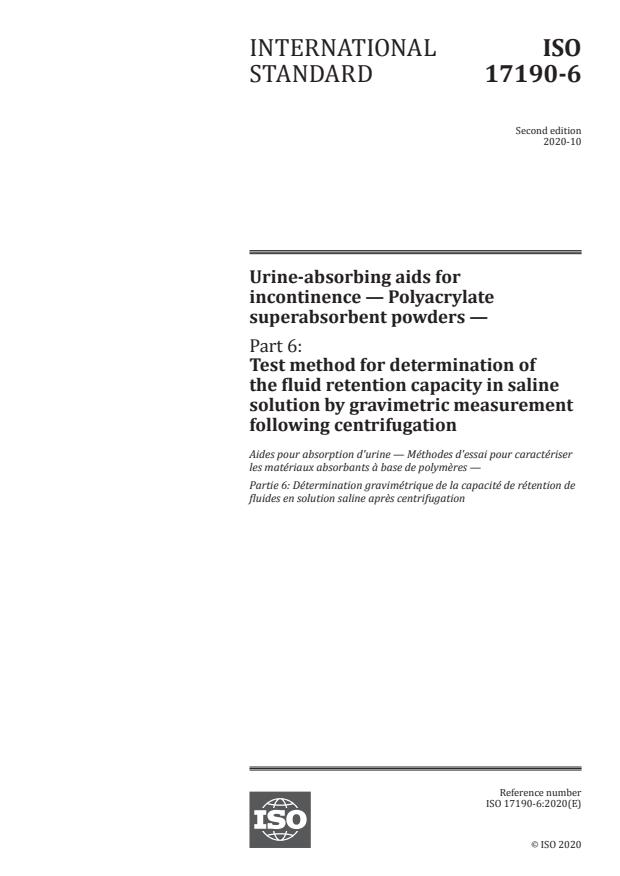
(Main)Urine-absorbing aids for incontinence — Polyacrylate superabsorbent powders — Part 6: Test method for determination of the fluid retention capacity in saline solution by gravimetric measurement following centrifugation
General Information
- Abstract
This document provides a test method for the determination of the fluid retention capacity of polyacrylate superabsorbent powders in saline solution, following centrifugation.
- Status
- Published
- Publication Date
- 26-Oct-2020
- Technical Committee
- ISO/TC 173/SC 3 - Aids for ostomy and incontinence
- Drafting Committee
- ISO/TC 173/SC 3/WG 2 - Urinary absorbing aids
- Current Stage
- 9060 - Close of review
- Completion Date
- 04-Jun-2031
Buy Documents
ISO 17190-6:2020 - Urine-absorbing aids for incontinence -- Polyacrylate superabsorbent powders
ISO 17190-6:2020 - Urine-absorbing aids for incontinence — Polyacrylate superabsorbent powders — Part 6: Test method for determination of the fluid retention capacity in saline solution by gravimetric measurement following centrifugation/27/2020
Overview
ISO 17190-6:2020 is an ISO test method for measuring the fluid retention capacity of polyacrylate superabsorbent powders used in urine‑absorbing aids for incontinence. The standard specifies a gravimetric measurement after centrifugation in a 0.9 % saline solution and defines sample preparation, apparatus, test conditions and reporting requirements. It is part of the ISO 17190 series addressing polymer‑based absorbent materials.
Key topics and requirements
- Scope: Determination of fluid retention capacity (centrifuge retention) of polyacrylate superabsorbent powders in saline solution.
- Sample size and preparation: Typical test portions are 0.180–0.220 g of dry polymer placed in heat‑sealed nonwoven “teabags” (60 × 40 mm to 60 × 85 mm).
- Test liquid: 0.9 % (m/m) sodium chloride solution prepared using Grade 1/ISO 3696 water; recommended solution temperature ≈ 23 ± 2 °C. Check conductivity for consistency.
- Immersion and absorption: Teabags are submerged; polymers are allowed to absorb saline for 30 minutes.
- Centrifugation: Centrifuge at a centrifugal acceleration of 2 452 ± 50 m·s⁻² (≈250 g) for 3 minutes, then weigh wet teabags immediately.
- Blanks and balancing: Test includes two blank bags; blanks may be reused if material and sealing conditions are unchanged (but regular checks recommended).
- Calculation: Centrifuge retention capacity w (g/g) is calculated from the wet mass of sample bags, average blank mass, and dry sample mass; results are averaged for duplicate specimen values and rounded to 0.1 unit.
- Environmental control: Conditioning and testing are typically at (23 ± 2) °C and (45 ± 15) % RH (ISO 187).
- Safety: Handling precautions for respirable polymer dust (guideline values noted) and general laboratory safety are required.
Practical applications
- Quality control testing of superabsorbent powders used in diapers, adult incontinence products and medical dressings.
- R&D comparison of different polyacrylate formulations for fluid retention performance in physiological saline.
- Regulatory and procurement specifications where standardized, comparable retention data are required.
- Test laboratories that certify absorbent materials or provide performance data to manufacturers and brand owners.
Who uses this standard
- Manufacturers of superabsorbent polymers and absorbent hygiene products
- Independent testing and certification laboratories
- Product development and quality assurance teams in healthcare and consumer‑care sectors
- Regulatory bodies and procurement specialists specifying performance criteria
Related standards
- ISO 17190 (other parts) - series for polymer‑based absorbent materials
- ISO 187 - standard atmosphere for conditioning and testing
- ISO 3696 - water for analytical laboratory use
Keywords: ISO 17190-6:2020, polyacrylate superabsorbent powders, fluid retention capacity, centrifuge retention, saline solution, gravimetric measurement, urine-absorbing aids, incontinence testing.
Relations
- Effective Date
- 23-Apr-2020
Buy Documents
ISO 17190-6:2020 - Urine-absorbing aids for incontinence -- Polyacrylate superabsorbent powders
ISO 17190-6:2020 - Urine-absorbing aids for incontinence — Polyacrylate superabsorbent powders — Part 6: Test method for determination of the fluid retention capacity in saline solution by gravimetric measurement following centrifugation/27/2020
Get Certified
Connect with accredited certification bodies for this standard

BSI Group
BSI (British Standards Institution) is the business standards company that helps organizations make excellence a habit.

TÜV Rheinland
TÜV Rheinland is a leading international provider of technical services.

TÜV SÜD
TÜV SÜD is a trusted partner of choice for safety, security and sustainability solutions.
Sponsored listings
Frequently Asked Questions
ISO 17190-6:2020 is a standard published by the International Organization for Standardization (ISO). Its full title is "Urine-absorbing aids for incontinence — Polyacrylate superabsorbent powders — Part 6: Test method for determination of the fluid retention capacity in saline solution by gravimetric measurement following centrifugation". This standard covers: This document provides a test method for the determination of the fluid retention capacity of polyacrylate superabsorbent powders in saline solution, following centrifugation.
This document provides a test method for the determination of the fluid retention capacity of polyacrylate superabsorbent powders in saline solution, following centrifugation.
ISO 17190-6:2020 is classified under the following ICS (International Classification for Standards) categories: 11.180.20 - Aids for incontinence and ostomy. The ICS classification helps identify the subject area and facilitates finding related standards.
ISO 17190-6:2020 has the following relationships with other standards: It is inter standard links to ISO 17190-6:2001. Understanding these relationships helps ensure you are using the most current and applicable version of the standard.
ISO 17190-6:2020 is available in PDF format for immediate download after purchase. The document can be added to your cart and obtained through the secure checkout process. Digital delivery ensures instant access to the complete standard document.
Standards Content (Sample)
INTERNATIONAL ISO
STANDARD 17190-6
Second edition
2020-10
Urine-absorbing aids for
incontinence — Polyacrylate
superabsorbent powders —
Part 6:
Test method for determination of
the fluid retention capacity in saline
solution by gravimetric measurement
following centrifugation
Aides pour absorption d'urine — Méthodes d'essai pour caractériser
les matériaux absorbants à base de polymères —
Partie 6: Détermination gravimétrique de la capacité de rétention de
fluides en solution saline après centrifugation
Reference number
©
ISO 2020
© ISO 2020
All rights reserved. Unless otherwise specified, or required in the context of its implementation, no part of this publication may
be reproduced or utilized otherwise in any form or by any means, electronic or mechanical, including photocopying, or posting
on the internet or an intranet, without prior written permission. Permission can be requested from either ISO at the address
below or ISO’s member body in the country of the requester.
ISO copyright office
CP 401 • Ch. de Blandonnet 8
CH-1214 Vernier, Geneva
Phone: +41 22 749 01 11
Email: copyright@iso.org
Website: www.iso.org
Published in Switzerland
ii © ISO 2020 – All rights reserved
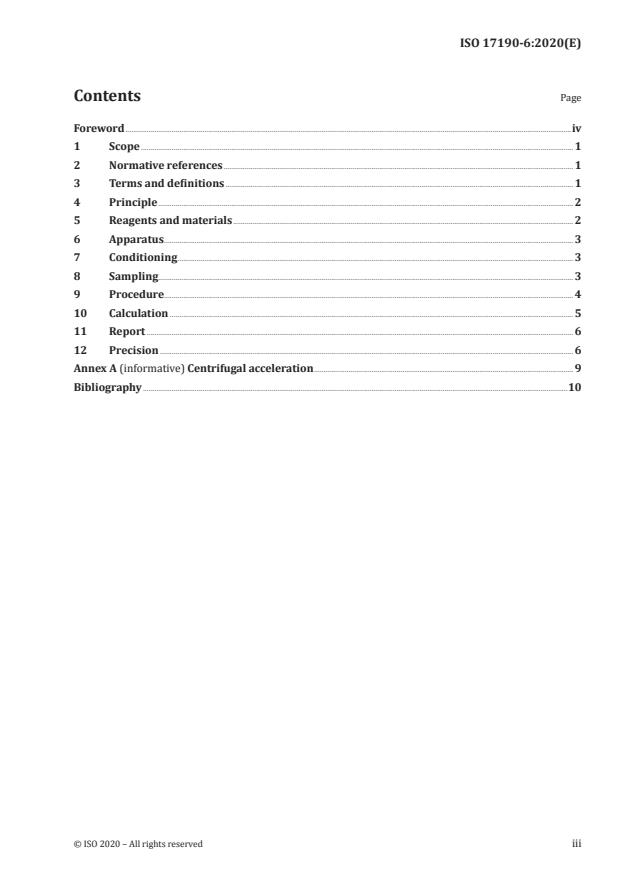
Contents Page
Foreword .iv
1 Scope . 1
2 Normative references . 1
3 Terms and definitions . 1
4 Principle . 2
5 Reagents and materials . 2
6 Apparatus . 3
7 Conditioning . 3
8 Sampling . 3
9 Procedure. 4
10 Calculation . 5
11 Report . 6
12 Precision . 6
Annex A (informative) Centrifugal acceleration . 9
Bibliography .10
Foreword
ISO (the International Organization for Standardization) is a worldwide federation of national standards
bodies (ISO member bodies). The work of preparing International Standards is normally carried out
through ISO technical committees. Each member body interested in a subject for which a technical
committee has been established has the right to be represented on that committee. International
organizations, governmental and non-governmental, in liaison with ISO, also take part in the work.
ISO collaborates closely with the International Electrotechnical Commission (IEC) on all matters of
electrotechnical standardization.
The procedures used to develop this document and those intended for its further maintenance are
described in the ISO/IEC Directives, Part 1. In particular, the different approval criteria needed for the
different types of ISO documents should be noted. This document was drafted in accordance with the
editorial rules of the ISO/IEC Directives, Part 2 (see www .iso .org/ directives).
Attention is drawn to the possibility that some of the elements of this document may be the subject of
patent rights. ISO shall not be held responsible for identifying any or all such patent rights. Details of
any patent rights identified during the development of the document will be in the Introduction and/or
on the ISO list of patent declarations received (see www .iso .org/ patents).
Any trade name used in this document is information given for the convenience of users and does not
constitute an endorsement.
For an explanation of the voluntary nature of standards, the meaning of ISO specific terms and
expressions related to conformity assessment, as well as information about ISO's adherence to the
World Trade Organization (WTO) principles in the Technical Barriers to Trade (TBT) see www .iso .org/
iso/ foreword .html.
This document was prepared by Technical Committee ISO/TC 173, Assistive products, Subcommittee
SC 3, Aids for ostomy and incontinence.
This second edition cancels and replaces the first edition (ISO 17190-6:2001), which has been technically
revised. The main changes compared to the previous edition are as follows:
— full text review and new laboratory analysis with statistical evaluation;
— sample weighing simplified;
— request for duplication removed.
A list of all parts in the ISO 17190 series can be found on the ISO website.
Any feedback or questions on this document should be directed to the user’s national standards body. A
complete listing of these bodies can be found at www .iso .org/ members .html.
iv © ISO 2020 – All rights reserved
INTERNATIONAL STANDARD ISO 17190-6:2020(E)
Urine-absorbing aids for incontinence — Polyacrylate
superabsorbent powders —
Part 6:
Test method for determination of the fluid retention
capacity in saline solution by gravimetric measurement
following centrifugation
WARNING — - This document does not claim to address all of the safety concerns, if any, associated
with its use. It is the responsibility of the user of this document to establish appropriate safety
and health practices and determine the applicability of regulatory limitations prior to use. It
is expected that the person performing this test has been fully trained in all aspects of this
procedure.
1 Scope
This document provides a test method for the determination of the fluid retention capacity of
polyacrylate superabsorbent powders in saline solution, following centrifugation.
2 Normative references
The following documents are referred to in the text in such a way that some or all of their content
constitutes requirements of this document. For dated references, only the edition cited applies. For
undated references, the latest edition of the referenced document (including any amendments) applies.
ISO 187, Paper, board and pulps — Standard atmosphere for conditioning and testing and procedure for
monitoring the atmosphere and conditioning of samples
ISO 3696, Water for analytical laboratory use — Specification and test methods
3 Terms and definitions
For the purposes of this document, the following terms and definitions apply.
ISO and IEC maintain terminological databases for use in standardization at the following addresses:
— ISO Online browsing platform: available at https:// www .iso .org/ obp
— IEC Electropedia: available at http:// www .electropedia .org/
3.1
sample
product or portion of a product taken from a production lot for testing purposes and identifiable and
traceable back to its origin
3.2
specimen
specific portion of the identified sample (3.1) upon which a test is performed
4 Principle
The sample is weighed and placed in a bag. The bag is submerged in the fluid to be absorbed and
afterwards centrifuged for a specified time, at a specified centrifugal force, to determine the amount of
fluid retained.
5 Reagents and materials
5.1 Water.
Grade 1 water in accordance with ISO 3696, with the exception that the conductivity can be as high as
30 μS/cm.
5.2 Sodium chloride solution.
5.2.1 0,9 % mass fraction of sodium chloride solution in water. Weigh (9,00 ± 0,01) g of sodium chloride
into a 1 l beaker and add (991,0 ± 0,1) g of deionized water (grade 3). Stir until dissolved.
5.2.2 The conductivity of the solution should be checked prior to each use using properly calibrated
measuring equipment. The expected conductivity of a 0,9 % saline solution is of the order of 1600 S/m at
25 °C. Each testing lab shall determine the correct conductivity for the conditions obtaining in the lab.
It is also recommended that the temperature of the solution be maintained at (23 ± 2) °C for the
duration of the test. As this matches the required laboratory temperature it is not necessary to record
the solution temperature.
5.3 Nonwoven bag.
NOTE Bags described in this document are often referred to as “teabags”.
2 2
The bag has the external dimensions of (60 x 40) mm to (60 x 85) mm and made of non-apertured
heat-sealable nonwoven. One example of a suitable specification for the nonwoven is the following:
— Mass per unit area: (16,5 ± 1,5) g/m ;
— Thermoplastic fibre content: (4,0 ± 0,8) g/m ;
— Web tensile strength in cross direction: (70 ± 12) N/m;
-1 -2
— Air permeability (4 plies) – 2,30 ± 0,50 l.min .cm at a pressure drop of 124 Pa.
Normally the teabag paper is supplied as a roll, for example 120 mm wide. This shall be stored flat as
storing in an upright position (as a wheel) will compress the paper at bottom of the roll and affect its
characteristics.
The teabag is made by cutting sections, for example 60 mm wide, which will provide teabags
60 x 60 mm when folded and sealed. In this example, the paper may be folded in half and sealed along
two sides ready for the addition of superabsorbent powder and the sealing of the final side prior to
running the test.
It is recommended to have teabags made in bulk and delivered ready-made for use in the lab.
In any case, teabags should be stored in cool, dry conditions. For best practice storing teabags in a
desiccator prior to use is also recommended.
2 © ISO 2020 – All rights reserved
6 Apparatus
2 2
6.1 Bag, having di
...
INTERNATIONAL ISO
STANDARD 17190-6
Second edition
2020-10
Urine-absorbing aids for
incontinence — Polyacrylate
superabsorbent powders —
Part 6:
Test method for determination of
the fluid retention capacity in saline
solution by gravimetric measurement
following centrifugation
Aides pour absorption d'urine — Méthodes d'essai pour caractériser
les matériaux absorbants à base de polymères —
Partie 6: Détermination gravimétrique de la capacité de rétention de
fluides en solution saline après centrifugation
Reference number
©
ISO 2020
© ISO 2020
All rights reserved. Unless otherwise specified, or required in the context of its implementation, no part of this publication may
be reproduced or utilized otherwise in any form or by any means, electronic or mechanical, including photocopying, or posting
on the internet or an intranet, without prior written permission. Permission can be requested from either ISO at the address
below or ISO’s member body in the country of the requester.
ISO copyright office
CP 401 • Ch. de Blandonnet 8
CH-1214 Vernier, Geneva
Phone: +41 22 749 01 11
Email: copyright@iso.org
Website: www.iso.org
Published in Switzerland
ii © ISO 2020 – All rights reserved
Contents Page
Foreword .iv
1 Scope . 1
2 Normative references . 1
3 Terms and definitions . 1
4 Principle . 2
5 Reagents and materials . 2
6 Apparatus . 3
7 Conditioning . 3
8 Sampling . 3
9 Procedure. 4
10 Calculation . 5
11 Report . 6
12 Precision . 6
Annex A (informative) Centrifugal acceleration . 9
Bibliography .10
Foreword
ISO (the International Organization for Standardization) is a worldwide federation of national standards
bodies (ISO member bodies). The work of preparing International Standards is normally carried out
through ISO technical committees. Each member body interested in a subject for which a technical
committee has been established has the right to be represented on that committee. International
organizations, governmental and non-governmental, in liaison with ISO, also take part in the work.
ISO collaborates closely with the International Electrotechnical Commission (IEC) on all matters of
electrotechnical standardization.
The procedures used to develop this document and those intended for its further maintenance are
described in the ISO/IEC Directives, Part 1. In particular, the different approval criteria needed for the
different types of ISO documents should be noted. This document was drafted in accordance with the
editorial rules of the ISO/IEC Directives, Part 2 (see www .iso .org/ directives).
Attention is drawn to the possibility that some of the elements of this document may be the subject of
patent rights. ISO shall not be held responsible for identifying any or all such patent rights. Details of
any patent rights identified during the development of the document will be in the Introduction and/or
on the ISO list of patent declarations received (see www .iso .org/ patents).
Any trade name used in this document is information given for the convenience of users and does not
constitute an endorsement.
For an explanation of the voluntary nature of standards, the meaning of ISO specific terms and
expressions related to conformity assessment, as well as information about ISO's adherence to the
World Trade Organization (WTO) principles in the Technical Barriers to Trade (TBT) see www .iso .org/
iso/ foreword .html.
This document was prepared by Technical Committee ISO/TC 173, Assistive products, Subcommittee
SC 3, Aids for ostomy and incontinence.
This second edition cancels and replaces the first edition (ISO 17190-6:2001), which has been technically
revised. The main changes compared to the previous edition are as follows:
— full text review and new laboratory analysis with statistical evaluation;
— sample weighing simplified;
— request for duplication removed.
A list of all parts in the ISO 17190 series can be found on the ISO website.
Any feedback or questions on this document should be directed to the user’s national standards body. A
complete listing of these bodies can be found at www .iso .org/ members .html.
iv © ISO 2020 – All rights reserved
INTERNATIONAL STANDARD ISO 17190-6:2020(E)
Urine-absorbing aids for incontinence — Polyacrylate
superabsorbent powders —
Part 6:
Test method for determination of the fluid retention
capacity in saline solution by gravimetric measurement
following centrifugation
WARNING — - This document does not claim to address all of the safety concerns, if any, associated
with its use. It is the responsibility of the user of this document to establish appropriate safety
and health practices and determine the applicability of regulatory limitations prior to use. It
is expected that the person performing this test has been fully trained in all aspects of this
procedure.
1 Scope
This document provides a test method for the determination of the fluid retention capacity of
polyacrylate superabsorbent powders in saline solution, following centrifugation.
2 Normative references
The following documents are referred to in the text in such a way that some or all of their content
constitutes requirements of this document. For dated references, only the edition cited applies. For
undated references, the latest edition of the referenced document (including any amendments) applies.
ISO 187, Paper, board and pulps — Standard atmosphere for conditioning and testing and procedure for
monitoring the atmosphere and conditioning of samples
ISO 3696, Water for analytical laboratory use — Specification and test methods
3 Terms and definitions
For the purposes of this document, the following terms and definitions apply.
ISO and IEC maintain terminological databases for use in standardization at the following addresses:
— ISO Online browsing platform: available at https:// www .iso .org/ obp
— IEC Electropedia: available at http:// www .electropedia .org/
3.1
sample
product or portion of a product taken from a production lot for testing purposes and identifiable and
traceable back to its origin
3.2
specimen
specific portion of the identified sample (3.1) upon which a test is performed
4 Principle
The sample is weighed and placed in a bag. The bag is submerged in the fluid to be absorbed and
afterwards centrifuged for a specified time, at a specified centrifugal force, to determine the amount of
fluid retained.
5 Reagents and materials
5.1 Water.
Grade 1 water in accordance with ISO 3696, with the exception that the conductivity can be as high as
30 μS/cm.
5.2 Sodium chloride solution.
5.2.1 0,9 % mass fraction of sodium chloride solution in water. Weigh (9,00 ± 0,01) g of sodium chloride
into a 1 l beaker and add (991,0 ± 0,1) g of deionized water (grade 3). Stir until dissolved.
5.2.2 The conductivity of the solution should be checked prior to each use using properly calibrated
measuring equipment. The expected conductivity of a 0,9 % saline solution is of the order of 1600 S/m at
25 °C. Each testing lab shall determine the correct conductivity for the conditions obtaining in the lab.
It is also recommended that the temperature of the solution be maintained at (23 ± 2) °C for the
duration of the test. As this matches the required laboratory temperature it is not necessary to record
the solution temperature.
5.3 Nonwoven bag.
NOTE Bags described in this document are often referred to as “teabags”.
2 2
The bag has the external dimensions of (60 x 40) mm to (60 x 85) mm and made of non-apertured
heat-sealable nonwoven. One example of a suitable specification for the nonwoven is the following:
— Mass per unit area: (16,5 ± 1,5) g/m ;
— Thermoplastic fibre content: (4,0 ± 0,8) g/m ;
— Web tensile strength in cross direction: (70 ± 12) N/m;
-1 -2
— Air permeability (4 plies) – 2,30 ± 0,50 l.min .cm at a pressure drop of 124 Pa.
Normally the teabag paper is supplied as a roll, for example 120 mm wide. This shall be stored flat as
storing in an upright position (as a wheel) will compress the paper at bottom of the roll and affect its
characteristics.
The teabag is made by cutting sections, for example 60 mm wide, which will provide teabags
60 x 60 mm when folded and sealed. In this example, the paper may be folded in half and sealed along
two sides ready for the addition of superabsorbent powder and the sealing of the final side prior to
running the test.
It is recommended to have teabags made in bulk and delivered ready-made for use in the lab.
In any case, teabags should be stored in cool, dry conditions. For best practice storing teabags in a
desiccator prior to use is also recommended.
2 © ISO 2020 – All rights reserved
6 Apparatus
2 2
6.1 Bag, having di
...