


ISO 24543:2022
(Main)Non-destructive testing — Acoustic emission testing — Verification of the receiving sensitivity spectra of piezoelectric acoustic emission sensors
Non-destructive testing — Acoustic emission testing — Verification of the receiving sensitivity spectra of piezoelectric acoustic emission sensors
This document specifies a method for the determination of the receiving sensitivity spectra of a piezoelectric acoustic emission sensor, in absolute units of volts output per motion input, whereby the motion can be particle displacement (e.g. in nanometres) or particle velocity (e.g. in millimetres per second) over a frequency range used for acoustic emission testing, from 20 kHz to about 1,5 MHz, whereby the sensor is stimulated by a motion pulse in normal direction to the sensor’s face from a directly coupled piezoelectric transmitter. This document also specifies a method for the determination of the transmitting sensitivity spectrum of a piezoelectric transmitter in absolute units, for example, in nanometres output per volt input, by measuring both the particle displacement pulse over the transmitter’s active face and the transmitter’s input voltage spectrum, using a scanning laser vibrometer. This document does not include the known cancellation effects on a sensor’s response, when the angle of incidence differs from normal (90°) or when the length of the wave passing across the sensor’s sensitive face is shorter than about 10 times the dimension of the sensor’s sensitive face. This document does not specify a method to measure the influence of different materials on a sensor’s sensitivity, but this effect is addressed in Annex F. NOTE The methods described in this document can be considered for use with other than piezoelectric sensors, which detect motion at a flat face and work in the same frequency range.
Essais non destructifs — Contrôle par émission acoustique — Vérification des spectres de sensibilité de réception des capteurs d’émission acoustique piézoélectriques
General Information
- Status
- Published
- Publication Date
- 28-Sep-2022
- Technical Committee
- ISO/TC 135/SC 9 - Acoustic emission testing
- Drafting Committee
- ISO/TC 135/SC 9/WG 9 - AE sensor sensitivity verification
- Current Stage
- 6060 - International Standard published
- Start Date
- 29-Sep-2022
- Due Date
- 21-Oct-2022
- Completion Date
- 29-Sep-2022
Relations
- Effective Date
- 11-Nov-2023
Overview - ISO 24543:2022 (Non‑destructive testing, Acoustic emission testing)
ISO 24543:2022 specifies validated methods to verify the receiving sensitivity spectra of piezoelectric acoustic emission (AE) sensors and to determine the transmitting sensitivity of piezoelectric transmitters. Measurements are expressed in absolute units (e.g., volts output per motion input - V/nm or V/(mm/s) for receiving sensitivity; nm/V for transmitting sensitivity) across the AE frequency range from 20 kHz to about 1.5 MHz. The standard describes two principal measurement approaches: a face‑to‑face transmitter–sensor coupling and a scanning laser vibrometer measurement of transmitter motion.
Keywords: ISO 24543:2022, acoustic emission testing, piezoelectric sensors, receiving sensitivity spectra, transmitting sensitivity, non‑destructive testing, laser vibrometer, sensor verification.
Key technical topics and requirements
- Measurement scope and units
- Receiving sensitivity in absolute units (V per displacement or velocity).
- Transmitting sensitivity in displacement per input voltage (nm/V).
- Frequency range
- Coverage from 20 kHz up to ~1.5 MHz suitable for AE testing.
- Primary setups
- Face‑to‑face setup: direct coupling of a piezoelectric transmitter to the sensor under test with controlled coupling agent.
- Laser vibrometer setup: scanning laser vibrometer measures particle displacement over the transmitter’s active face while recording input voltage.
- Hardware and procedural requirements
- Function generator, transmitter probe, coupling agent, sensor‑to‑transmitter fixing tool.
- Sensor under test (SUT) considerations (pyroelectric effects, pre‑amplifier influence, lists of SUTs).
- Signal cabling and transient recorder specifications (input impedance, bandwidth, sampling rate, buffer length, trigger and calibration).
- Data and quality control
- Procedures for capturing stimulus and response pulses, calculation of sensitivity spectra (see clauses 7 and 8).
- Reproducibility and influencing factors: sensor–transmitter coupling, temperature, transmitter changes.
- Limitations
- The standard excludes cancellation effects for off‑normal incidence and for wave lengths shorter than ~10× the sensor face dimension.
- Influence of different mounting materials is not fully specified (addressed in Annex F).
Practical applications and users
- Ensures traceable, comparable AE sensor sensitivity data across test laboratories.
- Used by:
- NDT / AE testing laboratories and inspectors
- Sensor and transmitter manufacturers for specification and QA
- Calibration laboratories validating AE sensors and probes
- Research groups developing AE measurement methods and instrumentation
- Typical applications: structural health monitoring, materials testing, pressure vessel inspection, and any AE application requiring quantitative sensor sensitivity.
Related standards and references
- ISO 12716 (Acoustic emission inspection - Vocabulary) is normative in ISO 24543:2022.
- Prepared under ISO/TC 135 (Non‑destructive testing), Subcommittee SC 9 (Acoustic emission testing).
For organizations seeking standardized, reproducible AE sensor verification and transmitter characterization, ISO 24543:2022 provides the procedural foundation and hardware/service requirements needed for reliable sensitivity spectra determination.

Get Certified
Connect with accredited certification bodies for this standard

IMP NDT d.o.o.
Non-destructive testing services. Radiography, ultrasonic, magnetic particle, penetrant, visual inspection.
Inštitut za kovinske materiale in tehnologije
Institute of Metals and Technology. Materials testing, metallurgical analysis, NDT.
Q Techna d.o.o.
NDT and quality assurance specialist. 30+ years experience. NDT personnel certification per ISO 9712, nuclear and thermal power plant inspections, QA/
Sponsored listings
Frequently Asked Questions
ISO 24543:2022 is a standard published by the International Organization for Standardization (ISO). Its full title is "Non-destructive testing — Acoustic emission testing — Verification of the receiving sensitivity spectra of piezoelectric acoustic emission sensors". This standard covers: This document specifies a method for the determination of the receiving sensitivity spectra of a piezoelectric acoustic emission sensor, in absolute units of volts output per motion input, whereby the motion can be particle displacement (e.g. in nanometres) or particle velocity (e.g. in millimetres per second) over a frequency range used for acoustic emission testing, from 20 kHz to about 1,5 MHz, whereby the sensor is stimulated by a motion pulse in normal direction to the sensor’s face from a directly coupled piezoelectric transmitter. This document also specifies a method for the determination of the transmitting sensitivity spectrum of a piezoelectric transmitter in absolute units, for example, in nanometres output per volt input, by measuring both the particle displacement pulse over the transmitter’s active face and the transmitter’s input voltage spectrum, using a scanning laser vibrometer. This document does not include the known cancellation effects on a sensor’s response, when the angle of incidence differs from normal (90°) or when the length of the wave passing across the sensor’s sensitive face is shorter than about 10 times the dimension of the sensor’s sensitive face. This document does not specify a method to measure the influence of different materials on a sensor’s sensitivity, but this effect is addressed in Annex F. NOTE The methods described in this document can be considered for use with other than piezoelectric sensors, which detect motion at a flat face and work in the same frequency range.
This document specifies a method for the determination of the receiving sensitivity spectra of a piezoelectric acoustic emission sensor, in absolute units of volts output per motion input, whereby the motion can be particle displacement (e.g. in nanometres) or particle velocity (e.g. in millimetres per second) over a frequency range used for acoustic emission testing, from 20 kHz to about 1,5 MHz, whereby the sensor is stimulated by a motion pulse in normal direction to the sensor’s face from a directly coupled piezoelectric transmitter. This document also specifies a method for the determination of the transmitting sensitivity spectrum of a piezoelectric transmitter in absolute units, for example, in nanometres output per volt input, by measuring both the particle displacement pulse over the transmitter’s active face and the transmitter’s input voltage spectrum, using a scanning laser vibrometer. This document does not include the known cancellation effects on a sensor’s response, when the angle of incidence differs from normal (90°) or when the length of the wave passing across the sensor’s sensitive face is shorter than about 10 times the dimension of the sensor’s sensitive face. This document does not specify a method to measure the influence of different materials on a sensor’s sensitivity, but this effect is addressed in Annex F. NOTE The methods described in this document can be considered for use with other than piezoelectric sensors, which detect motion at a flat face and work in the same frequency range.
ISO 24543:2022 is classified under the following ICS (International Classification for Standards) categories: 19.100 - Non-destructive testing. The ICS classification helps identify the subject area and facilitates finding related standards.
ISO 24543:2022 has the following relationships with other standards: It is inter standard links to ISO/IEEE 11073-10472:2024. Understanding these relationships helps ensure you are using the most current and applicable version of the standard.
ISO 24543:2022 is available in PDF format for immediate download after purchase. The document can be added to your cart and obtained through the secure checkout process. Digital delivery ensures instant access to the complete standard document.
Standards Content (Sample)
INTERNATIONAL ISO
STANDARD 24543
First edition
2022-09
Non-destructive testing — Acoustic
emission testing — Verification of
the receiving sensitivity spectra
of piezoelectric acoustic emission
sensors
Essais non destructifs — Contrôle par émission acoustique —
Vérification des spectres de sensibilité de réception des capteurs
d’émission acoustique piézoélectriques
Reference number
© ISO 2022
All rights reserved. Unless otherwise specified, or required in the context of its implementation, no part of this publication may
be reproduced or utilized otherwise in any form or by any means, electronic or mechanical, including photocopying, or posting on
the internet or an intranet, without prior written permission. Permission can be requested from either ISO at the address below
or ISO’s member body in the country of the requester.
ISO copyright office
CP 401 • Ch. de Blandonnet 8
CH-1214 Vernier, Geneva
Phone: +41 22 749 01 11
Email: copyright@iso.org
Website: www.iso.org
Published in Switzerland
ii
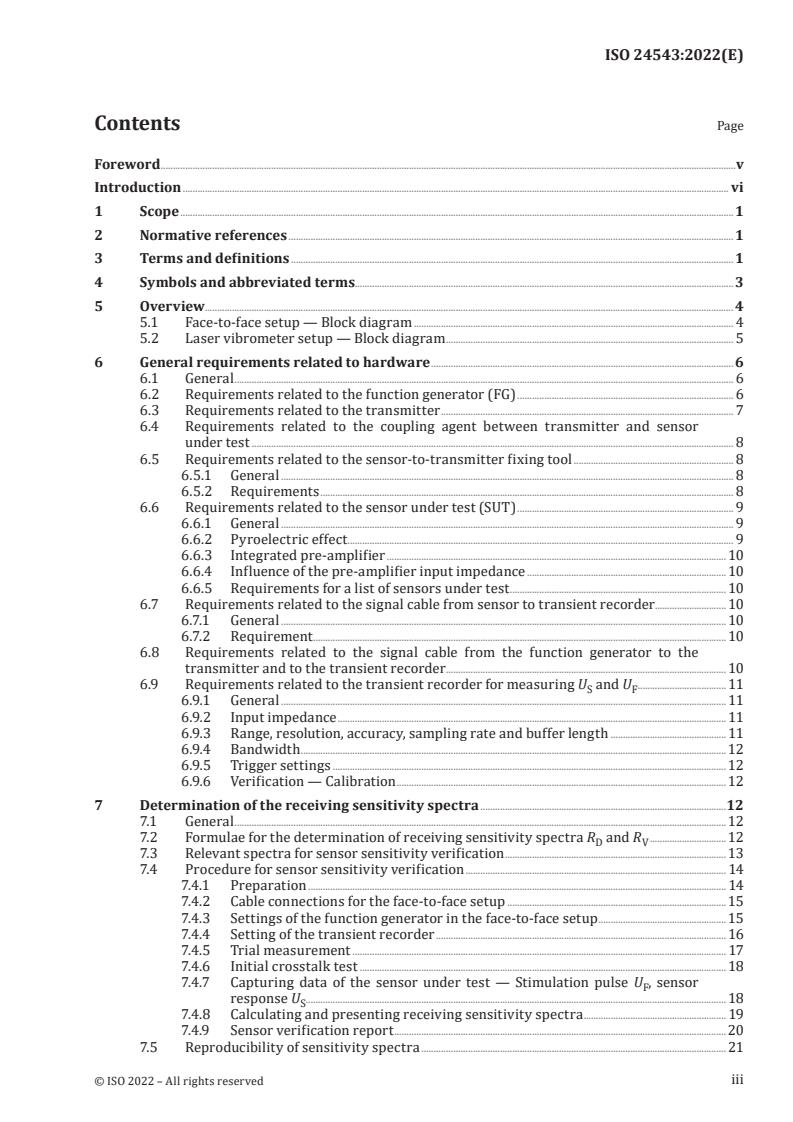
Contents Page
Foreword .v
Introduction . vi
1 Scope . 1
2 Normative references . 1
3 Terms and definitions . 1
4 Symbols and abbreviated terms.3
5 Overview . 4
5.1 Face-to-face setup — Block diagram . 4
5.2 Laser vibrometer setup — Block diagram . 5
6 General requirements related to hardware . 6
6.1 General . 6
6.2 Requirements related to the function generator (FG) . 6
6.3 Requirements related to the transmitter . 7
6.4 Requirements related to the coupling agent between transmitter and sensor
under test . 8
6.5 Requirements related to the sensor-to-transmitter fixing tool . 8
6.5.1 General . 8
6.5.2 Requirements . 8
6.6 Requirements related to the sensor under test (SUT) . 9
6.6.1 General . 9
6.6.2 Pyroelectric effect . 9
6.6.3 Integrated pre-amplifier . 10
6.6.4 Influence of the pre-amplifier input impedance . 10
6.6.5 Requirements for a list of sensors under test . 10
6.7 Requirements related to the signal cable from sensor to transient recorder. 10
6.7.1 General . 10
6.7.2 Requirement . 10
6.8 Requirements related to the signal cable from the function generator to the
transmitter and to the transient recorder . 10
6.9 Requirements related to the transient recorder for measuring U and U . 11
S F
6.9.1 General . 11
6.9.2 Input impedance . 11
6.9.3 Range, resolution, accuracy, sampling rate and buffer length . 11
6.9.4 Bandwidth .12
6.9.5 Trigger settings .12
6.9.6 Verification — Calibration .12
7 Determination of the receiving sensitivity spectra .12
7.1 General .12
7.2 Formulae for the determination of receiving sensitivity spectra R and R .12
D V
7.3 Relevant spectra for sensor sensitivity verification . 13
7.4 Procedure for sensor sensitivity verification . 14
7.4.1 Preparation . 14
7.4.2 Cable connections for the face-to-face setup . 15
7.4.3 Settings of the function generator in the face-to-face setup .15
7.4.4 Setting of the transient recorder . 16
7.4.5 Trial measurement . 17
7.4.6 Initial crosstalk test . 18
7.4.7 Capturing data of the sensor under test — Stimulation pulse U , sensor
F
response U . 18
S
7.4.8 Calculating and presenting receiving sensitivity spectra . 19
7.4.9 Sensor verification report . 20
7.5 Reproducibility of sensitivity spectra . 21
iii
7.5.1 Sensor-to-transmitter coupling . 21
7.5.2 Influence of temperature . 21
7.5.3 Change of the transmitter . 21
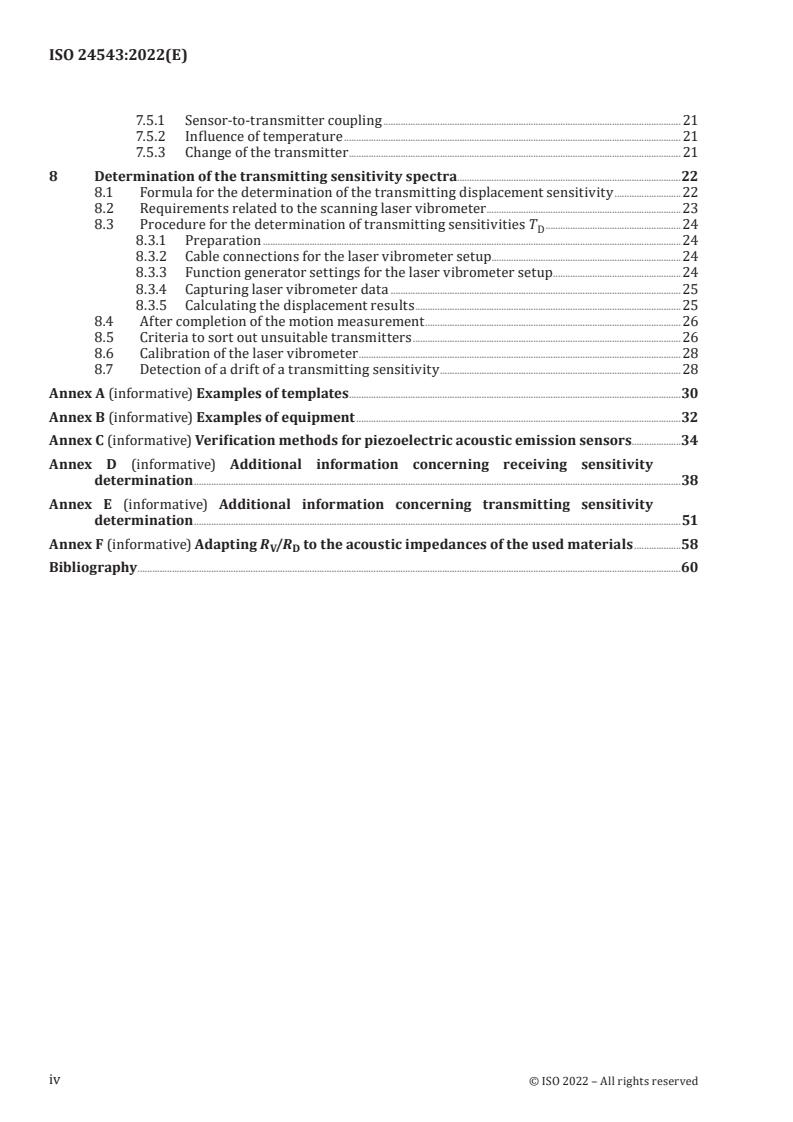
8 Determination of the transmitting sensitivity spectra.22
8.1 Formula for the determination of the transmitting displacement sensitivity .22
8.2 Requirements related to the scanning laser vibrometer . 23
8.3 Procedure for the determination of transmitting sensitivities T . 24
D
8.3.1 Preparation . 24
8.3.2 Cable connections for the laser vibrometer setup. 24
8.3.3 Function generator settings for the laser vibrometer setup . 24
8.3.4 Capturing laser vibrometer data . 25
8.3.5 Calculating the displacement results . 25
8.4 After completion of the motion measurement . 26
8.5 Criteria to sort out unsuitable transmitters . 26
8.6 Calibration of the laser vibrometer .28
8.7 Detection of a drift of a transmitting sensitivity .28
Annex A (informative) Examples of templates .30
Annex B (informative) Examples of equipment .32
Annex C (informative) Verification methods for piezoelectric acoustic emission sensors .34
Annex D (informative) Additional information concerning receiving sensitivity
determination .38
Annex E (informative) Additional information concerning transmitting sensitivity
determination .51
Annex F (informative) Adapting R /R to the acoustic impedances of the used materials .58
V D
Bibliography .60
iv
Foreword
ISO (the International Organization for Standardization) is a worldwide federation of national standards
bodies (ISO member bodies). The work of preparing International Standards is normally carried out
through ISO technical committees. Each member body interested in a subject for which a technical
committee has been established has the right to be represented on that committee. International
organizations, governmental and non-governmental, in liaison with ISO, also take part in the work.
ISO collaborates closely with the International Electrotechnical Commission (IEC) on all matters of
electrotechnical standardization.
The procedures used to develop this document and those intended for its further maintenance are
described in the ISO/IEC Directives, Part 1. In particular, the different approval criteria needed for the
different types of ISO documents should be noted. This document was drafted in accordance with the
editorial rules of the ISO/IEC Directives, Part 2 (see www.iso.org/directives).
Attention is drawn to the possibility that some of the elements of this document may be the subject of
patent rights. ISO shall not be held responsible for identifying any or all such patent rights. Details of
any patent rights identified during the development of the document will be in the Introduction and/or
on the ISO list of patent declarations received (see www.iso.org/patents).
Any trade name used in this document is information given for the convenience of users and does not
constitute an endorsement.
For an explanation of the voluntary nature of standards, the meaning of ISO specific terms and
expressions related to conformity assessment, as well as information about ISO's adherence to
the World Trade Organization (WTO) principles in the Technical Barriers to Trade (TBT), see
www.iso.org/iso/foreword.html.
This document was prepared by Technical Committee ISO/TC 135, Non-destructive testing,
Subcommittee SC 9, Acoustic emission testing.
Any feedback or questions on this document should be directed to the user’s national standards body. A
complete listing of these bodies can be found at www.iso.org/members.html.
v
Introduction
The proposed method of determining the receiving sensitivity spectra of a piezoelectric acoustic
emission sensor is based on a setup where the face of the sensor under test is directly coupled via a
thin layer of coupling agent to the active face of a piezoelectric transmitter. The transmitter, usually an
ultrasonic probe, stimulates the sensor under test by a particle displacement pulse in normal direction
to the sensor’s face. The displacement pulse is measured by a vibrometer at a number of positions on the
active area of the transmitter. This allows determining the transmitting sensitivity of the transmitter
in absolute units of nm/V and the receiving sensitivity of the sensor under test in absolute units of V/
nm.
The aim is to establish uniformity of acoustic emission testing, to form a basis for data correlation,
and to provide a basis for the uniform interpretation of results obtained by different acoustic emission
testing organizations at different times. For more information about the verification methods for
piezoelectric sensors, see Annex C.
vi
INTERNATIONAL STANDARD ISO 24543:2022(E)
Non-destructive testing — Acoustic emission testing
— Verification of the receiving sensitivity spectra of
piezoelectric acoustic emission sensors
1 Scope
This document specifies a method for the determination of the receiving sensitivity spectra of a
piezoelectric acoustic emission sensor, in absolute units of volts output per motion input, whereby
the motion can be particle displacement (e.g. in nanometres) or particle velocity (e.g. in millimetres
per second) over a frequency range used for acoustic emission testing, from 20 kHz to about 1,5 MHz,
whereby the sensor is stimulated by a motion pulse in normal direction to the sensor’s face from a
directly coupled piezoelectric transmitter.
This document also specifies a method for the determination of the transmitting sensitivity spectrum
of a piezoelectric transmitter in absolute units, for example, in nanometres output per volt input, by
measuring both the particle displacement pulse over the transmitter’s active face and the transmitter’s
input voltage spectrum, using a scanning laser vibrometer.
This document does not include the known cancellation effects on a sensor’s response, when the angle
of incidence differs from normal (90°) or when the length of the wave passing across the sensor’s
sensitive face is shorter than about 10 times the dimension of the sensor’s sensitive face.
This document does not specify a method to measure the influence of different materials on a sensor’s
sensitivity, but this effect is addressed in Annex F.
NOTE The methods described in this document can be considered for use with other than piezoelectric
sensors, which detect motion at a flat face and work in the same frequency range.
2 Normative references
The following documents are referred to in the text in such a way that some or all of their content
constitutes requirements of this document. For dated references, only the edition cited applies. For
undated references, the latest edition of the referenced document (including any amendments) applies.
ISO 12716, Non-destructive testing — Acoustic emission inspection — Vocabulary
3 Terms and definitions
For the purposes of this document, the terms and definitions given in ISO 12716 and the following apply.
ISO and IEC maintain terminology databases for use in standardization at the following addresses:
— ISO Online browsing platform: available at https:// www .iso .org/ obp
— IEC Electropedia: available at https:// www .electropedia .org/
3.1
transmitter
TM
piezoelectric device that converts an electrical signal to particle motion or pressure
Note 1 to entry: A single-letter TM identifier (TM-id A to Z) may be appended to identify a certain unit of
transmitter.
3.2
sensor under test
SUT
piezoelectric acoustic emission sensor whose receiving sensitivity (3.8, 3.9) spectra are verified
Note 1 to entry: A double-digit SUT identifier (SUT-id 00 to 99) may be appended to identify a type of SUT.
3.3
function generator
FG
electronic device for generating the stimulation pulse for the transmitter (3.1)
3.4
transient recorder
TRA
electronic device for waveform capture at two or more signal inputs with trigger input, pre-trigger
capability and personal computer interface
3.5
scanning laser vibrometer
LVM
instrument for non-contacting measurement of particle motion in absolute units of nanometres at a
number of positions on a surface in normal direction
3.6
face-to-face setup
arrangement where the active face of a transmitter (3.1) is directly coupled to the sensitive face of a
sensor under test (3.2) for a reproducible stimulation by an electrical pulse
3.7
laser vibrometer setup
LVM setup
arrangement where a scanning laser vibrometer (3.5) is used to measure the particle displacement pulse
at multiple positions at the free active face of a transmitter (3.1)
3.8
receiving displacement sensitivity
R
D
output voltage spectrum of a sensor in dB minus the particle displacement input spectrum in dB
Note 1 to entry: In this document, 0 dB of particle displacement sensitivity (R ) refers to 1 V/nm,
D
Note 2 to entry: When the term "sensitivity" is clearly related to a sensor under test (3.2), the word "receiving"
can be omitted.
3.9
receiving velocity sensitivity
R
V
output voltage spectrum of a sensor in dB minus the particle velocity input spectrum in dB
Note 1 to entry: In this document, 0 dB of particle velocity sensitivity (R ) refers to 1 Vs/mm.
V
Note 2 to entry: When the term "sensitivity" is clearly related to a sensor under test (3.2), the word "receiving"
can be omitted.
3.10
transmitting displacement sensitivity
T
D
output displacement spectrum of a transmitter (3.1) in dB minus its input voltage spectrum in dB
Note 1 to entry: In this document, 0 dB of particle displacement sensitivity (T ) refers to 1 nm/V.
D
Note 2 to entry: When the term "sensitivity" is clearly related to a transmitter, the word "transmitting" can be
omitted.
3.11
transmitting velocity sensitivity
T
V
output velocity spectrum of a transmitter (3.1) in dB minus its input voltage spectrum in dB
Note 1 to entry: In this document, 0 dB of particle velocity sensitivity (T ) refers to 1 mm/Vs.
V
Note 2 to entry: When the term "sensitivity" is clearly related to a transmitter, the word "transmitting" can be
omitted.
3.12
Han2SQ
designation of a specific time window function applied to the input of the fast Fourier transform on the
response of an acoustic emission sensor or of a laser vibrometer to a displacement pulse
Note 1 to entry: See D.2.3.
4 Symbols and abbreviated terms
D displacement signal measured by LVM and converted to a spectrum with 0 dB referring to 1 pm
peak; “D” may be appended by a TM-id (A to Z), a ring-id (1 to 5), and a window-id, see W7 below
FFT fast Fourier transform, a method to convert a time-series signal into a frequency spectrum
MS/s mega samples per second; “1 MS” means "1 million samples"
NOTE: If a quantity of memory is given in "MS", "1 MS" usually means "2 " (1 048 576) samples.
N number of a ring of measurement positions in range 1 to 5, see 8.2
R
N largest ring number N of measurement positions (see Figure 6) covering the sensitive face of
RL R
a type of SUT, for correct T selection, recorded in Table A.2
D
r radius of ring number N in mm, see 8.2
R R
R signal-to-stimulation ratio spectrum in dB, see Formula (4); the recommended naming of a
SS
specific R data file begins with "S", followed by the SUT-id (00 to 99), the TM-id (A to Z) and
SS
a window-id, see W7 below
R drift detection sensitivity spectrum of drift detection sensor 1, for the verification of a trans-
VDD1
mitting sensitivity drift, see 8.7 c) 1)
R drift detection sensitivity spectrum of drift detection sensor 2, for the verification of a trans-
VDD2
mitting sensitivity drift, see 8.7 c) 1)
R drift reference sensitivity spectrum of drift detection sensor 1, determined with a transmitter’s
VDR1
sensitivity determination according to 8.7 a)
R drift reference sensitivity spectrum of drift detection sensor 2, determined with a transmitter’s
VDR2
sensitivity determination according to 8.7 a)
R spectrum difference R minus R of drift detection sensor 1, see 8.7 c) 2)
VΔ1 VDD1 VDR1
R spectrum difference R minus R of drift detection sensor 2, see 8.7 c) 2)
VΔ2 VDD2 VDR2
U transmitter voltage in face-to-face setup, stimulated by a function generator and measured by
F
a transient recorder in the time domain, then transformed into the spectrum F(U ) in dB, with
F
0 dB referring to a sine wave of 1 mV peak
U transmitter voltage in LVM setup, stimulated by a function generator and measured by the
L
LVM in the time domain, then transformed into the spectrum F(U ) in dB, with 0 dB referring
L
to a sine wave of 1 mV peak
U sensor output voltage, also called “sensor response”, measured by a transient recorder in the
S
time domain, then converted into the spectrum F(U ) in dB, with 0 dB referring to a sine wave
S
of 1 mV peak
U average of 4 or 6 responses U from one SUT, stimulated by 4 or 6 transmitters, in per cent of
SAV% S
its maximum peak-to-peak voltage, see Figure 7
U deviation of the response U from U , with U in per cent of its maximum peak-to-peak
SΔ% S SAV% S
voltage, see Figure 7
F(D) FFT of the time signal D
F(U ) FFT of the time signal U
F F
F(U ) FFT of the time signal U
L L
F(U ) FFT of the time signal U
S S
W5 identifier for a 4 µs main-pulse time window
W7 identifier for a 50 µs time window
W8 identifier for a 100 µs time window
W9 identifier for a 200 µs time window
5 Overview
5.1 Face-to-face setup — Block diagram
The block diagram of the face-to-face setup is shown in Figure 1 a). Numerical keys identify the blocks
and alphabetical keys the interfaces. In this clause, the keys of Figure 1 are referenced in brackets.
The function generator (1) delivers the stimulation pulse U at the signal output (A) with a constant
F
repetition rate.
The signal U (A) is connected to the input (D) of transmitter (2), and to the input channel B (J) of
F
transient recorder (4). The electrical pulse stimulates a motion pulse at the transmitter’s active face
(E). This face is acoustically coupled via a thin layer of coupling agent (F) to the sensitive face (G) of the
sensor under test (3). The sensor’s signal output (H) delivers the sensor response U , which is connected
S
to the input channel A (I) of transient recorder (4). The transient recorder signal capture is triggered
at (K) by trigger output signal “Sync” (B) of function generator (1). The transient recorder (4) is under
control of a personal computer (5) via interfaces (L) and (M).
The data captured of each trigger are read out via (L) and (M) by personal computer (5) and shown at
the PC display in the time interval of the stimulation pulse, usually 200 milliseconds.
Stimulation pulse U (A) is shown in Figure D.1.
F
Examples of sensor responses U (H) of three types of sensors are shown in Figure D.6. to Figure D.8.
S
Not shown in Figure 1 is the fixture needed to align the centres of sensor and transmitter and to apply
a force on the interface (E–F–G). The force required depends on properties of the coupling agent and on
other forces that can apply, e.g. from the cable. A force of 10 N is recommended.
The operator may manipulate the fixture in order to see, if the coupling is stable or can be improved.
If satisfied with the reproducibility of the signal, the operator stops the capture repetition and stores
the latest acquired signal into a properly named file.
a) Face-to-face setup b) Laser vibrometer setup
Key
1 function generator (FG) with signal output key F coupling agent at the TM-to-SUT interface, also called
A, sync output key B and trigger input key C "couplant", see ISO 12716:2001, 2.15
2 transmitter with pulse input key D and G SUT input motion at its sensitive face, from key E in
displacement output at its active face key E face-to-face setup
3 sensor under test (SUT) with displacement H SUT output signal U to key I in face-to-face setup
S
sensitive input key G and response voltage
output key H
4 transient recorder (TRA) with channel A input I TRA input channel A, measures U from key H
S
key I, channel B input key J, trigger input key K,
and PC interface key L
5 personal computer (PC) with interface key M J TRA input channel B, measures U from key A
F
6 laser scan positioning unit for 21 positions at the K TRA trigger input from key B
active transmitter face key E
7 scanning laser vibrometer (LVM) with optical L TRA to PC interface, TRA-side
input key N, reference voltage input key O, and
trigger output key P
A FG output signal U in face-to-face setup, U in M PC in-/output from/to key L in face-to-face setup or
F L
LVM setup, the stimulation pulse key Q in LVM setup
B FG trigger output “Sync” to key K, open in LVM N LVM laser beam sequentially positioned by key 6 to
setup one of 22 positions at the TM face key E
C FG trigger input, from key P, open in face-to-face O LVM reference voltage input signal U , from key A
L
setup
D transmitter input signal U from key A P LVM trigger output to FG, key C
F
E transmitter output motion at its active face to Q LVM to PC interface, LVM side
key G in face-to-face setup, to key 6 in LVM setup
Figure 1 — Block diagrams of the face-to-face setup and the laser vibrometer setup
The face-to-face setup as described in Figure 1 can be used for sensors with and without integral pre-
amplifier, see 6.6.3.
5.2 Laser vibrometer setup — Block diagram
The laser vibrometer technique should be used for determining the transmitting sensitivity of a
transmitter to be used in the face-to-face setup.
This shall be performed:
a) after a transmitter’s purchase;
b) whenever the transmitter has been exposed to extraordinary conditions, e.g. to a mechanical or
thermal shock; and
c) once every year.
The block diagram of the laser vibrometer setup is shown in Figure 1 b). It is similar to 1 a). Instead of a
sensor under test (3), a laser vibrometer (7) measures the motion pulse at the transmitter’s active face
whereby the laser beam is sequentially positioned by (6) to one of 22 measurement positions, whereby
position 22 is the same as position 1, see Figure 6.
The stimulation pulse U is generated by function generator (1) at signal output (A) in response to
L
trigger input (C), generated by laser vibrometer (7), output (P). The transmitter input U is usually the
L
same as U in the face-to-face setup.
F
If a post-amplifier is used to drive the transmitter, for a better signal-to-noise ratio of the displacement
result, the voltage (O) shall be measured at the post-amplifier output.
The laser vibrometer is under control of a personal computer (5) which reads out the acquired data via
(Q) and (M).
For the improvement of the signal-to-noise ratio, the laser vibrometer measurements shall be repeated
and averaged ten thousand times for each measurement position, followed by a de-noising Savitzky-
rd
Golay filter 3 order, 41 samples.
Then a displacement of about 2 picometer can be separated from noise. This is about 0,2 % of the
displacement maximum of about 1 nm peak-to-peak with the function generator amplitude set to the
maximum (10 V peak-to-peak).
6 General requirements related to hardware
6.1 General
This clause defines general requirements related to hardware items for the face-to-face setup for
achieving optimal results for the determination of receiving sensitivity spectra of a sensor under
test (SUT). For the requirements related to the hardware of the laser vibrometer setup, see 8.2. For
examples of the equipment, see Annex B.
6.2 Requirements related to the function generator (FG)
The requirements in the following list are tuned to specified characteristics of a commercially available
function generator. For an example, see B.1.
A function generator PC board of comparable functionality and specifications, e.g. controllable by
software only, may be chosen alternatively.
a) The function generator shall be controllable by software via a standard interface, e.g. USB or LAN.
b) The output impedance shall be 50 Ω, the maximum amplitude setting 10 V peak-to-peak or more.
The amplitude setting shall apply at 50 Ω termination. If the output is open, the output voltage shall
be twice the voltage setting.
c) The function generator shall support the generation of a sine wave in a single-cycle burst mode
with a starting phase of 90°, so the output moves once per trigger from +10 V to -10 V and back to
+10 V.
d) A burst shall be generated in response to an internal trigger in a user defined time interval (in face-
to-face setup) and to an external trigger (in laser vibrometer setup) and to a software command.
e) The function generator shall provide a trigger output (“Sync”), when it is internally triggered.
f) The harmonic distortion at 1 MHz 10 V peak-to-peak shall be -45 dB maximum.
g) The inaccuracy of the output signal shall be ±1 % setting ±1 mV maximum at 1 kHz.
h) The amplitude flatness relative to 1 kHz shall be 0,15 dB maximum at 1 MHz.
i) The output sampling rate shall be at least 40 MS/s.
j) For the avoidance of ground loop noise in the measurement chain, the function generator’s internal
ground, usually connected to the shielding of the output and sync connectors, shall remain isolated
from protective earth for at least ±5 V. A terminal for the internal ground shall be available for an
optional external protective ground connection.
k) Periodic calibration of the function generator is recommended but not a requirement, since the
signal output is measured by the transient recorder, which shall be periodically calibrated.
6.3 Requirements related to the transmitter
The following requirements a) and b) related to the transmitter describe an ideal example.
This document recommends the use of a commercially available ultrasonic probe, see B.2.
The accuracy and reproducibility of the results of the face-to-face setup is limited by variations of
properties of the used transmitter, especially during the reverberation phase that follows the active
pulse.
An important objective of this document is to initiate the development of a transmitter type which
comes close to the ideal.
a) The transmitter shall employ a piezo element with almost perfect rear-side damping for the
reflection-free absorption of particle motion.
b) The diameter of the active face of the piezo element shall be sufficient to stimulate the sensitive face
of up to 25 mm diameter of a sensor under test (SUT) by a particle motion, usually a displacement
pulse, evenly distributed from centre to edge.
c) Using a unipolar cosine-shaped pulse of 20 V peak shall generate a displacement pulse of about
1 nm, see Figure E.2 a).
d) The capacitance of the piezo element, measured at 1 kHz, shall not exceed 2 nF.
e) For each transmitter unit to be used, the transmitting sensitivity shall be determined according to
Clause 8, or another procedure of equivalent accuracy, so that the displacement spectra at the input
of the SUT in the face-to-face setup can be reconstructed from the spectrum of the stimulation
pulse and the spectra of the transmitting sensitivities.
f) If the motion across the active area of the transmitter is not uniformly distributed and varies with
the centre distance, different transmitting sensitivities for different diameters of the sensitive
areas of different types of SUTs shall be determined.
g) Details about each transmitter unit shall be kept in a transmitter list. See A.1 for a template of such
lists.
h) Some manufacturers of piezoelectric transmitters recommend not to apply a permanent DC
voltage at the transmitter. In such a case, it is recommended to insert a DC blocker (a shielded, non-
polarized capacitor of 10 µF/50 V) between the cable and the terminal of the transmitter, see key D
in Figure 1 a) and b).
6.4 Requirements related to the coupling agent between transmitter and sensor under
test
The coupling agent shall:
a) provide an optimal coupling quality within 15 s after application (some sorts of grease exhibit
delays that can last hours);
b) provide a coupling quality that remains constant over the intended duration of a verification job,
usually a few minutes;
c) be highly fluid (low viscosity) to achieve requirement a);
d) not be toxic for the skin, to avoid the need for protective gloves;
e) not be toxic for the eyes or other organs;
f) neither cause a damage at the sensor, nor the transmitter nor the holding fixture;
g) be easily removable from any surface.
6.5 Requirements related to the sensor-to-transmitter fixing tool
6.5.1 General
Figure 2 shows an example solution to provide alignment of the centres of sensor and transmitter.
Figure 2 a) shows the parts needed for a sensor of about 20 mm diameter (key 5); and Figure 2 b) shows
a complete fixture whereby a sensor of about 6 mm diameter is mounted on top of the transmitter,
aligned by a diameter-matching sensor fixing ring and pressed down by a leaf spring.
The distance ring (key 3 in Figure 2 a) is to separate the sensor fixing ring (key 4) from the transmitter
in order to avoid disturbances in the sensor response spectra.
6.5.2 Requirements
The sensor-to-transmitter fixing tool shall:
a) fix the centre of the sensor aligned to the centre of the transmitter and put a force of at least 10 N
on the coupling agent between sensor and transmitter;
b) allow for a small movement between sensor and transmitter to let the operator see at the signal on
the PC display that coupling quality is good and stable;
c) provide a defined angular relation between sensor and transmitter, e.g. zero degrees between both
sideward mounted connectors;
d) not influence or hinder the motion transfer from transmitter to sensor, e.g. by design or material
properties of the fixing tools.
a) Parts of a sensor-to-transmitter fixture b) Fixture holding a small-diame-
ter sensor
Key
1 transmitter with active face looking upward
2 ring to be put over the transmitter face for centring the other rings
3 distance ring ensuring 1 mm distance between transmitter and sensor fixing ring
4 sensor fixing ring (such a ring is needed for each diameter of sensors to be verified)
5 sensor under test
Figure 2 — Example of a sensor-to-transmitter fixing tool
The recommended dimensions of keys 2 to 4 in Figure 2 are as follows.
e) The inner diameter of key 2 should equal the diameter of the cylindric part visible around the active
face of key 1 plus (0,05 mm to 0,15 mm); and this should equal the outer diameters of key 3 and key
4.
f) The outer diameter of key 2 should equal the inner diameter plus (9 mm to about 20 mm); and the
thickness should equal twice the height of the cylindric part of key 1 minus 0,1 mm, in order to
allow for a direct contact with a SUT of same geometry as key 1.
g) The inner diameter of key 3 should equal its outer diameter minus (2 mm to 4 mm).
h) The inner diameter of key 4 should equal the diameter of the SUT plus (0,05 mm to 1,5 mm).
i) The thickness of key 4 should equal 5 mm minus (0 mm to 0,5 mm).
j) The mentioned tolerances of the outer diameter of key 2 and the inner diameter of key 4 allow for a
small movement of the SUT on the TM.
k) Key 3 may be realized by an O-ring of 1 mm diameter of the cord and an inner diameter of key 1
diameter minus 2 mm. Its purpose is to hinder the coupling of the TM's motion to key 4, which
would disturb the sensitivity result for a SUT of small diameter at high frequencies.
All parts of the prototype rings shown in Figure 2 a) are produced by a 3D-printer.
6.6 Requirements related to the sensor under test (SUT)
6.6.1 General
The most commonly used acoustic emission sensors are of single-ended construction and employ a
coaxial cable connector. Sensors of differential construction are often equipped with an integral cable
ending in a two-pole plus shielding connector. An adapter for the connection of a differential sensor to a
single-ended input of the transient recorder can then be required.
6.6.2 Pyroelectric effect
Piezoelectric sensors are subject to the pyroelectric effect, meaning that a change of temperature acts
like a change of pressure and causes electric charge. If a sensor does not employ a discharge resistor in
range 10 MΩ to 100 MΩ, a change of the temperature can cause a high voltage stored in the capacitance
of the piezo element. When the sensor is then connected to the transient recorder, it can be damaged by
the discharge current.
If the presence of such discharge resistor is unknown, the resistance of the sensor can be measured. If
no discharge resistor is present, it is good practice to discharge stored energy by shortly connecting a
standard 50 Ω terminator to the sensor, before connecting the sensor to an instrument. Sensors with
integrated pre-amplifiers are usually internally protected against a damage from the pyroelectric
effect.
6.6.3 Integrated pre-amplifier
For sensors with integrated pre-amplifier, the normal power supply for that sensor should be used.
If the power voltage is fed-in via the signal output, a BNC-T-piece may be used for the connection of the
cable to the transient recorder.
The amplitude of the stimulation pulse shall be set for 50 % to 90 % of the full-scale pre-amplifier
output.
The amplitude of the stimulation pulse is measured and considered in the formula for sensitivity
calculation, see Formula (4).
Only for the verification of sensors with integral pre-amplifier, a verified AE system (stand alone or PC
board) may be used instead of a transient recorder (see 6.9).
6.6.4 Influence of the pre-amplifier input impedance
If the sensor is normally used with an external pre-amplifier of less than 1 MΩ input impedance, the
sensitivity of the combination of sensor and pre-amplifier is lower than determined by the normal face-
to-face setup due to the additional load. In the case of an input impedance of 10 KΩ, the reduction in
sensitivity has been determined to 0,5 dB at 100 kHz; 1,7 dB at 50 kHz; 3,8 dB at 25 kHz; 6 dB at 20 kHz.
The sensitivity spectrum of the combination of sensor and pre-amplifier can also be influenced by the
spectrum of the pre-amplifier's gain.
6.6.5 Requirements for a list of sensors under test
Each sensor type to be verified shall be registered in a SUT list with all information required for the use
in the face-to-face setup and for selecting the suited transmitting sensitivity according to the size of the
sensitive face. For a template of a SUT list, see A.2.
6.7 Requirements related to the signal cable from sensor to transient recorder
6.7.1 General
The sensor cable is usually a coaxial cable with coaxial connectors. The sensor cable can be removable
or non-removable at the sensor side. Differential sensors usually use an integral shielded two-pole cable
with a two-pole plus shielding connector. Since the capacitance of the sensor cable decreases the voltage
generated by the piezo electric effect, the length of the sensor cable influences the sensor’s sensitivity.
6.7.2 Requirement
If the sensor cable is removable from the sensor, the measurements shall be made using a cable length
between 20 cm and 30 cm in order to obtain comparable sensitivity spectra.
A cable longer than 30 cm may be used
...
Questions, Comments and Discussion
Ask us and Technical Secretary will try to provide an answer. You can facilitate discussion about the standard in here.
Loading comments...