


ISO 9661:1988
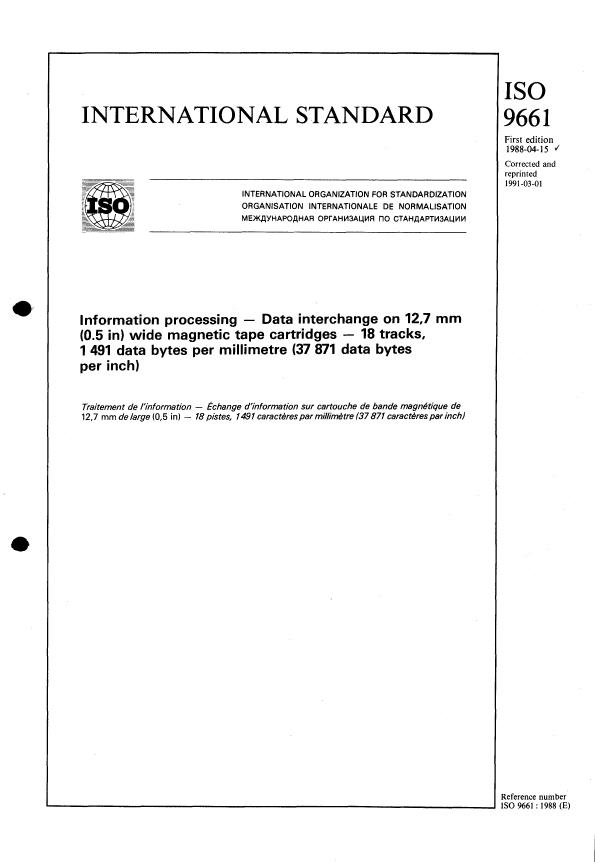
(Main)Information processing — Data interchange on 12,7 mm (0.5 in) magnetic tape cartridges — 18 tracks, 1 491 data bytes per millimetre (37 871 data bytes per inch)
Information processing — Data interchange on 12,7 mm (0.5 in) magnetic tape cartridges — 18 tracks, 1 491 data bytes per millimetre (37 871 data bytes per inch)
Traitement de l'information — Échange d'information sur cartouche de bande magnétique de 12,7 mm de large (0,5 in) — 18 pistes, 1 491 caractères par millimètre (37 871 caractères par inch)
General Information
- Status
- Withdrawn
- Publication Date
- 30-Mar-1988
- Withdrawal Date
- 30-Mar-1988
- Technical Committee
- ISO/IEC JTC 1 - Information technology
- Drafting Committee
- ISO/IEC JTC 1 - Information technology
- Current Stage
- 9599 - Withdrawal of International Standard
- Start Date
- 22-Dec-1994
- Completion Date
- 12-Feb-2026
Relations
- Effective Date
- 06-Jun-2022
- Effective Date
- 06-Jun-2022
- Effective Date
- 15-Apr-2008
- Effective Date
- 15-Apr-2008
- Effective Date
- 15-Apr-2008
ISO 9661:1988 - Information processing -- Data interchange on 12,7 mm (0.5 in) magnetic tape cartridges -- 18 tracks, 1 491 data bytes per millimetre (37 871 data bytes per inch)
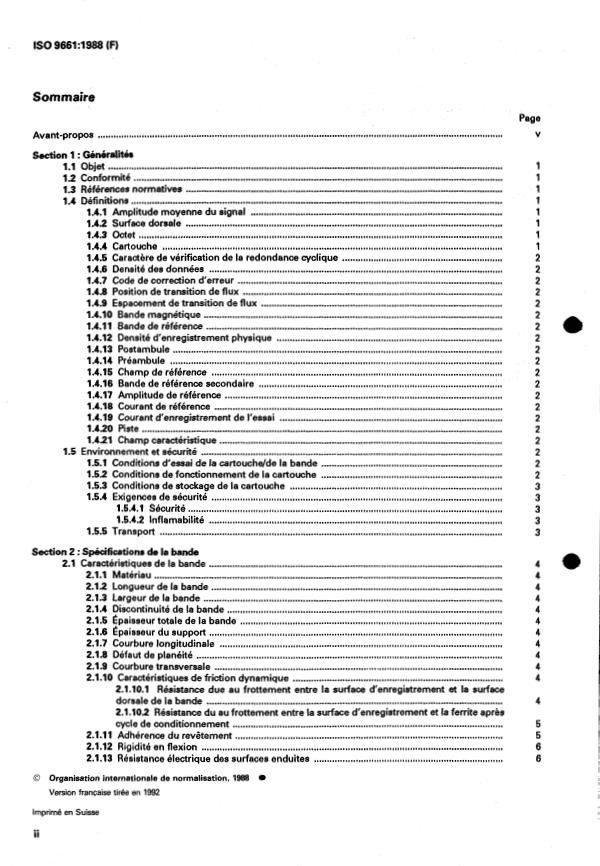
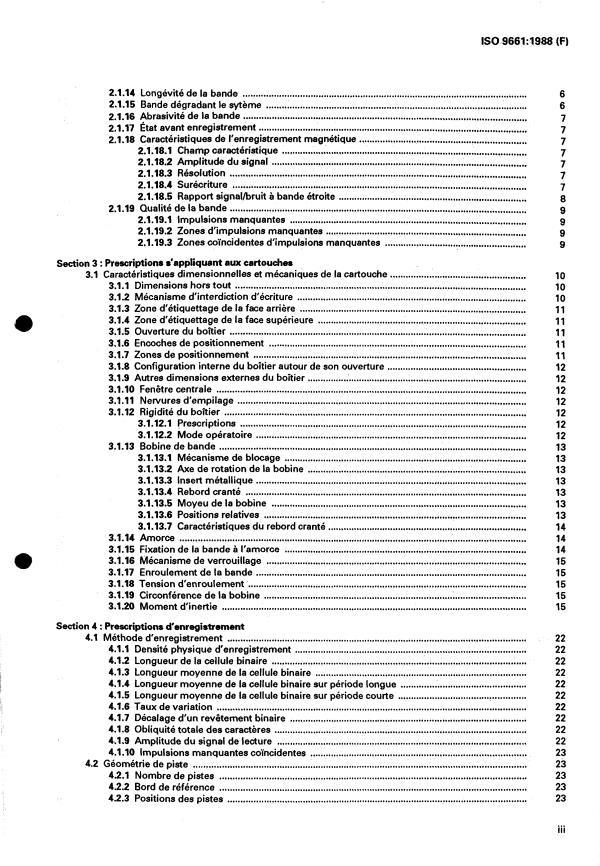
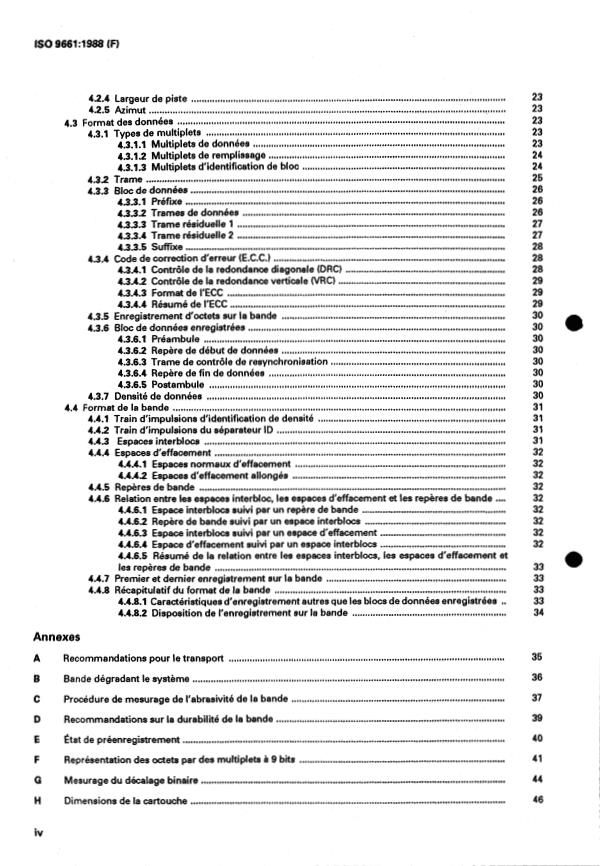
ISO 9661:1988 - Traitement de l'information -- Échange d'information sur cartouche de bande magnétique de 12,7 mm de large (0,5 in) -- 18 pistes, 1 491 caracteres par millimetre (37 871 caracteres par inch)
Get Certified
Connect with accredited certification bodies for this standard

BSI Group
BSI (British Standards Institution) is the business standards company that helps organizations make excellence a habit.

NYCE
Mexican standards and certification body.
Sponsored listings
Frequently Asked Questions
ISO 9661:1988 is a standard published by the International Organization for Standardization (ISO). Its full title is "Information processing — Data interchange on 12,7 mm (0.5 in) magnetic tape cartridges — 18 tracks, 1 491 data bytes per millimetre (37 871 data bytes per inch)". This standard covers: Information processing — Data interchange on 12,7 mm (0.5 in) magnetic tape cartridges — 18 tracks, 1 491 data bytes per millimetre (37 871 data bytes per inch)
Information processing — Data interchange on 12,7 mm (0.5 in) magnetic tape cartridges — 18 tracks, 1 491 data bytes per millimetre (37 871 data bytes per inch)
ISO 9661:1988 is classified under the following ICS (International Classification for Standards) categories: 35.220.20 - Magnetic storage devices in general. The ICS classification helps identify the subject area and facilitates finding related standards.
ISO 9661:1988 has the following relationships with other standards: It is inter standard links to ISO 9661:1988/Cor 2:1992, ISO 9661:1988/Cor 1:1990, ISO/IEC 9661:1994; is excused to ISO 9661:1988/Cor 1:1990, ISO 9661:1988/Cor 2:1992. Understanding these relationships helps ensure you are using the most current and applicable version of the standard.
ISO 9661:1988 is available in PDF format for immediate download after purchase. The document can be added to your cart and obtained through the secure checkout process. Digital delivery ensures instant access to the complete standard document.
Standards Content (Sample)
IS0
INTERNATIONAL STANDARD
First edition
1988-04-15 J
Corrected and
reprinted
_.__.__
1991 -03-01
INTERNATIONAL ORGANIZATION FOR STANDARDIZATION
ORGANISATION INTERNATIONALE DE NORMALISATION
MEXnYHAPOflHAR OPTAHMSAUMR Il0 CTAH,4APTMSAUMM
Information processing - Data interchange on 12,7 mm
(0.5 in) wide magnetic tape cartridges - 18 tracks,
I 491 data bytes per millimetre (37 871 data bytes
per inch)
Traitement de l'information - Échange d'information sur cartouche de bande magnétique de
12,7 mm de large (0,5 in) - 18 pistes, 7491 caractères par millimètre (37 871 caractères par inchi
Reference number
IS0 9661 : 1988 (E)
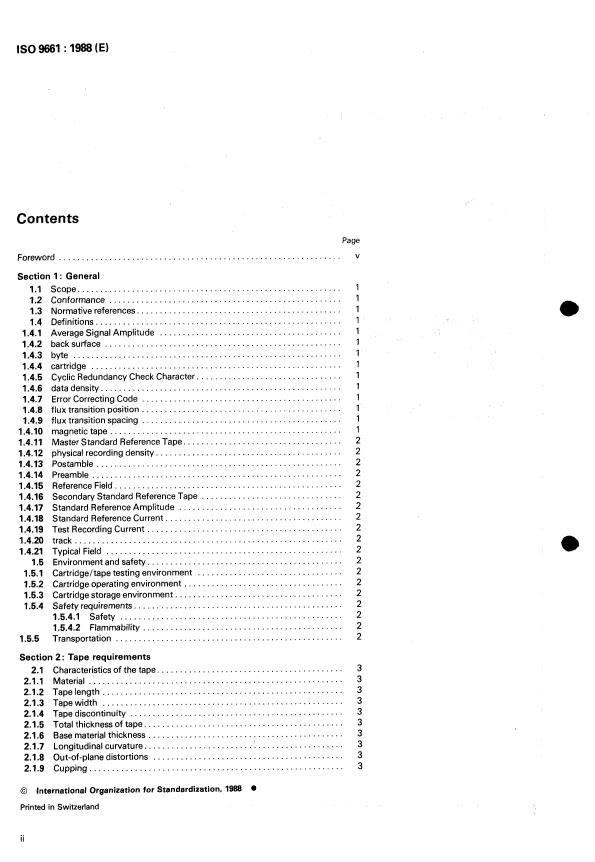
Contents
Page
Foreword . v
Section 1 : General
Scope. . . 1
1.1
Conformance . . 1
1.2
Normative references. . . 1
1.3
Definitions . . 1
1.4
Average Signal Amplitude . . 1
1.4.1
backsurface . . 1
1.4.2
...................... 1
1.4.3
cartridge . . 1
1.4.4
................... 1
1.4.5
.................. 1
1.4.6
Error Correcting Code . . 1
1.4.7
1.4.8 flux transition position
1.4.9 flux transition spacing .
............. 1
1.4.10
.................. 2
1.4.11
....................... 2
1.4.12
1.4.13
Preamble .
1.4.14
Reference Field. . . 2
1.4.15
1.4.16
1.4.17
1.4.18
Test Recording Current .
1.4.19
............................
1.4.20
................... 2
1.4.21
....................... 2
1.5
1.5.1
Cartridge operating environment .
1.5.2
1.5.3 Cartridge storage environment
Safety requirements. . .
1.5.4
1.5.4.1 Safety . . .
......... 2
.............. 2
....................
1.5.5
Section 2 : Tape requirements
2.1 Characteristics of the tape. . .
2.1.1 Material . .
2.1.2 Tape length. . .
.......... 3
............... 3
...................
2.1.8 Out-of-plane distortions .
.................
2.1.9 Cupping. .
O International Organization for Standardization, 1988
Printed in Switzerland
ii
IS0 9661 : 1988 (E)
2.1.10 Dynamic frictional characteristics . . . . . . . . . . . . . . . . . . . . . . . . . . . . . . . . . .
2.1.10.1 Frictional drag between the recording surface and the tape
back surface . . . . . . . . . . . . . . . . . . . . . . . . . . , . . . . . . . . . . . . . . . . . , . . . . . . . 3
2.1.10.2 Frictional drag between the tape recording surface and ferrite
. . . . . . . . . . . . . . . . . . . . . . . , . . . . . . . . . . . . . . .
after environmental cycling. 3
2.1.11 Coating adhesion . . . . . . . . . , . . . . . . . . . , . . . . . . . , , . . . . . . . . . . 4
2.1.12 Flexural rigidity . . . . . . . . . . . . . . . . . . . . . . . . . . . . . . . . , . . . . . . , , . . . . 4
Electrical resistance of coated surfaces . . . . . . . . . . . . . . . . . . . . . . . . . . . . . .
2.1.13 5
2.1.14 Tapedurability . 5
Inhibitor tape. . . . . . . . . . . . . . . . . . . . . . . . . . . . . . . . . . . . . . . . . . . . . . . . . . . .
2.1.15 5
2.1.16 Tapeabrasivity . 5
2.1.17 Pre-recording condition . . . . . . . . . . . . . . . . . . . . . . . . . . . . . . . . . . . . . . . . . . .
2.1.18 Magnetic recording characteristics . . . . . . . . . . . . . . . . . . . . . . . . . . . . . . . . . 5
2.1.18.1 Typical Field . . . . . . . . . . . . . . . . . . . . . . . . . . . . . . . . . . . . . . . . . . . 6
.............. 6
2.1.18.4 Overwrite. . . . . . . . . . . . . . . . . . . . . . . . 6
2.1.19 7
2.1.19.2 Missing pulse zone 7
2.1.19.3 Coincident missing 7
Section 3 : Cartridge requirements
Dimensional mechanical characteristics of the cartridge . . . . . . . . . . . . . . .
3.1 8
3.1.1 Overall dimensions . . . . . . . . . . . . . . . . . . . . . . . . . . . . . . . . . . . . . . . . . . . . . . . 8
3.1.2 Write-inhibit mechanism . . . . . . . . . . . . . . . . . . . . . . . . . . . .
3.1.3 Label area of the rear side . . . . . . . . . . . . . . . . . . . . . . . . . . .
3.1.4 Label area of the top side. . . . . . . . . . . . . . . . . . . . . . . . . . . . . . . . . . . . . . . . . . 9
3.1.5
3.1.6
3.1.7 . 9
3.1.8
3.1.9
3.1.10
3.1.11
3.1.12
3.1.13
3.1.13.1 Locking mechanism. . . . . . . . . . . . . . . . . . . . . . . . . . . . . . . . . . . . . 10
3.1.13.2 Axis of rotation of the reel. . . . . . . . . . . . . . . . . . . . . . . . . . . . . . . . 10
3.1.13.3 Metallic insert . . . .
3.1.13.4 Toothed rim
..........
3.1.14
3.1.15
3.1.16
3.1.17
Windtension . 12
3.1.18
3.1.19 Circumference of the tape re . . . . . . . . . . . . . . . . . . . . . . . . . . . . . . . . . . . ,
3.1.20 Moment of inertia. . . . . . . . . . . . . . . . 12
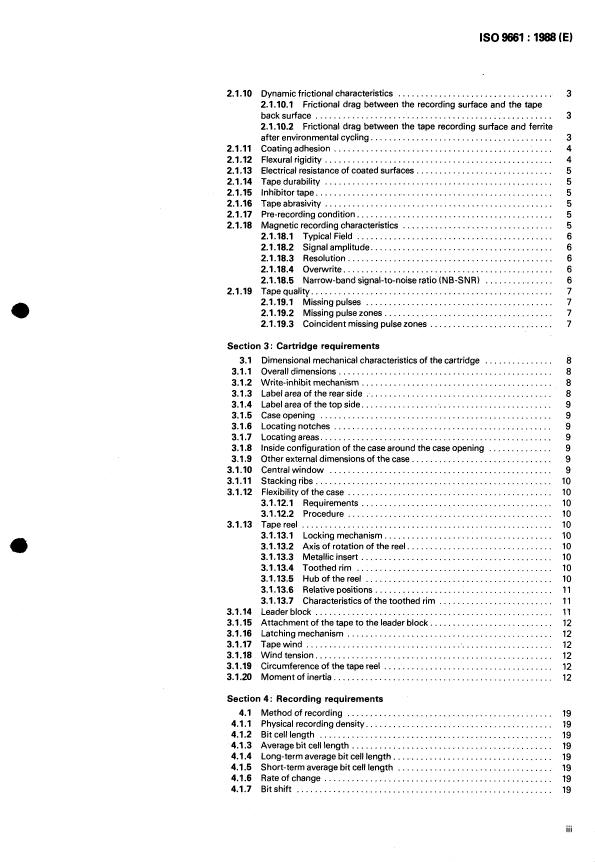
Section 4: Recording requirements
4.1 Method of recording . 19
4.1.1
4.1.2
4.1.3 Average bit cell length . . . . . . . . . . . . . . . . . . . . . . . . . . . . . . . . . . . .
4.1.4 Long-term average bit cell length. . . . . . . . . . . . . . . . . . . . . . . . . . .
4.1.5
4.1.6
4.1.7
iii
IS0 9661 : 1988 (E)
4.1.8 Total character skew . .
Read signal amplitude .
4.1.9
...................
4.1.10
4.2
4.2.1 Number of tracks .
Reference Edge. . .
4.2.2
Track positions . .
4.2.3
4.2.4
................
4.2.5
..................
4.3
4.3.1 Types of bytes. .
4.3.1 .I Data bytes . .
4.3.1.2 Pad bytes. .
.................
4.3.1.3 Block-ID bytes .
................ ................
4.3.2
Data block . .
4.3.3
4.3.3.1 Prefix .
4.3.3.2 Data Frames .
4.3.3.3 Residual Frame 1 . .
4.3.3.4 Residual Frame2 . .
............
............
4.3.4 Error Correcting Code (ECC) .
4.3.4.1 Diagonal Redundancy Check (DRC) .
4.3.4.2 Vertical Redundancy Check (VRC) .
4.3.4.3 ECC Format. . .
............. 26
4.3.5
Recorded Data Block. .
4.3.6
.............
................
4.3.7
................ .................
4.4
................
4.4.1
4.4.2
...................
4.4.3
..................
..........
4.4.4
.................
.............
................
4.4.5
4.4.6
...........
4.4.7
...........
4.4.8
.............. 30
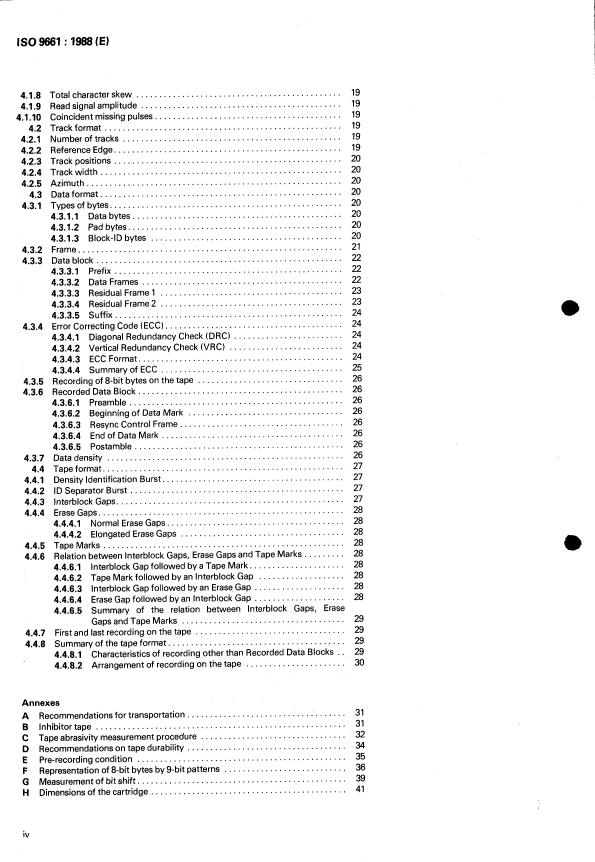
Annexes
A Recommendations for . 31
C Tape abrasivity measu . 32
D Recommendations on . 34
E Pre-recording condition .
F Representation of 8-bit b
G Measurement of bit shift .
H Dimensions of the cartrid
iv
IS0 9661 : 1988 (E)
Foreword
IS0 (the International Organization for Standardization) is a worldwide federation of
national standards bodies (IS0 member bodies). The work of preparing International
Standards is normally carried out through IS0 technical committees. Each member
body interested in a subject for which a technical committee has been established has
the right to be represented on that committee. International organizations, govern-
mental and non-governmental, in liaison with ISO, also take part in the work. IS0
collaborates closely with the International Electrotechnical Commission (IEC) on all
matters of electrotechnical standardization.
Draft International Standards adopted by the technical committees are circulated to
the member bodies for approval before their acceptance as International Standards by
the IS0 Council. They are approved in accordance with IS0 procedures requiring at
least 75 % approval by the member bodies voting.
International Standard IS0 9661 was prepared by the European Computer Manufac-
turers Association (as Standard ECMA-120) and was adopted, under a special "fast-
by Technical Committee ISO/TC 97, Information processing
track procedure",
systems, in parallel with its approval by the IS0 member bodies.
Annexes C, E, F and G form an integral part of this International Standard. Annexes A,
E, D and H are for information only.
V
IS0 9661 : 1988 (E)
INTERNATIONAL STANDARD
Information processing - Data interchange on 12,7 mm
(0.5 in) wide magnetic tape cartridges - 18 tracks,
1491 data bytes per millimetre (37 871 data bytes
per inch)
Section 1 : General
1.1 Scope IS0 2022 : 1986, Information processing - IS0 7-bit and CI bit
coded character sets - Code extension techniques.
(I) This International Standard specifies the physical and magnetic
IS0 4873 : 1986, Information processing - IS0 8-bit code for
characteristics of a 12,7 mm 10.5 in) wide, 18-track magnetic
information interchange - Structure and rules for implemen-
tape cartridge to enable interchangeability of such cartridges. It
tation.
also specifies a format and recording method thus allowing,
together with IS0 1001 for magnetic tape labelling, full data
interchange by means of such magnetic tape cartridges.
1.4 Definitions
For the purpose of this International Standard, the following
NOTE - Numeric values in the SI and/or Imperial measurement
definitions apply.
system in this International Standard may have been rounded off and
therefore are consistent with, but not exactly equal to, each other.
Either system may be used, but the two should be neither intermixed
1.4.1 Average Signal Amplitude : The average peak-to-peak
nor reconverted. The original design was made using SI units.
value of the signal output of the read head measured over a
minimum of 25,4 mm (1 in) of tape exclusive of missing pulses.
1.2 Conformance
1.4.2 back surface: The surface of the tape opposite the
A magnetic tape cartridge shall be in conformance with this
magnetic coating used to record data.
International Standard if it meets all mandatory requirements
specified herein. The tape requirements shall be satisfied
1.4.3 byte : An ordered set of eight bits acted upon as a unit
throughout the extent of the tape.
and recorded as a 9-bit pattern.
0 1.3 Normative references 1.4.4 cartridge: A container holding a supply reel of
magnetic tape with an attached leader block.
The following standards contain provisions which, through
reference in this text, constitute provisions of this International
1.4.5 Cyclic Redundancy Check Character : A character
Standard. At the time of publication, the editions indicated
represented by two bytes, placed at the end of a data block and
were valid. All standards are subject to revision, and parties to
used for error detection.
agreements based on this International Standard are encour-
aged to investigate the possibility of applying the most recent
1.4.6 data density: The number of 8-bit bytes stored per unit
editions of the standards listed below. Members of IEC and IS0
length of tape, expressed in bytes per millimetre (bytes per
maintain registers of currently valid International Standards.
inch).
IS0 646 : 1983, Information processing - IS0 7-bit coded
1.4.7 Error Correcting Code : A mathematical procedure
character set for information interchange.
yielding bits used for the detection and correction of errors.
IS0 683-13 : 1986, Heat-treatable steels, alloy steels and free-
1.4.8 flux transition position : That point which exhibits
cutting steels - Part 13: Wrought stainless steels.
maximum free-space flux density normal to the tape surface.
IS0 1001 : 1986, Information processing - File structure and
1.4.9 flux transition spacing: The distance along a track
labelling of magnetic tapes for information processing inter-
change. between successive flux transitions.
IS0 1302 : 1978, Technical drawings - Method of indicating
1.4.10 magnetic tape: A tape which will accept and retain
surface texture on drawings. the magnetic signals intended for input, output and storage
purposes on computers and associated equipment.
IS0 9661 : 1988 (E)
1.5.1 Cartridgekape testing environment
1.4.11 Master Standard Reference Tape : A tape selected
as the standard for Reference Field, Signal Amplitude, Resol-
Unless otherwise stated, tests and measurements made on the
ution and Overwrite.
tape cartridge to check the requirements of this International
NOTE - A Master Standard Reference Tape is being established at the Standard shall be carried out under the following conditions :
National Bureau of Standards (NBS) for this International Standard.
: 23 OC f 2 OC (73 OF f 4 OF)
temperature
1.4.12 physical recording density: The number of recorded
relative humidity : 40 % to 60 %
flux transitions per unit length of track, expressed in flux tran-
sitions per millimetre (ftpmm) (flux transitions per inch, [ftpil).
conditioning period before
testing : 24h
1.4.13 Postamble: A repeated 9-bit pattern at the end of a
Recorded Data block providing electronic synchronization
1.5.2 Cartridge operation environment
when reading in the reverse direction.
Cartridges used for data interchange shall be operated under
1.4.14 Preamble: A repeated 9-bit pattern at the beginning the following conditions :
of a Recorded Data Block providing electronic synchronization
: 16 OC to 32 OC (60 OF to 90 OF)
temperature
when reading in the forward direction.
: 20 % to 80 %
relative humidity
1.4.15 Reference Field: The Typical Field of the Master
: 25 OC max. (78 OF max.)
Standard Reference Tape. wet bulb temperature
The average temperature of the air immediately surrounding
1.4.16 Secondary Standard Reference Tape : A tape the
the tape shall not exceed 40,5 OC (105 OF).
performance of which is known and stated in relation to that of
the Master Standard Reference Tape.
NOTE - Localized tape temperatures in excess of 49 OC (120 OF) may
cause tape damage.
NOTE - Secondary Standard Reference Tapes are being developed at
the National Bureau of Standards (NBS) and will be available from the
Conditioning before operating : If a cartridge has been exposed
NBS Office of Standard Reference materials, Room 831 1, Chemistry
during storage and/or transportation to conditions outside the
Building, National Bureau of Standards, Gaithersburg, MA20899, USA.
above values, it shall be conditioned for a period of at least
It is intended that these be used for calibrating tertian/ reference tapes
24 h.
for use in routine calibration.
1.5.3 Cartridge storage environment
1.4.17 Standard Reference Amplitude : The Average
Signal Amplitude from the Master Standard Reference Tape
Cartridges used for data interchange shall be stored under the
when it is recorded with the Test Recording Current on the
following conditions :
NBS measurement system at 972 ftpmm (24 689 ftpi).
temperature : 5 OC to 32 OC (40 OF to 90 OF)
Traceability to the Standard Reference Amplitude is provided
by the calibration factors supplied with each Secondary Stan-
relative humidity : 5 % to 80 %
dard Reference Tape.
wet bulb temperature : 26 OC max. (80 OF max.)
1.4.18 Standard Reference Current: The current that pro-
duces the Reference Field.
1.5.4 Safety requirements
1.4.19 Test Recording Current: The current that is 1,5
1.5.4.1 Safety
times the Standard Reference Current.
The cartridge and its components shall not constitute any
safety or health hazard when used in its intended manner or in
1.4.20 track : A longitudinal area on the tape along which a
any foreseeable misuse in an information processing system.
series of magnetic signals may be recorded.
1.5.4.2 Flammability
1.4.21 Typical Field: In the plot of the Average Signal
Amplitude against the Recording Field at the physical recording
The cartridge and its components shall be made from materials
density of 972 ftpmm (24 689 ftpi), the minimum field that
which, if ignited from a match flame, do not continue to burn in
causes an Average Signal Amplitude equal to 85 % of the
a still carbon dioxide atmosphere.
maximum Average Signal Amplitude.
1.5.5 Transportation
1.5 Environment and safety
This International Standard does not specify parameters for the
Unless otherwise stated, the conditions specified below refer to
environment in which cartridges should be transported.
the ambient conditions in the test or computer room and not to
Annex A gives some recommendations for transportation.
those within the tape equipment.
IS0 9661 : 1988 (E)
Section 2 : Tape requirements
2.1.9 Cupping
2.1 Characteristics of the tape
The departure across the width of tape from a flat surface shall
2.1.1 Material
not exceed 0,3 mm (0.011 8 in).
The tape shall consist of a base material (oriented polyethylene Procedure :
terephthalate film or its equivalent) coated on one side with a
Cut a length of tape of 1,0 m f 0,l m (39.4 in f 3.9 in). Con-
strong, yet flexible layer of ferromagnetic material dispersed in
dition it for a minimum of 3 h in the test environment by hanging
a suitable binder. The back surface of the tape may also be
it so that the coated surface is freely exposed to the test
coated with a ferromagnetic or non-ferromagnetic material.
environment. From the centre portion of the conditioned tape
cutatestpieceof length25 mm(1 in). Standthetestpieceonits
2.1.2 Tape length
end in a cylinder which is at least 25 mm (1 in) high with an inside
diameter of 13,O mm it 0,2 mm (0.511 8 in f 0.007 9 in). With
The length of the tape shall not be less than 165 m (541 ft).
the cylinder standing on an optical comparator measure the
cupping by aligning the edges of the test piece to the reticle and
determining the distance from the aligned edges to the cor-
il) 2.1.3 Tape width
responding surface of the test piece at its centre.
The width of the taDe shall be 12,650 mm f 0,025 mm
(0.498 O in * 0,001 O in): The width shall be measured across
2.1 .IO Dynamic frictional characteristics
the tape from edge-to-edge when the tape is under a tension of
In the tests of 2.1.10.1 and 2.1.10.2 the specified forces of
less than 0,28 N (1.0 ozf).
1,0 N and 1,5 N (3.6 orf and 5.4 ozf), respectively, comprise
both the force component of the dynamic friction and the force
2.1.4 Tape discontinuity
0,64 N (2.30 ozf) applied to the sample of tape.
of
There shall be no discontinuities in the tape such as those pro-
NOTE - Particular attention should be given to keeping the surfaces
duced by tape splicing or perforations.
clean.
2.1.5 Total thickness of tape
2.1.10.1 Frictional drag between the recording surface and
the tape back surface
The total thickness of the tape at any point shall be between
The force required to move the recording surface in relation to
0,025 9 mm and 0,033 7 mm (1 020 pin and 1 330 (lin).
the back surface shall not be less than 1,0 N (3.6 ozf).
2.1.6 Base material thickness
Procedure
ai Wrap a test piece of tape around a 25,4 mm (1 in)
The thickness of the base material shall be 0,023 4 mm
diameter circular mandrel with the back surface of the
(921 pin) nomimal.
sample facing outward.
e
2.1.7 Longitudinal curvature
b) Place a second test piece of tape, with the recording
surface facing in, around the first sample for a total angle of
The radius of curvature of the edge of the tape shall not be less
wrap of 90°.
than 33 m (108 ft).
ci Apply a force of 0,64 N (2.30 ozf) to one end of the
outer test piece of tape. Secure its other end to a force
Procedure :
gauge which is mounted on a motorized linear slide.
Allow a length of tape of 1 m (39 in) to unroll and assume its
natural curvature on a flat smooth surface. Measure the devi- d) Drive the slide at a speed of 1 mm/s (0.039 in/s)
ation from a l m (39 in) chord. The deviation shall not be
greater than 3,8 mm (0.150 in). This deviation corresponds to
2.1.10.2 Frictional drag between the tape recording surface
the minimum radius of curvature of 33 m (108 ft) if measured
and ferrite after environmental cycling
over an arc of a circle.
The force required to move the tape at a point 1,34 m from the
leader block of the cartridge shall not be greater than 1.5 N.
2.1.8 Out-of-plane distortions
The force required at a point 4,3 m from the junction of the
tape with the cartridge hub shall not exceed the first force by
All visual evidence of out-of-plane distortion shall be removed
more than a factor of 4.
when the tape is subjected to a uniform tension of 0,6 N
(2.16 ozf). Out-of-plane distortions are local deformations
Procedure :
which cause portions of the tape to deviate from the plane of
the surface of the tape. Out-of-plane distortions are most
ai Wind tape on to a spool hub of diameter 50 mm (2 in)
readily observed when the tape is lying on a flat surface under to an outside diameter of 97 mm (4 in) with a winding ten-
no tension.
sion of 2,2 N f 0.2 N (7.91 ozf f 0.72 ozf).
IS0 9661 : 1988 (E)
d) Note the force at which any part of the coating first
b) Repeat the following two steps five times:
separates from the base material. If this is less than 1,5 N
1) Store for48 hat a tempeature of 50 OC (122 OF) and
(5.4 ozf), the test has failed. If the test piece peels away
a relative humidity of 10 % to 20 %.
from the double-sided pressure sensitive tape before the
force exceeds 1,5 N (5.4 ozf), an alternative type of double-
2) Condition in the testing environment for 2 h
sided pressure sensitive tape shall be used.
and rewind with a tension of 2,2 N k 0,2 N
(7.91 ozf k 0.72 ozf).
If the back surface of the tape is coated, repeat a) to d)
e)
for the back coating.
c) Condition the tape for 48 h at a temperature of 30,5 OC
(87 OF) and a relative humidity of 85 %. The tape shall re-
main in this environment for steps d) and e).
2.1.12 Flexural rigidity
d) Apply a force of 0,64 N (2.30 ozf) to one end of a test
piece of tape of not more than 1 m (39 in), taken 1,34 m
The flexural rigidity of the tape in the longitudinal direction shall
(52.75 in) from the leader block. Pass the test piece over a
be between 0,06 N.mm2and 0,16 N.mm2 (0.21 x lO-4lbf.in2
ferrite rod of diameter 25,4 mm (1 in) with the recording sur-
and 0.56 x 10⁻⁴ Ibf.in2).
face in contact with the rod for a total angle of wrap of 90°.
The rod shall be made from the ferrite specified in annex C. Procedure :
It shall be polished to a roughness value Ra of 0,05 pm
(roughness grade N2, IS0 1302). Pull the other end of the Clamp a 180 mm (7.1 in) test piece of tape in a universal testing
test piece horizontally at 1 mm/s (0.039 in/s). machine, allowing a 100 mm (3.9 in) separation between the
at 5 mm/min
machine jaws. Set the jaw separation speed
e) Repeat step d) for a similar test piece taken 4,3 m
(0.2 in/min). Plot the force against the distance. Calculate the
(14,ll ft) from the junction of the tape with the cartridge
flexural rigidity using the slope of the curve between 2,2 N and
hub.
6,7 N (0.5 Ibf and 1.5 Ibf) by the formula :
2.1.11 Coating adhesion
6F/ WT
E=-------
6LIL
The force required to peel any part of the coating from the tape
base material shall not be less than 1,5 N (5.4 ozfi.
I = WT3/12
Procedure :
6FT2
Flexural rigidity = El =
a) Take a test piece of the tape approximately 380 mm 126LIL
(15 in) long and scribe a line through the recording coating
across the width of the tape 125 mm (5 in) from one end.
where
a double-sided pressure sensitive tape, attach the
b) Using
6F is the change in force in newtons;
full width of the test piece to a smooth metal piece plate,
with the recording surface facing the plate, as shown in
T is the measured thickness in millimetres;
figure 1.
W is the measured width in millimetres;
c) Fold the test piece over 180°, attach the metal plate and
the free end of the test piece to the jaws of a universal
testing machine and set the speed of the jaw separation to 6LIL is the change in length of test piece between the
jaws divided by original length between the jaws.
254 mm/min (IO inlmin).
Recording surface
tessure-sensitive
Figure 1 - Coating adhesion
IS0 9661 : 1988 (E)
2.1.13 Electrical resistance of coated surfaces 2.1.15 Inhibitor tape
This International Standard does not specify parameters for
The electrical resistance of any square area of the recording
surface shall be within the range assessing whether or not a tape is an inhibitor tape.
-
IO5 S2 to 5 x 10⁸ !2 for non-backcoated tapes; However, annex B gives further information on inhibitor tapes.
-
IO5 S2 to 5 x IO9 S2 for backcoated tapes.
2.1.16 Tape abrasivity
The electrical resistance of any backcoating shall be less
than 106sZ.
Tape abrasivity is the tendency of the tape to wear the tape
transport. The length of the wear pattern on a wear bar shall
Procedure :
not exceed 56 pm (2 200 vin) when measured as specified in
annex C.
Condition a test piece of tape in the test environment for 24 h.
Position the test piece over two 24-carat gold-plated, semi-
circular electrodes having a radius r = 25,4 mm (1 in) and a
2.1.17 Pre-recording condition
finish of at least N4, so that the recording surface is in contact
with each electrode (see figure 2). These electrodes shall be
Prior to recording data or to testing, the tape shall have been
placed parallel to the ground and parallel to each other at a
distance d = 12,7 mm (0.5 in) between their centres. Apply a erased using alternating fields of decaying levels (anhysteretic
a
force Fof 1,62 N (0.36 Ibf) to each end of the test piece. Apply process) to ensure that the remanent magnetic moment of the
recording surface does not exceed 20 % of the maximum rem-
a d.c. voltage of 500 V f 10 V across the electrodes and
measure the resulting current flow. From this value, determine anent magnetic moment. Annex E specifies the method of
measurement.
the electrical 'resistance.
In addition no low density transitions shall be present on the
Repeat for a total of five positions along the test piece and
average the five resistance readings. For back-coated tape tape.
repeat the procedure with the backcoating in contact with the
electrodes.
2.1.18 Magnetic recording characteristics
The magnetic recording characteristics shall be as defined by
the testing requirements given below.
When performing these tests, the output or resultant signal
shall be measured on the same relative pass for both a tape
calibrated to the Master Standard Reference Tape and the tape
under test (i.e. read-while-write or first forward-read-pass) on
the same equipment.
The following conditions shall apply to the testing of all
magnetic recording characteristics, unless otherwise stated.
tape condition : pre-recording condition
li
tape speed : not greater than 2,5 m/s
F
F
(98.47 in/si
Figure 2 - Position of test piece over two semi-circular read-track : within the written track
electrodes
azimuth alignment : not greater than 6' between the
mean write transitions and the read
When mounting the test piece, make sure that no conducting
PP
paths exist between the electrodes except that through the
coating under test.
write-gap length
: 1,4 pm f 0,2 pm
(55.1 vin k 7.9 pin)
NOTE - Particular attention should be given to keeping the surfaces
clean.
write head saturation
density 0,34 T 1: 0,03 T
2.1.14 Tape durability
(3 400 gauss f 300 gauss)
This International Standard does not specify parameters for tape tension
2,2 N k 0,2 N
assessing tape durability.
(7.91 ozf 10.72 ozf)
However, a recommended procedure is descibed in annex D. recording current Test Recording Current
IS0 9661 : 1988 (E)
2.1.18.1 Typical Field
The Typical Field of the tape shall be between 90 % and 110 % of the Reference Field.
Traceability to the Reference Field is provided by the calibration factors supplied with each Secondary Standard Reference Tape.
2.1.18.2 Signal amplitude
The Average Signal Amplitude at the physical recording density of 972 ftpmm (24 689 ftpi) shall be between 70 % and 140 YO of the
Standard Reference Amplitude.
Traceability to the Standard Reference Amplitude is provided by the calibration factors supplied with each Secondary Standard
Reference Tape.
2.1.18.3 Resolution
The ratio of the Average Signal Amplitude at the physical recording density of 1 458 ftpmm (37 033 ftpi) to that at the physical record-
ing density of 972 ftpmm (24 689 ftpi) shall be between 80 % and 120 % of the same ratio for the Master Standard Reference Tape.
Traceability to the resolution of the Master Standard Reference Tape is provided by the calibration factors supplied with each Second-
ary Standard Reference Tape.
2.1.18.4 Overwrite
Overwrite is the ratio of the Average Signal Amplitude of the residual of the fundamental frequency of a tone pattern after being over-
written at 972 ftpmm (24 689 ftpi) to the Average Signal Amplitude of the 972 ftpmm (24 689 ftpi) signal. The Average Signal
Amplitude of the tone pattern is the peak-to-peak amplitude of the sinusoidal signal with equal rms power.
2.1.18.4.1 Requirement
The Overwrite for the tape shall be less than 120 % of the Overwrite for the Master Standard Reference Tape.
Traceability to the Overwrite of the Master Standard Reference Tape is provided by the calibration factors supplied with each Second
ary Standard Reference Tape.
Procedure
Record a tone pattern which shall be the following sequence of flux transitions:
1 O 0000 1 O O0 O O c
)
J al
where
a, = 1,029 pm (40.512 pin)
a2 = 0,514 pm (20.236 pin)
Record a 972 ftpmm (24 689 ftpi) signal over the tone pattern. Measure the Average Signal Amplitude of the residual of the
fundamental frequency of the tone pattern [one sixth of the frequency of the 972 ftpmm (24 689 ftpi) signall and the Average Signal
Amplitude of the 972 ftpmm (24 689 ftpi) signal. Both amplitude measurements should be made using suitable filters.
2.1.18.5 Narrow-band signal-to-noise ratio (NB-SNR)
The narrow-band signal-to-noise ratio is the average signal amplitude rms power divided by the average integrated (side band) rms
noise power, and is expressed in decibels.
2.1.18.5.1 Requirement
The NB-SNR ratio shall be equal to, or greater than, 30 dB when normalized to a track width of 410 pm (0.016 14 in). The normaliz-
ation factor is dB(410) = dB( W) + 10 log 410/ W, where W is the track width used when measuring dB( W).
IS0 9661 : 1988 (E)
2.1.18.5.2 Procedure write head saturation : 0,34 T k 0,03 T
(3 400 gauss +_ 300 gauss)
The NB-SNR ratio shall be measured using a spectrum analyzer
recording current : Test Recording Current
with a resolution bandwidth (RBW) of 1 kHz and a video band-
width (VBW) of 10 Hz. The tape speed shall be 762 mm/s
format : 18 tracks
(30 in/s) for the frequencies specified below.
tape tension : 2,2 N f 0,2 N (7.91 ozf t 0.72 ozf)
The NB-SNR ratio shall be measured as follows :
a) Measure the read-signal amplitude of the 972 ftpmm 2.1.19.1 Missing pulses
(24 689 ftpi) signal, taking a minimum of 150 samples over a
A missing pulse is a loss of read signal amplitude. A missing
minimum length of tape of 46 m (151 ftl.
pulse exists when the base-to-peak read signal amplitude is
b) On the next pass (read only) measure the rms noise
25 %, or less, of half the Average Signal Amplitude for the
power over the same section of tape and integrate the rms preceding 25,4 mm (1 in) of tape.
noise power (normalizing for the actual resolution band-
width) over the range from 332 kHz to 366 kHz.
2.1.19.2 Missing pulse zones
For other tape speeds all the frequencies shall be linearly
A missing pulse zone begins with a missing pulse and ends
scaled.
when 64 consecutive flux transitions are detected or a length of
1 mm of tape has been measured.
e
2.1.19 Tape quality
The missing pulse zone rate shall be less than one in 8 x 10⁶
flux transitions recorded.
The tape quality (including the effects of exposure to storage
and transportation environments) is defined by the testing re-
quirements given in the following clauses. The following con-
2.1.19.3 Coincident missing pulse zones
ditions shall apply to all quality testing requirements.
There are two 9-track groups in the 18-track format. One group
environment : operating environment
comprises the odd-numbered tracks, the other group com-
prises the even-numbered tracks. A simultaneous missing pulse
tape condition : pre-recording condition
zone condition on two or more tracks of a 9-track group is a
coincident pulse missing zone.
tape speed : 2 m/s (78.7 idsi
If a coincident missing pulse zone occurs at the same time in'
read-track width : 410 pm (0.016 14 pin)
both groups of tracks, it shall be considered as a single coinci-
physical recording density : 972 ftpmm (24 689 ftpii dent missing pulse zone. Its length shall begin with the start of
the earliest coincident missing pulse zone and terminate with
write-gap length : 1,4 pm 'I 0,2 pm
the end of the latest coincident missing pulse zone.
(55.1 pin 'I 7.9 pin)
No 165 m (541 ft) length of tape shall have more than 12 coinci-
azimuth alignment : not greater than 6' between the
dent missing pulse zones.
mean write transitions and the
read gap No coincident missing pulse zone shall exceed 50 mm (2 in).
*
IS0 9661 : 1988 (E)
Section 3 : Cartridge requirements
3.1.1 Overall dimensions (figures I to 6)
3.1 Dimensional and mechanical characteristics
of the cartridge
The overall dimensions of the case shall be
The cartridge shall consist of the following elements
I, = 125,OO mm k 0,32 mm (4.921 in -I 0.013 in)
- a case; /2 = 109,O mm f 0,32 mm (4.291 in k 0.013 in)
-
a reel for the magnetic tape;
-
a magnetic tape wound on the hub of the reel;
The corners of the case shall be rounded off as specified by
-
a locking mechanism for the reel;
rl = 3,OO max. (0.118 1 in max.)
- a write-inhibit mechanism;
r2 = 4,OO max. (0.157 5 in mi3x.j
- a leader block;
r3 = 3,OO min. (0.118 1 in min.)
-
a latching mechanism for the leader block.
3.1.2 Write-inhibit mechanism (figures 4 and 5)
Dimensional characteristics are specified for those parameters
deemed mandatory for interchange and compatible use of the
The write-inhibit mechanism shall have a flat surface identified
cartridge. Where there is freedom of design, only the functional
by a visual mark, for example a white spot, when in the position
characteristics of the elements described are indicated. In the
in which writing is inhibited. This International Standard does
figures a typical implementation is represented in third angle
not prescribe the actual implementation of the write-inhibit
projection.
mechanism. For example, it can be a rotatable or a slidable
element.
Where they are purely descriptive the dimensions are referred
to three Reference Surfaces A, B and C forming a geometrical
The front side of the case shall have a window specified by
trihedral (see figure 3). Where the dimensions are related to the
l4 = 11,80 mm I 0,25 mm (0.465 in I 0.010 in)
position of the cartridge in the drive, they may be referred to
4 to 11 show the
another surface of the cartridge. Figures
/5 = 15,60 mm f 0,25 mm (û.614 in I 0.010 in)
dimensions of the empty case.
/s = 7,40 mm f 0,25 mm (0.291 in f 0.010 in)
Figure 3 is a general view of the whole cartridge;
I, = 12.00 mm -I 0,25 mm (0.472 in IO.010 in)
Figure 4 shows the front side of the case which lies on refer-
ence surface A;
In the write-inhibit position the fiat surface of the write-inhibit
mechanism shall be behind this window at a distance
Figure 5 shows the top side of the case;
I8 = 2,55 mm min. (0.100 4 in min.)
Figure 6 shows the rear side of case;
from the front side of the case.
Figure 7 shows the bottom side of the case which lies in refer-
ence surface C;
In the write-enable position this surface shall be within
0,25 mm (0,010 in) of the front side of the case.
Figure 8 shows the side of the case which lies in reference
surface B;
The force required for the operation of the write-inhibit
mechanism shall be in the range
Figure 9 shows an enlarged view of a part of figure 4;
Figure 10 shows an enlarged cross-section of a location notch; 2 N to 9 N (0.45 Ibf to 2.02 Ibf)
Figure 11 shows an enlarged cross-section of a detail of the
when applied tangentially to the surface of the case.
opening of the case;
3.1.3 Label area of the rear side (figures 5 and 6)
Figure 12 shows an enlarged partial cross-section of the car-
tridge in hand;
On the rear side of the case there shall be a label area specified by
Figure 13 shows the same cross-section as figure 11 but of the
/9 = 7,OO mm f 0,25 mm (0.276 in f 0,010 in)
cartridge in the drive;
Figure 14 shows schematically the teeth of the toothed rim;
/,O = 80,OO mm L:;;: mm (3.149 6 in Lo,,: in)
Figure 15 shows two views and an enlarged cross-section of
/,, = 12,30 mm f 0,25 mm (0.484 in f 0.010 in)
the leader block;
/,* = 0,50 mm k 0,25 mm (0.020 in f 0.010 in)
Figure 16 shows the fixation of the tape to the leader block, and
r4 = 1,OO mm max. (0.039 4 in max.)
Figure 17 shows the leader block inserted in the case.
IS0 9661 : 1988 (E)
3.1.4 Label area of the top side (figure 5) Areas al and a2 shall have a diameter of 10,OO rnm f 0,25 rnrn
(0.394 in f 0.010 in). The positions of their centres shall be
On the top side of the case there shall be a label area, recessed
specified by
by 0,50 mrn f 0,25 rnm (0.020 in fO.010 in), specified by 19,
110, 112 and in addition by I25 = 108,50 rnrn k 0,25 rnrn (4.272 in f 0,010 in)
I13 = 31,OO rnrn f 025 rnrn (1.220 in f 0.010 in)
/z,j = 3,50 rnrn f 0,25 mrn (0.138 in f 0.010 in)
127 = 105,50 rnrn f 0,25 mrn (4.154 in k 0.010 in)
/14 = 75,OO rnrn TE;:: rnrn (2.952 8 in
9 in)
Area a3 shall have a diameter of 14,OO rnrn f 0,25 rnrn
(0.551 in f 0.010 in). The position of its centre shall be
3.1.5 Case opening (figures 4, 5, 7 and 9)
specified by
The case shall have an opening for the tape in which the leader
128 = 31,25 rnrn f 025 rnrn (1.230 in f 0.010 in)
block can be inserted (see also figure 17). This opening shall be
specified by
129 = 54,50 rnrn f 0,25 rnm (2.146 in f 0.010 in)
115 = 4,70 rnm f 0,25 rnrn (0.185 in f 0.010 in)
3.1.8 Inside configuration of the case around the case
11, = 14,90 rnrn f 0,32 rnrn (0.587 in f 0.013 in)
opening (figures 7 and 11)
117 = 7,50 rnrn f 0,25 rnrn (0.295 in f 0.010 in)
Figures 7 and 11 show the inside configuration of the case
around the opening of the case. This configuration shall be
118 = 87,lO rnm k 0,25 rnrn (3.429 in f 0.010 in)
defined as follows (see also 3.1.10)
1,g = 4,OO rnrn f 0,25 rnrn (0.157 in f 0.010 in)
130 = 3,30 rnrn f 0,25 rnm (0.130 in f 0.010 in)
r5 = 4,OO rnrn f 0,25 rnrn (0.157 in it 0.010 in)
/3, = 18,40 rnrn 1: 0,25 rnrn (0.724 in f 0.010 in)
C( = 5Ook lo
r6 = 1,50 rnm i 0.25 rnrn (0.059 in f 0.010 in)
Figure 9 shows at a larger scale the details of the configuration
of the case opening as seen at the right-hand side of figure 4. r7 = 1,50 rnrn f 0,25 rnrn (0.059 in f 0.010 in)
The oblique edge of the cae shall be tangential to the arc of
161 = 3,9 rnrn $: 0,5 rnrn (0.154 in k 0.020 in)
circle defined by r6 at an angle of
rnrn (0.665 in
1, = 16,9 rnrn
+ o.o2o in)
/I = 40Of30
163 = 3,O rnrn 4 0.5 rnrn (0.118 in f 0.020 in)
3.1.9 Other external dimensions of the case (figure 8)
1~ = 11,6 rnrn f 0.5 rnrn (0.457 in f 0.020 in)
The external form of the case shall be further specified by
~1 = 1’ k 30‘
132 = 1132
mrn f 0.3 rnrn (4.457 in f 0.012 in)
w2 = 200 f 20
1% = 26’00 rnrn k 0,25 rnrn (1 .O24 in k 0.010 in)
3.1.6 Locating notches (figures 7, 8 and 10)
r8 = 145,50 rnrn f0,25 rnrn (5.728 in f 0.010 in)
There shall be two locating notches open towards the bottom
rg = 145,50 rnrn f 0,25 rnrn (5.728 in f 0.010 in)
side. These location notches shall be specified by
6 = 30’ k30’
/20 = 106.00 mm f 0.25 rnm (4.173 in f 0.010 in)
121 = 5,OO rnrn it 0,25 rnrn (O. 197 in 1 0.010 in)
3.1.10 Central window (figure 7)
122 = 7,OO rnrn f 0,25 rnrn (0.276 in f 0.010 in)
The bottom side of the case shall have a central window. The
location of its centre shall be specified by 129 and
123 = 104,OO rnrn k 0,25 rnrn (4.094 in f 0.010 in)
= 61,OO rnrn f 0,25 rnm (2.402 in k 0.010 in)
124 = 2,50 rnm k 0,25 mrn (0.098 in i 0.010 in)
Its diameter shall be
/3 = l03O’f30’
y = 2Of 30’
dl = 43,5 rnrn * - 2zo 1.0 rnrn (1.713 in :::: in)
3.1.7 Locating areas (figure 7) The angle with its apex at the centre of this window and formed
by the two lines tangential to the parts shown in figure 7 in
The bottom side of the case shall have three circular locating
cross-section shall be
areas al, a2 and a3 which shall lie in the same horizontal plane
within 0,25 rnrn (0.010 in).
0 = 16’ k 30‘
IS0 9661 : 1988 (E)
3.1.13.1 Locking mechanism (figure 13)
3.1.11 Stacking ribs
This International Standard does not specify the actual im-
The bottom side of the case shall have two parallel stacking
of the locking mechanism. However, functionally
plementation
ribs. Their dimensions shall be
it shall satisfy the following requirements in the locked pos-
ition :
/35 = 5,OO mm I 0,25 mm (O. 197 in k 0,010 in)
- the angular resolution shall not be greater than 6O;
136 = 1,00 mm k 0,16 mm (0.039 4 in f 0.006 3 in)
13, = 7450 mm I 0.25 mm (2.933 in I 0.010 in) - the reel shall not rotate by more than IOo when a
torque not greater than 0,32 N + m (2.83 Ibf . in) is applied in
Their locations shall be
the direction that will cause the tape to unwind.
/% = 31,OO mm f 025 mm (1.220 in IO.010 in)
The button of the locking mechanism shall be made of nylon
6/6 with 2 % I 1 % molybdenum disulphide.
139 = 7,s mm f 0,32 mm (0.295 in k 0.013 in)
its dimensions shall be
lM = 7930 mm I 0,25 mm (3.130 in $: 0.010 in)
dg = 2,O mm I 0,5 mm (0.079 in IO.020 in)
3.1.12 Flexibility of the case
dlo = 10,O mm t 0,2 mm (0.393 7 in f 0.007 9 in)
The flexibility of the top and bottom sides of the case (see
,Q = 15Ok2'
figure 3) is the amount of deflection observed when they are
submitted to a perpendicular force F.
3.1.13.2 Axis of rotation of the reel
The axis of rotation of the reel shall be perpendicular to plane P
3.1.12.1 Requirements
(see 3.13.7) and pass through the centre of the centrai window
as specified by 129 and 1%.
The amount of deflection d shall meet the following require-
ments :
3.1.13.3 Metallic insert
Deflection of the top side:
The reel shall have a metallic insert made of stainless steel
0,025 6 F & d& 0,s + 0,054 F (0.004 5 F 4 d & 0.015 +
(IS0 683-13, type 3 or 7). It shall withstand a pull out force of
0.095 F)
300 N min. (67.4 Ibf min.). Its dimensions sh3!1 be
Deflection of the bottom side :
d2 = 35,OO mm mm (1.378 in
in)
0,022 8 F < d< 0,38 + 0,040 F (0.004 OF & d & 0.015 +
0.007 O F) d3 = 11,15 mm + 0,05 mm (0.439 O in t 0.002 O in)
1,51 mm t 0,lO mm (0.059 in rt 0.004 in)
where el =
Its central opening (diameter d3) shall be concentric with the
d is the measured deflection in millimetres (inches)
axis of rotation of the reel within 0,15 mm (0.006 in).
4,5 N < F < 54,0 N (1.0 Ibf < F < 12,l Ibf)
The metallic insert shall be parallel to plane P within 0,15 mm
(0.006 in).
3.1.12.2 Procedure
Measure the flexibility of the case in a universal testing machine
3.1.13.4 Toothed rim
operating in the compression mode. Use a suitable load cell for
the test. Apply a single point load with a radius of
The reel shall have a toothed rim acces
...
IS0
NORME INTERNATIONALE
Première édition
1988-04.1 5
INTERNATIONAL ORGANIZATION FOR STANDARDIZATION
ORGANISATION INTERNATIONALE DE NORMALISATION
MEXAYHAPOAHAR OPiAHM3AuMR no CTAHAAPTMSAIJMM
Traitement de l'information - Échange
d'information sur cartouche de bande
12,7 mm de large (0'5 in) -
magnétique de
18 pistes, 1 491 caractères par millimètre
(37 871 caractères par inch)
Information processing - Data interchange on 12,7 mm (0.5 in) wide magnetic tape
cartridges - 18 tracks, 1 431 data bytes per millimetre (37 871 data bytes per inch)
Numéro de référence
IS0 9661 : 1988 (F)
. IS0 9661:1988 (FI
Sommaire
Page
Avant-propos . V
Section 1 : GéneraMéS
1.1 Objet . 1
1.2 Conformité .
1.3 Références normatives .
1.4 Définitions .
1.4.1 Amplitude moyenne du signal . 1
1.4.2 Surface dorsale .
1.4.3 Octet .
1.4.4 Cartouche .
1.4.5 Caractère de vérification de la redondance cyclique . 2
1.4.6 Densité des données . 2
1.4.7 Code de correction d'erreur .
1.4.8 Position de transition de flux .
1.4.9 Espacement de transition de flux .
..
1.4.10 Bande magnetique .
1.4.1 1 Bande de référence .
1.4.12 Densité d'enregistrement physique .
1.4.13 Postambule . 2
1.4.14 Préambule .
1.4.15 Champ de référence .
1.4.16 Bande de référence secondaire .
1.4.17 Amplitude de référence . 2
1.4.18 Courant de référence . 2
1.4.19 Courant d'enregistrement de l'essai .
1.420 Piste .
1.421 Champ caractéristique . 2
1.5 Environnement et sécurité .
1.5.1 Conditions d'essai de la cartouchdde la bande . 2
1.52 Conditions de fonctionnement de la cartouche .
1.5.3 Conditions de stockage de la cartouche . 3
1.5.4 Exigences de sécurité . 3
1.5.4.1 Sécurité .
1.5.4.2 Inflamabilité . 3
1.5.5 Transport . 3
Section 2 : Spécifications de la bande
2.1 Caractéristiques de la bande . 4
2.1.1 Matériau . 4
2.12 Longueur de la bande . 4
2.1.3 Largeur de la bande .
2.1.4 Discontinuité de la bande . 4
2.1.5 Épaisseur totale de la bande . 4
2.1.6 Épaisseur du support . 4
2.1.7 Courbure longitudinale . 4
2.1.8 Défaut de planéité . 4
2.1.9 Courbure transversale . 4
2.1.10 Caractéristiques de friction dynamique . 4
2.1.10.1 Résistance due au frottement entre la surface d'enregistrement et la surface
dorsale de la bande . 4
2.1.10.2 Résistance du au frottement entre la surface d'enregistrement et la ferrite après
cycle de conditionnement . 5
2.1.1 1 Adhérence du revêtement . 5
2.1.12 Rigidité en flexion . 6
2.1.13 Résistance électrique des surfaces enduites . 6
O Organisation internationale de normalisation. 1988
Version française tirée en 1992
Imprimé en Suisse
ii
IS0 9661:1988 (9
2.1.14 Longévité de la bande . 6
2.1.15 Bande dégradant le sytème . 6
2.1.16 Abrasivite de la bande .
2.1.17 État avant enregistrement .
2.1.18 Caractéristiques de l'enregistrement magnétique .
2.1.18.1 Champ caractéristique .
2.1.18.2 Amplitude du signal .
2.1.18.3 Résolution .
2.1.18.4 Surécriture .
2.1.18.5 Rapport signalbruit a bande étroite .
2.1.19 Qualité de la bande .
2.1.19.1 Impulsions manquantes .
2.1.19.2 Zones d'impulsions manquantes .
2.1.19.3 Zones coïncidentes d'impulsions manquantes .
Section 3 : Prescriptions s'appliquant aux cartouches
3.1 Caractéristiques dimensionnelles et mécaniques de la cartouche .
3.1.1 Dimensions hors tout .
3.1.2 Mécanisme d'interdiction d'écriture .
3.1.3 Zone d'étiquettage de la face arrière .
3.1.4 Zone d'étiquettage de la face supérieure .
d
3.1.5 Ouverture du boîtier .
...................................................................................................
3.1.6 Encoches de positionnement 11
3.1.7 Zones de positionnement . 11
3.1.8 Configuration interne du boîtier autour de son ouverture . 12
3.1.9 Autres dimensions externes du boîtier . 12
3.1.10 Fenêtre centrale . 12
3.1.11 Nervures d'empilage . 12
3.1.12 Rigidité du boîtier . 12
3.1.12.1 Prescriptions .
3.1.12.2 Mode opératoire .
3 . -13 Bobine de bande . 13
3.1.13.1 Mécanisme de blocage .
3.1.13.2 Axe de rotation de la bobine . 13
3.1.13.3 Insert métallique . 13
3.1.13.4 Rebord cranté . 13
3.1.13.5 Moyeu de la bobine . 13
3.1.13.6 Positions relatives . 13
3.1.13.7 Caractéristiques du rebord cranté . 14
3.1.14 Amorce .
3.1.15 Fixation de la bande a l'amorce . 14
3.1.16 Mécanisme de verrouillage . 15
e
3.1.17 Enroulement de la bande . 15
3.1.18 Tension d'enroulement . 15
3.1.19 Circonférence de la bobine .
3.1.20 Moment d'inertie . 15
Section 4 : Prescriptions d'enregistrement
4.1 Méthode d'enregistrement . 22
4.1.1 Densité physique d'enregistrement . 22
4.1.2 Longueur de la cellule binaire . 22
4.1.3 Longueur moyenne de la cellule binaire . 22
4.1.4 Longueur moyenne de la cellule binaire sur période longue . 22
4.1.5 Longueur moyenne de la cellule binaire sur période courte .
4.1.6 Taux de variation . 22
4.1.7 Décalage d'un revêtement binaire .
4.1.8 Obliquité totale des caractères .
4.1.9 Amplitude du signal de lecture .
4.1.10 Impulsions manquantes coïncidentes . 23
4.2 Géométrie de piste . 23
4.2.1 Nombre de pistes . 23
4.2.2 Bord de référence .
4.2.3 Positions des pistes .
...
IS0 9661:1988 (Fi
4.2.4 Largeur de piste . 23
4.2.5 Azimut .
4.3 Format des données .
4.3.1 Types de multiplets .
4.3.1.1 Multiplets de données .
4.3.1 -2 Multiplets de remplissage .
4.3.1.3 Multiplets d'identification de bloc .
4-32 Trame .
4.3.3 Bloc de données .
4.3.3.1 préfixe .
4.3.3.2 Trames de données .
4.3.3.3 Trame résiduelle 1 .
4.3.3.4 Trame résiduelle 2 .
4.3.3.5 Suffixe . 28
4.3.4 Code de correction d'erreur (E.C.C.) .
4.3.4.1 Contrôle de la redondance diagonale (DRC) .
4.3.4.2 Contrôle de la redondance verticale (VRC) . 29
4.3.4.3 Format de I'ECC . 29
4.3.4.4 Résumé de I'ECC .
4.3.5 Enregistrement d'octets sur la bande .
4.3.6 Bloc de données enregistrées .
30 0
4.3.6.1 Préambule .
4.3.6.2 Repère de début de données .
4.3.6.3 Trame de contrôle de resynchronisation .
4.3.6.4 Repère de fin de données . 30
4.3.6.5 Postambule . 30
4.3.7 Densité de données .
4.4 Format de la bande .
4.4.1 Train d'impulsions d'identification de densité . 31
4.42 Train d'impulsions du séparateur ID . 31
4.4.3 Espaces interMocs . 31
4.4.4 Espaces d'effacement .
4.4.4.1 Espaces normaux d'effacement .
4.4.4.2 Espaces d'effacement allongés .
4.4.5 Repères de bande .
4.4.6 Relation entre les espaces interbloc. les espaces d'effacement et les repères de bande .
4.4.6.1 Espace interblocs suivi par un repère de bande .
4.4.6.2 Repère de bande suivi par un espace interblocs .
4.4.6.3 Espace interblocs suivi par un espace d'effacement .
4.4.6.4 Espace d'effacement suivi par un espace interblocs .
4.4.6.5 Résumé de la relation entre les espaces interblocs. les espaces d'effacement et
e
les repères de bande .
4.4.7 Premier et dernier enregistrement sur la bande .
4.4.8 Récapitulatif du format de la bande .
4.4.8.1 Caractéristiques d'enregistrement autres que les blocs de données enregistrées . 33
4.4.8.2 Disposition de l'enregistrement sur la bande .
Ann exes
Recommandations pour le transport . 35
A
Bande dégradant le système . 36
B
Procédure de mesurage de I'abrasivité de la bande . 37
C
D Recommandations sur la durabilité de la bande . 39
E État de préenregistrement .
F Représentation des octets par des multiplets a 9 bits . 41
0 Mesurage du décalage binaire . 44
H Dimensions de la cartouche .
iv
IS0 9661:1988 (FI
Avant-propos
L'ISO (Organisation internationale de normalisation) est une fédération
mondiale d'organismes nationaux de normalisation (comités membres de
I'ISO). L'élaboration des Normes internationales est confiée aux comités
techniques de 1'1S0. Chaque comité membre intéressé par une étude a le
droit de faire partie du comité technique créé à cet effet. Les organisations
internationales, gouvernementales et non gouvernementales, en liaison
avec I'ISO participent également aux travaux. L'ISO collabore étroitement
qui
avec la Commission électrotechnique internationale (CEI) en ce
concerne la normalisation électrotechnique.
Les projets de Normes internationales adoptés par les comités techniques
sont soumis aux comités membres pour approbation, avant leur accepta-
tion comme Normes internationales par le Conseil de PISO. Les Normes
internationales sont approuvées conformément aux procédures de 1'1S0
qui requièrent l'approbation de 75 % au moins des comités membres
votants.
IS0 9661 a été élaborée par l'Association euro-
La Norme internationale
péenne de constructeurs de calculateurs électroniques (sous l'appellation
norme ECMA 120) et été adoptée sous la procédure spéciale «d'approba-
tion rapide» par le comité technique ISO/TC 97, Systèmes de traitement de
l'information, en parallèle a son approbation par les comités membres de
I'ISO.
Les annexes C, E, F et G font partie intégrante de la présente Norme inter-
nationale. Les annexes A, 6, D et H sont données uniquement à titre d'infor-
mation.
V
NORME INTERNATIONALE IS0 9661:1988 (FI
Traitement de l'information - Échange d'information
sur cartouche de bande magnétique de 12'7 mm de
large (0'5 in) - 18 pistes, 1 491 caractères par
millimètre (37 871 caractères par inch)
Section 1 : Généralités
1.1 Objet IS0 646:1983, Traitement de l'information -Jeu IS0
de caratères codés a 7 éléments pour l'échange din-
La présente Norme internationale spécifie les caractéristi-
formation.
ques physiques et magnétiques de la cartouche à bande
magnétique de 12,7 mm de large (0,5 in), à 18 pistes,
IS0 683-1 3:1986, Aciers pour traitement thermiques,
destinée à permettre l'échange de données et I'inter-
aciers alliés et aciers pour décolletage - Partie 73 :
changeabilité physique entre systèmes de traitement
Aciers corroyés inoxydables.
de données. Elle spécifie également un format et une
méthode d'enregistrement. La présente Norme inter-
IS0 1001:1986. Traitement de I'information - $tique-
nationale, avec I'ISO 1001, traite de l'échange total de
tage des bandes magnétiques et structure des
données entre les systèmes de traitement des don-
fichiers pour î'échange d'information.
nées au moyen de ces cartouches de bande magnéti-
que.
IS0 1302: 1978, Dessins techniques - Indication des
états de surface sur les dessins.
NOTE - Les valeurs numériques dans les systèmes de
mesure SI et/ou impérial dans la présente Norme internatio-
nale avoir été arrondies et en conséquence Is0 2022:1986, Traitement de l'information - Jeux
cohérentes, mais non exactement égaies les unes aux autres. IS0 de caractères codes à 7 et 9 8 éléments - Techni-
L'un ou l'autre des systèmes peut &re utilisé, mais les deux ques d'extention de code.
ne doivent être ni mélangés ni reconvertis. La conception ori-
ginelle a été faite en utilisant les unités SI.
IS0 4873:1986, Traitement de l'information - Code
IS0 à 8 éléments pour l'échange d'information -
Structure et règles de matérialisation.
1.2 Conformité
Une cartouche de bande magnétique doit être
1.4 Définitions
conforme à la présente Norme internationale si elle
satisfait aux prescriptions obligatoires Spécifiées ici.
Pour les besoins de la présente Norme internationale,
Les prescriptions de la bande doivent être satisfaites
les définitions suivantes s'appliquent.
sur toute l'étendue de la bande.
1.4.1 amplitude moyenne du signal : Valeur crête à
crête moyenne du signal de sortie de la tête de lec-
1.3 Références normatives
ture mesurée sur une longueur de bande de 25.4 mm
(1 in) sans tenir compte des impulsions manquantes.
Les normes suivantes contiennent des dispositions
qui, par suite de la référence qui en est faite, consti-
1.4.2 surface dorsale : Surface de la bande opposée
tuent des dispositions valables pour la présente
au revêtement magnétique utilisé pour enregistrer
Norme internationale. Au moment de la publication,
des données.
les éditions indiquées étaient en vigueur. Toute
norme est sujette à révision et les parties prenantes
1.4.3 octet : Suite ordonnée de 8 bits considérés
des accords fondés sur la présente Norme internatio-
comme une unité et enregistrés comme une configu-
nale sont invitées à rechercher la possibilité d'appli-
ration à 9 bits.
quer les éditions les plus récentes des normes
1.4.4 cartouche : Bottier renfermant une bobine
indiquées ci-après. Les membres de la CE1 et de I'ISO
d'alimentation de bande magnétique munie dun bloc
possèdent des registres des Normes internationales
amorce.
en vigueur à un moment donné.
IS0 9661:1988 /FI
1.4.17 amplitude étalon de référence : Amplitude
1.4.5 caractère de vérification de la redondance
moyenne du signal de la bande-étalon de référence
cyclique : Caractère représenté par deux octets placés
lorsqu'elle est enregistrée avec le courant d'enregis-
à la fin d'un bloc de données et utilisés pour la détec-
trement d'essai sur le système de mesurage NBS à
tion d'erreur.
972 ftpmm (24 689 ftpi).
1.4.6 densité des données : Nombre d'octets stockés
La traçabilité de l'amplitude étalon de référence est
par unité de longueur de bande, exprimé en octets
délivrée par les facteurs d'étalonnage fournis avec
par millimètre (octets par pouce).
chaque bande-étalon de référence secondaire.
1.4.7 code de correction d'erreur : Procédure mathé-
1.4.18 courant étalon de référence : Courant qui pro-
matique donnant les bits utilisés pour la détection et
duit le champ de référence.
la correction des erreurs.
1.4.19 courant d'enregistrement de l'essai : Courant
1.4.8 position de transition de flux : Le trou qui pré-
à 1,5 fois le courant étalon de référence.
sente dans l'espace la densité maximale de flux per- égal
pendiculaire à la surface de la bande.
1.4.20 piste : Zone longitudinale sur la bande, sur
1.4.9 espacement de transition de flux : Sur une laquelle on peut enregistrer une série de signaux
piste, distance entre deux transitions de flux successi- magnétiques.
ves.
1.4.21 champ caractéristique : Quand on effectue la
1.4.10 bande magnétique : Bande sur laquelle il est
mesure de l'amplitude moyenne du signal en fonction du
possible d'enregistrer, sous forme magnétique, des
champ d'enregistrement à la densité d'enregistrement
signaux destinés à des entrées, des sorties ou des
physique de 972 ftpmm (24 689 ftpi), le champ mini-
mémorisations pour des calculateurs et leurs équipe-
mal donnant une amplitude moyenne du signal égale
ments associés.
à 85 % de l'amplitude moyenne du signal maximum.
1.4.11 bande de référence : Bande choisie comme
1.5 Environnement et sécurité
étalon pour le champ de référence, l'amplitude du
signal, la résolution et la surécriture.
Sauf indications contraires, les conditions spécifiées
ci-après précisent les conditions ambiantes dans la
NOTE - Une bande-étalon de référence est en cours de réali-
salle d'essai ou d'exploitation, et non celles à l'inté-
sation au National Bureau of Standards (NBSI.
rieur du dérouleur.
1.4.12 densité d'enregistrement physique : Nombre
1.5.1 Conditions d'essai de la cartouche/de la bande
de transitions de flux enregistrées par unité de lon-
gueur de piste exprimé en transitions de flux par mil-
Sauf indications contraires, les essais et mesurages
limètre (ftpmm) (transitions de flux par pouce, ftpi).
de bande afin de vérifier les
effectués sur la cartouche
prescriptions de la présente Norme internationale
1.4.13 postambule : Configration à 9 bits répétée à la
doivent être effectués dans les conditions suivantes :
fin d'un bloc de données enregistrées, assurant la
température : 23OCI2OC
synchronisation électronique lorsque la lecture s'ef-
(73 OF f 4 OF)
fectue en marche arrière.
humidité relative : 40%à60%
1.4.14 préambule : Configuration B 9 bits au début
d'un bloc de données enregistrées assurant la syn- période de conditionnement
avant essai : 24h
chronisation électronique lorsque la lecture s'effectue
en marche avant.
1.5.2 Conditions de fonctionnement de la cartouche
1.4.15 champ de réference : Champ caractéristique
de la bande de référence.
Les cartouches utilisées pour l'échange de données
doivent être utilisées dans les conditions suivantes :
1.4.16 bande-étalon de référence secondaire : Bande
température : 16°Cà320C
dont on connaît les performances, lesquelles sont
(60 OF B 90 OF)
indiquées par rapport à la bande-étalon de référence.
humidité relative : 20%à80%
NOTE - Les bandes étalons de référence secondaires sont
réalisées au National Bureau of Standards (NBS) et seront
température du thermomètre
disponibles auprés du NBS, Office of Standard Reference
humide : 25"Cmax.
materials, Room 8311, Chemistry Building, National Bureau
(78 OF max.)
of Standards, Gaithersburg, MA 20899, ttats-unis.
II est prévu que ces dernières soient utilisées pour l'étalon-
la bande
La température moyenne de l'air entourant
à utiliser dans l'&a-
nage des bandes de référencer tertiaires
ne doit pas dépasser 40,5 OC (105 OF).
lonnage de routine.
IS0 9661:1988 (FI
NOTE - Des temperatures ponctuelles sur la bande depas- 1.5.4 Exigences de sécurité
sant 49 OC il20 OF) peuvent endommager celle-ci.
Sécurité
1.5.4.1
Conditionnement avant le fonctionnement : Si une
La cartouche et ses composants ne doivent pas
cartouche a été exposée pendant le stockage et/ou le
constituer un danger pour la skurité ou la santé lors-
transport à des conditions n'entrant pas dans les pla-
qu'ils sont utilisés de la manière prévue ou dans tout
ges indiquées plus haut, elle doit, être conditionnée
mauvais usage prévisible dans un système de traite-
pendant au moins 24 h.
ment de données.
1.5.4.2 Inflammabilité
1.5.3 Conditions de stockage de la cartouche
La cartouche et ses composants doivent être réalisés
Les cartouches utilisées pour l'échange de données
dans des matériaux qui, s'ils s'enflamment à la
doivent être stockées dans les conditions suivantes :
flamme d'une allumette, ne continuent pas de brûler
dans une atmosphère de dioxyde de carbone,
température : 5OCà32 OC
(40 OF à 90 OF)
1.5.5 Transport
humidité relative : 5?"à80%
La présente Norme internationale ne spécifie pas les
température du thermomètre
paramètres de l'environnement dans lequel il
humide : 26OCmax.
convient de transporter les cartouches. L'annexe A
(80 OF max.)
donne certaines recommandations pour le transport.
IS0 9661:1988 (FI
Section 2 : Spécifications de la bande
2.1 Caractéristiques de la bande Les défauts de planéité apparaissent le plus fréquem-
ment lorsque la bande est posée sur une surface
2.1.1 Matériau
plane et n'est soumise à aucune tension.
La bande doit être contituée d'un support (film de
2.1.9 Courbure transversale
polyéthylène téréphtalate orienté ou équivalent)
revêtu d'un côté d'une couche solide mais souple de
L'écart transversal de la bande par rapport à une sur-
matériau ferromagnétique dispersé dans un liant
face plane ne doit pas dépasser 0,3 mm (0.01 1 8 in).
approprié. La surface dorsale de la bande peut égale-
ment être revêtue d'un matériau ferromagnétique ou
Mode opératoire :
non ferromagnétique.
Couper une longueur de bande de 1,0 m i 0,l m (39.4 in
2.1.2 Longueur de la bande tr 3.9 in). La conditionner pendant un minimum de 3 h
dans l'environnement d'essai en la suspendant de
La longueur de la bande ne doit pas être inférieure à
façon que la surface enduite soit librement exposée à
165 mm (541 ft).
l'environnement d'essai. Dans la portion centrale de la
bande conditionnée, découper une éprouvette de 25 mm
2.1.3 Largeur de la bande
(1 in) de long. Placer l'éprouvette sur son extrémité
dans un cylindre d'au-moins 25 mm (1 in) de haut et
La largeur de la bande dol &re de 12,650 mm f 0,025 mm
dont le diamèîre interne est de 13,O mm It 0,2 m (0,511 8 in
(0,498 O in i 0,OO 10 in). La largeur doit être mesurée
I0,007 9 in). Le cylindre étant posé sur un compara-
de bord à bord sur la bande lorsque celle-ci est sou-
teur optique, mesurer la courbure transversale en ali-
mise à une tension inférieure à 0,28 N (1,O ozf).
gnant les bords de l'éprouvette sur le réticule et en
déterminant la distance entre la corde passant par les
2.1.4 Discontinuité de la bande
deux bordsverticaux et le centre de la courbure.
II ne doit y avoir aucune discontinuité de la bande
2.1.10 Caractéristiques de friction dynamique
telle que celles qui sont produites par les raccords de
bande ou les perforations.
Dans les essais des alinéas 2.1.10.1 et 2.1.10.2, les
1 ,O N et 1,50 N (3,6 ozf
forces respectives spécifiées de
2.1.5 cpaisseur totale de la bande
et 5,4 ozf) comprennent à la fois la composante de
force de la friction dynamique et la force de 0.64 N
L'épaisseur totale de la bande en tout point doit
(2,30 ozf) appliquée à l'échantillon de bande.
être située entre 0,025 9 mm et 0.033 7 mm (1 020 pin
et 1 330 pin).
NOTE - II convient de veiller particulièrement 8 ce que les
surfaces restent propres.
2.1.6 Épaisseur du support
2.1.10.1 Résistance due au frottement entre la surface
L'épaisseur du support doit être égale à la valeur
d'enregistrement et la surface dorsale de la bande
nominale de 0,023 4 mm (921 pin).
La force prescrite pour déplacer la surface d'enregis-
2.1.7 Courbure longitudinale
trement par rapport à la surface dorsale ne doit pas
être inférieure à 1.0 N (3,6 ozf).
Le rayon de courbure du bout de la bande ne doit pas
être inférieur à 33 m (108 ft).
Mode opératoire :
Mode opératoire :
a) Enrouler une éprouvette autour d'un mandrin cir-
culaire de 25.4 mm (1 in) de diamètre, la surface dor-
Laisser se dérouler 1 m (39 in) de bande et évaluer sa
sale de l'échantillon étant tournée vers l'extérieur.
courbure naturelle sur une surface plate et lisse.
Mesurer l'écart par rapport à une corde de 1 m (39 in).
b) Placer une seconde éprouvette de bande, sa sur-
L'écart ne doit pas être supérieur à 3,8 mm (0,150 in).
face d'enregistrement venant en contact avec le
Cet écart correspond au rayon de courbure minimal
premier échantillon sur un angle d'enroulement
de 33 m (108 ft) s'il est mesuré avec un arc de cercle.
90".
total de
c) Appliquer une force de 0,64 N (2,30 ozf) sur l'une
2.1.8 Défaut de planéité
des extrémités de l'éprouvette externe de bande.
Toute preuve visuelle de défaut de planéité doit dis-
Fixer l'autre extrémité à un capteur de force monté
paraître lorsque la bande est soumise à une tension
sur un coulisseau lindaire motorisé.
0,6 N (2,16 ozf). Les défauts de planéité
uniforme de
d) Faire fonctionner le coulisseau à une vitesse de
sont des déformations locales qui font dévier des
1 mm/s (0,039 in/s).
portions de bande du plan de surface de la bande.
IS0 9661:1988 (FI
elRépéter la phase d) pour une éprouvette simi-
2.1.10.2 Résistance due au frottement entre la sur-
laire prise à 4,3 m (14,ll ft) de la jonction entre la
face d'enregistrement de la bande et la ferrite après
bande et le moyeu de la cartouche.
cycle de conditionnement à l'environnement
La force requise pour déplacer un point de la bande
2.1.11 Adhérence du revêtement
situé à 1,34 m du bloc amorce de la cartouche ne doit
pas être supérieure à 1,50 N. La force requise en un
La force requise pour peler toute partie du revête-
point situé à 4,3 m de la jonction entre la bande et le
ment du support de la bande ne doit pas être infé-
moyeu de la cartouche ne doit pas dépasser une
rieure à 1,5 N (5,4 ozf).
valeur égale à quatre fois la première force.
Mode opératoire :
Mode opératoire :
a) Prendre une éprouvette de bande d'environ
a) Bobiner la bande sur un moyeu de bobine de 50 mm
380 mm (15 in) de long et tracer une ligne sur le
(2 in) de diamètre, jusqu'à atteindre un diamètre
rev&tement d'enregistrement sur toute la largeur
extérieur de 97 mm 14 in) avec une tension d'enrou-
de la bande à 125 mm (5 in) d'une extrémité.
lement de 2,20 N f 0,2 N (7,91 od f 0,72 OZO.
b) A l'aide d'un ruban autocollant double face, fixer
b) Refaire cinq fois les deux opérations suivantes :
l'éprouvette sur toute sa largeur sur une plaque
métallique lisse, la surface d'enregistrement faisant
1)Stocker pendant 48 h à une température de
face à la plaque comme le montre la figure 1.
50 "C (122 OF) et une humidité relative de 10 Yo
à 20 Yo,
c) Plier l'éprouvette sur 180", fixer la plaque métalli-
que et l'extrémité libre de l'éprouvette aux mâchoi-
2) Conditionner dans un environnement d'essai
res d'une machine à essais universelle et régler la
pendant 2 h et rebobiner avec une tension de
vitesse de séparation des mâchoires à 254 mm/min
2,2 N f 0,2 N (7.91 od I0,72 ob).
(10 in/min).
c) Conditionner la bande pendant 48 h à une tempé-
d) Relever la force à laquelle une partie du revête-
rature de 30,5 "C (87 "FI et une humidité relative de
ment se sépare pour la lr* fois du support. Si cette
85 %. La bande doit rester dans cet environnement
force est inférieure à 13 N (5.4 od), i'essai eat mauvaia
pendant les phases d) et e).
Si l'échantillon se pèle du ruban autocollant double
face avant que la force dépasse 1,5 N (5,4 ozf), utili-
d) Appliquer une force de 0.64 N (2,30 od) à l'une
ser un autre type de ruban autocollant double face.
des extrémités d'une éprouvette de bande d'l m
maximum (39 in), prise à 1,34 m (52,75 in) du bloc
e)Si la surface dorsale de la bande est revêtue,
amorce. Faire passer l'éprouvette sur une barre en
répéter les opérations a) à d) pour le revêtement
ferrite de 254 mm (1 in) de diamètre, la surface
dorsal.
d'enregistrement étant en contact avec la tige sur
un angle total d'enroulement de 90".
La tige doit être en ferrite spécifiée dans l'annexe C.
Elle doit &tre polie de façon à obtenir une valeur de
rugosité fa de 0,05 pm (qualité géométrique de sur-
face N2, IS0 1302). Tirer l'autre extrémité de
l'éprouvette horizontalement à 1 mm/s (0,039 in/s).
Surface d'enregistrement
I
125 mm
r * Ruban autocollant
Figure 1 - AdhOrenco du revêtement
IS0 9661:1988 (FI
2.1.12 Rigidité en flexion et parallèles entre elles, leurs centres étant à une dis-
tance d = 12,7 mm (0,5 in) l'un de l'autre. Appliquer
La rigidité en flexion de la bande dans le sens longitu-
une force f de 1,62 N (0,36 Ibf) à chaque extrémité de
dinal doit se situer entre 0,06 N.mm2 et 0,16 N.mm2
l'éprouvette. Appliquer une tension C.C. de 500 V i: 10 V
Ibf.in2 et 0,56 x lo4 Ibf.in2).
(021 x
aux électrodes et mesurer le flux de courant qui en
résulte. A partir de cette valeur, déterminer la résis-
Mode opératoire :
tance électrique.
Brider une éprouvette de bande de 180 mm (7.1 in)
Répéter en cinq positions sur l'éprouvette et faire la
dans une machine à essais universelle en permettant
moyenne des cinq résistances relevées. Pour les ban-
une séparation de 100 mm (3.9 in) entre les mâchoi-
des à revêtement dorsal, répéter la procédure en met-
res de la machine. Régler la vitesse de séparation des
tant le revêtement dorsal, en contact avec les
mâchoires sur 5 mm/min (0,2 in/min). Tracer la
électrodes.
courbe de la force par la distance. Calculer la résis-
tance à la flexion en utilisant la pente de la courbe
entre 2,2 N et 6,7 N (0,5 Ibf et 1,5 Ibf) selon la formule
suivante :
6fM
E=-
I = w3/12
6F-P
Résistance à la flexion = El =-
126UL
où
6F est la variation de force en newtons ;
c
T est l'épaisseur mesurée en millimètres ;
F
F
W est la largeur mesurée en millimdtres ;
Figure 2 - Position de l'échantillon sur deux
66/6 est le changement de longueur de l'éprou-
électrodes semi-circulaires
vette entre les mâchoires divisé par longueur
d'origine entre les mâchoires.
Lors du montage de !'éprouvette, s'assurer qu'il
n'existe aucune liaison conductrice entre les électro-
2.1.13 Résistance électrique des surfaces enduites
des à part celle qui traverse le revêtement soumis aux
La résistance électrique de toute zone carrée de la essais.
surface d'enregistrement doit se situer dans la plage
NOTE - II convient de veiller tout particulierernent a mainte-
suivante :
nir les surfaces propres.
- lo5 R à 5 x 10⁸ R pour l
...
Questions, Comments and Discussion
Ask us and Technical Secretary will try to provide an answer. You can facilitate discussion about the standard in here.
Loading comments...