

ISO/IEC 20919:2021
(Main)Information technology — Linear tape file system (LTFS) Format specification
General Information
- Abstract
This document defines the LTFS Format requirements for interchanged media that claims LTFS compliance. Those requirements are specified as the size and sequence of data blocks and file marks on the media, the content and form of special data constructs (the LTFS Label and LTFS Index), and the content of the partition labels and use of MAM parameters. The data content (not the physical media) of the LTFS format shall be interchangeable among all data storage systems claiming conformance to this format. Physical media interchange is dependent on compatibility of physical media and the media access devices in use. NOTE: This document does not contain instructions or tape command sequences to build the LTFS structure.
- Status
- Published
- Publication Date
- 26-Jul-2021
- Technical Committee
- ISO/IEC JTC 1 - Information technology
- Drafting Committee
- ISO/IEC JTC 1 - Information technology
- Current Stage
- 9020 - International Standard under periodical review
- Start Date
- 15-Jul-2026
- Completion Date
- 15-Jul-2026
Overview
ISO/IEC 20919:2021 - Information technology - Linear tape file system (LTFS) Format specification - defines the LTFS format requirements for media claiming LTFS compliance. The standard specifies how LTFS structures (the LTFS Label and LTFS Index), data blocks, file marks, partition labels and Medium Auxiliary Memory (MAM) parameters must be arranged so that the data content of an LTFS volume is interchangeable among conformant storage systems. ISO/IEC 20919:2021 is the second edition (2021), adopted from the SNIA LTFS Format Specification (v2.5), and updates interoperability features from the 2016 edition.
Key topics and technical requirements
- Interchangeable data content: Defines the logical layout - size and sequence of data blocks and file marks - required for interoperability among LTFS implementations.
- LTFS Label and LTFS Index: Specifies content and XML formats for the label and index structures that describe files, extents and metadata on tape.
- Partition labels & MAM use: Describes partition labeling and use of drive-specific Medium Auxiliary Memory fields to support metadata like barcodes and vendor tags.
- Index types: Introduces Full and Incremental Indexes to support writing smaller indexes that record only changes since the last index.
- Interoperability features added in 2nd edition: Volume Advisory Locking, Percent Encoding for previously reserved characters in names, File hashes stored in the index, and Open For Write markers for files still open when an index was written.
- Scope limits: The standard governs logical format and interchangeability of data content - it does not include tape command sequences or low-level drive control instructions.
- Compatibility note: Physical media interchange also depends on physical media and drive compatibility (e.g., tape cartridge and drive family).
Practical applications
- Long-term archival and backup where file-level access is needed on tape (e.g., media asset management, cold storage, regulatory archives).
- Tape-based data migration between vendors and platforms while maintaining file metadata and integrity.
- Implementations of LTFS-capable software, tape libraries and archiving appliances that require a defined interchange format for portability and auditability.
- Use cases requiring incremental index updates, file integrity verification (file hashes), and safe-volume locking for managed media pools.
Who should use this standard
- Storage architects, backup/archival engineers and system integrators implementing LTFS on tape libraries.
- Software developers building LTFS writers/readers, file-system interfaces, or media-management tools.
- Archive and media asset professionals requiring interoperable tape formats for long-term retention.
Related standards
- ISO/IEC directives and JTC 1 procedures for standard development.
- Tape technology and drive-family specifications (for physical-media compatibility), and SNIA LTFS technical materials referenced by the specification.
Keywords: ISO/IEC 20919:2021, LTFS, Linear Tape File System, LTFS Label, LTFS Index, MAM, tape archival, tape interoperability, incremental index, volume advisory locking.
Relations
- Revises
ISO/IEC 20919:2016 - Information technology — Linear Tape File System (LTFS) Format Specification - Effective Date
- 23-Apr-2020
Get Certified
Connect with accredited certification bodies for this standard

BSI Group
BSI (British Standards Institution) is the business standards company that helps organizations make excellence a habit.

NYCE
Mexican standards and certification body.
Sponsored listings
Frequently Asked Questions
ISO/IEC 20919:2021 is a standard published by the International Organization for Standardization (ISO). Its full title is "Information technology — Linear tape file system (LTFS) Format specification". This standard covers: This document defines the LTFS Format requirements for interchanged media that claims LTFS compliance. Those requirements are specified as the size and sequence of data blocks and file marks on the media, the content and form of special data constructs (the LTFS Label and LTFS Index), and the content of the partition labels and use of MAM parameters. The data content (not the physical media) of the LTFS format shall be interchangeable among all data storage systems claiming conformance to this format. Physical media interchange is dependent on compatibility of physical media and the media access devices in use. NOTE: This document does not contain instructions or tape command sequences to build the LTFS structure.
This document defines the LTFS Format requirements for interchanged media that claims LTFS compliance. Those requirements are specified as the size and sequence of data blocks and file marks on the media, the content and form of special data constructs (the LTFS Label and LTFS Index), and the content of the partition labels and use of MAM parameters. The data content (not the physical media) of the LTFS format shall be interchangeable among all data storage systems claiming conformance to this format. Physical media interchange is dependent on compatibility of physical media and the media access devices in use. NOTE: This document does not contain instructions or tape command sequences to build the LTFS structure.
ISO/IEC 20919:2021 is classified under the following ICS (International Classification for Standards) categories: 35.220.20 - Magnetic storage devices in general. The ICS classification helps identify the subject area and facilitates finding related standards.
ISO/IEC 20919:2021 has the following relationships with other standards: It is inter standard links to ISO/IEC 20919:2016. Understanding these relationships helps ensure you are using the most current and applicable version of the standard.
ISO/IEC 20919:2021 is available in PDF format for immediate download after purchase. The document can be added to your cart and obtained through the secure checkout process. Digital delivery ensures instant access to the complete standard document.
Standards Content (Sample)
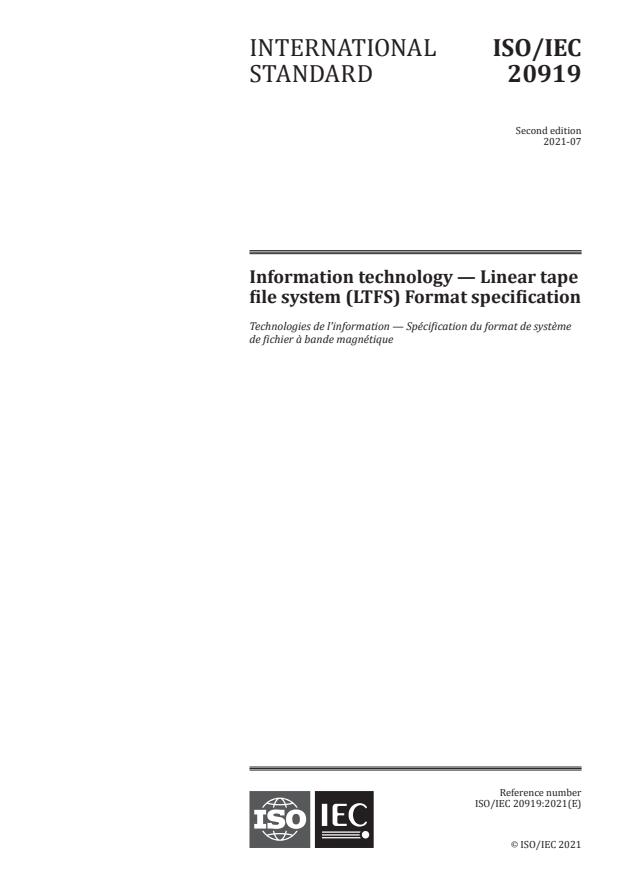
INTERNATIONAL ISO/IEC
STANDARD 20919
Second edition
2021-07
Information technology — Linear tape
file system (LTFS) Format specification
Technologies de l'information — Spécification du format de système
de fichier à bande magnétique
Reference number
©
ISO/IEC 2021
© ISO/IEC 2021
All rights reserved. Unless otherwise specified, or required in the context of its implementation, no part of this publication may
be reproduced or utilized otherwise in any form or by any means, electronic or mechanical, including photocopying, or posting
on the internet or an intranet, without prior written permission. Permission can be requested from either ISO at the address
below or ISO’s member body in the country of the requester.
ISO copyright office
CP 401 • Ch. de Blandonnet 8
CH-1214 Vernier, Geneva
Phone: +41 22 749 01 11
Email: copyright@iso.org
Website: www.iso.org
Published in Switzerland
ii © ISO/IEC 2021 – All rights reserved
Foreword
ISO (the International Organization for Standardization) and IEC (the International Electrotechnical
Commission) form the specialized system for worldwide standardization. National bodies that are
members of ISO or IEC participate in the development of International Standards through technical
committees established by the respective organization to deal with particular fields of technical activity.
ISO and IEC technical committees collaborate in fields of mutual interest. Other international
organizations, governmental and non-governmental, in liaison with ISO and IEC, also take part in the
work.
The procedures used to develop this document and those intended for its further maintenance are
described in the ISO/IEC Directives, Part 1. In particular, the different approval criteria needed for the
different types of document should be noted (see www.iso.org/directives or
www.iec.ch/members_experts/refdocs).
Attention is drawn to the possibility that some of the elements of this document may be the subject of
patent rights. ISO and IEC shall not be held responsible for identifying any or all such patent rights. Details
of any patent rights identified during the development of the document will be in the Introduction and/or
on the ISO list of patent declarations received (see www.iso.org/patents) or the IEC list of patent
declarations received (see patents.iec.ch).
Any trade name used in this document is information given for the convenience of users and does not
constitute an endorsement.
For an explanation of the voluntary nature of standards, the meaning of ISO specific terms and
expressions related to conformity assessment, as well as information about ISO's adherence to the World
Trade Organization (WTO) principles in the Technical Barriers to Trade (TBT), see
www.iso.org/iso/foreword.html. In the IEC, see www.iec.ch/understanding-standards.
This document was prepared by the Storage Networking Industry Association (SNIA) (as Linear Tape File
System (LTFS) Format Specification, Version 2.5) and drafted in accordance with its editorial rules. It was
adopted, under the JTC 1 PAS procedure, by Joint Technical Committee ISO/IEC JTC 1, Information
technology.
This second edition cancels and replaces the first edition (ISO/IEC 20919:2016), which has been
technically revised.
The main changes compared to the previous edition are as follows:
— Volume Advisory Locking — a method of marking a volume as locked against future modification;
— Percent Encoding — method of including previously reserved characters in names of files and
directories;
— Incremental Indexes — a method of recording a smaller index containing only changes since the last
index;
— File hashes — a method of recording fils hash information in the index in an interchangeable manner;
— Open For Write — a method of noting files in the index which were still open at the time the index is
written to tape.
Any feedback or questions on this document should be directed to the user’s national standards body. A
complete listing of these bodies can be found at www.iso.org/members.html and www.iec.ch/national-
committees.
© ISO/IEC 2021 – All rights reserved iii
USAGE
property of their respective owners.
The SNIA hereby grants permission for individuals to use this document for personal use only, and for
corporations and other business entities to use this document for internal use only (including internal
copying, distribution, and display) provided that:
1. Any text, diagram, chart, table or definition reproduced shall be reproduced in its entirety with
no alteration, and,
2. Any document, printed or electronic, in which material from this document (or any portion
hereof) is reproduced, shall acknowledge the SNIA copyright on that material, and shall credit
the SNIA for granting permission for its reuse.
Other than as explicitly provided above, you may not make any commercial use of this document or
any portion thereof, or distribute this document to third parties. All rights not explicitly granted are
expressly reserved to SNIA.
Permission to use this document for purposes other than those enumerated above may be requested
by e-mailing tcmd@snia.org. Please include the identity of the requesting individual and/or company
and a brief description of the purpose, nature, and scope of the requested use.
All code fragments, scripts, data tables, and sample code in this SNIA document are made available
under the following license:
BSD 3-Clause Software License
Copyright (c) 2020, The Storage Networking Industry Association.
Redistribution and use in source and binary forms, with or without modification, are
permitted provided that the following conditions are met:
* Redistributions of source code must retain the above copyright notice, this list of
conditions and the following disclaimer.
* Redistributions in binary form must reproduce the above copyright notice, this list of
conditions and the following disclaimer in the documentation and/or other materials
provided with the distribution.
* Neither the name of The Storage Networking Industry Association (SNIA) nor the names
of its contributors may be used to endorse or promote products derived from this software
without specific prior written permission.
THIS SOFTWARE IS PROVIDED BY THE COPYRIGHT HOLDERS AND
CONTRIBUTORS "AS IS" AND ANY EXPRESS OR IMPLIED WARRANTIES,
INCLUDING, BUT NOT LIMITED TO, THE IMPLIED WARRANTIES OF
MERCHANTABILITY AND FITNESS FOR A PARTICULAR PURPOSE ARE
DISCLAIMED. IN NO EVENT SHALL THE COPYRIGHT OWNER OR CONTRIBUTORS
BE LIABLE FOR ANY DIRECT, INDIRECT, INCIDENTAL, SPECIAL, EXEMPLARY, OR
CONSEQUENTIAL DAMAGES (INCLUDING, BUT NOT LIMITED TO, PROCUREMENT
OF SUBSTITUTE GOODS OR SERVICES; LOSS OF USE, DATA, OR PROFITS; OR
BUSINESS INTERRUPTION) HOWEVER CAUSED AND ON ANY THEORY OF
LIABILITY, WHETHER IN CONTRACT, STRICT LIABILITY, OR TORT (INCLUDING
NEGLIGENCE OR OTHERWISE) ARISING IN ANY WAY OUT OF THE USE OF THIS
SOFTWARE, EVEN IF ADVISED OF THE POSSIBILITY OF SUCH DAMAGE.
2 SNIA Standard LTFS Format Specification
Version 2.5.1
DISCLAIMER
The information contained in this publication is subject to change without notice. The SNIA makes no
warranty of any kind with regard to this specification, including, but not limited to, the implied
warranties of merchantability and fitness for a particular purpose. The SNIA shall not be liable for
errors contained herein or for incidental or consequential damages in connection with the furnishing,
performance, or use of this specification.
LTFS Format Specification SNIA Standard 3
Version 2.5.1
Revision History
Revision Date Sections Originator Comments
2.3.0 rev 1 3/18/14 Add section F.3 SNIA LTFS TWG Edits during TWG F2F
2.3.0 rev 2 12/15/14 Add Changes per SNIA LTFS TWG Edits adding Volume Advisory
TWG Locking, Volume UUID and LTFS
Name Encoding
2.3.0 rev 3 3/18/15 Add changes per SNIA LTFS TWG Edits Advisory Locking,
TWG Sha512,Media Pool Extended
Attributes &MAM
2.3.0 rev 4 3/24/15 Add edits from SNIA LTFS TWG Cleanup some reference errors
TWG review and minor editorial changes
2.3.0 rev 5 9/15/15 Add example 3 to SNIA LTFS TWG Added additional description
Appendix F.1.6 and example to describe
reclamation of spanned file
segments
2.3.0 rev 6 9/15/15 Add edits from SNIA LTFS TWG Revised wording in Appendix
TWG review F.1.6 example 3
2.4.0 rev 0 11/14/15 Add work from SNIA LTFS TWG Added changes listed in Change
TWG history
2.4.0 rev 1 1/12/17 Add edits from SNIA LTFS TWG Cleaned up some hyperlinks
TWG review and minor editorial changes
2.4.0 rev 2 1/17/17 Add edits from SNIA LTFS TWG Minor editorial changes
TWG F2F
2.4.0 rev3 6/12/17 Add edits from SNIA LTFS TWG Added Advisory Locking
TWG changes
2.4.0 rev 4 6/13/17 Add Media Pool SNIA LTFS TWG Added additional extended
changes per TWG attributes for Media Pool
2.4.0 rev 5 6/19/17 Add edits per SNIA LTFS TWG Cleaned up a couple of
TWG typographical errors
2.4.0 rev 6 10/10/17 Add edits per SNIA LTFS TWG Incorporated public review
TWG editorial comments
2.4.0 rev 7 10/18/17 Add edits per SNIA LTFS TWG Minor editorial changes
TWG
2.4.0 rev 8 10/24/17 Annex G SNIA LTFS TWG Minor editorial change
2.4.0 rev 9 11/14/17 Annex G SNIA LTFS TWG Minor editorial change
2.5.0 rev 0 12/04/18 Sections 5 & 9, SNIA LTFS TWG Add incremental indexes;
Annex B, etc. changes for sync behavior
2.5.0 rev 1 02/11/19 Add Annex H; SNIA LTFS TWG New Annex describing
edits per TWG incremental indexes
2.5.0 rev 2 04/02/19 Section 9.2; SNIA LTFS TWG Corrected typos in example
Annex H XML, updated flowchart in
Annex H to clarify intent
2.5.1 rev 0 08/18/20 Section 3; SNIA LTFS TWG Editorial changes to References
Annex I per feedback from ISO
Suggestion for changes or modifications to this document should be sent to the SNIA Linear Tape File
System Technical Work Group at http://www.snia.org/feedback/.
4 SNIA Standard LTFS Format Specification
Version 2.5.1
Changes between v1.0 and v2.0.0
• Incremented version number to 2.0.0 and updated date to March 11, 2011.
• Improvements in specification text to remove ambiguity and clarify intention of the specification.
These changes were made at several locations throughout the document.
• Improvements to clarify description of MAM parameters in Section 10 Medium Auxiliary Memory.
• Removed reference to a specific version of the Unicode standard in Section 7.5 Name pattern
format. This removes any requirement to use specific versions of Unicode support code in an
implementation.
• Improved description of Name pattern format to remove ambiguity in Section 7.5 Name pattern
format.
• Added description of LTFS Format specification version numbering in Section 2.1 Versions.
• Updated XML Schema for Label and Index to match version number format in Annex A and
Annex B.
• Added specification of minimum and recommended blocksize value for LTFS Volumes to Section
8.1.2 LTFS Label.
• Added definition of allowed version numbers to Section 8.1.2 LTFS Label and Section 9.2 Index.
• Added definition of fileoffset tag in Section 9.2 Index.
• Extended description in Section 6 Data Extents to support addition of fileoffset tag and associated
functionality.
• Added definition of highestfileuid tag in Section 9.2 Index.
• Added definition of fileuid tag in Section 9.2 Index.
• Added definition of backuptime tag in Section 9.2 Index.
• Incremented version number in Application Client Specific Information (ACSI) structure shown in
Section 10.3 Use of Volume Coherency Information for LTFS. This increment allows identification
of LTFS Volumes written with a LTFS v1.0 compliant implementation. A widely used v1.0
implementation wrote ambiguous ACSI values due to an implementation bug.
• Added definition of extended attributes in the ltfs.* namespace in Annex C.
• Added description for handling unknown XML tags in Index to Section 9.2.13 Managing LTFS
Indexes.
Changes between v2.0.0 and v2.0.1
• Incremented specification version number to 2.0.1.
• Updated specification date to August 17, 2011.
• Expanded historical record of changes between revisions of LTFS Format Specification.
• Improved description of constraints for two Indexes having the same generation number in
Section 5.4.1 Generation Number to make it clear that differences in access time values is
permitted between Indexes that are otherwise except for self pointer and index pointer values.
• Added note in Section 5.4.1 Generation Number to explicitly state that Index generation numbers
may increase by integer values other than 1.
• Expanded description of the ltfs.sync extended attribute in Annex C . The expanded description
explicitly states that this extended attribute triggers a sync of the in-memory data to the storage
media. That is, the operation is analogous to a POSIX sync operation.
LTFS Format Specification SNIA Standard 5
Version 2.5.1
Changes between v2.0.1 and v2.1.0
• Incremented specification version number to 2.1.0.
• Updated specification date to October 18, 2012.
• Added definition of symlink tag in Section 9.2 Index.
• Added example of symlink tag use in Annex E.
• Added symlink tag to Annex B.
• Added description of “ltfs.vendor.X.Y” extended attribute namespace in Annex C .
• Added description of software metadata section in Annex C.
• Added description of drive metadata section in Annex C.
• Added ”ltfs.labelVersion” extended attribute in Annex C.
• Added ”ltfs.indexVersion” extended attribute in Annex C
• Added ”ltfs.mediaEncrypted” extended attribute in Annex C .
• Improved description of ”ltfs.mediaStorageAlert” extended attribute in Annex C.
Changes between v2.1.0 and v2.2.0
• Incremented specification version number to 2.2.0.
• Updated specification date to July 16, 2013.
• Changed “2010” to “2013” in XML examples.
• Editorial Cleanup.
• Changed “extentinfo” definition in Section 9.2 Index.
• Changed “symlink” definition in Section 9.2 Index.
• Added additional paragraph to “symlink” definition in Section 9.2 Index.
• Added general comments at start of Section 10 Medium Auxiliary Memory.
• Added Section 10.4 Use of Host-type Attributes for LTFS.
• Removed Section 9 Certification from document.
• Added “ltfs.mamBarcode” extended attribute in Volume Metadata.
• Added “ltfs.mamApplicationVendor” extended attribute in Volume Metadata.
• Added “ltfs.mamApplicationVersion” extended attribute in Volume Metadata.
• Added “ltfs.mamApplicationFormatVersion” extended attribute in Volume Metadata.
• Added new Annex F Interoperability Recommendation and added File Spanning and File
Permissions subsections
Changes between v2.2.0 and 2.3.0 rev 1
• Add section F.3 Storing File Hash Values in LTFS
• Add Section 10.5 Volume Advisory Locking to Section 10 Medium Auxiliary Memory
• Added Volume UUID to Section 10.4 and Section 10.4.8
• Added LTFS Name Encoding to Sections 3.1, 7.4, 9.2.1 and 9.2.2
• Added SHA512 to Section F.3 Storing Hash Values in LTFS
• ISO document formatting changes
6 SNIA Standard LTFS Format Specification
Version 2.5.1
• Add Media Pool Extended Attributes and MAM
Changes between v2.3.0 rev 1 and v2.4.0
• Incremented specification version number to 2.4.0.
• Added new text to Section 10.5 Volume Advisory Locking
• Added new text to Annex C.4 VolumeMetadata, ltfs.volumeLockState
• Added new text for “openforwrite” to Section 9.2.9
• Added new entry to the file element list in Annex B
• Added new descriptive text to Annex E
• Added new example file “partialfile.bin” to Annex E
• Updated the compliance statement to “version 2.4.0” in Section 7.4 Name Format
• Added new percentencoding text to Section 7.4 Name Format
• Removed percentencoding definition from Section 9.2.7
• Removed percentencoding definition from Section 9.2.9
• Added new text to symlink definition in Section 9.2.9
• Removed percentencoding paragraph(s) from Section 9.2.10
• Removed the percentencoded entry from the directory, file and extended attributes sections in
Annex B
• Changed the name definition in the directory section of Annex B
• Changed the name definition in the file section of Annex B
• Changed the symlink definition in the file section of Annex B
• Changed the key definition in the extendedattributes section of Annex B
• Added new NameType definition to Annex B
• Changed the entry for fileuid “10” in Annex E
Changes between v2.4.0 and v2.4.0 rev 1
• Incremented specification version number to 2.4.0 rev 1.
• Changed version from 2.3.0 to 2.4.0 in Section 2.1 Versions
• Changed version from 2.3.0 to 2.4.0 in Annex E
• Cleaned up some hyperlinks and minor editorial changes
Changes between v2.4.0 rev 1 and v2.4.0 rev 2
• Changed version from 2.3.0 to 2.4.0 throughout document except for Section 9.2.19
• Changed updatetime in Annex E to reflect correct date/time value for example shown
• Changed highestfileuid in Annex E to reflect correct value for example shown
• Changed lockType to locktype throughout document
• Changed NameType to nametype throughout document
LTFS Format Specification SNIA Standard 7
Version 2.5.1
Changes between v2.4.0 rev 2 and v2.4.0 rev 3
• Updated the definition of the volumeLockState virtual extended attribute in Section 10.5 and
Annex C.4
Changes between v2.4.0 rev 3 and v2.4.0 rev 4
• Updated the definition of the Media Pool MAM attribute in Section 10.4 and Annex F.4.1.1
Changes between v2.4.0 rev 4 and v2.4.0 rev 5
• Fixed a couple of typographical errors
Changes between v2.4.0 rev 5 and v2.4.0 rev 6
• Corrections to Annex B – XML Schema
• Added Annex G – character representations
• Clarified in Section 7.4 that percent encoding does not apply to Table 13, and added reference to
Annex G
• Added two further IBM contributors to the Acknowledgements
Changes between v2.4.0 rev 6 and v2.4.0 rev 7
• Changed title and reference of table G.1 in Annex G – applies to 2.3 and later
• Added clarifying note for symlinks in Annex G
Changes between v2.4.0 rev 7 and v2.4.0 rev 8
• Changed column heading in tables G.1 and G.2 to “symlink target name”
• Improved wording of Note 3 in Annex G
Changes between v2.4.0 rev 8 and v2.4.0 rev 9
• Changed column heading in tables G.1 and G.2 to “File name, directory name, filename pattern”
• Added corresponding Note 4 in Annex G
Changes between v2.4.0 rev 9 and v2.5.0
• Incremented specification version number to 2.5.0.
• Added new text to describe Full and Incremental Indexes, in particular in 5.4 Index Layout and 9
Index Format.
• Added new virtual extended attributes related to Incremental Indexes in C.4.
• Specify required behavior in response to writing ltfs.commitMessage and ltfs.sync VEAs in
Annex C.
Changes between v2.5.0 rev 0 and v2.5.0 rev 1
• Added new informative Annex H describing background information on Incremental Indexes
• Editorial changes to clarify required vs optional elements in Incremental Indexes in 9 Index
Format.
• Clarified that the required behavior for ltfs.commitMessage and ltfs.sync applies only to
implementations supporting those VEAs.
8 SNIA Standard LTFS Format Specification
Version 2.5.1
Changes between v2.5.0 rev 1 and v2.5.0 rev 2
• Corrected typos in Incremental Indexes example XML in 9.2.2 and 9.2.12
• Corrected typos in Annex H and amended flowchart H.1 to clarify the intent
Changes between v2.5.0 rev 2 and v2.5.1 rev 0
• Moved informative references from Section 3 to new Annex I Bibliography
• Amended all references to SPC-3 / SPC-4 to SPC-5
LTFS Format Specification SNIA Standard 9
Version 2.5.1
Acknowledgements
The SNIA LTFS Technical Working Group, which developed and reviewed this specification, would
like to recognize the significant contributions made by the following members:
EMC Corporation. . Don Deel
Hewlett Packard Enterprise . Chris Martin
IBM. . David Pease
.................................................. ................ Ed Childers
.................................................. ................ Takeshi Ishimoto
.................................................. ................ Atsushi Abe
NetApp. . David Slik
Oracle Corporation. . Matthew Gaffney
................................................. ................. Carl Madison
Quantum Corporation. . Paul Stone
………………………………………………. Jim Wong
SNIA. . Arnold Jones
10 SNIA Standard LTFS Format Specification
Version 2.5.1
Contents
1 Introduction . 15
2 Scope . 16
2.1 Versions . 16
2.2 Conformance . 17
3 Normative references . 18
4 Definitions and Acronyms . 19
4.1 Definitions . 19
4.2 Acronyms . 21
5 Volume Layout . 22
5.1 LTFS Partitions . 22
5.2 LTFS Constructs . 22
5.3 Partition Layout . 23
5.4 Index Layout . 24
6 Data Extents . 27
6.1 Extent Lists . 27
6.2 Extents Illustrated . 27
6.3 Files Illustrated . 29
7 Data Formats . 32
7.1 Boolean format . 32
7.2 Creator format . 32
7.3 Extended attribute value format . 32
7.4 Name format . 32
7.5 Name pattern format . 34
7.6 String format . 34
7.7 Time stamp format . 34
7.8 UUID format . 35
8 Label Format . 36
8.1 Label Construct . 36
9 Index Format . 39
9.1 Index Construct . 39
9.2 Index . 39
LTFS Format Specification SNIA Standard 11
Version 2.5.1
10 Medium Auxiliary Memory . 53
10.1 Volume Change Reference . 53
10.2 Volume Coherency Information . 54
10.3 Use of Volume Coherency Information for LTFS . 5433
10.4 Use of Host-type Attributes for LTFS . 55
10.5 Volume Advisory Locking . 57
Annex A (normative) LTFS Label XML Schema . 59
Annex B (normative) LTFS Index XML Schemas . 61
B.1 LTFS Full Index XML Schema . 61
B.2 LTFS Incremental Index XML Schema . 63
Annex C (normative) Reserved Extended Attribute definitions . 66
C.1 Software Metadata . 66
C.2 Drive Metadata . 66
C.3 Object Metadata . 66
C.4 Volume Metadata . 67
C.5 Media Metadata . 69
Annex D (informative) Example of Valid Simple Complete LTFS Volume . 72
Annex E (informative) Complete Example LTFS Full Index . 73
Annex F (normative) Interoperability Recommendations . 78
F.1 Spanning Files across Multiple Tape Volumes in LTFS . 78
F.2 File Permissions in LTFS . 83
F.3 Storing File Hash Values in LTFS . 86
F.4 LTFS Media Pools . 87
Annex G (informative) Character representations . 89
Annex H (informative) Incremental Indexes . 92
H.1 Background . 92
H.2 Backwards Compatibility . 92
H.3 Traversing the Index Back Pointer Chain . 93
H.4 Incremental Index Format . 93
H.5 Processing Incremental Indexes . 95
H.6 Miscellaneous . 96
Annex I (informative) Bibliography . 98
12 SNIA Standard LTFS Format Specification
Version 2.5.1
List of Figures
Figure 1 — LTFS Partition . 22
Figure 2 — Label Construct . 22
Figure 3 — Index Construct . 23
Figure 4 — Partition Layout . 23
Figure 5 — Complete partition containing data . 24
Figure 6 — Back Pointer example . 25
Figure 7 — Back Pointer example for Incremental Indexes . 26
Figure 8 — Extent starting and ending with full block . 28
Figure 9 — Extent starting with full block and ending with fractional block . 28
Figure 10 — Extent starting and ending in mid-block . 28
Figure 11 — File contained in a single Data Extent . 29
Figure 12 — File contained in two Data Extents . 29
Figure 13 — Shared Blocks example . 30
Figure 14 — Sparse files example . 30
Figure 15 — Shared data example . 31
Figure 16 — Label construct . 36
Figure 17 — Index Construct . 39
Figure D.1 — Content of a simple LTFS volume . 72
Figure H.1 — Processing an Incremental Index (flowchart) . 97
LTFS Format Specification SNIA Standard 13
Version 2.5.1
List of Tables
Table 1 — Version elements . 16
Table 2 — Version comparisons . 16
Table 3 — Extent list entry starting and ending with full block . 28
Table 4 — Extent list entry starting with full block and ending with fractional
block . 28
Table 5 — Extent list entry starting and ending in mid-block . 28
Table 6 — Extent list entry for file contained in a single Data Extent . 29
Table 7 — Extent list entry for a file contained in two Data Extents . 29
Table 8 — Extent lists for Shared Blocks example . 30
Table 9 — Extent list for sparse files example . 31
Table 10 — Extent lists for shared data example . 31
Table 11 — Creator format definitions . 32
Table 12 — Reserved characters for name format . 33
Table 13 — Characters which should be avoided for name format . 33
Table 14 — Name percent-encoding . 33
Table 15 — Time stamp format . 35
Table 16 — VOL1 Label Construct . 36
Table 17 — Volume Coherency Information . 54
Table 18 — ACSI format for LTFS . 54
Table 19 — Relevant Host-type Attributes for LTFS . 55
Table 20 — Example of Host-type Attributes . 57
Table 21 — Volume Locked MAM Attribute . 58
Table 22 — Volume Locked MAM Attribute Values . 58
Table F.1 — Hash Types . 86
Table G.1 — Character representations : version 2.3 or later . 89
Table G.2 — Character representations : version 2.2 or earlier . 90
14 SNIA Standard LTFS Format Specification
Version 2.5.1
1 Introduction
This document defines a Linear Tape File System (LTFS) Format separate from any
implementation on data storage media. Using this format, data is stored in LTFS Volumes. An
LTFS Volume holds data files and corresponding metadata to completely describe the directory
and file structures stored on the volume.
The LTFS Format has these features:
• An LTFS Volume can be mounted and volume content accessed with full use of the data
without the need to access other information sources.
• Data can be passed between sites and applications using only the information written to
an LTFS Volume.
• Files can be written to, and read from, an LTFS Volume using standard POSIX file
operations.
The LTFS Format is particularly suited to these usages:
• Data export and import.
• Data interchange and exchange.
• Direct file and partial file recall from sequential access media.
• Archival storage of files using a simplified, self-contained or “self-describing” format on
sequential access media.
LTFS Format Specification SNIA Standard 15
Version 2.5.1
2 Scope
This document defines the LTFS Format requirements for interchanged media that claims LTFS
compliance. Those requirements are specified as the size and sequence of data blocks and file marks
on the media, the content and form of special data constructs (the LTFS Label and LTFS Index), and
the content of the partition labels and use of MAM parameters.
The data content (not the physical media) of the LTFS format shall be interchangeable among all data
storage systems claiming conformance to this format. Physical media interchange is dependent on
compatibility of physical media and the media access devices in use.
NOTE: This document does not contain instructions or tape command sequences to build the LTFS structure.
2.1 Versions
This document describes version 2.5.0 of the Linear Tape File System (LTFS) Format Specification.
The version number for the LTFS Format Specification consists of three integer elements separated
by period characters of the form M.N.R, where M, N and R are positive integers or zero. Differences
in the version number between different revisions of this specification indicate the nature of the
changes made between the two revisions. Each of the integers in the format specification are
incremented according to Table 1.
Table 1 — Version elements
Element Description
M Incremented when a major update has been made to the LTFS Format
Specification. Major updates are defined as any change to the on-media format or
specification semantics that are expected to break compatibility with older
versions of the specification.
N Incremented when a minor update has been made to the LTFS Format
Specification. Minor updates are defined as any change to the on-media format or
specification semantics that is not expected to break compatibility with older
versions of the specification that have the same value for M in the version
number.
R Incremented when textual revisions are made to the LTFS Format Specification.
Textual revisions are defined as revisions that improve the clarity of the
specification document without changing the intent of the document. By definition,
minor changes do not alter the on-media format or specification semantics.
NOTE 1: When any element of the specification version number is incremented, all sub-ordinate elements to the right are reset
to zero. For example, if the version is 1.0.12 and N is incremented to 1, then R is set to zero resulting in version 1.1.0.
NOTE 2: The first public version of this document used version number 1.0. This value should be interpreted as equivalent to
1.0.0 in the version numbering defined in this document.
The result of comparison between two LTFS version numbers M .N .R and M .N .R is defined in
A A A B B B
Table 2.
Table 2 — Version comparisons
Conditional Description
M < M M .N .R is an earlier version than M .N .R .
A B A A A B B B
M = M and M .N .R is an earlier version than M .N .R .
A B A A A B B B
M < N
A B
M = M M .N .R is an earlier version than M .N .R . However, as defined
A B and A A A B B B
N = N above, changes that result only in a different R value are descriptive
A B and
R < R changes in the specification rather than on media changes.
A B
16 SNIA Standard LTFS Format Specification
Version 2.5.1
2.2 Conformance
Recorded media claiming conformance to this format shall be in a consistent state when interchanged
or stored. See Section 4.1.4.
Any implementation conforming to this specification should be able to correctly read Label and Index
structures from all prior versions of this specification and write Label and Index structures conforming
to the descriptions in this document. The current Label and Index structures are defined in Section 8
Label Format and in Section 9 Index Format.
NOTE: Where practical, any implementation supporting a given version value for M should endeavor to support LTFS volumes
with version numbers containing higher values for N and R than those defined at the time of implementation.
LTFS Format Specification SNIA Standard 17
Version 2.5.1
3 Normative references
The following referenced documents are indispensable for the application of this document. For dated
references, only the edition cited applies. For undated references, the latest edition of the referenced
document (including any amendments) applies.
ISO/IEC 14776-455, Information Technology - Small Computer System Interface (SCSI) – Part 455:
SCSI Primary Commands - 5 (SPC-5) [ANSI INCITS.502-219]
SSC-4 SCSI Stream Commands – 4 (SSC-4) [ANSI INCITS 516-2013]
ISO 8601:2004 Data elements and interchange formats – Information interchange – Representation
of dates and times – (UTC)
ISO/IEC 10646:2012: Information technology - Universal Coded Character Set (UCS) (UTF-8)
IETF RFC 4648, The Base16, Base32, and Base64 Data Encodings, http://www.ietf.org/rfc/rfc4648.txt
IETF RFC 4122, Universally Unique Identifier (UUID) URN Namespace
http://www.ietf.org/rfc/rfc4122.txt
IETF RFC 3986, Uniform Resource Identifier (URI): Generic Syntax, http://www.ietf.org/rfc/rfc3986.txt
ANSI X3.27-1978 American National Standard Magnetic Tape Labels and File Structure for
Information
W3C - Extensible Markup Language (XML) http://www.w3.org/XML
OSF CDE 1.1, Remote Procedure Call – Universal Unique Identifier (UUID)
http://pubs.opengroup.org/onlinepubs/9629399/toc.pdf
18 SNIA Standard LTFS Format Specification
Version 2.5.1
4 Definitions and Acronyms
For the purposes of this document the following definitions and acronyms shall apply.
4.1 Definitions
4.1.1
Block Position
The position or location of a recorded block as specified by its LTFS Partition ID and logical block
number within that partition.
The block position of an Index is the position of the first logical block for the Index.
4.1.2
Complete Partition
An LTFS partition that consists of an LTFS Label Construct and a Content Area, where the last construct
in the Content Area is an Index Construct.
4.1.3
Content Area
A contiguous area in a partition, used to record Index Constructs and Data Extents.
4.1.4
Consistent State
A volume is consistent when both partitions are complete and the last Index Construct in the Index
Partition has a back pointer to the last Full Index Construct in the Data Partition.
4.1.5
Data Extent
A contiguous sequence of recorded blocks.
4.1.6
Data Partition
An LTFS partition primarily used for data files.
4.1.7
File
A group of logically related extents together with associated file metadata.
4.1.8
Filesystem sync
An operation during which all cached file data and metadata is flushed to the media.
4.1.9
Full Index
A data structure that describes all valid data files in an LTFS volume. The Full Index is an XML document
conforming to the XML schema shown in Annex B (normative) LTFS Index XML Schema.
4.1.10
Generation number
A positive decimal integer which shall indicate the specific generation of an Index within an LTFS
volume.
LTFS Format Specification SNIA Standard 19
Version 2.5.1
4.1.11
Incremental Index
A data structure that describes changes made to the LTFS volume since the last index was writ
...