

ISO 4931-1:2024
(Main)Buildings and civil engineering works — Principles, framework and guidance for resilience design — Part 1: Adaptation to climate change
General Information
- Abstract
The document provides principles, framework, and guidance for resilience design adaptive to climate change (RDACC) in buildings and civil engineering works. RDACC is applicable to both new construction and retrofits. RDACC does not address: — adaptation to climate change in the production and procurement of building materials, components and devices; — adaptation to climate change in construction processes; — climate change mitigation in buildings and civil engineering works; — emergency management related to climate change in buildings and civil engineering works.
- Status
- Published
- Publication Date
- 24-Sep-2024
- Technical Committee
- ISO/TC 59 - Buildings and civil engineering works
- Drafting Committee
- ISO/TC 59/WG 4 - Resilience of buildings and civil engineering works
- Current Stage
- 6060 - International Standard published
- Start Date
- 25-Sep-2024
- Due Date
- 16-Nov-2024
- Completion Date
- 25-Sep-2024

Overview
ISO 4931-1:2024 - Buildings and civil engineering works - Principles, framework and guidance for resilience design - Part 1: Adaptation to climate change - provides a standardized design approach for resilience design adaptive to climate change (RDACC). The standard sets out principles, a framework and practical guidance for adapting buildings and civil engineering works to changing climatic conditions over their service life. RDACC is applicable to both new construction and retrofit projects but explicitly excludes adaptation in material production/procurement, construction processes, climate-change mitigation measures, and emergency management.
Key topics and technical requirements
- Principles: change‑oriented perspective; preparing for uncertainty with certainty; synergy with mitigation and community/urban resilience; equity and sustainability considerations.
- Framework: a structured RDACC process to assess future climate impacts and design appropriate responses across an asset’s service life.
- Climatic Impact‑Drivers (CIDs): identification of physical climate conditions (means, events, extremes) that affect assets.
- Projected Climatic Design Parameters (PCDPs): use of climate projections to derive meteorological design parameters for buildings and infrastructure.
- Resilience limits and decision making:
- assessing the gap between existing and required resilience,
- developing adaptation strategies,
- identifying resilience limits (the CID magnitude beyond which no feasible strategy exists),
- making informed strategy decisions.
- Monitoring and optimization: ongoing performance monitoring to refine adaptation measures over time.
- Decommissioning: guidance on end-of-life planning for climate-impacted assets.
- Informative annexes: global guidelines, example PCDPs, case studies (e.g., Thames Estuary plan, Spaulding Hospital, Qinghai–Tibet Railway) and typical adaptation strategies.
Practical applications
ISO 4931-1:2024 is intended to be used as an engineering-level method to:
- inform climate‑resilient building and civil works design,
- guide retrofit decisions to extend service life under future climates,
- derive design parameters from climate projections for heat, flood, sea-level rise, permafrost thaw, etc.,
- integrate building-level adaptation with community and urban resilience planning,
- establish monitoring programs and decommissioning criteria tied to climate exposure.
Who should use this standard
- Asset owners and managers
- Design professionals (engineers, architects)
- Urban planners and authorities
- Investors and developers
- Standards developers and meteorologists
- Manufacturers, builders and contractors
Related standards and references
ISO 4931-1 references terminology and concepts consistent with standards such as ISO 14090:2019, ISO 15686-5:2017, and ISO 31073:2022, and aligns with IPCC guidance on climate projections. Use ISO 4931-1 to align resilience design and procurement decisions with recognized international best practice for adaptation to climate change.
Get Certified
Connect with accredited certification bodies for this standard

DIBt (Deutsches Institut für Bautechnik)
German Institute for Building Technology.
DIN CERTCO
DIN Group product certification.
Zavod za gradbeništvo Slovenije (ZAG) - Inšpekcija
ZAG inspection body for construction products, structures, and materials.
Sponsored listings
Frequently Asked Questions
ISO 4931-1:2024 is a standard published by the International Organization for Standardization (ISO). Its full title is "Buildings and civil engineering works — Principles, framework and guidance for resilience design — Part 1: Adaptation to climate change". This standard covers: The document provides principles, framework, and guidance for resilience design adaptive to climate change (RDACC) in buildings and civil engineering works. RDACC is applicable to both new construction and retrofits. RDACC does not address: — adaptation to climate change in the production and procurement of building materials, components and devices; — adaptation to climate change in construction processes; — climate change mitigation in buildings and civil engineering works; — emergency management related to climate change in buildings and civil engineering works.
The document provides principles, framework, and guidance for resilience design adaptive to climate change (RDACC) in buildings and civil engineering works. RDACC is applicable to both new construction and retrofits. RDACC does not address: — adaptation to climate change in the production and procurement of building materials, components and devices; — adaptation to climate change in construction processes; — climate change mitigation in buildings and civil engineering works; — emergency management related to climate change in buildings and civil engineering works.
ISO 4931-1:2024 is classified under the following ICS (International Classification for Standards) categories: 91.040.01 - Buildings in general; 93.010 - Civil engineering in general. The ICS classification helps identify the subject area and facilitates finding related standards.
ISO 4931-1:2024 is available in PDF format for immediate download after purchase. The document can be added to your cart and obtained through the secure checkout process. Digital delivery ensures instant access to the complete standard document.
Standards Content (Sample)
International
Standard
ISO 4931-1
First edition
Buildings and civil engineering
2024-09
works — Principles, framework and
guidance for resilience design —
Part 1:
Adaptation to climate change
Bâtiments et ouvrages de génie civil — Principes, cadre et
recommandations pour la conception de la résilience —
Partie 1: Adaptation au changement climatique
Reference number
© ISO 2024
All rights reserved. Unless otherwise specified, or required in the context of its implementation, no part of this publication may
be reproduced or utilized otherwise in any form or by any means, electronic or mechanical, including photocopying, or posting on
the internet or an intranet, without prior written permission. Permission can be requested from either ISO at the address below
or ISO’s member body in the country of the requester.
ISO copyright office
CP 401 • Ch. de Blandonnet 8
CH-1214 Vernier, Geneva
Phone: +41 22 749 01 11
Email: copyright@iso.org
Website: www.iso.org
Published in Switzerland
ii
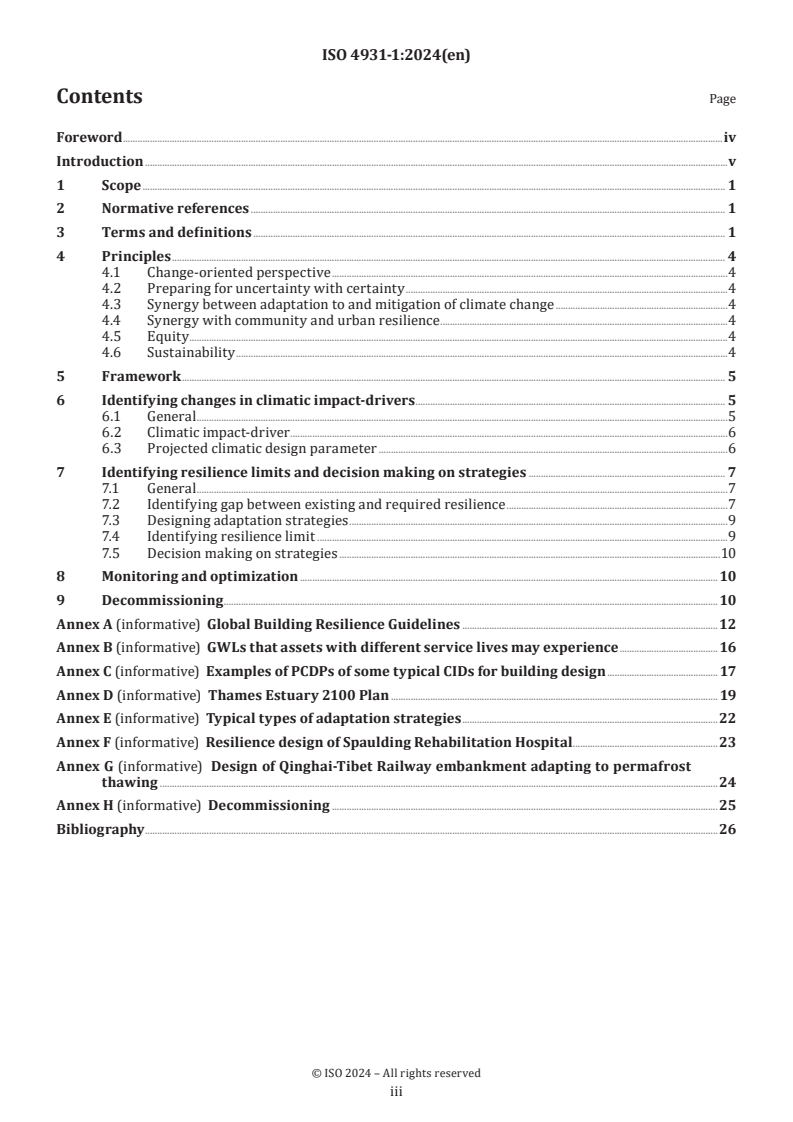
Contents Page
Foreword .iv
Introduction .v
1 Scope . 1
2 Normative references . 1
3 Terms and definitions . 1
4 Principles . 4
4.1 Change-oriented perspective .4
4.2 Preparing for uncertainty with certainty .4
4.3 Synergy between adaptation to and mitigation of climate change .4
4.4 Synergy with community and urban resilience .4
4.5 Equity .4
4.6 Sustainability .4
5 Framework . 5
6 Identifying changes in climatic impact-drivers . 5
6.1 General .5
6.2 Climatic impact-driver .6
6.3 Projected climatic design parameter .6
7 Identifying resilience limits and decision making on strategies . 7
7.1 General .7
7.2 Identifying gap between existing and required resilience .7
7.3 Designing adaptation strategies .9
7.4 Identifying resilience limit .9
7.5 Decision making on strategies .10
8 Monitoring and optimization .10
9 Decommissioning . 10
Annex A (informative) Global Building Resilience Guidelines .12
Annex B (informative) GWLs that assets with different service lives may experience .16
Annex C (informative) Examples of PCDPs of some typical CIDs for building design . 17
Annex D (informative) Thames Estuary 2100 Plan . 19
Annex E (informative) Typical types of adaptation strategies .22
Annex F (informative) Resilience design of Spaulding Rehabilitation Hospital .23
Annex G (informative) Design of Qinghai-Tibet Railway embankment adapting to permafrost
thawing .24
Annex H (informative) Decommissioning .25
Bibliography .26
iii
Foreword
ISO (the International Organization for Standardization) is a worldwide federation of national standards
bodies (ISO member bodies). The work of preparing International Standards is normally carried out through
ISO technical committees. Each member body interested in a subject for which a technical committee
has been established has the right to be represented on that committee. International organizations,
governmental and non-governmental, in liaison with ISO, also take part in the work. ISO collaborates closely
with the International Electrotechnical Commission (IEC) on all matters of electrotechnical standardization.
The procedures used to develop this document and those intended for its further maintenance are described
in the ISO/IEC Directives, Part 1. In particular, the different approval criteria needed for the different types
of ISO document should be noted. This document was drafted in accordance with the editorial rules of the
ISO/IEC Directives, Part 2 (see www.iso.org/directives).
ISO draws attention to the possibility that the implementation of this document may involve the use of (a)
patent(s). ISO takes no position concerning the evidence, validity or applicability of any claimed patent
rights in respect thereof. As of the date of publication of this document, ISO had not received notice of (a)
patent(s) which may be required to implement this document. However, implementers are cautioned that
this may not represent the latest information, which may be obtained from the patent database available at
www.iso.org/patents. ISO shall not be held responsible for identifying any or all such patent rights.
Any trade name used in this document is information given for the convenience of users and does not
constitute an endorsement.
For an explanation of the voluntary nature of standards, the meaning of ISO specific terms and expressions
related to conformity assessment, as well as information about ISO's adherence to the World Trade
Organization (WTO) principles in the Technical Barriers to Trade (TBT), see www.iso.org/iso/foreword.html.
This document was prepared by Technical Committee ISO/TC 59, Buildings and civil engineering works.
Any feedback or questions on this document should be directed to the user’s national standards body. A
complete listing of these bodies can be found at www.iso.org/members.html.
iv
Introduction
Adaptation to climate change has become an urgent need globally. According to the United Nations
Environment Programme (UNEP)'s Adaptation Gap Report 2022, "we must also urgently increase efforts to
adapt to the impacts of climate change that are already here and to those that are to come".
In the context of global climate change, buildings and civil engineering works with service lives of decades
or even centuries will face new climate challenges. These challenges include the increase of frequency and
intensity in extreme weather events such as heatwaves, wildfires and floods, as well as chronic changes such
as sea level rise. This can result in increase of vulnerability in built assets designed based on the climate
of the past decades, risking human health and well-being, and causing economic loss and social impacts.
Therefore, adaptation to climate change in buildings and civil engineering works should be considered in a
timely manner.
This document provides a design approach called the resilience design adaptive to climate change (RDACC),
which offers specific guidance on how to produce buildings and civil engineering works with climate change
resilience. It is a method for adaptation to climate change at the engineering level.
The typical actions of RDACC include:
— identifying changes in climatic impact-drivers;
— identifying resilience limits and decision making on strategies;
— monitoring and optimization;
— decommissioning.
This document is useful to stakeholders including asset owners and users, investors, authorities, standards
developers, meteorologists, engineers, architects, manufacturers, builders, and other parties involved in
the RDACC.
v
International Standard ISO 4931-1:2024(en)
Buildings and civil engineering works — Principles,
framework and guidance for resilience design —
Part 1:
Adaptation to climate change
1 Scope
The document provides principles, framework, and guidance for resilience design adaptive to climate
change (RDACC) in buildings and civil engineering works. RDACC is applicable to both new construction and
retrofits.
RDACC does not address:
— adaptation to climate change in the production and procurement of building materials, components and
devices;
— adaptation to climate change in construction processes;
— climate change mitigation in buildings and civil engineering works;
— emergency management related to climate change in buildings and civil engineering works.
2 Normative references
There are no normative references in this document.
3 Terms and definitions
For the purposes of this document, the following terms and definitions apply.
ISO and IEC maintain terminology databases for use in standardization at the following addresses:
— ISO Online browsing platform: available at https:// www .iso .org/ obp
— IEC Electropedia: available at https:// www .electropedia .org/
3.1
adaptation to climate change
climate change adaptation
process of adjustment to actual or expected climate (3.3) and its effects
Note 1 to entry: In human systems, adaptation seeks to moderate or avoid harm or exploit beneficial opportunities.
Note 2 to entry: In some natural systems, human intervention can facilitate adjustment to expected climate and its
effects.
[SOURCE: ISO 14090:2019, 3.1]
3.2
asset
whole building or structure or unit of construction works, or a system or a component or part thereof
[SOURCE: ISO 15686-5:2017, 3.4.1]
3.3
climate
statistical description of the weather in terms of the mean and variability of relevant quantities over a period
of time ranging from months to thousands or millions of years
[SOURCE: ISO 14050:2020, 3.8.1]
3.4
climate change
change in climate (3.3) that persists for an extended period, typically decades or longer
[SOURCE: ISO 14050:2020, 3.8.3]
3.5
climate change mitigation
human intervention to reduce greenhouse gas emissions or enhance greenhouse gas removals
[SOURCE: ISO 14050:2020, 3.8.6]
3.6
climate projection
simulated response of the climate (3.3) system to a scenario of future emissions or concentrations of
greenhouse gases (GHGs) and aerosols and changes in land use, generally derived using climate models
[SOURCE: IPCC, 2022]
3.7
climatic impact-driver
CID
physical climate (3.3) system condition (e.g. means, events, extremes) that affects an element of society or
ecosystems
[SOURCE: IPCC, 2022, modified]
3.8
constraint
factor that makes it harder to plan and implement adaptation actions
[SOURCE: IPCC, 2014, modified]
3.9
existing resilience
resilience (3.17) that an asset (3.2) currently designed can achieve in face of the CID (3.7) changing to a
certain magnitude
3.10
global climate model
GCM
complex mathematical representation of the major climate (3.3) system components (atmosphere, land
surface, ocean, and sea ice) and their interactions
[SOURCE: GFDL]
3.11
global warming level
global climate-change emissions relative to pre-industrial levels, expressed as global surface air temperature
[SOURCE: IPCC, 2022]
3.12
impact
result of a change or existing condition that may be adverse, neutral or beneficial
[SOURCE: ISO 15392:2019, 3.17]
3.13
maladaptation
actions that may lead to increased risk of adverse climate-related outcomes, including via increased
greenhouse gas (GHG) emissions, increased or shifted vulnerability to climate change (3.4), more inequitable
outcomes, or diminished welfare, now or in the future
[SOURCE: IPCC, 2022]
3.14
projected climatic design parameter
PCDP
meteorological parameter for buildings and civil engineering design base on climate projections (3.6)
3.15
Representative Concentration Pathway
RCP
scenarios that include time series of emissions and concentrations of the full suite of greenhouse gases
(GHGs) and aerosols and chemically active gases, as well as land use/land cover
[SOURCE: IPCC, 2022]
3.16
required resilience
resilience (3.17) that an asset (3.2) is desired to have in face of a CID (3.7)
3.17
resilience
adaptive capacity in a complex and changing environment
[SOURCE: ISO 31073:2022, 3.3.39, modified — "of an organization" has been removed.]
3.18
resilience design adaptive to climate change
RDACC
design approach to produce an asset (3.2) with resilience (3.17) to adapt to changing climatic conditions due
to climate change (3.4) throughout its service life (3.20)
3.19
resilience limit
maximum magnitude of the CID (3.7) that the asset can adapt to, beyond which there is no feasible strategy
3.20
service life
period of time after installation during which a facility or its component parts meet or exceed the
performance requirements
[SOURCE: ISO 15686-1:2011, 3.25]
3.21
Shared Socioeconomic Pathway
SSP
different levels of emissions and climate change (3.4) along the dimension of the RCPs (3.15) explored against
the backdrop of different socio-economic development pathways on the other dimension in a matrix
[SOURCE: IPCC, 2022, modified — "can hence be" has been removed.]
4 Principles
4.1 Change-oriented perspective
In the context of global climate change, buildings and civil engineering works can face different climatic
conditions which are beyond initial anticipations during their service lives. Extreme weather events such
as heatwaves and floods are projected to occur more frequently and intensely in some areas, while slow-
onset changes such as sea level rise and permafrost thawing will gradually emerge in some areas over time.
To address these changes, RDACC should adopt a change-oriented perspective for asset to adapt to future
environment.
NOTE See Annex A for Global Building Resilience Guidelines capturing principles for incorporating future focused
climate risk into building codes and standards.
4.2 Preparing for uncertainty with certainty
Although there are some uncertainties in climate projections, this should not be an excuse for inaction.
RDACC should take innovative measures to mitigate the impacts of uncertainties.
4.3 Synergy between adaptation to and mitigation of climate change
RDACC should take into account the synergistic effects of adaptation and mitigation of climate change.
Actions which can achieve both adaptation and mitigation should be prioritized; and maladaptation should
be avoided.
EXAMPLE Better thermal performance of buildings can reduce energy consumption and provide protection from
heatwaves in summer.
4.4 Synergy with community and urban resilience
RDACC should work within the framework of community and urban resilience, serving as the fundamental
resilience element.
NOTE Improving the drainage capacity of individual buildings is part of a comprehensive approach to dealing
with urban waterlogging and stormwater discharge. It demands coordination at community and city levels over, for
example, rainwater storage of a building which serves as a cushion for community discharge systems.
4.5 Equity
RDACC should take into account the needs of assets users of all ages, gender, financial means, ethnicities,
[1]
education, and physical abilities to ensure equitable reduction of risk and vulnerability .
4.6 Sustainability
RDACC should be carried out within the framework of sustainable development. Climate, economic, social
and environmental factors should be considered when adopting an adaptation strategy.
5 Framework
RDACC involves a series of actions integrated into the asset’s lifecycle, including design, operation, and
decommissioning phases (see Figure 1):
— In design phase, identify how the climatic conditions at the asset’s location may change during its service
life (see Clause 6). Next, identify the resilience limit and determine appropriate adaptation strategies
(see Clause 7).
These actions can be applied to a specific project with the following guidelines.
— When no projected climatic design parameter (PCDP) sets are available to quantify magnitude of
changes in CIDs at the asset’s location, RDACC should start from identifying changes in CIDs (see
Clause 6).
— When the PCDP sets are available, but no resilience limits are specified in current standards,
specification, etc., RDACC should start from identifying resilience limits (see 7.1 to 7.4).
— When both PCDP sets and resilience limits are available, RDACC can directly start from adaptation
strategies design (see 7.3) and decision making (see 7.5).
— During operation phase, monitor the changes in CIDs and effectiveness of implemented strategies and
embrace the latest climate knowledge and technological advancements to optimize strategies (see
Clause 8).
— Decommissioning is required when assets are no longer fit for purpose, and further adaptation is not a
viable option (see Clause 9).
Figure 1 — Framework of RDACC in an asset’s life cycle
Given the complex and multidisciplinary nature of RDACC, a professional team comprised of architects,
engineers, meteorologists, hydrologists, economists, etc. may be required to work with the asset owners.
6 Identifying changes in climatic impact-drivers
6.1 General
Global climate change results in changes in intensity and frequency of climatic impact-drivers (CIDs) (see
6.2), which can affect the built assets designed based on current climatic design parameters.
The CIDs that are projected to change during assets’ service lives and the magnitudes of these changes
should be identified. The magnitudes of changes should be quantified as PCDPs (see 6.3) that can be directly
applied to buildings and civil engineering design.
NOTE For a given asset, the changes can involve CIDs already considered in current design, as well as CIDs that
have not been perceived as risks. For example, a new building over its 60 year design life can face increasing storms,
high wind events and heatwaves, as well as sea level rise that previously did not pose a threat.
6.2 Climatic impact-driver
Most of the CIDs can have potential impacts on buildings and civil engineering works. Table 1 gives a non-
[3]
exhaustive list of abrupt and slow-onset CIDs .
Table 1 — CIDs that can have potential impacts on buildings and civil engineering works
abrupt slow-onset
heat and cold extreme heat, cold spell, frost, wildfires —
river flood, heavy precipitation and pluvial
wet and dry flood, groundwater impacts, landslide, —
drought, fire weather
severe windstorm, tropical cyclone, sand and
wind erosion
dust storm, wildfires
lake, river and sea ice, heavy snowfall and ice
snow and ice annual snowpack, permafrost level
storm, hail, snow avalanche
coastal coastal flood, coastal erosion relative sea level
open ocean — ocean acidity, ocean salinity
other air pollution weather UV emissions
[10]
NOTE: Most of the names of CIDs are derived from IPCC AR6 .
Cascading CIDs should also be taken into account, as CIDs may occur simultaneously or in succession, thus
amplifying or altering the impact on assets.
6.3 Projected climatic design parameter
The magnitude of changes in CIDs varies under different global warming levels (GWLs). PCDPs for different
magnitudes of each CID that assets can experience during their service lives should be obtained.
NOTE 1 GWLs represent the climate change outcomes at different future time points under different input
projections of Shared Socioeconomic Pathways (SSPs) (e.g. SSP1-1.9, SSP1-2.6, SSP2-4.5, SSP3-7.0, SSP5-8.5) or
Representative Concentration Pathways (RCPs) (e.g. RCP2.6, RCP4.5, RCP6.0, RCP8.5).
NOTE 2 A study shows that historical reference 1 % annual chance flood will occur more frequently in China, thus
becoming 71- (interquartile range, IQR: 58–81), 50- (39–60), and 42-year (32–47) events (medians of GCM results)
[12]
under 1,5 °C, 3,0 °C, and 4,0 °C GWLs respectively .
NOTE 3 Table B.1 in Annex B provides the GWLs that assets with different service lives would experience based on
the findings of IPCC AR6.
NOTE 4 Table C.1 in Annex C shows examples of PCDPs of some typical CIDs for building design.
NOTE 5 Canada launched a five-year initiative from 2016 to 2021, called Climate-Resilient Buildings and Core Public
Infrastructure Initiative, which develops projections of temperature, precipitation, wind, etc. for various locations in
Canada under different GWLs such as 1 °C, 2 °C, 3 °C, serving as a basis for updating building and infrastructure codes
[13]
and standards .
PCDPs are calculated using climate projections from global climate models (GCMs). Consult with
meteorologists if PCDPs are not available for the asset’s location. Utilizing multiple GCMs can also help offset
some of the uncertainties in climate projection.
NOTE 6 NYC Climate Resiliency Design Guidelines provides low estimate (10th percentile), middle range (25th to
75th percentile) and high estimate (90th percentile) for temperature and precipitation for 2020s, 2050s, 2080s and
[14]
2100 based on 35 GCMs and 2 RCPs .
The projected data source and calculation process of PCDPs should be documented to facilitate comparison
during monitoring and optimization (see Clause 8) and identifying opportunities to improve data availability
and usage.
7 Identifying resilience limits and decision making on strategies
7.1 General
The steps to identify the resilience limit for a CID are as follows:
— list different magnitudes of PCDPs of the CID that the asset can experience during its service life (see 6.3);
— identify the gaps between existing resilience and required resilience of the asset in face of different
magnitudes of the CID (see 7.2);
— design adaptation strategies that can bridge the gaps (see 7.3);
— identify the resilience limit (see 7.4).
When an asset is affected by multiple CIDs, the resilience limits for all CIDs should be coordinated by
considering technical conflicts, cost, and other factors among strategies.
The appropriate strategies for each CID should be determined within the feasible strategies that can achieve
the resilience limit (see 7.5).
The process of identifying resilience limits and decision making should be documented.
NOTE PIARC International Climate Change Adaptation Framework (2023) – Climate Change and Resilience of
Road Networks mentions the Adaptation Framework that can help organizations identify adaptation principles and
[15]
increase the climate resilience of transportation assets, operations and services .
7.2 Identifying gap between existing and required resilience
Required resilience should be described quantitively. The quantification for abrupt and slow-onset CID(s)
(see 6.2) differs.
— For abrupt CID(s)
The required resilience should be quantified in terms of desired functional recovery level, tolerable recovery
time and financial losses caused by direct and indirect impacts, occupant safety and other indicators after
the shock of CID(s).
NOTE 1 In face of a flood, an office building is desired to recover its partial functions in one month within acceptable
financial losses of 1 million dollars.
NOTE 2 Converting to a backup emergency shelter in face of abrupt CIDs is also a form of functional recovery for
assets. For example, according to urban emergency planning, a gymnasium needs to be temporarily converted into
emergency shelter, accommodating up to 5 000 people during extreme weather events. Fire evacuation systems, water
system, HVAC and other systems are expected to adapt to potential modifications for emergency.
NOTE 3 Direct impacts include physical damage and functional impacts, casualties, contents loss, etc., while
indirect impacts include loss in revenue and rent, etc. during recovery period. The impacts caused by urban water and
power outages during extreme weather events also must be considered.
— For slow-onset CID(s)
The required resilience should be quantified in terms of desired functional maintenance level, tolerable
maintenance cost, occupant safety and other indicators during the stress of CID(s).
Facing the same CID, required resilience may vary for different functional assets and different functional
parts of an asset.
NOTE 4 In case of a flood, functional areas of a hospital such as outpatient, emergency, medical technology, and
inpatient department must maintain normal and uninterrupted medical services, while a library can be temporarily
closed for a month without significant impact.
NOTE 5 When a wildfire/bushfire approaches a municipal office building, key activities within the building such as
the emergency operations centre must remain operational continually, while other governmental functions like motor
vehicle registrations can be shifted offline during the event and in the short period of time thereafter.
When the intensity of the CID increases, there can be a gap between the required resilience and existing
resilience. The gap should be quantified as the design goal of adaptation strategies (see 7.3). The gaps under
different magnitudes of the CID can vary. Figure 2 illustrates these gaps in face of abrupt CID(s) and slow-
onset CID(s) respectively.
a) In face of abrupt CID(s)
b) In face of slow-onset CID(s)
Key
required resilience
existing resilience
gap
1 shock from CID at current 5 stress from CID at current
2 shock from CID under a°C GWL 6 stress from CID under a°C GWL
3 shock from CID under b°C GWL 7 stress from CID under b°C GWL
4 shock from CID under c°C GWL 8 stress from CID under c°C GWL
NOTE Using GWLs in this figure is for reference only. They represent different magnitudes of CIDs.
Figure 2 — Illustration of gaps between existing resilience and required resilience in face of
different magnitudes of CIDs
7.3 Designing adaptation strategies
The adaptation strategies should be designed to bridge the gaps between required and existing resilience
(see 7.2). They can be either one-stop strategies implemented at the birth of the asset when the part(s)
involved are difficult or impossible to be modified or replaced after construction, or phased adaptation
strategies implemented at multiple points during the asset’s service life when some parts involved can be
modified or replaced over time to avoid unnecessary waste or missing opportunities to take advantage of
technological advancements. Alternatively, a hybrid approach can be used, applying some strategies initially
and other additional strategies when new data, risks, or technologies are identified.
Strategies may include safe-to-fail approaches based on the outcomes of risk assessments and the need to
[16]
prioritize available resources .
Alternative strategies for the failure of adaptation strategies should also be considered.
NOTE 1 To effectively mitigate the impact of summer warming, building shapes that facilitate natural ventilation
and reducing indoor temperature are prioritized and considered in one step, because the building shapes are difficult
to modify once they are built.
NOTE 2 Annex D describes a case of phased adaptation.
NOTE 3 Annex E lists some typical types of adaptation strategies.
NOTE 4 Annex F features a case study of the Spaulding Rehabilitation Hospital, showcasing a range of adaptation
strategies in use.
NOTE 5 Safe-to-fail approach recognizes that there are not enough resources to fix or prevent damage to most
infrastructure. Some infrastructure where the consequence of failure is small can be sacrificed based on a risk
assessment of the infrastructure system.
7.4 Identifying resilience limit
Resilience limit should be identified through feasibility assessment of adaptation strategies, taking into
account technical, cost, and other constraints.
— Technical constraint
Technical constraint refers to the limits imposed by the current level of technology.
NOTE 1 As technology advances and new innovations emerge, these constraints can be further expanded, providing
opportunities and possibilities for future adaptation.
— Cost constraint
Cost constraints occur when cost-benefit assessment of adaptation strategy(s) yields unacceptable results
or/and initial capital investments exceed available funding. “Cost” refers to incremental cost of strategy (s).
“Benefit” refers to the prevented losses by closing the gap between existing and required resilience (see 7.2)
throughout the asset's service life.
For one-stop strategies, costs include initial and ongoing operation and maintenance cost. For phased
adaptation strategies, costs are cumulative with each adaptation.
NOTE 2 The RDACC process can benefit from the conduct of two cost-benefit analysis – one from the perspective
of the asset owner capturing costs and benefits that fall directly to the owner (including costs of decommissioning)
and a second that also includes costs and benefits to the broader community. The second cost-benefit analysis can help
identify or secure additional funding from the community or others who will also derive value from the adaptation
investment.
— Other constraint
Cultural, social, environmental, and other factors can also be limiting.
NOTE 3 An electrical substation on a barrier island can be subject to sea level rise. For a moderate level of sea
level rise, it can be cost-effective to elevate equipment. However, if sea level rises beyond an identified threshold,
either the substation can no longer be accessible by utility equipment because surrounding land is under water or the
barrier island’s access bridge can be impassable. The barrier island can also see a decrease in residents as the island is
inundated, making continued investment in the substation unnecessary.
7.5 Decision making on strategies
Asset owners, with feedback from the RDACC team, users and other stakeholders, should determine the
appropriate strategy(s) from the feasible strategies that can achieve the resilience limits (see 7.4). Technical
reliability, cost-benefit, localized solutions, and environmental friendliness, etc. should be considered. The
coordination with other design goals such as seismic resilience is also needed.
NOTE In the design of a new hospital in Gansu, China, it is projected that the rainfall in the second half of this
century can increase, exceeding current design standard. This can result in the entrance steps and basement being
flooded. To reduce the risk, three alternative strategies were proposed: A. raising the elevation of entrances and roads,
B. improving the drainage capacity of the pipe network and C. placing critical equipment rooms and medical facilities
on upper floors. In terms of losses, these strategies all have high cost-effectiveness, with incremental costs amounting
to 1,2 million RMB, 350 000 RMB, and 660 000 RMB, compared to total losses of 35 000 000 RMB, respectively. After
comprehensive consideration, strategy A with highest costs but highest technical reliability was ultimately selected.
8 Monitoring and optimization
During the operation phase, long-term monitoring and optimization should be implemented, including but
not limited to:
— monitoring the changes in CIDs experienced by assets and the effectiveness of implemented adaptation
strategies, summarizing experiences and lessons learned;
— establishing a cadence for reassessing resilience limits based on the latest climate change knowledge
from IPCC and regional/local assessments;
— embracing new technologies and innovations and utilizing the knowledge and insights gained from the
experience to optimize adaptation.
NOTE Annex G introduces the design of China Qinghai-Tibet Railway embankment adapting to permafrost
thawing, including monitoring during its operation phase.
9 Decommissioning
When assets are no longer fit for purpose and further adaptation is not a viable option, decommissioning is
required. See Annex H.
The appropriate organizational models for decommissioning should be determined, including direct
decommissioning (using in-house expertise to plan and manage the entire process), contract decommissioning
(hiring experts to do the work), and asset sale (eliminating the need to address decommissioning), etc.
During the execution of decommissioning, asset removal and environmental restoration should be achieved,
considering the capital and social costs.
NOTE Decommissioning via in-house experts requires management of the entire life cycle and restoration
requirements. Few organizations have such expertise fully in-house, therefore requiring some contract support.
Decommissioning via contract support outsources the entire process, but requires the internal teams to understand
and orchestrate the program. Selling assets is simplest, but as growing understanding of climate change implications
strand assets with rapid devaluations, it can be increasingly difficult to sell assets.
Annex A
(informative)
Global Building Resilience Guidelines
A.1 General
NOTE The content in this annex is an excerpt from the Global Building Resilience Guidelines developed by the
Global Resiliency Dialogue, a collaborative of building code development and research organizations from Canada,
Australia, New Zealand and the USA, which worked collectively to engage with local interests and participate in
[17]
coordinated surveys to source a body of information as input to the work.
Buildings being constructed today face in their service life the prospect of experiencing different and
potentially more extreme weather than in the past, and possibly in geographic regions where such natural
phenomena have not occurred before or with such intensity.
Whilst contemporary building codes typically contain provisions and reference technical standards for
design and construction to take account of most weather-related natural hazards, these are primarily based
on data and experience from past events, whereas in a non-stationary climate the problem relates to future
conditions, which can be characterized based on scientific analysis of current trends and predicted events
using sophisticated scenario modelling.
The problem extends further to incorporate going beyond the recognized primary purpose of building codes,
being public health and safety, to enabling buildings to continue to perform primary functions of shelter and
re-occupation, even if rudimentary.
The Global Building Resilience Guidelines are organized around fifteen principles that provide a basis for
advancing building resilience through building codes. They are intended to help inform the development of
building codes and standards that incorporate future-focused climate resilience. The Guidelines are relevant
for all building code and standards writing bodies, who determine how best to apply them having regard to
their own jurisdictional circumstances.
It is important to note that where codes and standards are applied, they cannot guarantee a hazard event
will not result in the loss of life or injury, nor that building performance will be maintained through its
design life, but rather they can mitigate the overall impact of such event occurrences.
The principles are not weighted, but there is an intentional order as inevitably there are inherent
interdependencies.
A.2 Urgency
"Principle: The need to respond to the associated impacts of climate change and extreme weather events on
buildings and building occupants is more urgent than ever."
Communities around the globe are already experiencing the impacts of climate change. As buildings are the
foundation of social and economic function throughout society, and as rapid urbanization continues, there
is an urgent need to address the vulnerabilities of communities and the risks to the services provided by the
built environment from natural hazard events linked to climate change.
A.3 Clarity of objectives
"Principle: Recognizing that building resilience requires attention to the changing climatic conditions
buildings will face over their lifecycle and their expected operation post an event, the importance of building
codes focusing on occupant health and safety remains."
Occupant health and safety needs to remain the primary purpose of building code provisions. However, as
per the Guidelines’ definition for building resilience, enabling a level of building robustness beyond occupant
health and safety is considered appropriate within the bounds of the minimum necessary, having regard
to the climate-related natural hazard events that may reasonably be expected. This can help communities
to quickly resume their daily activities, economies to recover and help make the cost of recovery more
manageable.
A.4 Robust climate science
"Principle: Building code development will benefit from an evidence base that utilizes official climate
forecasts in the local jurisdiction or models based on peer-reviewed scientific research and ideally provide a
demonstration of various future state possibilities."
For buildings being constructed or substantially renovated from this point in time to provide an appropriate
level of building resilience, it is necessary for contemporary building codes and standards to be developed or
revised having regard to future climate projections and scenarios from scientific sources. In doing so, there
will need to be a transition from historic to predicted climate data to address future risk. This transition
must take account of frequency, severity and probable changes to geographic distribution, including routine
reviews to maintain fitness for purpose with the latest climate science.
A.5 Risk clarity
"Principle: Risk informed thinking and decision making is important in providing support for design
decisions to balance cost, energy performance, greenhouse gas emissions and resilience, where changing
risks can be balanced against certainty of performance for building development and maintenance."
Risk informs the minimum level of performance considered desirable. In turn, this becomes the goal
for buildings to achieve, be it through prescribed standards or unique performance solutions that can
demonstrate compliance.
A.6 Forward-looking
"Principle: A baseline assessment of current technical construction standards, where they exist enables a
comparison to be made with modelling and scenarios for future climate to help determine if they remain
adequate or new ones need to be developed."
On the basis that contemporary codes typically incorporate provisions for construction in areas prone to
natural hazards events, including those influenced by climate, as a matter of good regulatory practice, it
is important to determine if existing requirements are adequate for future risks. Establishing a baseline
assessment of current standards, where they exist, enables a comparison to be made with modelling and
scenarios for future climate to help determine if they remain adequate or new ones need to be developed.
A.7 Durability
"Principle: Understanding building design life is important not only to assist in determining minimum
necessary technical construction standards, but to also calibra
...