

ISO 11154:2023
(Main)Road vehicles — Roof load carriers
General Information
- Abstract
This document applies for roof racks of passenger cars and light commercial vehicles up to a permissible total weight of 3,5 t according to ISO 1176 and specifies requirements and test methods for these. It is also valid for roof racks mounted on trailers. So-called magnetic or suction foot racks, i.e. roof racks whose attachment on the vehicle is only via magnetic forces or vacuum, are excluded from this document. This document provides safety-related requirements under consideration of the weight, centre of gravity, air resistance and other safety-relevant properties for structures of roof racks for which no other technical or statutory regulations otherwise apply and which are not listed in 4.2. In individual cases, test requirements can extend beyond these requirements.
- Status
- Published
- Publication Date
- 01-Mar-2023
- Current Stage
- 6060 - International Standard published
- Start Date
- 02-Mar-2023
- Due Date
- 29-Mar-2022
- Completion Date
- 02-Mar-2023


Overview
ISO 11154:2023 - Road vehicles - Roof load carriers sets safety requirements and test methods for roof racks and roof load carriers used on passenger cars and light commercial vehicles (up to a permissible total weight of 3.5 t per ISO 1176). The standard also applies to roof racks mounted on trailers. It excludes magnetic or suction-foot racks whose attachment relies only on magnetic forces or vacuum. ISO 11154:2023 replaces ISO/PAS 11154:2006 and includes updated procedures and new dynamic tests (lane change and brake tests).
Key topics and technical requirements
ISO 11154:2023 covers both design and verification aspects with emphasis on safety, durability and functional performance:
- Scope & definitions: Types, symbols and designation rules for roof load carriers.
- Attachment requirements: Criteria for secure mounting to vehicle roof structures.
- Safety-related design considerations: Effects of weight, centre of gravity, air resistance and other safety-relevant properties.
- Test procedures and instruments:
- Static load-bearing capacity and directional force tests (in travel, opposing travel, lateral and vertical).
- Dynamic tests: vibration resistance, lane change test, brake test, and crash simulation stress.
- Environmental durability: corrosion resistance, weather/UV resistance, cold and heat tests for plastics.
- Functional tests for roof boxes (locks, hinges, opening mechanisms).
- Specified test fixtures and dummies (roof-box dummy, test wheel, skis, surfboard, boat, ladder, etc.).
- Operational safety: Pass/fail criteria for dynamic behaviour and occupant safety influence.
- Marking & instructions: Mandatory product marking, user instructions, initial assembly guidance and safety notes.
- Annexes: Test bicycle, payload determination methods, example safety notes and measuring procedures.
Practical applications and users
ISO 11154:2023 is intended for:
- OEMs and tier‑1/2 suppliers designing factory-fitted or aftermarket roof racks, roof boxes and load carriers.
- Product designers and engineers validating structural and functional performance under static, dynamic and environmental loads.
- Test laboratories and certification bodies implementing standardized test methods for compliance and type approval.
- Aftermarket manufacturers and distributors ensuring products meet safety and durability expectations.
- Regulators and vehicle homologation authorities referencing accepted safety criteria for roof-mounted loads.
Practical benefits include reducing risk of detachment or failure, improving aerodynamics and load stability, and providing clear test evidence for marketing claims or regulatory compliance.
Related standards
- ISO 1176 (vehicle categories/weights referenced)
- Relevant national vehicle regulations and homologation test procedures
Keywords: ISO 11154:2023, roof load carriers, roof racks, roof boxes, roof-mounted carriers, static load test, lane change test, brake test, corrosion resistance, vehicle accessories.
Relations
- Effective Date
- 06-Jun-2022
- Effective Date
- 01-Jul-2023
- Effective Date
- 08-Jul-2017
Get Certified
Connect with accredited certification bodies for this standard

TÜV Rheinland
TÜV Rheinland is a leading international provider of technical services.

TÜV SÜD
TÜV SÜD is a trusted partner of choice for safety, security and sustainability solutions.

DEKRA Certification Inc.
DEKRA US certification services.
Sponsored listings
Frequently Asked Questions
ISO 11154:2023 is a standard published by the International Organization for Standardization (ISO). Its full title is "Road vehicles — Roof load carriers". This standard covers: This document applies for roof racks of passenger cars and light commercial vehicles up to a permissible total weight of 3,5 t according to ISO 1176 and specifies requirements and test methods for these. It is also valid for roof racks mounted on trailers. So-called magnetic or suction foot racks, i.e. roof racks whose attachment on the vehicle is only via magnetic forces or vacuum, are excluded from this document. This document provides safety-related requirements under consideration of the weight, centre of gravity, air resistance and other safety-relevant properties for structures of roof racks for which no other technical or statutory regulations otherwise apply and which are not listed in 4.2. In individual cases, test requirements can extend beyond these requirements.
This document applies for roof racks of passenger cars and light commercial vehicles up to a permissible total weight of 3,5 t according to ISO 1176 and specifies requirements and test methods for these. It is also valid for roof racks mounted on trailers. So-called magnetic or suction foot racks, i.e. roof racks whose attachment on the vehicle is only via magnetic forces or vacuum, are excluded from this document. This document provides safety-related requirements under consideration of the weight, centre of gravity, air resistance and other safety-relevant properties for structures of roof racks for which no other technical or statutory regulations otherwise apply and which are not listed in 4.2. In individual cases, test requirements can extend beyond these requirements.
ISO 11154:2023 is classified under the following ICS (International Classification for Standards) categories: 43.040.60 - Bodies and body components. The ICS classification helps identify the subject area and facilitates finding related standards.
ISO 11154:2023 has the following relationships with other standards: It is inter standard links to ISO 7519:2024, ISO 11154:2023/Amd 1:2025, ISO/PAS 11154:2006. Understanding these relationships helps ensure you are using the most current and applicable version of the standard.
ISO 11154:2023 is available in PDF format for immediate download after purchase. The document can be added to your cart and obtained through the secure checkout process. Digital delivery ensures instant access to the complete standard document.
Standards Content (Sample)
INTERNATIONAL ISO
STANDARD 11154
First edition
2023-03
Road vehicles — Roof load carriers
Véhicules routiers — Porte-charges de toit
Reference number
© ISO 2023
All rights reserved. Unless otherwise specified, or required in the context of its implementation, no part of this publication may
be reproduced or utilized otherwise in any form or by any means, electronic or mechanical, including photocopying, or posting on
the internet or an intranet, without prior written permission. Permission can be requested from either ISO at the address below
or ISO’s member body in the country of the requester.
ISO copyright office
CP 401 • Ch. de Blandonnet 8
CH-1214 Vernier, Geneva
Phone: +41 22 749 01 11
Email: copyright@iso.org
Website: www.iso.org
Published in Switzerland
ii
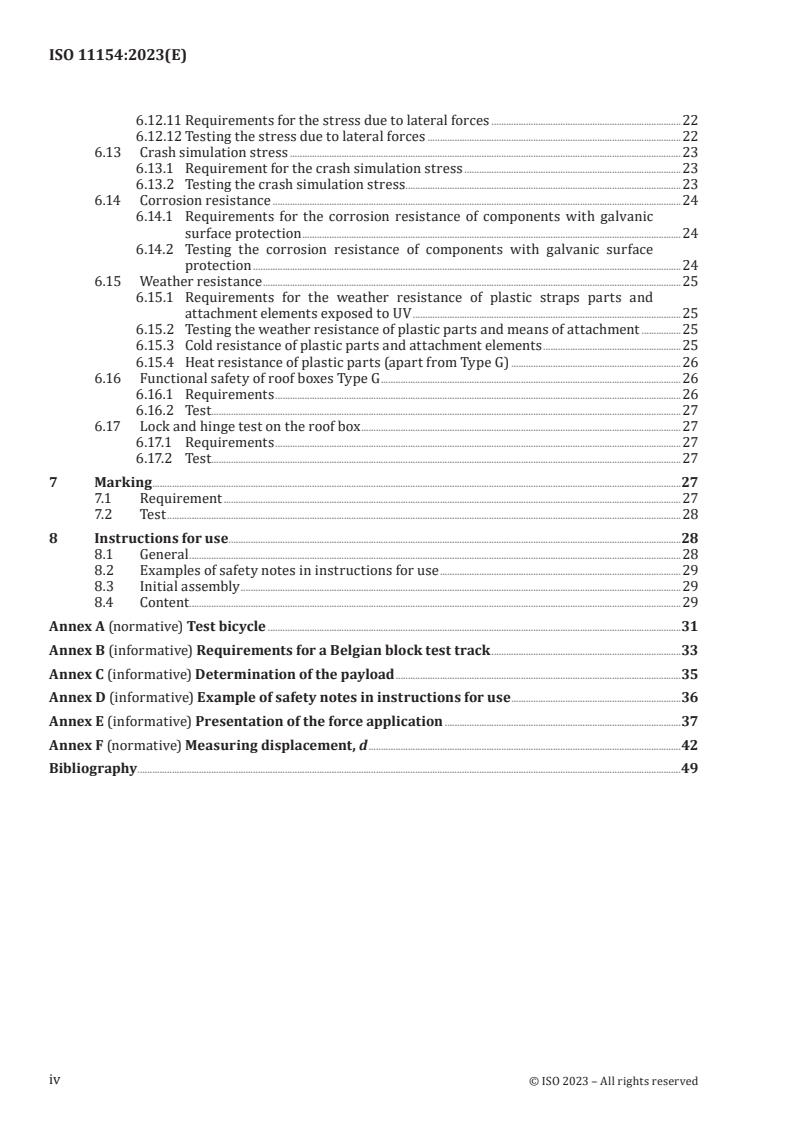
Contents Page
Foreword .v
1 Scope . 1
2 Normative references . 1
3 Terms and definitions . 1
4 Symbols, types and designation . 2
4.1 Symbols . 2
4.2 Types . 3
4.3 Designation . 4
5 Attachment to the vehicle.4
6 Safety requirements, tests .4
6.1 Measurement uncertainties . . 4
6.2 General . 4
6.3 Resistance of the materials . 5
6.4 Test procedure . 5
6.5 Test conditions . 6
6.6 Test specimens. 6
6.7 Test instruments . 6
6.7.1 Roof-box dummy for load simulation . 6
6.7.2 Test wheel . 7
6.7.3 Test skis . 7
6.7.4 Test snowboards . 7
6.7.5 Test surfboard . 7
6.7.6 Test surf mast . 8
6.7.7 Test boat . 8
6.7.8 Test ladder . 8
6.7.9 Test roof box . 8
6.7.10 Test air deflector device . 8
6.7.11 Test basket . 8
6.8 External design . 9
6.9 Functional design . 9
6.10 Attachment and type of load during the test . 9
6.11 Operational safety .12
6.11.1 General .12
6.11.2 Vibration resistance .12
6.11.3 Lane change test .13
6.11.4 Brake test . 14
6.11.5 Requirements and test criteria for lane change test (6.11.3) and brake test
(6.11.4) . 14
6.12 Static load bearing capacity . 14
6.12.1 General requirements . 14
6.12.2 General test . 16
6.12.3 Testing the forces in the direction of travel; height of the force application
point . 16
6.12.4 Requirements for forces in the direction of travel -F .20
x
6.12.5 Requirements for forces opposing the direction of travel +F .20
x
6.12.6 Testing the forces opposing the direction of travel +F .20
x
6.12.7 Requirements for forces 20° horizontal to the direction of travel (only for
Types A and B) .20
6.12.8 Testing the forces 20° horizontal to the direction of travel (only for Types A
and B). 21
6.12.9 Requirements for the stress due to vertical forces . 21
6.12.10 Testing the stress due to vertical forces . 21
iii
6.12.11 Requirements for the stress due to lateral forces .22
6.12.12 Testing the stress due to lateral forces . 22
6.13 Crash simulation stress . 23
6.13.1 Requirement for the crash simulation stress . 23
6.13.2 Testing the crash simulation stress . 23
6.14 Corrosion resistance . 24
6.14.1 Requirements for the corrosion resistance of components with galvanic
surface protection . 24
6.14.2 Testing the corrosion resistance of components with galvanic surface
protection . 24
6.15 Weather resistance .25
6.15.1 Requirements for the weather resistance of plastic straps parts and
attachment elements exposed to UV . 25
6.15.2 Testing the weather resistance of plastic parts and means of attachment .25
6.15.3 Cold resistance of plastic parts and attachment elements .25
6.15.4 Heat resistance of plastic parts (apart from Type G) .26
6.16 Functional safety of roof boxes Type G . 26
6.16.1 Requirements .26
6.16.2 Test . . . 27
6.17 Lock and hinge test on the roof box . 27
6.17.1 Requirements . 27
6.17.2 Test . . . 27
7 Marking . .27
7.1 Requirement . 27
7.2 Test .28
8 Instructions for use . .28
8.1 General .28
8.2 Examples of safety notes in instructions for use .29
8.3 Initial assembly .29
8.4 Content . .29
Annex A (normative) Test bicycle .31
Annex B (informative) Requirements for a Belgian block test track .33
Annex C (informative) Determination of the payload .35
Annex D (informative) Example of safety notes in instructions for use .36
Annex E (informative) Presentation of the force application .37
Annex F (normative) Measuring displacement, d .42
Bibliography .49
iv
Foreword
ISO (the International Organization for Standardization) is a worldwide federation of national standards
bodies (ISO member bodies). The work of preparing International Standards is normally carried out
through ISO technical committees. Each member body interested in a subject for which a technical
committee has been established has the right to be represented on that committee. International
organizations, governmental and non-governmental, in liaison with ISO, also take part in the work.
ISO collaborates closely with the International Electrotechnical Commission (IEC) on all matters of
electrotechnical standardization.
The procedures used to develop this document and those intended for its further maintenance are
described in the ISO/IEC Directives, Part 1. In particular, the different approval criteria needed for the
different types of ISO documents should be noted. This document was drafted in accordance with the
editorial rules of the ISO/IEC Directives, Part 2 (see www.iso.org/directives).
Attention is drawn to the possibility that some of the elements of this document may be the subject of
patent rights. ISO shall not be held responsible for identifying any or all such patent rights. Details of
any patent rights identified during the development of the document will be in the Introduction and/or
on the ISO list of patent declarations received (see www.iso.org/patents).
Any trade name used in this document is information given for the convenience of users and does not
constitute an endorsement.
For an explanation of the voluntary nature of standards, the meaning of ISO specific terms and
expressions related to conformity assessment, as well as information about ISO's adherence to
the World Trade Organization (WTO) principles in the Technical Barriers to Trade (TBT) see
www.iso.org/iso/foreword.html.
This document was prepared by Technical Committee ISO/TC 22, Road vehicles, Subcommittee SC 40,
Specific aspects for light and heavy commercial vehicles, busses and trailers.
This first edition cancels and replaces ISO/PAS 11154:2006, which has been technically revised.
The main changes are as follows:
— update and revision of document structure, which results in renumbering;
— update and revision Clause 2;
— update and revision Clause 6;
— addition of test procedure (6.4);
— addition of lane change test (6.11.3);
— addition of brake test (6.11.4);
— revision of 6.12.2, changing application of force from 10 min to 1 min.
Any feedback or questions on this document should be directed to the user’s national standards body. A
complete listing of these bodies can be found at www.iso.org/members.html.
v
INTERNATIONAL STANDARD ISO 11154:2023(E)
Road vehicles — Roof load carriers
1 Scope
This document applies for roof racks of passenger cars and light commercial vehicles up to a permissible
total weight of 3,5 t according to ISO 1176 and specifies requirements and test methods for these. It is
also valid for roof racks mounted on trailers.
So-called magnetic or suction foot racks, i.e. roof racks whose attachment on the vehicle is only via
magnetic forces or vacuum, are excluded from this document.
This document provides safety-related requirements under consideration of the weight, centre of
gravity, air resistance and other safety-relevant properties for structures of roof racks for which no
other technical or statutory regulations otherwise apply and which are not listed in 4.2. In individual
cases, test requirements can extend beyond these requirements.
2 Normative references
The following documents are referred to in the text in such a way that some or all of their content
constitutes requirements of this document. For dated references, only the edition cited applies. For
undated references, the latest edition of the referenced document (including any amendments) applies.
ISO 179-1, Plastics — Determination of Charpy-impact properties — Part 1: Non-instrumented impact test
ISO 3888-2, Passenger cars — Test track for a severe lane-change manoeuvre — Part 2: Obstacle avoidance
ISO 4210-2, Cycles — Safety requirements for bicycles — Part 2: Requirements for city and trekking, young
adult, mountain and racing bicycles
ISO 4892-2, Plastics — Methods of exposure to laboratory light sources — Part 2: Xenon-arc lamps
EN 15194, Cycles — Electrically power assisted cycles — EPAC Bicycles
3 Terms and definitions
For the purposes of this document, the following terms and definitions apply.
ISO and IEC maintain terminology databases for use in standardization at the following addresses:
— ISO Online browsing platform: available at https:// www .iso .org/ obp
— IEC Electropedia: available at https:// www .electropedia .org/
3.1
roof rack
device, which is attached directly or indirectly via other roof rack forms on the roof of passenger cars
or vehicles derived from this and which are suitable for the transportation of loads (3.2)
3.2
load
transport goods which can be transported with the roof racks (3.1) provided for this
4 Symbols, types and designation
4.1 Symbols
−F direction of the normal force of the load
Z
F direction of the vertical force, acting vertically to the direction of travel
z
F direction of the lateral force, acting laterally to the direction of travel
Y
−F direction of the longitudinal force, acting longitudinally to the direction of travel
x
F direction of the opposing longitudinal force, acting against the direction of travel
x
−F direction of the force in the horizontal plane, 20° to the vehicle longitudinal axis through
x20°
the centre point M
m permissible roof load in kilograms
D
m permissible load bearing capacity of the roof rack in kilograms
N
m dead weight of the roof racks and possibly the roof structural system in kilograms
E
s stroke path from deformation and displacement in millimetres
x-direction vehicle longitudinal axis
y-direction transverse to the vehicle longitudinal axis (horizontal)
z-direction transverse to the vehicle longitudinal axis (vertical)
M force application point
F front wheel contact force
Vr
F gravity force
g
F force transmitted to the ground by the rear wheel
Hr
S centre of gravity of test bicycle
m
RS wheelbase
h height of centre of gravity
Sm
The directions of action by the individual forces are shown correspondingly in Figure 1.
Key
1 cross member
2 support foot
Figure 1 — Presentation with the example of a base carrier, consisting of two carrying brackets
and four support feet for clamping attachment to a vehicle roof
4.2 Types
The following types of roof racks are differentiated:
Type A Base carrier
Type B Luggage carrier
Type C Ski carrier, snowboard carrier
Type D Windsurf carrier
Type E Bicycle carrier
Type F Boat carrier
Type G Roof box
Type H Air deflector device, advertising carriers and signal lights
Type I Luggage basket
Type J Front wheel/Rear wheel holder (bicycle)
Type K Cross-country ski carrier
Type L Surf mast carrier
NOTE Only types A and B can be mounted directly on the vehicle. Type A contains a base carrier, which
is mounted directly on the vehicle or on special devices on the vehicle. Type B (luggage carrier) is a luggage
basket with integrated carrier function. Types C to L can only be mounted on the base carrier (Type A). Special
versions are possible insofar as these correspond to the safety requirements of this document (see Introduction
and Clause 1).
The following essential elements characterize the base carrier:
— carrying bracket or cross member for holding and attaching roof rack types C to L;
— device (for example, supporting foot with retaining claws) for positive and non-positive attachment
of the carrying bracket or cross member to the vehicle or to special devices on the vehicle (screwed
or clamped connection or railing or similar).
4.3 Designation
Roof racks according to this document can be marked via the designation of the document and the
designation of the type.
EXAMPLE Designation of a roof rack type A:
Roof rack ISO 11154 – A
5 Attachment to the vehicle
The attachment of the roof racks to be tested according to this document with the vehicle shall be
realized by a mechanical non-positive locking. Combinations of non-positive with positive locking are
thus not excluded.
If a manufacturer brings a special roof rack into circulation, which only requires a carrying bracket or
cross member of type A (e.g. single wheel carrier or wind deflector) for attachment to the vehicle, the
manufacturer shall test this special roof rack completely with the entire intended structure and the
intended vehicle according to this document.
6 Safety requirements, tests
6.1 Measurement uncertainties
Unless otherwise stated, the measurement uncertainties based on the Newton values shall correspond
to the following:
Forces and torques ±5 %
Masses and weights ±2 %
Dimensions ±2 %
Angles ±2°
Time (e.g. test duration) ±5 s
Temperatures ±5 %
Pressure ±5 %
Speed ±5 %
6.2 General
The test requirements described in the following clauses are minimum requirements. Tests with
increased requirements are permissible.
The following requirements and associated tests apply for components whose failure would also entail
a failure of the overall system or detachment/loss of the load or which would render safe driving of the
vehicle impossible.
6.3 Resistance of the materials
The roof rack including accessories shall fulfil requirements 6.11 to 6.13 in the temperature range from
−20 °C to +60 °C.
This is to be demonstrated for plastic parts in the force flow by one of the following methods:
1)
— material test certificates and test reports show the suitability of the design for the intended
purpose;
— performing tests under the above extreme conditions;
— reference to corresponding material standards.
6.4 Test procedure
Five test samples shall be used for the tests. The sequence of the tests shall follow Figure 2.
Figure 2 — Test sequence
1) For example, technical specifications for the material or test sample of the manufacturer or manufacturer
certificate.
6.5 Test conditions
The strength and functional safety are determined both by dynamic test bench tests as well as in drive
tests and static-load tests.
The screws are tightened with the torques indicated in the instructions for use.
The roof racks shall be tested in the installation situation approved as least favourable for the user (e.g.
height-adjustable roof racks are tested in the highest position).
For types A to L, the distance in the x-direction of the middle plane of the base carrier, which the
roof racks to be tested assume, shall be (700 ± 2) mm. Roof racks for which the distance is already
specified by regulations or design, shall be tested with the specified distance. In case of roof racks that
are fastened to rain gutters, the following rain gutter distances shall serve as a basis: during drive
test ≥ 1 250 mm; during the tests for the static load bearing capacity = 1 250 mm. If the intended use is
limited by the manufacturer of the roof rack, the maximum permissible distance of rain gutters shall be
applied.
The detailed mounting conditions that shall be followed for the test are oriented to the specifications of
the manufacturers of the roof racks or vehicle manufacturers. These specifications shall be included in
the user information.
6.6 Test specimens
Roof racks which correspond to the series state shall be presented as test specimens for the operational
safety (see 6.11), the brake test (see 6.11.4), the static-load bearing capacity (see 6.12) and the crash
simulation stress (see 6.13). A new test specimen can be used, if required, for testing the operational
safety. If one of these tests is negative, this test may only be repeated to pass these requirements if an
improvement has been made to the roof rack or the attachment to the vehicle. The other tests shall be
repeated with this new technical status if their result is affected by the modification.
6.7 Test instruments
6.7.1 Roof-box dummy for load simulation
The test crate shall be designed according to Figure 3 and shall not be deformed by the load. The mass
of the test crate shall correspond to Table 1. The mass of the load weights shall be evenly distributed.
The centre of gravity height of the laden roof-box dummy shall be between 50 mm and 80 mm above
the roof rack, roof rails or roof panel.
Dimensions in millimetres
a
If the distance between the outer roof rails is more than 900 mm, the length of the test crate shall correspond
to this distance plus 100 mm.
Figure 3 — Test crate
6.7.2 Test wheel
The test bicycle shall correspond to Annex A.
The test wheel shall exhibit a diameter of 700 mm and the mass shall correspond to Table 1.
6.7.3 Test skis
The test skis shall exhibit a mass according to Table 1.
6.7.4 Test snowboards
The snowboard shall exhibit a mass according to Table 1.
6.7.5 Test surfboard
The test surfboard shall exhibit a mass according to Table 1. The dimensions of the test surfboard shall
correspond to Figure 4.
Dimensions in millimetres
Figure 4 — (Wind) surfboard
6.7.6 Test surf mast
The test surf mast shall exhibit a mass according to Table 1 and a minimum length of 4 500 mm.
6.7.7 Test boat
The test boat shall exhibit a mass according to Table 1. The dimensions of the test boat shall correspond
to Figure 5.
Dimensions in millimetres
Figure 5 — Boat
6.7.8 Test ladder
The test ladder shall exhibit a length of 4 m, with a mass of 9,5 kg.
6.7.9 Test roof box
The test roof box is not the roof-box dummy [see (6.7.1)] but the roof box itself.
This shall be loaded with the masses from Table 1.
6.7.10 Test air deflector device
The test air deflector device is the air deflector device itself.
6.7.11 Test basket
The test basket is the luggage basket itself. Test baskets shall be differentiated into two types:
with gallery on all sides (see Figure 6), with side gallery (see Figure 7).
Figure 6 — Test basket with gallery on all sides
Figure 7 — Test basket with side gallery
6.8 External design
In order to avoid injuries to other road users in the event of accidents, roof racks shall conform to the
requirements (see ECE-R 26, outer edges and protrusions) applicable at the time of testing.
See national statutory regulations regarding external limitation and lighting. An unintentional
detachment the cross member out of the means of attachment of the base carrier shall be prevented by
design (e.g. end stop).
6.9 Functional design
Safety-relevant locking mechanisms shall be secured against automatic and unintentional opening.
The testing of the locking mechanisms shall be performed by a manual test.
6.10 Attachment and type of load during the test
The attachment of the roof racks and their load during the tests according to 6.11 to 6.13 shall be
carried out as specified by the manufacturer.
Table 1 — Test weights
Roof rack Basis of the calcu- Test weights for Type of attachment Location of the cen-
lated test force for tests according to of the load/test tre of gravity of the
the test according 6.11 weights additional weight
to 6.12 and 6.13
Base carrier Permissible load 1,5 times the permis- A. In case of base A. Centre symmet-
Type A bearing capacity sible load bearing carriers with special rical to the attach-
specified by the capacity cross member profile ment points plate to
manufacturer and special assembly carrier
regulations for the
The additional
use of this profile
weights shall be
for attachment of
dimensioned so
the further roof rack
that a centre of
components or loads:
gravity of approx-
Additional load
imately 50 mm to
attached rigidly on
80 mm above the
a sufficiently stable
cross-member pro-
device (e.g. plate),
file results.
this is connected
firmly twice with the
two carrying bracket
or cross member
profiles (device
length 700 mm, de-
vice width 600 mm,
y-position of the
attachment points
aligned centrally,
distance of the base
carriers in x-direc-
tion as specified by
the manufacturer
or 700 mm in the
absence of specifica-
tions).
B. Base carriers B. See Figure 8.
where the attach-
ment of the further
roof rack compo-
nents or loads are
not specified in
more detail, are
fastened with a test
crate fastened with
straps and provided
with stoppers on
each cross member,
tested as specified in
Figure 8. (Distance
of the base carriers
in x-direction as
specified by the man-
ufacturer or 700 mm
in the absence of
specifications.)
The additional weights shall be attached at the points described in such way that they are resistant to movement and
vibration. The attachment of the additional load shall not lead to strengthening of the roof rack to be tested.
TTabablele 1 1 ((ccoonnttiinnueuedd))
Roof rack Basis of the calcu- Test weights for Type of attachment Location of the cen-
lated test force for tests according to of the load/test tre of gravity of the
the test according 6.11 weights additional weight
to 6.12 and 6.13
Luggage carrier Permissible load Additional loads Additional weight
Type B/ luggage bas- bearing capacity shall be attached distributed as speci-
ket Type I/ roof box specified by the with support from fied by the manufac-
Type G manufacturer existing or supplied turer
means of attachment
as specified by the
manufacturer on the
base of the luggage
carrier/luggage bas-
ket/roof box. Sand
bags shall be used as
additional loads.
Ski snowboard For each pair of skis See Figure 10, in case At the centre of grav-
carrier and snowboard as of load with skis or ity of the “test skis”,
Type C specified by the snowboards these with mounted skis/
manufacturer, but shall be mounted snowboards, the
min. 7 kg with the tip to the additional weight (if
rear. necessary) is mount-
ed in the area of the
bindings.
Cross-country ski For each pair of skis See Figure 10, in At the centre of grav-
carrier as specified by the case of load with ity of the “test skis”,
Type K manufacturer, but skis these shall be with mounted skis,
min. 3 kg mounted with the tip the additional weight
to the rear. (if necessary) is
mounted in the area
of the bindings.
(Wind) surf carrier For (wind) surfboard The roof rack is load- The centre of grav-
Type D as specified by the ed with a wind surf- ity of the additional
manufacturer, but board as specified weight is located at
min. 15 kg by the manufacturer, the approximate cen-
the front tip shall tre of gravity of the
point downward wind surfboard.
in the direction of
travel.
Surf mast carrier For each mast as The roof rack is The centre of grav-
Type L specified by the loaded with a surf ity of the additional
manufacturer, but mast or a similar weight is located at
min. 3 kg test object with the the approximate cen-
same dimensions, tre of gravity of the
as specified by the wind surf mast.
manufacturer.
Bicycle carrier For each bicycle The roof rack is The centre of
Type E as specified by loaded with a bicycle gravity of the ad-
the manufacturer, as specified by the ditional weights is
but min. 15 kg or manufacturer. located at a height
25 kg for EPAC (see of 500 mm ± 25 mm
Annex A) above the
cross-member sup-
port approximately
at the bicycle centre.
The additional weights shall be attached at the points described in such way that they are resistant to movement and
vibration. The attachment of the additional load shall not lead to strengthening of the roof rack to be tested.
TTabablele 1 1 ((ccoonnttiinnueuedd))
Roof rack Basis of the calcu- Test weights for Type of attachment Location of the cen-
lated test force for tests according to of the load/test tre of gravity of the
the test according 6.11 weights additional weight
to 6.12 and 6.13
Boat carrier As specified by the The roof rack is The centre of grav-
Type F manufacturer, but loaded with a boat ity of the additional
min. 25 kg as specified by the weight is located
manufacturer. at the approximate
centre of gravity of
the boat.
Air deflector device Test loads according 1,5 times the roof Attachment as speci- The centre of grav-
or similar to Tables 3 and 4 rack weight fied by the manufac- ity of the additional
Type H turer. weight is located
centre symmetrical-
See also Clause 5.
ly in relation to the
roof rack height and
width.
Front wheel/rear 2 kg 1,5 times the permis- The roof rack is load- Centre of wheel axle
wheel holder (bicy- sible load bearing ed with a front wheel (see Figure 9)
cle) capacity as specified by the
Type J manufacturer.
The additional weights shall be attached at the points described in such way that they are resistant to movement and
vibration. The attachment of the additional load shall not lead to strengthening of the roof rack to be tested.
6.11 Operational safety
6.11.1 General
The test for the operational safety has the aim of validating the damage-free functional capability under
operating conditions. To increase the safety of the validation, this test is carried out with increased test
weight according to Table 1.
The tests for the roof racks of Types A and B to be tested are carried out with the vehicle specially
provided for these types. The roof racks of Types C to L to be tested are mounted on a sufficiently stable
roof rack of Type A not subject to the test requirements, which is mounted on the test vehicle defined in
6.11.2.3.
The tests in real operation according to 6.11.2.2 and 6.11.2.3 can be replaced by adequate tests in the
laboratory. In order to reproduce a Belgian block test with laboratory equipment, the devices used shall
be able to reproduce six degrees of freedom and be suitable for frequencies of 0,5 Hz to 60 Hz. The
equipment shall also be able to measure and record the accelerations actually occurring, in order to
confirm that the current test results correspond to the target data. For the testing of the roof racks
Types A and B, the vehicle provided can be replaced by its roof section.
6.11.2 Vibration resistance
6.11.2.1 Requirements
The components of the roof rack and vehicle provided for the roof rack loaded during the tests shall not
exhibit any permanent deformation nor become non-functional. Signs of settling are not regarded as
permanent deformation.
Tightening torques (prevailing torque) of bolted joints shall not decrease by more than 30 %. The load
shall remain adequately secured on the roof rack after the test.
After all three test speeds, the maximum permissible displacement of the roof rack to be tested shall be
5 mm at the contact points to the vehicle.
The testing of Type A and B is conducted according to 6.11.2.2.
The testing of Type C to L is conducted according to 6.11.2.3.
6.11.2.2 Testing of Type A and B
The specially provided vehicle with roof rack to be tested and test weights travels on a Belgian block
test track for a test distance of minimum 2 000 m at each test speed.
Annex B gives the instructions for the construction of the Belgian block test track.
The test distance can be attained by travelling over the test track several times. The minimum length of
the test track is 50 m.
Speed: v = 15 km/h, 25 km/h and 35 km/h
Slope of the test track: 0 %
6.11.2.3 Testing of Type C to L
The test vehicle with roof rack to be tested and test weights travels on a Belgian block test track for a
test distance of minimum 2 000 m at each test speed.
Annex B gives the instructions for the construction of the Belgian block test track.
The test distance can be attained by travelling over the test track several times. The minimum length of
the test track is 50 m.
A suitable vehicle of medium class from current mass production with sufficient payload is used as a
test vehicle, which is characterized by a wheelbase of 2 450 mm to 2 750 mm and a vehicle height in K1
location of 1 400 mm to 1 650 mm. The vehicle does not have air suspension. The vehicle corresponds
to its approved state. Loading with additional weights not belonging to the vehicle is not permitted.
Vehicle-specific roof racks shall be tested with a suitable vehicle from the intended usage range.
Speed: v = 15 km/h, 25 km/h and 35 km/h
Slope of the test track: 0 %
6.11.3 Lane change test
6.11.3.1 Requirements
After the lane change test, it shall be determined by a visual inspection whether attachments or parts
of the carriers have loosened or whether damage to the vehicle or to the load has occurred.
Testing is carried out according to 6.11.3.2. However, the test shall not be carried out for roof racks on
trailers.
6.11.3.2 Test method
The lane change test shall be carried out according to ISO 3888-2 and is driven by a vehicle (see 6.11.2.3)
at the following speeds in succession:
— 50 km/h;
— 55 km/h;
— 60 km/h.
6.11.4 Brake test
6.11.4.1 Requirements during braking
After full braking, it shall be determined by a visual inspection whether attachments or parts of the
roof load carrier have loosened and/or whether damage to the vehicle or to the load has occurred.
6.11.4.2 Carrying out the brake test
When testing each roof rack, braking is performed with maximum attainable deceleration (with ABS)
on a flat, dry road with the relevant test vehicle at an initial speed for each of the three instances of
braking of 80 km/h, 30 km/h and 15 km/h until standstill. The coefficient of friction of the road surface
shall be 0,7 at a minimum. The following requirements for the mean fully developed deceleration
(measured with disconnected engine) shall be fulfilled:
— for passenger cars: 6,4 m/s with a maximum actuating force of 50 daN;
— for light commercial vehicles until 3,5 t: 5 m/s with a maximum actuating force of 70 daN.
The loading with additional weights is performed in accordance with Table 1.
6.11.5 Requirements and test criteria for lane change test (6.11.3) and brake test (6.11.4)
— The product shall remain safely fixed to the vehicle/roof, railing or roof load carrier device during
the complete test.
— The load shall remain safely fixed to the roof load carrier device.
— The load shall not be damaged during the test.
— The main function of the product shall remain after the competed test.
— No visual plastic deformations or cracks are allowed on structural parts.
A deformation can be accepted, as far as it does not have any negative influence on function or
safety of the device
— During the test, the load and the device of the roof lo
...