


ISO 15016:2015
(Main)Ships and marine technology — Guidelines for the assessment of speed and power performance by analysis of speed trial data
Ships and marine technology — Guidelines for the assessment of speed and power performance by analysis of speed trial data
The primary purpose of speed and power trials is to determine a ship's performance in terms of ship's speed, power and propeller shaft speed under prescribed ship's conditions and thereby verify the satisfactory attainment of a ship's speed stipulated by EEDI regulations and/or contract. ISO 15016:2015 defines and specifies the following procedures to be applied in the preparation, execution, analysis and reporting of speed trials for ships, with reference to the effects which may have an influence upon the speed, power and propeller shaft speed relationship: · the responsibility of each party involved, · the trial preparations, · the ship's condition, · the limiting weather and sea conditions, · the trial procedure, · the execution of the trial, · the measurements required, · the data acquisition and recording, · the procedures for the evaluation and correction, · the processing of the results. The contracted ship's speed and the ship's speed for EEDI are determined for stipulated conditions and at specific draughts (contract draught and/or EEDI draught). For EEDI, the environmental conditions are: no wind, no waves, no current and deep water of 15°C. Normally, such stipulated conditions are unlikely to be experienced in part or in full during the actual trials. In practice, certain corrections for the environmental conditions such as water depth, surface wind, waves, current and deviating ship draught, have to be considered. For this purpose, during the speed and power trials, not only are shaft power and ship's speed measured, but also relevant ship data and environmental conditions. The applicability of ISO 15016:2015 is limited to ships of the displacement type.
Navires et technologie maritime — Lignes directrices pour l'évaluation des performances de vitesse et de puissance par analyse des données d'essais de vitesse
General Information
Relations
Standards Content (Sample)
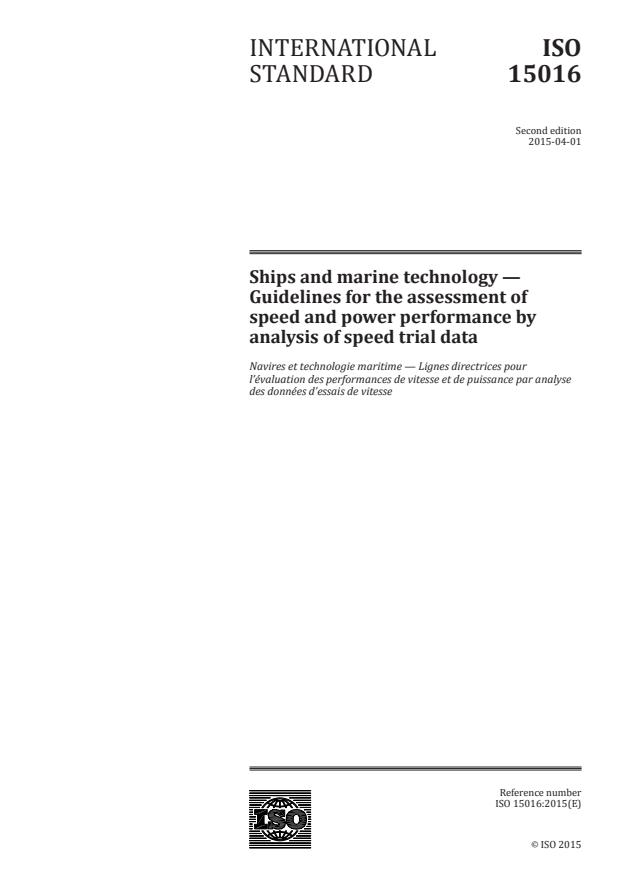
INTERNATIONAL ISO
STANDARD 15016
Second edition
2015-04-01
Ships and marine technology —
Guidelines for the assessment of
speed and power performance by
analysis of speed trial data
Navires et technologie maritime — Lignes directrices pour
l’évaluation des performances de vitesse et de puissance par analyse
des données d’essais de vitesse
Reference number
©
ISO 2015
© ISO 2015
All rights reserved. Unless otherwise specified, no part of this publication may be reproduced or utilized otherwise in any form
or by any means, electronic or mechanical, including photocopying, or posting on the internet or an intranet, without prior
written permission. Permission can be requested from either ISO at the address below or ISO’s member body in the country of
the requester.
ISO copyright office
Case postale 56 • CH-1211 Geneva 20
Tel. + 41 22 749 01 11
Fax + 41 22 749 09 47
E-mail copyright@iso.org
Web www.iso.org
Published in Switzerland
ii © ISO 2015 – All rights reserved
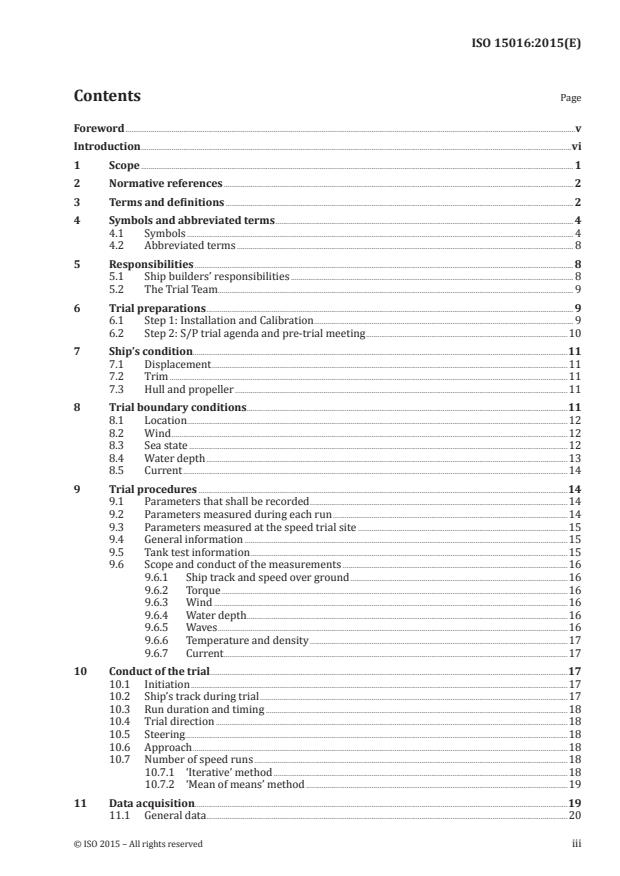
Contents Page
Foreword .v
Introduction .vi
1 Scope . 1
2 Normative references . 2
3 Terms and definitions . 2
4 Symbols and abbreviated terms . 4
4.1 Symbols . 4
4.2 Abbreviated terms . 8
5 Responsibilities . 8
5.1 Ship builders’ responsibilities . 8
5.2 The Trial Team. 9
6 Trial preparations . 9
6.1 Step 1: Installation and Calibration . 9
6.2 Step 2: S/P trial agenda and pre-trial meeting .10
7 Ship’s condition.11
7.1 Displacement .11
7.2 Trim .11
7.3 Hull and propeller .11
8 Trial boundary conditions .11
8.1 Location .12
8.2 Wind .12
8.3 Sea state .12
8.4 Water depth .13
8.5 Current .14
9 Trial procedures .14
9.1 Parameters that shall be recorded .14
9.2 Parameters measured during each run .14
9.3 Parameters measured at the speed trial site .15
9.4 General information .15
9.5 Tank test information .15
9.6 Scope and conduct of the measurements .16
9.6.1 Ship track and speed over ground .16
9.6.2 Torque .16
9.6.3 Wind .16
9.6.4 Water depth . .16
9.6.5 Waves .16
9.6.6 Temperature and density .17
9.6.7 Current.17
10 Conduct of the trial .17
10.1 Initiation .17
10.2 Ship’s track during trial .17
10.3 Run duration and timing .18
10.4 Trial direction .18
10.5 Steering .18
10.6 Approach .18
10.7 Number of speed runs .18
10.7.1 ‘Iterative’ method .18
10.7.2 ‘Mean of means’ method .19
11 Data acquisition.19
11.1 General data .20
11.2 Data on each run .20
11.3 Acquisition system .21
11.3.1 Minimum data .21
11.3.2 System requirements .21
11.3.3 Location .22
11.4 Manual data collection .22
12 Analysis procedure .24
12.1 General remarks .24
12.2 Description of the analysis procedure .24
12.2.1 Resistance data derived from the acquired data .25
12.2.2 Evaluation of the acquired data .25
12.2.3 Evaluation based on Direct Power Method .26
12.2.4 Correction of the measured ship’s speed due to the effect of current .29
12.2.5 Correction of the ship’s speed due to the effects of shallow water .30
12.2.6 Correction of the ship’s performance due to the effects of displacement .30
12.2.7 Conversion of power curve from trial condition to full load/
stipulated condition .30
13 Processing of the results .30
14 Reporting .31
15 Example of speed trial data analysis .32
Annex A (normative) General information and trial log sheet .34
Annex B (normative) Beaufort scale for wind velocity .35
Annex C (normative) Resistance increase due to wind .38
Annex D (normative) Resistance increase due to waves .48
Annex E (normative) Effect of water temperature and water density.61
Annex F (normative) Effect of current .62
Annex G (normative) Effect of shallow water .66
Annex H (normative) Effect of displacement .67
Annex I (normative) Conversion from trial condition to other stipulated load conditions .68
Annex J (normative) Derivation of load variation coefficients .70
Annex K (informative) Analysis of direct power method .75
Bibliography .85
iv © ISO 2015 – All rights reserved
Foreword
ISO (the International Organization for Standardization) is a worldwide federation of national standards
bodies (ISO member bodies). The work of preparing International Standards is normally carried out
through ISO technical committees. Each member body interested in a subject for which a technical
committee has been established has the right to be represented on that committee. International
organizations, governmental and non-governmental, in liaison with ISO, also take part in the work.
ISO collaborates closely with the International Electrotechnical Commission (IEC) on all matters of
electrotechnical standardization.
The procedures used to develop this document and those intended for its further maintenance are
described in the ISO/IEC Directives, Part 1. In particular the different approval criteria needed for the
different types of ISO documents should be noted. This document was drafted in accordance with the
editorial rules of the ISO/IEC Directives, Part 2 (see www.iso.org/directives).
Attention is drawn to the possibility that some of the elements of this document may be the subject of
patent rights. ISO shall not be held responsible for identifying any or all such patent rights. Details of any
patent rights identified during the development of the document will be in the Introduction and/or on
the ISO list of patent declarations received (see www.iso.org/patents).
Any trade name used in this document is information given for the convenience of users and does not
constitute an endorsement.
For an explanation on the meaning of ISO specific terms and expressions related to conformity
assessment, as well as information about ISO’s adherence to the WTO principles in the Technical Barriers
to Trade (TBT) see the following URL: Foreword - Supplementary information
The committee responsible for this document is ISO/TC 8, Ships and marine technology, Subcommittee
SC 6, Navigation and ship operations.
This second edition cancels and replaces the first edition (ISO 15016:2002), which has been
technically revised.
Annexes A, B, C, D, E, F, G, H, I and J form a normative part of this International Standard, whereas
Annex K is informative.
Introduction
This International Standard concerns the method of analysing the results obtained from speed trials.
The primary purpose of speed and power trials is to determine a ship’s performance in terms of
ship’s speed, power and propeller shaft speed under prescribed ship’s conditions and thereby verify
the satisfactory attainment of a ship’s speed stipulated by Energy Efficiency Design Index (EEDI)
regulations and/or contract. Ship’s speed is that realized under conditions stipulated by contract and/or
EEDI regulations, which are usually; smooth hull and propeller surfaces, no wind, no waves, no current
and deep water of 15°C.
In general it cannot be expected that all such stipulated conditions will be met during the actual trials. In
practice, certain corrections for the environmental conditions have to be considered, such as for water
[1][2]
depth, wind, waves and current .
The purpose of this International Standard is to define the basic requirements for the performance
of speed trials, and provide procedures for evaluation and correction of speed trial data, covering all
influences which may be relevant to the individual trial runs based on sound scientific grounds, thereby
enabling owners and others to have confidence in the validity of the final results.
This International Standard is intended to help the interested parties achieve the desired target accuracy
of, within 2 % in shaft power and 0,1 kn in speed.
The procedure specified in this International Standard has been developed largely on the basis of published
data on speed trials and on ship’s performance, the more important among them being listed in Clause 2.
ISO has invited the International Towing Tank Conference (ITTC) to co-operate on the development
of a new standard for speed/power trials taking into account the new guidelines issued by ITTC and
approved by MEPC65 for EEDI. The contribution of the STA-group and the ITTC is highly appreciated.
Substitution of terms clause
This International Standard is generally applied to those ships for which survey and certification of EEDI
is required under International Maritime Organization (IMO) Resolution MEPC.214(63) [as amended
by MEPC.234(65)]. In the case of other ships, to which the above IMO resolutions are not applicable,
the terms or phrases of this International Standard are deemed to be replaced as necessary (e.g.
“agreement between the Shipbuilder, the Owner and the Verifier” shall be read as “agreement between
the Shipbuilder and the Owner” etc.)
vi © ISO 2015 – All rights reserved
INTERNATIONAL STANDARD ISO 15016:2015(E)
Ships and marine technology — Guidelines for the
assessment of speed and power performance by analysis of
speed trial data
1 Scope
The primary purpose of speed and power trials is to determine a ship’s performance in terms of ship’s
speed, power and propeller shaft speed under prescribed ship’s conditions and thereby verify the
satisfactory attainment of a ship’s speed stipulated by EEDI regulations and/or contract.
This International Standard defines and specifies the following procedures to be applied in the
preparation, execution, analysis and reporting of speed trials for ships, with reference to the effects
which may have an influence upon the speed, power and propeller shaft speed relationship:
— the responsibility of each party involved,
— the trial preparations,
— the ship’s condition,
— the limiting weather and sea conditions,
— the trial procedure,
— the execution of the trial,
— the measurements required,
— the data acquisition and recording,
— the procedures for the evaluation and correction,
— the processing of the results.
The contracted ship’s speed and the ship’s speed for EEDI are determined for stipulated conditions and
at specific draughts (contract draught and/or EEDI draught). For EEDI, the environmental conditions
are: no wind, no waves, no current and deep water of 15°C.
Normally, such stipulated conditions are unlikely to be experienced in part or in full during the actual
trials. In practice, certain corrections for the environmental conditions such as water depth, surface
wind, waves, current and deviating ship draught, have to be considered. For this purpose, during the
speed and power trials, not only are shaft power and ship’s speed measured, but also relevant ship data
and environmental conditions.
The applicability of this International Standard is limited to ships of the displacement type.
In this International Standard, it was decided that the unit to express the amount of an angle should be
“rad” (radian) and that the unit of speed should be “m/s” (metres per second). Nevertheless, “°” (degree)
as a unit for an angle and “knots” as a unit for speed may be used. However, the units for the angles and
speeds which appear in calculation formulas are to be “rad” and “m/s” without exception. Moreover, for
the convenience of the users of this International Standard, numerical values using the units of degree
and knots are stated jointly at appropriate places.
If it is physically impossible to meet the conditions in this International Standard, a practical treatment is
allowed based on the documented mutual agreement among the Owner, the Verifier and the Shipbuilder.
2 Normative references
The following documents, in whole or in part, are normatively referenced in this document and are
indispensable for its application. For dated references, only the edition cited applies. For undated
references, the latest edition of the referenced document (including any amendments) applies.
ITTC 7.5-04-01-01.4:2002, ITTC Recommended Procedures and Guidelines, Speed and Power Trials, Part 4:
Instrumentation Installation and Calibration
ITTC 7.5-02-07-02.2, ITTC Recommended Procedures and Guidelines, Prediction of Power Increase in
Irregular Waves from Model Test
3 Terms and definitions
For the purposes of this document, the following terms and definitions apply.
3.1
brake power
power delivered by the output coupling of the propulsion machinery before passing through any speed-
reducing and transmission devices
3.2
contract power
brake power or shaft power that is stipulated in the new build or conversion contract between the
Shipbuilder and the Owner
3.3
contract speed
ship’s speed to be achieved as agreed within the terms of the new build/conversion contract
3.4
Double Run
two consecutive speed runs at the same power setting on reciprocal headings
Note 1 to entry: See 3.16 for speed runs.
3.5
EEDI
Energy Efficiency Design Index as formulated by IMO
3.6
EEDI power
brake power that is stipulated by the Energy Efficiency Design Index (EEDI) regulations
3.7
EEDI Speed
ship’s speed achieved under the conditions specified by the IMO Resolution MEPC.245(66) (as amended)
3.8
ideal conditions
ideal weather and sea conditions: no wind, no waves, no current and deep water of 15°C
3.9
measured ship’s speed
ship’s speed during a speed run derived from the headway distance between start and end position and
the elapsed time of the speed run
3.10
Owner
party that signed the new building or conversion contract with the Shipbuilder
2 © ISO 2015 – All rights reserved
3.11
power setting
setting of engine throttle and propeller shaft speed for fixed pitch propellers and setting of the pitch
angle for controllable pitch propellers
3.12
propeller pitch
design pitch for a fixed pitch propeller
3.13
pitch angle
operating pitch angle of a Controllable Pitch Propeller (CPP)
3.14
shaft power
net power supplied by the propulsion machinery to the propulsion shafting after passing through all
speed-reducing and other devices and after power for all attached auxiliaries has been taken off and
accounting for losses in shaft between propeller and the location of power measurement at the shaft
3.15
Shipbuilder
shipyard that signed the new building or conversion contract with the Owner
3.16
ship’s speed
speed of the ship that is realised under the stipulated conditions
Note 1 to entry: See also measured ship’s speed, contract speed and EEDI speed.
3.17
sister ships
ships with identical main dimensions, body lines, appendages and propulsion system built in a series by
the same Shipyard
3.18
S/P trials
speed and power trials to establish the relationship between power and speed for a particular ship
3.19
S/P trial agenda
document outlining the scope of a particular S/P trial
3.20
speed run
ship’s track with specified heading, distance and duration for which the measured ship’s speed and shaft
power are calculated
Note 1 to entry: This International Standard contains the procedures on how to conduct the trial and table(s)
portraying the runs to be conducted.
3.21
tank tests
model tank tests for the prediction of the speed power relation for the stipulated conditions
3.22
trial baseline
the track of the first S/P run
3.23
Trial Leader
duly authorised (Shipbuilder’s representative) person responsible for the execution of all phases of the
S/P trials including the pre-trial preparation
3.24
trial log
all the data recorded before, during and after the S/P trial
3.25
Trial Team
team that consists of the Trial Leader, the Owner’s representative, the appointed persons responsible for
the S/P trial measurements and, if the ship requires EEDI, the Verifier
3.26
Verifier
third party responsible for verification of the EEDI
3.27
zero pitch
Controllable Pitch Propeller (CPP) blade angle at which the pitch angle at the representative radius is
equivalent to zero
4 Symbols and abbreviated terms
4.1 Symbols
A is the lateral projected area above the waterline including superstructures
LV
A is the midship section area under water
M
A is the lateral projected area of superstructures above upper deck
OD
a , b , c are the factors for the torque coefficient curve
Q Q Q
a , b , c are the factors for the thrust coefficient curve
T T T
A is the transverse projected area above the waterline including superstructures in square metres
XV
B is the ship’s breadth
B(x) is the sectional breadth
B is the bluntness coefficient
f
C is the wind resistance coefficient; C (0) means the wind resistance coefficient in head wind
AA AA
C is the block coefficient
B
C is the frictional resistance coefficient for the actual water temperature and water density
F
C is the frictional resistance coefficient for the reference water temperature and water density
F0
C is the horizontal distance from midship section to centre of lateral projected area A , where +
MC LV
means forward from midship
C is the vertical prismatic coefficient
Pv
C is the total resistance coefficient for the reference water temperature and water density
T0
C is the coefficient of advance speed
U
D is the propeller diameter
E is the directional spectrum
e is the scale correlation factor of the wake fraction
i
F is the skin friction correction force same as in the normal self-propulsion tests
D
Fr is the Froude number
4 © ISO 2015 – All rights reserved
F is the external tow force measured during load variation test
X
g is the acceleration of gravity
G is the angular distribution function
h is the water depth
H (m) is the function to be determined by the distribution of singularities σ(x) which represents a
periodical disturbance by the ship
H is the significant wave height
1/3
H is the height of top of superstructure (bridge etc.)
BR
H is the height from waterline to centre of lateral projected area A
C LV
H is the significant height of local swell
S1/3
H is the significant height of local wind driven waves
W1/3
(i) is the run number
I is the modified Bessel function of the first kind of order 1
J is the propeller advance coefficient
J is the propeller advance coefficient in the ideal condition
id
J is the propeller advance coefficient in the trial condition
ms
k is the wave number
K is the modified Bessel function of the second kind of order 1
K is the torque coefficient
Q
K is the torque coefficient in the ideal condition
Qid
K is the torque coefficient in the trial condition
Qms
K is the thrust coefficient
T
K is the thrust coefficient in the ideal condition
Tid
K is the thrust coefficient in the trial condition
Tms
k is the non-dimensional radius of gyration in the lateral direction
yy
L is the distance of the bow to 95 % of maximum breadth on the waterline
BWL
L is the ship’s length overall
OA
L is the ship’s length between perpendiculars
PP
MCR is the Maximum Continuous Rating
th
m is the n moment of frequency spectrum
n
n is the corrected propeller shaft speed
id
n is the measured propeller shaft speed
ms
P
is the power corresponding to displacement volume ∇ during the S/P trial
P
is the power corresponding to displacement volume ∇ used in the tank test
P is the measured brake power
Bms
P is the delivered power in the ideal condition
Did
P is the delivered power in the trial condition
Dms
P is the power at full load/stipulated condition predicted by the tank tests
Full,P
P is the power at full load/stipulated condition obtained by the S/P trials
Full,S
P is the measured shaft power
Sms
P is the power at the trial condition predicted by the tank tests
Trial,P
P is the power at the trial condition obtained by the S/P trials
Trial,S
R is the resistance increase due to relative wind
AA
R is the resistance increase due to deviation of water temperature and water density
AS
R is the resistance increase due to waves
AW
R is the mean resistance increase in long crested irregular waves, as substitute for R
AWL AW
R is the mean resistance increase in regular waves based on Maruo’s theory, which is calculated
AWM
from the radiation and diffraction components
R is the correction term of R
AWR AWM
R is the frictional resistance for the actual water temperature and water density
F
R is the frictional resistance for the reference water temperature and water density
F0
R is the resistance in the ideal condition
id
R is the resistance in the trial condition
ms
R is the total resistance for the reference water temperature and water density
T0
R is the mean resistance increase in regular waves
wave
is the mean resistance increase in regular waves measured in the tank tests
EXP
R
wave
s is the directional spreading parameter
S is the wetted surface area
S is the full scale wetted surface, the same value as used in the normal self-propulsion test
S
S is the frequency spectrum
η
t is the thrust deduction factor
T is the period of variation of current speed
C
T is the draught; for a trim condition T is the deepest draught
deep deep
t is the thrust deduction factor in the ideal condition
id
T is the draught at midships
M
t is the thrust deduction factor in the trial condition
ms
V’ is the corrected relative wind velocity at the vertical position of the anemometer
WR
V’ is the averaged true wind velocity at the vertical position of the anemometer
WT
V is the speed of flow into propeller
A
V is the current speed
C
V is the measured ship’s speed over ground
G
V is the measured ship’s speed over the ground on the first of four runs
G1
V is the measured ship’s speed over the ground on the second of four runs
G2
V is the measured ship’s speed over the ground on the third of four runs
G3
V is the measured ship’s speed over the ground on the fourth of four runs
G4
V is the ship’s speed through the water
S
V is the relative wind velocity
WR
V is the relative wind velocity at the reference height
WRref
V is the true wind velocity
WT
V is the true wind velocity at the reference height
WTref
w is the model wake fraction
M
w is the model wake fraction in the ideal condition
Mid
w is the model wake fraction in the trial condition
Mms
w is the full-scale wake fraction
S
6 © ISO 2015 – All rights reserved
w is the full-scale wake fraction in the ideal condition
Sid
w is the full-scale wake fraction in the trial condition
Sms
x is the longitudinal coordinate
Z is the vertical position of the anemometer
a
Z is the reference height for the wind resistance coefficients
ref
Z is the vertical displacement relative to waves in steady motion
Γ
α is the power ratio
P
α is the effect of draught and encounter frequency
T
α is the angle between ship’s heading and component waves; 0 means head waves
β is the slope of the line element dl along the water line
W
Γ is the Gamma function
ΔP is the required correction for power
ΔR is the total resistance increase
Δt is the deviation of the thrust deduction factor
ΔV is the decrease of ship’s speed due to shallow water
Δw is the deviation of the wake fraction
M
Δη is the deviation of the relative rotative efficiency
R
ζ is the wave amplitude
A
η is the propulsive efficiency coefficient
D
η is the propulsive efficiency coefficient in ideal condition
Did
η is the propulsive efficiency coefficient in trial condition
Dms
η is the transmission efficiency
M
η is the propeller open water efficiency
O
η is the propeller efficiency in the ideal condition
Oms
η is the relative rotative efficiency
R
η is the relative rotative efficiency in the ideal condition
Rid
η is the relative rotative efficiency in the trial condition
Rms
η is the shaft efficiency
S
θ is the angle between ship’s heading and wave direction relative to the bow; 0 means head waves
m
λ is the scale factor
μ is the smoothing range
ξ , ξ are derived considering the load variation effect as described in Annex J
n V
ξ is derived considering the load variation effect as described in Annex J
P
ρ is the mass density of air
A
ρ is the water density in the model test
M
ρ is the water density for the actual water temperature and salt content
S
ρ is the water density for the reference water temperature and salt content
S0
τ is the load factor equal to K /J
P T
τ is the load factor in the ideal condition
Pid
τ is the load factor in the trial condition
Pms
ψ is the ship’s heading
ψ’
is the corrected relative wind direction at the vertical position of the anemometer
WR
ψ’ is the averaged true wind direction at the vertical position of the anemometer
WT
ψ is the relative wind direction; 0 means head winds
WR
ψ is the relative wind direction at the reference height
WRref
ψ is the true wind direction in Earth system
WT
ω is the circular frequency of regular waves
ω is the circular wave frequency of encounter
E
is the displacement volume during the S/P trial
∇
is the displacement volume used in the tank test
∇
4.2 Abbreviated terms
CPP Controllable Pitch Propeller
IMO International Maritime Organization
ITTC International Towing Tank Conference
JASNAOE The Japan Society of Naval Architects and Ocean Engineers
JONSWAP Joint North Sea Wave Project
MEPC Marine Environmental Protection Committee in IMO
SNAJ The Society of Naval Architects of Japan
SNAME The Society of Naval Architects and Marine Engineers, USA
STA-Group An international group of owners, shipyards, research institutes, classification societies and
universities studying and improving sea trial procedures and Sea Trial Analyses (STA)
5 Responsibilities
5.1 Ship builders’ responsibilities
The Shipbuilder is responsible for the planning, conduct and evaluation of the S/P trials. The Shipbuilder
shall ensure that:
— an appropriately authorized Trial Leader is appointed to oversee all aspects of the S/P trial,
— all permits and certificates required for the ship to go to sea are provided,
— all qualified personnel necessary for operating the ship and all engines, systems and equipment
required during the sea trials, are on board,
— all regulatory bodies: the Classification Society; the Owner; ship agents; suppliers; subcontractors;
harbour facilities; departments organizing the supply of provisions, fuel, water, towage, etc.,
necessary for conducting these trials; have been informed, are available and on board when required,
— all safety measures have been checked,
— all fixed, portable and individual material (for crew, trial personnel and guests) is on board and operative,
— any safety systems for conducting safe S/P trials have been checked in accordance with the
administrative requirements,
— an inclining test has been performed and/or at least a preliminary stability booklet including the
S/P trials condition has been approved, in accordance with the SOLAS Convention,
— all ship data relevant for the S/P trials Preparation, Conduct, Analysis and Reporting are made
available to the Trial Team prior to the S/P trials. This data shall include the information requested
8 © ISO 2015 – All rights reserved
in Annex A as well as the results of the tank tests for this ship at trial draught and trim, EEDI draught
and trim and Contract draught and trim.
Speed and power measurements and analysis shall be conducted by persons acknowledged as competent
to perform those tasks, as agreed between the Shipbuilder, the Owner and the (where applicable) Verifier.
The Shipbuilder shall arrange for divers to inspect the ship’s hull and propulsor(s) if necessary.
The Shipbuilder is responsible for the overall trial co-ordination. A pre-trial meeting between the Trial Team
and the ship’s crew shall be held to discuss the various trial events and to resolve any outstanding issues.
The Trial Leader shall maintain contact with the Trial Team on the preparation, execution and results
of the S/P trials.
5.2 The Trial Team
The Trial Team is responsible for correct measurements and reporting of the S/P trials according to this
International Standard and for the analysis of the measured data to derive the ship’s speed and power
at the stipulated conditions.
The Trial Team is responsible for the following:
— conducting an inspection of the ship, including the condition of the hull and propeller(s)/propulsor(s),
prior to the commencement of the S/P trial,
— the provision, installation, operation and removal of all necessary trial instrumentation and
temporary cabling,
— providing the ship’s Master and the Owner’s representative with a preliminary data package and
initial analysis before disembarking,
— delivering a final report on completion of full analysis of the measurements taken during the trial.
6 Trial preparations
The success of the S/P trials largely depends on the preparations. In this Clause the most important
steps are summarized.
6.1 Step 1: Installation and Calibration
Assemble all the trials instrumentation in the configuration that is to be used on the ship. Test the
instrumentation system for any malfunctioning or other complications.
Apart from the obvious inputs such as; shaft torque, propeller shaft speed and DGPS, it is important to check:
a) gyrocompasses,
b) anemometer system,
c) propeller pitch (of each propeller),
d) ship’s draught measurement system (if available),
e) water depth measuring system.
After the trial instrumentation is installed, all shipboard input signals to be recorded during the S/P
trials shall be calibrated prior to the trials. For this purpose the sensors shall be cycled throughout the
full operating range of the system.
This is accomplished by:
— slewing the gyrocompasses,
— changing the propeller pitch.
Prior to departure for S/P trials and with the ship in a steady loading condition, all draught marks, water
temperature and specific density, and ship’s draught measuring system (if available) shall be measured
and recorded. If no ship’s draught measuring system is available, all tank sounding data shall be recorded.
The shaft power shall be derived from torque and propeller shaft speed.
Shaft torque shall be measured by means of a calibrated permanent torque sensor or strain gauges on the
shaft. The measurement system shall be certified for power measurements with a bias error smaller than
1 % so that an overall bias error smaller than 2 % (on board the ship undergoing trials) can be achieved.
Alternative shaft torque measurement devices with a certified accuracy equal to or better than the
above figures are acceptable.
As part of the S/P trial preparation, the torsion meter’s zero torque readings shall be determined since
there is a residual torque in the shaft, which is resting on the line shaft bearings. The torsion meter zero
setting is to be carried out in accordance with its maker’s instructions. If not specified otherwise, the
zero torque value is determined with the ship at rest by turning the shaft ahead and astern and taking
the mean of these two readings as the zero value (refer to ITTC 7.5-04-01-01.4 2002).
The shaft material properties, e.g. the G-Modulus shall be fully described and documented by the
Shipbuilder. If no certificate based on an actual shaft torsional test is available, the G-Modulus of 82
400 N/mm shall be used. The shaft diameter used in the power calculation shall be derived from the
shaft circumference measured at the location of the torsion meter. In the case of controllable pitch
propeller(s) there might be a drilling diameter to be taken into account (to be supplied by Shipbuilder).
When shaft torque measurement is not possible, an alte
...
Questions, Comments and Discussion
Ask us and Technical Secretary will try to provide an answer. You can facilitate discussion about the standard in here.
Loading comments...