

ISO/TR 19169:2021
(Main)Geographic Information — Gap-analysis: mapping and describing the differences between the current GDF and ISO/TC 211 conceptual models to suggest ways to harmonize and resolve conflicting issues
General Information
- Abstract
This document maps and describes the differences between GDF (ISO 20524 series), from ISO/TC 204, and conceptual models from the ISO 19100 family, from ISO/TC 211, and suggests ways to harmonize and resolve issues of conflict. Throughout this document, reference to GDF refers to GDF v5.1, ISO 20524-1 and ISO 20524-2, unless expressly identified otherwise. Where necessary, reference will be made to Part 1 or Part 2.
- Status
- Published
- Publication Date
- 15-Jun-2021
- Technical Committee
- ISO/TC 211 - Geographic information/Geomatics
- Drafting Committee
- ISO/TC 211/JWG 11 - Joint ISO/TC 211 - ISO/TC 204 WG: GIS-ITS
- Current Stage
- 6060 - International Standard published
- Start Date
- 16-Jun-2021
- Due Date
- 31-May-2022
- Completion Date
- 16-Jun-2021
Buy Documents


ISO/TR 19169:2021 - Geographic Information — Gap-analysis: mapping and describing the differences between the current GDF and ISO/TC 211 conceptual models to suggest ways to harmonize and resolve conflicting issues Released:6/16/2021
Overview
ISO/TR 19169:2021 is a technical report that performs a gap-analysis between the GDF (Geographic Data Files) conceptual model (GDF v5.1 - ISO 20524-1 and ISO 20524-2) and the ISO 19100 family of conceptual geospatial models produced by ISO/TC 211. The report maps and describes differences, highlights conflicting concepts, and suggests approaches to harmonize GDF and ISO/TC 211 models to improve interoperability for map-data exchange and automated-vehicle applications.
Key topics and technical requirements
- Gap-analysis of conceptual models - systematic comparison of terms, definitions and model structure between GDF and ISO 19100-style models to identify mismatches and overlap.
- Model modularization - recommendation to modularize GDF according to the ISO 19100 family structure to simplify maintenance, reuse and alignment.
- Feature and catalogue modelling - advise dividing the GDF Generic Feature Model and Feature Catalogue into a Generic Feature Exchange Model and a Feature Catalogue Model, defined as application schemas per ISO 19109.
- Stereotypes and metamodels - propose replacing GDF internal stereotypes (Feature / Attribute / Relationship) with the ISO 19109 stereotype FeatureType and defining attribute/type/value concepts as metamodels to raise abstraction and interoperability.
- Location referencing & belts - identifies the need for clearer linear and location referencing (including the GDF “belt” concept) mapped to ISO/TC 211 approaches.
- Album/dataset and metadata - recommends modeling album and dataset structure as application schemas (ISO 19109) and reusing metadata elements from ISO 19115‑1.
- Encoding rules & implementation readiness - analysis of encoding implications and recommendations to prepare models for model-driven implementation; consistency checks (e.g., unique IDs) should be derived from UML model reports.
Applications and users
ISO/TR 19169:2021 is practical for:
- Map producers and navigation-data suppliers (e.g., TomTom, HERE) seeking harmonized exchange formats with authorities and OEMs.
- Automotive manufacturers and AD/ADAS system integrators needing consistent map/context data for connected and automated vehicles.
- Mapping and road authorities, transport agencies that exchange or validate road-network and traffic-related geospatial data.
- Standards developers and system architects (ISO/TC 204 and ISO/TC 211 stakeholders) planning application schemas and interoperability strategies.
- Geospatial software implementers preparing model-driven implementations that must bridge GDF and ISO 19100 family models.
Related standards
- ISO 20524-1 / ISO 20524-2 (GDF v5.1)
- ISO 19100 family (ISO/TC 211 conceptual standards)
- ISO 19109 (Rules for application schemas)
- ISO 19115-1 (Metadata)
- Historical: ISO 14825 (withdrawn; previous GDF v5.0)
ISO/TR 19169:2021 is a practical roadmap for harmonizing domain-specific GDF models with the ISO 19100 conceptual framework to reduce conversion complexity, improve interoperability and support robust map-data exchange for transport and automated-vehicle ecosystems.
Buy Documents
ISO/TR 19169:2021 - Geographic Information — Gap-analysis: mapping and describing the differences between the current GDF and ISO/TC 211 conceptual models to suggest ways to harmonize and resolve conflicting issues Released:6/16/2021
Get Certified
Connect with accredited certification bodies for this standard

BSI Group
BSI (British Standards Institution) is the business standards company that helps organizations make excellence a habit.

NYCE
Mexican standards and certification body.
Sponsored listings
Frequently Asked Questions
ISO/TR 19169:2021 is a technical report published by the International Organization for Standardization (ISO). Its full title is "Geographic Information — Gap-analysis: mapping and describing the differences between the current GDF and ISO/TC 211 conceptual models to suggest ways to harmonize and resolve conflicting issues". This standard covers: This document maps and describes the differences between GDF (ISO 20524 series), from ISO/TC 204, and conceptual models from the ISO 19100 family, from ISO/TC 211, and suggests ways to harmonize and resolve issues of conflict. Throughout this document, reference to GDF refers to GDF v5.1, ISO 20524-1 and ISO 20524-2, unless expressly identified otherwise. Where necessary, reference will be made to Part 1 or Part 2.
This document maps and describes the differences between GDF (ISO 20524 series), from ISO/TC 204, and conceptual models from the ISO 19100 family, from ISO/TC 211, and suggests ways to harmonize and resolve issues of conflict. Throughout this document, reference to GDF refers to GDF v5.1, ISO 20524-1 and ISO 20524-2, unless expressly identified otherwise. Where necessary, reference will be made to Part 1 or Part 2.
ISO/TR 19169:2021 is classified under the following ICS (International Classification for Standards) categories: 35.240.70 - IT applications in science. The ICS classification helps identify the subject area and facilitates finding related standards.
ISO/TR 19169:2021 is available in PDF format for immediate download after purchase. The document can be added to your cart and obtained through the secure checkout process. Digital delivery ensures instant access to the complete standard document.
Standards Content (Sample)
TECHNICAL ISO/TR
REPORT 19169
First edition
2021-06
Geographic Information — Gap-
analysis: mapping and describing the
differences between the current GDF
and ISO/TC 211 conceptual models
to suggest ways to harmonize and
resolve conflicting issues
Reference number
©
ISO 2021
© ISO 2021
All rights reserved. Unless otherwise specified, or required in the context of its implementation, no part of this publication may
be reproduced or utilized otherwise in any form or by any means, electronic or mechanical, including photocopying, or posting
on the internet or an intranet, without prior written permission. Permission can be requested from either ISO at the address
below or ISO’s member body in the country of the requester.
ISO copyright office
CP 401 • Ch. de Blandonnet 8
CH-1214 Vernier, Geneva
Phone: +41 22 749 01 11
Email: copyright@iso.org
Website: www.iso.org
Published in Switzerland
ii © ISO 2021 – All rights reserved
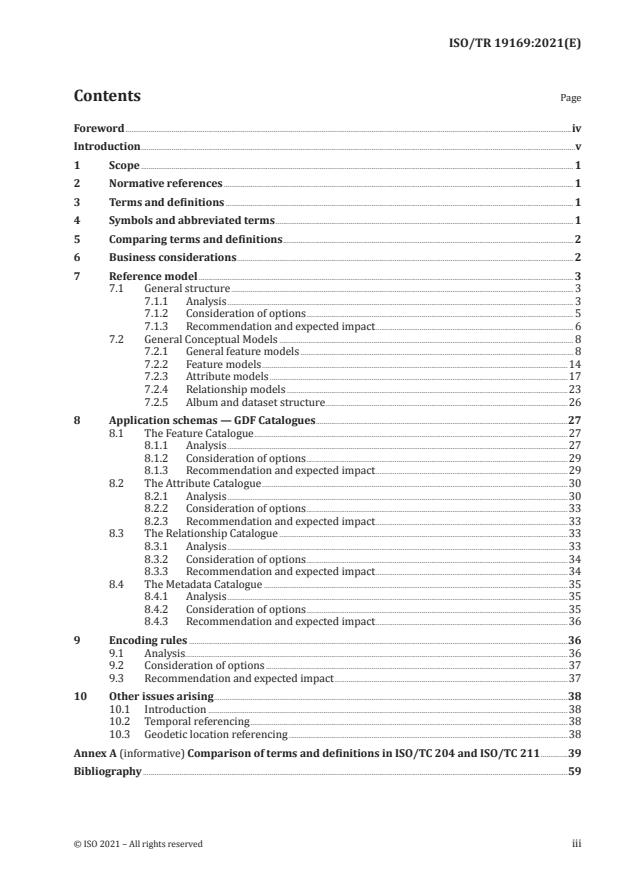
Contents Page
Foreword .iv
Introduction .v
1 Scope . 1
2 Normative references . 1
3 Terms and definitions . 1
4 Symbols and abbreviated terms . 1
5 Comparing terms and definitions . 2
6 Business considerations . 2
7 Reference model . 3
7.1 General structure . 3
7.1.1 Analysis . 3
7.1.2 Consideration of options . 5
7.1.3 Recommendation and expected impact . 6
7.2 General Conceptual Models . 8
7.2.1 General feature models . 8
7.2.2 Feature models .14
7.2.3 Attribute models .17
7.2.4 Relationship models .23
7.2.5 Album and dataset structure .26
8 Application schemas — GDF Catalogues .27
8.1 The Feature Catalogue .27
8.1.1 Analysis .27
8.1.2 Consideration of options .29
8.1.3 Recommendation and expected impact .29
8.2 The Attribute Catalogue .30
8.2.1 Analysis .30
8.2.2 Consideration of options .33
8.2.3 Recommendation and expected impact .33
8.3 The Relationship Catalogue .33
8.3.1 Analysis .33
8.3.2 Consideration of options .34
8.3.3 Recommendation and expected impact .34
8.4 The Metadata Catalogue .35
8.4.1 Analysis .35
8.4.2 Consideration of options .35
8.4.3 Recommendation and expected impact .36
9 Encoding rules .36
9.1 Analysis.36
9.2 Consideration of options .37
9.3 Recommendation and expected impact .37
10 Other issues arising .38
10.1 Introduction .38
10.2 Temporal referencing .38
10.3 Geodetic location referencing .38
Annex A (informative) Comparison of terms and definitions in ISO/TC 204 and ISO/TC 211 .39
Bibliography .59
Foreword
ISO (the International Organization for Standardization) is a worldwide federation of national standards
bodies (ISO member bodies). The work of preparing International Standards is normally carried out
through ISO technical committees. Each member body interested in a subject for which a technical
committee has been established has the right to be represented on that committee. International
organizations, governmental and non-governmental, in liaison with ISO, also take part in the work.
ISO collaborates closely with the International Electrotechnical Commission (IEC) on all matters of
electrotechnical standardization.
The procedures used to develop this document and those intended for its further maintenance are
described in the ISO/IEC Directives, Part 1. In particular, the different approval criteria needed for the
different types of ISO documents should be noted. This document was drafted in accordance with the
editorial rules of the ISO/IEC Directives, Part 2 (see www .iso .org/ directives).
Attention is drawn to the possibility that some of the elements of this document may be the subject of
patent rights. ISO shall not be held responsible for identifying any or all such patent rights. Details of
any patent rights identified during the development of the document will be in the Introduction and/or
on the ISO list of patent declarations received (see www .iso .org/ patents).
Any trade name used in this document is information given for the convenience of users and does not
constitute an endorsement.
For an explanation of the voluntary nature of standards, the meaning of ISO specific terms and
expressions related to conformity assessment, as well as information about ISO's adherence to the
World Trade Organization (WTO) principles in the Technical Barriers to Trade (TBT), see www .iso .org/
iso/ foreword .html.
This document was prepared by Technical Committee ISO/TC 211, Geographic information/Geomatics.
Any feedback or questions on this document should be directed to the user’s national standards body. A
complete listing of these bodies can be found at www .iso .org/ members .html.
iv © ISO 2021 – All rights reserved
Introduction
0.1 Background
From the start, GDF (Geographic Data Files) was based on similar geospatial concepts as ISO/TC 211
standards (the ISO 19100 family of standards). Over the years, GDF has been specified to provide
data structures to support a range of transport-related applications and in-car navigation systems.
GDF forms the basis of today's solutions used by TomTom, HERE and other navigational systems. The
ISO 19100 family of standards created by ISO/TC211 remain the conceptual basis for general geospatial
purposes. The basic concepts standards of the ISO 19100 family do not support any specific application
domains but have been widely adopted by the geospatial industry; ISO/TC211 standards also underpin
key European legislation such as the INSPIRE Directive.
With the emergence of increasingly connected and automated road vehicles, there is a need to share
geospatial information between the vehicle’s navigational and contextual awareness systems and the
mapping and road authorities (the road-side actors). The exchange of map-data between these actors
requires extensive interpretations and transformation rules to make sure that the map-data in the on-
board car navigation systems is aligned with that of the road-side actors, and that exchanges of data
robustly support safety and efficiency applications in an unambiguous, coherent way.
GDF continues to be developed to adapt to the requirements of road vehicle automation, as well as wider
domains of application, such as public transport, geospatial and navigation data. A lack of alignment
between GDF key concepts and those of ISO/TC211 standards reduces the collective efficacy of the
combined standards, increases the complexity of utilizing standards-conformant data in an efficient
manner and increases the risk and threats arising from ineffective conversions. This is not efficient,
and is mostly due to the lack of harmonization between the conceptual models of GDF and ISO/TC 211
standards.
Both models are in extensive use: GDF in the vehicle in-car navigation industry and the ISO 19100 family
of standards in the geospatial industry and with public authorities worldwide. Thus, it is not a non-
disruptive option for one group of actors to switch to the other base of standards – nor indeed are these
standards directly functionally equivalent. Therefore, the work underpinning this document aims to
identify the gaps between the two concepts and suggest ways to bridge them.
First, there is a need to perform a gap analysis, and then after that, suggest means to bridge the gap
and finally decide how to create standards or application schemas to accommodate the harmonization
that is necessary. The identification of opportunities to adjust concepts to align GDF and ISO/TC 211
concepts supports the need to achieve an improved interoperability of road and vehicle data systems,
and geospatial datasets in wider usage.
Within this document, comparative analysis and recommendations are provided. At a broad level,
the analysis and recommendations suggest modifications to GDF to make an ISO 19100 family-based
application schema in order to:
— make GDF ready to accommodate automated vehicles with support from ISO/TC 211;
— enable map data exchange between all actors (car makers, map makers, mapping authorities and
road owners);
— align with ISO/TC 211-based standards and related technology used by European institutions,
directives, CEN and in European-wide platforms like TN-ITS and DATEX II, and international
stakeholder groups such as TISA.
During the development of this document, various iterations of the GDF have been used and reviewed.
The current published version of GDF, known as GDF v5.1, Part 1, has been published as ISO 20524-1,
published 2020-03-30, and ISO 20524-2, published 2020-11-30. These documents revise the previously
used ISO 14825:2011, known as GDF v5.0. ISO 14825:2011 has been withdrawn. The analysis within
this document uses GDF v5.1 (ISO 20524-1 and ISO 20524-2) as a reference baseline.
0.2 Overview of recommendations
0.2.1 General
This subclause brings together the recommendations that have been made throughout the body of
this document. Each recommendation is summarized; in each case the reader is advised to review the
relevant referenced clause for the full explanation. Also, in each case, the primary actor expected to
address the recommendation is listed.
0.2.2 Model structure
See subclauses 7.1 and 7.2.1.
A more specific modularization of GDF according to the structure of the ISO 19100 family of standards
is recommended to simplify maintenance, revision and reuse of the concepts in the document. Specified
relations between the GDF Overall Conceptual Data Model and concepts from the ISO 19100 family of
standards is recommended to improve interoperability and reduce the need for specific GDF concepts.
It is recommended that the generic feature model and the feature catalogue model in the GDF GDM be
divided into specific models for a Generic Feature Exchange Model and a Feature Catalogue Model. The
models are recommended to be defined as application schemas according to ISO 19109 and prepared
for model-driven implementation.
There is a need for further studies on how to define the belt concept and the location referencing of GDF
features in general in terms of ISO/TC 211 standards.
There is a need to achieve a greater clarity of linear referencing of belts.
To be addressed by ISO/TC 204 and ISO/TC 211.
0.2.3 General Conceptual Models
See subclause 7.2.
It is recommended that the internal GDF stereotypes “Feature”, “Attribute” and “Relationship” be
replaced with the ISO 19109 stereotype “FeatureType”.
The core classes Feature and Attribute are recommended to be used only in the Generic Feature
Exchange Model, while a specific superclass for feature classes is recommended to be used in the
Feature, Attribute and Relationship Catalogues. The core Relationship class can be removed from the
GDF GDM.
The conceptual models for attribute types and attribute values are recommended to be defined as
metamodels to achieve an improved structure with a specified level of abstraction for concepts in
the GDF model. The metamodels ought to extend the ISO 19109 GFM in order to achieve improved
interoperability with models in, or based on, the ISO 19100 family.
It is recommended that the definition of a Feature in GDF be modified to include real-world phenomena
that are not physical. Furthermore, it is recommended that classes for logical placement be evaluated
and possibly changed to location referencing classes.
The album and dataset model are recommended to be defined in an application schema according to
rules in ISO 19109. The model ought to include the data organization structure and the generic feature
exchange model. To be addressed by ISO/TC 204.
0.2.4 The GDF Catalogues
See Clause 8.
It is recommended that the GDF Feature, Attribute and Relationship Catalogues be modelled as
application schemas according to rules in ISO 19109. The GDF Metadata Catalogue is recommended to
be modelled as a part of the model for album and dataset, with reuse of elements defined in ISO 19115-1.
vi © ISO 2021 – All rights reserved
It is recommended that a core superclass to replace the use of the classes Feature, Attribute and
Relationship in the Feature, Attribute and Relationship Catalogues be defined.
The listing of unique IDs in ISO 20524-1:2020, A.1, A.2 and A.3 ought to be a report from the UML model,
in order to maintain consistency. To be addressed by ISO/TC 204.
0.2.5 Encoding rules
It is recommended that GML implementation schemas for GDF be derived from the GDF application
schemas. In order to enable handling of requirements for attribute content in GML, it is recommended
that ISO/TC 211 seek to revise or amend ISO 19109 and ISO 19136-1 to facilitate such requirements.
If the two existing implementation encodings (MRS and GDF-XML) are to be maintained, specified
conversion rules ought to be defined in order to enable conversions from the UML model. To be
addressed by ISO/TC 204 and ISO/TC 211.
0.2.6 Aligning terminology
Annex A illustrates a continued difference between the definition of defined terms found in the GDF
standards (ISO 20524-1 and ISO 20524-2) or ISO/TC 204 and definitions found in the ISO 19100 family
of standards from ISO/TC 211. It is recommended that ISO/TC 211 lead activities to seek improved
harmonization of defined terms and their definitions across the TCs. To be addressed by ISO/TC 204
and ISO/TC 211.
0.2.7 Aligning GDF time domain syntax with other ISO standards
It is recommended that a detailed analysis of the syntax characteristics supported by GDF and
a comparison to the characteristics offered by the ISO 8601 series and ISO 19108 be undertaken in
advance of preparation of future revisions of GDF (ISO 20524 series), with the aim of adopting ISO 8601
series and ISO 19108 conformant syntax mechanisms. To be addressed by ISO/TC 204 and ISO/TC 211.
0.2.8 Adding epoch value to dynamic coordinate reference system in GDF
Concern has been raised that GDF needs to differentiate between the use of 'static' and 'dynamic'
coordinate reference systems, and add the epoch value in referencing to 'dynamic' CRS. To be addressed
by ISO/TC 204.
TECHNICAL REPORT ISO/TR 19169:2021(E)
Geographic Information — Gap-analysis: mapping and
describing the differences between the current GDF
and ISO/TC 211 conceptual models to suggest ways to
harmonize and resolve conflicting issues
1 Scope
This document maps and describes the differences between GDF (ISO 20524 series), from ISO/TC 204,
and conceptual models from the ISO 19100 family, from ISO/TC 211, and suggests ways to harmonize
and resolve issues of conflict.
Throughout this document, reference to GDF refers to GDF v5.1, ISO 20524-1 and ISO 20524-2, unless
expressly identified otherwise. Where necessary, reference will be made to Part 1 or Part 2.
2 Normative references
There are no normative references in this document.
3 Terms and definitions
No terms and definitions are listed in this document.
ISO and IEC maintain terminological databases for use in standardization at the following addresses:
— ISO Online browsing platform: available at https:// www .iso .org/ obp
— IEC Electropedia: available at https:// www .electropedia .org/
NOTE Geospatial terms occurring in ISO/TC 211 standards can also be found in https:// isotc211 .geolexica
[21]
.org/ .
4 Symbols and abbreviated terms
The following abbreviated terms apply:
ADAS advanced driver assistance systems
CRS coordinate reference system
GDF GDM geographic data files general data model
GDF geographic data files
GFM general feature model
GIS geographic information system
GML geography markup language
HD high definition
ITS intelligent transport systems
MC&G mapping, charting and geodesy
MDA model driven architecture
MRS media record structure
OEM(s) original equipment manufacturer(s)
OWL web ontology language
POI point of interest
UML unified modelling language
DIGEST digital geographic information exchange standard
5 Comparing terms and definitions
Throughout the later clauses of this document there is discussion concerning a comparison and
recommendations for improved alignment of the defined terms and their definitions used in GDF and
the ISO 19100 family.
In addition, Annex A provides a revised and updated version of a comparison of terms and definitions
found in GDF and the ISO 19100 family presented in a tabular form. The basis for the content of Annex A
is drawn from ISO 19132:2007, Annex E. This content has been updated to both reflect current terms
and definitions found in the latest available editions of GDF and standards within the ISO 19100 family.
Where the recommendations made in this document would result in modification of these defined
terms and definitions, these are highlighted.
6 Business considerations
Geospatial datasets have hugely widescale application across every sector of commerce, industry and
society. As such, the underpinning and interoperability provided by conformance to the geospatial
standards defined by ISO/TC 204 and ISO/TC 211 in conjunction with OGC, the Open Geospatial
Consortium, provide key tools for interoperability. These standards are widely adopted within the
Intelligent Transport Systems (ITS) domains and within Geographic Information Systems (GIS) and
geographic-enabled software and systems across many domains respectively.
Geospatial datasets relating to road networks are used for a very wide range of purposes, for example,
navigation, asset management, network management, incident response, road design, drainage, acoustic
propagation, land use planning and access planning, to name a few. Importantly, like other transport
networks, road networks significantly interface and interact with other non-highway features, such
as end-point destinations, POI gazetteers, footways, rights of way, soft estate, rail and water networks,
points of access, public transport interfaces, etc. Coherence of the standards underpinning all of these
geospatial data sets is important for interoperability and cross-domain interactions, analysis and
applications and services.
Within road networks, and the domain of ITS, detailed geospatial information that represents road
networks and the surrounding road environment is a critical component for route planning and
navigation. Advanced Driver Assistance Systems (ADAS) and systems for automated driving depend
on accurate and updated geospatial information from a variety of sources for the complete knowledge
needed for legal and safe navigation. Modern road vehicles are increasingly equipped with sensor
technologies. The outputs from these on-board sensors, and other sensors at the roadside, can be used
to generate and create local contextual geospatial knowledge, and can share this information with
map providers, Original Equipment Manufacturers (OEMs) and other road users. This sensor-derived
data can be very transitory and dynamic in nature, or can indicate detection of permanent change.
However, the local knowledge is neither sufficient for route planning nor for local navigation under
challenging conditions, such as fog or snow-covered roads, or where road maintenance activities such
2 © ISO 2021 – All rights reserved
as road closures are present; it needs to be combined with geospatial information from pre-processed
databases covering larger areas.
Commercial map providers and OEMs create and deliver ITS databases and services for the users of
ITS applications for route planning, navigation and other services. These products and services are
being extended to support ADAS and automated driving with higher integrity map data, so-called
High Definition (HD) maps. Map providers and OEMs need reliable and harmonized mechanisms that
can provide them with information from authorities and other sources for further sharing with the
road users, and for simulation and testing. Sharing information from authorities can improve the
data quality of ITS databases for route planning and navigation and thereby improve public safety,
reduce the risk of damage to infrastructure, improve strategic use of the road network and improve
the quality of mobility services. To enable the flow of information, models that describe the real world
and specifications for information exchange are needed; the harmonization and consistency of these
models and specifications, ought to reduce translation losses and errors, and improve opportunities for
service developments to reach the widest audiences possible.
7 Reference model
7.1 General structure
7.1.1 Analysis
A standardized methodology for information modelling is a core foundation for a digital representation
of real-world features and events. The ISO 19100 family from ISO/TC 211, as well as GDF from
ISO/TC 204, are based on the approach described in ISO 19103 and illustrated in Figure 1: a portion of
the real world, referred to as the universe of discourse, is perceived in a specific context (e.g. geographic
application in general, or navigation specifically) and defined in a conceptual model. The conceptual
model is formally described and represented in a conceptual schema. The conceptual schema is
described by use of a conceptual schema language. For this purpose, both GDF and the ISO 19100 family
[10]
apply the Unified Modelling Language (UML) .
Figure 1 — Information modelling (adapted from ISO 19103)
The standards in the ISO 19100 family are based on the concepts of a Model-Driven Architecture
[11]
(MDA) and a specific use of UML defined in the UML profile in ISO 19103 and the General Feature
Model (GFM) defined in ISO 19109. The founding principle in MDA is that models (represented in
schemas) are defined for different levels of abstraction. Furthermore, the conceptual schemas are
independent of specific implementation technologies. This brings benefits of being able to create
multiple technology-dependent implementations from common abstract models.
ISO 19103 defines four levels of abstraction for the use of MDA for geographic information, as illustrated
in Figure 2.
Within Figure 2:
— The top level contains the metamodels that define how information models is to be specified, e.g.
the UML Metamodel.
— The second level contains abstract schemas with basic concepts for representing e.g. geometry, time
and coordinate reference systems.
— The third level describes application schemas for specific applications such as 3D City Models or
road networks. The application schemas reuse concepts from the abstract schemas.
— Finally, the fourth level contains implementation schemas for specific implementation technologies.
Specific rules for conversion from UML to individual implementation technologies (such as XML,
GML, JSON, etc.) are applied to derive implementation schemas from the application schemas.
Figure 2 — Model Driven Architecture (MDA) as defined in ISO 19103 (adapted from
Reference [12])
The scope of ISO/TC 211 has mainly been to develop conceptual schemas in the two top levels of
abstraction as defined in ISO 19103. The core standards ISO 19103 and 19109 define metamodels and
modelling rules at the top level, while the majority of standards in the ISO 19100 family are defined as
abstract conceptual schemas. Application specific schemas for geospatial purposes are, in general, not
developed by ISO/TC 211, but rather by national or regional authorities, agencies or organizations.
Information modelling based on MDA has been applied for standards in the ITS domain as well, e.g.
in the ISO 21219 TPEG2 series for traffic and travel information services and the European public
transport standards such as CEN 12896 Transmodel and the CEN 16157 DATEX II series for traffic
information exchange. These standards are based on modelling and conversion rules that are similar
but not identical to rules in the ISO 19100 family.
The GDF standard (both the withdrawn ISO 14825:2011 [GDF v5] and the current revisions of GDF,
ISO 20524-1 and ISO 20524-2 [GDF v5.1]) contains a complete specification of concepts from several
4 © ISO 2021 – All rights reserved
levels of abstraction according to the structure in Figure 2, ranging from a metamodel to implementation
schemas. The GDF standard does not have a clear separation of the different levels of abstraction. In
order to perform a comparison between concepts defined in GDF and the ISO 19100 family, a mapping
from the structure of GDF to the MDA structure in ISO 19103 is suggested in Figure 3. Further details
are discussed in subsequent clauses of this document.
Figure 3 — Suggested mapping of GDF clauses to ISO 19103 MDA structure
Explanation of Figure 3:
— Clause 5 in GDF defines the Overall Conceptual Data Model which forms the fundamentals for the
catalogues that are defined in GDF Clauses 6, 7, 8 and 10. The Overall Conceptual Data Model is
partly a metamodel that defines specific UML concepts, and partly an abstract conceptual schema
for reuse in the catalogues.
— The Feature model in GDF subclause 5.2 is implemented as a generic model for feature exchange and
can be considered an application schema.
— The Structure model in GDF subclause 5.8 can also be considered an application schema, implemented
in GDF Clause 11.
— The GDF catalogues in GDF Clauses 6, 7, 8 and 10 are directly comparable to the application schema
level.
— The implementation specifications described in Clauses 11, 12, and 13 can be defined as
implementation schemas in the MDA levels of abstraction. Clause 11 realizes the structure defined
in GDF subclause 5.8 and describes the logical structure independent of file or database format.
Clauses 12 and 13 describe implementation in specific technologies.
— Clause 9 in GDF describes feature representation rules which can be considered more a cartographic
issue that is independent of the modelling structure.
7.1.2 Consideration of options
The MDA approach has clear advantages for interoperability, reuse and revision of schemas and has
been successful for the development of interoperable standards in the GIS domain. This is also true
for several domain application areas within the ITS domain, as described in subclause 7.1.1 of this
document. The metamodels and the abstract conceptual schemas from the ISO 19100 family are
reused in application schemas world-wide, defined by national and regional authorities, agencies
and organizations representing a wide range of geospatial information. Implementation schemas
for database and exchange formats are derived from the application schemas, and large amounts of
[13]
structured geospatial information is maintained according to the application schemas .
Furthermore, the core concepts from the ISO 19100 family have been implemented in the majority of
GIS software. This enables the exchange of information according to the ISO 19100 family between
stakeholders and software. Developers of application schemas can select to reuse specific parts
and versions of abstract schemas, and schemas in separate standards can be revised individually.
As different application schemas are founded on the same abstract concepts, conversions between
different application schemas are possible. Examples of such conversions are mapping from national
application schemas in European states to the common INSPIRE application schemas for the European
Union.
The GDF standard reuses some concepts from the metamodels and abstract schemas defined in the
ISO 19100 family of standards. Additionally, some specific concepts are defined in the Overall Conceptual
Data Model in GDF. The previous structure of GDF with the whole range of concepts defined in one
standard has the advantage that implementers need to consider only one standard, in isolation, based
on current editions. However, a module-based approach would be preferred to simplify maintenance
of individual parts of the standard suite. Furthermore, the lack of precise reuse of concepts from the
ISO 19100 family is a challenge for interoperability, exchange and reuse of information between the GIS
and ITS domains.
Finally, implementation schemas for GDF are not derived directly from application schemas but have
been created manually. This approach is time-consuming, error prone and can lead to differences
between conceptual schemas and implementation schemas.
7.1.3 Recommendation and expected impact
A more specific modularization of GDF according to the structure of the ISO 19100 family of standards
is recommended to simplify maintenance, revision and reuse of the concepts in the standard. A
modularization can be performed within the main GDF standards, or through Parts or a series of
standards as in the ISO 19100 family and the various Parts of the ISO 21219 series. The latter is a
preferable solution for maintenance and revision. Furthermore, specified relations between the GDF
Overall Conceptual Data Model and concepts from the ISO 19100 family is recommended to improve
interoperability and reduce the need for specific GDF concepts. Finally, implementation schemas can be
derived from application schemas, following conversion rules as defined in the ISO 19100 family.
Note As mentioned in subclause 7.1.1 of this document, the MDA approach and the derivation of
implementation schema direct from application schema successfully underpins a number of series of standards
in the ITS domain. The conversion rules adopted for this purpose do differ between each series of standards.
For the purpose of alignment of GDF with the ISO 19100 family, use of the conversion rules defined in ISO 19100
family standards is recommended (ISO 19118, ISO 19136 series, ISO/TS 19139-1). Specific conversion rules for
other implementation technologies as defined in GDF Clauses 11, 12 and 13 can need some modifications to be
applied in an MDA-based derivation of implementation schemas. It is recommended to define conversion rules
following the MDA approach according to requirements in ISO 19118.
A prototype model that can be a foundation for a modularized GDF, based on ISO 19100 family
standards, is suggested in Reference [14] and illustrated in Figure 4. The model is based on the General
Feature Model from ISO 19109 and the Feature Catalogue model from ISO 19110. Three main application
schemas are suggested in Reference [14]: the Feature Catalogue, the Feature Catalogue Exchange Model
and the Feature Exchange Model. Further details are to be found in Reference [14]. Figure 5 presents
the proposed configuration of the suggested model in an MDA structure.
Compared to the existing GDF standard, the Overall Conceptual Model in Figure 5 corresponds to the
basic concepts in Clause 5 of GDF (ISO 20524-1). The Feature, Attribute, Relationship and Metadata
Catalogue Application Schemas correspond to the existing Clauses 6, 7 and 8 of GDF. The Catalogue
Exchange Model and the Feature Exchange Model are Application Schemas based on the Overall
Conceptual Model and correspond to parts of Clause 5 of GDF.
6 © ISO 2021 – All rights reserved
Figure 4 — Suggested modularization of GDF (adapted from Reference [14])
Figure 5 — Suggested modularization of GDF in an MDA structure
7.2 General Conceptual Models
7.2.1 General feature models
7.2.1.1 Analysis
ISO 19109 describes a General Feature Model (GFM) for geographic information. The model is defined
as a metamodel according to the MDA structure in ISO 19103 (see Figure 2) and specifies the use of
UML concepts for development of application schemas of geographic information. The ISO 19109 GFM is
shown in Figure 6.
The core concepts of the ISO 19109 GFM are the metaclasses for FeatureType, PropertyType with
specializations AttributeType, Operation and FeatureAssociationRole, and FeatureAssociationType.
The metaclasses are instantiated in conceptual models through core UML concepts:
— FeatureType is instantiated as UML Classes.
— AttributeType is instantiated as attributes of UML Classes.
— Operation is instantiated as operations on UML Classes.
— FeatureAssociationRole is instantiated in UML Classes through the roles on the connecting ends of
associations to other UML Classes.
— FeatureAssociationType is instantiated as associations between UML Classes, and can be further
refined to compositions or aggregations. FeatureAssociations can also be instantiated as UML
Association Classes with attributes.
The use of the core ISO 19109 GFM concepts in other models are further discussed in subsequent
clauses.
NOTE 1 An Association Class is a complex UML concept that is subtyped from both the Association and
Class concepts in the UML Metamodel. Association Classes have rarely been used in models in, or based on, the
ISO 19100 family. Classes (feature types) associated with other classes through FeatureAssociationRoles have
been used for this purpose.
8 © ISO 2021 – All rights reserved
NOTE 2 FeatureAssociationType was a subtype of FeatureType in the first edition of ISO 19109 (2005). The
subtyping was removed in the current edition (2015), as it was not used in models and could lead to unexpected
abnormalities such as abstract associations and associations with associations. FeatureType classes with
FeatureAssociationRoles are recommended for representing a phenomenon with associations to another
phenomenon.
Figure 6 — The General Feature Model (GFM) from ISO 19109
ISO 19110 describes a conceptual model for Feature Catalogues, defined as a realization of the GFM. The
feature catalogue model defines the core concepts for catalogues of feature types, property types and
feature association types from the ISO 19109 GFM, as illustrated in Figure 7.
— The class FC_FeatureType is a realization of the ISO 19109 GFM metaclass FeatureType.
— The classes FC_PropertyType, FC_FeatureAttribute, FC_FeatureOperation and FC_AssociationRole
are realizations of the ISO 19109 GFM metaclasses PropertyType, AttributeType, Operation, and
AssociationRole respectively.
— The class FC_FeatureAssociation is a realization of the GFM metaclass FeatureAssociationType.
NOTE 3 The class FC_FeatureAssociation is subtyped from FC_FeatureType, like in the GFM in the first edition
of ISO 19109 (2005). It is not clear why this subtyping is still present in the revised version of ISO 19110, but it
makes it possible to describe associations between two FeatureTypes in the feature catalogue as an Association
Class with attributes.
Figure 7 — Conceptual model of a feature catalogue with realization from the ISO 19109 GFM,
from ISO 19110
The core model of GDF (ISO 20524-1) is the General Data Model (GDM), defined in Clause 5 of GDF and
illustrated in Figure 8 (from ISO 20524-1:2020, Figure 8). The GDF GDM serves several purposes in the
standard:
— It is defined in GDF subclause 5.1 (ISO 20524-1) to be a metamodel, though the concepts are not
modelled as metaclasses. The core concepts for Features, Attributes and Relationships are modelled
as regular UML classes and reused as supertypes in the Feature, Attribute and Relationship
Catalogues respectively.
— It defines the generic model of a feature catalogue with FeatureClasses, FeatureThemes and
FeatureCategories. The feature catalogue model is implemented as tables in Annex A of GDF
(ISO 20524-1).
— It is used in the implementation specifications for GDF, with classification of feature types based on
geometry and topology type. All features, relationships and attributes are instantiated as generic
types with relations to identifiers in the catalogues. This implementation is an essential feature in
GDF that reduces data set redundancy in a data file.
10 © ISO 2021 – All rights reserved
Figure 8 — The General Data Model of GDF
The GDF GDM also includes the concept of complex features as implementable subtypes of Feature. A
complex feature consists of other features as feature parts, as shown for planar topology features in
Figure 9.
Finally, GDF part 2 describes a specific type of area features, named a belt. A belt is a feature with a
defined set of surrounding lines: side lines that represent the sides (e.g. road markings or road edges)
and terminal lines that represent the ends. The belt feature has at least one direction that represents
an orientation of the feature as a property. A belt feature is discriminated from an a
...