

ISO/PRF 22382
(Main)Security and resilience — Authenticity, integrity and trust for products and documents — Guidelines for the content, security, issuance and examination of tax stamps
- Abstract
This document gives guidelines for the content, security, issuance and examination of physical tax stamps and marks used to indicate that the required excise duty or other applicable taxes identified with an item have been paid and to signify that the item is legitimately on the intended market. Specifically, this document gives guidance on: — defining the functions of a tax stamp; — identifying and consulting with stakeholders; — planning the procurement process and selection of suppliers; — the design and construction of tax stamps; — the overt and covert security features that provide protection of the tax stamp; — the finishing and application processes for the tax stamp; — security of the tax stamp supply chain; — serialization and unique identifier (UID) codes for tax stamps; — examination of tax stamps; — monitoring and assessing tax stamp performance. This document is applicable only to tax stamps that are physical in nature and apparent to the human senses of sight (with the aid of a revealing tool if necessary) or touch, applied to a consumer good or its packaging and which allow material authentication. When the term "authentication" is used in this document, it refers only to the authentication of the tax stamp, not to the product on which the tax stamp is affixed. This document does not apply to systems or procedures that an issuing authority has in place to control and monitor its excise revenue collection, except by reference to them where they have an impact on the design or specification of tax stamps.
- Status
- Not Published
- Technical Committee
- ISO/TC 292 - Security and resilience
- Current Stage
- 5020 - Proof sent to secretariat or FDIS ballot initiated: 8 weeks - 50 Approval
- Start Date
- 19-Nov-2026
Buy Documents
ISO/PRF 22382 - Security and resilience — Authenticity, integrity and trust for products and documents — Guidelines for the content, security, issuance and examination of tax stamps
REDLINE ISO/PRF 22382 - Security and resilience — Authenticity, integrity and trust for products and documents — Guidelines for the content, security, issuance and examination of tax stamps
ISO/PRF 22382 is an ISO guideline for the content, security, issuance and examination of physical tax stamps and marks. It is written for tax authorities and their suppliers, and it explains how to specify, procure, protect, issue, apply, authenticate and monitor tax stamps that show the applicable tax has been paid and that the item is legitimately on the intended market.
What does ISO/PRF 22382 specify?
ISO/PRF 22382 specifies guidelines for physical tax stamps and marks used on consumer goods or their packaging. It applies only to stamps that can be perceived by sight or touch and that support material authentication.
The document also limits what it covers: when it uses the term authentication, it means authentication of the tax stamp itself, not of the product carrying the stamp. It also excludes the tax authority’s internal revenue collection systems and procedures, except where those procedures affect stamp design or specification.
The document is organized into clauses on scope, normative references, terms and definitions, tax stamp functions, the overall process, procurement, physical construction, printing, unique identifiers, supply and distribution security, delivery, examination, and monitoring and assessment. It also includes informative annexes A to I that provide supporting guidance on procurement, design, substrates, comparison of approaches, authentication features, security-feature ratings, printing techniques, and examination tools.
| Annex | What it covers |
|---|---|
| A | Request for proposal guidance |
| B | Design, position and construction factors |
| C | Material tax stamp substrates |
| D | Comparison of material tax stamps and direct marking |
| E | Material tax stamp authentication features |
| F | Direct-marked tax stamp authentication features |
| G | Rating of security features |
| H | Summary of printing techniques |
| I | Authentication tools and usage |
What are the key requirements of ISO/PRF 22382?
ISO/PRF 22382 guides the tax authority through the full tax stamp lifecycle, from deciding the stamp’s function to checking how well it performs in use. The main practical message is that tax stamp programmes should be designed from the start around risk, supply-chain control, and field examination.
Functions and programme design
Clause 4 says the tax authority should decide what the stamp is for before finalizing the programme. The core function is tax collection, but the document also describes traceability, market monitoring, consumer reassurance, and other administrative or legislative functions.
That matters because a stamp designed only as proof of payment may not support traceability or consumer-facing verification. The authority is expected to decide which functions matter, then build the specification around them.
Procurement and stakeholder consultation
Clause 6 requires stakeholder consultation before final procurement decisions are made. Stakeholders can include manufacturers, importers, distributors, retailers, tax stamp providers, law enforcement, and consumer representatives.
The clause also calls for a needs assessment and a risk assessment. In practice, this means the authority should justify the programme, identify threats such as evasion and organized crime, and use those findings to shape the stamp design and security level.
Clause 6 also sets out a procurement sequence: request for information, shortlist, request for proposal, proposal evaluation, and contract award. It also addresses rights in the tax stamp artwork and asks the authority to define ownership and permitted use in the contract.
Construction, printing and tamper evidence
Clause 7 covers physical tax stamp construction, including size, position, substrate, inks, adhesives, authentication features, laminate and UID. It emphasizes layered security, meaning overt and covert features should be combined according to the assessed threat.
Clause 7.3 focuses on tamper evidence. The authority should choose materials and adhesives that make reuse, removal or replacement difficult, and evaluate whether the stamp clearly shows opening or tampering. In practice, this is what makes a stamp useful as a closure seal or anti-diversion measure.
Clause 8 then discusses printing. It distinguishes analogue printing, digital printing and direct marking, and notes that digital printing and direct marking are especially important for variable data such as serial numbers and UIDs. The authority should match the printing method to the security objective and to who will examine the stamp.
UID, serialization and traceability
Clause 9 says each tax stamp should have a unique identifier (UID). The UID may be sequential or randomized, but it must be unique and securely generated.
This is important because the UID is the key to monitoring issuance, application, reconciliation and movement through the supply chain. The clause also says the authority should decide how the UID will be read, whether by human senses, barcode, data matrix, QR code, or RFID tag, and should protect the UID against copying or interference.
Supply chain security, activation and reconciliation
Clause 10 covers production security, distribution security, issuance, application, activation, handling of unused or damaged stamps, invalid direct marks, and recording and reconciliation. The authority should control each step so stamps cannot be stolen, diverted, duplicated or used out of sequence.
In practice, this means secure premises, secure transport, controlled issuance to legitimate appliers, one-to-one stamp-to-product control, readable marking checks, and accounting for damaged or unused stamps. The document also expects the authority to decide when activation happens, such as at production, issue, application or first movement in the distribution chain.
Examination, monitoring and assessment
Clause 12 defines four examination levels, from quick human-sense inspection to forensic analysis. The authority should match the level to the examiner’s training and equipment, and can use smartphones where appropriate.
Clause 13 requires ongoing monitoring and assessment. The authority should test the stamp in realistic or adversarial conditions, check quality and conformity from different points in the supply chain, and update the programme when weaknesses are found.
What terms does ISO/PRF 22382 define?
- Activation - the stage when a tax stamp becomes live as a record that applicable taxes have become due.
- Authentication - the process of verifying that a tax stamp is genuine, with a defined level of assurance.
- Direct marking - applying tax stamp information directly onto the product or its packaging by laser marking, printing or similar methods.
- Tax stamp - a visible stamp, label or mark placed on goods to show that the applicable tax has been paid.
- Traceability - the use of coded unique identifiers to let the tax authority recreate events as a taxable product moves through the supply chain.
- UID - a unique identifier, meaning a sequence or code linked to one specific set of attributes within a defined system.
- Tamper evidence - the ability of a stamp to reveal that it has been compromised by tampering.
- Tax authority - the government agency responsible for collecting the applicable tax and specifying and designing tax stamps.
Who uses ISO/PRF 22382?
ISO/PRF 22382 is used by tax authorities and revenue authorities that plan or run tax stamp programmes. It is also relevant to manufacturers, packagers, importers, distributors and retailers that apply or verify tax stamps on taxable products.
The document is useful for tax stamp providers, security printers, software and equipment suppliers, and subcontractors that support serialization, activation, printing or examination. It also supports law enforcement, customs, forensic laboratories and other inspection bodies that need to authenticate stamps in the field or in the lab.
What changed in ISO/PRF 22382 from the previous edition?
ISO/PRF 22382 is the second edition and it cancels and replaces ISO 22382:2018. The foreword states that the revision is technically revised.
The stated changes are:
- terminology aligned with ISO 22300, with only tax-stamp-specific terms kept in Clause 3
- additional references added for standards published since the first edition
- clause order adjusted to be more logical for revenue authorities
- updates and minor amendments throughout the document
- Clause 8.2 on digital printing and Clause 8.3 on direct marking expanded and updated
- a new Annex G on rating of security features
Which standards are used with ISO/PRF 22382?
| Standard | What it contributes |
|---|---|
| EN ISO 22300:2025 / ISO 22300 | Vocabulary used throughout the document |
| ISO 22381 | Interoperability among object identification systems |
| ISO/DIS 22373 | Trustworthy supply and value chains |
| ISO 31000 | Risk management guidance for assessments |
| IEC 31010 | Risk assessment techniques |
| ISO 22380 | Product fraud risk and countermeasures |
| ISO 14298 | Security printing process management |
| ANSI SMS 02-2024 | Security management standard for secure suppliers |
| ISO 22388 | Guidance for securing physical documents and security-feature rating |
| ISO 22385 | Framework for trust and interoperability |
| ISO 22376 | Visible digital seal data format |
| ISO 22387 | Validation of artefact metrics and physical unclonable functions |
| ISO 37001 | Anti-bribery management systems |
What does the ISO/PRF 22382 document contain?
ISO/PRF 22382 contains a process overview figure, a procurement process figure, and detailed clause text on how to plan and operate a tax stamp programme. It also includes practical guidance on RFI and RFP content, supplier selection, rights management, issuance controls, activation, reconciliation and examination.
Several annexes provide implementation detail without repeating the main clauses. Annex B shows design and construction factors, Annex C gives substrate guidance for typical packaging and containers, and Annex D compares material tax stamps with direct marking. Annex E and Annex F describe authentication features for material and direct-marked stamps, while Annex G provides a way to think about security features against different threats.
The document also includes a summary of printing techniques in Annex H and an authentication-tool guide in Annex I. These annexes are aimed at design, procurement, testing, field inspection and forensic work, so readers can choose the stamp format, security features and examination methods that fit their programme.
Relations
- Effective Date
- 11-Jan-2025
Buy Documents
ISO/PRF 22382 - Security and resilience — Authenticity, integrity and trust for products and documents — Guidelines for the content, security, issuance and examination of tax stamps
REDLINE ISO/PRF 22382 - Security and resilience — Authenticity, integrity and trust for products and documents — Guidelines for the content, security, issuance and examination of tax stamps
Get Certified
Connect with accredited certification bodies for this standard

BSI Group
BSI (British Standards Institution) is the business standards company that helps organizations make excellence a habit.

Bureau Veritas
Bureau Veritas is a world leader in laboratory testing, inspection and certification services.

DNV
DNV is an independent assurance and risk management provider.
Sponsored listings
Frequently Asked Questions
ISO/PRF 22382 is a draft published by the International Organization for Standardization (ISO). Its full title is "Security and resilience — Authenticity, integrity and trust for products and documents — Guidelines for the content, security, issuance and examination of tax stamps". This standard covers: This document gives guidelines for the content, security, issuance and examination of physical tax stamps and marks used to indicate that the required excise duty or other applicable taxes identified with an item have been paid and to signify that the item is legitimately on the intended market. Specifically, this document gives guidance on: — defining the functions of a tax stamp; — identifying and consulting with stakeholders; — planning the procurement process and selection of suppliers; — the design and construction of tax stamps; — the overt and covert security features that provide protection of the tax stamp; — the finishing and application processes for the tax stamp; — security of the tax stamp supply chain; — serialization and unique identifier (UID) codes for tax stamps; — examination of tax stamps; — monitoring and assessing tax stamp performance. This document is applicable only to tax stamps that are physical in nature and apparent to the human senses of sight (with the aid of a revealing tool if necessary) or touch, applied to a consumer good or its packaging and which allow material authentication. When the term "authentication" is used in this document, it refers only to the authentication of the tax stamp, not to the product on which the tax stamp is affixed. This document does not apply to systems or procedures that an issuing authority has in place to control and monitor its excise revenue collection, except by reference to them where they have an impact on the design or specification of tax stamps.
This document gives guidelines for the content, security, issuance and examination of physical tax stamps and marks used to indicate that the required excise duty or other applicable taxes identified with an item have been paid and to signify that the item is legitimately on the intended market. Specifically, this document gives guidance on: — defining the functions of a tax stamp; — identifying and consulting with stakeholders; — planning the procurement process and selection of suppliers; — the design and construction of tax stamps; — the overt and covert security features that provide protection of the tax stamp; — the finishing and application processes for the tax stamp; — security of the tax stamp supply chain; — serialization and unique identifier (UID) codes for tax stamps; — examination of tax stamps; — monitoring and assessing tax stamp performance. This document is applicable only to tax stamps that are physical in nature and apparent to the human senses of sight (with the aid of a revealing tool if necessary) or touch, applied to a consumer good or its packaging and which allow material authentication. When the term "authentication" is used in this document, it refers only to the authentication of the tax stamp, not to the product on which the tax stamp is affixed. This document does not apply to systems or procedures that an issuing authority has in place to control and monitor its excise revenue collection, except by reference to them where they have an impact on the design or specification of tax stamps.
ISO/PRF 22382 is classified under the following ICS (International Classification for Standards) categories: 03.100.01 - Company organization and management in general. The ICS classification helps identify the subject area and facilitates finding related standards.
ISO/PRF 22382 has the following relationships with other standards: It is inter standard links to ISO 22382:2018. Understanding these relationships helps ensure you are using the most current and applicable version of the standard.
ISO/PRF 22382 is available in PDF format for immediate download after purchase. The document can be added to your cart and obtained through the secure checkout process. Digital delivery ensures instant access to the complete standard document.
Standards Content (Sample)
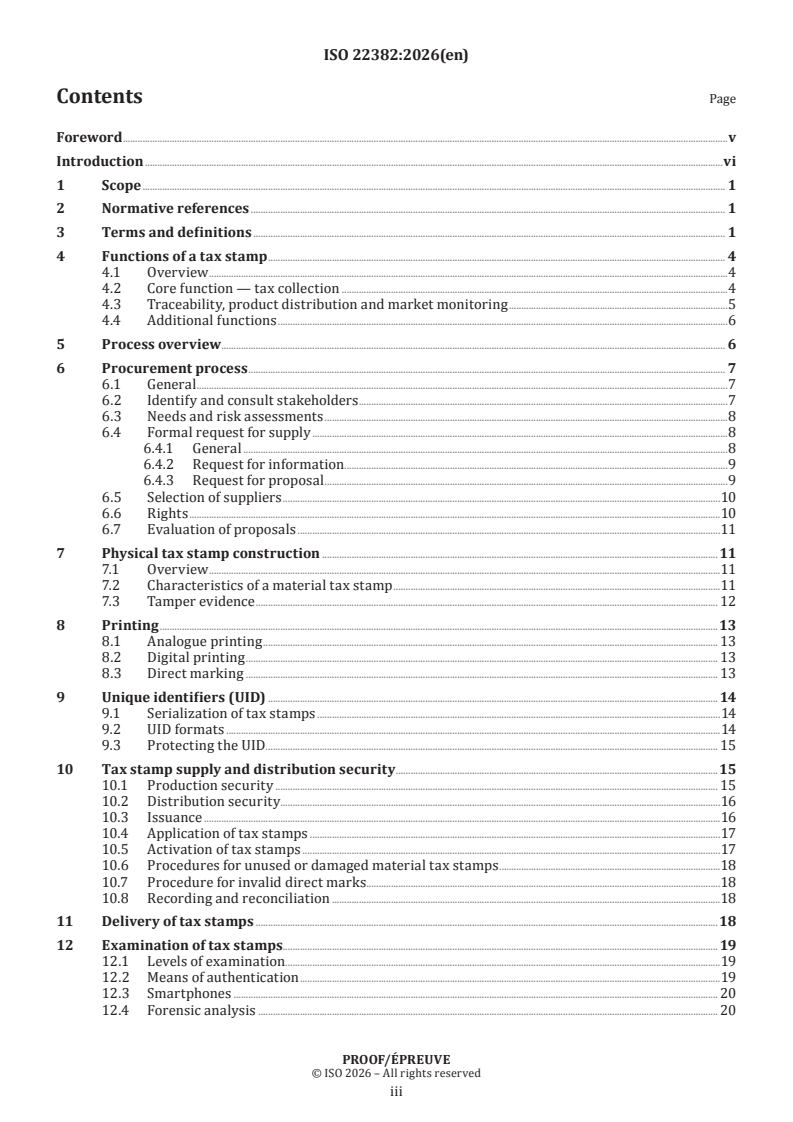
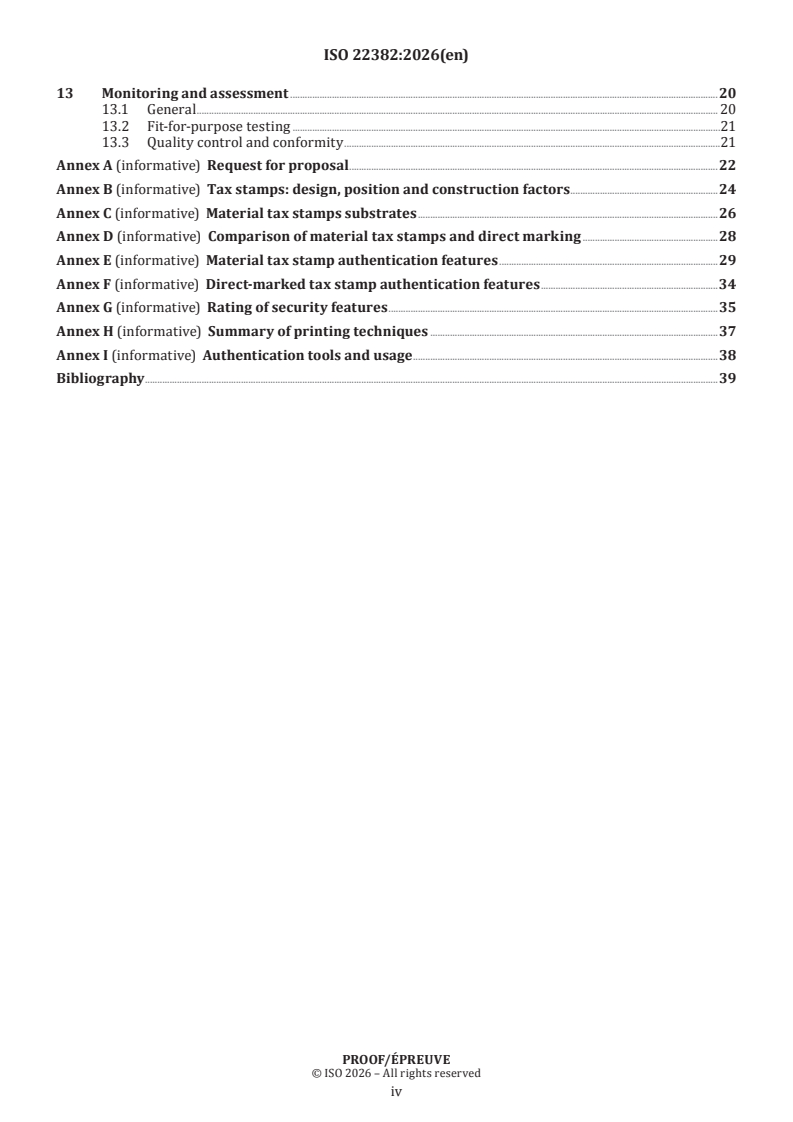
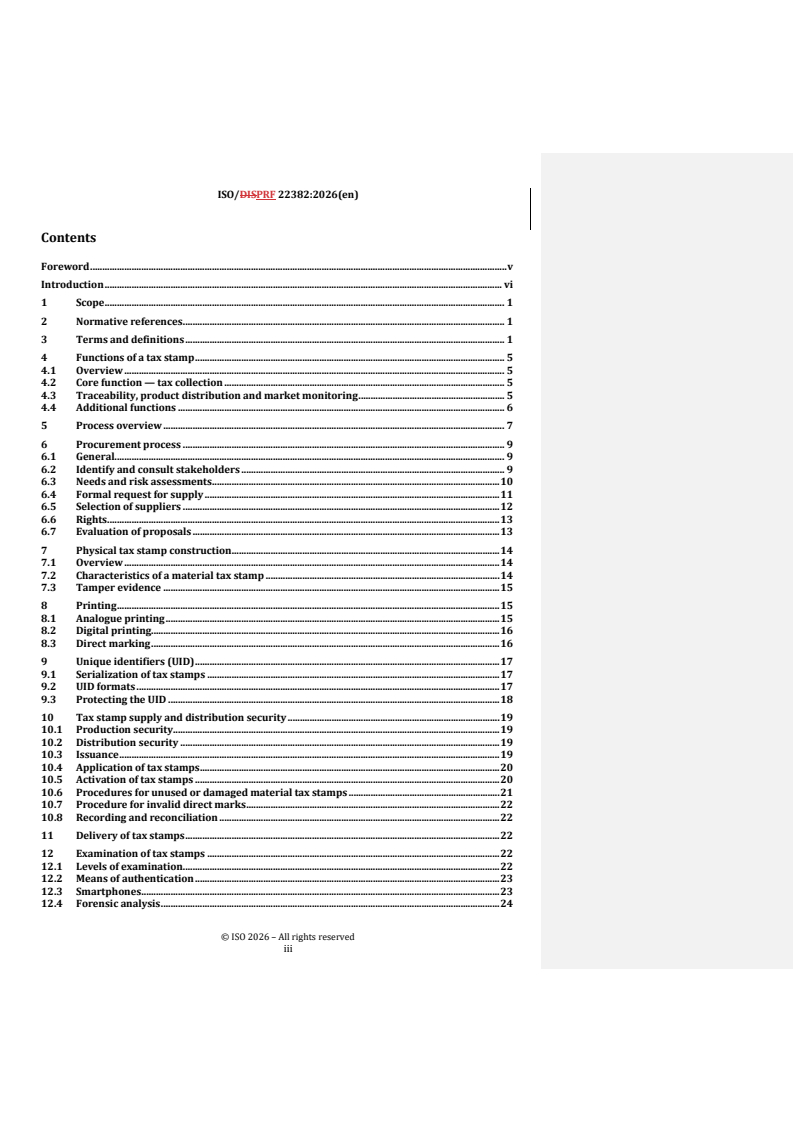
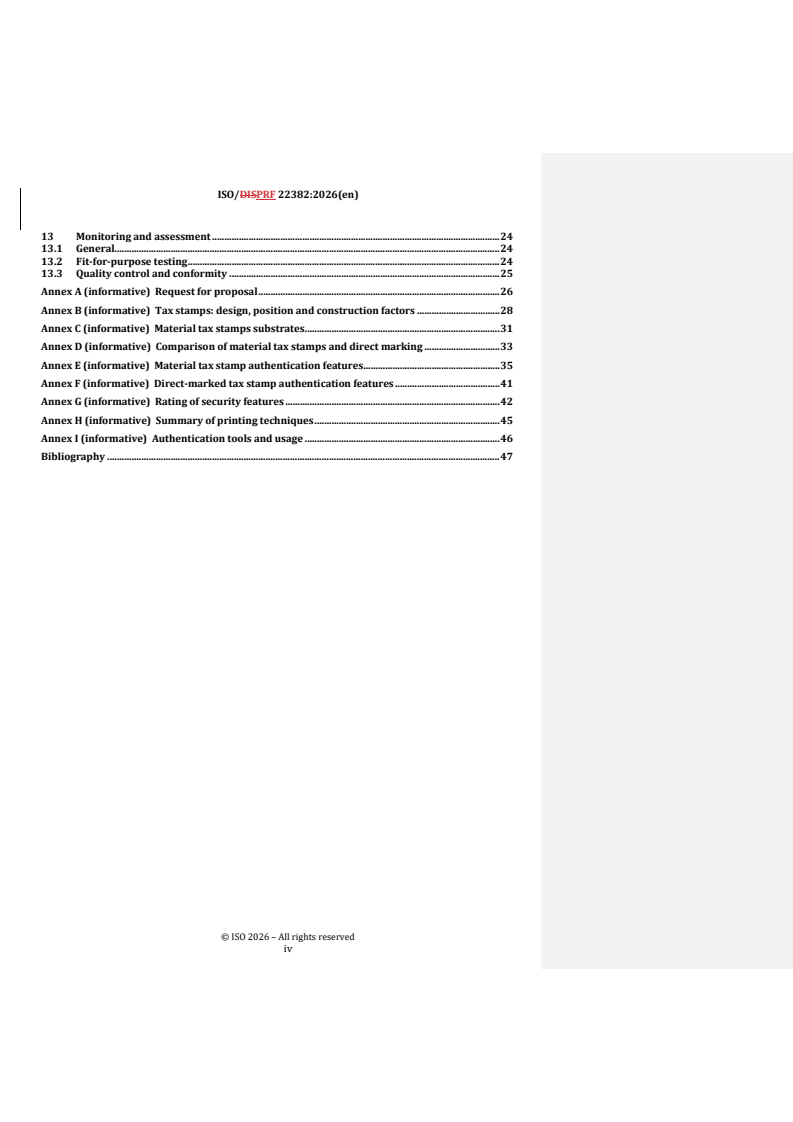
Contents
- Introduction
- 1 Scope
- 2 Normative references
- 3 Terms and definitions
- 3.1 activation
- 3.2 adhesive, noun
- 3.3 alteration
- 3.4 applicable tax
- 3.5 authentication
- 3.6 counterfeit, noun
- 3.7 counterfeit, verb
- 3.8 digital printing
- 3.9 direct marking
- 3.10 fluorescence
- 3.11 forgery
- 3.12 illicit product
- 3.13 simulation
- 3.14 substrate
- 3.15 tamper evidence
- 3.16 tax authority
- 3.17 taxable product
- 3.18 tax stamp
- 3.19 tax stamp applier
- 3.20 tax stamp stakeholder
- 3.21 traceability
- 3.22 unique identifier
- 4 Functions of a tax stamp
- 4.1 Overview
- 4.2 Core function — tax collection
- 4.3 Traceability, product distribution and market monitoring
- 4.4 Additional functions
- 5 Process overview
- 6 Procurement process
- 6.1 General
- 6.2 Identify and consult stakeholders
- 6.3 Needs and risk assessments
- 6.4 Formal request for supply
- 6.5 Selection of suppliers
- 6.6 Rights
- 6.7 Evaluation of proposals
- 7 Physical tax stamp construction
- 7.1 Overview
- 7.2 Characteristics of a material tax stamp
- 7.3 Tamper evidence
- 8 Printing
- 8.1 Analogue printing
- 8.2 Digital printing
- 8.3 Direct marking
- 9 Unique identifiers (UID)
- 9.1 Serialization of tax stamps
- 9.2 UID formats
- 9.3 Protecting the UID
- 10 Tax stamp supply and distribution security
- 10.1 Production security
- 10.2 Distribution security
- 10.3 Issuance
- 10.4 Application of tax stamps
- 10.5 Activation of tax stamps
- 10.6 Procedures for unused or damaged material tax stamps
- 10.7 Procedure for invalid direct marks
- 10.8 Recording and reconciliation
- 11 Delivery of tax stamps
- 12 Examination of tax stamps
- 12.1 Levels of examination
- 12.2 Means of authentication
- 12.3 Smartphones
- 12.4 Forensic analysis
- 13 Monitoring and assessment
- 13.1 General
- 13.2 Fit-for-purpose testing
- 13.3 Quality control and conformity
- Annex A
- Annex B
- Annex C
- Annex D
- Annex E
- Annex F
- Annex G
- Annex H
- Annex I
Introduction
The purpose of this document is to assist tax authorities to improve the collection of appropriate taxes by implementing new, or updating existing, tax stamp programmes. This document provides guidelines for tax stamp procurement, construction, security, issuance, traceability and examination, including the role of smartphones.
This document covers taxes levied on goods at the point of manufacture, importation, or sale. These include consumer goods, fuels and some industrial equipment or components. Tax stamps continue to be the most effective means to collect such taxes.
The first edition of this document (ISO 22382:2018) covered tax levied primarily on tobacco products and alcoholic beverages. However, in recent years the number and type of products that are taxed and stamped has expanded to include other fast-moving consumer goods (FMCG), such as soft drinks, sugar, entertainment software and more, as well as non-consumer items including fuel oils, agrichemicals and cement. This revision of the document seeks to address the issues associated with tax stamps’ expanded role.
As the range of directly-taxed goods expands, it becomes especially important that tax stamp programmes match best practice. The supply of taxable goods attracts criminal activity aimed at avoiding the tax, which can lead to substandard products that can be dangerous to consumer health, directly or indirectly, or otherwise unsafe. Modern tax stamps are an effective deterrent to this criminal activity, so the recommendations in this document aim o help to protect against such criminal activity. This document is applicable only to tax stamps that are apparent to the human senses of sight (with the aid of a revealing tool if necessary) or touch, which are applied to an item or its packaging. This can be as an affixed label or seal, as a design supplied in a print-ready electronic file, or as a set of printed or blazed characters, all of which are required to be authenticated.
PROOF/ÉPREUVE
International Standard ISO 22382:2026(en) Security and resilience — Authenticity, integrity and trust for products and documents — Guidelines for the content, security, issuance and examination of tax stamps
1 Scope
This document gives guidelines for the content, security, issuance, traceability and examination of physical tax stamps and marks used to indicate that the required taxes identified with an item have been paid, and to signify that the item is legitimately on the intended market.
Specifically, this document gives guidelines on:
- the functions of a tax stamp;
- identifying and consulting with stakeholders;
- the procurement process and selection of suppliers;
- the design and construction of tax stamps;
- the overt and covert security features that provide protection of the tax stamp;
- the finishing and application processes for the tax stamp;
- security of the tax stamp supply chain;
- serialization and unique identifier (UID) codes for tax stamps;
- traceability;
- examination of tax stamps;
- monitoring and assessing tax stamp performance.
This document does not apply to systems or procedures implemented by an issuing authority to control and monitor its tax collection, except by reference to them where they have an impact on the design or specification of tax stamps.
2 Normative references
The following documents are referred to in the text in such a way that some or all of their content constitutes requirements of this document. For dated references, only the edition cited applies. For undated references, the latest edition of the referenced document (including any amendments) applies. ISO 22300, Security and resilience — Vocabulary
3 Terms and definitions
For the purposes of this document, the terms and definitions given in ISO 22300 and the following apply. ISO and IEC maintain terminology databases for use in standardization at the following addresses:
- IEC Electropedia: available at http:// www .electropedia .org/
- ISO Online browsing platform: available at http:// www .iso .org/ obp PROOF/ÉPREUVE
ISO 22382:2026(en)
3.1 activation
stage in production or use of a tax stamp (3.18) when it becomes live (activated) as a record of the applicable taxes (3.4) becoming due Note 1 to entry: Activation of the unique identifier (3.22), if used, can be separate from activation of the tax stamp.
3.2 adhesive, noun
glue, noun chemical mixture that bonds two materials together Note 1 to entry: It can be enabled by heat, pressure or chemistry.
3.3 alteration
intentional attempt to change an authentic item or the data contained within or on an item by chemical, abrasive or other techniques Note 1 to entry: In this document, an “item” is a tax stamp (3.18).
3.4 applicable tax
specific tax on products as defined within national, state, provincial or local law
3.5 authentication
process of verifying that an item or its attributes are genuine with a specified or understood level of assurance Note 1 to entry: In this document, an “item” is a tax stamp (3.18). Note 2 to entry: The phrase “specified or understood level of assurance” acknowledges that it is impossible to achieve absolute certainty in authenticating any item. The degree of certainty varies with the type of authentication solutions used, the training and motivation of the examiner and the equipment available to them. For example, the level of authentication assurance achieved is very different between a consumer authenticating an item and a forensic laboratory authenticating the same item.
Note 3 to entry: The term “authentication” in this document refers only to the authentication of the tax stamp, not to the product on which the tax stamp is affixed.
3.6 counterfeit, noun
document or material good which purports to be something it is not in an attempt to be accepted as the genuine item
3.7 counterfeit, verb
act of creating a counterfeit item
3.8 digital printing
process of transferring a computer-generated image or data to a substrate (3.14) using a digital printer Note 1 to entry: Digital printers range from desktop home printers to sophisticated, versatile and large installations made by only a few companies. The latter are referenced in this document. PROOF/ÉPREUVE
ISO 22382:2026(en)
3.9 direct marking
applying a tax stamp (3.18) directly onto the product or its container or packaging through the use of laser marking or printing with inks or other markers Note 1 to entry: Direct-marked tax stamps are generated at the point of application, thus not requiring a substrate (3.14).
3.10 fluorescence
temporarily converting human-invisible ink or other components of a tax stamp (3.18) to become visible to humans by illuminating it with light which is also not visible to humans, usually ultra-violet (UV), which stimulates the ink or other components to radiate at a wavelength visible to human vision only when it is thus illuminated
3.11 forgery
altered document, typically to change the value referenced on the document or the identity it refers to
3.12 illicit product
taxable product (3.17) available on the market to avoid the payment of all or part of the applicable taxes (3.4) Note 1 to entry: Illicit products include illegally manufactured counterfeit, adulterated, re-filled, smuggled or illegal re-imported products.
3.13 simulation
imitation of a legitimate item to enable the result to be accepted as legitimate
3.14 substrate
material that a tax stamp (3.18) is made of when it is produced away from the site of the tax stamp applier (3.19)
3.15 tamper evidence
ability to reveal that an item has been compromised through an attempt or attempts to tamper with it, which is often achieved through the use of a frangible substrate (3.14), i.e. one that breaks up if it is tampered with Note 1 to entry: In this document, an “item” refers to a tax stamp (3.18). Note 2 to entry: Such attempts can be to alter the item or remove it from the item to place on another.
3.16 tax authority
government (national, provincial, state or local) agency that has responsibility for the collection of applicable taxes (3.4) and for the specification and design of tax stamps (3.18) Note 1 to entry: The tax authority can be an independent agency or part of customs, the ministry of finance or another government authority.
3.17 taxable product
product on which tax is due at the point of production, importation, or first domestic sale, according to local legislation
3.18 tax stamp
visible stamp, label or mark placed on goods to show that the applicable tax (3.4) has been paid Note 1 to entry: It can be in the form of a label, closure seal, indicium or mark applied to the product, the package or container of the taxable item.
PROOF/ÉPREUVE
ISO 22382:2026(en) Note 2 to entry: Tax stamps are a tool within a government’s system for the collection and protection of applicable taxes (3.4).
Note 3 to entry: Substrate (3.14)-based tax stamps are also referred to as “tax seals” and “tax banderols” (sometimes spelt “banderoles”).
3.19 tax stamp applier
entity that applies a tax stamp (3.18) to a taxable product (3.17) Note 1 to entry: The application can be done by direct marking (3.9) or by applying a substrate (3.14)-based tax stamp (3.18) .
Note 2 to entry: A tax stamp applier is usually a manufacturer, packager, repackager or importer of a taxable product (3.17) or products, or a tax stamp (3.18) supplier, which is also responsible for reporting the application of the tax stamp to the tax authority (3.16), with information about the product it is affixed to, if and when required by the tax authority.
3.20 tax stamp stakeholder
entity with a stake in the implementation, enforcement and use of a tax stamp (3.18) system
3.21 traceability
use of coded unique identifiers to enable the tax authority (3.16) (or another authorized entity) to recreate events generated as a taxable product (3.17) moves through its supply chain [1] Note 1 to entry: ISO 9001 defines traceability as the ability to trace history, application or location of an object. Also referred to as track and trace.
3.22 unique identifier
UID, noun sequence of numbers or letters and numbers (alphanumeric) or other code that represents or links to a single and specific set of attributes that are related to an object or class of objects during its life within a particular domain and scope of an object identification system [2] Note 1 to entry: Refer to ISO 22300 for definitions of “object” and “identification”.
4 Functions of a tax stamp
4.1 Overview
A critical step in introducing or upgrading a tax stamp is to decide on its function or functions. Primarily this is to collect, and confirm the collection of, the applicable tax or taxes. However, the tax authority should also consider other functions of its stamps. To do this, the tax authority can consult other stakeholders to find out whether they would value using the stamp in some way. Tax stamp functions should only be finalized after the stakeholders have been consulted. See 6.2. Possible functions that the tax authority should consider are described in 4.2 to 4.4.
4.2 Core function — tax collection
The functions of tax collection can be broken down into a number of elements, which include:
- creating or confirming the tax liability, which can be at the tax stamp’s point of issue or its application to the taxable product;
- being a receipt for the payment of applicable taxes;
- validating the tax-paid status of goods in the supply chain; PROOF/ÉPREUVE
ISO 22382:2026(en) - identifying non- or reduced tax-paid goods in the supply chain; - enabling the revenue authority to monitor, or (where necessary) control, the production or importation of taxable goods by controlling the number of tax stamps issued to the organization that applies them; - monitoring the production site and the application of the stamp to detect any illicit production.
4.3 Traceability, product distribution and market monitoring
A function that many tax authorities find useful is to allow for the tracking and tracing of the stamps, and therefore the item that the stamp is on, through the supply chain; this is also known as traceability. There are two discrete aspects of tax stamp traceability:
a) By applying traceability elements when a material stamp is produced, every stamp can be tracked through the distribution chain from the point of production to its application to a taxable product. b) Once a stamp is applied to a taxable product, whether as a material stamp or by direct marking (see 8.3), a traceable feature allows the tax authority (or other entity that is receiving the traceability data) to monitor the good from production or importation (i.e. strictly speaking, when the tax stamp is applied) through the supply chain to the retailer and end customer.
Traceability allows the tax authority to find when, where and by which entity the tax stamp was applied to the product, and then to monitor that product’s progress through the supply chain to its final consumer or user. This is done by interrogating the UID or code (see Clause 9) at any stage in the supply chain, thus allowing the tax authority to use information about the product’s origin and the route by which it reached the point where it is being examined to identify suspicious or criminal activity in the supply chain. If the tax authority decides to use traceability on its tax stamps, then it should consider what is required to implement this. This can include:
- the UID to be applied to the tax stamp (see Clause 9) or an alternative method of identifying and tracking each item;
- monitoring stations or monitoring staff at points in the supply chain to capture and record information about the location of the product and the tax stamp on it;
- the secure storage and handling of the data that is captured from this monitoring;
- the analysis of data and sharing it with law enforcement agencies, manufacturers or distributors and other relevant stakeholders.
Figure 1 provides an example of how traceability can function to monitor tax stamps in the supply chain. Figure 1 — Tax stamp data generation and application process to record and reconcile each stamp PROOF/ÉPREUVE
ISO 22382:2026(en) Tax authorities should consider opportunities for interaction with other fiscal domains (outlined in ISO 22381 [3] ) and other stakeholders, as appropriate. They should also consider establishing the trustworthiness of [4] the supply in conformance with ISO 22373 .
4.4 Additional functions
The tax authority should consider the additional functions of a tax stamp that are not directly related to the tax collection and tax enforcement function, in consultation with other stakeholders, particularly other government agencies.
Other functions can include:
- monitoring the market for each product category by recording actionable data on legal participants, stamps or markings and associated supply chain events, providing authorities with a new axis of information to compare against revenue or other sources;
- consumer reassurance through the use of a secure tamper-evident substrate-based tax stamp (see 7.3), which cannot be removed from the taxable product without being destroyed, making it more probable that an item bearing a tax stamp is legitimate;
- encouraging consumer engagement, by incentivizing consumers to examine the tax stamp on a product, for example with a smartphone app;
- facilitating legislative conformity where local, national or supra-national legislation or other regulations require tracking and tracing for certain products.
However, it is acknowledged that even though the traceability feature of a tax stamp brings accountability regarding its use by a manufacturer or importer, there is also a risk that an item affixed with a tax stamp can be illicit, as the result of criminal activity. Authorities should therefore be cautious in adopting or communicating the consumer reassurance function of tax stamps when the tax stamp serves other functions that are not directly related to the tax collection and tax enforcement function. This serves to avoid any potential liabilities if a citizen becomes harmed by a product bearing a tax stamp.
5 Process overview
The tax authority should regularly review its tax collection processes to assess how efficient and effective they are, particularly in minimizing tax avoidance or evasion. If in doing so, it concludes that using tax stamps – or upgrading an extant tax stamp – would help to improve its collection of taxes, then it should follow the process shown in Figure 2 to decide on the functions (as inClause 4), specification, design, supply, issuance, application and inspection of its stamps.
It should then regularly review the tax stamp programmes, including stamp security, legislation and enforcement, to identify any weaknesses in the tax stamp itself or in the procedures for production, issuance, activation, application and examination. The tax authority should have a standby tax stamp design that can quickly be put into production in the event that this review or enforcement activity reveals fraudulent production or use of the tax stamps in use.
NOTE Issuing a new tax stamp design is the quickest way to make fraudulent tax stamps obsolete. Figure 2 summarizes the process recommended in this document.
PROOF/ÉPREUVE
ISO 22382:2026(en) Figure 2 — Tax stamp procurement and review process
6 Procurement process
6.1 General
This Clause sets out best practice for how a revenue authority should approach the procurement of tax stamps.
6.2 Identify and consult stakeholders
The first step in considering a tax stamp programme is to identify and consult the stakeholders involved. Relevant tax stamp stakeholders vary across jurisdictions and can include the following. - Manufacturers of taxable goods that produce and package finished goods subject to taxation. Depending on local circumstances and tax systems, manufacturers can order, receive and apply tax stamps to finished goods. A manufacturer can also act as the local distributor. - The trademark holder that owns the trademark in the taxable goods. This is often the same entity as the manufacturer but not always.
- Importers of taxable goods that import part- or wholly-finished goods subject to taxation and that are responsible for the payment of applicable taxes and fees. The importer can order, receive and apply tax stamps to finished goods.
PROOF/ÉPREUVE
ISO 22382:2026(en) - Distributors or wholesalers of taxable goods that bring the taxable products from a warehouse or port to the local market.
...
Contents
- Introduction
- 1 Scope
- 2 Normative references
- 3 Terms and definitions
- 3.1 activation
- 3.2 adhesive, noun
- 3.2.1 glue
- 3.3 alteration
- 3.4 applicable tax
- 3.5 authentication
- 3.6 counterfeit (noun),, noun
- 3.7 counterfeit (verb),, verb
- 3.8 digital printing
- 3.9 direct marking
- 3.10 fluorescence
- 3.11 forgery
- 3.12 illicit product
- 3.13 simulation
- 3.14 substrate
- 3.15 tamper evidentevidence
- 3.16 tax authority
- 3.17 taxable product
- 3.18 tax stamp
- 3.19 tax stamp applier
- 3.20 tax stamp stakeholder
- 3.21 traceability
- 3.22 unique identifier
- 4 Functions of a tax stamp
- 4.1 Overview
- 4.2 Core function — revenuetax collection
- 4.3 Traceability, product distribution and market monitoring
- 4.4 Additional functions
- 5 Process overview
- 6 Procurement process
- 6.1 Introduction
- 6.1 General
- 6.2 Identify and consult stakeholders
- 6.3 Needs and risk assessments
- 6.4 The formalFormal request for supply
- 6.5 Selection of suppliers
- 6.6 Rights
- 6.7 Evaluation of proposals
- 7 Physical tax stamp construction
- 7.1 Overview
- 7.2 Characteristics of a material tax stamp
- 7.3 Tamper evidence
- 8 Printing
- 8.1 Analogue printing
- 8.2 Digital printing
- 8.3 Direct marking
- 9 Unique identifiers (UID)
- 9.1 Serialization of tax stamps
- 9.2 UID formats
- 9.3 Protecting the UID
- 10 Tax stamp supply and distribution security
- 10.1 Production security
- 10.2 Distribution security
- 10.3 Issuance
- 10.4 Application of tax stamps
- 10.5 Activation of tax stamps
- 10.6 Procedures for unused or damaged material tax stamps
- 10.7 Procedure for invalid direct marks
- 10.8 Recording and reconciliation
- 11 Delivery of tax stamps
- 12 Examination of tax stamps
- 12.1 Levels of examination
- 12.2 Means of authentication
- 12.3 Smartphones
- 12.4 Forensic analysis
- 13 Monitoring and assessment
- 13.1 General
- 13.2 Fit-for-purpose testing
- 13.3 Quality control and conformity
- Annex A
- Annex B
- Annex C
- Annex D
- Annex E
- Annex F
- Annex G
Introduction
The purpose of this document is to assist tax authorities to improve the collection of appropriate taxes by implementing new, or updating existing, tax stamp programmes. This document provides guidelines for tax stamp procurement, construction, security, issuance, traceability and examination, including the role of smartphones.
This guidance document covers taxes levied on goods at the point of manufacture, importation, or sale. These include consumer goods, fuels and some industrial equipment or components. Tax stamps continue to be the most effective means to collect such taxes.
The first edition of this document (ISO 22382:2018) covered tax levied primarily on tobacco products and alcoholic beverages. However, in recent years the number and type of products that are taxed and stamped has expanded to include other fast-moving consumer goods (FMCG), such as soft drinks, sugar, entertainment software and more, as well as non-consumer items including fuel oils, agrichemicals and cement. This revision of the document seeks to address the issues associated with tax stamps’ expanded role. As the range of directly-taxed goods expands, it becomes especially important that tax stamp programmes match best practice. The supply of taxable goods attracts criminal activity aimed at avoiding the tax, which mightcan lead to substandard products that mightcan be dangerous to consumer health, directly or indirectly, or otherwise unsafe. Modern tax stamps are an effective deterrent to this criminal activity, so the recommendations in this document shouldaim o help to protect against such criminal activity. This document is applicable only to tax stamps that are apparent to the human senses of sight (with the aid of a revealing tool if necessary) or touch, which are applied to an item or its packaging. This can be as an affixed label or seal, as a design supplied in a print-ready electronic file, or as a set of printed or blazed characters, all of which needare required to be capable of being authenticated.
ISO/DISPRF 22382:2026(en) Security and resilience — Authenticity, integrity and trust for products and documents — Guidelines for the content, security, issuance and examination of tax stamps
1 Scope
This document gives guidelines for the content, security, issuance, traceability and examination of physical tax stamps and marks used to indicate that the required taxes identified with an item have been paid, and to signify that the item is legitimately on the intended market.
Specifically, this document gives guidanceguidelines on:
- the functions of a tax stamp;
- identifying and consulting with stakeholders;
- the procurement process and selection of suppliers;
- the design and construction of tax stamps;
- the overt and covert security features that provide protection of the tax stamp;
- the finishing and application processes for the tax stamp;
- security of the tax stamp supply chain;
- serialization and unique identifier (UID) codes for tax stamps;
- traceability;
- examination of tax stamps;
- monitoring and assessing tax stamp performance.
This document does not apply to systems or procedures implemented by an issuing authority to control and monitor its revenuetax collection, except by reference to them where they have an impact on the design or specification of tax stamps.
2 Normative references
The following documents are referred to in the text in such a way that some or all of their content constitutes requirements of this document. For dated references, only the edition cited applies. For undated references, the latest edition of the referenced document (including any amendments) applies. EN ISO 22300:2025, Security and resilience -— Vocabulary (ISO 22300:2025)
3 Terms and definitions
For the purposes of this document, the terms and definitions given in EN ISO 22300:2025 ISO 22300 and the following apply.
ISO and IEC maintain terminology databases for use in standardization at the following addresses:
ISO/DISPRF 22382:2026(en) - IEC Electropedia: available at http://www.electropedia.org/ - ISO Online browsing platform: available at http://www.iso.org/obp
3.1 activation
stage in production or use of a tax stamp (3.18) when it becomes live (activated) as a record of the applicable taxes (3.4) becoming due Note 1 to entry: Activation of the unique identifier (3.22), if used, can be separate from activation of the tax stamp.
3.2 adhesive, noun
glue, noun chemical mixture that bonds two materials together Note 1 to entry: “Adhesive” can also be referred to as “glue”. Note 2 to entry: It can be enabled by heat, pressure or chemistry.
3.2.1 glue
chemical mixture that bonds two materials together
3.3 alteration
intentional attempt to change an authentic item or the data contained within or on an item by chemical, abrasive or other techniques Note 1 to entry: In this document, an “item” is a tax stamp (3.18).
3.4 applicable tax
specific tax on products as defined within national, state, provincial or local law
3.5 authentication
process of verifying that an item or its attributes are genuine with a specified or understood level of assurance Note 1 to entry: In this document, an “item” is a tax stamp (3.18). Note 2 to entry: The phrase “specified or understood level of assurance” acknowledges that it is impossible to achieve absolute certainty in authenticating any item. The degree of certainty varies with the type of authentication solutions used, the training and motivation of the examiner and the equipment available to them. For example, the level of authentication assurance achieved is very different between a consumer authenticating an item and a forensic laboratory authenticating the same item.
Note 3 to entry: The term “authentication” in this document refers only to the authentication of the tax stamp, not to the product on which the tax stamp is affixed.
3.6 counterfeit (noun),, noun
document or material good which purports to be something it is not in an attempt to be accepted as the genuine item
ISO/DISPRF 22382:2026(en)
3.7 counterfeit (verb),, verb
act of creating a counterfeit item
3.8 digital printing
process of transferring a computer-generated image or data to a substrate (3.14) using a digital printer Note 1 to entry: Digital printers range from desktop home printers to sophisticated, versatile and large installations made by only a few companies. The latter are referenced in this standarddocument.
3.9 direct marking
applying a tax stamp (3.18) directly onto the product or its container or packaging through the use of laser marking or printing with inks or other markers Note 1 to entry: Direct-marked tax stamps are generated at the point of application, thus not requiring a substrate (3.14)).
3.10 fluorescence
temporarily converting human-invisible ink or other componentcomponents of a tax stamp (3.18) to become visible to humans by illuminating it with light which is also not visible to humans, usually ultra-violet (UV)), which stimulates the ink etcor other components to radiate at a wavelength visible to human vision only when it is thus illuminated
3.11 forgery
altered document, typically to change the value referenced on the document or the identity it refers to.
3.12 illicit product
taxable product (3.17) available on the market to avoid the payment of all or part of the applicable taxes (3.4) Note 1 to entry: Illicit products include illegally manufactured counterfeit, adulterated, re-filled, smuggled or illegal reimported products.
3.13 simulation
imitation of a legitimate item to enable the result to be accepted as legitimate
3.14 substrate
material that a tax stamp (3.18) is made of when it is produced away from the site of thetaxthe tax stamp applier (3.19)
3.15 tamper evidentevidence
ability to reveal that an item has been compromised through an attempt or attempts to tamper with it, which is often achieved through the use of a frangible substrate (3.14;), i.e. one that breaks up if it is tampered with Note 1 to entry: In this document, an “item” refers to ataxa tax stamp (3.18). Note 2 to entry: AttemptsSuch attempts can be to alter the item or remove it from onethe item to place on another.
ISO/DISPRF 22382:2026(en)
3.16 tax authority
government (national, provincial, state or local) agency that has responsibility for the collection of applicable taxes (3.4) and for the specification and design of tax stamps (3.18) Note 1 to entry: The tax authority can be an independent agency or part of customs, the ministry of finance or otheranother government authority.
3.17 taxable product
product on which tax is due at the point of production, importation, or first domestic sale, according to local legislation
3.18 tax stamp
visible stamp, label or mark placed on goods to show that the applicable tax (3.4) has been paid Note 1 to entry: It can be in the form of a label, closure seal, indicium or mark applied to the product, the package or container of the taxable item.
Note 2 to entry: Tax stamps are a tool within a government’s system for the collection and protection of applicable taxes (3.4)).
Note 3 to entry: Substrate (3.14) -)-based tax stamps are also referred to as “tax seals” and “tax banderols” (sometimes spelledspelt “banderoles”).
3.19 tax stamp applier
entity that applies a tax stamp (3.18) to a taxable product (3.17) Note 1 to entry: The application can be done by direct marking (3.9) or by applying a substrate (3.14)-based tax stamp (3.18) .
Note 2 to entry: A tax stamp applier is usually a manufacturer, packager, repackager or importer of a taxable product (3.17) or products, or a tax stamp (3.18) supplier, which is also responsible for reporting the application of the tax stamp to the tax authority (3.16), with information about the product it is affixed to, if and when required by the tax authority.
3.20 tax stamp stakeholder
entity with a stake in the implementation, enforcement and use of a tax stamp (3.18) system
3.21 traceability
use of coded unique identifiers to enable the tax authority (3.16) (or another authorisedauthorized entity) to recreate events generated as a taxable product (3.17) moves through its supply chain. [1] Note 1 to entry: ISO 90009001 defines traceability as the ability to trace the history, application or location of an object. Also referred to as Track & Tracetrack and trace.
3.22 unique identifier
UID, noun sequence of numbers or letters and numbers (alphanumeric) or other code that represents or links to a single and specific set of attributes that are related to an object or class of objects during its life within a particular domain and scope of an object identification system [2] Note 1 to entry: Refer to ISO 22300 for definitions of “object” and “identification”.
ISO/DISPRF 22382:2026(en)
4 Functions of a tax stamp
4.1 Overview
A critical step in introducing or upgrading a tax stamp is to decide on its function or functions. Primarily this is to collect, and confirm the collection of, the applicable tax or taxes, but. However, the tax authority should also consider other functions forof its stamps, perhaps after consulting. To do this, the tax authority can consult other stakeholders to find out whether they would value using the stamp in some way. This section is placed here for the benefit of tax authorities, but the finalisation of taxTax stamp functions should only be delayed untilfinalized after consultation with the stakeholders. have been consulted. See subclause 6.2.
Possible functions that the tax authority should consider are described below in 4.2 to 4.4.
4.2 Core function — revenuetax collection
The functionfunctions of tax collection breakscan be broken down into a number of elements, which include:
- creating or confirming the tax liability, which can be at the tax stamp’s point of issue or its application to the taxable product;
- being a receipt for the payment of applicable taxes;
- validating the tax-paid status of goods in the supply chain;
- identifying non- or reduced tax-paid goods in the supply chain;
- enabling the revenue authority to monitor, or (where necessary) control, the production or importation of taxable goods by controlling the number of tax stamps issued to the organization that applies them;
- monitoring the production site and the application of the stamp to detect any illicit production.
4.3 Traceability, product distribution and market monitoring
A function that many tax authorities find useful is to allow for the tracking and tracing of the stamps, and therefore the item that the stamp is on, through the supply chain; this is also known as traceability. There are two discrete aspects to the use of tax stamp traceability:
a) By applying traceability elements when a material stamp is produced, every stamp can be tracked through the distribution chain from the point of production to its application to a taxable product;. b) Once a stamp is applied to a taxable product, whether as a material stamp or by direct marking (see 8.3), a traceable feature allows the tax authority (or other entity that is receiving the traceability data) to monitor the good from production or importation (i.e. strictly speaking, when the tax stamp is applied) through the supply chain to the retailer and end customer.
Traceability allows the tax authority to find when, where and by which entity the tax stamp was applied to the product, and then to monitor that product’s progress through the supply chain to its final consumer or user. This is done by interrogating the UID or code (see Clause 9) at any stage in the supply chain, thus allowing the tax authority to use information about the product’s origin and the route by which it reached the point where it is being examined to identify suspicious or criminal activity in the supply chain. If the tax authority decides to use traceability on its tax stamps, then it should consider what is required to implement this. This can include:
ISO/DISPRF 22382:2026(en) - the UID to be applied to the tax stamp (see Clause 9) or an alternative method of identifying and tracking each item; - monitoring stations or monitoring staff at points in the supply chain to capture and record information about the location of the product and the tax stamp on it; - the secure storage and handling of the data that is captured from this monitoring; - the analysis of data and sharing it with law enforcement agencies, manufacturers or distributors and other relevant stakeholders.
Figure 1 provides an example of how traceability can function to monitor tax stamps in the supply chain.
Figure 1 — Tax stamp data generation and application process to record and reconcile each stamp Tax authorities should consider opportunities for interaction with other fiscal domains (outlined in ISO [3] 22381 ) and other stakeholders, as appropriate. They should also consider establishing the trustworthiness [34] of the supply in conformance with ISO/DIS 22373 .
Field Code Changed
4.4 Additional functions
The tax authority should consider the otheradditional functions of a tax stamp can serve that are not directly related to the tax collection and tax enforcement function, in consultation with other stakeholders, particularly other government agencies.
ISO/DISPRF 22382:2026(en) Other functions can include:
- monitoring the market for each product category by recording actionable data on legal participants, stamps or markings and associated supply chain events, providing authorities with a new axis of information to compare against revenue or other sources;
- consumer reassurance through the use of a secure tamper-evident substrate-based tax stamp (see 7.3), which cannot be removed from the taxable product without being destroyed, making it more probable that an item bearing a tax stamp is legitimate;
- to encourageencouraging consumer engagement, by incentivisingincentivizing consumers to examine the tax stamp on a product, for example with a smartphone app;
- tax stamps can facilitatefacilitating legislative conformity where local, national or supra-national legislation or other regulations require tracking and tracing for certain products. ItHowever, it is, however, acknowledged that, even though the traceability feature of a tax stamp brings accountability regarding its use by a manufacturer or importer, there is also a risk that an item affixed with a tax stamp couldcan be illicit, as the result of criminal activity. Authorities should therefore be cautious in adopting or communicating the consumer reassurance function of tax stamps when the tax stamp serves other functions that are not directly related to the tax collection and tax enforcement function. This serves to avoid any potential liabilities if a citizen becomes harmed by a product bearing a tax stamp.
5 Process overview
The tax authority should regularly review its tax collection processes to assess how efficient and effective they are, particularly in minimisingminimizing tax avoidance or evasion. If in doing so, it concludes that using tax stamps – or upgrading an extant tax stamp – would help to improve its collection of taxes, then it should follow the process shown herein Figure 2 to decide on the functions (as inClause 4 Clause 4),), specification, design, supply, issuance, application and inspection of its stamps.
It should then regularly review the tax stamp programmes, including stamp security, legislation and enforcement, to identify any weaknesses in the tax stamp itself or in the procedures for production, issuance, activation, application and examination. The tax authority should have a standby tax stamp design that can quickly be put into production in the event that this review or enforcement activity reveals fraudulent production or use of the tax stamps in use.
NOTE Issuing a new tax stamp design is the quickest way to make fraudulent tax stamps obsolete. Figure 2 summarizes the process recommended in this document.
ISO/DISPRF 22382:2026(en)
ISO/DISPRF 22382:2026(en)
Figure 2 — Tax stamp procurement and review process
6 Procurement process
6.1 Introduction
6.1 General
This Clause sets out best practice for how a revenue authority should approach the procurement of tax stamps.
6.2 Identify and consult stakeholders
The first step in considering a tax stamp programme is to identify and consult the stakeholders involved. Relevant tax stamp stakeholderslstakeholders vary across jurisdictions and can include the following. - Manufacturers of taxable goods that produce and package finished goods subject to taxation. Depending on local circumstances and tax systems, manufacturers couldcan order, receive and apply tax stamps to finished goods. A manufacturer can also act as the local distributor. - The trademark holder that owns the trademark in the taxable goods. This is often the same entity as the manufacturer but not always.
ISO/DISPRF 22382:2026(en) - Importers of taxable goods that import part- or wholly-finished goods subject to taxation and that are responsible for the payment of applicable taxes and fees. The importer canordercan order, receive and apply tax stamps to finished goods.
- Distributors or wholesalers of taxable goods that bring the taxable products from a warehouse or port to the local market.
...