

ISO 16000-24:2018
(Main)Indoor air — Part 24: Performance test for evaluating the reduction of volatile organic compound concentrations by sorptive building materials
General Information
- Abstract
This document specifies a general laboratory test method for evaluating the reduction in concentration of VOCs by sorptive building materials. This method applies to boards, wallpapers, carpets, paint products, and other building materials. The sorption of those target compound(s), i.e. VOCs, can be brought about by adsorption, absorption and chemisorption. The performance of the material, with respect to its ability to reduce the concentration of VOCs in indoor air, is evaluated by measuring area-specific reduction rate and saturation mass per area. The former directly indicates material performance with respect to VOC reduction at a point in time; the latter relates to the ability to maintain that performance. This document is based on the test chamber method specified in ISO 16000-9. NOTE Sampling, transport and storage of materials to be tested, and preparation of test specimens, are described in ISO 16000-11. Air sampling and analytical methods to determine VOCs are described in ISO 16000-6 and ISO 16017-1.
- Status
- Published
- Publication Date
- 29-Nov-2018
- Technical Committee
- ISO/TC 146/SC 6 - Indoor air
- Drafting Committee
- ISO/TC 146/SC 6 - Indoor air
- Current Stage
- 9093 - International Standard confirmed
- Start Date
- 04-Mar-2024
- Completion Date
- 29-Aug-2026
Buy Documents







ISO 16000-24:2018 - Indoor air — Part 24: Performance test for evaluating the reduction of volatile organic compound concentrations by sorptive building materials/30/2018



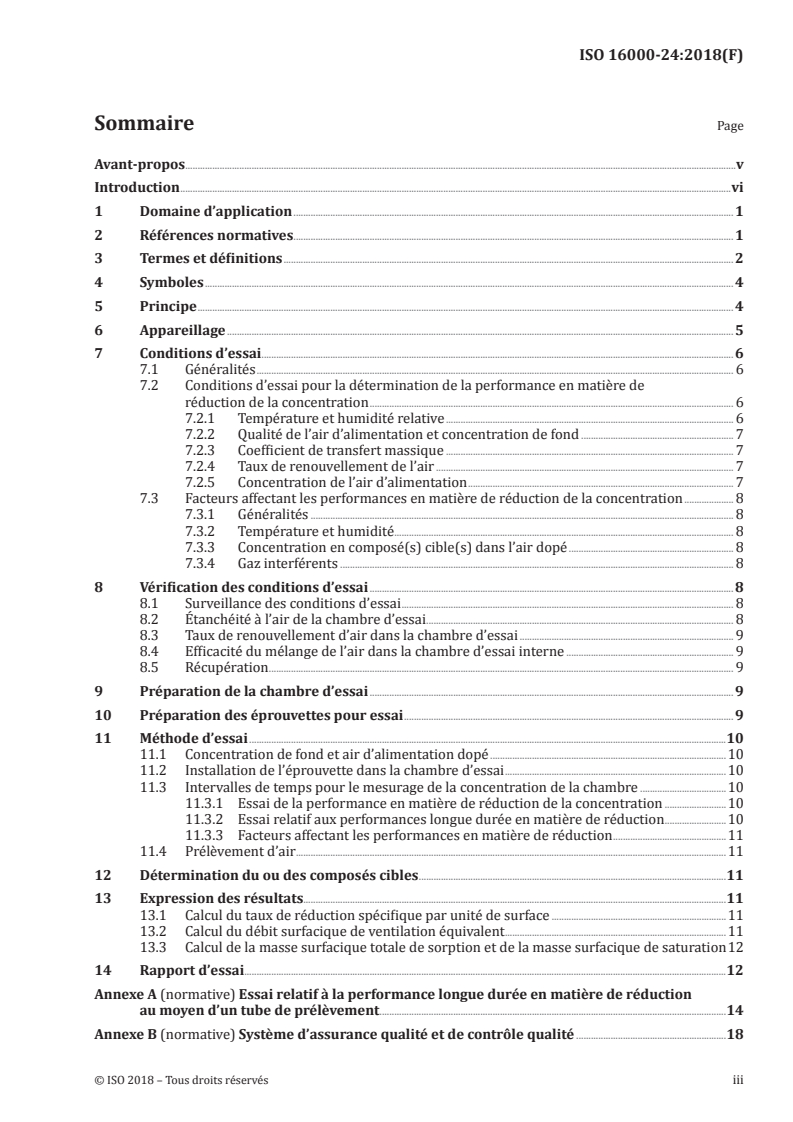
ISO 16000-24:2018 - Air intérieur — Partie 24: Essai de performance pour l'évaluation de la réduction des concentrations en composés organiques volatils par des matériaux de construction sorptifs/30/2018
Overview
ISO 16000-24:2018 - "Indoor air - Part 24" defines a laboratory performance test for evaluating reduction of volatile organic compound (VOC) concentrations by sorptive building materials. It covers common indoor products such as boards, wallpapers, carpets and paints where VOC removal occurs by adsorption, absorption or chemisorption. The method is based on the ISO 16000-9 test chamber technique and quantifies how materials reduce VOC levels over time.
Key technical topics and requirements
- Test principle: Controlled test-chamber experiments that measure how a material reduces VOC concentration in supply air.
- Performance metrics:
- Area-specific reduction rate - mass of VOC removed per unit area per time (indicates short-term performance).
- Saturation mass per area - theoretical maximum mass removed per unit area (indicates longevity).
- Related metrics: equivalent ventilation rate per area, sorption capacity, breakthrough time, half-lifetime and lifetime.
- Test conditions to control and verify:
- Temperature and relative humidity
- Supply air quality, background VOC concentration and spiking concentration
- Air change rate, mass transfer coefficient and internal chamber mixing
- Recovery, chamber airtightness and sampling schedules
- Sampling and analysis: The standard references ISO 16000-6 and ISO 16017-1 for air sampling and VOC analysis, and ISO 16000-11 for specimen preparation and handling.
- Annexes:
- Annex A - sample tube test for long-term reduction performance (sorption capacity measurement).
- Annex B - quality assurance and quality control system.
Practical applications and users
ISO 16000-24:2018 is used to:
- Compare and certify sorptive building products for indoor air quality (IAQ) improvement.
- Support product development and R&D for materials designed to reduce indoor VOCs.
- Provide quantitative data for building designers, architects and specifiers selecting materials to lower VOC exposure.
- Inform regulators, testing laboratories and third-party certifiers when verifying manufacturer claims.
- Feed indoor-air models by converting material performance to an equivalent ventilation rate per area for HVAC and IAQ planning.
Primary users: manufacturers of sorptive building materials, independent test labs, IAQ consultants, product certifiers, standards bodies and building professionals focused on healthy indoor environments.
Related standards
- ISO 16000-9 - emission test chamber method (basis of this procedure)
- ISO 16000-11 - sampling, storage and specimen preparation
- ISO 16000-6 and ISO 16017-1 - analytical methods for VOC determination
Keywords: ISO 16000-24:2018, indoor air, VOC reduction, sorptive building materials, test chamber, area-specific reduction rate, saturation mass per area, sorption capacity.
Relations
- Effective Date
- 13-Feb-2016
Buy Documents
ISO 16000-24:2018 - Indoor air — Part 24: Performance test for evaluating the reduction of volatile organic compound concentrations by sorptive building materials/30/2018
ISO 16000-24:2018 - Air intérieur — Partie 24: Essai de performance pour l'évaluation de la réduction des concentrations en composés organiques volatils par des matériaux de construction sorptifs/30/2018
Get Certified
Connect with accredited certification bodies for this standard

CIS Institut d.o.o.
Personal Protective Equipment (PPE) certification body. Notified Body NB-2890 for EU Regulation 2016/425 PPE.

Kiwa BDA Testing
Building and construction product certification.
Kmetijski inštitut Slovenije
Agricultural Institute of Slovenia. Soil testing, plant health, agricultural product analysis.
Sponsored listings
Frequently Asked Questions
ISO 16000-24:2018 is a standard published by the International Organization for Standardization (ISO). Its full title is "Indoor air — Part 24: Performance test for evaluating the reduction of volatile organic compound concentrations by sorptive building materials". This standard covers: This document specifies a general laboratory test method for evaluating the reduction in concentration of VOCs by sorptive building materials. This method applies to boards, wallpapers, carpets, paint products, and other building materials. The sorption of those target compound(s), i.e. VOCs, can be brought about by adsorption, absorption and chemisorption. The performance of the material, with respect to its ability to reduce the concentration of VOCs in indoor air, is evaluated by measuring area-specific reduction rate and saturation mass per area. The former directly indicates material performance with respect to VOC reduction at a point in time; the latter relates to the ability to maintain that performance. This document is based on the test chamber method specified in ISO 16000-9. NOTE Sampling, transport and storage of materials to be tested, and preparation of test specimens, are described in ISO 16000-11. Air sampling and analytical methods to determine VOCs are described in ISO 16000-6 and ISO 16017-1.
This document specifies a general laboratory test method for evaluating the reduction in concentration of VOCs by sorptive building materials. This method applies to boards, wallpapers, carpets, paint products, and other building materials. The sorption of those target compound(s), i.e. VOCs, can be brought about by adsorption, absorption and chemisorption. The performance of the material, with respect to its ability to reduce the concentration of VOCs in indoor air, is evaluated by measuring area-specific reduction rate and saturation mass per area. The former directly indicates material performance with respect to VOC reduction at a point in time; the latter relates to the ability to maintain that performance. This document is based on the test chamber method specified in ISO 16000-9. NOTE Sampling, transport and storage of materials to be tested, and preparation of test specimens, are described in ISO 16000-11. Air sampling and analytical methods to determine VOCs are described in ISO 16000-6 and ISO 16017-1.
ISO 16000-24:2018 is classified under the following ICS (International Classification for Standards) categories: 13.040.20 - Ambient atmospheres. The ICS classification helps identify the subject area and facilitates finding related standards.
ISO 16000-24:2018 has the following relationships with other standards: It is inter standard links to ISO 16000-24:2009. Understanding these relationships helps ensure you are using the most current and applicable version of the standard.
ISO 16000-24:2018 is available in PDF format for immediate download after purchase. The document can be added to your cart and obtained through the secure checkout process. Digital delivery ensures instant access to the complete standard document.
Standards Content (Sample)
SLOVENSKI STANDARD
01-september-2019
Nadomešča:
SIST ISO 16000-24:2013
Notranji zrak - 24. del: Preskus lastnosti vpojnih gradbenih materialov, ki znižujejo
koncentracije hlapnih organskih spojin
Indoor air - Part 24: Performance test for evaluating the reduction of volatile organic
compound concentrations by sorptive building materials
Air intérieur - Partie 24: Essai de performance pour l'évaluation de la réduction des
concentrations en composés organiques volatils par des matériaux de construction
sorptifs
Ta slovenski standard je istoveten z: ISO 16000-24:2018
ICS:
13.040.20 Kakovost okoljskega zraka Ambient atmospheres
91.100.01 Gradbeni materiali na Construction materials in
splošno general
2003-01.Slovenski inštitut za standardizacijo. Razmnoževanje celote ali delov tega standarda ni dovoljeno.
INTERNATIONAL ISO
STANDARD 16000-24
Second edition
2018-12
Indoor air —
Part 24:
Performance test for evaluating
the reduction of volatile organic
compound concentrations by sorptive
building materials
Air intérieur —
Partie 24: Essai de performance pour l'évaluation de la réduction des
concentrations en composés organiques volatils par des matériaux de
construction sorptifs
Reference number
©
ISO 2018
© ISO 2018
All rights reserved. Unless otherwise specified, or required in the context of its implementation, no part of this publication may
be reproduced or utilized otherwise in any form or by any means, electronic or mechanical, including photocopying, or posting
on the internet or an intranet, without prior written permission. Permission can be requested from either ISO at the address
below or ISO’s member body in the country of the requester.
ISO copyright office
CP 401 • Ch. de Blandonnet 8
CH-1214 Vernier, Geneva
Phone: +41 22 749 01 11
Fax: +41 22 749 09 47
Email: copyright@iso.org
Website: www.iso.org
Published in Switzerland
ii © ISO 2018 – All rights reserved
Contents Page
Foreword .iv
Introduction .v
1 Scope . 1
2 Normative references . 1
3 Terms and definitions . 1
4 Symbols . 4
5 Principle . 4
6 Apparatus and materials. 5
7 Test conditions . 6
7.1 General . 6
7.2 Test conditions to determine concentration reduction performance . 6
7.2.1 Temperature and relative humidity . 6
7.2.2 Supply air quality and background concentration . 6
7.2.3 Mass transfer coefficient . 7
7.2.4 Air change rate . . 7
7.2.5 Supply air concentration . 7
7.3 Factors affecting the concentration reduction performance . 7
7.3.1 General. 7
7.3.2 Temperature and humidity . 7
7.3.3 Concentration of target compound(s) in spiked air . 7
7.3.4 Interfering gases . 8
8 Verification of test conditions . 8
8.1 Monitoring of test conditions . 8
8.2 Airtightness of test chamber . 8
8.3 Air change rate in test chamber . 8
8.4 Efficiency of the internal test chamber air mixing . 8
8.5 Recovery . 8
9 Preparation of test chamber . 9
10 Preparation of test specimens . 9
11 Test method . 9
11.1 Background concentration and spiked supply air . 9
11.2 Placing the test specimen in the test chamber . 9
11.3 Time intervals for measurement of chamber concentration . 9
11.3.1 Test for concentration reduction performance . 9
11.3.2 Test for long-term reduction performance .10
11.3.3 Factors affecting the reduction performance .10
11.4 Air sampling .10
12 Determination of target compound(s) .10
13 Expression of results .10
13.1 Calculation of area-specific reduction rate .10
13.2 Calculation of equivalent ventilation rate per area .11
13.3 Calculation of total mass per area of sorption and saturation mass per area .11
14 Test report .11
Annex A (normative) Sample tube test for long-term reduction performance .13
Annex B (normative) System for quality assurance and quality control .17
Bibliography .19
Foreword
ISO (the International Organization for Standardization) is a worldwide federation of national standards
bodies (ISO member bodies). The work of preparing International Standards is normally carried out
through ISO technical committees. Each member body interested in a subject for which a technical
committee has been established has the right to be represented on that committee. International
organizations, governmental and non-governmental, in liaison with ISO, also take part in the work.
ISO collaborates closely with the International Electrotechnical Commission (IEC) on all matters of
electrotechnical standardization.
The procedures used to develop this document and those intended for its further maintenance are
described in the ISO/IEC Directives, Part 1. In particular the different approval criteria needed for the
different types of ISO documents should be noted. This document was drafted in accordance with the
editorial rules of the ISO/IEC Directives, Part 2 (see www .iso .org/directives).
Attention is drawn to the possibility that some of the elements of this document may be the subject of
patent rights. ISO shall not be held responsible for identifying any or all such patent rights. Details of
any patent rights identified during the development of the document will be in the Introduction and/or
on the ISO list of patent declarations received (see www .iso .org/patents).
Any trade name used in this document is information given for the convenience of users and does not
constitute an endorsement.
For an explanation on the voluntary nature of standards, the meaning of ISO specific terms and
expressions related to conformity assessment, as well as information about ISO's adherence to the
World Trade Organization (WTO) principles in the Technical Barriers to Trade (TBT) see the following
URL: www .iso .org/iso/foreword .html.
This document was prepared by Technical Committee ISO/TC 146, Air quality, Subcommittee SC 6,
Indoor air.
Any feedback or questions on this document should be directed to the user’s national standards body. A
complete listing of these bodies can be found at www .iso .org/members .html.
This second edition cancels and replaces the first edition (ISO 16000-24:2009), which has been
technically revised. The main changes compared to the previous edition are as follows.
— The target chemical compounds subject to this document have been changed from “volatile organic
compound (except formaldehyde)” to “volatile organic compound” specified in ISO 16000-6.
A list of all parts in the ISO 16000 series can be found on the ISO website.
iv © ISO 2018 – All rights reserved
Introduction
Sorptive building materials have been marketed in the form of sheet and board products for removing
airborne pollutants via physical sorption or chemical reaction.
Harmonized test methods for evaluating sorptive effects are important for comparative assessment
of the performance of sorptive building materials that are used for reducing levels of indoor air
contaminants.
This document specifies a test method for evaluating the performance of sorptive building materials
for reducing indoor air volatile organic compound (VOC) concentrations over time.
The performance of sorptive building materials is evaluated by measuring the area-specific reduction
rate and the saturation mass per area and is affected by a number of factors. Specific test conditions are
therefore defined in this document.
This document can be applied to most sorptive building materials used indoors and for VOCs (excluding
formaldehyde).
This document is based on and is complementary to the test chamber method specified in ISO 16000-9.
INTERNATIONAL STANDARD ISO 16000-24:2018(E)
Indoor air —
Part 24:
Performance test for evaluating the reduction of volatile
organic compound concentrations by sorptive building
materials
1 Scope
This document specifies a general laboratory test method for evaluating the reduction in concentration
of VOCs by sorptive building materials. This method applies to boards, wallpapers, carpets, paint
products, and other building materials. The sorption of those target compound(s), i.e. VOCs, can be
brought about by adsorption, absorption and chemisorption. The performance of the material, with
respect to its ability to reduce the concentration of VOCs in indoor air, is evaluated by measuring
area-specific reduction rate and saturation mass per area. The former directly indicates material
performance with respect to VOC reduction at a point in time; the latter relates to the ability to maintain
that performance.
This document is based on the test chamber method specified in ISO 16000-9.
NOTE Sampling, transport and storage of materials to be tested, and preparation of test specimens, are
described in ISO 16000-11. Air sampling and analytical methods to determine VOCs are described in ISO 16000-6
and ISO 16017-1.
2 Normative references
The following documents are referred to in the text in such a way that some or all of their content
constitutes requirements of this document. For dated references, only the edition cited applies. For
undated references, the latest edition of the referenced document (including any amendments) applies.
ISO 16000-3, Indoor air — Part 3: Determination of formaldehyde and other carbonyl compounds in indoor
air and test chamber air — Active sampling method
ISO 16000-6, Indoor air — Part 6: Determination of volatile organic compounds in indoor and test chamber
air by active sampling on Tenax TA sorbent, thermal desorption and gas chromatography using MS or MS-FID
ISO 16000-9, Indoor air — Part 9: Determination of the emission of volatile organic compounds from
building products and furnishing — Emission test chamber method
ISO 16000-11, Indoor air — Part 11: Determination of the emission of volatile organic compounds from
building products and furnishing — Sampling, storage of samples and preparation of test specimens
ISO 16017-1, Indoor, ambient and workplace air — Sampling and analysis of volatile organic compounds by
sorbent tube/thermal desorption/capillary gas chromatography — Part 1: Pumped sampling
3 Terms and definitions
For the purposes of this document, the following terms and definitions apply.
ISO and IEC maintain terminological databases for use in standardization at the following addresses:
— ISO Online browsing platform: available at https: //www .iso .org/obp
— IEC Electropedia: available at https: //www .electropedia .org/
3.1
area-specific reduction rate
q
ads
mass of target compound(s) (3.14) sorbed per time unit per area at the specified elapsed time from the
test start
3.2
breakthrough time
t
b
time at which the target compound (3.14) concentration in the air eluting from the sample tube reaches
0,5 % of the concentration in the supply air
3.3
degradation coefficient
ratio of the mass of target compound(s) (3.14) removed by the initial performance divided by the mass
of the same compound(s) lost by deterioration
3.4
elapsed time
t
e
time from the start of test to the start of air sampling
Note 1 to entry: Elapsed time is expressed in hours or days.
3.5
equivalent ventilation rate per area
q
V, eq
increased clean air ventilation rate giving the same reduction in target compound (3.14) concentration
as the building material
3.6
guideline concentration
corresponding threshold indoor air concentration for target compound(s) (3.14) as specified by the WHO
or an appropriate national standards body
3.7
half-lifetime
time elapsed from the start of the test until the target compound (3.14) concentration reduction
performance decreases to one-half of the initial concentration reduction performance
3.8
lifetime
t
lt
time period over which the product continues to reduce target compound (3.14) concentrations
Note 1 to entry: The lifetime is given in days or years.
Note 2 to entry: The lifetime is estimated from the area-specific reduction rate (3.1) and sorption capacity (3.12)
measured by the sample tube test.
3.9
mass transfer coefficient
k
a
coefficient arising from the concentrations difference between the test specimen and ambient air over
its surface
Note 1 to entry: Mass transfer coefficient is expressed in metres per hour.
2 © ISO 2018 – All rights reserved
3.10
recovery
measured mass of target compound(s) (3.14) in the air leaving the test chamber with no sample present
conditioned over a given time period divided by the mass of target compound(s) added to the test
chamber in the same time period
Note 1 to entry: The recovery is expressed as a percentage and provides information about the performance of
the entire method.
3.11
saturation mass per area
ρ
Aa
theoretical maximum mass of target compound(s) (3.14) that could be removed per area of the sorptive
material
Note 1 to entry: Saturation mass per area is expressed in micrograms per square metre. It corresponds to the
total mass per area of sorption (3.16) at the half-lifetime (3.7) , or is extrapolated from the sorption capacity (3.12)
derived from the test specified in Annex A.
3.12
sorption capacity
w
s
total mass of target compound(s) (3.14) sorbed at breakthrough time (3.2) per mass of sorbent
Note 1 to entry: Sorption capacity is expressed in micrograms per gram and is measured using the test specified
in Annex A.
3.13
supply air concentration
ρ
s
mass concentration of target compound(s) (3.14) in the air for supply to the test chamber
3.14
target compound
volatile organic compound in indoor air
3.15
test chamber concentration
concentration of target compound(s) (3.14) measured at the outlet of a test chamber, derived by dividing
the mass of the target compound(s) sampled at the outlet of the chamber by the volume of sampled air
3.16
total mass per area of sorption
ρ
A
integral over time of area-specific reduction rate (3.1) from the start of the test to the specified elapsed
time (3.4) measured with the test chamber
Note 1 to entry: Total mass per area of sorption is expressed in micrograms per square metre.
3.17
air sampling period
period of time during which air is sampled from the outlet of the test chamber using sampling tubes or
other devices
4 Symbols
Symbol Meaning Unit
A surface area of test specimen square metres
q area-specific reduction rate per time per area micrograms per square metre per hour
ads
q air flow rate per area cubic metres per square metre per hour
V, a
q equivalent ventilation rate per area cubic metres per square metre per hour
V, eq
k mass transfer coefficient determined using metres per hour
a
water vapor
L product loading factor square metres per cubic metre
m actual mass of test specimen in sample tube grams
n air change rate changes per hour
q air flow rate of test chamber cubic metres per hour
c
q air flow rate of sample tube litres per minute
s
t breakthrough time minutes
b
t elapsed time hours or days
e
t lifetime of the pollutant-removing performance hours or days or years
lt
V air volume of test chamber cubic metres
w sorption capacity measured by sample tube micrograms per gram
s
ρ mass of sorptive material per area grams per square metre
A
(surface density)
ρ saturation mass per area micrograms per square metre
Aa
ρ total mass per area of sorption measured by micrograms per square metre
Ac
chamber test
ρ concentration of target compound(s) at test micrograms per cubic metre
in, t
chamber inlet at elapsed time t
ρ test chamber concentration at elapsed time t micrograms per cubic metre
out, t
ρ supply air concentration in sample tube micrograms per cubic metre
s
5 Principle
The performance of a building material in reducing the concentration of target compound(s), i.e. VOCs,
from the indoor air, is evaluated by monitoring the reduction of the concentration inside a test chamber
containing a test specimen of that material. The test assesses both the initial performance of the
material and how long that performance is maintained.
In this test method, target compound-spiked air is supplied into a test chamber. The spiked air should
be prepared at approximately the guideline concentration level for target compound(s) in indoor
air. Reference to the WHO or an appropriate national standards body can be made if this is clearly
highlighted in the test report.
Performance is determined by monitoring the difference of the inlet and outlet concentration of the
test chamber. Testing should be continued for the half-lifetime, i.e. until the concentration reduction
performance of target compound(s) drops to half that at the start of the test under constant ventilation
conditions. This test determines area-specific reduction rate, ρ , and total mass per area of sorption, ρ ,
ads Ac
at the half-lifetime. The measured ρ at the half-lifetime is defined as the saturation mass per area, ρ .
Ac Aa
If a test material has a long-lasting target compound reduction performance (e.g. more than 28 days)
and the test might take too long a time, alternative methods specified in Annex A for determining ρ
Aa
may be applied.
The performance of sorptive building materials is mainly determined by the concentration of target
compound(s), the mass transfer coefficient of target compound(s) to the surface, and the sorption
4 © ISO 2018 – All rights reserved
characteristics of the building materials themselves (adsorption isotherm, diffusion resistance, and so
on). Therefore, the performance test method shall specify both the concentration of target compound(s)
and the mass transfer coefficient associated with the sorptive building materials.
A re-emission test should be conducted following the test for evaluating concentration reduction
performance, the procedure for which is described in 11.3.1.
NOTE The long-term target compound reduction performance is represented by the saturation mass per
area, ρ , and, if necessary, the lifetime of the pollutant-removing performance, t , as the subsidiary index.
Aa lt
6 Apparatus and materials
The usual laboratory apparatus and, in particular, the following.
6.1 Test chamber, complying with relevant specifications and requirements of ISO 16000-9
(see Figure 1). No air shall be allowed to circulate from the outlet back to the inlet.
Key
1 target compound(s) in spiked air (6.3) 5 device to circulate air and control air velocity
2 air sampling device (6.6) 6 temperature/humidity monitoring apparatus (6.4)
3 test specimen 7 test chamber outlet
4 test chamber (6.1) 8 air sampling device (6.6)
Figure 1 — Outline of the test chamber system
6.2 Air purifier or cylinder of clean air, to ensure the supply air before being spiked with target
compound(s) is as clean as possible, i.e. it shall not contain any contaminants at levels greater than the
chamber background requirements.
6.3 Supply air spiked with target compound(s), created by applying a standard gas (with known
target compound concentrations). Alternatively, use a stable source to generate air spiked with target
compound(s) that can be to supplied to the test chamber at a constant concentration. The stability of the
spiked concentration(s) shall be monitored.
The spiked concentration(s) should be determined at least twice (at the beginning and end of the test).
6.4 Temperature and humidity monitoring apparatus.
Temperature shall be maintained either by installing a test chamber in a place maintained at a required
temperature, or by maintaining a required temperature in the chamber. Relative humidity shall be
maintained at the required humidity of the supply air.
6.5 Air flow meter, installed at the inlet or the outlet of the test chamber to measure the air flow rate
through the chamber.
6.6 Air sampling devices, to sample the inlet and outlet air of the test chamber. When a separate
sampling port is used, sample directly from the inlet or outlet of the chamber.
If a duct or tube is used, it shall be as short as possible and kept at the same air temperature as that in
the test chamber. Such a duct or tube shall be made of a material with a very low sorption capacity, e.g.
polytetrafluoroethylene.
The sum of sampling air flow rates shall be smaller than the air flow rate into the chamber. Sampling
devices shall comply with the specifications of ISO 16000-3 and ISO 16000-6, respectively. When the air
is sampled from the inlet, ensure the supply air flow rate remains constant.
A multiport sampling manifold may be used to provide flexibility for duplicate air sampling. A mixing
chamber between the test chamber and the manifold or between the air inlet and the test chamber can
be included to permit addition and mixing of internal standard gases with the test chamber air stream.
The exhaust from the test chamber should be ducted into a fume hood, ensuring any chemicals emitted
from the test material are isolated from the laboratory environment.
6.7 Analytical instrument. For determination of VOCs, a gas chromatograph (GC) shall be used as
specified in ISO 16000-6 and ISO 16017-1. Alternative devices with an equal or better accuracy may
be used.
7 Test conditions
7.1 General
The test conditions shall comply with 7.2 and 7.3. This test shall be conducted under atmospheric
pressure conditions.
7.2 Test conditions to determine concentration reduction performance
7.2.1 Temperature and relative humidity
The temperature in the test chamber should be set to 23 °C ± 1 °C, and relative humidity should be
50 % ± 5 % during the test.
For building materials with applications under other climatic conditions, alternative temperature and air
humidity conditions may be used, preferably as specified in ISO 554. State the conditions in the test report.
To check the test material for temperature dependence of reduction performance, measurements under
other climatic conditions may be applied.
Initial variations can be observed in the test chamber climate after opening t
...
INTERNATIONAL ISO
STANDARD 16000-24
Second edition
2018-12
Indoor air —
Part 24:
Performance test for evaluating
the reduction of volatile organic
compound concentrations by sorptive
building materials
Air intérieur —
Partie 24: Essai de performance pour l'évaluation de la réduction des
concentrations en composés organiques volatils par des matériaux de
construction sorptifs
Reference number
©
ISO 2018
© ISO 2018
All rights reserved. Unless otherwise specified, or required in the context of its implementation, no part of this publication may
be reproduced or utilized otherwise in any form or by any means, electronic or mechanical, including photocopying, or posting
on the internet or an intranet, without prior written permission. Permission can be requested from either ISO at the address
below or ISO’s member body in the country of the requester.
ISO copyright office
CP 401 • Ch. de Blandonnet 8
CH-1214 Vernier, Geneva
Phone: +41 22 749 01 11
Fax: +41 22 749 09 47
Email: copyright@iso.org
Website: www.iso.org
Published in Switzerland
ii © ISO 2018 – All rights reserved
Contents Page
Foreword .iv
Introduction .v
1 Scope . 1
2 Normative references . 1
3 Terms and definitions . 1
4 Symbols . 4
5 Principle . 4
6 Apparatus and materials. 5
7 Test conditions . 6
7.1 General . 6
7.2 Test conditions to determine concentration reduction performance . 6
7.2.1 Temperature and relative humidity . 6
7.2.2 Supply air quality and background concentration . 6
7.2.3 Mass transfer coefficient . 7
7.2.4 Air change rate . . 7
7.2.5 Supply air concentration . 7
7.3 Factors affecting the concentration reduction performance . 7
7.3.1 General. 7
7.3.2 Temperature and humidity . 7
7.3.3 Concentration of target compound(s) in spiked air . 7
7.3.4 Interfering gases . 8
8 Verification of test conditions . 8
8.1 Monitoring of test conditions . 8
8.2 Airtightness of test chamber . 8
8.3 Air change rate in test chamber . 8
8.4 Efficiency of the internal test chamber air mixing . 8
8.5 Recovery . 8
9 Preparation of test chamber . 9
10 Preparation of test specimens . 9
11 Test method . 9
11.1 Background concentration and spiked supply air . 9
11.2 Placing the test specimen in the test chamber . 9
11.3 Time intervals for measurement of chamber concentration . 9
11.3.1 Test for concentration reduction performance . 9
11.3.2 Test for long-term reduction performance .10
11.3.3 Factors affecting the reduction performance .10
11.4 Air sampling .10
12 Determination of target compound(s) .10
13 Expression of results .10
13.1 Calculation of area-specific reduction rate .10
13.2 Calculation of equivalent ventilation rate per area .11
13.3 Calculation of total mass per area of sorption and saturation mass per area .11
14 Test report .11
Annex A (normative) Sample tube test for long-term reduction performance .13
Annex B (normative) System for quality assurance and quality control .17
Bibliography .19
Foreword
ISO (the International Organization for Standardization) is a worldwide federation of national standards
bodies (ISO member bodies). The work of preparing International Standards is normally carried out
through ISO technical committees. Each member body interested in a subject for which a technical
committee has been established has the right to be represented on that committee. International
organizations, governmental and non-governmental, in liaison with ISO, also take part in the work.
ISO collaborates closely with the International Electrotechnical Commission (IEC) on all matters of
electrotechnical standardization.
The procedures used to develop this document and those intended for its further maintenance are
described in the ISO/IEC Directives, Part 1. In particular the different approval criteria needed for the
different types of ISO documents should be noted. This document was drafted in accordance with the
editorial rules of the ISO/IEC Directives, Part 2 (see www .iso .org/directives).
Attention is drawn to the possibility that some of the elements of this document may be the subject of
patent rights. ISO shall not be held responsible for identifying any or all such patent rights. Details of
any patent rights identified during the development of the document will be in the Introduction and/or
on the ISO list of patent declarations received (see www .iso .org/patents).
Any trade name used in this document is information given for the convenience of users and does not
constitute an endorsement.
For an explanation on the voluntary nature of standards, the meaning of ISO specific terms and
expressions related to conformity assessment, as well as information about ISO's adherence to the
World Trade Organization (WTO) principles in the Technical Barriers to Trade (TBT) see the following
URL: www .iso .org/iso/foreword .html.
This document was prepared by Technical Committee ISO/TC 146, Air quality, Subcommittee SC 6,
Indoor air.
Any feedback or questions on this document should be directed to the user’s national standards body. A
complete listing of these bodies can be found at www .iso .org/members .html.
This second edition cancels and replaces the first edition (ISO 16000-24:2009), which has been
technically revised. The main changes compared to the previous edition are as follows.
— The target chemical compounds subject to this document have been changed from “volatile organic
compound (except formaldehyde)” to “volatile organic compound” specified in ISO 16000-6.
A list of all parts in the ISO 16000 series can be found on the ISO website.
iv © ISO 2018 – All rights reserved
Introduction
Sorptive building materials have been marketed in the form of sheet and board products for removing
airborne pollutants via physical sorption or chemical reaction.
Harmonized test methods for evaluating sorptive effects are important for comparative assessment
of the performance of sorptive building materials that are used for reducing levels of indoor air
contaminants.
This document specifies a test method for evaluating the performance of sorptive building materials
for reducing indoor air volatile organic compound (VOC) concentrations over time.
The performance of sorptive building materials is evaluated by measuring the area-specific reduction
rate and the saturation mass per area and is affected by a number of factors. Specific test conditions are
therefore defined in this document.
This document can be applied to most sorptive building materials used indoors and for VOCs (excluding
formaldehyde).
This document is based on and is complementary to the test chamber method specified in ISO 16000-9.
INTERNATIONAL STANDARD ISO 16000-24:2018(E)
Indoor air —
Part 24:
Performance test for evaluating the reduction of volatile
organic compound concentrations by sorptive building
materials
1 Scope
This document specifies a general laboratory test method for evaluating the reduction in concentration
of VOCs by sorptive building materials. This method applies to boards, wallpapers, carpets, paint
products, and other building materials. The sorption of those target compound(s), i.e. VOCs, can be
brought about by adsorption, absorption and chemisorption. The performance of the material, with
respect to its ability to reduce the concentration of VOCs in indoor air, is evaluated by measuring
area-specific reduction rate and saturation mass per area. The former directly indicates material
performance with respect to VOC reduction at a point in time; the latter relates to the ability to maintain
that performance.
This document is based on the test chamber method specified in ISO 16000-9.
NOTE Sampling, transport and storage of materials to be tested, and preparation of test specimens, are
described in ISO 16000-11. Air sampling and analytical methods to determine VOCs are described in ISO 16000-6
and ISO 16017-1.
2 Normative references
The following documents are referred to in the text in such a way that some or all of their content
constitutes requirements of this document. For dated references, only the edition cited applies. For
undated references, the latest edition of the referenced document (including any amendments) applies.
ISO 16000-3, Indoor air — Part 3: Determination of formaldehyde and other carbonyl compounds in indoor
air and test chamber air — Active sampling method
ISO 16000-6, Indoor air — Part 6: Determination of volatile organic compounds in indoor and test chamber
air by active sampling on Tenax TA sorbent, thermal desorption and gas chromatography using MS or MS-FID
ISO 16000-9, Indoor air — Part 9: Determination of the emission of volatile organic compounds from
building products and furnishing — Emission test chamber method
ISO 16000-11, Indoor air — Part 11: Determination of the emission of volatile organic compounds from
building products and furnishing — Sampling, storage of samples and preparation of test specimens
ISO 16017-1, Indoor, ambient and workplace air — Sampling and analysis of volatile organic compounds by
sorbent tube/thermal desorption/capillary gas chromatography — Part 1: Pumped sampling
3 Terms and definitions
For the purposes of this document, the following terms and definitions apply.
ISO and IEC maintain terminological databases for use in standardization at the following addresses:
— ISO Online browsing platform: available at https: //www .iso .org/obp
— IEC Electropedia: available at https: //www .electropedia .org/
3.1
area-specific reduction rate
q
ads
mass of target compound(s) (3.14) sorbed per time unit per area at the specified elapsed time from the
test start
3.2
breakthrough time
t
b
time at which the target compound (3.14) concentration in the air eluting from the sample tube reaches
0,5 % of the concentration in the supply air
3.3
degradation coefficient
ratio of the mass of target compound(s) (3.14) removed by the initial performance divided by the mass
of the same compound(s) lost by deterioration
3.4
elapsed time
t
e
time from the start of test to the start of air sampling
Note 1 to entry: Elapsed time is expressed in hours or days.
3.5
equivalent ventilation rate per area
q
V, eq
increased clean air ventilation rate giving the same reduction in target compound (3.14) concentration
as the building material
3.6
guideline concentration
corresponding threshold indoor air concentration for target compound(s) (3.14) as specified by the WHO
or an appropriate national standards body
3.7
half-lifetime
time elapsed from the start of the test until the target compound (3.14) concentration reduction
performance decreases to one-half of the initial concentration reduction performance
3.8
lifetime
t
lt
time period over which the product continues to reduce target compound (3.14) concentrations
Note 1 to entry: The lifetime is given in days or years.
Note 2 to entry: The lifetime is estimated from the area-specific reduction rate (3.1) and sorption capacity (3.12)
measured by the sample tube test.
3.9
mass transfer coefficient
k
a
coefficient arising from the concentrations difference between the test specimen and ambient air over
its surface
Note 1 to entry: Mass transfer coefficient is expressed in metres per hour.
2 © ISO 2018 – All rights reserved
3.10
recovery
measured mass of target compound(s) (3.14) in the air leaving the test chamber with no sample present
conditioned over a given time period divided by the mass of target compound(s) added to the test
chamber in the same time period
Note 1 to entry: The recovery is expressed as a percentage and provides information about the performance of
the entire method.
3.11
saturation mass per area
ρ
Aa
theoretical maximum mass of target compound(s) (3.14) that could be removed per area of the sorptive
material
Note 1 to entry: Saturation mass per area is expressed in micrograms per square metre. It corresponds to the
total mass per area of sorption (3.16) at the half-lifetime (3.7) , or is extrapolated from the sorption capacity (3.12)
derived from the test specified in Annex A.
3.12
sorption capacity
w
s
total mass of target compound(s) (3.14) sorbed at breakthrough time (3.2) per mass of sorbent
Note 1 to entry: Sorption capacity is expressed in micrograms per gram and is measured using the test specified
in Annex A.
3.13
supply air concentration
ρ
s
mass concentration of target compound(s) (3.14) in the air for supply to the test chamber
3.14
target compound
volatile organic compound in indoor air
3.15
test chamber concentration
concentration of target compound(s) (3.14) measured at the outlet of a test chamber, derived by dividing
the mass of the target compound(s) sampled at the outlet of the chamber by the volume of sampled air
3.16
total mass per area of sorption
ρ
A
integral over time of area-specific reduction rate (3.1) from the start of the test to the specified elapsed
time (3.4) measured with the test chamber
Note 1 to entry: Total mass per area of sorption is expressed in micrograms per square metre.
3.17
air sampling period
period of time during which air is sampled from the outlet of the test chamber using sampling tubes or
other devices
4 Symbols
Symbol Meaning Unit
A surface area of test specimen square metres
q area-specific reduction rate per time per area micrograms per square metre per hour
ads
q air flow rate per area cubic metres per square metre per hour
V, a
q equivalent ventilation rate per area cubic metres per square metre per hour
V, eq
k mass transfer coefficient determined using metres per hour
a
water vapor
L product loading factor square metres per cubic metre
m actual mass of test specimen in sample tube grams
n air change rate changes per hour
q air flow rate of test chamber cubic metres per hour
c
q air flow rate of sample tube litres per minute
s
t breakthrough time minutes
b
t elapsed time hours or days
e
t lifetime of the pollutant-removing performance hours or days or years
lt
V air volume of test chamber cubic metres
w sorption capacity measured by sample tube micrograms per gram
s
ρ mass of sorptive material per area grams per square metre
A
(surface density)
ρ saturation mass per area micrograms per square metre
Aa
ρ total mass per area of sorption measured by micrograms per square metre
Ac
chamber test
ρ concentration of target compound(s) at test micrograms per cubic metre
in, t
chamber inlet at elapsed time t
ρ test chamber concentration at elapsed time t micrograms per cubic metre
out, t
ρ supply air concentration in sample tube micrograms per cubic metre
s
5 Principle
The performance of a building material in reducing the concentration of target compound(s), i.e. VOCs,
from the indoor air, is evaluated by monitoring the reduction of the concentration inside a test chamber
containing a test specimen of that material. The test assesses both the initial performance of the
material and how long that performance is maintained.
In this test method, target compound-spiked air is supplied into a test chamber. The spiked air should
be prepared at approximately the guideline concentration level for target compound(s) in indoor
air. Reference to the WHO or an appropriate national standards body can be made if this is clearly
highlighted in the test report.
Performance is determined by monitoring the difference of the inlet and outlet concentration of the
test chamber. Testing should be continued for the half-lifetime, i.e. until the concentration reduction
performance of target compound(s) drops to half that at the start of the test under constant ventilation
conditions. This test determines area-specific reduction rate, ρ , and total mass per area of sorption, ρ ,
ads Ac
at the half-lifetime. The measured ρ at the half-lifetime is defined as the saturation mass per area, ρ .
Ac Aa
If a test material has a long-lasting target compound reduction performance (e.g. more than 28 days)
and the test might take too long a time, alternative methods specified in Annex A for determining ρ
Aa
may be applied.
The performance of sorptive building materials is mainly determined by the concentration of target
compound(s), the mass transfer coefficient of target compound(s) to the surface, and the sorption
4 © ISO 2018 – All rights reserved
characteristics of the building materials themselves (adsorption isotherm, diffusion resistance, and so
on). Therefore, the performance test method shall specify both the concentration of target compound(s)
and the mass transfer coefficient associated with the sorptive building materials.
A re-emission test should be conducted following the test for evaluating concentration reduction
performance, the procedure for which is described in 11.3.1.
NOTE The long-term target compound reduction performance is represented by the saturation mass per
area, ρ , and, if necessary, the lifetime of the pollutant-removing performance, t , as the subsidiary index.
Aa lt
6 Apparatus and materials
The usual laboratory apparatus and, in particular, the following.
6.1 Test chamber, complying with relevant specifications and requirements of ISO 16000-9
(see Figure 1). No air shall be allowed to circulate from the outlet back to the inlet.
Key
1 target compound(s) in spiked air (6.3) 5 device to circulate air and control air velocity
2 air sampling device (6.6) 6 temperature/humidity monitoring apparatus (6.4)
3 test specimen 7 test chamber outlet
4 test chamber (6.1) 8 air sampling device (6.6)
Figure 1 — Outline of the test chamber system
6.2 Air purifier or cylinder of clean air, to ensure the supply air before being spiked with target
compound(s) is as clean as possible, i.e. it shall not contain any contaminants at levels greater than the
chamber background requirements.
6.3 Supply air spiked with target compound(s), created by applying a standard gas (with known
target compound concentrations). Alternatively, use a stable source to generate air spiked with target
compound(s) that can be to supplied to the test chamber at a constant concentration. The stability of the
spiked concentration(s) shall be monitored.
The spiked concentration(s) should be determined at least twice (at the beginning and end of the test).
6.4 Temperature and humidity monitoring apparatus.
Temperature shall be maintained either by installing a test chamber in a place maintained at a required
temperature, or by maintaining a required temperature in the chamber. Relative humidity shall be
maintained at the required humidity of the supply air.
6.5 Air flow meter, installed at the inlet or the outlet of the test chamber to measure the air flow rate
through the chamber.
6.6 Air sampling devices, to sample the inlet and outlet air of the test chamber. When a separate
sampling port is used, sample directly from the inlet or outlet of the chamber.
If a duct or tube is used, it shall be as short as possible and kept at the same air temperature as that in
the test chamber. Such a duct or tube shall be made of a material with a very low sorption capacity, e.g.
polytetrafluoroethylene.
The sum of sampling air flow rates shall be smaller than the air flow rate into the chamber. Sampling
devices shall comply with the specifications of ISO 16000-3 and ISO 16000-6, respectively. When the air
is sampled from the inlet, ensure the supply air flow rate remains constant.
A multiport sampling manifold may be used to provide flexibility for duplicate air sampling. A mixing
chamber between the test chamber and the manifold or between the air inlet and the test chamber can
be included to permit addition and mixing of internal standard gases with the test chamber air stream.
The exhaust from the test chamber should be ducted into a fume hood, ensuring any chemicals emitted
from the test material are isolated from the laboratory environment.
6.7 Analytical instrument. For determination of VOCs, a gas chromatograph (GC) shall be used as
specified in ISO 16000-6 and ISO 16017-1. Alternative devices with an equal or better accuracy may
be used.
7 Test conditions
7.1 General
The test conditions shall comply with 7.2 and 7.3. This test shall be conducted under atmospheric
pressure conditions.
7.2 Test conditions to determine concentration reduction performance
7.2.1 Temperature and relative humidity
The temperature in the test chamber should be set to 23 °C ± 1 °C, and relative humidity should be
50 % ± 5 % during the test.
For building materials with applications under other climatic conditions, alternative temperature and air
humidity conditions may be used, preferably as specified in ISO 554. State the conditions in the test report.
To check the test material for temperature dependence of reduction performance, measurements under
other climatic conditions may be applied.
Initial variations can be observed in the test chamber climate after opening the test chamber door and
loading a test specimen. These variations should be recorded.
NOTE Temperature and relative humidity can affect area-specific reduction rate and re-desorption from the
test material.
7.2.2 Supply air quality and background concentration
The background concentration of the supply air for the test chamber and the air prior to spiking with
target compound(s) shall be low enough not to interfere with the test. The total VOC background
concentration shall be lower than 20 µg/m . The background concentration of each VOC shall be lower
than 2 µg/m . Purified water
...
INTERNATIONAL ISO
STANDARD 16000-24
Second edition
2018-12
Indoor air —
Part 24:
Performance test for evaluating
the reduction of volatile organic
compound concentrations by sorptive
building materials
Air intérieur —
Partie 24: Essai de performance pour l'évaluation de la réduction des
concentrations en composés organiques volatils par des matériaux de
construction sorptifs
Reference number
©
ISO 2018
© ISO 2018
All rights reserved. Unless otherwise specified, or required in the context of its implementation, no part of this publication may
be reproduced or utilized otherwise in any form or by any means, electronic or mechanical, including photocopying, or posting
on the internet or an intranet, without prior written permission. Permission can be requested from either ISO at the address
below or ISO’s member body in the country of the requester.
ISO copyright office
CP 401 • Ch. de Blandonnet 8
CH-1214 Vernier, Geneva
Phone: +41 22 749 01 11
Fax: +41 22 749 09 47
Email: copyright@iso.org
Website: www.iso.org
Published in Switzerland
ii © ISO 2018 – All rights reserved
Contents Page
Foreword .iv
Introduction .v
1 Scope . 1
2 Normative references . 1
3 Terms and definitions . 1
4 Symbols . 4
5 Principle . 4
6 Apparatus and materials. 5
7 Test conditions . 6
7.1 General . 6
7.2 Test conditions to determine concentration reduction performance . 6
7.2.1 Temperature and relative humidity . 6
7.2.2 Supply air quality and background concentration . 6
7.2.3 Mass transfer coefficient . 7
7.2.4 Air change rate . . 7
7.2.5 Supply air concentration . 7
7.3 Factors affecting the concentration reduction performance . 7
7.3.1 General. 7
7.3.2 Temperature and humidity . 7
7.3.3 Concentration of target compound(s) in spiked air . 7
7.3.4 Interfering gases . 8
8 Verification of test conditions . 8
8.1 Monitoring of test conditions . 8
8.2 Airtightness of test chamber . 8
8.3 Air change rate in test chamber . 8
8.4 Efficiency of the internal test chamber air mixing . 8
8.5 Recovery . 8
9 Preparation of test chamber . 9
10 Preparation of test specimens . 9
11 Test method . 9
11.1 Background concentration and spiked supply air . 9
11.2 Placing the test specimen in the test chamber . 9
11.3 Time intervals for measurement of chamber concentration . 9
11.3.1 Test for concentration reduction performance . 9
11.3.2 Test for long-term reduction performance .10
11.3.3 Factors affecting the reduction performance .10
11.4 Air sampling .10
12 Determination of target compound(s) .10
13 Expression of results .10
13.1 Calculation of area-specific reduction rate .10
13.2 Calculation of equivalent ventilation rate per area .11
13.3 Calculation of total mass per area of sorption and saturation mass per area .11
14 Test report .11
Annex A (normative) Sample tube test for long-term reduction performance .13
Annex B (normative) System for quality assurance and quality control .17
Bibliography .19
Foreword
ISO (the International Organization for Standardization) is a worldwide federation of national standards
bodies (ISO member bodies). The work of preparing International Standards is normally carried out
through ISO technical committees. Each member body interested in a subject for which a technical
committee has been established has the right to be represented on that committee. International
organizations, governmental and non-governmental, in liaison with ISO, also take part in the work.
ISO collaborates closely with the International Electrotechnical Commission (IEC) on all matters of
electrotechnical standardization.
The procedures used to develop this document and those intended for its further maintenance are
described in the ISO/IEC Directives, Part 1. In particular the different approval criteria needed for the
different types of ISO documents should be noted. This document was drafted in accordance with the
editorial rules of the ISO/IEC Directives, Part 2 (see www .iso .org/directives).
Attention is drawn to the possibility that some of the elements of this document may be the subject of
patent rights. ISO shall not be held responsible for identifying any or all such patent rights. Details of
any patent rights identified during the development of the document will be in the Introduction and/or
on the ISO list of patent declarations received (see www .iso .org/patents).
Any trade name used in this document is information given for the convenience of users and does not
constitute an endorsement.
For an explanation on the voluntary nature of standards, the meaning of ISO specific terms and
expressions related to conformity assessment, as well as information about ISO's adherence to the
World Trade Organization (WTO) principles in the Technical Barriers to Trade (TBT) see the following
URL: www .iso .org/iso/foreword .html.
This document was prepared by Technical Committee ISO/TC 146, Air quality, Subcommittee SC 6,
Indoor air.
Any feedback or questions on this document should be directed to the user’s national standards body. A
complete listing of these bodies can be found at www .iso .org/members .html.
This second edition cancels and replaces the first edition (ISO 16000-24:2009), which has been
technically revised. The main changes compared to the previous edition are as follows.
— The target chemical compounds subject to this document have been changed from “volatile organic
compound (except formaldehyde)” to “volatile organic compound” specified in ISO 16000-6.
A list of all parts in the ISO 16000 series can be found on the ISO website.
iv © ISO 2018 – All rights reserved
Introduction
Sorptive building materials have been marketed in the form of sheet and board products for removing
airborne pollutants via physical sorption or chemical reaction.
Harmonized test methods for evaluating sorptive effects are important for comparative assessment
of the performance of sorptive building materials that are used for reducing levels of indoor air
contaminants.
This document specifies a test method for evaluating the performance of sorptive building materials
for reducing indoor air volatile organic compound (VOC) concentrations over time.
The performance of sorptive building materials is evaluated by measuring the area-specific reduction
rate and the saturation mass per area and is affected by a number of factors. Specific test conditions are
therefore defined in this document.
This document can be applied to most sorptive building materials used indoors and for VOCs (excluding
formaldehyde).
This document is based on and is complementary to the test chamber method specified in ISO 16000-9.
INTERNATIONAL STANDARD ISO 16000-24:2018(E)
Indoor air —
Part 24:
Performance test for evaluating the reduction of volatile
organic compound concentrations by sorptive building
materials
1 Scope
This document specifies a general laboratory test method for evaluating the reduction in concentration
of VOCs by sorptive building materials. This method applies to boards, wallpapers, carpets, paint
products, and other building materials. The sorption of those target compound(s), i.e. VOCs, can be
brought about by adsorption, absorption and chemisorption. The performance of the material, with
respect to its ability to reduce the concentration of VOCs in indoor air, is evaluated by measuring
area-specific reduction rate and saturation mass per area. The former directly indicates material
performance with respect to VOC reduction at a point in time; the latter relates to the ability to maintain
that performance.
This document is based on the test chamber method specified in ISO 16000-9.
NOTE Sampling, transport and storage of materials to be tested, and preparation of test specimens, are
described in ISO 16000-11. Air sampling and analytical methods to determine VOCs are described in ISO 16000-6
and ISO 16017-1.
2 Normative references
The following documents are referred to in the text in such a way that some or all of their content
constitutes requirements of this document. For dated references, only the edition cited applies. For
undated references, the latest edition of the referenced document (including any amendments) applies.
ISO 16000-3, Indoor air — Part 3: Determination of formaldehyde and other carbonyl compounds in indoor
air and test chamber air — Active sampling method
ISO 16000-6, Indoor air — Part 6: Determination of volatile organic compounds in indoor and test chamber
air by active sampling on Tenax TA sorbent, thermal desorption and gas chromatography using MS or MS-FID
ISO 16000-9, Indoor air — Part 9: Determination of the emission of volatile organic compounds from
building products and furnishing — Emission test chamber method
ISO 16000-11, Indoor air — Part 11: Determination of the emission of volatile organic compounds from
building products and furnishing — Sampling, storage of samples and preparation of test specimens
ISO 16017-1, Indoor, ambient and workplace air — Sampling and analysis of volatile organic compounds by
sorbent tube/thermal desorption/capillary gas chromatography — Part 1: Pumped sampling
3 Terms and definitions
For the purposes of this document, the following terms and definitions apply.
ISO and IEC maintain terminological databases for use in standardization at the following addresses:
— ISO Online browsing platform: available at https: //www .iso .org/obp
— IEC Electropedia: available at https: //www .electropedia .org/
3.1
area-specific reduction rate
q
ads
mass of target compound(s) (3.14) sorbed per time unit per area at the specified elapsed time from the
test start
3.2
breakthrough time
t
b
time at which the target compound (3.14) concentration in the air eluting from the sample tube reaches
0,5 % of the concentration in the supply air
3.3
degradation coefficient
ratio of the mass of target compound(s) (3.14) removed by the initial performance divided by the mass
of the same compound(s) lost by deterioration
3.4
elapsed time
t
e
time from the start of test to the start of air sampling
Note 1 to entry: Elapsed time is expressed in hours or days.
3.5
equivalent ventilation rate per area
q
V, eq
increased clean air ventilation rate giving the same reduction in target compound (3.14) concentration
as the building material
3.6
guideline concentration
corresponding threshold indoor air concentration for target compound(s) (3.14) as specified by the WHO
or an appropriate national standards body
3.7
half-lifetime
time elapsed from the start of the test until the target compound (3.14) concentration reduction
performance decreases to one-half of the initial concentration reduction performance
3.8
lifetime
t
lt
time period over which the product continues to reduce target compound (3.14) concentrations
Note 1 to entry: The lifetime is given in days or years.
Note 2 to entry: The lifetime is estimated from the area-specific reduction rate (3.1) and sorption capacity (3.12)
measured by the sample tube test.
3.9
mass transfer coefficient
k
a
coefficient arising from the concentrations difference between the test specimen and ambient air over
its surface
Note 1 to entry: Mass transfer coefficient is expressed in metres per hour.
2 © ISO 2018 – All rights reserved
3.10
recovery
measured mass of target compound(s) (3.14) in the air leaving the test chamber with no sample present
conditioned over a given time period divided by the mass of target compound(s) added to the test
chamber in the same time period
Note 1 to entry: The recovery is expressed as a percentage and provides information about the performance of
the entire method.
3.11
saturation mass per area
ρ
Aa
theoretical maximum mass of target compound(s) (3.14) that could be removed per area of the sorptive
material
Note 1 to entry: Saturation mass per area is expressed in micrograms per square metre. It corresponds to the
total mass per area of sorption (3.16) at the half-lifetime (3.7) , or is extrapolated from the sorption capacity (3.12)
derived from the test specified in Annex A.
3.12
sorption capacity
w
s
total mass of target compound(s) (3.14) sorbed at breakthrough time (3.2) per mass of sorbent
Note 1 to entry: Sorption capacity is expressed in micrograms per gram and is measured using the test specified
in Annex A.
3.13
supply air concentration
ρ
s
mass concentration of target compound(s) (3.14) in the air for supply to the test chamber
3.14
target compound
volatile organic compound in indoor air
3.15
test chamber concentration
concentration of target compound(s) (3.14) measured at the outlet of a test chamber, derived by dividing
the mass of the target compound(s) sampled at the outlet of the chamber by the volume of sampled air
3.16
total mass per area of sorption
ρ
A
integral over time of area-specific reduction rate (3.1) from the start of the test to the specified elapsed
time (3.4) measured with the test chamber
Note 1 to entry: Total mass per area of sorption is expressed in micrograms per square metre.
3.17
air sampling period
period of time during which air is sampled from the outlet of the test chamber using sampling tubes or
other devices
4 Symbols
Symbol Meaning Unit
A surface area of test specimen square metres
q area-specific reduction rate per time per area micrograms per square metre per hour
ads
q air flow rate per area cubic metres per square metre per hour
V, a
q equivalent ventilation rate per area cubic metres per square metre per hour
V, eq
k mass transfer coefficient determined using metres per hour
a
water vapor
L product loading factor square metres per cubic metre
m actual mass of test specimen in sample tube grams
n air change rate changes per hour
q air flow rate of test chamber cubic metres per hour
c
q air flow rate of sample tube litres per minute
s
t breakthrough time minutes
b
t elapsed time hours or days
e
t lifetime of the pollutant-removing performance hours or days or years
lt
V air volume of test chamber cubic metres
w sorption capacity measured by sample tube micrograms per gram
s
ρ mass of sorptive material per area grams per square metre
A
(surface density)
ρ saturation mass per area micrograms per square metre
Aa
ρ total mass per area of sorption measured by micrograms per square metre
Ac
chamber test
ρ concentration of target compound(s) at test micrograms per cubic metre
in, t
chamber inlet at elapsed time t
ρ test chamber concentration at elapsed time t micrograms per cubic metre
out, t
ρ supply air concentration in sample tube micrograms per cubic metre
s
5 Principle
The performance of a building material in reducing the concentration of target compound(s), i.e. VOCs,
from the indoor air, is evaluated by monitoring the reduction of the concentration inside a test chamber
containing a test specimen of that material. The test assesses both the initial performance of the
material and how long that performance is maintained.
In this test method, target compound-spiked air is supplied into a test chamber. The spiked air should
be prepared at approximately the guideline concentration level for target compound(s) in indoor
air. Reference to the WHO or an appropriate national standards body can be made if this is clearly
highlighted in the test report.
Performance is determined by monitoring the difference of the inlet and outlet concentration of the
test chamber. Testing should be continued for the half-lifetime, i.e. until the concentration reduction
performance of target compound(s) drops to half that at the start of the test under constant ventilation
conditions. This test determines area-specific reduction rate, ρ , and total mass per area of sorption, ρ ,
ads Ac
at the half-lifetime. The measured ρ at the half-lifetime is defined as the saturation mass per area, ρ .
Ac Aa
If a test material has a long-lasting target compound reduction performance (e.g. more than 28 days)
and the test might take too long a time, alternative methods specified in Annex A for determining ρ
Aa
may be applied.
The performance of sorptive building materials is mainly determined by the concentration of target
compound(s), the mass transfer coefficient of target compound(s) to the surface, and the sorption
4 © ISO 2018 – All rights reserved
characteristics of the building materials themselves (adsorption isotherm, diffusion resistance, and so
on). Therefore, the performance test method shall specify both the concentration of target compound(s)
and the mass transfer coefficient associated with the sorptive building materials.
A re-emission test should be conducted following the test for evaluating concentration reduction
performance, the procedure for which is described in 11.3.1.
NOTE The long-term target compound reduction performance is represented by the saturation mass per
area, ρ , and, if necessary, the lifetime of the pollutant-removing performance, t , as the subsidiary index.
Aa lt
6 Apparatus and materials
The usual laboratory apparatus and, in particular, the following.
6.1 Test chamber, complying with relevant specifications and requirements of ISO 16000-9
(see Figure 1). No air shall be allowed to circulate from the outlet back to the inlet.
Key
1 target compound(s) in spiked air (6.3) 5 device to circulate air and control air velocity
2 air sampling device (6.6) 6 temperature/humidity monitoring apparatus (6.4)
3 test specimen 7 test chamber outlet
4 test chamber (6.1) 8 air sampling device (6.6)
Figure 1 — Outline of the test chamber system
6.2 Air purifier or cylinder of clean air, to ensure the supply air before being spiked with target
compound(s) is as clean as possible, i.e. it shall not contain any contaminants at levels greater than the
chamber background requirements.
6.3 Supply air spiked with target compound(s), created by applying a standard gas (with known
target compound concentrations). Alternatively, use a stable source to generate air spiked with target
compound(s) that can be to supplied to the test chamber at a constant concentration. The stability of the
spiked concentration(s) shall be monitored.
The spiked concentration(s) should be determined at least twice (at the beginning and end of the test).
6.4 Temperature and humidity monitoring apparatus.
Temperature shall be maintained either by installing a test chamber in a place maintained at a required
temperature, or by maintaining a required temperature in the chamber. Relative humidity shall be
maintained at the required humidity of the supply air.
6.5 Air flow meter, installed at the inlet or the outlet of the test chamber to measure the air flow rate
through the chamber.
6.6 Air sampling devices, to sample the inlet and outlet air of the test chamber. When a separate
sampling port is used, sample directly from the inlet or outlet of the chamber.
If a duct or tube is used, it shall be as short as possible and kept at the same air temperature as that in
the test chamber. Such a duct or tube shall be made of a material with a very low sorption capacity, e.g.
polytetrafluoroethylene.
The sum of sampling air flow rates shall be smaller than the air flow rate into the chamber. Sampling
devices shall comply with the specifications of ISO 16000-3 and ISO 16000-6, respectively. When the air
is sampled from the inlet, ensure the supply air flow rate remains constant.
A multiport sampling manifold may be used to provide flexibility for duplicate air sampling. A mixing
chamber between the test chamber and the manifold or between the air inlet and the test chamber can
be included to permit addition and mixing of internal standard gases with the test chamber air stream.
The exhaust from the test chamber should be ducted into a fume hood, ensuring any chemicals emitted
from the test material are isolated from the laboratory environment.
6.7 Analytical instrument. For determination of VOCs, a gas chromatograph (GC) shall be used as
specified in ISO 16000-6 and ISO 16017-1. Alternative devices with an equal or better accuracy may
be used.
7 Test conditions
7.1 General
The test conditions shall comply with 7.2 and 7.3. This test shall be conducted under atmospheric
pressure conditions.
7.2 Test conditions to determine concentration reduction performance
7.2.1 Temperature and relative humidity
The temperature in the test chamber should be set to 23 °C ± 1 °C, and relative humidity should be
50 % ± 5 % during the test.
For building materials with applications under other climatic conditions, alternative temperature and air
humidity conditions may be used, preferably as specified in ISO 554. State the conditions in the test report.
To check the test material for temperature dependence of reduction performance, measurements under
other climatic conditions may be applied.
Initial variations can be observed in the test chamber climate after opening the test chamber door and
loading a test specimen. These variations should be recorded.
NOTE Temperature and relative humidity can affect area-specific reduction rate and re-desorption from the
test material.
7.2.2 Supply air quality and background concentration
The background concentration of the supply air for the test chamber and the air prior to spiking with
target compound(s) shall be low enough not to interfere with the test. The total VOC background
concentration shall be lower than 20 µg/m . The background concentration of each VOC shall be lower
than 2 µg/m . Purified water
...
NORME ISO
INTERNATIONALE 16000-24
Deuxième édition
2018-12
Air intérieur —
Partie 24:
Essai de performance pour
l'évaluation de la réduction des
concentrations en composés
organiques volatils par des matériaux
de construction sorptifs
Indoor air —
Part 24: Performance test for evaluating the reduction of volatile
organic compound concentrations by sorptive building materials
Numéro de référence
©
ISO 2018
DOCUMENT PROTÉGÉ PAR COPYRIGHT
© ISO 2018
Tous droits réservés. Sauf prescription différente ou nécessité dans le contexte de sa mise en œuvre, aucune partie de cette
publication ne peut être reproduite ni utilisée sous quelque forme que ce soit et par aucun procédé, électronique ou mécanique,
y compris la photocopie, ou la diffusion sur l’internet ou sur un intranet, sans autorisation écrite préalable. Une autorisation peut
être demandée à l’ISO à l’adresse ci-après ou au comité membre de l’ISO dans le pays du demandeur.
ISO copyright office
Case postale 401 • Ch. de Blandonnet 8
CH-1214 Vernier, Genève
Tél.: +41 22 749 01 11
Fax: +41 22 749 09 47
E-mail: copyright@iso.org
Web: www.iso.org
Publié en Suisse
ii © ISO 2018 – Tous droits réservés
Sommaire Page
Avant-propos .v
Introduction .vi
1 Domaine d’application . 1
2 Références normatives . 1
3 Termes et définitions . 2
4 Symboles . 4
5 Principe . 4
6 Appareillage . 5
7 Conditions d’essai . 6
7.1 Généralités . 6
7.2 Conditions d’essai pour la détermination de la performance en matière de
réduction de la concentration . 6
7.2.1 Température et humidité relative . 6
7.2.2 Qualité de l’air d’alimentation et concentration de fond . 7
7.2.3 Coefficient de transfert massique . 7
7.2.4 Taux de renouvellement de l’air . 7
7.2.5 Concentration de l’air d’alimentation . 7
7.3 Facteurs affectant les performances en matière de réduction de la concentration . 8
7.3.1 Généralités . 8
7.3.2 Température et humidité . 8
7.3.3 Concentration en composé(s) cible(s) dans l’air dopé . 8
7.3.4 Gaz interférents . 8
8 Vérification des conditions d’essai . 8
8.1 Surveillance des conditions d’essai . 8
8.2 Étanchéité à l’air de la chambre d’essai . 8
8.3 Taux de renouvellement d’air dans la chambre d’essai . 9
8.4 Efficacité du mélange de l’air dans la chambre d’essai interne . 9
8.5 Récupération . 9
9 Préparation de la chambre d’essai . 9
10 Préparation des éprouvettes pour essai . 9
11 Méthode d’essai .10
11.1 Concentration de fond et air d’alimentation dopé .10
11.2 Installation de l’éprouvette dans la chambre d’essai .10
11.3 Intervalles de temps pour le mesurage de la concentration de la chambre .10
11.3.1 Essai de la performance en matière de réduction de la concentration .10
11.3.2 Essai relatif aux performances longue durée en matière de réduction .10
11.3.3 Facteurs affectant les performances en matière de réduction .11
11.4 Prélèvement d’air .11
12 Détermination du ou des composés cibles .11
13 Expression des résultats.11
13.1 Calcul du taux de réduction spécifique par unité de surface .11
13.2 Calcul du débit surfacique de ventilation équivalent .11
13.3 Calcul de la masse surfacique totale de sorption et de la masse surfacique de saturation 12
14 Rapport d’essai .12
Annexe A (normative) Essai relatif à la performance longue durée en matière de réduction
au moyen d’un tube de prélèvement.14
Annexe B (normative) Système d’assurance qualité et de contrôle qualité .18
Bibliographie .20
iv © ISO 2018 – Tous droits réservés
Avant-propos
L’ISO (Organisation internationale de normalisation) est une fédération mondiale d’organismes
nationaux de normalisation (comités membres de l’ISO). L’élaboration des Normes internationales est
en général confiée aux comités techniques de l’ISO. Chaque comité membre intéressé par une étude
a le droit de faire partie du comité technique créé à cet effet. Les organisations internationales,
gouvernementales et non gouvernementales, en liaison avec l’ISO participent également aux travaux.
L’ISO collabore étroitement avec la Commission électrotechnique internationale (IEC) en ce qui
concerne la normalisation électrotechnique.
Les procédures utilisées pour élaborer le présent document et celles destinées à sa mise à jour sont
décrites dans les Directives ISO/IEC, Partie 1. Il convient, en particulier de prendre note des différents
critères d’approbation requis pour les différents types de documents ISO. Le présent document a été
rédigé conformément aux règles de rédaction données dans les Directives ISO/IEC, Partie 2 (voir www
.iso .org/directives).
L’attention est attirée sur le fait que certains des éléments du présent document peuvent faire l’objet de
droits de propriété intellectuelle ou de droits analogues. L’ISO ne saurait être tenue pour responsable
de ne pas avoir identifié de tels droits de propriété et averti de leur existence. Les détails concernant
les références aux droits de propriété intellectuelle ou autres droits analogues identifiés lors de
l’élaboration du document sont indiqués dans l’Introduction et/ou dans la liste des déclarations de
brevets reçues par l’ISO (voir www .iso .org/brevets).
Les appellations commerciales éventuellement mentionnées dans le présent document sont données
pour information, par souci de commodité, à l’intention des utilisateurs et ne sauraient constituer un
engagement.
Pour une explication de la nature volontaire des normes, la signification des termes et expressions
spécifiques de l’ISO liés à l’évaluation de la conformité, ou pour toute information au sujet de l’adhésion
de l’ISO aux principes de l’Organisation mondiale du commerce (OMC) concernant les obstacles
techniques au commerce (OTC), voir le lien suivant: www .iso .org/iso/fr/avant -propos.
Le présent document a été élaboré par le comité technique ISO/TC 146, Qualité de l’air, sous-comité SC 6,
Air intérieur.
Il convient que l’utilisateur adresse tout retour d’information ou toute question concernant le présent
document à l’organisme national de normalisation de son pays. Une liste exhaustive desdits organismes
se trouve à l’adresse www .iso .org/fr/members .html.
Cette deuxième édition annule et remplace la première édition (ISO 16000-24:2009), qui a fait l’objet
d’une révision technique. Les principales modifications par rapport à l’édition précédente sont les
suivantes:
— les composés chimiques cibles auxquels s’applique le présent document sont les «composés
organiques volatils» spécifiés dans l’ISO 16000-6, et non plus les «composés organiques volatils
(sauf formaldéhyde)».
Une liste de toutes les parties de la série ISO 16000 se trouve sur le site web de l’ISO.
Introduction
Les matériaux de construction sorptifs ont été mis sur le marché sous forme de produits en film et en
planche servant à éliminer les polluants aériens par sorption physique ou par réaction chimique.
La normalisation des méthodes d’essai relatives à l’évaluation des effets sorptifs est essentielle pour
effectuer une analyse comparative des performances des matériaux de construction sorptifs utilisés
pour réduire les niveaux des contaminants dans l’air intérieur.
Le présent document spécifie une méthode d’essai pour l’évaluation des performances, dans le temps,
des matériaux de construction sorptifs en matière de réduction des concentrations en composés
organiques volatils (COV) dans l’air intérieur.
La performance des matériaux de construction sorptifs est évaluée par mesurage du taux de réduction
spécifique par unité de surface et de la masse surfacique de saturation, et elle est affectée par plusieurs
facteurs. Des conditions d’essai spécifiques sont par conséquent définies dans le présent document.
Le présent document peut s’appliquer à la majorité des matériaux de construction sorptifs utilisés en
intérieur ainsi qu’aux COV (à l’exception du formaldéhyde).
Le présent document s’appuie sur, et est complémentaire de, la méthode de la chambre d’essai spécifiée
dans l’ISO 16000-9.
vi © ISO 2018 – Tous droits réservés
NORME INTERNATIONALE ISO 16000-24:2018(F)
Air intérieur —
Partie 24:
Essai de performance pour l'évaluation de la réduction des
concentrations en composés organiques volatils par des
matériaux de construction sorptifs
1 Domaine d’application
Le présent document spécifie une méthode générale d’essai de laboratoire en vue de l’évaluation de la
réduction des concentrations en composés organiques volatils (COV) grâce à l’utilisation de matériaux
de construction sorptifs. Cette méthode s’applique aux planches, papiers peints, tapis, produits de
peinture et autres matériaux de construction. La sorption du ou des composés cibles, à savoir les COV,
peut être réalisée par adsorption, absorption et chimisorption. La performance du matériau, au regard
de sa capacité de réduction de la concentration en COV en air intérieur, est évaluée en mesurant le taux
de réduction spécifique par unité de surface et la masse surfacique de saturation. Le premier indique
directement la performance d’un matériau en fonction de la réduction de la concentration en COV à un
instant donné; la dernière indique la capacité d’un produit à maintenir cette performance.
Le présent document s’appuie sur la méthode de la chambre d’essai spécifiée dans l’ISO 16000-9.
NOTE L’échantillonnage, le transport et le stockage des matériaux à soumettre à essai, ainsi que la
préparation des éprouvettes, sont décrits dans l’ISO 16000-11. Le prélèvement de l’air et les méthodes d’analyse
en vue de la détermination des COV sont décrits dans l’ISO 16000-6 et l’ISO 16017-1.
2 Références normatives
Les documents suivants cités dans le texte constituent, pour tout ou partie de leur contenu, des
exigences du présent document. Pour les références datées, seule l’édition citée s’applique. Pour les
références non datées, la dernière édition du document de référence s’applique (y compris les éventuels
amendements).
ISO 16000-3, Air intérieur — Partie 3: Dosage du formaldéhyde et d'autres composés carbonylés dans l'air
intérieur et dans l'air des chambres d'essai — Méthode par échantillonnage actif
ISO 16000-6, Air intérieur — Partie 6: Dosage des composés organiques volatils dans l'air intérieur des
locaux et chambres d'essai par échantillonnage actif sur le sorbant Tenax TA, désorption thermique et
chromatographie en phase gazeuse utilisant MS ou MS-FID
ISO 16000-9, Air intérieur — Partie 9: Dosage de l'émission de composés organiques volatils de produits de
construction et d'objets d'équipement — Méthode de la chambre d'essai d'émission
ISO 16000-11, Air intérieur — Partie 11: Dosage de l'émission de composés organiques volatils de produits
de construction et d'objets d'équipement — Échantillonnage, conservation des échantillons et préparation
d'échantillons pour essai
ISO 16017-1, Air intérieur, air ambiant et air des lieux de travail — Échantillonnage et analyse des composés
organiques volatils par tube à adsorption/désorption thermique/chromatographie en phase gazeuse sur
capillaire — Partie 1: Échantillonnage par pompage
3 Termes et définitions
Pour les besoins du présent document, les termes et définitions suivants s’appliquent.
L’ISO et l’IEC tiennent à jour des bases de données terminologiques destinées à être utilisées en
normalisation, consultables aux adresses suivantes:
— ISO Online browsing platform: disponible à l’adresse https: //www .iso .org/obp;
— IEC Electropedia: disponible à l’adresse https: //www .electropedia .org/.
3.1
taux de réduction spécifique par unité de surface
q
ads
masse de composé(s) cible(s) (3.14) sorbée, par unité de temps et de surface, mesurée au temps écoulé
spécifié depuis le début de l’essai
3.2
temps de claquage
t
b
moment où la concentration en composé(s) cible(s) (3.14) dans l’air éluant du tube de prélèvement atteint
0,5 % de la concentration dans l’air d’alimentation
3.3
coefficient de dégradation
rapport de la masse de composé(s) cible(s) (3.14) éliminée par la performance initiale à la masse du (des)
même(s) composé(s) éliminée par détérioration
3.4
temps écoulé
t
e
temps écoulé entre le début de l’essai et le début des prélèvements d’air
Note 1 à l'article: Le temps écoulé est exprimé en heures ou en jours.
3.5
débit surfacique de ventilation équivalent
q
V, eq
débit de ventilation d’air propre plus important permettant d’obtenir une réduction de la concentration
en composé(s) cible(s) (3.14) identique à celle du matériau de construction
3.6
concentration de référence
seuil de concentration correspondant à un (des) composé(s) cible(s) (3.14) de l’air intérieur, tel que
spécifié par l’OMS ou par un organisme national de normalisation approprié
3.7
moitié de la durée de vie
temps écoulé entre le début de l’essai et le moment où la performance en matière de réduction de la
concentration en composé(s) cible(s) (3.14) atteint la moitié de la performance initiale de réduction de la
concentration
3.8
durée de vie
t
lt
période de temps pendant laquelle le produit conserve sa capacité de réduction de concentration en
composé(s) cible(s) (3.14)
Note 1 à l'article: La durée de vie est exprimée en jours ou en années.
Note 2 à l'article: La durée de vie est estimée à partir du taux de réduction spécifique par unité de surface (3.1) et
de la capacité de sorption (3.12) mesurée au moyen d’un tube de prélèvement.
2 © ISO 2018 – Tous droits réservés
3.9
coefficient de transfert massique
k
a
coefficient résultant de la différence de concentration entre l’éprouvette et l’air ambiant à sa surface
Note 1 à l'article: Le coefficient de transfert massique est exprimé en mètres par heure.
3.10
récupération
masse de composé(s) cible(s) (3.14) dans l’air sortant de la chambre d’essai, mesurée sur une période
donnée en l’absence d’échantillon, divisée par la masse du (des) composé(s) cible(s) ajoutée à la chambre
d’essai au cours de la même période
Note 1 à l'article: La récupération, exprimée en pourcentage, fournit des informations sur les performances de la
méthode complète.
3.11
masse surfacique de saturation
ρ
Aa
masse théorique maximale de composé(s) cible(s) (3.14) pouvant être retirée par aire de matériau sorptif
Note 1 à l'article: La masse surfacique de saturation est exprimée en microgrammes par mètre carré. Elle
correspond à la masse surfacique totale (3.16) à la moitié de la durée de vie (3.7) ou elle est extrapolée à partir de la
capacité de sorption (3.12) dérivée de l’essai spécifié à l’Annexe A.
3.12
capacité de sorption
w
s
masse totale de composé(s) cible(s) (3.14) sorbée au temps de claquage (3.2) par masse de sorbant
Note 1 à l'article: La capacité de sorption est exprimée en microgrammes par gramme et est mesurée au moyen
de l’essai spécifié à l’Annexe A.
3.13
concentration de l’air d’alimentation
ρ
s
fraction massique de composé(s) cible(s) (3.14) dans l’air qui alimente la chambre d’essai
3.14
composé cible
composé organique volatil dans l’air intérieur
3.15
concentration dans la chambre d’essai
concentration en composé(s) cible(s) (3.14) mesurée à la sortie de la chambre d’essai, calculée en divisant
la masse de composé(s) cible(s) prélevée à la sortie de la chambre d’essai par le volume d’air prélevé
3.16
masse surfacique totale de sorption
ρ
A
intégrale dans le temps du taux de réduction spécifique par unité de surface (3.1) entre le début de l’essai
et la fin du temps écoulé (3.4) spécifié, mesurée avec la chambre d’essai
Note 1 à l'article: La masse surfacique totale de sorption est exprimée en microgrammes par mètre carré.
3.17
période de prélèvement de l’air
période de temps durant laquelle l’air est prélevé à la sortie de la chambre d’essai au moyen de tubes de
prélèvement ou autres appareils
4 Symboles
Symbole Définition Unité
A surface de l’éprouvette mètres carrés
q taux de réduction spécifique par unité de temps et de microgrammes par mètre carré par
ads
surface heure
q débit d’air surfacique mètres cubes par mètre carré par heure
V, a
q débit surfacique de ventilation équivalent mètres cubes par mètre carré par heure
V, eq
k coefficient de transfert massique déterminé à l’aide de mètres par heure
a
vapeur d’eau
L facteur de charge du produit mètres carrés par mètre cube
m masse réelle de l’éprouvette dans le tube de prélèvement grammes
n taux de renouvellement de l’air renouvellements par heure
q débit d’air de la chambre d’essai mètres cubes par heure
c
q débit d’air du tube de prélèvement litres par minute
s
t temps de claquage minutes
b
t temps écoulé heures ou jours
e
t durée de vie de la performance d’élimination des polluants heures ou jours ou années
lt
V volume d’air de la chambre d’essai mètres cubes
w capacité de sorption mesurée par tube de prélèvement microgrammes par gramme
s
ρ masse surfacique de matériau sorptif (densité de surface) grammes par mètre carré
A
ρ masse surfacique de saturation microgrammes par mètre carré
Aa
ρ masse surfacique totale de sorption mesurée par essai microgrammes par mètre carré
Ac
en chambre
ρ concentration en composé(s) cible(s) à l’entrée de la microgrammes par mètre cube
in, t
chambre d’essai au temps écoulé t
ρ concentration dans la chambre d’essai au temps écoulé t microgrammes par mètre cube
out, t
ρ concentration en air d’alimentation dans le tube de pré- microgrammes par mètre cube
s
lèvement
5 Principe
La performance d’un matériau de construction en matière de réduction de la concentration en
composé(s) cible(s), à savoir les COV, dans l’air intérieur, est évaluée en surveillant la réduction de la
concentration à l’intérieur d’une chambre d’essai contenant une éprouvette du matériau soumis à essai.
L’essai évalue la performance initiale du matériau ainsi que la durée pendant laquelle la performance
est maintenue.
Dans cette méthode d’essai, la chambre d’essai est alimentée avec de l’air dopé avec le(s) composé(s)
cible(s). Il convient de préparer l’air dopé approximativement à la concentration de référence pour
le(s) composé(s) cible(s) dans l’air intérieur. Il est possible de faire référence à l’OMS ou à un organisme
national de normalisation approprié si le rapport d’essai l’indique clairement.
La performance est déterminée en observant la différence de concentration en COV cibles entre l’entrée
et la sortie de la chambre d’essai. Il convient de continuer l’essai pendant la moitié de la durée de vie,
c’est-à-dire jusqu’à ce que la performance en matière de réduction de la concentration en composé(s)
cible(s) soit réduite à la moitié de celle constatée au début de l’essai dans des conditions de ventilation
constantes. Cet essai détermine le taux de réduction spécifique par unité de surface, ρ , et la masse
ads
surfacique totale de sorption, ρ , à la moitié de la durée de vie. La valeur ρ mesurée à la moitié de la
Ac Ac
durée de vie est définie comme la masse surfacique de saturation, ρ .
Aa
4 © ISO 2018 – Tous droits réservés
Si la performance d’un matériau d’essai en matière de réduction de la concentration en composé(s)
cible(s) est, par exemple de plus de 28 jours et qu’un essai en chambre peut se révéler trop long, il est
possible d’appliquer d’autres méthodes, spécifiées à l’Annexe A, pour la détermination de ρ .
Aa
Les performances des matériaux de construction sorptifs sont déterminées en grande partie par la
concentration en composé(s) cible(s), le coefficient de transfert massique du ou des composés cibles
à leur surface, ainsi que les caractéristiques de sorption des matériaux de construction (isotherme
d’adsorption, résistance à la diffusion, etc.). De ce fait, la méthode d’essai relative aux performances
doit spécifier la concentration en composé(s) cible(s) et le coefficient de transfert massique associés aux
matériaux de construction sorptifs.
Il convient de réaliser un essai de réémission à la suite de l’essai permettant d’évaluer les performances
en matière de réduction de la concentration, dont le mode opératoire est décrit en 11.3.1.
NOTE La performance longue durée en matière de réduction de la concentration en composé(s) cible(s) est
représentée par la masse surfacique de saturation, ρ , avec, si nécessaire, la durée de vie de la performance
Aa
d’élimination des polluants, t , en indicateur secondaire.
lt
6 Appareillage
Appareillage usuel de laboratoire, et en particulier ce qui suit.
6.1 Chambre d’essai, conforme aux spécifications et exigences appropriées de l’ISO 16000-9
(voir la Figure 1). Aucun retour du flux d’air de la sortie vers l’entrée ne doit être possible.
Légende
1 alimentation en air dopé avec le(s) 5 dispositif de circulation d’air et de contrôle de vitesse de l’air
composé(s) cible(s) (6.3)
2 dispositif de prélèvement de l’air (6.6) 6 dispositif de contrôle de la température/de l’humidité (6.4)
3 éprouvette 7 sortie de la chambre d’essai
4 chambre d’essai (6.1) 8 dispositif de prélèvement de l’air (6.6)
Figure 1 — Schéma de la chambre d’essai
6.2 Purificateur d’air ou air propre en cylindre, afin de garantir que l’air d’alimentation, avant d’être
dopé avec le(s) composé(s) cible(s), est le plus propre possible, c’est-à-dire qu’il ne doit pas contenir de
contaminants à des niveaux qui dépassent ceux spécifiés pour la concentration de fond de la chambre
d’essai.
6.3 Alimentation en air dopé avec le(s) composé(s) cible(s), réalisée en introduisant dans la
chambre d’essai un gaz étalon (dont la concentration en composé(s) cible(s) est connue). Il est aussi
possible d’utiliser une source stable pour générer l’air dopé avec le(s) composé(s) cible(s) introduit dans
la chambre d’essai à une concentration stable. La stabilité de la concentration en composé(s) cible(s)
doit être surveillée.
Il convient que la ou les concentrations dopées soient déterminées au moins deux fois (au début et à la
fin de l’essai).
6.4 Dispositif de contrôle de la température et de l’humidité.
La température doit être contrôlée soit par l’installation d’une chambre d’essai dans un lieu maintenu
à la température requise, soit par le maintien de la température requise dans la chambre. L’humidité
relative doit être maintenue au niveau d’humidité requis de l’air d’alimentation.
6.5 Débitmètre d’air, installé à l’entrée ou à la sortie de la chambre d’essai pour mesurer le débit d’air
dans la chambre d’essai.
6.6 Dispositifs de prélèvement de l’air, pour prélever l’air entrant et l’air sortant de la chambre
d’essai. En cas d’utilisation d’un port de prélèvement distinct, prélever directement à l’entrée ou à la
sortie de la chambre.
En cas d’utilisation d’un tuyau ou d’un tube, ce dernier doit être le plus court possible et l’air doit y être
maintenu à la même température que celle de la chambre d’essai. Un tuyau ou tube de ce type doit être
fabriqué dans un matériau d’une capacité de sorption très faible, par exemple du polytétrafluoroéthylène.
La somme des débits d’air de prélèvement doit être inférieure au débit d’air entrant dans la chambre.
Les dispositifs de prélèvement doivent être conformes aux spécifications de l’ISO 16000-3 et de
l’ISO 16000-6, respectivement. Lors du prélèvement d’air à l’entrée, s’assurer que le débit de l’air
d’alimentation reste constant.
Pour plus de souplesse, un collecteur de prélèvement à plusieurs ports peut être utilisé afin de réaliser
un double des échantillons d’air. II est possible d’inclure une chambre de mélange entre la chambre
d’essai et le collecteur ou bien entre l’entrée d’air et la chambre d’essai pour permettre l’ajout et le
mélange de gaz étalons internes dans le débit d’air destiné à la chambre d’essai.
II convient que l’air extrait de la chambre d’essai soit conduit dans une hotte d’aspiration, pour garantir
qu’aucun élément chimique émis par le matériau d’essai ne puisse contaminer l’environnement du
laboratoire.
6.7 Instrument d’analyse. Pour la détermination des COV, un chromatographe en phase gazeuse (CG)
doit être utilisé conformément à l’ISO 16000-6 et l’ISO 16017-1. D’autres dispositifs peuvent être utilisés
s’ils ont une précision identique ou supérieure.
7 Conditions d’essai
7.1 Généralités
Les conditions d’essai doivent être conformes à 7.2 et à 7.3. Cet essai doit être réalisé dans des conditions
de pression atmosphérique.
7.2 Conditions d’essai pour la détermination de la performance en matière de
réduction de la concentration
7.2.1 Température et humidité relative
Il convient que la température de la chambre d’essai soit réglée à 23 °C ± 1 °C, et que l’humidité relative
soit de 50 % ± 5 % pendant l’essai.
6 © ISO 2018 – Tous droits réservés
Pour les matériaux de construction destinés à être utilisés dans des conditions climatiques différentes,
d’autres conditions de température et d’humidité de l’air peuvent être appliquées, de préférence
conformément aux spécifications de l’ISO 554. Mentionner les conditions dans le rapport d’essai.
Afin d’évaluer l’influence de la température sur les performances du matériau d’essai en matière
de réduction de la concentration, il est possible de réaliser des mesures dans d’autres conditions
climatiques.
Une variation initiale des conditions climatiques à l’intérieur de la chambre d’essai peut être observée
après l’ouverture de la porte de la chambre d’essai et le chargement d’une éprouvette d’essai. Il convient
d’enregistrer ces variations.
NOTE La température et l’humidité relative sont susceptibles d’avoir une influence sur le taux de réduction
spécifique par unité de surface et sur la redésorption du matériau d’essai.
7.2.2 Qualité de l’air d’alimentation et concentration de fond
La concentration de fond de l’air introduit dans la chambre d’essai et de l’air avant dopage avec le(s)
composé(s) cible(s) doit être suffisamment faible pour ne pas interférer avec l’essai. La concentration
de fond totale de COV doit être inférieure à 20 µg/m . La concentration de fond de chaque COV doit
être inférieure à 2 µg/m . L’eau purifiée utilisée pour l’humidification ne doit pas contenir de COV
interférents pouvant affecter l’essai.
7.2.3 Coefficient de transfert massique
Le coefficient de transfert massique, en termes de vitesse de l’air ambiant, à la surface de l’éprouvette
située à l’intérieur de la chambre doit être de 15 m/h ± 3 m/h (équivalent à 0,25 m/s ± 0,05 m/s) pour
une détermination au moyen de vapeur d’eau. Afin d’évaluer l’influence du coefficient de transfert
massique sur les performances du matériau, effectuer des mesures dans des conditions qui influencent
de façon appropriée le coefficient de transfert massique.
NOTE 1 Le coef
...
NORME ISO
INTERNATIONALE 16000-24
Deuxième édition
2018-12
Air intérieur —
Partie 24:
Essai de performance pour
l'évaluation de la réduction des
concentrations en composés
organiques volatils par des matériaux
de construction sorptifs
Indoor air —
Part 24: Performance test for evaluating the reduction of volatile
organic compound concentrations by sorptive building materials
Numéro de référence
©
ISO 2018
DOCUMENT PROTÉGÉ PAR COPYRIGHT
© ISO 2018
Tous droits réservés. Sauf prescription différente ou nécessité dans le contexte de sa mise en œuvre, aucune partie de cette
publication ne peut être reproduite ni utilisée sous quelque forme que ce soit et par aucun procédé, électronique ou mécanique,
y compris la photocopie, ou la diffusion sur l’internet ou sur un intranet, sans autorisation écrite préalable. Une autorisation peut
être demandée à l’ISO à l’adresse ci-après ou au comité membre de l’ISO dans le pays du demandeur.
ISO copyright office
Case postale 401 • Ch. de Blandonnet 8
CH-1214 Vernier, Genève
Tél.: +41 22 749 01 11
Fax: +41 22 749 09 47
E-mail: copyright@iso.org
Web: www.iso.org
Publié en Suisse
ii © ISO 2018 – Tous droits réservés
Sommaire Page
Avant-propos .v
Introduction .vi
1 Domaine d’application . 1
2 Références normatives . 1
3 Termes et définitions . 2
4 Symboles . 4
5 Principe . 4
6 Appareillage . 5
7 Conditions d’essai . 6
7.1 Généralités . 6
7.2 Conditions d’essai pour la détermination de la performance en matière de
réduction de la concentration . 6
7.2.1 Température et humidité relative . 6
7.2.2 Qualité de l’air d’alimentation et concentration de fond . 7
7.2.3 Coefficient de transfert massique . 7
7.2.4 Taux de renouvellement de l’air . 7
7.2.5 Concentration de l’air d’alimentation . 7
7.3 Facteurs affectant les performances en matière de réduction de la concentration . 8
7.3.1 Généralités . 8
7.3.2 Température et humidité . 8
7.3.3 Concentration en composé(s) cible(s) dans l’air dopé . 8
7.3.4 Gaz interférents . 8
8 Vérification des conditions d’essai . 8
8.1 Surveillance des conditions d’essai . 8
8.2 Étanchéité à l’air de la chambre d’essai . 8
8.3 Taux de renouvellement d’air dans la chambre d’essai . 9
8.4 Efficacité du mélange de l’air dans la chambre d’essai interne . 9
8.5 Récupération . 9
9 Préparation de la chambre d’essai . 9
10 Préparation des éprouvettes pour essai . 9
11 Méthode d’essai .10
11.1 Concentration de fond et air d’alimentation dopé .10
11.2 Installation de l’éprouvette dans la chambre d’essai .10
11.3 Intervalles de temps pour le mesurage de la concentration de la chambre .10
11.3.1 Essai de la performance en matière de réduction de la concentration .10
11.3.2 Essai relatif aux performances longue durée en matière de réduction .10
11.3.3 Facteurs affectant les performances en matière de réduction .11
11.4 Prélèvement d’air .11
12 Détermination du ou des composés cibles .11
13 Expression des résultats.11
13.1 Calcul du taux de réduction spécifique par unité de surface .11
13.2 Calcul du débit surfacique de ventilation équivalent .11
13.3 Calcul de la masse surfacique totale de sorption et de la masse surfacique de saturation 12
14 Rapport d’essai .12
Annexe A (normative) Essai relatif à la performance longue durée en matière de réduction
au moyen d’un tube de prélèvement.14
Annexe B (normative) Système d’assurance qualité et de contrôle qualité .18
Bibliographie .20
iv © ISO 2018 – Tous droits réservés
Avant-propos
L’ISO (Organisation internationale de normalisation) est une fédération mondiale d’organismes
nationaux de normalisation (comités membres de l’ISO). L’élaboration des Normes internationales est
en général confiée aux comités techniques de l’ISO. Chaque comité membre intéressé par une étude
a le droit de faire partie du comité technique créé à cet effet. Les organisations internationales,
gouvernementales et non gouvernementales, en liaison avec l’ISO participent également aux travaux.
L’ISO collabore étroitement avec la Commission électrotechnique internationale (IEC) en ce qui
concerne la normalisation électrotechnique.
Les procédures utilisées pour élaborer le présent document et celles destinées à sa mise à jour sont
décrites dans les Directives ISO/IEC, Partie 1. Il convient, en particulier de prendre note des différents
critères d’approbation requis pour les différents types de documents ISO. Le présent document a été
rédigé conformément aux règles de rédaction données dans les Directives ISO/IEC, Partie 2 (voir www
.iso .org/directives).
L’attention est attirée sur le fait que certains des éléments du présent document peuvent faire l’objet de
droits de propriété intellectuelle ou de droits analogues. L’ISO ne saurait être tenue pour responsable
de ne pas avoir identifié de tels droits de propriété et averti de leur existence. Les détails concernant
les références aux droits de propriété intellectuelle ou autres droits analogues identifiés lors de
l’élaboration du document sont indiqués dans l’Introduction et/ou dans la liste des déclarations de
brevets reçues par l’ISO (voir www .iso .org/brevets).
Les appellations commerciales éventuellement mentionnées dans le présent document sont données
pour information, par souci de commodité, à l’intention des utilisateurs et ne sauraient constituer un
engagement.
Pour une explication de la nature volontaire des normes, la signification des termes et expressions
spécifiques de l’ISO liés à l’évaluation de la conformité, ou pour toute information au sujet de l’adhésion
de l’ISO aux principes de l’Organisation mondiale du commerce (OMC) concernant les obstacles
techniques au commerce (OTC), voir le lien suivant: www .iso .org/iso/fr/avant -propos.
Le présent document a été élaboré par le comité technique ISO/TC 146, Qualité de l’air, sous-comité SC 6,
Air intérieur.
Il convient que l’utilisateur adresse tout retour d’information ou toute question concernant le présent
document à l’organisme national de normalisation de son pays. Une liste exhaustive desdits organismes
se trouve à l’adresse www .iso .org/fr/members .html.
Cette deuxième édition annule et remplace la première édition (ISO 16000-24:2009), qui a fait l’objet
d’une révision technique. Les principales modifications par rapport à l’édition précédente sont les
suivantes:
— les composés chimiques cibles auxquels s’applique le présent document sont les «composés
organiques volatils» spécifiés dans l’ISO 16000-6, et non plus les «composés organiques volatils
(sauf formaldéhyde)».
Une liste de toutes les parties de la série ISO 16000 se trouve sur le site web de l’ISO.
Introduction
Les matériaux de construction sorptifs ont été mis sur le marché sous forme de produits en film et en
planche servant à éliminer les polluants aériens par sorption physique ou par réaction chimique.
La normalisation des méthodes d’essai relatives à l’évaluation des effets sorptifs est essentielle pour
effectuer une analyse comparative des performances des matériaux de construction sorptifs utilisés
pour réduire les niveaux des contaminants dans l’air intérieur.
Le présent document spécifie une méthode d’essai pour l’évaluation des performances, dans le temps,
des matériaux de construction sorptifs en matière de réduction des concentrations en composés
organiques volatils (COV) dans l’air intérieur.
La performance des matériaux de construction sorptifs est évaluée par mesurage du taux de réduction
spécifique par unité de surface et de la masse surfacique de saturation, et elle est affectée par plusieurs
facteurs. Des conditions d’essai spécifiques sont par conséquent définies dans le présent document.
Le présent document peut s’appliquer à la majorité des matériaux de construction sorptifs utilisés en
intérieur ainsi qu’aux COV (à l’exception du formaldéhyde).
Le présent document s’appuie sur, et est complémentaire de, la méthode de la chambre d’essai spécifiée
dans l’ISO 16000-9.
vi © ISO 2018 – Tous droits réservés
NORME INTERNATIONALE ISO 16000-24:2018(F)
Air intérieur —
Partie 24:
Essai de performance pour l'évaluation de la réduction des
concentrations en composés organiques volatils par des
matériaux de construction sorptifs
1 Domaine d’application
Le présent document spécifie une méthode générale d’essai de laboratoire en vue de l’évaluation de la
réduction des concentrations en composés organiques volatils (COV) grâce à l’utilisation de matériaux
de construction sorptifs. Cette méthode s’applique aux planches, papiers peints, tapis, produits de
peinture et autres matériaux de construction. La sorption du ou des composés cibles, à savoir les COV,
peut être réalisée par adsorption, absorption et chimisorption. La performance du matériau, au regard
de sa capacité de réduction de la concentration en COV en air intérieur, est évaluée en mesurant le taux
de réduction spécifique par unité de surface et la masse surfacique de saturation. Le premier indique
directement la performance d’un matériau en fonction de la réduction de la concentration en COV à un
instant donné; la dernière indique la capacité d’un produit à maintenir cette performance.
Le présent document s’appuie sur la méthode de la chambre d’essai spécifiée dans l’ISO 16000-9.
NOTE L’échantillonnage, le transport et le stockage des matériaux à soumettre à essai, ainsi que la
préparation des éprouvettes, sont décrits dans l’ISO 16000-11. Le prélèvement de l’air et les méthodes d’analyse
en vue de la détermination des COV sont décrits dans l’ISO 16000-6 et l’ISO 16017-1.
2 Références normatives
Les documents suivants cités dans le texte constituent, pour tout ou partie de leur contenu, des
exigences du présent document. Pour les références datées, seule l’édition citée s’applique. Pour les
références non datées, la dernière édition du document de référence s’applique (y compris les éventuels
amendements).
ISO 16000-3, Air intérieur — Partie 3: Dosage du formaldéhyde et d'autres composés carbonylés dans l'air
intérieur et dans l'air des chambres d'essai — Méthode par échantillonnage actif
ISO 16000-6, Air intérieur — Partie 6: Dosage des composés organiques volatils dans l'air intérieur des
locaux et chambres d'essai par échantillonnage actif sur le sorbant Tenax TA, désorption thermique et
chromatographie en phase gazeuse utilisant MS ou MS-FID
ISO 16000-9, Air intérieur — Partie 9: Dosage de l'émission de composés organiques volatils de produits de
construction et d'objets d'équipement — Méthode de la chambre d'essai d'émission
ISO 16000-11, Air intérieur — Partie 11: Dosage de l'émission de composés organiques volatils de produits
de construction et d'objets d'équipement — Échantillonnage, conservation des échantillons et préparation
d'échantillons pour essai
ISO 16017-1, Air intérieur, air ambiant et air des lieux de travail — Échantillonnage et analyse des composés
organiques volatils par tube à adsorption/désorption thermique/chromatographie en phase gazeuse sur
capillaire — Partie 1: Échantillonnage par pompage
3 Termes et définitions
Pour les besoins du présent document, les termes et définitions suivants s’appliquent.
L’ISO et l’IEC tiennent à jour des bases de données terminologiques destinées à être utilisées en
normalisation, consultables aux adresses suivantes:
— ISO Online browsing platform: disponible à l’adresse https: //www .iso .org/obp;
— IEC Electropedia: disponible à l’adresse https: //www .electropedia .org/.
3.1
taux de réduction spécifique par unité de surface
q
ads
masse de composé(s) cible(s) (3.14) sorbée, par unité de temps et de surface, mesurée au temps écoulé
spécifié depuis le début de l’essai
3.2
temps de claquage
t
b
moment où la concentration en composé(s) cible(s) (3.14) dans l’air éluant du tube de prélèvement atteint
0,5 % de la concentration dans l’air d’alimentation
3.3
coefficient de dégradation
rapport de la masse de composé(s) cible(s) (3.14) éliminée par la performance initiale à la masse du (des)
même(s) composé(s) éliminée par détérioration
3.4
temps écoulé
t
e
temps écoulé entre le début de l’essai et le début des prélèvements d’air
Note 1 à l'article: Le temps écoulé est exprimé en heures ou en jours.
3.5
débit surfacique de ventilation équivalent
q
V, eq
débit de ventilation d’air propre plus important permettant d’obtenir une réduction de la concentration
en composé(s) cible(s) (3.14) identique à celle du matériau de construction
3.6
concentration de référence
seuil de concentration correspondant à un (des) composé(s) cible(s) (3.14) de l’air intérieur, tel que
spécifié par l’OMS ou par un organisme national de normalisation approprié
3.7
moitié de la durée de vie
temps écoulé entre le début de l’essai et le moment où la performance en matière de réduction de la
concentration en composé(s) cible(s) (3.14) atteint la moitié de la performance initiale de réduction de la
concentration
3.8
durée de vie
t
lt
période de temps pendant laquelle le produit conserve sa capacité de réduction de concentration en
composé(s) cible(s) (3.14)
Note 1 à l'article: La durée de vie est exprimée en jours ou en années.
Note 2 à l'article: La durée de vie est estimée à partir du taux de réduction spécifique par unité de surface (3.1) et
de la capacité de sorption (3.12) mesurée au moyen d’un tube de prélèvement.
2 © ISO 2018 – Tous droits réservés
3.9
coefficient de transfert massique
k
a
coefficient résultant de la différence de concentration entre l’éprouvette et l’air ambiant à sa surface
Note 1 à l'article: Le coefficient de transfert massique est exprimé en mètres par heure.
3.10
récupération
masse de composé(s) cible(s) (3.14) dans l’air sortant de la chambre d’essai, mesurée sur une période
donnée en l’absence d’échantillon, divisée par la masse du (des) composé(s) cible(s) ajoutée à la chambre
d’essai au cours de la même période
Note 1 à l'article: La récupération, exprimée en pourcentage, fournit des informations sur les performances de la
méthode complète.
3.11
masse surfacique de saturation
ρ
Aa
masse théorique maximale de composé(s) cible(s) (3.14) pouvant être retirée par aire de matériau sorptif
Note 1 à l'article: La masse surfacique de saturation est exprimée en microgrammes par mètre carré. Elle
correspond à la masse surfacique totale (3.16) à la moitié de la durée de vie (3.7) ou elle est extrapolée à partir de la
capacité de sorption (3.12) dérivée de l’essai spécifié à l’Annexe A.
3.12
capacité de sorption
w
s
masse totale de composé(s) cible(s) (3.14) sorbée au temps de claquage (3.2) par masse de sorbant
Note 1 à l'article: La capacité de sorption est exprimée en microgrammes par gramme et est mesurée au moyen
de l’essai spécifié à l’Annexe A.
3.13
concentration de l’air d’alimentation
ρ
s
fraction massique de composé(s) cible(s) (3.14) dans l’air qui alimente la chambre d’essai
3.14
composé cible
composé organique volatil dans l’air intérieur
3.15
concentration dans la chambre d’essai
concentration en composé(s) cible(s) (3.14) mesurée à la sortie de la chambre d’essai, calculée en divisant
la masse de composé(s) cible(s) prélevée à la sortie de la chambre d’essai par le volume d’air prélevé
3.16
masse surfacique totale de sorption
ρ
A
intégrale dans le temps du taux de réduction spécifique par unité de surface (3.1) entre le début de l’essai
et la fin du temps écoulé (3.4) spécifié, mesurée avec la chambre d’essai
Note 1 à l'article: La masse surfacique totale de sorption est exprimée en microgrammes par mètre carré.
3.17
période de prélèvement de l’air
période de temps durant laquelle l’air est prélevé à la sortie de la chambre d’essai au moyen de tubes de
prélèvement ou autres appareils
4 Symboles
Symbole Définition Unité
A surface de l’éprouvette mètres carrés
q taux de réduction spécifique par unité de temps et de microgrammes par mètre carré par
ads
surface heure
q débit d’air surfacique mètres cubes par mètre carré par heure
V, a
q débit surfacique de ventilation équivalent mètres cubes par mètre carré par heure
V, eq
k coefficient de transfert massique déterminé à l’aide de mètres par heure
a
vapeur d’eau
L facteur de charge du produit mètres carrés par mètre cube
m masse réelle de l’éprouvette dans le tube de prélèvement grammes
n taux de renouvellement de l’air renouvellements par heure
q débit d’air de la chambre d’essai mètres cubes par heure
c
q débit d’air du tube de prélèvement litres par minute
s
t temps de claquage minutes
b
t temps écoulé heures ou jours
e
t durée de vie de la performance d’élimination des polluants heures ou jours ou années
lt
V volume d’air de la chambre d’essai mètres cubes
w capacité de sorption mesurée par tube de prélèvement microgrammes par gramme
s
ρ masse surfacique de matériau sorptif (densité de surface) grammes par mètre carré
A
ρ masse surfacique de saturation microgrammes par mètre carré
Aa
ρ masse surfacique totale de sorption mesurée par essai microgrammes par mètre carré
Ac
en chambre
ρ concentration en composé(s) cible(s) à l’entrée de la microgrammes par mètre cube
in, t
chambre d’essai au temps écoulé t
ρ concentration dans la chambre d’essai au temps écoulé t microgrammes par mètre cube
out, t
ρ concentration en air d’alimentation dans le tube de pré- microgrammes par mètre cube
s
lèvement
5 Principe
La performance d’un matériau de construction en matière de réduction de la concentration en
composé(s) cible(s), à savoir les COV, dans l’air intérieur, est évaluée en surveillant la réduction de la
concentration à l’intérieur d’une chambre d’essai contenant une éprouvette du matériau soumis à essai.
L’essai évalue la performance initiale du matériau ainsi que la durée pendant laquelle la performance
est maintenue.
Dans cette méthode d’essai, la chambre d’essai est alimentée avec de l’air dopé avec le(s) composé(s)
cible(s). Il convient de préparer l’air dopé approximativement à la concentration de référence pour
le(s) composé(s) cible(s) dans l’air intérieur. Il est possible de faire référence à l’OMS ou à un organisme
national de normalisation approprié si le rapport d’essai l’indique clairement.
La performance est déterminée en observant la différence de concentration en COV cibles entre l’entrée
et la sortie de la chambre d’essai. Il convient de continuer l’essai pendant la moitié de la durée de vie,
c’est-à-dire jusqu’à ce que la performance en matière de réduction de la concentration en composé(s)
cible(s) soit réduite à la moitié de celle constatée au début de l’essai dans des conditions de ventilation
constantes. Cet essai détermine le taux de réduction spécifique par unité de surface, ρ , et la masse
ads
surfacique totale de sorption, ρ , à la moitié de la durée de vie. La valeur ρ mesurée à la moitié de la
Ac Ac
durée de vie est définie comme la masse surfacique de saturation, ρ .
Aa
4 © ISO 2018 – Tous droits réservés
Si la performance d’un matériau d’essai en matière de réduction de la concentration en composé(s)
cible(s) est, par exemple de plus de 28 jours et qu’un essai en chambre peut se révéler trop long, il est
possible d’appliquer d’autres méthodes, spécifiées à l’Annexe A, pour la détermination de ρ .
Aa
Les performances des matériaux de construction sorptifs sont déterminées en grande partie par la
concentration en composé(s) cible(s), le coefficient de transfert massique du ou des composés cibles
à leur surface, ainsi que les caractéristiques de sorption des matériaux de construction (isotherme
d’adsorption, résistance à la diffusion, etc.). De ce fait, la méthode d’essai relative aux performances
doit spécifier la concentration en composé(s) cible(s) et le coefficient de transfert massique associés aux
matériaux de construction sorptifs.
Il convient de réaliser un essai de réémission à la suite de l’essai permettant d’évaluer les performances
en matière de réduction de la concentration, dont le mode opératoire est décrit en 11.3.1.
NOTE La performance longue durée en matière de réduction de la concentration en composé(s) cible(s) est
représentée par la masse surfacique de saturation, ρ , avec, si nécessaire, la durée de vie de la performance
Aa
d’élimination des polluants, t , en indicateur secondaire.
lt
6 Appareillage
Appareillage usuel de laboratoire, et en particulier ce qui suit.
6.1 Chambre d’essai, conforme aux spécifications et exigences appropriées de l’ISO 16000-9
(voir la Figure 1). Aucun retour du flux d’air de la sortie vers l’entrée ne doit être possible.
Légende
1 alimentation en air dopé avec le(s) 5 dispositif de circulation d’air et de contrôle de vitesse de l’air
composé(s) cible(s) (6.3)
2 dispositif de prélèvement de l’air (6.6) 6 dispositif de contrôle de la température/de l’humidité (6.4)
3 éprouvette 7 sortie de la chambre d’essai
4 chambre d’essai (6.1) 8 dispositif de prélèvement de l’air (6.6)
Figure 1 — Schéma de la chambre d’essai
6.2 Purificateur d’air ou air propre en cylindre, afin de garantir que l’air d’alimentation, avant d’être
dopé avec le(s) composé(s) cible(s), est le plus propre possible, c’est-à-dire qu’il ne doit pas contenir de
contaminants à des niveaux qui dépassent ceux spécifiés pour la concentration de fond de la chambre
d’essai.
6.3 Alimentation en air dopé avec le(s) composé(s) cible(s), réalisée en introduisant dans la
chambre d’essai un gaz étalon (dont la concentration en composé(s) cible(s) est connue). Il est aussi
possible d’utiliser une source stable pour générer l’air dopé avec le(s) composé(s) cible(s) introduit dans
la chambre d’essai à une concentration stable. La stabilité de la concentration en composé(s) cible(s)
doit être surveillée.
Il convient que la ou les concentrations dopées soient déterminées au moins deux fois (au début et à la
fin de l’essai).
6.4 Dispositif de contrôle de la température et de l’humidité.
La température doit être contrôlée soit par l’installation d’une chambre d’essai dans un lieu maintenu
à la température requise, soit par le maintien de la température requise dans la chambre. L’humidité
relative doit être maintenue au niveau d’humidité requis de l’air d’alimentation.
6.5 Débitmètre d’air, installé à l’entrée ou à la sortie de la chambre d’essai pour mesurer le débit d’air
dans la chambre d’essai.
6.6 Dispositifs de prélèvement de l’air, pour prélever l’air entrant et l’air sortant de la chambre
d’essai. En cas d’utilisation d’un port de prélèvement distinct, prélever directement à l’entrée ou à la
sortie de la chambre.
En cas d’utilisation d’un tuyau ou d’un tube, ce dernier doit être le plus court possible et l’air doit y être
maintenu à la même température que celle de la chambre d’essai. Un tuyau ou tube de ce type doit être
fabriqué dans un matériau d’une capacité de sorption très faible, par exemple du polytétrafluoroéthylène.
La somme des débits d’air de prélèvement doit être inférieure au débit d’air entrant dans la chambre.
Les dispositifs de prélèvement doivent être conformes aux spécifications de l’ISO 16000-3 et de
l’ISO 16000-6, respectivement. Lors du prélèvement d’air à l’entrée, s’assurer que le débit de l’air
d’alimentation reste constant.
Pour plus de souplesse, un collecteur de prélèvement à plusieurs ports peut être utilisé afin de réaliser
un double des échantillons d’air. II est possible d’inclure une chambre de mélange entre la chambre
d’essai et le collecteur ou bien entre l’entrée d’air et la chambre d’essai pour permettre l’ajout et le
mélange de gaz étalons internes dans le débit d’air destiné à la chambre d’essai.
II convient que l’air extrait de la chambre d’essai soit conduit dans une hotte d’aspiration, pour garantir
qu’aucun élément chimique émis par le matériau d’essai ne puisse contaminer l’environnement du
laboratoire.
6.7 Instrument d’analyse. Pour la détermination des COV, un chromatographe en phase gazeuse (CG)
doit être utilisé conformément à l’ISO 16000-6 et l’ISO 16017-1. D’autres dispositifs peuvent être utilisés
s’ils ont une précision identique ou supérieure.
7 Conditions d’essai
7.1 Généralités
Les conditions d’essai doivent être conformes à 7.2 et à 7.3. Cet essai doit être réalisé dans des conditions
de pression atmosphérique.
7.2 Conditions d’essai pour la détermination de la performance en matière de
réduction de la concentration
7.2.1 Température et humidité relative
Il convient que la température de la chambre d’essai soit réglée à 23 °C ± 1 °C, et que l’humidité relative
soit de 50 % ± 5 % pendant l’essai.
6 © ISO 2018 – Tous droits réservés
Pour les matériaux de construction destinés à être utilisés dans des conditions climatiques différentes,
d’autres conditions de température et d’humidité de l’air peuvent être appliquées, de préférence
conformément aux spécifications de l’ISO 554. Mentionner les conditions dans le rapport d’essai.
Afin d’évaluer l’influence de la température sur les performances du matériau d’essai en matière
de réduction de la concentration, il est possible de réaliser des mesures dans d’autres conditions
climatiques.
Une variation initiale des conditions climatiques à l’intérieur de la chambre d’essai peut être observée
après l’ouverture de la porte de la chambre d’essai et le chargement d’une éprouvette d’essai. Il convient
d’enregistrer ces variations.
NOTE La température et l’humidité relative sont susceptibles d’avoir une influence sur le taux de réduction
spécifique par unité de surface et sur la redésorption du matériau d’essai.
7.2.2 Qualité de l’air d’alimentation et concentration de fond
La concentration de fond de l’air introduit dans la chambre d’essai et de l’air avant dopage avec le(s)
composé(s) cible(s) doit être suffisamment faible pour ne pas interférer avec l’essai. La concentration
de fond totale de COV doit être inférieure à 20 µg/m . La concentration de fond de chaque COV doit
être inférieure à 2 µg/m . L’eau purifiée utilisée pour l’humidification ne doit pas contenir de COV
interférents pouvant affecter l’essai.
7.2.3 Coefficient de transfert massique
Le coefficient de transfert massique, en termes de vitesse de l’air ambiant, à la surface de l’éprouvette
située à l’intérieur de la chambre doit être de 15 m/h ± 3 m/h (équivalent à 0,25 m/s ± 0,05 m/s) pour
une détermination au moyen de vapeur d’eau. Afin d’évaluer l’influence du coefficient de transfert
massique sur les performances du matériau, effectuer des mesures dans des conditions qui influencent
de façon appropriée le coefficient de transfert massique.
NOTE 1 Le coef
...