


ISO/TS 16775:2021
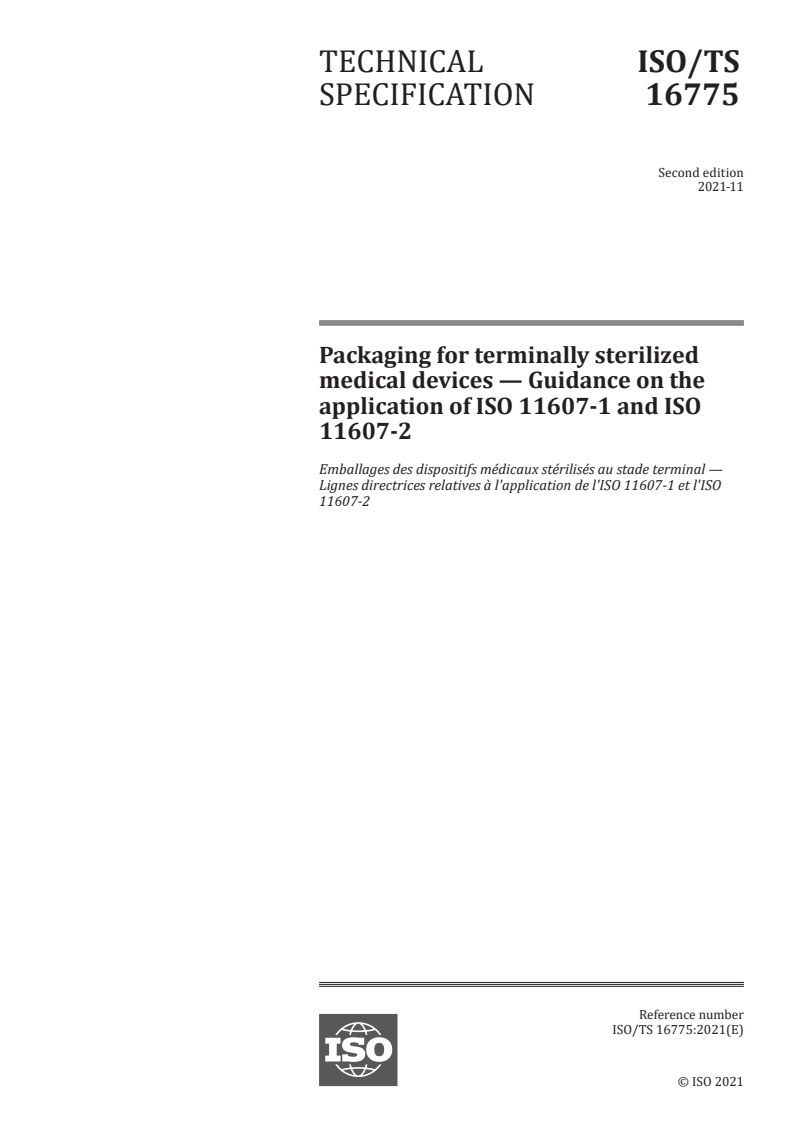
(Main)Packaging for terminally sterilized medical devices — Guidance on the application of ISO 11607-1 and ISO 11607-2
Packaging for terminally sterilized medical devices — Guidance on the application of ISO 11607-1 and ISO 11607-2
This document provides guidance for the application of the requirements contained in ISO 11607-1 and ISO 11607-2. It does not add to, or otherwise change, the requirements of ISO 11607-1 and ISO 11607-2. This is an informative document, not normative. It does not include requirements to be used as basis of regulatory inspection or certification assessment activities. The guidance can be used to better understand the requirements of ISO 11607-1 and ISO 11607-2 and illustrates the variety of methods and approaches available for meeting the requirements of those International Standards. It is not required that this document be used to demonstrate conformity with them. Guidance is given for evaluation, selection and use of packaging materials, preformed sterile barrier systems, sterile barrier systems and packaging systems. Guidance on validation requirements for forming, sealing and assembly processes is also given. This document provides information for both healthcare facilities and the medical devices industry for terminally sterilized medical devices. This document does not provide guidance for applications of packaging materials and systems after their opening. In the use of packaging for other purposes such as a “sterile field” or transport of contaminated items, other regulatory standards will apply.
Emballages des dispositifs médicaux stérilisés au stade terminal — Lignes directrices relatives à l'application de l'ISO 11607-1 et l'ISO 11607-2
Le présent document fournit des recommandations pour l’application des exigences énoncées dans l’ISO 11607-1 et dans l’ISO 11607-2. Il ne complète ni ne modifie en aucune manière les exigences de l’ISO 11607-1 et de l’ISO 11607-2. Le présent document est informatif, et non normatif. Il n’inclut pas d’exigence à utiliser comme base pour les activités d’inspection réglementaire ou d’évaluation pour certification. Le présent document d’orientation peut servir à mieux comprendre les exigences de l’ISO 11607-1 et de l’ISO 11607-2, ainsi qu’à illustrer la diversité des méthodes et approches possibles pour satisfaire aux exigences de ces Normes internationales. Il n’est pas nécessaire que le présent document soit utilisé pour démontrer la conformité avec ces dernières. Des recommandations sont fournies pour l’évaluation, la sélection et l’utilisation des matériaux d’emballage, des systèmes de barrière stérile préformés, des systèmes de barrière stérile et des systèmes d’emballage. Des recommandations relatives aux exigences en matière de validation pour les procédés de formage, de scellage et d’assemblage sont également fournies. Le présent document fournit des informations à la fois pour les établissements de santé et l’industrie des dispositifs médicaux concernant les dispositifs médicaux soumis à une stérilisation terminale. Le présent document ne fournit pas de recommandation pour les applications des matériaux et systèmes d’emballage après leur ouverture. D’autres normes réglementaires s’appliquent dans le cadre de l’utilisation d’emballage à d’autres fins, telles que le « champ stérile » ou le transport d’articles contaminés.
General Information
- Status
- Published
- Publication Date
- 04-Nov-2021
- Technical Committee
- ISO/TC 198 - Sterilization of health care products
- Drafting Committee
- ISO/TC 198/WG 7 - Packaging
- Current Stage
- 9093 - International Standard confirmed
- Start Date
- 13-Jun-2025
- Completion Date
- 12-Feb-2026
Relations
- Effective Date
- 12-Feb-2026
- Effective Date
- 23-Apr-2020
Overview
ISO/TS 16775:2021 - Packaging for terminally sterilized medical devices - is an informative technical specification that provides guidance on applying ISO 11607‑1 and ISO 11607‑2. It clarifies intent and illustrates methods and approaches to meet the requirements of those standards without adding new normative requirements. ISO/TS 16775:2021 is intended for the medical device industry and healthcare facilities involved with packaging, sterilization and sterile handling of terminally sterilized medical devices.
Key topics and technical scope
This guidance document helps interpret and apply requirements related to:
- Selection and evaluation of packaging materials - guidance on material properties, source, history and traceability.
- Preformed sterile barrier systems and sterile barrier systems - performance considerations, multi‑layer systems and reusable systems.
- Packaging system design and development - design inputs, design process, physical protection, and sterile fluid path considerations.
- Validation of forming, sealing and assembly processes - practical approaches for process validation and acceptance criteria.
- Microbial barrier and sterilization compatibility - ensuring package integrity and compatibility with intended sterilization methods.
- Aseptic presentation and usability evaluation - guidance for designing packaging to support aseptic presentation and user‑centred usability studies.
- Storage, transport and labelling - handling conditions, labelling system considerations and documentation needs.
- Quality and risk management - aligning packaging activities with quality systems and risk‑based decision making.
Note: ISO/TS 16775:2021 is informative only and does not create regulatory requirements nor replace ISO 11607‑1/11607‑2; it does not cover package use after opening or reuse in a contaminated transport context.
Practical applications and who uses it
ISO/TS 16775:2021 is practical for:
- Packaging engineers and design teams creating sterile packaging systems for single‑use or terminally sterilized devices.
- Sterilization engineers and validation specialists planning forming, sealing and assembly validation.
- Quality assurance and regulatory affairs professionals interpreting ISO 11607 requirements and preparing technical documentation.
- Contract packagers and CMOs responsible for production conditions, material traceability and seal integrity testing.
- Healthcare sterile processing departments seeking better understanding of packaging performance and aseptic presentation design.
Use cases include material selection, sealing process validation, documenting microbial barrier rationale, usability testing for aseptic opening, and establishing packaging families for product lines.
Related standards
- ISO 11607‑1 (Packaging for terminally sterilized medical devices - Requirements for materials, preformed sterile barrier systems and packaging systems)
- ISO 11607‑2 (Requirements for validation of the packaging process)
- ISO/TS 16775:2021 serves as guidance to apply the above standards consistently in industry practice.
ISO/TS 16775:2021 - Packaging for terminally sterilized medical devices — Guidance on the application of ISO 11607-1 and ISO 11607-2 Released:11/5/2021
ISO/TS 16775:2021 - Packaging for terminally sterilized medical devices — Guidance on the application of ISO 11607-1 and ISO 11607-2 Released:11/5/2021

ISO/TS 16775:2021 - Emballages des dispositifs médicaux stérilisés au stade terminal — Lignes directrices relatives à l'application de l'ISO 11607-1 et l'ISO 11607-2 Released:11/5/2021
ISO/TS 16775:2021 - Emballages des dispositifs médicaux stérilisés au stade terminal — Lignes directrices relatives à l'application de l'ISO 11607-1 et l'ISO 11607-2 Released:11/5/2021
Get Certified
Connect with accredited certification bodies for this standard

BSI Group
BSI (British Standards Institution) is the business standards company that helps organizations make excellence a habit.

TÜV Rheinland
TÜV Rheinland is a leading international provider of technical services.

TÜV SÜD
TÜV SÜD is a trusted partner of choice for safety, security and sustainability solutions.
Sponsored listings
Frequently Asked Questions
ISO/TS 16775:2021 is a technical specification published by the International Organization for Standardization (ISO). Its full title is "Packaging for terminally sterilized medical devices — Guidance on the application of ISO 11607-1 and ISO 11607-2". This standard covers: This document provides guidance for the application of the requirements contained in ISO 11607-1 and ISO 11607-2. It does not add to, or otherwise change, the requirements of ISO 11607-1 and ISO 11607-2. This is an informative document, not normative. It does not include requirements to be used as basis of regulatory inspection or certification assessment activities. The guidance can be used to better understand the requirements of ISO 11607-1 and ISO 11607-2 and illustrates the variety of methods and approaches available for meeting the requirements of those International Standards. It is not required that this document be used to demonstrate conformity with them. Guidance is given for evaluation, selection and use of packaging materials, preformed sterile barrier systems, sterile barrier systems and packaging systems. Guidance on validation requirements for forming, sealing and assembly processes is also given. This document provides information for both healthcare facilities and the medical devices industry for terminally sterilized medical devices. This document does not provide guidance for applications of packaging materials and systems after their opening. In the use of packaging for other purposes such as a “sterile field” or transport of contaminated items, other regulatory standards will apply.
This document provides guidance for the application of the requirements contained in ISO 11607-1 and ISO 11607-2. It does not add to, or otherwise change, the requirements of ISO 11607-1 and ISO 11607-2. This is an informative document, not normative. It does not include requirements to be used as basis of regulatory inspection or certification assessment activities. The guidance can be used to better understand the requirements of ISO 11607-1 and ISO 11607-2 and illustrates the variety of methods and approaches available for meeting the requirements of those International Standards. It is not required that this document be used to demonstrate conformity with them. Guidance is given for evaluation, selection and use of packaging materials, preformed sterile barrier systems, sterile barrier systems and packaging systems. Guidance on validation requirements for forming, sealing and assembly processes is also given. This document provides information for both healthcare facilities and the medical devices industry for terminally sterilized medical devices. This document does not provide guidance for applications of packaging materials and systems after their opening. In the use of packaging for other purposes such as a “sterile field” or transport of contaminated items, other regulatory standards will apply.
ISO/TS 16775:2021 is classified under the following ICS (International Classification for Standards) categories: 11.080.30 - Sterilized packaging. The ICS classification helps identify the subject area and facilitates finding related standards.
ISO/TS 16775:2021 has the following relationships with other standards: It is inter standard links to CEN ISO/TS 16775:2021, ISO/TS 16775:2014. Understanding these relationships helps ensure you are using the most current and applicable version of the standard.
ISO/TS 16775:2021 is available in PDF format for immediate download after purchase. The document can be added to your cart and obtained through the secure checkout process. Digital delivery ensures instant access to the complete standard document.
Standards Content (Sample)
TECHNICAL ISO/TS
SPECIFICATION 16775
Second edition
2021-11
Packaging for terminally sterilized
medical devices — Guidance on the
application of ISO 11607-1 and ISO
11607-2
Emballages des dispositifs médicaux stérilisés au stade terminal —
Lignes directrices relatives à l'application de l'ISO 11607-1 et l'ISO
11607-2
Reference number
© ISO 2021
All rights reserved. Unless otherwise specified, or required in the context of its implementation, no part of this publication may
be reproduced or utilized otherwise in any form or by any means, electronic or mechanical, including photocopying, or posting on
the internet or an intranet, without prior written permission. Permission can be requested from either ISO at the address below
or ISO’s member body in the country of the requester.
ISO copyright office
CP 401 • Ch. de Blandonnet 8
CH-1214 Vernier, Geneva
Phone: +41 22 749 01 11
Email: copyright@iso.org
Website: www.iso.org
Published in Switzerland
ii
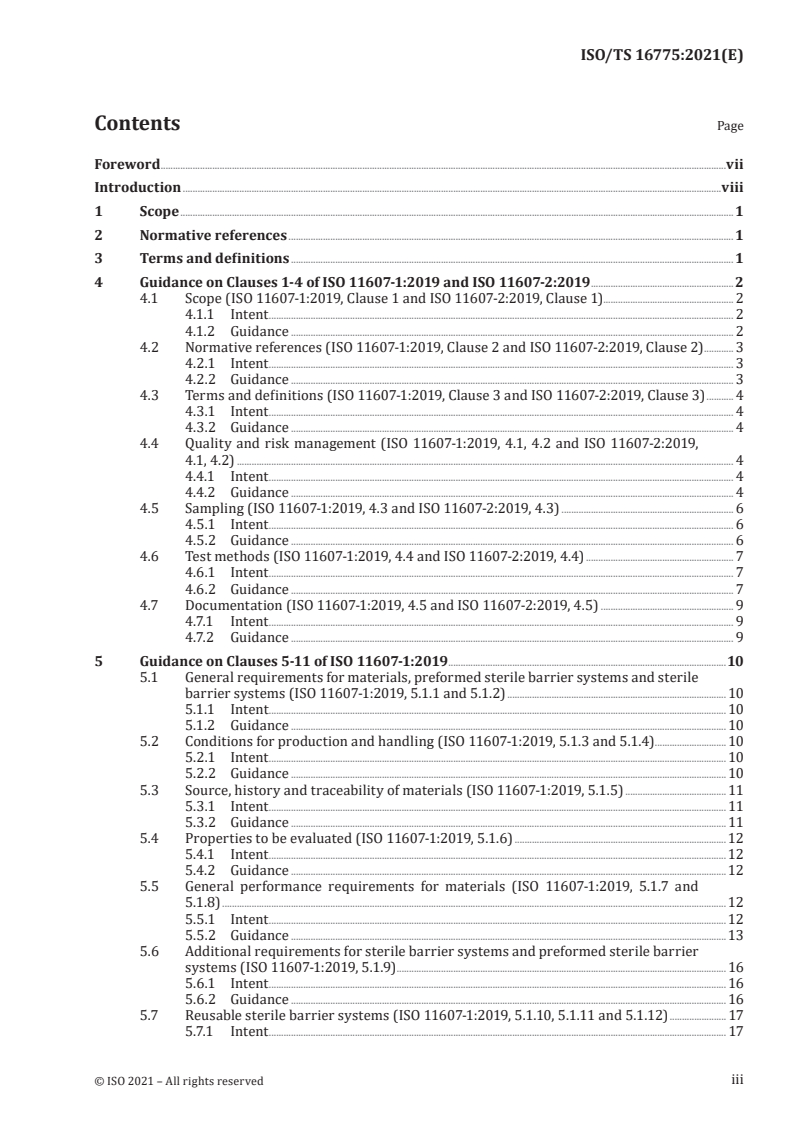
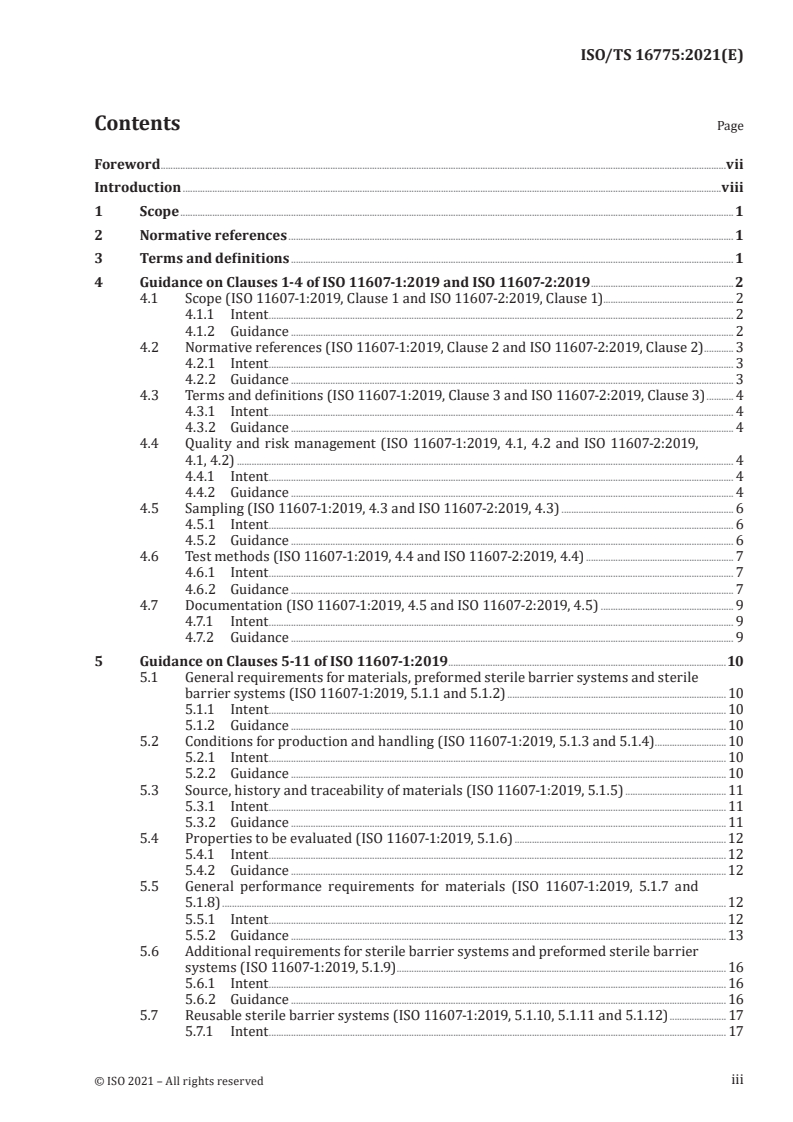
Contents Page
Foreword .vii
Introduction .viii
1 Scope . 1
2 Normative references . 1
3 Terms and definitions . 1
4 Guidance on Clauses 1-4 of ISO 11607-1:2019 and ISO 11607-2:2019 .2
4.1 Scope (ISO 11607-1:2019, Clause 1 and ISO 11607-2:2019, Clause 1). 2
4.1.1 Intent . 2
4.1.2 Guidance . 2
4.2 Normative references (ISO 11607-1:2019, Clause 2 and ISO 11607-2:2019, Clause 2) . 3
4.2.1 Intent . 3
4.2.2 Guidance . 3
4.3 Terms and definitions (ISO 11607-1:2019, Clause 3 and ISO 11607-2:2019, Clause 3) . 4
4.3.1 Intent . 4
4.3.2 Guidance . 4
4.4 Quality and risk management (ISO 11607-1:2019, 4.1, 4.2 and ISO 11607-2:2019,
4.1, 4.2) . 4
4.4.1 Intent . 4
4.4.2 Guidance . 4
4.5 Sampling (ISO 11607-1:2019, 4.3 and ISO 11607-2:2019, 4.3) . 6
4.5.1 Intent . 6
4.5.2 Guidance . 6
4.6 Test methods (ISO 11607-1:2019, 4.4 and ISO 11607-2:2019, 4.4) . 7
4.6.1 Intent . 7
4.6.2 Guidance . 7
4.7 Documentation (ISO 11607-1:2019, 4.5 and ISO 11607-2:2019, 4.5) . 9
4.7.1 Intent . 9
4.7.2 Guidance . 9
5 Guidance on Clauses 5-11 of ISO 11607-1:2019 .10
5.1 General requirements for materials, preformed sterile barrier systems and sterile
barrier systems (ISO 11607-1:2019, 5.1.1 and 5.1.2) . 10
5.1.1 Intent . 10
5.1.2 Guidance . 10
5.2 Conditions for production and handling (ISO 11607-1:2019, 5.1.3 and 5.1.4) . 10
5.2.1 Intent . 10
5.2.2 Guidance . 10
5.3 Source, history and traceability of materials (ISO 11607-1:2019, 5.1.5) . 11
5.3.1 Intent . 11
5.3.2 Guidance . 11
5.4 Properties to be evaluated (ISO 11607-1:2019, 5.1.6) .12
5.4.1 Intent . 12
5.4.2 Guidance .12
5.5 General performance requirements for materials (ISO 11607-1:2019, 5.1.7 and
5.1.8) . 12
5.5.1 Intent .12
5.5.2 Guidance .13
5.6 Additional requirements for sterile barrier systems and preformed sterile barrier
systems (ISO 11607-1:2019, 5.1.9) . 16
5.6.1 Intent . 16
5.6.2 Guidance . 16
5.7 Reusable sterile barrier systems (ISO 11607-1:2019, 5.1.10, 5.1.11 and 5.1.12) . 17
5.7.1 Intent . 17
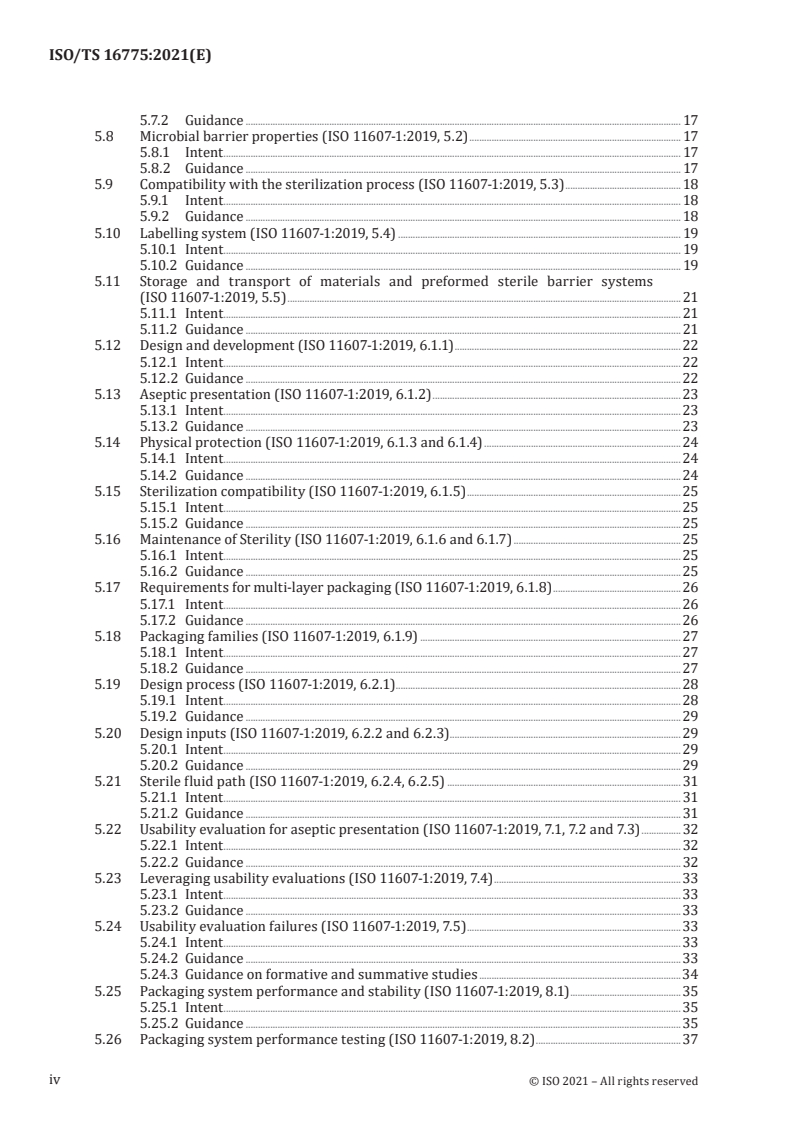
iii
5.7.2 Guidance . 17
5.8 Microbial barrier properties (ISO 11607-1:2019, 5.2) . 17
5.8.1 Intent . 17
5.8.2 Guidance . 17
5.9 Compatibility with the sterilization process (ISO 11607-1:2019, 5.3) . 18
5.9.1 Intent . 18
5.9.2 Guidance . 18
5.10 Labelling system (ISO 11607-1:2019, 5.4) . 19
5.10.1 Intent . 19
5.10.2 Guidance . 19
5.11 Storage and transport of materials and preformed sterile barrier systems
(ISO 11607-1:2019, 5.5) . 21
5.11.1 Intent . 21
5.11.2 Guidance . 21
5.12 Design and development (ISO 11607-1:2019, 6.1.1) . 22
5.12.1 Intent . 22
5.12.2 Guidance .22
5.13 Aseptic presentation (ISO 11607-1:2019, 6.1.2) . 23
5.13.1 Intent . 23
5.13.2 Guidance . 23
5.14 Physical protection (ISO 11607-1:2019, 6.1.3 and 6.1.4) . 24
5.14.1 Intent . 24
5.14.2 Guidance . 24
5.15 Sterilization compatibility (ISO 11607-1:2019, 6.1.5) . 25
5.15.1 Intent . 25
5.15.2 Guidance . 25
5.16 Maintenance of Sterility (ISO 11607-1:2019, 6.1.6 and 6.1.7) . 25
5.16.1 Intent . 25
5.16.2 Guidance . 25
5.17 Requirements for multi-layer packaging (ISO 11607-1:2019, 6.1.8) . 26
5.17.1 Intent . 26
5.17.2 Guidance . 26
5.18 Packaging families (ISO 11607-1:2019, 6.1.9) . 27
5.18.1 Intent . 27
5.18.2 Guidance . 27
5.19 Design process (ISO 11607-1:2019, 6.2.1) .28
5.19.1 Intent .28
5.19.2 Guidance .29
5.20 Design inputs (ISO 11607-1:2019, 6.2.2 and 6.2.3).29
5.20.1 Intent . 29
5.20.2 Guidance .29
5.21 Sterile fluid path (ISO 11607-1:2019, 6.2.4, 6.2.5) . 31
5.21.1 Intent . 31
5.21.2 Guidance . 31
5.22 Usability evaluation for aseptic presentation (ISO 11607-1:2019, 7.1, 7.2 and 7.3) . 32
5.22.1 Intent . 32
5.22.2 Guidance . 32
5.23 Leveraging usability evaluations (ISO 11607-1:2019, 7.4) . 33
5.23.1 Intent . 33
5.23.2 Guidance . 33
5.24 Usability evaluation failures (ISO 11607-1:2019, 7.5) . 33
5.24.1 Intent . 33
5.24.2 Guidance . 33
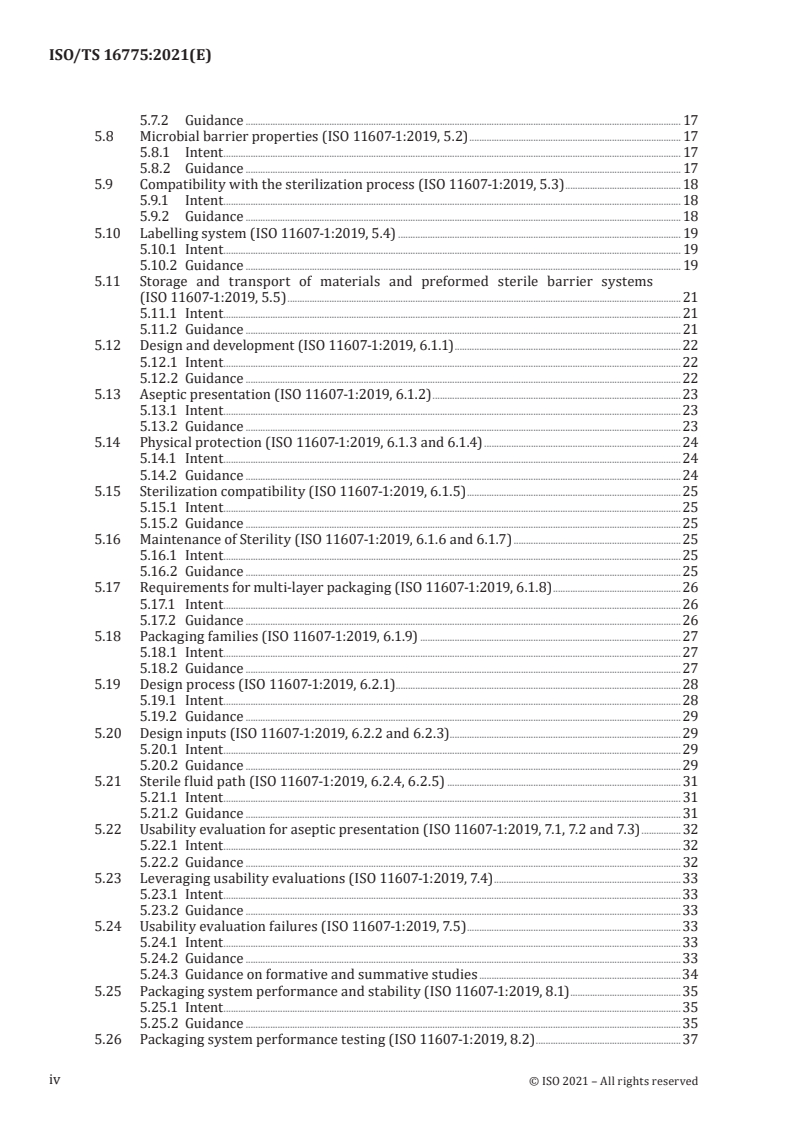
5.24.3 Guidance on formative and summative studies .34
5.25 Packaging system performance and stability (ISO 11607-1:2019, 8.1) . 35
5.25.1 Intent . 35
5.25.2 Guidance . 35
5.26 Packaging system performance testing (ISO 11607-1:2019, 8.2) . 37
iv
5.26.1 Intent . 37
5.26.2 Guidance . 37
5.27 Stability testing (ISO 11607-1:2019, 8.3) .38
5.27.1 Intent .38
5.27.2 Guidance .38
5.28 Packaging system validation and changes (ISO 11607-1:2019, 9.1) .40
5.28.1 Intent .40
5.28.2 Guidance .40
5.29 Change control (ISO 11607-1:2019, 9.2) .40
5.29.1 Intent .40
5.29.2 Guidance .40
5.30 Revalidations (ISO 11607-1:2019, 9.3, 9.4, and 9.5) .40
5.30.1 Intent .40
5.30.2 Guidance .40
5.31 Inspection immediately prior to aseptic presentation (ISO 11607-1:2019, Clause 10) . 41
5.31.1 Intent . 41
5.31.2 Guidance . 41
5.32 Information to be provided (ISO 11607-1:2019, Clause 11) . 41
5.32.1 Intent . 41
5.32.2 Guidance . 41
6 Guidance on Clauses 5-8 of ISO 11607-2:2019 .42
6.1 General Clauses 1-4 of ISO 11607-2:2019 . 42
6.2 Validation of packaging processes – general requirements (ISO 11607-2:2019,
5.1.1 and 5.1.2) . 42
6.2.1 Intent . 42
6.2.2 Guidance . 42
6.3 Process specification (ISO 11607-2:2019, 5.1.3) . 43
6.3.1 Intent . 43
6.3.2 Guidance . 43
6.4 Process validation of packaging families (ISO 11607-2:2019, 5.1.4) . 43
6.4.1 Intent . 43
6.4.2 Guidance . 43
6.5 Installation qualification (ISO 11607-2:2019, 5.2) .44
6.5.1 Intent .44
6.5.2 Guidance . 45
6.6 Operational qualification (ISO 11607-2:2019, 5.3) . 45
6.6.1 Intent . 45
6.6.2 Guidance .46
6.7 Performance qualification (ISO 11607-2:2019, 5.4) .46
6.7.1 Intent .46
6.7.2 Guidance .46
6.8 Formal approval of the process validation (ISO 11607-2:2019, 5.5). 47
6.8.1 Intent . 47
6.8.2 Guidance . 47
6.9 Process control and monitoring (ISO 11607-2:2019, 5.6) .48
6.9.1 Intent .48
6.9.2 Guidance .48
6.10 Process changes and revalidation (ISO 11607-2:2019, 5.7) .48
6.10.1 Intent .48
6.10.2 Guidance .48
6.11 Assembly (ISO 11607-2:2019, Clause 6) .49
6.11.1 Intent .49
6.11.2 Guidance .49
6.12 Use of reusable sterile barrier systems (ISO 11607-2:2019, Clause 7) . 51
6.12.1 Intent . 51
6.12.2 Guidance . 51
6.13 Sterile fluid path packaging (ISO 11607-2:2019, Clause 8) . 51
6.13.1 Intent . 51
v
6.13.2 Guidance . 51
Annex A (informative) Design and development for packaging systems – guidance for
industry .52
Annex B (informative) Guidance on the application of the ISO 11607 series in healthcare
facilities .60
Annex C (informative) Risk analysis tools — Guidance for industry and healthcare facilities .91
Annex D (informative) Considerations for sampling plans – Guidance for healthcare
facilities .93
Annex E (informative) Guidance on establishing process parameters – guidance for
industry .95
Annex F (informative) Sterilization considerations – Guidance for industry and healthcare
facilities . 101
Annex G (informative) Use of contract packagers – Guidance for industry and healthcare
facilities . 108
Annex H (informative) Example of a handling, distribution and storage checklist – Guidance
for healthcare facilities for selecting a sterile barrier system . 109
Annex I (informative) Investigating failure – Guidance for industry and healthcare facilities . 112
Annex J (informative) Validation summary – Guidance for healthcare facilities .116
Annex K (informative) Validation for wrapping process — Guidance for healthcare facilities . 118
Annex L (informative) Validation for reusable container process – Guidance for healthcare
facilities .124
Annex M (informative) Validation for heat sealing process for preformed sterile barrier
systems (PSBS) – Guidance for healthcare facilities . 130
Annex N (informative) Evaluation of sterile packaging by end users — Guidance for
healthcare facilities . 138
Bibliography . 139
vi
Foreword
ISO (the International Organization for Standardization) is a worldwide federation of national standards
bodies (ISO member bodies). The work of preparing International Standards is normally carried out
through ISO technical committees. Each member body interested in a subject for which a technical
committee has been established has the right to be represented on that committee. International
organizations, governmental and non-governmental, in liaison with ISO, also take part in the work.
ISO collaborates closely with the International Electrotechnical Commission (IEC) on all matters of
electrotechnical standardization.
The procedures used to develop this document and those intended for its further maintenance are
described in the ISO/IEC Directives, Part 1. In particular, the different approval criteria needed for the
different types of ISO documents should be noted. This document was drafted in accordance with the
editorial rules of the ISO/IEC Directives, Part 2 (see www.iso.org/directives).
Attention is drawn to the possibility that some of the elements of this document may be the subject of
patent rights. ISO shall not be held responsible for identifying any or all such patent rights. Details of
any patent rights identified during the development of the document will be in the Introduction and/or
on the ISO list of patent declarations received (see www.iso.org/patents).
Any trade name used in this document is information given for the convenience of users and does not
constitute an endorsement.
For an explanation of the voluntary nature of standards, the meaning of ISO specific terms and
expressions related to conformity assessment, as well as information about ISO's adherence to
the World Trade Organization (WTO) principles in the Technical Barriers to Trade (TBT), see
www.iso.org/iso/foreword.html.
This document was prepared by Technical Committee ISO/TC 198, Sterilization of health care products,
in collaboration with the European Committee for Standardization (CEN) Technical Committee CEN/
TC 102, Sterilizers and associated equipment for processing of medical devices, in accordance with the
Agreement on technical cooperation between ISO and CEN (Vienna Agreement).
This second edition cancels and replaces the first edition (ISO/TS 16775:2014), which has been
technically revised.
The main changes compared to the previous edition are as follows:
— updates to reflect ISO 11607-1:2019 and ISO 11607-2:2019 editions;
— intent and guidance is provided for each clause of the standard to improve usability of this document.
— new annexes have been added;
— some annexes have been removed.
Any feedback or questions on this document should be directed to the user’s national standards body. A
complete listing of these bodies can be found at www.iso.org/members.html.
vii
Introduction
Sterile barrier systems are intended to allow for sterilization, provide physical protection, maintain
the sterility of their contents until the point of use and ensure aseptic presentation. The sterile barrier
system, depending on conditions of handling, distribution or storage, can be combined with additional
protective packaging to create a packaging system.
ISO 11607-1 specifies the requirements for materials, sterile barrier systems, and packaging systems,
including the validation of the packaging system design while ISO 11607-2 specifies the requirements
for packaging process validation. The requirements outlined in these standards are generic and are
applicable to healthcare facilities and wherever medical devices are packaged and sterilized. It is
recognized that the circumstances of the application of these standards will be different when they are
used in a healthcare facility, by a medical device manufacturer or reprocessor.
This document provides guidance on the application of ISO 11607-1 and ISO 11607-2. This latest
revision has been completely reorganised following the structure of ISO 11607-1 and ISO 11607-2 and
referring to individual or groups of clauses or subclauses while indicating the intent of the requirements
followed by relevant guidance. It can be used for the systematic application of ISO 11607-1 and
ISO 11607-2 or as a reference when questions come up about specific requirements. Clause 4 covers
the general requirements that are identical in ISO 11607-1 and ISO 11607-2, while Clause 5 applies to
ISO 11607-1:2019 and Clause 6 to ISO 11607-2:2019. Guidance on the application of risk management
over the packaging life cycle has been added in anticipation of the upcoming amendments to
ISO 11607 (all parts).
This guidance document is applicable to healthcare facilities and to industry while differences for the
two environments are addressed as necessary. Although healthcare facilities are usually not involved in
sterile barrier system design tasks, their part in the sterile barrier system and packaging system design
process consists of carefully selecting an appropriate sterile barrier system and protective packaging
based on the identified risks related to the content, sterilization method, transport, storage and aseptic
presentation. Sterile barrier and packaging systems and the related processes must then be properly
validated, and sealing, closure and assembly processes must be controlled and monitored. To ensure
patient safety, healthcare facilities should develop written procedures to be implemented by adequately
trained personnel. Guidance given in the annexes of this document is applicable to healthcare facilities
and/or industry, as indicated.
The conditions of use of this guidance can vary widely around the world and can be subject to
interpretation by circumstances and regulatory environments.
viii
TECHNICAL SPECIFICATION ISO/TS 16775:2021(E)
Packaging for terminally sterilized medical devices —
Guidance on the application of ISO 11607-1 and ISO 11607-
1 Scope
This document provides guidance for the application of the requirements contained in ISO 11607-1 and
ISO 11607-2. It does not add to, or otherwise change, the requirements of ISO 11607-1 and ISO 11607-2.
This is an informative document, not normative. It does not include requirements to be used as basis of
regulatory inspection or certification assessment activities.
The guidance can be used to better understand the requirements of ISO 11607-1 and ISO 11607-2 and
illustrates the variety of methods and approaches available for meeting the requirements of those
International Standards. It is not required that this document be used to demonstrate conformity with
them.
Guidance is given for evaluation, selection and use of packaging materials, preformed sterile barrier
systems, sterile barrier systems and packaging systems. Guidance on validation requirements for
forming, sealing and assembly processes is also given.
This document provides information for both healthcare facilities and the medical devices industry for
terminally sterilized medical devices.
This document does not provide guidance for applications of packaging materials and systems after
their opening. In the use of packaging for other purposes such as a “sterile field” or transport of
contaminated items, other regulatory standards will apply.
2 Normative references
The following documents are referred to in the text in such a way that some or all of their content
constitutes requirements of this document. For dated references, only the edition cited applies. For
undated references, the latest edition of the referenced document (including any amendments) applies.
ISO 11607-1:2019, Packaging for terminally sterilized medical devices — Part 1: Requirements for
materials, sterile barrier systems and packaging systems
ISO 11607-2:2019, Packaging for terminally sterilized medical devices — Part 2: Validation requirements
for forming, sealing and assembly processes
3 Terms and definitions
For the purposes of this document, the terms and definitions given in ISO 11607-1:2019 and
ISO 11607-2:2019 and the following apply.
ISO and IEC maintain terminological databases for use in standardization at the following addresses:
— ISO Online browsing platform: available at https:// www .iso .org/ obp
— IEC Electropedia: available at http:// www .electropedia .org/
3.1
process
set of interrelated or interacting activities that use inputs to deliver an intended result
Note 1 to entry: Whether the “intended result” of a process is called output, product or service depends on the
context of the reference.
Note 2 to entry: Inputs to a process are generally the outputs of other processes and outputs of a process are
generally the inputs to other processes.
Note 3 to entry: Two or more interrelated and interacting processes in series can also be referred to as a process.
[SOURCE: ISO 9000:2015, 3.4.1, modified — Notes to entry 4, 5 and 6 are deleted.]
3.2
risk
combination of the probability of occurrence of harm and the severity of that harm
[SOURCE: ISO/IEC Guide 63: 2019, 3.10, modified — Note 1 to entry deleted.]
3.3
risk control
process (3.1) in which decisions are made and measures implemented by which risks (3.2) are reduced
to, or maintained within, specified
...
TECHNICAL ISO/TS
SPECIFICATION 16775
Second edition
2021-11
Packaging for terminally sterilized
medical devices — Guidance on the
application of ISO 11607-1 and ISO
11607-2
Emballages des dispositifs médicaux stérilisés au stade terminal —
Lignes directrices relatives à l'application de l'ISO 11607-1 et l'ISO
11607-2
Reference number
© ISO 2021
All rights reserved. Unless otherwise specified, or required in the context of its implementation, no part of this publication may
be reproduced or utilized otherwise in any form or by any means, electronic or mechanical, including photocopying, or posting on
the internet or an intranet, without prior written permission. Permission can be requested from either ISO at the address below
or ISO’s member body in the country of the requester.
ISO copyright office
CP 401 • Ch. de Blandonnet 8
CH-1214 Vernier, Geneva
Phone: +41 22 749 01 11
Email: copyright@iso.org
Website: www.iso.org
Published in Switzerland
ii
Contents Page
Foreword .vii
Introduction .viii
1 Scope . 1
2 Normative references . 1
3 Terms and definitions . 1
4 Guidance on Clauses 1-4 of ISO 11607-1:2019 and ISO 11607-2:2019 .2
4.1 Scope (ISO 11607-1:2019, Clause 1 and ISO 11607-2:2019, Clause 1). 2
4.1.1 Intent . 2
4.1.2 Guidance . 2
4.2 Normative references (ISO 11607-1:2019, Clause 2 and ISO 11607-2:2019, Clause 2) . 3
4.2.1 Intent . 3
4.2.2 Guidance . 3
4.3 Terms and definitions (ISO 11607-1:2019, Clause 3 and ISO 11607-2:2019, Clause 3) . 4
4.3.1 Intent . 4
4.3.2 Guidance . 4
4.4 Quality and risk management (ISO 11607-1:2019, 4.1, 4.2 and ISO 11607-2:2019,
4.1, 4.2) . 4
4.4.1 Intent . 4
4.4.2 Guidance . 4
4.5 Sampling (ISO 11607-1:2019, 4.3 and ISO 11607-2:2019, 4.3) . 6
4.5.1 Intent . 6
4.5.2 Guidance . 6
4.6 Test methods (ISO 11607-1:2019, 4.4 and ISO 11607-2:2019, 4.4) . 7
4.6.1 Intent . 7
4.6.2 Guidance . 7
4.7 Documentation (ISO 11607-1:2019, 4.5 and ISO 11607-2:2019, 4.5) . 9
4.7.1 Intent . 9
4.7.2 Guidance . 9
5 Guidance on Clauses 5-11 of ISO 11607-1:2019 .10
5.1 General requirements for materials, preformed sterile barrier systems and sterile
barrier systems (ISO 11607-1:2019, 5.1.1 and 5.1.2) . 10
5.1.1 Intent . 10
5.1.2 Guidance . 10
5.2 Conditions for production and handling (ISO 11607-1:2019, 5.1.3 and 5.1.4) . 10
5.2.1 Intent . 10
5.2.2 Guidance . 10
5.3 Source, history and traceability of materials (ISO 11607-1:2019, 5.1.5) . 11
5.3.1 Intent . 11
5.3.2 Guidance . 11
5.4 Properties to be evaluated (ISO 11607-1:2019, 5.1.6) .12
5.4.1 Intent . 12
5.4.2 Guidance .12
5.5 General performance requirements for materials (ISO 11607-1:2019, 5.1.7 and
5.1.8) . 12
5.5.1 Intent .12
5.5.2 Guidance .13
5.6 Additional requirements for sterile barrier systems and preformed sterile barrier
systems (ISO 11607-1:2019, 5.1.9) . 16
5.6.1 Intent . 16
5.6.2 Guidance . 16
5.7 Reusable sterile barrier systems (ISO 11607-1:2019, 5.1.10, 5.1.11 and 5.1.12) . 17
5.7.1 Intent . 17
iii
5.7.2 Guidance . 17
5.8 Microbial barrier properties (ISO 11607-1:2019, 5.2) . 17
5.8.1 Intent . 17
5.8.2 Guidance . 17
5.9 Compatibility with the sterilization process (ISO 11607-1:2019, 5.3) . 18
5.9.1 Intent . 18
5.9.2 Guidance . 18
5.10 Labelling system (ISO 11607-1:2019, 5.4) . 19
5.10.1 Intent . 19
5.10.2 Guidance . 19
5.11 Storage and transport of materials and preformed sterile barrier systems
(ISO 11607-1:2019, 5.5) . 21
5.11.1 Intent . 21
5.11.2 Guidance . 21
5.12 Design and development (ISO 11607-1:2019, 6.1.1) . 22
5.12.1 Intent . 22
5.12.2 Guidance .22
5.13 Aseptic presentation (ISO 11607-1:2019, 6.1.2) . 23
5.13.1 Intent . 23
5.13.2 Guidance . 23
5.14 Physical protection (ISO 11607-1:2019, 6.1.3 and 6.1.4) . 24
5.14.1 Intent . 24
5.14.2 Guidance . 24
5.15 Sterilization compatibility (ISO 11607-1:2019, 6.1.5) . 25
5.15.1 Intent . 25
5.15.2 Guidance . 25
5.16 Maintenance of Sterility (ISO 11607-1:2019, 6.1.6 and 6.1.7) . 25
5.16.1 Intent . 25
5.16.2 Guidance . 25
5.17 Requirements for multi-layer packaging (ISO 11607-1:2019, 6.1.8) . 26
5.17.1 Intent . 26
5.17.2 Guidance . 26
5.18 Packaging families (ISO 11607-1:2019, 6.1.9) . 27
5.18.1 Intent . 27
5.18.2 Guidance . 27
5.19 Design process (ISO 11607-1:2019, 6.2.1) .28
5.19.1 Intent .28
5.19.2 Guidance .29
5.20 Design inputs (ISO 11607-1:2019, 6.2.2 and 6.2.3).29
5.20.1 Intent . 29
5.20.2 Guidance .29
5.21 Sterile fluid path (ISO 11607-1:2019, 6.2.4, 6.2.5) . 31
5.21.1 Intent . 31
5.21.2 Guidance . 31
5.22 Usability evaluation for aseptic presentation (ISO 11607-1:2019, 7.1, 7.2 and 7.3) . 32
5.22.1 Intent . 32
5.22.2 Guidance . 32
5.23 Leveraging usability evaluations (ISO 11607-1:2019, 7.4) . 33
5.23.1 Intent . 33
5.23.2 Guidance . 33
5.24 Usability evaluation failures (ISO 11607-1:2019, 7.5) . 33
5.24.1 Intent . 33
5.24.2 Guidance . 33
5.24.3 Guidance on formative and summative studies .34
5.25 Packaging system performance and stability (ISO 11607-1:2019, 8.1) . 35
5.25.1 Intent . 35
5.25.2 Guidance . 35
5.26 Packaging system performance testing (ISO 11607-1:2019, 8.2) . 37
iv
5.26.1 Intent . 37
5.26.2 Guidance . 37
5.27 Stability testing (ISO 11607-1:2019, 8.3) .38
5.27.1 Intent .38
5.27.2 Guidance .38
5.28 Packaging system validation and changes (ISO 11607-1:2019, 9.1) .40
5.28.1 Intent .40
5.28.2 Guidance .40
5.29 Change control (ISO 11607-1:2019, 9.2) .40
5.29.1 Intent .40
5.29.2 Guidance .40
5.30 Revalidations (ISO 11607-1:2019, 9.3, 9.4, and 9.5) .40
5.30.1 Intent .40
5.30.2 Guidance .40
5.31 Inspection immediately prior to aseptic presentation (ISO 11607-1:2019, Clause 10) . 41
5.31.1 Intent . 41
5.31.2 Guidance . 41
5.32 Information to be provided (ISO 11607-1:2019, Clause 11) . 41
5.32.1 Intent . 41
5.32.2 Guidance . 41
6 Guidance on Clauses 5-8 of ISO 11607-2:2019 .42
6.1 General Clauses 1-4 of ISO 11607-2:2019 . 42
6.2 Validation of packaging processes – general requirements (ISO 11607-2:2019,
5.1.1 and 5.1.2) . 42
6.2.1 Intent . 42
6.2.2 Guidance . 42
6.3 Process specification (ISO 11607-2:2019, 5.1.3) . 43
6.3.1 Intent . 43
6.3.2 Guidance . 43
6.4 Process validation of packaging families (ISO 11607-2:2019, 5.1.4) . 43
6.4.1 Intent . 43
6.4.2 Guidance . 43
6.5 Installation qualification (ISO 11607-2:2019, 5.2) .44
6.5.1 Intent .44
6.5.2 Guidance . 45
6.6 Operational qualification (ISO 11607-2:2019, 5.3) . 45
6.6.1 Intent . 45
6.6.2 Guidance .46
6.7 Performance qualification (ISO 11607-2:2019, 5.4) .46
6.7.1 Intent .46
6.7.2 Guidance .46
6.8 Formal approval of the process validation (ISO 11607-2:2019, 5.5). 47
6.8.1 Intent . 47
6.8.2 Guidance . 47
6.9 Process control and monitoring (ISO 11607-2:2019, 5.6) .48
6.9.1 Intent .48
6.9.2 Guidance .48
6.10 Process changes and revalidation (ISO 11607-2:2019, 5.7) .48
6.10.1 Intent .48
6.10.2 Guidance .48
6.11 Assembly (ISO 11607-2:2019, Clause 6) .49
6.11.1 Intent .49
6.11.2 Guidance .49
6.12 Use of reusable sterile barrier systems (ISO 11607-2:2019, Clause 7) . 51
6.12.1 Intent . 51
6.12.2 Guidance . 51
6.13 Sterile fluid path packaging (ISO 11607-2:2019, Clause 8) . 51
6.13.1 Intent . 51
v
6.13.2 Guidance . 51
Annex A (informative) Design and development for packaging systems – guidance for
industry .52
Annex B (informative) Guidance on the application of the ISO 11607 series in healthcare
facilities .60
Annex C (informative) Risk analysis tools — Guidance for industry and healthcare facilities .91
Annex D (informative) Considerations for sampling plans – Guidance for healthcare
facilities .93
Annex E (informative) Guidance on establishing process parameters – guidance for
industry .95
Annex F (informative) Sterilization considerations – Guidance for industry and healthcare
facilities . 101
Annex G (informative) Use of contract packagers – Guidance for industry and healthcare
facilities . 108
Annex H (informative) Example of a handling, distribution and storage checklist – Guidance
for healthcare facilities for selecting a sterile barrier system . 109
Annex I (informative) Investigating failure – Guidance for industry and healthcare facilities . 112
Annex J (informative) Validation summary – Guidance for healthcare facilities .116
Annex K (informative) Validation for wrapping process — Guidance for healthcare facilities . 118
Annex L (informative) Validation for reusable container process – Guidance for healthcare
facilities .124
Annex M (informative) Validation for heat sealing process for preformed sterile barrier
systems (PSBS) – Guidance for healthcare facilities . 130
Annex N (informative) Evaluation of sterile packaging by end users — Guidance for
healthcare facilities . 138
Bibliography . 139
vi
Foreword
ISO (the International Organization for Standardization) is a worldwide federation of national standards
bodies (ISO member bodies). The work of preparing International Standards is normally carried out
through ISO technical committees. Each member body interested in a subject for which a technical
committee has been established has the right to be represented on that committee. International
organizations, governmental and non-governmental, in liaison with ISO, also take part in the work.
ISO collaborates closely with the International Electrotechnical Commission (IEC) on all matters of
electrotechnical standardization.
The procedures used to develop this document and those intended for its further maintenance are
described in the ISO/IEC Directives, Part 1. In particular, the different approval criteria needed for the
different types of ISO documents should be noted. This document was drafted in accordance with the
editorial rules of the ISO/IEC Directives, Part 2 (see www.iso.org/directives).
Attention is drawn to the possibility that some of the elements of this document may be the subject of
patent rights. ISO shall not be held responsible for identifying any or all such patent rights. Details of
any patent rights identified during the development of the document will be in the Introduction and/or
on the ISO list of patent declarations received (see www.iso.org/patents).
Any trade name used in this document is information given for the convenience of users and does not
constitute an endorsement.
For an explanation of the voluntary nature of standards, the meaning of ISO specific terms and
expressions related to conformity assessment, as well as information about ISO's adherence to
the World Trade Organization (WTO) principles in the Technical Barriers to Trade (TBT), see
www.iso.org/iso/foreword.html.
This document was prepared by Technical Committee ISO/TC 198, Sterilization of health care products,
in collaboration with the European Committee for Standardization (CEN) Technical Committee CEN/
TC 102, Sterilizers and associated equipment for processing of medical devices, in accordance with the
Agreement on technical cooperation between ISO and CEN (Vienna Agreement).
This second edition cancels and replaces the first edition (ISO/TS 16775:2014), which has been
technically revised.
The main changes compared to the previous edition are as follows:
— updates to reflect ISO 11607-1:2019 and ISO 11607-2:2019 editions;
— intent and guidance is provided for each clause of the standard to improve usability of this document.
— new annexes have been added;
— some annexes have been removed.
Any feedback or questions on this document should be directed to the user’s national standards body. A
complete listing of these bodies can be found at www.iso.org/members.html.
vii
Introduction
Sterile barrier systems are intended to allow for sterilization, provide physical protection, maintain
the sterility of their contents until the point of use and ensure aseptic presentation. The sterile barrier
system, depending on conditions of handling, distribution or storage, can be combined with additional
protective packaging to create a packaging system.
ISO 11607-1 specifies the requirements for materials, sterile barrier systems, and packaging systems,
including the validation of the packaging system design while ISO 11607-2 specifies the requirements
for packaging process validation. The requirements outlined in these standards are generic and are
applicable to healthcare facilities and wherever medical devices are packaged and sterilized. It is
recognized that the circumstances of the application of these standards will be different when they are
used in a healthcare facility, by a medical device manufacturer or reprocessor.
This document provides guidance on the application of ISO 11607-1 and ISO 11607-2. This latest
revision has been completely reorganised following the structure of ISO 11607-1 and ISO 11607-2 and
referring to individual or groups of clauses or subclauses while indicating the intent of the requirements
followed by relevant guidance. It can be used for the systematic application of ISO 11607-1 and
ISO 11607-2 or as a reference when questions come up about specific requirements. Clause 4 covers
the general requirements that are identical in ISO 11607-1 and ISO 11607-2, while Clause 5 applies to
ISO 11607-1:2019 and Clause 6 to ISO 11607-2:2019. Guidance on the application of risk management
over the packaging life cycle has been added in anticipation of the upcoming amendments to
ISO 11607 (all parts).
This guidance document is applicable to healthcare facilities and to industry while differences for the
two environments are addressed as necessary. Although healthcare facilities are usually not involved in
sterile barrier system design tasks, their part in the sterile barrier system and packaging system design
process consists of carefully selecting an appropriate sterile barrier system and protective packaging
based on the identified risks related to the content, sterilization method, transport, storage and aseptic
presentation. Sterile barrier and packaging systems and the related processes must then be properly
validated, and sealing, closure and assembly processes must be controlled and monitored. To ensure
patient safety, healthcare facilities should develop written procedures to be implemented by adequately
trained personnel. Guidance given in the annexes of this document is applicable to healthcare facilities
and/or industry, as indicated.
The conditions of use of this guidance can vary widely around the world and can be subject to
interpretation by circumstances and regulatory environments.
viii
TECHNICAL SPECIFICATION ISO/TS 16775:2021(E)
Packaging for terminally sterilized medical devices —
Guidance on the application of ISO 11607-1 and ISO 11607-
1 Scope
This document provides guidance for the application of the requirements contained in ISO 11607-1 and
ISO 11607-2. It does not add to, or otherwise change, the requirements of ISO 11607-1 and ISO 11607-2.
This is an informative document, not normative. It does not include requirements to be used as basis of
regulatory inspection or certification assessment activities.
The guidance can be used to better understand the requirements of ISO 11607-1 and ISO 11607-2 and
illustrates the variety of methods and approaches available for meeting the requirements of those
International Standards. It is not required that this document be used to demonstrate conformity with
them.
Guidance is given for evaluation, selection and use of packaging materials, preformed sterile barrier
systems, sterile barrier systems and packaging systems. Guidance on validation requirements for
forming, sealing and assembly processes is also given.
This document provides information for both healthcare facilities and the medical devices industry for
terminally sterilized medical devices.
This document does not provide guidance for applications of packaging materials and systems after
their opening. In the use of packaging for other purposes such as a “sterile field” or transport of
contaminated items, other regulatory standards will apply.
2 Normative references
The following documents are referred to in the text in such a way that some or all of their content
constitutes requirements of this document. For dated references, only the edition cited applies. For
undated references, the latest edition of the referenced document (including any amendments) applies.
ISO 11607-1:2019, Packaging for terminally sterilized medical devices — Part 1: Requirements for
materials, sterile barrier systems and packaging systems
ISO 11607-2:2019, Packaging for terminally sterilized medical devices — Part 2: Validation requirements
for forming, sealing and assembly processes
3 Terms and definitions
For the purposes of this document, the terms and definitions given in ISO 11607-1:2019 and
ISO 11607-2:2019 and the following apply.
ISO and IEC maintain terminological databases for use in standardization at the following addresses:
— ISO Online browsing platform: available at https:// www .iso .org/ obp
— IEC Electropedia: available at http:// www .electropedia .org/
3.1
process
set of interrelated or interacting activities that use inputs to deliver an intended result
Note 1 to entry: Whether the “intended result” of a process is called output, product or service depends on the
context of the reference.
Note 2 to entry: Inputs to a process are generally the outputs of other processes and outputs of a process are
generally the inputs to other processes.
Note 3 to entry: Two or more interrelated and interacting processes in series can also be referred to as a process.
[SOURCE: ISO 9000:2015, 3.4.1, modified — Notes to entry 4, 5 and 6 are deleted.]
3.2
risk
combination of the probability of occurrence of harm and the severity of that harm
[SOURCE: ISO/IEC Guide 63: 2019, 3.10, modified — Note 1 to entry deleted.]
3.3
risk control
process (3.1) in which decisions are made and measures implemented by which risks (3.2) are reduced
to, or maintained within, specified
...
SPÉCIFICATION ISO/TS
TECHNIQUE 16775
Deuxième édition
2021-11
Emballages des dispositifs médicaux
stérilisés au stade terminal — Lignes
directrices relatives à l'application de
l'ISO 11607-1 et l'ISO 11607-2
Packaging for terminally sterilized medical devices — Guidance on
the application of ISO 11607-1 and ISO 11607-2
Numéro de référence
DOCUMENT PROTÉGÉ PAR COPYRIGHT
© ISO 2021
Tous droits réservés. Sauf prescription différente ou nécessité dans le contexte de sa mise en œuvre, aucune partie de cette
publication ne peut être reproduite ni utilisée sous quelque forme que ce soit et par aucun procédé, électronique ou mécanique,
y compris la photocopie, ou la diffusion sur l’internet ou sur un intranet, sans autorisation écrite préalable. Une autorisation peut
être demandée à l’ISO à l’adresse ci-après ou au comité membre de l’ISO dans le pays du demandeur.
ISO copyright office
Case postale 401 • Ch. de Blandonnet 8
CH-1214 Vernier, Genève
Tél.: +41 22 749 01 11
E-mail: copyright@iso.org
Web: www.iso.org
Publié en Suisse
ii
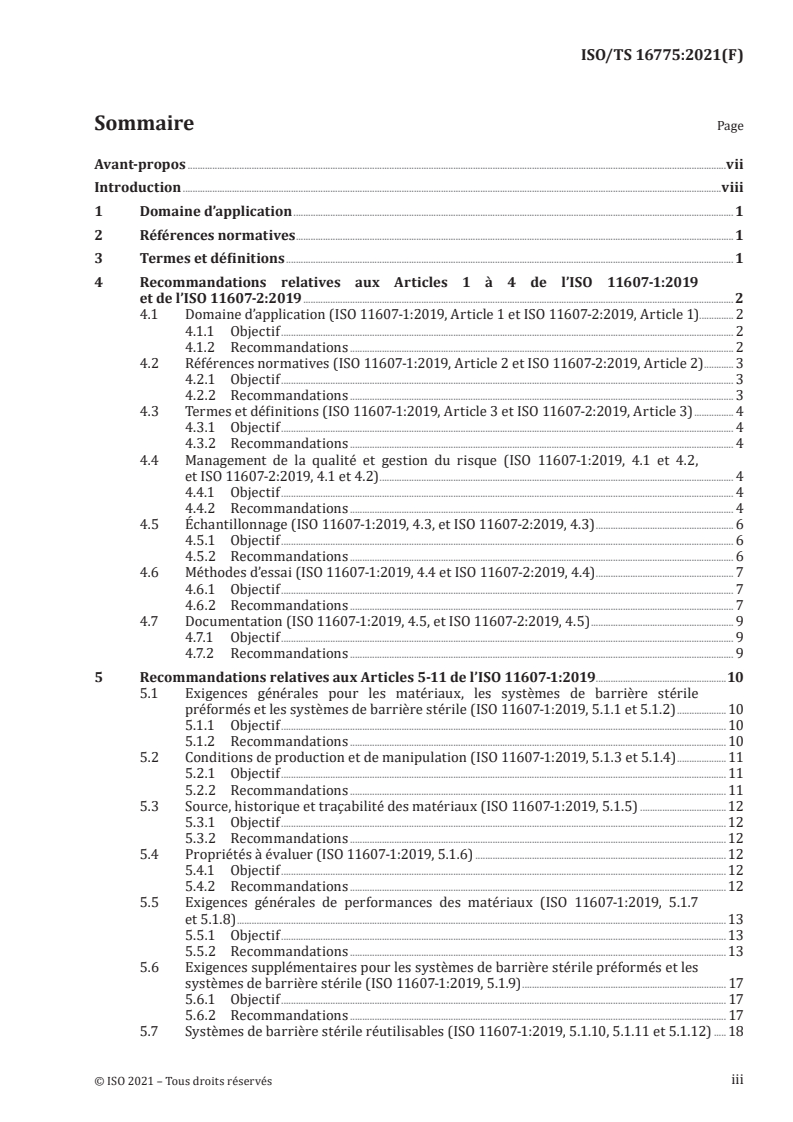
Sommaire Page
Avant-propos .vii
Introduction .viii
1 Domaine d’application . 1
2 Références normatives .1
3 Termes et définitions . 1
4 Recommandations relatives aux Articles 1 à 4 de l’ISO 11607-1:2019
et de l’ISO 11607-2:2019 . 2
4.1 Domaine d’application (ISO 11607-1:2019, Article 1 et ISO 11607-2:2019, Article 1). 2
4.1.1 Objectif . 2
4.1.2 Recommandations . 2
4.2 Références normatives (ISO 11607-1:2019, Article 2 et ISO 11607-2:2019, Article 2) . 3
4.2.1 Objectif . 3
4.2.2 Recommandations . 3
4.3 Termes et définitions (ISO 11607-1:2019, Article 3 et ISO 11607-2:2019, Article 3) . 4
4.3.1 Objectif . 4
4.3.2 Recommandations . 4
4.4 Management de la qualité et gestion du risque (ISO 11607-1:2019, 4.1 et 4.2,
et ISO 11607-2:2019, 4.1 et 4.2) . 4
4.4.1 Objectif . 4
4.4.2 Recommandations . 4
4.5 Échantillonnage (ISO 11607-1:2019, 4.3, et ISO 11607-2:2019, 4.3) . 6
4.5.1 Objectif . 6
4.5.2 Recommandations . 6
4.6 Méthodes d’essai (ISO 11607-1:2019, 4.4 et ISO 11607-2:2019, 4.4) . 7
4.6.1 Objectif . 7
4.6.2 Recommandations . 7
4.7 Documentation (ISO 11607-1:2019, 4.5, et ISO 11607-2:2019, 4.5) . 9
4.7.1 Objectif . 9
4.7.2 Recommandations . 9
5 Recommandations relatives aux Articles 5-11 de l’ISO 11607-1:2019 .10
5.1 Exigences générales pour les matériaux, les systèmes de barrière stérile
préformés et les systèmes de barrière stérile (ISO 11607-1:2019, 5.1.1 et 5.1.2) . 10
5.1.1 Objectif . 10
5.1.2 Recommandations . 10
5.2 Conditions de production et de manipulation (ISO 11607-1:2019, 5.1.3 et 5.1.4) . 11
5.2.1 Objectif . 11
5.2.2 Recommandations . 11
5.3 Source, historique et traçabilité des matériaux (ISO 11607-1:2019, 5.1.5) .12
5.3.1 Objectif .12
5.3.2 Recommandations .12
5.4 Propriétés à évaluer (ISO 11607-1:2019, 5.1.6) .12
5.4.1 Objectif .12
5.4.2 Recommandations .12
5.5 Exigences générales de performances des matériaux (ISO 11607-1:2019, 5.1.7
et 5.1.8) . 13
5.5.1 Objectif . 13
5.5.2 Recommandations . 13
5.6 Exigences supplémentaires pour les systèmes de barrière stérile préformés et les
systèmes de barrière stérile (ISO 11607-1:2019, 5.1.9) . 17
5.6.1 Objectif . 17
5.6.2 Recommandations . 17
5.7 Systèmes de barrière stérile réutilisables (ISO 11607-1:2019, 5.1.10, 5.1.11 et 5.1.12) . 18
iii
5.7.1 Objectif . 18
5.7.2 Recommandations . 18
5.8 Propriétés de la barrière microbienne (ISO 11607-1:2019, 5.2) . 19
5.8.1 Objectif . 19
5.8.2 Recommandations . 19
5.9 Compatibilité avec le procédé de stérilisation (ISO 11607-1:2019, 5.3) . 19
5.9.1 Objectif . 19
5.9.2 Recommandations . 19
5.10 Systèmes d’étiquetage (ISO 11607-1:2019, 5.4) . 20
5.10.1 Objectif . 20
5.10.2 Recommandations . 20
5.11 Stockage et transport des matériaux et des systèmes de barrière stérile préformés
(ISO 11607-1:2019, 5.5) .22
5.11.1 Objectif . 22
5.11.2 Recommandations . 22
5.12 Conception et développement (ISO 11607-1:2019, 6.1.1) . 24
5.12.1 Objectif . 24
5.12.2 Recommandations . 24
5.13 Présentation aseptique (ISO 11607-1:2019, 6.1.2) . 25
5.13.1 Objectif . 25
5.13.2 Recommandations . 25
5.14 Protection physique (voir l’ISO 11607-1:2019, 6.1.3 et 6.1.4) . 26
5.14.1 Objectif . 26
5.14.2 Recommandations . 26
5.15 Compatibilité de stérilisation (ISO 11607-1:2019, 6.1.5) . 27
5.15.1 Objectif . 27
5.15.2 Recommandations . 27
5.16 Maintien de la stérilité (voir l’ISO 11607-1:2019, 6.1.6 et 6.1.7) . 27
5.16.1 Objectif . 27
5.16.2 Recommandations . 27
5.17 Exigences relatives aux emballages multicouches (ISO 11607-1:2019, 6.1.8) .28
5.17.1 Objectif .28
5.17.2 Recommandations .28
5.18 Familles d’emballage (ISO 11607-1:2019, 6.1.9) .29
5.18.1 Objectif .29
5.18.2 Recommandations .29
5.19 Processus de conception (ISO 11607-1:2019, 6.2.1) . 31
5.19.1 Objectif . 31
5.19.2 Recommandations . 31
5.20 Données de conception (voir l’ISO 11607-1:2019, 6.2.2 et 6.2.3) . 32
5.20.1 Objectif . 32
5.20.2 Recommandations . 32
5.21 Dispositif de passage de fluide stérile (ISO 11607-1:2019, 6.2.4, 6.2.5) .34
5.21.1 Objectif .34
5.21.2 Recommandations .34
5.22 Évaluation de l’aptitude à l’utilisation pour la présentation aseptique (ISO 11607-
1:2019, 7.1, 7.2 et 7.3) . . 35
5.22.1 Objectif . 35
5.22.2 Recommandations . 35
5.23 Tirer profit des évaluations de l’aptitude à l’utilisation (ISO 11607-1:2019, 7.4) .36
5.23.1 Objectif . 36
5.23.2 Recommandations . 36
5.24 Défaillance de l’évaluation de l’aptitude à l’utilisation (ISO 11607-1:2019, 7.5) . 37
5.24.1 Objectif . 37
5.24.2 Recommandations . 37
5.24.3 Recommandations relatives aux études formatives et sommatives .38
5.25 Performance et stabilité du système d’emballage (ISO 11607-1:2019, 8.1) .38
5.25.1 Objectif .38
iv
5.25.2 Recommandations .39
5.26 Essais de performance du système d’emballage (ISO 11607-1:2019, 8.2) . 41
5.26.1 Objectif . 41
5.26.2 Recommandations . 41
5.27 Essai de stabilité (ISO 11607-1:2019, 8.3) . 42
5.27.1 Objectif . 42
5.27.2 Recommandations . 42
5.28 Validation et modifications du système d’emballage (ISO 11607-1:2019, 9.1) .44
5.28.1 Objectif .44
5.28.2 Recommandations .44
5.29 Contrôles des modifications (ISO 11607-1:2019, 9.2) .44
5.29.1 Objectif .44
5.29.2 Recommandations .44
5.30 Revalidations (ISO 11607-1:2019, 9.3, 9.4, et 9.5) . 45
5.30.1 Objectif . 45
5.30.2 Recommandations . 45
5.31 Inspection immédiatement avant la présentation aseptique (ISO 11607-1:2019,
Article 10) . 45
5.31.1 Objectif . 45
5.31.2 Recommandations . 45
5.32 Informations à fournir (ISO 11607-1:2019, Article 11) .46
5.32.1 Objectif .46
5.32.2 Recommandations .46
6 Recommandations relatives aux Articles 5 à 8 de l’ISO 11607-2:2019 .46
6.1 Articles généraux 1 à 4 de l’ISO 11607-2:2019 .46
6.2 Validation des procédés d’emballage — Exigences générales (ISO 11607-2:2019,
5.1.1 et 5.1.2) . 47
6.2.1 Objectif . 47
6.2.2 Recommandations . 47
6.3 Spécification du procédé (ISO 11607-2:2019, 5.1.3) . 47
6.3.1 Objectif . 47
6.3.2 Recommandations . 47
6.4 Validation de procédé pour les familles d’emballage (ISO 11607-2:2019, 5.1.4) .48
6.4.1 Objectif .48
6.4.2 Recommandations .48
6.5 Qualification de l’installation (ISO 11607-2:2019, 5.2) .49
6.5.1 Objectif .49
6.5.2 Recommandations .49
6.6 Qualification opérationnelle (ISO 11607-2:2019, 5.3) .50
6.6.1 Objectif . 50
6.6.2 Recommandations . 50
6.7 Qualification des performances (ISO 11607-2:2019, 5.4) . 51
6.7.1 Objectif . 51
6.7.2 Recommandations . 51
6.8 Approbation formelle de la validation du procédé (ISO 11607-2:2019, 5.5). 52
6.8.1 Objectif . 52
6.8.2 Recommandations . 52
6.9 Contrôle et surveillance du procédé (ISO 11607-2:2019, 5.6) . 52
6.9.1 Objectif . 52
6.9.2 Recommandations . 53
6.10 Modifications et revalidation du procédé (ISO 11607-2:2019, 5.7) .53
6.10.1 Objectif . 53
6.10.2 Recommandations . 53
6.11 Assemblage (ISO 11607-2:2019, Article 6) .54
6.11.1 Objectif .54
6.11.2 Recommandations .54
6.12 Utilisation de systèmes de barrière stérile réutilisables (ISO 11607-2:2019,
Article 7) . 56
v
6.12.1 Objectif . 56
6.12.2 Recommandations .56
6.13 Emballage de passage de fluide stérile (ISO 11607-2:2019, Article 8) .56
6.13.1 Objectif . 56
6.13.2 Recommandations .56
Annexe A (informative) Conceptions et développement de systèmes d’emballage —
Recommandations pour l’industrie . .57
Annexe B (informative) Recommandations relatives à l’application de la série de normes
ISO 11607 dans les établissements de santé .65
Annexe C (informative) Outils d’analyse du risque — Recommandations à l’intention de
l’industrie et des établissements de santé .99
Annexe D (informative) Considérations relatives aux plans d’échantillonnage —
Recommandations pour les établissements de santé . 101
Annexe E (informative) Recommandations relatives à l’établissement des paramètres
du procédé — Recommandations pour l’industrie . 103
Annexe F (informative) Considérations relatives à la stérilisation — Recommandations
pour l’industrie et les établissements de santé . 109
Annexe G (informative) Recours à des sous-traitants pour la prestation de
conditionnement — Recommandations pour l’industrie et les établissements de
santé .117
Annexe H (informative) Exemple de liste de contrôle pour la manipulation, la distribution
et le stockage — Recommandations pour la sélection d’un système de barrière
stérile en établissements de santé . 118
Annexe I (informative) Recherche des défaillances — Recommandations pour l’industrie
et les établissements de santé . 121
Annexe J (informative) Rapport sommaire de validation — Recommandations pour les
établissements de santé . 125
Annexe K (informative) Validation du procédé de conditionnement — Recommandations
pour les établissements de santé . 127
Annexe L (informative) Validation du procédé pour conteneurs réutilisables —
Recommandations pour les établissements de santé . 133
Annexe M (informative) Validation du procédé de thermoscellage pour les systèmes de
barrière stérile préformés (SBSP) — Recommandations pour les établissements
de santé . 139
Annexe N (informative) Évaluation des emballages stériles par les utilisateurs finaux —
Recommandations pour les établissements de santé . 148
Bibliographie . 149
vi
Avant-propos
L'ISO (Organisation internationale de normalisation) est une fédération mondiale d'organismes
nationaux de normalisation (comités membres de l'ISO). L'élaboration des Normes internationales est
en général confiée aux comités techniques de l'ISO. Chaque comité membre intéressé par une étude
a le droit de faire partie du comité technique créé à cet effet. Les organisations internationales,
gouvernementales et non gouvernementales, en liaison avec l'ISO participent également aux travaux.
L'ISO collabore étroitement avec la Commission électrotechnique internationale (IEC) en ce qui
concerne la normalisation électrotechnique.
Les procédures utilisées pour élaborer le présent document et celles destinées à sa mise à jour sont
décrites dans les Directives ISO/IEC, Partie 1. Il convient, en particulier, de prendre note des différents
critères d'approbation requis pour les différents types de documents ISO. Le présent document a
été rédigé conformément aux règles de rédaction données dans les Directives ISO/IEC, Partie 2 (voir
www.iso.org/directives).
L'attention est attirée sur le fait que certains des éléments du présent document peuvent faire l'objet de
droits de propriété intellectuelle ou de droits analogues. L'ISO ne saurait être tenue pour responsable
de ne pas avoir identifié de tels droits de propriété et averti de leur existence. Les détails concernant
les références aux droits de propriété intellectuelle ou autres droits analogues identifiés lors de
l'élaboration du document sont indiqués dans l'Introduction et/ou dans la liste des déclarations de
brevets reçues par l'ISO (voir www.iso.org/brevets).
Les appellations commerciales éventuellement mentionnées dans le présent document sont données
pour information, par souci de commodité, à l’intention des utilisateurs et ne sauraient constituer un
engagement.
Pour une explication de la nature volontaire des normes, la signification des termes et expressions
spécifiques de l'ISO liés à l'évaluation de la conformité, ou pour toute information au sujet de l'adhésion
de l'ISO aux principes de l’Organisation mondiale du commerce (OMC) concernant les obstacles
techniques au commerce (OTC), voir www.iso.org/avant-propos.
Le présent document a été élaboré par le comité technique ISO/TC 198, Stérilisation des produits de
santé, en collaboration avec le comité technique CEN/TC 102, Stérilisateurs et équipements associés pour
le traitement des dispositifs médicaux, du Comité européen de normalisation (CEN) conformément à
l’Accord de coopération technique entre l’ISO et le CEN (Accord de Vienne).
Cette deuxième édition annule et remplace la première édition (ISO/TS 16775:2014), qui a fait l’objet
d’une révision technique.
Les principales modifications par rapport à l’édition précédente sont les suivantes:
— mises à jour afin de tenir compte des éditions de l’ISO 11607-1:2019 et de l’ISO 11607-2:2019;
— indication de l’objectif et des recommandations pour chaque article de la norme afin d’améliorer
l’utilisabilité du présent document;
— ajout de nouvelles annexes;
— suppression de certaines annexes.
Il convient que l’utilisateur adresse tout retour d’information ou toute question concernant le présent
document à l’organisme national de normalisation de son pays. Une liste exhaustive desdits organismes
se trouve à l’adresse www.iso.org/fr/members.html.
vii
Introduction
Les systèmes de barrière stérile sont conçus pour permettre la stérilisation, fournir une protection
physique, maintenir la stérilité du contenu jusqu’au point d’utilisation et assurer une présentation
aseptique. Le système de barrière stérile peut être combiné avec un emballage de protection
supplémentaire pour créer un système d’emballage, en fonction des conditions de manipulation,
de distribution ou de stockage.
L’ISO 11607-1 spécifie les exigences relatives aux matériaux, aux systèmes de barrière stérile et aux
systèmes d’emballage, y compris la validation de la conception du système d’emballage, tandis que
l’ISO 11607-2 spécifie les exigences relatives à la validation du procédé d’emballage. Les exigences
énoncées dans ces normes sont génériques et s’appliquent aux établissements de santé et aux lieux où
les dispositifs médicaux sont emballés et stérilisés. Il est admis que les circonstances d’application de
ces normes sont différentes lorsqu’elles sont utilisées dans un établissement de santé, par un fabricant
de dispositifs médicaux ou dans le cadre du retraitement.
Le présent document fournit des recommandations relatives à l’application de l’ISO 11607-1 et de
l’ISO 11607-2. L’organisation de cette dernière révision a été complètement revue selon la structure
de l’ISO 11607-1 et de l’ISO 11607-2 et fait référence à des articles et paragraphes individuels ou à
des groupes d’articles ou de paragraphes tout en indiquant l’objectif des exigences suivies par les
recommandations pertinentes. Elle peut être utilisée pour l’application systématique de l’ISO 11607-1
et de l’ISO 11607-2 ou en guise de référence lorsque des questions se posent sur certaines exigences
spécifiques. L’Article 4 couvre les exigences générales identiques à celles de l’ISO 11607-1 et de
l’ISO 11607-2, tandis que l’Article 5 s’applique à l’ISO 11607-1:2019 et l’Article 6 à l’ISO 11607-2:2019. Des
recommandations relatives à l’application de la gestion du risque au cours du cycle de vie de l’emballage
ont été ajoutées en prévision des modifications à venir de l’ISO 11607 (toutes les parties).
Le présent document d’orientation s’applique aux établissements de santé et à l’industrie. Les différences
entre les deux environnements sont abordées le cas échéant. Bien que les établissements de santé
ne soient généralement pas impliqués dans les tâches de conception de systèmes de barrière stérile,
leur rôle dans le processus de conception de systèmes de barrière stérile et de systèmes d’emballage
consiste à sélectionner soigneusement un système de barrière stérile approprié et un emballage de
protection adapté aux risques identifiés liés au contenu, à la méthode de stérilisation, au transport, au
stockage et à la présentation aseptique. Les systèmes de barrière stérile et d’emballage ainsi que les
procédés connexes doivent ensuite être correctement validés. En outre, les procédés d’étanchéité, de
fermeture et d’assemblage doivent être contrôlés et surveillés. Pour assurer la sécurité des patients, il
convient que les établissements de santé élaborent des modes opératoires écrits qui doivent être mis en
œuvre par un personnel formé. Les recommandations énoncées dans les annexes du présent document
s’appliquent aux établissements de santé et/ou à l’industrie, conformément aux indications.
Les conditions d’utilisation de ces recommandations peuvent varier considérablement à travers
le monde et peuvent être sujettes à interprétation selon les circonstances et les environnements
réglementaires.
viii
SPÉCIFICATION TECHNIQUE ISO/TS 16775:2021(F)
Emballages des dispositifs médicaux stérilisés au stade
terminal — Lignes directrices relatives à l'application de
l'ISO 11607-1 et l'ISO 11607-2
1 Domaine d’application
Le présent document fournit des recommandations pour l’application des exigences énoncées dans
l’ISO 11607-1 et dans l’ISO 11607-2. Il ne complète ni ne modifie en aucune manière les exigences de
l’ISO 11607-1 et de l’ISO 11607-2. Le présent document est informatif, et non normatif. Il n’inclut pas
d’exigence à utiliser comme base pour les activités d’inspection réglementaire ou d’évaluation pour
certification.
Le présent document d’orientation peut servir à mieux comprendre les exigences de l’ISO 11607-1 et de
l’ISO 11607-2, ainsi qu’à illustrer la diversité des méthodes et approches possibles pour satisfaire aux
exigences de ces Normes internationales. Il n’est pas nécessaire que le présent document soit utilisé
pour démontrer la conformité avec ces dernières.
Des recommandations sont fournies pour l’évaluation, la sélection et l’utilisation des matériaux
d’emballage, des systèmes de barrière stérile préformés, des systèmes de barrière stérile et des
systèmes d’emballage. Des recommandations relatives aux exigences en matière de validation pour les
procédés de formage, de scellage et d’assemblage sont également fournies.
Le présent document fournit des informations à la fois pour les établissements de santé et l’industrie
des dispositifs médicaux concernant les dispositifs médicaux soumis à une stérilisation terminale.
Le présent document ne fournit pas de recommandation pour les applications des matériaux et
systèmes d’emballage après leur ouverture. D’autres normes réglementaires s’appliquent dans le cadre
de l’utilisation d’emballage à d’autres fins, telles que le « champ stérile » ou le transport d’articles
contaminés.
2 Références normatives
Les documents suivants sont cités dans le texte de sorte qu’ils constituent, pour tout ou partie de leur
contenu, des exigences du présent document. Pour les références datées, seule l’édition citée s’applique.
Pour les références non datées, la dernière édition du document de référence s’applique (y compris les
éventuels amendements).
ISO 11607-1:2019, Emballages des dispositifs médicaux stérilisés au stade terminal — Partie 1: Exigences
relatives aux matériaux, aux systèmes de barrière stérile et aux systèmes d'emballage
ISO 11607-2:2019, Emballages des dispositifs médicaux stérilisés au stade terminal — Partie 2: Exigences
de validation pour les procédés de formage, scellage et assemblage
3 Termes et définitions
Pour les besoins du présent document, les termes et définitions donnés dans l’ISO 11607-1:2019 et
l’ISO 11607-2:2019 ainsi que les suivants s’appliquent.
L’
...
SPÉCIFICATION ISO/TS
TECHNIQUE 16775
Deuxième édition
2021-11
Emballages des dispositifs médicaux
stérilisés au stade terminal — Lignes
directrices relatives à l'application de
l'ISO 11607-1 et l'ISO 11607-2
Packaging for terminally sterilized medical devices — Guidance on
the application of ISO 11607-1 and ISO 11607-2
Numéro de référence
DOCUMENT PROTÉGÉ PAR COPYRIGHT
© ISO 2021
Tous droits réservés. Sauf prescription différente ou nécessité dans le contexte de sa mise en œuvre, aucune partie de cette
publication ne peut être reproduite ni utilisée sous quelque forme que ce soit et par aucun procédé, électronique ou mécanique,
y compris la photocopie, ou la diffusion sur l’internet ou sur un intranet, sans autorisation écrite préalable. Une autorisation peut
être demandée à l’ISO à l’adresse ci-après ou au comité membre de l’ISO dans le pays du demandeur.
ISO copyright office
Case postale 401 • Ch. de Blandonnet 8
CH-1214 Vernier, Genève
Tél.: +41 22 749 01 11
E-mail: copyright@iso.org
Web: www.iso.org
Publié en Suisse
ii
Sommaire Page
Avant-propos .vii
Introduction .viii
1 Domaine d’application . 1
2 Références normatives .1
3 Termes et définitions . 1
4 Recommandations relatives aux Articles 1 à 4 de l’ISO 11607-1:2019
et de l’ISO 11607-2:2019 . 2
4.1 Domaine d’application (ISO 11607-1:2019, Article 1 et ISO 11607-2:2019, Article 1). 2
4.1.1 Objectif . 2
4.1.2 Recommandations . 2
4.2 Références normatives (ISO 11607-1:2019, Article 2 et ISO 11607-2:2019, Article 2) . 3
4.2.1 Objectif . 3
4.2.2 Recommandations . 3
4.3 Termes et définitions (ISO 11607-1:2019, Article 3 et ISO 11607-2:2019, Article 3) . 4
4.3.1 Objectif . 4
4.3.2 Recommandations . 4
4.4 Management de la qualité et gestion du risque (ISO 11607-1:2019, 4.1 et 4.2,
et ISO 11607-2:2019, 4.1 et 4.2) . 4
4.4.1 Objectif . 4
4.4.2 Recommandations . 4
4.5 Échantillonnage (ISO 11607-1:2019, 4.3, et ISO 11607-2:2019, 4.3) . 6
4.5.1 Objectif . 6
4.5.2 Recommandations . 6
4.6 Méthodes d’essai (ISO 11607-1:2019, 4.4 et ISO 11607-2:2019, 4.4) . 7
4.6.1 Objectif . 7
4.6.2 Recommandations . 7
4.7 Documentation (ISO 11607-1:2019, 4.5, et ISO 11607-2:2019, 4.5) . 9
4.7.1 Objectif . 9
4.7.2 Recommandations . 9
5 Recommandations relatives aux Articles 5-11 de l’ISO 11607-1:2019 .10
5.1 Exigences générales pour les matériaux, les systèmes de barrière stérile
préformés et les systèmes de barrière stérile (ISO 11607-1:2019, 5.1.1 et 5.1.2) . 10
5.1.1 Objectif . 10
5.1.2 Recommandations . 10
5.2 Conditions de production et de manipulation (ISO 11607-1:2019, 5.1.3 et 5.1.4) . 11
5.2.1 Objectif . 11
5.2.2 Recommandations . 11
5.3 Source, historique et traçabilité des matériaux (ISO 11607-1:2019, 5.1.5) .12
5.3.1 Objectif .12
5.3.2 Recommandations .12
5.4 Propriétés à évaluer (ISO 11607-1:2019, 5.1.6) .12
5.4.1 Objectif .12
5.4.2 Recommandations .12
5.5 Exigences générales de performances des matériaux (ISO 11607-1:2019, 5.1.7
et 5.1.8) . 13
5.5.1 Objectif . 13
5.5.2 Recommandations . 13
5.6 Exigences supplémentaires pour les systèmes de barrière stérile préformés et les
systèmes de barrière stérile (ISO 11607-1:2019, 5.1.9) . 17
5.6.1 Objectif . 17
5.6.2 Recommandations . 17
5.7 Systèmes de barrière stérile réutilisables (ISO 11607-1:2019, 5.1.10, 5.1.11 et 5.1.12) . 18
iii
5.7.1 Objectif . 18
5.7.2 Recommandations . 18
5.8 Propriétés de la barrière microbienne (ISO 11607-1:2019, 5.2) . 19
5.8.1 Objectif . 19
5.8.2 Recommandations . 19
5.9 Compatibilité avec le procédé de stérilisation (ISO 11607-1:2019, 5.3) . 19
5.9.1 Objectif . 19
5.9.2 Recommandations . 19
5.10 Systèmes d’étiquetage (ISO 11607-1:2019, 5.4) . 20
5.10.1 Objectif . 20
5.10.2 Recommandations . 20
5.11 Stockage et transport des matériaux et des systèmes de barrière stérile préformés
(ISO 11607-1:2019, 5.5) .22
5.11.1 Objectif . 22
5.11.2 Recommandations . 22
5.12 Conception et développement (ISO 11607-1:2019, 6.1.1) . 24
5.12.1 Objectif . 24
5.12.2 Recommandations . 24
5.13 Présentation aseptique (ISO 11607-1:2019, 6.1.2) . 25
5.13.1 Objectif . 25
5.13.2 Recommandations . 25
5.14 Protection physique (voir l’ISO 11607-1:2019, 6.1.3 et 6.1.4) . 26
5.14.1 Objectif . 26
5.14.2 Recommandations . 26
5.15 Compatibilité de stérilisation (ISO 11607-1:2019, 6.1.5) . 27
5.15.1 Objectif . 27
5.15.2 Recommandations . 27
5.16 Maintien de la stérilité (voir l’ISO 11607-1:2019, 6.1.6 et 6.1.7) . 27
5.16.1 Objectif . 27
5.16.2 Recommandations . 27
5.17 Exigences relatives aux emballages multicouches (ISO 11607-1:2019, 6.1.8) .28
5.17.1 Objectif .28
5.17.2 Recommandations .28
5.18 Familles d’emballage (ISO 11607-1:2019, 6.1.9) .29
5.18.1 Objectif .29
5.18.2 Recommandations .29
5.19 Processus de conception (ISO 11607-1:2019, 6.2.1) . 31
5.19.1 Objectif . 31
5.19.2 Recommandations . 31
5.20 Données de conception (voir l’ISO 11607-1:2019, 6.2.2 et 6.2.3) . 32
5.20.1 Objectif . 32
5.20.2 Recommandations . 32
5.21 Dispositif de passage de fluide stérile (ISO 11607-1:2019, 6.2.4, 6.2.5) .34
5.21.1 Objectif .34
5.21.2 Recommandations .34
5.22 Évaluation de l’aptitude à l’utilisation pour la présentation aseptique (ISO 11607-
1:2019, 7.1, 7.2 et 7.3) . . 35
5.22.1 Objectif . 35
5.22.2 Recommandations . 35
5.23 Tirer profit des évaluations de l’aptitude à l’utilisation (ISO 11607-1:2019, 7.4) .36
5.23.1 Objectif . 36
5.23.2 Recommandations . 36
5.24 Défaillance de l’évaluation de l’aptitude à l’utilisation (ISO 11607-1:2019, 7.5) . 37
5.24.1 Objectif . 37
5.24.2 Recommandations . 37
5.24.3 Recommandations relatives aux études formatives et sommatives .38
5.25 Performance et stabilité du système d’emballage (ISO 11607-1:2019, 8.1) .38
5.25.1 Objectif .38
iv
5.25.2 Recommandations .39
5.26 Essais de performance du système d’emballage (ISO 11607-1:2019, 8.2) . 41
5.26.1 Objectif . 41
5.26.2 Recommandations . 41
5.27 Essai de stabilité (ISO 11607-1:2019, 8.3) . 42
5.27.1 Objectif . 42
5.27.2 Recommandations . 42
5.28 Validation et modifications du système d’emballage (ISO 11607-1:2019, 9.1) .44
5.28.1 Objectif .44
5.28.2 Recommandations .44
5.29 Contrôles des modifications (ISO 11607-1:2019, 9.2) .44
5.29.1 Objectif .44
5.29.2 Recommandations .44
5.30 Revalidations (ISO 11607-1:2019, 9.3, 9.4, et 9.5) . 45
5.30.1 Objectif . 45
5.30.2 Recommandations . 45
5.31 Inspection immédiatement avant la présentation aseptique (ISO 11607-1:2019,
Article 10) . 45
5.31.1 Objectif . 45
5.31.2 Recommandations . 45
5.32 Informations à fournir (ISO 11607-1:2019, Article 11) .46
5.32.1 Objectif .46
5.32.2 Recommandations .46
6 Recommandations relatives aux Articles 5 à 8 de l’ISO 11607-2:2019 .46
6.1 Articles généraux 1 à 4 de l’ISO 11607-2:2019 .46
6.2 Validation des procédés d’emballage — Exigences générales (ISO 11607-2:2019,
5.1.1 et 5.1.2) . 47
6.2.1 Objectif . 47
6.2.2 Recommandations . 47
6.3 Spécification du procédé (ISO 11607-2:2019, 5.1.3) . 47
6.3.1 Objectif . 47
6.3.2 Recommandations . 47
6.4 Validation de procédé pour les familles d’emballage (ISO 11607-2:2019, 5.1.4) .48
6.4.1 Objectif .48
6.4.2 Recommandations .48
6.5 Qualification de l’installation (ISO 11607-2:2019, 5.2) .49
6.5.1 Objectif .49
6.5.2 Recommandations .49
6.6 Qualification opérationnelle (ISO 11607-2:2019, 5.3) .50
6.6.1 Objectif . 50
6.6.2 Recommandations . 50
6.7 Qualification des performances (ISO 11607-2:2019, 5.4) . 51
6.7.1 Objectif . 51
6.7.2 Recommandations . 51
6.8 Approbation formelle de la validation du procédé (ISO 11607-2:2019, 5.5). 52
6.8.1 Objectif . 52
6.8.2 Recommandations . 52
6.9 Contrôle et surveillance du procédé (ISO 11607-2:2019, 5.6) . 52
6.9.1 Objectif . 52
6.9.2 Recommandations . 53
6.10 Modifications et revalidation du procédé (ISO 11607-2:2019, 5.7) .53
6.10.1 Objectif . 53
6.10.2 Recommandations . 53
6.11 Assemblage (ISO 11607-2:2019, Article 6) .54
6.11.1 Objectif .54
6.11.2 Recommandations .54
6.12 Utilisation de systèmes de barrière stérile réutilisables (ISO 11607-2:2019,
Article 7) . 56
v
6.12.1 Objectif . 56
6.12.2 Recommandations .56
6.13 Emballage de passage de fluide stérile (ISO 11607-2:2019, Article 8) .56
6.13.1 Objectif . 56
6.13.2 Recommandations .56
Annexe A (informative) Conceptions et développement de systèmes d’emballage —
Recommandations pour l’industrie . .57
Annexe B (informative) Recommandations relatives à l’application de la série de normes
ISO 11607 dans les établissements de santé .65
Annexe C (informative) Outils d’analyse du risque — Recommandations à l’intention de
l’industrie et des établissements de santé .99
Annexe D (informative) Considérations relatives aux plans d’échantillonnage —
Recommandations pour les établissements de santé . 101
Annexe E (informative) Recommandations relatives à l’établissement des paramètres
du procédé — Recommandations pour l’industrie . 103
Annexe F (informative) Considérations relatives à la stérilisation — Recommandations
pour l’industrie et les établissements de santé . 109
Annexe G (informative) Recours à des sous-traitants pour la prestation de
conditionnement — Recommandations pour l’industrie et les établissements de
santé .117
Annexe H (informative) Exemple de liste de contrôle pour la manipulation, la distribution
et le stockage — Recommandations pour la sélection d’un système de barrière
stérile en établissements de santé . 118
Annexe I (informative) Recherche des défaillances — Recommandations pour l’industrie
et les établissements de santé . 121
Annexe J (informative) Rapport sommaire de validation — Recommandations pour les
établissements de santé . 125
Annexe K (informative) Validation du procédé de conditionnement — Recommandations
pour les établissements de santé . 127
Annexe L (informative) Validation du procédé pour conteneurs réutilisables —
Recommandations pour les établissements de santé . 133
Annexe M (informative) Validation du procédé de thermoscellage pour les systèmes de
barrière stérile préformés (SBSP) — Recommandations pour les établissements
de santé . 139
Annexe N (informative) Évaluation des emballages stériles par les utilisateurs finaux —
Recommandations pour les établissements de santé . 148
Bibliographie . 149
vi
Avant-propos
L'ISO (Organisation internationale de normalisation) est une fédération mondiale d'organismes
nationaux de normalisation (comités membres de l'ISO). L'élaboration des Normes internationales est
en général confiée aux comités techniques de l'ISO. Chaque comité membre intéressé par une étude
a le droit de faire partie du comité technique créé à cet effet. Les organisations internationales,
gouvernementales et non gouvernementales, en liaison avec l'ISO participent également aux travaux.
L'ISO collabore étroitement avec la Commission électrotechnique internationale (IEC) en ce qui
concerne la normalisation électrotechnique.
Les procédures utilisées pour élaborer le présent document et celles destinées à sa mise à jour sont
décrites dans les Directives ISO/IEC, Partie 1. Il convient, en particulier, de prendre note des différents
critères d'approbation requis pour les différents types de documents ISO. Le présent document a
été rédigé conformément aux règles de rédaction données dans les Directives ISO/IEC, Partie 2 (voir
www.iso.org/directives).
L'attention est attirée sur le fait que certains des éléments du présent document peuvent faire l'objet de
droits de propriété intellectuelle ou de droits analogues. L'ISO ne saurait être tenue pour responsable
de ne pas avoir identifié de tels droits de propriété et averti de leur existence. Les détails concernant
les références aux droits de propriété intellectuelle ou autres droits analogues identifiés lors de
l'élaboration du document sont indiqués dans l'Introduction et/ou dans la liste des déclarations de
brevets reçues par l'ISO (voir www.iso.org/brevets).
Les appellations commerciales éventuellement mentionnées dans le présent document sont données
pour information, par souci de commodité, à l’intention des utilisateurs et ne sauraient constituer un
engagement.
Pour une explication de la nature volontaire des normes, la signification des termes et expressions
spécifiques de l'ISO liés à l'évaluation de la conformité, ou pour toute information au sujet de l'adhésion
de l'ISO aux principes de l’Organisation mondiale du commerce (OMC) concernant les obstacles
techniques au commerce (OTC), voir www.iso.org/avant-propos.
Le présent document a été élaboré par le comité technique ISO/TC 198, Stérilisation des produits de
santé, en collaboration avec le comité technique CEN/TC 102, Stérilisateurs et équipements associés pour
le traitement des dispositifs médicaux, du Comité européen de normalisation (CEN) conformément à
l’Accord de coopération technique entre l’ISO et le CEN (Accord de Vienne).
Cette deuxième édition annule et remplace la première édition (ISO/TS 16775:2014), qui a fait l’objet
d’une révision technique.
Les principales modifications par rapport à l’édition précédente sont les suivantes:
— mises à jour afin de tenir compte des éditions de l’ISO 11607-1:2019 et de l’ISO 11607-2:2019;
— indication de l’objectif et des recommandations pour chaque article de la norme afin d’améliorer
l’utilisabilité du présent document;
— ajout de nouvelles annexes;
— suppression de certaines annexes.
Il convient que l’utilisateur adresse tout retour d’information ou toute question concernant le présent
document à l’organisme national de normalisation de son pays. Une liste exhaustive desdits organismes
se trouve à l’adresse www.iso.org/fr/members.html.
vii
Introduction
Les systèmes de barrière stérile sont conçus pour permettre la stérilisation, fournir une protection
physique, maintenir la stérilité du contenu jusqu’au point d’utilisation et assurer une présentation
aseptique. Le système de barrière stérile peut être combiné avec un emballage de protection
supplémentaire pour créer un système d’emballage, en fonction des conditions de manipulation,
de distribution ou de stockage.
L’ISO 11607-1 spécifie les exigences relatives aux matériaux, aux systèmes de barrière stérile et aux
systèmes d’emballage, y compris la validation de la conception du système d’emballage, tandis que
l’ISO 11607-2 spécifie les exigences relatives à la validation du procédé d’emballage. Les exigences
énoncées dans ces normes sont génériques et s’appliquent aux établissements de santé et aux lieux où
les dispositifs médicaux sont emballés et stérilisés. Il est admis que les circonstances d’application de
ces normes sont différentes lorsqu’elles sont utilisées dans un établissement de santé, par un fabricant
de dispositifs médicaux ou dans le cadre du retraitement.
Le présent document fournit des recommandations relatives à l’application de l’ISO 11607-1 et de
l’ISO 11607-2. L’organisation de cette dernière révision a été complètement revue selon la structure
de l’ISO 11607-1 et de l’ISO 11607-2 et fait référence à des articles et paragraphes individuels ou à
des groupes d’articles ou de paragraphes tout en indiquant l’objectif des exigences suivies par les
recommandations pertinentes. Elle peut être utilisée pour l’application systématique de l’ISO 11607-1
et de l’ISO 11607-2 ou en guise de référence lorsque des questions se posent sur certaines exigences
spécifiques. L’Article 4 couvre les exigences générales identiques à celles de l’ISO 11607-1 et de
l’ISO 11607-2, tandis que l’Article 5 s’applique à l’ISO 11607-1:2019 et l’Article 6 à l’ISO 11607-2:2019. Des
recommandations relatives à l’application de la gestion du risque au cours du cycle de vie de l’emballage
ont été ajoutées en prévision des modifications à venir de l’ISO 11607 (toutes les parties).
Le présent document d’orientation s’applique aux établissements de santé et à l’industrie. Les différences
entre les deux environnements sont abordées le cas échéant. Bien que les établissements de santé
ne soient généralement pas impliqués dans les tâches de conception de systèmes de barrière stérile,
leur rôle dans le processus de conception de systèmes de barrière stérile et de systèmes d’emballage
consiste à sélectionner soigneusement un système de barrière stérile approprié et un emballage de
protection adapté aux risques identifiés liés au contenu, à la méthode de stérilisation, au transport, au
stockage et à la présentation aseptique. Les systèmes de barrière stérile et d’emballage ainsi que les
procédés connexes doivent ensuite être correctement validés. En outre, les procédés d’étanchéité, de
fermeture et d’assemblage doivent être contrôlés et surveillés. Pour assurer la sécurité des patients, il
convient que les établissements de santé élaborent des modes opératoires écrits qui doivent être mis en
œuvre par un personnel formé. Les recommandations énoncées dans les annexes du présent document
s’appliquent aux établissements de santé et/ou à l’industrie, conformément aux indications.
Les conditions d’utilisation de ces recommandations peuvent varier considérablement à travers
le monde et peuvent être sujettes à interprétation selon les circonstances et les environnements
réglementaires.
viii
SPÉCIFICATION TECHNIQUE ISO/TS 16775:2021(F)
Emballages des dispositifs médicaux stérilisés au stade
terminal — Lignes directrices relatives à l'application de
l'ISO 11607-1 et l'ISO 11607-2
1 Domaine d’application
Le présent document fournit des recommandations pour l’application des exigences énoncées dans
l’ISO 11607-1 et dans l’ISO 11607-2. Il ne complète ni ne modifie en aucune manière les exigences de
l’ISO 11607-1 et de l’ISO 11607-2. Le présent document est informatif, et non normatif. Il n’inclut pas
d’exigence à utiliser comme base pour les activités d’inspection réglementaire ou d’évaluation pour
certification.
Le présent document d’orientation peut servir à mieux comprendre les exigences de l’ISO 11607-1 et de
l’ISO 11607-2, ainsi qu’à illustrer la diversité des méthodes et approches possibles pour satisfaire aux
exigences de ces Normes internationales. Il n’est pas nécessaire que le présent document soit utilisé
pour démontrer la conformité avec ces dernières.
Des recommandations sont fournies pour l’évaluation, la sélection et l’utilisation des matériaux
d’emballage, des systèmes de barrière stérile préformés, des systèmes de barrière stérile et des
systèmes d’emballage. Des recommandations relatives aux exigences en matière de validation pour les
procédés de formage, de scellage et d’assemblage sont également fournies.
Le présent document fournit des informations à la fois pour les établissements de santé et l’industrie
des dispositifs médicaux concernant les dispositifs médicaux soumis à une stérilisation terminale.
Le présent document ne fournit pas de recommandation pour les applications des matériaux et
systèmes d’emballage après leur ouverture. D’autres normes réglementaires s’appliquent dans le cadre
de l’utilisation d’emballage à d’autres fins, telles que le « champ stérile » ou le transport d’articles
contaminés.
2 Références normatives
Les documents suivants sont cités dans le texte de sorte qu’ils constituent, pour tout ou partie de leur
contenu, des exigences du présent document. Pour les références datées, seule l’édition citée s’applique.
Pour les références non datées, la dernière édition du document de référence s’applique (y compris les
éventuels amendements).
ISO 11607-1:2019, Emballages des dispositifs médicaux stérilisés au stade terminal — Partie 1: Exigences
relatives aux matériaux, aux systèmes de barrière stérile et aux systèmes d'emballage
ISO 11607-2:2019, Emballages des dispositifs médicaux stérilisés au stade terminal — Partie 2: Exigences
de validation pour les procédés de formage, scellage et assemblage
3 Termes et définitions
Pour les besoins du présent document, les termes et définitions donnés dans l’ISO 11607-1:2019 et
l’ISO 11607-2:2019 ainsi que les suivants s’appliquent.
L’
...
Questions, Comments and Discussion
Ask us and Technical Secretary will try to provide an answer. You can facilitate discussion about the standard in here.
Loading comments...