

ISO 19165-1:2018
(Main)Geographic information — Preservation of digital data and metadata — Part 1: Fundamentals
General Information
- Abstract
ISO 19165-1:2018 defines a preservation metadata extension of ISO 19115‑1. ISO 19165-1:2018 defines the requirements for the long-term preservation of digital geospatial data. These data also include metadata, representation information, provenance, context and any other content items that capture the knowledge that are necessary to fully understand and reuse the archived data. This document also refers to characteristics of data formats that are useful for the purpose of archiving. Geospatial data are preserved as a geospatial information package (IP). This document defines the requirements of the geospatial archival IP and details of the geospatial submission and the dissemination IPs. A geospatial archival IP is fully self-describing and allows a future reconstruction of the dataset without external documentation. The functional requirements for a preservation archive are defined in Annex D. ISO 19165-1:2018 complements standards developed by ISO/TC 211 as well as other ISO standards such as ISO 14721.
- Status
- Published
- Publication Date
- 25-Apr-2018
- Technical Committee
- ISO/TC 211 - Geographic information/Geomatics
- Drafting Committee
- ISO/TC 211/WG 7 - Information communities
- Current Stage
- 9093 - International Standard confirmed
- Start Date
- 20-Sep-2023
- Completion Date
- 29-Aug-2026
Buy Documents


ISO 19165-1:2018 - Geographic information -- Preservation of digital data and metadata


ISO 19165-1:2018 - Geographic information — Preservation of digital data and metadata — Part 1: Fundamentals/26/2018
Overview
ISO 19165-1:2018 - Geographic information - Preservation of digital data and metadata - Part 1: Fundamentals - defines foundational requirements for the long-term preservation of digital geospatial data. It specifies a preservation metadata extension to ISO 19115‑1 and describes how geospatial datasets, associated metadata, representation information, provenance and context should be packaged and managed so they remain understandable and reusable over time.
Key concepts include the geospatial information package (IP) - notably the geospatial archival information package (AIP) - which must be fully self-describing to enable future reconstruction of a dataset without external documentation. Annex D defines functional requirements for a preservation archive, and the standard references packaging approaches such as the Open Packaging Convention (OPC).
Key topics and requirements
- Preservation metadata extension to ISO 19115-1: requirements for metadata that support long-term access and understanding.
- Geospatial information package types: archival, submission and dissemination IPs, with rules for what each must contain.
- Self-describing archival AIP: content, representation information, and preservation description information to permit future reconstruction.
- Metadata classes and elements covered include identifiers, format and product specifications, preservation actions, provenance, association of resources, fixity (integrity checks), and information package descriptions.
- Data format and structure considerations: characteristics of formats useful for archiving and the need to preserve data structures, algorithms/software references, and coordinate reference system information.
- Rights and licensing: capture of access and distribution conditions and rights enforcement measures.
- Functional archive requirements: defined in Annex D (ingest, management, preservation actions, dissemination).
- Conformance & testability: normative sections (e.g., abstract test suite, data dictionary) guide implementation and validation.
Practical applications and users
ISO 19165-1 is intended for organizations responsible for the long-term stewardship of geospatial information, including:
- National mapping agencies and cadastres
- Research data repositories and digital libraries
- GIS data custodians and archives
- Data producers and publishers preparing submission packages
- Software developers building archival packaging, ingest and dissemination systems
- Records managers and policy makers defining preservation workflows and agreements
Common uses: designing preservation workflows, creating archive-ready geospatial AIPs, specifying metadata profiles for repositories, ensuring reproducibility and integrity of geospatial datasets, and informing format selection and rights management.
Related standards
- ISO 19115-1 (metadata fundamentals)
- ISO 14721 (OAIS reference model)
- ISO 19115-3 (XML schema implementation)
- ISO 19110, ISO 19157 (feature cataloguing, data quality)
- Archival metadata families such as PREMIS and W3C PROV are informative complements for provenance and preservation practice.
Keywords: ISO 19165-1, geospatial data preservation, preservation metadata, geospatial information package, digital archiving, OAIS, ISO 19115-1, long-term preservation.
Buy Documents
ISO 19165-1:2018 - Geographic information -- Preservation of digital data and metadata
ISO 19165-1:2018 - Geographic information — Preservation of digital data and metadata — Part 1: Fundamentals/26/2018
Get Certified
Connect with accredited certification bodies for this standard

BSI Group
BSI (British Standards Institution) is the business standards company that helps organizations make excellence a habit.

NYCE
Mexican standards and certification body.
Sponsored listings
Frequently Asked Questions
ISO 19165-1:2018 is a standard published by the International Organization for Standardization (ISO). Its full title is "Geographic information — Preservation of digital data and metadata — Part 1: Fundamentals". This standard covers: ISO 19165-1:2018 defines a preservation metadata extension of ISO 19115‑1. ISO 19165-1:2018 defines the requirements for the long-term preservation of digital geospatial data. These data also include metadata, representation information, provenance, context and any other content items that capture the knowledge that are necessary to fully understand and reuse the archived data. This document also refers to characteristics of data formats that are useful for the purpose of archiving. Geospatial data are preserved as a geospatial information package (IP). This document defines the requirements of the geospatial archival IP and details of the geospatial submission and the dissemination IPs. A geospatial archival IP is fully self-describing and allows a future reconstruction of the dataset without external documentation. The functional requirements for a preservation archive are defined in Annex D. ISO 19165-1:2018 complements standards developed by ISO/TC 211 as well as other ISO standards such as ISO 14721.
ISO 19165-1:2018 defines a preservation metadata extension of ISO 19115‑1. ISO 19165-1:2018 defines the requirements for the long-term preservation of digital geospatial data. These data also include metadata, representation information, provenance, context and any other content items that capture the knowledge that are necessary to fully understand and reuse the archived data. This document also refers to characteristics of data formats that are useful for the purpose of archiving. Geospatial data are preserved as a geospatial information package (IP). This document defines the requirements of the geospatial archival IP and details of the geospatial submission and the dissemination IPs. A geospatial archival IP is fully self-describing and allows a future reconstruction of the dataset without external documentation. The functional requirements for a preservation archive are defined in Annex D. ISO 19165-1:2018 complements standards developed by ISO/TC 211 as well as other ISO standards such as ISO 14721.
ISO 19165-1:2018 is classified under the following ICS (International Classification for Standards) categories: 35.240.70 - IT applications in science. The ICS classification helps identify the subject area and facilitates finding related standards.
ISO 19165-1:2018 is available in PDF format for immediate download after purchase. The document can be added to your cart and obtained through the secure checkout process. Digital delivery ensures instant access to the complete standard document.
Standards Content (Sample)
INTERNATIONAL ISO
STANDARD 19165-1
First edition
2018-05
Geographic information —
Preservation of digital data and
metadata —
Part 1:
Fundamentals
Information géographique — Archivage des données numériques et
des métadonnées —
Partie 1: Principes fondamentaux
Reference number
©
ISO 2018
© ISO 2018
All rights reserved. Unless otherwise specified, or required in the context of its implementation, no part of this publication may
be reproduced or utilized otherwise in any form or by any means, electronic or mechanical, including photocopying, or posting
on the internet or an intranet, without prior written permission. Permission can be requested from either ISO at the address
below or ISO’s member body in the country of the requester.
ISO copyright office
CP 401 • Ch. de Blandonnet 8
CH-1214 Vernier, Geneva
Phone: +41 22 749 01 11
Fax: +41 22 749 09 47
Email: copyright@iso.org
Website: www.iso.org
Published in Switzerland
ii © ISO 2018 – All rights reserved
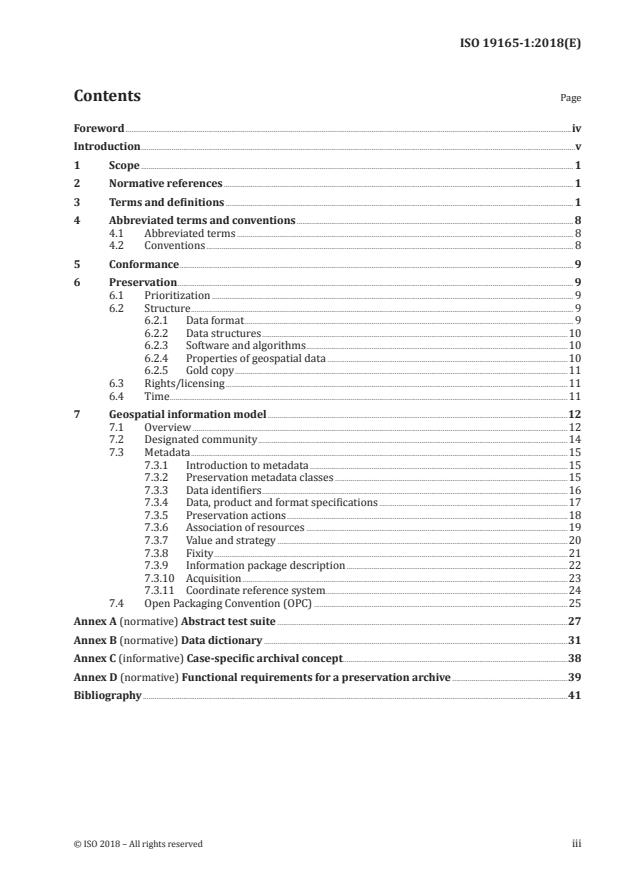
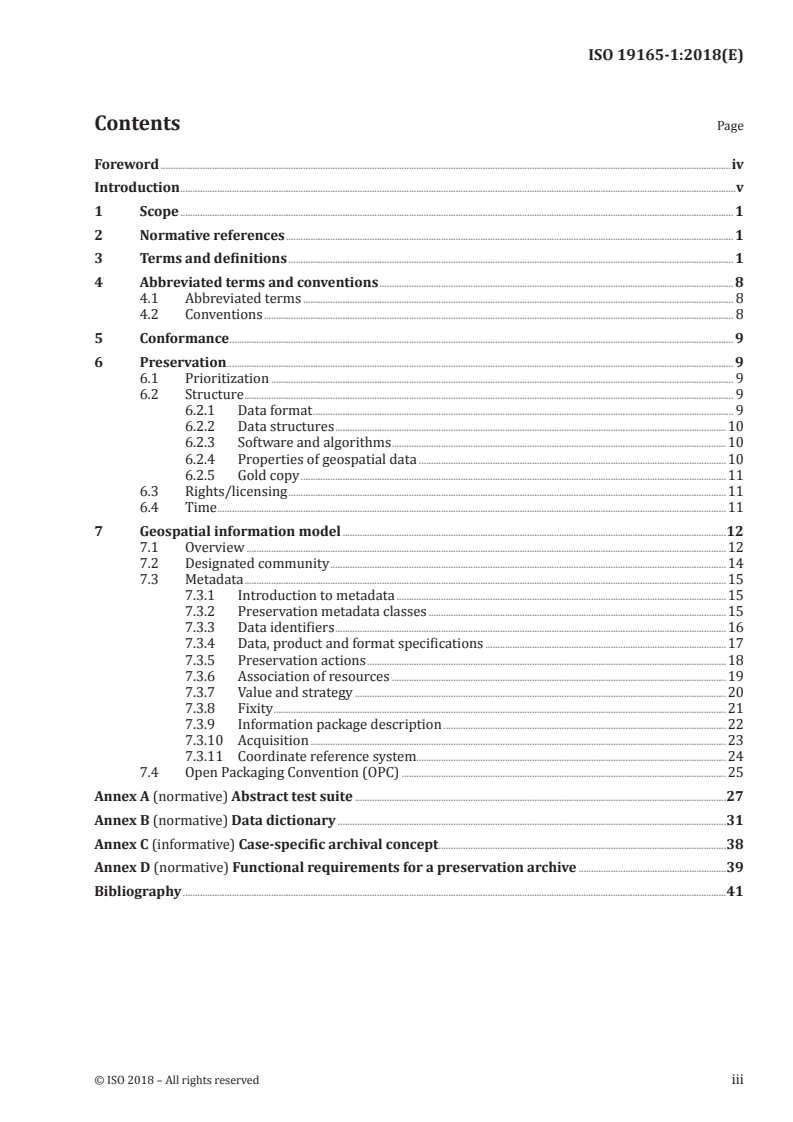
Contents Page
Foreword .iv
Introduction .v
1 Scope . 1
2 Normative references . 1
3 Terms and definitions . 1
4 Abbreviated terms and conventions . 8
4.1 Abbreviated terms . 8
4.2 Conventions . 8
5 Conformance . 9
6 Preservation . 9
6.1 Prioritization . 9
6.2 Structure . 9
6.2.1 Data format . 9
6.2.2 Data structures .10
6.2.3 Software and algorithms .10
6.2.4 Properties of geospatial data .10
6.2.5 Gold copy .11
6.3 Rights/licensing .11
6.4 Time .11
7 Geospatial information model .12
7.1 Overview .12
7.2 Designated community .14
7.3 Metadata .15
7.3.1 Introduction to metadata .15
7.3.2 Preservation metadata classes .15
7.3.3 Data identifiers .16
7.3.4 Data, product and format specifications .17
7.3.5 Preservation actions .18
7.3.6 Association of resources .19
7.3.7 Value and strategy .20
7.3.8 Fixity .21
7.3.9 Information package description .22
7.3.10 Acquisition .23
7.3.11 Coordinate reference system.24
7.4 Open Packaging Convention (OPC) .25
Annex A (normative) Abstract test suite .27
Annex B (normative) Data dictionary .31
Annex C (informative) Case-specific archival concept .38
Annex D (normative) Functional requirements for a preservation archive .39
Bibliography .41
Foreword
ISO (the International Organization for Standardization) is a worldwide federation of national standards
bodies (ISO member bodies). The work of preparing International Standards is normally carried out
through ISO technical committees. Each member body interested in a subject for which a technical
committee has been established has the right to be represented on that committee. International
organizations, governmental and non-governmental, in liaison with ISO, also take part in the work.
ISO collaborates closely with the International Electrotechnical Commission (IEC) on all matters of
electrotechnical standardization.
The procedures used to develop this document and those intended for its further maintenance are
described in the ISO/IEC Directives, Part 1. In particular the different approval criteria needed for the
different types of ISO documents should be noted. This document was drafted in accordance with the
editorial rules of the ISO/IEC Directives, Part 2 (see www .iso .org/directives).
Attention is drawn to the possibility that some of the elements of this document may be the subject of
patent rights. ISO shall not be held responsible for identifying any or all such patent rights. Details of
any patent rights identified during the development of the document will be in the Introduction and/or
on the ISO list of patent declarations received (see www .iso .org/patents).
Any trade name used in this document is information given for the convenience of users and does not
constitute an endorsement.
For an explanation on the voluntary nature of standards, the meaning of ISO specific terms and
expressions related to conformity assessment, as well as information about ISO's adherence to the
World Trade Organization (WTO) principles in the Technical Barriers to Trade (TBT) see the following
URL: www .iso .org/iso/foreword .html.
This document was prepared by Technical Committee ISO/TC 211, Geographic information/Geomatics.
iv © ISO 2018 – All rights reserved
Introduction
Today’s information is mostly stored on digital media, which has a shorter lifetime than that of analogue
media for a variety of reasons. Unless systematically archived, the storage media will decay and the
information is lost. Missing or incorrect metadata describing the format of data can also result in lost
digital information. Unfortunately, this daunting scenario occurs often. Consequently, the epoch in
which we presently live is sometimes named the “Digital Dark Age”.
Traditional archives are facilities or organizations that preserve records, originally generated by or for
a government organization, institution, or corporation, for access by public or private communities. The
archive accomplishes this task by taking ownership of the records, ensuring they are understandable
to the accessing community, and managing them so as to preserve their information content, data
integrity and authenticity (ISO 16363/TDR). The major focus for preserving this information has been
to ensure that they are on media with long term stability and that access to this media is carefully
controlled (ISO 14721).
Geospatial data possess several distinguishing structural characteristics that may include:
— relations to a well-defined section of the Earth;
— exchange by using theme-specific and sophisticated exchange formats;
— links to thematic data (databases);
— transformation between different coordinate reference systems;
— visualization (map output);
— large data volumes;
— existence of several levels-of-detail of the same dataset;
— links between a geospatial dataset and rights.
These distinctive features suggest that geospatial data shall be preserved together with relevant
metadata content that fully addresses these structural characteristics.
ISO 14721 defines a reference model for archiving digital information. The application of ISO 14721
is not limited to space data and it is widely used by digital libraries. However, ISO 14721 does not
completely cover all the needs for digital data and metadata preservation for geospatial data in general.
Therefore, the ISO 19165 series addresses geospatial data, its data model structures, the multiplicity of
data formats, and intellectual property rights. ISO 19165 is required by and developed for the geospatial
community. ISO/TC 211, Geographic information/Geomatics, has developed the ISO 19100 family of
standards dedicated to geographic information. One of them is ISO 19115-1. ISO 19165 is modelled as
a specialization of ISO 19115-1. This document is neither a profile nor an implementation of ISO 14721.
Apart from the ISO standards mentioned above, other standards for archival metadata exist. Examples
[19]
are the provenance family of documents of the W3C and PREMIS, the data dictionary for preservation
[17]
metadata .
INTERNATIONAL STANDARD ISO 19165-1:2018(E)
Geographic information — Preservation of digital data and
metadata —
Part 1:
Fundamentals
1 Scope
This document defines a preservation metadata extension of ISO 19115-1.
It defines the requirements for the long-term preservation of digital geospatial data. These data also
include metadata, representation information, provenance, context and any other content items that
capture the knowledge that are necessary to fully understand and reuse the archived data. This
document also refers to characteristics of data formats that are useful for the purpose of archiving.
Geospatial data are preserved as a geospatial information package (IP). This document defines
the requirements of the geospatial archival IP and details of the geospatial submission and the
dissemination IPs. A geospatial archival IP is fully self-describing and allows a future reconstruction
of the dataset without external documentation. The functional requirements for a preservation archive
are defined in Annex D.
This document complements standards developed by ISO/TC 211 as well as other ISO standards such as
ISO 14721.
2 Normative references
The following documents are referred to in the text in such a way that some or all of their content
constitutes requirements of this document. For dated references, only the edition cited applies. For
undated references, the latest edition of the referenced document (including any amendments) applies.
ISO 14721:2012, Space data and information transfer systems — Open archival information system
(OAIS) — Reference model
ISO 19110, Geographic information — Methodology for feature cataloguing
ISO 19115-1:2014, Geographic information — Metadata — Part 1: Fundamentals
ISO/TS 19115-3, Geographic information — Metadata — XML schema implementation of metadata
fundamentals
ISO 19157:2013, Geographic information — Data quality
3 Terms and definitions
For the purposes of this document, the following terms and definitions apply.
ISO and IEC maintain terminological databases for use in standardization at the following addresses:
— IEC Electropedia: available at http: //www .electropedia .org/
— ISO Online browsing platform: available at http: //www .iso .org/obp
3.1
access rights information
information that identifies the access restrictions pertaining to the content information, including the
legal framework, licensing terms, and access control
Note 1 to entry: Access rights information contains the access and distribution conditions stated within the
submission agreement, related to both preservation (by the OAIS) and final usage (by the consumer). It also
includes the specifications for the application of rights enforcement measures.
[SOURCE: ISO 14721:2012, 1.7.2, modified — Supporting content has been relocated to Note 1 to entry.]
3.2
access software
type of software that presents part of or all of the information content of an information object in forms
understandable to humans or systems
[SOURCE: ISO 14721:2012, 1.7.2, modified]
3.3
archival information package
AIP
information package (3.16), consisting of the content information (3.6) and the associated preservation
description information (PDI) (3.25), which is preserved within an OAIS (3.22)
[SOURCE: ISO 14721:2012, 1.7.2, modified]
3.4
AIP edition
AIP whose content information or preservation description information has been upgraded or improved
with the intent not to preserve information, but to increase or improve it
Note 1 to entry: This definition only refers to digital migration.
Note 2 to entry: An AIP edition is not considered to be the result of a migration.
[SOURCE: ISO 14721:2012, 1.7.2, modified — Supporting content has been relocated to Note 2 to entry.]
3.5
AIP version
AIP whose content information or preservation description information has undergone a transformation
on a source AIP and is a candidate to replace the source AIP
Note 1 to entry: An AIP version is considered to be the result of a digital migration.
[SOURCE: ISO 14721:2012, 1.7.2, modified — Supporting content has been relocated to Note 1 to entry.]
3.6
content information
set of information that is the original target of preservation or that includes part or all of that
information
Note 1 to entry: Content information is an information object composed of its content data object and its
representation information.
[SOURCE: ISO 14721:2012, 1.7.2, modified — Supporting content has been relocated to Note 1 to entry.]
3.7
data dictionary
formal repository of terms used to describe data
[SOURCE: ISO 14721:2012, 1.7.2, modified]
2 © ISO 2018 – All rights reserved
3.8
data dissemination session
delivery of media or a single telecommunications session that provides data to a consumer
Note 1 to entry: The data dissemination session format/contents is based on a data model negotiated between
the OAIS and the consumer in the request agreement. This data model identifies the logical constructs used by
the OAIS and how they are represented on each media delivery or in the telecommunication session.
[SOURCE: ISO 14721:2012, 1.7.2, modified — Supporting content has been relocated to Note 1 to entry.]
3.9
data submission session
delivery of media or a single telecommunications session that provides data to an OAIS
Note 1 to entry: The data submission session format/contents is based on a data model negotiated between the
OAIS and the producer in the submission agreement. This data model identifies the logical constructs used by the
producer and how they are represented on each media delivery or in the telecommunication session.
[SOURCE: ISO 14721:2012, 1.7.2, modified — Supporting content has been relocated to Note 1 to entry.]
3.10
designated community
identified group of potential consumers who should be able to understand a particular set of information
Note 1 to entry: The designated community may be composed of multiple user communities. A designated
community is defined by the archive and this definition may change over time.
[SOURCE: ISO 14721:2012, 1.7.2, modified — Supporting content has been relocated to Note 1 to entry.]
3.11
digital migration
transfer of digital information, while intending to preserve it, within the OAIS
Note 1 to entry: Digital migration is distinguished from transfers in general by three attributes:
— a focus on the preservation of the full information content that needs preservation;
— a perspective that the new archival implementation of the information is a replacement for the old;
— an understanding that full control and responsibility over all aspects of the transfer resides with the OAIS.
[SOURCE: ISO 14721:2012, 1.7.2, modified — Supporting content has been relocated to Note 1 to entry.]
3.12
digital object
object composed of a set of bit sequences
[SOURCE: ISO 14721:2012, 1.7.2, modified]
3.13
dissemination information package
DIP
information package, derived from one or more AIPs, and sent by archives to the consumer in response
to a request to the OAIS
[SOURCE: ISO 14721:2012, 1.7.2, modified]
3.14
federated archives
group of archives that has agreed to provide access to their holdings via one or more common finding aids
[SOURCE: ISO 14721:2012, 1.7.2, modified]
3.15
geographic information system
information system dealing with information concerning phenomena associated with location relative
to the Earth
[SOURCE: ISO 19101-1:2014, 4.1.20]
3.16
information package
logical container composed of optional content information and optional associated preservation
description information
Note 1 to entry: Associated with this information package is packaging information used to delimit and
identify the content information and package description information used to facilitate searches for the content
information.
[SOURCE: ISO 14721:2012, 1.7.2, modified — Supporting content has been relocated to Note 1 to entry.]
3.17
knowledge base
database of knowledge about a particular subject
Note 1 to entry: The database contains facts, inferences, and procedures needed for problem solution [Webster
Computer].
Note 2 to entry: The set of information may be incorporated by, or understood by, a person or a system.
[SOURCE: ISO/TS 19101-2:2008, 4.18, modified]
3.18
long term
period of time long enough for there to be concern about the impacts of changing technologies, including
support for new media and data formats, and of a changing designated community, on the information
being held in an OAIS
Note 1 to entry: This period extends into the indefinite future.
[SOURCE: ISO 14721:2012, 1.7.2, modified — Supporting content has been relocated to Note 1 to entry.]
3.19
long term preservation
act of maintaining information, independently understandable by a designated community, and with
evidence supporting its authenticity, over the long term
[SOURCE: ISO 14721:2012, 1.7.2, modified]
3.20
management
role played by those who set overall OAIS policy as one component in a broader policy domain,
for example as part of a larger organization
[SOURCE: ISO 14721:2012, 1.7.2, modified]
3.21
metadata
information about a resource
[SOURCE: ISO 19115-1:2014, 4.10]
4 © ISO 2018 – All rights reserved
3.22
open archival information system
OAIS
archive, consisting of an organization, which may be part of a larger organization, of people and systems,
that has accepted the responsibility to preserve information and make it available for a designated
community
Note 1 to entry: An OAIS Archive meets a set of responsibilities that allows to be distinguished from other uses
of the term 'archive'. The term 'open' in OAIS is used to imply that this recommendation and future related
recommendations and standards are developed in open forums, and it does not imply that access to the archive
is unrestricted.
[SOURCE: ISO 14721:2012, 1.7.2, modified — Supporting content has been relocated to Note 1 to entry.]
3.23
package description
information intended for use by access aids
[SOURCE: ISO 14721:2012, 1.7.2, modified]
3.24
packaging information
information used to bind and identify the components of an information package
EXAMPLE The ISO 9660 volume and directory information is used on a CD-ROM to provide the content of
several files containing content information and preservation description information.
[SOURCE: ISO 14721:2012, 1.7.2, modified — Supporting content has been relocated to an example.]
3.25
preservation description information
PDI
information which is necessary for adequate preservation of the content information and which can be
categorized as provenance, reference, fixity, context, and access rights Information
[SOURCE: ISO 14721:2012, 1.7.2, modified]
3.26
profile
set of one or more base standards or subsets of base standards, and, where applicable, the identification
of chosen clauses, classes, options and parameters of those base standards, that are necessary for
accomplishing a particular function
Note 1 to entry: A profile is derived from base standards so that by definition, conformance to a profile is
conformance to the base standards from which it is derived.
[SOURCE: ISO 19106:2004, 4.5]
3.27
producer
role played by those persons or client systems that provide the information to be preserved
Note 1 to entry: This can include other OAISes or internal OAIS persons or systems.
[SOURCE: ISO 14721:2012, 1.7.2, modified — Supporting content has been relocated to Note 1 to entry.]
3.28
provenance information
information that documents the history of the content information
Note 1 to entry: This information tells the origin or source of the content information, any changes that may
have taken place since it was originated, and who has had custody of it since it was originated. The archive is
responsible for creating and preserving provenance Information from the point of Ingest; however, earlier
provenance information should be provided by the producer. Provenance information adds to the evidence to
support authenticity.
[SOURCE: ISO 14721:2012, 1.7.2, modified — Supporting content has been relocated to Note 1 to entry.]
3.29
reference information
information that is used as an identifier for the content information
Note 1 to entry: Reference information also includes identifiers that allow outside systems to refer unambiguously
to particular content information. An example of reference information is an ISBN.
[SOURCE: ISO 14721:2012, 1.7.2, modified — Supporting content has been relocated to Note 1 to entry.]
3.30
reference model
framework for understanding significant relationships among the entities of some environment, and
for the development of consistent standards or specifications supporting that environment
Note 1 to entry: A reference model is based on a small number of unifying concepts and may be used as a basis for
education and explaining standards to a non-specialist.
[SOURCE: ISO 14721:2012, 1.7.2, modified — Supporting content has been relocated to Note 1 to entry.]
3.31
refreshment
digital migration where the effect is to replace a media instance with a copy that is sufficiently exact
that all archival storage hardware and software continues to run as before
[SOURCE: ISO 14721:2012, 1.7.2]
3.32
repackaging
digital migration in which there is an alteration in the packaging information of the AIP
[SOURCE: ISO 14721:2012, 1.7.2]
3.33
replication
digital migration where there is no change to the packaging information, the content information,
and the PDI
Note 1 to entry: The bits used to represent these information objects are preserved in the transfer to the same or
new media instance.
[SOURCE: ISO 14721:2012, 1.7.2, modified — Supporting content has been relocated to Note 1 to entry.]
3.34
representation information
information that maps a data object into more meaningful concepts
EXAMPLE 1 Representation information for a bit sequence which is a FITS file might consist of the FITS
standard which defines the format plus a dictionary which defines the meaning in the file of keywords which are
not part of the standard.
6 © ISO 2018 – All rights reserved
EXAMPLE 2 JPEG software which is used to render a JPEG file; rendering the JPEG file as bits is not very
meaningful to humans but the software, which embodies an understanding of the JPEG standard, maps the bits
into pixels which can then be rendered as an image for human viewing.
[SOURCE: ISO 14721:2012, 1.7.2, modified — Supporting content has been relocated to examples 1 and 2.]
3.35
resolution (of imagery)
smallest distance between two uniformly illuminated objects that can be separately resolved in an image
Note 1 to entry: This definition refers to the spatial resolution.
Note 2 to entry: In the general case, the resolution determines the possibility to distinguish between distinct
neighbouring features (objects).
Note 3 to entry: Resolution can also refer to the spectral and the temporal resolution.
[SOURCE: ISO/TS 19130-2:2014, 4.61, modified — addition of Notes 1, 2 and 3 to entry]
3.36
source
document providing legal and/or administrative facts on which the land administration (LA) object
[right, restriction, responsibility, basic administrative unit, party, or spatial unit] is based
[SOURCE: ISO 19152:2012, 4.1.21]
3.37
spatial source
source with the spatial representation of one (part of) or more spatial units
[SOURCE: ISO 19152:2012, 4.1.22, modified — The EXAMPLE was deleted.]
3.38
submission agreement
agreement reached, between an OAIS and the producer, that specifies a data model, and any other
arrangements needed, for the data submission session
Note 1 to entry: This data model identifies format/contents and the logical constructs used by the producer and
how they are represented on each media delivery or in a telecommunication session.
[SOURCE: ISO 14721:2012, 1.7.2, modified — Supporting content has been relocated to Note 1 to entry.]
3.39
submission information package
SIP
information package that is delivered by the producer to the OAIS for use in the construction or update
of one or more AIPs and/or the associated descriptive information
[SOURCE: ISO 14721:2012, 1.7.2, modified]
3.40
transformation
digital migration in which there is an alteration to the content information or PDI of an archival
information package
EXAMPLE Changing ASCII codes to UNICODE in a text document being preserved is a transformation.
[SOURCE: ISO 14721:2012, 1.7.2, modified — Supporting content has been relocated to an example.]
4 Abbreviated terms and conventions
4.1 Abbreviated terms
AIP archival information package
ASCII American Standard Code for Information Interchange
CRS coordinate reference system
DIP dissemination information package
FITS flexible image transport system
geo-AIP geospatial archival information package
geo-DIP geospatial dissemination information package
geo-SIP geospatial submission information package
HTTP hypertext transfer protocol
ISBN international standard book number
JPEG joint photographic expert group
LA land administration
MIME multipurpose internet mail extensions
OAIS open archival information system
OPC open packaging convention
PDI preservation description information
SIP submission information package
SOA service oriented architecture
TAR tape archiving (packaging format)
URI uniform resource identifier
XML extensible mark-up language
ZIP file compression format
4.2 Conventions
Some of the classes and attributes are defined in other ISO geographic information standards. Those
classes and attributes are identified by one of the following two-character codes.
CI = Citation (ISO 19115-1)
DS = Dataset (ISO 19115-1)
DQ = Data Quality (ISO 19157)
EX = Extent (ISO 19115-1)
GP = Geospatial Preservation (ISO 19165)
8 © ISO 2018 – All rights reserved
LI = Lineage (ISO 19115-1)
MD = Metadata (ISO 19115-1)
SV = Metadata for Services (ISO 19115-1)
TM = Temporal (ISO 19108)
5 Conformance
Details of the conformance classes are given in the Abstract test suite in Annex A.
6 Preservation
6.1 Prioritization
The extremely rapid increase in the quantity of data prevents preservation of all information.
Consequently, only a selected subset of data can move to a long term archive as determined by an
appraisal strategy. The appraisal strategy shall primarily evaluate the relevance of the data to be
archived. This appraisal should be done by the producer in cooperation with the archival institution, by
the appropriate involvement of the consumer community. Preservation shall be included in the product
life cycle and requires a decision on the archival procedure at the moment the data are created.
The value of geospatial datasets shall be appraised according to their content and categorized
accordingly as having short-term or long term archival value with described time spans. The short-
term value could, for example, be 1 year to 10 years. For these geospatial data with a short-term value,
a disposal schedule may be created where the archival storage and possible disposal process are
described. The preservation duration may be reassessed before the end of the term defined. Geospatial
datasets that have been classified as having long term value could, for example, be 100 years or more.
An appraisal of every layer of a geographic information system is required because not all layers are
equally relevant. However, layers are often interdependent. The archival process shall guarantee
consistency among interdependent layers.
The layers relevance may be distinguished by the time, the function and the relationship.
See Annex C for more details on topics to be discussed during the initial appraisal.
EXAMPLE
Function: A typical example is a future analysis of a land consolidation project. Though the administrative
procedure will be fully complete after a few years, the information keeps its value as documentation of the
change of landscape.
Relation: Often geospatial information is related to several topics and data sources at the same time. For example,
drinking water may have a network given as vectors, a map layer in raster, and written documentation.
6.2 Structure
6.2.1 Data format
Today, most geospatial data are stored in commonly accepted or specialized data formats. Those
formats have a specific structure and include metadata, either within the structure or as a separate file.
Some of the formats are standardized by ISO and/or IEC; others are de-facto standards.
A geospatial dataset shall be archived together with the full documentation of its data format either
by maintaining the full documentation on all geospatial formats held in the archive’s collections or by
linking via unique identifiers to well established file format registries. Archival in an undocumented
format is not permitted. One of the key components of sustainable long term preservation is detailed
knowledge of the file format that houses data, because even file formats that are currently well
understood may become incomprehensible over time.
The documentation of the data format shall include the format structure, its properties, the metadata,
and eventually a means of accessing and interpreting the data.
In consideration of experience, cost, and resources, an implementation of this standard shall link to
[18]
existing and acknowledged format-registries .
The use of a specified profile for any given file format is highly desirable knowledge to support long term
preservation and it should be meticulously recorded, along with pointers towards any conformance
and/or validation tools and methods used to assert the quality of the profiled file.
A graphic representation of the file content (plotted map) shall be archived where feasible.
6.2.2 Data structures
Many geospatial data are structured and simple storage of the data is not sufficient to preserve the
structure. In many cases, the storage requires software to access and interpret the data. Software
is a form of representation information in the OAIS model. Consequently, the full content shall be
transferred to the archive preserving the structure. This requires an archiving strategy that allows a
persistent understanding of the technology for accessing this dataset.
6.2.3 Software and algorithms
When using algorithms or software to extract results out of the data, careful attention should be paid
to preserve the replicability of the results. This can be facilitated by performing regular maintenance
using tests and validation programs.
6.2.4 Properties of geospatial data
Geospatial data have a number of particular properties which require consideration before archiving.
If the data are to be archived, an assumption about potential future uses of the data has to be made.
Based on this assumption, decisions are made about which properties and their details will be archived
and which others will be dropped. This is particularly important for data that have fine granularity,
structured in objects or aggregated to larger units such as layers.
Some geospatial data are created and maintained taking into account complex geospatial and
topological relationships between elements. For such complex products there are dependencies and
topological relationships that can exist between the layer units.
Often, geospatial data are stored redundantly, e.g. to serve different applications or to increase
performance.
— If the data require different ways of access such as in full resolution or in reduced resolution in the
form of an image pyramid, it shall be decided before preservation which of the resolution levels of
the data shall be preserved.
— In some cases, only the raw data, i.e. the original data, and a description of the method of the creation
of the derived product need to be archived. However, if it takes significant effort to generate derived
products that are deemed valuable to the user community then those products will need to be
archived as well.
— If identical data exist in redundant forms, it shall be decided before preservation which of the
storage types shall be preserved.
The appraisal of geospatial data may use different criteria from other types of data. Often the same
geospatial data exist at several servers with different levels of aggregation, from raw data to an
aggregated data product.
10 © ISO 2018 – All rights reserved
For archiving, assumptions shall be made about typical geospatial data products, i.e. typical
aggregations of the raw data used by the designated communities (see 7.2). Based on the assumption
the raw data shall be archived in a way that allows a full derivation of the data product.
6.2.5 Gold copy
This document sets several methods for securely archiving geospatial data. However, the totality of
all methods can never guarantee a full recovery of the data after a very long period of time. In order
to increase reliability, a separate copy of the data archive shall be established in open, file based
repositories, not databases, nor other complex environments. Often, this copy is called a gold copy.
EXAMPLE In the presence of multiple versions of time-series data specific temporal subsets from earlier
versions are preserved as gold copies to facilitate verification of the ability to regenerate a given earlier version.
6.3 Rights/licensing
The problems of assuming sufficient control of mainly digital content information and preservation
description information are addressed in three related categories, as follows (ISO 14721:2012, 3.2.2):
— copyright implications, intellectual property and other legal restrictions on use;
— authority to modify representation information;
— agreements with external organizations.
Authoritative geospatial data often possess legal restrictions, e.g. Creative Commons. The rights
may be transferred to the archive together with the dataset and related items such as software and
documentation. Where transferred, the rights shall be guaranteed by the archive.
With respect to mapping products, legal restrictions may play a role in the copyright, fees for the use of
a dataset, restricted access to personal data, or for other applications. Rights including those imposed
on archived data are often a function of time.
6.4 Time
Many geospatial data are never obsolete or are continuously updated such as cadastral data. These
kinds of geospatial datasets never become mature for archiving if the criterion requires that the
datasets do not change within a certain time interval.
In order to allow for archiving these data one of the following methods shall be applied.
— If a system contains data of the same topic and the same area but of different epochs, then the older
data shall not be overwritten by new data. A system such as the ISO 19152 VersionedObject shall be
in place to manage current and older data.
— If overridden data are not kept in the system, a time slice shall be defined in periodic intervals in
order to allow moving the complete dataset to the archive.
Some organizations may choose to archive data by temporal sampling in order to save storage capacity,
if it is appropriate to do so. In such cases, it is essential to ensure that the requirements of the designated
community are met by any sampling constraints to ensure any data collected is a comfortable fit with
the expressed future use cases. Any variations of collection intervals should be recorded in the archival
information package (AIP) documentation, ensuring that current users are informed of the limits of the
data being archived and future consumers of the data will be well aware of the contents of the archived
dataset.
7 Geospatial information model
7.1 Overview
ISO 14721:2012, 2.2 and 4.2 describe an information model for data preservation. The core concept
is the content information that is composed by a data object and the representation information.
In the geospatial case, the data object will be the geospatial digital dataset to be preserved and the
representation information is what allows the designated community to understand the data. For
geospatial information, the representation information is covered by ISO 19115-1, ISO 19157, ISO 19110,
and ISO 19165 (this document). An example of representation information is the description of the
dataset coordinate reference system (CRS).
The OAIS model also defines the information package as a conceptual container of two types of
information called content information and preservation description information (PDI). The latter is
all the information necessary to preserve the content information, to identify it in the archive, and to
understand the environment in which the content information was created. Content information and
preservation description information are both contained in information packages (IPs). See Annex B for
details.
ISO 19165 defines the elements of the IP as one of its central components. This package should be ready
to be shared with other organizations, including those outside the geospatial community.
ISO 19165 has specialized versions of the IPs named geospatial submission information package (geo-
SIP), geospatial archival information package (geo-AIP), and geospatial dissemination information
package (geo-DIP). Their special properties include, lossless compression, cartographic series support
(i.e. a manageable regional size), as well as a container for information regarding geometry (vector and
raster), attributes, topology, metadata, quicklooks, and recommendations on how to symbolize the data.
This document maps the PDI of ISO 14721 into an extension of the ISO 19115-1 metadata standard. The
extension follows the rules specified in ISO 19115-1:2014, C.4 “Rules for creating an extension”. This
document has not been designed as a community profile and does not consider ISO 19115-1:2014, C.6
as it does not impose any new r
...
INTERNATIONAL ISO
STANDARD 19165-1
First edition
2018-05
Geographic information —
Preservation of digital data and
metadata —
Part 1:
Fundamentals
Information géographique — Archivage des données numériques et
des métadonnées —
Partie 1: Principes fondamentaux
Reference number
©
ISO 2018
© ISO 2018
All rights reserved. Unless otherwise specified, or required in the context of its implementation, no part of this publication may
be reproduced or utilized otherwise in any form or by any means, electronic or mechanical, including photocopying, or posting
on the internet or an intranet, without prior written permission. Permission can be requested from either ISO at the address
below or ISO’s member body in the country of the requester.
ISO copyright office
CP 401 • Ch. de Blandonnet 8
CH-1214 Vernier, Geneva
Phone: +41 22 749 01 11
Fax: +41 22 749 09 47
Email: copyright@iso.org
Website: www.iso.org
Published in Switzerland
ii © ISO 2018 – All rights reserved
Contents Page
Foreword .iv
Introduction .v
1 Scope . 1
2 Normative references . 1
3 Terms and definitions . 1
4 Abbreviated terms and conventions . 8
4.1 Abbreviated terms . 8
4.2 Conventions . 8
5 Conformance . 9
6 Preservation . 9
6.1 Prioritization . 9
6.2 Structure . 9
6.2.1 Data format . 9
6.2.2 Data structures .10
6.2.3 Software and algorithms .10
6.2.4 Properties of geospatial data .10
6.2.5 Gold copy .11
6.3 Rights/licensing .11
6.4 Time .11
7 Geospatial information model .12
7.1 Overview .12
7.2 Designated community .14
7.3 Metadata .15
7.3.1 Introduction to metadata .15
7.3.2 Preservation metadata classes .15
7.3.3 Data identifiers .16
7.3.4 Data, product and format specifications .17
7.3.5 Preservation actions .18
7.3.6 Association of resources .19
7.3.7 Value and strategy .20
7.3.8 Fixity .21
7.3.9 Information package description .22
7.3.10 Acquisition .23
7.3.11 Coordinate reference system.24
7.4 Open Packaging Convention (OPC) .25
Annex A (normative) Abstract test suite .27
Annex B (normative) Data dictionary .31
Annex C (informative) Case-specific archival concept .38
Annex D (normative) Functional requirements for a preservation archive .39
Bibliography .41
Foreword
ISO (the International Organization for Standardization) is a worldwide federation of national standards
bodies (ISO member bodies). The work of preparing International Standards is normally carried out
through ISO technical committees. Each member body interested in a subject for which a technical
committee has been established has the right to be represented on that committee. International
organizations, governmental and non-governmental, in liaison with ISO, also take part in the work.
ISO collaborates closely with the International Electrotechnical Commission (IEC) on all matters of
electrotechnical standardization.
The procedures used to develop this document and those intended for its further maintenance are
described in the ISO/IEC Directives, Part 1. In particular the different approval criteria needed for the
different types of ISO documents should be noted. This document was drafted in accordance with the
editorial rules of the ISO/IEC Directives, Part 2 (see www .iso .org/directives).
Attention is drawn to the possibility that some of the elements of this document may be the subject of
patent rights. ISO shall not be held responsible for identifying any or all such patent rights. Details of
any patent rights identified during the development of the document will be in the Introduction and/or
on the ISO list of patent declarations received (see www .iso .org/patents).
Any trade name used in this document is information given for the convenience of users and does not
constitute an endorsement.
For an explanation on the voluntary nature of standards, the meaning of ISO specific terms and
expressions related to conformity assessment, as well as information about ISO's adherence to the
World Trade Organization (WTO) principles in the Technical Barriers to Trade (TBT) see the following
URL: www .iso .org/iso/foreword .html.
This document was prepared by Technical Committee ISO/TC 211, Geographic information/Geomatics.
iv © ISO 2018 – All rights reserved
Introduction
Today’s information is mostly stored on digital media, which has a shorter lifetime than that of analogue
media for a variety of reasons. Unless systematically archived, the storage media will decay and the
information is lost. Missing or incorrect metadata describing the format of data can also result in lost
digital information. Unfortunately, this daunting scenario occurs often. Consequently, the epoch in
which we presently live is sometimes named the “Digital Dark Age”.
Traditional archives are facilities or organizations that preserve records, originally generated by or for
a government organization, institution, or corporation, for access by public or private communities. The
archive accomplishes this task by taking ownership of the records, ensuring they are understandable
to the accessing community, and managing them so as to preserve their information content, data
integrity and authenticity (ISO 16363/TDR). The major focus for preserving this information has been
to ensure that they are on media with long term stability and that access to this media is carefully
controlled (ISO 14721).
Geospatial data possess several distinguishing structural characteristics that may include:
— relations to a well-defined section of the Earth;
— exchange by using theme-specific and sophisticated exchange formats;
— links to thematic data (databases);
— transformation between different coordinate reference systems;
— visualization (map output);
— large data volumes;
— existence of several levels-of-detail of the same dataset;
— links between a geospatial dataset and rights.
These distinctive features suggest that geospatial data shall be preserved together with relevant
metadata content that fully addresses these structural characteristics.
ISO 14721 defines a reference model for archiving digital information. The application of ISO 14721
is not limited to space data and it is widely used by digital libraries. However, ISO 14721 does not
completely cover all the needs for digital data and metadata preservation for geospatial data in general.
Therefore, the ISO 19165 series addresses geospatial data, its data model structures, the multiplicity of
data formats, and intellectual property rights. ISO 19165 is required by and developed for the geospatial
community. ISO/TC 211, Geographic information/Geomatics, has developed the ISO 19100 family of
standards dedicated to geographic information. One of them is ISO 19115-1. ISO 19165 is modelled as
a specialization of ISO 19115-1. This document is neither a profile nor an implementation of ISO 14721.
Apart from the ISO standards mentioned above, other standards for archival metadata exist. Examples
[19]
are the provenance family of documents of the W3C and PREMIS, the data dictionary for preservation
[17]
metadata .
INTERNATIONAL STANDARD ISO 19165-1:2018(E)
Geographic information — Preservation of digital data and
metadata —
Part 1:
Fundamentals
1 Scope
This document defines a preservation metadata extension of ISO 19115-1.
It defines the requirements for the long-term preservation of digital geospatial data. These data also
include metadata, representation information, provenance, context and any other content items that
capture the knowledge that are necessary to fully understand and reuse the archived data. This
document also refers to characteristics of data formats that are useful for the purpose of archiving.
Geospatial data are preserved as a geospatial information package (IP). This document defines
the requirements of the geospatial archival IP and details of the geospatial submission and the
dissemination IPs. A geospatial archival IP is fully self-describing and allows a future reconstruction
of the dataset without external documentation. The functional requirements for a preservation archive
are defined in Annex D.
This document complements standards developed by ISO/TC 211 as well as other ISO standards such as
ISO 14721.
2 Normative references
The following documents are referred to in the text in such a way that some or all of their content
constitutes requirements of this document. For dated references, only the edition cited applies. For
undated references, the latest edition of the referenced document (including any amendments) applies.
ISO 14721:2012, Space data and information transfer systems — Open archival information system
(OAIS) — Reference model
ISO 19110, Geographic information — Methodology for feature cataloguing
ISO 19115-1:2014, Geographic information — Metadata — Part 1: Fundamentals
ISO/TS 19115-3, Geographic information — Metadata — XML schema implementation of metadata
fundamentals
ISO 19157:2013, Geographic information — Data quality
3 Terms and definitions
For the purposes of this document, the following terms and definitions apply.
ISO and IEC maintain terminological databases for use in standardization at the following addresses:
— IEC Electropedia: available at http: //www .electropedia .org/
— ISO Online browsing platform: available at http: //www .iso .org/obp
3.1
access rights information
information that identifies the access restrictions pertaining to the content information, including the
legal framework, licensing terms, and access control
Note 1 to entry: Access rights information contains the access and distribution conditions stated within the
submission agreement, related to both preservation (by the OAIS) and final usage (by the consumer). It also
includes the specifications for the application of rights enforcement measures.
[SOURCE: ISO 14721:2012, 1.7.2, modified — Supporting content has been relocated to Note 1 to entry.]
3.2
access software
type of software that presents part of or all of the information content of an information object in forms
understandable to humans or systems
[SOURCE: ISO 14721:2012, 1.7.2, modified]
3.3
archival information package
AIP
information package (3.16), consisting of the content information (3.6) and the associated preservation
description information (PDI) (3.25), which is preserved within an OAIS (3.22)
[SOURCE: ISO 14721:2012, 1.7.2, modified]
3.4
AIP edition
AIP whose content information or preservation description information has been upgraded or improved
with the intent not to preserve information, but to increase or improve it
Note 1 to entry: This definition only refers to digital migration.
Note 2 to entry: An AIP edition is not considered to be the result of a migration.
[SOURCE: ISO 14721:2012, 1.7.2, modified — Supporting content has been relocated to Note 2 to entry.]
3.5
AIP version
AIP whose content information or preservation description information has undergone a transformation
on a source AIP and is a candidate to replace the source AIP
Note 1 to entry: An AIP version is considered to be the result of a digital migration.
[SOURCE: ISO 14721:2012, 1.7.2, modified — Supporting content has been relocated to Note 1 to entry.]
3.6
content information
set of information that is the original target of preservation or that includes part or all of that
information
Note 1 to entry: Content information is an information object composed of its content data object and its
representation information.
[SOURCE: ISO 14721:2012, 1.7.2, modified — Supporting content has been relocated to Note 1 to entry.]
3.7
data dictionary
formal repository of terms used to describe data
[SOURCE: ISO 14721:2012, 1.7.2, modified]
2 © ISO 2018 – All rights reserved
3.8
data dissemination session
delivery of media or a single telecommunications session that provides data to a consumer
Note 1 to entry: The data dissemination session format/contents is based on a data model negotiated between
the OAIS and the consumer in the request agreement. This data model identifies the logical constructs used by
the OAIS and how they are represented on each media delivery or in the telecommunication session.
[SOURCE: ISO 14721:2012, 1.7.2, modified — Supporting content has been relocated to Note 1 to entry.]
3.9
data submission session
delivery of media or a single telecommunications session that provides data to an OAIS
Note 1 to entry: The data submission session format/contents is based on a data model negotiated between the
OAIS and the producer in the submission agreement. This data model identifies the logical constructs used by the
producer and how they are represented on each media delivery or in the telecommunication session.
[SOURCE: ISO 14721:2012, 1.7.2, modified — Supporting content has been relocated to Note 1 to entry.]
3.10
designated community
identified group of potential consumers who should be able to understand a particular set of information
Note 1 to entry: The designated community may be composed of multiple user communities. A designated
community is defined by the archive and this definition may change over time.
[SOURCE: ISO 14721:2012, 1.7.2, modified — Supporting content has been relocated to Note 1 to entry.]
3.11
digital migration
transfer of digital information, while intending to preserve it, within the OAIS
Note 1 to entry: Digital migration is distinguished from transfers in general by three attributes:
— a focus on the preservation of the full information content that needs preservation;
— a perspective that the new archival implementation of the information is a replacement for the old;
— an understanding that full control and responsibility over all aspects of the transfer resides with the OAIS.
[SOURCE: ISO 14721:2012, 1.7.2, modified — Supporting content has been relocated to Note 1 to entry.]
3.12
digital object
object composed of a set of bit sequences
[SOURCE: ISO 14721:2012, 1.7.2, modified]
3.13
dissemination information package
DIP
information package, derived from one or more AIPs, and sent by archives to the consumer in response
to a request to the OAIS
[SOURCE: ISO 14721:2012, 1.7.2, modified]
3.14
federated archives
group of archives that has agreed to provide access to their holdings via one or more common finding aids
[SOURCE: ISO 14721:2012, 1.7.2, modified]
3.15
geographic information system
information system dealing with information concerning phenomena associated with location relative
to the Earth
[SOURCE: ISO 19101-1:2014, 4.1.20]
3.16
information package
logical container composed of optional content information and optional associated preservation
description information
Note 1 to entry: Associated with this information package is packaging information used to delimit and
identify the content information and package description information used to facilitate searches for the content
information.
[SOURCE: ISO 14721:2012, 1.7.2, modified — Supporting content has been relocated to Note 1 to entry.]
3.17
knowledge base
database of knowledge about a particular subject
Note 1 to entry: The database contains facts, inferences, and procedures needed for problem solution [Webster
Computer].
Note 2 to entry: The set of information may be incorporated by, or understood by, a person or a system.
[SOURCE: ISO/TS 19101-2:2008, 4.18, modified]
3.18
long term
period of time long enough for there to be concern about the impacts of changing technologies, including
support for new media and data formats, and of a changing designated community, on the information
being held in an OAIS
Note 1 to entry: This period extends into the indefinite future.
[SOURCE: ISO 14721:2012, 1.7.2, modified — Supporting content has been relocated to Note 1 to entry.]
3.19
long term preservation
act of maintaining information, independently understandable by a designated community, and with
evidence supporting its authenticity, over the long term
[SOURCE: ISO 14721:2012, 1.7.2, modified]
3.20
management
role played by those who set overall OAIS policy as one component in a broader policy domain,
for example as part of a larger organization
[SOURCE: ISO 14721:2012, 1.7.2, modified]
3.21
metadata
information about a resource
[SOURCE: ISO 19115-1:2014, 4.10]
4 © ISO 2018 – All rights reserved
3.22
open archival information system
OAIS
archive, consisting of an organization, which may be part of a larger organization, of people and systems,
that has accepted the responsibility to preserve information and make it available for a designated
community
Note 1 to entry: An OAIS Archive meets a set of responsibilities that allows to be distinguished from other uses
of the term 'archive'. The term 'open' in OAIS is used to imply that this recommendation and future related
recommendations and standards are developed in open forums, and it does not imply that access to the archive
is unrestricted.
[SOURCE: ISO 14721:2012, 1.7.2, modified — Supporting content has been relocated to Note 1 to entry.]
3.23
package description
information intended for use by access aids
[SOURCE: ISO 14721:2012, 1.7.2, modified]
3.24
packaging information
information used to bind and identify the components of an information package
EXAMPLE The ISO 9660 volume and directory information is used on a CD-ROM to provide the content of
several files containing content information and preservation description information.
[SOURCE: ISO 14721:2012, 1.7.2, modified — Supporting content has been relocated to an example.]
3.25
preservation description information
PDI
information which is necessary for adequate preservation of the content information and which can be
categorized as provenance, reference, fixity, context, and access rights Information
[SOURCE: ISO 14721:2012, 1.7.2, modified]
3.26
profile
set of one or more base standards or subsets of base standards, and, where applicable, the identification
of chosen clauses, classes, options and parameters of those base standards, that are necessary for
accomplishing a particular function
Note 1 to entry: A profile is derived from base standards so that by definition, conformance to a profile is
conformance to the base standards from which it is derived.
[SOURCE: ISO 19106:2004, 4.5]
3.27
producer
role played by those persons or client systems that provide the information to be preserved
Note 1 to entry: This can include other OAISes or internal OAIS persons or systems.
[SOURCE: ISO 14721:2012, 1.7.2, modified — Supporting content has been relocated to Note 1 to entry.]
3.28
provenance information
information that documents the history of the content information
Note 1 to entry: This information tells the origin or source of the content information, any changes that may
have taken place since it was originated, and who has had custody of it since it was originated. The archive is
responsible for creating and preserving provenance Information from the point of Ingest; however, earlier
provenance information should be provided by the producer. Provenance information adds to the evidence to
support authenticity.
[SOURCE: ISO 14721:2012, 1.7.2, modified — Supporting content has been relocated to Note 1 to entry.]
3.29
reference information
information that is used as an identifier for the content information
Note 1 to entry: Reference information also includes identifiers that allow outside systems to refer unambiguously
to particular content information. An example of reference information is an ISBN.
[SOURCE: ISO 14721:2012, 1.7.2, modified — Supporting content has been relocated to Note 1 to entry.]
3.30
reference model
framework for understanding significant relationships among the entities of some environment, and
for the development of consistent standards or specifications supporting that environment
Note 1 to entry: A reference model is based on a small number of unifying concepts and may be used as a basis for
education and explaining standards to a non-specialist.
[SOURCE: ISO 14721:2012, 1.7.2, modified — Supporting content has been relocated to Note 1 to entry.]
3.31
refreshment
digital migration where the effect is to replace a media instance with a copy that is sufficiently exact
that all archival storage hardware and software continues to run as before
[SOURCE: ISO 14721:2012, 1.7.2]
3.32
repackaging
digital migration in which there is an alteration in the packaging information of the AIP
[SOURCE: ISO 14721:2012, 1.7.2]
3.33
replication
digital migration where there is no change to the packaging information, the content information,
and the PDI
Note 1 to entry: The bits used to represent these information objects are preserved in the transfer to the same or
new media instance.
[SOURCE: ISO 14721:2012, 1.7.2, modified — Supporting content has been relocated to Note 1 to entry.]
3.34
representation information
information that maps a data object into more meaningful concepts
EXAMPLE 1 Representation information for a bit sequence which is a FITS file might consist of the FITS
standard which defines the format plus a dictionary which defines the meaning in the file of keywords which are
not part of the standard.
6 © ISO 2018 – All rights reserved
EXAMPLE 2 JPEG software which is used to render a JPEG file; rendering the JPEG file as bits is not very
meaningful to humans but the software, which embodies an understanding of the JPEG standard, maps the bits
into pixels which can then be rendered as an image for human viewing.
[SOURCE: ISO 14721:2012, 1.7.2, modified — Supporting content has been relocated to examples 1 and 2.]
3.35
resolution (of imagery)
smallest distance between two uniformly illuminated objects that can be separately resolved in an image
Note 1 to entry: This definition refers to the spatial resolution.
Note 2 to entry: In the general case, the resolution determines the possibility to distinguish between distinct
neighbouring features (objects).
Note 3 to entry: Resolution can also refer to the spectral and the temporal resolution.
[SOURCE: ISO/TS 19130-2:2014, 4.61, modified — addition of Notes 1, 2 and 3 to entry]
3.36
source
document providing legal and/or administrative facts on which the land administration (LA) object
[right, restriction, responsibility, basic administrative unit, party, or spatial unit] is based
[SOURCE: ISO 19152:2012, 4.1.21]
3.37
spatial source
source with the spatial representation of one (part of) or more spatial units
[SOURCE: ISO 19152:2012, 4.1.22, modified — The EXAMPLE was deleted.]
3.38
submission agreement
agreement reached, between an OAIS and the producer, that specifies a data model, and any other
arrangements needed, for the data submission session
Note 1 to entry: This data model identifies format/contents and the logical constructs used by the producer and
how they are represented on each media delivery or in a telecommunication session.
[SOURCE: ISO 14721:2012, 1.7.2, modified — Supporting content has been relocated to Note 1 to entry.]
3.39
submission information package
SIP
information package that is delivered by the producer to the OAIS for use in the construction or update
of one or more AIPs and/or the associated descriptive information
[SOURCE: ISO 14721:2012, 1.7.2, modified]
3.40
transformation
digital migration in which there is an alteration to the content information or PDI of an archival
information package
EXAMPLE Changing ASCII codes to UNICODE in a text document being preserved is a transformation.
[SOURCE: ISO 14721:2012, 1.7.2, modified — Supporting content has been relocated to an example.]
4 Abbreviated terms and conventions
4.1 Abbreviated terms
AIP archival information package
ASCII American Standard Code for Information Interchange
CRS coordinate reference system
DIP dissemination information package
FITS flexible image transport system
geo-AIP geospatial archival information package
geo-DIP geospatial dissemination information package
geo-SIP geospatial submission information package
HTTP hypertext transfer protocol
ISBN international standard book number
JPEG joint photographic expert group
LA land administration
MIME multipurpose internet mail extensions
OAIS open archival information system
OPC open packaging convention
PDI preservation description information
SIP submission information package
SOA service oriented architecture
TAR tape archiving (packaging format)
URI uniform resource identifier
XML extensible mark-up language
ZIP file compression format
4.2 Conventions
Some of the classes and attributes are defined in other ISO geographic information standards. Those
classes and attributes are identified by one of the following two-character codes.
CI = Citation (ISO 19115-1)
DS = Dataset (ISO 19115-1)
DQ = Data Quality (ISO 19157)
EX = Extent (ISO 19115-1)
GP = Geospatial Preservation (ISO 19165)
8 © ISO 2018 – All rights reserved
LI = Lineage (ISO 19115-1)
MD = Metadata (ISO 19115-1)
SV = Metadata for Services (ISO 19115-1)
TM = Temporal (ISO 19108)
5 Conformance
Details of the conformance classes are given in the Abstract test suite in Annex A.
6 Preservation
6.1 Prioritization
The extremely rapid increase in the quantity of data prevents preservation of all information.
Consequently, only a selected subset of data can move to a long term archive as determined by an
appraisal strategy. The appraisal strategy shall primarily evaluate the relevance of the data to be
archived. This appraisal should be done by the producer in cooperation with the archival institution, by
the appropriate involvement of the consumer community. Preservation shall be included in the product
life cycle and requires a decision on the archival procedure at the moment the data are created.
The value of geospatial datasets shall be appraised according to their content and categorized
accordingly as having short-term or long term archival value with described time spans. The short-
term value could, for example, be 1 year to 10 years. For these geospatial data with a short-term value,
a disposal schedule may be created where the archival storage and possible disposal process are
described. The preservation duration may be reassessed before the end of the term defined. Geospatial
datasets that have been classified as having long term value could, for example, be 100 years or more.
An appraisal of every layer of a geographic information system is required because not all layers are
equally relevant. However, layers are often interdependent. The archival process shall guarantee
consistency among interdependent layers.
The layers relevance may be distinguished by the time, the function and the relationship.
See Annex C for more details on topics to be discussed during the initial appraisal.
EXAMPLE
Function: A typical example is a future analysis of a land consolidation project. Though the administrative
procedure will be fully complete after a few years, the information keeps its value as documentation of the
change of landscape.
Relation: Often geospatial information is related to several topics and data sources at the same time. For example,
drinking water may have a network given as vectors, a map layer in raster, and written documentation.
6.2 Structure
6.2.1 Data format
Today, most geospatial data are stored in commonly accepted or specialized data formats. Those
formats have a specific structure and include metadata, either within the structure or as a separate file.
Some of the formats are standardized by ISO and/or IEC; others are de-facto standards.
A geospatial dataset shall be archived together with the full documentation of its data format either
by maintaining the full documentation on all geospatial formats held in the archive’s collections or by
linking via unique identifiers to well established file format registries. Archival in an undocumented
format is not permitted. One of the key components of sustainable long term preservation is detailed
knowledge of the file format that houses data, because even file formats that are currently well
understood may become incomprehensible over time.
The documentation of the data format shall include the format structure, its properties, the metadata,
and eventually a means of accessing and interpreting the data.
In consideration of experience, cost, and resources, an implementation of this standard shall link to
[18]
existing and acknowledged format-registries .
The use of a specified profile for any given file format is highly desirable knowledge to support long term
preservation and it should be meticulously recorded, along with pointers towards any conformance
and/or validation tools and methods used to assert the quality of the profiled file.
A graphic representation of the file content (plotted map) shall be archived where feasible.
6.2.2 Data structures
Many geospatial data are structured and simple storage of the data is not sufficient to preserve the
structure. In many cases, the storage requires software to access and interpret the data. Software
is a form of representation information in the OAIS model. Consequently, the full content shall be
transferred to the archive preserving the structure. This requires an archiving strategy that allows a
persistent understanding of the technology for accessing this dataset.
6.2.3 Software and algorithms
When using algorithms or software to extract results out of the data, careful attention should be paid
to preserve the replicability of the results. This can be facilitated by performing regular maintenance
using tests and validation programs.
6.2.4 Properties of geospatial data
Geospatial data have a number of particular properties which require consideration before archiving.
If the data are to be archived, an assumption about potential future uses of the data has to be made.
Based on this assumption, decisions are made about which properties and their details will be archived
and which others will be dropped. This is particularly important for data that have fine granularity,
structured in objects or aggregated to larger units such as layers.
Some geospatial data are created and maintained taking into account complex geospatial and
topological relationships between elements. For such complex products there are dependencies and
topological relationships that can exist between the layer units.
Often, geospatial data are stored redundantly, e.g. to serve different applications or to increase
performance.
— If the data require different ways of access such as in full resolution or in reduced resolution in the
form of an image pyramid, it shall be decided before preservation which of the resolution levels of
the data shall be preserved.
— In some cases, only the raw data, i.e. the original data, and a description of the method of the creation
of the derived product need to be archived. However, if it takes significant effort to generate derived
products that are deemed valuable to the user community then those products will need to be
archived as well.
— If identical data exist in redundant forms, it shall be decided before preservation which of the
storage types shall be preserved.
The appraisal of geospatial data may use different criteria from other types of data. Often the same
geospatial data exist at several servers with different levels of aggregation, from raw data to an
aggregated data product.
10 © ISO 2018 – All rights reserved
For archiving, assumptions shall be made about typical geospatial data products, i.e. typical
aggregations of the raw data used by the designated communities (see 7.2). Based on the assumption
the raw data shall be archived in a way that allows a full derivation of the data product.
6.2.5 Gold copy
This document sets several methods for securely archiving geospatial data. However, the totality of
all methods can never guarantee a full recovery of the data after a very long period of time. In order
to increase reliability, a separate copy of the data archive shall be established in open, file based
repositories, not databases, nor other complex environments. Often, this copy is called a gold copy.
EXAMPLE In the presence of multiple versions of time-series data specific temporal subsets from earlier
versions are preserved as gold copies to facilitate verification of the ability to regenerate a given earlier version.
6.3 Rights/licensing
The problems of assuming sufficient control of mainly digital content information and preservation
description information are addressed in three related categories, as follows (ISO 14721:2012, 3.2.2):
— copyright implications, intellectual property and other legal restrictions on use;
— authority to modify representation information;
— agreements with external organizations.
Authoritative geospatial data often possess legal restrictions, e.g. Creative Commons. The rights
may be transferred to the archive together with the dataset and related items such as software and
documentation. Where transferred, the rights shall be guaranteed by the archive.
With respect to mapping products, legal restrictions may play a role in the copyright, fees for the use of
a dataset, restricted access to personal data, or for other applications. Rights including those imposed
on archived data are often a function of time.
6.4 Time
Many geospatial data are never obsolete or are continuously updated such as cadastral data. These
kinds of geospatial datasets never become mature for archiving if the criterion requires that the
datasets do not change within a certain time interval.
In order to allow for archiving these data one of the following methods shall be applied.
— If a system contains data of the same topic and the same area but of different epochs, then the older
data shall not be overwritten by new data. A system such as the ISO 19152 VersionedObject shall be
in place to manage current and older data.
— If overridden data are not kept in the system, a time slice shall be defined in periodic intervals in
order to allow moving the complete dataset to the archive.
Some organizations may choose to archive data by temporal sampling in order to save storage capacity,
if it is appropriate to do so. In such cases, it is essential to ensure that the requirements of the designated
community are met by any sampling constraints to ensure any data collected is a comfortable fit with
the expressed future use cases. Any variations of collection intervals should be recorded in the archival
information package (AIP) documentation, ensuring that current users are informed of the limits of the
data being archived and future consumers of the data will be well aware of the contents of the archived
dataset.
7 Geospatial information model
7.1 Overview
ISO 14721:2012, 2.2 and 4.2 describe an information model for data preservation. The core concept
is the content information that is composed by a data object and the representation information.
In the geospatial case, the data object will be the geospatial digital dataset to be preserved and the
representation information is what allows the designated community to understand the data. For
geospatial information, the representation information is covered by ISO 19115-1, ISO 19157, ISO 19110,
and ISO 19165 (this document). An example of representation information is the description of the
dataset coordinate reference system (CRS).
The OAIS model also defines the information package as a conceptual container of two types of
information called content information and preservation description information (PDI). The latter is
all the information necessary to preserve the content information, to identify it in the archive, and to
understand the environment in which the content information was created. Content information and
preservation description information are both contained in information packages (IPs). See Annex B for
details.
ISO 19165 defines the elements of the IP as one of its central components. This package should be ready
to be shared with other organizations, including those outside the geospatial community.
ISO 19165 has specialized versions of the IPs named geospatial submission information package (geo-
SIP), geospatial archival information package (geo-AIP), and geospatial dissemination information
package (geo-DIP). Their special properties include, lossless compression, cartographic series support
(i.e. a manageable regional size), as well as a container for information regarding geometry (vector and
raster), attributes, topology, metadata, quicklooks, and recommendations on how to symbolize the data.
This document maps the PDI of ISO 14721 into an extension of the ISO 19115-1 metadata standard. The
extension follows the rules specified in ISO 19115-1:2014, C.4 “Rules for creating an extension”. This
document has not been designed as a community profile and does not consider ISO 19115-1:2014, C.6
as it does not impose any new r
...