


ISO/FDIS 8124-5
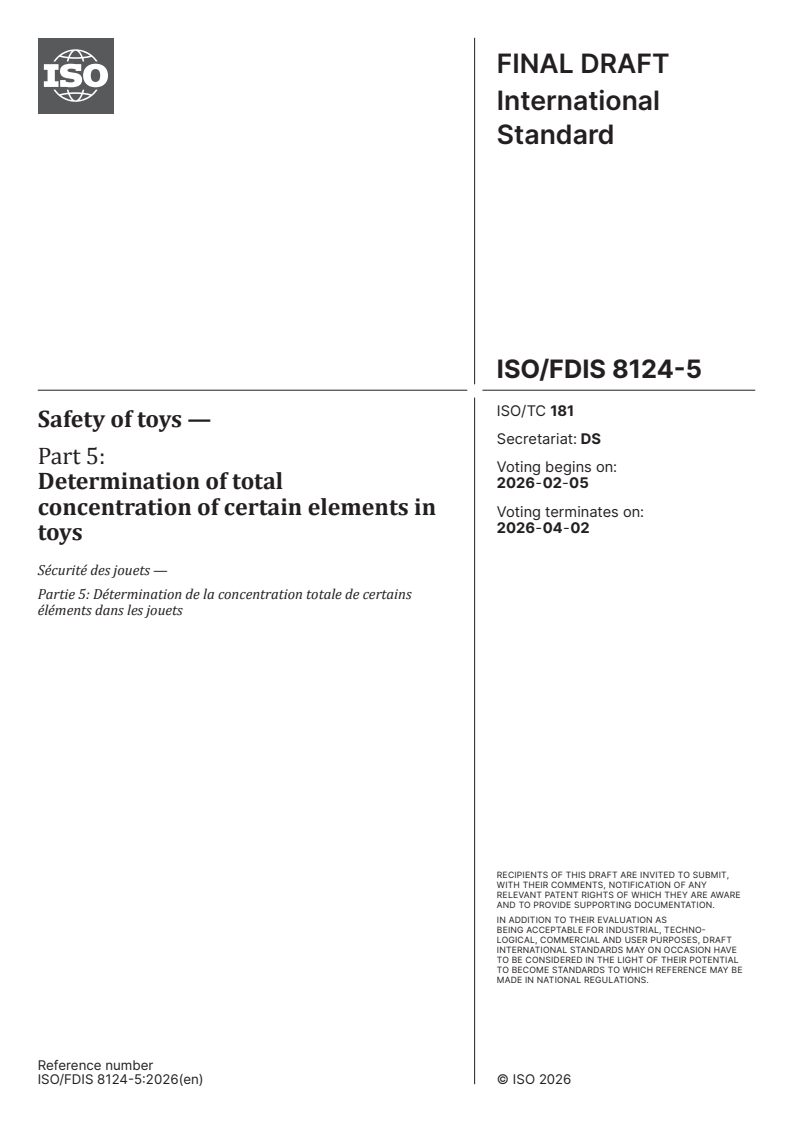
(Main)Safety of toys — Part 5: Determination of total concentration of certain elements in toys
Safety of toys — Part 5: Determination of total concentration of certain elements in toys
ISO 8124-5:2015 specifies methods of sampling and digestion prior to analysis of the total concentration of the elements antimony, arsenic, barium, cadmium, chromium, lead, mercury, and selenium from toy materials and from parts of toys. Digestion methods for the elements mentioned above are specified for the following types of toy materials: coatings of paints, varnishes, lacquers, printing inks, polymers, and similar coatings; polymeric and similar materials, including laminates, whether textile-reinforced or not, but excluding other textiles; paper, paperboard, and cardboard; natural or synthetic textiles; metallic materials whether coated or not; other materials, whether mass-coloured or not (e.g. wood, fibreboard, hardboard, bone, and leather); materials intended to leave a trace (e.g. the graphite materials in pencils and liquid ink in pens); pliable modelling materials, including modelling clays and gels; paints to be used as such in the toy, including finger paints, varnishes, lacquers, and similar materials in solid or liquid form; packaging materials that form part of the toy or have intended play value.
Sécurité des jouets — Partie 5: Détermination de la concentration totale de certains éléments dans les jouets
General Information
- Status
- Not Published
- Technical Committee
- ISO/TC 181 - Safety of toys
- Drafting Committee
- ISO/TC 181 - Safety of toys
- Current Stage
- 5020 - FDIS ballot initiated: 2 months. Proof sent to secretariat
- Start Date
- 05-Feb-2026
- Completion Date
- 05-Feb-2026
Relations
- Effective Date
- 12-Nov-2022
Overview
ISO/FDIS 8124-5:2026 is a critical international standard developed by ISO/TC 181, focusing on the safety of toys. This document specifies standardized methods for sampling and preparing toy materials for the determination of the total concentration of specific hazardous elements. The elements covered include antimony, arsenic, barium, cadmium, chromium, lead, mercury, and selenium-substances known for their potential health risks, especially to children.
The standard details digestion (sample preparation) protocols for a wide range of toy materials, including paints, polymers, textiles, metals, paper, and materials intended to leave a trace (like pencils and inks). It plays a vital role in ensuring that toys placed on the market do not expose children to harmful levels of toxic elements, supporting compliance with both international and regional toy safety regulations.
Key Topics
- Sampling and Digestion Methods: Comprehensive procedures for collecting representative samples and digesting toy materials prior to analysis.
- Element Scope: Focuses on total concentration of antimony, arsenic, barium, cadmium, chromium, lead, mercury, and selenium.
- Material Types Covered:
- Coatings (paint, varnish, lacquer, ink, polymers)
- Polymeric materials and laminates
- Natural and synthetic textiles
- Paper, paperboard, cardboard
- Metal materials (coated and uncoated)
- Trace-leaving materials (e.g., pencil graphite, inks)
- Pliable modeling materials (clay, gels)
- Paints and similar materials in solid or liquid form
- Packaging with play value or forming part of the toy
- Analytical Screening Tools: Inclusion of energy dispersive X-ray fluorescence (EDXRF) as an optional method for screening plastics.
- Test Reporting: Guidance on expressing and documenting results to support regulatory compliance.
Applications
ISO/FDIS 8124-5 is essential for a range of stakeholders in the toy industry and regulatory authorities:
- Manufacturers and Importers: Use this standard to verify raw materials and finished products comply with global safety requirements for elemental content, minimizing risk of recalls and protecting brand reputation.
- Testing Laboratories: Provides harmonized laboratory practices for consistent and reliable quantification of heavy metals and other elements in toy materials, supporting accredited testing and certification processes.
- Regulatory Compliance: Supports both initial material assessment (screening) and detailed quantitative analysis, serving as an evidence base for compliance with international standards like ISO 8124-3, EN 71-3, and ASTM F963.
- Risk Management: Enables early identification of hazardous material in the supply chain, facilitating corrective actions and safe product design.
- Quality Assurance: Can form part of internal or supplier audits, ensuring that materials and finished products consistently meet safety thresholds for restricted elements.
Related Standards
ISO/FDIS 8124-5 is part of the broader ISO 8124 series on toy safety. Relevant related standards include:
- ISO 8124-3: Migration of certain elements - details test methods to determine the soluble element content in toys and toy materials.
- EN 71-3: European standard providing requirements and test methods for migration of certain elements in toys.
- ASTM F963: Standard consumer safety specification for toy safety, used widely in the United States.
- ISO 8124 Series: Comprehensive suite of standards covering various aspects of toy safety, from mechanical and physical properties to flammability.
Implementing ISO/FDIS 8124-5 ensures systematic, harmonized approaches to assessing and managing the risks posed by certain elements in toys, forming a cornerstone of global toy safety compliance and consumer protection.
Keywords: ISO 8124-5, toy safety, heavy metals in toys, toy material testing, elemental analysis, toy compliance, digestion methods, toy regulations, hazardous elements, EDXRF screening
ISO/FDIS 8124-5 - Safety of toys — Part 5: Determination of total concentration of certain elements in toys Released:22. 01. 2026
REDLINE ISO/FDIS 8124-5 - Safety of toys — Part 5: Determination of total concentration of certain elements in toys Released:22. 01. 2026
Frequently Asked Questions
ISO/FDIS 8124-5 is a draft published by the International Organization for Standardization (ISO). Its full title is "Safety of toys — Part 5: Determination of total concentration of certain elements in toys". This standard covers: ISO 8124-5:2015 specifies methods of sampling and digestion prior to analysis of the total concentration of the elements antimony, arsenic, barium, cadmium, chromium, lead, mercury, and selenium from toy materials and from parts of toys. Digestion methods for the elements mentioned above are specified for the following types of toy materials: coatings of paints, varnishes, lacquers, printing inks, polymers, and similar coatings; polymeric and similar materials, including laminates, whether textile-reinforced or not, but excluding other textiles; paper, paperboard, and cardboard; natural or synthetic textiles; metallic materials whether coated or not; other materials, whether mass-coloured or not (e.g. wood, fibreboard, hardboard, bone, and leather); materials intended to leave a trace (e.g. the graphite materials in pencils and liquid ink in pens); pliable modelling materials, including modelling clays and gels; paints to be used as such in the toy, including finger paints, varnishes, lacquers, and similar materials in solid or liquid form; packaging materials that form part of the toy or have intended play value.
ISO 8124-5:2015 specifies methods of sampling and digestion prior to analysis of the total concentration of the elements antimony, arsenic, barium, cadmium, chromium, lead, mercury, and selenium from toy materials and from parts of toys. Digestion methods for the elements mentioned above are specified for the following types of toy materials: coatings of paints, varnishes, lacquers, printing inks, polymers, and similar coatings; polymeric and similar materials, including laminates, whether textile-reinforced or not, but excluding other textiles; paper, paperboard, and cardboard; natural or synthetic textiles; metallic materials whether coated or not; other materials, whether mass-coloured or not (e.g. wood, fibreboard, hardboard, bone, and leather); materials intended to leave a trace (e.g. the graphite materials in pencils and liquid ink in pens); pliable modelling materials, including modelling clays and gels; paints to be used as such in the toy, including finger paints, varnishes, lacquers, and similar materials in solid or liquid form; packaging materials that form part of the toy or have intended play value.
ISO/FDIS 8124-5 is classified under the following ICS (International Classification for Standards) categories: 97.200.50 - Toys. The ICS classification helps identify the subject area and facilitates finding related standards.
ISO/FDIS 8124-5 has the following relationships with other standards: It is inter standard links to ISO 8124-5:2015. Understanding these relationships helps ensure you are using the most current and applicable version of the standard.
ISO/FDIS 8124-5 is available in PDF format for immediate download after purchase. The document can be added to your cart and obtained through the secure checkout process. Digital delivery ensures instant access to the complete standard document.
Standards Content (Sample)
FINAL DRAFT
International
Standard
ISO/TC 181
Safety of toys —
Secretariat: DS
Part 5:
Voting begins on:
2026-02-05
Determination of total
concentration of certain elements in
Voting terminates on:
2026-04-02
toys
Sécurité des jouets —
Partie 5: Détermination de la concentration totale de certains
éléments dans les jouets
RECIPIENTS OF THIS DRAFT ARE INVITED TO SUBMIT,
WITH THEIR COMMENTS, NOTIFICATION OF ANY
RELEVANT PATENT RIGHTS OF WHICH THEY ARE AWARE
AND TO PROVIDE SUPPOR TING DOCUMENTATION.
IN ADDITION TO THEIR EVALUATION AS
BEING ACCEPTABLE FOR INDUSTRIAL, TECHNO-
LOGICAL, COMMERCIAL AND USER PURPOSES, DRAFT
INTERNATIONAL STANDARDS MAY ON OCCASION HAVE
TO BE CONSIDERED IN THE LIGHT OF THEIR POTENTIAL
TO BECOME STAN DARDS TO WHICH REFERENCE MAY BE
MADE IN NATIONAL REGULATIONS.
Reference number
FINAL DRAFT
International
Standard
ISO/TC 181
Safety of toys —
Secretariat: DS
Part 5:
Voting begins on:
Determination of total
concentration of certain elements in
Voting terminates on:
toys
Sécurité des jouets —
Partie 5: Détermination de la concentration totale de certains
éléments dans les jouets
RECIPIENTS OF THIS DRAFT ARE INVITED TO SUBMIT,
WITH THEIR COMMENTS, NOTIFICATION OF ANY
RELEVANT PATENT RIGHTS OF WHICH THEY ARE AWARE
AND TO PROVIDE SUPPOR TING DOCUMENTATION.
© ISO 2026
IN ADDITION TO THEIR EVALUATION AS
All rights reserved. Unless otherwise specified, or required in the context of its implementation, no part of this publication may
BEING ACCEPTABLE FOR INDUSTRIAL, TECHNO-
LOGICAL, COMMERCIAL AND USER PURPOSES, DRAFT
be reproduced or utilized otherwise in any form or by any means, electronic or mechanical, including photocopying, or posting on
INTERNATIONAL STANDARDS MAY ON OCCASION HAVE
the internet or an intranet, without prior written permission. Permission can be requested from either ISO at the address below
TO BE CONSIDERED IN THE LIGHT OF THEIR POTENTIAL
or ISO’s member body in the country of the requester.
TO BECOME STAN DARDS TO WHICH REFERENCE MAY BE
MADE IN NATIONAL REGULATIONS.
ISO copyright office
CP 401 • Ch. de Blandonnet 8
CH-1214 Vernier, Geneva
Phone: +41 22 749 01 11
Email: copyright@iso.org
Website: www.iso.org
Published in Switzerland Reference number
ii
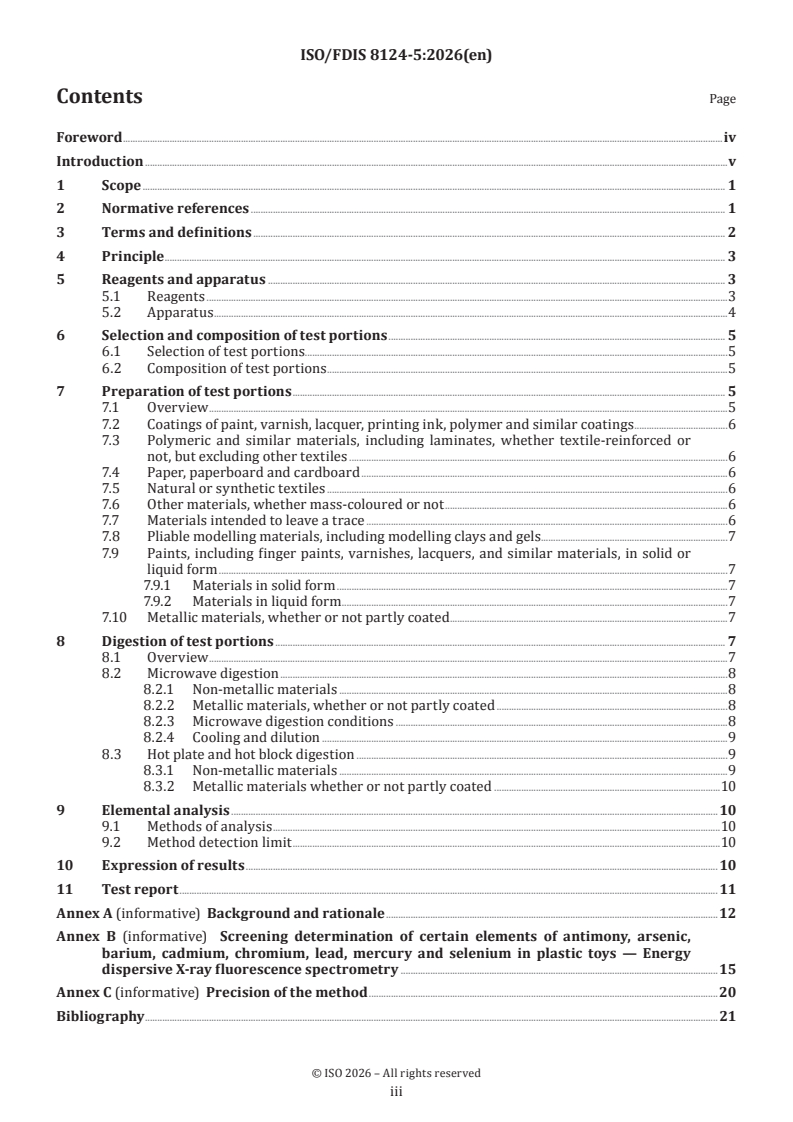
Contents Page
Foreword .iv
Introduction .v
1 Scope . 1
2 Normative references . 1
3 Terms and definitions . 2
4 Principle . 3
5 Reagents and apparatus . 3
5.1 Reagents .3
5.2 Apparatus .4
6 Selection and composition of test portions . 5
6.1 Selection of test portions.5
6.2 Composition of test portions .5
7 Preparation of test portions . 5
7.1 Overview .5
7.2 Coatings of paint, varnish, lacquer, printing ink, polymer and similar coatings .6
7.3 Polymeric and similar materials, including laminates, whether textile-reinforced or
not, but excluding other textiles .6
7.4 Paper, paperboard and cardboard .6
7.5 Natural or synthetic textiles .6
7.6 Other materials, whether mass-coloured or not .6
7.7 Materials intended to leave a trace .6
7.8 Pliable modelling materials, including modelling clays and gels .7
7.9 Paints, including finger paints, varnishes, lacquers, and similar materials, in solid or
liquid form .7
7.9.1 Materials in solid form .7
7.9.2 Materials in liquid form . . .7
7.10 Metallic materials, whether or not partly coated .7
8 Digestion of test portions . 7
8.1 Overview .7
8.2 Microwave digestion .8
8.2.1 Non-metallic materials .8
8.2.2 Metallic materials, whether or not partly coated .8
8.2.3 Microwave digestion conditions .8
8.2.4 Cooling and dilution .9
8.3 Hot plate and hot block digestion .9
8.3.1 Non-metallic materials .9
8.3.2 Metallic materials whether or not partly coated .10
9 Elemental analysis .10
9.1 Methods of analysis .10
9.2 Method detection limit .10
10 Expression of results . 10
11 Test report .11
Annex A (informative) Background and rationale .12
Annex B (informative) Screening determination of certain elements of antimony, arsenic,
barium, cadmium, chromium, lead, mercury and selenium in plastic toys — Energy
dispersive X-ray fluorescence spectrometry .15
Annex C (informative) Precision of the method .20
Bibliography .21
iii
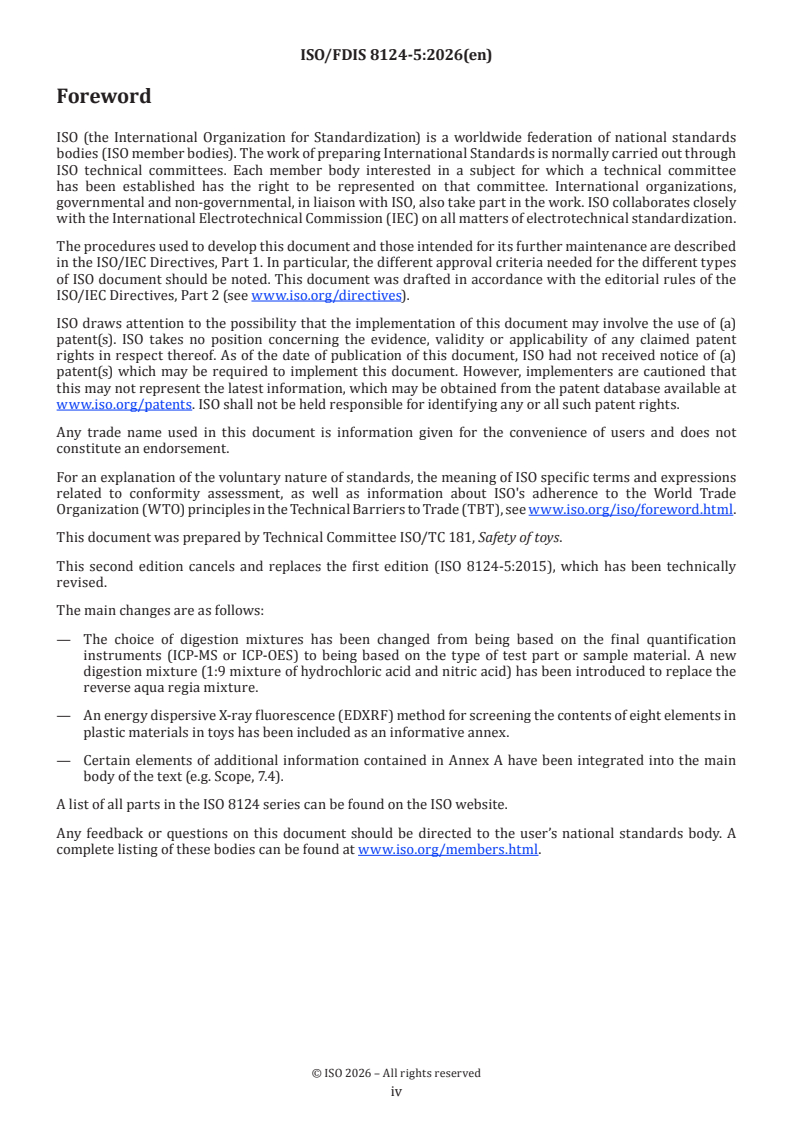
Foreword
ISO (the International Organization for Standardization) is a worldwide federation of national standards
bodies (ISO member bodies). The work of preparing International Standards is normally carried out through
ISO technical committees. Each member body interested in a subject for which a technical committee
has been established has the right to be represented on that committee. International organizations,
governmental and non-governmental, in liaison with ISO, also take part in the work. ISO collaborates closely
with the International Electrotechnical Commission (IEC) on all matters of electrotechnical standardization.
The procedures used to develop this document and those intended for its further maintenance are described
in the ISO/IEC Directives, Part 1. In particular, the different approval criteria needed for the different types
of ISO document should be noted. This document was drafted in accordance with the editorial rules of the
ISO/IEC Directives, Part 2 (see www.iso.org/directives).
ISO draws attention to the possibility that the implementation of this document may involve the use of (a)
patent(s). ISO takes no position concerning the evidence, validity or applicability of any claimed patent
rights in respect thereof. As of the date of publication of this document, ISO had not received notice of (a)
patent(s) which may be required to implement this document. However, implementers are cautioned that
this may not represent the latest information, which may be obtained from the patent database available at
www.iso.org/patents. ISO shall not be held responsible for identifying any or all such patent rights.
Any trade name used in this document is information given for the convenience of users and does not
constitute an endorsement.
For an explanation of the voluntary nature of standards, the meaning of ISO specific terms and expressions
related to conformity assessment, as well as information about ISO's adherence to the World Trade
Organization (WTO) principles in the Technical Barriers to Trade (TBT), see www.iso.org/iso/foreword.html.
This document was prepared by Technical Committee ISO/TC 181, Safety of toys.
This second edition cancels and replaces the first edition (ISO 8124-5:2015), which has been technically
revised.
The main changes are as follows:
— The choice of digestion mixtures has been changed from being based on the final quantification
instruments (ICP-MS or ICP-OES) to being based on the type of test part or sample material. A new
digestion mixture (1:9 mixture of hydrochloric acid and nitric acid) has been introduced to replace the
reverse aqua regia mixture.
— An energy dispersive X-ray fluorescence (EDXRF) method for screening the contents of eight elements in
plastic materials in toys has been included as an informative annex.
— Certain elements of additional information contained in Annex A have been integrated into the main
body of the text (e.g. Scope, 7.4).
A list of all parts in the ISO 8124 series can be found on the ISO website.
Any feedback or questions on this document should be directed to the user’s national standards body. A
complete listing of these bodies can be found at www.iso.org/members.html.
iv
Introduction
This document specifies a method for the determination of the total concentration of certain elements in
toy materials. It can be used to decide whether there is a need to undertake migration testing in accordance
with the method specified in ISO 8124-3 or other equivalent standards, e.g. EN 71-3 or ASTM F963.
NOTE 1 A material can be considered to conform to the requirements of ISO 8124-3 if the total concentration
results are below the soluble limits as prescribed in ISO 8124-3:2020/Amd 1:2023, Table 1. If the soluble limits in
ISO 8124-3:2020/Amd 1:2023, Table 1 are exceeded, migration testing in accordance with ISO 8124-3 is required for
the determination of conformity.
This document presents a screening determination method for eight elements in plastics using the
analytical technique of energy dispersive X-ray fluorescence (EDXRF) spectrometry as an option for quickly
determining whether the screened part or section of a product requires quantitative analysis using the
digestion method.
This document can be used when taking decisions on the conformity of material with regulatory
requirements that impose restrictions on the total concentration of certain elements.
NOTE 2 Where legal conformity requires migration testing, this document can only be used to non-quantitatively
confirm compliance with regulatory limits.
This document has been developed only for the eight elements listed in Table 1. The method specified in
this document can be used for other elements provided adequate analytical performance is demonstrated.
Manufacturers are encouraged to apply the test methods of this document and the limits from ISO 8124-3 to
raw materials used in the manufacture of toys to give increased certainty of conformity to the requirements
of ISO 8124-3.
For further information on the background and rationale behind this document, see Clause A.1.
v
FINAL DRAFT International Standard ISO/FDIS 8124-5:2026(en)
Safety of toys —
Part 5:
Determination of total concentration of certain elements in
toys
1 Scope
1.1 This document specifies methods of sampling and analysing the total concentration of the elements
antimony, arsenic, barium, cadmium, chromium, lead, mercury and selenium from toy materials and from
parts of toys.
1.2 Digestion methods for the elements mentioned in 1.1 are specified for the following types of toy
materials:
— coatings of paint, varnish, lacquer, printing ink, polymer and similar coatings;
— polymeric and similar materials, including laminates, whether textile-reinforced or not, but excluding
other textiles;
— paper, paperboard and cardboard;
— natural or synthetic textiles;
— metallic materials, whether coated or not;
— other materials, whether mass-coloured or not (e.g. wood, fibreboard, hardboard, bone, and leather);
— materials intended to leave a trace (e.g. the graphite materials in pencils and liquid ink in pens);
— pliable modelling materials, including modelling clays and gels;
— paints to be used as such in the toy, including finger paints, varnishes, lacquers and similar materials in
solid or liquid form;
— packaging materials that form part of the toy or have intended play value (e.g. boxes containing jigsaw
puzzles or packaging on which the instructions are included in the case of games. Items such as blister
packs containing simple instructions are not included in this category).
Digestion methods for glass, ceramic and other siliceous materials or fluorinated polymers or fluorinated
polymer coatings are not described. These types of materials are outside the scope of this document.
1.3 Screening determination (without the need for sample preparation and digestion) of the elements
mentioned in 1.1 is specified for plastics using energy dispersive X-ray fluorescence (EDXRF) spectrometry
(see Annex B).
2 Normative references
The following documents are referred to in the text in such a way that some or all of their content constitutes
requirements of this document. For dated references, only the edition cited applies. For undated references,
the latest edition of the referenced document (including any amendments) applies.
ISO 8124-1:2022, Safety of toys — Part 1: Safety aspects related to mechanical and physical properties
ISO 3696, Water for analytical laboratory use — Specification and test methods
3 Terms and definitions
For the purposes of this document, the following terms and definitions apply.
ISO and IEC maintain terminology databases for use in standardization at the following addresses:
— ISO Online browsing platform: available at https://www.iso.org/obp
— IEC Electropedia: available at https://www.electropedia.org/
3.1
base material
material upon which coatings (3.2) can be formed or deposited
[SOURCE: ISO 8124-3:2020, 3.1]
3.2
coating
layers of material formed or deposited on the base material (3.1) of a toy, including paints, varnishes,
lacquers, inks, polymers, or other substances of a similar nature, whether they contain metallic particles
or not, no matter how they have been applied to the toy, and which can be removed by scraping (3.8) with a
sharp blade
Note 1 to entry: This definition includes metallic coatings deposited on a metal surface such as an electroplated
coating. However, electroplating will only require testing if it can be removed by scraping (3.8); otherwise, it may be
tested with the base material.
[SOURCE: ISO 8124-3:2020, 3.2, modified — Note 1 to entry has been added.]
3.3
complete digestion
complete breakdown of the original material leaving only insoluble residues
3.4
composite test portion
test portion (3.9) that is composed of more than one similar material type or colour of material
3.5
method detection limit
MDL
three times the standard deviation of the result obtained in the method blank by the laboratory carrying out
the analysis
[SOURCE: ISO 8124-3:2020, 3.3]
3.6
laboratory sample
toy either in the form in which it is marketed, or in the form in which it is intended to be marketed
Note 1 to entry: The definition does not preclude the taking of raw materials used to manufacture the toy, provided
they are representative of the final toy. See 1.1 and Clause B.1.
3.7
method blank
solution that has undergone the same digestion processes used for the digestion of test portions (3.9) and
consists of all reagents excluding the test portion
3.8
scraping
mechanical process for removal of coatings (3.2) down to the base material (3.1)
[SOURCE: ISO 8124-3:2020, 3.7]
3.9
test portion
single material taken from an accessible part of a laboratory sample (3.6)
Note 1 to entry: This definition precludes the compositing of dissimilar materials, e.g. compositing textiles and paint
coatings is not permitted.
3.10
screening determination
analytical procedure to determine the presence or absence of substances in the representative part or
section of a product, relative to the value or values chosen as the criterion for presence, absence or further
testing
4 Principle
The prepared test portion is digested in highly acidic conditions at high temperature using a hot plate
digestion, a hot block digestion technique, or a microwave digestion system. Hot acid digestion destroys the
material matrix allowing the elements of interest to be solubilized and quantified by a suitable analytical
instrument (see 9.2).
NOTE The EDXRF screening determination (3.10) method is capable of directly analyzing materials without the
need for sample preparation and digestion. See Annex B.
5 Reagents and apparatus
5.1 Reagents
Only reagents of recognized analytical grade or equivalent shall be used. The concentration of the analyte or
interfering substances in the reagents and water shall be negligible compared to the lowest concentration to
be determined.
“Trace metal” grade or equivalent reagents shall be used for the calibration standards used for the final
instrumentation quantification stage, as follows.
5.1.1 Nitric acid, concentrated, 1,40 g/ml, a mass fraction of 65 %, “analytical” grade.
5.1.2 Nitric acid, 1+9: Add 100 ml concentrated nitric acid (5.1.1) to 500 ml water (5.1.4). Dilute to
1 000 ml with water (5.1.4).
5.1.3 Hydrochloric acid, concentrated, 1,19 g/ml, a mass fraction of 37 %, “analytical” grade.
5.1.4 Water, of at least grade 3 purity, in accordance with ISO 3696.
5.1.5 Hydrogen peroxide, a mass fraction of 30 %.
NOTE Hydrogen peroxide which is not stabilized can be stored according to the instruction of the manufacturer.
5.1.6 Methylene chloride, “analytical” grade.
5.1.7 Acetone/ethanol solution, 1:1 mixture of absolute ethanol and acetone (“analytical” grades).
5.1.8 Acid mixture A, 1:9 mixture of hydrochloric acid (5.1.3) and nitric acid (5.1.1)
5.1.9 Acid mixture B, i.e. aqua regia, 3:1 mixture of hydrochloric acid (5.1.3) and nitric acid (5.1.1)
NOTE The acid mixtures A and B are best prepared in situ in the presence of test sample. The order of mixing the
acids is not critical but can be the same for consistency.
5.2 Apparatus
All glassware shall be soaked in nitric acid (5.1.2) for at least 2 h and then rinsed in deionized water before
use.
5.2.1 Microwave digestion system
Microwave sample preparation system equipped with a sample holder and high-pressure microwave
digestion vessels (5.2.2, high pressure microwave digestion vessel).
NOTE 1 Some newer models of microwave digestion systems do not utilize high-pressure digestion vessels and
these systems are considered as a suitable alternative provided they give an equivalent performance.
NOTE 2 There are many safety and operational recommendations specific to the model and manufacturer of the
microwave equipment used in individual laboratories. The analyst is required to consult the specific equipment
manual, manufacturer and literature for proper and safe operation of the microwave equipment and vessels (see
Clause A.2).
5.2.2 High pressure microwave digestion vessel
Closed-top vessel specifically designed for microwave digestion, of suitable capacity. It is recommended to
use a vessel capable of withstanding a temperature of at least 225 °C and an internal pressure of at least
3 000 kPa. The liner of the vessel shall be PTFE (polytetrafluoroethylene)/TFM [tris-(α-trifluoromethyl-β,β-
difluorovinyl)-1,3,5-enzenetricarboxylate], or PTFE/PFA (perfluoroalkoxy ethylene) or another chemically
inert material. Vessels shall also be equipped with a safety relief valve or disc that will prevent vessel
rupture or ejection of the vessel cap. The inner liners shall be inspected regularly to check for any chemical
or physical degradation.
NOTE Internal pressures in excess of 3 000 kPa can occur with some samples, e.g. crayons. A suitable pressure-
rated vessel (e.g. 5 000 kPa) can be used in these cases.
5.2.3 Scalpel, or other suitable scraping or cutting tools.
5.2.4 Laboratory grinding mill.
5.2.5 Rotary grinder, preferably with carbide burr grinders.
1)
5.2.6 Centrifuge, capable of centrifuging at (5 000 ± 500) g , with compatible tubes.
5.2.7 Analytical balance, capable of measuring accurately to 0,000 1 g.
5.2.8 Polypropylene or PTFE microfilters, pore size 0,45 µm.
5.2.9 Volumetric flasks, 10 ml, 25 ml or 100 ml capacity with stopper.
5.2.10 Pipettes, 1 ml, 5 ml, 10 ml, 20 ml, etc.
5.2.11 Beakers, 25 ml, 50 ml, 100 ml, etc.
1) 1 g = 9,806 65 m/s .
5.2.12 Electric hot plate, suitable for operation at surface temperatures up to at least 140 °C.
NOTE Provided that the hot plate is capable of handling the extra heating required, use of a 12 mm to 25 mm thick
heat-resistant glass plate placed on the hot plate can help reduce the presence of hot spots common to electric hot
plates.
5.2.13 Filter paper and funnel.
5.2.14 Hot block digester, heated metal block with variable temperature settings up to at least 140 °C
(optionally can have programmable settings and temperature ramps) with compatible digestion vessels of
suitable capacity.
6 Selection and composition of test portions
6.1 Selection of test portions
NOTE See A.1.2 for a discussion on practical considerations when deciding whether to use composite test
portions.
Test portions shall be taken from accessible parts (see ISO 8124-1) of the laboratory sample in accordance
with Clause 7 (preparation of test portions). When appropriate, the laboratory sample shall be subjected to
relevant tests in accordance with ISO 8124-1, before the accessibility is considered. Identical materials in the
laboratory sample can be combined and treated as a single test portion, but the use of additional laboratory
samples is not permitted. If it is not possible to obtain at least 10 mg, no further testing shall be conducted
and this shall be reported under Clause 11 c) (test report).
The test portion mass should be in the region of 100 mg where sufficient material is available.
6.2 Composition of test portions
Up to three test portions can be combined to form a composite test portion provided that the required
method detection limitcan still be achieved (see A.1.2) and the combined materials are similar in nature.
The compositing of dissimilar materials is not permitted, e.g. compositing textiles and paint coatings. When
calculating the concentration of a target element in a material, it is assumed that all of that element found
in the digested sample originated from any one of the composited materials. Using this assumption and
the masses of the individual materials, the total concentration of the target element is calculated for each
individual material in the composite test portion.
7 Preparation of test portions
7.1 Overview
Materials from the laboratory sample are selected for testing in accordance with Clause 6 and removed
using cutting tools such as scalpels, razor blades, scissors and grinding and milling tools as described in
the following subclauses. If a grinding apparatus [such as a mill (5.2.4) or rotary grinding tool (5.2.5) with
disposable grinding bits] is used, then any contaminated parts shall be thoroughly cleaned or disposed of
between uses to prevent cross-contamination. Ensure that the device itself cannot contaminate the material
being prepared.
In 7.2 to 7.10, collect sufficient material to obtain a test portion of between 10 mg and 100 mg. In cases
where less than 10 mg of material is available (see 6.1) no further testing is required and this is reported
under Clause 11 c) (test report).
Digest the prepared test portion according to the procedures described in 8.2 (microwave digestion) or 8.3
(hot plate and hot block digestion of test portion).
NOTE The EDXRF screening determination (3.10) method is capable of directly analyzing materials without the
need for sample preparation and digestion. See Annex B.
7.2 Coatings of paint, varnish, lacquer, printing ink, polymer and similar coatings
Remove each different coating from the laboratory sample by scraping down to the base material, taking
care to avoid the inclusion of the base material. Where lithographic coatings (dot printing) are present,
it is impractical to separate the individual colours. These coatings shall be removed in such a way that a
representative test portion is obtained.
For some coatings deposited on a non-polymeric base material, it is permissible to add a few drops of
solvent, such as acetone/ethanol (5.1.7) mixture or methylene chloride (5.1.6), to soften the paint and aid
in its removal from the base material. In the first instance, acetone/ethanol (5.1.7) should be used. If this
treatment is not effective in aiding removal, methylene chloride can be used under a fumes hood.
If a solvent treatment is used, ensure that all traces of solvent have been removed by evaporation prior to
microwave digestion (see 8.2). Divide removed coatings into small pieces having a maximum length in any
direction of 2 mm in order to facilitate efficient digestion.
7.3 Polymeric and similar materials, including laminates, whether textile-reinforced or not,
but excluding other textiles
Scrape off, cut or grind the clean, dry material into pieces having a maximum length in any dimension of
2 mm using a scalpel or other suitable scraping or cutting tool.
7.4 Paper, paperboard and cardboard
Cut the material into pieces with a maximum length in any dimension of 2 mm using a suitable cutting tool.
If the paper or paperboard to be tested is coated with paint, varnish, lacquer, printing ink, adhesive or
similar coating, test portions of the coating shall not be taken separately. In such cases, take test portions
from the material so that they also include representative parts of the coated area.
Material that is printed, where the ink has become part of the base material, is prepared as though it is
unprinted. For example, a paper can be printed with ink and coated with a thick varnish. The varnish can be
scraped off and would be regarded as a coating but the remaining printed paper would be regarded as paper.
7.5 Natural or synthetic textiles
Cut the material into pieces having a maximum length in any dimension of 2 mm using a suitable cutting
tool.
If the sample is not of a uniform material or colour, where possible, obtain a test portion from each different
material or colour present in a mass greater than 100 mg. Materials or colours present in amounts between
10 mg and 100 mg shall form part of the test portion obtained from the main material.
Test portions taken from patterned textiles shall be representative of the whole material.
7.6 Other materials, whether mass-coloured or not
Cut, scrape or grind the material into pieces having a maximum length in any dimension of 2 mm using a
suitable cutting tool.
7.7 Materials intended to leave a trace
Obtain test portions from each different material in the laboratory sample, in the form in which it appears
in the laboratory sample, ensuring that the material is cut into pieces having a maximum length in any
dimension of 2 mm.
7.8 Pliable modelling materials, including modelling clays and gels
Obtain test portions from each different material or colour of material in the form in which it appears in
the laboratory sample, i.e. without allowing the material to dry out. Cut the material into pieces having a
maximum length in any dimension of 2 mm.
7.9 Paints, including finger paints, varnishes, lacquers, and similar materials, in solid or
liquid form
7.9.1 Materials in solid form
Using a suitable tool, grind, crush or cut the sample into particles having a maximum length in any dimension
of 2 mm.
Finger paint supplied in the form of powder shall be diluted with water (5.1.4) in accordance with the
manufacturer’s instructions and then prepared according to 7.9.2.
7.9.2 Materials in liquid form
Ensure that all settled material has been incorporated into the sample by scraping and long-term mechanical
shaking. Immediately prior to sampling, ensure the liquid is homogenized by stirring or shaking for 5 min.
Obtain a test portion of between 10 mg and 100 mg. In cases where less than 10 mg of material is available
(see 6.1) no further testing is required and this is reported under Clause 11 c) (test report). Digest the
prepared test portion according to 8.2 or 8.3.
If the liquid is intended to solidify or dry during intended use, it shall be coated onto a clean glass plate and
dried to constant weight before taking test portions as described in 7.2.
Report under Clause 11 g) (test report) whether the material was tested in the dry or liquid state.
7.10 Metallic materials, whether or not partly coated
Where practical, obtain the test portion from an uncoated part of the metallic material. If the metal
part is partially coated, remove any coatings (including electroplated coatings) that can be scraped off.
Electroplating that cannot be removed by scraping shall be tested together with the metallic base material.
NOTE Metallic materials that are completely coated so that no metal is accessible, as defined in ISO 8124-1, are
not tested. However, this approach differs in legal texts in certain regions of the world. For example, the United States
Consumer Product Safety Improvement Act of 2008 requires that surface coatings do not render the base material
inaccessible. Furthermore, ISO 8124-3 only requires the testing of metallic components that are small parts, i.e. fit
wholly within the test cylinder shown in ISO 8124-1:2022, Figure 26.
Using suitable cutting and grinding tools, obtain a test portion of between 10 mg and 100 mg. In cases where
less than 10 mg of material is available (see 6.1) no further testing is required and this is reported under
Clause 11 c) (test report).
8 Digestion of test portions
8.1 Overview
WARNING 1 Hydrogen peroxide can be used in hot plate and block digestions, but if used in microwave digestions,
great care shall be taken in order to avoid potential build-up of pressure during the heating cycle which can cause
accidents and consequential loss of sample.
WARNING 2 Fumes from nitric acid and hydrochloric acid are toxic; perform the operations described in 8.2 and
8.3 in a fume hood, especially when using hot plate and hot block digestion.
The steps in 8.2 and 8.3 are carried out under a fume hood or in the microwave digestion system (5.2.1).
Subclauses 8.2 and 8.3 describe how to digest the test portion using either acid mixture A (5.1.8) or acid
mixture B (5.1.9) followed by dilution and quantification using the instrumental technique of inductively
coupled plasma mass spectroscopy (ICP-MS) or inductively coupled plasma optical emission spectroscopy
(ICP-OES). Other instrumental techniques can be used provided that they fulfil the criteria relating to
method detection limits set out in Table 1.
Method blanks shall be run with each batch of test portions digested according to 8.2 or 8.3.
If arsenic or mercury is being quantified, the digestion technique shall use a closed vessel on the hot block
digester (5.2.14) or in the microwave digestion system (5.2.1).
NOTE Certain volatile elements such as arsenic and mercury are prone to be lost during hot plate digestion but
laboratory testing has shown that mercury is not lost when using aqua regia acid mix.
Neither the microwave digestion system (5.2.1) nor the conditions to be used are specified in this document.
The test laboratory may therefore use any appropriate microwave system and digestion conditions. Examples
of microwave digestion temperature programmes are given in 8.2.3. However, the test laboratory should
determine the optimum digestion conditions based upon the equipment manufacturer’s recommendations
and the laboratory’s own experiences with digestion of various material types. It is essential to achieve
complete digestion. If the safety relief valve or system activates during the digestion, the analysis shall be
repeated using a new test portion and a suitably pressure rated vessel.
8.2 Microwave digestion
8.2.1 Non-metallic materials
NOTE 1 Non-metallic materials include materials mentioned in 1.2, except for metallic materials.
Weigh accurately (to the nearest 0,1 mg) between 10 mg and 100 mg of the test portion prepared in Clause 7
(preparation of test portions) into a microwave digestion vessel (5.2.2) then carefully add 6 ml of acid
mixture A (5.1.8).
To reduce the potential for matrix interference, it is recommended to use the same grade reagents as the
calibration standards. The volume of the acid mixture can be adjusted to meet the minimum requirements
of the apparatus, provided that the specified ratio is maintained.
Allow the initial reaction to subside before sealing the vessel in accordance with the manufacturer's
instructions.
8.2.2 Metallic materials, whether or not partly coated
Replace the acids in 8.2.1 with acid mixture B, i.e. aqua regia (5.1.9) and proceed as described in
subclause 8.2.1.
8.2.3 Microwave digestion conditions
The microwave digestion system (5.2.1) shall be loaded with the sealed digestion vessel (5.2.2) and digested
according to the conditions and temperatures recommended by the equipment manufacturers, as optimized
by the test laboratory.
Examples of microwave digestion temperature programmes are given as below:
— For non-metallic materials: the temperature of each sample digestion solution rises to 210 °C in
approximately 20 min and holds for 15 min at 210 °C.
— For metallic materials: the temperature of each sample digestion solution rises to 175 °C in approximately
10 min and holds for 5 min at 175 °C.
8.2.4 Cooling and dilution
Following completion of the digestion programme, allow the vessels to cool for at least 5 min before
transferring to a fume hood for further cooling until the temperature of the sample is less than 40 °C
(typically at least 1 h). Carefully open the vessel and check that the test portion has been completely digested.
If the digestion is incomplete (e.g. evidence of original sample or solid lumps of charred test portion), the test
should be repeated using a new test portion and alternative digestion conditions until complete digestion is
achieved. If complete digestion cannot be obtained despite these efforts, an alternative method shall be used
(see A.4.2, incomplete digestion). Such alternative methods are outside the scope of this document, and their
use shall be clearly indicated in the final test report [see Clause 11 d), test report].
When the digestion is complete, quantitatively transfer the digestate with washings to a beaker and
evaporate to about 1 ml on a hot plate. Allow to cool and then add about 4 ml to 5 ml water followed by 3
to 4 drops of hydrochloric acid (5.1.3). Filter (5.2.8 or 5.2.13) the digest solution into a 25 ml volumetric
flask (5.2.9) or where limited sample was available, into a 10 ml volumetric flask. Dilute to the mark with
water (5.1.4), seal the flask with a stopper and mix thoroughly. This diluted digest shall be subjected to
instrumental quantification as soon as practically possible.
Alternatively, the step of evaporating the digestion solution described above may be omitted, provided the
instrument can tolerate high acidity matrix samples. Laboratories should prepare the working calibration
standards using the same acid matrix in the digestates in that case.
8.3 Hot plate and hot block digestion
8.3.1 Non-metallic materials
NOTE Non-metallic materials include materials mentioned in 1.2, except for metallic materials.
Weigh accurately (to the nearest 0,1 mg) between 10 mg and 100 mg of the test portion prepared in Clause 7
into a clean 25 ml beaker (5.2.11) or hot block digestion vessel, then carefully add 6 ml of acid mixture
A (5.1.8). The volume of the acid mixture may be adjusted to meet the minimum requirements of the
apparatus, provided that the specified ratio is maintained. Allow any reaction that occurs to subside, add
1 ml of hydrogen peroxide (5.1.5) (optional) drop wise and cover with a watch glass if the reaction vessel is
a beaker. Heat in a hot block (5.2.14) or on a hot plate (5.2.12) (surface temperature approximately 140 °C)
until most of the acid has evaporated.
In the case of hot plate digestion, evaporate to a final volume of approximately 1 ml. The composition of
this 1 ml digestate is predominantly concentrated nitric acid with reaction products from the sample. To
eliminate the possibility of cross-contamination or sample loss, avoid boiling or evaporating to complete
dryness.
If brown fumes are still observed after 1 h or particles are observed in the solution, continue the heating.
Add a few millilitres of acid mixture A (5.1.8) as necessary to prevent the sample from becoming dry. When
the sample ceases to emit brown fumes, the digestion is complete. Remove the reaction vessel from the hot
plate or hot block and allow to cool to room temperature.
If a complete digestion cannot be achieved, an alternative method shall be used (see A.4.1, incomplete
digestion).
Rinse the beaker and bottom of the watch glass with about 4 ml to 5 ml water (5.1.4) and then add 3 to 4
drops of concentrated hydrochloric acid. Filter (5.2.8 or 5.2.13) if necessary and then transfer the reaction
mixture with washings into a 25 ml volumetric flask or where limited sample was available, into a 10 ml
volumetric flask, make up to volume using water, seal the flask with a stopper and mix thoroughly. This
diluted digest shall be subjected to instrumental quantification as soon as practically possible.
Where the digestate is made up to 25 ml volume, the diluted solution contains approximately a volume
fraction of 4 % nitric acid (1 ml) with minor (<0,5
...
ISO /TC 181/WG 8
Secretariat: DS
Date: 2026-01-22
Safety of toys —
Part 5:
Determination of total concentration of certain elements in toys
Second edition
2025-12-08
Sécurité des jouets —
Partie 5: Détermination de la concentration totale de certains éléments dans les jouets
FDIS stage
2 © ISO 2024 – All rights reserved
All rights reserved. Unless otherwise specified, or required in the context of its implementation, no part of this publication
may be reproduced or utilized otherwise in any form or by any means, electronic or mechanical, including photocopying,
or posting on the internet or an intranet, without prior written permission. Permission can be requested from either ISO
at the address below or ISO’s member body in the country of the requester.
ISO copyright office
CP 401 • Ch. de Blandonnet 8
CH-1214 Vernier, Geneva
Phone: + 41 22 749 01 11
EmailE-mail: copyright@iso.org
Website: www.iso.orgwww.iso.org
Published in Switzerland
iiiiii
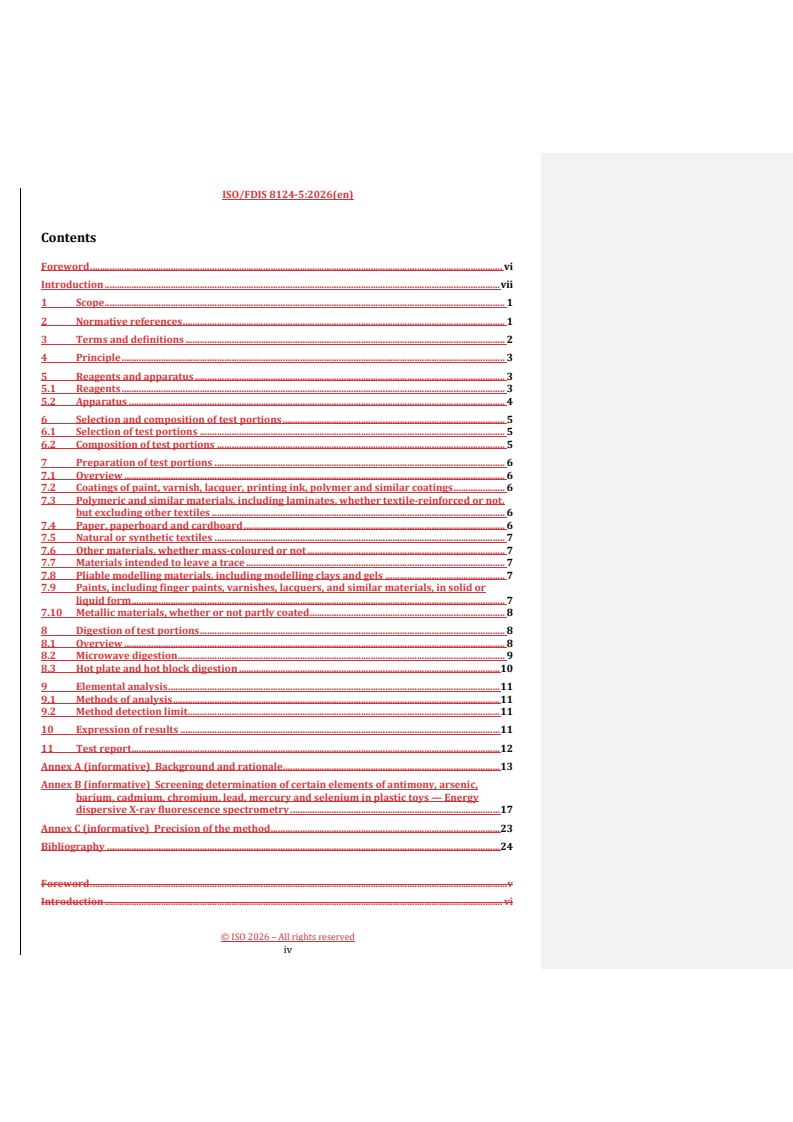
Contents
Foreword . vi
Introduction . vii
1 Scope . 1
2 Normative references . 1
3 Terms and definitions . 2
4 Principle . 3
5 Reagents and apparatus . 3
5.1 Reagents . 3
5.2 Apparatus . 4
6 Selection and composition of test portions . 5
6.1 Selection of test portions . 5
6.2 Composition of test portions . 5
7 Preparation of test portions . 6
7.1 Overview . 6
7.2 Coatings of paint, varnish, lacquer, printing ink, polymer and similar coatings . 6
7.3 Polymeric and similar materials, including laminates, whether textile-reinforced or not,
but excluding other textiles . 6
7.4 Paper, paperboard and cardboard . 6
7.5 Natural or synthetic textiles . 7
7.6 Other materials, whether mass-coloured or not . 7
7.7 Materials intended to leave a trace . 7
7.8 Pliable modelling materials, including modelling clays and gels . 7
7.9 Paints, including finger paints, varnishes, lacquers, and similar materials, in solid or
liquid form . 7
7.10 Metallic materials, whether or not partly coated . 8
8 Digestion of test portions . 8
8.1 Overview . 8
8.2 Microwave digestion . 9
8.3 Hot plate and hot block digestion . 10
9 Elemental analysis . 11
9.1 Methods of analysis . 11
9.2 Method detection limit . 11
10 Expression of results . 11
11 Test report . 12
Annex A (informative) Background and rationale . 13
Annex B (informative) Screening determination of certain elements of antimony, arsenic,
barium, cadmium, chromium, lead, mercury and selenium in plastic toys — Energy
dispersive X-ray fluorescence spectrometry . 17
Annex C (informative) Precision of the method . 23
Bibliography . 24
Foreword . v
Introduction . vi
iv
1 Scope . 1
2 Normative references . 1
3 Terms and definitions . 2
4 Principle . 3
5 Reagents and apparatus . 3
5.1 Reagents . 3
5.2 Apparatus . 4
6 Selection and composition of test portions . 5
6.1 Selection of test portions . 5
6.2 Composition of test portions . 5
7 Preparation of test portions . 5
7.1 Overview . 5
7.2 Coatings of paint, varnish, lacquer, printing ink, polymer and similar coatings . 6
7.3 Polymeric and similar materials, including laminates, whether textile-reinforced or not,
but excluding other textiles . 6
7.4 Paper, paperboard and cardboard . 6
7.5 Natural or synthetic textiles . 6
7.6 Other materials, whether mass-coloured or not . 6
7.7 Materials intended to leave a trace . 6
7.8 Pliable modelling materials, including modelling clays, and gels . 7
7.9 Paints, including finger paints, varnishes, lacquers, and similar materials, in solid or
liquid form . 7
7.9.1 Materials in solid form . 7
7.9.2 Materials in liquid form . 7
7.10 Metallic materials whether or not partly coated . 7
8 Digestion of test portions . 7
8.1 Overview . 7
8.2 Microwave digestion . 8
8.2.1 Non-metallic materials . 8
8.2.2 Metallic materials, whether or not partly coated . 8
8.2.3 Microwave digestion conditions . 8
8.2.4 Cooling and dilution . 9
8.3 Hot plate and hot block digestion . 9
8.3.1 Non-metallic materials . 9
8.3.2 Metallic materials whether or not partly coated . 10
9 Elemental analysis . 10
9.1 Methods of Analysis . 10
9.2 Method detection limit . 10
10 Expression of results . 10
11 Test report . 11
Annex A (informative) Background and rationale . 12
Annex B (informative) Screening determination of certain elements of antimony, arsenic,
barium, cadmium, chromium, lead, mercury and selenium in plastic toys — Energy
dispersive X-ray fluorescence spectrometry . 16
Annex C (informative) Precision of the method . 21
Bibliography . 22
vv
Foreword
ISO (the International Organization for Standardization) is a worldwide federation of national standards
bodies (ISO member bodies). The work of preparing International Standards is normally carried out through
ISO technical committees. Each member body interested in a subject for which a technical committee has been
established has the right to be represented on that committee. International organizations, governmental and
non-governmental, in liaison with ISO, also take part in the work. ISO collaborates closely with the
International Electrotechnical Commission (IEC) on all matters of electrotechnical standardization.
The procedures used to develop this document and those intended for its further maintenance are described
in the ISO/IEC Directives, Part 1. In particular, the different approval criteria needed for the different types of
ISO document should be noted. This document was drafted in accordance with the editorial rules of the
ISO/IEC Directives, Part 2 (see www.iso.org/directives 2 (see www.iso.org/directives).
ISO draws attention to the possibility that the implementation of this document may involve the use of (a)
patent(s). ISO takes no position concerning the evidence, validity or applicability of any claimed patent rights
in respect thereof. As of the date of publication of this document, ISO had not received notice of (a) patent(s)
which may be required to implement this document. However, implementers are cautioned that this may not
represent the latest information, which may be obtained from the patent database available at
www.iso.org/patents.www.iso.org/patents. ISO shall not be held responsible for identifying any or all such
patent rights.
Any trade name used in this document is information given for the convenience of users and does not
constitute an endorsement.
For an explanation of the voluntary nature of standards, the meaning of ISO specific terms and expressions
related to conformity assessment, as well as information about ISO's adherence to the World Trade
Organization (WTO) principles in the Technical Barriers to Trade (TBT), see
www.iso.org/iso/foreword.htmlwww.iso.org/iso/foreword.html.
This document was prepared by Technical Committee ISO/TC 181, Safety of toys.
This second edition cancels and replaces the first edition (ISO 8124-5:2015), which has been technically
revised.
The main changes are as follows:
— — The choice of digestion mixtures has been changed from being based on the final quantification
instruments (ICP-MS or ICP-OES) to being based on the type of test part/ or sample material. A new
digestion mixture (1:9 mixture of hydrochloric acid and nitric acid) ishas been introduced to replace the
reverse aqua regia mixture.
— — An energy dispersive X-ray fluorescence (EDXRF) method for screening the contents of eight elements
in plastic materials in toys is givenhas been included as an informative annex.
— Certain elements of additional information contained in Annex A have been integrated into the main body
of the text (e.g. Scope, 7.4).
A list of all parts in the ISO 8124 series can be found on the ISO website.
Any feedback or questions on this document should be directed to the user’s national standards body. A
complete listing of these bodies can be found at www.iso.org/members.html.
Field Code Changed
vi
Introduction
For the use and applicability of this document, see Clause A.1 .
This document establishesspecifies a method for the determination of the total concentration of certain
elements in toy materials and. It can be used to decide whether there is a need to undertake migration testing
in accordance with the method specified in ISO 8124--3 or other equivalent standards, e.g. EN 71--3 or
ASTM F963.
NOTE 1 A material can be considered to conform to the requirements of ISO 8124--3:2020/Amd 1:2023 if the total
concentration results are below the soluble limits as prescribed in ISO 8124--3:2020/Amd 1:2023, Table 1. If the soluble
limits in ISO 8124--3:2020/Amd 1:2023, Table 1 are exceeded, migration testing in accordance with ISO 8124--
3:2020/Amd 1:2023 will be is required to determinefor the determination of conformity with ISO 8124-3:2020/Amd
1:2023. A.
This document presents a screening determination method for the eight elements in plastics using the
analytical technique of energy dispersive X-ray fluorescence (EDXRF) spectrometry is provided as an option
tofor quickly determinedetermining whether the screened part or section of a product would require to be
quantitatively analyzed byrequires quantitative analysis using the digestion method described in this
document.
In addition,This document can be used when taking decisions can be also taken, within the scope of this
document, on the conformity of the material with any regulatory requirements that impose restrictions on the
total concentration of certain elements.
NOTE 2 Where legal conformity requires migration testing, this document can only be used to non-quantitatively
confirm compliance with regulatory limits.
Users of thisThis document are reminded that it has been developed only for the eight elements listed in
Table 1.Table 1. The use of this method specified in this document can be used for other elements must be
validated by the user.
viivii
Safety of toys —
Part 5: Determination of total concentration of certain elements
in toys
1 Scope
1.1 1.1 This document specifies methods of sampling and analysis of the total concentration
of the elements antimony, arsenic, barium, cadmium, chromium, lead, mercury and selenium
from toy materials and from parts of toys.
NOTE Other elements can be determined by this method provided adequate analytical performance
is demonstrated. Manufacturers are encouraged to apply the test methods of this document and the limits
from ISO 8124--3 to raw materials used in the manufacture of toys to give increased certainty of conformity
to the requirements of ISO 8124--3.
For further information on the background and rationale behind this document, see Clause A.1.
viii
Safety of toys —
Part 5:
Determination of total concentration of certain elements in toys
1 Scope1.2
1.1 This document specifies methods of sampling and analysing the total concentration of the elements
antimony, arsenic, barium, cadmium, chromium, lead, mercury and selenium from toy materials and from
parts of toys.
1.2 Digestion methods for the elements mentioned in 1.11.1 are specified for the following types of toy
materials:
— coatings of paint, varnish, lacquer, printing ink, polymer and similar coatings;
— polymeric and similar materials, including laminates, whether textile-reinforced or not, but excluding
other textiles;
— paper, paperboard and cardboard;
— natural or synthetic textiles;
— metallic materials, whether coated or not;
— other materials, whether mass-coloured or not (e.g. wood, fibreboard, hardboard, bone, and leather);
— materials intended to leave a trace (e.g. the graphite materials in pencils and liquid ink in pens);
— pliable modelling materials, including modelling clays and gels;
— paints to be used as such in the toy, including finger paints, varnishes, lacquers and similar materials in
solid or liquid form;
— packaging materials that form part of the toy or have intended play value (see A.2.1, packaginge.g. boxes
containing jigsaw puzzles or packaging on which the instructions are included in the case of games. Items
such as blister packs containing simple instructions are not included in this category).
NOTE Digestion methods for glass, ceramic and other siliceous materials or fluorinated polymers or
fluorinated polymer coatings are not described, and these. These types of materials are outside the scope of
this document (see Clause A.1, use and applicability).
1.3 1.3 Screening determination (without the need for sample preparation and digestion) of the
elements mentioned in 1.1 are1.1 is specified for plastics using energy dispersive X-ray fluorescence
(EDXRF) spectrometry (see Annex B).Annex B).
2 Normative references
The following documents are referred to in the text in such a way that some or all of their content constitutes
requirements of this document. For dated references, only the edition cited applies. For undated references,
the latest edition of the referenced document (including any amendments) applies.
ISO 8124--1:2022, Safety of toys — Part 1: Safety aspects related to mechanical and physical properties
ISO 8124-3, Safety of toys — Part 3: Migration of certain elements
ISO 3696, Water for analytical laboratory use — Specification and test methods
3 Terms and definitions
For the purposes of this document, the following terms and definitions apply.
ISO and IEC maintain terminology databases for use in standardization at the following addresses:
— ISO Online browsing platform: available at https://www.iso.org/obp
Field Code Changed
— IEC Electropedia: available at https://www.electropedia.org/
Field Code Changed
3.1 3.1
base material
material upon which coatings (3.2)(3.2) can be formed or deposited
3.2
[SOURCE: ISO 8124-3:2020, 3.1]
3.2
coating
all layers of material formed or deposited on the base material (3.1)(3.1) of a toy, including paints, varnishes,
lacquers, inks, polymers, or other substances of a similar nature, whether they contain metallic particles or
not, no matter how they have been applied to the toy, and which can be removed by scraping (3.8)(3.8) with
a sharp blade
[SOURCE: ISO 8124-3:2020, 3.2]
Note 1 to entry: This definition includes metallic coatings deposited on a metal surface such as an electroplated coating.
However, electroplating will only require testing if it can be removed by scraping (3.8);(3.8); otherwise, it may be tested
with the base material.
3.3
[SOURCE: ISO 8124-3:2020, 3.2, modified — Note 1 to entry has been added.]
3.3
complete digestion
complete breakdown of the original material leaving only insoluble residues
3.23.4 3.4
composite test portion
test portion (3.9)(3.9) that is composed of more than one similar material type or colour of material
3.33.5 3.5
method detection limit
MDL
three times the standard deviation of the result obtained in the method blank by the laboratory carrying out
the analysis
[SOURCE: ISO 8124-3:2020, 3.3]
3.43.6 3.6
laboratory sample
toy either in the form in which it is marketed, or in the form in which it is intended to be marketed
Note 1 to entry: The definition does not preclude the taking of raw materials used to manufacture the toy, provided
they are representative of the final toy. See 1.1 and Annex B.1.See 1.1 and Clause B.1.
3.53.7 3.7
method blank
solution that has undergone the same digestion processes used for the digestion of test portions (3.9)(3.9) and
consists of all reagents excluding the test portion
3.63.8 3.8
scraping
mechanical process for removal of coatings (3.2)(3.2) down to the base material (3.1)(3.1)
[SOURCE: ISO 8124-3:2020, 3.7]
3.73.9 3.9
test portion
single material taken from an accessible part of a laboratory sample (3.6)(3.6)
Note 1 to entry: This definition precludes the compositing of dissimilar materials, e.g. compositing textiles and paint
coatings is not permitted.
3.83.10 3.10
screening determination
analytical procedure to determine the presence or absence of substances in the representative part or section
of a product, relative to the value or values chosen as the criterion for presence, absence or further testing
4 Principle
The prepared test portion is digested in highly acidic conditions at high temperature using a hot plate
digestion, a hot block digestion technique, or a microwave digestion system. Hot acid digestion destroys the
material matrix allowing the elements of interest to be solubilisedsolubilized and quantified by a suitable
analytical instrument (see Clause 9.2).9.2).
NOTE The EDXRF screening determination (3.10)(3.10) method is capable of directly analyzing materials without
the need for sample preparation and digestion, See Annex B. See Annex B.
5 Reagents and apparatus
5.1 Reagents
Only reagents of recognized analytical grade or equivalent shall be used. The concentration of the analyte or
interfering substances in the reagents and water shall be negligible compared to the lowest concentration to
be determined.
“Trace metal” grade or equivalent reagents shall be used for the calibration standards used for the final
instrumentation quantification stage, as follows.
5.1.1 5.1.1 Nitric acid, concentrated, 1,40 g/ml, a mass fraction of 65 %, “analytical” grade.
5.1.2 5.1.2 Nitric acid, 1+9: Add 100 ml concentrated nitric acid (5.1.1)(5.1.1) to 500 ml water
(5.1.4).(5.1.4). Dilute to 1 000 ml with water (5.1.4).(5.1.4).
5.1.3 5.1.3 Hydrochloric acid, concentrated, 1,19 g/ml, a mass fraction of 37 %, “analytical” grade.
5.1.4 5.1.4 Water, of at least grade 3 purity, in accordance with ISO 3696.
5.1.5 5.1.5 Hydrogen peroxide, a mass fraction of 30 %.
NOTE Hydrogen peroxide which is not stabilized can be stored according to the instruction of the manufacturer.
5.1.6 5.1.6 Methylene chloride, “analytical” grade.
5.1.7 5.1.7 Acetone/ethanol solution, 1:1 mixture of absolute ethanol and acetone (“analytical” grades).
5.1.8 5.1.8 Acid mixture A, 1:9 mixture of hydrochloric acid (5.1.3)(5.1.3) and nitric acid (5.1.1)(5.1.1)
5.1.9 5.1.9 Acid mixture B, i.e. aqua regia, 3:1 mixture of hydrochloric acid (5.1.3)(5.1.3) and nitric acid
(5.1.1)(5.1.1)
NOTE The acid mixtures A and B are best prepared in situ in the presence of test sample. The order of mixing the
acids is not critical but can be the same for consistency.
5.2 Apparatus
All glassware shall be soaked in nitric acid (5.1.2)(5.1.2) for at least 2 h and then rinsed in deioniseddeionized
water before use.
5.2.1 5.2.1 Microwave digestion system
Microwave sample preparation system equipped with a sample holder and high-pressure microwave
digestion vessels (5.2.2,(5.2.2, high pressure microwave digestion vessel).
NOTE 1 Some newer models of microwave digestion systems do not utiliseutilize high-pressure digestion vessels and
these systems are considered as a suitable alternative provided they give an equivalent performance.
NOTE 2 There are many safety and operational recommendations specific to the model and manufacturer of the
microwave equipment used in individual laboratories. The analyst is required to consult the specific equipment manual,
manufacturer, and literature for proper and safe operation of the microwave equipment and vessels (see A.3, precautions
relating to the use of microwave digestion).Clause A.2).
5.2.2 5.2.2 High pressure microwave digestion vessel
Closed-top vessel specifically designed for microwave digestion, of suitable capacity. It is recommended to use
a vessel capable of withstanding a temperature of at least 225 °C and an internal pressure of at least 3 000 kPa.
The liner of the vessel shall be PTFE (polytetrafluoroethylene)/TFM [tris-(α-trifluoromethyl-β,β-
difluorovinyl)-1,3,5-enzenetricarboxylate], or PTFE/PFA (perfluoroalkoxy ethylene) or another chemically
inert material. Vessels shall also be equipped with a safety relief valve or disc that will prevent vessel rupture
or ejection of the vessel cap. The inner liners shall be inspected regularly to check for any chemical or physical
degradation.
NOTE Internal pressures in excess of 3 000 kPa can occur with some samples, e.g. crayons, and so a. A suitable
pressure-rated vessel, (e.g. 5 000 kPa,) can be used in these cases.
5.2.3 5.2.3 Scalpel, or other suitable scraping or cutting tools.
5.2.4 5.2.4 Laboratory grinding mill.
5.2.5 5.2.5 Rotary grinder, preferably with carbide burr grinders.
1 1)
5.2.6 5.2.6 Centrifuge, capable of centrifuging at (5 000 ± 500) g , , with compatible tubes.
1 2
1 g = 9,806 65 m/s .
1) 2
1 g = 9,806 65 m/s .
5.2.7 5.2.7 Analytical balance, capable of measuring accurately to 0,000 1 g.
5.2.8 5.2.8 Polypropylene or PTFE microfilters, pore size 0,45 µm.
5.2.9 5.2.9 Volumetric flasks, 10 ml, 25 ml or 100 ml capacity with stopper.
5.2.10 5.2.10 Pipettes, 1 ml, 5 ml, 10 ml, 20 ml, etc.
5.2.11 5.2.11 Beakers, 25 ml, 50 ml, 100 ml, etc.
5.2.12 5.2.12 Electric hot plate, suitable for operation at surface temperatures up to at least 140 °C.
NOTE Provided that the hot plate is capable of handling the extra heating required, use of a 12 mm to 25 mm thick
heat-resistant glass plate placed on the hot plate can help reduce the presence of hot spots common to electric hot plates.
5.2.13 5.2.13 Filter paper and funnel.
5.2.14 5.2.14 Hot block digester, heated metal block with variable temperature settings up to at least
140 °C (optionally can have programmable settings and temperature ramps) with compatible digestion
vessels of suitable capacity.
6 Selection and composition of test portions
See A.1.2 (practical considerations in deciding whether to composite test portions).
6.1 Selection of test portions
NOTE See A.1.2 for a discussion on practical considerations when deciding whether to use composite test portions.
Test portions shall be taken from accessible parts (see ISO 8124--1) of the laboratory sample in accordance
with Clause 7Clause 7 (preparation of test portions). When appropriate, the laboratory sample shall be
subjected to relevant tests in accordance with ISO 8124--1, before the accessibility is considered. Identical
materials in the laboratory sample can be combined and treated as a single test portion, but the use of
additional laboratory samples is not permitted. If it is not possible to obtain at least 10 mg, no further testing
shall be conducted and this shall be reported under Clause 11Clause 11 c) (test report).
It is recommended that the The test portion mass should be in the region of 100 mg where sufficient material
is available.
NOTE The EDXRF screening determination (3.10) method is capable of directly analyzing materials without the need
for sample preparation and digestion, See Annex B.
6.2 Composition of test portions
Up to three test portions can be combined to form a composite test portion provided that the required method
detection limit (3.5) canlimitcan still be achieved (see A.1.2, practical considerations in deciding whether to
composite test portions)A.1.2) and the combined materials are similar in nature.
The compositing of dissimilar materials is not permitted, e.g. compositing textiles and paint coatings. When
calculating the concentration of a target element in a material, it is assumed that all of that element found in
the digested sample originated from any one of the composited materials. Using this assumption and the
masses of the individual materials, the total concentration of the target element is calculated for each
individual material in the composite test portion.
7 Preparation of test portions
7.1 Overview
Materials from the laboratory sample are selected for testing in accordance with Clause 6 (selection and
composition of test portion)Clause 6 and removed using cutting tools such as scalpels, razor blades, scissors,
and grinding and milling tools as described in the following subclauses below. If a grinding apparatus [such as
a mill (5.2.4)(5.2.4) or rotary grinding tool (5.2.5)(5.2.5) with disposable grinding bits] is used, then any
contaminated parts shall be thoroughly cleaned or disposed of between uses to prevent cross-contamination.
Ensure that the device itself cannot contaminate the material being prepared.
In 7.2 to 7.10,In 7.2 to 7.10, collect sufficient material to obtain a test portion of between 10 mg and 100 mg.
In cases where less than 10 mg of material is available (see 6.1, selection of test portions)6.1) no further testing
is required and this is reported under Clause 11Clause 11 c) (test report).
Digest the prepared test portion according to the procedures described in 8.28.2 (microwave digestion) or
8.38.3 (hot plate and hot block digestion of test portion).
NOTE The EDXRF screening determination (3.10)(3.10) method is capable of directly analyzing materials without
the need for sample preparation and digestion,. See Annex B.Annex B.
7.2 Coatings of paint, varnish, lacquer, printing ink, polymer and similar coatings
Remove each different coating from the laboratory sample by scraping down to the base material, taking care
to avoid the inclusion of the base material. Where lithographic coatings (dot printing) are present, it is
impractical to separate the individual colours and so remove these. These coatings shall be removed in such a
way that a representative test portion is obtained.
For some coatings deposited on a non-polymeric base material, it is permissible to add a few drops of solvent,
such as acetone/ethanol (5.1.7)(5.1.7) mixture or methylene chloride (5.1.6),(5.1.6), to soften the paint and
aid in its removal from the base material.
In the first instance, acetone/ethanol (5.1.7)(5.1.7) should be used. If this treatment is not effective in aiding
removal, methylene chloride can be used under a fumes hood.
If a solvent treatment is used, ensure that all traces of solvent have been removed by evaporation prior to
microwave digestion (see 8.2, microwave digestion).8.2). Divide removed coatings into small pieces having a
maximum length in any direction of 2 mm in order to facilitate efficient digestion.
7.3 Polymeric and similar materials, including laminates, whether textile-reinforced or not,
but excluding other textiles
Scrape off, cut, or grind the clean, dry material into pieces having a maximum length in any dimension of 2 mm
using a scalpel or other suitable scraping or cutting tool.
7.4 Paper, paperboard and cardboard
See A.2.2 (paper, paperboard and cardboard).
Cut the material into pieces with a maximum length in any dimension of 2 mm using a suitable cutting tool.
If the paper or paperboard to be tested is coated with paint, varnish, lacquer, printing ink, adhesive, or similar
coating, test portions of the coating shall not be taken separately. In such cases, take test portions from the
material so that they also include representative parts of the coated area.
Material that is printed, where the ink has become part of the base material, is prepared as though they are
unprinted.
it is unprinted. For example, a paper can be printed with ink and coated with a thick varnish. The varnish can
be scraped off and would be regarded as a coating but the remaining printed paper would be regarded as
paper.
7.5 Natural or synthetic textiles
Cut the material into pieces having a maximum length in any dimension of 2 mm using a suitable cutting tool.
If the sample is not of a uniform material or colour, where possible, obtain a test portion from each different
material or colour present in a mass greater than 100 mg. Materials or colours present in amounts between
10 mg and 100 mg shall form part of the test portion obtained from the main material.
Test portions taken from patterned textiles shall be representative of the whole material.
7.6 Other materials, whether mass-coloured or not
Cut, scrape or grind the material into pieces having a maximum length in any dimension of 2 mm using a
suitable cutting tool.
7.7 Materials intended to leave a trace
Obtain test portions from each different material in the laboratory sample, in the form thatin which it appears
in the laboratory sample, ensuring that the material is cut into pieces having a maximum length in any
dimension of 2 mm.
7.8 Pliable modelling materials, including modelling clays, and gels
Obtain test portions from each different material or colour of material in the form thatin which it appears in
the laboratory sample, i.e. without allowing the material to dry out. Cut the material into pieces having a
maximum length in any dimension of 2 mm.
7.9 Paints, including finger paints, varnishes, lacquers, and similar materials, in solid or
liquid form
7.9.1 Materials in solid form
Using a suitable tool, grind, crush, or cut the sample into particles having a maximum length in any dimension
of 2 mm.
Finger paint supplied in the form of powder shall be diluted with water (5.1.4)(5.1.4) in accordance with the
manufacturer’s instructions and then prepared according to 7.9.2 (materials in liquid form).7.9.2.
7.9.2 Materials in liquid form
Ensure that all settled material has been incorporated into the sample by scraping and long-term mechanical
shaking. Immediately prior to sampling, ensure the liquid is homogenisedhomogenized by stirring or shaking
for 5 min. Obtain a test portion of between 10 mg and 100 mg. In cases where less than 10 mg of material is
available (see 6.1, selection of test portion)6.1) no further testing is required and this is reported under
Clause 11Clause 11 c) (test report). Digest the prepared test portion according to 8.2 (microwave
digestion)8.2 or 8.3 (hot plate and hot block digestion of test portion).8.3.
If the liquid is intended to solidify or dry during intended use, it shall be coated onto a clean glass plate and
dried to constant weight before taking test portions as described in 7.2 (coatings of paint, varnish, lacquer,
printing ink, polymer and similar coatings).7.2.
Report under Clause 11Clause 11 g) (test report) whether the material was tested in the dry or liquid state.
7.10 Metallic materials, whether or not partly coated
Where practical, obtain the test portion from an uncoated part of the metallic material. If the metal part is
partially coated, remove any coatings (including electroplated coatings) that can be scraped off. Electroplating
that cannot be removed by scraping shall be tested together with the metallic base material.
NOTE Metallic materials that are completely coated so that no metal is accessible, as defined in ISO 8124--1, are not
tested. However, this approach differs in legal texts in certain regions of the world. For example, the United States
Consumer Product Safety Improvement Act of 2008 deemsrequires that surface coatings do not render the base material
inaccessible. Furthermore, ISO 8124--3 only requires the testing of metallic components that are small parts, i.e. fit wholly
within the test cylinder shown in ISO 8124--1:2022, Figure 26.
Using suitable cutting and grinding tools, obtain a test portion of between 10 mg and 100 mg. In cases where
less than 10 mg of material is available (see 6.1, selection of test portion)6.1) no further testing is required
and this is reported under Clause 11Clause 11 c) (test report).
8 Digestion of test portions
8.1 Overview
WARNING 1 — Hydrogen peroxide can be used in hot plate and block digestions;, but if used in microwave digestions,
great care mustshall be taken in order to avoid potential build-up of pressure during the heating cycle which can cause
accidents and consequential loss of sample.
WARNING 2 — Fumes from nitric acid and hydrochloric acid are toxic; perform the following operations described in
8.2 and 8.3 in a fume hood, especially when using hot plate and hot block digestion.
The steps in 8.2 (microwave digestion) and 8.3 (hot plate8.2 and hot block digestion of test portion)8.3 are
carried out under a fume hood or in the microwave digestion system (5.2.1).(5.2.1).
Subclause 8.2 (microwave digestion) or 8.3 (hot plateSubclauses 8.2 and hot block digestion of test
portion)8.3 describe how to digest the test portion using either Acidacid mixture A (5.1.8) or Acid(5.1.8) or
acid mixture B (5.1.9)(5.1.9) followed by dilution and quantification using the instrumental technique of
inductively coupled plasma – mass spectroscopy (ICP-MS) or inductively coupled plasma – optical emission
spectroscopy (ICP-OES). Other instrumental techniques can be used provided that they fulfil the criteria
relating to method detection limits (3.5) set out in Table 1.set out in Table 1.
Method blanks shall be run with each batch of test portions digested according to 8.2 (microwave
digestion)8.2 or 8.3 (hot plate and hot block digestion).8.3.
If arsenic or mercury is being quantified, the digestion technique shall use a closed vessel on the hot block
digester (5.2.14)(5.2.14) or in the microwave digestion system (5.2.1).(5.2.1).
NOTE Certain volatile elements such as arsenic and mercury are prone to be lost during hot plate digestion but
laboratory testing has shown that mercury is not lost when using aqua regia acid mix.
TheNeither the microwave digestion system (5.2.1)(5.2.1) nor the conditions to be used are specified in this
document. This allows the The test laboratory tomay therefore use any appropriate microwave system and
digestion conditions. Examples of microwave digestion temperature program are given in clause
8.2.3
...
Questions, Comments and Discussion
Ask us and Technical Secretary will try to provide an answer. You can facilitate discussion about the standard in here.
Loading comments...