

ISO/TR 8124-9:2025
(Main)Safety of toys — Part 9: Safety aspects related to mechanical and physical properties — Comparison of ISO 8124-1, EN 71-1 and ASTM F963
General Information
- Abstract
This document consists of a comparison of the mechanical and physical requirements covered by the following toy safety standards: a) ISO: ISO 8124-1:2022; b) Europe (CEN): EN 71-1:2014+A1:2018; c) USA: ASTM F963-23.
- Status
- Published
- Publication Date
- 30-Sep-2025
- Technical Committee
- ISO/TC 181 - Safety of toys
- Drafting Committee
- ISO/TC 181 - Safety of toys
- Current Stage
- 9092 - International Standard to be revised
- Start Date
- 22-Jan-2026
- Completion Date
- 29-Aug-2026
Overview
ISO/TR 8124-9:2025 is a Technical Report that compares the mechanical and physical safety requirements of three major toy safety standards: ISO 8124-1:2022 (ISO), EN 71-1:2014+A1:2018 (Europe/CEN), and ASTM F963-23 (USA). Published October 2025, this third-edition report documents differences and commonalities in scope, definitions, test methods and requirement application to support harmonized interpretation and regulatory compliance across markets.
Key topics and technical requirements
The report provides a structured, clause-by-clause comparison and analysis of mechanical and physical aspects of toy safety, including:
- Scope comparison - alignment and scope boundaries for each standard.
- Terms and definitions - detailed analysis of critical terms (e.g., aquatic toy, small part, projectile, removable component, squeeze toy, rattle).
- Requirements for use and abuse - distinctions between normal use and reasonably foreseeable abuse scenarios.
- Material-specific rules - requirements for fillings, expanding materials, glass/porcelain, and detached components.
- Small parts - exemptions, test methods, and marking/warning requirements.
- Shape, size and strength - rules for balls, marbles, pompoms, suction cups and hemispheric toys.
- Edges, points and projections - safe limits, functional exemptions, and applicable test methods.
- Metal wires/rods and plastic film - flexure tests, sheet thickness, balloon requirements and packaging film considerations.
- Cords and strings - length limits, loop/noose hazards, diameter rules, self-retracting cords, and attachment requirements for cribs, perambulators and pull toys.
- Test methods and templates - referenced procedures and test apparatus where standards differ.
(These topics mirror the document sections to help engineers and compliance teams locate relevant comparisons quickly.)
Practical applications - who uses this standard
ISO/TR 8124-9 is a practical tool for:
- Toy manufacturers and designers: to design products that meet multiple regional requirements and reduce redesign costs.
- Product safety engineers and test labs: to plan test programs and interpret differences in test methods.
- Regulatory and compliance teams: to prepare conformity documentation and market-entry strategies for EU, US and international markets.
- Importers, retailers and market surveillance authorities: to assess compliance risk and align enforcement actions.
- Standards developers and legal teams: to harmonize national regulations or defend compliance positions.
Related standards
- ISO 8124-1:2022 - Safety of toys: mechanical and physical properties (ISO baseline)
- EN 71-1:2014+A1:2018 - European toy safety requirements
- ASTM F963-23 - US toy safety standard
- ISO/TR 8124-9:2025 - Comparative Technical Report (this document)
Keywords: toy safety, ISO 8124-1, EN 71-1, ASTM F963, mechanical and physical properties, small parts, cords, edges, projections, standards comparison, regulatory compliance, toy testing.
Relations
- Effective Date
- 06-Jun-2022
Frequently Asked Questions
ISO/TR 8124-9:2025 is a technical report published by the International Organization for Standardization (ISO). Its full title is "Safety of toys — Part 9: Safety aspects related to mechanical and physical properties — Comparison of ISO 8124-1, EN 71-1 and ASTM F963". This standard covers: This document consists of a comparison of the mechanical and physical requirements covered by the following toy safety standards: a) ISO: ISO 8124-1:2022; b) Europe (CEN): EN 71-1:2014+A1:2018; c) USA: ASTM F963-23.
This document consists of a comparison of the mechanical and physical requirements covered by the following toy safety standards: a) ISO: ISO 8124-1:2022; b) Europe (CEN): EN 71-1:2014+A1:2018; c) USA: ASTM F963-23.
ISO/TR 8124-9:2025 is classified under the following ICS (International Classification for Standards) categories: 97.200.50 - Toys. The ICS classification helps identify the subject area and facilitates finding related standards.
ISO/TR 8124-9:2025 has the following relationships with other standards: It is inter standard links to ISO/TR 8124-9:2020. Understanding these relationships helps ensure you are using the most current and applicable version of the standard.
ISO/TR 8124-9:2025 is available in PDF format for immediate download after purchase. The document can be added to your cart and obtained through the secure checkout process. Digital delivery ensures instant access to the complete standard document.
Standards Content (Sample)
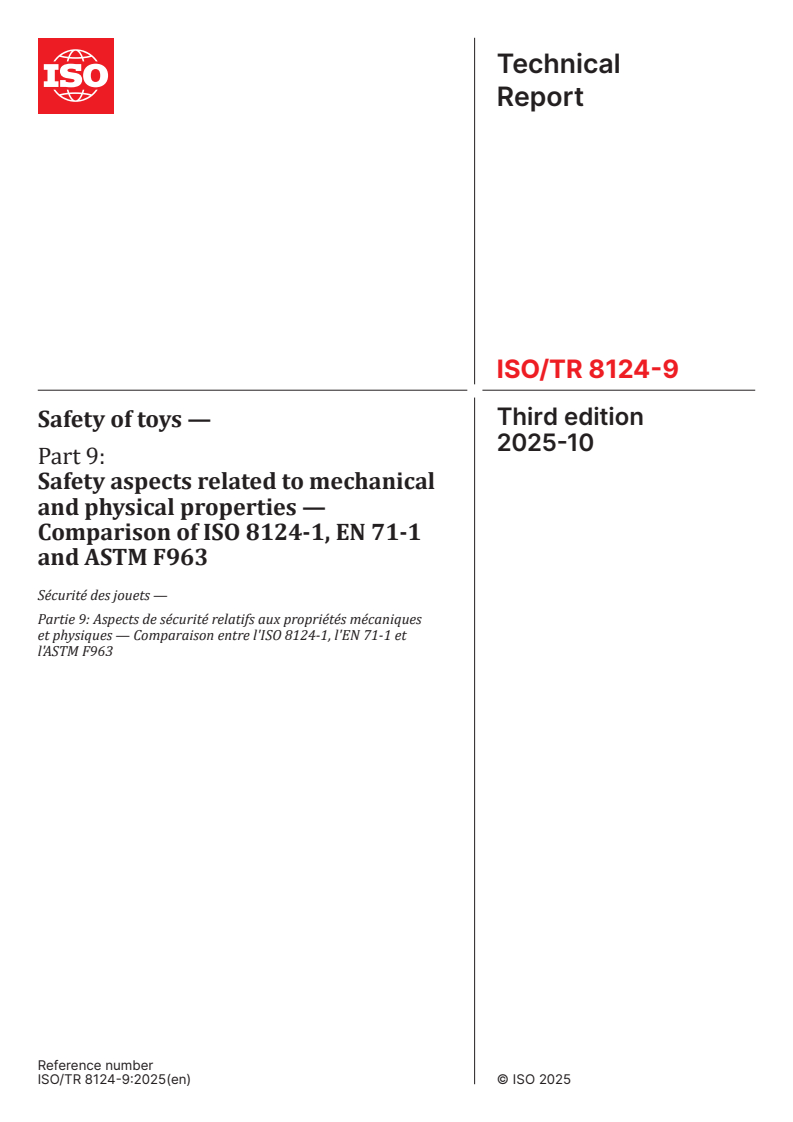
Technical
Report
ISO/TR 8124-9
Third edition
Safety of toys —
2025-10
Part 9:
Safety aspects related to mechanical
and physical properties —
Comparison of ISO 8124-1, EN 71-1
and ASTM F963
Sécurité des jouets —
Partie 9: Aspects de sécurité relatifs aux propriétés mécaniques
et physiques — Comparaison entre l'ISO 8124-1, l'EN 71-1 et
l'ASTM F963
Reference number
© ISO 2025
All rights reserved. Unless otherwise specified, or required in the context of its implementation, no part of this publication may
be reproduced or utilized otherwise in any form or by any means, electronic or mechanical, including photocopying, or posting on
the internet or an intranet, without prior written permission. Permission can be requested from either ISO at the address below
or ISO’s member body in the country of the requester.
ISO copyright office
CP 401 • Ch. de Blandonnet 8
CH-1214 Vernier, Geneva
Phone: +41 22 749 01 11
Email: copyright@iso.org
Website: www.iso.org
Published in Switzerland
ii
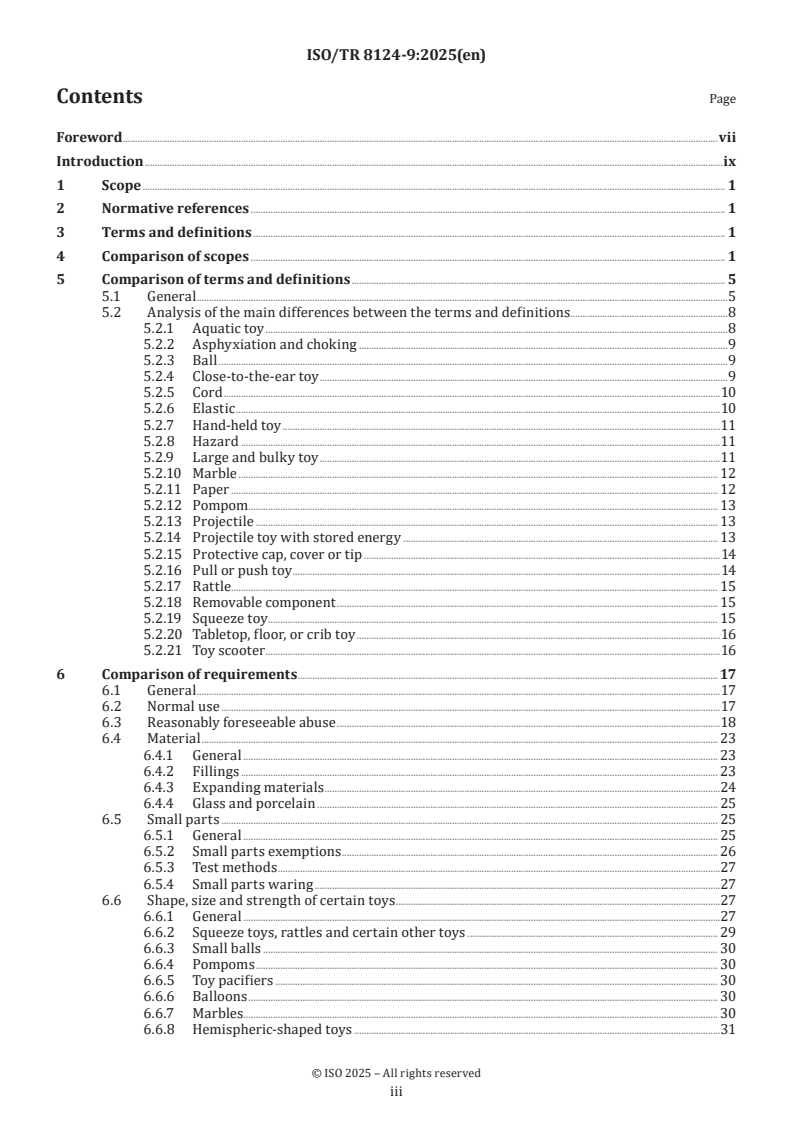
Contents Page
Foreword .vii
Introduction .ix
1 Scope . 1
2 Normative references . 1
3 Terms and definitions . 1
4 Comparison of scopes . 1
5 Comparison of terms and definitions . 5
5.1 General .5
5.2 Analysis of the main differences between the terms and definitions .8
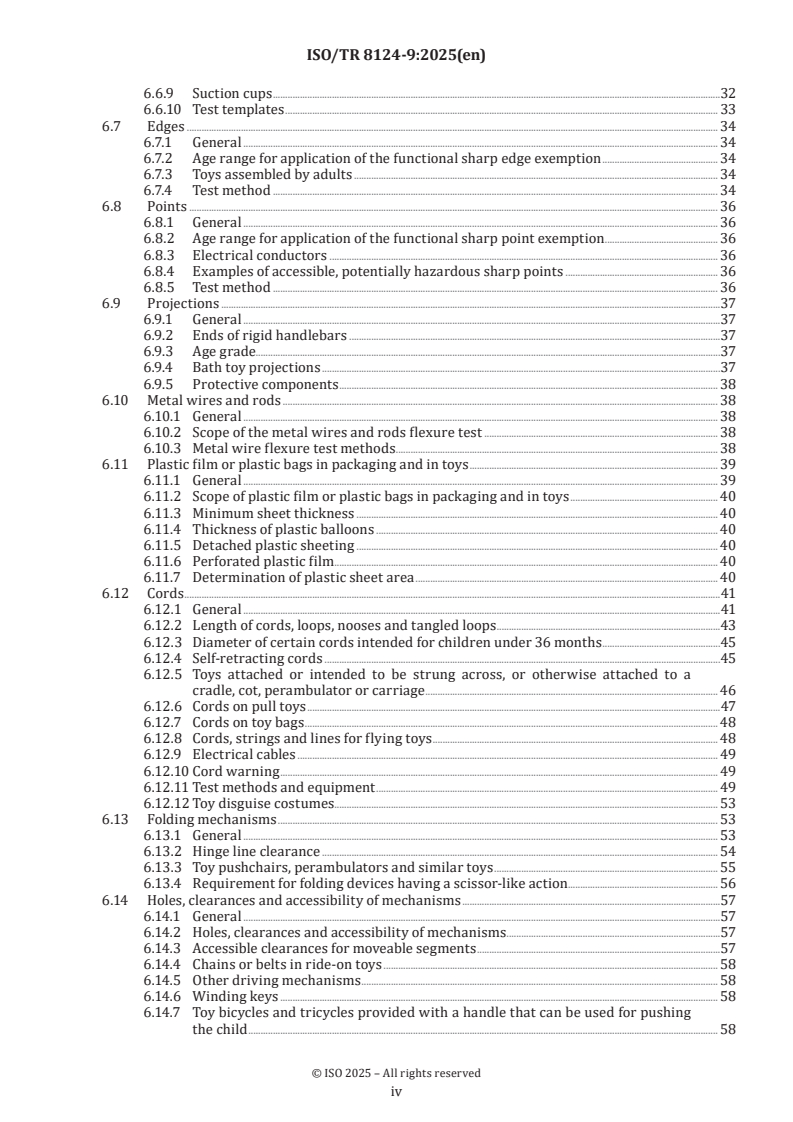
5.2.1 Aquatic toy .8
5.2.2 Asphyxiation and choking .9
5.2.3 Ball .9
5.2.4 Close-to-the-ear toy .9
5.2.5 Cord .10
5.2.6 Elastic .10
5.2.7 Hand-held toy .11
5.2.8 Hazard .11
5.2.9 Large and bulky toy .11
5.2.10 Marble . 12
5.2.11 Paper . 12
5.2.12 Pompom. 13
5.2.13 Projectile . 13
5.2.14 Projectile toy with stored energy . 13
5.2.15 Protective cap, cover or tip .14
5.2.16 Pull or push toy .14
5.2.17 Rattle. 15
5.2.18 Removable component . 15
5.2.19 Squeeze toy . 15
5.2.20 Tabletop, floor, or crib toy .16
5.2.21 Toy scooter .16
6 Comparison of requirements . . 17
6.1 General .17
6.2 Normal use .17
6.3 Reasonably foreseeable abuse .18
6.4 Material . 23
6.4.1 General . 23
6.4.2 Fillings . 23
6.4.3 Expanding materials .24
6.4.4 Glass and porcelain . 25
6.5 Small parts . 25
6.5.1 General . 25
6.5.2 Small parts exemptions . 26
6.5.3 Test methods .27
6.5.4 Small parts waring .27
6.6 Shape, size and strength of certain toys .27
6.6.1 General .27
6.6.2 Squeeze toys, rattles and certain other toys . 29
6.6.3 Small balls . 30
6.6.4 Pompoms . 30
6.6.5 Toy pacifiers . 30
6.6.6 Balloons . 30
6.6.7 Marbles . . 30
6.6.8 Hemispheric-shaped toys .31
iii
6.6.9 Suction cups .32
6.6.10 Test templates . 33
6.7 Edges . 34
6.7.1 General . 34
6.7.2 Age range for application of the functional sharp edge exemption . 34
6.7.3 Toys assembled by adults . 34
6.7.4 Test method . 34
6.8 Points . 36
6.8.1 General . 36
6.8.2 Age range for application of the functional sharp point exemption . 36
6.8.3 Electrical conductors . 36
6.8.4 Examples of accessible, potentially hazardous sharp points . 36
6.8.5 Test method . 36
6.9 Projections .37
6.9.1 General .37
6.9.2 Ends of rigid handlebars .37
6.9.3 Age grade.37
6.9.4 Bath toy projections .37
6.9.5 Protective components . 38
6.10 Metal wires and rods . 38
6.10.1 General . 38
6.10.2 Scope of the metal wires and rods flexure test . 38
6.10.3 Metal wire flexure test methods . 38
6.11 Plastic film or plastic bags in packaging and in toys . 39
6.11.1 General . 39
6.11.2 Scope of plastic film or plastic bags in packaging and in toys . 40
6.11.3 Minimum sheet thickness . 40
6.11.4 Thickness of plastic balloons . 40
6.11.5 Detached plastic sheeting . 40
6.11.6 Perforated plastic film. 40
6.11.7 Determination of plastic sheet area . 40
6.12 Cords .41
6.12.1 General .41
6.12.2 Length of cords, loops, nooses and tangled loops .43
6.12.3 Diameter of certain cords intended for children under 36 months .45
6.12.4 Self-retracting cords .45
6.12.5 Toys attached or intended to be strung across, or otherwise attached to a
cradle, cot, perambulator or carriage . 46
6.12.6 Cords on pull toys .47
6.12.7 Cords on toy bags . 48
6.12.8 Cords, strings and lines for flying toys . 48
6.12.9 Electrical cables . 49
6.12.10 Cord warning . 49
6.12.11 Test methods and equipment . 49
6.12.12 Toy disguise costumes. 53
6.13 Folding mechanisms . 53
6.13.1 General . 53
6.13.2 Hinge line clearance . 54
6.13.3 Toy pushchairs, perambulators and similar toys . 55
6.13.4 Requirement for folding devices having a scissor-like action . 56
6.14 Holes, clearances and accessibility of mechanisms .57
6.14.1 General .57
6.14.2 Holes, clearances and accessibility of mechanisms.57
6.14.3 Accessible clearances for moveable segments .57
6.14.4 Chains or belts in ride-on toys . 58
6.14.5 Other driving mechanisms . 58
6.14.6 Winding keys . 58
6.14.7 Toy bicycles and tricycles provided with a handle that can be used for pushing
the child . 58
iv
6.15 Springs . 58
6.16 Stability and overload requirements .59
6.16.1 Stability requirements for ride-on toys and seats.59
6.16.2 Overload requirements for ride-on toys and seats . 64
6.16.3 Stability of stationary floor toys . 66
6.17 Enclosures.67
6.17.1 General .67
6.17.2 Ventilation .67
6.17.3 Toys that enclose the head . 68
6.17.4 Closures . 68
6.17.5 Toy chests safety labelling . 69
6.18 Items that cover the face and simulated protective equipment . 69
6.19 Projectile toys . .70
6.19.1 General .70
6.19.2 General requirements of projectiles .71
6.19.3 Projectile range .71
6.19.4 Impact surface .71
6.19.5 Discharge mechanism . . 72
6.19.6 Kinetic energy and warning . 75
6.19.7 Toy catapults and projectiles propelled by an elastic band and projectile toys
without stored energy where the discharge mechanism can store energy, only
when held in place by the user .76
6.19.8 Dart .76
6.19.9 Mouth-actuated projectile toys . 77
6.19.10 Test method . 77
6.20 Flying toys . 78
6.20.1 General . 78
6.20.2 Scope and exemption . 78
6.20.3 Leading part(s) on rigid parts of flying toys . 78
6.20.4 Rotor blades on flying toys and remote-controlled flying toys . 78
6.20.5 Rotor or propeller warning . 80
6.21 Aquatic toys . 81
6.22 Braking . 82
6.22.1 General . 82
6.22.2 Braking device — Exemptions . 82
6.22.3 Braking device — Scope . 82
6.22.4 Freewheeling facility . 83
6.22.5 Brake performance test . 83
6.23 Toy bicycles . 83
6.23.1 General . 83
6.23.2 Braking system . 84
6.23.3 Warning . 84
6.24 Speed limitation of electrically driven ride-on toys . 84
6.24.1 General . 84
6.24.2 Seat requirements . 85
6.24.3 Determination of maximum design speed of electrically-driven ride-on toys . 85
6.25 Toys containing a heat source . 86
6.25.1 General . 86
6.25.2 Exemption for toys containing a heat source . 87
6.25.3 Scope of toys containing a heat source . 87
6.25.4 Temperature rise for heat sources . 87
6.25.5 Test environment for toys containing a heat source . 87
6.26 Liquid-filled toys . 88
6.27 Mouth-actuated toys . 88
6.28 Toy roller skates, toy inline skates and toy skateboards . 89
6.29 Percussion caps . 89
6.30 Acoustic requirements . 90
6.30.1 General . 90
6.30.2 Scope for the acoustic . 90
v
6.30.3 Category of acoustic toys . 90
6.30.4 Rattles .91
6.30.5 Comparison of the acoustic requirements .91
6.30.6 Test method . 92
6.31 Toy scooters . 93
6.31.1 General . 93
6.31.2 Comparison of toy scooter requirements . . 94
6.32 Magnets and magnetic components . 95
6.32.1 General . 95
6.32.2 Magnetic or electrical experimental sets intended for children 8 years and over. 96
6.32.3 All other toys with magnets and magnetic components . 96
6.33 Yo-yo balls . 98
6.34 Straps intended to be worn fully or partially around the neck . 99
6.35 Sledges and toboggans with cords for pulling . 99
6.36 Jaw entrapment in handles and steering wheels . 100
6.37 Assembly . 100
6.38 Functional toys . 102
6.39 Toys intended to come into contact with food . 102
6.40 Inflatable toys . . 102
6.41 Toys gun markings (refer to ISO 8124-1:2022, Annex D) . 103
6.42 Toys comprising monofilament fibres which can present long hair hazards . 103
6.43 Packaging and packaging components (spherical, egg-shaped or ellipsoidal and
hemispheric-shaped containers) . 103
Annex A (informative) Index of requirements by EN 71-1 .105
Annex B (informative) Index of requirements by ASTM F963 .115
Bibliography .123
vi
Foreword
ISO (the International Organization for Standardization) is a worldwide federation of national standards
bodies (ISO member bodies). The work of preparing International Standards is normally carried out through
ISO technical committees. Each member body interested in a subject for which a technical committee
has been established has the right to be represented on that committee. International organizations,
governmental and non-governmental, in liaison with ISO, also take part in the work. ISO collaborates closely
with the International Electrotechnical Commission (IEC) on all matters of electrotechnical standardization.
The procedures used to develop this document and those intended for its further maintenance are described
in the ISO/IEC Directives, Part 1. In particular, the different approval criteria needed for the different types
of ISO document should be noted. This document was drafted in accordance with the editorial rules of the
ISO/IEC Directives, Part 2 (see www.iso.org/directives).
ISO draws attention to the possibility that the implementation of this document may involve the use of (a)
patent(s). ISO takes no position concerning the evidence, validity or applicability of any claimed patent
rights in respect thereof. As of the date of publication of this document, ISO had not received notice of (a)
patent(s) which may be required to implement this document. However, implementers are cautioned that
this may not represent the latest information, which may be obtained from the patent database available at
www.iso.org/patents. ISO shall not be held responsible for identifying any or all such patent rights.
Any trade name used in this document is information given for the convenience of users and does not
constitute an endorsement.
For an explanation of the voluntary nature of standards, the meaning of ISO specific terms and expressions
related to conformity assessment, as well as information about ISO's adherence to the World Trade
Organization (WTO) principles in the Technical Barriers to Trade (TBT), see www.iso.org/iso/foreword.html.
This document was prepared by Technical Committee ISO/TC 181, Safety of toys.
This third edition cancels and replaces the second edition (ISO/TR 8124-9:2020), which has been technically
revised. The main changes are as follows:
Clause Change
Clause 1 Modified the standards “ISO 8124-1:2018, EN 71-1:2014+A1:2018 and ASTM F963-17” to “ISO 8124-1:2022,
EN 71-1:2014+A1:2018 and ASTM F963-23”.
5.1 Modified Table 3, “Defined terms”, update the order and numbering of the definition.
5.2 Modified 5.2.3 “Ball”, 5.2.15 “Protective cap, cover or tip” and 5.2.16 “Pull or push toy”.
Added 5.2.18 “Removable component ” and 5.2.20 “Tabletop, floor, or crib toy”.
6.3 Modified Table 27, “Parameters for reasonably foreseeable abuse tests”, updated the parameters for torque
test and tension test.
Modified Table 28, “impact medium specifications for the drop test”, deleted the hardness requirement in
ISO 8124-1.
Added 6.3 h) comparison of tension test method of ISO 8124-1, EN 71-1 and ASTM F963.
6.4 Modified 6.4.3, updated the expanding materials requirements of ISO 8124-1.
6.5 Modified Table 36 “Small parts exemptions”, indicated that small parts exemption does not include remov-
able components such as pen caps in ISO 8124-1.
6.12 Modified Table 55 “Plastic film thickness measurement gauge comparison”, updated the diameter of meas-
uring surface and compression force of plastic film thickness measurement gauge in ISO 8124-1.
6.13 Modified Table 64 “Test methods and equipment used for testing of fixed loops, nooses and tangled loops”,
updated the figure of head probe for cords and elastics in ASTM F963.
6.16 Modified Table 73 “Differences of the test method for stability testing”, updated the scope of stability testing
in EN 71-1 and exemption of stability testing in ASTM F963.
Modified Table 77 “Differences in test methods for dynamic strength test”, updated test method of dynamic
strength test.
NOTE The technical changes referred to above include the significant technical changes from the revised document, but this is
not an exhaustive list of all modifications from the previous version.
vii
Clause Change
6.17 Modified 6.17.2 “Ventilation”, added options to ventilation requirements in ISO 8124-1 and ASTM F963.
6.19 Modified Table 86 “Differences of requirements for description and dimensions of the improvised projec-
tiles”, deleted temperature and humidity requirement for storage of improvised projectiles in ASTM F963.
6.21 Modified Table 95 “Differences in warnings for aquatic toys", updated content and location of warnings.
6.23 Modified 6.23.2 “Braking system”, added the operating position of the braking systems.
6.24 Modified Table 101 "Comparison of the test to determine the maximum design speed of electrically driven
ride-on toys”.
Added new speed limitations for electrically driven ride-on toys in ISO 8124-1.
6.25 Modified 6.29 “Percussion caps”, added the warning that only use percussion caps recommended by the
manufacturer in EN 71-1.
6.27 Modified Table 113 “Comparison of the acoustic requirements”, added relevant toy categories i n accordance
with updates to reference standards.
Modified Table 114 “Measurement parameter”, added relevant toy types in accordance with updates to
reference standards.
6.29 Added 6.38 “Functional toys”.
6.30 Modified 6.39 “Toys intended to come into contact with food”, added requirements for toys intended to
come into contact with food in ISO 8124-1 and ASTM F963.
6.38 Added 6.40 “Inflatable toys”.
6.39 Modified Table A.1, “Index of requirements by EN 71-1”.
6.40 Modified Table B.1, “Index of requirements by ASTM F963-23”.
Annex A Modified the standards “ISO 8124-1:2018, EN 71-1:2014+A1:2018 and ASTM F963-17” to “ISO 8124-1:2022,
EN 71-1:2014+A1:2018 and ASTM
...