

ISO 8124-4:2025
(Main)Safety of toys — Part 4: Activity toys for domestic use
General Information
- Abstract
This document specifies requirements and test methods for activity toys for indoor and outdoor domestic family use intended for children under 14 years to play on or in. Products covered by this document include swings, slides, see-saws, carousels, rocking toys, climbing frames, toddler swing seats and other products often intended to bear the mass of one or more children. Products not included within the scope of this document are: a) fitness and sporting equipment unless attached to the activity toy; b) equipment intended for use in schools, daycare centres, kindergartens, public playgrounds, restaurants, shopping centres and similar public places; c) juvenile care products such as, but not limited to, infant swings, playpens/enclosures, beds or furniture including picnic tables, cradle rockers and products specifically designed for therapeutic use; d) pools with maximum depth of water over 400 mm measured, between the overflow level and the deepest point within the pool. Inflatable activity toys are included in the scope of this document. However, a powered blower used to continuously inflate the toy is not covered by this document. Such equipment is considered to be a household appliance and is covered by requirements given in IEC 60335-2-80.[ REF Reference_ref_8 \r \h 5 08D0C9EA79F9BACE118C8200AA004BA90B0200000008000000100000005200650066006500720065006E00630065005F007200650066005F0038000000 ]
- Status
- Published
- Publication Date
- 05-Jun-2025
- Technical Committee
- ISO/TC 181 - Safety of toys
- Drafting Committee
- ISO/TC 181/WG 11 - Revision of ISO 8124-4 Safety of toys
- Current Stage
- 6060 - International Standard published
- Start Date
- 06-Jun-2025
- Due Date
- 14-Jun-2025
- Completion Date
- 06-Jun-2025
Overview
ISO 8124-4:2025 - Safety of toys - Part 4: Activity toys for domestic use specifies safety requirements and test methods for activity toys intended for household indoor and outdoor use by children under 14 years. The standard covers products that commonly bear the weight of one or more children, such as swings, slides, see-saws, carousels, rocking toys, climbing frames and toddler swing seats. Inflatable activity toys and paddling pools are included, while equipment for schools, public playgrounds, juvenile care products and pools deeper than 400 mm are excluded. Powered blowers used for continuous inflation are outside the scope and are covered by IEC 60335-2-80.
Key Topics and Technical Requirements
The standard addresses practical safety aspects and associated test methods, including:
- Materials and hardware requirements to ensure durability and safe construction.
- Static strength tests and dynamic strength procedures for structural integrity.
- Maximum height and stability criteria, differentiated by free height of fall (≤600 mm and >600 mm).
- Corners, edges, protruding parts, crush and shear points to minimize impact and entrapment injuries.
- Entrapment prevention (head, neck, clothing, hair, feet, fingers) with dedicated test methods.
- Rope diameters, open tubing and hand-grip requirements to ensure secure support and reduce hazards.
- Requirements for specific types: slides (run-out sections, retaining sides), swings and crossbeams (suspension strength, clearances), see-saws, carousels, and inflatable activity toys (anchorage, containment).
- Paddling pool requirements for shallow domestic pools and inflatable walls.
- Warnings, labelling, assembly/installation, operating and maintenance instructions to support safe use and consumer information.
- Comprehensive test methods for stability, static and dynamic strength, impact determination and entrapment testing.
Applications - Who Uses ISO 8124-4:2025
This standard is essential for:
- Toy manufacturers and designers developing domestic activity toys.
- Product safety engineers and compliance teams verifying conformity.
- Test laboratories conducting mechanical, stability and entrapment tests.
- Importers, retailers and procurement specialists ensuring products meet regulatory and market safety expectations.
- Regulators and standards bodies referencing harmonized safety criteria for consumer protection.
- Installers and maintenance personnel using the labelling and assembly requirements to reduce on-site risks.
Related Standards
- ISO 8124 series (general toy safety framework)
- IEC 60335-2-80 (household appliances - continuous blower units for inflatable products)
ISO 8124-4:2025 is a practical reference for anyone responsible for the design, testing and safe supply of domestic activity toys, helping reduce injury risk through clear requirements and standardized test methods.
Relations
- Effective Date
- 17-Jul-2021
- Effective Date
- 10-Jul-2021
- Effective Date
- 23-Apr-2020
Frequently Asked Questions
ISO 8124-4:2025 is a standard published by the International Organization for Standardization (ISO). Its full title is "Safety of toys — Part 4: Activity toys for domestic use". This standard covers: This document specifies requirements and test methods for activity toys for indoor and outdoor domestic family use intended for children under 14 years to play on or in. Products covered by this document include swings, slides, see-saws, carousels, rocking toys, climbing frames, toddler swing seats and other products often intended to bear the mass of one or more children. Products not included within the scope of this document are: a) fitness and sporting equipment unless attached to the activity toy; b) equipment intended for use in schools, daycare centres, kindergartens, public playgrounds, restaurants, shopping centres and similar public places; c) juvenile care products such as, but not limited to, infant swings, playpens/enclosures, beds or furniture including picnic tables, cradle rockers and products specifically designed for therapeutic use; d) pools with maximum depth of water over 400 mm measured, between the overflow level and the deepest point within the pool. Inflatable activity toys are included in the scope of this document. However, a powered blower used to continuously inflate the toy is not covered by this document. Such equipment is considered to be a household appliance and is covered by requirements given in IEC 60335-2-80.[ REF Reference_ref_8 \r \h 5 08D0C9EA79F9BACE118C8200AA004BA90B0200000008000000100000005200650066006500720065006E00630065005F007200650066005F0038000000 ]
This document specifies requirements and test methods for activity toys for indoor and outdoor domestic family use intended for children under 14 years to play on or in. Products covered by this document include swings, slides, see-saws, carousels, rocking toys, climbing frames, toddler swing seats and other products often intended to bear the mass of one or more children. Products not included within the scope of this document are: a) fitness and sporting equipment unless attached to the activity toy; b) equipment intended for use in schools, daycare centres, kindergartens, public playgrounds, restaurants, shopping centres and similar public places; c) juvenile care products such as, but not limited to, infant swings, playpens/enclosures, beds or furniture including picnic tables, cradle rockers and products specifically designed for therapeutic use; d) pools with maximum depth of water over 400 mm measured, between the overflow level and the deepest point within the pool. Inflatable activity toys are included in the scope of this document. However, a powered blower used to continuously inflate the toy is not covered by this document. Such equipment is considered to be a household appliance and is covered by requirements given in IEC 60335-2-80.[ REF Reference_ref_8 \r \h 5 08D0C9EA79F9BACE118C8200AA004BA90B0200000008000000100000005200650066006500720065006E00630065005F007200650066005F0038000000 ]
ISO 8124-4:2025 is classified under the following ICS (International Classification for Standards) categories: 97.200.50 - Toys. The ICS classification helps identify the subject area and facilitates finding related standards.
ISO 8124-4:2025 has the following relationships with other standards: It is inter standard links to ISO 8124-4:2014/Amd 1:2017, ISO 8124-4:2014/Amd 2:2019, ISO 8124-4:2014. Understanding these relationships helps ensure you are using the most current and applicable version of the standard.
ISO 8124-4:2025 is available in PDF format for immediate download after purchase. The document can be added to your cart and obtained through the secure checkout process. Digital delivery ensures instant access to the complete standard document.
Standards Content (Sample)
International
Standard
ISO 8124-4
Third edition
Safety of toys —
2025-06
Part 4:
Activity toys for domestic use
Sécurité des jouets —
Partie 4: Jouets d’activité à usage familiale
Reference number
© ISO 2025
All rights reserved. Unless otherwise specified, or required in the context of its implementation, no part of this publication may
be reproduced or utilized otherwise in any form or by any means, electronic or mechanical, including photocopying, or posting on
the internet or an intranet, without prior written permission. Permission can be requested from either ISO at the address below
or ISO’s member body in the country of the requester.
ISO copyright office
CP 401 • Ch. de Blandonnet 8
CH-1214 Vernier, Geneva
Phone: +41 22 749 01 11
Email: copyright@iso.org
Website: www.iso.org
Published in Switzerland
ii
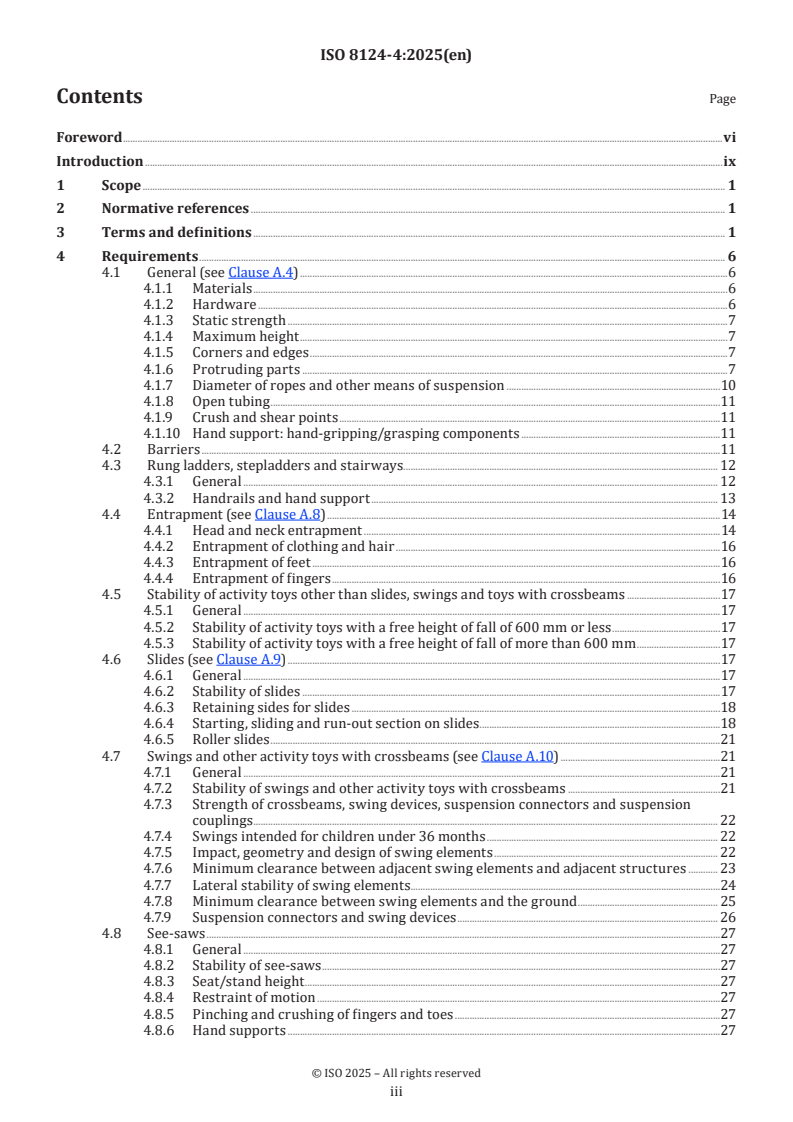
Contents Page
Foreword .vi
Introduction .ix
1 Scope . 1
2 Normative references . 1
3 Terms and definitions . 1
4 Requirements . 6
4.1 General (see Clause A.4) .6
4.1.1 Materials .6
4.1.2 Hardware .6
4.1.3 Static strength .7
4.1.4 Maximum height .7
4.1.5 Corners and edges .7
4.1.6 Protruding parts .7
4.1.7 Diameter of ropes and other means of suspension .10
4.1.8 Open tubing .11
4.1.9 Crush and shear points .11
4.1.10 Hand support: hand-gripping/grasping components .11
4.2 Barriers .11
4.3 Rung ladders, stepladders and stairways. 12
4.3.1 General . 12
4.3.2 Handrails and hand support . 13
4.4 Entrapment (see Clause A.8) .14
4.4.1 Head and neck entrapment .14
4.4.2 Entrapment of clothing and hair .16
4.4.3 Entrapment of feet .16
4.4.4 Entrapment of fingers .16
4.5 Stability of activity toys other than slides, swings and toys with crossbeams .17
4.5.1 General .17
4.5.2 Stability of activity toys with a free height of fall of 600 mm or less .17
4.5.3 Stability of activity toys with a free height of fall of more than 600 mm .17
4.6 Slides (see Clause A.9) .17
4.6.1 General .17
4.6.2 Stability of slides .17
4.6.3 Retaining sides for slides .18
4.6.4 Starting, sliding and run-out section on slides.18
4.6.5 Roller slides .21
4.7 Swings and other activity toys with crossbeams (see Clause A.10) .21
4.7.1 General .21
4.7.2 Stability of swings and other activity toys with crossbeams .21
4.7.3 Strength of crossbeams, swing devices, suspension connectors and suspension
couplings . . 22
4.7.4 Swings intended for children under 36 months . 22
4.7.5 Impact, geometry and design of swing elements . 22
4.7.6 Minimum clearance between adjacent swing elements and adjacent structures . 23
4.7.7 Lateral stability of swing elements.24
4.7.8 Minimum clearance between swing elements and the ground . 25
4.7.9 Suspension connectors and swing devices . 26
4.8 See-saws .27
4.8.1 General .27
4.8.2 Stability of see-saws .27
4.8.3 Seat/stand height .27
4.8.4 Restraint of motion .27
4.8.5 Pinching and crushing of fingers and toes .27
4.8.6 Hand supports .27
iii
4.9 Carousels and rocking activity toys .27
4.10 Inflatable activity toys (see Clause A.15) .27
4.10.1 General .27
4.10.2 Anchorage . 28
4.10.3 Connection tubes for continuous inflation . 28
4.10.4 Containment . 29
4.11 Paddling pools . 30
4.11.1 General . 30
4.11.2 Static strength of paddling pools with non-inflatable walls . 30
4.11.3 Paddling pools with inflatable walls . 30
5 Warnings and labelling .30
5.1 Labelling . 30
5.2 Assembly and installation instructions . 30
5.2.1 General . 30
5.2.2 Information on playground surfacing materials .31
5.2.3 Paddling pools .31
5.3 Operating instructions .32
5.4 Maintenance instructions . .32
5.5 Warnings . 33
5.5.1 Drowning . 33
5.5.2 Inflatable activity toys . 33
5.5.3 Paddling pools . 33
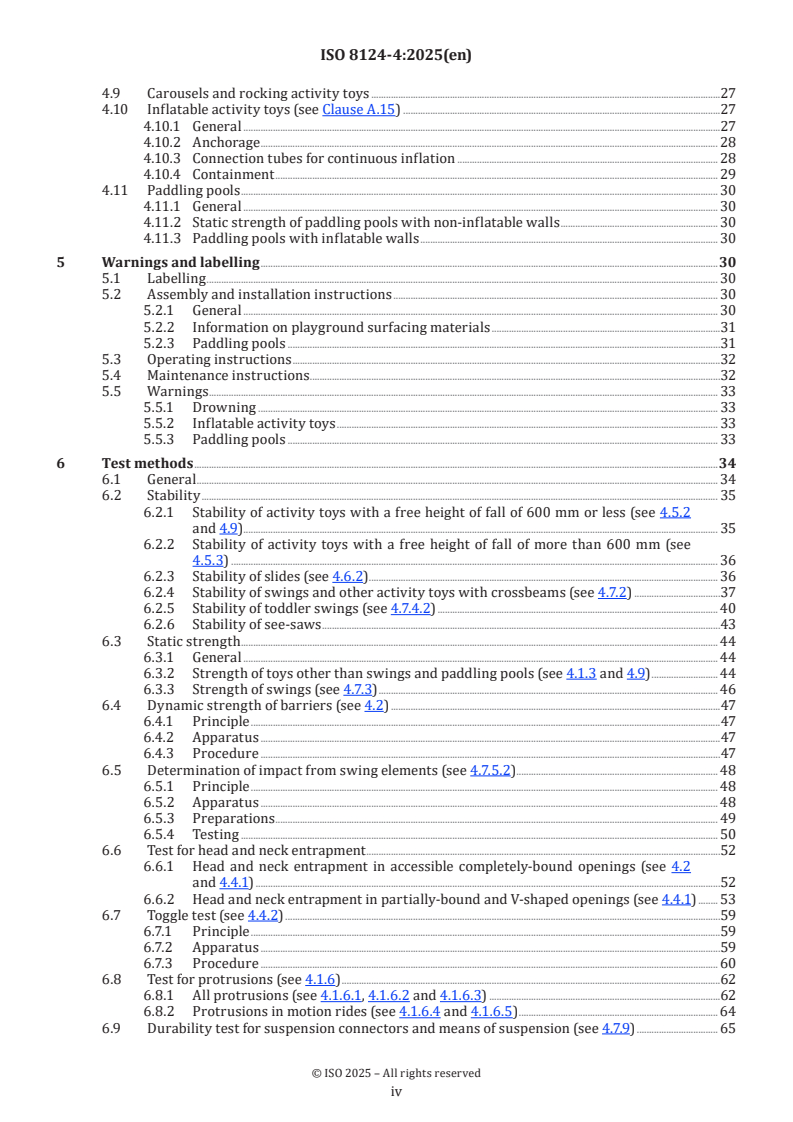
6 Test methods .34
6.1 General . 34
6.2 Stability . 35
6.2.1 Stability of activity toys with a free height of fall of 600 mm or less (see 4.5.2
and 4.9) . 35
6.2.2 Stability of activity toys with a free height of fall of more than 600 mm (see
4.5.3) . 36
6.2.3 Stability of slides (see 4.6.2) . 36
6.2.4 Stability of swings and other activity toys with crossbeams (see 4.7.2) .37
6.2.5 Stability of toddler swings (see 4.7.4.2) . 40
6.2.6 Stability of see-saws .43
6.3 Static strength . . . 44
6.3.1 General . 44
6.3.2 Strength of toys other than swings and paddling pools (see 4.1.3 and 4.9) . 44
6.3.3 Strength of swings (see 4.7.3) . 46
6.4 Dynamic strength of barriers (see 4.2) .47
6.4.1 Principle .47
6.4.2 Apparatus .47
6.4.3 Procedure .47
6.5 Determination of impact from swing elements (see 4.7.5.2) . 48
6.5.1 Principle . 48
6.5.2 Apparatus . 48
6.5.3 Preparations . 49
6.5.4 Testing . 50
6.6 Test for head and neck entrapment .52
6.6.1 Head and neck entrapment in accessible completely-bound openings (see 4.2
and 4.4.1) .52
6.6.2 Head and neck entrapment in partially-bound and V-shaped openings (see 4.4.1) . 53
6.7 Toggle test (see 4.4.2) .59
6.7.1 Principle .59
6.7.2 Apparatus .59
6.7.3 Procedure . 60
6.8 Test for protrusions (see 4.1.6) .62
6.8.1 All protrusions (see 4.1.6.1, 4.1.6.2 and 4.1.6.3) .62
6.8.2 Protrusions in motion rides (see 4.1.6.4 and 4.1.6.5) . 64
6.9 Durability test for suspension connectors and means of suspension (see 4.7.9) . 65
iv
6.9.1 Principle . 65
6.9.2 Apparatus . 65
6.9.3 Procedure . 65
6.9.4 Alternate procedure . 66
6.10 Deflation of inflatable activity toys . 66
6.10.1 Principle . 66
6.10.2 Apparatus .67
6.10.3 Procedure .67
6.11 Static load test for paddling pools with non-inflatable walls (see 4.11.2) .67
6.12 Diameter of ropes and other means of suspension .67
6.13 Measurements of sliding and run-out sections on slides (see 4.6.4) .67
6.13.1 Measurement of inclination of the sliding section on slides [see 4.6.4 d)].67
6.13.2 Measurement of the minimum angle along the sliding section and the run-out
section on slides [see 4.6.4 e)] . 68
6.14 Measurement of the height of falling protection of swings with double seats and
examination of gaps between the swing seat and the falling protection . 69
Annex A (informative) Rationale .70
Annex B (informative) Consumer information sheet for playground surfacing materials . 74
Annex C (informative) Safety labelling guidelines for certain types of activity toys .75
Bibliography .77
v
Foreword
ISO (the International Organization for Standardization) is a worldwide federation of national standards
bodies (ISO member bodies). The work of preparing International Standards is normally carried out through
ISO technical committees. Each member body interested in a subject for which a technical committee
has been established has the right to be represented on that committee. International organizations,
governmental and non-governmental, in liaison with ISO, also take part in the work. ISO collaborates closely
with the International Electrotechnical Commission (IEC) on all matters of electrotechnical standardization.
The procedures used to develop this document and those intended for its further maintenance are described
in the ISO/IEC Directives, Part 1. In particular, the different approval criteria needed for the different types
of ISO document should be noted. This document was drafted in accordance with the editorial rules of the
ISO/IEC Directives, Part 2 (see www.iso.org/directives).
ISO draws attention to the possibility that the implementation of this document may involve the use of (a)
patent(s). ISO takes no position concerning the evidence, validity or applicability of any claimed patent
rights in respect thereof. As of the date of publication of this document, ISO had not received notice of (a)
patent(s) which may be required to implement this document. However, implementers are cautioned that
this may not represent the latest information, which may be obtained from the patent database available at
www.iso.org/patents. ISO shall not be held responsible for identifying any or all such patent rights.
Any trade name used in this document is information given for the convenience of users and does not
constitute an endorsement.
For an explanation of the voluntary nature of standards, the meaning of ISO specific terms and expressions
related to conformity assessment, as well as information about ISO's adherence to the World Trade
Organization (WTO) principles in the Technical Barriers to Trade (TBT), see www.iso.org/iso/foreword.html.
This document was prepared by Technical Committee ISO/TC 181, Safety of toys.
This third edition cancels and replaces the second edition (ISO 8124-4:2014), which has been technically revised.
It also incorporates the Amendment(s) ISO 8124-4:2014/Amd. 1:2017 and ISO 8124-4:2014/Amd. 2:2019.
The main changes are as follows:
— the Scope has been modified to exclude pools over 400 mm deep;
— the definition of "activity toy" has been modified to reflect the inclusion of paddling pools;
— the definition of "barrier" has been modified to include the concepts of prevention of passing through or
beneath the device;
— the definition of "declined plane" has been added to support requirements for slides;
— definitions for "hand-gripping component" and "hand-grasping component" have been added;
— a definition for "resilient behaviour" has been added;
— a modification has been made requiring conformity with relevant requirements from ISO 8124-1 after
testing;
— requirements have been added for materials to be resistant to degradation;
— general requirements for hardware have been added;
— requirements for the diameter of ropes and other means of suspension, including an option for free
hanging ropes, have been added;
— a general requirement concerning crush and shear points has been added, and such requirements have
been removed from specific component clauses;
— a general requirement concerning hand-gripping and hand-grasping components has been added;
vi
— the minimum height of barrier for platforms from 1 000 mm to 1 830 mm above the ground has been
[2]
changed to align with ASTM F1148;
— references to handrails have been removed in requirements for barriers;
— requirements for handrails for rung ladders, step ladders and stairways have been added;
[1]
— head and neck entrapment requirements have been modified to align with EN 71-8;
[1]
— finger entrapment requirements have been modified to align with EN 71-8;
[1]
— the toggle test has been modified to align with EN 71-8;
— certain declined planes have been removed from slide requirements;
— attachment slides have been removed from stability requirements;
— a lower mass test has been added for slides that are not suitable for children 36 months or over;
— the mass tolerance for stability test load has been modified from 2 kg to 0,5 kg;
— a requirement for a minimum radius on the finishing end of retaining sides on the run-out section of
slides has been added;
— the width requirement for the starting section of slides has been modified to be at least the same as the
width of the sliding section;
— a requirement for handrails on the starting section of slides has been added;
[1]
— a test method for inclination of the sliding section of slides has been added from EN 71-8;
[1]
— a requirement and test method from EN 71-8 for the angle along the sliding section and run-out section
on slides have been added;
[ ]
— a requirement concerning attachment of swing elements to upper body components from ASTM F1148 2
has been added;
— the testing for stability of swings has been modified to be dependant only on the height of the crossbeam;
[1]
— a calculation of number of users in alignment with EN 71-8 has been added for swings and other toys
with crossbeams;
[1]
— requirements for the geometry and design of swing elements have been added to align with EN 71-8;
[1]
— the testing for impact from swing elements has been modified to align with EN 71-8;
— the distance from the ground to upper rotation point is now used when determining the minimum distance
between suspension points and the minimum clearance between swing elements and the ground;
— a requirement for suspension couplings to be prefixed to the means of suspension has been added;
— requirements for the stability of see-saws have been added;
— requirements concerning pinching and crushing from see-saws have been added;
— requirements for hand supports on see-saws have been added;
— a requirement for anchor points at all external corners of inflatable activity toys has been added;
— requirements concerning operating instructions have been added;
— the warning requirements for paddling pools have been modified to remove symbol options.
A list of all parts in the ISO 8124 series can be found on the ISO website.
vii
Any feedback or questions on this document should be directed to the user’s national standards body. A
complete listing of these bodies can be found at www.iso.org/members.html.
viii
Introduction
[1]
This document is largely based upon existing standards in the European Union (EN 71-8 ) and in the United
[2] [3] [4]
States (ASTM F1148, ASTM F2729 and ASTM F2666 ). However, it should not be construed that a toy
manufactured in conformity with this document will be in full compliance with relevant national toy safety
requirements in the market where the product is intended to be distributed. The user of this document is
therefore advised to be aware of relevant national requirements.
Conformance to the requirements of this document will minimize potential hazards associated with toys
resulting from their use in their intended play modes (normal use) as well as unintended play modes
(reasonably foreseeable abuse).
This document does not, nor is it intended to, eliminate parental responsibility in the appropriate selection
of toys. In addition, this document does not eliminate the need for parental supervision in situations where
children of various ages potentially have access to the same toy(s).
NOTE See Annex A for information on the rationale behind the preparation of this document.
ix
International Standard ISO 8124-4:2025(en)
Safety of toys —
Part 4:
Activity toys for domestic use
1 Scope
This document specifies requirements and test methods for activity toys for indoor and outdoor domestic
family use intended for children under 14 years to play on or in.
Products covered by this document include swings, slides, see-saws, carousels, rocking toys, climbing
frames, toddler swing seats and other products often intended to bear the mass of one or more children.
Products not included within the scope of this document are:
a) fitness and sporting equipment unless attached to the activity toy;
b) equipment intended for use in schools, daycare centres, kindergartens, public playgrounds, restaurants,
shopping centres and similar public places;
c) juvenile care products such as, but not limited to, infant swings, playpens/enclosures, beds or furniture
including picnic tables, cradle rockers and products specifically designed for therapeutic use;
d) pools with maximum depth of water over 400 mm measured, between the overflow level and the
deepest point within the pool.
Inflatable activity toys are included in the scope of this document. However, a powered blower used to
continuously inflate the toy is not covered by this document. Such equipment is considered to be a household
[5]
appliance and is covered by requirements given in IEC 60335-2-80.
2 Normative references
The following documents are referred to in the text in such a way that some or all of their content constitutes
requirements of this document. For dated references, only the edition cited applies. For undated references,
the latest edition of the referenced document (including any amendments) applies.
ISO 7010:2019, Graphical symbols — Safety colours and safety signs — Registered safety signs
ISO 8124-1:2022, Safety of toys — Part 1: Safety aspects related to mechanical and physical properties
ISO 868, Plastics and ebonite — Determination of indentation hardness by means of a durometer (Shore
hardness)
3 Terms and definitions
For the purposes of this document, the terms and definitions given in ISO 8124-1 and the following apply.
ISO and IEC maintain terminology databases for use in standardization at the following addresses:
— ISO Online browsing platform: available at https:// www .iso .org/ obp
— IEC Electropedia: available at https:// www .electropedia .org/
3.1
activity toy
toy intended for domestic use, the support structure of which remains stationary while the activity is taking
place and which is intended for the performance by a child of any of the following activities: climbing, swinging,
sliding, rocking, spinning, jumping, bouncing, crawling, creeping and paddling, or any combination thereof
EXAMPLE Swings, slides, carousels, climbing frames, rigid playhouses and paddling pools (see Figure 1).
Note 1 to entry: Aquatic toys and non-inflatable trampolines are not considered as activity toys in the context of this
document.
NOTE Images are not to scale.
Figure 1 — Examples of activity toys
3.2
anchor
device used to fix the toy to the standing surface
3.3
attachment slide
slide for which access to the starting section is possible only by passing via other equipment or parts of
other equipment
3.4
barrier
enclosing device around an elevated surface intended to prevent children from falling and that prevents
both inadvertent and deliberate attempts to pass through or beneath the device
3.5
crossbeam
bar or beam which forms a main load-bearing part of certain activity toys
3.6
declined plane
surface, which can be used for gliding downward in a sitting or lying position
3.7
entrapment
condition in which a body, part of a body or clothing becomes caught and impedes withdrawal
3.8
forced movement
movement where the direction and the extent of the child's movement is determined by the operation of the
equipment, for example swinging, sliding, rocking or revolving
3.9
free height of fall
greatest vertical distance from the intended body support, for example from the seat of a swing to the impact
area below
3.10
free space
space in, on or around the activity toy that can be occupied by a user undergoing a forced movement by the
equipment, for example swinging, sliding, rocking or revolving
Note 1 to entry: The definition of free space does not include the three-dimensional area in which a falling movement
takes place.
3.11
handrail
rail intended to assist the users in balancing or steadying themselves
3.12
hand-grasping component
component intended to be grasped by the hand to steady a user
EXAMPLE Handrail.
3.13
hand-gripping component
component intended to be gripped by the hand to support the full body weight
EXAMPLE A rung of a horizontal ladder or trapeze bar.
3.14
impact area
area of a swing element that comes into contact with the test mass during an impact test
Note 1 to entry: The impact test is specified in 6.5.
3.15
infant swing
stationary unit with a frame and a powered mechanism enabling an infant to swing in a seated position
Note 1 to entry: An infant swing is intended for use with infants from birth until the child is able to sit upright
unassisted.
3.16
inflatable activity toy
activity toy, with a structure made of flexible material, inflated by air, intended for children to play on or in
EXAMPLE Bouncy castle, inflatable slides (see Figure 2).
Note 1 to entry: There are two types of inflatable activity toys: one is kept inflated by a closure (valve) once inflated;
the other is kept inflated only by the continuous input of air from a blower.
Figure 2 — Examples of inflatable activity toys
3.17
paddling pool
pool with a maximum depth of water of 400 mm measured between the overflow level and the deepest point
within the pool
Note 1 to entry: A permanently installed pool is not considered to be a toy.
Note 2 to entry: Examples of typical paddling pools can be found in Guidance Document No. 8 on the application of the
[6]
European directive on the safety of toys (2009/48/EC).
3.18
platform
any elevated substantially horizontal surface intended to be used by a child as a place for play or as a
transition between components
Note 1 to entry: Slide starting sections measuring less than 129 000 mm are not considered platforms.
3.19
resilient behaviour
capability of regaining an original shape or of absorbing shock after bending, stretching, compression,
impact or other actions
EXAMPLE Representative examples of materials with a resilient behaviour include thermoplastic, textile,
ethylene vinyl acetate (EVA) or flexible rubber).
3.20
slide
structure with inclined surface(s) on which the user slides in a defined track
Note 1 to entry: Inclined planes designed primarily for other purposes, such as roofs and ramps, do not constitute slides.
3.21
suspension connector
device that forms the direct contact between a crossbeam and the swing device
Note 1 to entry: See Figure 3.
3.22
swing
structure, incorporating suspension connectors and a swing device with swing element, suspension coupling
and a means of suspension and often attached to or incorporating a crossbeam
Note 1 to entry: See Figure 3.
a) Example of a flat seat b) Example of a gondola
Key
1 swing device
2 crossbeam/support member
3 upper suspension connector
4 upper suspension coupling
5 lower suspension connector
6 lower suspension coupling
7 means of suspension
8 swing element (e.g. seat, rings, bar, gondola)
NOTE A swing device can include one or more footrests. Footrests are considered as parts of the swing elements.
Figure 3 — Diagrammatic representation of examples of swings
3.23
toddler swing
fully enclosed single occupancy swing intended for young children who can sit upright unaided
Note 1 to entry: A seat is considered fully enclosed when a containment system is employed to support the child on all
sides and in between the legs (see Figure 4).
Figure 4 — Examples of toddler swing seats
4 Requirements
4.1 General (see Clause A.4)
4.1.1 Materials
Metals subject to structural degradation such as by rust or corrosion shall be painted, galvanized or
otherwise treated.
Woods shall be naturally resistant to rot and insect infestation or treated to avoid such deterioration.
Creosote, pentachlorophenol, tributyl tin oxide, and surface coatings that contain pesticides shall not be
used for activity toys.
Plastics and other materials that experience ultraviolet (UV) degradation shall be stabilized against
ultraviolet light.
4.1.2 Hardware
Bolts shall be sized so that after final assembly, their ends shall either:
a) meet the requirements of 4.1.6 when the nuts are tightened to a torque of between 2,3 Nm and 2,8 Nm: or
b) be recessed such that the end of the bolt lies at or below a surrounding surface located within 25 mm of
the centre line of the bolt.
Threaded ends of exposed bolts or rods that protrude from adjacent surfaces in areas of normally expected
play, or that have exposed hazardous sharp edges or burrs shall be covered by smooth finish caps.
When installed in accordance with the manufacturer’s instructions, caps shall not be removed when
subjected to a torque of (0,45 ± 0,02) Nm when tested in accordance with ISO 8124-1:2022, 5.24.5 and a
tensile force of (70 ± 2) N when tested in accordance with ISO 8124-1:2022, 5.24.6.4.
Lock washers, self-locking nuts or other locking means shall be provided for all bolts.
4.1.3 Static strength
Activity toys, other than swings and paddling pools, shall not collapse when tested in accordance with
6.3.2. After testing, the toy shall continue to conform to the relevant requirements of this document and
ISO 8124-1.
NOTE Requirements for swings are given in 4.7.2. Requirements for paddling pools are given in 4.11.2.
4.1.4 Maximum height
See Clause A.5.
There shall be no part of the activity toy designed to encourage the child to climb, sit on or stand on it, with
a height of 2 500 mm or more when measured from the ground.
This does not include barriers, roofs, etc., that are not intended to be climbed, sat on or stood on.
Barriers, roofs, etc., that are not intended to be climbed on shall be designed in such a way that climbing is
not encouraged.
4.1.5 Corners and edges
See Clause A.6.
Exposed corners and edges shall be rounded.
Exposed corners and edges on moving parts shall have a minimum radius of 3 mm. This does not apply to
swing elements with a mass of 1 000 g or less, however the corners and edges of these swing elements shall
be rounded.
4.1.6 Protruding parts
4.1.6.1 General
Protruding parts (such as bolt ends and nuts) shall be recessed or be protected in such a way that they do
not constitute an entrapment hazard or ot
...