

ISO 8124-10:2023
(Main)Safety of toys — Part 10: Experimental sets for chemistry and related activities
General Information
- Abstract
This document specifies requirements for the maximum amount and, in some cases, the maximum concentration of certain substances and mixtures used in experimental sets for chemistry and related activities. These substances and mixtures are: — those classified as dangerous by the Globally Harmonized System of Classification and Labelling of Chemicals (GHS);[3] — substances and mixtures which in excessive amounts could harm the health of the children using them and which are not classified as dangerous by the GHS; — any other chemical substance(s) and mixture(s) delivered with the experimental set. This document applies to experimental sets for chemistry and related activities, including chemistry sets, crystal-growing sets, carbon-dioxide-generating experimental sets and supplementary sets. This document also specifies requirements for marking, a contents list, instructions for use, eye protection and the equipment intended for carrying out the experiments. This document does not apply to combined sets, for example a combination of a chemistry set and a crystal-growing set. Requirements for certain other chemical toys are given in ISO 8124-11. See Clause A.1.
- Status
- Published
- Publication Date
- 18-May-2023
- Technical Committee
- ISO/TC 181 - Safety of toys
- Drafting Committee
- ISO/TC 181/WG 9 - Chemical toys
- Current Stage
- 6060 - International Standard published
- Start Date
- 19-May-2023
- Due Date
- 05-Mar-2024
- Completion Date
- 19-May-2023
Overview
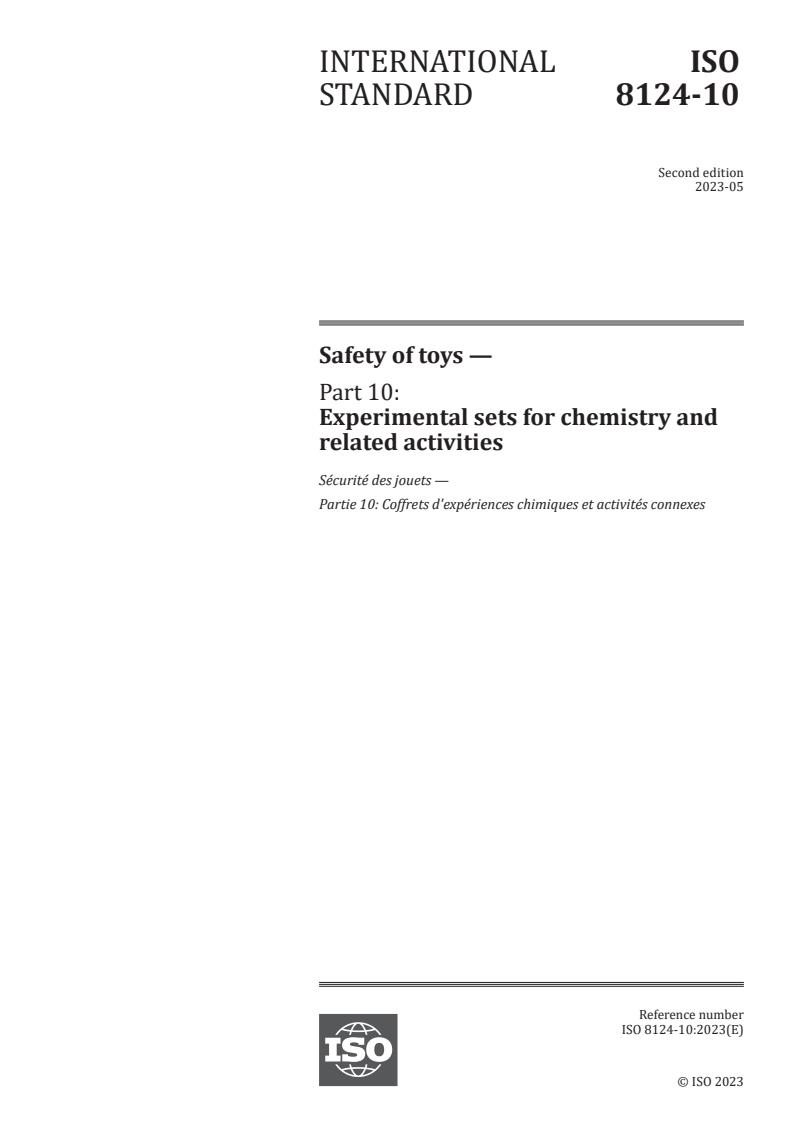
ISO 8124-10:2023 - Safety of toys - Part 10: Experimental sets for chemistry and related activities - defines safety requirements for chemical experimental toy sets. The standard specifies maximum amounts and, where relevant, maximum concentrations of substances and mixtures supplied with chemistry sets, crystal‑growing sets, carbon‑dioxide‑generating sets and supplementary sets. It covers classification by the Globally Harmonized System (GHS), packaging, marking, contents lists, instructions, eye protection and required equipment to reduce health risks to children when sets are used as intended or foreseeably misused.
Key topics and technical requirements
- Scope of chemicals: Applies to substances classified as dangerous under the GHS, substances that can harm children in excessive amounts even if not GHS‑classified, and any other chemicals delivered with the set.
- Set types covered: Chemistry sets, crystal‑growing sets and carbon‑dioxide‑generating experimental sets; supplementary sets are addressed. Combined sets (e.g., chemistry + crystal‑growing) are excluded.
- Quantities and concentrations: Specifies permissible amounts/concentrations for listed substances (see the standard’s tables) - manufacturers must limit supply to safe levels.
- Packaging and containers: Requirements for containers, closures, glassware (test tubes, borosilicate test), and child‑resistant packaging where applicable.
- Equipment and PPE: Minimum provisions for transfer equipment, test tube holders/stands and eye protection.
- Marking and information: Mandatory marking of containers and primary packaging, warnings, a contents list with first‑aid info, clear instructions for use and supervising adult guidance.
- Age and supervision: Sets must include age guidance and emphasize the need for adult supervision; instructions must make experiments safe and controllable.
Practical applications and users
Who uses ISO 8124-10:
- Toy and experimental‑set manufacturers designing compliant chemistry and crystal kits
- Product safety and compliance teams preparing technical files and conformity documentation
- Test laboratories assessing packaging, marking and chemical limits
- Retailers and importers verifying product safety for market placement
- Regulators and standards bodies aligning national requirements with international practice
Benefits:
- Reduces chemical risks to children and clarifies safe product design limits
- Supports regulatory compliance and market access by following recognized safety criteria
- Improves user safety through standardized warnings, content lists and required PPE
Related standards
- ISO 8124-1 - Safety aspects related to mechanical and physical properties
- ISO 8124-11 - Chemical toys (sets) other than experimental sets
- ISO 8317 / EN 862 - Child‑resistant packaging requirements
- EN 71-4 - European basis referenced in the standard
Keywords: ISO 8124-10, safety of toys, experimental sets for chemistry, chemistry sets safety, chemical toy safety, GHS, marking and instructions, eye protection, toy standards.
Relations
- Revises
ISO 8124-10:2019 - Safety of toys — Part 10: Experimental sets for chemistry and related activities - Effective Date
- 23-Apr-2020
Frequently Asked Questions
ISO 8124-10:2023 is a standard published by the International Organization for Standardization (ISO). Its full title is "Safety of toys — Part 10: Experimental sets for chemistry and related activities". This standard covers: This document specifies requirements for the maximum amount and, in some cases, the maximum concentration of certain substances and mixtures used in experimental sets for chemistry and related activities. These substances and mixtures are: — those classified as dangerous by the Globally Harmonized System of Classification and Labelling of Chemicals (GHS);[3] — substances and mixtures which in excessive amounts could harm the health of the children using them and which are not classified as dangerous by the GHS; — any other chemical substance(s) and mixture(s) delivered with the experimental set. This document applies to experimental sets for chemistry and related activities, including chemistry sets, crystal-growing sets, carbon-dioxide-generating experimental sets and supplementary sets. This document also specifies requirements for marking, a contents list, instructions for use, eye protection and the equipment intended for carrying out the experiments. This document does not apply to combined sets, for example a combination of a chemistry set and a crystal-growing set. Requirements for certain other chemical toys are given in ISO 8124-11. See Clause A.1.
This document specifies requirements for the maximum amount and, in some cases, the maximum concentration of certain substances and mixtures used in experimental sets for chemistry and related activities. These substances and mixtures are: — those classified as dangerous by the Globally Harmonized System of Classification and Labelling of Chemicals (GHS);[3] — substances and mixtures which in excessive amounts could harm the health of the children using them and which are not classified as dangerous by the GHS; — any other chemical substance(s) and mixture(s) delivered with the experimental set. This document applies to experimental sets for chemistry and related activities, including chemistry sets, crystal-growing sets, carbon-dioxide-generating experimental sets and supplementary sets. This document also specifies requirements for marking, a contents list, instructions for use, eye protection and the equipment intended for carrying out the experiments. This document does not apply to combined sets, for example a combination of a chemistry set and a crystal-growing set. Requirements for certain other chemical toys are given in ISO 8124-11. See Clause A.1.
ISO 8124-10:2023 is classified under the following ICS (International Classification for Standards) categories: 97.200.50 - Toys. The ICS classification helps identify the subject area and facilitates finding related standards.
ISO 8124-10:2023 has the following relationships with other standards: It is inter standard links to ISO 8124-10:2019. Understanding these relationships helps ensure you are using the most current and applicable version of the standard.
ISO 8124-10:2023 is available in PDF format for immediate download after purchase. The document can be added to your cart and obtained through the secure checkout process. Digital delivery ensures instant access to the complete standard document.
Standards Content (Sample)
INTERNATIONAL ISO
STANDARD 8124-10
Second edition
2023-05
Safety of toys —
Part 10:
Experimental sets for chemistry and
related activities
Sécurité des jouets —
Partie 10: Coffrets d'expériences chimiques et activités connexes
Reference number
© ISO 2023
All rights reserved. Unless otherwise specified, or required in the context of its implementation, no part of this publication may
be reproduced or utilized otherwise in any form or by any means, electronic or mechanical, including photocopying, or posting on
the internet or an intranet, without prior written permission. Permission can be requested from either ISO at the address below
or ISO’s member body in the country of the requester.
ISO copyright office
CP 401 • Ch. de Blandonnet 8
CH-1214 Vernier, Geneva
Phone: +41 22 749 01 11
Email: copyright@iso.org
Website: www.iso.org
Published in Switzerland
ii
Contents Page
Foreword .iv
Introduction .v
1 Scope . 1
2 Normative references . 1
3 Terms and definitions . 2
4 Chemical substances in experimental sets (see Clause A.2) . 3
4.1 Chemistry sets . 3
4.1.1 Inclusion in the chemistry set . 3
4.1.2 Inclusion for experiments (as mentioned in the instructions but not
supplied in the chemistry set) . 3
4.1.3 Requirements for packaging in containers . 4
4.2 Crystal-growing sets . 8
4.3 Carbon-dioxide-generating experimental sets . 10
5 Equipment .11
5.1 General requirements . 11
5.2 Containers and glassware .12
5.2.1 Test tubes . 12
5.2.2 Other glassware .12
5.2.3 Containers for reagents, substances and mixtures .12
5.2.4 Packaging and closures .12
5.2.5 Empty containers . .13
5.2.6 Test method for borosilicate glass . 14
5.3 Equipment for the transfer of liquid . 15
5.4 Test tube stand and test tube holder . 15
5.5 Eye protection . 15
6 Marking (see Clause A.6) .15
6.1 General requirements . 15
6.2 Marking of individual containers, packaging and glassware . 16
6.3 Marking of the primary packaging . 16
6.3.1 Warnings for experimental sets and supplementary sets . 16
6.3.2 Warnings for supplementary sets . 17
7 Contents list with warnings and first aid information .17
8 Instructions for use (see 5.1) .17
8.1 General instructions . 17
8.2 Advice for supervising adults . . 18
8.3 Safety rules . 18
8.3.1 Chemistry sets . 18
8.3.2 Crystal-growing sets . 19
8.3.3 Carbon-dioxide-generating experimental sets . 20
Annex A (informative) Rationale .21
Annex B (informative) Environmental considerations .23
Annex C (informative) Significant technical changes to ISO 8124-10:2019.24
Bibliography .25
iii
Foreword
ISO (the International Organization for Standardization) is a worldwide federation of national standards
bodies (ISO member bodies). The work of preparing International Standards is normally carried out
through ISO technical committees. Each member body interested in a subject for which a technical
committee has been established has the right to be represented on that committee. International
organizations, governmental and non-governmental, in liaison with ISO, also take part in the work.
ISO collaborates closely with the International Electrotechnical Commission (IEC) on all matters of
electrotechnical standardization.
The procedures used to develop this document and those intended for its further maintenance are
described in the ISO/IEC Directives, Part 1. In particular, the different approval criteria needed for the
different types of ISO document should be noted. This document was drafted in accordance with the
editorial rules of the ISO/IEC Directives, Part 2 (see www.iso.org/directives).
ISO draws attention to the possibility that the implementation of this document may involve the use
of (a) patent(s). ISO takes no position concerning the evidence, validity or applicability of any claimed
patent rights in respect thereof. As of the date of publication of this document, ISO had not received
notice of (a) patent(s) which may be required to implement this document. However, implementers are
cautioned that this may not represent the latest information, which may be obtained from the patent
database available at www.iso.org/patents. ISO shall not be held responsible for identifying any or all
such patent rights.
Any trade name used in this document is information given for the convenience of users and does not
constitute an endorsement.
For an explanation of the voluntary nature of standards, the meaning of ISO specific terms and
expressions related to conformity assessment, as well as information about ISO's adherence to
the World Trade Organization (WTO) principles in the Technical Barriers to Trade (TBT), see
www.iso.org/iso/foreword.html.
This document was prepared by Technical Committee ISO/TC 181, Safety of toys.
This second edition cancels and replaces the first edition (ISO 8124-10:2019), which has been technically
revised. The main changes are given in Annex C.
A list of all parts in the ISO 8124 series can be found on the ISO website.
Any feedback or questions on this document should be directed to the user’s national standards body. A
complete listing of these bodies can be found at www.iso.org/members.html.
iv
Introduction
This document is largely based upon an existing standard in the European Union (EN 71-4).
Conformity with the requirements of this document will reduce the risks and health hazards to children
when experimental sets involving chemical experiments are used as intended or in a foreseeable way,
bearing in mind the behaviour of children.
During use of these experimental sets, hazards should be kept to a minimum by the provision of
appropriate information to make the experiments safe and controllable. Therefore, this document
specifies warning phrases and instructions for use with experimental sets.
As a general rule, experimental sets are designed and manufactured for particular ages of children.
Their characteristics are related to the age and stage of development of the children, and their use
presupposes certain aptitudes. Age requirements are therefore given.
The requirements of this document do not release parents or carers from their responsibility of
watching over a child while he or she is carrying out experiments. On the contrary, the use of these sets
requires close supervision by adults.
Products covered by this document can be subject to legal requirements specific to the jurisdiction
in which they are sold and conformity with the requirements in this document cannot be relied on to
ensure compliance with those requirements.
v
INTERNATIONAL STANDARD ISO 8124-10:2023(E)
Safety of toys —
Part 10:
Experimental sets for chemistry and related activities
1 Scope
This document specifies requirements for the maximum amount and, in some cases, the maximum
concentration of certain substances and mixtures used in experimental sets for chemistry and related
activities.
These substances and mixtures are:
— those classified as dangerous by the Globally Harmonized System of Classification and Labelling of
[3]
Chemicals (GHS);
— substances and mixtures which in excessive amounts could harm the health of the children using
them and which are not classified as dangerous by the GHS;
— any other chemical substance(s) and mixture(s) delivered with the experimental set.
This document applies to experimental sets for chemistry and related activities, including chemistry
sets, crystal-growing sets, carbon-dioxide-generating experimental sets and supplementary sets.
This document also specifies requirements for marking, a contents list, instructions for use, eye
protection and the equipment intended for carrying out the experiments.
This document does not apply to combined sets, for example a combination of a chemistry set and a
crystal-growing set.
Requirements for certain other chemical toys are given in ISO 8124-11.
See Clause A.1.
2 Normative references
The following documents are referred to in the text in such a way that some or all of their content
constitutes requirements of this document. For dated references, only the edition cited applies. For
undated references, the latest edition of the referenced document (including any amendments) applies.
ISO 48-5, Rubber, vulcanized or thermoplastic — Determination of hardness — Part 5: Indentation
hardness by IRHD pocket meter method
ISO 868, Plastics and ebonite — Determination of indentation hardness by means of a durometer (Shore
hardness)
ISO 8124-1, Safety of toys — Part 1: Safety aspects related to mechanical and physical properties
ISO 8124-11, Safety of toys — Part 11: Chemical toys (sets) other than experimental sets
ISO 8317, Child-resistant packaging — Requirements and testing procedures for reclosable packages
EN 862, Packaging — Child-resistant packaging — Requirements and testing procedures for non-reclosable
packages for non-pharmaceutical products
3 Terms and definitions
For the purposes of this document, the following terms and definitions apply.
ISO and IEC maintain terminology databases for use in standardization at the following addresses:
— ISO Online browsing platform: available at https:// www .iso .org/ obp
— IEC Electropedia: available at https:// www .electropedia .org/
3.1
chemical toy
toy intended for the direct handling of chemical substances and mixtures and which is used in a manner
appropriate to a given age group and under the supervision of an adult
[SOURCE: ISO 8124-2:2014, 3.1]
3.2
experimental set
chemical toy (3.1) in which the experimental and explorative character in playing with single chemical
substances and mixtures is guided by strict instructions that dominate over the creative ideas of the
user
3.3
chemistry set
experimental set (3.2) consisting of one or more chemical substances and/or mixtures, with or without
equipment, intended for carrying out chemical experiments
Note 1 to entry: The definition also covers experimental sets for chemical experiments within the fields of
mineralogy, biology, physics, microscopy and environmental sciences whenever they contain one or more
chemical substances and/or mixtures which are classified as hazardous according to the GHS, excluding crystal-
growing sets (3.4) and carbon-dioxide-generating experimental sets (3.5).
3.4
crystal-growing set
experimental set (3.2) consisting of one or more chemical substances for growing crystals without any
reaction between the supplied substances
Note 1 to entry: A crystal-growing set is used to grow crystals of different substances in aqueous solutions.
The crystals can be grown on different materials (e.g. stones or gypsum) and can be coloured in different ways
(e.g. with food colours). The expanding nature of the growing crystal is not subject to requirements within
ISO 8124-1 for expanding materials, as the expansion is not related to the absorption of water in the crystal and
the expansion usually takes place over a long period of time (several days or weeks).
3.5
carbon-dioxide-generating experimental set
experimental set (3.2) consisting mainly of a carbon-dioxide-donor substance or mixture and a carbon-
dioxide-liberating substance or mixture which, after combination, generate carbon dioxide in the
presence of water in an open system without any gas-tight restriction or confinement
Note 1 to entry: The set is used to carry out and observe chemical reactions where there is no intention to
generate carbon dioxide in order to demonstrate speed, velocity or noise.
3.6
supplementary set
incomplete experimental set (3.2) which is intended to be used with a complete experimental set (3.2)
4 Chemical substances in experimental sets (see Clause A.2)
4.1 Chemistry sets
4.1.1 Inclusion in the chemistry set
The chemical substances, mixtures and indicators given in Table 1 and Table 2 may be supplied in
chemistry sets or in a supplementary set for a chemistry set up to the amounts and concentrations
specified in those tables.
The quality of the chemicals used should be appropriate for the experiments described. In particular,
the chemicals should not contain impurities or substances that allow undefined or dangerous reactions
to occur.
NOTE 1 Information on the quality of chemicals can be obtained from manufacturers.
Furthermore, colourants and colouring materials which are not specified in Table 2 may only be
supplied in chemistry sets if they do not react with the substances and mixtures of the set and if they do
not fulfil the criteria of any of the following hazard classes:
— “acute toxicity” (hazard class 3.1);
— “skin corrosion/irritation” (hazard class 3.2);
— “serious eye damage/eye irritation” (hazard class 3.3);
— “respiratory or skin sensitisation” (hazard class 3.4);
— “germ cell mutagenicity” (hazard class 3.5);
— “carcinogenicity” (hazard class 3.6);
— “reproductive toxicity” (hazard class 3.7);
— “specific target organ toxicity — single exposure” (hazard class 3.8);
— “specific target organ toxicity — repeated exposure” (hazard class 3.9);
— “aspiration hazard” (hazard class 3.10).
Colourants which are permitted for use in food or cosmetics may be provided.
[3]
NOTE 2 The classification is detailed in the GHS (Part 3: Health Hazards).
Besides the chemical substances, mixtures and indicators given in Table 1 and Table 2 and colourants
and colouring materials, only foodstuffs and additives permitted for use in food and their mixtures may
be supplied in chemistry sets, if pure additives permitted for use in food are not classified as hazardous
substances or mixtures are not classified as hazardous mixtures.
NOTE 3 Samples of rocks, stones and minerals on which to perform experiments in order to distinguish their
composition are sometimes supplied with the set.
4.1.2 Inclusion for experiments (as mentioned in the instructions but not supplied in the
chemistry set)
See Clause A.3.
The use of reagents listed in Table 3 may be suggested in the instructions at concentrations not
exceeding those specified. The substances specified in Table 3 shall not be supplied in a chemistry set.
Apart from its presence in tincture of iodine, denatured alcohol (ethanol) shall not be supplied in a
chemistry set. However, where experiments contained in the instructions of a chemistry set require it,
the use of denatured alcohol may be suggested in the instructions.
The instructions for use may suggest the use of other substances that are not classified as hazardous
substances or mixtures that are not classified as hazardous mixtures (e.g. sucrose, table sugar, starch,
[3]
flour).
4.1.3 Requirements for packaging in containers
The substances and mixtures in Tables 1 and 2 in a chemistry set or in a supplementary set of a
chemistry set shall be supplied in containers (see 5.2.3) which are provided with closures (see 5.2.4.1).
Table 1 — Maximum amounts of chemical substances and mixtures for chemistry sets and
labelling
Chemical Maxi- GHS Signal CAS EINECS INDEX
substance or mixture mum picto- word Registry number number
®e
amount grams (see Number
per set Figure 1)
Aluminium potassium 10 g — — 10043–67–1 233–141–3 —
sulfate
Ammonium carbonate 5 g GHS07 Warning 10361–29–2 233–786–0 —
Ammonium chloride 30 g GHS07 Warning 12125–02–9 235–186–4 017–014–
00–8
Ammonium iron (III) 5 g GHS05 Danger 10138–04–2 233–382–4 —
sulfate
Ammonium sodium hydro- 5 g — — 13011–54–6 235–860–8 —
gen phosphate
Calcium carbonate 100 g — — 471–34–1 207–439–9 —
Calcium chloride 10 g GHS07 Warning 10043–52–4 233–140–8 017–013–
00–2
a
Calcium hydroxide 20 g GHS05, GHS07 Danger 1305–62–0 215–137–3 —
Calcium nitrate 5 g GHS03, Danger 10124–37–5 233–332–1 —
GHS05, GHS07
a
Calcium oxide 10 g GHS05, GHS07 Danger 1305–78–8 215–138–9 —
Calcium sulfate 100 g — — 7778–18–9 231–900–3 —
b
Charcoal 100 g — — 7440–44–0 231–153–3 —
Citric acid 20 g GHS07 Warning 77–92–9 201–069–1 —
Copper sheet 100 g — — 7440–50–8 231–159–6 —
Copper (II) oxide 10 g GHS07, GHS09 Warning 1317–38–0 215–269–1 029–016–
00–6
Copper (II) sulfate 15 g GHS05, Danger 7758–98–7 231–847–6 029–004–
GHS07, GHS09 00–0
Disodium disulfite 10 g GHS05, GHS07 Danger 7681–57–4 231–673–0 016–063–
00–2
a
Only one of these substances shall be provided in each set.
b
Generally, IUPAC chemical nomenclature is used with the exception of these substances.
c
Only to be provided in chemistry sets intended for children over 12 years of age.
d
Denatured alcohol (ethanol).
e ®
Chemical Abstracts Service (CAS) Registry Number is a trademark of the American Chemical Society (ACS). This
information is given for the convenience of users of this document and does not constitute an endorsement by ISO of the
product named.
TTabablele 1 1 ((ccoonnttiinnueuedd))
Chemical Maxi- GHS Signal CAS EINECS INDEX
substance or mixture mum picto- word Registry number number
®e
amount grams (see Number
per set Figure 1)
Glycerol (containing at 25 g — — 56–81–5 200–289–5 —
least 15 % water)
Hexamethylene-te- 10 g GHS02, GHS07 Warning 100–97–0 202–905–8 612–101–00–2
b
tramine (solid fuel)
b
Iron filings 100 g GHS02 Warning 7439–89–6 231–096–4 —
b
Iron powder 100 g GHS02 Danger 7439–89–6 231–096–4 —
Iron (III) chloride 10 g GHS05, GHS07 Danger 7705–08–0 231–729–4 —
Iron (II) sulfate 10 g GHS07 Warning 7720–78–7 231–753–5 026–003–
00–7
Lactose 100 g — — 63–42–3 200–559–2 —
Lead-free solder 100 g — — — — —
Magnesium strip 3 g GHS02 Warning 7439–95–4 231–104–6 012–001–
00–3
Magnesium sulfate 25 g — — 7487–88–9 231–298–2 —
Manganese (IV) dioxide 5 g GHS07, GHS08 Danger 1313–13–9 215–202–6 025–001–
00–3
Manganese (II) sulfate 15 g GHS05, Danger 7785–87–7 232–089–9 025–003–
GHS08, GHS09 00–4
Ninhydrin 1 g GHS07 Warning 485–47–2 207–618–1 —
Pepsin A 10 g GHS07, GHS08 Danger 9001–75–6 232–629–3 647–008–
00–6
Potassium bromide 15 g GHS07 Warning 7758–02–3 231–830–3 —
Potassium hexacyanofer- 10 g GHS07 Warning 13746–66–2 237–323–3 —
b
rate (III)
Potassium hexacyanofer- 10 g — — 13943–58–3 237–722–2 —
b
rate (II)
Potassium iodide 10 g GHS08 Danger 7681–11–0 231–659–4 —
c
Potassium permanganate 15 g GHS03, Danger 7722–64–7 231–760–3 025–002–
GHS07, 00–9
GHS08, GHS09
Potassium permanganate: 10 g GHS03, Danger — — —
sodium sulfate mixture GHS07,
(1:2) (mass fraction) GHS08, GHS09
Silver nitrate 10 ml GHS05, Warning 7761–88–8 231–853–9 047–001–
(0,01 g/ml mass concen- GHS07, GHS09 00–2
tration aqueous solution)
Sodium acetate 20 g — — 127–09–3 204–823–8 —
Sodium carbonate 50 g GHS07 Warning 497–19–8 207–838–8 011–005–
00–2
Sodium chloride 100 g — — 7647–14–5 231–598–3 —
a
Only one of these substances shall be provided in each set.
b
Generally, IUPAC chemical nomenclature is used with the exception of these substances.
c
Only to be provided in chemistry sets intended for children over 12 years of age.
d
Denatured alcohol (ethanol).
e ®
Chemical Abstracts Service (CAS) Registry Number is a trademark of the American Chemical Society (ACS). This
information is given for the convenience of users of this document and does not constitute an endorsement by ISO of the
product named.
TTabablele 1 1 ((ccoonnttiinnueuedd))
Chemical Maxi- GHS Signal CAS EINECS INDEX
substance or mixture mum picto- word Registry number number
®e
amount grams (see Number
per set Figure 1)
Sodium hydrogen car- 50 g — — 144–55–8 205–633–8 —
bonate
Sodium hydrogen sulfate 30 g GHS05 Danger 7681–38–1 231–665–7 016–046–00-
X
Sodium silicate solution 100 ml GHS05 Danger 1344–09–8 215–687–4 —
(SiO : Na O > 2)
2 2
Sodium sulfate 100 g — — 7757–82–6 231–820–9 —
Sodium thiosulfate 50 g — — 7772–98–7 231–867–5 —
Sulfur 15 g GHS07 Warning 7704–34–9 231–722–6 016–094–
00–1
Tannin 15 g — — 1401–55–4 215–753–2 —
Tartaric acid 20 g GHS05 Danger 87–69–4 201–766–0 —
Tin (II) chloride 15 g GHS05, Danger 7772–99–8 231–868–0 —
GHS07,
GHS08, GHS09
b
Tincture of iodine 10 ml GHS02, Danger 7553–56–2 231–442–4 053–001–003
(0,025 g/ml mass concen- GHS07, GHS08
d
tration ethanolic solution)
b
Urea 10 g — — 57–13–6 200–315–5 —
Zinc powder (stabilized) or 20 g GHS09 Warning 7440–66–6 231–175–3 030–001–
zinc pellets 01–9
Zinc sulfate 20 g GHS05, Danger 7446–20–0 231–793–3 030–006–
(heptahydrate) GHS07, GHS09 00–9
a
Only one of these substances shall be provided in each set.
b
Generally, IUPAC chemical nomenclature is used with the exception of these substances.
c
Only to be provided in chemistry sets intended for children over 12 years of age.
d
Denatured alcohol (ethanol).
e ®
Chemical Abstracts Service (CAS) Registry Number is a trademark of the American Chemical Society (ACS). This
information is given for the convenience of users of this document and does not constitute an endorsement by ISO of the
product named.
If indicators are supplied in solution, their solid contents shall not exceed the amounts and
concentrations specified in Table 2.
Non-bleeding indicators in books, pads or rolls are not of toxicological concern and are sometimes
supplied without any quantity limitations for the relevant indicator(s).
Table 2 — Maximum amounts and concentrations of indicators for chemistry sets and labelling
Chemical substance or Maxi- GHS picto- Signal CAS EINECS INDEX
mixture mum grams word Registry number number
amount (see Number
per set Figure 1)
Eosin 1 g GHS07 Warning 17372–87–1 241–409–6 —
Iodine [0,025 g/ml mass
concentration in an aqueous
053–001–
solution (0,025 g/ml mass 10 ml GHS08 Warning 7553–56–2 231–442–4
00–3
concentration) of potassium
iodide]
Litmus blue 1 g — — 1393–92–6 215–739–6 —
Litmus red 1 g — — 1393–92–6 215–739–6 —
Luminol [5 % (mass fraction) —
3 g — — 521–31–3 208–309–4
mixture with sodium sulfate]
Methyl orange [15 % (mass —
fraction) mixture with sodi- 3 g GHS07 Warning 547–58–0 208–925–3
um sulfate]
Methylene blue 1 g GHS07 Warning 61–73–4 200–515–2 —
Phenol red 1 g GHS07 Warning 143–74–8 205–609–7 —
Thymol blue 1 g — — 76–61–9 200–973–3 —
Bleeding universal indicator — — — — —
1 pad
paper
If not mentioned otherwise, the maximum amounts of the solid substances in Table 1 and Table 2 refer
to the anhydrous chemicals. Equivalent amounts of the hydrated chemicals may replace the anhydrous
substances.
Table 3 — Maximum concentration of reagents not supplied with the chemistry set and
labelling
Reagent Maximum GHS picto- Signal CAS EINECS INDEX
concentra- grams word Registry number number
tion (see Figure 1) Number
mol/l
Ammonia solution 1336–21–
2 GHS05 Danger 215–647–6 007–001–01–2
Hydrochloric acid 2 GHS05 Warning 7647–01–0 231–595–7 017–002–01-X
a
Hydrogen peroxide 7722–
1 — — 231–765–0 008–003–00–9
84–1
Sodium hydroxide solution 1 GHS05 Danger 1310–73–2 215–185–5 011–002–00–6
Additional units (e.g. percentage) may also be used, for example, on the packaging or the instructions for use.
a
The concentration of hydrogen peroxide is equivalent to a 3 % (volume fraction) solution.
a) GHS02 b) GHS03 c) GHS05
d) GHS07 e) GHS08 f) GHS09
The use of these pictograms shall comply with the requirements in the GHS.
[3]
SOURCE: GHS.
Figure 1 — GHS pictograms
4.2 Crystal-growing sets
See Clause A.4.
The chemical substances given in Table 4 may be supplied in crystal-growing sets or in a supplementary
set for a crystal-growing set up to the amounts specified.
A crystal-growing set shall only contain substances which cannot react with each other.
The quality of the chemicals used in crystal-growing sets should be appropriate for the experiments
described; in particular, the chemicals should not contain impurities or substances which allow
undefined or dangerous reactions to occur.
Besides the chemical substances given in Table 4, only colourants and colouring materials which do not
fulfil the criteria of any of the following hazard classes shall be supplied in crystal-growing sets:
— “acute toxicity” (hazard class 3.1);
— “skin corrosion/irritation” (hazard class 3.2);
— “serious eye damage/eye irritation” (hazard class 3.3);
— “respiratory or skin sensitisation” (hazard class 3.4);
— “germ cell mutagenicity” (hazard class 3.5);
— “carcinogenicity” (hazard class 3.6);
— “reproductive toxicity” (hazard class 3.7);
— “specific target organ toxicity — single exposure” (hazard class 3.8);
— “specific target organ toxicity — repeated exposure” (hazard class 3.9);
— “aspiration hazard” (hazard class 3.10).
[3]
NOTE The classification is detailed in the GHS (Part 3: Health Hazards).
If substances are supplied as mixtures or if substances or mixtures are supplied in solution, their solid
contents shall not exceed the amounts specified in Table 4.
Samples of materials on which to grow the crystals may be supplied with the set [e.g. plaster of Paris
(gypsum), different stones, different minerals] without limits to their quantities. For gypsum, applicable
requirements shall be as specified in ISO 8124-11 (e.g. labelling).
Colourants which are permitted for use in food or cosmetics may be provided.
The substances and mixtures in Table 4 in a crystal-growing set or in a supplementary set for a crystal-
growing set shall be supplied in child-resistant packaging (see 5.2.4.2).
Table 4 — Maximum amounts of chemical substances for crystal-growing sets and labelling
Chemical substance Maxi- GHS picto- Signal CAS EINECS INDEX
mum grams (see word Registry number number
amount Figure 1) Number
per set
g
017–014–
a
Ammonium chloride 30 GHS07 Warning 12125–02–9 235–186–4
00–8
Ammonium dihydrogen or-
thophosphate (ammonium 600 — — 7722–76–1 231–764–5 —
biphosphate)
Aluminium potassium
600 — — 7784–24–9 233–141–3 —
sulfate
b
Citric acid 50 GHS07 Warning 77–92–9 201–069–1 —
GHS05, GHS07, 029–004–
Copper (II) sulfate 50 Danger 7758–98–7 231–847–6
GHS09 00–0
026–003–
Iron (II) sulfate 50 GHS07 Warning 7782–63–0 231–753–5
00–7
Magnesium sulfate 100 — — 10034–99–8 231–298–2 —
Potassium dihydrogen
600 — — 7778–77–0 231–913–4 —
phosphate
Potassium hexacyanofer-
100 GHS07 Warning 13746–66–2 237–323–3 —
rate (III)
Potassium sodium tartrate 600 — — 6381–59–5 205–698–2 —
Sodium acetate 100 — — 127–09–3 204–823–8 —
Sodium hydrogen carbonate 600 — — 144–55–8 205–633–8 —
b
Sodium silicate
50 GHS05, GHS07 Danger 1344–09–8 215–687–4 —
(SiO : Na O > 2)
2 2
Sodium sulfate 100 — — 7757–82–6 231–820–9 —
Sodium thiosulfate 600 — — 7772–98–7 231–867–5 —
e.g. 12004– e.g. 234–
Strontium aluminate 5 GHS 07 Warning —
d d
37–4 455–3
b
Tartaric acid 50 GHS05 Danger 87–69–4 201–766–0 —
The maximum amounts specified refer to anhydrous chemicals. Equivalent amounts of the hydrated chemicals may replace
the anhydrous substances.
a
Shall be supplied as an aqueous solution.
b
Shall not be supplied in a set with sodium hydrogen carbonate.
c
Shall not be supplied in a set with any acid, for example citric acid.
d
If different to the given number, the CAS or EINECS number of the chemical supplier should be given.
TTabablele 4 4 ((ccoonnttiinnueuedd))
Chemical substance Maxi- GHS picto- Signal CAS EINECS INDEX
mum grams (see word Registry number number
amount Figure 1) Number
per set
g
Trisodium citrate 600 — — 6132–04–3 200–675–3 —
e.g. 1314– e.g. 215–
c
Zinc sulfide 5 — — —
d d
98–3 251–3
The maximum amounts specified refer to anhydrous chemicals. Equivalent amounts of the hydrated chemicals may replace
the anhydrous substances.
a
Shall be supplied as an aqueous solution.
b
Shall not be supplied in a set with sodium hydrogen carbonate.
c
Shall not be supplied in a set with any acid, for example citric acid.
d
If different to the given number, the CAS or EINECS number of the chemical supplier should be given.
4.3 Carbon-dioxide-generating experimental sets
See Clause A.5.
The chemical substances given in Table 5 may be supplied in carbon-dioxide-generating experimental
sets whose function relies on the generation of carbon dioxide. The amounts supplied in a single set
shall not exceed those specified in Table 5. If mixtures of these substances are supplied in solid form,
the single mixture shall consist of stoichiometric equivalent amounts of acidic and carbon-dioxide-
generating substances.
The quality of the chemicals used in carbon-dioxide-generating experimental sets should be appropriate
for the experiments described; in particular, the chemicals should not contain impurities or substances
which allow undefined or dangerous reactions to occur.
Besides the chemical substances given in Table 5, carbon-dioxide-generating experimental sets may
only contain gypsum or colourants. For gypsum, applicable requirements are specified in ISO 8124-11
(e.g. labelling). Only colourants and colouring materials which do not fulfil the criteria of any of the
following hazard classes shall be supplied in carbon-dioxide-generating experimental sets:
— “acute toxicity” (hazard class 3.1);
— “skin corrosion/irritation” (hazard class 3.2);
— “serious eye damage/eye irritation” (hazard class 3.3);
— “respiratory or skin sensitisation” (hazard class 3.4);
— “germ cell mutagenicity” (hazard class 3.5);
— “carcinogenicity” (hazard class 3.6);
— “reproductive toxicity” (hazard class 3.7);
— “specific target organ toxicity — single exposure” (hazard class 3.8);
— “specific target organ toxicity — repeated exposure” (hazard class 3.9);
— “aspiration hazard” (hazard class 3.10).
Colourants that are permitted for use in food or cosmetics may be provided.
[3]
NOTE The classification is detailed in the GHS (Part 3: Health Hazards).
If substances are supplied as mixtures or if substances or mixtures are supplied in solution, their solid
contents shall not exceed the amounts specified in Table 5.
The substances in Table 5 in a carbon-dioxide-generating experimental set shall be supplied in child-
resistant packaging (see 5.2.4.3).
Table 5 — Maximum amounts of chemical substances for carbon-dioxide-generating
experimental sets and labelling
Chemical substance Maximum GHS picto- Signal CAS EINECS INDEX
amount grams (see word Registry number number
per set Figure 1) Number
g
a
Citric acid 100 GHS07 Warning 77–92–9 201–069–1 —
Disodium hydrogen phos-
20 — — 7558–79–4 231–448–7 —
phate
a
Malic acid 60 GHS07 Warning 6915–15–7 230–022–8 —
Potassium hydrogen car-
50 — — 298–14–6 206–059–0 —
bonate
Potassium dihydrogen phos-
100 — — 7778–77–0 231–913–4 —
phate
Sodium dihydrogen phos-
70 — — 7558–80–7 231–449–2 —
phate
Sodium hydrogen carbonate 100 — — 144–55–8 205–633–8 —
a
Tartaric acid 60 GHS05 Danger 87–69–4 201–766–0 —
The maximum amounts specified refer to anhydrous chemicals. Equivalent amounts of the hydrated chemicals may replace
the anhydrous substances.
a
Only one of these substances shall be provided in each set.
5 Equipment
5.1 General requirements
Experimental sets, excluding supplementary sets, shall be supplied with instructions for use (see
Clause 8); a contents list with warnings and first aid information (see Clause 7); the equipment
necessary for carrying out the experiments described in the instructions for use; and, if required, eye
protection (see 5.5) and/or a test tube stand (see 5.4).
Supplementary sets shall be supplied with instructions for use (see Clause 8) and a contents list with
warnings and first aid information, as specified in Clause 7.
All the experiments described in the instructions for use shall be evaluated by the manufacturer. In
particular, it shall not be possible for substances to be formed in amounts that are injurious to health.
Any known hazards arising from the use of the set, especially during the experiments, should be
detailed (e.g. handling of chemicals, handling of glassware, retarded boiling point, back flow of barrier
water into overheated glassware, evolution of gases and handling of burners and other heating sources).
5.2 Containers and glassware
5.2.1 Test tubes
5.2.1.1 Sets in which test tubes are heated
In experimental sets where the instructions for use include chemical experiments in which test tubes
are heated, all test tubes shall be made of borosilicate glass in order to be heat-resistant.
Glass test tubes which are intended to be heated shall have dimensions greater than 110 mm in length
and greater than 15 mm in internal diameter.
Glass test tubes which are not intended to be heated, for example those used as containers, shall have
dimensions not greater than 90 mm in length and not greater than 12 mm in internal diameter unless
they are made of borosilicate glass.
When necessary, borosilicate glass shall be identified by the test method described in 5.2.6.
5.2.1.2 Sets in which test tubes are not heated
In experimental sets where the instructions for use do not include chemical experiments in which glass
test tubes are heated, any glass tubes not made of borosilicate glass shall be labelled in accordance with
6.2.
5.2.2 Other glassware
In experimental sets where the instructions for use include experiments in which laboratory glassware
is heated, all glassware intended to be heated shall be made of borosilicate glass in order to be heat-
resistant. This requirement does not apply to glass tubing intended to be heated for the purpose of
bending.
Unless made of borosilicate glass, glassware which is not intended to be heated, but which by its
appearance or shape could be construed as being suitable for heating, shall be labelled in accordance
with 6.2.
When necessary, borosilicate glass shall be identified by the test method described in 5.2.6.
5.2.3 Containers for reagents, substances and mixtures
Containers for reagents shall differ in size and shape from laboratory glassware to avoid them being
mistaken as glassware for use in experiments.
All containers for reagents, substances and mixtures shall be shock-resistant. They shall not break or
crack when subjected to the drop test specified in ISO 8124-1.
5.2.4 Packaging and closures
5.2.4.1 Chemistry sets
All substances and mixtures in Tables 1 and 2 shall be supplied in child-resistant containers. Closures
for child-resistant containers shall conform with ISO 8317.
Closures for child-resistant containers intended to be used for liquids shall not break, crack or leak
when tested in according to the following procedure:
— Fill the container with water. The filling volume shall be three-quarters of the container volume.
— Attach the closure.
— Drop the filled container, including its closure, with its closure facing downwards, five times from
a height of (850 ± 50) mm on to a 4-mm-thick steel plate which has a 2-mm-thick coating of shore
A hardness (75 ± 5) as measured according to ISO 868 or ISO 48-5 and which is placed on a non-
flexible horizontal surface.
— Check visually for any breaks, cracks or leakages of the closure.
NOTE Conformity with these requirements is intended to prevent younger children accessing materials
contained in such containers.
5.2.4.2 Crystal-growing sets
The following crystal-growing substances in Table 4 shall be supplied in packaging that conforms with
5.2.4.1:
— ammonium chloride;
— citric acid;
— copper (II) sulfate;
— iron (II) sulfate;
— potassium hexacyanoferrate (III);
— sodium silicate;
— strontium aluminate;
— tartaric acid.
All other crystal-growing substances in Table 4 shall be supplied either:
a) in containers which are provided with closures that conform with 5.2.4.1; or
b) in non-reclosable, child-resistant packaging, as specified in EN 862.
The containers and/or packaging in which the substances are supplied shall not contain more than
200 g.
5.2.4.3 Carbon-dioxide-generating experimental sets
The following carbon-dioxide-generating substances in Table 5 shall be supplied in packaging that
conforms with 5.2.4.1:
— citric acid;
— tartaric acid;
— malic acid.
All other carbon-dioxide-generating substances in Table 5 shall be supplied either:
a) in containers which are provided with closures that conform with 5.2.4.1; or
b) in non-reclosable, child-resistant packaging, as specified in EN 862.
5.2.5 Empty containers
Empty containers intended for storage of reagents in Table 3 shall have a maximum volume in
accordance with Table 6 and shall be provided with closures (see 5.2.4.1).
Table 6 — Maximum volume of the empty containers for reagents (see Table 3)
Maximum volume
of the empty container
Reagent
ml
Ammonia solution 50
Hydrochloric acid 100
Hydrogen peroxide 100
Sodium hydroxide solution 100
5.2.6 Test method for borosilicate glass
5.2.6.1 General
Several methods exist to distinguish borosilicate glass, for example determination of density and
refractive index. A density method is given in this subclause.
5.2.6.2 Apparatus
5.2.6.2.1 25-ml pycnometer.
5.2.6.2.2 Water bath, capable of maintaining a temperature of (20 ± 1) °C.
5.2.6.2.3 Deionised water.
5.2.6.2.4 Analytical balance, accuracy 0,1 mg.
5.2.6.3 Procedure
a) Weigh the pycnometer (m ).
b) Make sure that the fraction from the glass sample is clean. Place it in the pycnometer and re-weigh
the pycnometer (m ).
c) Fill up the pycnometer with water and place it in a water bath until the conte
...