

ISO 8124-6:2023
(Main)Safety of toys — Part 6: Certain phthalate esters
General Information
- Abstract
This document specifies a method standard for the determination of di-iso-butyl phthalate (DIBP), di-n-butyl phthalate (DBP), benzyl-butyl phthalate (BBP), bis-(2-ethylhexyl) phthalate (DEHP), di-n-octyl phthalate (DNOP), di-iso-nonyl phthalate (DINP) and di-iso-decyl phthalate (DIDP) in toys. It can also be applied to other phthalate esters (see G.2) if adequate validation is demonstrated. This document applies to toys made of plastics, textiles, coatings and liquids. This document has been validated for polyvinylchloride (PVC) and polyurethane (PU) plastics and some representative paint coatings (see Annex B). This document can also be applied to other product categories.
- Status
- Published
- Publication Date
- 03-Aug-2023
- Technical Committee
- ISO/TC 181 - Safety of toys
- Drafting Committee
- ISO/TC 181/WG 6 - Phthalate plasticizers in toys
- Current Stage
- 9092 - International Standard to be revised
- Start Date
- 22-Jan-2026
- Completion Date
- 29-Aug-2026

Overview
ISO 8124-6:2023 - Safety of toys, Part 6: Certain phthalate esters is a method standard for the laboratory determination of key phthalate esters in toys and similar products. It specifies sampling, extraction and analytical procedures (including GC‑MS analysis and calibration options) for quantifying DIBP, DBP, BBP, DEHP, DNOP, DINP and DIDP. The method is validated for PVC and PU plastics and representative paint coatings, and can be extended to other phthalate esters or product categories with appropriate validation.
Keywords: ISO 8124-6:2023, phthalate esters, toy safety, phthalates in toys, phthalate testing method
Key Topics
- Target analytes: DIBP, DBP, BBP, DEHP, DNOP, DINP, DIDP (with allowance for other phthalates if validated).
- Scope of materials: plastics, textiles, coatings and liquids (validated for PVC, PU and some coatings - see Annex B).
- Sampling and test portions: rules for individual and composite test portions; composite test design and mathematical model (Annex D).
- Extraction methods: multiple extraction routes (Methods A, B, C) and optional Soxhlet/solvent/ultrasonic procedures (Annex C, E).
- Analytical technique: GC‑MS identification and quantification with external (ES) or internal standard (IS) calibration; example GC‑MS conditions provided (Annex F).
- Quality control: requirements for limit of quantification (LOQ), method blanks, recovery checks, calibration verification and precision (Annex B).
- Calculations & conformity: explicit formulas for individual and composite test results, including maximum-concentration assessments.
- Practical details: sample weighing, extract clean‑up, final solution volume adjustments and reporting requirements.
Applications
Who uses ISO 8124-6:2023 and why:
- Testing laboratories - for accredited phthalate testing and routine conformity assessment of toys.
- Toy manufacturers & suppliers - to verify material compliance and control phthalate content in PVC/PU/plasticized components and coatings.
- Regulators & market surveillance - to harmonize enforcement testing protocols and compare results across jurisdictions.
- Importers & retailers - to ensure product batches meet national or regional phthalate restrictions. Practical benefits include standardized sampling, reliable GC‑MS workflows, composite testing for efficient batch screening, and documented QC procedures for reproducible results.
Related standards
- ISO 8124 series (see ISO website) - harmonized toy safety parts.
- ISO 8124-1:2022 referenced for mechanical/physical safety context.
Note: ISO 8124-6:2023 provides the test method only; it does not set concentration limits - users should refer to applicable national or regional phthalate restrictions when assessing conformity.
Relations
- Revises
ISO 8124-6:2018 - Safety of toys — Part 6: Certain phthalate esters in toys and children's products - Effective Date
- 23-Apr-2020
Frequently Asked Questions
ISO 8124-6:2023 is a standard published by the International Organization for Standardization (ISO). Its full title is "Safety of toys — Part 6: Certain phthalate esters". This standard covers: This document specifies a method standard for the determination of di-iso-butyl phthalate (DIBP), di-n-butyl phthalate (DBP), benzyl-butyl phthalate (BBP), bis-(2-ethylhexyl) phthalate (DEHP), di-n-octyl phthalate (DNOP), di-iso-nonyl phthalate (DINP) and di-iso-decyl phthalate (DIDP) in toys. It can also be applied to other phthalate esters (see G.2) if adequate validation is demonstrated. This document applies to toys made of plastics, textiles, coatings and liquids. This document has been validated for polyvinylchloride (PVC) and polyurethane (PU) plastics and some representative paint coatings (see Annex B). This document can also be applied to other product categories.
This document specifies a method standard for the determination of di-iso-butyl phthalate (DIBP), di-n-butyl phthalate (DBP), benzyl-butyl phthalate (BBP), bis-(2-ethylhexyl) phthalate (DEHP), di-n-octyl phthalate (DNOP), di-iso-nonyl phthalate (DINP) and di-iso-decyl phthalate (DIDP) in toys. It can also be applied to other phthalate esters (see G.2) if adequate validation is demonstrated. This document applies to toys made of plastics, textiles, coatings and liquids. This document has been validated for polyvinylchloride (PVC) and polyurethane (PU) plastics and some representative paint coatings (see Annex B). This document can also be applied to other product categories.
ISO 8124-6:2023 is classified under the following ICS (International Classification for Standards) categories: 97.200.50 - Toys. The ICS classification helps identify the subject area and facilitates finding related standards.
ISO 8124-6:2023 has the following relationships with other standards: It is inter standard links to ISO 8124-6:2018. Understanding these relationships helps ensure you are using the most current and applicable version of the standard.
ISO 8124-6:2023 is available in PDF format for immediate download after purchase. The document can be added to your cart and obtained through the secure checkout process. Digital delivery ensures instant access to the complete standard document.
Standards Content (Sample)
INTERNATIONAL ISO
STANDARD 8124-6
Third edition
2023-08
Safety of toys —
Part 6:
Certain phthalate esters
Sécurité des jouets —
Partie 6: Certains esters de phtalates
Reference number
© ISO 2023
All rights reserved. Unless otherwise specified, or required in the context of its implementation, no part of this publication may
be reproduced or utilized otherwise in any form or by any means, electronic or mechanical, including photocopying, or posting on
the internet or an intranet, without prior written permission. Permission can be requested from either ISO at the address below
or ISO’s member body in the country of the requester.
ISO copyright office
CP 401 • Ch. de Blandonnet 8
CH-1214 Vernier, Geneva
Phone: +41 22 749 01 11
Email: copyright@iso.org
Website: www.iso.org
Published in Switzerland
ii
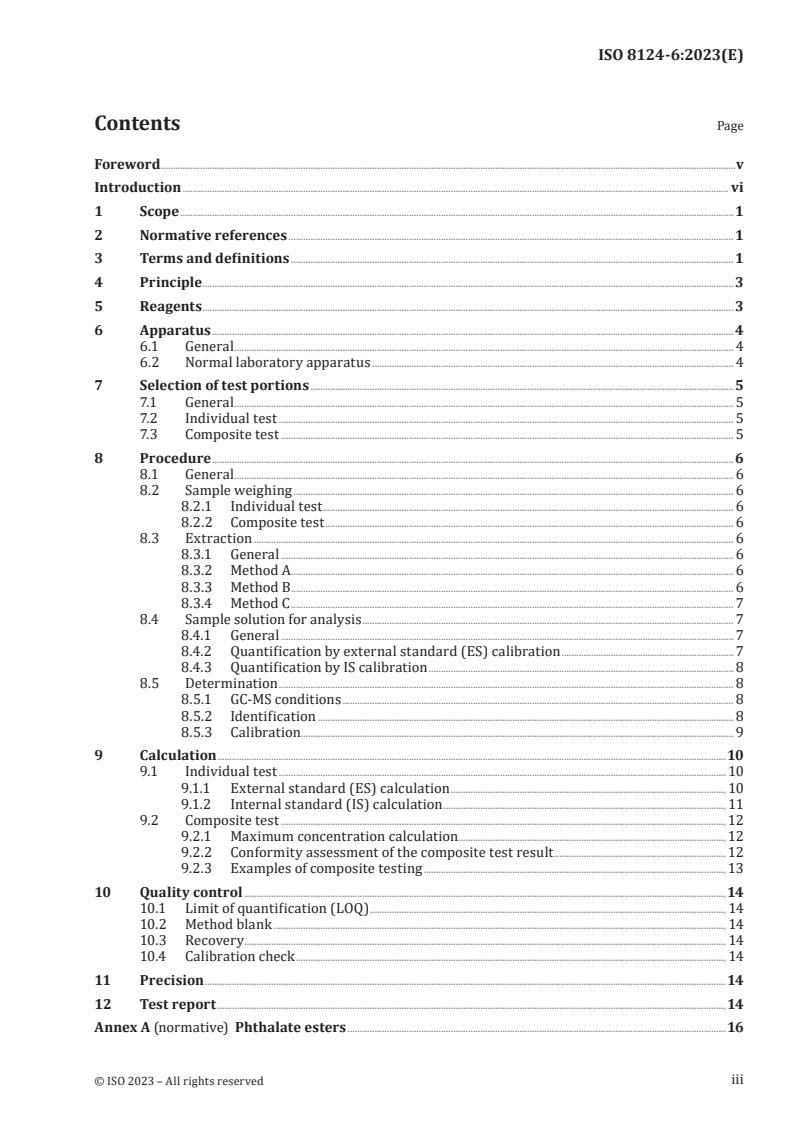
Contents Page
Foreword .v
Introduction . vi
1 Scope . 1
2 Normative references . 1
3 Terms and definitions . 1
4 Principle . 3
5 Reagents . 3
6 Apparatus . 4
6.1 General . 4
6.2 Normal laboratory apparatus . 4
7 Selection of test portions .5
7.1 General . 5
7.2 Individual test . 5
7.3 Composite test . 5
8 Procedure .6
8.1 General . 6
8.2 Sample weighing . 6
8.2.1 Individual test . 6
8.2.2 Composite test . 6
8.3 Extraction . 6
8.3.1 General . 6
8.3.2 Method A . . . 6
8.3.3 Method B . 6
8.3.4 Method C . 7
8.4 Sample solution for analysis . 7
8.4.1 General . 7
8.4.2 Quantification by external standard (ES) calibration . 7
8.4.3 Quantification by IS calibration . 8
8.5 Determination . 8
8.5.1 GC-MS conditions . 8
8.5.2 Identification . 8
8.5.3 Calibration . . . 9
9 Calculation .10
9.1 Individual test . 10
9.1.1 External standard (ES) calculation . 10
9.1.2 Internal standard (IS) calculation . 11
9.2 Composite test .12
9.2.1 Maximum concentration calculation.12
9.2.2 C onformity assessment of the composite test result .12
9.2.3 Examples of composite testing . 13
10 Quality control .14
10.1 Limit of quantification (LOQ) . 14
10.2 Method blank . 14
10.3 Recovery . 14
10.4 Calibration check . 14
11 Precision .14
12 Test report .14
Annex A (normative) Phthalate esters .16
iii
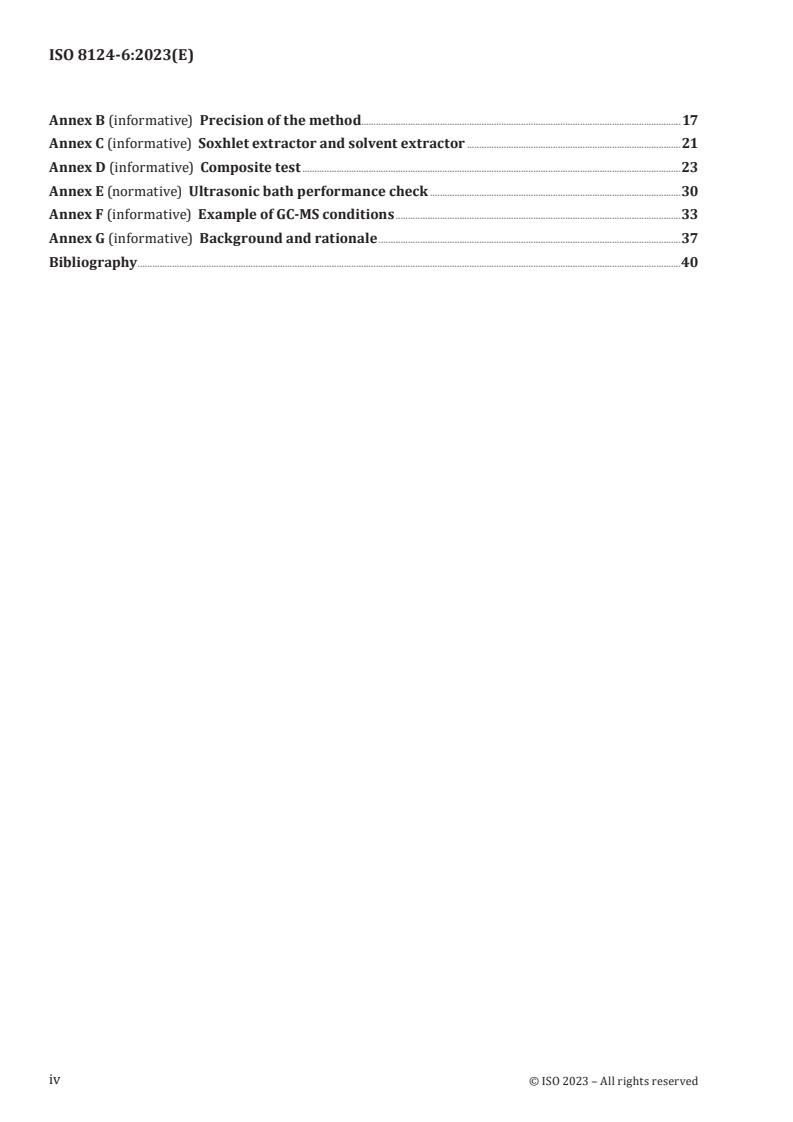
Annex B (informative) Precision of the method.17
Annex C (informative) Soxhlet extractor and solvent extractor .21
Annex D (informative) Composite test .23
Annex E (normative) Ultrasonic bath performance check .30
Annex F (informative) Example of GC-MS conditions .33
Annex G (informative) Background and rationale .37
Bibliography .40
iv
Foreword
ISO (the International Organization for Standardization) is a worldwide federation of national standards
bodies (ISO member bodies). The work of preparing International Standards is normally carried out
through ISO technical committees. Each member body interested in a subject for which a technical
committee has been established has the right to be represented on that committee. International
organizations, governmental and non-governmental, in liaison with ISO, also take part in the work.
ISO collaborates closely with the International Electrotechnical Commission (IEC) on all matters of
electrotechnical standardization.
The procedures used to develop this document and those intended for its further maintenance are
described in the ISO/IEC Directives, Part 1. In particular, the different approval criteria needed for the
different types of ISO document should be noted. This document was drafted in accordance with the
editorial rules of the ISO/IEC Directives, Part 2 (see www.iso.org/directives).
ISO draws attention to the possibility that the implementation of this document may involve the use
of (a) patent(s). ISO takes no position concerning the evidence, validity or applicability of any claimed
patent rights in respect thereof. As of the date of publication of this document, ISO had received notice
of (a) patent(s) which may be required to implement this document. However, implementers are
cautioned that this may not represent the latest information, which may be obtained from the patent
database available at www.iso.org/patents. ISO shall not be held responsible for identifying any or all
such patent rights.
Any trade name used in this document is information given for the convenience of users and does not
constitute an endorsement.
For an explanation of the voluntary nature of standards, the meaning of ISO specific terms and
expressions related to conformity assessment, as well as information about ISO's adherence to
the World Trade Organization (WTO) principles in the Technical Barriers to Trade (TBT), see
www.iso.org/iso/foreword.html.
This document was prepared by Technical Committee ISO/TC 181, Safety of toys.
A list of all parts in the ISO 8124 series can be found on the ISO website.
This third edition cancels and replaces the second edition (ISO 8124-6:2018), which has been technically
revised.
The main changes are as follows:
— removal of “children’s products” from the title, scope and other parts of this document;
— addition of new definitions for instrument detection limit (3.9) and action limit in (3.11);
— replacement of “4 °C” with “0 °C to 8 °C” in 5.3, 5.4, 5.5.2 and 5.5.3;
— addition of the composite test in 7.3 and 9.2;
— addition of the maximum total mass of composite test portions for the composite test in 8.2.2;
— addition of a clean-up procedure in 8.4.1;
— the volume of the final solution adjusted from 1 ml to 50 ml in 8.4.2.1, 8.4.2.2.1 and 8.4.2.2.2;
— addition of the composite test mathematic model in Annex D;
— addition of a list including other phthalate esters in G.2.
Any feedback or questions on this document should be directed to the user’s national standards body. A
complete listing of these bodies can be found at www.iso.org/members.html.
v
Introduction
This document does not determine the limits for certain phthalate esters. It is intended to be used as a
method standard in conformity assessment. The user of this document is therefore advised to be aware
of relevant national requirements.
In some countries, phthalate ester requirements for toys are also applicable to other product categories
with materials similar to those of toys. The scope of this document covers various materials used in
toys and other product categories.
Annex A and Annex E are normative, whereas Annex B, Annex C, Annex D, Annex F and Annex G are for
information only. However, they are crucial and helpful for correctly interpreting this document.
vi
INTERNATIONAL STANDARD ISO 8124-6:2023(E)
Safety of toys —
Part 6:
Certain phthalate esters
WARNING — Persons using this document should be familiar with normal laboratory practice.
This document does not purport to address all of the safety problems, if any, associated with its
use. It is the responsibility of the user to establish appropriate safety and health practices.
IMPORTANT — It is absolutely essential that tests conducted in accordance with this document
should be carried out by suitably trained staff.
1 Scope
This document specifies a method standard for the determination of di-iso-butyl phthalate (DIBP), di-
n-butyl phthalate (DBP), benzyl-butyl phthalate (BBP), bis-(2-ethylhexyl) phthalate (DEHP), di-n-octyl
phthalate (DNOP), di-iso-nonyl phthalate (DINP) and di-iso-decyl phthalate (DIDP) in toys. It can also
be applied to other phthalate esters (see G.2) if adequate validation is demonstrated.
This document applies to toys made of plastics, textiles, coatings and liquids. This document has been
validated for polyvinylchloride (PVC) and polyurethane (PU) plastics and some representative paint
coatings (see Annex B).
This document can also be applied to other product categories.
2 Normative references
The following documents are referred to in the text in such a way that some or all of their content
constitutes requirements of this document. For dated references, only the edition cited applies. For
undated references, the latest edition of the referenced document (including any amendments) applies.
ISO 2758, Paper — Determination of bursting strength
ISO 8124-1:2022, Safety of toys — Part 1: Safety aspects related to mechanical and physical properties
3 Terms and definitions
For the purposes of this document, the following terms and definitions apply.
ISO and IEC maintain terminology databases for use in standardization at the following addresses:
— ISO Online browsing platform: available at https:// www .iso .org/ obp
— IEC Electropedia: available at https:// www .electropedia .org/
3.1
laboratory sample
toy in the form in which it is marketed or intended to be marketed
3.2
base material
material upon which coatings (3.3) may be formed or deposited
[SOURCE: ISO 8124-3:2020, 3.1]
3.3
coating
layers of material formed or deposited on the base material (3.2) of toys, including paints, varnishes,
lacquers, inks, polymers or other substances of a similar nature, whether they contain metallic particles
or not, no matter how they have been applied to the toy or children’s product and which can be removed
by scraping with a sharp blade
[SOURCE: ISO 8124-3:2020, 3.2]
3.4
scraping
mechanical process for removal of coatings (3.3) down to the base material (3.2)
[SOURCE: ISO 8124-3:2020, 3.7]
3.5
test portion
portion of homogeneous material taken from a corresponding part of the laboratory sample (3.1) for
analysis
3.6
composite test portion
mixed test portion (3.5) formed by physically mixing several test portions of similar materials
Note 1 to entry: This term excludes the compositing of dissimilar materials; for example, compositing textiles
and paint coatings (3.3) are not permitted.
3.7
composite test
test performed on the composite test portion (3.6)
3.8
limit of quantification
LOQ
lowest concentration of target in a test sample that can be quantitatively determined with an acceptable
level of precision and accuracy under the experimental conditions specified in the method
Note 1 to entry: The LOQ is related to the mass of the test portion (3.5) and the final volume of the solvent.
[SOURCE: ISO 15216-1:2017, 3.18, modified — Note 1 to entry revised.]
3.9
instrument detection limit
IDL
lowest concentration at which an instrument can distinguish the presence of analyte from the
background generated by a matrix, such as a reagent blank, having a minimal amount of analyte
[SOURCE: ISO 18158:2016, 2.3.5, modified — Definition revised.]
3.10
method blank
aliquot of solvents that is treated exactly as a sample, including exposure to glassware, apparatus and
conditions used for a particular test, but with no added sample
Note 1 to entry: Method blank data are used to assess contamination from the laboratory environment.
3.11
action limit
acceptable limit of quantification (3.8) that, if exceeded, requires further individual tests
4 Principle
The test portion of a toy or children’s product is extracted through a Soxhlet extractor, solvent extractor
(see Annex C) or ultrasonic bath with dichloromethane. Phthalate esters in the extract are determined
qualitatively and quantitatively by gas chromatography-mass spectrometry (GC-MS).
5 Reagents
®1)
5.1 Dichloromethane, CAS Registry Number (CAS No.) 75-09-2, analytical grade or higher, free of
phthalate esters.
5.2 Phthalate esters reference substances, DIBP, DBP, BBP, DEHP, DNOP, DINP and DIDP (as
specified in Annex A), minimum of 95 % purity.
5.3 Stock solution, 100 mg/l each of DIBP, DBP, BBP, DEHP and DNOP and 500 mg/l each of DINP and
DIDP in dichloromethane (5.1).
Stock solution should be properly stored at 0 °C to 8 °C to prevent change of concentration. It is
recommended that these solutions be prepared at least every three months.
5.4 External standard (ES) calibration solutions
A series of calibration standard solutions (of at least five equidistant calibrations in the range of 0,2 mg/l
to 10 mg/l for DIBP, DBP, BBP, DEHP and DNOP, 1 mg/l to 50 mg/l for DINP and DIDP) are prepared by
transferring 0,1 ml to 5 ml of the stock solution (5.3) to a series of 50 ml volumetric flasks and making
up to the mark with dichloromethane.
Calibration standard solutions should be properly stored at 0 °C to 8 °C to prevent change of
concentration. It is recommended that these solutions be prepared at least monthly.
5.5 Internal standard (IS) calibration solutions
5.5.1 Internal reference substances
Benzyl benzoate (BB, CAS No. 120-51-4) or di-n-amyl phthalate (DAP, CAS No. 131-18-0) [also known as
di-n-pentyl phthalate (DPP)], minimum of 95 % purity.
The internal reference substances should not be present in the test portion matrix. Other compounds,
such as isotopically labelled phthalate esters, can be used as alternative internal reference substances.
5.5.2 Internal standard stock solution
250 mg/l of BB, DAP or others, in dichloromethane.
IS solutions should be properly stored at 0 °C to 8 °C to prevent change of concentration. It is
recommended that these solutions be prepared at least every three months.
5.5.3 Internal standard calibration solutions
A series of calibration standard solutions (of at least five equidistant calibrations in the range of
0,2 mg/l to 10 mg/l for DIBP, DBP, BBP, DEHP and DNOP, 1 mg/l to 50 mg/l for DINP and DIDP) are
prepared by transferring 0,1 ml to 5 ml of the stock solution (5.3) to a series of 50 ml volumetric flasks ®
1) Chemical Abstracts Service (CAS) Registry Number is a trademark of the American Chemical Society (ACS).
This information is given for the convenience of users of this document and does not constitute an endorsement by
ISO of the product named. Equivalent products may be used if they can be shown to lead to the same results.
and adding 2 ml of the IS stock solution (5.5.2) before making up to the mark with dichloromethane.
Each of the calibration standards contains 10 mg/l IS.
IS calibration solutions should be properly stored at 0 °C to 8 °C to prevent change of concentration. It is
recommended that these solutions be prepared at least monthly.
6 Apparatus
6.1 General
Phthalate esters are common contaminants which can affect the test result even at a low level of
concentration. In order to prevent interference and cross-contamination, any type of plastic apparatus
that could affect the analysis should be avoided, and glassware and equipment should be scrupulously
cleaned before use.
6.2 Normal laboratory apparatus
6.2.1 Gas chromatography-mass spectrometer (GC-MS), with a capillary column coupled to a
mass spectrometric detector (electron ionization, EI) used for the analysis. See 8.4.1.
6.2.2 Soxhlet extractor, see Figure C.1.
6.2.3 Solvent extractor, see Figure C.2.
6.2.4 Extraction thimble, made of cellulose.
6.2.5 Cotton wool, for extraction thimble.
6.2.6 Analytical balance, capable of measuring to an accuracy of 0,001 g.
6.2.7 Concentration apparatus, for example a rotary evaporator.
6.2.8 Solid phase extraction (SPE) cartridge, 1 000 mg silica gel/6 ml tubes or equivalent.
6.2.9 Volumetric flasks, of 5 ml, 10 ml, 25 ml, 50 ml and 100 ml nominal capacity.
6.2.10 Pipettes, of 0,1 ml, 0,5 ml, 1 ml, 2 ml, 5 ml and 10 ml nominal capacity.
6.2.11 Polytetrafluoroethylene (PTFE) membrane filter, of pore size 0,45 μm.
6.2.12 Ultrasonic bath, thermostatically controlled internally or externally, with the effective
2 2
ultrasonic power intensity ranging from 0,25 W/cm to 2,0 W/cm . The performance check of the
ultrasonic bath shall be performed as specified in Annex E.
EXAMPLE An ultrasonic bath with a total power consumption of 1 200 W, including 200 W of effective
ultrasonic power and 1 000 W of heating power, with an internal bath base area of 400 cm , will provide an
2 2
effective ultrasonic power intensity of 0,50 W/cm (=200 W/400 cm ).
6.2.13 Ultrasonic basket, usually supplied together with the ultrasonic bath. When hung on the
ultrasonic bath, its lowest level is approximately 3 cm to 5 cm above the bottom of the bath.
6.2.14 Airtight glass reaction vessel, pressure-resistant to at least 0,2 MPa and with a gross volume
of 2 to 10 times the volume of dichloromethane. The reaction vessel should be tightly closed to prevent
the evaporation of dichloromethane during ultrasonic extraction.
6.2.15 Centrifuge, capable of centrifuging at (5 000 ± 500) g.
7 Selection of test portions
7.1 General
Individual test for one test portion and composite test for multiple test portions are used in this
document.
7.2 Individual test
For solid materials, use a scalpel or other appropriate cutting equipment to cut a representative portion
from the laboratory sample into small pieces. For coatings, remove each different coating from the
laboratory sample by scraping if possible. Extra care shall be taken to minimize the inclusion of base
material. In the uncompressed condition, each piece shall have no dimension greater than 5 mm and be
uniformly mixed.
For liquid materials, use an appropriate apparatus, such as a pipette or syringe, to transfer a
representative portion from the laboratory sample. Extra care shall be taken to minimize cross-
contamination.
Analysis of toy materials present in amounts less than 0,010 g is not required.
NOTE The requirement does not preclude the taking of test portions from materials used to manufacture
the toy, provided they are representative of the final toy.
7.3 Composite test
When used properly, the composite test can reduce costs and improve efficiency without affecting the
accuracy of the test. A composite test used for quantitative assessment shall meet all the following
conditions:
a) Only similar materials can be combined to form a composite test portion. The compositing of
dissimilar materials is not appropriate (e.g. compositing plastics and coatings).
b) Similar masses shall be weighed for each constituent test portion. The mass between any two
constituent test portions should not differ by more than 10 %.
c) The limit of quantification (LOQ) of target phthalate esters is lower than 50 mg/kg.
When a composite test is used for the quantitative assessment, the number of the constituent test
portions (K) shall be less than or equal to 3 (i.e. K ≤ 3). Composite tests with K more than 3 can be
performed with reference to Annex D.
A composite test is used for judging conformity with requirements. If the result of the composite test is
above the action limits, further individual tests are needed.
NOTE Composite testing cannot be used to solve the problem of insufficient mass of a test portion. If the mass
of a constituent test portion is not enough to perform an individual test, it is impossible to get a representative
result via composite testing.
8 Procedure
8.1 General
Except for 8.2, the following procedures are applicable to both the individual test and the composite
test.
8.2 Sample weighing
8.2.1 Individual test
In general, weigh to the nearest 1 mg approximately 1 g of a single test portion into an extraction
thimble (6.2.4) or airtight glass reaction vessel (6.2.14). If 1 g test portion cannot be obtained from a
single laboratory sample, then as many test portions as possible shall be taken from multiple laboratory
samples; 0,05 g is recommended as a minimum test portion.
8.2.2 Composite test
The total amount of all composite test portions shall not exceed 2 g. The mass deviation of each
constituent test portion should not exceed 10 %. The mass of constituent test portions shall be recorded
and used for subsequent calculation.
8.3 Extraction
8.3.1 General
Three options of extraction procedures, Method A (8.3.2), Method B (8.3.3) and Method C (8.3.4), are
described. Laboratories can select the most suitable one at their discretion.
8.3.2 Method A
Place the thimble with the test portion into a 250-ml Soxhlet extractor (6.2.2). In order to prevent the
sample from floating, add cotton wool (6.2.5) to the top of the thimble.
Add 120 ml of dichloromethane (5.1) into the 250-ml flask. Reflux for 6 h with no less than four reflux
cycles per hour.
The volume of the dichloromethane may be adjusted according to the Soxhlet extractor.
After cooling, reduce the volume of the dichloromethane to about 10 ml using a suitable concentration
apparatus (6.2.7), taking care to avoid reduction to dryness.
When using a rotary evaporator, it is recommended that the temperature of the water bath is in the
range of 40 °C to 50 °C, with a constant pressure of between 30 kPa to 45 kPa.
During the refluxing and concentration steps, careful temperature control is necessary in order to
avoid the loss of phthalate esters.
8.3.3 Method B
Place the thimble with the test portion into the solvent extractor (6.2.3). In order to prevent the sample
from floating, add cotton wool (6.2.5) to the top of the thimble.
Add 80 ml of dichloromethane (5.1) into the receiver. Immerse for 1,5 h at about 80 °C and reflux for
1,5 h. Finally, concentrate the dichloromethane extract to about 10 ml.
The volume of the dichloromethane may be adjusted according to the solvent extractor.
During the refluxing and concentration steps, careful temperature control is necessary in order to
avoid the loss of phthalate esters.
8.3.4 Method C
8.3.4.1 For solid materials
Add 25 ml of dichloromethane to the sample in the airtight glass reaction vessel (6.2.14). Place the
vessel in an ultrasonic bath with an initial temperature of 60 °C for 60 min.
NOTE If the material does not dissolve or swell in dichloromethane, Method A (8.3.2) or Method B (8.3.3)
could be preferable.
The volume of the final solution may be adjusted according to the mass of the tested portion. Care
should be taken not to affect the LOQ (10.1).
8.3.4.2 For liquid materials
Add 15 ml of dichloromethane to the sample in the airtight glass reaction vessel (6.2.14). Place the
vessel in an ultrasonic bath with an initial temperature of 60 °C for 60 min.
8.4 Sample solution for analysis
8.4.1 General
After cooling to room temperature, filter the solution, which is obtained after the test portion has
been treated according to the procedure as specified in 8.3.2, 8.3.3 or 8.3.4, where appropriate, with
PTFE membrane filter (6.2.11) for GC-MS (6.2) analysis. Two options of quantification procedures, ES
calibration (8.4.2) and IS calibration (8.4.3), are described in this subclause. Laboratories can select the
most suitable one at their discretion.
When the extract exhibits turbidity before filtration and a sufficient volume for GC-MS analysis is
difficult to obtain, three options of additional treatment are described. Laboratories can select one or
more suitable option(s) at their discretion:
a) Precipitate any polymer with acetonitrile or hexane and shake vigorously, then allow at least 5 min
for the polymer to settle.
b) Centrifuge at up to 5 000 g (6.2.15).
c) Purify the solution with a pretreated SPE cartridge (6.2.8), which is pretreated with approximately
10 ml of dichloromethane before purification, discard the effluent, rinse the cartridge with 3 ml of
dichloromethane three times and collect the eluate.
8.4.2 Quantification by external standard (ES) calibration
8.4.2.1 Method A and Method B
Transfer the extract or the eluate into an appropriately sized volumetric flask and make up to the mark
with dichloromethane for GC-MS analysis.
The final solution may be adjusted to obtain a volume between 1 ml and 50 ml according to the mass of
the tested specimen. Care should be taken not to affect the LOQ (10.1) and operability.
8.4.2.2 Method C
8.4.2.2.1 For solid materials
Use the extract or the eluate for GC-MS analysis.
The final solution may be adjusted to obtain a volume between 1 ml and 50 ml, according to the mass of
the tested specimen. Care should be taken not to affect the LOQ (10.1) and operability.
8.4.2.2.2 For liquid materials
Transfer the extract or the eluate into an appropriately sized volumetric flask and make up to the mark
with dichloromethane for GC-MS analysis.
The final solution may be adjusted to obtain a volume between 1 ml and 50 ml, according to the mass of
the tested specimen. Care should be taken not to affect the LOQ (10.1) and operability.
8.4.3 Quantification by IS calibration
For Method A or Method B, transfer the extract or the eluate and a certain volume of the IS stock solution
(5.5.2) into an appropriately sized volumetric flask and make up to the mark with dichloromethane.
The final solution contains 10 mg/l of IS.
The volume of both IS solution and the final solution may be adjusted according to the test specimen
mass and concentration. The concentration of IS in the final test solution should be the same as that of
standard calibration solutions (5.5.3).
8.5 Determination
8.5.1 GC-MS conditions
Due to the variation of instruments in different laboratories, no universally applicable instructions can
be provided for chromatographic analysis. The following general GC-MS operating conditions have been
found suitable and an example of operating conditions is given in Annex F.
a) Column: capillary column, non-polar (phenylarylene polymer equivalent to 5 % phenylmethyl
polysiloxane) or equivalent.
b) Oven temperature programme.
c) Carrier gas: helium or hydrogen, constant flow.
d) Injector system: split or splitless.
e) Ionization method: electron ionization (EI), 70 eV.
f) Determination: identification by full scan mode, quantification by selected ion monitoring (SIM)
mode simultaneously.
8.5.2 Identification
Identify the compound by matching both retention times and relative intensities of the diagnostic ions
of the test solution and the standard solution.
The target compound is considered to be identified in the test solution if the following criteria are
fulfilled:
a) the relative retention time of the analyte corresponds to that of the calibration solution at a
tolerance of ± 0,1 minute.
b) the diagnostic ions (see Table F.1) are present at the substance-specific retention time;
c) the relative intensities of the diagnostic ions (refer to Table F.1) in full scan, expressed as a
percentage of the intensity of the most intense ion, shall correspond to those of the calibration
standard at comparable concentrations, measured under the same conditions, within the tolerances
in Table 1.
NOTE Some isomers of DINP or DIDP can interfere with the identification of DINP or DIDP. For example, di-
propyl-heptyl phthalate (DPHP, CAS No. 53306-54-0) is one of the isomers of DIDP. It is theoretically difficult to
separate DPHP from DIDP, but they can be recognized through the feature of peak, retention time and abundance
ratio.
Table 1 — Maximum permitted tolerances for relative ion intensities using a range of mass
spectrometric techniques
Relative intensity Maximum permitted tolerances
(% of base peak) (relative intensity)
> 50 % ±10 %
20 % to 50 % ±15 %
10 % to 20 % ±20 %
≤ 10 % ±50 %
8.5.3 Calibration
8.5.3.1 General
Two optional calibration methods, ES (8.5.3.2) and IS (8.5.3.3), are described in this subclause. Either
ES or IS can be used for calibration. Laboratories can choose the most suitable calibration method
according to their best practice (see Annex G).
A calibration curve shall be established for either method. A minimum of five equidistant calibration
standard solutions (5.4 or 5.5.3) shall be prepared. Quantification is based on the measurement of the
peak area. The correlation coefficient (r), of each calibration curve shall be at least 0,995.
The isomers of DINP and DIDP shall be quantified using baseline integration.
DINP and DIDP are available as different isomeric mixtures under different CAS numbers. Since the
chromatogram of the GC-MS is different for each mixture, the laboratory should choose the reference
substance that matches as closely as possible to the isomeric ratio to the phthalate esters in the test
portion and report the CAS No. of the reference material used in accordance with Clause 12 f).
NOTE Due to the existence of inseparable isomers, the peaks of DNOP, DINP and DIDP are partially
overlapped. The interference of this can be minimized effectively when m/z = 279 (DNOP), m/z = 293 (DINP) and
m/z = 307 (DIDP) are selected as quantification ions, respectively.
8.5.3.2 External standard (ES) calibration
Integrate the peak areas of the target quantification ions (see Table F.1) in the chromatogram by ES
calibration.
To establish the calibration curve, the response A is plotted against the concentration C in accordance
with Formula (1):
A = (a ×C)+b (1)
1 1
where
A is the peak area or sum of peak areas of the individual phthalate ester in the calibration solution;
a is the slope of the calibration curve;
C is the concentration of the individual phthalate ester in the calibration solution in mg/l;
b is the ordinate intercept of the calibration curve.
8.5.3.3 Internal standard (IS) calibration
Integrate the peak areas of the target quantification ions (see Table F.1) in the chromatogram by IS
calibration.
To establish the calibration curve, the response A/A is plotted against the concentration ratio C/C in
IS IS
accordance with Formula (2):
A C
=×()a +b (2)
A C
IS IS
where
A is the peak area or sum of peak areas of the individual phthalate ester in the calibration solution;
A is the peak area of the IS in the calibration solution;
IS
a is the slope of the calibration curve;
C is the concentration of the individual phthalate ester in the calibration solution in mg/l;
C is the concentration of the IS in the calibration solution in mg/l;
IS
b is the ordinate intercept of the calibration curve.
NOTE It is common practice to set the IS concentration (C ) to 10 mg/l for the IS methods when the amount
IS
and concentration of IS added to the test portion and calibrants prior to injection are the same.
9 Calculation
9.1 Individual test
9.1.1 External standard (ES) calculation
Calculate the concentration of the individual phthalate ester in the test portion by using Formula (3)
based on Formula (1):
()Ab−
V 1
w = ××D× (3)
s
a m 10000
where
w is the concentration of the individual phthalate ester found in the test portion, in %;
s
A is the peak area or sum of peak areas of the individual phthalate ester in the test solution;
b is the ordinate intercept of the calibration curve, obtained from Formula (1);
a is the slope of the calibration curve, obtained from Formula (1);
V is the volume of the final solution, in ml;
M is the mass of the test portion, in g;
D is the dilution factor.
The result should be expressed as a mass percentage (%) and reported with three significant figures or
three decimal places.
The response values of phthalate ester in the calibration solutions and test solution should be within
the linear range of instrument detection. If the response value is out of the range, further dilution or
pre-concentration is needed with dichloromethane.
9.1.2 Internal standard (IS) calculation
Calculate the concentration of the individual phthalate ester in the test portion by using Formula (4)
based on Formula (2):
C
A V 1
IS
w =−()b ×× ××D (4)
s 2
A a m 10000
IS 2
where
w is the concentration of the individual phthalate ester found in the test portion, in %;
S
A is the peak area or sum of peak areas of the individual phthalate ester in the test solution;
A is the peak area of the IS in the test solution;
IS
b is the ordinate intercept of the calibration curve, obtained from Formula (2);
C is the concentration of the IS in the calibration solution, in mg/l;
IS
a is the slope of the calibration curve, obtained from Formula (2);
V is the volume of the final solution, in ml;
M is the mass of the test portion, in g;
D is the dilution factor.
The result shall be expressed as a mass percentage (%) and reported with three significant figures or
with three decimal places.
The response values of phthalate ester in the calibration solutions and test solution should be within
the linear range of instrument detection. If the response value is out of the range, further dilution or
pre-concentration is needed.
9.2 Composite test
9.2.1 Maximum concentration calculation
For both ES and IS calculations, the maximum concentration (w ) of the target phthalate ester in the
max
composite test portions can be calculated using Formula (5). The maximum concentration (w ) is
max
used to determine whether a further individual test is needed.
V 1
wC=× ××D (5)
max
m 10000
min
where
w is the maximum concentration of the target phthalate esters in the composite test portions
max
in %;
C is the concentration of the target phthalate ester in the composite test portion solution in mg/l;
V is the volume of the final solution in ml;
m is the minimum mass of the constituent test portions in g;
min
D is the dilution factor.
NOTE The w calculation assumes that all determined phthalate esters come from the constituent test
max
portion with minimum mass in the worst case.
9.2.2 Conformity assessment of the composite test result
When the maximum concentration (w ) of the target phthalate ester(s) in the composite test has been
max
calculated, a safety factor (F) shall be introduced to account for the uncertainty of the composite test
to ensure all the non-conforming materials can be correctly identified, and the action limit is generated
using Formula (6):
L = L×F (6)
act
where
L is the action limit in %;
act
L is the limit for the phthalate ester(s) in %;
F is the safety factor of the limit.
When K ≤ 3, F = 0,8 is recommended.
NOTE The safety factor of 0,8 for phthalate esters is based on practical experience considering multiple
uncertainty factors such as mass deviation and possible mutual influence. When K > 3, the laboratory can
determine the safety factor based on the uncertainty from the composite test.
When w < L , each test portion in the composite sample can be considered conforming and
max a
...