

ISO 21070
(Main)Ships and marine technology — Marine environment protection — Management and handling of shipboard garbage
- Abstract
ISO 21070:2017 specifies procedures for the shipboard management of garbage, including handling, collection, separation, marking, treatment, and storage. It also describes the ship-to-shore interface and the delivery of garbage from the ship to the port reception facility. MARPOL, Annex V sets the minimum standard for garbage management that apply to ships. ISO 21070:2017 applies to the management and handling of shipboard garbage during the period the garbage will be on board. The definition of garbage in this document is as defined in MARPOL, Annex V.
- Status
- Not Published
- Technical Committee
- ISO/TC 8/SC 2 - Marine environment protection
- Drafting Committee
- ISO/TC 8/SC 2/WG 4 - Management of ship waste
- Current Stage
- 6000 - International Standard under publication
- Start Date
- 04-Nov-2026
- Completion Date
- 07-Nov-2026
Buy Documents
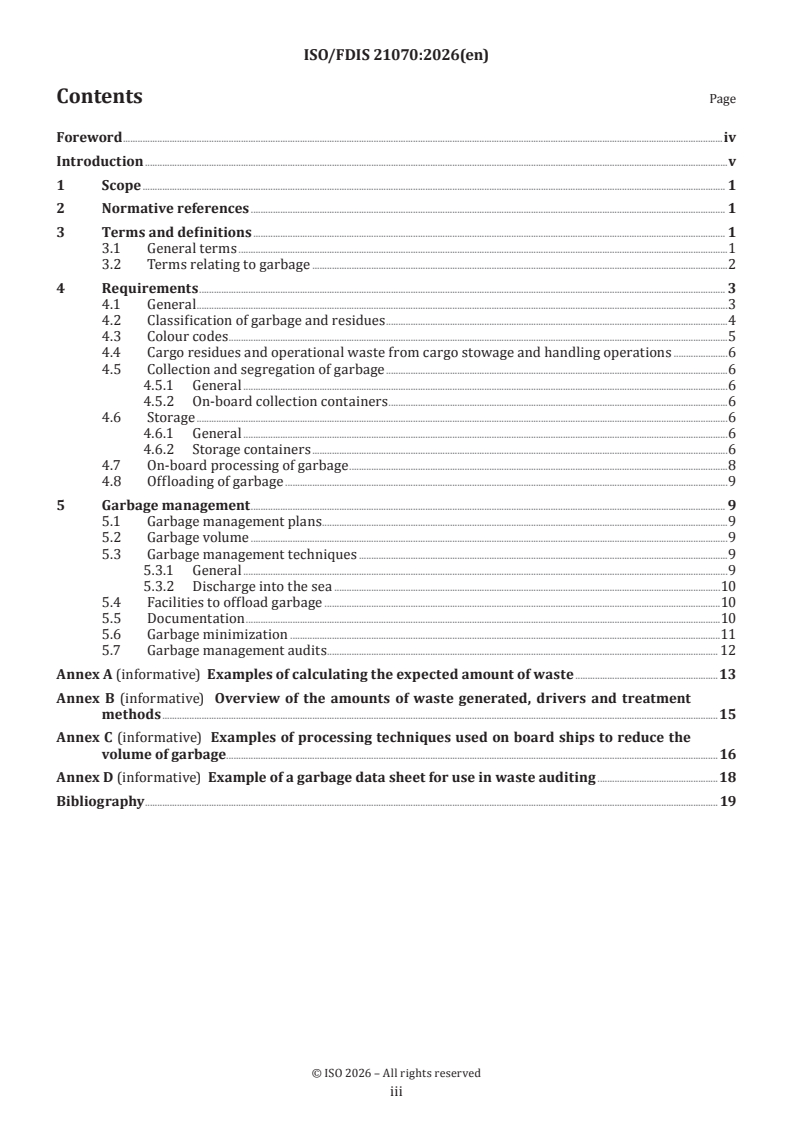
ISO/FDIS 21070 - Ships and marine technology — Marine environment protection — Management and handling of shipboard garbage
REDLINE ISO/FDIS 21070 - Ships and marine technology — Marine environment protection — Management and handling of shipboard garbage
ISO 21070 is an ISO standard for ships and marine technology that specifies how shipboard garbage is managed and handled. It covers collection, segregation, marking, treatment, storage, the ship-to-shore interface, and delivery to port reception facilities for use by ship operators, crews, and port-side waste handlers. The document is written to support marine environment protection and to align shipboard practice with MARPOL Annex V.
What does ISO 21070 specify?
ISO 21070 specifies procedures for managing garbage while it is on board a ship, from the point it is generated until it is offloaded to a port reception facility. It also organises the subject around definitions, operational requirements, and management practices, with informative annexes that give calculation methods, examples, and audit tools.
| Annex | What it covers |
|---|---|
| Annex A | Examples of calculating the expected amount of waste |
| Annex B | Overview of waste amounts, drivers, and treatment methods |
| Annex C | Examples of processing techniques used on board to reduce garbage volume |
| Annex D | Example of a garbage data sheet for waste auditing |
The scope is limited to shipboard management during the period the garbage remains on board. MARPOL Annex V is the minimum baseline for garbage management on ships, and the standard uses the MARPOL definition of garbage.
What are the key requirements of ISO 21070?
ISO 21070 focuses on practical shipboard controls: classify the waste, label it clearly, keep different streams separate, store it safely, and offload it in a way that fits the receiving port. The main value of the document is that it turns garbage management into an organised onboard process rather than an ad hoc disposal activity.
4.2 Classification of garbage and residues
ISO 21070 sets out categories and types of garbage and residues, including plastics, food wastes, domestic waste, glass, paper products, medical waste, wood, metal, cooking oil, incinerator ashes, operational wastes, animal carcasses, fishing gear, e-waste, EGCS residues, and cargo residues. In practice, this classification is the basis for segregation, container marking, storage, and disposal decisions.
The standard also distinguishes cargo residues that are harmful to the marine environment (HME) from non-HME cargo residues. That matters because HME residues require separate handling and can trigger different port reception needs.
4.3 Colour codes
ISO 21070 assigns colour codes to waste categories, such as yellow for plastics, green for food waste, grey for domestic waste, blue for glass, white on black for paper products, brown for wood, orange for e-waste, and black for incinerator ashes. The colour system supports quick recognition on board and at the port.
In practice, this helps crew sort waste correctly even when storage space is limited and handling is repeated by different people. It also reduces mixing, which can make recycling harder or impossible.
4.4 Cargo residues and operational waste
ISO 21070 requires garbage management plans to include procedures for cargo residues and operational waste from cargo storage and handling. For ships with Exhaust Gas Cleaning Systems (EGCS), residues from the EGCS are to be collected and managed separately.
This matters because cargo-related waste often comes from normal ship operation rather than domestic activities, and it can follow different treatment routes. Separate control avoids contamination of recyclable streams and keeps special residues from being mixed into general garbage.
4.5 Collection and segregation of garbage
ISO 21070 requires garbage to be collected regularly where it is generated and segregated into the relevant types. Suitable containers should be available at the point of generation, and containers are to be marked clearly for their intended use.
The standard also requires different types of garbage to be handled and treated separately. If waste is mixed, recycling becomes more difficult and disposal can become more expensive.
4.6 Storage
ISO 21070 requires garbage to be stored on board in containers sized for the expected waste volume, ship type, sailing schedule, and number of persons on board. Movable containers are to be fit for purpose, easy to handle, and suitable for the material stored; built-in containers such as tanks and silos are to meet applicable design and construction requirements.
The storage site itself needs practical safety features such as access, securing means, adequate size, fire protection, ventilation for internal sites, lighting, and suitable drainage arrangements. For hazardous material, the document calls for separate storage areas and additional protective features. For readers, this section is the main design guide for ship layout and equipment selection.
4.7 On-board processing of garbage
ISO 21070 allows on-board processing equipment such as shredders, pulpers, and compactors, but segregated garbage to be offloaded to port reception facilities is not to be treated or mixed in a way that cross-contaminates it or prevents recycling ashore. That means processing should reduce volume without destroying the value of the separated waste stream.
In practice, the ship can reduce storage demand, but it still has to preserve the ability of the receiving facility to handle the waste appropriately.
4.8 Offloading of garbage
ISO 21070 says offloading arrangements should support safe handling in normal loading conditions and minimise manual handling. The ship should take into account the type and location of the port reception facility and the port’s notification and service arrangements.
This is important because a shipboard system that works well at sea can still fail at berth if the access route is awkward or if the port requires different notification steps. The standard therefore links ship design and onboard procedures to the receiving port.
5 Garbage management
ISO 21070 requires a garbage management plan and says the ship should be equipped to implement it effectively. The plan should consider waste volume, voyage duration, the number of persons on board, the ship’s operation, and other relevant regulations.
The standard also builds in waste minimisation, documentation, and audits. It gives a hierarchy of prevention, reuse, recycling or composting ashore, and on-board energy recovery or incineration subject to incineration rules, which helps reduce the amount of waste that has to be stored and landed.
What terms does ISO 21070 define?
- Discharge - any release from a ship, whether by spilling, pumping, leaking, emptying, or another form of release.
- Port reception facility (PRF) - a fixed, floating, or mobile facility that can receive MARPOL residues and wastes from ships.
- Garbage - food waste, domestic waste, operational waste, plastics, cargo residue, cooking oil, fishing gear, and animal carcasses generated during normal ship operation, as defined for MARPOL Annex V.
- Cargo residue - remnants of cargo material left on deck or in holds after loading or unloading, including excess or spillage and related wash water.
- Operational waste - solid waste collected during normal maintenance or operations of a ship, including cargo stowage and handling materials.
- Plastics - polymer-based solid material, including synthetic ropes, synthetic fishing nets, plastic bags, and incinerator ashes from plastic products.
- Recycling - recovery operation in which waste materials are reprocessed into products, materials, or substances.
- Reuse - using a product or component again for the same purpose for which it was made.
Who uses ISO 21070?
ISO 21070 is used by shipowners, ship operators, masters, officers, and crew who need a clear shipboard garbage system. It is also relevant to naval architects, ship designers, equipment suppliers, and shipyards because it affects container layout, storage space, access routes, and onboard handling equipment.
Port reception facility operators and port authorities can use it to understand what segregated waste they should receive from ships. It is also useful for environmental, quality, and compliance staff who prepare garbage management plans, maintain records, and perform audits.
What changed in ISO 21070 from the previous edition?
ISO 21070 is the third edition and cancels and replaces ISO 21070:2017. It also incorporates ISO 21070:2017/Amd 1:2022.
The main change stated in the document is that revisions to MARPOL adopted after the second edition were incorporated into this edition.
Which standards are used with ISO 21070?
ISO 21070 refers to MARPOL, Annex I to VI, as amended. MARPOL Annex V provides the minimum garbage-management baseline, while the other annexes support related waste streams such as oily waste and other residues that may arise on board.
The introduction says ISO 21070 is expected to be used in conjunction with ISO 16304, which addresses the arrangement and management of port waste reception facilities. The bibliography also points to IMO guidance on garbage management plans, port waste reception facilities, incinerators, and implementation of MARPOL Annex V.
What does the ISO 21070 document contain?
ISO 21070 contains a classification table for waste categories and types, a colour-code table for labels and markings, and an on-board garbage management scheme figure. Annex A provides example formulas for estimating waste volumes and a small table of typical waste quantities.
Annex B gives an overview of waste generation rates, what drives them, and the treatment methods used on board. Annex C describes processing techniques such as shredders, pulpers, compactors, comminutors, incinerators, plasma arc destruction systems, and new technologies, with practical notes on how each one affects waste volume and handling.
Annex D provides an example garbage data sheet for waste auditing. Taken together, these annexes support planning, ship design, operating procedures, training, and record-keeping.
Relations
- Effective Date
- 09-Sep-2023
- Effective Date
- 09-Sep-2023
Buy Documents
ISO/FDIS 21070 - Ships and marine technology — Marine environment protection — Management and handling of shipboard garbage
REDLINE ISO/FDIS 21070 - Ships and marine technology — Marine environment protection — Management and handling of shipboard garbage
Get Certified
Connect with accredited certification bodies for this standard

DNV
DNV is an independent assurance and risk management provider.

BSI Group
BSI (British Standards Institution) is the business standards company that helps organizations make excellence a habit.

Bureau Veritas
Bureau Veritas is a world leader in laboratory testing, inspection and certification services.
Sponsored listings
Frequently Asked Questions
ISO 21070 is a draft published by the International Organization for Standardization (ISO). Its full title is "Ships and marine technology — Marine environment protection — Management and handling of shipboard garbage". This standard covers: ISO 21070:2017 specifies procedures for the shipboard management of garbage, including handling, collection, separation, marking, treatment, and storage. It also describes the ship-to-shore interface and the delivery of garbage from the ship to the port reception facility. MARPOL, Annex V sets the minimum standard for garbage management that apply to ships. ISO 21070:2017 applies to the management and handling of shipboard garbage during the period the garbage will be on board. The definition of garbage in this document is as defined in MARPOL, Annex V.
ISO 21070:2017 specifies procedures for the shipboard management of garbage, including handling, collection, separation, marking, treatment, and storage. It also describes the ship-to-shore interface and the delivery of garbage from the ship to the port reception facility. MARPOL, Annex V sets the minimum standard for garbage management that apply to ships. ISO 21070:2017 applies to the management and handling of shipboard garbage during the period the garbage will be on board. The definition of garbage in this document is as defined in MARPOL, Annex V.
ISO 21070 is classified under the following ICS (International Classification for Standards) categories: 13.020.99 - Other standards related to environmental protection; 47.020.99 - Other standards related to shipbuilding and marine structures. The ICS classification helps identify the subject area and facilitates finding related standards.
ISO 21070 has the following relationships with other standards: It is inter standard links to ISO 21070:2017, ISO 21070:2017/Amd 1:2022. Understanding these relationships helps ensure you are using the most current and applicable version of the standard.
ISO 21070 is available in PDF format for immediate download after purchase. The document can be added to your cart and obtained through the secure checkout process. Digital delivery ensures instant access to the complete standard document.
Standards Content (Sample)
FINAL DRAFT
International
Standard
ISO/FDIS 21070
ISO/TC 8/SC 2
Ships and marine technology —
Secretariat: ANSI
Marine environment protection
Voting begins on:
— Management and handling of
2026-09-08
shipboard garbage
Voting terminates on:
2026-11-03
Navires et technologie marine — Protection de l'environnement
marin — Gestion et manutention des déchets à bord du navire
RECIPIENTS OF THIS DRAFT ARE INVITED TO SUBMIT,
WITH THEIR COMMENTS, NOTIFICATION OF ANY
RELEVANT PATENT RIGHTS OF WHICH THEY ARE AWARE
AND TO PROVIDE SUPPOR TING DOCUMENTATION.
IN ADDITION TO THEIR EVALUATION AS
BEING ACCEPTABLE FOR INDUSTRIAL, TECHNO
LOGICAL, COMMERCIAL AND USER PURPOSES, DRAFT
INTERNATIONAL STANDARDS MAY ON OCCASION HAVE
TO BE CONSIDERED IN THE LIGHT OF THEIR POTENTIAL
TO BECOME STAN DARDS TO WHICH REFERENCE MAY BE
MADE IN NATIONAL REGULATIONS.
Reference number
ISO/FDIS 21070:2026(en) © ISO 2026
FINAL DRAFT
ISO/FDIS 21070:2026(en)
International
Standard
ISO/FDIS 21070
ISO/TC 8/SC 2
Ships and marine technology —
Secretariat: ANSI
Marine environment protection
Voting begins on:
— Management and handling of
shipboard garbage
Voting terminates on:
Navires et technologie marine — Protection de l'environnement
marin — Gestion et manutention des déchets à bord du navire
RECIPIENTS OF THIS DRAFT ARE INVITED TO SUBMIT,
WITH THEIR COMMENTS, NOTIFICATION OF ANY
RELEVANT PATENT RIGHTS OF WHICH THEY ARE AWARE
AND TO PROVIDE SUPPOR TING DOCUMENTATION.
© ISO 2026
IN ADDITION TO THEIR EVALUATION AS
All rights reserved. Unless otherwise specified, or required in the context of its implementation, no part of this publication may
BEING ACCEPTABLE FOR INDUSTRIAL, TECHNO
LOGICAL, COMMERCIAL AND USER PURPOSES, DRAFT
be reproduced or utilized otherwise in any form or by any means, electronic or mechanical, including photocopying, or posting on
INTERNATIONAL STANDARDS MAY ON OCCASION HAVE
the internet or an intranet, without prior written permission. Permission can be requested from either ISO at the address below
TO BE CONSIDERED IN THE LIGHT OF THEIR POTENTIAL
or ISO’s member body in the country of the requester.
TO BECOME STAN DARDS TO WHICH REFERENCE MAY BE
MADE IN NATIONAL REGULATIONS.
ISO copyright office
CP 401 • Ch. de Blandonnet 8
CH-1214 Vernier, Geneva
Phone: +41 22 749 01 11
Email: copyright@iso.org
Website: www.iso.org
Published in Switzerland Reference number
ISO/FDIS 21070:2026(en) © ISO 2026
ii
ISO/FDIS 21070:2026(en)
Contents Page
Foreword .iv
Introduction .v
1 Scope . 1
2 Normative references . 1
3 Terms and definitions . 1
3.1 General terms .1
3.2 Terms relating to garbage .2
4 Requirements . 3
4.1 General .3
4.2 Classification of garbage and residues .4
4.3 Colour codes .5
4.4 Cargo residues and operational waste from cargo stowage and handling operations .6
4.5 Collection and segregation of garbage .6
4.5.1 General .6
4.5.2 On-board collection containers .6
4.6 Storage .6
4.6.1 General .6
4.6.2 Storage containers .6
4.7 On-board processing of garbage .8
4.8 Offloading of garbage .9
5 Garbage management . 9
5.1 Garbage management plans .9
5.2 Garbage volume .9
5.3 Garbage management techniques .9
5.3.1 General .9
5.3.2 Discharge into the sea .10
5.4 Facilities to offload garbage .10
5.5 Documentation .10
5.6 Garbage minimization .11
5.7 Garbage management audits . . 12
Annex A (informative) Examples of calculating the expected amount of waste .13
Annex B (informative) Overview of the amounts of waste generated, drivers and treatment
methods .15
Annex C (informative) Examples of processing techniques used on board ships to reduce the
volume of garbage.16
Annex D (informative) Example of a garbage data sheet for use in waste auditing .18
Bibliography . 19
iii
ISO/FDIS 21070:2026(en)
Foreword
ISO (the International Organization for Standardization) is a worldwide federation of national standards
bodies (ISO member bodies). The work of preparing International Standards is normally carried out through
ISO technical committees. Each member body interested in a subject for which a technical committee
has been established has the right to be represented on that committee. International organizations,
governmental and non-governmental, in liaison with ISO, also take part in the work. ISO collaborates closely
with the International Electrotechnical Commission (IEC) on all matters of electrotechnical standardization.
The procedures used to develop this document and those intended for its further maintenance are described
in the ISO/IEC Directives, Part 1. In particular, the different approval criteria needed for the different types
of ISO document should be noted. This document was drafted in accordance with the editorial rules of the
ISO/IEC Directives, Part 2 (see www.iso.org/directives).
ISO draws attention to the possibility that the implementation of this document may involve the use of (a)
patent(s). ISO takes no position concerning the evidence, validity or applicability of any claimed patent
rights in respect thereof. As of the date of publication of this document, ISO had not received notice of (a)
patent(s) which may be required to implement this document. However, implementers are cautioned that
this may not represent the latest information, which may be obtained from the patent database available at
www.iso.org/patents. ISO shall not be held responsible for identifying any or all such patent rights.
Any trade name used in this document is information given for the convenience of users and does not
constitute an endorsement.
For an explanation of the voluntary nature of standards, the meaning of ISO specific terms and expressions
related to conformity assessment, as well as information about ISO's adherence to the World Trade
Organization (WTO) principles in the Technical Barriers to Trade (TBT), see www.iso.org/iso/foreword.html.
This document was prepared by Technical Committee ISO TC 8, Ships and marine technology, Subcommittee
SC 2, Marine environment protection.
This third edition cancels and replaces the second edition (ISO 21070:2017), which has been technically
revised. It also incorporates the Amendment ISO 21070:2017/Amd 1:2022.
The main changes are as follows:
— revisions to MARPOL made after the publication of second edition are incorporated into this document.
Any feedback or questions on this document should be directed to the user’s national standards body. A
complete listing of these bodies can be found at www.iso.org/members.html.
iv
ISO/FDIS 21070:2026(en)
Introduction
[2]
The management of shipboard garbage is extensively controlled by MARPOL, Annex V. Additionally,
States party to the MARPOL Convention have undertaken regional and national implementing legislation to
regulate and enforce provisions for handling ships’ waste and for providing adequate reception facilities at
ports and terminals subject to Parties' flag state and port state control authorities.
[2]
This document has been prepared to reflect the amendments of MARPOL, Annex V adopted in January
2013 and October 2016.
This document provides for the minimization, management and segregation of a ship’s garbage, so that it
can be managed onboard and offloaded efficiently to the relevant reception facilities onshore.
To obtain the most efficient management of waste and to reduce the time and resource burden in segregating
and handling waste on the ship and in the ports, the concept of waste minimization has been integrated
into this document by incorporating the following basic principle: prevention before recycling before energy
recovery before disposal.
This document concentrates on:
— the prevention, elimination and minimization of waste prior to sailing;
— the minimization of waste at the source on the ship;
— garbage collection at the source;
— the waste segregation on the ship into defined categories that are recognized globally and fit into many
different waste categorization systems around the world;
— waste minimization once segregated;
— waste storage on board the ship;
— the health and safety concerns surrounding the handling, storage and offloading of waste.
Both ship owners and coastal states are more aware of the importance of well-organized and -managed
waste collection and its benefits, especially with respect to health and safety on board ships, the reduction of
pollution and the potential cost benefits for ship owners and national governments. This document provides
a fixed standard for segregated garbage that any harbour facility worldwide can expect when a ship arrives
in port. However, it cannot work alone. This document is expected to be used in conjunction with ISO 16304.
[1]
This document does not consider the various (and numerous) shore-side waste handling systems that
exist, but can encourage the provision of recycling facilities for shipboard waste in ports.
v
FINAL DRAFT International Standard ISO/FDIS 21070:2026(en)
Ships and marine technology — Marine environment
protection — Management and handling of shipboard
garbage
1 Scope
This document specifies procedures for the shipboard management of garbage, including handling,
collection, separation, marking, treatment and storage. It also describes the ship-to-shore interface and the
delivery of garbage from the ship to the port reception facility. This document applies to the management
and handling of shipboard garbage during the period while the garbage is on board.
[2]
NOTE MARPOL, Annex V sets the minimum standard for garbage management that apply to ships.
2 Normative references
There are no normative references in this document.
3 Terms and definitions
For the purposes of this document, the following terms and definitions apply.
ISO and IEC maintain terminology databases for use in standardization at the following addresses:
— ISO Online browsing platform: available at https:// www .iso .org/ obp
— IEC Electropedia: available at https:// www .electropedia .org/
3.1 General terms
3.1.1
discharge
any release, however caused, from a ship including any escape, disposal, spilling, leaking, pumping, emitting
or emptying
[2]
[SOURCE: MARPOL Article 2 (3)(a) ]
3.1.2
hazardous waste
waste which, due to its nature, physical, chemical or infectious properties, is potentially hazardous to human
health or the environment, or both, during use, handling, storage or transportation, including any materials
which require special handling, disposal or recycling techniques to eliminate or reduce the hazard
3.1.3
port reception facility
PRF
any fixed, floating or mobile facility capable of receiving MARPOL residues/wastes from ships and fit for
that purpose
Note 1 to entry: For the purposes of this document, this relates to reception facilities for garbage as defined by
[2]
MARPOL, Annex V. An adequate port reception facility is a facility that mariners use and fully meets the needs of
the ships regularly using it and the port and does not provide mariners with a disincentive to use it. Furthermore, it
should contribute to the improvement of the marine environment. It should also allow for the ultimate disposal of
ships’ wastes to take place in an environmentally appropriate way.
ISO/FDIS 21070:2026(en)
[ ]
[SOURCE: Circular MEPC.1/Circ.834/Rev.1, 9 modified — note 1 to entry has been added.]
3.1.4
recycling
any recovery operation by which waste materials are reprocessed into products, materials or substances
whether for the original or other purposes
Note 1 to entry: It includes the reprocessing of organic material but does not include energy recovery and the
reprocessing into materials that are to be used as fuels or for backfilling operations.
3.1.5
reuse
any operation by which products or components that are not waste are used again for the same purpose for
which they were conceived
3.2 Terms relating to garbage
3.2.1
cargo residue
remnants of any cargo material which are not covered by other annexes to the MARPOL Convention and
which remain on the deck or in holds following loading or unloading, including loading and unloading excess
or spillage, whether in wet or dry conditions or entrained in wash water, but do not include cargo dust
remaining on the deck after sweeping or dust on the external surfaces of the ship
Note 1 to entry: Dry bulk cargo residues can include substances that are harmful to the marine environment (HME)
with special restrictions for discharges (3.1.1) including HME entrained in cargo hold wash water. Port reception
facilities (3.1.4) for cargo residues considered to be HME can be required at loading or discharge ports handling bulk
dry cargoes.
3.2.2
domestic waste
all types of waste not covered by other annexes to the MARPOL Convention that are generated in the
accommodation spaces on board the ship
Note 1 to entry: Domestic wastes do not include grey water.
[2]
[SOURCE: MARPOL Annex V, reg. 1.4 ]
3.2.3
garbage
all kinds of food waste, domestic waste (3.2.2) and operational waste (3.2.5), all plastics (3.2.10), cargo residue
(3.2.1), cooking oil, fishing gear, and animal carcasses generated during the normal operation of the ship and
liable to be disposed of continuously or periodically except those substances which are defined or listed in
other annexes to the present MARPOL Convention
Note 1 to entry: Garbage does not include fresh fish and parts thereof generated as a result of fishing activities
undertaken during the voyage, or as a result of aquaculture activities which involve the transport of fish including
shellfish for placement in the aquaculture facility and the transport of harvested fish including shellfish from such
facilities to shore for processing.
[2]
[SOURCE: MARPOL Annex V reg. 1.9 ]
3.2.4
incinerator ashes
ash and clinkers resulting from shipboard incinerators used for incineration of garbage (3.2.3)
[2]
[SOURCE: MARPOL Annex V reg. 1.10 ]
ISO/FDIS 21070:2026(en)
3.2.5
operational waste
all solid waste (including slurries) not covered by other annexes in the MARPOL Convention that are collected
on board during normal maintenance or operations of a ship, or used for cargo stowage and handling
Note 1 to entry: Operational waste includes, but is not limited to, the following wastes associated with cargo storage
and handling: dunnage, shoring, pallets, lining, transit and packing materials, plywood, paper, cardboard, wire, plastic
wrapping and steel strapping.
Note 2 to entry: Operational waste also includes cleaning agents and additives contained in cargo holds and external
wash water.
Note 3 to entry: Operational waste does not include grey water, bilge water, or other similar discharges (3.1.1) essential
to the operation of a ship.
Note 4 to entry: Wooden material can be defined as quarantine waste in certain countries.
3.2.6
oily rag
rag which contains oil and is controlled in MARPOL, Annex I
3.2.7
maintenance waste
waste deriving from the maintenance of the ship
3.2.8
medical waste
waste generated by health care activities, ranging from used needles and syringes to soiled dressings, body
parts, diagnostic samples, blood, chemicals, pharmaceuticals, medical devices and radioactive materials
Note 1 to entry: Medical waste is distinguished into two categories: infectious and non-infectious by the World Health
Organization.
3.2.9
quarantine waste
waste that requires segregation and special handling due to its potential to spread diseases or plant and
animal pests
3.2.10
plastics
solid material which contains, as an essential ingredient, one or more high molecular mass polymers, and,
which is formed (shaped) during either the manufacture of the polymer or the fabrication into a finished
product by heat and/or pressure
Note 1 to entry: Plastics have material properties ranging from hard and brittle to soft and elastic.
Note 2 to entry: For the purpose of this document, plastics include plastic in any form, including synthetic ropes,
synthetic fishing nets, plastic garbage (3.2.3) bags and incinerator ashes (3.2.4) from plastic products.
[2]
[SOURCE: MARPOL Annex V, reg. 1.13 ]
4 Requirements
4.1 General
This clause specifies the minimum requirements for waste treatment on board, including waste separation,
marking, collecting, storing and offloading to port reception facilities.
While it is recognized that on-board waste management should be standardized, it should be noted that
offloading procedures depend on the ports and the port reception facilities available.
NOTE For shipboard incineration, see C.5.
ISO/FDIS 21070:2026(en)
4.2 Classification of garbage and residues
The categories and garbage types covered in this document are listed in Table 1.
Table 1 — Categories and types of garbage and residues
MARPOL
[2]
Type Annex V Description
Category
Part 1 – For all garbage other than cargo residue
Plastics All garbage that consists of or includes plastic in any form, including synthetic ropes
A
and fishing nets. Plastics shall be retained onboard and disposed of ashore.
Food wastes B
Domestic waste C
Glass C NOTE 1 Can require separation by colours.
Paper products C
Medical waste C NOTE 2 Reference is made to the Guidelines for the Implementation of MARPOL 2012,
[7]
Annex V, section 5.2.5.
Wood C
Metal C
Cooking oil D
Incinerator ashes E NOTE 3 Incinerator ash from plastic products can contain toxic or heavy metal.
Operational wastes Examples of (non-hazardous) waste are: dunnage, shoring, pallets, lining, transit and
packing materials, plywood, paper, cardboard, wire, plastic wrapping, steel strapping
NOTE 4 Some regional or national legislations can require even further separate
identification and handling.
NOTE 5 Operational wastes can be considered hazardous. Examples of hazardous
F waste are: batteries, fluorescent lamps, garbage contaminated with hazardous
waste, and any other waste that is considered hazardous waste. This kind of waste
is handled and treated separately.
NOTE 6 Oily waste and rags contaminated with oily waste are listed in MARPOL,
[2]
Annex I.
NOTE 7 Medical waste is a separate item.
Animal carcasses G
Fishing gear H
E-waste I Examples include computers, laptops, keyboards, cell phones, portable communi-
cations devices.
EGCS residues - Residues of Exhaust Gas Cleaning System (EGCS)
NOTE 8 Ships having Exhaust Gas Cleaning System (EGCS) can have residues in
EGCS.
[2]
NOTE 9 Requirements on EGCS are given in MARPOL, Annex VI.
Part 2 – For all cargo residues
Cargo residues See 4.4.
J
(non HME) NOTE 10 Dry cargo residues can include deck or cargo hold sweepings and wash
water containing such residues.
ISO/FDIS 21070:2026(en)
TTabablele 1 1 ((ccoonnttiinnueuedd))
MARPOL
[2]
Type Annex V Description
Category
Cargo residues See 4.4.
(HME) Solid bulk cargoes should be assessed by the shipper as to whether or not they are
K harmful to the marine environment, and can include:
— acute aquatic toxicity;
— chronic aquatic toxicity;
— carcinogenicity;
— mutagenicity.
[6]
SOURCE: IMO Resolution MEPC.277(70).
NOTE Inexpensive and readily available standard label software and a colour printer can be useful for creating
labels/markings aboard ships, for collection and storage containers. Coloured signage/labels can be affixed to
appropriate portable containers, such as drums, boxing or bagging for retention and storage aboard. Such a colour
coding system is useful for easy identification when off-loading at a reception facility. Further, such a labelling scheme
facilitates efficient segregation of wastes, by type, for further handling and recycling by port reception facility
operators. Additional or supplemental labels can be affixed to those types of waste requiring special handling such as
hazardous, quarantine, or medical wastes and incinerator ash for ships equipped with such equipment.
Garbage that is contaminated by another category of garbage shall be handled in accordance with the more
stringent disposal requirements that are applicable.
4.3 Colour codes
Inexpensive and readily available standard label software and a colour printer may be useful for creating
labels/markings, as shown in Table 1 and according to the colour scheme in Table 2, on-board ship for
collection and storage container labelling. Coloured signage/labels can be affixed to appropriate portable
containers such as drums, boxing or bagging for retention and storage aboard. Such a colour coding
system can be useful for easy identification when offloading at a reception facility. Furthermore, such a
labelling scheme facilitates efficient segregation of wastes by type, for further handling and recycling by
port reception facility operators. Additional or supplemental labels can be affixed to those types of waste
requiring special handling such as hazardous or harmful, quarantine, or medical wastes and incinerator
ashes for ships equipped with such equipment, as appropriate.
Table 2 — Colour codes for waste
Waste Colour
Plastics Yellow
Food waste Green
Domestic waste Grey
Cooking oil —
Incinerator ashes Black
Operational waste —
Cargo residue —
Animal carcasses —
Fishing gear —
Glass Blue
Paper products White on black
Medical waste Yellow
Oil contaminated waste —
ISO/FDIS 21070:2026(en)
TTabablele 2 2 ((ccoonnttiinnueuedd))
Waste Colour
Wood Brown
Metal Grey
E-waste Orange
4.4 Carg
...
ISO/FDIS 21070:2026(en)
ISO/TC 8/SC 2/WG 4
Secretariat: ANSI
Date: 2026-01-29-08-24
Ships and marine technology — Marine environment protection —
Management and handling of shipboard garbage
Navires et technologie marine -- — Protection de l'environnement marin --— Gestion et manutention des
déchets à bord du navire
FDIS stage
ISO/FDIS 21070:2026(en)
All rights reserved. Unless otherwise specified, or required in the context of its implementation, no part of this publication
may be reproduced or utilized otherwise in any form or by any means, electronic or mechanical, including photocopying,
or posting on the internet or an intranet, without prior written permission. Permission can be requested from either ISO
at the address below or ISO'sISO’s member body in the country of the requester.
ISO Copyright Officecopyright office
CP 401 • Ch. de Blandonnet 8
CH-1214 Vernier, Geneva
Phone: + 41 22 749 01 11
Email: E-mail: copyright@iso.org
Website: www.iso.org
Published in Switzerland.
ii
ISO/DISFDIS 21070:20252026(en)
Contents Page
Foreword . iv
Introduction . v
1 Scope . 1
2 Normative references . 1
3 Terms and definitions . 1
3.1 General terms . 1
3.2 Terms relating to garbage . 2
4 Requirements . 4
4.1 General. 4
4.2 Classification of garbage and residues . 4
4.3 Colour codes . 6
4.4 Cargo residues and operational waste from cargo stowage and handling operations . 6
4.5 Collection and segregation of garbage . 7
4.6 Storage . 7
4.7 On-board processing of garbage . 10
4.8 Offloading of garbage . 10
5 Garbage management . 10
5.1 Garbage management plans . 10
5.2 Garbage volume . 11
5.3 Garbage management techniques . 11
5.4 Facilities to offload garbage . 13
5.5 Documentation . 13
5.6 Garbage minimization . 13
5.7 Garbage management audits . 14
Annex A (informative) Examples of calculating the expected amount of waste . 16
Annex B (informative) Overview of the amounts of waste generated, drivers and treatment
methods . 18
Annex C (informative) Examples of processing techniques used on board ships to reduce the
volume of garbage . 19
Annex D (informative) Example of a garbage data sheet for use in waste auditing . 21
Bibliography . 22
iii
ISO/FDIS 21070:2026(en)
Foreword
ISO (the International Organization for Standardization) is a worldwide federation of national standards
bodies (ISO member bodies). The work of preparing International Standards is normally carried out through
ISO technical committees. Each member body interested in a subject for which a technical committee has been
established has the right to be represented on that committee. International organizations, governmental and
non-governmental, in liaison with ISO, also take part in the work. ISO collaborates closely with the
International Electrotechnical Commission (IEC) on all matters of electrotechnical standardization.
The procedures used to develop this document and those intended for its further maintenance are described
in the ISO/IEC Directives, Part 1. In particular, the different approval criteria needed for the different types of
ISO document should be noted. This document was drafted in accordance with the editorial rules of the
ISO/IEC Directives, Part 2 (see www.iso.org/directives).
ISO draws attention to the possibility that the implementation of this document may involve the use of (a)
patent(s). ISO takes no position concerning the evidence, validity or applicability of any claimed patent rights
in respect thereof. As of the date of publication of this document, ISO had not received notice of (a) patent(s)
which may be required to implement this document. However, implementers are cautioned that this may not
represent the latest information, which may be obtained from the patent database available at
www.iso.org/patents. ISO shall not be held responsible for identifying any or all such patent rights.
Any trade name used in this document is information given for the convenience of users and does not
constitute an endorsement.
For an explanation of the voluntary nature of standards, the meaning of ISO specific terms and expressions
related to conformity assessment, as well as information about ISO's adherence to the World Trade
Organization (WTO) principles in the Technical Barriers to Trade (TBT), see www.iso.org/iso/foreword.html.
This document was prepared by Technical Committee ISO TC 8, Ships and marine technology, Subcommittee
SC 2, Marine environment protection.
This third edition cancels and replaces the second edition (ISO 21070:2017)), which has been technically
revised. It also incorporates the Amendment(s) ISO 21070:2017/Amd 1:2022.
The main changes are as follows:
— — Revisionsrevisions to MARPOL made after the publication of second edition are incorporated into this
document.
Any feedback or questions on this document should be directed to the user’s national standards body. A
complete listing of these bodies can be found at www.iso.org/members.html.
iv
ISO/DISFDIS 21070:20252026(en)
Introduction
[2]
The management of shipboard garbage is extensively controlled by MARPOL, Annex V. Additionally, States
party to the MARPOL Convention have undertaken regional and national implementing legislation to regulate
and enforce provisions for handling ships’ waste and for providing adequate reception facilities at ports and
terminals subject to Parties' flag state and port state control authorities.
[2]
This document has been prepared to reflect the amendments of MARPOL, Annex V adopted in January 2013
and October 2016.
This document provides for the minimization, management and segregation of a ship’s garbage, so that it can
be managed onboard and offloaded efficiently to the relevant reception facilities onshore.
To obtain the most efficient management of waste and to reduce the time and resource burden in segregating
and handling waste on the ship and in the ports, the concept of waste minimization has been integrated into
this document by incorporating the following basic principle: prevention before recycling before energy
recovery before disposal.
This document concentrates on:
— — the prevention/, elimination/ and minimization of waste prior to sailing,;
— — the minimization of waste at the source on the ship,;
— — garbage collection at the source,;
— — the waste segregation on the ship into defined categories that are recognized globally and fit into many
different waste categorization systems around the world,;
— — waste minimization once segregated,;
— — waste storage on board the ship, and;
— — the health and safety concerns surrounding the handling, storage and offloading of waste.
Both ship owners and coastal states are more aware of the importance of well-organized and -managed waste
collection and its benefits, especially with respect to health and safety on board ships, the reduction of
pollution and the potential cost benefits for ship owners and national governments. This document provides
a fixed standard for segregated garbage that any harbour facility worldwide can expect when a ship arrives in
port. However, it cannot work alone. This document is expected to be used in conjunction with ISO 16304
[1]
[1]. This document does not consider the various (and numerous) shore-side waste handling systems that
exist, but can encourage the provision of recycling facilities for shipboard waste in ports.
v
DRAFT International Standard ISO/DIS 21070:2025(en)
Ships and marine technology — Marine environment protection —
Management and handling of shipboard garbage
1 Scope
This document specifies procedures for the shipboard management of garbage, including handling, collection,
separation, marking, treatment and storage. It also describes the ship-to-shore interface and the delivery of
garbage from the ship to the port reception facility. This document applies to the management and handling
of shipboard garbage during the period while the garbage is on board.
[2]
NOTE : MARPOL, Annex V sets the minimum standard for garbage management that apply to ships.
2 Normative references
The following documents are referred to in the text in such a way that some or all of their content constitutes
requirements of this document. For dated references, only the edition cited applies. For undated references,
the latest edition of the referenced document (including any amendments) applies.
International Convention for the Prevention of Pollution from Ships, (MARPOL) Annex I to VI, as amended
There are no normative references in this document.
3 Terms and definitions
For the purposes of this document, the following terms and definitions apply.
ISO and IEC maintain terminology databases for use in standardization at the following addresses:
— — ISO Online browsing platform: available at https://www.iso.org/obp
— — IEC Electropedia: available at https://www.electropedia.org/
3.1 General terms
3.1.1 3.1.1
discharge
any release, however caused, from a ship including any escape, disposal, spilling, leaking, pumping, emitting
or emptying
[2]
[SOURCE: MARPOL Article 2 (3)(a) )]]
3.1.2 3.1.2
hazardous waste
waste which, due to its nature, physical, chemical or infectious properties, is potentially hazardous to human
health or the environment, or both, during use, handling, storage or transportation, including any materials
which require special handling, disposal or recycling techniques to eliminate or reduce the hazard
ISO/FDIS 21070:2026(en)
3.1.3 3.1.3
port reception facility
PRF
any fixed, floating or mobile facility capable of receiving MARPOL residues/wastes from ships and fit for that
purpose
[8]
[SOURCE: Circular MEPC.1/Circ.834/Rev.1 ]
Note 1 to entry: For the purposes of this document, this relates to reception facilities for garbage as defined by MARPOL,
[2]
Annex V. An adequate port reception facility is a facility that mariners use and fully meets the needs of the ships
regularly using it and the port and does not provide mariners with a disincentive to use it. Furthermore, it should
contribute to the improvement of the marine environment. It should also allow for the ultimate disposal of ships’ wastes
to take place in an environmentally appropriate way.
[2]
[SOURCE: IMO ResolutionCircular MEPC.83(44) ]
[9] ]
3.1/Circ.834/Rev.1, .4 modified — note 1 to entry has been added.]
3.1.4
recycling
any recovery operation by which waste materials are reprocessed into products, materials or substances
whether for the original or other purposes.
Note 1 to entry: It includes the reprocessing of organic material but does not include energy recovery and the
reprocessing into materials that are to be used as fuels or for backfilling operations.
3.1.5 3.1.5
reuse
any operation by which products or components that are not waste are used again for the same purpose for
which they were conceived
3.2 Terms relating to garbage
3.2.1 3.2.1
cargo residue
remnants of any cargo material which are not covered by other annexes to the MARPOL Convention and which
remain on the deck or in holds following loading or unloading, including loading and unloading excess or
spillage, whether in wet or dry conditions or entrained in wash water, but doesdo not include cargo dust
remaining on the deck after sweeping or dust on the external surfaces of the ship
Note 1 to entry: Dry bulk cargo residues maycan include substances that are harmful to the marine environment (HME)
with special restrictions for discharges (3.1.1(3.1.1)) including HME entrained in cargo hold wash water. Port reception
facilities (3.1.4(3.1.4)) for cargo residues considered to be HME maycan be required at loading or discharge ports
handling bulk dry cargoes.
3.2.2 3.2.2
domestic waste
all types of waste not covered by other annexes to the MARPOL Convention that are generated in the
accommodation spaces on board the ship
Note 1 to entry: Domestic wastes do not include grey water.
[2]
[SOURCE: MARPOL Annex V, reg. 1.4 ]]
ISO/DISFDIS 21070:20252026(en)
3.2.3 3.2.3
garbage
all kinds of food waste, domestic waste (3.2.2(3.2.2)) and operational waste (3.2.5(3.2.5),), all plastics
(3.2.10(3.2.11),), cargo residue (3.2.1(3.2.1),), cooking oil, fishing gear, and animal carcasses generated during
the normal operation of the ship and liable to be disposed of continuously or periodically except those
substances which are defined or listed in other annexes to the present MARPOL Convention.
Note 1 to entry: Garbage does not include fresh fish and parts thereof generated as a result of fishing activities
undertaken during the voyage, or as a result of aquaculture activities which involve the transport of fish including
shellfish for placement in the aquaculture facility and the transport of harvested fish including shellfish from such
facilities to shore for processing.
[2]
[SOURCE: MARPOL Annex V reg. 1.9 ]]
3.2.4 3.2.4
incinerator ashes
ash and clinkers resulting from shipboard incinerators used for incineration of garbage (3.2.3(3.2.3))
[2]
[SOURCE: MARPOL Annex V reg. 1.10 ]]
3.2.5 3.2.5
operational waste
all solid waste (including slurries) not covered by other annexes in the MARPOL Convention that are collected
on board during normal maintenance or operations of a ship, or used for cargo stowage and handling
Note 1 to entry: Operational waste includes, but is not limited to, the following wastes associated with cargo storage and
handling: dunnage, shoring, pallets, lining, transit and packing materials, plywood, paper, cardboard, wire, plastic
wrapping, and steel strapping.
Note 2 to entry: Operational waste also includes cleaning agents and additives contained in cargo holds and external
wash water.
Note 3 to entry: Operational waste does not include grey water, bilge water, or other similar discharges (3.1.1(3.1.1))
essential to the operation of a ship.
Note 4 to entry: Wooden material maycan be defined as quarantine waste in certain countries.
3.2.6 3.2.6
oily rag
rag which contains oil and is controlled in MARPOL, Annex I
3.2.7 3.2.7
maintenance waste
waste deriving from the maintenance of the ship
3.2.8 3.2.8
medical waste
waste generated by health care activities, ranging from used needles and syringes to soiled dressings, body
parts, diagnostic samples, blood, chemicals, pharmaceuticals, medical devices and radioactive materials
Note 1 to entry: Medical waste is distinguished into two categories: infectious and non-infectious by the World Health
Organization.
3.2.9 3.2.9
quarantine waste
waste that requires segregation and special handling due to its potential to spread diseases or plant and animal
pests
ISO/FDIS 21070:2026(en)
3.2.10 3.2.10
plastics
solid material which contains, as an essential ingredient, one or more high molecular mass polymers, and,
which is formed (shaped) during either the manufacture of the polymer or the fabrication into a finished
product by heat and/or pressure
Note 1 to entry: Plastics have material properties ranging from hard and brittle to soft and elastic.
Note 2 to entry: For the purpose of this document, plastics include plastic in any form, including synthetic ropes, synthetic
fishing nets, plastic garbage (3.2.3(3.2.3)) bags and incinerator ashes (3.2.4(3.2.4)) from plastic products.
[2]
[SOURCE: MARPOL Annex V, reg. 1.13 ]]
4 Requirements
4.1 General
This clause specifies the minimum requirements for waste treatment on board, including waste separation,
marking, collecting, storing and offloading to port reception facilities.
While it is recognized that on-board waste management should be standardized, it should be noted that
offloading procedures depend on the ports and the port reception facilities available.
NOTE For shipboard incineration, see C.5B.5.
4.2 Classification of garbage and residues
The following categories and garbage types covered in this document are listed in Table 1Table 1.
Table 1 — Categories and types of garbage and residues
MARPOL
Annex V
Type Description
[2]
Category
Part 1 – For all garbage other than cargo residue
Plastics All garbage that consists of or includes plastic in any form, including synthetic
A ropes and fishing nets. ShallPlastics shall be retained onboard and disposed of
ashore.
Food wastes B
Domestic waste C
Glass C NOTE 1 Can require separation by colours.
Paper products C
Medical waste C NOTE 2 Reference is made to the Guidelines for the Implementation of
[7]
MARPOL 2012, Annex V, section 5.2.5.
Wood C
Metal C
ISO/DISFDIS 21070:20252026(en)
MARPOL
Annex V
Type Description
[2]
Category
Cooking oil D
Incinerator ashes E NOTE 3 Incinerator ash from plastic products can contain toxic or heavy metal.
Operational Examples of (non-hazardous) waste are: dunnage, shoring, pallets, lining, transit
wastes and packing materials, plywood, paper, cardboard, wire, plastic wrapping, steel
strapping
NOTE 1 4 Some regional or national legislations can require even further separate
identification and handling.
NOTE 2 5 Operational wastes can be considered hazardous. Examples of
F
hazardous waste are: batteries, fluorescent lamps, garbage contaminated with
hazardous waste, and any other waste that is considered hazardous waste. This
kind of waste is handled and treated separately.
NOTE 3 6 Oily waste and rags contaminated with oily waste are listed in MARPOL,
[2]
Annex I.
NOTE 4 7 Medical waste is a separate item.
Animal carcasses G
Fishing gear H
E-waste I Examples include computers, laptops, keyboards, cell phones, portable
communications devices.
EGCS residues - Residues of Exhaust Gas Cleaning System (EGCS)
NOTE1NOTE 8 Ships having Exhaust Gas Cleaning System (EGCS) can have
residues in EGCS.
[2]
NOTE2NOTE 9 Requirements on EGCS are given in MARPOL, Annex VI.
Part 2 – For all cargo residues
Cargo residues See 4.44.4.
J
(non HME) NOTE 10 Dry cargo residues can include deck or cargo hold sweepings and wash
water containing such residues.
Cargo residues See 4.44.4.
(HME) Solid bulk cargoes should be assessed by the shipper as to whether or not they are
K harmful to the marine environment, and can include:
— — acute aquatic toxicity;
— — chronic aquatic toxicity;
— — carcinogenicity;
— — mutagenicity.
[6]
SOURCE: IMO Resolution MEPC.277(70) [5].).
NOTE Inexpensive and readily available standard label software and a colour printer can be useful for creating
labels/markings aboard ships, for collection and storage containers. Coloured signage/labels can be affixed to
appropriate portable containers, such as drums, boxing or bagging for retention and storage aboard. Such a colour coding
system is useful for easy identification when off-loading at a reception facility. Further, such a labelling scheme facilitates
efficient segregation of wastes, by type, for further handling and recycling by port reception facility operators. Additional
or supplemental labels can be affixed to those types of waste requiring special handling such as hazardous, quarantine,
or medical wastes and incinerator ash for ships equipped with such equipment.
ISO/FDIS 21070:2026(en)
Garbage that is contaminated by another category of garbage shall be handled in accordance with the more
stringent disposal requirements that are applicable.
4.3 Colour codes
Inexpensive and readily available standard label software and a colour printer may be useful for creating
labels/markings, as shown in Table 1Table 1 and according to the colour scheme in Table 2Table 2,, on-board
ship for collection and storage container labelling. Coloured signage/labels can be affixed to appropriate
portable containers such as drums, boxing or bagging for retention and storage aboard. Such a colour coding
system can be useful for easy identification when offloading at a reception facility. Furthermore, such a
labelling scheme facilitates efficient segregation of wastes by type, for further handling and recycling by port
reception facility operators. Additional or supplemental labels couldcan be affixed to those types of waste
requiring special handling such as hazardous or harmful, quarantine, or medical wastes and incinerator ashes
for ships equipped with such equipment, as appropriate.
Table 2 — Colour codes for waste
Waste Colour
Plastics Yellow
Food waste Green
Domestic waste Grey
Cooking oil —
Incinerator ashes Black
Operational waste —
Cargo residue —
Animal carcasses —
Fishing gear —
Glass Blue
Paper products White on black
Medical waste Yellow
Oil contaminated waste —
Wood Brown
Metal Grey
E-waste Orange
4.4 Cargo residues and operational waste from cargo stowage and handling operations
Ships shall have procedures in their garbage management plan to deal with cargo residues and operational
waste from cargo storage and handling operations.
In ships with Exhaust Gas Cleaning Systemsexhaust gas cleaning systems (EGCS), residues in the EGCS shall
be collected and managed separately.
ISO/DISFDIS 21070:20252026(en)
4.5 Collection and segregation of garbage
4.5.1 General
Garbage shall be regularly collected in the areas where it is generated. At the point of collection, the garbage
should be appropriately segregated into the types according to Table 1Table 1. The garbage shall be
transported to a storage site on board the ship appropriate for that category (see Table 1Table 1),), where it
may be segregated further as necessary.
Different types of garbage shall be handled and treated separately.
Cargo residues HME (see Table 1Table 1)) can be hazardous. This shall be handled and treated separately.
Mixing of different types of garbage can make recycling more difficult or impossible and more expensive.
4.5.2 On-board collection containers
Collection containers of suitable size, design, and number as appropriate for the volume and category of
garbage anticipated should be available where the garbage is generated. The collection containers shall also
comply with the applicable safety requirements (such as metal safety containers used for collection of oily
rags or sealed/covered containers used for quarantine wastes) and shall be easy to transport manually. For
hygiene reasons, the containers shall be emptied regularly.
Collection containers shall be marked to clearly identify their use (see Table 1Table 1 for categories and
Table 2Table 2 for colours) as appropriate. See examples of standardized marking/labelling of collection
containers.
4.6 Storage
4.6.1 General
Collected garbage shall be appropriately stored on board until it is disposed of in accordance with the
applicable international, regional and/or national legislationat a port.
The capacity of the designated storage site(s) shall be commensurate with the number and size of storage
containers required to accommodate shipboard garbage. Storage capacity is dependent on number of persons
or crew on board and the type of vessel. Annexes AAnnex A and BB can help with defining the capacity needed
for storin
...