

ISO 21070:2017
(Main)Ships and marine technology — Marine environment protection — Management and handling of shipboard garbage
General Information
- Abstract
ISO 21070:2017 specifies procedures for the shipboard management of garbage, including handling, collection, separation, marking, treatment, and storage. It also describes the ship-to-shore interface and the delivery of garbage from the ship to the port reception facility. MARPOL, Annex V sets the minimum standard for garbage management that apply to ships. ISO 21070:2017 applies to the management and handling of shipboard garbage during the period the garbage will be on board. The definition of garbage in this document is as defined in MARPOL, Annex V.
- Status
- Published
- Publication Date
- 29-Oct-2017
- Technical Committee
- ISO/TC 8/SC 2 - Marine environment protection
- Drafting Committee
- ISO/TC 8/SC 2 - Marine environment protection
- Current Stage
- 9092 - International Standard to be revised
- Start Date
- 08-Sep-2023
- Completion Date
- 29-Aug-2026
Buy Documents


ISO 21070:2017 - Ships and marine technology -- Marine environment protection -- Management and handling of shipboard garbage
ISO 21070:2017 - Ships and marine technology — Marine environment protection — Management and handling of shipboard garbage/30/2017
Overview
ISO 21070:2017 - Ships and marine technology: Marine environment protection - Management and handling of shipboard garbage specifies standardized procedures for shipboard garbage management. It covers the handling, collection, separation, marking, treatment and storage of garbage while it is on board, and describes the ship-to-shore interface for delivery of garbage to a port reception facility (PRF). The standard aligns with and builds on the minimum requirements set by MARPOL Annex V and reflects amendments up to 2013.
Key Topics
ISO 21070:2017 addresses practical and technical requirements, including:
- Classification of garbage (consistent with MARPOL definitions such as domestic waste, operational waste, cargo residues, plastics, incinerator ashes).
- Colour codes and marking systems for onboard segregation and container identification.
- Collection and segregation procedures, including requirements for onboard collection containers.
- Storage: requirements for storage containers and safe onboard storage practices.
- On-board processing techniques to reduce volume and manage waste prior to offload.
- Offloading procedures and the ship-to-shore interface for delivery to port reception facilities.
- Garbage management plans: shipboard plans, documentation, and record-keeping.
- Garbage volume assessment and minimization strategies based on the principle: prevention → recycling → energy recovery → disposal.
- Discharge rules (referenced alongside MARPOL Annex V limits) and guidance for permitted discharges vs. prohibited discharges.
- Auditing and reporting: guidance for waste audits, data sheets and continuous improvement.
Applications
ISO 21070:2017 is used by:
- Shipowners and ship operators to implement compliant onboard garbage procedures and management systems.
- Shipboard personnel (officers and crew) for daily collection, segregation and storage practices.
- Port reception facility managers to anticipate and handle segregated waste deliveries.
- Maritime regulators and port/state control for assessing compliance with MARPOL and national rules.
- Designers and suppliers of onboard waste handling systems and equipment. Practical benefits include improved regulatory compliance with MARPOL Annex V, reduced marine pollution risk, enhanced crew safety and hygiene, more efficient port offloading, and potential cost savings through waste minimization and recycling.
Related standards and guidance
- MARPOL Annex V (IMO) - sets minimum international regulatory requirements for garbage from ships.
- IMO Guidelines for Implementation of MARPOL Annex V
- MEPC.1/Circ.834 - guidance for port reception facilities providers and users.
- ISO 16304 - complementary guidance on ship/shore waste interfaces and reception facility expectations.
Keywords: ISO 21070:2017, shipboard garbage management, MARPOL Annex V, port reception facility, waste minimization, garbage segregation, marine environment protection.
Relations
- Effective Date
- 04-Sep-2021
- Effective Date
- 09-Sep-2023
- Effective Date
- 05-Jul-2014
Buy Documents
ISO 21070:2017 - Ships and marine technology -- Marine environment protection -- Management and handling of shipboard garbage
ISO 21070:2017 - Ships and marine technology — Marine environment protection — Management and handling of shipboard garbage/30/2017
Get Certified
Connect with accredited certification bodies for this standard

DNV
DNV is an independent assurance and risk management provider.

BSI Group
BSI (British Standards Institution) is the business standards company that helps organizations make excellence a habit.

Bureau Veritas
Bureau Veritas is a world leader in laboratory testing, inspection and certification services.
Sponsored listings
Frequently Asked Questions
ISO 21070:2017 is a standard published by the International Organization for Standardization (ISO). Its full title is "Ships and marine technology — Marine environment protection — Management and handling of shipboard garbage". This standard covers: ISO 21070:2017 specifies procedures for the shipboard management of garbage, including handling, collection, separation, marking, treatment, and storage. It also describes the ship-to-shore interface and the delivery of garbage from the ship to the port reception facility. MARPOL, Annex V sets the minimum standard for garbage management that apply to ships. ISO 21070:2017 applies to the management and handling of shipboard garbage during the period the garbage will be on board. The definition of garbage in this document is as defined in MARPOL, Annex V.
ISO 21070:2017 specifies procedures for the shipboard management of garbage, including handling, collection, separation, marking, treatment, and storage. It also describes the ship-to-shore interface and the delivery of garbage from the ship to the port reception facility. MARPOL, Annex V sets the minimum standard for garbage management that apply to ships. ISO 21070:2017 applies to the management and handling of shipboard garbage during the period the garbage will be on board. The definition of garbage in this document is as defined in MARPOL, Annex V.
ISO 21070:2017 is classified under the following ICS (International Classification for Standards) categories: 13.020.99 - Other standards related to environmental protection; 47.020.99 - Other standards related to shipbuilding and marine structures. The ICS classification helps identify the subject area and facilitates finding related standards.
ISO 21070:2017 has the following relationships with other standards: It is inter standard links to ISO 21070:2017/Amd 1:2022, ISO/FDIS 21070, ISO 21070:2011. Understanding these relationships helps ensure you are using the most current and applicable version of the standard.
ISO 21070:2017 is available in PDF format for immediate download after purchase. The document can be added to your cart and obtained through the secure checkout process. Digital delivery ensures instant access to the complete standard document.
Standards Content (Sample)
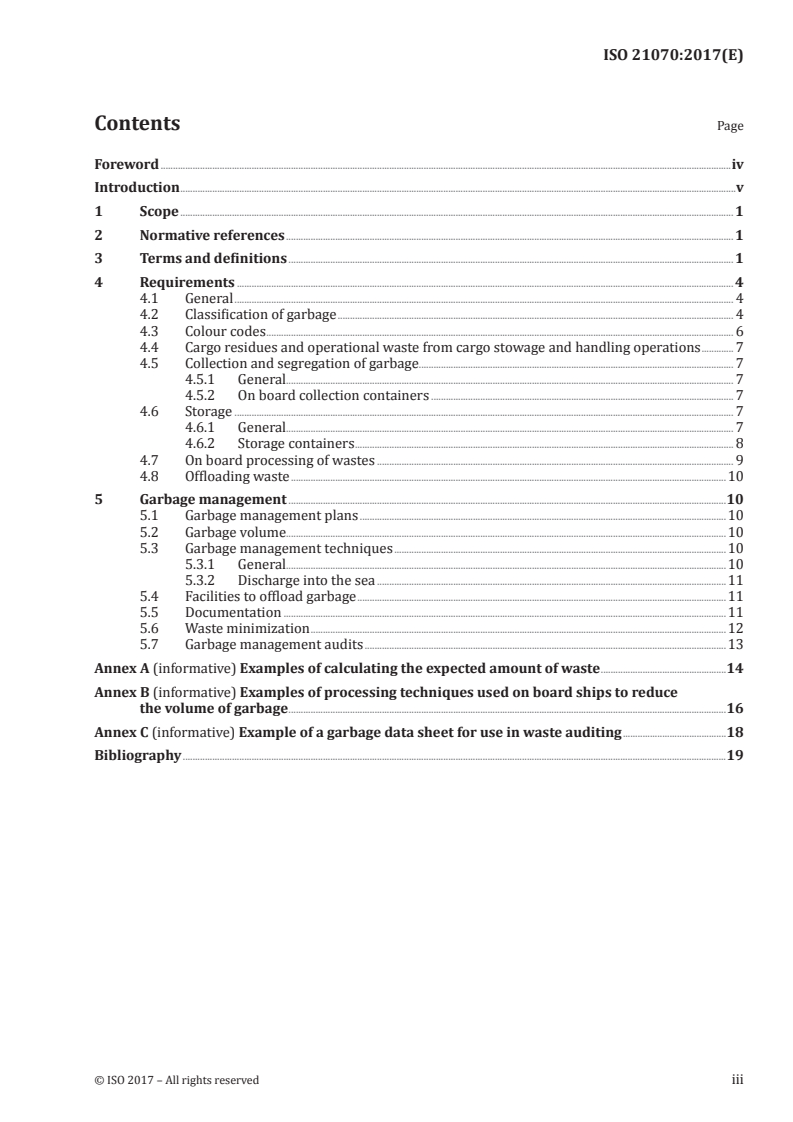
INTERNATIONAL ISO
STANDARD 21070
Second edition
2017-10
Ships and marine technology —
Marine environment protection
— Management and handling of
shipboard garbage
Navires et technologie marine — Protection de l'environnement
marin — Gestion et manutention des déchets à bord du navire
Reference number
©
ISO 2017
© ISO 2017, Published in Switzerland
All rights reserved. Unless otherwise specified, no part of this publication may be reproduced or utilized otherwise in any form
or by any means, electronic or mechanical, including photocopying, or posting on the internet or an intranet, without prior
written permission. Permission can be requested from either ISO at the address below or ISO’s member body in the country of
the requester.
ISO copyright office
Ch. de Blandonnet 8 • CP 401
CH-1214 Vernier, Geneva, Switzerland
Tel. +41 22 749 01 11
Fax +41 22 749 09 47
copyright@iso.org
www.iso.org
ii © ISO 2017 – All rights reserved
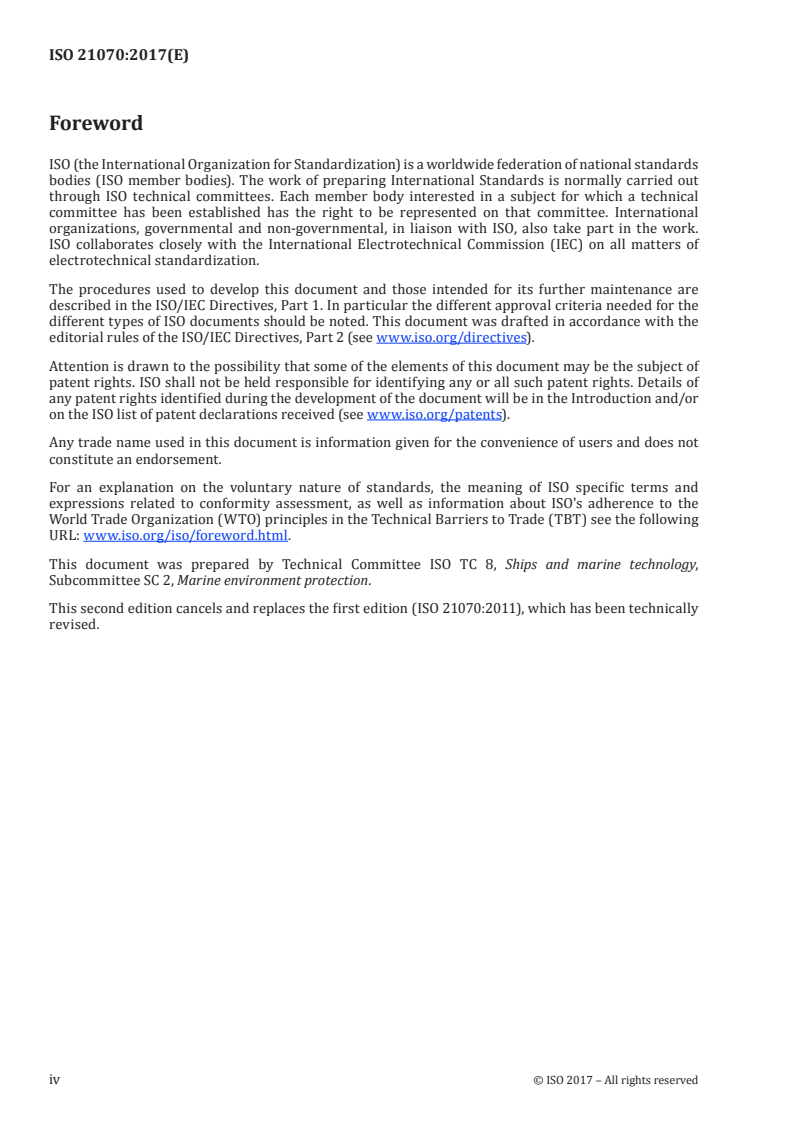
Contents Page
Foreword .iv
Introduction .v
1 Scope . 1
2 Normative references . 1
3 Terms and definitions . 1
4 Requirements . 4
4.1 General . 4
4.2 Classification of garbage . 4
4.3 Colour codes . 6
4.4 Cargo residues and operational waste from cargo stowage and handling operations . 7
4.5 Collection and segregation of garbage . . 7
4.5.1 General. 7
4.5.2 On board collection containers . 7
4.6 Storage . 7
4.6.1 General. 7
4.6.2 Storage containers . 8
4.7 On board processing of wastes . 9
4.8 Offloading waste .10
5 Garbage management .10
5.1 Garbage management plans .10
5.2 Garbage volume.10
5.3 Garbage management techniques .10
5.3.1 General.10
5.3.2 Discharge into the sea .11
5.4 Facilities to offload garbage .11
5.5 Documentation .11
5.6 Waste minimization .12
5.7 Garbage management audits .13
Annex A (informative) Examples of calculating the expected amount of waste .14
Annex B (informative) Examples of processing techniques used on board ships to reduce
the volume of garbage .16
Annex C (informative) Example of a garbage data sheet for use in waste auditing .18
Bibliography .19
Foreword
ISO (the International Organization for Standardization) is a worldwide federation of national standards
bodies (ISO member bodies). The work of preparing International Standards is normally carried out
through ISO technical committees. Each member body interested in a subject for which a technical
committee has been established has the right to be represented on that committee. International
organizations, governmental and non-governmental, in liaison with ISO, also take part in the work.
ISO collaborates closely with the International Electrotechnical Commission (IEC) on all matters of
electrotechnical standardization.
The procedures used to develop this document and those intended for its further maintenance are
described in the ISO/IEC Directives, Part 1. In particular the different approval criteria needed for the
different types of ISO documents should be noted. This document was drafted in accordance with the
editorial rules of the ISO/IEC Directives, Part 2 (see www.iso.org/directives).
Attention is drawn to the possibility that some of the elements of this document may be the subject of
patent rights. ISO shall not be held responsible for identifying any or all such patent rights. Details of
any patent rights identified during the development of the document will be in the Introduction and/or
on the ISO list of patent declarations received (see www.iso.org/patents).
Any trade name used in this document is information given for the convenience of users and does not
constitute an endorsement.
For an explanation on the voluntary nature of standards, the meaning of ISO specific terms and
expressions related to conformity assessment, as well as information about ISO's adherence to the
World Trade Organization (WTO) principles in the Technical Barriers to Trade (TBT) see the following
URL: www.iso.org/iso/foreword.html.
This document was prepared by Technical Committee ISO TC 8, Ships and marine technology,
Subcommittee SC 2, Marine environment protection.
This second edition cancels and replaces the first edition (ISO 21070:2011), which has been technically
revised.
iv © ISO 2017 – All rights reserved
Introduction
The management of shipboard garbage is extensively controlled by MARPOL, Annex V. Additionally,
States party to the MARPOL Convention have undertaken regional and national implementing
legislation to regulate and enforce provisions for handling ships’ waste and for providing adequate
reception facilities at ports and terminals subject to Parties' flag state and port state control authorities.
This document has been prepared to reflect the amendments of MARPOL, Annex V of January 2013.
This document provides for the minimization, management and segregation of a ship’s garbage, so that
it can be managed on-board and offloaded efficiently to the relevant reception facilities onshore.
To obtain the most efficient management of waste and to reduce the time and resource burden in
segregating and handling waste on the ship and in the ports, the concept of waste minimization has
been integrated into this document by incorporating the following basic principle: Prevention before
recycling before energy recovery before disposal.
This document concentrates on
— the prevention/elimination/minimization of waste prior to sailing,
— the minimization of waste at the source on the ship,
— the garbage collection at the source,
— the waste segregation on the ship into defined categories that are recognized globally and fit into
the many different waste categorization systems around the world,
— the waste minimization once segregated,
— the waste storage on board ship, and
— the health and safety concerns surrounding the handling, storage and offloading of waste.
Both ship owners and coastal states are more aware of the importance of well-organized and managed
waste collection and its benefits, especially with respect to health and safety on board ships, the
reduction of pollution and the potential cost benefits for ship owners and national governments. This
document provides a fixed standard for segregated garbage that any harbour facility worldwide may
expect when a ship arrives in port. However, it cannot work alone. ISO 16304 works in conjunction
with this document. This document does not consider the available various (and numerous) shore-side
waste handling systems that exist, but may encourage the provision of recycling facilities for shipboard
waste in ports.
INTERNATIONAL STANDARD ISO 21070:2017(E)
Ships and marine technology — Marine environment
protection — Management and handling of shipboard
garbage
1 Scope
This document specifies procedures for the shipboard management of garbage, including handling,
collection, separation, marking, treatment, and storage. It also describes the ship-to-shore interface and
the delivery of garbage from the ship to the port reception facility. MARPOL, Annex V sets the minimum
standard for garbage management that apply to ships. This document applies to the management and
handling of shipboard garbage during the period the garbage will be on board. The definition of garbage
in this document is as defined in MARPOL, Annex V.
2 Normative references
The following documents are referred to in the text in such a way that some or all of their content
constitutes requirements of this document. For dated references, only the edition cited applies. For
undated references, the latest edition of the referenced document (including any amendments) applies.
International Convention for the Prevention of Pollution from Ships, (MARPOL) Annex I to VI, as amended,
IMO, consolidated edition 2011
Guidelines for the Implementation of MARPOL Annex V, IMO, 2012
MEPC.1/ Circ. 834, Consolidated guidance for port reception facilities providers and users, IMO,15 April 2014
3 Terms and definitions
For the purposes of this document, the following terms and definitions apply.
ISO and IEC maintain terminological databases for use in standardization at the following addresses:
— IEC Electropedia: available at http://www.electropedia.org/
— ISO Online browsing platform: available at http://www.iso.org/obp
3.1 General terms
3.1.1
discharge
any release, however caused, from a ship including any escape, disposal, spilling, leaking, pumping,
emitting or emptying
[SOURCE: MARPOL Article 2 (3)(a)]
3.1.2
harmful substance
substance which, if introduced into the sea, is liable to create hazards to human health; harm living
resources and marine life; damage amenities or interfere with other legitimate uses of the sea, and;
includes any substance subject to control by the present MARPOL Convention
[SOURCE: MARPOL Article 2 (2)]
3.1.3
hazardous waste
waste which, due to its nature, physical, chemical or infectious properties, is potentially hazardous to
human health and/or the environment during use, handling, storage or transportation, including any
material which may require special handling, disposal or recycling techniques to eliminate or reduce
the hazard
3.1.4
port reception facility
PRF
any fixed, floating or mobile facility capable of receiving MARPOL residues/wastes from ships and fit
for that purpose
[SOURCE: Circular MEPC 1/Circ.834]
Note 1 to entry: For the purposes of this document, this relates to reception facilities for garbage as defined by
MARPOL, Annex V. An adequate port reception facility is a facility that mariners use and fully meets the needs of
the ships regularly using it and the port and does not provide mariners with a disincentive to use it. Furthermore,
it should contribute to the improvement of the marine environment. It should also allow for the ultimate disposal
of ships’ wastes to take place in an environmentally appropriate way.
[SOURCE: IMO Resolution MEPC.83(44)]
3.1.5
recycling
activity of segregating and recovering components and materials for reprocessing
3.1.6
reuse
activity of recovering components and materials for further use without reprocessing
3.2 Terms relating to garbage
3.2.1
cargo residue
remnants of any cargo material which are not covered by other annexes to the present MARPOL
Convention and which remain on the deck or in holds following loading or unloading, including loading
and unloading excess or spillage, whether in wet or dry conditions or entrained in wash water but does
not include cargo dust remaining on the deck after sweeping or dust on the external surfaces of the ship
Note 1 to entry: Dry bulk cargo residues may include substances that are harmful to the marine environment
(HME) with special restrictions for discharges (3.1.1) including HME entrained in cargo hold wash water. Port
reception facilities (3.1.4) for cargo residues considered to be HME may be required at loading or discharge ports
handling bulk dry cargoes.
[SOURCE: MARPOL Annex V reg. 1.2]
3.2.2
domestic waste
all types of waste not covered by other annexes to the present MARPOL Convention that are generated
in the accommodation spaces on board the ship
Note 1 to entry: Domestic wastes does not include grey water.
[SOURCE: MARPOL Annex V reg. 1.4]
2 © ISO 2017 – All rights reserved
3.2.3
garbage
all kinds of food waste, domestic waste (3.2.2) and operational waste (3.2.5), all plastics (3.2.11), cargo
residue (3.2.1), cooking oil, fishing gear, and animal carcasses generated during the normal operation
of the ship and liable to be disposed of continuously or periodically except those substances which are
defined or listed in other annexes to the present MARPOL Convention.
Note 1 to entry: Garbage does not include fresh fish and parts thereof generated as a result of fishing activities
undertaken during the voyage, or as a result of aquaculture activities which involve the transport of fish including
shellfish for placement in the aquaculture facility and the transport of harvested fish including shellfish from
such facilities to shore for processing.
[SOURCE: MARPOL Annex V reg. 1.9]
3.2.4
incinerator ashes
ash and clinkers resulting from shipboard incinerators used for incineration of garbage (3.2.3)
[SOURCE: MARPOL Annex V reg. 1.10]
3.2.5
operational waste
all solid waste (including slurries) not covered by other annexes in the present MARPOL Convention that
are collected on board during normal maintenance or operations of a ship, or used for cargo stowage
and handling
Note 1 to entry: Operational waste includes, but is not limited to, the following wastes associated with cargo
storage and handling: dunnage, shoring, pallets, lining, transit and packing materials, plywood, paper, cardboard,
wire, plastic wrapping, and steel strapping.
Note 2 to entry: Operational waste also includes cleaning agents and additives contained in external wash water.
Note 3 to entry: Operational waste does not include grey water, bilge water, or other similar discharges (3.1.1)
essential to the operation of a ship.
Note 4 to entry: Wooden material may be defined as quarantine waste in certain countries.
[SOURCE: MARPOL Annex V reg. 1.12]
3.2.6
oily rag
rag which has been saturated with oil and controlled in MARPOL, Annex I
3.2.7
contaminated rag
rag which has been saturated with any substance defined as potentially hazardous or harmful to human
health and/or the environment
3.2.8
maintenance waste
materials collected by the crew while maintaining and operating the ship
3.2.9
medical waste
solid waste that is generated in the diagnosis, treatment, or immunization of human beings or animals,
in research pertaining thereto, or in the production or testing of biological materials, including but not
limited to isolation wastes, infectious agents, human blood and blood products, pathological wastes,
sharps, body parts, contaminated bedding, surgical wastes and potentially contaminated laboratory
wastes and dialysis wastes
Note 1 to entry: Medical waste is distinguished into two categories: infectious and non-infectious as defined by
the World Health Organization.
3.2.10
quarantine waste
solid or liquid waste determined by local or regional legislation to require special handling, segregation
and disposal due to its potential to spread disease, diseases, or plant and animal pests when discharged
or delivered ashore
3.2.11
plastic
solid material which contains as an essential ingredient one or more high molecular mass polymers
and which is formed (shaped) during either the manufacture of the polymer or the fabrication into a
finished product by heat and/or pressure
Note 1 to entry: Plastics have material properties ranging from hard and brittle to soft and elastic.
Note 2 to entry: For the purpose of this document, plastics include plastic in any form, including synthetic ropes,
synthetic fishing nets, plastic garbage (3.2.3) bags and incinerator ashes (3.2.4) from plastic products.
[SOURCE: MARPOL Annex V, reg. 1.13]
4 Requirements
4.1 General
This clause specifies the minimum requirements for waste treatment on board, including waste
separation, marking, collecting, storing and offloading to port reception facilities.
While it is recognized that on board waste management should be standardized, it shall be noted that
offloading procedures depend on the ports and the port reception facilities available.
4.2 Classification of garbage
The following categories and garbage types covered in this document are listed in Table 1.
Table 1 — Categories and garbage types
MARPOL Industry recognized symbol
Type Annex V (available through a simple Description
category internet search)
All garbage that consists of or includes plastic
in any form, including synthetic ropes and
fishing nets, shall be retained on board and
Plastics A
disposed of ashore.
For recyclable plastics only
Food
B —
wastes
Domestic
C —
waste
4 © ISO 2017 – All rights reserved
Table 1 (continued)
MARPOL Industry recognized symbol
Type Annex V (available through a simple Description
category internet search)
Cooking oil D —
Incinerator NOTE Incinerator ash from plastic products
E
ashes may contain toxic or heavy metals.
Examples of (non-hazardous) wastes are
dunnage, shoring, pallets, lining, transit and
packing materials, plywood, paper cardboard,
wire, plastic wrapping, and steel strapping.
NOTE 1 Some regional or national legislation
may require even further separate identifica-
tion and handling.
NOTE 2 Operational waste can be considered
Operational
F hazardous. Examples of hazardous waste are
wastes
batteries, fluorescent lamps, garbage contam-
inated with hazardous waste, and any other
waste that is considered hazardous waste.
This kind of waste is handled and treated
separately.
NOTE 3 Oily waste and rags are MARPOL,
Annex I waste.
NOTE 4 Medical waste is a separate item.
See 4.3.
Cargo
NOTE Dry cargo residues may include deck or
G
residue
cargo hold sweepings and wash water contain-
ing such residues.
Animal
H —
carcasses
Fishing gear I —
NOTE May require separation by colours.
Glass C
Paper
C —
Products
Reference is made to guidelines to MARPOL,
Annex V 2012, 5.2.5.
Medical
—
waste
Table 1 (continued)
MARPOL Industry recognized symbol
Type Annex V (available through a simple Description
category internet search)
For example, cargo securing materials, etc.
Oil
contaminated F
waste
Wood C —
Metal C —
E-waste C —
Garbage that is contaminated by another category of garbage shall be handled in accordance with the
more stringent disposal requirements that are applicable.
4.3 Colour codes
Inexpensive and readily available standard label software and a colour printer may be useful for
creating labels/markings, as shown in Table 1 and according to the colour scheme in Table 2, aboard ship
for collection and storage container labelling. Coloured signage/labels could be affixed to appropriate
portable containers such as drums, boxing or bagging for retention and storage aboard. Such a
colour coding system would be useful for easy identification when offloading at a reception facility.
Furthermore, such a labelling scheme will facilitate efficient segregation of wastes by type, for further
handling and recycling by port reception facility operators. Additional or supplemental labels could be
affixed to those types of waste requiring special handling such as hazardous or harmful, quarantine, or
medical wastes and incinerator ashes for ships equipped with such equipment, as appropriate.
6 © ISO 2017 – All rights reserved
Table 2 — Colour codes for waste
Waste Colour
Plastics Ye
...
INTERNATIONAL ISO
STANDARD 21070
Second edition
2017-10
Ships and marine technology —
Marine environment protection
— Management and handling of
shipboard garbage
Navires et technologie marine — Protection de l'environnement
marin — Gestion et manutention des déchets à bord du navire
Reference number
©
ISO 2017
© ISO 2017, Published in Switzerland
All rights reserved. Unless otherwise specified, no part of this publication may be reproduced or utilized otherwise in any form
or by any means, electronic or mechanical, including photocopying, or posting on the internet or an intranet, without prior
written permission. Permission can be requested from either ISO at the address below or ISO’s member body in the country of
the requester.
ISO copyright office
Ch. de Blandonnet 8 • CP 401
CH-1214 Vernier, Geneva, Switzerland
Tel. +41 22 749 01 11
Fax +41 22 749 09 47
copyright@iso.org
www.iso.org
ii © ISO 2017 – All rights reserved
Contents Page
Foreword .iv
Introduction .v
1 Scope . 1
2 Normative references . 1
3 Terms and definitions . 1
4 Requirements . 4
4.1 General . 4
4.2 Classification of garbage . 4
4.3 Colour codes . 6
4.4 Cargo residues and operational waste from cargo stowage and handling operations . 7
4.5 Collection and segregation of garbage . . 7
4.5.1 General. 7
4.5.2 On board collection containers . 7
4.6 Storage . 7
4.6.1 General. 7
4.6.2 Storage containers . 8
4.7 On board processing of wastes . 9
4.8 Offloading waste .10
5 Garbage management .10
5.1 Garbage management plans .10
5.2 Garbage volume.10
5.3 Garbage management techniques .10
5.3.1 General.10
5.3.2 Discharge into the sea .11
5.4 Facilities to offload garbage .11
5.5 Documentation .11
5.6 Waste minimization .12
5.7 Garbage management audits .13
Annex A (informative) Examples of calculating the expected amount of waste .14
Annex B (informative) Examples of processing techniques used on board ships to reduce
the volume of garbage .16
Annex C (informative) Example of a garbage data sheet for use in waste auditing .18
Bibliography .19
Foreword
ISO (the International Organization for Standardization) is a worldwide federation of national standards
bodies (ISO member bodies). The work of preparing International Standards is normally carried out
through ISO technical committees. Each member body interested in a subject for which a technical
committee has been established has the right to be represented on that committee. International
organizations, governmental and non-governmental, in liaison with ISO, also take part in the work.
ISO collaborates closely with the International Electrotechnical Commission (IEC) on all matters of
electrotechnical standardization.
The procedures used to develop this document and those intended for its further maintenance are
described in the ISO/IEC Directives, Part 1. In particular the different approval criteria needed for the
different types of ISO documents should be noted. This document was drafted in accordance with the
editorial rules of the ISO/IEC Directives, Part 2 (see www.iso.org/directives).
Attention is drawn to the possibility that some of the elements of this document may be the subject of
patent rights. ISO shall not be held responsible for identifying any or all such patent rights. Details of
any patent rights identified during the development of the document will be in the Introduction and/or
on the ISO list of patent declarations received (see www.iso.org/patents).
Any trade name used in this document is information given for the convenience of users and does not
constitute an endorsement.
For an explanation on the voluntary nature of standards, the meaning of ISO specific terms and
expressions related to conformity assessment, as well as information about ISO's adherence to the
World Trade Organization (WTO) principles in the Technical Barriers to Trade (TBT) see the following
URL: www.iso.org/iso/foreword.html.
This document was prepared by Technical Committee ISO TC 8, Ships and marine technology,
Subcommittee SC 2, Marine environment protection.
This second edition cancels and replaces the first edition (ISO 21070:2011), which has been technically
revised.
iv © ISO 2017 – All rights reserved
Introduction
The management of shipboard garbage is extensively controlled by MARPOL, Annex V. Additionally,
States party to the MARPOL Convention have undertaken regional and national implementing
legislation to regulate and enforce provisions for handling ships’ waste and for providing adequate
reception facilities at ports and terminals subject to Parties' flag state and port state control authorities.
This document has been prepared to reflect the amendments of MARPOL, Annex V of January 2013.
This document provides for the minimization, management and segregation of a ship’s garbage, so that
it can be managed on-board and offloaded efficiently to the relevant reception facilities onshore.
To obtain the most efficient management of waste and to reduce the time and resource burden in
segregating and handling waste on the ship and in the ports, the concept of waste minimization has
been integrated into this document by incorporating the following basic principle: Prevention before
recycling before energy recovery before disposal.
This document concentrates on
— the prevention/elimination/minimization of waste prior to sailing,
— the minimization of waste at the source on the ship,
— the garbage collection at the source,
— the waste segregation on the ship into defined categories that are recognized globally and fit into
the many different waste categorization systems around the world,
— the waste minimization once segregated,
— the waste storage on board ship, and
— the health and safety concerns surrounding the handling, storage and offloading of waste.
Both ship owners and coastal states are more aware of the importance of well-organized and managed
waste collection and its benefits, especially with respect to health and safety on board ships, the
reduction of pollution and the potential cost benefits for ship owners and national governments. This
document provides a fixed standard for segregated garbage that any harbour facility worldwide may
expect when a ship arrives in port. However, it cannot work alone. ISO 16304 works in conjunction
with this document. This document does not consider the available various (and numerous) shore-side
waste handling systems that exist, but may encourage the provision of recycling facilities for shipboard
waste in ports.
INTERNATIONAL STANDARD ISO 21070:2017(E)
Ships and marine technology — Marine environment
protection — Management and handling of shipboard
garbage
1 Scope
This document specifies procedures for the shipboard management of garbage, including handling,
collection, separation, marking, treatment, and storage. It also describes the ship-to-shore interface and
the delivery of garbage from the ship to the port reception facility. MARPOL, Annex V sets the minimum
standard for garbage management that apply to ships. This document applies to the management and
handling of shipboard garbage during the period the garbage will be on board. The definition of garbage
in this document is as defined in MARPOL, Annex V.
2 Normative references
The following documents are referred to in the text in such a way that some or all of their content
constitutes requirements of this document. For dated references, only the edition cited applies. For
undated references, the latest edition of the referenced document (including any amendments) applies.
International Convention for the Prevention of Pollution from Ships, (MARPOL) Annex I to VI, as amended,
IMO, consolidated edition 2011
Guidelines for the Implementation of MARPOL Annex V, IMO, 2012
MEPC.1/ Circ. 834, Consolidated guidance for port reception facilities providers and users, IMO,15 April 2014
3 Terms and definitions
For the purposes of this document, the following terms and definitions apply.
ISO and IEC maintain terminological databases for use in standardization at the following addresses:
— IEC Electropedia: available at http://www.electropedia.org/
— ISO Online browsing platform: available at http://www.iso.org/obp
3.1 General terms
3.1.1
discharge
any release, however caused, from a ship including any escape, disposal, spilling, leaking, pumping,
emitting or emptying
[SOURCE: MARPOL Article 2 (3)(a)]
3.1.2
harmful substance
substance which, if introduced into the sea, is liable to create hazards to human health; harm living
resources and marine life; damage amenities or interfere with other legitimate uses of the sea, and;
includes any substance subject to control by the present MARPOL Convention
[SOURCE: MARPOL Article 2 (2)]
3.1.3
hazardous waste
waste which, due to its nature, physical, chemical or infectious properties, is potentially hazardous to
human health and/or the environment during use, handling, storage or transportation, including any
material which may require special handling, disposal or recycling techniques to eliminate or reduce
the hazard
3.1.4
port reception facility
PRF
any fixed, floating or mobile facility capable of receiving MARPOL residues/wastes from ships and fit
for that purpose
[SOURCE: Circular MEPC 1/Circ.834]
Note 1 to entry: For the purposes of this document, this relates to reception facilities for garbage as defined by
MARPOL, Annex V. An adequate port reception facility is a facility that mariners use and fully meets the needs of
the ships regularly using it and the port and does not provide mariners with a disincentive to use it. Furthermore,
it should contribute to the improvement of the marine environment. It should also allow for the ultimate disposal
of ships’ wastes to take place in an environmentally appropriate way.
[SOURCE: IMO Resolution MEPC.83(44)]
3.1.5
recycling
activity of segregating and recovering components and materials for reprocessing
3.1.6
reuse
activity of recovering components and materials for further use without reprocessing
3.2 Terms relating to garbage
3.2.1
cargo residue
remnants of any cargo material which are not covered by other annexes to the present MARPOL
Convention and which remain on the deck or in holds following loading or unloading, including loading
and unloading excess or spillage, whether in wet or dry conditions or entrained in wash water but does
not include cargo dust remaining on the deck after sweeping or dust on the external surfaces of the ship
Note 1 to entry: Dry bulk cargo residues may include substances that are harmful to the marine environment
(HME) with special restrictions for discharges (3.1.1) including HME entrained in cargo hold wash water. Port
reception facilities (3.1.4) for cargo residues considered to be HME may be required at loading or discharge ports
handling bulk dry cargoes.
[SOURCE: MARPOL Annex V reg. 1.2]
3.2.2
domestic waste
all types of waste not covered by other annexes to the present MARPOL Convention that are generated
in the accommodation spaces on board the ship
Note 1 to entry: Domestic wastes does not include grey water.
[SOURCE: MARPOL Annex V reg. 1.4]
2 © ISO 2017 – All rights reserved
3.2.3
garbage
all kinds of food waste, domestic waste (3.2.2) and operational waste (3.2.5), all plastics (3.2.11), cargo
residue (3.2.1), cooking oil, fishing gear, and animal carcasses generated during the normal operation
of the ship and liable to be disposed of continuously or periodically except those substances which are
defined or listed in other annexes to the present MARPOL Convention.
Note 1 to entry: Garbage does not include fresh fish and parts thereof generated as a result of fishing activities
undertaken during the voyage, or as a result of aquaculture activities which involve the transport of fish including
shellfish for placement in the aquaculture facility and the transport of harvested fish including shellfish from
such facilities to shore for processing.
[SOURCE: MARPOL Annex V reg. 1.9]
3.2.4
incinerator ashes
ash and clinkers resulting from shipboard incinerators used for incineration of garbage (3.2.3)
[SOURCE: MARPOL Annex V reg. 1.10]
3.2.5
operational waste
all solid waste (including slurries) not covered by other annexes in the present MARPOL Convention that
are collected on board during normal maintenance or operations of a ship, or used for cargo stowage
and handling
Note 1 to entry: Operational waste includes, but is not limited to, the following wastes associated with cargo
storage and handling: dunnage, shoring, pallets, lining, transit and packing materials, plywood, paper, cardboard,
wire, plastic wrapping, and steel strapping.
Note 2 to entry: Operational waste also includes cleaning agents and additives contained in external wash water.
Note 3 to entry: Operational waste does not include grey water, bilge water, or other similar discharges (3.1.1)
essential to the operation of a ship.
Note 4 to entry: Wooden material may be defined as quarantine waste in certain countries.
[SOURCE: MARPOL Annex V reg. 1.12]
3.2.6
oily rag
rag which has been saturated with oil and controlled in MARPOL, Annex I
3.2.7
contaminated rag
rag which has been saturated with any substance defined as potentially hazardous or harmful to human
health and/or the environment
3.2.8
maintenance waste
materials collected by the crew while maintaining and operating the ship
3.2.9
medical waste
solid waste that is generated in the diagnosis, treatment, or immunization of human beings or animals,
in research pertaining thereto, or in the production or testing of biological materials, including but not
limited to isolation wastes, infectious agents, human blood and blood products, pathological wastes,
sharps, body parts, contaminated bedding, surgical wastes and potentially contaminated laboratory
wastes and dialysis wastes
Note 1 to entry: Medical waste is distinguished into two categories: infectious and non-infectious as defined by
the World Health Organization.
3.2.10
quarantine waste
solid or liquid waste determined by local or regional legislation to require special handling, segregation
and disposal due to its potential to spread disease, diseases, or plant and animal pests when discharged
or delivered ashore
3.2.11
plastic
solid material which contains as an essential ingredient one or more high molecular mass polymers
and which is formed (shaped) during either the manufacture of the polymer or the fabrication into a
finished product by heat and/or pressure
Note 1 to entry: Plastics have material properties ranging from hard and brittle to soft and elastic.
Note 2 to entry: For the purpose of this document, plastics include plastic in any form, including synthetic ropes,
synthetic fishing nets, plastic garbage (3.2.3) bags and incinerator ashes (3.2.4) from plastic products.
[SOURCE: MARPOL Annex V, reg. 1.13]
4 Requirements
4.1 General
This clause specifies the minimum requirements for waste treatment on board, including waste
separation, marking, collecting, storing and offloading to port reception facilities.
While it is recognized that on board waste management should be standardized, it shall be noted that
offloading procedures depend on the ports and the port reception facilities available.
4.2 Classification of garbage
The following categories and garbage types covered in this document are listed in Table 1.
Table 1 — Categories and garbage types
MARPOL Industry recognized symbol
Type Annex V (available through a simple Description
category internet search)
All garbage that consists of or includes plastic
in any form, including synthetic ropes and
fishing nets, shall be retained on board and
Plastics A
disposed of ashore.
For recyclable plastics only
Food
B —
wastes
Domestic
C —
waste
4 © ISO 2017 – All rights reserved
Table 1 (continued)
MARPOL Industry recognized symbol
Type Annex V (available through a simple Description
category internet search)
Cooking oil D —
Incinerator NOTE Incinerator ash from plastic products
E
ashes may contain toxic or heavy metals.
Examples of (non-hazardous) wastes are
dunnage, shoring, pallets, lining, transit and
packing materials, plywood, paper cardboard,
wire, plastic wrapping, and steel strapping.
NOTE 1 Some regional or national legislation
may require even further separate identifica-
tion and handling.
NOTE 2 Operational waste can be considered
Operational
F hazardous. Examples of hazardous waste are
wastes
batteries, fluorescent lamps, garbage contam-
inated with hazardous waste, and any other
waste that is considered hazardous waste.
This kind of waste is handled and treated
separately.
NOTE 3 Oily waste and rags are MARPOL,
Annex I waste.
NOTE 4 Medical waste is a separate item.
See 4.3.
Cargo
NOTE Dry cargo residues may include deck or
G
residue
cargo hold sweepings and wash water contain-
ing such residues.
Animal
H —
carcasses
Fishing gear I —
NOTE May require separation by colours.
Glass C
Paper
C —
Products
Reference is made to guidelines to MARPOL,
Annex V 2012, 5.2.5.
Medical
—
waste
Table 1 (continued)
MARPOL Industry recognized symbol
Type Annex V (available through a simple Description
category internet search)
For example, cargo securing materials, etc.
Oil
contaminated F
waste
Wood C —
Metal C —
E-waste C —
Garbage that is contaminated by another category of garbage shall be handled in accordance with the
more stringent disposal requirements that are applicable.
4.3 Colour codes
Inexpensive and readily available standard label software and a colour printer may be useful for
creating labels/markings, as shown in Table 1 and according to the colour scheme in Table 2, aboard ship
for collection and storage container labelling. Coloured signage/labels could be affixed to appropriate
portable containers such as drums, boxing or bagging for retention and storage aboard. Such a
colour coding system would be useful for easy identification when offloading at a reception facility.
Furthermore, such a labelling scheme will facilitate efficient segregation of wastes by type, for further
handling and recycling by port reception facility operators. Additional or supplemental labels could be
affixed to those types of waste requiring special handling such as hazardous or harmful, quarantine, or
medical wastes and incinerator ashes for ships equipped with such equipment, as appropriate.
6 © ISO 2017 – All rights reserved
Table 2 — Colour codes for waste
Waste Colour
Plastics Ye
...