


ISO 9984
(Main)Information and documentation — Transliteration of Georgian characters into Latin characters
Information and documentation — Transliteration of Georgian characters into Latin characters
This document establishes a system for the transliteration of Georgian characters into Latin characters, in accordance with the principles of stringent conversion in order to permit international information exchange, particularly by electronic means. This document can be used anyone who has a clear understanding of the system, and is certain that it can be applied without ambiguity. This document focuses on the unambiguous written conversion. The correct pronunciation of the original text is out of the scope of this document.
Information et documentation — Translittération des caractères géorgiens en caractères latins
Informatika in dokumentacija – Transliteracija gruzijskih znakov v latinične znake
General Information
- Status
- Not Published
- Technical Committee
- ISO/TC 46 - Information and documentation
- Drafting Committee
- ISO/TC 46 - Information and documentation
- Current Stage
- 6000 - International Standard under publication
- Start Date
- 05-Dec-2025
- Completion Date
- 10-Jan-2026
Relations
- Effective Date
- 10-Jun-2023
Overview
ISO 9984:2025 - Information and documentation - Transliteration of Georgian characters into Latin characters - defines a reversible, machine-friendly system for converting modern Georgian script into Latin (romanized) characters. Prepared by ISO/TC 46, this second edition updates the 1996 standard and aligns the system with the Georgian national system (2002, presidential decree 2011) while adding modifications to ensure reversibility and suitability for international information exchange, particularly by electronic means.
Key topics and technical requirements
- Transliteration tables: Core mappings for the 33 characters of the current Georgian alphabet (Unicode range U+10D0–U+10FF) are provided with Latin equivalents and example words. Tables include Unicode hexadecimal codes for both Georgian characters and their Latin transliterations.
- Reversibility: The system is designed for stringent, unambiguous conversion so original Georgian text can be recovered from the Latin form.
- Marking of special consonants:
- Glottalized consonants are indicated using a neutral apostrophe (Unicode U+0027), e.g. კ → k' (Row 10).
- Aspirated vs. glottalized distinctions were revised from the earlier edition; several consonant romanizations changed (details in Table 4).
- Digraph handling and ambiguity avoidance: Certain Georgian letters map to digraphs (e.g. ჟ → zh, შ → sh). To prevent confusion with adjacent Latin characters (e.g. z + h versus zh), the middle dot (Unicode U+00B7) may be used to separate characters where needed (for reversible machine processing).
- Scope limits: The standard focuses on unambiguous written conversion; correct pronunciation and capitalization rules are explicitly out of scope (capitalization is optional and follows target-language conventions).
- Obsolete characters: A separate table lists historical or non-standard Georgian characters with their transliterations for reference.
Applications and who uses ISO 9984
ISO 9984 is intended for any organization or professional needing precise, machine-readable romanization of Georgian script, for example:
- Libraries, archives, and cataloguers implementing consistent metadata and authority control
- Database designers, search engines, and information systems supporting multilingual indexing and retrieval
- GIS and toponymy projects exchanging geographic names internationally
- Publishers, academic researchers, and documentation specialists who require reversible transliteration for data exchange and preservation
By following ISO 9984, implementers ensure consistent, interoperable romanization suitable for automated processing, data exchange, and long-term information management.
Related standards and references
- ISO/IEC 10646 (Unicode) - character code points referenced in the tables
- BGN/PCGN Romanization of Georgian, UNGEGN reports, ALA-LC romanization tables - listed in the ISO 9984 bibliography and useful for comparative practice
- Georgian national decree on Latin transliteration of geographical names (2011) - underlying national system referenced by this edition
Keywords: ISO 9984, Georgian transliteration, romanization, Unicode, reversible transliteration, Georgian to Latin, transliteration tables, metadata, information exchange.

ISO/DIS 9984:2025
ISO/PRF 9984 - Information and documentation — Transliteration of Georgian characters into Latin characters Released:6. 11. 2025
REDLINE ISO/PRF 9984 - Information and documentation — Transliteration of Georgian characters into Latin characters Released:6. 11. 2025
Frequently Asked Questions
ISO 9984 is a draft published by the International Organization for Standardization (ISO). Its full title is "Information and documentation — Transliteration of Georgian characters into Latin characters". This standard covers: This document establishes a system for the transliteration of Georgian characters into Latin characters, in accordance with the principles of stringent conversion in order to permit international information exchange, particularly by electronic means. This document can be used anyone who has a clear understanding of the system, and is certain that it can be applied without ambiguity. This document focuses on the unambiguous written conversion. The correct pronunciation of the original text is out of the scope of this document.
This document establishes a system for the transliteration of Georgian characters into Latin characters, in accordance with the principles of stringent conversion in order to permit international information exchange, particularly by electronic means. This document can be used anyone who has a clear understanding of the system, and is certain that it can be applied without ambiguity. This document focuses on the unambiguous written conversion. The correct pronunciation of the original text is out of the scope of this document.
ISO 9984 is classified under the following ICS (International Classification for Standards) categories: 01.140.10 - Writing and transliteration. The ICS classification helps identify the subject area and facilitates finding related standards.
ISO 9984 has the following relationships with other standards: It is inter standard links to ISO 9984:1996. Understanding these relationships helps ensure you are using the most current and applicable version of the standard.
ISO 9984 is available in PDF format for immediate download after purchase. The document can be added to your cart and obtained through the secure checkout process. Digital delivery ensures instant access to the complete standard document.
Standards Content (Sample)
SLOVENSKI STANDARD
01-junij-2025
Informatika in dokumentacija – Transliteracija gruzijskih znakov v latinične znake
Information and documentation — Transliteration of Georgian characters into Latin
characters
Information et documentation — Translittération des caractères géorgiens en caractères
latins
Ta slovenski standard je istoveten z: ISO/DIS 9984
ICS:
01.140.10 Pisanje in prečrkovanje Writing and transliteration
2003-01.Slovenski inštitut za standardizacijo. Razmnoževanje celote ali delov tega standarda ni dovoljeno.
DRAFT
International
Standard
ISO/DIS 9984
ISO/TC 46
Information and documentation —
Secretariat: AFNOR
Transliteration of Georgian
Voting begins on:
characters into Latin characters
2025-04-02
Information et documentation — Translittération des caractères
Voting terminates on:
géorgiens en caractères latins
2025-06-25
ICS: 01.140.10
THIS DOCUMENT IS A DRAFT CIRCULATED
FOR COMMENTS AND APPROVAL. IT
IS THEREFORE SUBJECT TO CHANGE
AND MAY NOT BE REFERRED TO AS AN
INTERNATIONAL STANDARD UNTIL
PUBLISHED AS SUCH.
IN ADDITION TO THEIR EVALUATION AS
BEING ACCEPTABLE FOR INDUSTRIAL,
TECHNOLOGICAL, COMMERCIAL AND
USER PURPOSES, DRAFT INTERNATIONAL
STANDARDS MAY ON OCCASION HAVE TO
This document is circulated as received from the committee secretariat.
BE CONSIDERED IN THE LIGHT OF THEIR
POTENTIAL TO BECOME STANDARDS TO
WHICH REFERENCE MAY BE MADE IN
NATIONAL REGULATIONS.
RECIPIENTS OF THIS DRAFT ARE INVITED
TO SUBMIT, WITH THEIR COMMENTS,
NOTIFICATION OF ANY RELEVANT PATENT
RIGHTS OF WHICH THEY ARE AWARE AND TO
PROVIDE SUPPORTING DOCUMENTATION.
Reference number
ISO/DIS 9984:2025(en)
DRAFT
ISO/DIS 9984:2025(en)
International
Standard
ISO/DIS 9984
ISO/TC 46
Information and documentation —
Secretariat: AFNOR
Transliteration of Georgian
Voting begins on:
characters into Latin characters
Information et documentation — Translittération des caractères
Voting terminates on:
géorgiens en caractères latins
ICS: 01.140.10
THIS DOCUMENT IS A DRAFT CIRCULATED
FOR COMMENTS AND APPROVAL. IT
IS THEREFORE SUBJECT TO CHANGE
AND MAY NOT BE REFERRED TO AS AN
INTERNATIONAL STANDARD UNTIL
PUBLISHED AS SUCH.
IN ADDITION TO THEIR EVALUATION AS
BEING ACCEPTABLE FOR INDUSTRIAL,
© ISO 2025
TECHNOLOGICAL, COMMERCIAL AND
USER PURPOSES, DRAFT INTERNATIONAL
All rights reserved. Unless otherwise specified, or required in the context of its implementation, no part of this publication may
STANDARDS MAY ON OCCASION HAVE TO
be reproduced or utilized otherwise in any form or by any means, electronic or mechanical, including photocopying, or posting on
This document is circulated as received from the committee secretariat. BE CONSIDERED IN THE LIGHT OF THEIR
the internet or an intranet, without prior written permission. Permission can be requested from either ISO at the address below
POTENTIAL TO BECOME STANDARDS TO
WHICH REFERENCE MAY BE MADE IN
or ISO’s member body in the country of the requester.
NATIONAL REGULATIONS.
ISO copyright office
RECIPIENTS OF THIS DRAFT ARE INVITED
CP 401 • Ch. de Blandonnet 8
TO SUBMIT, WITH THEIR COMMENTS,
CH-1214 Vernier, Geneva
NOTIFICATION OF ANY RELEVANT PATENT
Phone: +41 22 749 01 11
RIGHTS OF WHICH THEY ARE AWARE AND TO
PROVIDE SUPPORTING DOCUMENTATION.
Email: copyright@iso.org
Website: www.iso.org
Published in Switzerland Reference number
ISO/DIS 9984:2025(en)
ii
ISO/DIS 9984:2025(en)
Contents Page
Foreword .iv
Introduction .vi
1 Scope . 1
2 Normative references . 1
3 Terms and definitions . 1
4 Transliteration tables . 2
4.1 General .2
4.2 Georgian characters .2
4.3 Other characters used in the Georgian script .3
Bibliography . 4
iii
ISO/DIS 9984:2025(en)
Foreword
ISO (the International Organization for Standardization) is a worldwide federation of national standards
bodies (ISO member bodies). The work of preparing International Standards is normally carried out through
ISO technical committees. Each member body interested in a subject for which a technical committee
has been established has the right to be represented on that committee. International organizations,
governmental and non-governmental, in liaison with ISO, also take part in the work. ISO collaborates closely
with the International Electrotechnical Commission (IEC) on all matters of electrotechnical standardization.
The procedures used to develop this document and those intended for its further maintenance are described
in the ISO/IEC Directives, Part 1. In particular, the different approval criteria needed for the different types
of ISO documents should be noted. This document was drafted in accordance with the editorial rules of
the ISO/IEC Directives, Part 2 (see www.iso.org/directives). Attention is drawn to the possibility that some
of the elements of this document may be the subject of patent rights. ISO shall not be held responsible for
identifying any or all such patent rights. Details of any patent rights identified during the development
of the document will be in the Introduction and/or on the ISO list of patent declarations received (see
www.iso.org/patents). Any trade name used in this document is information given for the convenience of
users and does not constitute an endorsement.
For an explanation of the voluntary nature of standards, the meaning of ISO specific terms and expressions
related to conformity assessment, as well as information about ISO's adherence to the World Trade
Organization (WTO) principles in the Technical Barriers to Trade (TBT), see www.iso.org/iso/foreword.html.
This document was prepared by Technical Committee ISO/TC 46 Information and documentation.
This second edition cancels and replaces the first edition (ISO 9984:1996), which has been technically
revised. The main changes are as follows:
— The system is now based on the Georgian national system of 2002 (presidential decree of 2011),
1)
with modifications incorporated to ensure reversibility . There are certain digraphs included in the
romanizations in the table, e.g. /zh/ for ჟ (row 16), and to ensure there is no ambiguity with the possible
occurrence of /z/ followed by /h/, such adjoining characters should be separated by a middle dot symbol
in their romanization (Unicode 00B7) to show that they do not represent the digraph, so /z·h/ for the
character combination ზჰ (rows 7 and 33).
This is relevant to characters:
/g/ გ (row 3) followed by /h/ ჰ (row 33)
/z/ ზ (row 7) followed by /h/ ჰ (row 33)
/s/ ს (row 18) followed by /h/ ჰ (row 33)
/k/ ქ (row 22) followed by /h/ ჰ (row 33)
/t/ თ (row 8) followed by /s/ ს (row 18)
/d/ დ (row 4) followed by /z/ ზ (row 7)
— In introducing digraphs to follow the national system, there are 10 modifications to former romanizations:
1) For information, Georgia has also developed a transcription system: Guidelines for Latin Transliteration of the
Sound System of the Georgian language 2019-2020 (State Language Department, Bulletin II, Griponi Publishing, Tbilisi,
ISBN 978-9941-480-63-8): https://enadep.gov.ge/uploads/Guidelines_for_Latin_Transliteration_of_the_Sound_System_
of_the_Georgian_Language_.pdf (Accessed 16 July 2024). This simpler system, which does not differentiate between
aspirated and glottal consonants with the use of apostrophes, is also used nationally for the text of statements, notices,
titles, posters, signs, geographical and personal names on addresses and road stencils, advertisements, and other visual
information intended to inform the public. It is not used for academic or scientific purposes.
...
International
Standard
Second edition
Information and documentation —
Transliteration of Georgian
characters into Latin characters
Information et documentation — Translittération des caractères
géorgiens en caractères latins
PROOF/ÉPREUVE
Reference number
© ISO 2025
All rights reserved. Unless otherwise specified, or required in the context of its implementation, no part of this publication may
be reproduced or utilized otherwise in any form or by any means, electronic or mechanical, including photocopying, or posting on
the internet or an intranet, without prior written permission. Permission can be requested from either ISO at the address below
or ISO’s member body in the country of the requester.
ISO copyright office
CP 401 • Ch. de Blandonnet 8
CH-1214 Vernier, Geneva
Phone: +41 22 749 01 11
Email: copyright@iso.org
Website: www.iso.org
Published in Switzerland
PROOF/ÉPREUVE
ii
Contents Page
Foreword .iv
Introduction .v
1 Scope . 1
2 Normative references . 1
3 Terms and definitions . 1
4 Transliteration tables . 2
4.1 General .2
4.2 Georgian characters .2
4.3 Other characters used in the Georgian script .3
Bibliography . 5
PROOF/ÉPREUVE
iii
Foreword
ISO (the International Organization for Standardization) is a worldwide federation of national standards
bodies (ISO member bodies). The work of preparing International Standards is normally carried out through
ISO technical committees. Each member body interested in a subject for which a technical committee
has been established has the right to be represented on that committee. International organizations,
governmental and non-governmental, in liaison with ISO, also take part in the work. ISO collaborates closely
with the International Electrotechnical Commission (IEC) on all matters of electrotechnical standardization.
The procedures used to develop this document and those intended for its further maintenance are described
in the ISO/IEC Directives, Part 1. In particular, the different approval criteria needed for the different types
of ISO document should be noted. This document was drafted in accordance with the editorial rules of the
ISO/IEC Directives, Part 2 (see www.iso.org/directives).
ISO draws attention to the possibility that the implementation of this document may involve the use of (a)
patent(s). ISO takes no position concerning the evidence, validity or applicability of any claimed patent
rights in respect thereof. As of the date of publication of this document, ISO had not received notice of (a)
patent(s) which may be required to implement this document. However, implementers are cautioned that
this may not represent the latest information, which may be obtained from the patent database available at
www.iso.org/patents. ISO shall not be held responsible for identifying any or all such patent rights.
Any trade name used in this document is information given for the convenience of users and does not
constitute an endorsement.
For an explanation of the voluntary nature of standards, the meaning of ISO specific terms and expressions
related to conformity assessment, as well as information about ISO's adherence to the World Trade
Organization (WTO) principles in the Technical Barriers to Trade (TBT), see www.iso.org/iso/foreword.html.
This document was prepared by Technical Committee ISO/TC 46, Information and documentation.
This second edition cancels and replaces the first edition (ISO 9984:1996), which has been technically
revised.
The main changes are as follows.
— The system is now based on the Georgian national system of 2002 (presidential decree of 2011), with
modifications incorporated to ensure reversibility, for detail see Table 4.
Any feedback or questions on this document should be directed to the user’s national standards body. A
complete listing of these bodies can be found at www.iso.org/members.html.
PROOF/ÉPREUVE
iv
Introduction
This document is one of the International Standards dealing with the conversion of systems of writing
developed by ISO/TC 46. The aim of these International Standards is to provide a means for international
communication of written messages. The system is entirely reversible.
For information, Georgia has also developed a transcription system, see Reference [7]. This simpler system,
which does not differentiate between aspirated and glottal consonants with the use of apostrophes, is also
used nationally for the text of statements, notices, titles, posters, signs, geographical and personal names on
addresses and road stencils, advertisements, and other visual information intended to inform the public. It
is not used for academic or scientific purposes.
— 10 modifications to the former romanizations (shown in Table 1) have been added in Table 4;
Table 1 — General comparison of former and new romanizations
Row Georgian Former New
number character romanization romanization
16 ჟ ž zh
23 ღ ḡ gh
25 შ š sh
26 ჩ č' ch
27 ც c' ts
28 ძ j dz
32 ჯ ǰ j
29 წ c ts'
30 ჭ č ch'
31 ხ x kh
— glottalized consonants have been marked with neutral (vertical line) apostrophe (Unicode 0027)
(e.g. 4.2, row 19: ტ was /t/ now / t'/). This is relevant to the items shown in Table 2;
Table 2 — Marking of glottalized consonants
Row Georgian Former New
number character romanization romanization
10 კ k k'
15 პ p p'
19 ტ t t'
24 ყ q q'
29 წ c ts'
30 ჭ č ch'
— Previously, aspirated counterparts were represented with this mark (e.g. 4.2, row 8: თ was /t'/, now /t/).
This is relevant to the items shown in Table 3;
PROOF/ÉPREUVE
v
Table 3 — Marking of aspirated consonants
Row Georgian Former New
number character romanization romanization
8 თ t' t
21 ფ p' p
22 ქ k' k
26 ჩ č' ch
27 ც c' ts
— The main system (see 4.2) is now limited to the 33 characters of the current Georgian alphabet (removing
long obsolete addition
...
ISO/DISPRF 9984:2025(en)
ISO/TC 46
Secretariat: AFNOR
Date: 2025-11-05-16
Information and documentation — Transliteration of Georgian
characters into Latin characters
Information et documentation — Translittération des caractères géorgiens en caractères latins
PROOF
ISO/PRF 9984:2025(en)
All rights reserved. Unless otherwise specified, or required in the context of its implementation, no part of this publication
may be reproduced or utilized otherwise in any form or by any means, electronic or mechanical, including photocopying,
or posting on the internet or an intranet, without prior written permission. Permission can be requested from either ISO
at the address below or ISO’s member body in the country of the requester.
ISO copyright office
CP 401 • Ch. de Blandonnet 8
CH-1214 Vernier, Geneva
Phone: + 41 22 749 01 11
EmailE-mail: copyright@iso.org
Website: www.iso.orgwww.iso.org
Published in Switzerland
ii
ISO/PRF 9984:2025(en)
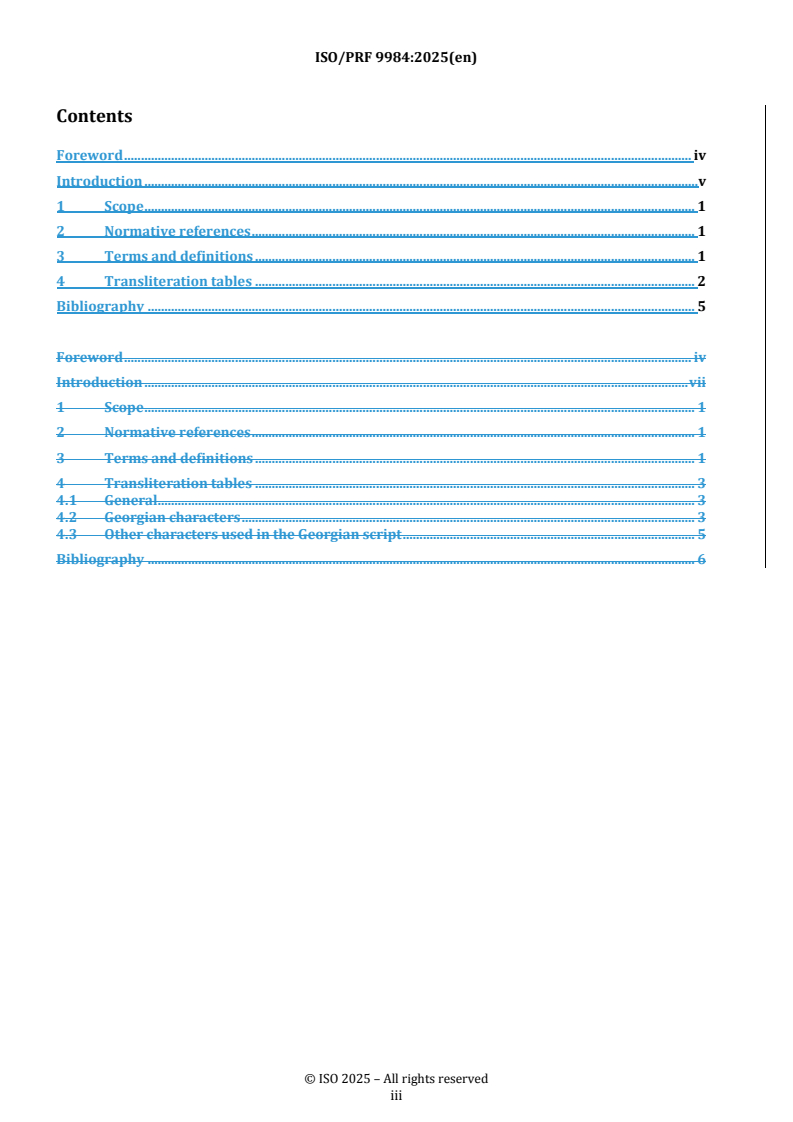
Contents
Foreword . iv
Introduction . v
1 Scope . 1
2 Normative references . 1
3 Terms and definitions . 1
4 Transliteration tables . 2
Bibliography . 5
Foreword . iv
Introduction . vii
1 Scope . 1
2 Normative references . 1
3 Terms and definitions . 1
4 Transliteration tables . 3
4.1 General . 3
4.2 Georgian characters . 3
4.3 Other characters used in the Georgian script . 5
Bibliography . 6
iii
ISO/PRF 9984:2025(en)
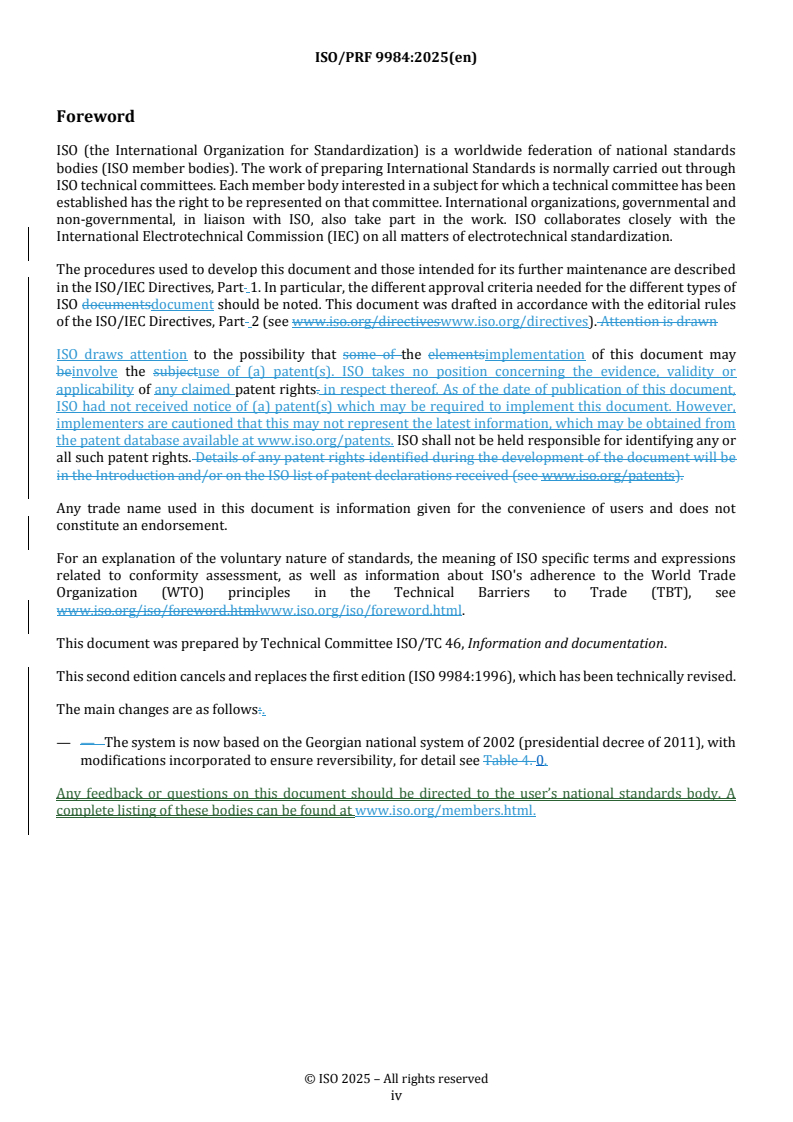
Foreword
ISO (the International Organization for Standardization) is a worldwide federation of national standards
bodies (ISO member bodies). The work of preparing International Standards is normally carried out through
ISO technical committees. Each member body interested in a subject for which a technical committee has been
established has the right to be represented on that committee. International organizations, governmental and
non-governmental, in liaison with ISO, also take part in the work. ISO collaborates closely with the
International Electrotechnical Commission (IEC) on all matters of electrotechnical standardization.
The procedures used to develop this document and those intended for its further maintenance are described
in the ISO/IEC Directives, Part 1. In particular, the different approval criteria needed for the different types of
ISO documentsdocument should be noted. This document was drafted in accordance with the editorial rules
of the ISO/IEC Directives, Part 2 (see www.iso.org/directiveswww.iso.org/directives). Attention is drawn
ISO draws attention to the possibility that some of the elementsimplementation of this document may
beinvolve the subjectuse of (a) patent(s). ISO takes no position concerning the evidence, validity or
applicability of any claimed patent rights. in respect thereof. As of the date of publication of this document,
ISO had not received notice of (a) patent(s) which may be required to implement this document. However,
implementers are cautioned that this may not represent the latest information, which may be obtained from
the patent database available at www.iso.org/patents. ISO shall not be held responsible for identifying any or
all such patent rights. Details of any patent rights identified during the development of the document will be
in the Introduction and/or on the ISO list of patent declarations received (see www.iso.org/patents).
Any trade name used in this document is information given for the convenience of users and does not
constitute an endorsement.
For an explanation of the voluntary nature of standards, the meaning of ISO specific terms and expressions
related to conformity assessment, as well as information about ISO's adherence to the World Trade
Organization (WTO) principles in the Technical Barriers to Trade (TBT), see
www.iso.org/iso/foreword.htmlwww.iso.org/iso/foreword.html.
This document was prepared by Technical Committee ISO/TC 46, Information and documentation.
This second edition cancels and replaces the first edition (ISO 9984:1996), which has been technically revised.
The main changes are as follows:.
— — The system is now based on the Georgian national system of 2002 (presidential decree of 2011), with
modifications incorporated to ensure reversibility, for detail see Table 4. 0.
Any feedback or questions on this document should be directed to the user’s national standards body. A
complete listing of these bodies can be found at www.iso.org/members.html.
iv
ISO/PRF 9984:2025(en)
Introduction
This document is one of the International Standards dealing with the conversion of systems of writing
developed by ISO/TC 46. The aim of these International Standards is to provide a means for international
communication of written messages. The system is entirely reversible.
For information, Georgia has also developed a transcription system, see Reference [6].[Error! Reference
source not found.]. This simpler system, which does not differentiate between aspirated and glottal
consonants with the use of apostrophes, is also used nationally for the text of statements, notices, titles,
posters, signs, geographical and personal names on addresses and road stencils, advertisements, and other
visual information intended to inform the public. It is not used for academic or scientific purposes.
— — 10 modifications to the former romanizations (shown in Table 1)0) have been added in Table 4;0;
Table 1 – — General comparison of former and new romanizations
Row Georgian Former New
number character romanization romanization
16 ჟ ž zh
23 ღ ḡ gh
25 შ š sh
26 ჩ č' ch
27 ც c' ts
28 ძ j dz
32 ჯ ǰ j
29 წ c ts'
30 ჭ č ch'
31 ხ x kh
— — glottalized consonants have been marked with neutral (vertical line) apostrophe (Unicode 0027) (e.g.
4.2,4.2, row 19: ტ was /t/ now / t'/). This is relevant to the items shown in Table 2:0;
Table 2 – — Marking of glottalized consonants
Row Georgian Former New
number character romanization romanization
10 კ k k'
15 პ p p'
19 ტ t t'
24 ყ q q'
29 წ c ts'
30 ჭ č ch'
— — Previously, aspirated counterparts were represented with this mark (e.g. 4.2,4.2, row 8: თ was /t'/,
now /t/). This is relevant to the items shown in Table 3:0;
v
ISO/PRF 9984:2025(en)
Table 3 – — Marking of aspirated consonants
Row Georgian Former New
number character romanization romanization
8 თ t' t
21 ფ p' p
22 ქ k' k
26 ჩ č' ch
27 ც
...
Questions, Comments and Discussion
Ask us and Technical Secretary will try to provide an answer. You can facilitate discussion about the standard in here.
Loading comments...