


ISO 20858:2007
(Main)Ships and marine technology — Maritime port facility security assessments and security plan development
Ships and marine technology — Maritime port facility security assessments and security plan development
ISO 20858:2007 establishes a framework to assist marine port facilities in specifying the competence of personnel to conduct a marine port facility security assessment and to develop a security plan as required by the ISPS Code International Standard, conducting the marine port facility security assessment, and drafting/implementing a Port Facility Security Plan (PFSP). In addition, ISO 20858:2007 establishes certain documentation requirements designed to ensure that the process used in performing the duties described above was recorded in a manner that would permit independent verification by a qualified and authorized agency (if the port facility has agreed to the review). It is not an objective of ISO 20858:2007 to set requirements for a contracting government or designated authority in designating a Recognized Security Organization (RSO), or to impose the use of an outside service provider or other third parties to perform the marine port facility security assessment or security plan if the port facility personnel possess the expertise outlined in this specification. Ship operators may be informed that marine port facilities that use this document meet an industry-determined level of compliance with the ISPS Code. Port infrastructure that falls outside the security perimeter of a marine port facility might affect the security of the facility/ship interface. ISO 20858:2007 does not address the requirements of the ISPS Code relative to such infrastructures. State governments have a duty to protect their populations and infrastructures from marine incidents occurring outside their marine port facilities. These duties are outside the scope of ISO 20858:2007.
Navires et technologie maritime — Évaluations de la sécurité des installations portuaires maritimes et réalisation de plans de sécurité
General Information
- Status
- Published
- Publication Date
- 04-Nov-2007
- Technical Committee
- ISO/TC 8/SC 11 - Intermodal and Short Sea Shipping
- Drafting Committee
- ISO/TC 8/SC 11 - Intermodal and Short Sea Shipping
- Current Stage
- 9093 - International Standard confirmed
- Start Date
- 26-Sep-2024
- Completion Date
- 12-Feb-2026
Relations
- Effective Date
- 15-Apr-2008
Overview
ISO 20858:2007 - Ships and marine technology - Maritime port facility security assessments and security plan development - provides a practical framework to help marine port facilities meet the ISPS Code intent. The standard focuses on specifying required competence of personnel, conducting a marine port facility security assessment, and drafting/implementing a Port Facility Security Plan (PFSP). It also sets documentation and record-keeping practices to allow independent verification by authorized reviewers. Use of ISO 20858 is voluntary and does not replace national obligations or prescribe how authorities designate Recognized Security Organizations (RSOs).
Key topics and requirements
ISO 20858:2007 covers the full assessment-to-plan lifecycle and associated records. Major technical topics include:
- Competence and roles: criteria for personnel conducting security assessments and for Port Facility Security Officers (PFSO).
- Security assessment procedures: defining assessment scope, identifying assets/infrastructure, and capturing current security status.
- Threats, scenarios and scoring: development of threat scenarios, classification of consequences and likelihood, and scoring of security incidents.
- Countermeasures and prioritization: selection, exceptions, and prioritization of mitigations to reduce identified risks.
- PFSP content: required plan elements such as plot plans, security administration, access control (including restricted/public areas), procedures for interfacing with ships, Declarations of Security (DoS), cargo handling controls, delivery of ship’s stores/bunkers, monitoring, communications, emergency and incident procedures.
- Specialised requirements: additional considerations for passenger/ferry and cruise terminals.
- Verification and maintenance: audits, plan amendments, drills and exercises, skills/competency records, and retention of documentation.
- Documentation: safeguarding assessment reports, PFSP, operations and training records to permit independent verification.
Practical applications and users
ISO 20858 is useful for:
- Port authorities and marine port facility operators preparing or revising PFSPs.
- Port Facility Security Officers, security managers and security personnel defining competencies and training.
- Recognized Security Organizations (RSOs), consultants and auditors assessing compliance with ISPS Code expectations.
- Ship operators wanting assurance that a port facility follows a recognized, auditable assessment process.
- Certification bodies and governments referencing an industry-consensus approach for documentation and verification.
Related standards
- ISPS Code (IMO) - mandatory international code for ship and port facility security (ISO 20858 supports ISPS implementation).
- ISO 28000 - Supply chain security management systems.
- ISO 9001 / ISO 14001 and ISM Code - examples of management systems referenced for integration with security processes.
Keywords: ISO 20858, Port Facility Security Plan, PFSP, ISPS Code, marine port facility security assessment, port security, Port Facility Security Officer, security incident scoring.
Get Certified
Connect with accredited certification bodies for this standard

DNV
DNV is an independent assurance and risk management provider.

Lloyd's Register
Lloyd's Register is a global professional services organisation specialising in engineering and technology.

ABS Quality Evaluations Inc.
American Bureau of Shipping quality certification.
Sponsored listings
Frequently Asked Questions
ISO 20858:2007 is a standard published by the International Organization for Standardization (ISO). Its full title is "Ships and marine technology — Maritime port facility security assessments and security plan development". This standard covers: ISO 20858:2007 establishes a framework to assist marine port facilities in specifying the competence of personnel to conduct a marine port facility security assessment and to develop a security plan as required by the ISPS Code International Standard, conducting the marine port facility security assessment, and drafting/implementing a Port Facility Security Plan (PFSP). In addition, ISO 20858:2007 establishes certain documentation requirements designed to ensure that the process used in performing the duties described above was recorded in a manner that would permit independent verification by a qualified and authorized agency (if the port facility has agreed to the review). It is not an objective of ISO 20858:2007 to set requirements for a contracting government or designated authority in designating a Recognized Security Organization (RSO), or to impose the use of an outside service provider or other third parties to perform the marine port facility security assessment or security plan if the port facility personnel possess the expertise outlined in this specification. Ship operators may be informed that marine port facilities that use this document meet an industry-determined level of compliance with the ISPS Code. Port infrastructure that falls outside the security perimeter of a marine port facility might affect the security of the facility/ship interface. ISO 20858:2007 does not address the requirements of the ISPS Code relative to such infrastructures. State governments have a duty to protect their populations and infrastructures from marine incidents occurring outside their marine port facilities. These duties are outside the scope of ISO 20858:2007.
ISO 20858:2007 establishes a framework to assist marine port facilities in specifying the competence of personnel to conduct a marine port facility security assessment and to develop a security plan as required by the ISPS Code International Standard, conducting the marine port facility security assessment, and drafting/implementing a Port Facility Security Plan (PFSP). In addition, ISO 20858:2007 establishes certain documentation requirements designed to ensure that the process used in performing the duties described above was recorded in a manner that would permit independent verification by a qualified and authorized agency (if the port facility has agreed to the review). It is not an objective of ISO 20858:2007 to set requirements for a contracting government or designated authority in designating a Recognized Security Organization (RSO), or to impose the use of an outside service provider or other third parties to perform the marine port facility security assessment or security plan if the port facility personnel possess the expertise outlined in this specification. Ship operators may be informed that marine port facilities that use this document meet an industry-determined level of compliance with the ISPS Code. Port infrastructure that falls outside the security perimeter of a marine port facility might affect the security of the facility/ship interface. ISO 20858:2007 does not address the requirements of the ISPS Code relative to such infrastructures. State governments have a duty to protect their populations and infrastructures from marine incidents occurring outside their marine port facilities. These duties are outside the scope of ISO 20858:2007.
ISO 20858:2007 is classified under the following ICS (International Classification for Standards) categories: 47.020.99 - Other standards related to shipbuilding and marine structures. The ICS classification helps identify the subject area and facilitates finding related standards.
ISO 20858:2007 has the following relationships with other standards: It is inter standard links to ISO/PAS 20858:2004. Understanding these relationships helps ensure you are using the most current and applicable version of the standard.
ISO 20858:2007 is available in PDF format for immediate download after purchase. The document can be added to your cart and obtained through the secure checkout process. Digital delivery ensures instant access to the complete standard document.
Standards Content (Sample)
INTERNATIONAL ISO
STANDARD 20858
First edition
2007-10-15
Ships and marine technology — Maritime
port facility security assessments and
security plan development
Navires et technologie maritime — Évaluation de la sécurité des
installations portuaires maritimes et réalisation de plans de sécurité
Reference number
©
ISO 2007
PDF disclaimer
This PDF file may contain embedded typefaces. In accordance with Adobe's licensing policy, this file may be printed or viewed but
shall not be edited unless the typefaces which are embedded are licensed to and installed on the computer performing the editing. In
downloading this file, parties accept therein the responsibility of not infringing Adobe's licensing policy. The ISO Central Secretariat
accepts no liability in this area.
Adobe is a trademark of Adobe Systems Incorporated.
Details of the software products used to create this PDF file can be found in the General Info relative to the file; the PDF-creation
parameters were optimized for printing. Every care has been taken to ensure that the file is suitable for use by ISO member bodies. In
the unlikely event that a problem relating to it is found, please inform the Central Secretariat at the address given below.
© ISO 2007
All rights reserved. Unless otherwise specified, no part of this publication may be reproduced or utilized in any form or by any means,
electronic or mechanical, including photocopying and microfilm, without permission in writing from either ISO at the address below or
ISO's member body in the country of the requester.
ISO copyright office
Case postale 56 • CH-1211 Geneva 20
Tel. + 41 22 749 01 11
Fax + 41 22 749 09 47
E-mail copyright@iso.org
Web www.iso.org
Published in Switzerland
ii © ISO 2007 – All rights reserved
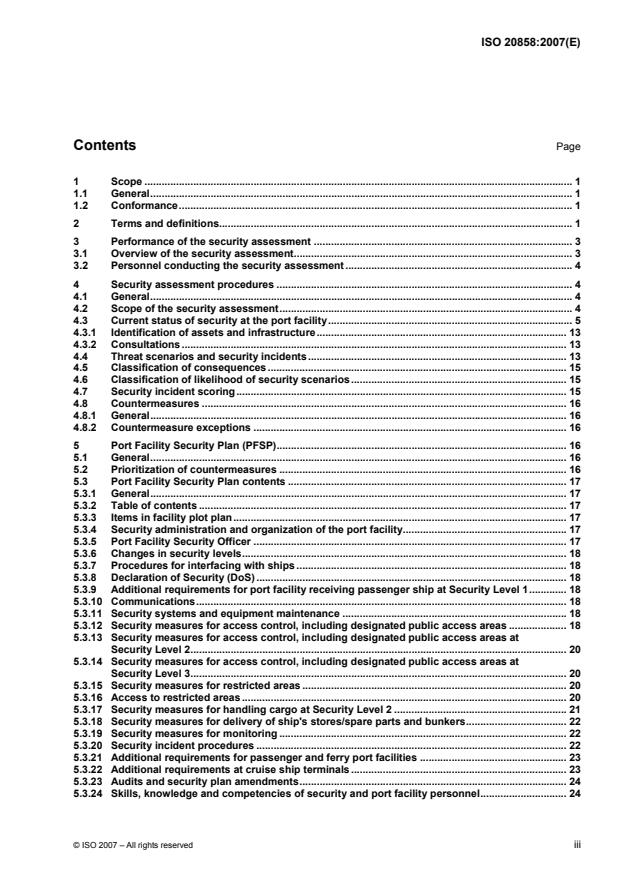
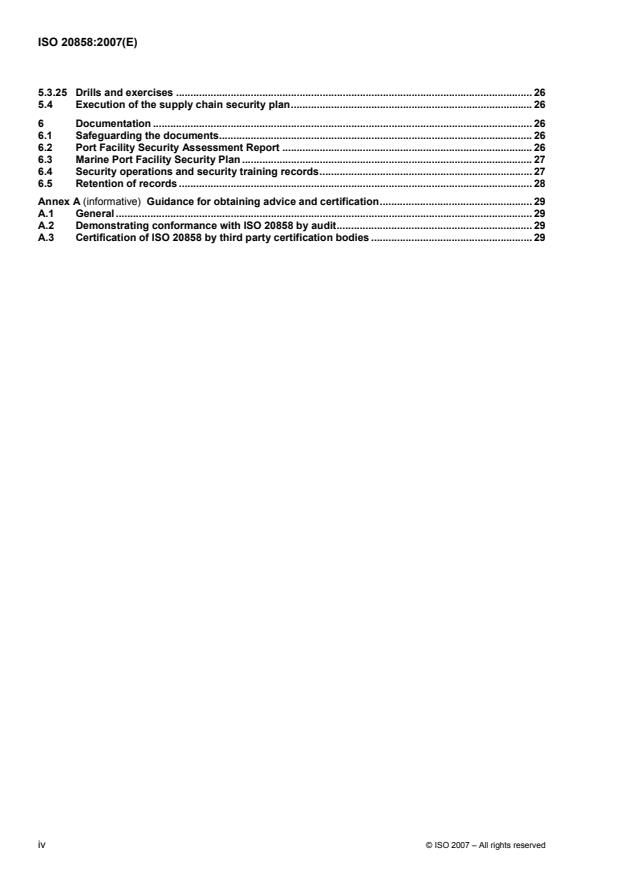
Contents Page
1 Scope. 1
1.1 General. 1
1.2 Conformance. 1
2 Terms and definitions. 1
3 Performance of the security assessment . 3
3.1 Overview of the security assessment. 3
3.2 Personnel conducting the security assessment . 4
4 Security assessment procedures . 4
4.1 General. 4
4.2 Scope of the security assessment. 4
4.3 Current status of security at the port facility. 5
4.3.1 Identification of assets and infrastructure. 13
4.3.2 Consultations . 13
4.4 Threat scenarios and security incidents. 13
4.5 Classification of consequences . 15
4.6 Classification of likelihood of security scenarios . 15
4.7 Security incident scoring. 15
4.8 Countermeasures . 16
4.8.1 General. 16
4.8.2 Countermeasure exceptions . 16
5 Port Facility Security Plan (PFSP). 16
5.1 General. 16
5.2 Prioritization of countermeasures . 16
5.3 Port Facility Security Plan contents . 17
5.3.1 General. 17
5.3.2 Table of contents . 17
5.3.3 Items in facility plot plan. 17
5.3.4 Security administration and organization of the port facility. 17
5.3.5 Port Facility Security Officer . 17
5.3.6 Changes in security levels. 18
5.3.7 Procedures for interfacing with ships . 18
5.3.8 Declaration of Security (DoS) . 18
5.3.9 Additional requirements for port facility receiving passenger ship at Security Level 1. 18
5.3.10 Communications. 18
5.3.11 Security systems and equipment maintenance . 18
5.3.12 Security measures for access control, including designated public access areas . 18
5.3.13 Security measures for access control, including designated public access areas at
Security Level 2. 20
5.3.14 Security measures for access control, including designated public access areas at
Security Level 3. 20
5.3.15 Security measures for restricted areas . 20
5.3.16 Access to restricted areas . 20
5.3.17 Security measures for handling cargo at Security Level 2 . 21
5.3.18 Security measures for delivery of ship's stores/spare parts and bunkers. 22
5.3.19 Security measures for monitoring . 22
5.3.20 Security incident procedures . 22
5.3.21 Additional requirements for passenger and ferry port facilities . 23
5.3.22 Additional requirements at cruise ship terminals . 23
5.3.23 Audits and security plan amendments. 24
5.3.24 Skills, knowledge and competencies of security and port facility personnel. 24
5.3.25 Drills and exercises . 26
5.4 Execution of the supply chain security plan. 26
6 Documentation . 26
6.1 Safeguarding the documents. 26
6.2 Port Facility Security Assessment Report . 26
6.3 Marine Port Facility Security Plan . 27
6.4 Security operations and security training records. 27
6.5 Retention of records . 28
Annex A (informative) Guidance for obtaining advice and certification. 29
A.1 General. 29
A.2 Demonstrating conformance with ISO 20858 by audit. 29
A.3 Certification of ISO 20858 by third party certification bodies . 29
iv © ISO 2007 – All rights reserved
Foreword
ISO (the International Organization for Standardization) is a worldwide federation of national standards bodies
(ISO member bodies). The work of preparing International Standards is normally carried out through ISO
technical committees. Each member body interested in a subject for which a technical committee has been
established has the right to be represented on that committee. International organizations, governmental and
non-governmental, in liaison with ISO, also take part in the work. ISO collaborates closely with the
International Electrotechnical Commission (IEC) on all matters of electrotechnical standardization.
International Standards are drafted in accordance with the rules given in the ISO/IEC Directives, Part 2.
The main task of technical committees is to prepare International Standards. Draft International Standards
adopted by the technical committees are circulated to the member bodies for voting. Publication as an
International Standard requires approval by at least 75 % of the member bodies casting a vote.
Attention is drawn to the possibility that some of the elements of this document may be the subject of patent
rights. ISO shall not be held responsible for identifying any or all such patent rights.
ISO 20858 was prepared by Technical Committee ISO/TC 8, Ships and marine technology.
This first edition of ISO 20858 cancels and replaces ISO/PAS 20858:2004, which has been technically revised.
Introduction
This International Standard addresses the execution of marine port facility security assessments, marine port
facility security plans (including countermeasures) and the skills and knowledge required of the personnel
involved. This International Standard is designed to ensure that the completed work meets the requirements
of the International Maritime Organization (IMO) International Ships and Port Facility Security Code (ISPS)
and the appropriate maritime security practices that can be verified by an outside auditor. Since other ISO
standards may address non-marine port facilities the word “marine” usually appears before port facilities in
this standard. This standard is intended to address port facilities as defined in the ISPS.
vi © ISO 2007 – All rights reserved
INTERNATIONAL STANDARD ISO 20858:2007(E)
Ships and marine technology — Maritime port facility security
assessments and security plan development
1 Scope
1.1 General
This International Standard establishes a framework to assist marine port facilities in specifying the
competence of personnel to conduct a marine port facility security assessment and to develop a security plan
as required by the ISPS Code International Standard, conducting the marine port facility security assessment,
and drafting/implementing a Port Facility Security Plan (PFSP).
In addition, this International Standard establishes certain documentation requirements designed to ensure
that the process used in performing the duties described above was recorded in a manner that would permit
independent verification by a qualified and authorized agency (if the port facility has agreed to the review). It is
not an objective of this International Standard to set requirements for a contracting government or designated
authority in designating a Recognized Security Organization (RSO), or to impose the use of an outside service
provider or other third parties to perform the marine port facility security assessment or security plan if the port
facility personnel possess the expertise outlined in this specification. Ship operators may be informed that
marine port facilities that use this document meet an industry-determined level of compliance with the ISPS
Code.
Port infrastructure that falls outside the security perimeter of a marine port facility might affect the security of
the facility/ship interface. This International Standard does not address the requirements of the ISPS Code
relative to such infrastructures. State governments have a duty to protect their populations and infrastructures
from marine incidents occurring outside their marine port facilities. These duties are outside the scope of this
International Standard.
1.2 Conformance
While compliance with the ISPS Code is internationally mandated for all signatory countries, the use of this
International Standard is voluntary. If a contracting government establishes requirements that preclude the
use of this International Standard, local law takes precedence and compliance with this International Standard
should not be claimed.
2 Terms and definitions
For the purposes of this document, the following terms and definitions apply.
2.1
cargo
items that are placed on the ship to be transported to another port, such as boxes, pallets, cargo transport
units, and bulk liquid and non-liquid matter
2.2
consequence
loss of life, damage to property or economic disruption, including disruption to transport systems that can
reasonably be expected as a result of an attack on or at the marine port facility
2.3
International Maritime Organization
IMO
specialized agency of the United Nations whose purpose is “to provide machinery for cooperation among
governments in the field of governmental regulation and practices relating to technical matters of all kinds
affecting shipping engaged in international trade; to encourage and facilitate the general adoption of the
highest practicable standards in matters concerning maritime safety, efficiency of navigation, and prevention
and control of marine pollution from ships”
2.4
ISPS Code
international code for the security of ships and port facilities consisting of Part A (the provisions of which shall
be treated as mandatory), and Part B (the provisions of which shall be treated as recommendatory), as
adopted on 12 December 2002 by Resolution 2 of the Conference of Contracting Governments to the
International Convention for the Safety at Sea, 1974, as may be amended by the Organization
2.5
likelihood
probability of a threat scenario becoming a security incident, considering the resistance the physical and
operational security measures in place at the marine port facility
2.6
management system
organization’s structure for managing its processes or activities that transform inputs of resources into a
product or service, which meet the organization’s objectives
NOTE It is not the intent of this document to specify a specific management system or require the creation of a
separate security management system. ISO 9001 (Quality Management Systems), ISO 14001 (Environmental
Management Systems), ISO 28000 (Supply Chain Security Management Systems) and the International Maritime
Organization’s International Safety Management (ISM) Code are examples of management systems.
2.7
marine port facility
those areas of the port and harbour where the ship/port interface takes place
NOTE The ship/port interface means the interactions that occur when a ship is directly and immediately affected by
actions involving the movement of persons and/or goods, or the provisions of port services to and from the ship. This
includes areas such as anchorages, waiting berths, and approaches from seaward. The marine port facility extends
landside to the security perimeter. Note that, for the purposes of this International Standard, there can be more than one
marine port facility in a harbour. In that case, only the anchorages, waiting berths, and approaches from seaward that are
used to service the marine port facility using this document are included. There can be areas of ports and harbours that
are addressed in the ISPS Code, but that are not addressed in this International Standard.
2.8
Port Facility Security Plan
PFSP
plan to ensure the application of measures designed to protect the people, port facility, ships, cargo, cargo
transport units, and ship stores within the port facility from the risks of a security incident
2.9
risk
chance of injury, damage or loss postulated by considering the consequence of a threat and the likelihood of
its occurrence
2.10
security
resistance to intentional, unauthorized acts designed to cause harm or damage to ships and ports
2 © ISO 2007 – All rights reserved
2.11
security crisis management team
group of people who have the knowledge and authority to bring the necessary resources to bear in the event
of an imminent security threat or actual security incident
2.12
security incident
suspicious act or circumstance threatening the security of a ship or port facility
2.13
security personnel
individuals who have assigned security duties defined in the port facility and who may or may not be
employees
2.14
ship’s stores
supplies and spare parts intended for use by a ship calling on a marine port facility
2.15
target
personnel, ships, cargo, physical assets, and control/documentation systems within a marine port facility
2.16
security threat scenario
means by which a potential security incident might occur
NOTE Because attack methods are nearly infinite, several general postulated security threat scenarios are specified
to address the full range of attack scenarios. Local authorities, port facility management and personnel conducting the
security assessment could add more specific security threat scenarios to the list of general security threat scenarios,
depending on local circumstances.
3 Performance of the security assessment
3.1 Overview of the security assessment
The port facility implementing this International Standard shall conduct a security assessment or draw upon
existing security assessments that are valid, documented and meet the requirements of this International
Standard. The assessment shall consider security threat scenarios, consequences of a successful attack on
the port facility, and the likelihood of each security threat scenario being successful given the security
measures in place. Based on these considerations, a determination shall be made if additional security
countermeasures are required.
NOTE The authorized maritime security group convened to compose the PFSA needs to be collectively
knowledgeable in port/facility operations, security and the potential security threats that could occur at the specific site.
From their experience and training, they review current conditions (using a provided Performance Review) and produce a
realistic list of security threat scenarios that could adversely affect the facility. These potential security incidents are
thoroughly studied, and then charted with regard to the likelihood of an occurrence and subsequent consequences, if it
occurs. The resultant security risk chart for each of these incidents indicates which are of such gravity as to need effective
human and/or physical countermeasures. The formulating team will increasingly apply these countermeasures until the
identified risk is reduced to an acceptable level (meeting with the approval of the contracting government).
At this stage, the PFSA evolves into the PFSP. The aforementioned process is dealt with in more detail within this
document, and forms the route toward a site-specific facility plan. Although basically stated, nothing here is intended to
oversimplify the effort needed to construct a comprehensive quality plan. The above sequence will establish a plan for
effective security for the standard Security Level 1, following which the group will reapply the countermeasures required
for the higher Security Levels 2 and 3, as described herein. The contracting government reviews and approves the
prepared plan for submission to the IMO.
3.2 Personnel conducting the security assessment
Those involved in a Port Facility Security Assessment (PFSA) shall be able to draw upon expert assistance
relative to:
⎯ knowledge of current security threats and patterns;
⎯ recognition and detection of weapons, dangerous substances, and devices;
⎯ recognition, on a non-discriminatory basis, of characteristics and behavioural patterns of persons who are
likely to threaten security;
⎯ techniques used to circumvent security measures;
⎯ methods used to cause a security incident;
⎯ effects of explosives on structures and port facility services;
⎯ port business practices;
⎯ contingency planning, emergency preparedness, and response;
⎯ physical security measures (e.g. fences);
⎯ radio and telecommunications systems, including computer systems and networks;
⎯ transport and civil engineering;
⎯ ship and port operations;
⎯ maintenance of appropriate measures to avoid unauthorized disclosure of, or access to, sensitive security
material;
⎯ knowledge of the requirements in Chapter XI-2 and part A of the ISPS Code and relevant national and
international legislation and security requirements;
⎯ knowledge of security and surveillance equipment and systems, as well as their operational limitations.
All personnel involved in a PFSA, including those called on to provide the expertise listed above, shall be
listed in the Port Facility Security Assessment Report as specified in 6.2.
4 Security assessment procedures
4.1 General
A security assessment provides the basis for developing the Marine Port Facility Security Plan. The
methodology used in the assessment is not specified in this International Standard. However, the
methodology used in the assessment shall meet the requirements of this International Standard.
4.2 Scope of the security assessment
The scope of the assessment extends to those port facilities and port infrastructures that could be threatened
or be used to threaten maritime trade.
The port facility security assessment shall include, as a minimum, all areas
⎯ where port facility/ship operations are conducted within the port facility,
4 © ISO 2007 – All rights reserved
⎯ where cargo is staged, stowed or handled before/following marine transportation within the port facility,
⎯ where cargo documentation for marine transportation is handled/accessible within the port facility,
⎯ attached to the port facility without an intervening security perimeter, and
⎯ including ship channels used to approach the port facility.
4.3 Current status of security at the port facility
The person(s) conducting the security assessment shall review all current security operations and emergency
plans used by the port facility. All reviewed plans shall be listed. The person(s) conducting the security
assessment shall, in addition, conduct an on-site review of the port facility and surrounding vicinity. As a
minimum, the person(s) conducting the security assessment should examine and document items in the
following performance review list during the port facility security assessment.
This performance review list is not exhaustive. Some items on the list are not applicable to certain port
facilities and a negative indication concerning any specific factor does not mean that security is inadequate.
The performance review list is a generalized method for assessing the current status of a port facility’s
security; it is not intended to set security requirements.
A copy of the completed performance review list shall be included in the assessment report.
In Table 1, if the factor indicated is in effect at the port facility, the “yes” block should be checked. If the factor
is not in effect, the “no” block should be checked. If the factor is not applicable, put “NA” in the “Comments”
column (additional comment pages may be added as needed).
Table 1 — Performance review list
Factors Yes No Comments
Do the current port facility security documents address the following?
1 Security organization of the port facility
Organization’s links with other relevant authorities and the necessary
communication systems to enable an effective, continuous operation of the
organization and its links with others, including ships in port
3 Basic Security Level 1 measures, both operational and physical, that will be in
place
Additional security measures that will enable the port facility to progress
without delay to Level 2 and, when necessary, to Level 3
5 Regular reviews or audits of the PFSP or its amendments in response to
current experiences or changing circumstances
6 Reporting procedures, including lists of appropriate contracting government’s
contact points
7 Role and structure of the port facility security organization
8 Duties, responsibilities and training requirements of all port facility personnel
who have security roles, and the performance measures needed to assess
their effectiveness
9 Port facility security organization’s links with other national or local authorities
with security responsibilities
10 Communication systems provided to enable effective and continuous
communication among port facility security personnel, ships in port and, when
appropriate, with national or local authorities with security responsibilities
Factors Yes No Comments
11 Procedures or safeguards necessary to enable such continuous
communications to be maintained at all times
Procedures and practices to protect security-sensitive information held in
paper or electronic format
13 Maintenance frequency of security equipment and procedures to assess the
continuing effectiveness of security measures and equipment, including
identification of, and responses to, equipment failures or malfunctions
Procedures that require submission and assessments of reports relating to
possible breaches of security or security concerns
15 Procedures relating to traffic flow within the facility
Procedures covering the delivery of spare parts and ship’s stores
17 Procedures to maintain and update records of dangerous goods and
hazardous substances, including their location within the port facility
Means of alerting and obtaining the services of waterside patrols and specialist
search teams, including bomb searches and underwater searches
19 Procedures for assisting ship security officers in confirming the identity of
those seeking to board the ship when requested
20 Procedures for facilitating shore leave for ship personnel or personnel
changes, as well as access of visitors to the ship (including representatives of
seafarers, welfare and labour organizations)
21 Procedures for internal and external notifications for the following (if
applicable):
⎯ bomb/terrorist security threats;
⎯ an actual explosion or detonation;
⎯ fire on the port facility or berthed ship;
⎯ hostage situation;
⎯ civil disturbance/violent labour dispute;
⎯ emergency evacuation;
⎯ informing employees to/not to report to work;
⎯ accounting for all personnel on the port facility, including their names;
⎯ specific safety guidance on the proper use of fire arms by authorized
personnel in the port facility.
22 Sketches of the port facility, access points, working areas, cargo stowage
areas
23 Security organization of the port facility
Are the following true for the organization and performance of port facility
security duties?
24 Security force is as described in the PFSP’s “Security Force” and is
adequately equipped with vehicles to patrol, respond to alarms and
emergencies and maintain supervision
25 Personnel with security roles or access to restricted areas have passed
background checks performed at the time of employment and periodically
thereafter. This has been documented and the process used explained
26 Security personnel are provided with security updates at the beginning of each
work shift
27 Security force orders are reviewed monthly and revised as needed
28 Security personnel wear distinct/authoritative uniforms
6 © ISO 2007 – All rights reserved
Factors Yes No Comments
29 Security personnel patrols routinely cover all portions of the port facility,
including all exterior and principal interior access points
Port facility has an organized/equipped security crisis management team or
local community has an organized/equipped crisis management team
31 Procedures are in place to bring in additional security in an emergency or
crisis situation
32 Liaison has been established between the port security officer and local
government
33 Security personnel report their status to a designated contact during their
security patrols
Security personnel assignments and patrol times and routes are varied to
prevent predictability
35 Training records for security personnel are maintained
Armed security personnel are properly trained in the use of force and weapons
and certified by appropriate authorities
37 Vehicles intended for use in security patrols are conspicuously marked
Only approved personnel are allowed to carry firearms
39 Security force inspects security barriers and clear zones at least monthly
40 Records of security inspections are maintained and accessible to authorized
personnel
41 If fitted, intrusion detection system signals are monitored at a central location
and a security response can be initiated from that point
All external access points are guarded or secured and locked when not in use
43 Security measures are in effect to protect electrical power supplies and
transmission facilities. (If equipped with an emergency generator, it should be
within a restricted area.)
44 Security measures are in effect to protect communications systems
45 Non-compliance with the security plan is noted and remedial action is promptly
taken
46 Security measures are in place where water bodies form part of the perimeter
barrier to prevent/detect illegal unauthorized access
47 Port facility has effective after-hours/weekend restricted area security checks
Access to the port facility
48 Perimeter fencing is adequate to prevent unauthorized entry and meets
recognized industry standards or government standards (explain which
standard)
If masonry or brick walls form part of the perimeter barrier, they are inspected
regularly for effectiveness
50 Buildings, floors or roofs that form part of the perimeter barrier are
complemented by intrusion-detection equipment
51 Perimeter fences/walls have unobstructed zones on each side
52 Access points through the perimeter are kept to the minimum needed for safe
and efficient operations
53 Gates provide equivalent level of security as perimeter fencing
54 Pass system is used to identify all personnel entering the port facility and
indicate their degrees of access to portions of the port facility
Factors Yes No Comments
55 Employees display passes when working in restricted areas
56 Security personnel certify passes of bearers upon entry
57 Personnel pass system is managed to prevent unauthorized issuance of
passes
58 Lost passes are replaced with passes bearing different serial numbers
59 Passes are designed to enable security and other personnel to recognize
individuals quickly and positively identify the authorizations and limitations
applicable to the bearer
Pass procedures cover the resolution of queries by the pass checker
61 Procedures ensure the return or disablement of passes upon termination of
employment or assignment
Procedures are in place to control the whereabouts of visitors
63 Procedures are in place to provide security for the port facility to meet
international agreements on the humane treatment of ship crews
Truck drivers, vendors and other visitors are permitted access only to those
areas required to conduct their business; only authorized personnel are
permitted in warehouses
65 Permanent records of visitors, vendors, and truck drivers entering the port
facility are maintained and easily accessible by authorized personnel for a
defined period
66 Random screening (at a minimum) of trucks for explosives and weapons are
made of vehicles entering the port facility
67 If parking is allowed on the port facility, access to parking areas is supervised
and restricted by a pass system for all vehicles
Parking-pass records that match personnel with pass number and motor
vehicle identification are maintained
69 All vehicles are required to be parked in designated parking areas. Employees,
vendors and visitors going to or from parking areas are required to pass
through an area under the supervision of security personnel
70 Parking for employees, dockworkers and visitors is at away from docks, wharfs
and piers, and outside of fenced operational, cargo handling, and designated
storage areas
71 Temporary parking passes are issued to vendors and visitors for parking in
designated areas
All openings that permit access to the port facility (such as drainage ditches,
tunnels, manholes for sewers and utility access, and sidewalk elevators) are
properly secured
Restricted areas within the facility
73 Restricted areas of the port facility have been designated in the port security
plan by the port facility operator
74 All restricted-area access points are appropriately posted
75 All restricted areas have clearly marked perimeters
76 All restricted areas have pass systems and entrances and exits are guarded,
controlled, or closed and secured
77 Only those personnel whose duties require access to information or equipment
are allowed within restricted areas
78 Security personnel perform routine patrols of restricted areas
8 © ISO 2007 – All rights reserved
Factors Yes No Comments
79 At Security Level 2, procedures are in place to
⎯ enhance the effectiveness of barriers or fencing surrounding restricted
areas by using either patrols or automatic intrusion-detection devices,
⎯ reduce the number of access points to restricted areas and increase the
controls applied at the remaining accesses; restrict parking adjacent to
berthed ships,
⎯ increase supervision of personnel and cargo movement/storage in the
restricted areas,
⎯ continuously monitor and record surveillance equipment,
⎯ enhance the number and frequency of patrols, including waterside patrols
undertaken on the boundaries of restricted areas and within those areas,
⎯ establish and restrict access to areas adjacent to restricted areas, and
⎯ enforce restrictions on access by unauthorized craft to the waters
adjacent to ships using the port facility.
80 At Security Level 3, procedures are in place to
⎯ set up additional restricted areas within the port facility in proximity to the
security incident or potential location of the security threat to which
access is denied, and
⎯ prepare for the searching of restricted areas as part of a search of all, or
part, of the port facility.
Handling of cargo
The port facility has measures in place that
⎯ prevent cargo tampering, and
⎯ prevent cargo that is not meant for carriage from being accepted and
stored within the port facility.
82 Security measures in place include inventory-control procedures at access
points to the port facility, once cargo within the port facility has been identified
as having been checked and accepted for loading onto a ship or for temporary
storage in a restricted area while awaiting loading. Cargo that does not have a
confirmed date for loading is clearly identified as such, segregated from cargo
to be loaded or is prohibited from the port facility
83 At Security Level 1
⎯ cargo, cargo transport units and cargo storage areas are routinely
checked within the port facility prior to and during cargo handling
operations,
⎯ checks are performed to ensure that cargo entering the port facility
matches the delivery notes or equivalent cargo documentation,
⎯ vehicle screenings for explosives and weapons are conducted, and
⎯ when cargo enters the port facility, and upon storage there, checks are
conducted of the container seals that are used to prevent tampering.
84 Restricted areas are designated for the safe inspection of cargo
Cargo stored in open areas near a fence or port facility perimeter shall be
spaced to enable security personnel to see between the perimeter barrier and
the cargo, to minimize the use of stacked cargo to transit over the perimeter
barrier
86 Cargo stored in warehouse facilities is properly stacked and placed so that
security personnel may observe it. (This will minimize areas where people can
hide)
Cargo information and delivery orders for cargo, cargo transport units, and
containers are checked for accuracy and verified before acceptance
Factors Yes No Comments
88 Access to areas where documentation is processed is limited to authorized
personnel; ship documents are safeguarded from theft and documentation
fraud
89 The placement of cargo on the port facility is controlled and all cargo can be
readily identified by security and management personnel
90 Drivers entering the port facility are issued gate passes to control and identify
those authorized to pick up or deliver cargo
Cargo is only released to drivers who have proper documentation and
authorization
92 Before receiving a shipment, personnel processing delivery orders verify the
identity of the trucker and trucking company
93 Cargo is moved directly from railcars or ships to storage facilities and directly
from storage facilities to railcars and ships
94 The master flow and drain valves, and valves that would permit direct outward
flow of a bulk liquid or gas storage tank contents to the surface, are securely
locked in the closed position when in a non-operating or non-standby status
95 The starter controls on all bulk liquid and gas transfer pumps are locked in the
“off” position, or located at a site accessible to authorized personnel only
96 Loading and unloading connections of pipelines, loading arms, or transfer
hoses are securely capped or blank-flanged when not in actual service or
standby service
10 © ISO 2007 – All rights reserved
Factors Yes No Comments
97 Security personnel are kept aware of locations of high-consequence and
dangerous goods. The following is an indicative list of such goods:
⎯ Class 1, Division 1.1 explosives;
⎯ Class 1, Division 1.2 explosives;
⎯ Class 1, Division 1.3 Compatibility Group C explosives;
⎯ Class 1, Division 1.5 explosives;
⎯ Class 2.1, flammable gases in bulk;
⎯ Class 2.3, toxic gases (excluding aerosols);
⎯ Class 3, flammable liquids in bulk of packing Groups I and II;
⎯ Class 3 and Class 4.1, desensitized explosives;
⎯ Class 4.2, goods of Packing Group I in bulk;
⎯ Class 4.3, goods of Packing Group I in bulk;
⎯ Class 5.1, oxidizing liquids in bulk of Packing Group I;
⎯ Class 5.1, perchlorates, ammonium nitrate, and ammonium nitrate
fertilisers, in bulk;
⎯ Class 6.1, toxic substances of Packing Group I;
⎯ Class 6.2, infectious substances of Category A;
⎯ Class 7, radioactive material in quantities greater than 3 000 A1 (special
form) or 3 000 A2, as applicable, in Type B or Type C packages;
⎯ Class 8, corrosive substances of Packing Group I in bulk.
NOTE 1 For the purposes of this list, “in bulk” means transported in quantities
greater than 3 000 kg or 3 000 l in portable tanks or bulk containers.
NOTE 2 For purposes of non-proliferation of nuclear material, the Convention on
Physical Protection of Nuclear Material applies to international transport (supported by
IAEA INFCIRC/225[Rev.4]).
NOTE 3 For Class 7, A1 and A2 refer to maximum activity levels of radioactive
materials. Specifically, A1 means the maximum activity of special-form radioactive
materials permitted in a Type A package. A2 means the same for other than special-
form radioactive materials. Special form means the material consists of materials of a
certain minimum size (not likely to be distributed by wind).
Delivery of ship stores, including a ship’s spare and replacement parts
98 Drivers entering the port facility obtain gate passes to control and identify
those authorized to deliver ship’s stores
99 Procedures are in place to visually, physically or electronically/chemically
inspect ship’s stores
100 Procedures are in place to prevent tampering with ship’s stores
101 Restricted areas are designated to perform inspections of ship’s stores
102 Escorts are provided for delivery vehicles within the port facility where the
PFSP requires it
103 Ship’s stores are scheduled in advance of delivery and coordinated between
the port facility and the ship
104 Measures are in place to confirm that stores presented for delivery are
accompanied by evidence that they have been ordered by, or are expect
...
Questions, Comments and Discussion
Ask us and Technical Secretary will try to provide an answer. You can facilitate discussion about the standard in here.
Loading comments...