

ISO 24644-1:2026
(Main)Mass customization value chain management — Part 1: Framework
- Abstract
This document specifies a framework for mass customization value chain management, including the framework model, functions and information flow of mass customization. This document does not describe interoperability at a system level or interoperability throughout the life cycle in detail.
- Status
- Published
- Publication Date
- 17-Nov-2026
- Technical Committee
- ISO/TC 184/SC 5 - Interoperability, integration, and architectures for enterprise systems and automation applications
- Drafting Committee
- ISO/TC 184/SC 5/WG 14 - Mass customization
- Current Stage
- 6060 - International Standard published - 60 Publication
- Start Date
- 18-Nov-2026
- Due Date
- 18-Nov-2026
- Completion Date
- 18-Nov-2026


ISO 24644-1:2026 is an ISO International Standard for mass customization value chain management. It specifies a framework for the framework model, the functions involved, and the information flow of mass customization for organizations that design, produce, deliver, and service customized products and services.
It is written for organizations that need to map mass customization across business functions and lifecycle stages. The document helps readers understand how user demands move through interaction, R&D, sales, sourcing, production, logistics, and service.
What does ISO 24644-1:2026 specify?
ISO 24644-1:2026 specifies a framework for mass customization value chain management. It covers the framework model, the functional model, and the information flow of mass customization, while keeping the focus on how activities and data move through the value chain.
The document does not go into system-level interoperability in detail or describe interoperability throughout the life cycle in detail. In practice, that means it gives a structure for organizing mass customization, not a full implementation guide for connecting every system.
The document is organized into clauses 1 to 8 and informative annexes A to E.
| Annex | What it covers |
|---|---|
| Annex A | Consumer electronics industry |
| Annex B | Iron and steel industry |
| Annex C | Electrical industry |
| Annex D | Reverse customization |
| Annex E | Automotive industry |
What are the key requirements of ISO 24644-1:2026?
ISO 24644-1:2026 is built around a lifecycle view of mass customization and a function view of enterprise activity. Clause 5 explains that the framework consists of an activity interaction model, activity definitions, and general information flows, using concepts from enterprise modelling. For readers, this means the standard is meant to help you describe the work, the actors, and the data links in a structured way.
Framework model and domains
Clause 6 defines the framework model as having two dimensions: system level and life cycle. The system level uses five layers - Equipment layer (EML), Control layer (CTL), Workshop layer (WSL), Enterprise layer (EPL), and Collaboration layer (CBL) - and the life cycle covers interaction, R&D, marketing and sales, sourcing and planning, production, logistics, and service.
Clause 6 also groups mass customization into the Concept-to-order (CTO), Order-to-delivery (OTD), and Delivery-to-service (DTS) domains. This matters because it shows where user demand is created, where orders are turned into products, and where service feedback returns to earlier stages.
Functional model and cross-functional integration
Clause 7 presents a user-centred functional model in which the seven activities exchange information through a common interface. The document states that activities do not need to map one-to-one to departments, and they may be carried out by internal units or external third parties. In practice, the standard is pointing readers toward a shared platform or coordinated system rather than isolated departmental workflows.
Clause 7 also identifies QHSE (Quality, Health, Safety, and Environment) management and data management as fundamental components. That means mass customization is not only about speed and configuration - it also needs quality control, risk management, environmental consideration, governance, data integration, analytics, security, and privacy.
Activity-by-activity requirements
Clause 7.3 says interaction should collect user demands, form social communities, screen and analyze demand, and output customized demands for R&D. This is the point where user feedback becomes a usable design input, so companies need a disciplined way to capture, filter, and store it.
Clause 7.4 says R&D should refine primary demand into quantifiable demand, match it to resources, verify designs through user interaction, and carry out modular design, development, and test processes after approval. It also says process data should be recorded for reuse, which supports later redesign, upgrades, and product iteration.
Clause 7.6 to 7.9 cover sourcing and planning, production, logistics, and service. These clauses describe how a master production schedule triggers supplier sourcing, how production converts the schedule into an executable plan, how logistics handles off-site delivery with updated schedules, and how service feeds product and user experience data back into the system. For users of the standard, this means the value chain is treated as one connected flow, not as separate handoffs.
Information flow
Clause 8 describes the information flow of mass customization around the user. It says an intelligent interaction engine connects whole-life-cycle activities, supports exchange between the user and each activity node, and links concept discussion, product design, user orders, production planning, delivery information, and post-delivery service feedback.
What terms does ISO 24644-1:2026 define?
ISO 24644-1:2026 defines the core vocabulary needed to describe mass customization consistently.
- Mass customization - a production mode that offers customized products and services while keeping the cost and efficiency of mass production.
- Value chain - the range of activities or parties that create or receive value in the form of products or services.
- Information flow - the transfer of information from an information-source-object to an information-destination-object.
- Interaction - the exchange of information between a user and a system through a human-system interface to reach a goal.
- Product scheme - product solutions designed according to user customization demands.
- User experience - a person's perceptions and responses resulting from the use or anticipated use of a product, system, or service.
- Intelligent interaction engine - software integrated with enterprise systems that supports information exchange between users and enterprise systems.
Who uses ISO 24644-1:2026?
ISO 24644-1:2026 is useful for manufacturers, platform operators, and supply chain partners that manage customized products across multiple functions. It is also relevant to enterprise architects, process engineers, quality managers, and digital transformation teams that need to define how data and responsibilities move across a mass customization environment.
The annexes show its use across consumer electronics, iron and steel, electrical products, reverse customization, and automotive applications. In practice, users apply it to design process flows, align planning and production, coordinate suppliers and logistics, and structure feedback from service back into new product development.
What changed in ISO 24644-1:2026 from the previous edition?
ISO 24644-1:2026 is the first edition and it cancels and replaces ISO/PAS 24644-1:2023. The foreword states that the document was technically revised.
The stated changes are:
- Clause 7 adds QHSE management and data management.
- Clause 8 adds the intelligent interaction engine node.
- Annex E has been added.
What does the ISO 24644-1:2026 document contain?
ISO 24644-1:2026 contains a clause structure that moves from scope and terms to framework, functional model, and information flow. It includes Table 1, which defines the notation used in the functional model, and a series of figures that show the framework model, the domains, and the workflows for the seven activities.
The document also includes detailed workflow descriptions for interaction, R&D, marketing and sales, sourcing and planning, production, logistics, service, QHSE management, and data management. The annexes add industry-specific examples and process views for consumer electronics, iron and steel, electrical products, reverse customization, and automotive use cases.
Relations
- Effective Date
- 01-Feb-2025
Get Certified
Connect with accredited certification bodies for this standard

DVS-ZERT GmbH
German welding certification society.

CARES (UK Certification Authority for Reinforcing Steels)
UK certification for reinforcing steels and construction.

EWF/IIW (European/International Welding Federation)
International welding personnel certification.
Sponsored listings
Frequently Asked Questions
ISO 24644-1:2026 is a standard published by the International Organization for Standardization (ISO). Its full title is "Mass customization value chain management — Part 1: Framework". This standard covers: This document specifies a framework for mass customization value chain management, including the framework model, functions and information flow of mass customization. This document does not describe interoperability at a system level or interoperability throughout the life cycle in detail.
This document specifies a framework for mass customization value chain management, including the framework model, functions and information flow of mass customization. This document does not describe interoperability at a system level or interoperability throughout the life cycle in detail.
ISO 24644-1:2026 is classified under the following ICS (International Classification for Standards) categories: 25.040.40 - Industrial process measurement and control. The ICS classification helps identify the subject area and facilitates finding related standards.
ISO 24644-1:2026 has the following relationships with other standards: It is inter standard links to ISO/PAS 24644-1:2023. Understanding these relationships helps ensure you are using the most current and applicable version of the standard.
ISO 24644-1:2026 is available in PDF format for immediate download after purchase. The document can be added to your cart and obtained through the secure checkout process. Digital delivery ensures instant access to the complete standard document.
Standards Content (Sample)
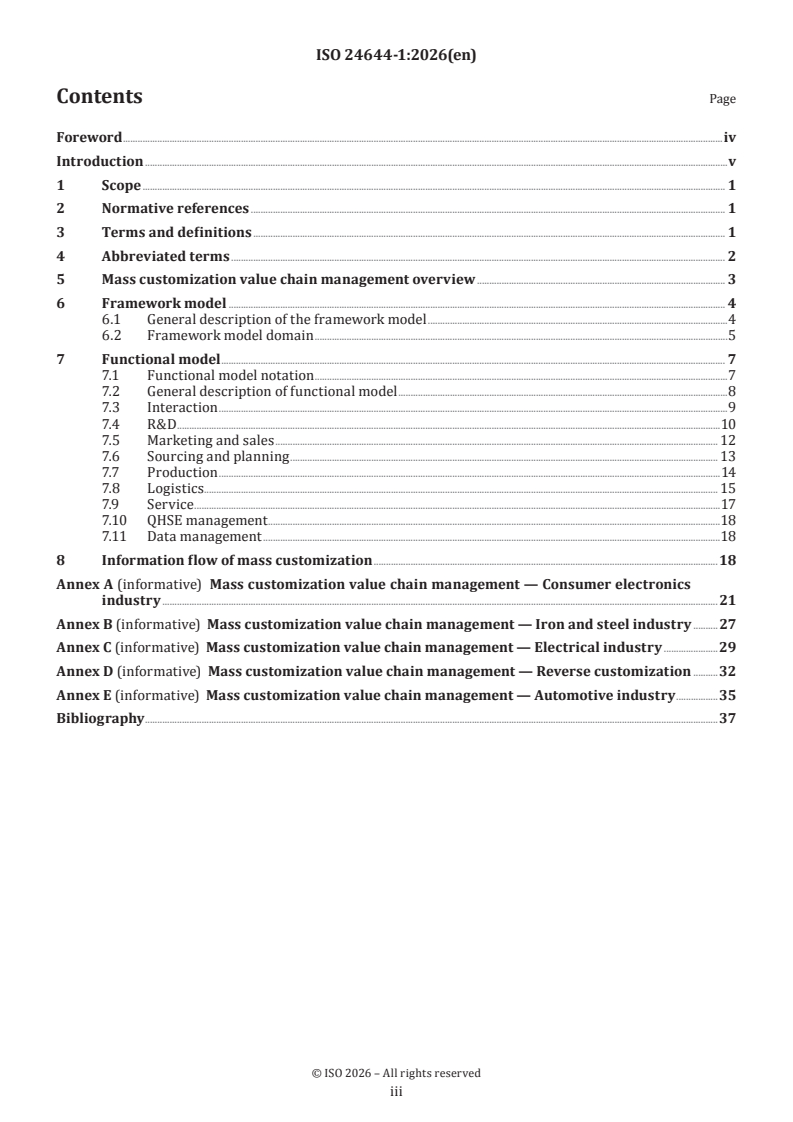
Contents
- Introduction
- 1 Scope
- 2 Normative references
- 3 Terms and definitions
- 3.1 domain, noun
- 3.2 information flow, noun
- 3.3 interaction, noun
- 3.4 mass customization, noun
- 3.5 user experience, noun
- 3.6 value-added service, noun
- 3.7 value chain, noun
- 3.8 product scheme, noun
- 3.9 social community, noun
- 3.10 computer-aided X, noun
- 3.11 intelligent interaction engine, noun
- 4 Abbreviated terms
- 5 Mass customization value chain management overview
- 6 Framework model
- 6.1 General description of the framework model
- 6.2 Framework model domain
- 7 Functional model
- 7.1 Functional model notation
- 7.2 General description of functional model
- 7.3 Interaction
- 7.4 R&D
- 7.5 Marketing and sales
- 7.6 Sourcing and planning
- 7.7 Production
- 7.8 Logistics
- 7.9 Service
- 7.10 QHSE management
- 7.11 Data management
- 8 Information flow of mass customization
- Annex A
- Annex B
- Annex C
- Annex D
- Annex E
- Bibliography
Introduction
Alongside the generalization and popularization of Internet technologies, Internet of Things (IoT), flexible manufacturing technologies and modern logistics, individualized customization services have become embedded into all industrial and service sectors. Users can, by means of Internet platforms, determine and customize their own products according to their own demands. Mass customization is becoming a new mode in the manufacturing industry, and value chains will ultimately be driven by the users. Cooperation among enterprises is required by using quick-response Internet platforms to provide a wide range of products and services in small lots to satisfy the users with various individualized demands. From the user’s perspective, when they directly interact with enterprises for customized products, they also wish to participate in the creation process of their individualized product and to obtain or receive information about the progress of the product.
From the enterprise perspective, mass customization will assist enterprises in realizing the real-time and accurate understanding of the user’s demands. Customized products increase the premium value of products for enterprises. Through accurately estimating a priori information from customized product demand and requirements from the users, enterprises can reduce or eliminate inventory-related costs by appropriately conducting large-scale procurement or production.
International Standard ISO 24644-1:2026(en) Mass customization value chain management — Part 1:
Framework
1 Scope
This document specifies a framework for mass customization value chain management, including the framework model, functions and information flow of mass customization. This document does not describe interoperability at a system level or interoperability throughout the life cycle in detail.
2 Normative references
There are no normative references in this document.
3 Terms and definitions
For the purposes of this document, the following terms and definitions apply. ISO and IEC maintain terminological databases for use in standardization at the following addresses:
- ISO Online browsing platform: available at https:// www .iso .org/ obp
- IEC Electropedia: available at https:// www .electropedia .org/
3.1 domain, noun
functional area [1] [SOURCE: ISO 24097-1:2017 , 3.1.2, modified — “in a policy assertion” has been deleted from the definition. The EXAMPLE has been deleted.]
3.2 information flow, noun
transfer of information from an information-source-object to an information-destination-object [2] [SOURCE: ISO/IEC 16500-1:1999 , 3.30]
3.3 interaction, noun
exchange of information between a user and a system via the human-system interface to achieve the intended goal [3] [SOURCE: EN ISO 11064-5:2008 , 3.20, modified — the admitted term "dialogue" has been deleted.]
3.4 mass customization, noun
production mode that provides customized products and services according to the individualized demands of users with the cost and efficiency in mass production
ISO 24644-1:2026(en)
3.5 user experience, noun
person's perceptions and responses resulting from the use and/or anticipated use of a product, system or service [4] [SOURCE: ISO/IEC 30071-1:2019 , 3.1.6, modified — Notes 1 and 2 to entry have been deleted.]
3.6 value-added service, noun
service that is offered in addition to the core service in question thus creating additional value [5] [SOURCE: ISO 17573-2:2025 , 3.238]
3.7 value chain, noun
range of activities or parties that create or receive value in the form of products or services [6] [SOURCE: ISO 22948:2020 , 3.2.11]
3.8 product scheme, noun
product solutions designed according to user customization demands
3.9 social community, noun
collective organization where people with common interests, goals or values come together socially Note 1 to entry: A social community can represent physical communities based on geographic areas, or online communities such as social networking groups.
3.10 computer-aided X, noun
CAX, noun comprehensive term for various computer-aided technologies such as CAD, CAM, CAE, CAPP, CIM, CAS, CAT, CAI, etc.
3.11 intelligent interaction engine, noun
software integrating with enterprise systems, supporting information exchange between users and enterprise systems to meet user needs or complete the intended task
4 Abbreviated terms
For the purposes of this document, the following abbreviated terms apply. APS Advanced planning and scheduling BOM Bill of material B2B Business to business CAX Computer aided X CBL Collaboration layer CTL Control layer CP Configuration partner CRM Customer relationship management
ISO 24644-1:2026(en) CTO Concept-to-order DTS Delivery-to-service EML Equipment layer EPL Enterprise layer ERP Enterprise resource planning EVI Early vendor involvement FIFO First-in-first-out MRP Material requirements planning OTD Order-to-delivery PLM Product lifecycle management QHSE Quality, health, safety, and environment TMS Transportation management system WMS Warehouse management system WSL Workshop layer
5 Mass customization value chain management overview
For mass customization value chain management, the value activities of mass customization can be divided into domains from the perspective of life cycle and system, and the contents of each activity and the information transmitted between activities should be clearly defined. The framework of mass customization value chain management consists of an activity interaction model, activity definitions, and identification of general information flows. This document falls in the constructs of function view, according to the definition [7] of enterprise activity and function view in ISO 19439:2006 .
NOTE 1 ISO 19439 specifies that the function view is required to represent the business processes of the enterprise domain, their functionality, behaviour, inputs and outputs. The function view is required to describe the assembly of single processing steps as a collection of processes (business processes and enterprise activities) structured as a network of activities reflecting their logical connection and interdependencies. NOTE 2 ISO 19439 specifies that enterprise activity is all, or part, of process functionality that consists of elementary tasks performed in the enterprise that consume inputs and allocate time and resources to produce outputs.
With the definitions and concepts of enterprise activity and function view, the framework is generated [7] referring to the enterprise modelling concepts defined in ISO 19439:2006 , which fulfils the requirement [8] of ISO 15704:2019 5.3.3 and 6.5.1.3. Specifically, the framework corresponds with the domain identification, concept definitions and requirements definition of the function view at the generic level as [9] shown in the dashed area of Figure 1. The modelling concepts are reused in ISO 19440:2020 , which builds [7] on ISO 19439:2006 , to identify and specify constructs necessary for users that model enterprises. [7] [7] NOTE 3 Figure 1 is excerpted from ISO 19439:2006 , and it is Figure 5 in ISO 19439:2006 .
ISO 24644-1:2026(en) Figure 1 — Overview of the framework for enterprise modelling
6 Framework model
6.1 General description of the framework model
The framework model of mass customization consists of two dimensions, namely system level and life cycle. The vertical axis in Figure 2 presents the system level, which includes equipment layer (EML), control layer (CTL), workshop layer (WSL), enterprise layer (EPL) and collaboration layer (CBL) based on [10] IEC 62264-1:2013 . The horizontal axis in Figure 2 covers the whole life cycle of a product, which includes seven activities: interaction, research and development (R&D), marketing and sales, sourcing and planning, production, logistics and service.
System level in Figure 2 is divided into five layers according to the organizational structure related to enterprise production activities, in which:
- Equipment layer (EML) is applied by an enterprise to realize the actual physical process, and perceive and operate it by means of sensor, instrument, machine, device, and other methods;
- Control layer (CTL) is used for handling information, and realizing the monitoring and controlling physical process within an enterprise;
- Workshop layer (WSL) is applicable for realizing production management within a factory or a workshop;
- Enterprise layer (EPL) aims to realize enterprise oriented business management; and
ISO 24644-1:2026(en) - Collaboration layer (CBL) is applied to realizing the interconnectivity and sharing of internal and external information in an enterprise and the business coordination between enterprises. Mass customization domains include concept-to-order (CTO) domain, order-to-delivery (OTD) domain, and delivery-to-service (DTS) domain.
As shown in Figure 2, the CTO domain covers four activities from the life cycle, i.e., interaction, R&D, marketing and sales, and sourcing and planning, and it contains WSL and CBL from the system level. The OTD domain includes the production activity and logistic activity. In the production activity, it covers the EML, CTL, WSL and EPL. In the logistics activity, it includes all five system layers. The DTS domain covers the service activity from the life cycle, and contains the EPL and CBL from the system level.
Key domain Figure 2 — Mass customization domains
6.2 Framework model domain
In the CTO domain, user demands should be focused on, product schemes are the output of the interaction and R&D activities. User orders are generated through the marketing and sales activity. Enterprises arrange a master production schedule according to the product scheme and the user orders, and find suitable suppliers through the sourcing and planning activity to ensure commodity supply. The contents of a user order include user basic information, customization information, expected delivery date and place, product model, payment information, etc.
NOTE In this document, commodity includes raw material and purchasing parts from suppliers.
ISO 24644-1:2026(en) In the interaction activity, enterprises collect user demands, and interact with users and ecosystem partners, conduct user demands analysis and screening, and output customized demands. The interaction methods include user interface, network (e.g. users’ interactions with enterprises via surfing the Internet by using the platforms), social networking (e.g., users’ interaction with enterprises through the social media), web, apps, etc.
In the R&D activity, enterprises conduct customized demands classification, assessment and transformation, and output product solutions after simulation verification. If customized demands cannot be achieved, enterprises should provide timely feedback to users.
In the marketing and sales activity, enterprises conduct product positioning and pricing, and this activity should obtain user orders through precision marketing.
In the sourcing and planning activity, enterprises find suitable material suppliers for source searching demands and procurement demands.
In the OTD domain, factories conduct the production activity to produce customized products, and deliver them to users through the logistics activity.
In the production activity, factories arrange a detailed production plan according to the master production schedule and material status (including material in stock or its expected arrival time), and workshops shall execute manufacturing according to the detailed production plan. In the logistics activity, enterprises arrange reasonable a delivery route and deliver the customized products to the designated place at the appointed time through logistics management. In the DTS domain, enterprises obtain user experience information through the service activity, and the analysis of conduct online or offline diagnosis to get the status information of products, and this activity should provide after-sales and value-added services for users. Enterprises should promote the recycling of customized products.
The user experience information and new demands obtained from the DTS domain get the fed back to the CTO domain and OTD domain to promote product optimization and iteration. Figure 3 depicts mass customization domains, elements and functions, and information flow showing the interaction between the users and domains, pictorially summarizing the dynamics of the CTO, OTD, and DTS domains.
ISO 24644-1:2026(en) Key domain function information flow element Figure 3 — Mass customization domains and functions
7 Functional model
7.1 Functional model notation
Figure 4 provides a mass customization functional model. The notations used in Figure 4 and the interaction workflow of seven activities (interaction, R&D, marketing and sales, sourcing and planning, production, logistics and service) shown in Figure 5 to Figure 11 are described in Table 1.
ISO 24644-1:2026(en) Table 1 — Notation used in functional model and workflow of seven activities Symbol Name Definition Any entity (e.g. person, group) who makes usage of either the customusers ized services or products, or both.
A set of actions that consumes time and resources and whose perforactivity mance is necessary to achieve, or contribute to, the realization of one or more outcomes.
input/output Information which transfers into/out of workflow.
information The representation of all information that is dealt within an informadatabase tion system, taken together.
element A necessary or typical part of workflow.
Transfer of information from an information-source-object to an inforinformation flow mation-destination-object.
7.2 General description of functional model
As shown in Figure 4, the mass customization functional model is a synthesis of user-centred functions covering seven activities in the customization life cycle. In Figure 4, “Users” is shown at the centre; the rectangle boxes in the perimeter represent the lifecycle activities; and the solid arrows represent the information flow between “Users” and the activities and also between the adjacent activities. The activities do not need to completely correspond to a department or departments of the enterprise. Different enterprises may place one or more activities in different departments or with external entrusted third parties. Mass customization enterprises need to establish a unified platform or system not only to support the horizontal integration and interoperability of the seven activities, but also to acquire users’ immediate and overall satisfaction from creativity to product development, production, delivery and service. In mass customization, the relationship among activities is between multiple entities (e.g., corporative, enterprises or departments), which may take the same role carrying out the same activity simultaneously, and they may interact with another entity or a group of entities. The reason for taking the same role or the same activity simultaneously is to meet a high demand of customized products in a short period of time. To ensure the proper data is transmitted between different entities, the input and output of each activity can be seen as the data which should be exchanged or accessed through a common interface from/to other activities. The users of this document can build their own uniform semantic/format models of data and interface accordingly, which can be helpful to establish an interoperable mass customization system. NOTE The method of achieving interoperability in the functional model of mass customization is described in [8] ISO 15704:2019 .
QHSE (Quality, Health, Safety, and Environment) management and data management are fundamental components of the mass customization functional model.
ISO 24644-1:2026(en) Figure 4 — Functional model
7.3 Interaction
Interaction is an activity which specifies reciprocal actions, including recognizing information, making inputs, making selections and receiving outputs, required by users to achieve a goal. The workflow of the interaction activity is shown in Figure 5.
An interaction platform aggregates user resources (e.g., a multitude of user information collected from the users via the interaction platform) by introducing the users being targeted for mass customization. Then the platform categorizes the users to form social communities for demand interaction. In each social community, experts, key opinion leaders, enterprises and resource parties should provide high-quality and relevant topics for community discussion and also supply professional information for reference to the community members. After demand interaction, the platform conducts demand analysis and screening from the perspective of cost, outcome, scale, etc. Customized demands are the output of the interaction activity. Meanwhile, the new product/service demands proposed by the users from the service activity are sent to the interaction activity to be included in the demand interaction. Through the repository and reuse of interaction data of different social communities, the platform achieves a unified analysis and utilization of these data, such as the output of user profiles. The output of the customized demand from the interaction activity should be transmitted to the R&D activity for demand creation.
ISO 24644-1:2026(en) Figure 5 — Workflow of the interaction activity
7.4 R&D
R&D includes activities that enterprises undertake to innovate and introduce new products and services. R&D defines the product scheme based on the customized demands and the resources, and then publishes the product scheme to the marketing and sales activity and the sourcing and planning activity. The workflow of the R&D activity is shown in Figure 6.
R&D, in the mass customization, refines the users' primary demand and transforms it into a quantifiable demand. R&D then distributes the quantifiable demand to appropriate resource providers, including but not limited to, technical resources, design resources and supplier resources corresponding to the quantifiable demand classifications such as function, appearance, and module. The providers then design customized products according to the quantifiable demand distributed to them, and the design is verified and optimized through interactions with the users. Once the final design for the customized products is approved, modular design, development and test processes should be carried out. Then, the customized product can be available on the market.
The interactivity of the demand distribution and resource matching process should be considered while implementing the mass customization system. Enterprises should build mechanisms for timely release of the demand to the providers and collection of the response from the providers. Modular design plays an important role in mass customization because it balances "mass production" and "customized craft" by linking the customized demand to different process configurations or different combinations of modules for productizing. On the one hand, consideration should be given in the module design process to ensure that configurability will not affect product functionality. Consideration should also be given as to whether or not the designed module can easily be used for large-scale production while balancing customizability and cost.
ISO 24644-1:2026(en) Moreover, the process data generated by R&D should be comprehensively recorded in a data store (e.g., R&D data repository and reuse) as reusable resources/knowledge base for possible process reengineering, system upgrades or product iterations.
...