


ISO 8326:1987
(Main)Information processing systems — Open Systems Interconnection — Basic connection oriented session service definition
Information processing systems — Open Systems Interconnection — Basic connection oriented session service definition
Systèmes de traitement de l'information — Interconnexion de systèmes ouverts — Service de session en mode connexion
General Information
- Status
- Withdrawn
- Publication Date
- 05-Aug-1987
- Withdrawal Date
- 05-Aug-1987
- Technical Committee
- ISO/IEC JTC 1 - Information technology
- Drafting Committee
- ISO/IEC JTC 1 - Information technology
- Current Stage
- 9599 - Withdrawal of International Standard
- Start Date
- 09-Oct-1996
- Completion Date
- 12-Feb-2026
Relations
- Effective Date
- 06-Jun-2022
- Effective Date
- 15-Apr-2008
- Effective Date
- 18-Dec-2008
Get Certified
Connect with accredited certification bodies for this standard

BSI Group
BSI (British Standards Institution) is the business standards company that helps organizations make excellence a habit.

NYCE
Mexican standards and certification body.
Sponsored listings
Frequently Asked Questions
ISO 8326:1987 is a standard published by the International Organization for Standardization (ISO). Its full title is "Information processing systems — Open Systems Interconnection — Basic connection oriented session service definition". This standard covers: Information processing systems — Open Systems Interconnection — Basic connection oriented session service definition
Information processing systems — Open Systems Interconnection — Basic connection oriented session service definition
ISO 8326:1987 is classified under the following ICS (International Classification for Standards) categories: 35.100.50 - Session layer. The ICS classification helps identify the subject area and facilitates finding related standards.
ISO 8326:1987 has the following relationships with other standards: It is inter standard links to ISO 8326:1987/Amd 4:1992, ISO/IEC 8326:1996; is excused to ISO 8326:1987/Amd 4:1992. Understanding these relationships helps ensure you are using the most current and applicable version of the standard.
ISO 8326:1987 is available in PDF format for immediate download after purchase. The document can be added to your cart and obtained through the secure checkout process. Digital delivery ensures instant access to the complete standard document.
Standards Content (Sample)
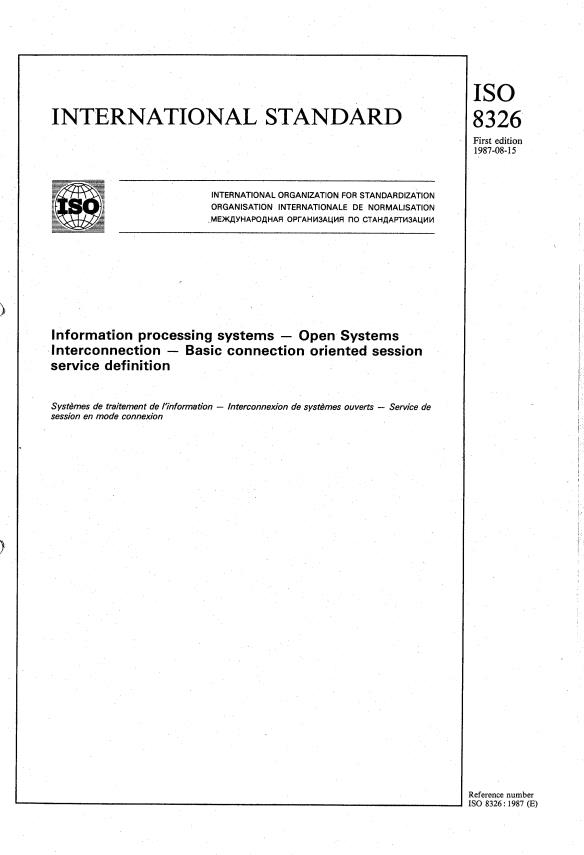
IS0
INTERNATIONAL STANDARD
First edition
1987-08-15
INTERNATIONAL ORGANIZATION FOR STANDARDIZATION
ORGANISATION INTERNATIONALE DE NORMALISATION
MEX,QYHAPO,QHAR OPrAHM3AL&iR Il0 CTAH,QAPTM3AuMM
Information processing systems - Open Systems
Interconnection - Basic connection oriented session
service definition
Systèmes de traitement de finformation - Interconnexion de systèmes ouverts - Service de
session en mode connexion
!eference number
SO 8326 : 1987 (E)
Foreword
IS0 (the International Organization for Standardization) is a worldwide federation of
national standards bodies (IS0 member bodies). The work of preparing International
Standards is normally carried out through IS0 technical committees. Each member
body interested in a subject for which a technical committee has been established has
the right to be represented on that committee. International organizations, govern-
mental and non-governmental, in liaison with ISO, also take part in the work.
Draft International Standards adopted by the technical committees are circulated to
the member bodies for approval before their acceptance as International Standards by
the IS0 Council. They are approved in accordance with IS0 procedures requiring at
least 75 % approval by the member bodies voting.
International Standard IS0 8326 was prepared by Technical Committee ISO/TC 97,
Information processing systems.
Users should note that all International Standards undergo revision from time to time
and that any reference made herein to any other International Standard implies its
latest edition, unless otherwise stated.
O International Organization for Standardization, 1987 O
Printed in Switzerland
ii
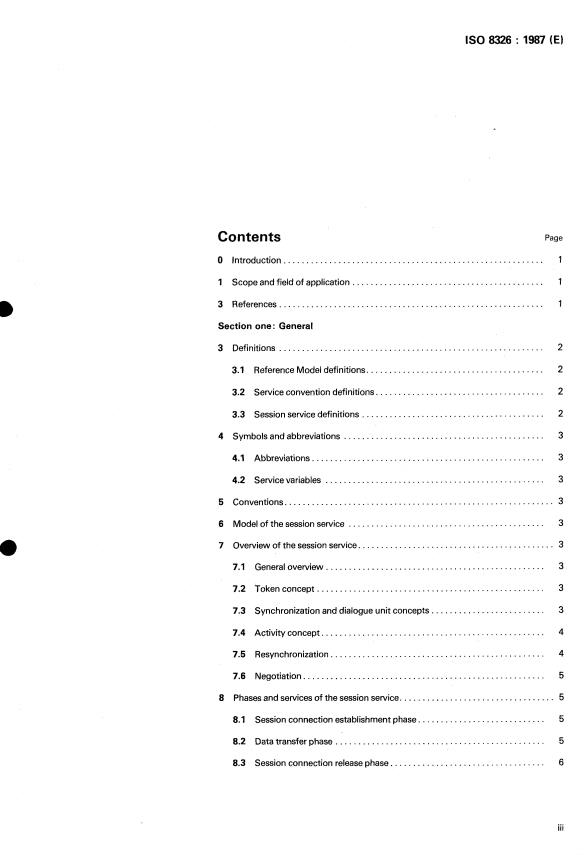
IS0 8326 : 1987 (E)
Contents Page
O Introduction. . . 1
1 Scope and field of application . 1
3 References. . 1
Section one: General
3 Definitions . . 2
3.1 Reference Model definitions. .
3.2 Service convention definitions. .
3.3 Session service definitions .
4 Symbols and abbreviations .
4.1 Abbreviations. . . 3
4.2 Service variables . 3
5 Conventions. . . 3
6 Model of the session se . 3
7 Overview of the session service. . . 3
7.1 General overview . 3
7.2 Token concept. . 3
7.3 Synchronization and dialogue unit concepts .
7.4 Activity concept . 4
7.5 Resynchronization . . 4
7.6 Negotiation . 5
8 Phases and services of the session service. . 5
8.1 Session connection establishment phase. . 5
8.2 Data transfer phase . 5
8.3 Session connection release phase. . 6
iii
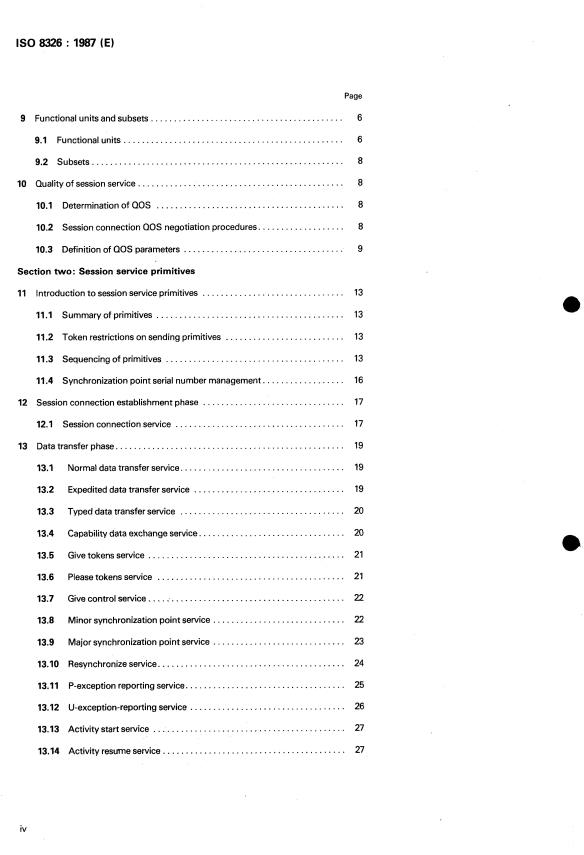
IS0 8326 : 1987 (E)
Page
9 Functional units and subsets . .
9.1 Functional units .
9.2 Subsets . .
10 Quality of session service . . .
10.1 Determination of QOS . . .
10.2 Session connection QOS negotiation procedures .
10.3 Definition of QOS parameters . .
Section two: Session service primitives
Introduction to session service primitives .
11 13
11.1 Summary of primitives . 13
11.2 Token restrictions on sending primitives . 13
11.3 Sequencing of primitives . 13
11.4 Synchronization point serial number management . .
12 Session connection establishment phase . 17
12.1 Session connection service . 17
13 Datatransfer phase . 19
13.1 Normal data transfer service . .
13.2 Expedited data transfer service . . 19
13.3 Typed data transfer service . 20
13.4 Capability data exchange service . 20
13.5 Givetokensservice . 21
Please tokens service . . .
13.6 21
Give control service . 22
13.7
13.8 Minor synchronization point service . 22
Major synchronization point service . 23
13.9
13.10 Resynchronize service . . 24
13.11 P-exception reporting service . 25
13.12 U-exception-reporting service . 26
13.13 Activity start service . 27
13.14 Activity resume service . 27
iv
IS0 8326 : 1987 (E)
Page
13.15 Activity interrupt service .
13.16 Activity discard service .
13.17 Activity end service .
14 Session connection release phase .
14.1 Orderly release service .
14.2 U-abortservice .
14.3 P-abort service .
15 Sequences of primitives .
15.1 Statetables .
15.2 Sequences of primitives at one session connection end-point .
16 Collision .
16.1 Collision as viewed by the SS-user .
16.2 Collision resolution by the SS-provider .
Annexes
A Statetables .
Corrections incorporated in IS0 8326 : 1987 .
B
V
a
IS0 8326 : 1987 (E)
INTERNATIONAL §TAN DARD
Information processing systems - Open Systems
Interconnection - Basic connection oriented session
service definition
O Introduction 1 Scope and field of application
This International Standard defines in an abstract way the exter-
This International Standard is one of a set of International Stan-
nally visible service provided by the OS1 Session Layer in terms of
dards produced to facilitate the interconnection of computer
a) the primitive actions and events of the service;
systems.
b) the parameter data associated with each primitive
action and event;
This International Standard is related to other International
c) the relationship between, and the valid sequence of
Standards in the set as defined by the Reference Model for
these actions and events.
Open Systems Interconnection (IS0 7498). The Reference
The service defined in this International Standard is that which
Model subdivides the area of standardization for interconnec-
is provided by the OS1 session protocol (in conjunction with the
tion into a series of layers of specification, each of manageable
OS1 presenta-
transport service) and which may be used by the
size.
tion protocol.
This International Standard does not specify individual im-
The purpose of this International Standard is to define the ser-
plementations or products, nor does it constrain the implementa-
vice provided to the Presentation Layer at the boundary
tion of entities and interfaces within a computer system. There
between the Session and Presentation Layers of the Reference
is, therefore, no conformance to this International Standard.
Model. The session service is provided by the session protocol
making use of the services available from the Transport Layer.
This international Standard also defines the session service
2 References
characteristics which the presentation protocol may exploit.
IS0 7498, Information processing systems - Open Systems
The relationship between the International Standards for the
Interconnection - Basic Reference Model.
session service, session protocol, transport service, and the
IS0 7498lAdd.3, Information processing systems - Open
presentation protocol is illustrated in figure 1.
Systems Interconnection - Basic Reference Model - Adden-
dum 3: Name including addressing. 1)
It is recognized that, with respect to session Quality of Service,
IS0 8072, Information processing systems - Open Systems
(described in clause IO), work is still in progress to provide an
Interconnection - Transport service definitions.
integrated treatment of QOS across all of the layers of the OS1
IS0 8327, Information processing systems - Open Systems
Reference Model and to ensure that the individual treatments in
Interconnection - Basic connection oriented session protocol
each layer service satisfy overall QOS objectives in a consistent
specification.
manner. As a consequence, an addendum may be added to this
International Standard at a later time which reflects further ISOITR 8509, Information processing systems - Open
Systems Interconnection - Service conventions.
00s developments and integration.
I Pi esentation I
based on service provided
t
Session service
t
provides service
I Session I
protocol
based on service provided
Transport service
Figure 1 - Relationship of this International Standard to other OS1 standards
At present at stage of draft; publication anticipated in due course.
1)
IS0 8326 : 1987 (E)
Section one : General
3.3.1 calling SS-user: An SS-user that initiates a session
3 Definitions
connection establishment request.
NOTE - The definitions contained in this clause make use of abbrevia-
tions defined in clause 4.
3.3.2 called SS-user: An SS-user with whom a calling SS-
user wishes to establish a session connection.
3.1 Reference Model definitions
NOTE - Calling SS-users and called SS-users are defined with respect
to a single connection. An SS-user can be both a calling and called SS-
This International Standard is based on the concepts developed
user simultaneously.
in IS0 7498, and makes use of the following terms defined in it:
a) expedited-session-service-data-unit;
3.3.3 sending SS-user: An SS-user that acts as a source of
b) session-connection ;
data during the data transfer phase of a session connection.
c) Session Layer;
3.3.4 receiving SS-user: An SS-user that acts as a sink of
d) session-service;
data during the data phase of a session connection.
e) session-service-access-point;
NOTE - An SS-user can be both a sending and a receiving SS-user
f I session-service-data-unit ;
simultaneously.
g) Transport Layer;
3.3.5 requestor; requesting SS-user : An SS-user that
h) duplex;
initiates a particular action.
i) half-duplex.
3.3.6 acceptor; accepting SS-user: An SS-user that
accepts a particular action.
3.2 Service convention definitions
This International Standard also makes use of the following
3.3.7 token: An attribute of a session connection which is
terms defined in ISO/TR 8509, as they apply to the Session
dynamically assigned to one SS-user at a time to permit certain
Layer :
services to be invoked.
ai service-user;
3.3.8 conditional (parameter) : A parameter whose
b) service-provider;
presence in a request or response depends on conditions
defined in the text of this International Standard; and whose
c) primitive;
presence in an indication or confirm is mandatory if that
di request; parameter was present in the preceding session service
primitive, or absent if that parameter was absent in the
e) indication;
preceding session service primitive.
fi response;
3.3.9 proposed parameter: The value for a parameter pro-
g) confirm.
posed by an SS-user in an S-CONNECT request or an
S-CONNECT response that it wishes to use on the session con-
nection.
3.3 Session-service definitions
3.3.10 selected parameter: The value for a parameter that
For the purpose of this lnternational Standard, the following
has been chosen for use on the session connection.
definitions also apply.
IS0 8326 : 1987 (E)
7.2 Token concept
4 Symbols and abbreviations
A token is an attribute of a session connection which is
4.1 Abbreviations
dynamically assigned to one SS-user at a time to permit certain
services to be invoked. It is the right to exclusive use of the
ss : session-service
service.
SSAP : session-service-access-point
SSDU : session-service-data-unit
Four tokens are defined:
NSSDU : normal-data-session-service-data-unit
TSSDU : typed-data-session-service-data-unit
a) the data token;
XSSDU : expedited-session-service-data-unit
QûS : quality of service ;
b) the release token
c) the synchronize-minor token;
4.2 Service variables
d) the major/activity token.
V(A) See 11.4.1.1
A token is always in one of the following states:
ViM) See 11.4.1.2
V(R) See 11.4.1.3
available, in which case it is always
e)
Vsc See 11.4.1.4
1) assigned to one SS-user, who then has the ex-
clusive right to use the associated service (provided that
no other restrictions apply) : and
5 Conventions
2) not assigned to the other SS-user, who does not
This International Standard uses the descriptive conventions
it later;
have the right to use the service but may acquire
defined in ISO/TR 8509 except that, where indicated in this
International Standard, parameter values associated with a ser-
O1
vice primitive may be passed in a direction opposite to the
direction of the service primitive.
f) not available to either SS-user, in which case neither
SS-user has the exclusive use of the associated service. The
service then becomes inherently available to both SS-users
6 Model of the session service
(data transfer and release), or otherwise unavailable to both
SS-users (synchronization and activities).
This International Standard uses the abstract model for a layer
service defined in ISO/TR 8509. The model defines the inter-
actions between the SS-user and the SS-provider which take
Restrictions related to the availability and assignment of tokens
place at the two SSAPs. Information is passed between an SS- are defined in 11.2.
user and the SS-provider by service primitives, which may con-
vey parameters.
7.3 Synchronization and dialogue unit concepts
7 Overview of the session service
SS-users may insert synchronization points into the data they
are transmitting. Each synchronization point is identified by a
serial number maintained by the SS-provider (see 11.4).
7.1 General overview
The session service provides the means for organized and syn-
Any semantics which SS-users may give to their synchroniza-
chronized exchange of data between cooperating SS-users. It
tion points are transparent to the SS-provider.
provides its users with means to
There are two types of synchronization points:
a) establish a connection with another SS-user, exchange
data with that user in a synchronized manner, and release
a) minor synchronization points;
the connection in an orderly manner;
b) negotiate for the use of tokens to exchange data, syn- b) major synchronization points.
chronize and release the connection, and to arrange for data
exchange to be half-duplex or duplex:
Major synchronization points are used to structure the
exchange of data into a series of dialogue units. The
c) establish synchronization points within the dialogue
characteristic of a dialogue unit is that all communication
and, in the event of errors, resume the dialogue from an
within it is completely separated from all communication before
agreed synchronization point;
and after it. A major synchronization point indicates the end of
one dialogue unit and the beginning of the next. Each major
interrupt a dialogue and resume it later at a prearranged
d)
synchronization point is confirmed explicitly.
point.
IS0 8326 : 1987 (E)
An activity can be interrupted and then resumed on the same or
Minor synchronization points are used to structure the
on a subsequent session connection. This can be considered as
exchange of data within a dialogue unit. Figure 2 illustrates
how a dialogue unit is structured through the use of minor syn- a form of resynchronization.
chronization points. Each minor synchronization point may or
Figure 3 shows how an activity may be structured into dialogue
may not be confirmed explicitly.
units through the use of major synchronization points. In addi-
tion, the SS-users may transfer data outside an activity.
7.4 Activity concept
7.5 Resynchronization
The activity concept allows SS-users to distinguish between
different logical pieces of work called activities. Each activity Resynchronization may be initiated by either SS-user. It sets
the session connection to a defined state, and therefore
consists of one or more dialogue units. Only one activity is
includes reassignment of tokens and setting the synchroniza-
allowed on a session connection at a time, but there may be
tion point serial number to a new value. Resynchronization
several consecutive activities during a session connection. An
activity may also span more than one session connection. purges all undelivered data.
Dialoque unit
.'
MINOR MINOR MAJOR
MAJOR MINOR
SYNC SYNC SYNC SYNC SYNC
POINT POINT POINT POINT
POINT
Figure 2 - Example of a structured dialogue unit
Dialoaue unit
Dialogue unit
--
I AI I
t f t
ACTIVITY MINOR MINOR MAJOR MINOR ACTIVITY
SYNC SYNC END
START SYNC SYNC
POINT POINT POINT POINT (MAJOR SYNC
POINT)
Figure 3 -- Example of a structured activity
IS0 8326 : 1987 (E)
Three options are provided : In all other combinations of functional units, no initial syn-
chronization point serial number is proposed.
a) abandon option which is used to set the synchroniza-
tion point serial number to an unused value;
b) restart option which is used to set the synchronization 8 Phases and serviceS.of the session service
point serial number to any used value which is greater than
the synchronization point serial number which identifies the The session service comprises three phases. The purpose of
each phase, and a short description of the associated services
last acknowledged major synchronization point;
is given in this clause. The services and the primitives by which
c) set option which is used to set the synchronization
they are invoked are defined in clauses 12, 13 and 14.
point serial number to any value chosen by the SS-user.
8.1 Session connection establishment phase
7.6 Negotiation
The session connection establishment phase is concerned with
establishing a connection between two SS-users. It has one
Negotiation takes place between both SS-users during the
service associated with it:
session connection establishment phase according to the
following rules.
the session connection service (see 12.1 ) is used to set up a
session connection and to negotiate tokens and parameters
to be used for the connection.
7.6.1 Negotiation of functional units
The kernel functional unit (see clause 9) is always used. Each
8.2 Data transfer phase
SS-user proposes the use or non-use of each of the other func-
tional units. A functional unit is selected only if both SS-users
The data transfer phase is concerned with the exchange of data
propose use of the functional unit and it is supported by the
between the two SS-users connected in the session connec-
SS-provider. Specific negotiation rules are given in 12.1.2.
tion establishment phase.
7.6.2 Negotiation of initiai token settings
There are four services associated with data transfer:
a) the normal data transfer service (see 13.1) allows the
When the calling SS-user proposes use of a functional unit that
transfer of normal data SSDUs (NSSDUs) over a session
requires a token, it also proposes the initial token settings:
connection. Its use is controlled by the data token if the
a) calling SS-user side;
half-duplex functional unit has been selected;
b) called SS-user side;
b) the expedited data transfer service (see 13.2) allows the
transfer of expedited SSDUs (XSSDUs) over a session con-
c) called SS-user choice.
nection free from the token and flow control constraints of
the normal data transfer service, typed data transfer service
If the use of the functional unit is selected, the token is set to
and capability data exchange service;
d) the sîde proposed by the called SS-user, if "called
c) the typed data transfer service (see 13.3) is used to
SS-user choice" is proposed by the calling SS-user; or
transfer typed data SSDUs (TSSDUs) independent of the
e) in all other cases, the side proposed by the calling
availability and assignment of the data token;
SS-user.
d) the capability data exchange service (see 13.4) is used
to exchange a limited amount of confirmed SS-user data
7.6.3 Negotiation of initiai synchronization point serial
while not within an activity.
number
There are three services concerned with token management:
When a calling SS-user proposes any of the major synchronize,
minor synchronize or resynchronize functional units, but does
e) the give tokens service (see 13.5) allows an SS-user to
it also
not propose the activity management functional unit, surrender one or more specific tokens to the other SS-user;
proposes a value for the initial synchronization point serial
f) the please tokens service (see 13.6) allows an SS-user
num ber.
to request the other SS-user to transfer one or more specific
tokens to it;
The calling SS-user may also propose a value for the initial syn-
chronization point serial number even if the activity manage-
g) the give control service (see 13.7) allows an SS-user to
ment functional unit is proposed provided that any of the minor
surrender all available tokens to the other SS-user.
synchronize, major synchronize or resynchronize functional
units are also proposed. If the called SS-user selects use of any
There are three services associated with synchronization and
of the minor synchronize, major synchronize or resynchronize
resynchronization :
functional units, but does not select use of the activity manage-
ment functional unit, it returns a value for the initial syn- h) the minor synchronization point service (see 13.8)
chronization point serial number which may or may not be the allows the SS-user to separate the flow of NSSDUs and
TSSDUs transmitted before the service was invoked from
same as the value proposed by the calling SS-user. The value
returned by the called SS-user is used as the initial synchroniza- the subsequent flow of NSSDUs and TSSDUs. Its use is
controlled by the synchronize-minor token ;
tion point serial number for the session connection.
IS0 8326 : 1987 (E)
8.3 Session connection release phase
i) the major synchronization point service (see 13.9) allows
the SS-user to confine the flow of sequentially transmitted
NSSDUs, TSSDUs and XSSDUs in each direction within a
The session connection release phase is concerned with releas-
dialogue unit. Its use is controlled by the major/activity
ing a previously established session connection. It has three
token :
services associated with it:
j) the resynchronize service (see 13.10) is used to set the
session connection to a previous or to a new synchroniza-
a) the orderly release service (see 14.1) provides a
tion point and to reassign the available tokens. This service
means of achieving the orderly release of a session
may cause loss of NSSDUs, TSSDUs and XSSDUs.
connection ;
b) the user-initiated abort service (see 14.2) (U-abort ser-
There are two services for reporting errors or unanticipated
vice) is used to initiate the release of a session connection in
situations:
a way that will terminate any outstanding service request.
This service may cause loss of NSSDUs, TSSDUs and
k) the provider-initiated exception reporting service
XSSDUs;
(see 13.11 ) (P-exception reporting service) permits SS-
users to be notified of exception conditions or SS-provider
c) the provider-initiated abort service (see 14.3) (P-abort
protocol errors. This service may cause loss of NSSDUs,
TSSDUs and XSSDUs: service) is used by the SS-provider to indicate the release of
the session connection for internal reasons. This service
may cause loss of NSSDUs, TSSDUs and XSSDUs. Any
I) the user-initiated exception reporting service (see 13.12)
outstanding service request is terminated.
(U-exception reporting service) is used by the SS-user to
report an exception condition when the data token is
available but not assigned to the SS-user. This service may
cause loss of NSSDUs, TSSDUs and XSSDUs.
9 Functional units and subsets
There are five services associated with activities:
Functional units
m) the activity start service (see 13.13) is used to indicate
that a new activity is entered. Its use is controlled by the
Functional units are logical groupings of related services
major/activity token;
defined by this International Standard for the purpose of
n) the activity resume service (see 13.14) is used to
indicate that a previously interrupted activity is re-entered. negotiation of SS-user requirements during the session
a)
Its use is controlled by the major/activity token; connection establishment phase;
O) the activity interrupt service (see 13.15) allows an
reference by other International Standards.
b)
activity to be abnormally terminated with the implication
that the work so far achieved is not to be discarded and may
be resumed later. Its use is controlled by the major/activity
Table 1 specifies the association of tokens and functional units.
token. This service may cause loss of NSSDUs, TSSDUs
When a functional unit implies the availability of a token, ser-
and XSSDUs;
vices concerned with the management of that token are pro-
vided in order to be able to request and transfer the available
p) the activity discard service (see 13.16) allows an activity tokens.
to be abnormally terminated with the implication that the
so far achieved is to be discarded, and not resumed.
work
Its use is controlled by the major/activity token. This service
The services associated with each functional unit are specified
may cause loss of NSSDUs, TSSDUs and XSSDUs;
in table 2.
q) the activity end service (see 13.17) is used to end an
activity (and set a major synchronization point). Its use is
controlled by the inajor/activity token;
Table 1 - Functional units using tokens
I Functional unit I Token
Using the activity services may lead to a state where no activity
Negotiated release Release token
is in progress on the session connection. When activity services
Half-duplex Data token
are employed, but no activity is in progress, only the activity
Minor synchronize Synchronize-minor token
start, activity resume, token management, capability data,
Major synchronize Major/activity token
typed data, normal data, expedited data, abort and release ser-
Activity management Major/activity token
vices may be invoked by the SS-users.
IS0 8326 : 1987 (E)
Table 2 - Services associated with each functional unit
Functional unit Service(s1 Reference
Kernel (non-negotiable) Session connection 12.1
Normal data transfer 13.1
Orderly release 14.1
U-Abort 14.2
P-Abort 14.3
__
Orderly release 14.1
Negotiated release
Give tokens 13.5
Please tokens 13.6
Half-duplex Give tokens
Please tokens
-~___
Duolex No additional service
Expedited data Expedited data transfer I 13.2
Typed data Typed data transfer 13.3
Capabilitv data exchanae Caaabilitv data exchanae 13.4
Minor synchronize Minor synchronization point
Give tokens
Please tokens
Major synchronize Major synchronization point
Give tokens
Please tokens
Resvnchronize
Resynchronize 13.10
Exceptions Provider exception reporting 13.11
User exception reporting I-- 13.12
Activity management Activity start 13.13
Activity resume 13.14
Activity interrupt 13.15
Activity discard 13.16
Activity end 13.17
Give tokens 13.5
Please tokens 13.6
Give control 13.7
9.1.1 Kernel functional unit 9.1.5 Expedited data functional unit
The expedited data functional unit supports the session ex-
The kernel functional unit supports the basic session services
pedited data transfer service.
required to establish a session connection, transfer normal data
and release the session connection.
9.1.6 Typed data functional unit
The typed data functional unit supports the typed data transfer
9.1.2 Negotiated release functional unit
service.
The negotiated release functional unit supports the negotiated
9.1.7 Capability data exchange functional unit
orderly release service. The release token is available when this
functional unit has been selected.
The capability data exchange functional unit supports the
capability data exchange service. This functional unit can only
be selected when the activity management functional unit has
9.1.3 Half-duplex functional unit
been selected.
The half-duplex functional unit supports the half-duplex ser-
vice. The data token is available when this functional unit has 9.1.8 Minor synchronize functional unit
been selected. It is not possible to select both this functional
The minor synchronize functional unit supports the minor syn-
unit and the duplex functional unit for use on the same session
chronization point service. The synchronize-minor token is
connection.
available when this functional unit has been selected.
9.1.4 ûuplex functional unit
9.1.9 Major synchronize functional unit
The major synchronize functional unit supports the major syn-
The duplex functional unit supports the duplex service. It is not
possible to select both this functional unit and the half-duplex chronization point service. The major/activity token is available
when this functional unit has been selected.
functional unit for use on the same session connection.
IS0 8326 : 1987 (E)
Two types of session service QOS parameters are identified :
9.1.10 Resynchronize functional unit
a) those which are negotiated during the session connec-
The resynchronize functional unit supports the resynchronize
tion establishment phase:
service.
1) session connection protection (see 10.3.9);
2) session connection priority (see 10.3.10);
9.1.11 Exceptions functional unit
3) residual error rate (see 10.3.5);
The exceptions functional unit supports the user exception and
4) throughput, for each direction of transfer (see 10.3.3);
provider exception reporting services.
5) transit delay, for each direction of transfer (see 10.3.4);
This functional unit can only be selected when the half-duplex
6) optimized dialogue transfer (see 10.3.13); and
functional unit has been selected.
7) extended control (see 10.3.12);
9.1.12 Activity management functional unit b) those which are not negotiated during the session con-
nection establishment phase but whose values are selected
The activity management functional unit supports the activity and/or known by other methods (for example, a priori
management services and the give control service. The
knowledge and agreement, or by means of management
major/activity token is available when this functional unit has functions) not defined in this International Standard :
been selected.
1) session connection establishment delay (see 10.3.1 1;
2) session connection establishment failure probability
9.2 Subsets
(see 10.3.2);
3) transfer failure probability (see 10.3.6);
A subset is defined as a combination of the kernel functional
unit together with any other set of functional units provided
4) session connection release delay (see 10.3.7);
that
5) session connection release failure probability (see
a) if the capability data functional unit is included in the
10.3.8);
subset, then the activity management functional unit is also
6) session connection resilience (see 10.3.1 1)
included in the subset; and
The negotiation procedures for parameters listed in ai are
b) if the exceptions functional unit is included in the
defined in 10.2. Once the session connection is established, the
subset, then the half-duplex functional unit is also included
selected QOS parameters are not re-negotiated during the
in the subset.
lifetime of the session connection. The SS-user should be
aware that changes in QOS during a session connection are not
NOTE - This International Standard contains no requirements for the
signalled in the session service.
registration of subsets. Users of this International Standard may define
subsets to meet their session service needs. Other International Stan-
dards may identify subsets that comply with the above definition.
10.2 Session connection ClOS negotiation
procedures
QOS negotiation is described in terms of parameters which can
10 Quality of session service
be conveyed by the S-CONNECT primitives during the session
connection establishment phase (see clause 12). For the
The term "Quality of Service" (QOS) refers to certain
parameters which are negotiated during the session connection
characteristics of a session connection as observed between
establishment phase [see lO.lai1, the parameter values and
the session connection endpoints. QOS describes aspects of a
negotiation rules are defined as follows:
session connection which are attributable solely to the SS-
provider; such aspects are independent of SS-user behaviour
In the S-CONNECT request primitive, the calling SS-
a)
(which is beyond the control of the SS-provider). SS-user
user can specify:
behaviour does not impact the QOS provided.
1 i for session connection protection, session connec-
tion priority, extended control, and optimized dialogue
Once a session connection is established, the SS-users at the
transfer, a single parameter value which is the "desired"
two ends have the same knowledge and understanding of what
QOS; for extended control and optimized dialogue
the QOS over the session connection is.
transfer, one of the two values "feature desired" or
"feature not desired" is conveyed;
10.1 Determination of 00s
NOTE - If the calling SS-user proposes use of the expedited data
functional unit, the extended control parameter has the value "feature
QOS is described in terms of QOS parameters.
desired".
2) for residual error rate, and for each direction of
The definition of the QOS parameters associated with the
throughput and transit delay, two parameter values
session service is given in 10.3. These definitions provide both
which are the "desired" QOS and the "lowest accep-
SS-users and the SS-provider with a common understanding
table" QOS to which the calling SS-user will agree.
of the QOS characteristics.
IS0 8326 : 1987 (E)
b) In the S-CONNECT indication primitive, for each of the c) In the S-CONNECT response primitive, for each of the
negotiated parameters, an "available" value is conveyed negotiated parameters, an "agreed" value is conveyed
which is specified as follows:
which is specified as follows:
1) for optimized dialogue transfer, if the "available"
1) for session connection protection, if the SS-
value in the S-CONNECT indication primitive is "feature
provider agrees to provide a QOS value equivalent to the
not desired" and the called SS-user agrees not to have
"desired" value specified in the S-CONNECT request,
the feature provided on the session connection, then
then the SS-provider specifies that value as "available";
"feature not desired" is specified as "agreed"; other-
if the SS-provider does not agree to provide the
wise the SS-user may reject establishment of the session
"desired" QOS requested, the SS-provider refuses to
if the "available" value in the indication
connection;
establish the session connection by issuing the
primitive is "feature desired" and the SS-user agrees to
S-CONNECT (reject) confirm primitive to the calling
have the feature provided, then "feature desired" is
SS-user ;
specified as "agreed"; otherwise, if the SS-user does
not agree to provision of the feature. the value "feature
2) for session connection priority, the SS-provider
not desired" is specified as "agreed";
specifies the QOS value it is willing to provide (a value
which is equal to or better than the "desired" value
2) for each of the other parameters, if the called SS-
specified in the S-CONNECT request) as "available"; user agrees to the QOS value specified as "available" in
the S-CONNECT indication primitive, then the identical
value is specified as "agreed"; if the SS-user does not
3) for the residual error rate and each direction of
throughput and transit delay, if the SS-provider agrees agree to the "available" value, the SS-user may reject
establishment of the session connection.
to provide a value of QOS which is equal to or better
than the "lowest acceptable" QOS value specified in the
d) In the S-CONNECT confirm primitive, for each of the
S-CONNECT request, then the SS-provider specifies the
negotiated parameters, an "agreed" value is conveyed
value as "available"; if the SS-provider does not agree
which is identical to the "agreed" value conveyed in the
to provide this QOS, then the SS-provider refuses to
S-CONNECT response.
establish the session connection by issuing the
S-CONNECT (reject) confirm primitive to the calling
SS-user;
10.3 Definition of 00s parameters
4) for extended control and optimized dialogue 00s parameters can be classified as
transfer, if the "desired" value in the S-CONNECT re-
a) parameters which express session service performance
quest primitive is "feature not desired" then "feature not
parameters, as shown in table 3;
desired" is specified as "available"; if the "desired"
value is "feature desired" and the SS-provider agrees to b) parameters which express other session service
provide the feature on the session connection, then characteristics, as shown in table 4.
"feature desired" is specified as "available"; otherwise if
the SS-provider does not agree to provide the feature, These session service QOS parameters are defined in this sub-
"feature not desired" is specified as "available". clause.
Table 3 - Classification of performance QOS parameters
Performance criterion
Phase
Speed * Accuracy/relia bility
Session connection Session connection Session connection establishment failure probability
esta blishrnent establishment delay (rnisconnection/session connection refusal)
Data transfer Throughput Residual error rate (corruption, duplication/loss)
Transit delay Session connection resilience
Transfer failure probability
Session connection Session connection Session connection release failure probability
release release delay
I
Table 4 - Parameters specifying other session
service features
Extended control
Session connection protection
Session connection priority
Optirnized dialogue transfer
IS0 8326 : 1987 (E)
10.3.1 Session connection establishment delay It is possible for either the input or the output of a sequence of
SSDUs to be excessively delayed by the SS-users. Such occur-
Session connection establishment delay is the maximum
rences are excluded in calculating “average throughput”
acceptable delay between an S-CONNECT request and the cor-
values.
responding S-CONNECT confirm primitive.
For each direction of transfer, and for each of the “maximum
NOTE - This delay includes SSuser dependent components.
throughput” and ”average throughput” specifications, the
throughput 00s for a particular session connection is
10.3.2 Session connection establishment failure
negotiated between the SS-users and the SS-provider
probability
(see 10.2).
Session connection establishment failure probability is the ratio
Throughput on a session connection relates only to the transfer
of total session connection establishment failures to total session
of normal data and typed data over the session connection.
connection establishment attempts in a measurement sample.
There is no specification of the throughput for data which is
Session connection establishment failure is defined to occur
transferred in association with the issue of any other session
when a requested session connection is not established within
service primitives (for example S-CONNECT, S-CAPABILITY-
the specified maximum acceptable session connection
DATA, etc.).
establishment delay as a result of misconnection, session con-
nection refusal, or excessive delay on the part of the SS-
provider. Session connection establishment attempts which fail
10.3.4 Transit delay
as a result of error, session connectior! refusal, or excessive
delay on the part of an SS-user are excluded in calculating ses-
Transit delay is the elapsed time between the completion of any
sion connection establishment failure probability.
session service request primitive and the corresponding session
service indication primitive occurring during the data transfer
phase of a session connection. Elapsed time values are
10.3.3 Throughput
calculated only on service primitive pairs which are successfully
completed.
Throughput is defined for each direction of transfer, in terms of
a sequence of at least two SSDUs successfully transferred by
Successful completion of a service primitive pair is defined to
an S-DATA requestis-DATA indication or S-TYPED-DATA
occur when the issue of the request primitive by one SS-user
requestis-TYPED-DATA indication sequence of primitives.
results in the issue of the corresponding indication primitive to
Given such a sequence of n SSDUs, where n > 2, the
the peer user (including any SS-user data associated with the
throughput is defined to be the smaller of
primitive) which is without error, and in a proper sequence with
a) the number of SS-user data octets contained in the last
respect to other primitives, prior to release of the session con-
n-I SSDUs divided by the time between the first and last
nection by the receiving SS-user.
S-DATA or S-TYPED-DATA request in the sequence; and
b) the number of SS-user data octets contained in the last
In duplex and half-duplex session connections, transit delay is
n - 1 SSDUs divided by the time between the first and last specified independently for each direction of transfer. In
S-DATA or S-TYPED-DATA indications in the sequence.
general, each transit delay specification defines both the
average value and the maximum value expected for a session
Successful transfer of the octets in a transmitted SSDU is
connection. Each specification of transit delay assumes a
defined to occur when the bits are delivered to the intended
previously stated average size for SS-user data included in the
receiving SS-user without error, in the proper sequence, prior
service primitive pair.
to release of the session connection by the receiving SS-user.
An attempt to measure the transit delay for an individual service
primitive pair may be greatly influenced if the receiving SS-user
Throughput is only meaningful for a sequence of complete
exercises flow control. Such occurrences are excluded in
SSDUs and each specification is based on a previously stated
calculating both average and maximum transit delay values.
average SSDU size.
Throughput is specified separately for each direction of transfer
10.3.5 Residual error rate
on a session connection. In each direction, a specification of
throughput will consist of a ”maximum throughput” value and
Residual error rate is the ratio of total incorrect, lost, and
an ”average throughput” val
...
Questions, Comments and Discussion
Ask us and Technical Secretary will try to provide an answer. You can facilitate discussion about the standard in here.
Loading comments...