


IEC 62264-2:2004
(Main)Enterprise-control system integration — Part 2: Model object attributes
Enterprise-control system integration — Part 2: Model object attributes
in conjunction with IEC 62264-1, specifies generic interface content between manufacturing control functions and other enterprise functions. The interfaces considered are the interfaces between Levels 3 and 4 of the hierarchical model defined in IEC 62264-1. The goal is to reduce the risk, cost, and errors associated with implementing these interfaces.
Intégration des systèmes entreprise-contrôle — Partie 2: Attributs des modèles d'objets
General Information
- Status
- Withdrawn
- Publication Date
- 08-Aug-2004
- Withdrawal Date
- 08-Aug-2004
- Current Stage
- 9599 - Withdrawal of International Standard
- Start Date
- 25-Mar-2015
- Completion Date
- 12-Feb-2026
Relations
- Effective Date
- 04-Sep-2010
Get Certified
Connect with accredited certification bodies for this standard

National Aerospace and Defense Contractors Accreditation Program (NADCAP)
Global cooperative program for special process quality in aerospace.
CARES (UK Certification Authority for Reinforcing Steels)
UK certification for reinforcing steels and construction.
DVS-ZERT GmbH
German welding certification society.
Sponsored listings
Frequently Asked Questions
IEC 62264-2:2004 is a standard published by the International Organization for Standardization (ISO). Its full title is "Enterprise-control system integration — Part 2: Model object attributes". This standard covers: in conjunction with IEC 62264-1, specifies generic interface content between manufacturing control functions and other enterprise functions. The interfaces considered are the interfaces between Levels 3 and 4 of the hierarchical model defined in IEC 62264-1. The goal is to reduce the risk, cost, and errors associated with implementing these interfaces.
in conjunction with IEC 62264-1, specifies generic interface content between manufacturing control functions and other enterprise functions. The interfaces considered are the interfaces between Levels 3 and 4 of the hierarchical model defined in IEC 62264-1. The goal is to reduce the risk, cost, and errors associated with implementing these interfaces.
IEC 62264-2:2004 is classified under the following ICS (International Classification for Standards) categories: 25.040.40 - Industrial process measurement and control. The ICS classification helps identify the subject area and facilitates finding related standards.
IEC 62264-2:2004 has the following relationships with other standards: It is inter standard links to IEC 62264-2:2015. Understanding these relationships helps ensure you are using the most current and applicable version of the standard.
IEC 62264-2:2004 is available in PDF format for immediate download after purchase. The document can be added to your cart and obtained through the secure checkout process. Digital delivery ensures instant access to the complete standard document.
Standards Content (Sample)
INTERNATIONAL IEC
STANDARD 62264-2
First edition
2004-07
Enterprise-control system integration –
Part 2:
Object model attributes
Reference number
Publication numbering
As from 1 January 1997 all IEC publications are issued with a designation in the
60000 series. For example, IEC 34-1 is now referred to as IEC 60034-1.
Consolidated editions
The IEC is now publishing consolidated versions of its publications. For example,
edition numbers 1.0, 1.1 and 1.2 refer, respectively, to the base publication, the
base publication incorporating amendment 1 and the base publication incorporating
amendments 1 and 2.
Further information on IEC publications
The technical content of IEC publications is kept under constant review by the IEC,
thus ensuring that the content reflects current technology. Information relating to
this publication, including its validity, is available in the IEC Catalogue of
publications (see below) in addition to new editions, amendments and corrigenda.
Information on the subjects under consideration and work in progress undertaken
by the technical committee which has prepared this publication, as well as the list
of publications issued, is also available from the following:
• IEC Web Site (www.iec.ch)
• Catalogue of IEC publications
The on-line catalogue on the IEC web site (www.iec.ch/searchpub) enables you to
search by a variety of criteria including text searches, technical committees
and date of publication. On-line information is also available on recently issued
publications, withdrawn and replaced publications, as well as corrigenda.
• IEC Just Published
This summary of recently issued publications (www.iec.ch/online_news/ justpub)
is also available by email. Please contact the Customer Service Centre (see
below) for further information.
• Customer Service Centre
If you have any questions regarding this publication or need further assistance,
please contact the Customer Service Centre:
Email: custserv@iec.ch
Tel: +41 22 919 02 11
Fax: +41 22 919 03 00
INTERNATIONAL IEC
STANDARD 62264-2
First edition
2004-07
Enterprise-control system integration –
Part 2:
Object model attributes
IEC 2004
All rights reserved. Unless otherwise specified, no part of this publication may be reproduced or utilized in any form or by any
means, electronic or mechanical, including photocopying and microfilm, without permission in writing from the publisher.
IEC Copyright Office Case postale 56 CH-1211 Genève 20 Switzerland
• • •
PRICE CODE
XD
For price, see current catalogue
– 2 – 62264-2 © IEC:2004(E)
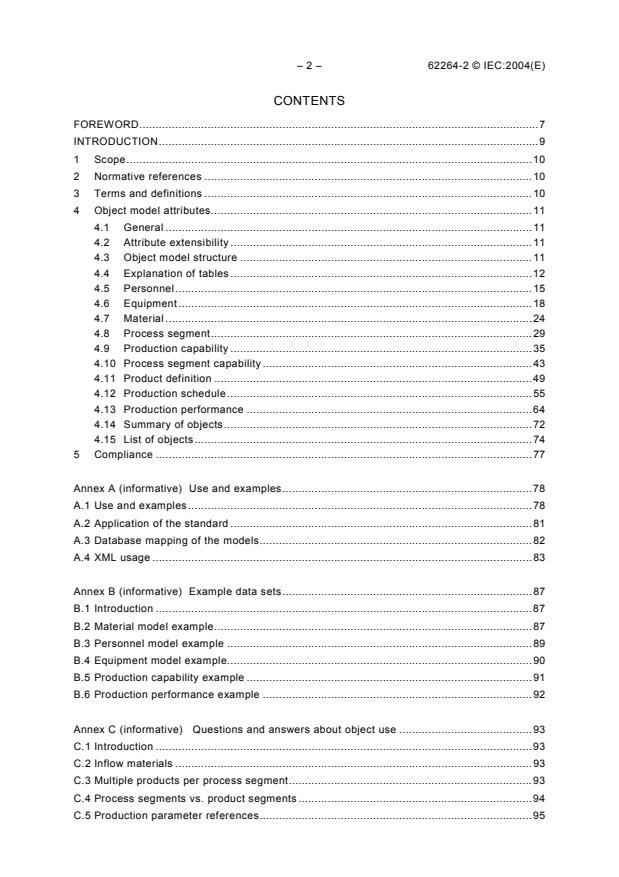
CONTENTS
FOREWORD.7
INTRODUCTION.9
1 Scope.10
2 Normative references .10
3 Terms and definitions .10
4 Object model attributes.11
4.1 General .11
4.2 Attribute extensibility .11
4.3 Object model structure .11
4.4 Explanation of tables .12
4.5 Personnel.15
4.6 Equipment.18
4.7 Material .24
4.8 Process segment.29
4.9 Production capability .35
4.10 Process segment capability .43
4.11 Product definition .49
4.12 Production schedule.55
4.13 Production performance .64
4.14 Summary of objects.72
4.15 List of objects.74
5 Compliance .77
Annex A (informative) Use and examples.78
A.1 Use and examples.78
A.2 Application of the standard .81
A.3 Database mapping of the models.82
A.4 XML usage .83
Annex B (informative) Example data sets.87
B.1 Introduction .87
B.2 Material model example.87
B.3 Personnel model example .89
B.4 Equipment model example.90
B.5 Production capability example .91
B.6 Production performance example .92
Annex C (informative) Questions and answers about object use .93
C.1 Introduction .93
C.2 Inflow materials .93
C.3 Multiple products per process segment.93
C.4 Process segments vs. product segments .94
C.5 Production parameter references.95
62264-2 IEC:2004(E) – 3 –
C.6 How class name and property names are used to identify elements.96
C.7 Possible capability over-counts.97
C.8 Routing and process capability .98
C.9 Product and process capability dependencies.100
C.10 Representation of dependencies.101
C.11 Representation of material produced and consumed.102
C.12 Material produced and the capability model .102
C.13 How a material transfer is handled.102
C.14 Why the maintenance and QA models are different from the production model .103
Annex D (informative) Logical information flows.104
Figure 1 – Detailed relationship models .14
Figure 2 – Personnel model .15
Figure 3 – Equipment model .18
Figure 4 – Material model .24
Figure 5 – Process segment model .29
Figure 6 – Production capability model .35
Figure 7 – Process segment capability.43
Figure 8 – Product definition model.49
Figure 9 – Production schedule model .55
Figure 10 – Production performance model.64
Figure 11 – Object model inter-relationships .73
Figure A.1 – Personnel model.79
Figure A.2 – Instances of a person class .80
Figure A.3 – UML model for class and class properties .80
Figure A.4 – Class property .80
Figure A.5 – Instances of a person properties .81
Figure A.6 – Instances of person and person properties .81
Figure A.7– XML schema for a person object.84
Figure A.8 – XML schema for person properties.84
Figure A.9 – Example of person and person property.85
Figure A.10 – Example of person class information.85
Figure A.11 – Adaptor to map different property names and values.86
Figure C.1 – Class and property names used to identify elements .96
Figure C.2 – A property defining overlapping subsets of the capability.98
Figure C.3 – Routing for a product .99
Figure C.4 – Routing with co-products and material dependencies.99
Figure C.5 – Product and process capability relationships .100
Figure C.6 – Time-based dependencies .101
Figure C.7 – Maintenance schedule and performance model .103
Figure D.1 – Enterprise to manufacturing system logical information flows .104
Figure D.2 – Logical information flows among multiple systems .105
– 4 – 62264-2 © IEC:2004(E)
Table 1 – UML notation used .12
Table 2 – Example table .13
Table 3 – Attributes of personnel class .15
Table 4 – Attributes of personnel class property .16
Table 5 – Attributes of person .16
Table 6 – Attributes of person property .17
Table 7 – Attributes of qualification test specification.17
Table 8 – Attributes of qualification test result.18
Table 9 – Attributes of equipment class .19
Table 10 – Attributes of equipment class property.19
Table 11 – Attributes of equipment .20
Table 12 – Attributes of equipment property.20
Table 13 – Attributes of equipment capability test specification.21
Table 14 – Attributes of equipment capability test result .21
Table 15 – Attributes of maintenance request .22
Table 16 – Attributes of maintenance work order .22
Table 17 – Attributes of maintenance response.23
Table 18 – Attributes of material class .24
Table 19 – Attributes of material class property .25
Table 20 – Attributes of material definition .25
Table 21 – Attributes of material definition property .25
Table 22 – Attributes of material lot .26
Table 23 – Attributes of material lot property.26
Table 24 – Attributes of material sublot.27
Table 25 – Attributes of QA test specification.27
Table 26 – Attributes of QA test result .28
Table 27 – Attributes of process segment .30
Table 28 – Attributes of personnel segment specification.30
Table 29 – Attributes of personnel segment specification property .31
Table 30 – Attributes of equipment segment specification .31
Table 31 – Attributes of equipment segment specification property .32
Table 32 – Attributes of material segment specification.32
Table 33 – Attributes of material segment specification property.33
Table 34 – Attributes of process segment parameter .33
Table 35 – Attributes of process segment dependency .34
Tabe 36 – Attributes of production capability .36
Table 37 – Attributes of personnel capability.37
Table 38 – Attributes of personnel capability property.38
Table 39 – Attributes of equipment capability.39
62264-2 IEC:2004(E) – 5 –
Table 40 – Attributes of equipment capability property .40
Table 41 – Attributes of material capability .41
Table 42 – Attributes of material capability property.42
Table 43 – Attributes of process segment capability.44
Table 44 – Attributes of personnel segment capability .45
Table 45 – Attributes of personnel segment capability property.45
Table 46 – Attributes of equipment segment capability.46
Table 47 – Attributes of equipment segment capability property.46
Table 48 – Attributes of material segment capability .47
Table 49 – Attributes of material segment capability property .48
Table 50 – Attributes of product definition.50
Table 51 – Attributes of manufacturing bill .50
Table 52 – Attributes of product segment.51
Table 53 – Attributes of product parameter .51
Table 54 – Attributes of personnel specification .51
Table 55 – Attributes of personnel specification property .52
Table 56 – Attributes of equipment specification .52
Table 57 – Attributes of equipment specification property .53
Table 58 – Attributes of mmaterial specification .53
Table 59 – Attributes of material specification property .54
Table 60 – Attributes of product segment dependency .54
Table 61 – Attributes of production schedule .56
Table 62 – Attributes of production request.56
Table 63 – Attributes of segment requirement.57
Table 64 – Attributes of production parameter.58
Table 65 – Attributes of personnel requirement.58
Table 66 – Attributes of personnel requirement property .59
Table 67 – Attributes of equipment requirement .59
Table 68 – Attributes of equipment requirement property .60
Table 69 – Attributes of material produced requirement .60
Table 70 – Attributes of material produced requirement property .61
Table 71 – Attributes of material consumed requirement.61
Table 72 – Attributes of material consumed requirement property .62
Table 73 – Attributes of consumable expected .62
Table 74 – Attributes of consumable expected property .63
Table 75 – Attributes of production performance.65
Table 76 – Attributes of production response .65
Table 77 – Attributes of segment response .66
Table 78 – Attributes of production data.67
Table 79 – Attributes of personnel actual .67
Table 80 – Attributes of personnel actual property .68
Table 81 – Attributes of equipment actual .68
Table 82 – Attributes of equipment actual property .69
– 6 – 62264-2 © IEC:2004(E)
Table 83 – Attributes of material produced actual .69
Table 84 – Attributes of material produced actual property.70
Table 85 – Attributes of material consumed actual .70
Table 86 – Attributes of material consumed actual property .71
Table 87 – Attributes of consumable actual.71
Table 88 – Attributes of consumable actual property.72
Table 89 – Personnel model objects .74
Table 90 – Equipment model objects .74
Table 91 – Material model objects .74
Table 92- Process segment model objects .75
Table 93 – Production capability model objects.75
Table 94 – Process segment capability model objects.75
Table 95 – Product definition object models.75
Table 96 – Production schedule model objects .76
Table 97 – Production performance object models .76
Table A.1 – Attributes of person.79
Table A.2 – Database structure for person.82
Table A.3 – Database structure for person property .82
Table A.4 – Database for person with data .82
Table C.1 – Definition of segment types.95
62264-2 IEC:2004(E) – 7 –
INTERNATIONAL ELECTROTECHNICAL COMMISSION
____________
ENTERPRISE-CONTROL SYSTEM INTEGRATION –
Part 2: Object model attributes
FOREWORD
1) The International Electrotechnical Commission (IEC) is a worldwide organization for standardization comprising
all national electrotechnical committees (IEC National Committees). The object of IEC is to promote
international co-operation on all questions concerning standardization in the electrical and electronic fields. To
this end and in addition to other activities, IEC publishes International Standards, Technical Specifications,
Technical Reports, Publicly Available Specifications (PAS) and Guides (hereafter referred to as “IEC
Publication(s)”). Their preparation is entrusted to technical committees; any IEC National Committee interested
in the subject dealt with may participate in this preparatory work. International, governmental and non-
governmental organizations liaising with the IEC also participate in this preparation. IEC collaborates closely
with the International Organization for Standardization (ISO) in accordance with conditions determined by
agreement between the two organizations.
2) The formal decisions or agreements of IEC on technical matters express, as nearly as possible, an international
consensus of opinion on the relevant subjects since each technical committee has representation from all
interested IEC National Committees.
3) IEC Publications have the form of recommendations for international use and are accepted by IEC National
Committees in that sense. While all reasonable efforts are made to ensure that the technical content of IEC
Publications is accurate, IEC cannot be held responsible for the way in which they are used or for any
misinterpretation by any end user.
4) In order to promote international uniformity, IEC National Committees undertake to apply IEC Publications
transparently to the maximum extent possible in their national and regional publications. Any divergence
between any IEC Publication and the corresponding national or regional publication shall be clearly indicated in
the latter.
5) IEC provides no marking procedure to indicate its approval and cannot be rendered responsible for any
equipment declared to be in conformity with an IEC Publication.
6) All users should ensure that they have the latest edition of this publication.
7) No liability shall attach to IEC or its directors, employees, servants or agents including individual experts and
members of its technical committees and IEC National Committees for any personal injury, property damage or
other damage of any nature whatsoever, whether direct or indirect, or for costs (including legal fees) and
expenses arising out of the publication, use of, or reliance upon, this IEC Publication or any other IEC
Publications.
8) Attention is drawn to the Normative references cited in this publication. Use of the referenced publications is
indispensable for the correct application of this publication.
9) Attention is drawn to the possibility that some of the elements of this IEC Publication may be the subject of
patent rights. IEC shall not be held responsible for identifying any or all such patent rights.
International Standard IEC 62264-2 has been prepared by subcommittee 65A: System
aspects, of IEC technical committee 65: Industrial-process measurement and control, and ISO
SC5, JWG 15, of ISO technical committee 184: Enterprise-control system integration.
It is published as double logo standard.
This standard is based upon ANSI/ISA-95.00.02-2001, Enterprise-Control System Integration,
Part 2: Object Model Attributes. It is used with permission of the copyright holder, the
Instrumentation, Systems and Automation Society (ISA) . ISA encourages the use and
application of its industry standards on a global basis.
___________
For information on ISA standards, contact ISA at: ISA – The Instrumentation, Systems and Automation Society,
PO Box 12277, Research Triangle Park, NC 27709, USA, Tel. 1+919.549.8411, URL: standards.isa.org.
– 8 – 62264-2 © IEC:2004(E)
This standard was submitted to the National Committees for voting under the Fast Track
Procedure as the following documents:
FDIS Report on voting
65A/408/FDIS 65A/416/RVD
Full information on the voting for the approval of this standard can be found in the report on
voting indicated in the above table. In ISO, the standard has been approved by 10 P members
out of 11 having cast a vote.
This publication has been drafted in accordance with the ISO/IEC Directives, Part 2.
IEC 62264 consists of the following parts under the general title Enterprise-control system
integration:
Part 1: Models and terminology
Part 2: Object model attributes
Part 3: Models of manufacturing operations
The committee has decided that the contents of this publication will remain unchanged until
the maintenance result date indicated on the IEC web site under "http://webstore.iec.ch" in
the data related to the specific publication. At this date, the publication will be
• reconfirmed;
• withdrawn;
• replaced by a revised edition, or
• amended.
A bilingual version may be issued at a later date.
62264-2 IEC:2004(E) – 9 –
INTRODUCTION
IEC 62264 is a multi-part standard that defines the interface content between enterprise
activities and control activities. This part of IEC 62264 provides the definitions of the
attributes of the object models in IEC 62264-1.
IEC 62264 defines object models of exchanged information between enterprise systems and
control systems. This part of IEC 62264 adds details to the object models through the
definition of attributes, so that implement able interfaces may be constructed. IEC 62264
does not define models of enterprise objects or control objects.
The area of concern of this standard is strongly related to the ISO TC 184 (Industrial
automation systems and integration) scope. Nevertheless the objectives and approaches are
completely different and complementary. Relevant TC184 standards or work in progress
address the modeling of enterprise and/or the modeling of enterprise objects whereas this
standard specifies the content of interfaces between control functions and enterprise
functions. The functions may be precisely modeled with TC184 standards. See
ISO/IEC 62264-1 Annex A for further details.
– 10 – 62264-2 © IEC:2004(E)
ENTERPRISE-CONTROL SYSTEM INTEGRATION –
Part 2: Object model attributes
1 Scope
This part of IEC 62264, in conjunction with IEC 62264-1, specifies generic interface content
between manufacturing control functions and other enterprise functions. The interfaces
considered are the interfaces between Levels 3 and 4 of the hierarchical model defined in
IEC 62264-1. The goal is to reduce the risk, cost, and errors associated with implementing
these interfaces.
Since IEC 62264 covers many domains, and there are many different standards in those
domains, the semantics of this Standard are described at a level intended to enable the other
standards to be mapped to these semantics. To this end, this Standard defines a set of
generic interfaces content elements, together with a mechanism for extending those elements
for implementations.
The scope of this part of IEC 62264 is limited to the definition of attributes of the IEC 62264-1
object models.
This part of IEC 62264 does not define attributes to represent the object relationships defined
in IEC 62264-1.
2 Normative references
The following referenced documents are indispensable for the application of this document.
For dated references, only the edition cited applies. For undated references, the latest edition
of the referenced document (including any amendments) applies.
IEC 62264-1, Enterprise-Control System Integration – Part 1: Models and terminology
ISO 10303-1:1994, Industrial automation systems and integration – Product data representa-
tion and exchange – Part 1: Overview and fundamental principles
ISO 15704:2000, Industrial automation systems – Requirements for enterprise–reference
architectures and methodologies
3 Terms and definitions
For the purpose of this document, the terms and definitions given in IEC 62264-1 as well as
the following apply.
3.1
event
representation of a solicited or unsolicited fact indicating a state change in the enterprise
62264-2 IEC:2004(E) – 11 –
3.2
product
the desired output or by-product of the processes of an enterprise
NOTE 1 A product may be an intermediate product or end product from a business perspective.
NOTE 2 Also defined in ISO 10303-1 as: ‘a substance produced by a natural or artificial process’.
3.3
property
object denoting an implementation specific characteristic of an entity
4 Object model attributes
4.1 General
This clause describes the attributes associated with the objects listed in IEC 62264-1.
Tables 3 to 88 in Clause 4 define the attributes of objects defined in IEC 62264-1, Clause 7.
The attributes are an extension to the object information model presented in IEC 62264-1 and
are thus a part of the definition of terms. The attributes of this part of IEC 62264 and the
object models of IEC 62264-1 define interface content for integration of Level 3 and Level 4
enterprise-control systems. See also IEC 62264-1, Clause 7.4.
In this part of IEC 62264, the word “Class” used as part of an object definition name is to be
considered as a category, not as a “Class” in the object-oriented sense.
EXAMPLE “Personnel class” is to be considered a “personnel category”, in the sense of distinguishing between the
kinds of personnel in the real world.
A minimum set of industry-independent information has been defined, in this part of
IEC 62264, as attributes. However, values for all attributes may not be required depending on
the actual usage of the models. If additional information, including industry- and application-
specific information, is needed, it shall be represented as property objects. This mechanism is
the extension capability referenced in Clause 1. This solution increases the usability through
the use of standard attributes, and allows flexibility and extensibility through the use of
properties. This was done to make the standard as widely applicable as possible.
4.2 Attribute extensibility
For particular applications, the objects defined in the object models will need to be extended
through the addition of attributes to object class definitions. Accordingly, this part of
IEC 62264 provides for attributes that are application or industry specific, to be modeled in
terms of properties and represented in property classes in the model. For example, the
personnel class property would be used to define application or industry specific attributes for
personnel classes, and person property would be used to contain instance values for the
properties.
4.3 Object model structure
The object models are depicted using the Unified Modelling Language (UML) notational
methodology.
Table 1 defines the UML notations used in the object diagrams.
– 12 – 62264-2 © IEC:2004(E)
Table 1 – UML notation used
Symbol Definition
Defines a package, a collection of object models, state models, use
classes, and other UML models. In this document a package is used to
specify an external model, such as a production rule model, or a reference
Package
to another part of the model.
Defines a class of objects, each with the same types of attributes. Each
object is uniquely identifiable or enumerable. No operations or methods are
Class
listed for the classes. Attributes with a “ – ” before their name indicate
attributes that are generally optional in any use of the class.
An association between elements of a class and elements of another or the
same class. Each association is identified. May have the expected number
Role 1.1
or range of members of the subclass, when ‘n’ indicates an indeterminate
number. For example, 0,n means that zero or more members of the
Association name
0.n Role
subclass may exist.
Generalization (arrow points to the super class) shows that an element of
the class is a specialized type of the super class.
Is a type of
Dependence is a weak association that shows that a modelling element
depends on another modelling element. The item at the tail depends on the
Depends on
item at the head of the relationship.
Aggregation (made up of) shows that an element of the class is made up of
elements of other classes.
Is an aggregation of
Composite shows a strong form of aggregation, which requires that a part
instance be included in at most one composite at a time and that the
Is a composite of
composite object has sole responsibility for disposition of its parts.
4.4 Explanation of tables
4.4.1 Tables of attributes
This subclause gives the meaning of the attribute tables. This includes a listing of the object
identification, data types, and presentation of the examples in the tables.
4.4.2 Object identification
Many objects in the information model require unique identifications (IDs). These IDs shall be
unique within the scope of the exchanged information. This may require translations:
– from the internal ID of the source system to the interface content ID;
– from the interface content ID to the internal ID of the target system.
EXAMPLE A unit may be identified as “X6777” in the interface content, as resource “R100011” in the business
system, and as “East Side Reactor” in the control system.
A unique identification set shall be agreed to in order to exchange information.
The object IDs are used only to identify objects within related exchanged information sets.
The object ID attributes are not global object IDs or database index attributes.
62264-2 IEC:2004(E) – 13 –
Generally, objects that are elements of aggregations, and are not referenced elsewhere in the
model, do not require unique IDs.
4.4.3 Data types
The attributes presented are abstract representations, without any specific data type
specified. A specific implementation will show how the information is represented.
Example 1 An attribute may be represented as a string in one implementation and as a
numeric value in another implementation.
Example 2 A date/time value may be represented in ISO standard format in one
implementation and in Julian calendar format in another.
Example 3 A relationship may be represented by two fields (type and key) in database
tables or by a specific tag in XML.
4.4.4 Presentation of examples
Examples are included with each attribute given. Where multiple examples are used, there
are multiple rows in the right hand column. See Table Table 2 below for how the example
rows and columns are used.
Table 2 – Example table
Attribute name Description Examples
Name of first attribute Description of first attribute Example #1 for first attribute
Example #2 for first attribute
Example #3 for first attribute
Name of second attribute Description of second attribute Example #1 for second attribute
Example #2 for second attribute
Example #3 for second attribute
Name of third attribute Description of third attribute Example #1 for third attribute
Example #2 for third attribute
Example #3 for third attribute
When an example value is a set of values, or a member of a set of values, the set of values is
given within a set of braces, {}.
The examples are purely fictional. They are provided to further describe attributes in the
model. No attempt was made to make the examples complete or representative of any
manufacturing enterprise.
4.4.5 Data relationships
The models used to document a reference to a resource, in another package, using the class
or instance, with additional optional specification using properties, are not fully illustrated in
the IEC 62264-1 object model figures. This relationship does not conform to the Unified
Modeling Language (UML) modeling methodology, but was done to keep the diagrams
simpler. Figure 1 illustrates how it is currently presented, on the left side, and how it could be
more accurately modeled in UML on the right side. UML was used in this standard as a
visualization method and not meant to describe implementations. The simplified relationship
diagram method is used for the following objects and their relationship to another package:
– 14 – 62264-2 © IEC:2004(E)
Personnel capability Equipment capability
Material capability Personnel segment capability
Equipment segment capability Material segment capability
Personnel segment specification Equipment segment specification
Material segment specification Personnel specification
Equipment specification Material specification
Personnel requirement Equipment requirement
Material produced requirement Material consumed requirement
Consumable expected Personnel actual
Equipment actual Material produced actual
Material consumed actual Consumable actual
ReRessoouurrcece
Ccaappaabbilitilityy
0.n
ReRessoouurrcece
ReRessoouurrcece
Note: The
Ccaappaabbilitilityy
Ccaappaabbilitilityy
correspondence
Pprropopererttyy
relationship is
defined through one
0.n 0.n
and only one of four
0.n
relationships A, A and
ReRessoouurrcece
B, C, or C and D.
Ccaappaabbilitilityy
A C
Pprropopererttyy
B D
0.1
0.n Corresponds
0.n
to element in
0.1
0.n
ReResosouurrccee ReResosouurrccee
Cacatetegogorryy Definitidefinitioonn Defined Definitidefinitioonn
1.1
by
ReRessoouurrcece
Modmodelel
0.n
0.n
1.1 1.1
ReResosouurrccee
ReResosouurrccee
Simplified relationship
Cacatetegogorryy
Maps to Pprropopererttyy
Pprropopererttyy
model
Detailed relationship
model
IEC 953/04
Figure 1 – Detailed relationship models
The correspondence relationship is determined through one and only one of four possible
relationships: to the resource catagory definition; to the resource catagory definition and
resource catagory property; to the resource definition; or to the resource definition and
resource property.
In the model above, the term resource catagory indicates: personnel class, equipment class,
material class, and material definitions. The term resource indicates: person, equipment,
material lot, and material sublot. The term resource capability indicates the use in the
capability model, the process segment capability model, the process segment model, the
product definition model, the production schedule model, and the production performance
model.
Corresponds
to element in
Corresponds
to element in
Corresponds
to element in
Corresponds
to element in
62264-2 IEC:2004(E) – 15 –
4.5 Personnel
4.5.1 Personnel model
The personnel model contains the information about specific personnel, classes of personnel,
and qualifications of personnel. Figure 2 is a modified copy of Figure 14 in Part 1. This
corresponds to a resource model for personnel, as given in ISO 15704.
0.n
Personnel
Person
class 0.n
Defined by
0.n
0.n
Maps to
Personnel Person
class property property
1.n 0.n
< Records the
Qualification
testing of
test
Qualification
0.n 0.n
result
test
< Defines a procedure
Is used
...
Questions, Comments and Discussion
Ask us and Technical Secretary will try to provide an answer. You can facilitate discussion about the standard in here.
Loading comments...