


ISO/IEC 10373-3:2018
(Main)Identification cards — Test methods — Part 3: Integrated circuit cards with contacts and related interface devices
Identification cards — Test methods — Part 3: Integrated circuit cards with contacts and related interface devices
This document defines test methods for characteristics of integrated circuit cards with contacts and related interface devices according to the definition given in ISO/IEC 7816-3. Each test method is cross‑referenced to one or more base standards, which can be ISO/IEC 7810 that defines the information storage technologies employed in identification card applications. NOTE Criteria for acceptability do not form part of this document but can be found in the International Standards mentioned above. This document defines test methods which are specific to integrated circuit technology with contacts. ISO/IEC 10373-1 defines test methods which are common to one or more card technologies and other parts of the ISO/IEC 10373 series define other technology‑specific tests. Test methods defined in this document are intended to be performed separately and independently. A given card is not required to pass through all the tests sequentially. The test methods defined in this document are based on ISO/IEC 7816-3. Conformance of cards and IFDs determined using the test methods defined in this document does not preclude failures in the field. Reliability testing is outside the scope of this document. This document does not define any test to establish the complete functioning of integrated circuit cards. The test methods require only that the minimum functionality be verified. The minimum functionality is defined as follows. — Any integrated circuit present in the card continues to show an Answer to Reset response which conforms to the base standard. — Any contacts associated with any integrated circuit present in the card continue to show electrical resistance which conforms to the base standard.
Cartes d'identification — Méthodes d'essai — Partie 3: Cartes à circuit(s) intégré(s) à contacts et dispositifs d'interface assimilés
General Information
Relations
Standards Content (Sample)
INTERNATIONAL ISO/IEC
STANDARD 10373-3
Third edition
2018-09
Identification cards — Test
methods —
Part 3:
Integrated circuit cards with contacts
and related interface devices
Cartes d'identification — Méthodes d'essai —
Partie 3: Cartes à circuit(s) intégré(s) à contacts et dispositifs
d'interface assimilés
Reference number
©
ISO/IEC 2018
© ISO/IEC 2018
All rights reserved. Unless otherwise specified, or required in the context of its implementation, no part of this publication may
be reproduced or utilized otherwise in any form or by any means, electronic or mechanical, including photocopying, or posting
on the internet or an intranet, without prior written permission. Permission can be requested from either ISO at the address
below or ISO’s member body in the country of the requester.
ISO copyright office
CP 401 • Ch. de Blandonnet 8
CH-1214 Vernier, Geneva
Phone: +41 22 749 01 11
Fax: +41 22 749 09 47
Email: copyright@iso.org
Website: www.iso.org
Published in Switzerland
ii © ISO/IEC 2018 – All rights reserved
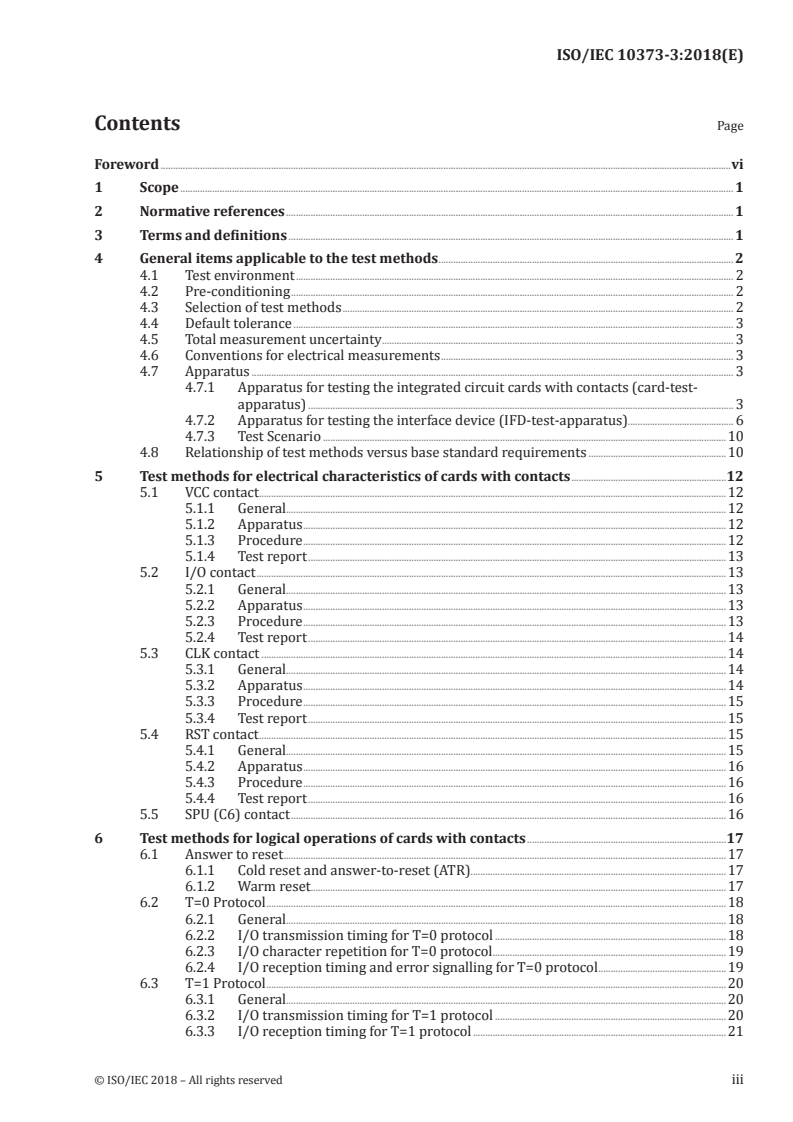
Contents Page
Foreword .vi
1 Scope .1
2 Normative references .1
3 Terms and definitions .1
4 General items applicable to the test methods . 2
4.1 Test environment . 2
4.2 Pre-conditioning . 2
4.3 Selection of test methods . 2
4.4 Default tolerance . 3
4.5 Total measurement uncertainty . 3
4.6 Conventions for electrical measurements . 3
4.7 Apparatus . 3
4.7.1 Apparatus for testing the integrated circuit cards with contacts (card-test-
apparatus) . 3
4.7.2 Apparatus for testing the interface device (IFD-test-apparatus). 6
4.7.3 Test Scenario .10
4.8 Relationship of test methods versus base standard requirements .10
5 Test methods for electrical characteristics of cards with contacts .12
5.1 VCC contact .12
5.1.1 General.12
5.1.2 Apparatus .12
5.1.3 Procedure .12
5.1.4 Test report .13
5.2 I/O contact .13
5.2.1 General.13
5.2.2 Apparatus .13
5.2.3 Procedure .13
5.2.4 Test report .14
5.3 CLK contact .14
5.3.1 General.14
5.3.2 Apparatus .14
5.3.3 Procedure .15
5.3.4 Test report .15
5.4 RST contact .15
5.4.1 General.15
5.4.2 Apparatus .16
5.4.3 Procedure .16
5.4.4 Test report .16
5.5 SPU (C6) contact .16
6 Test methods for logical operations of cards with contacts .17
6.1 Answer to reset .17
6.1.1 Cold reset and answer-to-reset (ATR).17
6.1.2 Warm reset.17
6.2 T=0 Protocol .18
6.2.1 General.18
6.2.2 I/O transmission timing for T=0 protocol .18
6.2.3 I/O character repetition for T=0 protocol .19
6.2.4 I/O reception timing and error signalling for T=0 protocol .19
6.3 T=1 Protocol .20
6.3.1 General.20
6.3.2 I/O transmission timing for T=1 protocol .20
6.3.3 I/O reception timing for T=1 protocol .21
© ISO/IEC 2018 – All rights reserved iii
6.3.4 Character Waiting Time (CWT) behaviour .22
6.3.5 Card-reaction to IFD exceeding CWT .22
6.3.6 Block Guard time (BGT) .23
6.3.7 Block sequencing by the card .24
6.3.8 Reaction of the card to protocol errors .26
6.3.9 Recovery of a transmission error by the card .26
6.3.10 Resynchronization .27
6.3.11 IFSD negotiation .28
6.3.12 Abortion by the IFD .29
7 Test methods for physical and electrical characteristics of the IFD .29
7.1 Activation of contacts .29
7.1.1 General.29
7.1.2 Apparatus .29
7.1.3 Procedure .30
7.1.4 Test report .30
7.2 VCC contact .30
7.2.1 General.30
7.2.2 Apparatus .30
7.2.3 Procedure .30
7.2.4 Test report .31
7.3 I/O contact .32
7.3.1 General.32
7.3.2 Apparatus .32
7.3.3 Procedure .32
7.3.4 Test report .33
7.4 CLK contact .33
7.4.1 General.33
7.4.2 Apparatus .33
7.4.3 Procedure .33
7.4.4 Test report .34
7.5 RST contact .34
7.5.1 General.34
7.5.2 Apparatus .35
7.5.3 Procedure .35
7.5.4 Test report .36
7.6 SPU (C6) contact .36
7.7 Deactivation of the contacts .36
7.7.1 General.36
7.7.2 Apparatus .36
7.7.3 Procedure .36
7.7.4 Test report .36
8 Test methods for logical operations of the IFD .37
8.1 Answer to reset .37
8.1.1 Card reset (cold reset).37
8.1.2 Card reset (warm reset) .37
8.2 T=0 Protocol .38
8.2.1 General.38
8.2.2 I/O transmission timing for T=0 protocol .38
8.2.3 I/O character repetition for T=0 protocol .38
8.2.4 I/O reception timing and error signaling for T=0 protocol .39
8.3 T=1 Protocol .40
8.3.1 General.40
8.3.2 I/O transmission timing for T=1 protocol .40
8.3.3 I/O reception timing for T=1 protocol .41
8.3.4 IFD Character Waiting Time (CWT) behaviour .42
8.3.5 IFD-reaction to card exceeding CWT .42
8.3.6 Block Guard Time (BGT) .43
iv © ISO/IEC 2018 – All rights reserved
8.3.7 Block sequencing by the IFD .43
8.3.8 Recovery of a transmission error by the IFD .46
8.3.9 IFSC negotiation .47
8.3.10 Abortion by the card .47
8.4 IFD — Reaction of the IFD to invalid PCBs .48
8.4.1 General.48
8.4.2 Apparatus .48
8.4.3 Procedure .48
8.4.4 Test report .49
Bibliography .50
© ISO/IEC 2018 – All rights reserved v
Foreword
ISO (the International Organization for Standardization) and IEC (the International Electrotechnical
Commission) form the specialized system for worldwide standardization. National bodies that are
members of ISO or IEC participate in the development of International Standards through technical
committees established by the respective organization to deal with particular fields of technical
activity. ISO and IEC technical committees collaborate in fields of mutual interest. Other international
organizations, governmental and non-governmental, in liaison with ISO and IEC, also take part in the
work. In the field of information technology, ISO and IEC have established a joint technical committee,
ISO/IEC JTC 1.
The procedures used to develop this document and those intended for its further maintenance are
described in the ISO/IEC Directives, Part 1. In particular the different approval criteria needed for
the different types of document should be noted. This document was drafted in accordance with the
editorial rules of the ISO/IEC Directives, Part 2 (see www .iso .org/directives).
Attention is drawn to the possibility that some of the elements of this document may be the subject
of patent rights. ISO and IEC shall not be held responsible for identifying any or all such patent
rights. Details of any patent rights identified during the development of the document will be in the
Introduction and/or on the ISO list of patent declarations received (see www .iso .org/patents).
Any trade name used in this document is information given for the convenience of users and does not
constitute an endorsement.
For an explanation on the voluntary nature of standards, the meaning of ISO specific terms and
expressions related to conformity assessment, as well as information about ISO's adherence to the
World Trade Organization (WTO) principles in the Technical Barriers to Trade (TBT) see the following
URL: www .iso .org/iso/foreword .html.
This document was prepared by ISO/IEC JTC 1, Information technology, SC 17, Cards and personal
identification.
This third edition cancels and replaces the second edition (ISO/IEC 10373-3:2010), which has been
technically revised. It also incorporates the Technical Corrigendum ISO/IEC 10373-3:2010/Cor 1:2013.
The main changes compared to the previous edition are as follows:
— editorial clarification of scenario 6 (6.3.6.2.3 in the previous edition) with addition of supported
PCB values;
— miscellaneous editorial improvement on e.g. symbols, notes and references.
A list of all the parts in the ISO 10373 series can be found on the ISO website.
Any feedback or questions on this document should be directed to the user’s national standards body. A
complete listing of these bodies can be found at www .iso .org/members .html.
vi © ISO/IEC 2018 – All rights reserved
INTERNATIONAL STANDARD ISO/IEC 10373-3:2018(E)
Identification cards — Test methods —
Part 3:
Integrated circuit cards with contacts and related
interface devices
1 Scope
This document defines test methods for characteristics of integrated circuit cards with contacts and
related interface devices according to the definition given in ISO/IEC 7816-3. Each test method is
cross-referenced to one or more base standards, which can be ISO/IEC 7810 that defines the information
storage technologies employed in identification card applications.
NOTE Criteria for acceptability do not form part of this document but can be found in the International
Standards mentioned above.
This document defines test methods which are specific to integrated circuit technology with contacts.
ISO/IEC 10373-1 defines test methods which are common to one or more card technologies and other
parts of the ISO/IEC 10373 series define other technology-specific tests.
Test methods defined in this document are intended to be performed separately and independently. A
given card is not required to pass through all the tests sequentially. The test methods defined in this
document are based on ISO/IEC 7816-3.
Conformance of cards and IFDs determined using the test methods defined in this document does not
preclude failures in the field. Reliability testing is outside the scope of this document.
This document does not define any test to establish the complete functioning of integrated circuit cards.
The test methods require only that the minimum functionality be verified. The minimum functionality
is defined as follows.
— Any integrated circuit present in the card continues to show an Answer to Reset response which
conforms to the base standard.
— Any contacts associated with any integrated circuit present in the card continue to show electrical
resistance which conforms to the base standard.
2 Normative references
The following documents are referred to in the text in such a way that some or all of their content
constitutes requirements of this document. For dated references, only the edition cited applies. For
undated references, the latest edition of the referenced document (including any amendments) applies.
ISO/IEC 7816-3:2006, Identification cards — Integrated circuit cards — Part 3: Cards with contacts —
Electrical interface and transmission protocols
3 Terms and definitions
For the purposes of this document, the following terms and definitions apply.
ISO and IEC maintain terminological databases for use in standardization at the following addresses:
— ISO Online browsing platform: available at https: //www .iso .org/obp
© ISO/IEC 2018 – All rights reserved 1
— IEC Electropedia: available at http: //www .electropedia .org/
3.1
card
integrated circuit card with contacts
3.2
DUT
device under test
card (3.1) or IFD (3.4) that is subject to testing
3.3
etu-factor
parameters negotiable by protocol and parameters selection (PPS), described in ISO/IEC 7816-
3:2006, 6.3.1
3.4
IFD
interface device related to integrated circuit cards with contacts as defined in ISO/IEC 7816-3
3.5
normal use
use as an identification card, involving equipment processes appropriate to the card technology and
storage as a personal document between equipment processes
[SOURCE: ISO/IEC 7810:2003, 4.4]
3.6
test method
method for testing characteristics of identification cards and related interface devices for the purpose
of confirming their compliance with International Standards
3.7
test scenario
defined typical protocol and application specific communication to be used with the test methods (3.6)
defined in this document
3.8
typical protocol and application specific communication
communication between a DUT (3.2) and the corresponding test-apparatus based on the protocol and
application implemented in the DUT (3.2) and representing its normal use (3.5)
4 General items applicable to the test methods
4.1 Test environment
Unless otherwise specified, testing of physical, electrical and logical characteristics shall take place in
an environment of a temperature 23 °C ± 3 °C, of a relative humidity 40 % to 60 %.
4.2 Pre-conditioning
Where pre-conditioning is required by the test method, the identification cards to be tested shall be
conditioned to the test environment for a period of 24 h before testing unless otherwise specified.
4.3 Selection of test methods
Tests shall be applied as required to test the attributes of the card defined by the relevant base standard
(see 4.8).
2 © ISO/IEC 2018 – All rights reserved
4.4 Default tolerance
Unless otherwise specified, a default tolerance of ±5 % shall be applied to the quantity values given
to specify the characteristics of the test equipment (e.g. linear dimensions) and the test method
procedures (e.g. test equipment adjustments).
4.5 Total measurement uncertainty
The total measurement uncertainty for each quantity determined by these test methods shall be stated
in the test report.
4.6 Conventions for electrical measurements
Potential differences are defined with respect to the GND contact of the card and currents flowing to
the card are considered positive.
4.7 Apparatus
4.7.1 Apparatus for testing the integrated circuit cards with contacts (card-test-apparatus)
4.7.1.1 Generating the VCC voltage (U ) and timing
CC
Table 1 — Voltage and timing for VCC
Parameter Operating condition Range Accuracy
U Class A, B, C −1 V to 6 V ±20 mV
CC
t , t Class A, B, C 0 µs to 500 µs ±100 µs
R F
4.7.1.2 Measuring ICC
Table 2 — I parameters
CC
Characteristic Mode Range Accuracy Resolution
Spike measurement 0 mA to 200 mA ±2 mA 20 ns
I Active mode 0 mA to 100 mA ±1 mA Averaged over 1 ms
CC
Clock stop 0 µA to 200 µA ±10 µA Averaged over 1 ms
4.7.1.3 Generating SPU (C6) voltage
See 5.5 and ISO/IEC 7816-3.
4.7.1.4 Generating the RST voltage and timing
Table 3 — RST voltage and timing
Parameter Operating condition Range Accuracy
U U Class A, B −1 V to 6 V ±20 mV
IH, IL
U Class C −1 V to 2 V ±20 mV
IH
U Class C −1 V to 1 V ±20 mV
IL
t , t 0 µs to 2 µs ±20 ns
R F
NOTE t and t are generated between 10 % and 90 % of the V min and V max values.
R F H L
© ISO/IEC 2018 – All rights reserved 3
4.7.1.5 Measuring the RST current
Table 4 — RST current
Characteristic Mode Range Accuracy Resolution
I Active −30 µA to 200 µA ±10 µA 100 ns
IH
I Active −200 µA to 30 µA ±10 µA 100 ns
IL
4.7.1.6 Generating the I/O voltage and timing in reception mode
Table 5 — I/O voltage and timing
Parameter Mode Operating condition Range Accuracy
Card: Reception,
U U Class A, B −1 V to 6 V ±20 mV
IH, IL
Apparatus: Transmission
Card: Reception,
U Class C −1 V to 2 V ±20 mV
IH
Apparatus: Transmission
Card: Reception,
U Class C −1 V to 1 V ±20 mV
IL
Apparatus: Transmission
Card: Reception,
t , t 0 µs to 2 µs ±100 ns
R F
Apparatus: Transmission
NOTE t and t are generated between 10 % and 90 % of the V min and V max values.
R F H L
4.7.1.7 Measuring the I/O current in reception mode
Table 6 — I/O current (reception mode)
Parameter Mode Range Accuracy Resolution
Card: Reception,
I −300 µA to 30 µA ±10 µA 100 ns
IH
Apparatus: Transmission
Card: Reception,
−1,5 mA to −0,2 mA ±50 µA 100 ns
Apparatus: Transmission
I
IL
Card: Reception,
−200 µA to 30 µA ±10 µA 100 ns
Apparatus: Transmission
4.7.1.8 Generating the I/O current
Table 7 — I/O current
Stabilization time
Parameter Mode Range Accuracy
after level is reached
Card: Transmission 20 kΩ pull-up to VCC
I ±200 Ω
OH
Apparatus: Reception or equivalent circuit
Card: Transmission
I 0 mA to 1,5 mA ±50 µA <100 ns
OL
Apparatus: Reception
4.7.1.9 Measuring the I/O voltage and timing
Table 8 — I/O voltage and timing
Characteristic Operating condition Range Accuracy Resolution
U U Class A, B, C −1 V to 6 V ±20 mV 20 ns
IH, IL
t , t 0 µs to 2 µs ±20 ns
R F
NOTE t and t are measured between 10 % and 90 % of the V min and V max values.
R F H L
4 © ISO/IEC 2018 – All rights reserved
4.7.1.10 Generating the CLK voltage
Table 9 — CLK voltage
Parameter Operating condition Range Accuracy Resolution
U U Class A, B −1 V to 6 V ±20 mV 20 ns
IH, IL
U Class C −1 V to 2 V ±20 mV 20 ns
IH
U Class C −1 V to 2 V ±20 mV 20 ns
IL
4.7.1.11 Generating the CLK waveforms (single cycle measurement)
Table 10 — CLK waveforms
Parameter Range Accuracy
Duty cycle 35 % to 65 % of period ±5 ns
Frequency 0,5 MHz to 5,5 MHz ±5 kHz
Frequency 5 MHz to 20,5 MHz ±50 kHz
t , t 1 % to 10 % of period ±5 ns
R F
NOTE t and t are generated between 10 % and 90 % of the V (100 %) min and V (0 %) max.
R F H L
4.7.1.12 Measuring the CLK current
Table 11 — CLK current
Characteristic Mode Range Accuracy Resolution
I Active −30 µA to 150 µA ±10 µA 20 ns
IH
I Active −150 µA to 30 µA ±10 µA 20 ns
IL
4.7.1.13 Measuring the contact capacitance of RST, CLK and I/O
The contact capacitance of a contact shall be measured between the contact and the GND contact.
Table 12 — Contact capacitance
Characteristic Range Accuracy
C 0 pF to 50 pF ±5 pF
4.7.1.14 Generating the sequence of the activation and deactivation of the contacts
Table 13 — Activation and deactivation
Range of switching the sig-
Accuracy
nals
0 s to 1 s ±200 ns (or 1 CLK period, whichever is smaller)
4.7.1.15 Emulating the I/O protocol
The card-test-apparatus shall be able to emulate the protocol T=0 and T=1 and IFD applications
which are required to run the typical application specific communications corresponding to the card
applications.
NOTE If a specific functionality is not implemented in the card, the card-test-apparatus is not required to
have the corresponding test-capability (e.g. T=1 protocol not implemented in the card).
© ISO/IEC 2018 – All rights reserved 5
4.7.1.16 Generating the I/O character timing in reception mode
The card-test-apparatus shall be able to generate the I/O bit stream according to ISO/IEC 7816-3.
All timing parameters, e.g. start bit length, guard time, error signaling, shall be configurable.
Table 14 — I/O character timing (reception mode)
Symbol Parameter Accuracy
ε All timing parameters ±4 CLK cycles
t
4.7.1.17 Measuring and monitoring the I/O protocol
The card-test-apparatus shall be able to measure and monitor the timing of the logical low and high
states of the I/O-line relative to the CLK-frequency.
Table 15 — Timing characteristics
Characteristic Accuracy
All timing characteristics ±2 CLK cycles
4.7.1.18 Protocol analysis
The card-test-apparatus shall be able to analyse the I/O-bit stream in accordance to T=0 and T=1
protocol according to ISO/IEC 7816-3 and extract the logical data flow for further protocol and
application verifications.
NOTE If a specific functionality is not implemented in the card, the card-test-apparatus is not required to
have the corresponding test-capability (e.g. T=1 protocol not implemented in the card). Conversely, it is possible
that an apparatus needs extended capabilities, e.g. being able to generate any case 2 command (see ISO/IEC 7816-
4) if a card does not support the standard READ BINARY.
4.7.2 Apparatus for testing the interface device (IFD-test-apparatus)
4.7.2.1 Generating the VCC current (I )
CC
Table 16 — VCC current
Stabilization time
Parameter Mode Range Accuracy after the level is
reached
b
Spike generation 0 mA to 120 mA ±2 mA <100 ns
Active mode 0 mA to 70 mA ±1 mA <100 ns
I
CC
Idle mode (CLK-Stop) 0 mA to 1,2 mA ±10 µA <100 ns
a
Inactive −1,2 mA to 0 mA ±10 µA <100 ns
t , t 100 ns ±50 ns
R F
pulse length 100 ns to 500 ns ±50 ns
pause length
100 ns to 1 000 ns ±50 ns
frequently
pause length
10 µs to 2 000 µs ±1 µs
randomly
a
The maximum output voltage shall be limited to 5 V.
b
Dynamic conditions for spike generation.
6 © ISO/IEC 2018 – All rights reserved
4.7.2.2 Measuring the VCC voltage (U ) and timing
CC
Table 17 — VCC voltage and timing
Characteristic Operating condition Range Accuracy Resolution
U Class A, B, C −1 V to 6 V ±20 mV 10 ns
CC
4.7.2.3 Measuring the SPU (C6) voltage (U ) and timing
CC
Table 18 — SPU voltage and timing
Characteristic Operating condition Range Accuracy Resolution
U Class A, B, C −1 V to 6 V ±20 mV 10 ns
CC
4.7.2.4 Generating the RST current
Table 19 — RST current
Stabilization time
Parameter Mode Range Accuracy after the level is
reached
I Active −30 µA to 200 µA ±10 µA <100 ns
IH
I Active −250 µA to 30 µA ±10 µA <100 ns
IL
a
I Inactive −1,2 mA to 0 mA ±10 µA <100 ns
a
The output voltage shall be limited to a range from −0,5 V to 5,5 V.
4.7.2.5 Measuring RST voltage and timing
Table 20 — RST voltage and timing
Characteristic Operating condition Range Accuracy Resolution
U U Class A, B, C −1 V to 6 V ±20 mV 20 ns
IH, IL
t , t 0 µs to 2 µs ±20 ns
R F
NOTE t and t are measured between 10 % and 90 % of the V min and V max values.
R F H L
4.7.2.6 Generating the I/O currents
Table 21 — I/O currents
Stabilization time
Parameter Mode Range Accuracy after the level is
reached
Apparatus: Reception and
Transmission
I , I −400 µA to 50 µA ±5 µA <100 ns
IH OH
IFD: Transmission and
Reception
Apparatus: Reception
I IFD: Transmission and 0 mA to 1,5 mA ±10 µA <100 ns
IL
Reception
I IFD: Reception 0 µA to 1 200 µA ±10 µA <100 ns
OL
a
I Inactive −1,2 mA to 0 mA ±10 µA <100 ns
a
The output voltage shall be limited to a range from −0,5 V to 5,5 V.
© ISO/IEC 2018 – All rights reserved 7
4.7.2.7 Measuring the I/O voltage and timing
Table 22 — I/O voltage and timing
Characteristic Operating condition Range Accuracy Resolution
U U Class A, B, C −1 V to 6 V ±20 mV 20 ns
IH, IL
t , t 0 µs to 2 µs ±20 ns
R F
NOTE t and t are measured between 10 % and 90 % of the V min and V max values.
R F H L
4.7.2.8 Generating the I/O voltage and timing in transmission mode
Table 23 — I/O voltage and timing (transmission mode)
Parameter Mode Operating condition Range Accuracy
IFD: Reception,
U U Class A, B −1 V to 6 V ±20 mV
IH, IL
Apparatus: Transmission
IFD: Reception,
U Class C −1 V to 2 V ±20 mV
IH
Apparatus: Transmission
IFD: Reception,
U Class C −1 V to 1 V ±20 mV
IL
Apparatus: Transmission
IFD: Reception,
t , t 0 µs to 2 µs ±100 ns
R F
Apparatus: Transmission
NOTE t and t are generated between 10 % and 90 % of the V min and V max values.
R F H L
4.7.2.9 Measuring the I/O current in transmission mode
Table 24 — I/O current (transmission mode)
Parameter Mode Range Accuracy Resolution
I Transmission 0 µA to 1 200 µA ±10 µA 20 ns
OL
a
I Inactive 0 mA to 1,2 mA ±10 µA 20 ns
a
The output voltage shall be limited to a range from −0,5 V to 5,5 V.
4.7.2.10 Generating the CLK current
Table 25 — CLK current
Stabilization time
Parameter Mode Range Accuracy after the level is
reached
I Active −30 µA to 150 µA ±10 µA <20 ns
IH
I Active −150 µA to 30 µA ±10 µA <20 ns
IL
a
I Inactive −1,2 mA to 0 mA ±10 µA <100 ns
a
The output voltage shall be limited to −0,5 V to 5,5 V.
4.7.2.11 Measuring the CLK voltage and timing
Table 26 — CLK voltage and timing
Characteristic Operating condition Range Accuracy Resolution
U U Class A, B, C −1 V to 6 V ±20 mV 20 ns
IH, IL
8 © ISO/IEC 2018 – All rights reserved
4.7.2.12 Measuring the CLK waveforms (single cycle measurement)
The IFD-test-apparatus shall be able to check every cycle during the measurement.
Table 27 — CLK waveforms
Characteristic Range Accuracy
a
Duty cycle 35 % to 65 % of period ±2,5 % of period
b
Frequency 0,5 MHz to 20,5 MHz ±2,5 % of period
c
t , t 1 % to 10 % of period ±2,5 % of period
R F
a
Duty cycle shall be measured from 50 % to 50 % of V min (100 %) and V max (0 %) rising edge to rising edge.
H L
b
Frequency shall be measured from 50 % to 50 % of the leading edges of two adjacent clock-cycles of V min (100 %)
H
and V max (0 %) rising edge to rising edge.
L
c
t and t shall be measured between 10 % and 90 % of V (100 %) min and V (0 %) max.
R F H L
4.7.2.13 Measuring the contact capacitance between GND and I/O
Table 28 — Contact capacitance
Characteristic Range Accuracy
C 0 pF to 50 pF ±5 pF
4.7.2.14 Emulating the I/O protocol
The IFD-test-apparatus shall be able to emulate the protocol T=0 and T=1 and card applications which
are required to run the Test Scenario.
NOTE If a specific functionality is not implemented in the IFD, the IFD-test-apparatus is not required to have
the corresponding test-capability (e.g. T=1 protocol not implemented in the card).
4.7.2.15 Generating the I/O character timing in transmission mode
The Test IFD-test-apparatus shall be able to generate the I/O bit stream according to ISO/IEC 7816-3
relative to the CLK-frequency.
All timing parameters, e.g. start bit length, guard time and error signaling, shall be configurable.
Table 29 — Timing parameters
Symbol Parameter Accuracy
ε All timing parameters ±4 CLK cycles
t
4.7.2.16 Measuring and monitoring the I/O protocol
The IFD-test-apparatus shall be able to measure and monitor the timing of the logical low and high
states of the I/O-line relative to the CLK-frequency.
Table 30 — Timing characteristics
Characteristic Accuracy
All timing characteristics ±2 CLK cycles
© ISO/IEC 2018 – All rights reserved 9
4.7.2.17 Protocol analysis
The Test IFD-test-apparatus shall be able to analyse the I/O-bit stream in accordance to T=0 and
T=1 protocol according to ISO/IEC 7816-3 and extract the logical data flow for further protocol and
application verifications.
NOTE If a specific functionality is not implemented in the card, the IFD-test-apparatus is not required to
have the corresponding test-capability (e.g. T=1 protocol not implemented in the card).
4.7.2.18 Overall impedance (current and voltage sources inactive)
Table 31 — Impedance
Contact Resistance Accuracy Capacity Accuracy
VCC 10 kΩ ±1 kΩ 30 pF ±6 pF
I/O 50 kΩ ±5 kΩ 30 pF ±6 pF
RST 50 kΩ ±5 kΩ 30 pF ±6 pF
CLK 50 kΩ ±5 kΩ 30 pF ±6 pF
4.7.3 Test Scenario
Testing of the DUT as defined in Clauses 6, 7 and 8 requires a Test Scenario to be executed. This Test
Scenario is a ”typical protocol and application specific communication”, dependent on the protocol and
application specific functionality foreseen for the normal use of and implement
...
Questions, Comments and Discussion
Ask us and Technical Secretary will try to provide an answer. You can facilitate discussion about the standard in here.
Loading comments...