

ISO/IEC 10373-6:2025
(Main)Cards and security devices for personal identification — Test methods — Part 6: Contactless proximity objects
General Information
- Abstract
This document defines test methods which are specific to proximity cards and objects, proximity coupling devices and proximity extended devices, defined in ISO/IEC 14443-1, ISO/IEC 14443-2, ISO/IEC 14443-3 and ISO/IEC 14443-4. NOTE Test methods defined in this document are intended to be performed separately. A given proximity card or object, proximity coupling device or proximity extended device, is not required to pass through all the tests sequentially. The conformance test plan defined in Annex O specifies the list of tests required for each part of the ISO/IEC 14443 series.
- Status
- Published
- Publication Date
- 12-Feb-2025
- Technical Committee
- ISO/IEC JTC 1/SC 17 - Cards and security devices for personal identification
- Current Stage
- 6060 - International Standard published
- Start Date
- 13-Feb-2025
- Due Date
- 11-Jul-2025
- Completion Date
- 13-Feb-2025

Overview
ISO/IEC 10373-6:2025 - fifth edition - defines specific test methods for contactless proximity objects, including proximity cards, proximity coupling devices (PCD), proximity integrated circuit cards (PICC) and proximity extended devices as defined in ISO/IEC 14443-1 through -4. The standard specifies apparatus, measurement setups and procedures to verify electromagnetic, modulation, timing and protocol-related parameters. Tests are intended to be executed individually (not necessarily sequentially), and the conformance test plan (Annex O) identifies required tests for each part of the ISO/IEC 14443 series.
Key topics and technical requirements
- Test scope and environment: Default items such as test environment, pre-conditioning, setup tolerances, measurement uncertainty and device-under-test (DUT) positioning.
- Apparatus and calibration: Requirements for oscilloscopes, calibration coils, test PCD assemblies, sense coils and mechanical construction of test equipment.
- Reference devices: Use of Reference PICC and Active Reference PICC for repeatable transmission/reception measurements.
- ISO/IEC 14443-1 & -2 parameter tests: Alternating magnetic field tests, field strength, modulation index and waveform analysis, phase stability, and load modulation reception at multiple bit rates.
- EMD (electromagnetic disturbance) testing: PCD and PICC EMD immunity/level tests, EMD recovery and noise-floor preconditions to assess robustness in noisy electromagnetic environments.
- Transmission/reception and performance: PICC transmission, reception sensitivity, resonance frequency, maximum loading effect and operating field strength.
- Protocol-level tests (ISO/IEC 14443-3 & -4): Frame handling, mode alternation, high bit-rate selection and additional PCD/PICC protocol tests.
- Tools & annexes: Normative annexes include antenna designs, sense coil specifications, analysis tools (modulation, phase stability, drift) and concrete test programs.
Applications and who uses this standard
ISO/IEC 10373-6:2025 is essential for:
- Manufacturers of contactless smart cards, NFC tags, readers and secure elements seeking interoperability and regulatory conformance.
- Test laboratories performing compliance, certification and type-approval testing for contactless proximity systems.
- System integrators and solution architects validating reader-card interactions, reliability and electromagnetic robustness in access control, payment, eID and transit systems.
- Certification bodies and regulators that require standardized test methods to demonstrate compliance with ISO/IEC 14443.
Related standards
- ISO/IEC 14443-1 to -4 (physical characteristics, radio frequency power and signal interface, initialization and anticollision, transmission protocol)
- Other parts of the ISO/IEC 10373 test-method series (for contact and other card types)
Keywords: ISO/IEC 10373-6:2025, contactless proximity objects, proximity cards, PCD, PICC, ISO/IEC 14443, test methods, conformance testing, EMD, modulation index, calibration coils.
Relations
- Effective Date
- 06-Jun-2022
- Effective Date
- 06-Jun-2022
- Effective Date
- 06-Jun-2022
Get Certified
Connect with accredited certification bodies for this standard

BSI Group
BSI (British Standards Institution) is the business standards company that helps organizations make excellence a habit.

NYCE
Mexican standards and certification body.
Sponsored listings
Frequently Asked Questions
ISO/IEC 10373-6:2025 is a standard published by the International Organization for Standardization (ISO). Its full title is "Cards and security devices for personal identification — Test methods — Part 6: Contactless proximity objects". This standard covers: This document defines test methods which are specific to proximity cards and objects, proximity coupling devices and proximity extended devices, defined in ISO/IEC 14443-1, ISO/IEC 14443-2, ISO/IEC 14443-3 and ISO/IEC 14443-4. NOTE Test methods defined in this document are intended to be performed separately. A given proximity card or object, proximity coupling device or proximity extended device, is not required to pass through all the tests sequentially. The conformance test plan defined in Annex O specifies the list of tests required for each part of the ISO/IEC 14443 series.
This document defines test methods which are specific to proximity cards and objects, proximity coupling devices and proximity extended devices, defined in ISO/IEC 14443-1, ISO/IEC 14443-2, ISO/IEC 14443-3 and ISO/IEC 14443-4. NOTE Test methods defined in this document are intended to be performed separately. A given proximity card or object, proximity coupling device or proximity extended device, is not required to pass through all the tests sequentially. The conformance test plan defined in Annex O specifies the list of tests required for each part of the ISO/IEC 14443 series.
ISO/IEC 10373-6:2025 is classified under the following ICS (International Classification for Standards) categories: 35.240.15 - Identification cards. Chip cards. Biometrics. The ICS classification helps identify the subject area and facilitates finding related standards.
ISO/IEC 10373-6:2025 has the following relationships with other standards: It is inter standard links to ISO/IEC 10373-6:2020/Amd 2:2020, ISO/IEC 10373-6:2020, ISO/IEC 10373-6:2020/Amd 1:2021. Understanding these relationships helps ensure you are using the most current and applicable version of the standard.
ISO/IEC 10373-6:2025 is available in PDF format for immediate download after purchase. The document can be added to your cart and obtained through the secure checkout process. Digital delivery ensures instant access to the complete standard document.
Standards Content (Sample)
International
Standard
ISO/IEC 10373-6
Fifth edition
Cards and security devices for
2025-02
personal identification — Test
methods —
Part 6:
Contactless proximity objects
Cartes et dispositifs de sécurité pour l'identification
personnelle — Méthodes d'essai —
Partie 6: Objets sans contact de proximité
Reference number
© ISO/IEC 2025
All rights reserved. Unless otherwise specified, or required in the context of its implementation, no part of this publication may
be reproduced or utilized otherwise in any form or by any means, electronic or mechanical, including photocopying, or posting on
the internet or an intranet, without prior written permission. Permission can be requested from either ISO at the address below
or ISO’s member body in the country of the requester.
ISO copyright office
CP 401 • Ch. de Blandonnet 8
CH-1214 Vernier, Geneva
Phone: +41 22 749 01 11
Email: copyright@iso.org
Website: www.iso.org
Published in Switzerland
© ISO/IEC 2025 – All rights reserved
ii
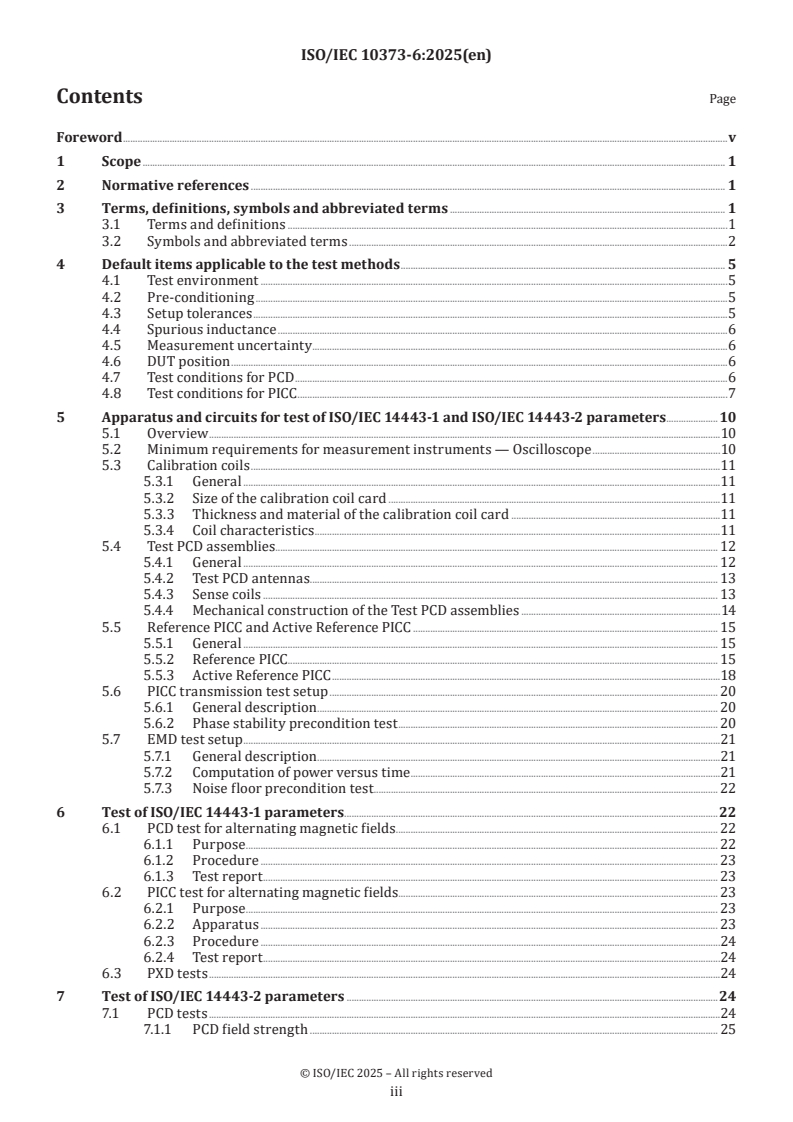
Contents Page
Foreword .v
1 Scope . 1
2 Normative references . 1
3 Terms, definitions, symbols and abbreviated terms . 1
3.1 Terms and definitions .1
3.2 Symbols and abbreviated terms .2
4 Default items applicable to the test methods . 5
4.1 Test environment .5
4.2 Pre-conditioning .5
4.3 Setup tolerances .5
4.4 Spurious inductance .6
4.5 Measurement uncertainty .6
4.6 DUT position .6
4.7 Test conditions for PCD .6
4.8 Test conditions for PICC .7
5 Apparatus and circuits for test of ISO/IEC 14443-1 and ISO/IEC 14443-2 parameters .10
5.1 Overview .10
5.2 Minimum requirements for measurement instruments — Oscilloscope .10
5.3 Calibration coils .11
5.3.1 General .11
5.3.2 Size of the calibration coil card .11
5.3.3 Thickness and material of the calibration coil card .11
5.3.4 Coil characteristics .11
5.4 Test PCD assemblies . . . 12
5.4.1 General . 12
5.4.2 Test PCD antennas. 13
5.4.3 Sense coils . 13
5.4.4 Mechanical construction of the Test PCD assemblies .14
5.5 Reference PICC and Active Reference PICC . 15
5.5.1 General . 15
5.5.2 Reference PICC. 15
5.5.3 Active Reference PICC .18
5.6 PICC transmission test setup . 20
5.6.1 General description . 20
5.6.2 Phase stability precondition test . 20
5.7 EMD test setup .21
5.7.1 General description .21
5.7.2 Computation of power versus time .21
5.7.3 Noise floor precondition test . . 22
6 Test of ISO/IEC 14443-1 parameters . .22
6.1 PCD test for alternating magnetic fields . 22
6.1.1 Purpose . 22
6.1.2 Procedure . 23
6.1.3 Test report . 23
6.2 PICC test for alternating magnetic fields. 23
6.2.1 Purpose . 23
6.2.2 Apparatus . 23
6.2.3 Procedure .24
6.2.4 Test report .24
6.3 PXD tests .24
7 Test of ISO/IEC 14443-2 parameters .24
7.1 PCD tests .24
7.1.1 PCD field strength . 25
© ISO/IEC 2025 – All rights reserved
iii
7.1.2 Modulation index m and waveform . 26
7.1.3 Phase stability test .27
7.1.4 Load modulation reception for PICC to PCD bit rates of f /128, f /64, f /32 and
c c c
f /16 .27
c
7.1.5 Load modulation reception for PICC to PCD bit rates of f /8, f /4 and f /2 . 34
c c c
7.1.6 PCD EMD immunity test . 35
7.2 PICC tests . 36
7.2.1 PICC transmission . 36
7.2.2 PICC EMD level and low EMD time test . 38
7.2.3 PICC reception . 39
7.2.4 PICC resonance frequency .43
7.2.5 PICC maximum loading effect .43
7.2.6 PICC operating field strength test .45
7.3 Test methods for bit rates of 3f /4, f , 3f /2 and 2f from PCD to PICC .45
c c c c
7.4 PXD tests .45
8 Test of ISO/IEC 14443-3 and ISO/IEC 14443-4 parameters .46
8.1 PCD tests . 46
8.1.1 PCD EMD recovery test . 46
8.1.2 Additional PCD tests .47
8.2 PICC tests . 48
8.3 PXD tests . 48
8.3.1 PCD and PICC Modes . 48
8.3.2 Automatic mode alternation . 48
8.3.3 PCD Mode . 49
8.3.4 PICC Mode . 50
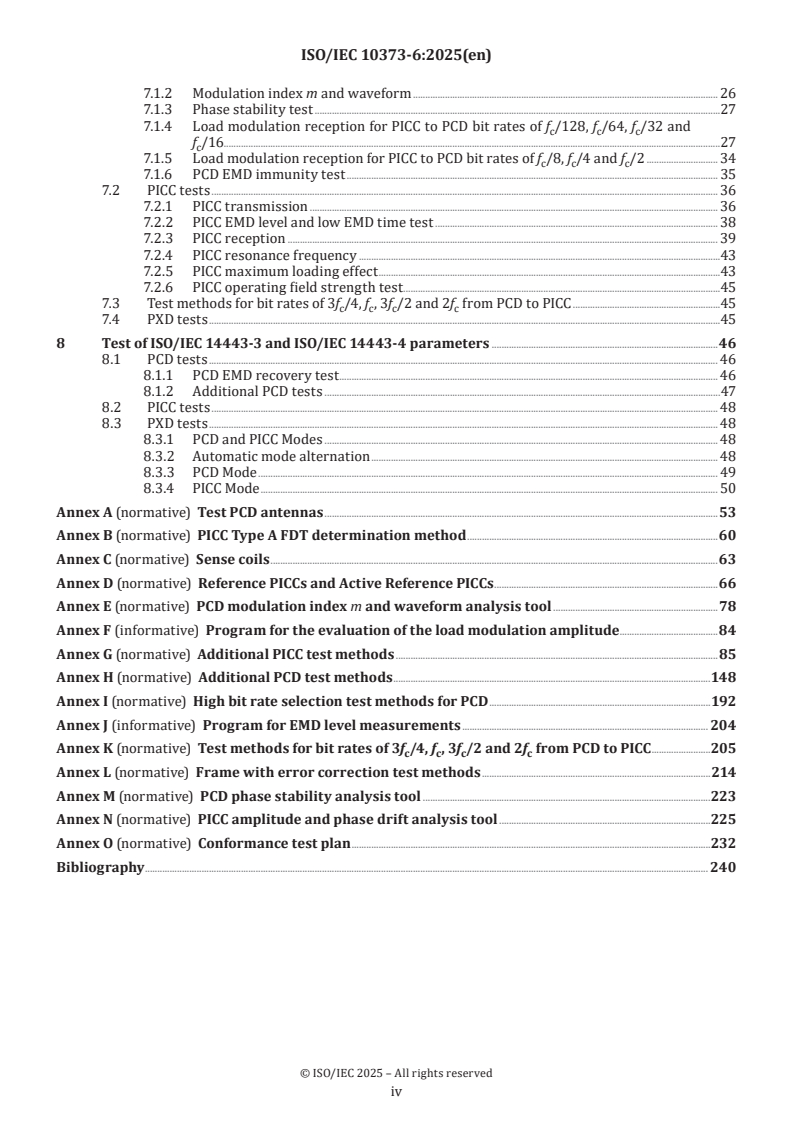
Annex A (normative) Test PCD antennas .53
Annex B (normative) PICC Type A FDT determination method .60
Annex C (normative) Sense coils .63
Annex D (normative) Reference PICCs and Active Reference PICCs .66
Annex E (normative) PCD modulation index m and waveform analysis tool .78
Annex F (informative) Program for the evaluation of the load modulation amplitude.84
Annex G (normative) Additional PICC test methods .85
Annex H (normative) Additional PCD test methods .148
Annex I (normative) High bit rate selection test methods for PCD .192
Annex J (informative) Program for EMD level measurements . 204
Annex K (normative) Test methods for bit rates of 3f /4, f , 3f /2 and 2f from PCD to PICC .205
c c c c
Annex L (normative) Frame with error correction test methods .214
Annex M (normative) PCD phase stability analysis tool .223
Annex N (normative) PICC amplitude and phase drift analysis tool .225
Annex O (normative) Conformance test plan .232
Bibliography . 240
© ISO/IEC 2025 – All rights reserved
iv
Foreword
ISO (the International Organization for Standardization) and IEC (the International Electrotechnical
Commission) form the specialized system for worldwide standardization. National bodies that are
members of ISO or IEC participate in the development of International Standards through technical
committees established by the respective organization to deal with particular fields of technical activity.
ISO and IEC technical committees collaborate in fields of mutual interest. Other international organizations,
governmental and non-governmental, in liaison with ISO and IEC, also take part in the work.
The procedures used to develop this document and those intended for its further maintenance are described
in the ISO/IEC Directives, Part 1. In particular, the different approval criteria needed for the different types
of document should be noted. This document was drafted in accordance with the editorial rules of the ISO/
IEC Directives, Part 2 (see www.iso.org/directives or www.iec.ch/members_experts/refdocs).
ISO and IEC draw attention to the possibility that the implementation of this document may involve the
use of (a) patent(s). ISO and IEC take no position concerning the evidence, validity or applicability of any
claimed patent rights in respect thereof. As of the date of publication of this document, ISO and IEC had not
received notice of (a) patent(s) which may be required to implement this document. However, implementers
are cautioned that this may not represent the latest information, which may be obtained from the patent
database available at www.iso.org/patents and https://patents.iec.ch. ISO and IEC shall not be held
responsible for identifying any or all such patent rights.
Any trade name used in this document is information given for the convenience of users and does not
constitute an endorsement.
For an explanation of the voluntary nature of standards, the meaning of ISO specific terms and expressions
related to conformity assessment, as well as information about ISO's adherence to the World Trade
Organization (WTO) principles in the Technical Barriers to Trade (TBT) see www.iso.org/iso/foreword.html.
In the IEC, see www.iec.ch/understanding-standards.
This document was prepared by Joint Technical Committee ISO/IEC JTC 1, Information technology, SC 17,
Cards and security devices for personal identification.
This fifth edition cancels and replaces the fourth edition (ISO/IEC 10373-6:2020), which has been technically
revised. It also incorporates the Amendment ISO/IEC 10373-6:2020/Amd.2:2020.
The main changes are as follows:
— addition of explicit RFU reception test methods;
— modifications of the PICC transmission test methods;
— simplifications of the impedance matching networks; and
— corrections of the conformance test plan.
A list of all the parts in the ISO/IEC 10373 series can be found on the ISO website.
Any feedback or questions on this document should be directed to the user’s national standards
body. A complete listing of these bodies can be found at www.iso.org/members.html and
www.iec.ch/national-committees.
© ISO/IEC 2025 – All rights reserved
v
International Standard ISO/IEC 10373-6:2025(en)
Cards and security devices for personal identification — Test
methods —
Part 6:
Contactless proximity objects
1 Scope
This document defines test methods which are specific to proximity cards and objects, proximity coupling
devices and proximity extended devices, defined in ISO/IEC 14443-1, ISO/IEC 14443-2, ISO/IEC 14443-3 and
ISO/IEC 14443-4.
NOTE Test methods defined in this document are intended to be performed separately. A given proximity card
or object, proximity coupling device or proximity extended device, is not required to pass through all the tests
sequentially.
The conformance test plan defined in Annex O specifies the list of tests required for each part of the
ISO/IEC 14443 series.
2 Normative references
The following documents are referred to in the text in such a way that some or all of their content constitutes
requirements of this document. For dated references, only the edition cited applies. For undated references,
the latest edition of the referenced document (including any amendments) applies.
ISO/IEC 7810, Identification cards — Physical characteristics
ISO/IEC 14443-1:2018, Cards and security devices for personal identification — Contactless proximity objects
— Part 1: Physical characteristics
ISO/IEC 14443-2:2020, Cards and security devices for personal identification — Contactless proximity objects
— Part 2: Radio frequency power and signal interface
ISO/IEC 14443-3:2018, Cards and security devices for personal identification — Contactless proximity objects
— Part 3: Initialization and anticollision
ISO/IEC 14443-4:2018, Cards and security devices for personal identification — Contactless proximity objects
— Part 4: Transmission protocol
3 Terms, definitions, symbols and abbreviated terms
3.1 Terms and definitions
For the purposes of this document, the terms and definitions given in ISO/IEC 14443-1, ISO/IEC 14443-2,
ISO/IEC 14443-3, ISO/IEC 14443-4 and the following apply.
ISO and IEC maintain terminology databases for use in standardization at the following addresses:
— ISO Online browsing platform: available at https:// www .iso .org/ obp
— IEC Electropedia: available at https:// www .electropedia .org/
© ISO/IEC 2025 – All rights reserved
3.1.1
base standard
standard to which the test method (3.1.8) is used to verify conformance
3.1.2
CascadeLevels
number of cascade levels of the PICC
3.1.3
command set
set describing the PICC commands during initialization and anticollision
Note 1 to entry: See ISO/IEC 14443-3:2018, 6.4 for PICC Type A and ISO/IEC 14443-3:2018, 7.5 for PICC Type B.
3.1.4
loading effect
change in PCD antenna current caused by the presence of PICC(s) in the field due to the mutual coupling
modifying the PCD antenna resonance and quality factor
3.1.5
mute
no response within a specified timeout
EXAMPLE Expiration of FWT.
3.1.6
scenario
defined typical protocol and application specific communication to be used with the test methods (3.1.8)
defined in this document
3.1.7
test initial state
TIS
element from PICC states that is the PICC state before performing a specific PICC command from command
set (3.1.3)
3.1.8
test method
method for testing characteristics of devices in scope for the purpose of verifying their conformance with
International Standards
3.1.9
test target state
TTS
element from PICC states that is the PICC state after performing a specific PICC command from command
set (3.1.3)
3.2 Symbols and abbreviated terms
For the purposes of this document, the symbols and abbreviated terms given in ISO/IEC 14443-1,
ISO/IEC 14443-2, ISO/IEC 14443-3, ISO/IEC 14443-4 and the following apply.
NOTE Elements in bold square brackets [ ] are optional.
Answer to ATTRIB(cid) Answer to ATTRIB with CID = cid
ATTRIB(cid, fsdi) ATTRIB command with CID = cid and Maxi-
mum Frame Size Code value = fsdi
© ISO/IEC 2025 – All rights reserved
~CRC Invalid CRC with respect to the communication signal interface Type
A (CRC_A) or Type B (CRC_B), transmitted instead of the specified
CRC if present in the command or response definition
DUT Device under test; within the scope of this document, DUT repre-
sents the PICC under test
I(c) ([INF = inf] [,CID = cid] ISO/IEC 14443-4 I-block with chaining bit c∈{1,0}, block number
n
[,NAD = nad]) n∈{1,0} and information field INF. By default no CID and no NAD will
be transmitted. If CID = cid∈{0.15} is specified, it will be transmit-
ted as second parameter. If NAD = nad∈{0.'FF'} is specified, it will
be transmitted as third parameter (or second parameter if no CID is
transmitted).
IUT Implementation Under Test (ISO/IEC 9646); within the scope of this
document, IUT represents the PCD under test
LT Lower Tester (ISO/IEC 9646), the PICC-emulation part of the
PCD-test-apparatus
N/A Not applicable
PPS(cid, dri, dsi) PPS request with CID = cid, DRI = dri and DSI = dsi
~PUPI Unmatched PUPI, transmitted instead of the specified PUPI if pres-
ent in the command or response definition
R(ACK [,CID = cid]) ISO/IEC 14443-4 R(ACK) block with block number n. The definition
n
of the optional CID symbol is as described in the I(c) block above
n
R(NAK [,CID = cid]) ISO/IEC 14443-4 R(NAK) block with block number n. The definition
n
of the optional CID symbol is as described in the I(c) block above
n
RATS(cid, fsdi) RATS command with CID = cid and FSDI value = fsdi
READY(I) READY state in cascade level I, I ∈ {1, 2, 3}; e.g. READY(2) is a PICC
cascade level 2
READY*(I) READY* state in cascade level I, I ∈ {1, 2, 3}; e.g. READY*(2) is a PICC
cascade level 2
REQB(N) REQB command with N as defined in ISO/IEC 14443-3:2018, 7.7
S(WTX)(WTXM [,CID = cid]) ISO/IEC 14443-4 S(WTX) block with parameter WTXM. The defi-
nition of the optional CID symbol is as described in the I(c) block
n
above
S(DESELECT [,CID = cid]) ISO/IEC 14443-4 S(DESELECT) block. The definition of the optional
CID symbol is as described in the I(c) block above
n
SAK(cascade) the SELECT(I) answer with the cascade bit (bit 3) set to (1)b
SAK(complete) the SELECT(I) answer with the cascade bit (bit 3) set to (0)b
SELECT(I) SELECT command of cascade level I, i.e.
SELECT(1) = ( '93 70' UIDTX BCC CRC_A)
SELECT(2) = ( '95 70' UIDTX BCC CRC_A)
SELECT(3) = ( '97 70' UIDTX BCC CRC_A)
© ISO/IEC 2025 – All rights reserved
SLOTMARKER(n) Slot-MARKER command with slot number n, i.e.
(16 × (n − 1) + 5 CRC_B)
TB-PDU Transmission Block Protocol Data Unit, which consists of either
I-block, R-block or S-block
TEST_COMMAND_SEQUENCE1 Sequence of commands used for several PICC tests. When transmitted
to DUT Type A, the sequence should contain at least one I-block ending
with (0)b and at least one I-block ending with (1)b.
NOTE Its definition depends on applicative layer and represents a
standard transaction of the application supported by the DUT. The applicant
may also provide a specified set of commands.
TEST_COMMAND1(1) Default test command consisting of one unchained I-block
NOTE This command depends on the negotiated maximum frame size
value of the PICC.
TEST_COMMAND1(n), n > 1 Default test command consisting of n chained I-blocks (PCD chaining)
NOTE This command depends on the negotiated maximum frame size
value of the PICC.
TEST_COMMAND1(n) INF field of k'th I-block chain of TEST_COMMAND1(n)
k
NOTE This command depends on the negotiated maximum frame size
value of the PICC.
TEST_COMMAND2(n), n > 1 Default test command which expects a response consisting of n chained
I-blocks
NOTE This command depends on the negotiated maximum frame size
value of the PCD.
TEST_COMMAND3 Default test command consisting of one I-block which needs more
than FWT time for execution
TEST_COMMAND4 Default test command which expects a response of one I-block in
conformance with the PICC transmission minimum frame length
required for the PICC transmission test
TEST_RESPONSE1(n) INF field of the response to TEST_COMMAND1(n)
NOTE This response is assumed to be always unchained.
TEST_RESPONSE2(n) Response to TEST_COMMAND2(n)
NOTE This response depends on the negotiated maximum frame size
value of the PCD.
TEST_RESPONSE2(n) INF field of k'th I-block chain of TEST_RESPONSE2(n)
k
NOTE This response depends on the negotiated maximum frame size
value of the PCD.
TEST_RESPONSE3 Response I-block to TEST_COMMAND3
NOTE This response is always assumed to be unchained.
TEST_RESPONSE4 Response I-block to TEST_COMMAND4
TM-PDU Test Management Protocol Data Unit (ISO/IEC 9646-1, PDU)
t Start of PICC transmission
START
UIDTX UID 32-bit data at cascade level I ∈ {1, 2, 3} (see Table 1)
I
~UIDTX Wrong UID 32-bit data cascade level I ∈ {1, 2, 3} (see Table 1)
I
© ISO/IEC 2025 – All rights reserved
UT Upper Tester (ISO/IEC 9646), the master part of the PCD-test-appa-
ratus
UT_APDU Upper Tester Application Protocol Data Unit: a packet of data to be
sent by the PCD to the LT through the RF interface
V DC voltage measured at connector CON3 of the Reference PICC
load
WUPB(N) WUPB command with N as defined in ISO/IEC 14443-3:2018, 7.7
~X Bit sequence consisting of the inverted bits of bit sequence X or any
other bit sequence different from X
X[[a.b]] Bit subsequence of bit sequence X consisting of the bits between
position a and b included. If a > b then the sequence is empty
X[[n]] Bit at position n of bit sequence X. First bit is at position 1
X[n] Byte at position n of bit sequence X. First byte is at position 1
(i.e. X[n] = X[[(n − 1) × 8 + 1.n × 8]])
Table 1 shows the mapping from UID to UIDTX.
Table 1 — Mapping from UID to UIDTX
Cascade level Single UID PICC Double UID PICC Triple UID PICC
UIDTX UID0 UID1 UID2 UID3 '88' UID0 UID1 UID2 '88' UID0 UID1 UID2
UIDTX — UID3 UID4 UID5 UID6 '88' UID3 UID4 UID5
UIDTX — — UID6 UID7 UID8 UID9
4 Default items applicable to the test methods
4.1 Test environment
Unless otherwise specified, testing shall take place in an environment of temperature 23 °C ± 3 °C
(73 °F ± 5 °F) and of relative humidity 25 % to 75 %.
4.2 Pre-conditioning
No environmental pre-conditioning of PICCs or PCDs is required by the test methods in this document.
4.3 Setup tolerances
The following absolute tolerances shall be used when adjusting the Test PCD assembly modulation waveform:
a) for timings (t , t , t , t , t , t , t ):
1 2 3 5 6 r f
1) ±1/f for a PCD to PICC bit rate of f /128;
c c
2) ±0,5/f for a PCD to PICC bit rate of f /64;
c c
3) ±0,3/f for PCD to PICC bit rates higher than f /64;
c c
b) for envelope overshoot, Type A, PCD to PICC bit rate of f /128: ±1 % of H ;
c INITIAL
c) for envelope overshoot, Type A, PCD to PICC bit rates higher than f /128: ±0,01 × (1-a);
c
d) for envelope overshoot and undershoot, Type B: ±0,01 × (1-b);
© ISO/IEC 2025 – All rights reserved
e) for the modulation index m: ±0,5 %;
f) for the pulse shape factor a: ±0,02;
g) for PCD field envelope during 60 % of t : ±0,5 % of H
2 INITIAL.
Unless otherwise specified, a tolerance of ±5 % shall be applied to the quantity values given to specify the
characteristics of the test equipment (e.g. linear dimensions) and the test method procedures (e.g. test
equipment adjustments).
4.4 Spurious inductance
Resistors and capacitors should have negligible inductance.
4.5 Measurement uncertainty
The measurement uncertainty for each quantity determined by these test methods shall be stated in the
test report.
Basic information is given in ISO/IEC Guide 98-3.
4.6 DUT position
Unless otherwise specified, the PICC and Reference PICC antennas shall be centered on the sense coil a of the
Test PCD assembly.
4.7 Test conditions for PCD
Unless otherwise specified, the test conditions defined in Table 2 shall be applied.
Table 2 — Test conditions for PCD
Conditions Values
Type Type A and Type B
Test positions Position 0: See Table 3
Position Z : See Table 3
max
Reference PICCs Reference PICC 1, Reference PICC 2 and Reference PICC 3
In accordance with the support of optional PICC classes as declared by the PCD manufac-
turer in Table 3:
a) Reference PICC 4 if PICC Class 4 is supported;
b) Reference PICC 5 if PICC Class 5 is supported;
c) Reference PICC 6 if PICC Class 6 is supported.
The information defined in Table 3 shall be provided by the PCD manufacturer.
© ISO/IEC 2025 – All rights reserved
Table 3 — PCD manufacturer information
Parameter Description Unit
Position 0 Position and orientation of the Reference PICCs on the PCD
surface. This position may be PICC classes dependent.
a
Position Z Position with maximum operating distance on the Z axis .
max
This position may be PICC classes dependent.
Temperature range Minimum and maximum temperature values. °C
Optional PICC classes List of supported optional PICC classes
PCD to PICC supported bit rates List of supported optional PCD to PICC bit rates.
PICC to PCD supported bit rates List of supported optional PICC to PCD bit rates.
Maximum frame size supported Maximum frame size in reception. Bytes
PCD to PICC frame with error Frame with error correction from PCD to PICC.
correction supported
PICC to PCD frame with error Frame with error correction from PICC to PCD.
correction supported
Internal output buffer size Maximum size of the command UT_APDU. Bytes
Internal input buffer size Maximum size of the response UT_APDU. Bytes
Type A collision resolution Collision resolution for Type A supported.
Polling in order to detect PICCs re- PCD commits to periodically present an unmodulated RF field
quiring 5 ms of at least 5,1 ms duration prior to both Type A and Type B
request commands.
a
Z axis shall be perpendicular to the PCD surface through Position 0. If the PCD surface is not flat, Z axis shall correspond
to the axis along which PICCs would habitually be held to the PCD and shall be coherent with PCD ergonomics; if not, the test
laboratory may choose to redefine it (directionally).
Unless otherwise specified, the values defined in Table 4 shall be used to adjust PCD-test-apparatus
parameters.
Table 4 — Values of the PCD-test-apparatus parameters unless otherwise specified
Parameter Value Applies to
PCD to PICC and PICC to PCD bit rates f /128 Type A and Type B
c
Load modulation amplitude More than 20 mV at H Type A and Type B
min
Reference PICCs resonance frequency 16,5 MHz Type A and Type B
J1 setting position ‘a’ Type A and Type B
J2 setting position ‘a’ Type A and Type B
Reference PICCs position Position Z Type A and Type B
max
Start Of Frame (SOF) timing 10 etu “0” followed by 2 etu “1” Type B
End Of Frame (EOF) timing 10 etu “0” Type B
Extra Guard Time (EGT) timing 0 etu Type B
TR0 for ATQB and DESELECT 200/f Type B
s
Frame waiting time Any value as specified in ISO/IEC 14443- Type A and Type B
4:2018, 7.3
UID Any of the size and contents as specified Type A
in ISO/IEC 14443-3:2018, 6.5.4
TR1 140/f Type B
s
FSCI 8 Type A
Maximum Frame Size Code in ATQB 8 Type B
4.8 Test conditions for PICC
Unless otherwise specified, the test conditions defined in Table 5 shall be applied:
© ISO/IEC 2025 – All rights reserved
Table 5 — Test conditions for PICC
Conditions Values
a
Field strength For PICC Class 1: 1,5 A/m, 2,5 A/m, 4,5 A/m and 7,5 A/m
For PICC Class 2 and Class 3: 1,5 A/m, 2,5 A/m, 4,5 A/m and 8,5 A/m
For PICC Class 4: 2 A/m, 4 A/m, 7 A/m and 12 A/m
For PICC Class 5: 2,5 A/m, 4,5 A/m, 8 A/m and 14 A/m
For PICC Class 6: 4,5 A/m, 7 A/m, 11 A/m and 18 A/m
a
Any additional field strength values between H and H may be applied.
min max
The information defined in Table 6 shall be provided by the PICC manufacturer.
Table 6 — PICC manufacturer information
Parameter Description Unit
Location of the external rectangle/ Drawing with dimensions of PICC outside shape and the
a
circle of the claimed PICC class position of the external rectangle/circle of the claimed PICC
class.
a
PICC class (optional) Claimed PICC class.
Resonance frequency range Minimum and maximum resonance frequency. MHz
(optional)
Communication signal interface Supported communication signal interface(s):
a) Type A
b) Type B
c) Type A and Type B
Temperature range Minimum and maximum operating temperature. °C
PCD to PICC supported bit rates List of supported optional PCD to PICC bit rates.
PICC to PCD supported bit rates List of supported optional PICC to PCD bit rates.
Same bit rate for both directions Indication if only same bit rate from PCD to PICC and from
PICC to PCD is supported.
Random or fixed UID (Type A) Indication whether the UID (Type A) or PUPI (Type B) is
or PUPI (Type B) random or fixed.
AFI values (Type B) List of AFI values (except ‘00’) the PICC matches.
Maximum frame size supported Maximum frame size in reception. Bytes
PCD to PICC frame with error Frame with error correction from PCD to PICC.
correction supported
PICC to PCD frame with error Frame with error correction from PICC to PCD.
correction supported
TEST_COMMAND_SEQUENCE1 See O.2.1
TEST_COMMAND1 See O.2.1
TEST_COMMAND2 See O.2.1
TEST_COMMAND3 See O.2.1
TEST_COMMAND4 See O.2.1
a
If not provided, test methods for PICC Class 1 shall be used.
Unless otherwise specified, the values defined in Table 7 shall be used to adjust PICC-test-apparatus
parameters.
© ISO/IEC 2025 – All rights reserved
Table 7 — Values of the PICC-test-apparatus parameters unless otherwise specified
Parameter Value Applies to
Parameters applicable for all PCD to PICC bit rates
FSDI 8 Type A
Start Of Frame (SOF) timing 10 etu “0” followed by 2 etu “1” Type B
End Of Frame (EOF) timing 10 etu “0” Type B
Extra Guard Time (EGT) timing 0 etu Type B
Maximum Frame Size Code in ATTRIB 8 Type B
Parameters applicable for a PCD to PICC bit rate of f /128
c
PCD field envelope during 60 % of t 0,5 % Type A
t 40/f Type A
1 c
t 7/f Type A
2 c
t 12/f Type A
3 c
t 6/f Type A
4 c
Overshoot 0 Type A and Type B
Modulation index m 12 % Type B
Rise time t , fall time t 12/f Type B
r f c
Parameters applicable for a PCD to PICC bit rate of f /64
c
a 0,1 Type A
t 18/f Type A
1 c
t 15/f Type A
5 c
t 9/f Type A
6 c
Overshoot 0 Type A and Type B
Modulation index m 12 % Type B
Rise time t , fall time t 10/f Type B
r f c
Parameters applicable for a PCD to PICC bit rate of f /32
c
a 0,2 Type A
t 9/f Type A
1 c
t 7/f Type A
5 c
t 8/f Type A
6 c
Overshoot 0 Type A and Type B
Modulation index m 12 % Type B
Rise time t , fall time t 8/f Type B
r f c
Parameters applicable for a PCD to PICC bit rate of f /16
c
a 0,4 Type A
t 5/f Type A
1 c
t 4/f Type A
5 c
t 5/f Type A
6 c
Overshoot 0 Type A and Type B
Modulation index m 12 % Type B
Rise time t , fall time t 6/f Type B
r f c
Parameters applicable for a PCD to PICC bit rate of f /8
c
Overshoot 0 Type A and Type B
Modulation index m 8 % for short modulation pulses Type A and Type B
Rise time t , fall time t 5/f Type A and Type B
r f c
Parameters applicable for a PCD to PICC bit rate of f /4
c
© ISO/IEC 2025 – All rights reserved
TTaabblle 7 e 7 ((ccoonnttiinnueuedd))
Parameter Value Applies to
Overshoot 0 Type A and Type B
Modulation index m 8 % for short modulation pulses Type A and Type B
Rise time t , fall time t 4/f Type A and Type B
r f c
Parameters applicable for a PCD to PICC bit rate of f /2
c
Overshoot 0 Type A and Type B
Modulation index m 8 % for short modulation pulses Type A and Type B
Rise time t , fall time t 3/f Type A and Type B
r f c
Parameters applicable for a PCD to PICC bit rate of 3f /4 and 3f /2
c c
PR 56° Type A and Type B
ISI 0 Type A and Type B
d
ISI 1 Type A and Type B
m
Phase noise 0,03 Type A and Type B
Parameters applicable for a PCD to PICC bit rate of f and 2f
c c
PR 60° Type A and Type B
ISI 0 Type A and Type B
d
ISI 1 Type A and Type B
m
Phase noise 0,0125 Type A and Type B
5 Apparatus and circuits for test of ISO/IEC 14443-1 and ISO/IEC 14443-2
parameters
5.1 Overview
This clause defines the test apparatus and test circuits for verifying the operation of a PICC or a PCD
according to ISO/IEC 14443-1 and ISO/IEC 14443-2. The test apparatus includes the following:
a) measurement instruments (see 5.2);
b) calibration coils (see 5.3);
c) Test PCD assemblies (see 5.4);
d) Reference PICC and Active Reference PICC (see 5.5);
e) PICC transmission test setup (see 5.6);
f) EMD test setup (see 5.7).
These are described in the following subclauses.
5.2 Minimum requirements for measurement instruments — Oscilloscope
The digital sampling oscilloscope shall be capable of sampling at a rate of at least 500 million samples per
second with a resolution of at least 8 bits at optimum scaling and shall have an overall minimum bandwidth
of 250 MHz. The oscilloscope should have the capability to output the sampled data as a text file to facilitate
mathematical and other operations such as windowing on the sampled data using computer programs (see
Annex E and Annex F).
NOTE The overall bandwidth is the combination of oscilloscope and probing system bandwidth.
© ISO/IEC 2025 – All rights reserved
5.3 Calibration coils
5.3.1 General
This subclause defines the size, thickness and characteristics of the calibration coils 1 and 2.
Calibration coil 1 shall be used only in Test PCD assembly 1 and calibration coil 2 shall be used only in Test
PCD assembly 2.
5.3.2 Size of the calibration coil card
The calibration coil card shall consist of an area which has the height and width of an ID-1 type defined in
ISO/IEC 7810 containing a single turn coil concentric with the card outline (see Figure 1).
Key
1 calibration coil 1 (ISO/IEC 7810 ID-1 outline)
2 calibration coil 2 (ISO/IEC 7810 ID-1 outline)
3 coil 72 × 42, 1 turn
4 coil 46 × 24, 1 turn
5 connections
NOTE Drawings are not to scale.
Figure 1 — Calibrat
...