

ISO 16063-21:2003/Amd 1:2016
(Amendment)Methods for the calibration of vibration and shock transducers — Part 21: Vibration calibration by comparison to a reference transducer — Amendment 1
General Information
- Abstract
- Status
- Published
- Publication Date
- 01-Feb-2016
- Technical Committee
- ISO/TC 108 - Mechanical vibration, shock and condition monitoring
- Drafting Committee
- ISO/TC 108/WG 34 - Calibration of vibration and shock transducers
- Current Stage
- 6060 - International Standard published
- Start Date
- 02-Feb-2016
- Due Date
- 04-Feb-2018
- Completion Date
- 04-Feb-2018

Overview
ISO 16063-21:2003/Amd 1:2016 is an essential international standard published by the International Organization for Standardization (ISO). It provides updated methods for the calibration of vibration and shock transducers through a comparison technique with a reference transducer. This amendment enhances clarity on the use and definition of transfer standards, vital for ensuring consistency, reliability, and traceability in vibration calibration.
The standard is part of the ISO 16063 series, which addresses the calibration of vibration and shock measurement instruments, and is maintained by ISO Technical Committee ISO/TC 108, Subcommittee SC 3. It supports industries where precise vibration measurements are critical, from manufacturing quality control to predictive maintenance.
Key Topics
Vibration calibration by comparison: The standard specifies procedures for calibrating vibration transducers by comparing their output against that of a calibrated reference transducer.
Transfer standard clarification: Amendment 1 introduces a formal definition and guidance on transfer standards-devices used as intermediaries to maintain traceability between measurement standards ensuring accuracy over time.
Uncertainty documentation: Detailed requirements are set for documenting the uncertainties involved in calibration, ensuring transparency and consistency.
Traceability: Emphasizes traceable calibration paths, aligning with the international vocabulary of metrology (VIM) for measurement science and ensuring global comparability of results.
Integration with IEC and other standards: It aligns with electrotechnical standardization efforts by IEC, providing a harmonized approach for mechanical vibration measurement calibration.
Applications
ISO 16063-21:2003/Amd 1:2016 is crucial for a variety of industrial and scientific areas, including:
Manufacturing and Quality Assurance: Ensures vibration sensors used in production lines and equipment condition monitoring deliver reliable data for quality control and troubleshooting.
Predictive Maintenance: Accurate calibrations help in monitoring machine health by precisely measuring vibration levels to predict failures and reduce downtime.
Research and Development: Laboratories performing material testing and structural analysis rely on highly accurate vibration measurement through properly calibrated transducers.
Calibration Laboratories: Standardizes procedures for calibration labs offering calibration services, facilitating accreditation and audit compliance.
Automotive, Aerospace, and Energy Sectors: Supports stringent safety and performance requirements by standardizing vibration sensor calibration methods.
Related Standards
ISO 16063-21:2003/Amd 1:2016 is part of a broader framework of standards addressing vibration and shock measurement:
ISO 16063 Series: Covers other calibration methods including sensitivity calibration and shock calibration techniques.
International Vocabulary of Metrology (VIM): Provides terminologies referenced in this standard for measurement concepts and uncertainty.
IEC Standards: Collaborates with IEC standards related to electromechanical calibration instruments.
ISO/IEC Directives: Followed for the preparation and maintenance process of the standard, ensuring quality and international acceptance.
Practical Benefits
Improved Measurement Accuracy: Calibration by comparison ensures vibration transducers provide reliable, reproducible results.
Enhanced Compliance: Aligns with international metrology principles and supports conformity assessment.
Clear Guidance on Transfer Standards: Clarifies definitions allowing organizations to confidently manage calibration chains.
Global Traceability: Facilitates international trade and technical cooperation by harmonizing vibration calibration methods and terminology.
For professionals involved in vibration measurement and calibration, ISO 16063-21:2003/Amd 1:2016 is an indispensable reference to maintain the highest standards of measurement precision and reliability.
Relations
- Effective Date
- 25-Aug-2026
- Effective Date
- 25-Aug-2026
- Effective Date
- 25-Aug-2026
- Effective Date
- 15-Apr-2026
- Effective Date
- 21-Aug-2021
Get Certified
Connect with accredited certification bodies for this standard

BSMI (Bureau of Standards, Metrology and Inspection)
Taiwan's standards and inspection authority.
Sponsored listings
Frequently Asked Questions
ISO 16063-21:2003/Amd 1:2016 is a standard published by the International Organization for Standardization (ISO). Its full title is "Methods for the calibration of vibration and shock transducers — Part 21: Vibration calibration by comparison to a reference transducer — Amendment 1". This standard covers: Methods for the calibration of vibration and shock transducers — Part 21: Vibration calibration by comparison to a reference transducer — Amendment 1
Methods for the calibration of vibration and shock transducers — Part 21: Vibration calibration by comparison to a reference transducer — Amendment 1
ISO 16063-21:2003/Amd 1:2016 is classified under the following ICS (International Classification for Standards) categories: 17.160 - Vibrations, shock and vibration measurements. The ICS classification helps identify the subject area and facilitates finding related standards.
ISO 16063-21:2003/Amd 1:2016 has the following relationships with other standards: It is inter standard links to EN ISO 10326-1:2016, EN ISO 8041-1:2017, EN ISO 8041-2:2021, EN ISO 8437-4:2021, ISO 16063-21:2003. Understanding these relationships helps ensure you are using the most current and applicable version of the standard.
ISO 16063-21:2003/Amd 1:2016 is available in PDF format for immediate download after purchase. The document can be added to your cart and obtained through the secure checkout process. Digital delivery ensures instant access to the complete standard document.
Standards Content (Sample)
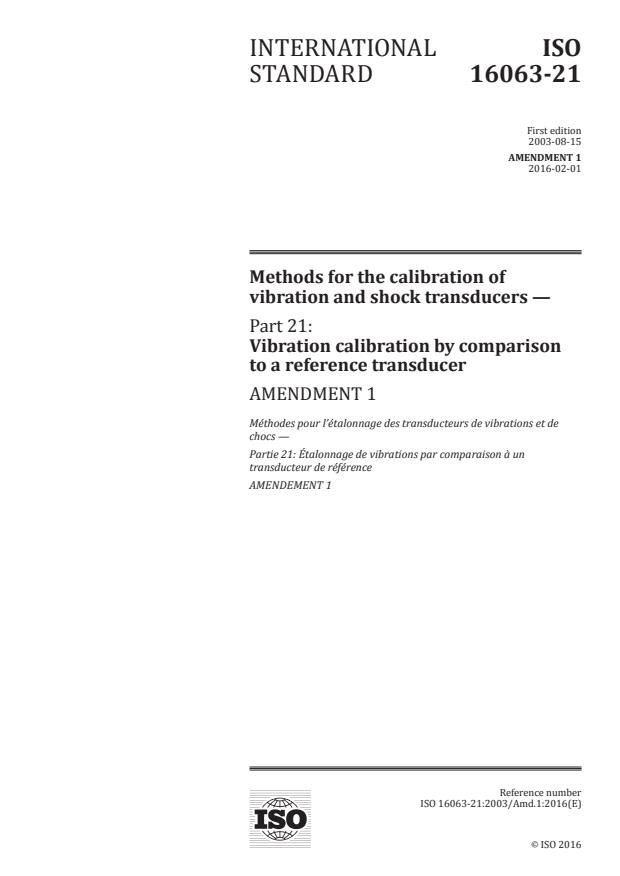
INTERNATIONAL ISO
STANDARD 16063-21
First edition
2003-08-15
AMENDMENT 1
2016-02-01
Methods for the calibration of
vibration and shock transducers —
Part 21:
Vibration calibration by comparison
to a reference transducer
AMENDMENT 1
Méthodes pour l’étalonnage des transducteurs de vibrations et de
chocs —
Partie 21: Étalonnage de vibrations par comparaison à un
transducteur de référence
AMENDEMENT 1
Reference number
ISO 16063-21:2003/Amd.1:2016(E)
©
ISO 2016
ISO 16063-21:2003/Amd.1:2016(E)
© ISO 2016, Published in Switzerland
All rights reserved. Unless otherwise specified, no part of this publication may be reproduced or utilized otherwise in any form
or by any means, electronic or mechanical, including photocopying, or posting on the internet or an intranet, without prior
written permission. Permission can be requested from either ISO at the address below or ISO’s member body in the country of
the requester.
ISO copyright office
Ch. de Blandonnet 8 • CP 401
CH-1214 Vernier, Geneva, Switzerland
Tel. +41 22 749 01 11
Fax +41 22 749 09 47
copyright@iso.org
www.iso.org
ii © ISO 2016 – All rights reserved
ISO 16063-21:2003/Amd.1:2016(E)
Foreword
ISO (the International Organization for Standardization) is a worldwide federation of national standards
bodies (ISO member bodies). The work of preparing International Standards is normally carried out
through ISO technical committees. Each member body interested in a subject for which a technical
committee has been established has the right to be represented on that committee. International
organizations, governmental and non-governmental, in liaison with ISO, also take part in the work.
ISO collaborates closely with the International Electrotechnical Commission (IEC) on all matters of
electrotechnical standardization.
The procedures used to develop this document and those intended for its further maintenance are
described in the ISO/IEC Directives, Part 1. In particular the different approval criteria needed for the
different types of ISO documents should be noted. This document was drafted in accordance with the
editorial rules of the ISO/IEC Directives, Part 2 (see www.iso.org/directives).
Attention is drawn to the possibility that some of the elements of this do
...