


ISO/TS 18152:2010
(Main)Ergonomics of human-system interaction — Specification for the process assessment of human-system issues
Ergonomics of human-system interaction — Specification for the process assessment of human-system issues
ISO/TS 18152:2010 presents a human-systems (HS) model for use in ISO/IEC 15504-conformant assessment of the maturity of an organization in performing the processes that make a system usable, healthy and safe. It describes processes that address human-system issues and the outcomes of these processes. It details the practices and work products associated with achieving the outcomes of each process.
Ergonomie de l'interaction homme-système - Spécification pour l'évaluation de processus des aspects homme-système
General Information
- Status
- Published
- Publication Date
- 26-May-2010
- Technical Committee
- ISO/TC 159/SC 4 - Ergonomics of human-system interaction
- Drafting Committee
- ISO/TC 159/SC 4 - Ergonomics of human-system interaction
- Current Stage
- 9093 - International Standard confirmed
- Start Date
- 27-Apr-2026
- Completion Date
- 02-May-2026
Relations
- Effective Date
- 13-Mar-2010
Overview
ISO/TS 18152:2010 - Ergonomics of human-system interaction - specifies a Human-Systems (HS) process model for assessing how well an organization manages human-system issues affecting usability, health and safety. Designed for use with ISO/IEC 15504-conformant process assessment, the Technical Specification describes HS processes, expected outcomes, associated practices and recommended work products. The model is intended to be tailored to specific organizational and system contexts (software, hardware, embedded, consumer or bespoke systems).
Key Topics
- Human-systems (HS) process model: A structured set of processes that address human factors across the system life cycle. Core process groups include:
- HS.1 Life cycle involvement
- HS.2 Integrate human factors
- HS.3 Human-centred design
- Process outcomes, practices and work products: Each process description specifies measurable outcomes and the practices/work products used to achieve them - enabling process-based assessment and improvement.
- Assessment alignment: Written for ISO/IEC 15504 process capability assessment; Annex E explains capability scales and attributes.
- Tailoring guidance: The model must be adapted for industry sector, system type and project needs; Annex D provides tailoring advice.
- Informative mappings and exemplars: Annexes include an exemplar assessment model and mappings to ISO 13407, ISO/IEC 15288 and other standards, helping integrate human factors into broader lifecycle and systems-engineering processes.
- Scope and limits: Focuses on processes for specifying and evaluating usability, health and safety; it does not define staff roles or competency requirements.
Applications
ISO/TS 18152:2010 is practical for:
- Process assessors and process model developers conducting ISO/IEC 15504-style maturity evaluations of human-factor processes.
- Human factors/ergonomics specialists and project teams who need to document practices, produce work products, or justify human-centred activities in procurement and contracts.
- Systems engineers, software/hardware designers and program managers seeking to integrate usability, safety and human-centred design into lifecycle processes.
- Organizations aiming for structured human-system process improvement, supplier evaluation, or evidence-based claims about usability capability.
Related Standards
- ISO 13407 - Human-centred design processes for interactive systems
- ISO/IEC 15504 - Information technology - Process assessment
- ISO/IEC 15288 - Systems engineering - System life cycle processes
- ISO 9241-11, ISO 6385, ISO/IEC 9126-1 (listed as normative references)
ISO/TS 18152:2010 is a bridge between ergonomics/human factors and lifecycle process assessment - useful for embedding human-centred design and usability assurance into organizational process maturity and procurement decisions.
Get Certified
Connect with accredited certification bodies for this standard

CIS Institut d.o.o.
Personal Protective Equipment (PPE) certification body. Notified Body NB-2890 for EU Regulation 2016/425 PPE.

Kiwa BDA Testing
Building and construction product certification.
Kmetijski inštitut Slovenije
Agricultural Institute of Slovenia. Soil testing, plant health, agricultural product analysis.
Sponsored listings
Frequently Asked Questions
ISO/TS 18152:2010 is a technical specification published by the International Organization for Standardization (ISO). Its full title is "Ergonomics of human-system interaction — Specification for the process assessment of human-system issues". This standard covers: ISO/TS 18152:2010 presents a human-systems (HS) model for use in ISO/IEC 15504-conformant assessment of the maturity of an organization in performing the processes that make a system usable, healthy and safe. It describes processes that address human-system issues and the outcomes of these processes. It details the practices and work products associated with achieving the outcomes of each process.
ISO/TS 18152:2010 presents a human-systems (HS) model for use in ISO/IEC 15504-conformant assessment of the maturity of an organization in performing the processes that make a system usable, healthy and safe. It describes processes that address human-system issues and the outcomes of these processes. It details the practices and work products associated with achieving the outcomes of each process.
ISO/TS 18152:2010 is classified under the following ICS (International Classification for Standards) categories: 13.180 - Ergonomics. The ICS classification helps identify the subject area and facilitates finding related standards.
ISO/TS 18152:2010 has the following relationships with other standards: It is inter standard links to ISO/PAS 18152:2003. Understanding these relationships helps ensure you are using the most current and applicable version of the standard.
ISO/TS 18152:2010 is available in PDF format for immediate download after purchase. The document can be added to your cart and obtained through the secure checkout process. Digital delivery ensures instant access to the complete standard document.
Standards Content (Sample)
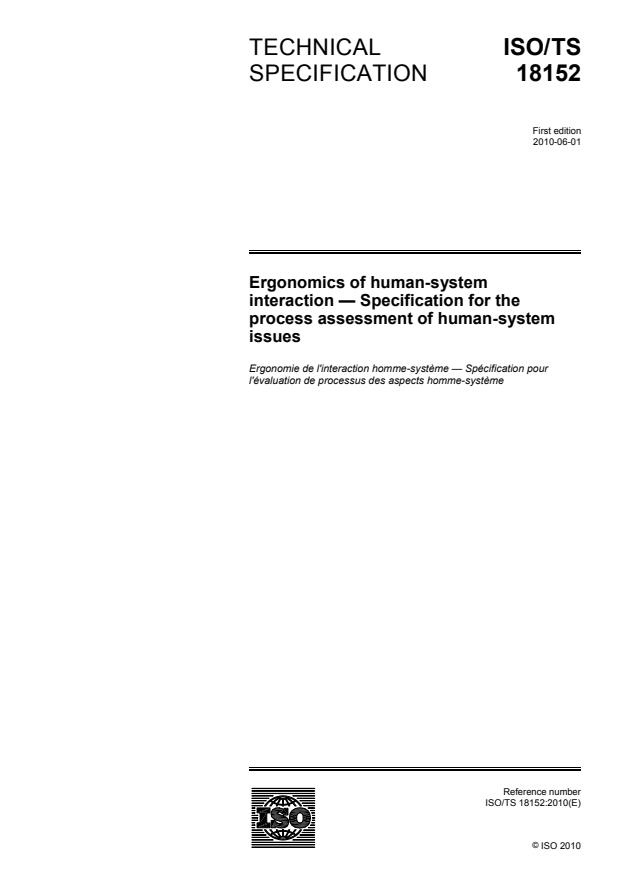
TECHNICAL ISO/TS
SPECIFICATION 18152
First edition
2010-06-01
Ergonomics of human-system
interaction — Specification for the
process assessment of human-system
issues
Ergonomie de l'interaction homme-système — Spécification pour
l'évaluation de processus des aspects homme-système
Reference number
©
ISO 2010
PDF disclaimer
This PDF file may contain embedded typefaces. In accordance with Adobe's licensing policy, this file may be printed or viewed but
shall not be edited unless the typefaces which are embedded are licensed to and installed on the computer performing the editing. In
downloading this file, parties accept therein the responsibility of not infringing Adobe's licensing policy. The ISO Central Secretariat
accepts no liability in this area.
Adobe is a trademark of Adobe Systems Incorporated.
Details of the software products used to create this PDF file can be found in the General Info relative to the file; the PDF-creation
parameters were optimized for printing. Every care has been taken to ensure that the file is suitable for use by ISO member bodies. In
the unlikely event that a problem relating to it is found, please inform the Central Secretariat at the address given below.
© ISO 2010
All rights reserved. Unless otherwise specified, no part of this publication may be reproduced or utilized in any form or by any means,
electronic or mechanical, including photocopying and microfilm, without permission in writing from either ISO at the address below or
ISO's member body in the country of the requester.
ISO copyright office
Case postale 56 • CH-1211 Geneva 20
Tel. + 41 22 749 01 11
Fax + 41 22 749 09 47
E-mail copyright@iso.org
Web www.iso.org
Published in Switzerland
ii © ISO 2010 – All rights reserved
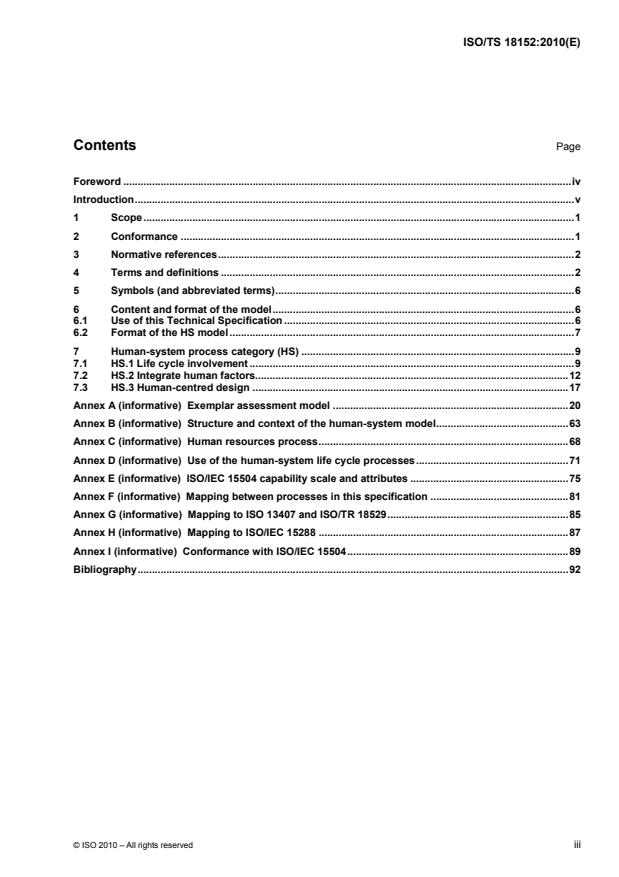
Contents Page
Foreword .iv
Introduction.v
1 Scope.1
2 Conformance .1
3 Normative references.2
4 Terms and definitions .2
5 Symbols (and abbreviated terms).6
6 Content and format of the model.6
6.1 Use of this Technical Specification .6
6.2 Format of the HS model.7
7 Human-system process category (HS) .9
7.1 HS.1 Life cycle involvement .9
7.2 HS.2 Integrate human factors.12
7.3 HS.3 Human-centred design .17
Annex A (informative) Exemplar assessment model .20
Annex B (informative) Structure and context of the human-system model.63
Annex C (informative) Human resources process.68
Annex D (informative) Use of the human-system life cycle processes.71
Annex E (informative) ISO/IEC 15504 capability scale and attributes .75
Annex F (informative) Mapping between processes in this specification .81
Annex G (informative) Mapping to ISO 13407 and ISO/TR 18529.85
Annex H (informative) Mapping to ISO/IEC 15288 .87
Annex I (informative) Conformance with ISO/IEC 15504.89
Bibliography.92
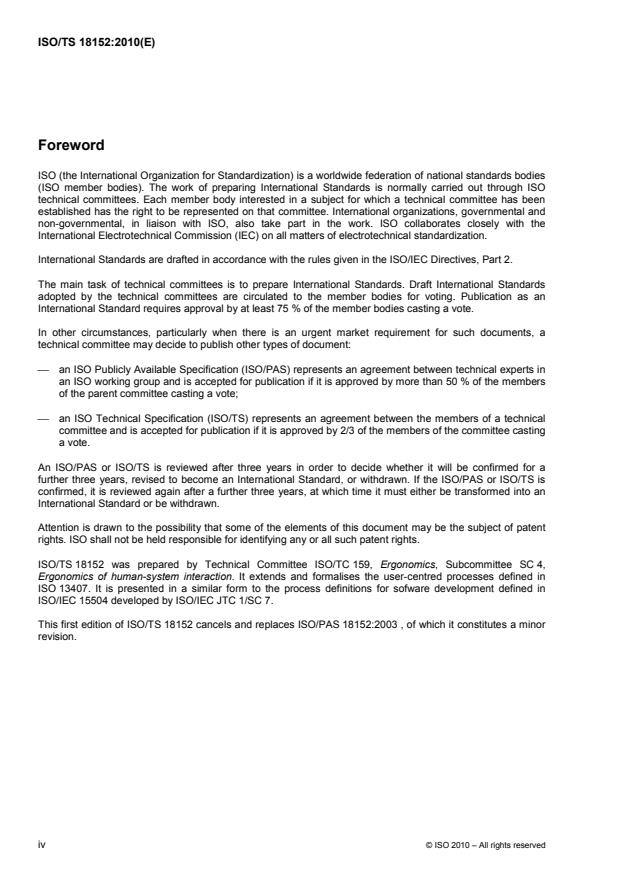
Foreword
ISO (the International Organization for Standardization) is a worldwide federation of national standards bodies
(ISO member bodies). The work of preparing International Standards is normally carried out through ISO
technical committees. Each member body interested in a subject for which a technical committee has been
established has the right to be represented on that committee. International organizations, governmental and
non-governmental, in liaison with ISO, also take part in the work. ISO collaborates closely with the
International Electrotechnical Commission (IEC) on all matters of electrotechnical standardization.
International Standards are drafted in accordance with the rules given in the ISO/IEC Directives, Part 2.
The main task of technical committees is to prepare International Standards. Draft International Standards
adopted by the technical committees are circulated to the member bodies for voting. Publication as an
International Standard requires approval by at least 75 % of the member bodies casting a vote.
In other circumstances, particularly when there is an urgent market requirement for such documents, a
technical committee may decide to publish other types of document:
⎯ an ISO Publicly Available Specification (ISO/PAS) represents an agreement between technical experts in
an ISO working group and is accepted for publication if it is approved by more than 50 % of the members
of the parent committee casting a vote;
⎯ an ISO Technical Specification (ISO/TS) represents an agreement between the members of a technical
committee and is accepted for publication if it is approved by 2/3 of the members of the committee casting
a vote.
An ISO/PAS or ISO/TS is reviewed after three years in order to decide whether it will be confirmed for a
further three years, revised to become an International Standard, or withdrawn. If the ISO/PAS or ISO/TS is
confirmed, it is reviewed again after a further three years, at which time it must either be transformed into an
International Standard or be withdrawn.
Attention is drawn to the possibility that some of the elements of this document may be the subject of patent
rights. ISO shall not be held responsible for identifying any or all such patent rights.
ISO/TS 18152 was prepared by Technical Committee ISO/TC 159, Ergonomics, Subcommittee SC 4,
Ergonomics of human-system interaction. It extends and formalises the user-centred processes defined in
ISO 13407. It is presented in a similar form to the process definitions for sofware development defined in
ISO/IEC 15504 developed by ISO/IEC JTC 1/SC 7.
This first edition of ISO/TS 18152 cancels and replaces ISO/PAS 18152:2003 , of which it constitutes a minor
revision.
iv © ISO 2010 – All rights reserved
Introduction
By the time ISO/PAS 18152 had reached the end of its six-year life it had proved to be a useful collection of
information with a range of uses. For example, it is cited in ISO/IEC 15288 (the reference model for systems
engineering) as the means to address human-system issues in the system lifecycle. However, there are a
number of ongoing developments in other standards and related pre-standardization work in ISO/TC 159 and
in other ISO technical committees that need to be completed before the material in this Technical
Specification can be further developed into a standard or other ISO document. In order to ensure its continued
availability within ISO until a project is started to develop a possible successor, it has been converted into this
Technical Specification.
This Technical Specification presents a view of system life cycle processes with an emphasis on the
identification and handling of issues related to people (users and other stakeholders). It is intended for use in
process assessment. The specification describes a set of processes that address issues associated with
humans throughout the life cycle of a system.
Process models offer
a) the potential to analyse the ability of an organization to deliver and/or maintain a system that meets a
required level of performance,
b) a description of the factors that hinder this ability, and
c) the means of addressing such shortcomings and mitigating risk.
These have led to the widespread adoption of process modelling and assessment as an element in the
assurance of timely and effective system delivery. Processes are defined at the level of what is done to
develop and operate a system or organization. Process reference models have been defined for particular
applications and industries. International Standard process models are being developed by ISO and
ISO/IEC JTC 1. This Technical Specification provides a bridge between standardization in the area of
Ergonomics (by ISO/TC 159) and the life cycle standardization being carried out by ISO/IEC JTC 1,
Information technology, SC 7, Software engineering.
ISO/TS 18152 makes the contents of ISO 13407 accessible to process assessors and to those familiar with,
or involved in, process modelling. ISO/TS 18152 extends the range of processes in ISO 13407 to cover the
integration of human-centred design with project and organizational processes and makes a clearer
separation between human-centred processes and human-centred design in the system life cycle. A mapping
between ISO/TS 18152 and ISO 13407 is provided in Annex G.
ISO/TS 18152 informs the developers and users of process models who want to integrate Ergonomics/Human
Factors processes in system, hardware and software life cycles in order to assure system usability, health and
safety.
The processes in ISO/TS 18152 (the Human-System process model, or HS model) present a collation of good
practice in ergonomics/human factors, user/human-centred design and human factors integration across a
range of industries worldwide. These processes are performed by a range of staff and with different degrees
of rigour depending on the industrial sector, the type of system, its purpose or use and the need for an
assured level of usability.
ISO/TS 18152 has been developed with the following objectives in mind:
⎯ To provide the means of assessing and mitigating risks arising from human-system issues that will affect
usability through the life cycle, both at transition points between life cycle stages and during each stage.
⎯ To provide a description of human-system processes for use in project planning and for inter-disciplinary
communication.
⎯ As a basis for understanding and cooperation during the tendering process and for human-system
capability evaluation to support contract award, either in a stand-alone manner or in conjunction with a
software or system capability evaluation.
⎯ To provide a basis for structured human-system process improvement by supplier, customer or employer
organizations.
vi © ISO 2010 – All rights reserved
TECHNICAL SPECIFICATION ISO/TS 18152:2010(E)
Ergonomics of human-system interaction — Specification for
the process assessment of human-system issues
1 Scope
This Technical Specification presents a human-systems (HS) model for use in ISO/IEC 15504-conformant
assessment of the maturity of an organization in performing the processes that make a system usable, healthy
and safe. It describes processes that address human-system issues and the outcomes of these processes. It
details the practices and work products associated with achieving the outcomes of each process.
The model describes processes for specifying and evaluating usability, health and safety, but it does not
address all processes relating to their achievement.
The model will always be tailored to the specific organizational and system context prior to use in assessment.
Annex D provides advice on tailoring process models for a range of uses.
The HS model does not define the roles or competencies of staff who perform HS processes.
This Technical Specification is intended for use by process assessors and those developing process
assessment models and tools. It may be informative for those responsible for human factors activities and
human factors specialists. The latter groups of readers should familiarise themselves with the vocabulary of
process modelling and process assessment prior to reading this Technical Specification. The Bibliography
lists informative standards and texts.
This Technical Specification is intended to be used in conjunction with ISO 13407 and ISO/IEC 15504. The
latter standard provides the framework in which the process descriptions in this Technical Specification may
be used. This Technical Specification defines an additional category of processes for use with other process
standards, for example ISO/IEC 12207 and ISO/IEC 15288.
NOTE 1 Readers of this Technical Specification are expected to be familiar with ISO 13407 and ISO/IEC 15504.
The HS model can be applied to the specification, design, assessment and operation of manned or embedded
systems, hardware and software. The HS model can be applied to generic systems (for example consumer
products), bespoke systems (for example control or defence systems) and systems which continuously
change to meet changes in the business or user environment (for example management information systems).
However, it will need to be tailored for each application.
NOTE 2 Copyright release for the process descriptions: Users of this Technical Specification may freely reproduce the
process descriptions contained in Clause 7 and Annex A as part of any Process Assessment Model, or as part of any
demonstration of compatibility with this Technical Specification, so that it can be used for its intended purpose.
2 Conformance
Those wishing to claim that derived process assessment models are conformant to this Technical
Specification shall meet the conformance requirements of ISO/IEC 15504-2:2003, 6.3. An example of such a
conformance statement is provided by the attestation of conformance in Annex I.
3 Normative references
The following referenced documents are indispensable for the application of this document. For dated
references, only the edition cited applies. For undated references, the latest edition of the referenced
document (including any amendments) applies.
ISO 6385, Ergonomic principles in the design of work systems
ISO/IEC 9126-1, Software engineering — Product quality — Part 1: Quality model
ISO 9241-11, Ergonomic requirements for office work with visual display terminals (VDTs) — Part 11:
Guidance on usability
ISO 13407:1999, Human-centred design processes for interactive systems
ISO/IEC 15288:2002, Systems engineering — System life cycle processes
ISO/IEC 15504-2:2003, Information technology — Process assessment — Part 2: Performing an assessment
ISO/IEC TR 15504-9, Information technology — Software process assessment — Part 9: Vocabulary
4 Terms and definitions
For the purposes of this document, the terms and definitions given in ISO 6385, ISO 9241-11, ISO 13407,
ISO/IEC TR 15504-9, ISO/IEC 9126-1 and ISO/IEC 15288 and the following apply.
NOTE The terms most relevant to this Technical Specification are given here.
4.1
(process) capability
ability of a process to achieve a required goal
[ISO/IEC TR 15504-9:1998]
NOTE 1 This usage differs from human capability, military capability and operational capability. To avoid confusion,
these alternative usages are avoided in this Technical Specification.
NOTE 2 The capability levels used in ISO/IEC 15504-2 are included in Annex E.
4.2
context of use
users, tasks, equipment (hardware, software and materials), and the physical and social environments in
which a system is used
[ISO 9241-11:1998]
4.3
enabling system
system that complements the system of interest during its life-cycle stages, but does not contribute directly to
its functionality
NOTE 1 For example, when the system enters the production stage of the life cycle, an (enabling) production system is
required.
NOTE 2 Each enabling system has a life cycle of its own. This Technical Specification is applicable to each enabling
system when, in its own right, it is treated as the system of interest.
2 © ISO 2010 – All rights reserved
4.4
enterprise
that part of an organization with responsibility to acquire and to supply products and/or services according to
agreements
[ISO/IEC 15288:2002]
NOTE An organization may be involved in several enterprises and an enterprise may involve one or more
organizations.
4.5
ergonomics
human factors
study of human capabilities and limitations, human interaction with technologies and environments, and the
application of this knowledge to products, processes and environments
NOTE The new word “Ergonomics” was originally created from a combination of the Greek words “ergos” and
“nomos” to mean literally “laws of work”.
4.6
formative evaluation
evaluation designed and used to improve the object of evaluation, especially when it is still being developed
[The Program Evaluation Standards, second edition]
4.7
HF data
information about users and other stakeholders that is generated and maintained by the Human Sciences
NOTE This includes, for example, anthropometric data, health and safety data, psychometric measurements,
ergonomics standards, accessibility standards, and expert knowledge in all human sciences (e.g. psychology, sociology,
medicine, human computer interaction, behavioural science, anthropology, management science, education, personnel
and staffing management), and codifications of this information and knowledge (e.g. international standards, legislative
requirements, existing patents, good practice, style guides and project standards).
4.8
human-centred design
approach to design that is characterised by the active involvement of users, a clear understanding of user and
task requirements, an appropriate allocation of function between users and technology, iterations of design
solutions, and multi-disciplinary design
[ISO 13407:1999, 5.1]
NOTE Usability engineering is often used as a substitute for human-centred design. However applying usability
engineering methods does not necessarily prescribe the active user involvement that is the essence of human-centred
design. In addition, usability engineering often over-emphasises the role of evaluation methods. Human-centred design,
on the other hand, refers to the process of analysing context of use, eliciting user requirements, producing design
solutions and evaluating the design against the requirements, all in an iterative fashion.
4.9
human factors integration
systematic approach to the identification, tracking and resolution of human-system issues in order to ensure
the balanced development of both the technological and human aspects of operational capability
NOTE 1 The aim is to ensure that project decisions are properly informed by adequate information about the
human-related issues, and that relevant project decisions take proper account of HF data.
NOTE 2 Adapted from UK MoD Human Factors Integration — An Introductory Guide, 2000.
4.10
human-system issue
issue (for example, a need, want, constraint, limit, concern, barrier, factor or consideration) relating to the
people (users and other stakeholders) and their involvement in, or interaction with, a system at any time in the
life cycle of that system
NOTE The domains in which HS issues can arise are listed in B.6.
4.11
life cycle
the stages and activities spanning the life of the system from the definition of its requirements to the
termination of its use covering its conception, development, operation, maintenance support and disposal
NOTE Adapted from definitions in IEC 61508, ISO 13407 and ISO/IEC 12207.
4.12
(base) practice
technical or management activity that contributes to the creation of the output (i.e. work products,
see Annex A) of a process or enhances the capability of a process
[ISO/IEC TR 15504-9:1998]
4.13
process
set of interrelated activities, which transform inputs into outputs
[ISO 8402:1994]
4.14
process assessment
disciplined evaluation of an organization's processes against a model
[ISO/IEC TR 15504-9:1998]
4.15
process category
set of processes addressing the same general area of activity
[ISO/IEC TR 15504-9:1998]
4.16
process improvement
action taken to change an organization's processes so that they meet the organization's business needs and
achieve its business goals more effectively
[ISO/IEC TR 15504-9:1998]
4.17
project
endeavour with defined start and finish dates undertaken to create a product or service in accordance with
specified resources and requirements
[ISO/IEC 15288:2002]
NOTE The term “project” is not intended to be exclusive to the development of a system. Projects include long-term
activities related to a system, such as training, maintenance and support.
4 © ISO 2010 – All rights reserved
4.18
prototype
artefact created for the purpose of demonstration to users in order to elicit or test user feedback
NOTE 1 This includes inter alia demonstrators, mock-ups, paper prototypes, simulations, role-plays, dummy systems
or documents, scenarios.
NOTE 2 Adapted from ISO 13407.
4.19
stakeholder
interested party having a right, share or claim in the system or in its possession of qualities that meet that
party's needs and/or expectations
EXAMPLE The user, the customer, the employer, developers, regulatory bodies, maintenance staff, support desk.
“The employer” includes those responsible for providing the personnel for a system (e.g. staffing planners, training
organization).
NOTE The term “project stakeholder” is used in this Technical Specification to refer to the members of an
organization who have a stake in a project. This includes, for example, the project manager, task leaders, technical staff,
administrative staff, and quality assurance.
4.20
summative evaluation
evaluation designed to present conclusions about the merit or worth of the object of evaluation and
recommendations about whether it should be retained, altered or eliminated
[The Program Evaluation Standards, second edition]
4.21
system
combination of interacting elements organized to achieve one or more stated purposes
[ISO/IEC 15288:2002]
NOTE 1 A system may be considered as a product or as the services it provides.
NOTE 2 A system includes the workplace, physical equipment, computer software, documentation, manuals, human
tasks and organizational or management procedures. When these are combined with users and operated, the result is a
work system q.v. ISO 6385 gives guidance on the design and operation of work systems.
4.22
task
activity required to achieve an intended outcome of a work system
NOTE 1 Adapted from ISO 6385.
NOTE 2 Task is not used to describe a project activity, the term “practice” q.v. is used for this type of activity.
4.23
user
individual interacting with the system [ISO 13407:1999]
NOTE The user organization can also be considered as a user of the system.
4.24
usability
extent to which a product can be used by specified users to achieve specified goals with effectiveness,
efficiency and satisfaction in a specified context of use
[ISO 9241-11:1998]
4.25
work product
artefact associated with the execution of a process
[ISO/IEC TR 15504-9:1998]
NOTE A work product might be used, produced or changed by a process.
4.26
work system
system comprising one or more workers and work equipment, acting together to perform the system function,
in the work space, in the work environment, under the conditions imposed by the work tasks
[ISO 6385]
5 Symbols (and abbreviated terms)
BP base practice
HCD human-centred design
HF human factors
HFI human factors integration
HR human resources
HS human-system
6 Content and format of the model
6.1 Use of this Technical Specification
The HS model presents a particular view of system processes that emphasises the treatment of HS issues in
the system life cycle and its processes. The human-system process category consists of a set of processes
that address issues associated with people throughout the system life cycle. The HS processes contribute to
the achievement of usability, health and safety for the intended users of a system throughout its life.
Clause 7 presents three sets of process descriptions. Each description presents the purpose of the process,
what will be achieved if it is performed (the outcomes) and lists the practices by which these outcomes are
achieved. Notes on each practice and a list of the work products used by and produced by the process are
provided in Annex A.
Informative annexes are provided to this Technical Specification. Annex A provides descriptive notes on the
processes and practices in Clause 7, and lists of work products for each process. It may be used as an
assessment model. Annex B describes the technical components of the model, the relationship between the
processes in the model, the lifecycle and the organization, and places it in context to assessment and process
standards and HFI. Annex C presents an additional set of processes relating to human resources activities
and system usability. Annex D describes the use of the HS model in process definition, improvement and
6 © ISO 2010 – All rights reserved
assessment. Annex E describes the ISO/IEC 15504 capability scale and indicates the practices in the HS
model which are evidence of maturity greater than level 1. Annex F indicates the interrelationship between the
processes and work products in the HS model. Annexes G and H present mappings between the HS model
and ISO process models for HCD and the system life cycle. Annex I is an ISO/IEC 15504 conformance
statement for the HS model.
6.2 Format of the HS model
The HS model presented in this Technical Specification uses the format common to process assessment
models. Process assessment models describe the processes that give an organization the best opportunity to
achieve defined technical goals. The processes in this model are described in the format used in
ISO/IEC 15504. Each process is described with a reference number of the form HS.n.m and a unique title.
“HS” indicates that the process is from the HS model, “n” is the view (i.e. super process) reference and “m” is
the unique process number. The purpose of each process is described, along with a note indicating the
benefits of enactment of the process. The list of outcomes indicates the significant, assessable results of the
achievement of the process. A list of the activities (practices) by which the purpose is achieved is also
included. These are uniquely numbered by extension of the process reference and a sequential number
commencing with the identifier “BP”. Process models do not indicate roles associated with the enactment of
processes. Enactment of HS processes is not specifically associated with any roles, specialisms or
professions.
Table 1 lists the processes belonging to the human-system process category with a type and a reference. The
reference provides a link to the subclauses of Clause 7 that describe the processes, and to the annexes that
provide further details. These annexes are described in 6.1. Annexes B and F provide details of the links
between the processes in the HS model. Processes are likely to be instantiated and enacted several times in
a life cycle and in several parts of an organization. This is in part a result of the hierarchical reduction of a
system into sub-systems and implementable elements, each of which will be defined, developed and
maintained by the enactment of the relevant processes, and in part the result of iterative development or
continuous improvement of the system. Processes are performed whenever the preconditions for enactment
(i.e. need for the outcomes) occur. The duration and degree of rigour employed in the enactment of a process
depends on context and requirements.
This Technical Specification uses the concept of stage enabling systems presented in ISO/IEC 15288 as a
basis for HS.1, the life-cycle involvement process. ISO/IEC 15288 describes each stage in the life cycle of a
system of interest as a process. This Technical Specification adopts this concept and describes the HS
elements of these processes.
Table 1 classifies the processes in the model using the process description provided in ISO/IEC 15504. This
defines three types (basic, extended and new) and 2 levels (process and component). For this process
Technical Specification, these combine in relation to ISO 13407 as follows:
a) Basic Process — identical in intent to a process in ISO 13407.
b) Extended Process — expansion of a process in ISO 13407.
c) New Process — outside the scope of ISO 13407.
d) Component Process — a group of one or more ISO 13407 activities from the same process.
e) Extended Component Process — one or more of ISO 13407 activities from the same process, with
additional material. This would normally be a component process of an extended process.
f) New Component Process — one or more component processes outside the scope of ISO 13407. These
would normally be component processes of a new or extended process.
Table 1 — Human-system life cycle processes
Reference Number. Overview of process
Process Name Ref. No. Type of process
HS.1 This process anticipates the particular HS issues at specific stages of the life cycle. It makes the system life
cycle efficient by addressing people in the stage enabling systems for the system of interest.
NOTE These processes are in general grouped according to the example stages provided in Annex B of ISO/IEC 15288 q.v.
However, in order to create meaningful groups of HS activities, the utilisation stage is split between the early stages (installation
and transition to use) and the mainstream use of the system (operation and support of the system).
Life cycle involvement HS.1 Extended
Human-system issues in conception HS.1.1 New component
Human-system issues in development HS.1.2 Extended component
Human-system issues in production and utilisation HS.1.3 New component
Human-system issues in utilisation and support HS.1.4 Extended component
Human-system issues in retirement HS.1.5 New component
HS.2 This process ensures that HS issues are addressed by the appropriate stakeholders. It reduces life cycle costs
by ensuring that design for people is used within the organization.
Integrate human factors
HS.2 Extended
Human-system issues in business strategy HS.2.1 New component
Human-system issues in quality management HS.2.2 New component
Human-system issues in authorisation and control HS.2.3 Extended component
Management of human-system issues HS.2.4 Extended component
HF data in trade-off and risk mitigation HS.2.5 New component
User involvement HS.2.6 Extended component
Human-system integration HS.2.7 Extended component
Develop and re-use HF data HS.2.8 New component
HS.3 This process enables user-centred technical activity to be focused appropriately. It contributes to a better
system by designing for people who use the system of interest in its context of use.
Human-centred design
HS.3 Basic
Context of use HS.3.1 Component
User requirements HS.3.2 Component
Produce design solutions HS.3.3 Component
Evaluation of use HS.3.4 Component
HS.4 This process provides the means to resolve issues by means of the human part of the system, rather than the
equipment-centred part. It ensures the continued delivery of the correct number of competent people required to use
the most suitable equipment.
NOTE This process has not been reviewed to the same standard as HS.1-3. It is therefore presented in Annex C rather than
in the main text of the standard.
Human resources HS.4 New
Human resources strategy HS.4.1 New component
Define standard competencies and identify gaps HS.4.2 New component
Design staffing solution and delivery plan HS.4.3 New component
Evaluate system solutions and obtain feedback HS.4.4 New component
8 © ISO 2010 – All rights reserved
7 Human-system process category (HS)
7.1 HS.1 Life cycle involvement
The purpose of the Life cycle involvement process is to consider the interests and needs of the individuals
and/or groups that will work with the system.
NOTE The benefits include: the usability of a system is given specific attention; user satisfaction with, and
acceptance of, the system are enhanced; working conditions for users are improved; support and training costs are
reduced; users can be made to feel more empowered and motivated to learn; the through-life costs of the system are
minimised and overall system effectiveness maximised; the system adapts to changing user needs; organizational change,
including the responsibilities of users and developers, is addressed.
As a result of successful implementation of this process, the following outcomes are achieved:
1) projects meet and anticipate the issues and risks arising from human-system interaction;
2) the system has a life cycle, phase planning and resourcing designed to combat HF risks in a
cost-effective manner;
3) the needs of the stakeholders in the system are communicated to the organization;
4) HS processes are applied when required in the life cycle.
This is achieved through performance of the following sub-processes.
7.1.1 HS.1.1 Human-system issues in conception
The purpose of the Human issues in conception process is to establish a focus on user issues in each part of
the organization which deals with the strategy, markets, options and overall planning for a proposed system.
NOTE The benefits include: system whole-life costing including personnel costs and soft costs such as training and
reorganization; the assessment of future system performance takes human and organizational performance into account;
systems are less likely to encounter problems with operational acceptance or when fielded; the human aspects of system
cost and effectiveness are included in the business case for the system.
As a result of successful implementation of this process, the following outcomes are achieved:
1) HS risks and the impact on the stakeholders, existing systems and the working environment are
considered in the development and assessment of the system concept;
2) evolving and future stakeholder, organization, social and legislative requirements are described in
the system strategy;
3) marketing strategy takes account of HS issues to define systems which meet users' and employer's
needs and expectations;
4) the organization takes future acquisition strategy into account when defining organizational change.
This is achieved through performance of the following practices:
⎯ HS.1.1.BP1 Identify expected context of use of systems.
⎯ HS.1.1.BP2 Analyse the system concept.
⎯ HS.1.1.BP3 Describe the objectives which the user or user organization wants to achieve through use of
the system.
⎯ HS.1.1.BP4 Identify and analyse the roles of each group of stakeholders likely to be affected by the
system.
⎯ HS.1.1.BP5 Perform research into required system usability.
⎯ HS.1.1.BP6 Present context and human resources options and constraints to the project stakeholders.
⎯ HS.1.1.BP7 Contribute to the business case for the system.
7.1.2 HS.1.2 Human-system issues in development
The purpose of the Human-system issues in development process is to present and represent the needs of
the user in the specification, design and verification of the system and its elements.
NOTE The benefits include: potential user problems and scope for improvements in; the technology, supporting
material, organizational or physical environment are identified and included in trade-off studies; the design option that best
fits the functional and user and organizational requirements is evolved; the hazards to and from users are identified and
mitigated.
As a result of successful implementation of this process, the following outcomes are achieved:
1) design is based on trials of prototypes by potential users;
2) the principles of human-centred design are applied in the development of the system;
3) HS costs (e.g. personnel and training costs), effectiveness (e.g. human performance) and risks are
known;
4) feedback and further requirements from the users are collected and used.
This is achieved through performance of the following practices:
⎯ HS.1.2.BP1 Generate design options for each aspect of the system related to its use and its effect on
stakeholders.
⎯ HS.1.2.BP2 Produce user-centred solutions for each design option.
⎯ HS.1.2.BP3 Design for customisation.
⎯ HS.1.2.BP4 Develop simulation or trial implementation of key aspects of the system for the purposes of
testing with users.
⎯ HS.1.2.BP5 Collect user input on the usability of the developing system.
⎯ HS.1.2.BP6 Assess the health and well-being risks to the users of the system.
⎯ HS.1.2.BP7 Assess the risks to the community and environment arising from human error in the use of
the system.
7.1.3 HS.1.3 Human-system issues in production and utilization
The purpose of the Human issues in production and utilization process is to facilitate, oversee and ensure that
HS aspects are given sufficient attention throughout the implementation, introduction and validation of a
system.
NOTE The benefits include: the fit between the system, its operational goals and the user requirements is assessed;
the HR issues of re-organization and training are aligned with system introduction; the system is incorporated into the
organization, e.g. with the safety management system, system support organization, quality management system, training,
recruitment and staff development processes; the delivered system conforms to international, national and/or statutory
requirements; the costs, time scales and resources required to put the system into service are fully understood.
10 © ISO 2010 – All rights reserved
As a result of successful implementation of this process, the following outcomes are achieved:
1) the system is adapted to meet the requirements of individual implementations;
2) transition is made to new designs of jobs and new teamworking arrangements;
3) the HS issues of introduction and rollout are addressed;
4) critical HS criteria are part of the acceptance of the delivered system.
This is achieved through performance of the following practices:
⎯ HS.1.3.BP1 Evolve options and constraints into an implementation strategy covering technical,
integration, and planning and manning issues.
⎯ HS.1.3.BP2 Identify, specify and produce the infrastructure for the system.
⎯ HS.1.3.BP3 Maintain contact with users and the client organization throughout the definition,
development and introduction of a system.
⎯ HS.1.3.BP4 Build required competencies into training and awareness programmes.
⎯ HS.1.3.BP5 Test that the system meets the requirements of the users, the tasks and the environment,
as defined in its specification.
⎯ HS.1.3.BP6 Analyse feedback on the system during delivery and inform the organization of emerging
issues.
7.1.4 HS.1.4 Human-system issues in utilization and support
The purpose of the Human issues in utilization and support process is to monitor and advise the user
organization on the user's response to operation, use, support and maintenance of the system.
NOTE The benefits include: the system is more responsive to changes in users (for example, their needs, tasks,
context); the system is more responsive to changes in its stakeholders; system usability is maintained at required levels.
As a result of successful implementation of this process, the following outcomes are achieved:
1) safe operational and health and safety procedures are complied with;
2) the long-term use of the system is monitored in relation to the design intent;
3) the competencies required to utilise and support the system are identified and evolved over time;
4) user and maintainer requirements for support are met by the system.
This is achieved through performance of the following practices:
⎯ HS.1.4.BP1 Produce personnel strategy.
⎯ HS.1.4.BP2 Deliver training and other forms of awareness-raising to users and support staff.
⎯ HS.1.4.BP3 Review the system for adherence to applicable human science knowledge, style guides,
standards, guidelines, regulations and legislation.
⎯ HS.1.4.BP4 Assess the effect of change on the usability of the system.
⎯ HS.1.4.BP5 Review the health and well-being risks to the users of the system.
⎯ HS.1.4.BP6 Review the risks to the community and environment arising from human error in the use of
the system.
⎯ HS.1.4.BP7 Take action on issues arising from in-service assessment.
⎯ HS.1.4.BP8 Perform research to refine and consolidate operation and support strategy for the system.
7.1.5 HS.1.5 Human-system issues in retirement
The purpose of the Human-system issues in retirement process is to take account of user needs in the close
down, removal from service, decommissioning and destruction of a system.
NOTE The benefits include: the HS risks, and health and safety issues associated with removal from service and
destruction of the system are addressed; there is support for users during and after decommissioning.
As a result of successful implementation of this process, the following outcomes are achieved:
1) user reactions and in-service data are used to define future versions of the system;
2) the re-allocation, departure from employment and/or transfer of users is defined and actioned;
3) user requirements for the replacement(s) of the system are identified;
4) the safety and health and safety hazards to workers, users and the general public are monitored.
This is achieved through performance of the following practices:
⎯ HS.1.5.BP1 Collect and analyse in-service reports to generate updates or lessons learnt for the next
version of the system.
⎯ HS.1.5.BP2 Identify risks and health and safety issues associated with removal from ser
...
Questions, Comments and Discussion
Ask us and Technical Secretary will try to provide an answer. You can facilitate discussion about the standard in here.
Loading comments...