

ISO 9241-920:2024
(Main)Ergonomics of human-system interaction — Part 920: Tactile and haptic interactions
General Information
- Abstract
This document specifies requirements and recommendations for tactile/haptic hardware and software interactions. It provides guidance on the design and selection of hardware, software and combinations of hardware and software interactions, including: — the design or use of tactile/haptic inputs, outputs and/or combinations of inputs and outputs, with general guidance on their design or use as well as on designing or using combinations of tactile and haptic interactions for use in combination with other modalities or as the exclusive mode of interaction; — the tactile/haptic encoding of information, including textual data, graphical data and controls; — the design of tactile/haptic objects; — the layout of tactile/haptic space; — interaction techniques. The recommendations given in this document are applicable to a variety of tactile/haptic devices, representing the real world or virtual or mixed realities (e.g. exoskeletons, wearables, force feedback devices, touchables, tangibles) and stimulation types (e.g. acoustic radiation pressure, electrical muscle stimulation) and they can also be found in virtual and augmented environments. This document provides general information about how various forms of tactile/haptic interaction can be applied to various user tasks. This document does not include guidance on the role of walking in virtual or mixed realities for tactile/haptic interaction. NOTE It is recognized that some interactive scenarios can be constrained by the limitation that a real workspace is to be modelled in a virtual environment. Objects can be in suboptimal positions or conditions for tactile/haptic interaction by virtue of the situation being modelled.
- Status
- Published
- Publication Date
- 10-Oct-2024
- Technical Committee
- ISO/TC 159/SC 4 - Ergonomics of human-system interaction
- Drafting Committee
- ISO/TC 159/SC 4/WG 9 - Tactile and haptic interaction
- Current Stage
- 6060 - International Standard published
- Start Date
- 11-Oct-2024
- Due Date
- 11-Jan-2025
- Completion Date
- 11-Oct-2024
Buy Documents

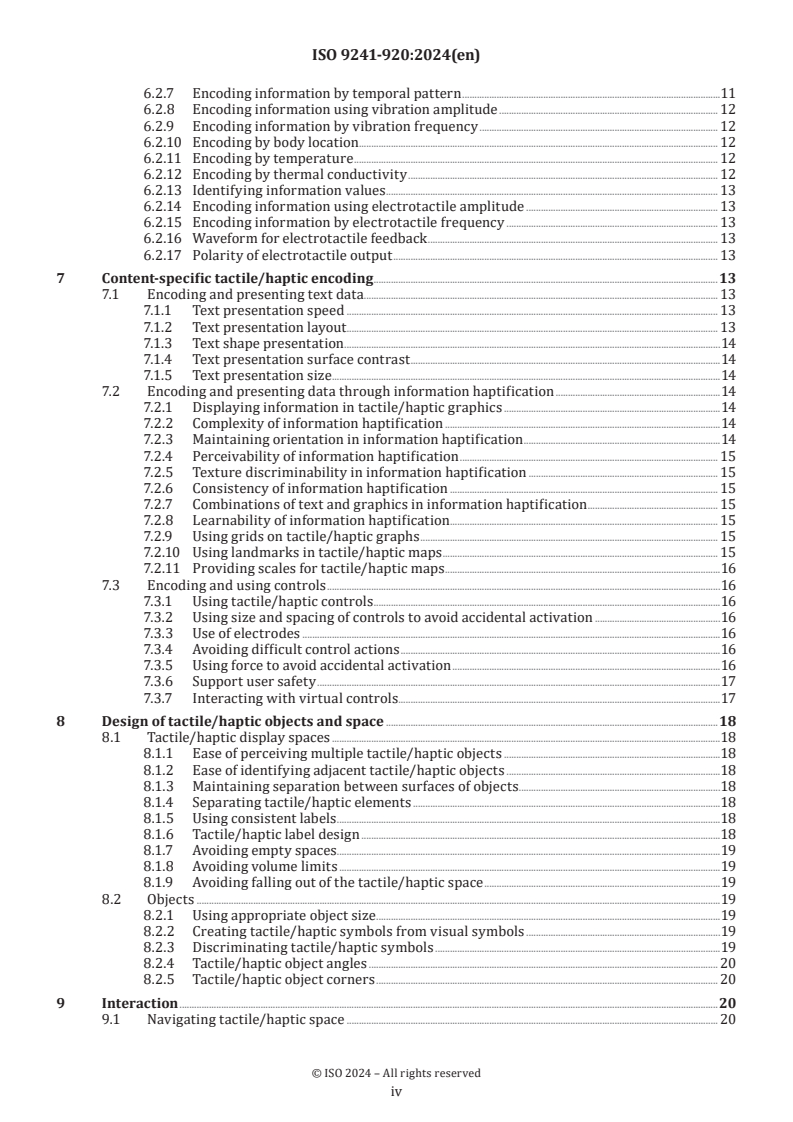
ISO 9241-920:2024 - Ergonomics of human-system interaction — Part 920: Tactile and haptic interactions Released:11. 10. 2024

ISO 9241-920:2024 - Ergonomie de l'interaction homme-systeme — Partie 920: Interactions tactiles et haptiques Released:11. 10. 2024
Overview
ISO 9241-920:2024 - "Ergonomics of human‑system interaction - Part 920: Tactile and haptic interactions" defines requirements and recommendations for designing tactile and haptic hardware and software interactions. The standard covers tactile/haptic inputs and outputs, encoding of information (text, graphics, controls), tactile object and space design, interaction techniques, and guidance for combinations of tactile/haptic with other modalities. It applies to a wide range of devices (wearables, exoskeletons, force‑feedback controllers, tangibles) and stimulation types (vibration, electrotactile, thermal, mechanical) used in real, virtual and mixed realities.
Key topics and technical requirements
ISO 9241-920 provides structured guidance across these technical areas:
- Tactile/haptic inputs and outputs - general design guidance for optimizing performance, accessibility, contextual cues, system state indication, fatigue minimization, and modality coherence.
- Individualization and control - recommendations to enable users to adjust modalities, override or limit force feedback, and personalize tactile/haptic parameters.
- Unintentional perceptions and safety - limiting acoustic and thermal side effects, avoiding sensory adaptation and perceptual illusions, and preventing temporal/spatial masking.
- Attributes for encoding information - guidance on using amplitude, frequency, waveform, spatial addressability, apparent motion, electrotactile properties and other attributes to encode information reliably.
- Content-specific encoding - methods for presenting text, tactile/haptic graphics (information haptification), and interactive controls so they are perceivable, discriminable and learnable.
- Tactile/haptic object and space design - layout, object separation, labeling, object size, and spatial organization for multi‑element tactile displays.
- Conformance and application guidance - how to apply recommendations and evaluate implementations for ergonomic effectiveness.
(See ISO 9241-920 sections 4–9 for detailed topic breakdown.)
Practical applications and users
ISO 9241-920 is directly applicable to professionals designing, evaluating or implementing tactile and haptic systems, including:
- UX and interaction designers working on haptic touchscreens, wearables or controllers
- Product designers and hardware engineers for force‑feedback devices, exoskeletons, and tactile displays
- VR/AR developers integrating haptic feedback into virtual environments
- Accessibility specialists creating tactile graphics and tactile interfaces for visually impaired users
- Usability engineers and human factors teams responsible for ergonomics, safety and compliance
Practical uses include designing accessible tactile graphics, mapping information to vibration or electrotactile patterns, defining safe force‑feedback behaviors, and arranging tactile display spaces to avoid confusion or fatigue.
Related standards
ISO 9241-920 is part of the ISO 9241 ergonomics of human‑system interaction family. It complements other ISO 9241 parts addressing usability and human‑centred design and should be considered alongside organizational usability and accessibility practices when developing tactile/haptic products.
Keywords: ISO 9241-920, tactile interactions, haptic interactions, ergonomics, tactile encoding, haptic design, wearables, force feedback, electrotactile, tactile graphics, information haptification, VR/AR.
Relations
- Effective Date
- 12-Feb-2026
- Consolidates
ISO 660:2020 - Animal and vegetable fats and oils — Determination of acid value and acidity - Effective Date
- 06-Jun-2022
- Effective Date
- 23-Apr-2020
Buy Documents
ISO 9241-920:2024 - Ergonomics of human-system interaction — Part 920: Tactile and haptic interactions Released:11. 10. 2024
ISO 9241-920:2024 - Ergonomie de l'interaction homme-systeme — Partie 920: Interactions tactiles et haptiques Released:11. 10. 2024
Get Certified
Connect with accredited certification bodies for this standard

BSI Group
BSI (British Standards Institution) is the business standards company that helps organizations make excellence a habit.

CIS Institut d.o.o.
Personal Protective Equipment (PPE) certification body. Notified Body NB-2890 for EU Regulation 2016/425 PPE.

Kiwa BDA Testing
Building and construction product certification.
Sponsored listings
Frequently Asked Questions
ISO 9241-920:2024 is a standard published by the International Organization for Standardization (ISO). Its full title is "Ergonomics of human-system interaction — Part 920: Tactile and haptic interactions". This standard covers: This document specifies requirements and recommendations for tactile/haptic hardware and software interactions. It provides guidance on the design and selection of hardware, software and combinations of hardware and software interactions, including: — the design or use of tactile/haptic inputs, outputs and/or combinations of inputs and outputs, with general guidance on their design or use as well as on designing or using combinations of tactile and haptic interactions for use in combination with other modalities or as the exclusive mode of interaction; — the tactile/haptic encoding of information, including textual data, graphical data and controls; — the design of tactile/haptic objects; — the layout of tactile/haptic space; — interaction techniques. The recommendations given in this document are applicable to a variety of tactile/haptic devices, representing the real world or virtual or mixed realities (e.g. exoskeletons, wearables, force feedback devices, touchables, tangibles) and stimulation types (e.g. acoustic radiation pressure, electrical muscle stimulation) and they can also be found in virtual and augmented environments. This document provides general information about how various forms of tactile/haptic interaction can be applied to various user tasks. This document does not include guidance on the role of walking in virtual or mixed realities for tactile/haptic interaction. NOTE It is recognized that some interactive scenarios can be constrained by the limitation that a real workspace is to be modelled in a virtual environment. Objects can be in suboptimal positions or conditions for tactile/haptic interaction by virtue of the situation being modelled.
This document specifies requirements and recommendations for tactile/haptic hardware and software interactions. It provides guidance on the design and selection of hardware, software and combinations of hardware and software interactions, including: — the design or use of tactile/haptic inputs, outputs and/or combinations of inputs and outputs, with general guidance on their design or use as well as on designing or using combinations of tactile and haptic interactions for use in combination with other modalities or as the exclusive mode of interaction; — the tactile/haptic encoding of information, including textual data, graphical data and controls; — the design of tactile/haptic objects; — the layout of tactile/haptic space; — interaction techniques. The recommendations given in this document are applicable to a variety of tactile/haptic devices, representing the real world or virtual or mixed realities (e.g. exoskeletons, wearables, force feedback devices, touchables, tangibles) and stimulation types (e.g. acoustic radiation pressure, electrical muscle stimulation) and they can also be found in virtual and augmented environments. This document provides general information about how various forms of tactile/haptic interaction can be applied to various user tasks. This document does not include guidance on the role of walking in virtual or mixed realities for tactile/haptic interaction. NOTE It is recognized that some interactive scenarios can be constrained by the limitation that a real workspace is to be modelled in a virtual environment. Objects can be in suboptimal positions or conditions for tactile/haptic interaction by virtue of the situation being modelled.
ISO 9241-920:2024 is classified under the following ICS (International Classification for Standards) categories: 13.180 - Ergonomics; 35.180 - IT Terminal and other peripheral equipment. The ICS classification helps identify the subject area and facilitates finding related standards.
ISO 9241-920:2024 has the following relationships with other standards: It is inter standard links to EN ISO 9241-920:2024, ISO 660:2020, ISO 9241-920:2009. Understanding these relationships helps ensure you are using the most current and applicable version of the standard.
ISO 9241-920:2024 is available in PDF format for immediate download after purchase. The document can be added to your cart and obtained through the secure checkout process. Digital delivery ensures instant access to the complete standard document.
Standards Content (Sample)
International
Standard
ISO 9241-920
Second edition
Ergonomics of human-system
2024-10
interaction —
Part 920:
Tactile and haptic interactions
Ergonomie de l'interaction homme-système —
Partie 920: Interactions tactiles et haptiques
Reference number
© ISO 2024
All rights reserved. Unless otherwise specified, or required in the context of its implementation, no part of this publication may
be reproduced or utilized otherwise in any form or by any means, electronic or mechanical, including photocopying, or posting on
the internet or an intranet, without prior written permission. Permission can be requested from either ISO at the address below
or ISO’s member body in the country of the requester.
ISO copyright office
CP 401 • Ch. de Blandonnet 8
CH-1214 Vernier, Geneva
Phone: +41 22 749 01 11
Email: copyright@iso.org
Website: www.iso.org
Published in Switzerland
ii
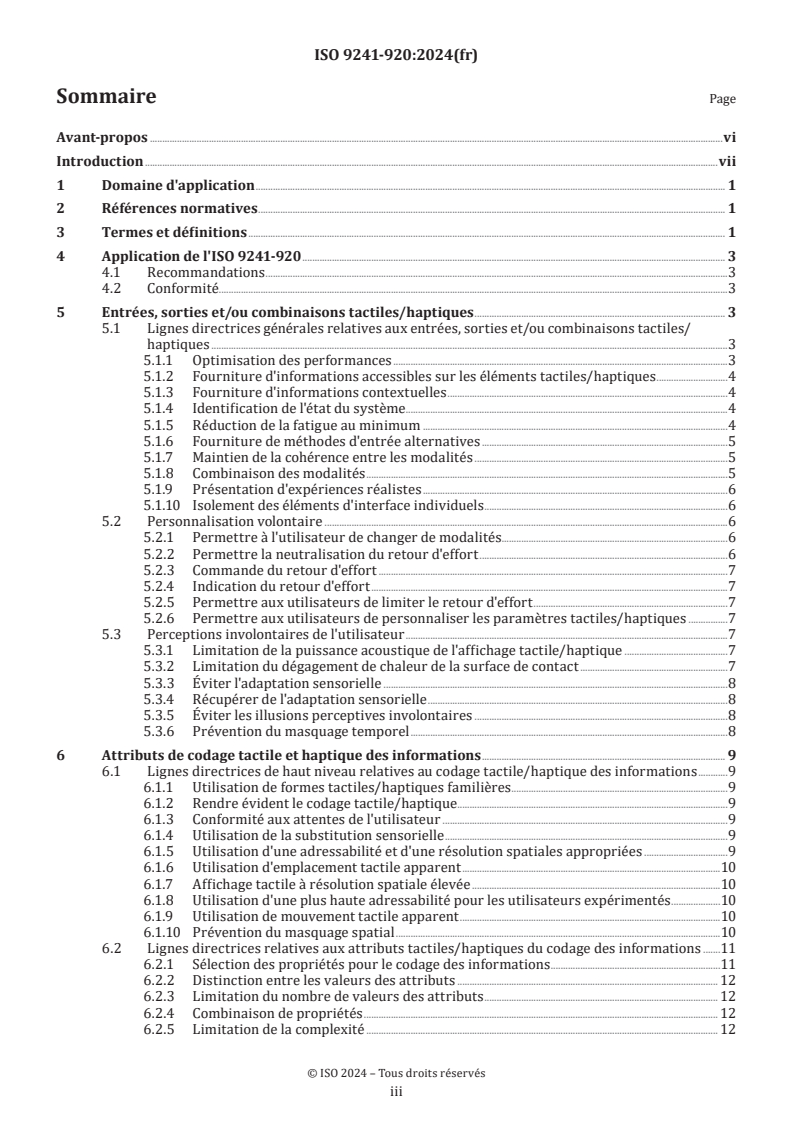
Contents Page
Foreword .vi
Introduction .vii
1 Scope . 1
2 Normative references . 1
3 Terms and definitions . 1
4 Applying ISO 9241-920 . 2
4.1 Recommendations .2
4.2 Conformance .3
5 Tactile/haptic inputs, outputs and/or combinations . 3
5.1 General guidance on tactile/haptic inputs, outputs and/or combinations .3
5.1.1 Optimizing performance .3
5.1.2 Providing accessible information on tactile/haptic elements .3
5.1.3 Providing contextual information .3
5.1.4 Identifying system state .4
5.1.5 Minimizing fatigue . . .4
5.1.6 Providing alternative input methods .4
5.1.7 Maintaining coherence between modalities .4
5.1.8 Combining modalities .5
5.1.9 Presenting realistic experiences .5
5.1.10 Isolation of individual interface elements .5
5.2 Intentional individualization .6
5.2.1 Enabling users to change modalities .6
5.2.2 Enabling force feedback override .6
5.2.3 Force feedback control .6
5.2.4 Force feedback indication .6
5.2.5 Enabling users to limit force feedback .6
5.2.6 Enabling users to individualize tactile/haptic parameters .6
5.3 Unintentional user perceptions .7
5.3.1 Limiting acoustic output of tactile/haptic display .7
5.3.2 Limiting heat gain of contact surface.7
5.3.3 Avoiding sensory adaptation .7
5.3.4 Recovering from sensory adaptation .7
5.3.5 Avoiding unintended perceptual illusions .7
5.3.6 Preventing temporal masking .8
6 Attributes of tactile and haptic encoding of information . 8
6.1 High level guidance on tactile/haptic encoding of information .8
6.1.1 Using familiar tactile/haptic patterns .8
6.1.2 Making tactile/haptic encoding obvious .8
6.1.3 Conformity to user expectations .8
6.1.4 Using sensory substitution .8
6.1.5 Using appropriate spatial addressability and resolution . .9
6.1.6 Using tactile apparent location .9
6.1.7 Tactile display of high spatial resolution .9
6.1.8 Using higher addressability for trained users .9
6.1.9 Using tactile apparent motion .9
6.1.10 Preventing spatial masking .9
6.2 Guidance on specific tactile/haptic attributes for encoding information .10
6.2.1 Selecting properties for encoding information .10
6.2.2 Discriminating between attribute values .11
6.2.3 Limiting the number of attribute values .11
6.2.4 Combining properties .11
6.2.5 Limiting complexity.11
6.2.6 Encoding by object shape .11
iii
6.2.7 Encoding information by temporal pattern .11
6.2.8 Encoding information using vibration amplitude . 12
6.2.9 Encoding information by vibration frequency . 12
6.2.10 Encoding by body location . 12
6.2.11 Encoding by temperature . 12
6.2.12 Encoding by thermal conductivity . 12
6.2.13 Identifying information values . 13
6.2.14 Encoding information using electrotactile amplitude . 13
6.2.15 Encoding information by electrotactile frequency . 13
6.2.16 Waveform for electrotactile feedback . 13
6.2.17 Polarity of electrotactile output . 13
7 Content-specific tactile/haptic encoding .13
7.1 Encoding and presenting text data. 13
7.1.1 Text presentation speed . 13
7.1.2 Text presentation layout . 13
7.1.3 Text shape presentation . .14
7.1.4 Text presentation surface contrast .14
7.1.5 Text presentation size .14
7.2 Encoding and presenting data through information haptification .14
7.2.1 Displaying information in tactile/haptic graphics .14
7.2.2 Complexity of information haptification .14
7.2.3 Maintaining orientation in information haptification .14
7.2.4 Perceivability of information haptification . 15
7.2.5 Texture discriminability in information haptification . 15
7.2.6 Consistency of information haptification . 15
7.2.7 Combinations of text and graphics in information haptification . 15
7.2.8 Learnability of information haptification . 15
7.2.9 Using grids on tactile/haptic graphs . 15
7.2.10 Using landmarks in tactile/haptic maps . 15
7.2.11 Providing scales for tactile/haptic maps .16
7.3 Encoding and using controls .16
7.3.1 Using tactile/haptic controls .16
7.3.2 Using size and spacing of controls to avoid accidental activation .16
7.3.3 Use of electrodes .16
7.3.4 Avoiding difficult control actions .16
7.3.5 Using force to avoid accidental activation .16
7.3.6 Support user safety .17
7.3.7 Interacting with virtual controls .17
8 Design of tactile/haptic objects and space .18
8.1 Tactile/haptic display spaces .18
8.1.1 Ease of perceiving multiple tactile/haptic objects .18
8.1.2 Ease of identifying adjacent tactile/haptic objects .18
8.1.3 Maintaining separation between surfaces of objects .18
8.1.4 Separating tactile/haptic elements .18
8.1.5 Using consistent labels .18
8.1.6 Tactile/haptic label design .18
8.1.7 Avoiding empty spaces.19
8.1.8 Avoiding volume limits .19
8.1.9 Avoiding falling out of the tactile/haptic space .19
8.2 Objects .19
8.2.1 Using appropriate object size .19
8.2.2 Creating tactile/haptic symbols from visual symbols .19
8.2.3 Discriminating tactile/haptic symbols .19
8.2.4 Tactile/haptic object angles . 20
8.2.5 Tactile/haptic object corners . 20
9 Interaction .20
9.1 Navigating tactile/haptic space . 20
iv
9.1.1 Providing navigation information . 20
9.1.2 Supporting path planning . 20
9.1.3 Providing well-designed paths . 20
9.1.4 Making landmarks easy to identify and recognize . 20
9.1.5 Providing appropriate navigation techniques . 20
9.1.6 Providing navigational aids . .21
9.1.7 Understanding the tactile/haptic space .21
9.1.8 Supporting exploratory strategies (procedures) .21
9.2 Reconfiguration .21
9.2.1 Reconfiguring the tactile/haptic space.21
9.2.2 System-initiated reconfigurations .21
9.2.3 Maintaining user’s sense of location during reconfiguration . 22
9.3 Interaction techniques. 22
9.3.1 Implementing interaction techniques . 22
9.3.2 Avoiding unintended oscillation . 22
Bibliography .23
v
Foreword
ISO (the International Organization for Standardization) is a worldwide federation of national standards
bodies (ISO member bodies). The work of preparing International Standards is normally carried out through
ISO technical committees. Each member body interested in a subject for which a technical committee
has been established has the right to be represented on that committee. International organizations,
governmental and non-governmental, in liaison with ISO, also take part in the work. ISO collaborates closely
with the International Electrotechnical Commission (IEC) on all matters of electrotechnical standardization.
The procedures used to develop this document and those intended for its further maintenance are described
in the ISO/IEC Directives, Part 1. In particular, the different approval criteria needed for the different types
of ISO documents should be noted. This document was drafted in accordance with the editorial rules of the
ISO/IEC Directives, Part 2 (see www.iso.org/directives).
ISO draws attention to the possibility that the implementation of this document may involve the use of (a)
patent(s). ISO takes no position concerning the evidence, validity or applicability of any claimed patent
rights in respect thereof. As of the date of publication of this document, ISO had not received notice of (a)
patent(s) which may be required to implement this document. However, implementers are cautioned that
this may not represent the latest information, which may be obtained from the patent database available at
www.iso.org/patents. ISO shall not be held responsible for identifying any or all such patent rights.
Any trade name used in this document is information given for the convenience of users and does not
constitute an endorsement.
For an explanation of the voluntary nature of standards, the meaning of ISO specific terms and expressions
related to conformity assessment, as well as information about ISO’s adherence to the World Trade
Organization (WTO) principles in the Technical Barriers to Trade (TBT), see www.iso.org/iso/foreword.html.
This document was prepared by Technical Committee ISO/TC 159, Ergonomics, Subcommittee SC 4,
Ergonomics of human-system interaction, in collaboration with the European Committee for Standardization
(CEN) Technical Committee CEN/TC 122, Ergonomics, in accordance with the Agreement on technical
cooperation between ISO and CEN (Vienna Agreement).
This second edition cancels and replaces the first edition (ISO 9241-920:2009), which has been technically
revised.
The main change is as follows:
— The document has been updated to reflect newer research in tactile/haptic interactions.
A list of all parts in the ISO 9241 series can be found on the ISO website.
Any feedback or questions on this document should be directed to the user’s national standards body. A
complete listing of these bodies can be found at www.iso.org/members.html.
vi
Introduction
Tactile and haptic interactions have become increasingly important interaction modalities. Mobile
interaction relies on gesture-based touch interaction and tactile/haptic control devices and can utilize
vibration-based displays as one of several ways to provide information or experiences to the user. Touch,
vibration and tactile/haptic interactions are also found in special-purpose computing environments (e.g.
simulation, remote control or surgery) and in assistive technologies.
While considerable research exists, a lack of ergonomic standards in this area can possibly result in systems
being developed without sufficient concern for either ergonomics or interoperability, leading to serious
difficulties related to ergonomics for users of multiple incompatible or conflicting tactile/haptic devices or
applications.
This document provides ergonomics requirements and recommendations for tactile and haptic hardware
and software interactions, including guidance related to the design and evaluation of hardware, software
and combinations of hardware and software interactions. The guidelines are not technology-dependent and
will also be applicable to future technologies.
ISO 9241-910 provides a common set of terms, definitions and descriptions of the various concepts central
to designing and using tactile/haptic interactions. It also provides an overview of the range of tactile/haptic
applications, objects, attributes and interactions.
ISO 9241-940 provides ways of evaluating tactile/haptic interactions for their usability, the validation of
requirements and the verification that systems meet the requirements.
ISO 9241-960 focuses on gestures as a specific type of tactile/haptic interaction and describes their features
and usability requirements. Information on gesture-based interfaces can be found in the ISO/IEC 30113
series. Information on contactless gestures can be found in ISO TS 9241-430.
For guidance and recommendations on the accessibility of tactile/haptic interactions, including information
on the use of braille, see ISO 9241-971. It does not provide recommendations specific to braille but can apply
to interactions that make use of braille.
vii
International Standard ISO 9241-920:2024(en)
Ergonomics of human-system interaction —
Part 920:
Tactile and haptic interactions
1 Scope
This document specifies requirements and recommendations for tactile/haptic hardware and software
interactions. It provides guidance on the design and selection of hardware, software and combinations of
hardware and software interactions, including:
— the design or use of tactile/haptic inputs, outputs and/or combinations of inputs and outputs, with
general guidance on their design or use as well as on designing or using combinations of tactile and
haptic interactions for use in combination with other modalities or as the exclusive mode of interaction;
— the tactile/haptic encoding of information, including textual data, graphical data and controls;
— the design of tactile/haptic objects;
— the layout of tactile/haptic space;
— interaction techniques.
The recommendations given in this document are applicable to a variety of tactile/haptic devices,
representing the real world or virtual or mixed realities (e.g. exoskeletons, wearables, force feedback
devices, touchables, tangibles) and stimulation types (e.g. acoustic radiation pressure, electrical muscle
stimulation) and they can also be found in virtual and augmented environments.
This document provides general information about how various forms of tactile/haptic interaction can be
applied to various user tasks.
This document does not include guidance on the role of walking in virtual or mixed realities for tactile/
haptic interaction.
NOTE It is recognized that some interactive scenarios can be constrained by the limitation that a real workspace
is to be modelled in a virtual environment. Objects can be in suboptimal positions or conditions for tactile/haptic
interaction by virtue of the situation being modelled.
2 Normative references
There are no normative references in this document.
3 Terms and definitions
For the purposes of this document, the following terms and definitions apply.
ISO and IEC maintain terminology databases for use in standardization at the following addresses:
— ISO Online browsing platform: available at https:// www .iso .org/ obp
— IEC Electropedia: available at https:// www .electropedia .org/
3.1
electrotactile feedback
delivering tactile/haptic sensations to the user by excitation of the cutaneous nerve fibres with electric current
3.2
electrostatic feedback
delivering tactile/haptic sensations of friction to the user by electric force
3.3
information haptification
presentation and exploration of data and their relations through tactile/haptic interaction
3.4
sensory substitution
information usually analysed by one sense provided through another sense
EXAMPLE 1 Tactile sensations can substitute for visual input, e.g. when visible text is transcribed into tactile
sensations through braille for an individual who is blind.
EXAMPLE 2 A visual diagram is substituted by an audible representation of the information in the diagram.
Note 1 to entry: Sensory substitution allows the system to provide the same information in more than one modality. It
is not a substitution on the part of human perception. For example, persons who experience synaesthesia, which is an
involuntary association of one sense with another or one sensory attribute with another, sometimes experience colour
when hearing sound.
3.5
tactile
appertaining to touch
[SOURCE: ISO 9241-910:2011, 2.5]
3.6
haptic, adj
appertaining to haptics (3.7)
Note 1 to entry: While there is no difference between haptic and tactile (3.5) in most dictionary definitions, in the area
of haptics, researchers and developers use haptic to include all haptic sensations, while tactile is limited to mechanical
stimulation of the skin. In ISO 9241, the word haptic covers all touch sensations and tactile is used in a more specific
manner. Also, both terms can be used together to assist in searches.
[SOURCE: ISO 9241-910:2011, 2.2]
3.7
haptics, noun
sensory and/or motor activity based in the skin, muscles, joints and tendons
Note 1 to entry: Haptics consists of two parts: touch and kinaesthesis.
[SOURCE: ISO 9241-910:2011, 2.1]
4 Applying ISO 9241-920
4.1 Recommendations
The recommendations given in Clauses 5 to 9 should be evaluated for their applicability. The applicable
recommendations should be implemented, unless there is evidence that to do so would cause deviation from
the design objectives.
4.2 Conformance
If it is claimed that a product conforms to the applicable requirements and recommendations in this
document, then the procedures used to establish conformance of the product shall be specified. The level of
detail of the specification is a matter of negotiation between the involved parties.
NOTE Guidance on the evaluation of tactile/haptic products can be found in ISO 9241-940.
5 Tactile/haptic inputs, outputs and/or combinations
5.1 General guidance on tactile/haptic inputs, outputs and/or combinations
5.1.1 Optimizing performance
The system should be optimized to take into account the following:
a) the accuracy of available devices, the accuracy of the user and the required accuracy of the task;
b) the ability of a user to control the velocity and the force (including direction) involved in operations;
NOTE 1 High speed of user actions is inconsistent with accurate control of force, and vice versa.
c) active exploration over passive exploration, when appropriate;
NOTE 2 This can increase kinaesthetic perception.
d) extended contact area;
NOTE 3 Extended area can be needed depending on the part of the body in contact with a tactile/haptic device.
EXAMPLE 1 The back does not resolve two-point discrimination as easily as the fingertip.
e) multiple point-of-contact operation, when possible and appropriate;
NOTE 4 This can reduce errors and improve tactile perception.
EXAMPLE 2 The use of two hands in reading braille can improve efficiency.
f) the overall amount and distributed nature of cognitive and sensory task demands.
NOTE 5 Effectiveness of tactile and haptic inputs is affected by overall workload, conflict among multi-task
demands and/or overload or decrement of particular sensory information channels.
5.1.2 Providing accessible information on tactile/haptic elements
The system should provide accessible alternatives of all tactile/haptic user interface elements, whether
those alternatives are automatically presented or not.
NOTE An accessible alternative can describe the user interface element through text, sound labels, synthetic
speech or sign language or as braille text.
EXAMPLE Touchscreen buttons with spoken descriptions.
5.1.3 Providing contextual information
The system should provide a context to help the user to understand the meaning of the tactile/haptic
perception and the environment or program.
NOTE 1 Contextual information that is helpful includes information about the purpose of the program, and
information about possibilities and pitfalls in the environment.
NOTE 2 Contextual information can be in the form of a short message, such as a caption under an image or model,
and presented as speech, sign language or braille.
EXAMPLE 1 An automobile's steering wheel vibrates to provide a tactile cue alert for lane deviation. A visual alert
icon on the dashboard simultaneously provides the driver contextual information about why the wheel is vibrating.
EXAMPLE 2 Tactile/haptic cues for presenting information can have an optional auditory cue.
5.1.4 Identifying system state
The system should provide information that allows the user to know which task or function is active.
5.1.5 Minimizing fatigue
The system should:
a) ensure user comfort over extended periods of time;
b) avoid or minimize user fatigue.
NOTE Minimization of tactile/haptic fatigue can be achieved by:
— careful choice of body location for stimulation;
— careful choice of method of contact with the body;
— careful choice of stimulus frequency;
— choosing the lowest effective magnitude of the stimulus;
— reducing minute, precise joint rotations, particularly at proximal segments;
— not using static positions at or near the end of the range of motion;
— not expecting users to overreach to discover the full extent of the display.
5.1.6 Providing alternative input methods
The system should enable users to accomplish the same function in multiple ways. If the task is a fine
manipulation task, alternative means should be offered that require less movement precision to enable this
type of interaction.
NOTE 1 The most efficient, logical or effective input or control mechanism for a majority of users can potentially be
difficult, if not impossible, for individual users with differing abilities to use.
EXAMPLE One-handed (either left or right) operation is used.
NOTE 2 Changing the scale of the virtual environment can make fine motor tasks easier.
5.1.7 Maintaining coherence between modalities
The system should maintain coherence, where appropriate, between the tactile/haptic modality and other
modalities, including the descriptions of actions.
NOTE 1 The visual perception of objects can bias, and be biased by, the tactile/haptic perception of objects. This
can also occur between the tactile/haptic modality and other modalities.
NOTE 2 Aspects of coherence (amodal attributes) can include:
— size;
— orientation;
— shape;
— mapping;
— separation of objects;
— temporal presentation.
NOTE 3 Coherence also includes the relative location of on-screen controls, including the directions in which they
can be moved.
NOTE 4 Incoherence can cause confusion and control instabilities in multimodal systems.
5.1.8 Combining modalities
Combining modalities is recommended, as it supports usability and can make systems more accessible.
Some effects of combining modalities are:
a) reinforcement of information obtained from purely tactile/haptic interactions;
EXAMPLE 1 A sound when an object is struck.
b) provision of additional information not presented via tactile/haptic interactions;
NOTE 1 The resulting combinations can enhance spatial memory and the identification and exploration of
objects and their attributes.
EXAMPLE 2 Information on the colour of an object.
NOTE 2 Combination of modalities can contradict information obtained from purely tactile/haptic interactions
if those modalities present conflicting (i.e. non-congruent) information to the tactile/haptic modality (see 5.1.7).
c) compensation for sensory channels that are diminished or overloaded.
NOTE 3 Tactile cues can be particularly effective when audio or visual cues are less effective (e.g. loud noise,
low visibility).
5.1.9 Presenting realistic experiences
While the use of real-world experiences (e.g. following the laws of physics) can enhance the user's
understanding, they are not always necessary. Deviating from real-world experiences may be used to:
a) simplify and focus on important features;
b) explore new experiences.
NOTE There are several cases, especially in designing interface widgets, where the slightly unreal, yet
well-designed, behaviour of a virtual object makes it easier to use.
EXAMPLE Properties of an object (e.g. size, frequency of its vibration) are changed as it is approached by the user,
even though these properties would not change in the real world.
5.1.10 Isolation of individual interface elements
The system should prevent accidental activation of interface elements in proximity to the one being
activated.
EXAMPLE 1 Because there is a high risk of unintentional vibration where the nearby actuator vibrates at the same
resonant frequency, a rigid surround is installed to reduce the spreading of vibration.
EXAMPLE 2 Mechanical or electrical crosstalk between different tactile/haptic channels is reduced to minimize
any unintentional perceptual illusion.
EXAMPLE 3 Active haptic objects that are too close to each other in space results in the user accidentally activating
both haptic objects rather than one.
5.2 Intentional individualization
5.2.1 Enabling users to change modalities
The system should enable the user both to disable tactile/haptic output and/or have output presented in
another modality, where feasible.
Individuals differ in the ability to effectively perceive, process and use visual, audio and/or tactile/haptic
cues. Allowing users the capability to select among alternatives, or combine several modalities when
appropriate, should be considered.
NOTE 1 Tactile/haptic stimuli can annoy users who do not want to use them, as they are difficult to ignore.
NOTE 2 Tactile/haptic cues can be preferred when other sensory channels are diminished or overloaded (e.g. loud
noise, low visibility, need for stealth).
5.2.2 Enabling force feedback override
The system should allow any force feedback to be overridden by the user.
EXAMPLE When feedback is used for support, the user has the possibility to reduce or stop the feedback if it is no
longer felt to be necessary by the user to perform the action or operation.
5.2.3 Force feedback control
Where the system allows force feedback to be disabled by the user, it should be possible to easily reenable it.
EXAMPLE A mobile phone has a “do not disturb” setting that will turn device vibration on or off.
5.2.4 Force feedback indication
Where the system allows force feedback to be overridden by the user, a clear status indicator should be
available to support users’ awareness of the force feedback state.
5.2.5 Enabling users to limit force feedback
Options to adjust tactile/haptic parameters should be provided to limit the maximum possible force for
force feedback to be no greater than the maximum force that the user can exert.
NOTE 1 It can be inappropriate if the delay-time is shorter than the human reaction time.
NOTE 2 Users vary in the amount of force that can overpower or be “too strong” for them.
5.2.6 Enabling users to individualize tactile/haptic parameters
Options to adjust tactile/haptic parameters should be provided to prevent discomfort, pain or injury to
users of interactive systems.
NOTE 1 Different users have different thresholds for sensation and pain. Furthermore, over a user's lifespan,
thresholds of sensation and pain will change (e.g. spatial and temporal acuity degrade with age).
NOTE 2 Users vary in the amount of maximum force that they can perceive comfortably.
EXAMPLE Tactile/haptic signals are made stronger to overcome distractions and physical exertion.
5.3 Unintentional user perceptions
5.3.1 Limiting acoustic output of tactile/haptic display
Sounds generated as a side effect of the tactile/haptic display should not negatively interfere with:
a) the user perceiving presented auditory information;
b) nearby equipment and/or persons;
c) security requirements;
d) assistive technologies.
NOTE Systems are sometimes designed to use this side effect as part of the experience.
5.3.2 Limiting heat gain of contact surface
The heat gain of the contact surface (not intentionally generated) should not:
a) deform the contact surface;
b) disturb the user’s tactile/haptic perception;
c) injure the user’s skin;
d) damage the tactile/haptic interface.
NOTE An unintentional temperature increase or decrease of the contact surface of a tactile/haptic interface can
occur from various intentional tactile/haptic actions (e.g. vibration, friction) and can affect tactile/haptic perception
or action.
5.3.3 Avoiding sensory adaptation
The system should minimize the effects of sensory adaptation to vibration.
NO
...
Norme
internationale
ISO 9241-920
Deuxième édition
Ergonomie de l'interaction homme-
2024-10
système —
Partie 920:
Interactions tactiles et haptiques
Ergonomics of human-system interaction —
Part 920: Tactile and haptic interactions
Numéro de référence
DOCUMENT PROTÉGÉ PAR COPYRIGHT
© ISO 2024
Tous droits réservés. Sauf prescription différente ou nécessité dans le contexte de sa mise en œuvre, aucune partie de cette
publication ne peut être reproduite ni utilisée sous quelque forme que ce soit et par aucun procédé, électronique ou mécanique,
y compris la photocopie, ou la diffusion sur l’internet ou sur un intranet, sans autorisation écrite préalable. Une autorisation peut
être demandée à l’ISO à l’adresse ci-après ou au comité membre de l’ISO dans le pays du demandeur.
ISO copyright office
Case postale 401 • Ch. de Blandonnet 8
CH-1214 Vernier, Genève
Tél.: +41 22 749 01 11
E-mail: copyright@iso.org
Web: www.iso.org
Publié en Suisse
ii
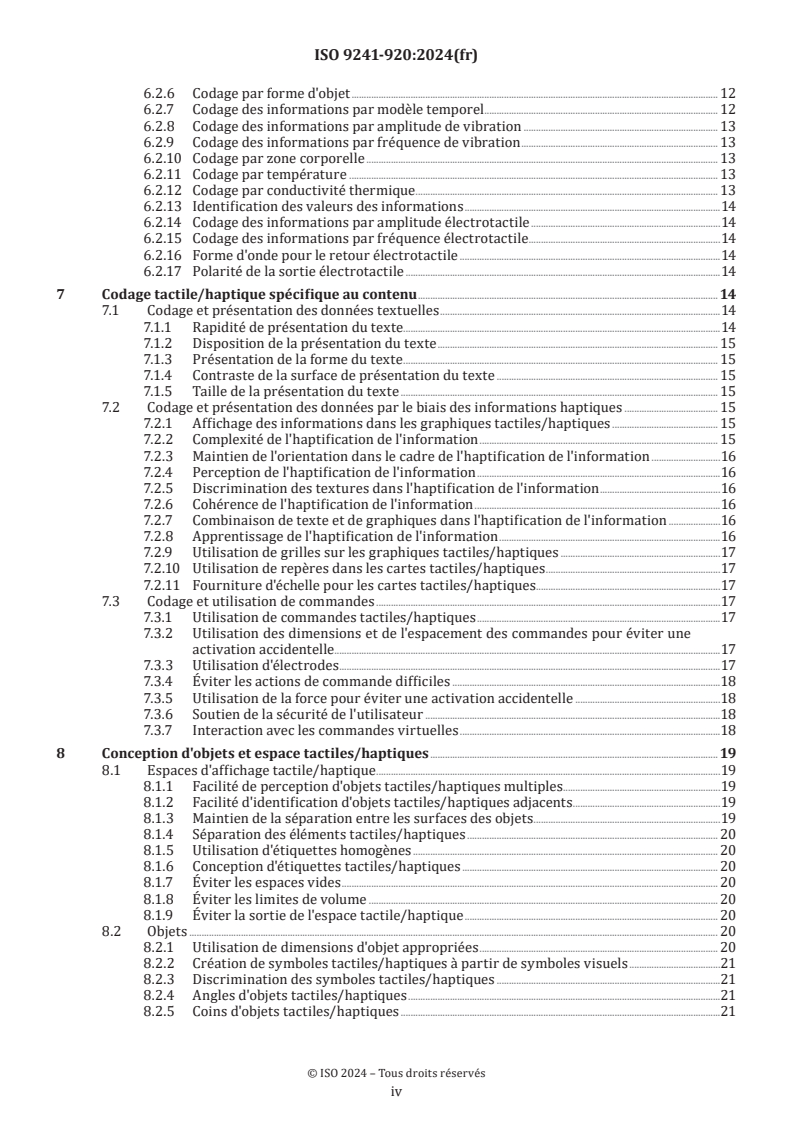
Sommaire Page
Avant-propos .vi
Introduction .vii
1 Domaine d'application . 1
2 Références normatives . 1
3 Termes et définitions . 1
4 Application de l'ISO 9241-920 . 3
4.1 Recommandations .3
4.2 Conformité.3
5 Entrées, sorties et/ou combinaisons tactiles/haptiques . 3
5.1 Lignes directrices générales relatives aux entrées, sorties et/ou combinaisons tactiles/
haptiques .3
5.1.1 Optimisation des performances .3
5.1.2 Fourniture d'informations accessibles sur les éléments tactiles/haptiques .4
5.1.3 Fourniture d'informations contextuelles .4
5.1.4 Identification de l'état du système . .4
5.1.5 Réduction de la fatigue au minimum .4
5.1.6 Fourniture de méthodes d'entrée alternatives .5
5.1.7 Maintien de la cohérence entre les modalités .5
5.1.8 Combinaison des modalités .5
5.1.9 Présentation d'expériences réalistes .6
5.1.10 Isolement des éléments d'interface individuels .6
5.2 Personnalisation volontaire .6
5.2.1 Permettre à l'utilisateur de changer de modalités.6
5.2.2 Permettre la neutralisation du retour d'effort .6
5.2.3 Commande du retour d'effort .7
5.2.4 Indication du retour d'effort .7
5.2.5 Permettre aux utilisateurs de limiter le retour d'effort .7
5.2.6 Permettre aux utilisateurs de personnaliser les paramètres tactiles/haptiques .7
5.3 Perceptions involontaires de l'utilisateur .7
5.3.1 Limitation de la puissance acoustique de l'affichage tactile/haptique .7
5.3.2 Limitation du dégagement de chaleur de la surface de contact .7
5.3.3 Éviter l'adaptation sensorielle .8
5.3.4 Récupérer de l'adaptation sensorielle .8
5.3.5 Éviter les illusions perceptives involontaires .8
5.3.6 Prévention du masquage temporel .8
6 Attributs de codage tactile et haptique des informations . 9
6.1 Lignes directrices de haut niveau relatives au codage tactile/haptique des informations .9
6.1.1 Utilisation de formes tactiles/haptiques familières .9
6.1.2 Rendre évident le codage tactile/haptique .9
6.1.3 Conformité aux attentes de l'utilisateur .9
6.1.4 Utilisation de la substitution sensorielle .9
6.1.5 Utilisation d'une adressabilité et d'une résolution spatiales appropriées .9
6.1.6 Utilisation d'emplacement tactile apparent .10
6.1.7 Affichage tactile à résolution spatiale élevée .10
6.1.8 Utilisation d'une plus haute adressabilité pour les utilisateurs expérimentés .10
6.1.9 Utilisation de mouvement tactile apparent .10
6.1.10 Prévention du masquage spatial .10
6.2 Lignes directrices relatives aux attributs tactiles/haptiques du codage des informations .11
6.2.1 Sélection des propriétés pour le codage des informations .11
6.2.2 Distinction entre les valeurs des attributs . 12
6.2.3 Limitation du nombre de valeurs des attributs . 12
6.2.4 Combinaison de propriétés . 12
6.2.5 Limitation de la complexité . 12
iii
6.2.6 Codage par forme d'objet . 12
6.2.7 Codage des informations par modèle temporel . 12
6.2.8 Codage des informations par amplitude de vibration . 13
6.2.9 Codage des informations par fréquence de vibration . 13
6.2.10 Codage par zone corporelle . 13
6.2.11 Codage par température . 13
6.2.12 Codage par conductivité thermique . 13
6.2.13 Identification des valeurs des informations .14
6.2.14 Codage des informations par amplitude électrotactile .14
6.2.15 Codage des informations par fréquence électrotactile .14
6.2.16 Forme d'onde pour le retour électrotactile .14
6.2.17 Polarité de la sortie électrotactile .14
7 Codage tactile/haptique spécifique au contenu . 14
7.1 Codage et présentation des données textuelles .14
7.1.1 Rapidité de présentation du texte.14
7.1.2 Disposition de la présentation du texte . 15
7.1.3 Présentation de la forme du texte . 15
7.1.4 Contraste de la surface de présentation du texte . 15
7.1.5 Taille de la présentation du texte . 15
7.2 Codage et présentation des données par le biais des informations haptiques . 15
7.2.1 Affichage des informations dans les graphiques tactiles/haptiques . 15
7.2.2 Complexité de l'haptification de l'information . 15
7.2.3 Maintien de l'orientation dans le cadre de l'haptification de l'information .16
7.2.4 Perception de l'haptification de l'information .16
7.2.5 Discrimination des textures dans l'haptification de l'information .16
7.2.6 Cohérence de l'haptification de l'information .16
7.2.7 Combinaison de texte et de graphiques dans l'haptification de l'information .16
7.2.8 Apprentissage de l'haptification de l'information .16
7.2.9 Utilisation de grilles sur les graphiques tactiles/haptiques .17
7.2.10 Utilisation de repères dans les cartes tactiles/haptiques .17
7.2.11 Fourniture d'échelle pour les cartes tactiles/haptiques.17
7.3 Codage et utilisation de commandes .17
7.3.1 Utilisation de commandes tactiles/haptiques .17
7.3.2 Utilisation des dimensions et de l'espacement des commandes pour éviter une
activation accidentelle .17
7.3.3 Utilisation d'électrodes .17
7.3.4 Éviter les actions de commande difficiles .18
7.3.5 Utilisation de la force pour éviter une activation accidentelle .18
7.3.6 Soutien de la sécurité de l'utilisateur .18
7.3.7 Interaction avec les commandes virtuelles .18
8 Conception d'objets et espace tactiles/haptiques . 19
8.1 Espaces d'affichage tactile/haptique .19
8.1.1 Facilité de perception d'objets tactiles/haptiques multiples .19
8.1.2 Facilité d'identification d'objets tactiles/haptiques adjacents .19
8.1.3 Maintien de la séparation entre les surfaces des objets .19
8.1.4 Séparation des éléments tactiles/haptiques . 20
8.1.5 Utilisation d'étiquettes homogènes . 20
8.1.6 Conception d'étiquettes tactiles/haptiques . 20
8.1.7 Éviter les espaces vides . 20
8.1.8 Éviter les limites de volume . 20
8.1.9 Éviter la sortie de l'espace tactile/haptique . 20
8.2 Objets . 20
8.2.1 Utilisation de dimensions d'objet appropriées . 20
8.2.2 Création de symboles tactiles/haptiques à partir de symboles visuels .21
8.2.3 Discrimination des symboles tactiles/haptiques .21
8.2.4 Angles d'objets tactiles/haptiques .21
8.2.5 Coins d'objets tactiles/haptiques .21
iv
9 Interaction .22
9.1 Navigation dans l'espace tactile/haptique . 22
9.1.1 Fourniture d'informations relatives à la navigation . 22
9.1.2 Planification de parcours. 22
9.1.3 Fourniture de parcours bien conçus . . 22
9.1.4 Facilité d'identification et de reconnaissance des repères . 22
9.1.5 Fourniture de techniques de navigation appropriées. 22
9.1.6 Fourniture d'aides relatives à la navigation . 22
9.1.7 Appréhension de l'espace tactile/haptique . 23
9.1.8 Stratégies (procédures) d'exploration . 23
9.2 Reconfiguration . 23
9.2.1 Reconfiguration de l'espace tactile/haptique . 23
9.2.2 Reconfigurations initiées par le système . 23
9.2.3 Maintien du sens de la localisation de l'utilisateur pendant la reconfiguration . 23
9.3 Techniques d'interaction .24
9.3.1 Mise en œuvre des techniques d'interaction .24
9.3.2 Éviter l'oscillation involontaire .24
Bibliographie .25
v
Avant-propos
L'ISO (Organisation internationale de normalisation) est une fédération mondiale d'organismes nationaux
de normalisation (comités membres de l'ISO). L'élaboration des Normes internationales est en général
confiée aux comités techniques de l'ISO. Chaque comité membre intéressé par une étude a le droit de faire
partie du comité technique créé à cet effet. Les organisations internationales, gouvernementales et non
gouvernementales, en liaison avec l'ISO participent également aux travaux. L'ISO collabore étroitement avec
la Commission électrotechnique internationale (IEC) en ce qui concerne la normalisation électrotechnique.
Les procédures utilisées pour élaborer le présent document et celles destinées à sa mise à jour sont
décrites dans les Directives ISO/IEC, Partie 1. Il convient, en particulier, de prendre note des différents
critères d'approbation requis pour les différents types de documents ISO. Le présent document
a été rédigé conformément aux règles de rédaction données dans les Directives ISO/IEC, Partie 2
(voir www.iso.org/directives).
L'ISO attire l'attention sur le fait que la mise en application du présent document peut entraîner l'utilisation
d'un ou de plusieurs brevets. L'ISO ne prend pas position quant à la preuve, à la validité et à l'applicabilité
de tout droit de propriété revendiqué à cet égard. À la date de publication du présent document, l'ISO
n'avait pas reçu notification qu'un ou plusieurs brevets pouvaient être nécessaires à sa mise en application.
Toutefois, il y a lieu d'avertir les responsables de la mise en application du présent document que des
informations plus récentes sont susceptibles de figurer dans la base de données de brevets, disponible à
l'adresse www.iso.org/brevets. L'ISO ne saurait être tenue pour responsable de ne pas avoir identifié tout ou
partie de tels droits de brevet.
Les appellations commerciales éventuellement mentionnées dans le présent document sont données pour
information, par souci de commodité, à l'intention des utilisateurs et ne sauraient constituer un engagement.
Pour une explication de la nature volontaire des normes, la signification des termes et expressions
spécifiques de l'ISO liés à l'évaluation de la conformité, ou pour toute information au sujet de l'adhésion de
l'ISO aux principes de l'Organisation mondiale du commerce (OMC) concernant les obstacles techniques au
commerce (OTC), voir www.iso.org/avant-propos.
Le présent document a été élaboré par le comité technique ISO/TC 159, Ergonomie, sous-comité
SC 4 Ergonomie de l'interaction homme/système, en collaboration avec le comité technique CEN/TC 122,
Ergonomie, du Comité européen de normalisation (CEN), conformément à l'Accord de coopération technique
entre l'ISO et le CEN (Accord de Vienne).
Cette deuxième édition annule et remplace la première édition (ISO 9241-920:2009), qui a fait l'objet d'une
révision technique.
La principale modification est la suivante:
— le document a été mis à jour pour refléter les recherches les plus récentes dans le domaine des interactions
tactiles/haptiques.
Une liste de toutes les parties de la série ISO 9241 se trouve sur le site web de l'ISO.
Il convient que l'utilisateur adresse tout retour d'information ou toute question concernant le présent
document à l'organisme national de normalisation de son pays. Une liste exhaustive desdits organismes
se trouve à l'adresse www.iso.org/fr/members.html. Une liste exhaustive desdits organismes se trouve à
l'adresse www.iso.org/fr/members.html.
vi
Introduction
Les interactions tactiles et haptiques sont devenues des modalités d'interaction de plus en plus importantes.
L'interaction mobile repose sur l'interaction tactile fondée sur la gestuelle et les dispositifs de commande
tactiles/haptiques, et peut utiliser des affichages fondés sur les vibrations comme l'un des nombreux
moyens permettant de fournir des informations ou des expériences à l'utilisateur. Les interactions tactiles,
vibratoires et tactiles/haptiques sont également présentes dans les environnements informatiques à
usage spécial (par exemple, la simulation, la commande à distance ou la chirurgie) et dans les technologies
d'assistance.
Malgré toutes les recherches existantes, l'absence de normes ergonomiques dans ce secteur peut
possiblement résulter en l'élaboration de systèmes ne portant pas une attention suffisante à l'ergonomie
comme à l'interopérabilité, induisant de sérieuses difficultés relatives à l’ergonomie pour les utilisateurs de
nombreux dispositifs ou applications tactiles/haptiques incompatibles ou conflictuels.
Le présent document fournit des exigences et des recommandations relatives à l'ergonomie concernant les
interactions tactiles et haptiques des matériels et logiciels, y compris des lignes directrices relatives à la
conception et à l'évaluation des interactions des matériels et des logiciels ainsi que de leurs combinaisons.
Ces lignes directrices ne dépendent pas de la technologie et seront aussi applicables aux technologies futures.
L'ISO 9241-910 fournit un ensemble commun de termes, de définitions et de descriptions des différents
concepts essentiels à la conception et à l'utilisation des interactions tactiles/haptiques. Elle fournit
également une vue d'ensemble de l'éventail des applications, des objets, des attributs et des interactions
tactiles/haptiques.
L'ISO 9241-940 fournit des méthodes d'évaluation des interactions tactiles/haptiques en ce qui concerne
leur utilisabilité, la validation des exigences et la vérification de la conformité des systèmes aux exigences.
L'ISO 9241-960 se concentre sur la gestuelle en tant que type spécifique d'interaction tactile/haptique et
décrit leurs caractéristiques et leurs exigences en matière d'utilisabilité. Des informations concernant
les interfaces fondées sur la gestuelle peuvent être trouvées dans la série de normes ISO/IEC 30113. Des
informations concernant les gestes sans contact peuvent être trouvées dans l'ISO TS 9241-430.
Pour des lignes directrices et des recommandations concernant l'accessibilité des interactions tactiles/
haptiques, y compris des informations sur l'utilisation du braille, voir l'ISO 9241-971. Elle ne fournit pas de
recommandations spécifiques au braille, mais peut s'appliquer aux interactions qui utilisent le braille.
vii
Norme internationale ISO 9241-920:2024(fr)
Ergonomie de l'interaction homme-système —
Partie 920:
Interactions tactiles et haptiques
1 Domaine d'application
Le présent document donne des exigences et des recommandations ergonomiques relatives aux interactions
tactiles/haptiques des matériels et des logiciels. Elle fournit des lignes directrices relatives à la conception
et à la sélection des interactions des matériels et des logiciels ainsi que de leurs combinaisons, y compris:
— la conception ou l'utilisation des entrées et sorties tactiles et haptiques et/ou des combinaisons d'entrées
et sorties, avec des lignes directrices générales relatives à leur conception ou leur utilisation ainsi que
des lignes directrices relatives à la conception ou à l’utilisation des combinaisons d'interactions tactiles
et haptiques destinées à l'utilisation en combinaison avec d'autres modalités ou en tant que mode exclusif
d'interaction;
— le codage tactile/haptique d'informations, y compris les données textuelles, les données graphiques et
les commandes;
— la conception d'objets tactiles/haptiques;
— l'aménagement de l'espace tactile/haptique;
— les techniques d'interaction.
Les recommandations énoncées dans le présent document sont applicables à divers dispositifs tactiles/
haptiques, représentant le monde réel ou des réalités virtuelles ou mixtes (par exemple, exosquelettes,
appareils portables, dispositifs à retour d'effort, surfaces tactiles, tangibles) et divers types de stimulation
(par exemple, pression de rayonnement acoustique, stimulation musculaire électrique) et pouvant également
se trouver dans des environnements virtuels et augmentés.
Le présent document fournit des informations générales sur la manière dont diverses formes d'interaction
tactile/haptique peuvent être appliquées à diverses tâches de l'utilisateur.
Le présent document ne comporte pas de recommandations concernant le rôle de la marche en réalité
virtuelle ou mixte pour l'interaction tactile/haptique.
NOTE Il est admis que certains scénarios interactifs peuvent être limités par le besoin de modéliser un espace de
travail en un environnement virtuel. Les objets peuvent se trouver dans des positions ou conditions sous-optimales
pour l'interaction tactile/haptique en raison de la situation à modéliser.
2 Références normatives
Le présent document ne contient aucune référence normative.
3 Termes et définitions
Pour les besoins du présent document, les termes et définitions suivants s'appliquent.
L'ISO et l'IEC tiennent à jour des bases de données terminologiques destinées à être utilisées en normalisation,
consultables aux adresses suivantes:
— ISO Online browsing platform: disponible à l'adresse https:// www .iso .org/ obp
— IEC Electropedia: disponible à l'adresse https:// www .electropedia .org/
3.1
retour électrotactile
transmission de sensations tactiles/haptiques à l'utilisateur par excitation des fibres nerveuses cutanées au
moyen d'un courant électrique
3.2
retour électrostatique
transmission de sensations tactiles/haptiques de frottement à l’utilisateur au moyen d’une force électrique
3.3
haptification de l'information
présentation et exploration des données et de leurs relations par le biais d’une interaction tactile/haptique
3.4
substitution sensorielle
information habituellement analysée par un sens fournie par un autre sens
EXEMPLE 1 Des sensations tactiles peuvent se substituer à une entrée visuelle, par exemple lorsqu'un texte visible
est transcrit en sensations tactiles par le biais du braille pour une personne aveugle.
EXEMPLE 2 Un diagramme visuel est remplacé par une représentation audible des informations contenues dans le
diagramme.
Note 1 à l'article: La substitution sensorielle permet au système de fournir les mêmes informations en plus d'une
modalité. Il ne s'agit pas d'une substitution au niveau de la perception humaine. Par exemple, les personnes qui
souffrent de synesthésie, c'est-à-dire d'une association involontaire d'un sens avec un autre ou d'un attribut sensoriel
avec un autre, perçoivent parfois de la couleur en entendant un son.
3.5
tactile
se rapportant au toucher
[SOURCE: ISO 9241-910:2011, 2.5]
3.6
haptique
se rapportant à l'haptique (3.7)
Note 1 à l'article: Bien que la plupart des dictionnaires ne fassent pas de distinction entre haptique et tactile (3.5),
dans le domaine de l'haptique, les chercheurs et les développeurs utilisent le terme haptique pour désigner toutes
les sensations haptiques alors que le terme tactile est limité à la stimulation mécanique de la peau. Dans la norme
ISO 9241, le terme haptique couvre toutes les sensations de toucher et le terme tactile est utilisé de manière plus
spécifique. De ce fait, les deux termes sont utilisés ensemble pour faciliter les recherches.
[SOURCE: ISO 9241-910:2011, 2.2]
3.7
haptique
activité sensorielle et/ou motrice basée dans la peau, les muscles, les articulations et les tendons
Note 1 à l'article: L’haptique comprend deux parties: le toucher et la kinesthésie.
[SOURCE: ISO 9241-910:2011, 2.1]
4 Application de l'ISO 9241-920
4.1 Recommandations
Il convient d'évaluer l'applicabilité des recommandations individuelles indiquées dans les Articles 5 à 9. Il
convient de mettre en œuvre les recommandations applicables, à moins qu'il n'existe des preuves que cette
mise en œuvre entraînerait un écart par rapport aux objectifs de conception.
4.2 Conformité
Si un produit est déclaré avoir satisfait aux exigences et recommandations applicables du présent document,
les procédures d'établissement de la conformité du produit doivent être spécifiées. Le niveau de détail de la
spécification est à convenir entre les parties impliquées.
NOTE Des recommandations relatives à l'évaluation des produits tactiles/haptiques peuvent être trouvées dans
l'ISO 9241-940.
5 Entrées, sorties et/ou combinaisons tactiles/haptiques
5.1 Lignes directrices générales relatives aux entrées, sorties et/ou combinaisons tactiles/
haptiques
5.1.1 Optimisation des performances
Il convient que le système soit optimisé pour prendre en compte les éléments suivants:
a) la fiabilité des dispositifs disponibles, la précision de l'utilisateur ainsi que le niveau de précision
nécessaire pour la tâche;
b) la capacité d'un utilisateur à contrôler la vitesse et la force (y compris la direction) impliquées dans les
opérations;
NOTE 1 La grande rapidité des actions de l'utilisateur est incompatible avec le contrôle précis des forces, et
vice versa.
c) l'exploration active au lieu de l'exploration passive, le cas échéant;
NOTE 2 Cela peut augmenter la perception kinesthésique.
d) une zone de contact élargie;
NOTE 3 Une zone plus étendue peut être nécessaire selon la partie du corps en contact avec un dispositif
tactile/haptique.
EXEMPLE 1 Le dos ne résout pas la discrimination à deux points aussi facilement que le bout du doigt.
e) le fonctionnement à points de contact multiples, si possible et selon le cas;
NOTE 4 Cela peut réduire les erreurs et améliorer la perception tactile.
EXEMPLE 2 L'efficacité de la lecture du braille peut être améliorée en utilisant les deux mains.
f) la quantité globale et la répartition des demandes de tâches cognitives et sensorielles.
NOTE 5 L'efficacité des entrées tactiles et haptiques est affectée par la charge de travail globale, les
contradictions existantes entre les demandes multitâches, et/ou la surcharge ou la réduction de canaux
d'informations sensoriels particuliers.
5.1.2 Fourniture d'informations accessibles sur les éléments tactiles/haptiques
Il convient que le système fournisse des descriptions alternatives de tous les éléments tactiles/haptiques de
l'interface utilisateur, que ces alternatives soient présentées automatiquement ou non.
NOTE Une alternative accessible peut décrire l'élément de l'interface utilisateur sous forme de texte, d'indications
sonores, de synthèse vocale, de langage des signes ou de texte en braille.
EXEMPLE Des boutons d'écran tactile avec des descriptions vocales.
5.1.3 Fourniture d'informations contextuelles
Il convient que le système indique le contexte afin d'aider l'utilisateur à comprendre la signification de la
perception tactile/haptique et de l'environnement ou du programme.
NOTE 1 Les informations contextuelles utiles tiennent compte de l'objet du programme et des possibilités et pièges
de l'environnement.
NOTE 2 Les informations contextuelles peuvent se présenter sous forme d'un court message tel qu'une légende au-
dessous d'une image ou d'un modèle, présenté sous forme vocale, en langage des signes ou en braille.
EXEMPLE 1 Le volant d'une automobile vibre pour fournir un signal tactile d'alerte en cas d'écart par rapport
à la voie. Une icône d'alerte visuelle sur le tableau de bord fournit simultanément au conducteur des informations
contextuelles indiquant pourquoi le volant vibre.
EXEMPLE 2 Les signaux tactiles/haptiques pour la présentation d'informations peuvent être accompagnés d'un
signal sonore facultatif.
5.1.4 Identification de l'état du système
Il convient que le système fournisse les informations permettant à l'utilisateur de connaître la tâche ou la
fonction active.
5.1.5 Réduction de la fatigue au minimum
Il convient que le système:
a) assure le confort de l'utilisateur sur de longues périodes;
b) évite ou réduise au minimum la fatigue de l'utilisateur.
NOTE La fatigue tactile/haptique peut être réduite au minimum en:
— choisissant judicieusement la zone corporelle de stimulation;
— choisissant judicieusement la méthode de contact avec le corps;
— choisissant judicieusement la fréquence de stimulation;
— choisissant la plus faible valeur du stimulus;
— réduisant les rotations d'articulation infimes et précises, notamment au niveau des segments proximaux;
— n'utilisant pas de positions statiques près de ou à la fin de la limite supérieure du mouvement;
— n'obligeant pas les utilisateurs à «se contorsionner» pour découvrir tout l'affichage.
5.1.6 Fourniture de méthodes d'entrée alternatives
Il convient que le système permette aux utilisateurs d'accomplir la même fonction de différentes manières.
S'il s'agit d'une tâche de manipulation fine, il convient que des moyens alternatifs nécessitant une précision
de mouvement moindre soient proposés pour permettre ce type d'interaction.
NOTE 1 Il peut s'avérer difficile, voire impossible, pour des utilisateurs ayant un handicap de faire usage des
mécanismes d'entrée ou de commande les plus performants, logiques ou efficaces généralement utilisés par la majorité
des utilisateurs.
EXEMPLE Le fonctionnement avec une seule main (gauche ou droite) est utilisé.
NOTE 2 La modification de l'échelle de l'environnement virtuel peut rendre plus aisées les tâches exigeant une
motricité précise.
5.1.7 Maintien de la cohérence entre les modalités
Il convient que le système maintienne, le cas échéant, la cohérence entre la modalité tactile/haptique et
d'autres modalités, y compris dans les descriptions des actions.
NOTE 1 La perception visuelle des objets peut biaiser et être biaisée par la perception tactile/haptique des objets.
Cela peut aussi se produire entre la modalité tactile/haptique et d'autres modalités.
NOTE 2 Les aspects de cohérence (attributs amodaux) peuvent comprendre:
— taille;
— orientation;
— la forme;
— mise en correspondance;
— séparation des objets;
— présentation temporelle.
NOTE 3 La cohérence inclut aussi la localisation relative des commandes à l'écran, y compris les directions dans
lesquelles elles peuvent être déplacées.
NOTE 4 L'incohérence peut entraîner une confusion et des instabilités de commande dans les systèmes
multimodaux.
5.1.8 Combinaison des modalités
La combinaison des modalités est recommandée, car elle favorise l'utilisabilité et peut rendre les systèmes
plus accessibles. Les effets de la combinaison des modalités sont notamment les suivants:
a) renforcer les informations issues des interactions purement tactiles/haptiques;
EXEMPLE 1 Un son émis lorsqu'un objet est atteint.
b) fournir des informations complémentaires qui ne sont pas présentées par le biais des interactions
tactiles/haptiques;
NOTE 1 Les combinaisons qui en résultent peuvent améliorer la mémoire spatiale ainsi que l'identification et
l'exploration des objets et de leurs attributs.
EXEMPLE 2 Les informations sur la couleur d'un objet.
NOTE 2 La combinaison des modalités peut contredire les informations obtenues à partir d'interactions
purement tactiles/haptiques si ces modalités présentent des informations conflictuelles (c'est-à-dire non
congruentes) par rapport à la modalité tactile/haptique (voir 5.1.7).
c) compenser les canaux sensoriels réduits ou surchargés.
NOTE 3 Les indices tactiles peuvent être particulièrement efficaces lorsque des indices sonores ou visuels sont
moins efficaces (par exemple bruit fort, mauvaise visibilité).
5.1.9 Présentation d'expériences réalistes
Bien que les expériences du monde réel (par exemple l'application des lois de la physique) puissent améliorer
la compréhension de l'utilisateur, elles ne sont pas toujours nécessaires. Il est possible de s'écarter de ces
expériences réelles pour:
a) simplifier et se focaliser sur des aspects importants;
b) explorer de nouvelles expériences.
NOTE Il existe plusieurs cas, notamment lors de la conception des objets de contrôle d'une interface, où le
comportement, quelque peu irréel, mais bien conçu, d'un objet virtuel permet une meilleure utilisation.
EXEMPLE Les propriétés d'un objet (par exemple les dimensions ou la fréquence de vibration) changent à mesure
qu'un utilisateur s'en approche, même si ces propriétés ne sont pas à même de changer dans la réalité.
5.1.10 Isolement des éléments d'interface individuels
Il convient que le système empêche l'activation accidentelle d'éléments d'interface à proximité de celui qui
est activé.
EXEMPLE 1 Compte tenu du risque élevé de vibrations involontaires au voisinage d'un dispositif de commande
vibrant à la même fréquence de résonance, une enceinte rigide est installée pour réduire la propagation de la vibration.
EXEMPLE 2 Pour réduire au minimum toute illusion perceptive involontaire, la diaphonie mécanique ou électrique
entre différents canaux tactiles/haptiques est réduite.
EXEMPLE 3 Des objets haptiques actifs trop proches les uns des autres dans l'espace amènent l'utilisateur à activer
accidentellement les deux objets haptiques plutôt qu'un seul.
5.2 Personnalisation volontaire
5.2.1 Permettre à l'utilisateur de changer de modalités
Il convient que le système permette à l'utilisateur de désactiver la sortie tactile/haptique et/ou de la
présenter dans une autre modalité, dans la mesure du possible.
Les individus diffèrent dans leur capacité à percevoir, traiter et utiliser efficacement les indices visuels,
sonores et/ou tactiles/haptiques. Il convient d'envisager, le cas échéant, la possibilité pour les utilisateurs de
choisir parmi des alternatives ou de combiner plusieurs modalités.
NOTE 1 Les stimuli tactiles/haptiques peuvent gêner les utilisateurs, car il est difficile pour l'utilisateur de les
ignorer s'il ne veut pas les utiliser.
NOTE 2 Il peut être souhaitable de privilégier les signaux tactiles/haptiques lorsque d'autres canaux sensoriels
sont réduits ou surchargés (par exemple bruit fort, mauvaise visibilité, nécessité de discrétion).
5.2.2 Permettre la neutralisation du retour d'effort
Il convient que le système permette à l'utilisateur de neutraliser le retour d'effort.
EXEMPLE Lorsque le retour d'effort est utilisé à des fins d'assistance,
...