

ISO/TR 9241-313:2025
(Main)Ergonomics of human-system interaction — Part 313: Optical measurement methods for reflective displays
General Information
- Abstract
This document provides background information and a validated methodology for optical reflection measurements for flat direct view electronic displays. This document includes calculation methods for using measured reflection coefficients to predict display performance in specific indoor and outdoor ambient illumination conditions. This document demonstrates optical measurements of electrophoretic displays (EPDs), as a reflective electronic visual display technology; many methods are also applicable to other appropriate reflective and emissive displays. This document does not include a methodology for ergonomics evaluation.
- Status
- Published
- Publication Date
- 14-Jul-2025
- Technical Committee
- ISO/TC 159/SC 4 - Ergonomics of human-system interaction
- Drafting Committee
- ISO/TC 159/SC 4/WG 2 - Visual display requirements
- Current Stage
- 6060 - International Standard published
- Start Date
- 15-Jul-2025
- Due Date
- 05-Oct-2025
- Completion Date
- 15-Jul-2025

Overview
ISO/TR 9241-313:2025 - Ergonomics of human-system interaction, Part 313 - provides background and a validated methodology for optical reflection measurements of flat direct‑view electronic displays, with a focus on reflective displays such as electrophoretic displays (EPDs). The report explains how to measure and model reflection components so measured reflection coefficients can be used to predict display performance under specified indoor and outdoor ambient illumination conditions. It is a Technical Report that complements other parts of the ISO 9241 series and does not prescribe an ergonomics evaluation methodology.
Key topics
- Reflection measurement methodology for flat direct‑view electronic displays, including definitions, calibration standards and diagnostic samples.
- Measurement geometries and instruments:
- BRDF (bi‑directional reflection distribution function) measurement approaches
- Imaging sphere, conoscope, gonioreflectometer
- Variable aperture source (VAS) and annulus source techniques
- Separation and quantification of fundamental reflection components:
- Specular, haze (off‑specular), and Lambertian (diffuse) reflection
- Source‑size dependence of haze and specular components
- Methods to derive spectral radiance and predict display contrast and reflected luminance under multi‑source ambient illumination (indoor and outdoor scenarios)
- Examples and demonstrations on EPDs, with methods applicable to other reflective and some emissive displays
- Alignment with ambient illumination definitions from CIE and ISO/CIE references for indoor/outdoor conditions
Practical applications
- Display manufacturers: validate and optimize coatings, surface treatments, and optical stacks to improve readability in real-world light conditions.
- Test laboratories and quality engineers: standardized procedures to measure BRDF, specular/haze components, and predict contrast under ambient illumination.
- Product designers and systems engineers: predict product performance (sunlight readability, indoor glare) early in design and select mitigation strategies (anti‑reflective coatings, matte finishes, optical films).
- Researchers: compare reflective display technologies (EPD vs. other reflective or emissive solutions) using consistent optical metrics.
Benefits
- Enables objective, repeatable optical reflection testing for reflective displays.
- Translates measured optical characteristics into predicted visual performance in specific ambient environments.
- Supports design decisions to improve readability, reduce glare, and optimize user experience for low‑power reflective displays.
Related standards
- ISO 9241 series (ergonomics of human‑system interaction), including parts on visual performance and measurement
- Relevant CIE documents (e.g., CIE 015:2018, CIE S‑017:2020) and ISO/CIE colorimetric references cited in the report
Keywords: ISO/TR 9241-313:2025, reflective displays, optical measurement, electrophoretic displays, EPD, BRDF, variable aperture source, ambient illumination, display contrast.
Get Certified
Connect with accredited certification bodies for this standard

BSI Group
BSI (British Standards Institution) is the business standards company that helps organizations make excellence a habit.

CIS Institut d.o.o.
Personal Protective Equipment (PPE) certification body. Notified Body NB-2890 for EU Regulation 2016/425 PPE.

Kiwa BDA Testing
Building and construction product certification.
Sponsored listings
Frequently Asked Questions
ISO/TR 9241-313:2025 is a technical report published by the International Organization for Standardization (ISO). Its full title is "Ergonomics of human-system interaction — Part 313: Optical measurement methods for reflective displays". This standard covers: This document provides background information and a validated methodology for optical reflection measurements for flat direct view electronic displays. This document includes calculation methods for using measured reflection coefficients to predict display performance in specific indoor and outdoor ambient illumination conditions. This document demonstrates optical measurements of electrophoretic displays (EPDs), as a reflective electronic visual display technology; many methods are also applicable to other appropriate reflective and emissive displays. This document does not include a methodology for ergonomics evaluation.
This document provides background information and a validated methodology for optical reflection measurements for flat direct view electronic displays. This document includes calculation methods for using measured reflection coefficients to predict display performance in specific indoor and outdoor ambient illumination conditions. This document demonstrates optical measurements of electrophoretic displays (EPDs), as a reflective electronic visual display technology; many methods are also applicable to other appropriate reflective and emissive displays. This document does not include a methodology for ergonomics evaluation.
ISO/TR 9241-313:2025 is classified under the following ICS (International Classification for Standards) categories: 13.180 - Ergonomics; 35.180 - IT Terminal and other peripheral equipment. The ICS classification helps identify the subject area and facilitates finding related standards.
ISO/TR 9241-313:2025 is available in PDF format for immediate download after purchase. The document can be added to your cart and obtained through the secure checkout process. Digital delivery ensures instant access to the complete standard document.
Standards Content (Sample)
Technical
Report
ISO/TR 9241-313
First edition
Ergonomics of human-system
2025-07
interaction —
Part 313:
Optical measurement methods for
reflective displays
Ergonomie de l’interaction homme-système —
Partie 313: Méthodes de mesure optique pour écrans
réfléchissants
Reference number
© ISO 2025
All rights reserved. Unless otherwise specified, or required in the context of its implementation, no part of this publication may
be reproduced or utilized otherwise in any form or by any means, electronic or mechanical, including photocopying, or posting on
the internet or an intranet, without prior written permission. Permission can be requested from either ISO at the address below
or ISO’s member body in the country of the requester.
ISO copyright office
CP 401 • Ch. de Blandonnet 8
CH-1214 Vernier, Geneva
Phone: +41 22 749 01 11
Email: copyright@iso.org
Website: www.iso.org
Published in Switzerland
ii
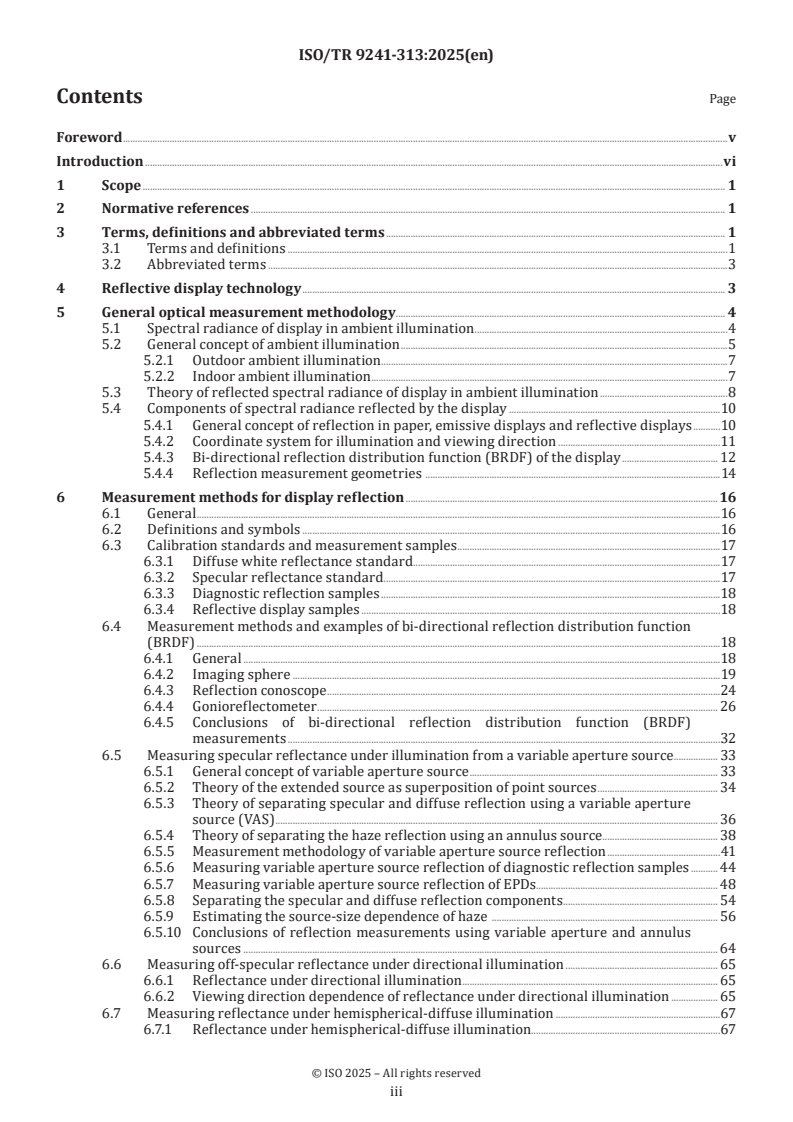
Contents Page
Foreword .v
Introduction .vi
1 Scope . 1
2 Normative references . 1
3 Terms, definitions and abbreviated terms . 1
3.1 Terms and definitions .1
3.2 Abbreviated terms .3
4 Reflective display technology . 3
5 General optical measurement methodology . 4
5.1 Spectral radiance of display in ambient illumination .4
5.2 General concept of ambient illumination .5
5.2.1 Outdoor ambient illumination . .7
5.2.2 Indoor ambient illumination .7
5.3 Theory of reflected spectral radiance of display in ambient illumination .8
5.4 Components of spectral radiance reflected by the display .10
5.4.1 General concept of reflection in paper, emissive displays and reflective displays .10
5.4.2 Coordinate system for illumination and viewing direction .11
5.4.3 Bi-directional reflection distribution function (BRDF) of the display . 12
5.4.4 Reflection measurement geometries .14
6 Measurement methods for display reflection .16
6.1 General .16
6.2 Definitions and symbols .16
6.3 Calibration standards and measurement samples .17
6.3.1 Diffuse white reflectance standard.17
6.3.2 Specular reflectance standard .17
6.3.3 Diagnostic reflection samples .18
6.3.4 Reflective display samples .18
6.4 Measurement methods and examples of bi-directional reflection distribution function
(BRDF) .18
6.4.1 General .18
6.4.2 Imaging sphere .19
6.4.3 Reflection conoscope .24
6.4.4 Gonioreflectometer . 26
6.4.5 Conclusions of bi-directional reflection distribution function (BRDF)
measurements .32
6.5 Measuring specular reflectance under illumination from a variable aperture source . 33
6.5.1 General concept of variable aperture source . 33
6.5.2 Theory of the extended source as superposition of point sources . 34
6.5.3 Theory of separating specular and diffuse reflection using a variable aperture
source (VAS) . 36
6.5.4 Theory of separating the haze reflection using an annulus source . . 38
6.5.5 Measurement methodology of variable aperture source reflection .41
6.5.6 Measuring variable aperture source reflection of diagnostic reflection samples . 44
6.5.7 Measuring variable aperture source reflection of EPDs. 48
6.5.8 Separating the specular and diffuse reflection components . 54
6.5.9 Estimating the source-size dependence of haze . 56
6.5.10 Conclusions of reflection measurements using variable aperture and annulus
sources . 64
6.6 Measuring off-specular reflectance under directional illumination . 65
6.6.1 Reflectance under directional illumination . 65
6.6.2 Viewing direction dependence of reflectance under directional illumination . 65
6.7 Measuring reflectance under hemispherical-diffuse illumination .67
6.7.1 Reflectance under hemispherical-diffuse illumination.67
iii
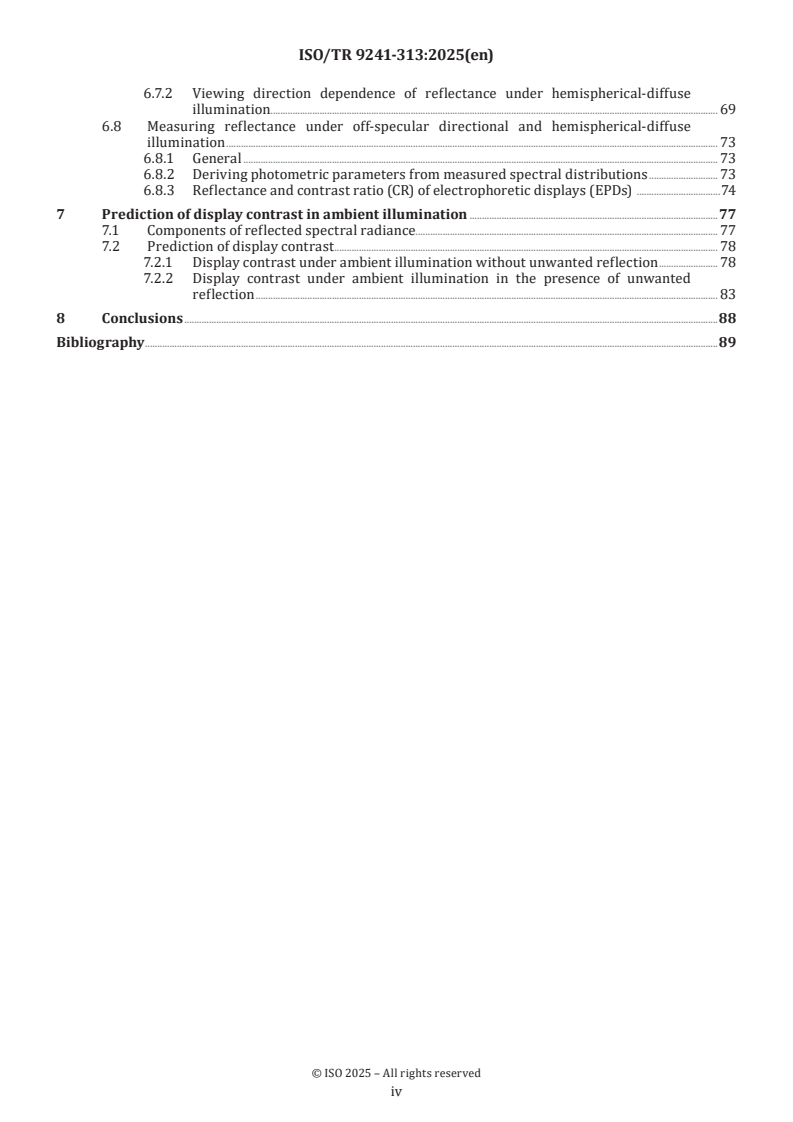
6.7.2 Viewing direction dependence of reflectance under hemispherical-diffuse
illumination. 69
6.8 Measuring reflectance under off-specular directional and hemispherical-diffuse
illumination . 73
6.8.1 General . 73
6.8.2 Deriving photometric parameters from measured spectral distributions . 73
6.8.3 Reflectance and contrast ratio (CR) of electrophoretic displays (EPDs) .74
7 Prediction of display contrast in ambient illumination .77
7.1 Components of reflected spectral radiance. 77
7.2 Prediction of display contrast . 78
7.2.1 Display contrast under ambient illumination without unwanted reflection . 78
7.2.2 Display contrast under ambient illumination in the presence of unwanted
reflection . 83
8 Conclusions .88
Bibliography .89
iv
Foreword
ISO (the International Organization for Standardization) is a worldwide federation of national standards
bodies (ISO member bodies). The work of preparing International Standards is normally carried out through
ISO technical committees. Each member body interested in a subject for which a technical committee
has been established has the right to be represented on that committee. International organizations,
governmental and non-governmental, in liaison with ISO, also take part in the work. ISO collaborates closely
with the International Electrotechnical Commission (IEC) on all matters of electrotechnical standardization.
The procedures used to develop this document and those intended for its further maintenance are described
in the ISO/IEC Directives, Part 1. In particular, the different approval criteria needed for the different types
of ISO document should be noted. This document was drafted in accordance with the editorial rules of the
ISO/IEC Directives, Part 2 (see www.iso.org/directives).
ISO draws attention to the possibility that the implementation of this document may involve the use of (a)
patent(s). ISO takes no position concerning the evidence, validity or applicability of any claimed patent
rights in respect thereof. As of the date of publication of this document, ISO had not received notice of (a)
patent(s) which may be required to implement this document. However, implementers are cautioned that
this may not represent the latest information, which may be obtained from the patent database available at
www.iso.org/patents. ISO shall not be held responsible for identifying any or all such patent rights.
Any trade name used in this document is information given for the convenience of users and does not
constitute an endorsement.
For an explanation of the voluntary nature of standards, the meaning of ISO specific terms and expressions
related to conformity assessment, as well as information about ISO's adherence to the World Trade
Organization (WTO) principles in the Technical Barriers to Trade (TBT), see www.iso.org/iso/foreword.html.
This document was prepared by Technical Committee ISO/TC 159, Ergonomics, Subcommittee SC 04,
Ergonomics of human-system interaction.
A list of all parts in the ISO 9241 series can be found on the ISO website.
Any feedback or questions on this document should be directed to the user’s national standards body. A
complete listing of these bodies can be found at www.iso.org/members.html.
v
Introduction
This document provides an overview of recent research on applying the optical reflection measurement
methodology for flat direct view electronic displays to electrophoretic displays (EPDs). This document
contributes background to ISO 9241-307, ISO 9241-305 and ISO 9241-303, providing information regarding
reflective displays in ambient indoor and outdoor illumination environments defined by CIE 015:2018, CIE
S017:2020, and ISO/CIE 11664-2:2022.
Reflective displays convey information by modulating the reflected light, using independently controlled
segments or pixels. Any reflective display performs the following two basic optical functions, either equally
for all wavelengths achromatically or for selective wavelengths chromatically:
— reflecting ambient illumination towards the human observer;
—modulating the amount and spectral distribution of the reflected light.
For example, EPDs use electrically charged pigments to reflect and modulate light. Opaque white pigments
with near-Lambertian reflection characteristics form the paper-like, diffuse reflecting background. Light-
absorbing black pigments attenuate the reflected light as traditional ink does on paper. These properties
differentiate EPDs from other display technologies by its paper-like appearance that offers a wide range of
viewing directions and sunlight readability. Other properties are low power consumption and the absence
of flicker. Other known reflective display technologies use reflectors with metallic, mirror or retroreflective
characteristics, combined with diffusers, achromatic reflection modulators (for example liquid crystal
shutters) and a colour filter array (CFA). EPDs are used in static and mobile applications including e-readers,
wearables and signage for both indoor and outdoor applications.
A reflective display must have ambient illumination for the displayed information to be visible. Ambient
illumination has directional and diffuse components. In outdoor environments, direct sunlight is the
directional component, and skylight the diffuse component. In indoor environments, the diffuse component
is dominant, e.g. diffuse daylight through windows and light is scattered by walls and ceiling. In addition,
specular reflection of light sources of various sizes (from small luminaires to large windows) has the
potential to obliterate the information on display screens. This document explains how to separately
measure the display’s reflection characteristics under specific measurement illumination conditions, e.g.
off-specular directional, hemispherical-diffuse, and specular variable aperture source (VAS) illumination.
The three fundamental reflection components (specular, haze, and Lambertian) are measured separately
and as a function of illumination source size. Once the reflection coefficients for each illumination geometry
are measured, the reflected luminance from each illumination component is determined, and the infinite
variety of ambient multi-source illumination is expressed as a summation of reflected illumination
components from these sources. The total spectral radiance entering the observer’s eye when viewing a
display is then predicted as a summation of all the ambient light components reflected into the direction of
viewing. The contributions from each source are scaled according to their irradiance spectra for specific in-
and outdoor illumination environments.
This document includes examples of standardized indoor and outdoor illumination conditions, and uses
EPDs to illustrate the measurement methods.
vi
Technical Report ISO/TR 9241-313:2025(en)
Ergonomics of human-system interaction —
Part 313:
Optical measurement methods for reflective displays
1 Scope
This document provides background information and a validated methodology for optical reflection
measurements for flat direct view electronic displays. This document includes calculation methods for using
measured reflection coefficients to predict display performance in specific indoor and outdoor ambient
illumination conditions.
This document demonstrates optical measurements of electrophoretic displays (EPDs), as a reflective
electronic visual display technology; many methods are also applicable to other appropriate reflective and
emissive displays. This document does not include a methodology for ergonomics evaluation.
2 Normative references
The following documents are referred to in the text in such a way that some or all of their content constitutes
requirements of this document. For dated references, only the edition cited applies. For undated references,
the latest edition of the referenced document (including any amendments) applies.
ISO 9241-302, Ergonomics of human-system interaction — Part 302: Terminology for electronic visual displays
ISO 9241-303, Ergonomics of human-system interaction — Part 303: Requirements for electronic visual displays
ISO 9241-305:2008, Ergonomics of human-system interaction — Part 305: Optical laboratory test methods for
electronic visual displays
3 Terms, definitions and abbreviated terms
3.1 Terms and definitions
For the purposes of this document, the terms and definitions given in ISO 9241-302, ISO 9241-303,
ISO 9241-305 and the following apply.
ISO and IEC maintain terminology databases for use in standardization at the following addresses:
— ISO Online browsing platform: available at https:// www .iso .org/ obp
— IEC Electropedia: available at https:// www .electropedia .org/
3.1.1
reflective display
electronic display device that modulates light from an external source by reflection, using independently
electronically controlled segments or pixels
Note 1 to entry: Any reflective display consists of at least two basic optical elements: reflector and reflection
modulator. The reflector reflects ambient light back towards the human observer; the reflection modulator changes
the reflectance either equally for all wavelengths for an achromatic display or in a spectrally selective manner for a
colour one.
Note 2 to entry: Information on reflective displays is only visible in ambient illumination.
3.1.2
electronic paper display
reflective display (3.1.1) having diffuse reflection characteristics with a wide range of viewing directions,
holding static information with no or low power consumption and without flicker
Note 1 to entry: In literature, the acronym EPD often stands for “electronic paper display” as well as for “electrophoretic
display.” In this document, EPD stands for electrophoretic display, not electronic paper display.
Note 2 to entry: There are many short forms for electronic paper display, including e-paper, electrophoretic ink,
electronic ink or e-ink. Any such short forms that are not clearly defined, refer to a specific technology or product, or
are proprietary or trademark-protected, are not used in this document.
3.1.3
electrophoretic display
EPD
electronic paper display (3.1.2) using electrically charged pigments to reflect and modulate light
Note 1 to entry: Opaque white pigments form the diffuse reflecting background for black or colour pigments that
absorb or spectrally attenuate reflected light in the same way as traditional ink on paper.
Note 2 to entry: This document reports measurement examples on electrophoretic display (EPD).
3.1.4
electronic reader
e-reader
handheld electronic device that uses an electronic paper display (3.1.2) in general, and an electrophoretic
display (3.1.3) in particular, to present visual information
3.1.5
emissive display
electronic display that modulates light by emission from an internal source, using independently
electronically controlled segments or pixels
Note 1 to entry: This light is either produced by the transducer itself or provided by one or more internal light source(s)
modulated by the transducer.
Note 2 to entry: Information on emissive displays is visible without ambient illumination, and reflected ambient
illumination is possibly disturbing to the viewing of emissive displays, see IEC 62977-2-2.
3.1.6
information-dependent reflection
reflection off a reflective display (3.1.1) that is modulated according to the visual information to be displayed
Note 1 to entry: This is also referred to as information-dependent reflection or visual information.
3.1.7
unwanted reflection
reflection off a reflective display (3.1.1) that is not modulated according to the visual information to be
displayed
Note 1 to entry: This is also referred to as information-independent reflection.
Note 2 to entry: Examples are reflections from the first surface of the display device.
Note 3 to entry: Specular reflections of ambient light sources (luminaires, lamps, windows, etc.) on a display screen
are unwanted reflections. They reduce the contrast and thus the legibility of displayed information. Often, they are
the cause of glare, leading to discomfort or inability to recognize the information for the user, see ISO 9241-305: 2008,
5.4.11, and CIE S017:2020.
3.1.8
contrast under ambient illumination
contrast of a reflective display (3.1.1) where both hemispherical-diffuse and directional illumination are
incident to its surface at defined geometry, illumination spectra, and illumination levels that simulate a
realistic lighting environment
3.2 Abbreviated terms
For the purposes of this document, the following abbreviated terms apply.
1-D one-dimensional
2-D two-dimensional
AG anti-glare
B&W black-and-white
BRDF bi-directional reflection distribution function
BSDF bi-directional scattering distribution function
CCD charge-coupled device
CFA colour filter array
CR contrast ratio
DUT display under test
EPD electrophoretic display
IR illuminance ratio
LCD liquid crystal display
LED light-emitting diode
LMD light measuring device
OFT optical Fourier transform
PSF point spread function
VAS variable aperture source
4 Reflective display technology
Reflective displays convey information by modulating the amount and spectral distribution of reflected light.
For displaying information, the display area is divided into independent electronically-controlled segments
(for text) or pixels (for graphics and images). Any reflective display performs two basic optical functions:
reflecting ambient illumination, and modulating the amount and spectral distribution of the reflected light.
The optical characteristics of ambient light reflections determine the appearance of the reflective display. In
order to mimic paper, the display background is white. For this, its reflection is as high as possible, spectrally
uniform, and diffuse with a near-Lambertian scatter characteristic (independent of viewing direction).
The optical characteristics of the reflected light modulation determine whether the viewer sees achromatic
or colour information. Modulators attenuate (subtract from) the reflected light within the visible part of the
spectrum (approximately 380 nm to 730 nm). In an achromatic display, the modulator subtracts light about
equally for all wavelengths; in a colour display, the subtraction is wavelength-selective.
The various reflective display technologies use different means to reflect and modulate ambient light as
[7]
much and as effectively as possible:
EPDs use electrically charged pigments to reflect and modulate light. Opaque white pigments with paper-
like (Lambertian) reflection characteristics form the white background in which contrasting black or colour
pigments are used that absorb or spectrally attenuate reflected light in the same way as traditional ink on
[8]
paper. Diffuse white reflection ensures paper-like appearance over a wide range of viewing directions.
EPDs are preferred in electronic paper due to their paper-like optical characteristics, combined with low
power consumption and the absence of flicker. They are suited to a wide range of stationary and mobile
applications including e-readers, wearables, signage, and are used in indoor and outdoor environments
where readability in ambient lighting is critical. The measurement examples in this document are confined
to EPD for their widespread use as electronic reading devices.
Other reflective display and electronic paper technologies include gain reflectors, such as mirrors or
retroreflectors, combined with diffusers to improve viewing direction range. Some technologies switch
reflection by using liquid crystal shutters or electrophoretic nanoparticles that disrupt retroreflection, and
use CFAs to colour the reflected light. Electrowetting colour displays have three layers of light switching
cells (cyan, magenta, and yellow) in front of a reflector. Others combine the functions of reflector and
spectral modulators into “colour-changing mirrors” i.e. mirror-like reflectors that colour the reflected light
(phase-changing, electrochromic, or interferometric devices).
Both reflector and modulator of the display are responsible for the information-dependent reflection. For
the background to have the maximum possible luminance, the display is expected to reflect as much incident
light as possible. An ideal white diffuse reflector has a diffuse reflectance of close to 100 %. Mirror reflectors
and retroreflectors have a higher reflectance compared to a diffuse reflector but only within a narrow range
of viewing directions. Even if an efficient reflector is achieved, unwanted reflections (perceived as glare)
will change the display white, and reduce contrast and colour modulation. A variety of sources potentially
degrade these visual attributes. Surface reflection is specular or diffuse (haze), depending on whether the
display has a glossy or a matte anti-glare (AG) surface. Optical losses come from reflection and scatter at
internal optical interfaces. Transparency and aperture ratio of optical layers above the reflector (for example
liquid crystal shutters and CFA) reduce the incident light on the inbound pass then, after reflection, again on
the outbound path. The aperture ratio or effective pixel area is defined as the ratio of the optically active
area to that of the total pixel area. The optical properties of the reflective display’s layer structure and its
surface differentiate electronic paper from printed paper.
NOTE Not even printed paper is free of disturbing reflection when it has a glossy surface called “coated paper”
that is otherwise preferred for its better colour reproduction.
5 General optical measurement methodology
5.1 Spectral radiance of display in ambient illumination
Although reflective displays have become widely used in e-readers, the development of appropriate optical
measurement methods has not kept pace. Users of e-readers compare them to not only emissive tablet
displays, but also to printed materials. Optical measurement standards exist for emissive electronic displays
and conventional printing on paper, for example the measurement standards issued by IEC on liquid crystal
displays (LCD), and specifications for conventional printing on paper, for example the Specifications for
Newsprint Advertising Production (SNAP) and the Specifications for Web Offset Printing (SWOP). Standards
covering these topics are not suitable for reflective displays because of the fundamentally different ways
that ambient illumination affects the information displayed on emissive displays, reflective displays, and
printed paper.
— Emissive displays show information by modulating the emitted light. Reflected ambient light is
always disturbing as it adds background noise to the desired emissive signal. Therefore, the optical
characteristics of emissive displays are measured in a darkroom. Ambient light is only of interest when
1)
determining the effect of unwanted reflections . The measurement of emissive display characteristics
under ambient light is addressed in IEC 62977-2-2.
— Reflective displays modulate ambient light to show information. Information on reflective displays is
only visible in ambient illumination, but direct reflection of the illumination source is perceived as glare.
Whether the reflection is information-dependent or unwanted will depend on the illumination and
viewing geometry. Therefore, reflection measurements differentiate between information-dependent
and unwanted reflection in order to separate one from the other. Information-dependent reflection
[9]
is measured with the exclusion of unwanted reflection. In practice, handheld mobile display users
automatically do this by tilting their displays to avoid unwanted reflection. In some cases, unwanted
reflection is measured for applications such as signage where it is unavoidable. Therefore, measurement
[10]
illumination for reflective displays has specific spectral distribution and geometry.
— Print paper with a matte surface (office print paper, newsprint) exhibits efficient Lambertian scatter of
incident light. If the surface is matte, contrast is maintained over a wide range of viewing angles, and
there is no glare from specular reflection. Glossy surfaces of coated paper (magazine print) are not free
of glare.
The recognition of these differences between emissive displays, reflective displays and printed paper
resulted in the development of a measurement standard for electronic paper displays IEC 62679-3-1:2014.
Optical characterization, as specified in these documents, requires the following steps:
a) identifying the fundamental components of ambient illumination, then specifying the geometry,
illumination levels and spectra for each illumination component;
b) identifying the fundamental components of information-dependent and unwanted reflection, then
specifying the measurement methods for each reflection component;
c) estimating the total spectral radiance of the display in ambient illumination conditions as the sum of its
reflective components.
From the total spectral display radiance, the complete photometric and colorimetric properties of the
display under multi-source illumination are determined.
5.2 General concept of ambient illumination
Ambient illumination comes from many sources, each with its own spectral distribution, angular
distribution, and direction of incidence to a display. Users in general view reflective displays in both
indoor and outdoor lighting environments as shown in Figure 1. Viewers of handheld screens tend to avoid
unwanted reflections. Reflection measurement specifications made in IEC 62679-3-1 specify measurements
that exclude unwanted reflections as well as measurements that include reflected components that are not
modulated (e.g. front surface reflections).
1) For example, ISO 9241-305 specifies viewing requirements for emissive desktop displays in an office environment
where glare, caused by unwanted reflections of windows, light sources, or brightly illuminated objects, is present.
ISO 9241-307 explains that display and lighting design can minimize disturbing reflection to satisfy minimum contrast
requirements.
Key
1 sun
2 sky
3 display
4 display viewer
Figure 1 — Outdoor ambient illumination environment for display viewing
The ISO 9241-300 series in general specifies the viewing requirements for emissive displays in an indoor
work environment. Ambient indoor illumination is potentially disturbing, i.e. liable to cause glare to be
controlled and its effect minimized. ISO 9241-307 distinguishes between a diffuse background illuminance
(“design screen illuminance”, specified in lux), and those light sources with specified source aperture angles,
luminance and CIE illuminant spectra that potentially cause unwanted reflections (see ISO 9241-305:2008,
5.2.4 and 5.4.11, ISO 9241-307, CIE 015:2018, CIE S017:2020 and ISO/CIE 11664-2:2022.). For reflective
displays, the design screen illuminance is considered as useful workplace illumination to view reflective
displays, for which illumination geometry and spectra are specified. Depending on the illumination
geometry (not specified in ISO 9241-307), large and small aperture sources either provide illumination for
information-dependent reflection or cause glare from unwanted reflection.
Key
1 e-reader with an EPD screen
2 directed illumination from the sun
3 hemispherical-diffuse illumination of scattered light
4 directed illumination from a desk lamp
Figure 2 — Reflective display in an ambient illumination environment
Figure 2 shows the example of an e-reader with an EPD screen in an indoor illumination environment
near a window. It receives directed illumination from the sun (through window) and a desk lamp, plus
hemispherical-diffuse illumination of scattered light. Due to its illumination and viewing geometry, the desk
lamp illumination causes both information-dependent and unwanted reflections (in a limited area of the
display).
5.2.1 Outdoor ambient illumination
For outdoor illumination, it is assumed that under clear sky conditions, daylight is characterized by the
simultaneous illumination from two light sources, directional sunlight and hemispherical-diffuse skylight
[10],[12]
(blue sky). The amount and direction of the illumination at the display surface is dependent on the
display orientation, and the sun’s altitude and azimuth. From the innumerable possible combinations,
IEC 62679-3-1 establishes a reference outdoor lighting geometry with the display screen in vertical
orientation and the sun in front of the display, inclined at 45° to the display normal direction. Based on data
[13]
from IESNA and ASTM G197-08, the reference daylight illumination conditions are defined as illuminance
[11]
of directional sunlight E (λ) with an approximate CIE standard illuminant D50, and of hemispherical
s,dir
[4]
skylight E (λ) approximating a CIE illuminant D75, see Table 1.
s,hemi
Table 1 — IEC 62679-3-1:2014 reference outdoor illumination
CIE standard illuminants [ISO/CIE
Illumination geometry Illuminance E [lx] 11664-2:2022] and CIE illuminant
s
[CIE 015:2018]
Directional E 65 000 D50 (D65)
s,dir
Hemispherical-diffuse E 15 000 D75 (D65)
s,hemi
ISO 9241-307:2008, C.2.3 includes specifications for outdoor illumination, see Table 2. Outdoor illumination
is specified by the design screen illuminance E , and the luminance of overcast and clear sky or sun,
s
approximated by large (15°) or small (1°) aperture sources. However, the illuminance range is larger than
that specified in IEC 62679-3-1 for reflective displays; the reflected display luminance under 1 lx illumination
is too low for reading. The specifications do not include hemispherical-diffuse sources, the inclinations of
the aperture sources, or illumination spectra.
Table 2 — ISO 9241-307:2008 reference outdoor illumination
Luminance
CIE standard illumi-
Illuminance E [lx] nant [ISO/CIE 11664-
Source luminance
s
Luminous object Geometry
2 2:2022]
L [cd/m ]
s
Overcast sky 2 000
Large aperture
source
Approximately
Clear sky 8 000
D65
1 lx ≤ E ≤ 10 lx
s
Small aperture
Sun 10
source
5.2.2 Indoor ambient illumination
[10]
For indoor illumination the following assumption is made: although the illumination conditions
for indoor lighting environments are varied, they are generally comprised of hemispherical-diffuse
illumination and multiple directional light sources. Indoor illumination has directional components from
artificial light sources and a diffuse component from background illumination scattered by interior walls
and ceiling, fixtures and fittings. This includes daylight coming through windows. In addition, the display
reflects brightly illuminated objects in its environment. One study on indoor illumination at cities around
[15]
the world measured the average spectral distribution over the course of one year. Spectral data in that
study indicate that indoor illumination approximated D50, dominated by diffuse illumination through
windows. Further measurements and modelling indicate a combination of 60 % diffuse illumination and
40 % directed in window-exposed indoor environments. These illumination conditions are specified
as the IEC 62679-3-1:2014 reference indoor illumination conditions shown in Table 3, with CIE standard
illuminants to be chosen to approximate actual indoor illumination environments. Other illuminance levels
and spectra are also chosen to represent specific indoor usage environments.
Table 3 — IEC 62679-3-1:2014 reference indoor illumination
CIE standard illuminants [ISO/CIE
Illumination geometry Illuminance [lx]
11664-2:2022]
Directional E 200 A (D65, D50)
s,dir
Hemispherical-diffuse E 300 D65 (D50, A)
s,hemi
ISO 9241-307:2008 specifies indoor illumination for office and other indoor viewing environments by the
design screen illuminance E , and the luminance of typical components of the illumination represented
s
by the luminance of the large (15°) aperture source L and the luminance of the small (1°) aperture
ref,ext
source L . Table 4 shows indoor illumination specifications for emissive, reflective and transflective
ref,sml
LCD for handheld devices at indoor locations (as specified in ISO 9241-307:2008, Table 167). The design
screen illuminance is the “luminous environment to the screen that contributes to its luminance and colour;
therefore, the contrast on the screen is changed by the luminous environment.” For reflective displays,
the reflection of the design screen illuminance is considered useful because ISO 9241-305:2008, 5.2 states
that “for reflective displays such as paper, contrast on the display screen is even caused by the luminous
environment.” For indoor viewing, the design screen illuminance ranges from 50 lx to 5 000 lx, with other
levels for specific building and work areas (ISO 9241-307:2008, Table 167). ISO 9241-305 and ISO 9241-307
distinguish between a luminance component reflected from diffuse illumination and a luminance
component specularly reflected from either a large (15°) or small (1°) aperture source of illumination. Both
measurements are combined to calculate the contrast of unwanted specular reflections that competes
with the text or other information generated by the display. The spectral distribution of these illumination
[10]
components is not specified.
Table 4 — ISO 9241-307:2008 reference indoor illumination
Source luminance CIE standard
illuminants
[ISO/CIE
Design screen illu-
11664-2:2022]
Large aperture source Small aperture source
minance E [lx]
Environment
s
and CIE illu-
2 2
L [cd/m ] L [cd/m ]
ref,ext ref,sml
minants [CIE
015:2018]
General office 200 2 000
50 lx ≤ E ≤ 5 000
s
A, D65, FL11
lx (see ISO 9241-
Controlled environ-
and FL12
125 200
307:2008, Table 167)
ment
5.3 Theory of reflected spectral radiance of display in ambient illumination
Reflected spectral radiance L(λ, θ ) indicates how much of the ambient illumination reflected by the display
d
will be received at the human eye viewing that display from a specified direction θ . The human observer
d
perceives the spectral radiance as lightness and colour information. The spectral radiance of ambient light
reflected from the display to the eye depends on both the source-detector geometry and the reflection
properties of the display in that geometry. The reflection of ambient light is either diffuse or specular, and,
depending on the reflection geometry, is either information-dependent or unwanted. The total ambient
spectral radiance of a display set to a colour state Q measured by a light measuring device (LMD) from a
defined viewing direction θ is expressed in Formula (1).
d
LL()λθ, = ()λλ+L () (1)
QT,,dQ dif Qs, pec
where
L (λ, θ ) is the total ambient spectral radiance of a display set to a colour state Q measured from a
Q,T d
-1 -2 -1
defined viewing direction θ , in W sr m nm ;
d
-1 -2 -1
L (λ) is the spectral radiance from diffuse reflection, in W sr m nm ;
Q,dif
-1 -2 -1
L (λ) is the spectral radiance from specular reflection, in W sr m nm .
Q,spec
Depending on the display technology, diffuse and specular reflections can each be information-dependent
or unwanted, i.e. modulated by the input signal corresponding to the display colour Q or not. For example, a
reflective display with a Lambertian reflector will modulate L (λ). Or, in a different example, a reflective
Q,dif
display with colour-changing mirror-like reflectors will modulate L (λ).
Q,spec
Ambient lighting is often composed of multiple incoherent sources, each with its own directional or
hemispherical-diffuse illumination geometry. Thus the reflection of light off a display is treated as the linear
spectral response system shown in Formula (2):
E
s1
1
LR= RR ··E +ζ L (2)
[]
Tn12 s2 s
π
E
sn
where
-1 -2 -1
L is the total ambient spectral radiance of a display, in W sr m nm ;
T
th
R is the spectral reflectio
...