

ISO 17651-3:2026
(Main)Simultaneous interpreting — Interpreters’ working environment — Part 3: Requirements and recommendations for interpreting hubs
General Information
- Abstract
This document specifies requirements and provides recommendations for the design, equipment and operation of interpreting hubs for simultaneous interpreting. This document also ensures the usability and accessibility of interpreting hubs for all interpreters. This document builds upon ISO 20109 and ISO 24019, which both contain requirements and recommendations regarding the equipment necessary for simultaneous interpreting.
- Status
- Published
- Publication Date
- 02-Mar-2026
- Technical Committee
- ISO/TC 37/SC 5 - Translation, interpreting and related technology
- Drafting Committee
- ISO/TC 37/SC 5 - Translation, interpreting and related technology
- Current Stage
- 6060 - International Standard published
- Start Date
- 03-Mar-2026
- Due Date
- 02-May-2026
- Completion Date
- 03-Mar-2026
Buy Documents

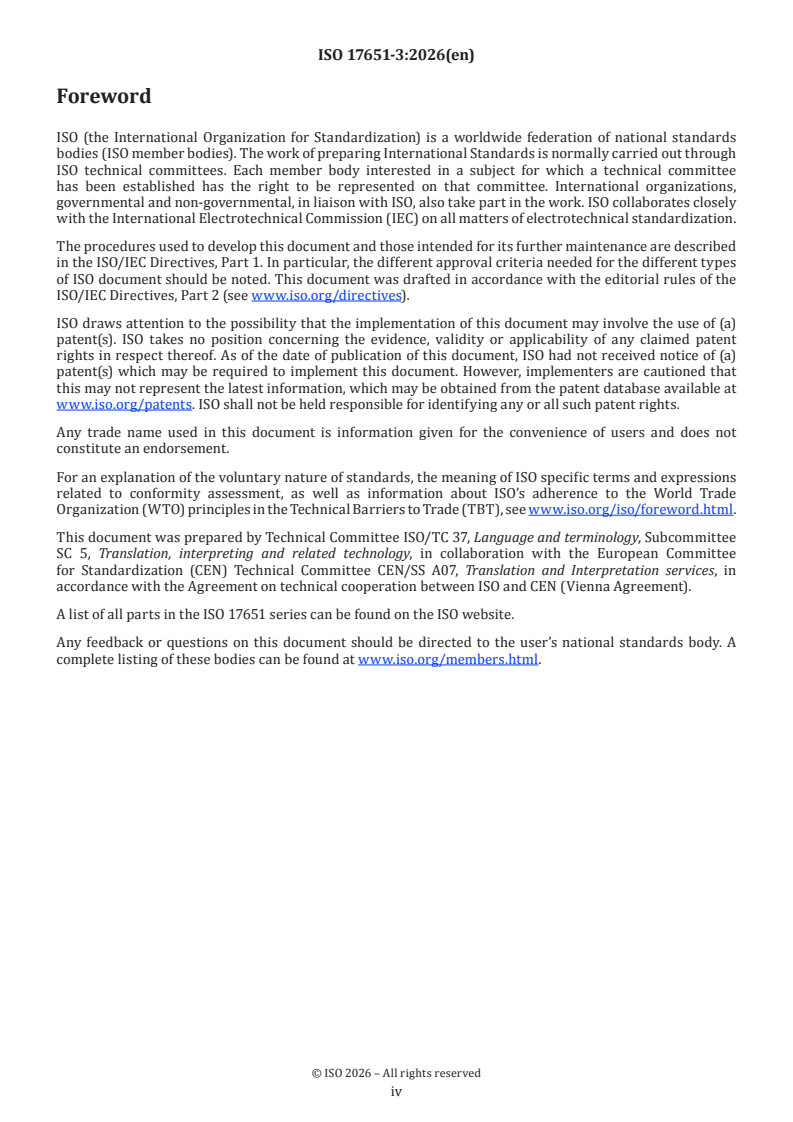
ISO 17651-3:2026 - Simultaneous interpreting — Interpreters’ working environment — Part 3: Requirements and recommendations for interpreting hubs
ISO 17651-3:2026 - Interprétation simultanée — Environnement de travail des interprètes — Partie 3: Exigences et recommandations pour les hubs d’interprétation
Overview
ISO 17651-3:2026 sets out the requirements and recommendations for the design, equipment, and operation of interpreting hubs used for simultaneous interpreting. This international standard issued by ISO aims to ensure that interpreting hubs are both usable and accessible for all interpreters, regardless of physical ability or modality (spoken or signed language). The document addresses both purpose-built and ad hoc interpreting hubs, including technical infrastructure, workspace ergonomics, and the provision of support and amenities for interpreters.
Drawing upon previous standards such as ISO 20109 (simultaneous interpreting equipment) and ISO 24019 (interpreting delivery platforms), ISO 17651-3 delivers a comprehensive framework to facilitate high-quality, efficient, and accessible simultaneous interpreting in remote and hybrid settings.
Keywords: simultaneous interpreting, interpreting hub, interpreter working environment, interpreting equipment, accessibility, ISO standard, remote interpreting.
Key Topics
Facilities and Workspace Requirements
- Criteria for siting, layout, and accessibility of interpreting hubs
- Separate recommendations for both purpose-built and ad hoc hubs
- Collaboration between technical experts, interpreters, and accessibility consultants in design and operation
Booth Specifications
- Guidelines for both spoken and signed language hub booths
- Requirements related to space, acoustics, lighting, ventilation, and sound insulation
- Emphasis on visual comfort, including window size, daylight standards, and visibility among interpreter teams
Information Technology Infrastructure
- Stipulations concerning redundant internet connections, power backup, and wired LAN connectivity
- Security measures to ensure confidentiality and data protection during events
- Centralized technical control by support staff for quality assurance
Interpreting Equipment
- Compliance with ISO 20109 for hardware and ISO 24019 for software platforms
- Accessible controls and accommodations for interpreters with visual impairments or other disabilities
- Standards for microphones, headphones, headsets, and video displays
Image and Audio Content
- Provision of clear, high-quality images and audio of speakers and visual materials
- Special requirements for signed language interpreting, ensuring the full visibility of hand and facial expressions
- Recommendations for display sizing and positioning to reduce eye strain and cognitive load
Support and Amenities
- On-site technical support staff for immediate troubleshooting
- Provision of rest areas, easy access to toilets, and water facilities for interpreters
Applications
ISO 17651-3:2026 is essential for any organization or venue planning to host multilingual events with simultaneous interpreting-especially where interpreters work remotely or where physical booths lack direct line-of-sight to event proceedings. Typical applications include:
- International organizations, conferences, and summits
- Distance and hybrid meetings requiring multilingual communication
- Broadcasters and media companies offering live translated content
- Event planning companies and interpreting service providers establishing interpreting hubs
- Facilities managers ensuring accessibility and technical compliance for interpreters
Implementing this standard helps to:
- Guarantee consistent-quality interpreting services
- Improve comfort, safety, and accessibility for interpreters
- Enhance audio-visual quality and minimize disruption or technical failures during events
- Meet legal and organizational requirements for accessibility and inclusion
Related Standards
For comprehensive compliance and interoperability, the following standards are directly referenced or complement ISO 17651-3:2026:
- ISO 20109: Simultaneous interpreting - Equipment - Requirements
- ISO 24019: Simultaneous interpreting delivery platforms - Requirements and recommendations
- ISO 17651-1: Simultaneous interpreting - Permanent booths
- ISO 17651-2: Simultaneous interpreting - Mobile booths
- ISO 17651-4: Simultaneous interpreting - Signed language interpreting (under development)
- ISO 21542: Accessibility and usability of the built environment
- ISO 9241-303: Ergonomics of human-system interaction - Electronic visual displays
- ISO 16283-1: Acoustics - Airborne sound insulation
Adhering to ISO 17651-3 in combination with these related standards will ensure a professional, robust, and future-proof simultaneous interpreting environment.
Relations
- Effective Date
- 12-Feb-2026
- Effective Date
- 08-Oct-2022
Buy Documents
ISO 17651-3:2026 - Simultaneous interpreting — Interpreters’ working environment — Part 3: Requirements and recommendations for interpreting hubs
ISO 17651-3:2026 - Interprétation simultanée — Environnement de travail des interprètes — Partie 3: Exigences et recommandations pour les hubs d’interprétation
Get Certified
Connect with accredited certification bodies for this standard

DIBt (Deutsches Institut für Bautechnik)
German Institute for Building Technology.
DIN CERTCO
DIN Group product certification.

Aboma Certification B.V.
Specialized in construction, metal, and transport sectors.
Sponsored listings
Frequently Asked Questions
ISO 17651-3:2026 is a standard published by the International Organization for Standardization (ISO). Its full title is "Simultaneous interpreting — Interpreters’ working environment — Part 3: Requirements and recommendations for interpreting hubs". This standard covers: This document specifies requirements and provides recommendations for the design, equipment and operation of interpreting hubs for simultaneous interpreting. This document also ensures the usability and accessibility of interpreting hubs for all interpreters. This document builds upon ISO 20109 and ISO 24019, which both contain requirements and recommendations regarding the equipment necessary for simultaneous interpreting.
This document specifies requirements and provides recommendations for the design, equipment and operation of interpreting hubs for simultaneous interpreting. This document also ensures the usability and accessibility of interpreting hubs for all interpreters. This document builds upon ISO 20109 and ISO 24019, which both contain requirements and recommendations regarding the equipment necessary for simultaneous interpreting.
ISO 17651-3:2026 is classified under the following ICS (International Classification for Standards) categories: 91.040.10 - Public buildings. The ICS classification helps identify the subject area and facilitates finding related standards.
ISO 17651-3:2026 has the following relationships with other standards: It is inter standard links to EN ISO 17651-3:2026, ISO 6363-1:2022. Understanding these relationships helps ensure you are using the most current and applicable version of the standard.
ISO 17651-3:2026 is available in PDF format for immediate download after purchase. The document can be added to your cart and obtained through the secure checkout process. Digital delivery ensures instant access to the complete standard document.
Standards Content (Sample)
International
Standard
ISO 17651-3
First edition
Simultaneous interpreting —
2026-03
Interpreters’ working
environment —
Part 3:
Requirements and
recommendations for interpreting
hubs
Interprétation simultanée — Environnement de travail des
interprètes —
Partie 3: Exigences et recommandations pour les hubs
d’interprétation
Reference number
© ISO 2026
All rights reserved. Unless otherwise specified, or required in the context of its implementation, no part of this publication may
be reproduced or utilized otherwise in any form or by any means, electronic or mechanical, including photocopying, or posting on
the internet or an intranet, without prior written permission. Permission can be requested from either ISO at the address below
or ISO’s member body in the country of the requester.
ISO copyright office
CP 401 • Ch. de Blandonnet 8
CH-1214 Vernier, Geneva
Phone: +41 22 749 01 11
Email: copyright@iso.org
Website: www.iso.org
Published in Switzerland
ii
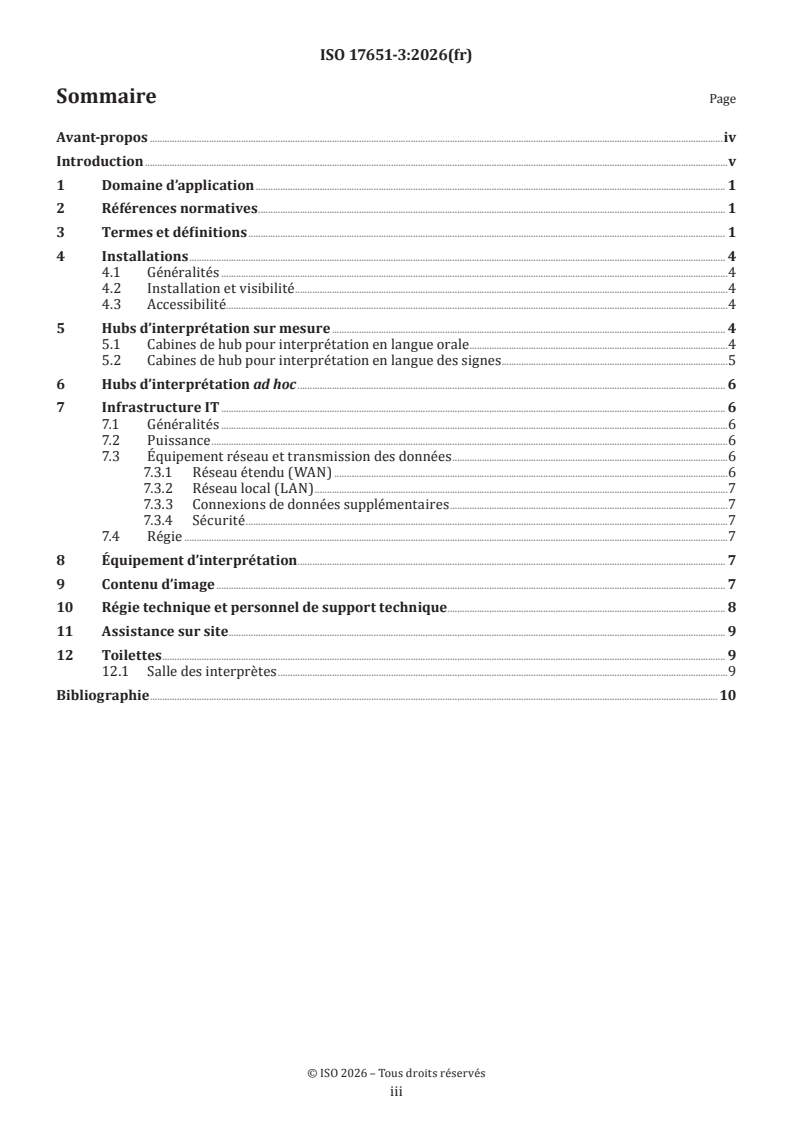
Contents Page
Foreword .iv
Introduction .v
1 Scope . 1
2 Normative references . 1
3 Terms and definitions . 1
4 Facilities . 4
4.1 General .4
4.2 Siting and visibility .4
4.3 Accessibility .4
5 Purpose-built interpreting hubs . 4
5.1 Spoken language hub booths .4
5.2 Signed language hub booths .5
6 Ad hoc interpreting hubs . 5
7 IT infrastructure . 6
7.1 General .6
7.2 Power .6
7.3 Network equipment and data transmission.6
7.3.1 Wide area network (WAN) .6
7.3.2 Local area network (LAN) .6
7.3.3 Additional data connections .6
7.3.4 Security . . .7
7.4 Control .7
8 Interpreting equipment . 7
9 Image content . 7
10 Technical control and technical support staff . 8
11 On-site assistance . 8
12 Amenities for interpreters . 8
12.1 Toilets .8
12.2 Interpreters’ room .8
Bibliography . 9
iii
Foreword
ISO (the International Organization for Standardization) is a worldwide federation of national standards
bodies (ISO member bodies). The work of preparing International Standards is normally carried out through
ISO technical committees. Each member body interested in a subject for which a technical committee
has been established has the right to be represented on that committee. International organizations,
governmental and non-governmental, in liaison with ISO, also take part in the work. ISO collaborates closely
with the International Electrotechnical Commission (IEC) on all matters of electrotechnical standardization.
The procedures used to develop this document and those intended for its further maintenance are described
in the ISO/IEC Directives, Part 1. In particular, the different approval criteria needed for the different types
of ISO document should be noted. This document was drafted in accordance with the editorial rules of the
ISO/IEC Directives, Part 2 (see www.iso.org/directives).
ISO draws attention to the possibility that the implementation of this document may involve the use of (a)
patent(s). ISO takes no position concerning the evidence, validity or applicability of any claimed patent
rights in respect thereof. As of the date of publication of this document, ISO had not received notice of (a)
patent(s) which may be required to implement this document. However, implementers are cautioned that
this may not represent the latest information, which may be obtained from the patent database available at
www.iso.org/patents. ISO shall not be held responsible for identifying any or all such patent rights.
Any trade name used in this document is information given for the convenience of users and does not
constitute an endorsement.
For an explanation of the voluntary nature of standards, the meaning of ISO specific terms and expressions
related to conformity assessment, as well as information about ISO’s adherence to the World Trade
Organization (WTO) principles in the Technical Barriers to Trade (TBT), see www.iso.org/iso/foreword.html.
This document was prepared by Technical Committee ISO/TC 37, Language and terminology, Subcommittee
SC 5, Translation, interpreting and related technology, in collaboration with the European Committee
for Standardization (CEN) Technical Committee CEN/SS A07, Translation and Interpretation services, in
accordance with the Agreement on technical cooperation between ISO and CEN (Vienna Agreement).
A list of all parts in the ISO 17651 series can be found on the ISO website.
Any feedback or questions on this document should be directed to the user’s national standards body. A
complete listing of these bodies can be found at www.iso.org/members.html.
iv
Introduction
In light of the surge in distance interpreting, new working environments for simultaneous interpreting have
developed.
This document concerns purpose-built and ad hoc interpreting hubs which allow interpreters to provide
simultaneous interpreting when they are at a location other than that of all participants of a communicative
event without a direct view of the proceedings and where technical support is provided.
Interpreting is an activity that requires high levels of concentration; therefore, the working environment
should minimize factors which add to cognitive load.
This document addresses the following:
a) distinct workplace requirements as compared to booths with a direct view of the communicative event;
b) dedicated information and communication technology (ICT) infrastructure and technical control;
c) communication between interpreters, and between interpreters and technical support staff.
This document complements ISO 17651-1, ISO 17651-2 and ISO 17651-4.
v
International Standard ISO 17651-3:2026(en)
Simultaneous interpreting — Interpreters’ working
environment —
Part 3:
Requirements and recommendations for interpreting hubs
1 Scope
This document specifies requirements and provides recommendations for the design, equipment and
operation of interpreting hubs for simultaneous interpreting. This document also ensures the usability and
accessibility of interpreting hubs for all interpreters.
This document builds upon ISO 20109 and ISO 24019, which both contain requirements and recommendations
regarding the equipment necessary for simultaneous interpreting.
2 Normative references
The following documents are referred to in the text in such a way that some or all of their content constitutes
requirements of this document. For dated references, only the edition cited applies. For undated references,
the latest edition of the referenced document (including any amendments) applies.
ISO 9241-303, Ergonomics of human-system interaction — Part 303: Requirements for electronic visual displays
ISO 16283-1, Acoustics — Field measurement of sound insulation in buildings and of building elements — Part 1:
Airborne sound insulation
ISO 17651-1:2024, Simultaneous interpreting — Interpreters’ working environment — Part 1: Requirements
and recommendations for permanent booths
ISO 17651-2, Simultaneous interpreting — Interpreters’ working environment — Part 2: Requirements and
recommendations for mobile booths
1)
ISO 17651-4:— , Simultaneous interpreting — Interpreters’ working environment — Part 4: Requirements and
recommendations for signed language interpreting
ISO 20109:2025, Simultaneous interpreting — Equipment — Requirements
ISO 21542, Building construction — Accessibility and usability of the built environment
ISO 24019, Simultaneous interpreting delivery platforms — Requirements and recommendations
EN 17037:2018+A1:2021, Daylight in buildings
3 Terms and definitions
For the purposes of this document, the following terms and definitions apply.
ISO and IEC maintain terminology databases for use in standardization at the following addresses:
— ISO Online browsing platform: available at https:// www .iso .org/ obp
1) Under preparation. Stage at the time of publication: ISO/DIS 17651-4:2026.
— IEC Electropedia: available at https:// www .electropedia .org/
3.1
interpreter
person who interprets
[SOURCE: ISO 20539:2023, 3.1.13]
3.2
interpreting
interpretation
rendering spoken or signed information from a source language into a target language in spoken or signed
form, conveying both the meaning and language register of the source language content
[SOURCE: ISO 20539:2023, 3.1.11]
3.3
simultaneous interpreting
mode of interpreting (3.2) performed while a speaker or signer is still speaking or signing
[SOURCE: ISO 20539:2023, 3.4.12]
3.4
signed language interpreting
interpreting (3.2) between two signed languages or between a signed language and a spoken language
[SOURCE: ISO 20539:2023, 3.4.3]
3.5
distance interpreting
remote interpreting
interpreting (3.2) of a speaker or signer in a different location from that of the interpreter (3.1), enabled by
information and communications technology
[SOURCE: ISO 20539:2023, 3.4.16]
3.6
simultaneous interpreting delivery platform
SIDP
virtual environment used in simultaneous interpreting (3.3) for managing the processing of audio and video
signals during the transmission of information from speakers or signers to distant interpreters (3.1) and the
interpreters’ renditions to a distant audience
[SOURCE: ISO 20539:2023, 3.5.2.7]
3.7
booth
simultaneous interpreting booth
self-contained unit enclosing the interpreter’s (3.1) workspace
Note 1 to entry: One of the purposes of booths is to provide insulation, both from the noise transmitted from the
booth’s external environment into the booth itself and vice versa, and from noise passing from one booth to another.
[SOURCE: ISO 20539:2023, 3.5.2.1]
3.8
permanent booth
permanent simultaneous interpreting booth
booth (3.7) structurally integrated into a facility
[SOURCE: ISO 20539:2023, 3.5.2.2]
...
Norme
internationale
ISO 17651-3
Première édition
Interprétation simultanée —
2026-03
Environnement de travail des
interprètes —
Partie 3:
Exigences et recommandations
pour les hubs d’interprétation
Simultaneous interpreting — Interpreters’ working
environment —
Part 3: Requirements and recommendations for interpreting hubs
Numéro de référence
DOCUMENT PROTÉGÉ PAR COPYRIGHT
© ISO 2026
Tous droits réservés. Sauf prescription différente ou nécessité dans le contexte de sa mise en œuvre, aucune partie de cette
publication ne peut être reproduite ni utilisée sous quelque forme que ce soit et par aucun procédé, électronique ou mécanique,
y compris la photocopie, ou la diffusion sur l’internet ou sur un intranet, sans autorisation écrite préalable. Une autorisation peut
être demandée à l’ISO à l’adresse ci-après ou au comité membre de l’ISO dans le pays du demandeur.
ISO copyright office
Case postale 401 • Ch. de Blandonnet 8
CH-1214 Vernier, Genève
Tél.: +41 22 749 01 11
E-mail: copyright@iso.org
Web: www.iso.org
Publié en Suisse
ii
Sommaire Page
Avant-propos .iv
Introduction .v
1 Domaine d’application . 1
2 Références normatives . 1
3 Termes et définitions . 1
4 Installations . 4
4.1 Généralités .4
4.2 Installation et visibilité .4
4.3 Accessibilité.4
5 Hubs d’interprétation sur mesure . 4
5.1 Cabines de hub pour interprétation en langue orale .4
5.2 Cabines de hub pour interprétation en langue des signes .5
6 Hubs d’interprétation ad hoc . 6
7 Infrastructure IT . 6
7.1 Généralités .6
7.2 Puissance .6
7.3 Équipement réseau et transmission des données .6
7.3.1 Réseau étendu (WAN) .6
7.3.2 Réseau local (LAN) .7
7.3.3 Connexions de données supplémentaires .7
7.3.4 Sécurité .7
7.4 Régie .7
8 Équipement d’interprétation . . 7
9 Contenu d’image . 7
10 Régie technique et personnel de support technique . 8
11 Assistance sur site . . 9
12 Toilettes . 9
12.1 Salle des interprètes .9
Bibliographie . 10
iii
Avant-propos
L’ISO (Organisation internationale de normalisation) est une fédération mondiale d’organismes nationaux
de normalisation (comités membres de l’ISO). L’élaboration des Normes internationales est en général
confiée aux comités techniques de l’ISO. Chaque comité membre intéressé par une étude a le droit de faire
partie du comité technique créé à cet effet. Les organisations internationales, gouvernementales et non
gouvernementales, en liaison avec l’ISO participent également aux travaux. L’ISO collabore étroitement avec
la Commission électrotechnique internationale (IEC) en ce qui concerne la normalisation électrotechnique.
Les procédures utilisées pour élaborer le présent document et celles destinées à sa mise à jour sont
décrites dans les Directives ISO/IEC, Partie 1. Il convient, en particulier, de prendre note des différents
critères d’approbation requis pour les différents types de documents ISO. Le présent document a
été rédigé conformément aux règles de rédaction données dans les Directives ISO/IEC, Partie 2 (voir
www.iso.org/directives).
L’ISO attire l’attention sur le fait que la mise en application du présent document peut entraîner l’utilisation
d’un ou de plusieurs brevets. L’ISO ne prend pas position quant à la preuve, à la validité et à l’applicabilité de
tout droit de brevet revendiqué à cet égard. À la date de publication du présent document, l’ISO n’avait pas
reçu notification qu’un ou plusieurs brevets pouvaient être nécessaires à sa mise en application. Toutefois,
il y a lieu d’avertir les responsables de la mise en application du présent document que des informations
plus récentes sont susceptibles de figurer dans la base de données de brevets, disponible à l’adresse
www.iso.org/brevets. L’ISO ne saurait être tenue pour responsable de ne pas avoir identifié tout ou partie de
tels droits de propriété.
Les appellations commerciales éventuellement mentionnées dans le présent document sont données pour
information, par souci de commodité, à l’intention des utilisateurs et ne sauraient constituer un engagement.
Pour une explication de la nature volontaire des normes, la signification des termes et expressions
spécifiques de l’ISO liés à l’évaluation de la conformité, ou pour toute information au sujet de l’adhésion de
l’ISO aux principes de l’Organisation mondiale du commerce (OMC) concernant les obstacles techniques au
commerce (OTC), voir www.iso.org/avant-propos.
Le présent document a été élaboré par le comité technique ISO/TC 37, Langage et terminologie, sous-comité
SC 5, Traduction, interprétation et technologies apparentées, en collaboration avec le comité technique CEN/
SS A07, Services de traduction et d’interprétation, du Comité européen de normalisation (CEN) conformément
à l’Accord de coopération technique entre l’ISO et le CEN (Accord de Vienne).
Une liste de toutes les parties de la série ISO 17651 se trouve sur le site web de l’ISO.
Il convient que l’utilisateur adresse tout retour d’information ou toute question concernant le présent
document à l’organisme national de normalisation de son pays. Une liste exhaustive desdits organismes se
trouve à l’adresse www.iso.org/fr/members.html.
iv
Introduction
Compte tenu de l’essor de l’interprétation à distance, de nouveaux environnements de travail pour
l’interprétation simultanée ont été développés.
Le présent document concerne les hubs d’interprétation sur mesure et ad hoc, qui permettent aux interprètes
d’assurer l’interprétation simultanée lorsqu’ils se trouvent à un endroit différent de celui où se trouvent tous
les participants à un événement de communication, sans vue directe sur le déroulement de l’événement, et
qu’un support technique est fourni.
L’interprétation est une activité qui nécessite de hauts niveaux de concentration; par conséquent, il convient
que l’environnement de travail réduise au maximum les facteurs qui augmentent la charge cognitive.
Ce document concerne:
a) les exigences relatives au lieu de travail distinctes de celles des cabines avec une vue directe sur
l’événement de communication;
b) l’infrastructure dédiée aux technologies de l'information et de la communication (TIC) et la régie
technique;
c) la communication entre les interprètes et entre les interprètes et le personnel de support technique.
Le présent document complète l’ISO 17651-1, l’ISO 17651-2 et l’ISO 17651-4.
v
Norme internationale ISO 17651-3:2026(fr)
Interprétation simultanée — Environnement de travail des
interprètes —
Partie 3:
Exigences et recommandations pour les hubs d’interprétation
1 Domaine d’application
Le présent document spécifie des exigences et fournit des recommandations sur la conception, l’équipement
et le fonctionnement des hubs pour l’interprétation simultanée. Ce document garantit également la facilité
d’utilisation et l’accessibilité des hubs d’interprétation pour tous les interprètes.
Le présent document s’appuie sur l’ISO 20109 et l’ISO 24019, qui contiennent des exigences et
recommandations relatives à l’équipement nécessaire pour l’interprétation simultanée.
2 Références normatives
Les documents suivants sont cités dans le texte de sorte qu’ils constituent, pour tout ou partie de leur
contenu, des exigences du présent document. Pour les références datées, seule l’édition citée s’applique. Pour
les références non datées, la dernière édition du document de référence s'applique (y compris les éventuels
amendements).
ISO 9241-303, Ergonomie de l'interaction homme-système — Partie 303: Exigences relatives aux écrans de
visualisation électroniques
ISO 16283-1, Acoustique — Mesurage in situ de l'isolation acoustique des bâtiments et des éléments de
construction — Partie 1: Isolation des bruits aériens
ISO 17651-1:2024, Interprétation simultanée — Environnement de travail des interprètes — Partie 1: Exigences
et recommandations pour les cabines permanentes
ISO 17651-2, Interprétation simultanée — Environnement de travail des interprètes — Partie 2: Exigences et
recommandations pour les cabines mobiles
1)
ISO 17651-4:— , Interprétation simultanée — Environnement de travail des interprètes — Partie 4: Exigences
et recommandations pour l’interprétation en langue des signes
ISO 20109:2025, Interprétation simultanée — Équipement — Exigences
ISO 21542, Cadre bâti — Accessibilité et usage de l’environnement bâti
ISO 24019, Plateformes de distribution d’interprétation simultanée — Exigences et recommandations
EN 17037:2018+A1:2021, Lumière naturelle dans les bâtiments
3 Termes et définitions
Pour les besoins du présent document, les termes et définitions suivants s’appliquent.
1) En cours d’élaboration. Stade au moment de la publication: ISO/DIS 17651-4:2026.
L’ISO et l’IEC tiennent à jour des bases de données terminologiques destinées à être utilisées en normalisation,
consultables aux adresses suivantes:
— ISO Online browsing platform: disponible à l’adresse https:// www .iso .org/ obp
— IEC Electropedia: disponible à l’adresse https:// www .electropedia .org/
3.1
interprète
personne qui interprète
[SOURCE: ISO 20539:2023, 3.1.13]
3.2
interprétation
interprétation
restitution des informations parlées ou signées d’une langue source dans une langue cible sous forme parlée
ou signée, en transmettant à la fois la signification et le registre de langue du contenu dans la langue source
[SOURCE: ISO 20539:2023, 3.1.11]
3.3
interprétation simultanée
mode d’interprétation (3.2) réalisé pendant qu’un orateur ou un signeur continue de parler ou de signer
[SOURCE: ISO 20539:2023, 3.4.12]
3.4
interprétation en langue des signes
interprétation (3.2) entre deux langues des signes ou entre une langue des signes et une langue orale
[SOURCE: ISO 20539:2023, 3.4.3]
3.5
interprétation à distance
télé-interprétation
interprétation (3.2) d’un orateur ou d’un signeur situé à un endroit différent de celui de l’interprète (3.1),
rendue possible par les technologies de l’information et de la communication
[SOURCE: ISO 20539:2023, 3.4.16]
3.6
plateforme de distribution d’interprétation simultanée
PDIS
environnement virtuel utilisé en interprétation simultanée (3.3) pour gérer le traitement des signaux audio
et vidéo au cours de la transmission d’informations communiquées par des orateurs ou des signeurs à des
interprètes (3.1) à distance et la restitution de l’information par les interprètes à une audience à distance
[SOURCE: ISO 20539:2023, 3.5.2.7]
3.7
cabine
cabine d’interprétation simultanée
unité autonome contenant l’espace de travail de l’interprète (3.1)
Note 1 à l'article: L’un des objectifs des cabines est de fournir une isolation à la fois vis-à-vis des bruits transmis depuis
l’environnement extérieur dans la cabine et inversement, et vis-à-vis du bruit d’une cabine à une autre.
[SOURCE: ISO 20539:2023, 3.5.2.1]
3.8
cabine permanente
cabine permanente d’interprétation simultanée
cabine (3.7) intégrée structurellement dans une installation
[SOURCE: ISO 20539:2023, 3.5.2.2]
3.9
cabine mobile
cabine mobile d’interprétation simultanée
cabine (3.7) autonome assemblée à partir de composants modulaires qui peuvent être transportés et montés
dans diverses installations
[SOURCE: ISO 20539:2023, 3.5.2.3]
3.10
cabine de hub
cabine (3.7) intégrée structurellement dans un hub d’interprétation (3.11) sur mesure
3.11
hub d’interprétation
hub
installation comportant des cabines (3.7) et entièrement équipée pour assurer l’interprétation à distance
(3.5) et gérée par le personnel de support technique
3.12
interface d’interprétation
équipement contenant des commandes, utilisé par l’interprète (3.1) pour faciliter l’interprétation simultanée
(3.3)
EXEMPLE Commandes de l’écoute, de la vision, de la parole et des signes.
[SOURCE: ISO 20539:2023, 3.5.2.8]
3.13
console matérielle
console d’interprétation
interface d’interprétation (3.12) con
...